Introduction
Chronic physical illnesses and the ensuing medical and functional burden are a major public health concern, especially in older adults. Of adults aged 65 years and older, 75%–88% report having at least one chronic illness, and about 50% report having two or more illnesses (Cigolle et al., Reference Cigolle, Langa, Kabeto, Tian and Blaum2007). Older adults with greater illness burden have an increased likelihood of poor psychological outcomes, including anxiety, which may complicate treatment and contribute to greater disability and poorer self-reported health functioning (Lenze et al., Reference Lenze2001). Notably, symptoms of anxiety are relatively common in older primary care patients, with a prevalence rate between 2% and 11% (Stanley et al., Reference Stanley, Roberts, Bourland and Novy2001).
Not all individuals with chronic medical problems experience psychological distress, perhaps in part due to adaptive cognitive and emotional characteristics, such as optimism. Importantly, most individuals with chronic medical problems or impairment are able to identify at least one or more positive characteristics about themselves or their illness experience (Benyamini et al., Reference Benyamini, Idler, Leventhal and Leventhal2000), which, in turn, is associated with longevity, better perceived health, and decreased pain and psychopathology.
Conceptualized as a cognitive-emotional characteristic, optimism is comprised of a general, positive mood or attitude about the future and a tendency to anticipate a favorable outcome to life situations (Scheier and Carver, Reference Scheier and Carver1992), whereas pessimism is a general, negative expectation for the future. Although some research suggests that optimism and pessimism are independent, negatively correlated constructs (Mroczek et al., Reference Mroczek, Spiro, Aldwin, Ozer and Bosse1993), other studies classify optimism/pessimism as a unidimensional construct on a continuum; in the current study, we consider both possibilities.
Chronic medical problems often encompass both psychological and functional components. Anxious, ruminative, and insecure feelings may occur during times of medical illness because chronic health problems tend to challenge previously held ideas about the self and, paired with potential activity limitations, may result in role changes or a sense of helplessness (Soo et al., Reference Soo, Burney and Basten2009). When present, anxiety is associated with reduced quality of life, physical functioning and general health, increased pain, and a reduced ability to master illness symptoms (Cully et al., Reference Cully2006).
As a protective factor, optimism may provide a measure of resilience against such negative outcomes via the use of active, adaptive coping strategies, direct problem-engagement, motivation to overcome adversity, confidence regarding goal attainment, and a more realistic and future-oriented life perspective (Brissette et al., Reference Brissette, Scheier and Carver2002). In the context of stressors, including chronic illness, optimism is associated with reduced depression, and better psychological adjustment and well-being, whereas pessimism is related to greater anxiety and depression, anger, guilt, despair, and increased physical dysfunction (Scheier and Carver, Reference Scheier and Carver1992). Our study is the first to examine the potential buffering effect of optimism, and the exacerbating effect of pessimism, in the illness–anxiety linkage for older adults.
Therefore, given the potentially prominent role of anxiety in the experience of medical illness for older adults, we examined optimism and pessimism as potential moderators of the illness–anxiety linkage. We hypothesized that greater levels of illness burden and pessimism would be significantly positively associated, and optimism would be significantly negatively associated, with anxiety symptoms. We also hypothesized that optimism and pessimism would moderate the relationship between illness burden and symptoms of anxiety, such that greater optimism would weaken, whereas greater pessimism would strengthen, this relationship.
Methods
Participants
Importantly, older adults with anxiety are more likely to present to their primary care provider than to a mental health specialist; therefore, participants were recruited from private internal medicine practices and hospital-affiliated internal medicine and geriatric clinics in Rochester, New York. Subject selection and screening have been described previously (Hirsch et al., Reference Hirsch, Duberstein, Chapman and Lyness2007); briefly, this study, which was approved by an Institutional Review Board, utilized trained raters and attempted to recruit all patients aged 65 years and older presenting for care at participating clinic sites and giving formal written informed consent.
Measures
Anxiety symptoms were assessed using the Snaith Clinical Anxiety Scale (CAS; Snaith et al., Reference Snaith, Constantopoulos, Jardine and McGuffin1978), which is derived by factor analysis from the Hamilton Anxiety Scale, after deletion of items assessing depression. The CAS measures the domains of psychic anxiety, somatic tension, hyperarousal, worrying thoughts, apprehension, and motor restlessness, and exhibits adequate convergent validity with other well-known measures of anxiety, including the Hospital Anxiety and Depression Scale (r = 0.69−0.75; Bjelland et al., Reference Bjelland, Dahl, Haug and Neckelmann2002). On the CAS, a score of 11 represents moderate, and 16 represents severe, anxiety severity. In the current study, internal consistency was moderate (0.62).
Medical illness burden was assessed utilizing the Cumulative Illness Rating Scale (CIRS; Linn et al., Reference Linn, Linn and Gurel1968), which provides a rating of illness burden based on the sum of severities in each of 12 organ systems; an additional psychiatric scale was unused and not included in scoring. A physician investigator (JML) assigned CIRS scores for each organ system based on physical examinations, laboratory evaluations, and medical history ascertained from health records and interviews. The CIRS is predictive of mortality and hospitalization, but distinguishes between health status and functional impairment (Parmelee et al., Reference Parmelee, Thuras, Katz and Lawton1995), including in primary care patients. In the current study, Cronbach's α = 0.71, and our CIRS total score (mean = 10.17, SD = 3.16) is comparable to previous ambulatory outpatient samples (Hudon et al., Reference Hudon, Fortin and Vanasse2005); a score above 20 suggests severe pathology across bodily systems.
Optimism and pessimism were measured using the Life Orientation Test – Revised (LOT-R; Scheier et al., Reference Scheier, Carver and Bridges1994), consisting of ten items, which assesses trait-like optimism and pessimism via general, dispositional outcome expectancies of the respondent. Item examples include: (1) In uncertain times, I usually expect the best; and, (2) If something can go wrong for me, it will. Negatively worded items are reverse scored, items are summed, and higher total scores indicate increased optimism; Cronbach's α for the total score = 0.67. Separate subscale scores for optimism (Items 1, 4, 10; α = 0.56) and pessimism (Items 3, 7, 9; α = 0.72) were also derived.
We assessed age, gender, race, education level, cognitive status, functional impairment, and depressive symptoms as covariates. Functional impairment was assessed by the Karnofsky Performance Status Scale (KPSS; Karnofsky and Barchenal, Reference Karnofsky, Barchenal and Macleod1949), a physician-rated scale, which describes limitations in abilities to perform normal daily activities due to physical illness. Lower scores on the KPSS indicate greater functional impairment. Depressive symptoms were assessed using the Hamilton Rating Scale for Depression (HRSD; Hamilton, Reference Hamilton1960), a 24-item, interviewer-administered measure. To avoid multicollinearity with the outcome measure, two items (psychic anxiety; somatic anxiety) were excluded from the HRSD total score. Cognitive status was assessed using the Mini-Mental State Examination (MMSE; Folstein et al., Reference Folstein, Folstein and McHugh1975), a measure of general cognitive functioning.
Statistical analyses
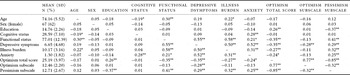
Power analyses indicated that our sample size (n = 109) was sufficient to detect an effect at 0.95 power, 0.05 level of significance, and 0.15 population effect size. Bivariate correlations were used to assess the degree of association between predictor variables; no relationship reached accepted cutoffs for multicollinearity (p > 0.70; see Table 1). We used hierarchical linear regressions to test the hypothesized associations between illness burden and symptoms of anxiety, and to assess the moderator status of optimism total score, as well as optimism and pessimism subscale scores. Covariates were age, gender, race, educational level, cognitive status, functional impairment, and depressive symptoms. Predictors and potential moderators were centered and, along with covariates, were entered on the first step of the regression. Multiplicative interaction terms were entered on the second step of the model (Baron and Kenny, Reference Baron and Kenny1986). To illustrate the interaction term, patients were categorized into high and low groups based on being ± 1 SD from the mean score.
Frequencies and bivariate correlations of study variables

*p < 0.05; **p < 0.01.
Note: Cognitive status = MMSE total score; Functional status = Karnofsky Performance Status Scale total score; Depressive symptoms = Hamilton Depression Rating Scale total score; Illness burden = Cumulative Illness Rating Scale total score; Optimism total score. Optimism subscale and Pessimism subscale = Life Orientation Test – Revised total score and subscale scores.
Results
In our sample of 109 older adult primary care patients (67 females; 62%), with a mean age of 74.16 years (SD = 5.52), our bivariate hypotheses were supported. Illness burden was associated with greater levels of anxiety symptoms (r = 0.30, p < 0.01) and less optimism (r = −0.27, p < 0.01; see Table 1). Greater total optimism was associated with lower levels of anxiety symptoms (r = −0.24, p < 0.05), as well as with lower levels of covariates, including functional impairment (r = −0.35, p < 0.01) and depressive symptoms (r = −0.35, p < 0.01). Further, higher scores on the optimism subscale were associated with fewer depressive symptoms (r = −0.28, p < 0.01), whereas greater pessimism subscale scores were associated with greater functional impairment (r = 0.41, p < 0.001), depressive symptoms (r = 0.29, p < 0.01), illness burden (r = 0.32, p < 0.01), and anxiety (r = 0.25, p < 0.01). However, the minimal association between optimism and pessimism in our sample of older adults (r = −0.32) is lower than that found in studies of young (r = −0.57, z = 3.09; Chang and Farrehi, Reference Chang and Farrehi2001) and middle-aged adults (r = −0.54, z = 3.43; Chang and Sanna, Reference Chang and Sanna2001), suggesting greater independence of these variables in older versus younger samples.
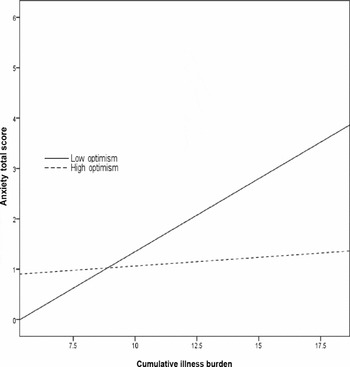
Results from hierarchical, multivariable linear regressions testing interaction effects also supported our hypotheses, indicating that illness burden was significantly positively associated with anxiety symptoms (t (df = 12.95) = 2.96, p < 0.01; Un β = 0.77, SE = 0.26) and that optimism total score was a significant moderator of the association between illness burden and anxiety symptoms (t = −2.76, p < 0.01; Un β = −0.03, SE = 0.01; Cohen's f 2 effect size = 0.76), over and above the effects of covariates. Greater illness burden was related to higher levels of anxiety; however, in individuals with greater levels of total optimism, this association was weakened (see Figure 1). Main effects also existed: education was associated with less anxiety symptoms, (t = −2.23, p < 0.05; Un β = −0.15, SE = 0.07), whereas poor cognitive status (t = 2.40, p < 0.05; Un β = 0.05, SE = 0.02) and depressive symptoms (t = 5.05, p < 0.001; Un β = 0.20, SE = 0.04) were associated with greater levels of anxiety symptoms.
Optimism total score as a moderator of the association between illness burden and anxiety symptoms.

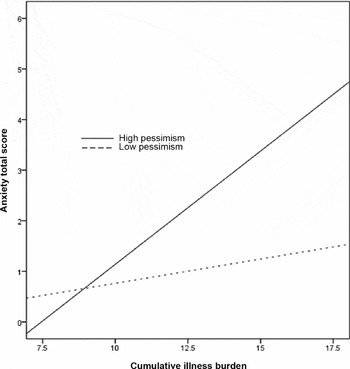
Interaction analyses using subscales in the models were also conducted and pessimism, but not optimism, was found to be a significant moderator of the relationship between illness burden and anxiety symptoms (t (df = 10.97) = −2.36, p < 0.05; Un β = −0.04, SE = 0.02; Cohen's f 2 effect size = 0.79). Older adults with greater pessimism manifested a stronger association between illness burden and anxiety (see Figure 2).
Pessimism subscale score as a moderator of the association between illness burden and anxiety symptoms.

Discussion
In our sample of older primary care patients, greater medical illness burden was associated with higher levels of anxiety, and confirming our hypothesis, overall optimism buffered this relationship. Our hypotheses were only partially supported, however, in independent subscale analyses; pessimism, but not optimism, was a significant moderator. Our results confirm the well-documented association between chronic medical problems and anxiety in older adults (Hocking and Koenig, Reference Hocking and Koenig1995) and contribute to a growing body of literature suggesting better outcomes for individuals with positive or future-oriented cognitions and emotions, and poor outcomes for those with a negative or pessimistic perspective.
Although sometimes not possible, overcoming the symptoms and challenges of a chronic medical problem involves emotional impetus, physical well-being, and assistive resources or social support (Albrecht and Devlieger, Reference Albrecht and Devlieger1999). As such, the presence of optimism, as well as the absence of pessimism, may be critical components of successful maintenance or recovery from chronic health difficulties. Our results suggest that pessimism may play a particularly significant role in the experience of illness-related anxiety for older adults, and there is some precedent for this finding. Previous research suggests that the relationship between, and the effects of, optimism and pessimism may be more disparate for older than younger adults (Chang and Sanna, Reference Chang and Sanna2001); for instance, pessimism, but not optimism, was found to be associated with depressive symptoms in older adults (Robinson-Whelen et al., Reference Robinson-Whelen, Kim, MacCallum and Kiecolt-Glaser1997). When faced with medical illness, pessimistic health expectations such as fear of relapse, symptom worsening, or death, as well as pessimistic psychological expectations including fear of role changes or loss of social interaction, may contribute more strongly to the presence of anxiety than optimism does to its absence.
Yet, during times of medical distress, optimism may act as a buffer, providing an expectancy of “better future times” and allowing a patient to envision and move toward health-related goals (de Ridder et al., Reference de Ridder, Fournier and Bensing2004), including adherence to treatment regimens, engagement in adaptive health behaviors, and a willingness to replace activities lost to an illness episode or activity restriction with substitute behaviors or goals (Duke et al., Reference Duke, Leventhal, Brownlee and Leventhal2002), which, in turn, may serve to reduce illness-related anxiety. Importantly for older adults, the natural aging process may bring with it an improved ability to regulate internal cognitive and emotional states, as well as an age-related shift toward a more positive affective and behavioral style (Carstensen et al., Reference Carstensen, Fung and Charles2003). This late-life capacity for capitalizing on positive, and eschewing negative, emotional functioning may be, in part, attributed to changing degrees of future orientation, such as optimism. Therefore, capitalizing on these cognitive and emotional changes may be an important therapeutic strategy for older adults experiencing illness burden.
Optimism and pessimism, as measured by the LOT-R, are assumed to be stable and trait-like, but may also be malleable and amenable to change via psycho-education. Preliminary findings suggest that training individuals to think optimistically can reduce depression (Hawkins and Miller, Reference Hawkins and Miller2003); perhaps similar techniques could be used to decrease health-related anxiety. For instance, health-compromised individuals might be asked to set health-related goals and identify pathways toward their attainment, or to restructure their attributions about the cause of their illness. Encouragement of meaningful, supportive interpersonal relationships that foster a positive future orientation, or lead to achievement of health goals, may also be important.
From a theoretical perspective, it is also important to examine the pattern of our results, and to assess whether or not there might be some overlap of variance between our variables of interest. Some previous research suggests that optimism and pessimism are orthogonal, yet related, constructs, and which can be further differentiated from related factors such as positive and negative affect, and anxiety. On the other hand, some research suggests that optimism and pessimism exist on a bipolar continuum, or that optimism/pessimism is inextricably intertwined with affective constructs (Marshall et al., Reference Marshall, Wortman, Kusulas, Hervig and Vickers1992). It should be noted that, as assessed by the LOT-R, optimism and pessimism are conceptualized as generalized, cognitive outcome expectancies, without affective content; yet, not surprisingly, these fundamental dimensions of cognition have been found to map onto, but remain distinct from, mood, namely positive and negative affect, or their broader parent constructs of extraversion and neuroticism, respectively. In the current study, both optimism and pessimism have only minimal to moderate correlations with symptoms of depression and anxiety, and with each other, suggesting their relative independence. Further, we do not view this as evidence of contamination between factors but, rather, support for the notion that reciprocal causal relations may exist, and which should be examined in future prospective studies. Finally, it is important to consider the conceptual framework of our moderating variables, optimism and pessimism, which are general dispositions (Scheier and Carver, Reference Scheier and Carver1985), and our dependent variable of anxiety symptoms, which is characterized as a transient state outcome and was assessed as occurring in the “past two days” at the time of interview. Thus, it seems theoretically plausible that we should discuss the effect of dispositional optimism/pessimism on transient mood, rather than the effect of mood on a trait-like characteristic.
Despite this, potential limitations must be addressed, including use of cross-sectional data, which limits causal assessment; cohort effects, recall bias, and bi-directionality are also of concern. For instance, anxiety in older adults may contribute to diminished health and functional status and increased healthcare utilization (DiMatteo et al., Reference DiMatteo, Lepper and Croghan2000), and treatment of anxiety often results in improved symptom burden and self-care (Katon et al., Reference Katon, Richardson, Lozano and McCauley2004). Individuals with higher levels of optimism may also simply experience less anxiety, whereas those with greater pessimism may experience more anxiety (Myers and Steed, Reference Myers and Steed1999). Secondary analysis of data collected for other purposes may have resulted in our inability to adequately assess or statistically control for factors potentially related to our variables of interest. As an example, our use of the Snaith Anxiety Scale – although it is derived from a gold standard measure, the Hamilton Anxiety Scale – may not be the most appropriate measure of anxiety in older adults; use of the Geriatric Anxiety Inventory (Pachana et al., Reference Pachana, Byrne, Siddle, Koloski, Harley and Arnold2007) or Geriatric Anxiety Scale (Segal et al., Reference Segal, June, Payne, Coolidge and Yochim2010), which assess age-specific anxiety symptoms, should be considered in future research. Our small sample was also largely female and predominantly White; therefore, longitudinal studies, using a larger and more diverse sample, are necessary to fully understand these relationships. Finally, although primary care sites are an important “point of capture” for older adults with mental health difficulties, generalizability to other demographic and patient subgroups is unknown. Importantly, our non-clinical, primary care sample had relatively low levels of anxiety, perhaps permitting greater influence of our moderating variables. Older adults with greater functional impairment, or who are home-bound or in long-term care facilities, may experience greater anxiety, perhaps benefiting less from optimism or being more detrimentally affected by pessimism, than members of our relatively mobile sample. Therefore, our results should be replicated in such settings and with such patients.
Our results may have implications for the development of future-oriented interventions to reduce illness-related anxiety in cognitively intact older adults. As a cognitive–emotional construct, optimism/pessimism may be amenable to change via employment of brief, cognitive–behavioral therapeutic strategies, such as reframing perceived limitations, challenging maladaptive assumptions about illness outcomes, and cognitive restructuring, which are ideally suited for utilization in primary care or other medical settings, including prior to medical procedures, and which have been shown to successfully reduce anxiety in older adults (Wetherell et al., Reference Wetherell, Sorrell, Thorp and Patterson2005). For older adults experiencing cognitive impairment, however, clinical adaptations may be necessary to bolster optimism and reduce pessimism; for instance, simplification and brevity of psychoeducational materials, increasingly structured and repetitive goal-setting strategies, social skills training, and integration of family and caregivers may increase success (Koder, Reference Koder1998; Kraus et al., Reference Kraus2008). Because of their potential beneficial contribution to both physical and mental health for older adults, an imperative exists for development, manualization, and clinical trials of optimism-enhancement and pessimism-reduction strategies as a therapeutic health intervention.
Conflict of interest
None.
Description of authors' roles
J.K. Hirsch conceptualized this secondary analysis, conducted analyses, and wrote the paper; K.L. Walker and E.C. Chang assisted with conceptualization of the study and writing the paper; and J.M. Lyness designed and carried out the study and assisted with writing the paper.
Acknowledgments
This study was funded by NIMH grants R01 MH61429 and K24 MH071509-05. We thank the patients, staff, and providers of the following primary care practices: Department of Medicine–University of Rochester Medical Center, Pulsifer Medical, East Ridge Family Medicine, Highland Family Medicine, Olsan Medical, Clinton Crossings Medical, Panorama Internal Medicine, Highland Geriatric Medicine, and Culver Medical. We thank the following for technical assistance: Karen Gibson, MSEd, Constance Bowen, MA, James Evinger, MDiv, Cameron Gardner, MD, Michael New, Andra Niculescu, MD, Jean Sauvain, BS, Jill Scheltz, BA, LMT, Judy Woodhams, MFA, and Logan Tindell, BS.