Introduction
Urinary incontinence is an uncomfortable and upsetting symptom that many women see as a natural part of the ageing process. This leads to a loss of independence and impacts on every aspect of life including personal hygiene, work environment, recreational activities and psychological well-being, with symptoms of anxiety in 57% of cases and depression in up to as many as 38%.Reference Perry, McGrother and Turner1 Taking this into account, as well as the associated loss of confidence and avoidance behaviour noted in women, it is not surprising that many women find this a difficult topic to discuss or seek help for. As a result, although incontinence is very common, it still carries a significant stigma.
The overall cost of incontinence to the National Health Service in England is difficult to calculate. The Continence Foundation calculated the figure of £354 million in 1998, but this figure did not take into account residential, nursing or long-term hospital care.Reference Wagner and Hu2 Many older people move into residential or nursing homes as a result of their incontinence; incontinence is second only to dementia as an initiating factor for admission to nursing homes. Turner et al. estimated that clinically significant storage symptoms of the bladder were costing the NHS £233 million per year for women alone.Reference Turner, Shaw, McGrother, Dallosso and Cooper3 Thus the cost associated with this care is considerable.
In this review we will summarize the initial assessment and management of urinary incontinence in women, with a particular focus on the various surgical approaches available and the recent evidence for this. The details of the search strategy and article selection can be obtained from the authors. This is a general overview and by no means a comprehensive systematic review.
Definitions
The International Continence Society has over the years published many articles updating and standardizing the terminology used by professionals when writing about incontinence.Reference Abrams, Cardozo, Fall, Griffiths, Rosier, Ulmsten, van Kerrebroeck, Victor and Wein4 Some of the current definitions are outlined below:
Urinary incontinence (UI) is the complaint of any involuntary leakage of urine.
Urgency is the complaint of a sudden compelling desire to pass urine which is difficult to defer.
Urge urinary incontinence is the complaint of involuntary leakage accompanied by or immediately preceded by urgency.
Stress urinary incontinence (SUI) is the complaint of involuntary leakage on effort or exertion, or on sneezing or coughing.
Mixed urinary incontinence (MUI) is the complaint of involuntary leakage associated with urgency and also with exertion, effort, sneezing or coughing.
Continuous urinary incontinence is the complaint of continuous leakage.
Overactive bladder (OAB) is a symptom syndrome including urgency, with or without urge incontinence, usually with frequency and nocturia.
Other types of urinary incontinence may be situational, for example the report of incontinence during sexual intercourse, or giggle incontinence. In an elderly population it is also important to remember functional incontinence – an inability to reach the toilet due to either poor mobility or cognitive impairment.
Prevalence
Urinary incontinence is an embarrassing problem to many women and thus its presence may be significantly under-reported. In a UK community study carried out in 1980, the prevalence of urinary incontinence known to the health and social service agencies was 0.2% in women aged 15–64 years and 2.5% in those aged 65 and over.Reference Thomas, Plymat, Blannin and Meade5 Following a postal survey the actual prevalence in the same area was 8.5% in women aged 15–64 years and 11.6% in those aged 65 and over. Incontinence was described as ‘moderate’ or ‘severe’ in one-fifth of those who reported it and in these cases less than one-third were receiving any care for it.
The Leicestershire MRC Incontinence Study (2000) is the largest prevalence study carried out in the United Kingdom, including 15,904 participants over the age of 40.Reference Perry, Shaw, Assassa, Dallosso, Williams, Brittain, Mensah, Smith, Clarke, Jagger, Mayne, Castleden, Jones and McGrother6 In this study, 33.6% of the population reported significant urinary symptoms, but only 6.2% found these bothersome and only 2.4% both bothersome and socially disabling. Of the population surveyed, 3.8% (one in nine of those with clinically significant symptoms) felt the need for help with their symptoms.Reference Perry, Shaw, Assassa, Dallosso, Williams, Brittain, Mensah, Smith, Clarke, Jagger, Mayne, Castleden, Jones and McGrother6 Thus only a minority perceive their urinary incontinence as a major problem. For the others, who do perceive a problem with which they would like help, there appear to be several barriers to presentation. They may be too embarrassed to seek advice, may not wish to bother their general practitioner, may believe urinary incontinence to be a normal consequence of the ageing process or may not appreciate that treatments are available.
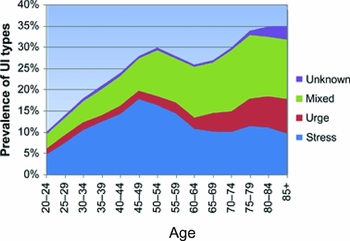
The EPINCONT survey carried out in Norway from 1995 to 1997 included 27,936 participants, looking at all women over the age of 20.Reference Hannestad, Rortveit, Sandvik and Hunskaar7 The results showed that slight to moderate urinary incontinence is more common in younger women, while moderate and severe urinary incontinence affects the elderly more often. Stress urinary incontinence appeared to be the most common type and 50% of women in the EPINCONT survey reported this as their only symptom; 11% described urge urinary incontinence only, while 36% reported mixed symptoms.
This study indicated the different trends in prevalence of various subtypes of urinary incontinence in women (see Figure 1) as they age, with a reduction in the complaints of stress incontinence in those aged 50 years and over, and an increase in urge incontinence and mixed symptoms in women aged 60 years and above. The proportion of incontinence that was regarded as severe also varied between the subtypes (17, 28 and 38% in the stress, urge and mixed categories, respectively).Reference Hannestad, Rortveit, Sandvik and Hunskaar7
Prevalence of women from the EPINCONT Study with urinary incontinence across age rangesReference Hannestad, Rortveit, Sandvik and Hunskaar7

Assessment
The most important initial step of assessment is to accurately categorize the urinary incontinence as either stress urinary incontinence, urge urinary incontinence or mixed as defined above. Clinical assessment should seek to ascertain the severity of symptoms, identify relevant predisposing and precipitating factors and other diagnoses that may require referral for additional investigation and treatment.8
Investigations recommended by NICE in this assessment include a 3-day bladder diary, assessment of pelvic floor muscle tone and pelvic organ prolapse, urine testing and residual urine volumes if voiding dysfunction is suspected.8
Conservative measures
The mainstay of any treatment for urinary incontinence is lifestyle modification which should include:
Weight loss: there is increasing evidence that a 5–10% reduction in total body weight can reduce frequency or episodes of incontinence by up to 50%.Reference Khong and Jackson9–Reference Mommsen and Foldspang13
Caffeine reduction: a trial of caffeine reduction is recommended for the treatment of women with urge urinary incontinence or OAB symptoms.Reference Arya, Myers and Jackson14–Reference Tomlinson, Dougherty, Pendergast, Boyington, Coffman and Pickens16
Fluid intake: consider advising modification of high or low fluid intake for the treatment of women with urinary incontinence or OAB.Reference Zimmern, Litman, Mueller, Norton and Goode17
Pelvic floor muscle training: must be included in first-line conservative management programmes for women with stress, urge, or mixed urinary incontinence. A recent Cochrane review looked at 14 trials involving 836 women and found that pelvic floor muscle training helps women with all types of incontinence, although women with stress incontinence who exercise for 3 months or more benefit the most.Reference Dumoulin and Hay-Smith18
Bladder training: for a minimum of 6 weeks, should be offered as first-line treatment to women with urge or mixed urinary incontinence. There is poor evidence behind this in isolation as many studies look at a combination of behavioural techniques, including fluid management, bladder retraining and pelvic floor exercises, with or without anti-cholinergic medication. Cure rate seems to be in the region of 45–75%, with overall improvement in symptoms in up to 90% of patients.Reference Halaska, Voigt, Sindlár, Koleska, Martan, Stulc and Kunath19
Drug therapies
Pharmacotherapy is still useful in the management of urge urinary incontinence, overactive bladder or the urge component of mixed urinary incontinence. The medications used are primarily anti-muscarinics. NICE currently recommends immediate-release non-proprietary oxybutynin as first-line drug treatment if bladder training has been ineffective.8 If immediate-release oxybutynin is not well tolerated, darifenacin, solifenacin, tolterodine, trospium or an extended-release or transdermal formulation of oxybutynin are suggested as alternatives. Women should be counselled about the adverse effects of anti-muscarinic drugs – most commonly dry eyes, dry mouth, and constipation.8 There is a recent move away from using oxybutynin as first-line treatment in certain situations, e.g. the elderly, or those with cognitive impairment, or history of delirium.
Surgical interventions
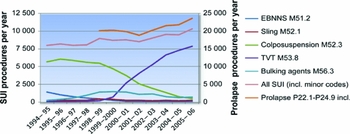
There has been a dramatic change in the trends in the type of surgical procedures undertaken in recent years; between 1997–98 and 2005–6 (see Figure 2), the annual number of operations undertaken for stress urinary incontinence increased by 28%, despite over 90% reduction in the number of colposuspensions and needle suspension procedures and 50% reduction in bladder neck buttress, sling and urethral bulking procedures. This increase was entirely due to the rapid introduction of the tension-free vaginal tape in 1998 followed by minimally invasive synthetic mid-urethral sling procedures.Reference Hilton20
Trends in surgical incontinence procedures from 1994 to 2006Reference Hilton20

Any woman wishing to consider surgical treatment for urinary incontinence should be informed about the benefits and risks of surgical and non-surgical options; counselling should include consideration of the woman's childbearing wishes. These procedures outlined below should only be offered following failure of conservative measures.
Surgical interventions for detrusor overactivity
Botulinum toxin. Bladder wall injection with botulinum toxin A should be used in the treatment of idiopathic detrusor overactivity only in women who have not responded to conservative treatments and who are willing and able to self-catheterize.8 The published Cochrane review looked at eight studies of botulinum toxin A injections into the bladder and found an improvement in a number of parameters including number of incontinence episodes, bladder capacity, maximum detrusor pressure, and quality of life.Reference Duthiel, Herbison, Wilson and Wilson21 These effects appear to last for between 6 and 9 months. Low doses of botulinum toxin (100–150 U) appeared to have beneficial effects, but higher doses (300 U) may have been more effective.Reference Duthiel, Herbison, Wilson and Wilson21, Reference Sahai, Dowson, Khan and Dasgupta22 The use of botulinum toxin A for this indication is outside the UK marketing authorization for the product. Informed consent to treatment should be obtained and documented, and NICE recommends special ongoing arrangements for research.8 Only three small randomized studies have been published so far,Reference Sahai, Khan and Dasgupta23–Reference Brubaker, Richter, Visco, Mahajan, Nygaard, Braun, Barber, Menefee, Schaffer, Weber and Wei25 and the RELAX study is due to report in early 2011 (ISRCTN 26091555).
Botulinum toxin has become an increasingly popular treatment option for intractable cases of detrusor overactivity mainly because of its ease of administration, usually via a flexible cystoscope and the short-term efficacy data. As a result it has gained popularity over other surgical options.
Sacral nerve stimulation. Sacral nerve stimulation (SNS) involves the stimulation of the sacral nerves to modulate the neural reflexes that influence the bladder, sphincter and pelvic floor.Reference Juenemann, Lue, Schmidt and Tanagho26 SNS is recommended for the treatment of urinary incontinence due to detrusor overactivity in women who have not responded to conservative treatments, as well as for the treatment of urinary frequency and urinary retention.
Women should be offered sacral nerve stimulation on the basis of their response to preliminary percutaneous nerve evaluation carried out over 3–5 days.8 If an improvement in symptoms is noted then a permanent device can be inserted. The quantity of evidence is limited in this area, but a systematic review did show that 50–80% of women achieve continence and greater than 50% will have an improvement in their main incontinence symptoms after treatment.Reference Brazzelli, Murray and Fraser27, Reference Siegel, Catanzaro, Dijkema, Elhilali, Fowler, Gajewski, Hassouna, Janknegt, Jonas, van Kerrebroeck, Lycklama, Nijeholt, Oleson and Schmidt28 There still remains a large re-operation rate, with up to a third of patients undergoing a repeat procedure. Minor adjustments are frequently required for relocation of the generator. Common complications include pain at the implant or lead site, lead-related problems such as lead migration, wound problems, adverse effects on bowel function, infection and generator problems. Life-long follow-up is recommended.
Procedures for stress urinary incontinence
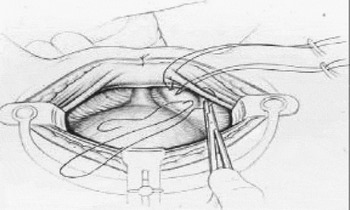
Colposuspension. This technique was first developed by John Christopher Burch in 1961Reference Burch30 (see Figure 3). Published studies for Burch colposuspensions have reported follow-up to 20 years, subjective and objective cure rates ranging from 80 to 94% after 1 year with effect diminishing over time. Cure rates seem to plateau after 10–12 years and 69% of women can still expect to be continent after this.Reference Alcalay, Monga and Stanton31 A 2003 Cochrane review of 46 trials involving a total of 4738 women reported 1-year continence rates of 85–90% and cure rates after 5 years of 70%.Reference Lapitan, Cody and Grant32
Open colposuspension illustrating sutures elevating para-urethral fascia towards Cooper's ligamentReference Smith, Dmochowski, Hilton, Abrams, Cardozo, Khoury and Wein29

A similar review of 22 trials looked at laparoscopic colposuspension.Reference Dean, Ellis, Wilson and Herbison33 Ten trials involved the comparison of laparoscopic with open colposuspension. The subjective impression of cure up to 2 years seemed similar for both procedures; however, there was a significantly higher objective rate of cure as assessed by urodynamics with open colposuspension. Trends were shown towards fewer peri-operative complications, less post-operative pain and shorter hospital stay for laparoscopic compared with open colposuspension, at a significantly higher cost (mean cost: £1805 vs. £1433, respectively).Reference Dean, Ellis, Wilson and Herbison33 Currently, laparoscopic colposuspension is not recommended as a routine procedure for the treatment of stress urinary incontinence in women. In addition, if the procedure is being carried out it should be performed only by an experienced laparoscopic surgeon working in a multidisciplinary team with expertise in the assessment and treatment of urinary incontinence.8
Tension-free vaginal tape (TVT). Since its introduction in 1996 by Ulmsten, TVT has revolutionized the management of female urinary stress incontinence.Reference Ulmsten, Henriksson, Johnson and Varhos34 It has almost entirely replaced the previous standard operation for stress incontinence (the Burch colposuspension), and some authors believe it should now be considered the gold standard.
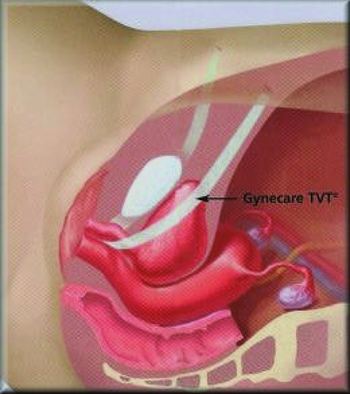
TVT insertion involves placement of a retropubic mid-urethral tape using a ‘bottom-up’ approach, a polypropylene mesh being inserted vaginally from the bottom using trocars passing retropubically upwards. This is recommended as a treatment option for stress urinary incontinence only after conservative management has failed (see Figure 4). Initial studies carried out by Ulmsten et al. in 1996/1998 found that this resulted in cure rates between 80 and 90% in primary cases of stress incontinence.Reference Ulmsten, Henriksson, Johnson and Varhos34, Reference Ulmsten, Falconer, Johnson, Jomaa, Lannér, Nilsson and Olsson35 When this was compared with other incontinence procedures, there was no difference in objective and subjective cure rates. There was, however, a significant reduction in operation time, hospital stay and time for resuming normal activity in patients undergoing TVT insertion.Reference Ward and Hilton36–Reference Ward and Hilton38 The retropubic placement of the mid-urethra tapes has been associated with the risk of bladder injury, the rates varying between 0.8 and 21%. Significantly more patients experience delayed voiding following colposuspension needing intermittent self-catheterization than those following TVT. We now have good long-term data that the effect of TVT is sustained up to 11 years, with 90% objectively cured on negative cough and pad testing.Reference Nilsson, Palva, Rezapour and Falconer39
Transvaginal tape placement (courtesy of Ethicon, a Johnson & Johnson Company)

Other urethral tape procedures. Following the success of the TVT many modifications to this mid-urethral support with a synthetic mesh have been developed. Synthetic slings using a ‘retropubic approach’ (inserting the mesh suprapubically and exiting vaginally) have similar cure rates, but a high rate of bladder perforation (11%). Delorme introduced a modified tape procedure in which the tape was brought to support the mid-urethra from inside the thighs through the obturator foramina on both sides, the so called ‘outside-in’ transobturator tape procedure (TOT).Reference Delorme, Droupy, de Tayrac and Delmas40 De Leval further modified the procedure to be an ‘inside-out’ procedure called the tension-free vaginal tape-obturator (TVT-O).Reference De Leval41 Studies comparing both transobturator tapes to the retropubic approach have found that they confer no benefit, with similar cure rates up to 24 months.Reference Latthe, Foon and Toozs-Hobson42 There is conflicting evidence with regard to complications, but no good evidence to suggest any significant differences. Transobturator foramen approach is recommended in NICE guidance as an alternative treatment option for stress urinary incontinence if conservative management has failed, but women should be made aware of the lack of long-term outcome data.8
Peri-urethral bulking agents. The practice of injection of intramural bulking agents has been long-standing with popularity growing in the early 1970s.Reference Berg43 NICE currently recommend that intramural bulking agents (glutaraldehyde cross-linked collagen, silicone, carbon-coated zirconium beads or hyaluronic acid/dextran copolymer) should be considered for the management of stress urinary incontinence, if conservative management has failed.8 Women should be made aware that repeat injections may be required to achieve efficacy, efficacy diminishes with time and that efficacy is inferior to that of retropubic colposuspension or mid-urethral tape procedures. Autologous fat and polytetrafluoroethylene used as intramural bulking agents are not recommended due to safety concerns.8
A Cochrane review article updated in 2007 identified 12 trials including 1318 women.Reference Keegan, Atiemo, Cody, McClinton and Pickard44 The data were limited and not suitable for meta-analysis. Injection of autologous fat was compared with placebo in a study of 68 women which was terminated early because of safety concerns, with no differences in subjective or objective outcome between the two groups. No studies were found comparing injection therapy with conservative treatment. Two studies that compared injection with surgical management found significantly better objective outcome in the surgical group. Eight studies compared different agents including silicone particles, calcium hydroxylapatite, ethylene vinyl alcohol and carbon spheres and reported improvements equivalent to collagen. Porcine dermal implant gave improvements comparable to silicone at 6 months. A comparison of peri-urethral and transurethral methods of delivery of the bulking agent found a similar outcome, but a higher rate of early complications in the peri-urethral group.Reference Keegan, Atiemo, Cody, McClinton and Pickard44
Other urological procedures
Augmentation cystoplasty. Augmentation cystoplasty for the management of idiopathic detrusor overactivity can be carried out using any detubularized portion of the gastrointestinal tract, most commonly the ileum. The segment of bowel is sutured into an incision over the dome of the bladder in order to prevent increases in bladder pressure when the detrusor contracts. Cystoplasty is an operation done less and less often, and is now restricted to women with the most severe refractory symptoms who are willing to perform self-catheterization indefinitely. The improvement in symptoms and continence rates is high (85–95%),Reference Ivil and Suresh45, Reference Venn and Mundy46 but the risks of surgery are considerable and include bowel disturbance, metabolic acidosis, mucus retention in the bladder, urinary tract infection, and a small risk of malignancy occurring in the ileal segment.Reference Barrington, Fulford, Griffiths and Stephenson47–Reference Golomb, Klutke and Raz49 Thus lifelong annual cystoscopy is recommended, although the evidence of cancer within the first 15 years is lacking.Reference Hamid, Greenwell, Nethercliffe, Freeman, Venn and Woodhouse50
Urinary diversion. Urinary diversion should be considered for a woman with OAB only when conservative treatments have failed, and if sacral nerve stimulation and augmentation cystoplasty are not appropriate or are unacceptable to her. An ileal conduit urinary diversion (the Bricker ileal conduitReference Bricker51) was developed during the 1940s and is still one of the most used techniques. The ureters are surgically resected from the bladder and an uretero-enteric anastamosis is made to drain the urine into a detached section of ileum. The end of the ileum is then brought out through a stoma in the abdominal wall. Life-long follow-up is recommended to monitor for complications related to stoma (stomal necrosis, stomal retraction, stomal obstruction, parastomal hernias, stomal stenosis, and stomal prolapse); bowel (prolonged ileus, bowel obstruction, enteric fistula or anastomotic leak); conduit or reservoir (necrosis, stricture, elongation and retraction, urolithiasis); and ureterointestinal anastomosis (leakage or stricture).Reference Farnham and Cookson52
Artifical urinary sphincter. The artificial urinary sphincter is a device consisting of an inflatable cuff placed around the urethra, which occludes the urethra. Pressure is maintained by means of an inflated pressure-regulating balloon. Whenever the patient wishes to pass urine a small pump located in the labium is manually operated to deflate the cuff and allow the bladder to empty; the balloon will automatically re-inflate restoring continence.
This is a complex surgical procedure and in view of the associated morbidity, the use of an artificial urinary sphincter should be considered for the management of stress urinary incontinence in women only if previous surgery has failed. Overall success rates range between 76 and 89%, with lower success rates and higher revision rates being noted in those patients with neurogenic voiding dysfunction as the primary indication for placement.Reference Shaikh, Ong, Glavind, Cook and N'Dow53 The most extensive evaluation involved 207 patients with a mean follow-up of 4 years.Reference Costa, Mottet, Rabut, Thuret, Ben and Wagner54 An overall success rate of 89% was reported in the non-neurogenic population with vaginal extrusion rate of 6%. Life-long follow-up is recommended.
Conclusion
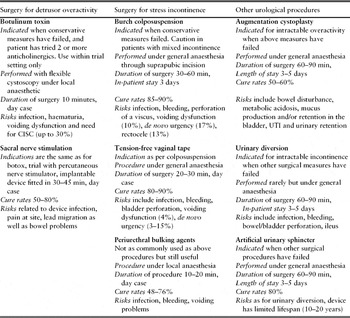
Table 1 is a summary of the surgical interventions. All cases must be reviewed on an individual basis and indications are merely a guide.
Summary of surgical procedures

Most women with urinary incontinence will be improved following simple conservative treatments, but there will always be a small number who will require help from a specialist and this will sometimes mean surgery. There are many different options at the disposal of a specialist, which may cure urinary incontinence completely or improve the quality of life of women living with these symptoms.
Stress incontinence remains the area where surgery has been most successful, TVT having changed our management of this condition dramatically. Urge incontinence remains a problem that has been less amenable to surgical interventions, but with promising initial results with botulinum toxin, perhaps future reviews may challenge this. Augmentation cystoplasty, urinary diversion and artificial urinary sphincters are uncommonly used procedures for female urinary incontinence and remain options when all else has failed.
It is important for all healthcare professionals to be sensitive to the presence and impact of incontinence and to feel confident to raise the issue whenever women present. Possessing knowledge of available treatment options allows professionals to have an open and real discussion about the management of urinary incontinence.
Conflicts of interest
The authors have no conflicts of interest to declare.