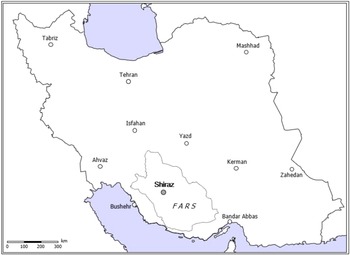
The Shirazi dialect belongs to the Western Iranian branch of the Iranian languages, which form part of the Indo-Iranian branch of the Indo-European languages. It is spoken in Shiraz in Fars province and is closely related to New Persian. This article deals with Old Shirazi written manuscripts from the eighth/fourteenth to the ninth/fifteenth centuries, which are the only attested data sources for earlier stages of Shirazi, as well as with Modern Shirazi currently spoken in Shiraz. The approximate location of this dialect is indicated in Figure 1.
The location of the Shirazi dialect. Source: The author is grateful to Christian Rammer, Frankfurt, for providing the map.

The suffix -ō /-ū/o (k) is attested in the Shirazi dialect, and mostly occurs with nouns. The original function of this suffix is yet to be discovered, though it is generally considered to be associated with some form of ‘diminutive’ and is presumably cognate with several formatives containing a velar plosive [k], or a reflex thereof, in other Iranian languages, for example, Balochi -ok or Persian -ak/e.
Although the term ‘diminutive’ is widely used in the literature, the present study emphasises that what are traditionally referred to as diminutives often express a much broader range of notions than merely ‘less than expected size’. These functions generally include an evaluative component, expressing the speaker's empathy, familiarity, and endearment in relation to the diminutive-marked noun. Cross-linguistically, such evaluative connotations are widely attested.Footnote 1
This study focuses on what I refer to as the definitising function of -ū/-o in Modern Shirazi. It can be shown that the K-suffix -ō in the Old Shirazi dialect has evaluative and diminutive semantics, while in Modern Shirazi the K-suffix -ū is systematically associated with definiteness in a manner approximately comparable to the better-researched definite articles of European languages, for example, English and Swedish.
Previous studies on the history of definiteness marking assume that it originates from a demonstrative with deictic meaning (see section 1 below). The Shirazi definiteness marker has considerable implications for our understanding of definiteness systems and their emergence. Even though the precise function of the ancestor of Shirazi –ō/ū/ remains obscure, it can be stated with some certainty that it is not related to a demonstrative element.
While definiteness, referentiality, and related notions have been discussed at length for Germanic, Slavic and Semitic languages,Footnote 2 the study of definiteness markers in Iranian languages is rather new. There is little research on indefiniteness in Iranian languages.Footnote 3 The most recent studies on definiteness by Nourzaei show that definiteness markers in Koroshi Balochi and Colloquial Tehrani Persian originated diachronically from the evaluative (diminutive) suffix.Footnote 4
The data for this article are extracted from various sources. The material for the old stage is taken from two manuscripts of poetry. The corpus contains a total of 14,945 words. The language of these two manuscripts is not comprehensible by Modern Shirazi speakers. In addition, I investigate Shirazi data from the twentieth century, comprising a total of 3,658 words in the poetry genre.
The data for Modern Shirazi stem from a corpus of spoken Shirazi narratives consisting of 14 short and long narrative texts (for example, free speech, tales, and life stories) recorded from Shirazi male and female speakers of different ages and social backgrounds between 2018 and 2020. All the speakers live in Shiraz city. The corpus contains a total of 7,737 words (see Table 2 for an overview of the corpus data).
I combine the quantitative data with a strong qualitative approach, illustrating the various functions with authentic examples and appropriate references to context. I also refer to the results of a questionnaire-based survey with ten Shirazi speakers, based on the questionnaire used for Kurdish by Haig,Footnote 5 with some modifications, for instance, reducing the number of plural noun phrases (NPs) due to inhibited use of this suffix with plural nouns (see section 4.2).
One of the most interesting aspects of the corpus data is the use of the K-suffix as a clear definiteness marker by all the speakers, regardless of gender. The definiteness function of the K-suffix is systematically documented for all the speakers, and the results from the questionnaires confirm this.
One of the most important aspects of the narrative data is the absence of the K-suffix with demonstratives except in deictic and recognitional contexts, which the questionnaire data confirm. The findings of the questionnaires and corpus data show a systematic trend of definiteness usage throughout the group of Shirazi speakers.
In contrast to other Iranian languages, for instance Balochi and Persian,Footnote 6 the Shirazi data lend themselves to interpretation in terms of a gradual continuum of grammaticalisation of the kind commonly predicted for the emergence of definiteness markers.Footnote 7 The development appears to be systematic across linguistic contexts, rather than being sensitive to speech context (genre and speaker gender). I will also study the possible role of language contact in developing the K-suffix in Shirazi.
I aim to demonstrate the systematicity of definiteness marking in Shirazi, noting its functional profile and a range of structural and functional constraints that it shares with definiteness markers in other languages.Footnote 8 It can be shown that, in contrast to Koroshi Balochi spoken in Shiraz and other regions in this province, the definiteness function of the K-suffix is systematically reflected in all the recorded narratives, with all the speakers and in all genres.
This article is organised as follows: section 1 deals with definiteness and types of definiteness in context; section 2 gives an overview of the Shirazi dialect; section 3 presents the use of the K-suffix as an evaluative marker in Old Shirazi; section 4 illustrates K-suffixes as definiteness markers in Shirazi; section 5 presents data from a text corpus and from questionnaire data; section 6 deals with historical sources of the K-suffix; and section 7 discusses the grammaticalisation pathway.
1. Definiteness
Definiteness is defined as a property of noun phrases that is derived from their information status in a specific linguistic context. It is thus a contextual property of referring expressions rather than an inherent property of nouns. Languages differ in the extent to which they indicate definiteness systematically in morphosyntax and the means by which they do so. For instance, in English, French, and Arabic, definiteness is marked fairly consistently by items generally referred to as articles. Elsewhere, definiteness may be indicated by affixes (for example, Icelandic), clitics (for example, Kwakw'ala), word-order properties (for example, Chinese), or various combinations of these strategies, or there may be no regular means for indicating definiteness.Footnote 9 In the interests of brevity, I will consider the following types of definiteness, which are relevant to the information structure status of noun phrases in this study:Footnote 10
• Anaphoric definiteness concerns referents that have an antecedent in the preceding textual context: A boy and a girl entered the classroom. The girl sat down.
• Bridging/associative definiteness occurs when the referent has not previously been mentioned in the discourse context, but its existence can be inferred from associated expressions:Footnote 11 They entered a dark room and could not find the light switch.
• Proper nouns are directly associated with an entity and are primarily used to refer to that entity, such as ‘German’ or ‘John’.
• Possessed nouns occur when the noun is accompanied by a grammatical possessor, often syntactically fulfilling the determiner function, such as my house, their son, Mary's birthday.
• Deictically modified nouns refer to nouns accompanied by demonstrative elements: this article, that house.
• Unique referents are entities that are assumed to be uniquely identifiable by all members of a given speech community, hence requiring no preceding or inferable mention (the sun, the river (in a given community), the president, etc.)
• Situational/deictic definiteness occurs when identifiability is achieved through the immediate speech context, possibly aided by additional gestures and adverbial expressions: the man over there (pointing).
2. The Shirazi dialect
The Shirazi dialect belongs to the Western Iranian branch of the Iranian languages, which are part of the Indo-Iranian branch of Indo-European languages. It has been attested two stages: Old Shirazi and Modern Shirazi. It appears that the Old Shirazi variety differs to a great extent from Modern Shirazi. Describing the differences between the old and modern stages is outside the scope of the present study; for details, see the footnote.Footnote 12
Similar to New Persian (NP), Modern Shirazi is verb-final and has an accusative alignment system and no morphological case system. However, there is a marker-ro/re similar to NP -rā in example 1.Footnote 13
Example 1)


The status of Shirazi as a dialect of New Persian is controversial among Iranian scholars—however, this issue is outside the scope of this article. The Shirazi dialect is mainly spoken in Shiraz, which is located in Fars province in southwestern Iran. Shirazi speakers are monolingual, although some of them prefer to speak standard Persian with their children. The main area and the surrounding region where Shirazi is spoken are very linguistically diverse and multilingual. Contact languages include three different language families: Indo-European (Iranian), Turkic, and Semitic. The total number of Shirazi speakers is uncertain. However, the number of speakers in Shiraz is around 2.5 million.Footnote 15 This number covers all Shiraz populations from different ethnic groups such as Turks, Arabs and Lors, and immigrants from various cities in Fars province and beyond. Like other Iranian languages spoken in Iran, for example, Lori and Balochi, the Shirazi dialect is highly influenced by Standard Persian. Parents in Shiraz prefer to speak Standard Persian with their children to prepare them for school. In the following sub-sections, I will present a survey of previous studies on the K-suffix.
2.1. Overview and previous research on the K-suffix in the Shirazi dialect
In Shirazi, a nominal suffix exists in the form of the suffix -ō/ -ū/ -o. In the manuscripts of Old Shirazi (eighth/fourteenth and ninth/fifteenth centuries), the K-suffix is realised as ضمه (و) on the character ‘ه’, for example, ای بیتُه ‘this verse’ آن حالُه ‘that mood’. It is transcribed as -ō by Iranian scholarsFootnote 16 and Mahmoodi.Footnote 17 Firoozanbakhsh transcribes it as -o in his doctoral dissertation.Footnote 18
In Modern Shirazi, the variation of this suffix (ū and o) depends on the phonological environment. If a noun ends with -eh, for example, xūneh ‘home’, baččeh ‘child’, šūneh ‘comb’, the K- suffix-ū is pronounced -o, as in xūno, baččo, šūno (see example 25).
I assume that the K-suffix is a reflex of a common proto-Shirazi suffix of the approximate form *k. Footnote 19 However, this assumption remains hypothetical. This suffix is presumably cognate with several formatives containing a velar plosive [k] or a reflex thereof in other Iranian languages, for example, Balochi ok, Kurdish -eke/aka, and Persian -ak/e. For the time being I will follow Haig and refer to it as the K-suffix.Footnote 20
The existence of the K-suffix -ō in Old Shirazi, in a manuscript titled Divan-e Shams, the son of Nāser’ (ŠN), was recognised by the Iranian scholar Navvabi, though he did not provide a detailed discussion of its nature. He glossed this suffix as ‘harf-e taꜤrīf’.Footnote 21 Based on the same Divan, Firoozanbakhsh reports that this suffix functions as marking ‘definiteness only with the singular nouns and always appears with demonstratives pronouns’.Footnote 22
To my best of my knowledge, no extensive study has focused on the K-suffix in Modern Shirazi either. However, its existence is mentioned by some scholars, for instance WindfuhrFootnote 23 and Kalbasi.Footnote 24
In Shirazi, K-suffixes occur on nouns, for example, māšīn-ū ‘the car’, doxtar-ū ‘the girl’. The position of the K-suffix is always on the second constituent of a compound noun phrase, for example, zan=o šohar-ū ‘the woman and husband’ and an attributive combination, for example, qalb=e doxtar-ū ‘the girl's heart’ and tūp=e koček-ū ‘the small ball’. Similar observations have been attested in Old Shirazi; see section 3 and Colloquial Tehrani Persian.Footnote 25
To summarise, like other Iranian languages such as Balochi (Koroshi),Footnote 26 Modern Shirazi's K-suffixes are not attested with any kind of evaluative meanings. However, Old Shirazi's K-suffixes still demonstrate earlier evaluative semantics such as endearment, proximity, and mutuality (see section 3.1).
If we assume that the Shirazi K-suffix has originated from an evaluative suffix, then we could say that the earlier stages of multi-functionality of the K-suffix, which are reasonably representative of earlier stages of the New Western Iranian K-suffix, have been lost in Shirazi.Footnote 27 This is not surprising because we could expect a narrowing of this suffix's semantic domain as it grammaticalises toward serving as a definiteness marker. The Modern Shirazi dialect now exhibits quite regular marking of definiteness only with singular nouns and regardless of inter-speaker and inter-genre issues, which contrasts with the findings for the K-suffix in Koroshi spoken in the same regionFootnote 28 as well as Colloquial Tehrani Persian.Footnote 29 In the following sections, I first study the K-suffix's uses in Old Shirazi (section 3) and then focus on its definiteness marking usage in Modern Shirazi (section 4).
3. The K-suffix in Old ShiraziFootnote 30
This section provides some background on the nature of the K-suffix in Old Shirazi before turning to a detailed account of the suffix in Modern Shirazi, which has developed a systematic association with definiteness.
In contrast to New Persian, we do not have a large amount of material from the earlier stages of Shirazi. The only attested texts of Old Shirazi exist mainly in the poetry (poems) genre. They can be found in the Divan of Shams, the son of Nāser (eighth/fourteenth century), the poem Kān-e Malāhat by Shah daꜤi Allah-e Shirazi (ninth/fifteenth century), and in verses from the Divan of Abu Ishaq Hallaj Shirazi, the Divan of SaꜤdi and the Divan of Hafez. In addition, Majma'al-Fars Sarwarī, Ferdaws- ol-Murshidiyyah, and Farhang-e soruri, have included some verses and sentences in Old Shirazi.Footnote 31 Furthermore, there are two collections of poetry written by Samandar, a contemporary poet (twentieth century).
For the present study, I have taken a close look at the use and frequency of the K-suffix in the following poems and verses:
a) Divan of Shams, the son of Nāser (ŠN)
b) Divan of Kān-e Melāhat (KM)
c) Mosalasāt in Divan-e SaꜤdī
d) Shirazi verses in Divan-e Hafez
e) Samandar's poems (twentieth century)
In the following sub-sections I will discuss in detail the use of the K-suffix in the abovementioned works in turn.
3.1. The K-suffix in ŠNFootnote 32
The data for this section are taken from an appendix of ŠN's verses by Firoozanbakhsh and from Navvabi's different articles.Footnote 33 The K-suffix in ŠN has not been found in any indefinite contexts and is attested only with singular nouns. The K-suffix always comes with a demonstrative pronoun. The frequency of the proximal pronoun is higher than that of the distal pronoun, as in examples 2 and 3. Following Nourzaei, I gloss the K-suffix as EV (Evaluative) here.Footnote 34
Example 2)
Example 3)


Examples 4 and 5 show that the K-suffix is compatible with proper nouns. The K-suffix in these passages is a sign of endearment and affection on the part of the poet towards himself and his lover. Finding this type of NP marked with the K-suffix is difficult in the published transcriptions because of the editors’ different readings. On two pages of the original manuscript published by NavvabiFootnote 37 the K-suffix appears as the diacritic dhamma ضمه (و), which indicates a short labial vowel. It is found together with proper nouns, for example, the person's name ‘Nāser’, which can be observed in vocative contexts. However, Navvabi transcribes it without dhamma, and he treats such cases as vocative markers. Firoozanbakhsh transcribes it but does not comment on this.Footnote 38
Example 4) The K-suffix with a proper noun
Example 5) The K-suffix with a common noun


In ŠN, the K-suffix occurs in what I refer to as contexts of proximity and mutual knowledge. The same observation can be made for the K-suffix in Sistani Balochi and New Persian.Footnote 41 By ‘proximity’, I refer to contexts in which the referent is an item in the speaker's immediate perceptual range. In the following examples, the NPs’ šeꜤr ‘poem’ and bayt ‘verse’ are accompanied by a proximate demonstrative and are marked with the K-suffix. The items marked with the K-suffix do not have a referent in the previous clauses. Instead, they are items in the immediate perceptual range of the speaker. They seem to be dependent on a deictic concept of proximity.
Example 6)
Example 7)


In the following example, šahr ‘city’ is marked with the K-suffix. The city does not have a referent in the previous clauses. Instead, it is an item in the immediate perceptual range of the speaker. It seems to be dependent on a deictic concept of proximity. The poet marked it with the K-suffix because it is an item familiar to both the poet and the addressee.
Example 8)

Mutual knowledge, on the other hand, involves contexts where the identity of the referent is known by both speakers through their shared world knowledge even though the referent has not previously been introduced in the linguistic context.
In the following example, xāl ‘mark’ is marked with the K-suffix. It does not have a referent in the previous clauses, but the poet marks it with the K-suffix because it is familiar to both the poet and the reader.Footnote 45
Example 9)

In the following example, pos ‘son’ is marked with the K-suffix. The son does not have a referent in the previous clauses, but the poet marks it with the K-suffix because it is familiar to both the poet and the reader.
Example 10)

In the data, one instance is attested of a word marked with the K-suffix that has a referent in the previous clause. In the following passage, hāl-ō ‘the mood’ marked with the K-suffix has a referent hāl in the last clause. Note that the K-suffix comes with a person-marking clitic =vam. A combination of a K-suffix with a person-marking clitic is ungrammatical in Modern Shirazi (see section 4.2). Note the same observation has been made for Colloquial Tehrani Persian and Koroshi.Footnote 48
Example 11)


There are some words, mainly adverbs, for which the K-suffix forms part of the stem, as in the following example.
Example 12)

Summary
In the ŠN corpus, the K-suffix is not attested in indefinite contexts. It is only attested with the singular nouns, which always come with demonstratives. The primary function of the K-suffix with these nouns is to convey notions of proximity and mutuality. I found a few nouns using the K-suffix in vocative contexts to denote endearment. These examples can indicate earlier stages of the evaluative suffix in Shirazi and show how evaluative markers might evolve towards definiteness markers. The K-suffix with the proper nouns can still be found in Modern Shirazi (see section 4.2). One case is attested where the item marked with the K-suffix has a referent in the previous clause (see example 11). Due to the small number of such cases, we cannot say much about the reason behind them. However, they may be extending the use of the K-suffix to anaphoric definiteness, which is found in KM in some more cases below and is a typical pattern in Modern Shirazi (see section 4.2).
3.2. The K-suffix in KM
KM dates back to roughly a century after ŠN (eighth/fourteenth century). As in ŠN, the K-suffix in KM has not been found in indefinite contexts. Similar to ŠN, it is only attested with singular nouns. However, the K-suffix appears with collective nouns such as mardom, that is, mardom-ō ‘people’ and xalġ, xalġ-ō ‘folk’. It may be the case that such nouns are treated as singular nouns. There is a type of context, however, that distinguishes KM from ŠN, namely the emerging use of the K-suffix with nouns without accompanying demonstratives. Examples for this section are extracted from manuscript KM (2518 at Tehran University Library).Footnote 51
Examples 13 and 14 demonstrate the K-suffix with distal and proximal demonstratives.
Example 13) The K-suffix with distal demonstrative
Example 14) The K-suffix with proximal demonstrative


In the following passages, the NP šayx ‘the shaykh’ is marked with the K-suffix without carrying demonstratives.
Example 15) The K-suffix without a demonstrative pronoun

As in ŠN, in the combination of a noun and an adjective, the K-suffix is attached to the second constituent, for example, azī heǰr-e tahl-ō ‘from this bitterness of separation’.Footnote 55
The K-suffix has been attested with the stem of the word, and the most attested cases are adverbs, onkonō ‘there’Footnote 56, endonō ‘like this’.Footnote 57 The following example shows enkonō, ‘here’.
Example 16) The K-suffix as part of the stem

The use of the K-suffix in KM is similar to that in ŠN, namely to signal proximity and mutuality. However, there are contexts in which the nouns marked with the K-suffix have a referent in the previous clauses, but the number of these cases is minimal.
In the following passages, NP xalġ-ō ‘this people’ and rāh-ō ‘this path’ are accompanied by demonstratives and marked with the K-suffix. These items do not have a referent in the previous clauses. Instead, they are items in the immediate perceptual range of the speaker. They seem to be dependent on a deictic concept of proximity.
Example 17)
Example 18)


In the following passage, NP, hamān ǰannat-ō ‘that paradise’ is marked with the K-suffix. The marked noun does not have a referent in the previous clauses. Still, the poet marks it with the K-suffix because it is an item familiar to both the poet and the reader. Culturally this means that if someone has committed an evil deed and later regrets it and repents, then their destination is paradise.
Example 19) the K-suffix with PROX

One of the crucial distinguishing features of the K-suffix in KM is that a small number of the NPs marked with the K-suffix refer to items that already exist in the linguistic context.
In the following passage, ī qessay-ō marked with the K-suffix refers back to qessay= ġorb=e xo in the first line.
Example 20)


Similarly, the NP bahr-ō ‘sea’ accompanied by a proximate demonstrative and marked with the K-suffix ī bahr-ō refers to the NP bahr ‘sea’ in the first line, as in the following example.
Example 21)

Like example 21, in example 22 NP ī sayl-ū ‘this flood’ refers to ‘sayl’ in lines 9–10 in the qaṣide.
Example 22)

Summary
The corpus data of KM are, overall, quite similar to that of ŠN, with proximity and mutuality accounting for most uses of the K-suffix. In contrast to ŠN, nouns are found that are marked with the K-suffix without accompanying demonstratives. I have found some examples marked with the K-suffix that lack any obvious connotation of mutuality and proximity. Instead, these items have referents in the previous clauses. These examples indicate how evaluative notions, for example, proximity and mutuality, might evolve toward definiteness in anaphoric contexts. In her recent linguistic investigation of diminutive semantics, Ponsonnat states that evaluative semantics are connected to notions of familiarity and proximity.Footnote 65 In the case of the proximity and mutual knowledge contexts demonstrated in Old Shirazi, the concepts of proximity and mutuality (shared common knowledge) paved the way for anaphoric definite contexts. The same observation has been made in BalochiFootnote 66 and New Persian.Footnote 67 It is thus not unreasonable to conclude that an erstwhile evaluative marker that came to be associated with notions of proximity and mutuality would lead to an anaphoric definiteness marker, which is a common strategy for nouns in Modern Shirazi (see section 4.1).
3.3. The K-suffix in Mosalasāt and Divane Hafez ShirazFootnote 68
The data for this section come from 15 verses of Mosalasāt in Koliyāt-e Saʾdi, written in Old Shirazi and transcribed and translated into Persian by Sadeghi,Footnote 69 and a few verses in Divan-e Hafez in Old Shirazi, transcribed and translated into Persian by Navvabi.Footnote 70 Note that the Shirazi verses in Mosalasāt date back to roughly a century earlier than ŠN (eighth/fourteenth century) and two centuries earlier than KM (ninth/fifteenth century). Hafez lived at nearly the same time as ŠN (eighth/fourteenth century) and approximately a century earlier than KM (ninth/fifteenth century). There is no trace of the K-suffix in their poetry. Owing to the small number of Old Shirazi verses in these two Divans, we cannot draw any significant conclusions. However, the absence of the K-suffix might indicate that it was already considered dialectal, and that using the K-suffix was thus considered informal style. Navvabi points out that both Shams son of Nāser and Dāi use a form of Shirazi which is only used at home and in the market, and that this form of the language is not comprehensible to today's Shirazi speakers, while the language of Hafez and SaꜤdi is.Footnote 71 This may suggest that the development of the K-suffix towards a definiteness marker started in the informal register of the language and then spread to the formal register. The same results can be found in Colloquial Tehrani Persian and Balochi.
3.4. The K-suffix in Samandar's poems
Samandar's poems are much more recent than the previous manuscripts. One of the exciting developments of the K-suffix in Samandar's poems is the absence of demonstratives with the K-suffix, which is common in ŠN and KM (see sections 3.1 and 3.2). Examples for this section are taken from Samandar's collection of poems titled šeꜤr-e šīrāz ‘Poem of Shiraz’.Footnote 72
The items lolehbād-ū ‘whirlwind’ and hasūd-ū ‘envious’ are marked with the K-suffix without it being combined with demonstrative determiners.
Example 23)
Example 24)


Note, the K-suffix ū in tīsk-ū=š ‘his small nightingale’ demonstrates the small size of the nightingale, reflecting its original diminutive meaning.
In the following example, the NP ‘letter’ marked with the K-suffix has a referent in the previous clause.
Example 25)

Note that the K-suffix -ū has been attested as part of the word stem, for example, kākū, ‘brother’ āmū ‘uncle’.
In his later book, which was published 26 years after this one, the poet makes copious use of the K-suffix. This may be a difference of style rather than a language change. It seems that he changed style because he wanted to portray the people's language more faithfully in his text. In the following extract, I will present only a small part of his poem, which comes from his book titled šīrāz az Gol Behtaru,Footnote 76 without providing a detailed discussion of the function of the K-suffix kū šāer-ū kū delbar-ū kū sāqīū kū sāġar-ū. ‘Where is the poet, where is the lover, where is the butler, where is the goblet?’
To summarise, the K-suffix in Samandar's collection of poems is attested only with singular nouns and without being combined with demonstrative pronouns. The primary use of the K-suffix is to indicate mutuality, and there are some traces of the diminutive sense of this suffix (see example 24). In addition, it appears with possessed nouns (with a person-marking clitic), which is ungrammatical in Modern Shirazi (see section 4.2).
3.5 Summary of old Shirazi
The K-suffix is attested in Old Shirazi. It is not attested in indefinite contexts and is associated with clear evaluative notions, as is also found in ENP manuscripts and Balochi.Footnote 77 It is generally associated with proximity and mutuality semantics, and with endearment. However, we have already found some instances of the K-suffix which have a referent in the previous clauses (anaphoric contexts).
The presence of the K-suffix with demonstratives across the manuscripts is highly remarkable and shows a gradual development of the K-suffix, which presumably developed from an evaluative suffix into a definiteness marker in different stages of Shirazi. This involves a gradual reduction in the combination of the K-suffix with demonstratives. Comparing Old Shirazi with Koroshi,Footnote 78 Nourzaei suggests that the most likely starting point for the development of the evaluative suffix toward a definiteness marker was the combination of the K-suffix with demonstrative pronouns, as indicated by its use in ŠN. In its later development, which is evident in KM (approximately one century after ŠN), we find an increase in use of the K-suffix without it being combined with demonstratives. In Samandar's work (twentieth century), it is used exclusively without demonstratives. The combination of the K-suffix with the demonstratives is only attested in deictic situations and recognitional contexts in Modern Shirazi (see section 4).
Across the manuscripts, I have noted several constraints on the use of the K-suffix. It does not appear with plural nouns, which is common in the Modern Shirazi dialect and can be observed in other Modern Iranian languages, for instance, Koroshi and Colloquial Tehrani Persian. However, the K-suffix occurs with collective nouns in the KM manuscript (see example 14). Inhibition of the K-suffix in Shirazi verses in the Divans of SaꜤdi and Hafez gives the impression that use of the K-suffix was considered a stylistic issue. The same observation has been made in Balochi dialects, where the K-suffix (with its potential evaluative notions) has not been attested in formal settings. The same observation has been found regarding the K-suffix -ū in the Lāri language.Footnote 79
Note that I have found an alternative K-suffix -ak such as yār-ak ‘friend’ with very low frequency in ŠN, KM, and Samandar's poems (example 23); see the discussion on this issue in section 8.
What should we then call the K-suffix in Old Shirazi? What is interesting about it is that it does not mark the noun systematically. According to Becker, the definition of the term ‘definite article’ is very controversial, and she mentions that ‘what definite articles are required to encode are anaphoric, bridging, situationally unique, and established referents’.Footnote 80 Becker emphasises that the crucial issue is not completely obligatory usage, but a rather systematic association with the relevant contexts.Footnote 81 The K-suffix in Old Shirazi is not systematically associated with well-established definite contexts. Whether it should be considered a ‘definite article’ remains an open question, in my view. However, it is evident that the suffix is still more clearly associated with evaluative notions (endearment, proximity, and mutuality) than with definiteness. In the Modern Shirazi dialect (section 4), we will see that the same suffix is systematically associated with well-established definite contexts. Definiteness is a necessary but not sufficient criterion for using the K-suffix. There are still some notionally definite NPs in our corpus which do not take a K-suffix (see section 4.3). In the above subsections, I have given a detailed description of the situation of the K-suffix in the attested Old Shirazi material and the twentieth century, and I now turn to the use of the K-suffix in contemporary Shirazi.
4. Analysing the K-suffix in the Modern Shirazi dialect
The data extracts come from 15 spontaneous short texts recorded from different Shirazi speakers between the ages of nine and 70 from different social backgrounds. The total duration of the recording is approximate two-and-a-half hours. Speakers recorded their narratives via mobile phones and sent their sound files via WhatsApp software. After transcribing the data, the analysis of the use of K-suffix was begun.
In Modern Shirazi, there is a prominent association of the K-suffix with definiteness. The suffix is scarcely seen outside of definite contexts (for example, never in indefinite contexts), which is very similar to Koroshi, Balochi, and Lori spoken in this region.
Before turning to the examples, it is necessary to briefly sketch the system of discourse-new nouns. Like other contemporary Western Iranian languages, discourse-new specific nouns are handled differently depending on whether they are singular or plural. Singular discourse-new nouns are overtly and consistently marked with an indefiniteness marker in Shirazi. The word ‘ye/yek’ ‘one’ precedes the noun, which is combined with a suffix =ī on the noun to show an indefinite singular specific meaning, as in the following examples:
Example 26) Indefinite singular specific
Example 27) Indefinite singular specific


Note that in the questionnaire data this is attested only with ye, as in the following example, sībhāro mīgozāšt dāxele ye sabad ‘put the apples into a basket’.
In example 28 we see a non-singular indefinite, sīb ‘apples’, which is simply left unmarked.Footnote 84
Example 28) Indefinite plural

Once introduced, a referent has definite status (anaphoric definite). The most common strategy for marking a referent with definite status in Modern Shirazi (excluding anaphoric pronouns and zero anaphoric) is with the K-suffix.Footnote 86 This stands in contrast to other Iranian languages in our survey, such as Middle Persian,Footnote 87 Balochi,Footnote 88 and Colloquial Tehrani Persian,Footnote 89 which have two main strategies for marking definite nouns: combining the noun with a proximate demonstrative or using the bare form of the noun with no additional marking. Bare nouns can also be found in Central Kurdish dialects.Footnote 90
Although the combination of nouns with the K-suffix is the most common strategy for marking definite nouns, there are some cases where structural conditions inhibit the use of the K-suffix in definite contexts (see section 4.3), which are left without marking of the K-suffix. The number of cases without the K-suffix is small. This observation demonstrates that marking definite nouns with the K-suffix is not obligatory for all nouns, but it is systematically used in definite contexts.
4.1. K-suffix as a definiteness marker in Shirazi
The following subsections outline the main attested uses of the K-suffix in the Modern Shirazi dialect.
Anaphoric definiteness and the K-suffix
Under the heading of anaphoric definiteness, we include referents that have an antecedent in the preceding textual context. In Shirazi, singular NPs that are anaphorically definite take a K-suffix, subject to certain structural conditions as outlined below (section 4.2). The following examples illustrate K-suffixes with anaphoric definite meaning used with human, animate, and inanimate nouns.
In example 29, the singular NP ‘girl’ marked with the K-suffix has an antecedent ‘a girl’ in the preceding textual context.
Example 29) Anaphoric definite with a human noun


In example 30, the singular NP ‘the woman’ marked with the K-suffix has an antecedent ‘a woman’ in the preceding textual context.
Example 30) Anaphoric definite with a human noun


In example 31, the singular NP ‘the ghoul’ marked with the K-suffix has an antecedent ‘a ghoul’ in the preceding textual context.
Example 31) Anaphoric definite with an animate noun


In example 32, the singular NP ‘the camel’ marked with the K-suffix has an antecedent ‘a camel’ in the preceding textual context.
Example 32) Anaphoric definite with an inanimate noun


In example 33, the singular NP ‘the ball’ marked with the K-suffix has an antecedent ‘a ball’ in the preceding textual context.
Example 33) Anaphoric definite with inanimate nouns

In example 34, the singular NP ‘the bed’ marked with the K-suffix has an antecedent ‘a bed’ in the preceding textual context.
Example 34) Anaphoric definite with inanimate nouns


Bridging and the K-suffix
Under the heading of bridging definiteness, we include referents that are identifiable based on their unambiguous link to another previously mentioned referent.
In example 35, the singular NP ‘the tent’ marked with the K-suffix is identifiable based on its connection with camping as a previously mentioned referent.
Example 35) The K-suffix for bridging


In example 36, the singular NP dar-ū ‘the door’ marked with the K-suffix is identifiable based on its association with the room as a previously mentioned referent.
Example 36) The K-suffix for bridging

In example 37, the singular NP ‘the bridegroom’ marked with the K-suffix is identifiable based on its association with marriage as the previously mentioned referent.
Example 37) The K-suffix for bridging

In the questionnaire data, bridging contexts are generally signalled with a possessed noun.
Example 38) Possessed noun for bridging

Situational definiteness and the K-suffix
In situational definiteness contexts, Shirazi generally requires a demonstrative, usually combined with a K-suffix. Like other Iranian languages such as Balochi, Shirazi has two-way deixis (ī proximal and ūn/ū distal) indicated by demonstratives. Demonstrative determiners are not inflected for number. The demonstrative pronouns, which are used as third person pronouns, are inflected for the element -ro. ex. ūno ‘that one’. The combination of a K-suffix with a proximal ī is more frequent than with distal ūn/ū. There do not appear to be semantic constraints on the deictically modified nouns.
The following passage demonstrates a situational definiteness context where the demonstrative combines with a K-suffix on lāmp-ū ‘the lamp’. The lamp was previously introduced into the story in line seven. In the example below (line 12 of the narrative), the speaker refers to the same referent. The husband points to the lamp and says to his wife ‘what do you want with this lamp?’
Example 39) Situational definiteness

Similar to example 39, example 40 displays a situational definiteness context, where the demonstrative again combines with a K-suffix on taxtū ‘the bed’. The bed was introduced into the story previously in line one. The narrator points to the bed at the end of line six and asks her husband to buy it.
Example 40) Situational definiteness


The following passage demonstrates a definiteness context where the demonstrative combines with a K-suffix with gardanband-ū ‘necklace’. The necklace was previously introduced into the story in line 89. In the example below (line 103 of the narrative), the speaker refers to the same referent. However, when the participant is talking about it, the necklace is not present in the story, since the wooden hen has eaten it up.
Example 41) Situational definiteness

The following passage displays a situational definiteness context where the demonstrative again combines with a K-suffix with māšīn-ū ‘the car’. The car has not been mentioned in the story previously. The speaker points to the car, which appears on the other side of the street, and says to her sister, ‘Let's go with this car’.
Example 42) Situational definiteness

Similar to example 42, example 43 displays a situational definiteness context where the demonstrative again combines with a K-suffix on fekrūro ‘idea’. The idea has not been mentioned in the story previously. The storyteller points to the idea and says to his audience that everyone (king and his ministers) accepted this new idea to go to the bābā khar kansh’s palace.
Example 43) Situational definiteness

Absolutely unique referent and the K-suffix
In the category of absolutely unique definiteness, we include referents that are identifiable as being the only thing of their kind, for example, sky, moon and earth. The present data demonstrate that use of the K-suffix with unique referents is uncommon. However, it is attested twice by two speakers, in free speech and in questionnaire data, respectively.
Example 44) Absolutely unique referent
Example 45) Absolutely unique referent


4.2 Structural constraints on the K-suffix with anaphoric definiteness in Shirazi
As previously mentioned, anaphorically definite nouns are generally marked with a K-suffix in Shirazi. However, the presence of the K-suffix is systematically inhibited under certain conditions. In the following subsections, I will describe the main systematic structural constraints on use of the K-suffix with anaphoric definiteness.Footnote 108
Plural
There is one plural suffix in Shirazi, namely, -hā.Footnote 109 Nouns marked with this suffix never take a K-suffix, regardless of their definiteness status. In example 46, ‘kalāġ-hā ‘the crows’ is an anaphoric definite, but lacks a K-suffix due to the presence of the plural marker ‘hā’.
Example 46) Absence of the K-suffix with a plural noun

Like example 44, in example 45, ‘baččehā’ ‘the children’ is an anaphoric definite but lacks a K-suffix due to the presence of the plural marker ‘hā’.
Example 47) Absence of the K-suffix


Possessed nouns
In addition to the independent pronouns, there are person-marking clitics (PC), which are used in all functions of the oblique case, for direct and indirect objects, and as possessive pronouns. They compensate for the loss of the morphological case system.Footnote 112 The following table (Table 1) demonstrates the attested PCs in my data.
Person-marking clitics in Shirazi

A possessor can be marked by an ezafe construction, for example, doxtar=e pādešāh ‘the king's daughter’, bāġ=e mā ‘our garden’ or a possessive pronoun, for example, māl=e man ‘mine’. The K-suffix is systematically absent from person-marking clitics and possessive pronouns; cf. ‘doll’, ‘bag’, ‘hump’, and ‘our house’. A similar observation is attested in Colloquial Tehrani Persian.Footnote 113
Example 48) Absence of the K-suffix
Example 49) Absence of the K-suffix
Example 50) Absence of the K-suffix


However, the K-suffix is attested with a possessor marked with ezafe, in contrast to KoroshiFootnote 117 čerāq-hā=ye māšīn-ū ‘the lights of the car’.
Certain prepositions
The data demonstrate that the K-suffix does not occur in combination with certain prepositions, for instance az ‘from’ and tū ‘inside’, as in examples 51–53.
Example 51) Absence of the K-suffix
Example 52) Absence of the K-suffix
Example 53) Absence of the K-suffix


Note that the data demonstrate that the K-suffix is absent from some connection words such as čūn ‘because’. In the following example, the K-suffix is absent from kūh ‘the mountain’ despite its definite status.
Example 54) Absence of the K-suffix

Certain nouns
The data show that the K-suffix is always absent with certain nouns, especially those expressing conventionalised locations, such as ‘bathroom’, ‘home’, and ‘town’ in examples 55–57. I have made the same observation in the other Iranian languages under investigation.Footnote 122
Example 55) Absence of the K-suffix
Example 56) Absence of the K-suffix
Example 57) Absence of the K-suffix


Titles and proper nouns
Generally, the K-suffix is absent from titles and proper nouns, as in examples 58–61.
Example 58) Absence of the K-suffix
Example 59) Absence of the K-suffix
Example 60) Absence of the K-suffix
Example 61)


However, only two instances of the K-suffix with a proper noun have been attested (as in example 62) in the questionnaire data. It might be that the K-suffix in this context still bears its evaluative meaning. I was informed by my Shirazi speakers that in rural areas the use of the K-suffix with children's names is still widespread. This reveals that the diminutive intimacy meaning of the K-suffix is common in Shirazi.
Example 62) of the K-suffix

The following passage is the only attested example with the K-suffix in a title.
Example 63) Absence of the K-suffix

Note, in contrast to other Iranian languages,Footnote 132 the term ‘Mullah’ is not considered a proper noun, as in the following example.
Example 64) Absence of the K-suffix

In the current data, the K-suffix is attested once with the adverb hālā-ū ‘now’ as part of the word stem, as in the following example.
Example 65)

4.3. Unexpected absence of the K-suffix
Even after the structural constraints described above are considered, there remains a residue of nouns in definiteness contexts that lack the K-suffix, which is similar to the situation for Koroshi. The number of such unmarked definiteness is very low regardless of inter-genre and inter-speaker issues.
When NPs are anaphorically definite but lack a K-suffix, the noun is in its bare form. In example 66, āftābparast ‘the chameleon’ in the third line is marked with the K-suffix, but in line nine, the same noun occurs with the same referent, but without a K-suffix.
Example 66) Absence of the K-suffix

In example 67 doxtar ‘the girl’ is a previously introduced referent who is the main participant in the story, but the word appears as a bare noun without the K-suffix. Similarly, the previously introduced referent gardanband ‘necklace’, which is the main item in the story, appears as a bare noun without the K-suffix.
Example 67) Absence of the K-suffix


Similarly, dīv ‘demon’ in example 68 is a previously introduced referent that is the main participant in the story, but the word appears as a bare noun without the K-suffix.
Example 68) Absence of the K-suffix

Finally, there are examples of contextually definite nouns with general plural semantics that lack the expected K-suffix, although the nouns are not overtly marked as plural. In example 69, xār ‘the bush’ is anaphorically definite, but notionally it consists of an indeterminate number of small items.
Example 69) Absence of the K-suffix

The following example is somewhat different. The lack of the expected K-suffix on qasr ‘palace’ may be related to a shift in perspective in the narration. In this case, the narration is presented from the king's perspective, who expresses surprise at seeing a marvellous palace that is better than his own.
Example 70) Absence of the K-suffix

4.4 Summary of the Modern Shirazi dialect
Based on the data, with very few exceptions, the K-suffix is always used with anaphoric singular nouns regardless of genres and speakers. The exceptions occur under the following structural conditions:
a) Plural marking of the noun
b) In combination with possessors, for example, clitic pronouns
c) In combination with certain prepositions
d) In combination with certain nouns indicating conventional locations
e) When the noun can be construed as a title or proper noun.
Some residual cases remain to be investigated in a future study. It is my impression that the absence of the K-suffix in these contexts might be due to the speakers not being totally accustomed to it. Note that no variation in the lack of the K-suffix was observed in this dialect with regard to the speakers, genre, and speech situation. This suggests that the use of the K-suffix as a definiteness marker has spread across the speech community more extensively than in other Western Iranian languages, such as Colloquial Tehrani Persian and Koroshi.Footnote 140 For Koroshi, Nourzaei reports that the high frequency of the K-suffix depends on the genre and age of the speech community. The K-suffix sees a higher frequency of use in the younger generation's speech than in that of the older speakers, and is more frequent in the fairy tales than in the biographical and procedural texts.Footnote 141
In the next section, I will examine the quantitative data from our corpus to shed light on the nature of the changes that have occurred in Shirazi.
5. The emergence of definiteness: evidence from the corpus and the questionnaire
Cross-linguistically, definiteness occurs only sporadically. However, grammaticalised marking of definiteness is well-known in the Indo-European languages of Western Europe.Footnote 142 The grammaticalisation of definiteness markers has been a central issue in grammaticalisation theory. It is widely recognised that most definite articles across languages originated from demonstratives or linking particles such as relative pronouns and developed into articles.Footnote 143 The source of the definiteness markers in the Shirazi dialects, particularly in New Western Iranian languages, however, is entirely different from that of the languages of Western Europe, namely an evaluative suffix. I have frequently noted the combination of the K-suffix with the demonstratives in Old Shirazi (see section 3), and in KoroshiFootnote 144 and Colloquial Tehrani Persian,Footnote 145 which prevents the development of demonstratives into definiteness markers in Iranian languages.
Comparing the findings from the old stage with the current stage of Shirazi allows us to formulate initial hypotheses regarding the developmental sequence that led to the current stage. The corpus consists of Old Shirazi manuscripts that date back to the eighth/fourteenth and ninth/fifteenth centuries and modern spontaneous spoken narratives recorded from both male and female speakers in 2018–2020. In total, there are two written manuscripts (see section 3), 15 narrative texts, three of which are long (approximately 50 minutes–one hour), and a number of short texts (approximately 5–10 minutes in length). The following table (Table 2) presents an overview of the narrative corpus.
An overview of the corpus.

The second source of data, a questionnaire conducted in 2018 and 2020 with ten speakers, is presented below.Footnote 146 I first studied the overall frequencies of the K-suffix in the corpus.
5.1 Overall frequency of K-suffixes
In the literature, grammaticalisation theories assume increasing obligatoriness. This means that the grammaticalising element comes to be required in a particular syntactic configuration, and speakers have correspondingly less choice about whether or not they use it. In the grammaticalisation theory, this is generally assumed to correlate with ‘a rise in frequency through the expansion to new contexts where the element becomes obligatory’.Footnote 147 In the following section, I will discuss the overall frequency of K-suffixes in Shirazi's various stages of development.
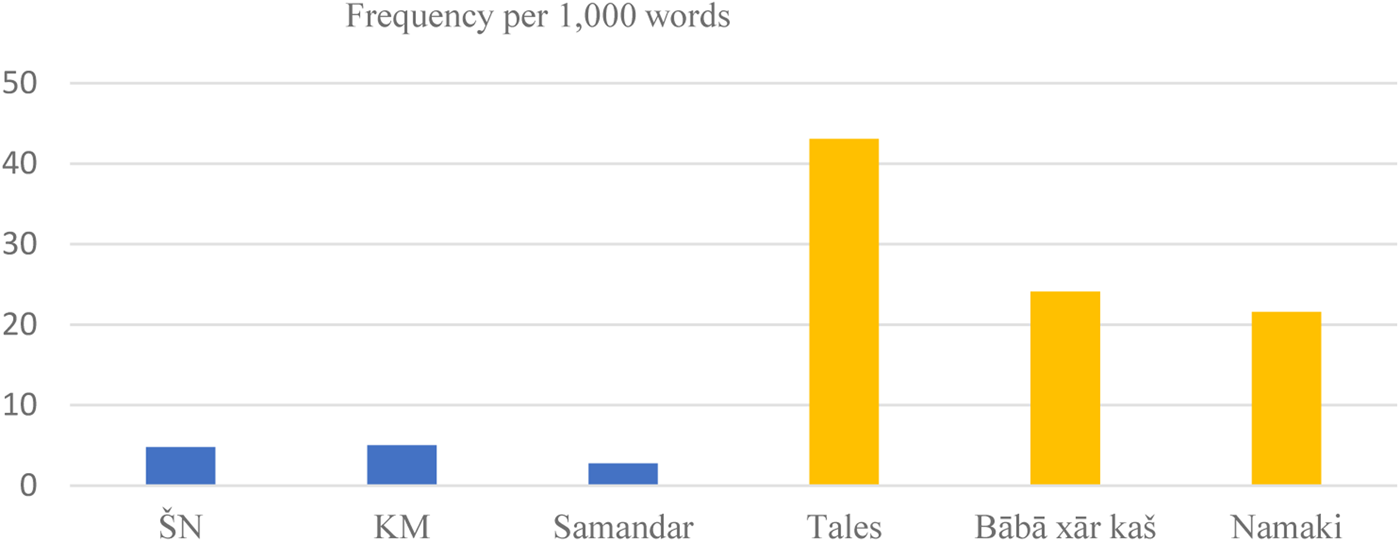
The first measure I consider is the overall number of K-suffixes across all texts in the corpus per orthographic word,Footnote 148 normalised to a value of frequency per 1,000 words to enable comparison across texts of different lengths. Except for three of our Modern Shirazi texts that are long, all the texts have fewer than 100 words overall with a high number of K-suffixes. A high value for the K-suffix in a short text is not particularly significant, while high rates of occurrence in longer texts are much more significant. To facilitate calculation, I combined the texts of fewer than 700 words together; all of them are tales that were narrated by the same speaker. Two texts were not counted (Mullah and dared del) due to genre differences and speaker issues.
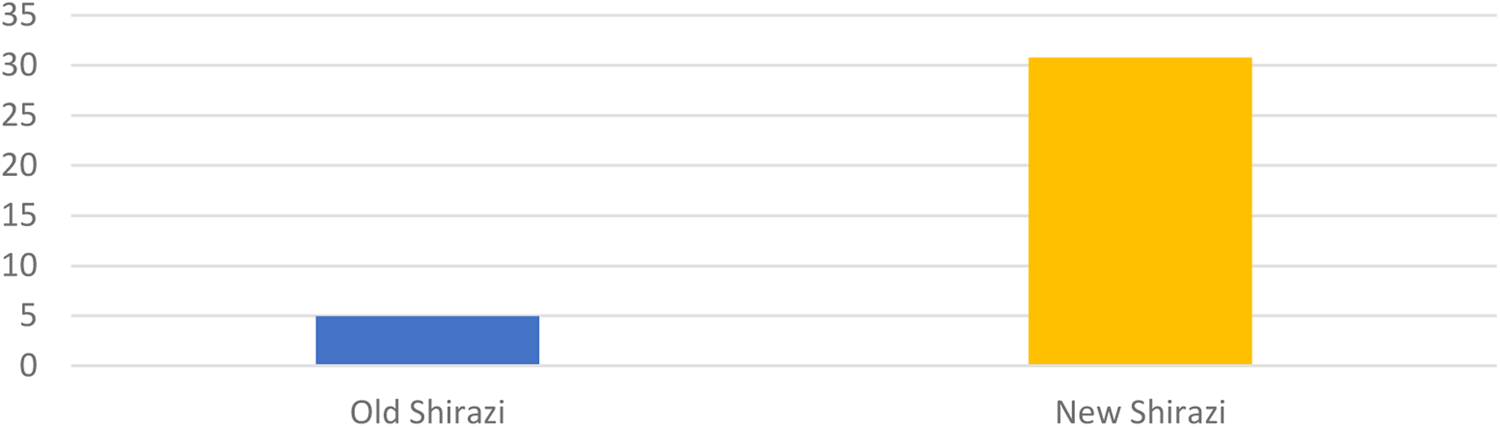
The results for these two stages of Shirazi dialects are shown in the diagrams. Figure 2 shows the overall frequency of the K-suffix in the old stage and modern stage. Figure 3 displays the frequency of the K-suffix individually.
Overall frequency of K-suffixes per 1,000 words.

Overall frequency of K-suffixes per 1,000 words.

There are some points of interest here. First, our speculation that overall frequency would increase with a shift towards definiteness function is confirmed. In Modern Shirazi, the mean value of K-suffixes per 1,000 words is 31, almost six times that of Old Shirazi (5). As shown in Figure 3, excluding the individual differences for the time being, the higher frequency of Modern Shirazi, based on three speakers, demonstrates high levels of the K-suffix among the speakers, which we would expect for uniformly grammaticalised definiteness markers in Modern Shirazi. This is in contrast to the overall frequency of the K-suffix in Koroshi. The higher frequency of the K-suffix is essentially the result of two texts narrated by a female speaker.Footnote 149 Overall, frequency is at best a very crude measure of grammaticalisation, which is also reflected in our Shirazi findings.
The second interesting point is that the frequency of the K-suffix is the same in the eighth/fourteenth and ninth/fifteenth centuries, and yet the frequency decreases in the twentieth century and increases in Modern Shirazi. Our qualitative investigation of the two stages of Shirazi demonstrated that in both Divans (ŠN and KM) and even in Samandar's poems, K-suffixes are mainly used with evaluative semantics.
The third interesting point is the individual differences among these three speakers. Female speaker (1), with a value of 43, uses the K-suffix almost twice as frequently as the other two speakers, the male speaker (value 24) and female speaker 2 (value 22). The issues of age, gender, and education are not relevant here. Due to all three speakers being from the same city, having the same educational background, and being roughly the same age, the reason for this result might (a) be dependent on the type of NP in the narrative texts. Both texts narrated by the one male and two female speakers contain plentiful nouns phrases functioning as personal names, for example, king, Namaki, or Bābā Khārkash, which do not take a K-suffix, alongside other constraints on the use of the K-suffix (see section 4.2). It also might (b) be dependent on interference from standard Persian, because during their narrations, both speakers use the Colloquial Tehrani Persian K-suffix e instead of Shirazi -ū, such as in doxtar-e. Finally, it might (c) be a matter of individual preference among the speakers. Overall, the female speakers tend to use more K-suffixes than the male speakers. This point needs to be tested with more narrative texts from male and female speakers in a future study.
The crucial point here is the K-suffix is used in all types of texts and by all the speakers of Shirazi. In Modern Shirazi, K-suffixes are not associated with evaluative and diminutive semantics, but are associated with definiteness. As I have shown in section 4.3, however, the association is not entirely regular, which resembles my finding for Koroshi and Colloquial Tehrani Persian.Footnote 150 There are also instances of definite NPs that lack the expected K-suffix for reasons that are not fully understood. As shown in Figure 3, in Shirazi we can expect, on the one hand, a drop in the frequency of the K-suffixes because they are no longer used for evaluative functions. On the other hand, we can expect an increase in their frequency because of their new function as definiteness markers. I do not have a conclusive answer as to how these are related. Therefore, we need to investigate further with the other languages in our survey.
The overall picture thus clearly suggests that the K-suffix is used as a definiteness marker in Modern Shirazi. In ŠN, the high rate of K-suffixes is associated with evaluative semantics and some traces of endearment notions, and the K-suffix always appears with demonstrative pronouns. Similarly, in KM, the high rate of K-suffixes is associated with evaluative semantics. However, there is a tendency for K-suffixes to appear without being combined with a demonstrative. We also found some instances of NPs marked with the K-suffix which have a referent in the discourse. These instances pave the way for using the K-suffix in anaphoric tracking in the modern stage of Shirazi.
Summary of narrative corpus data
The corpus data, combined with the qualitative analysis in the previous sections, show that there is no difference in the overall frequency of the K-suffixes in the Old Shirazi stage (ŠN from eighth/fourteenth and KM from ninth/fifteenth centuries) despite the long period of time between them. There is a drop in frequency in attested material from the twentieth century. One possible reason for the lower frequency of the K-suffix might be the written form of the attested data.
In the manuscripts from the eighth/fourteenth century, the K-suffix is always combined with demonstratives. In the manuscript from the ninth/fifteenth century, we notice some instances of the K-suffix without accompanying demonstratives. Use of the K-suffix is mainly restricted to proximity and mutuality contexts, with some traces of endearment meaning. However, we already find instances of the K-suffix in anaphoric contexts in KM. I consider this to be the second stage in the co-option of evaluative morphology into a marker of definiteness. We already find the first stage in New Persian and in Sistani Balochi (where evaluative usage prevails) when the K-suffix is used in recognitional and deictic contexts without any obvious evaluative or diminutive connotations. The most distinguishing features of the K-suffix in Samandar (twentieth century) are the absence of demonstratives in combination with K-suffixes, for reasons that cannot yet be fully understood. However, their use is recognitional, with some notion of ‘small physical size’. The K-suffix in ŠN, KM, and Samandar is only attested with singular nouns, which is a typical pattern for K-suffixes in the Modern Shirazi data.
One possible explanation for this result might be that as long as the evaluative semantics of the K-suffix declines, and proximity and mutuality notions predominate, a new cycle of development of the K-suffix towards definiteness starts in which singular nouns seem to attract this suffix more than plural nouns. Modern Shirazi differs from Old Shirazi in its almost complete lack of evaluative semantics. Instead, the K-suffix is associated with definite contexts, although this has not yet become entirely regularised. The K-suffix has some constraints regarding the plural and possessive constructions (for example, possessor marked with person-marking clitics and possessive pronouns).
K-suffixes in Modern Shirazi are not used together with demonstratives in anaphoric contexts, which contrasts with my observation in Koroshi.Footnote 151 Most instances where the storyteller combines a K-suffix with demonstratives are recognitional and deictic contexts in the discourse (see section 4.1). However, I already have noted some instances of the K-suffix in recognitional and deictic contexts unaccompanied by demonstratives, which might pave the way for a complete disappearance of demonstratives combined with the K-suffix. Based on the data from Shirazi and Koroshi, one could assume that the K-suffixes use demonstratives as a supportive structure (hook) along the way towards definiteness, and can relinquish them once they are mature enough to stand alone. This needs to be investigated with other languages covered by our survey.
Questionnaire data
The questionnaire data stem from a questionnaire using a set of 102 items, built into six ʻmini-narratives', each recounting a short episode of approximately ten sentences. Speakers have presented their narratives in Persian and are asked to translate them orally into Shirazi. Their narratives were recorded with a mobile phone, and the relevant NPs were coded for presence versus absence of K-suffixes and several other features. For a fuller outline of the questionnaire methodology, see Haig.Footnote 152 The results here are based on the initial pilot study from Shirazi, based on ten speakers.
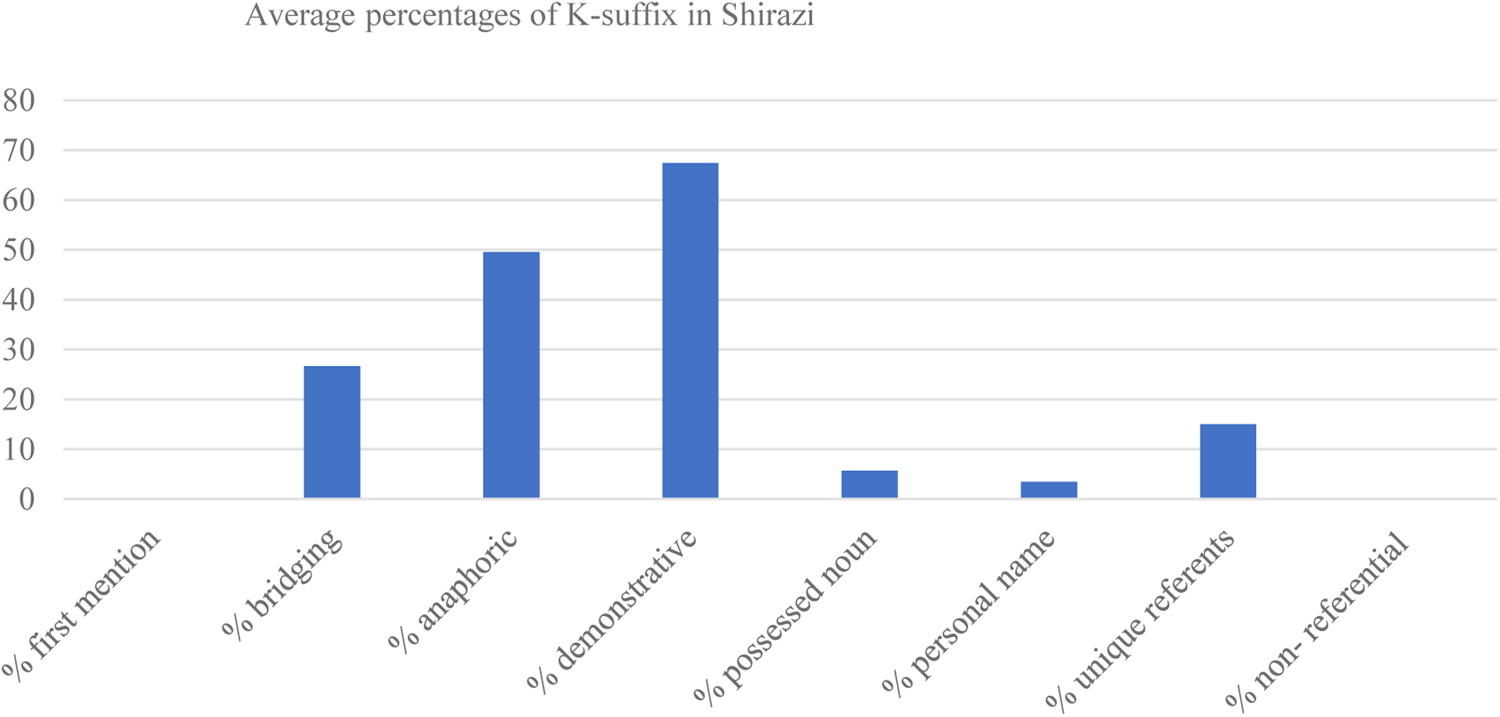
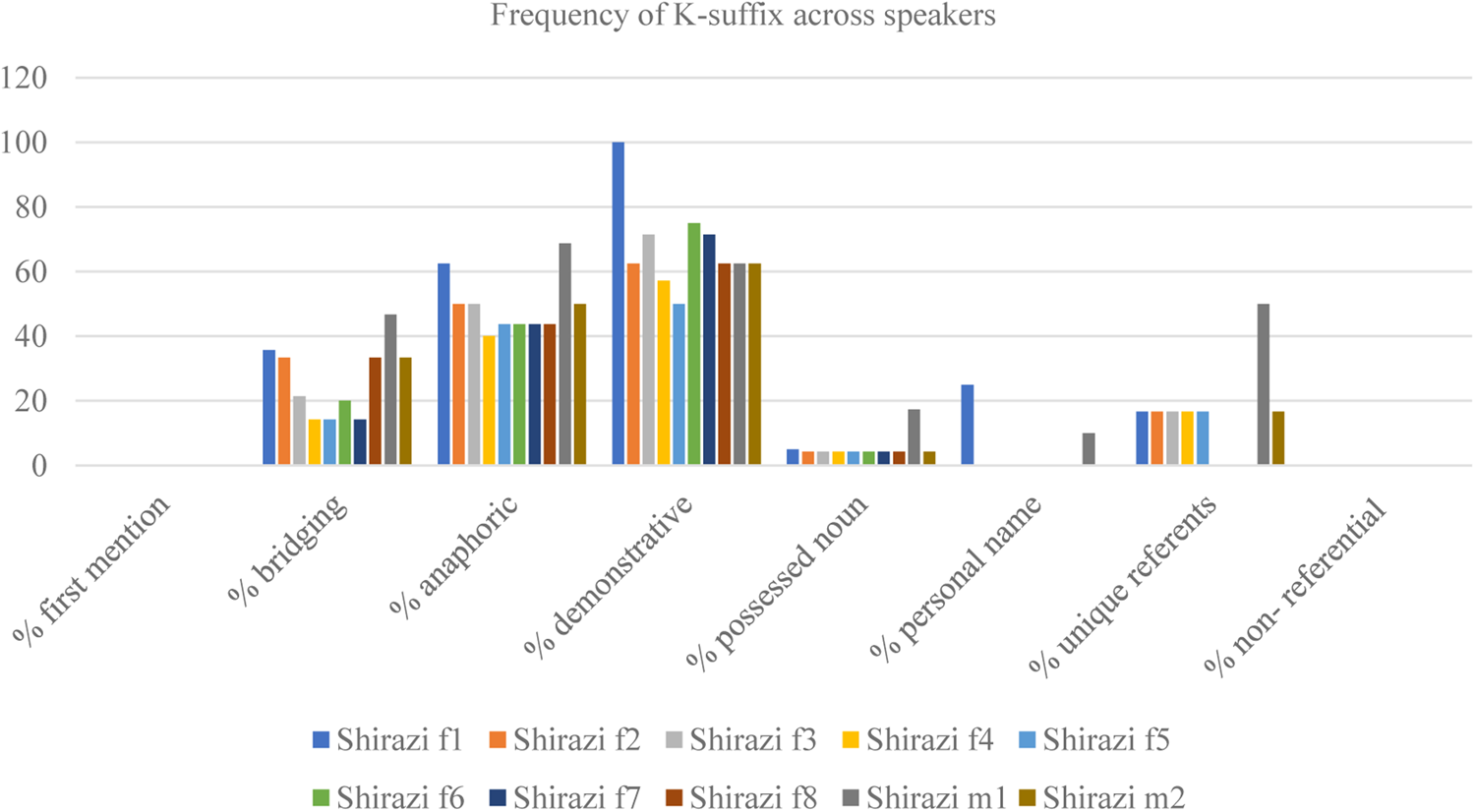
Figure 4 presents the percentage of nouns carrying a K-suffix in the respective contexts: first mention (indefinite), bridging, anaphoric, demonstratives, possessed, personal nouns, unique references, and non-referential/generic (as in negated existential, such as ‘in those days there were no cars’). When we consider the questionnaire data, we find that about half of the nouns in anaphoric and bridging contexts take K-suffixes. Other nouns in these contexts are accompanied by proximal demonstratives, or are in the plural, and thus have not been counted here.
The percentage of nouns carrying a K-suffix in each context.

As presented in Figure 5, overall and across all speakers, we find a massive inter-speaker difference in marking anaphoric definiteness and bridging, demonstratives and unique referents. Moreover, we see consistent observance of the structural constraint against the use of K-suffixes with plural markers, possessed nouns with person-marking clitic, and generic nouns, and a complete absence of K-suffixes in the indefinite. Furthermore, we find a consistent lack of K-suffixes with personal names, except with two speakers, a male and a female; the male speaker is the oldest participant, and the female is middle-aged. The use of K-suffix with personal names reveals an earlier endearment notion of this suffix, which is common in the Lāri language in informal settings, for example, Mohsen-ū ‘Mohsen’. Not surprisingly, the use of the K-suffix with demonstratives only appears in deictic and recognitional contexts, as we also find in the corpus data. There was a tendency towards using the K-suffix with unique referents among the speakers; seven out of ten of them marked unique referents with the K-suffix. On the whole, this is the system found in the corpus data discussed in section 4.
The frequency of the K-suffix across all speakers.

6. What is the origin of the K-suffix?
In contrast to my previous study on K-suffixes across Balochi dialects, which clearly traces the development of the same suffix (namely -ok/ak) from evaluative to definiteness meaning,Footnote 153 the Shirazi case is more complicated. This is because I found another form of K-suffix, namely -ak, alongside the K-suffix -ū in the attested material from the old stage and the twentieth century. The K-suffix -ū, however, is more productive than the K-suffix -ak. The attested NPs with the K-suffix -ak include del-ak ‘heart’, yār-ak ‘friend’, tanz-ak ‘scoffing’, šengūl-ak ‘happy’, hāl-ak ‘mood’ in ŠN, mardom-ak ‘people’ in KM, and kāqaz-ak, ‘paper’ in Samandar's work. My Modern Shirazi corpus lacks nouns with the -ak suffix; when I tested these words with the Shirazi speakers, they pointed out that these words are still common in Shirazi, though more in poems and poetry than everyday speech. I have observed the same forms -ak and -ū in the Lāri language as well. A similar result can be found in Persian with the K-suffixes -ak and -e/he; the -ak suffix continues as diminutive/evaluative and -e/he as a definiteness marker.Footnote 154
Since both suffixes are attested with evaluative semantics, I would suggest that there could be two forms of the K-suffix in Shirazi: Middle Persian -ak/-ag and *-ūg/-ōg, which might come from different Persian dialect varieties spoken in Shirazi at that time, although this needs further investigation. I would assume that in Shirazi -ak/-ag has continued as an evaluative suffix, while the other one, *-ūg/-ōg, has developed into a definiteness marker.
7. Grammaticalisation pathway
Across different stages of the Shirazi dialects, we find the reflexes of presumably cognate and originally evaluative morphology, *ūk, which has developed in various ways in different stages. In Old Shirazi, however, the K-suffix has maintained some traces of evaluative usages, for example, endearment and proximity, that are not constrained by definiteness. In Modern Shirazi, the evaluative use is unattested, and the suffix is compatible with definite contexts regardless of inter-speaker and genre issues.
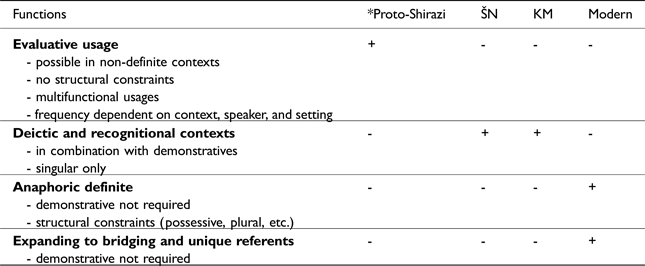
Overall, the results of the distribution of different usages across the Shirazi stages strengthen my hypothesis regarding the development pathway of grammaticalisation, namely from evaluative towards definiteness in Balochi.Footnote 155 We see in Shirazi that, except in a few contexts of endearment, diminutive uses are entirely absent, the most frequent uses being deictic and recognitional in ŠN eighth/fourteenth and KM ninth/fifteenth centuries. However, we already found some instances of the K-suffix in deictic anaphoric tracking, which shows an extension towards anaphoric contexts, and then an entire separation of deictic from anaphoric contextsFootnote 156 and further extension of its use to the bridging and unique reference contexts in the Modern Shirazi stage. This observation can be linked to Hawkins’ suggestion that each stage of grammaticalisation ‘maintains the usage possibilities of the previous stage and introduces more ambiguity and polysemy, but expands the grammatical environments and the frequency of usage of the definite article’.Footnote 157
Based on our observations in the old stages of Shirazi, since the attested written material is based on an informal style of language which would have been used at home at the time of SaꜤdi and Hafez, we further surmise that the use of the K-suffix would initially be restricted to informal styles, from which it can also be extended to formal styles and everyday speech. I have found the same observation regarding the K-suffix -e/he in Colloquial Tehrani Persian.
In general, the distribution of different usages across the Shirazi stages is demonstrated as a development pathway, as summed up in Table 3, similar to the Balochi pathway.Footnote 158
An overview of the grammaticalisation path from evaluative to definiteness

These results, which are attested in Shirazi, Balochi,Footnote 159 and Persian,Footnote 160 demonstrate that the development of definiteness marking can follow a distinct path from that generally assumed for demonstrative-based definiteness marking. However, the endpoints may be fairly similar.
The starting point here is an evaluative marker, though we lack evidence of multifunctionality in earlier stages of the K-suffix in Shirazi. There is, however, supporting evidence from ENPFootnote 161 and BalochiFootnote 162 and (with the same suffix, -ū) from the Lāri language spoken in the same province (338 kilometres from Shiraz), in which the same suffix is typically used in interactional contexts, paired with diminutive meaning. This comes to be associated with deictic marking, a kind of ‘attention-seeking device’, which can be assumed to provide the bridging context for continued development of the suffix towards being a marker of anaphoric definiteness (as attested in Old Shirazi). In the final stages, the K-suffix is consistently associated with contexts of anaphoric definiteness and expands to further contexts, such as bridging and unique referents (Modern Shirazi).
This stands in contrast to my observations in Koroshi and Colloquial Tehrani Persian,Footnote 163 which have two ways of marking definite nouns. The new system (NP marked with the K-suffix) coexists with the inherited system of bare-nouns or with a demonstrative plus NP marking of definiteness. In Shirazi, with a few exceptions, we find only one way of marking definite nouns, with a K-suffix, which is similar to more familiar article-based systems (English and German). This shows that the development of the definiteness marking is more mature in Shirazi than in Koroshi, Colloquial Tehrani, and Hamedāni Persian.Footnote 164
The Shirazi case can be added to the earlier investigations of our survey (Koroshi and Colloquial Tehrani Persian). The incompatibility of this suffix with plural marking and possessive constructions, especially with person-marking clitics, thus remains something of a puzzle, in particular when compared to definiteness marking in Central Kurdish and Lori, which are also based on a K-suffix, but for which no such constraints exist.Footnote 165 Regarding the possessive constructions, Haspelmath states that the absence of definiteness marking with possessed nouns is due to ‘economy’.Footnote 166 Becker finds no typological evidence for the lack of definiteness marking with a plural number. However, there is clear evidence that indefinite markers and plural number cannot be combined.Footnote 167 I assume that the incompatibility of a definiteness suffix with a plural marker in Shirazi (-hā), Koroshi (obār/bār) and Colloquial Tehrani Persian (-hā) could be due to the new cycle of development of the K-suffix towards a definiteness marker, in which singular nouns seem to attract the K-suffix first, and that this then spreads to the plural nouns. This could be linked to the intrusion of the object markers in the nominal system of Balochi and possibly in other Iranian languages.Footnote 168 However, this hypothesis needs to be tested with other languages in our survey, and such testing is underway.
Finally, I suggest two possibilities for the development of the K-suffix towards definiteness in Shirazi. The first (a) comprises language contact and areal considerations, which have been suggested to have contributed to the development of definiteness in other languages, for example, through German influence on Upper Sorbian Footnote 169 and Old Prussian.Footnote 170 Shirazi is closest to the Mesopotamian/Zagros region. Several other Iranian languages have definiteness marking (Central and Southern Kurdish, Hawrami, Lori, Bakhtiari, Koroshi), probably in response to the influence of Semitic languages such as Northeastern Neo-Aramaic and Arabic.Footnote 171
One of the interesting points regarding areal influence is the spreading of the same K-suffix inside and outside of Iranian languages spoken in the Zagros zone. Khan reports that some Neo Aramaic dialects have borrowed the K-suffix due to contact with the Kurdish dialect.Footnote 172 Even the Turkic languages of west Iran have borrowed definiteness marking from neighbouring varieties of Kurdish.Footnote 173 Dolatkhah and colleagues report borrowing of the K-suffix in Kashkay due to contact with Iranians.Footnote 174 Note that their observation regarding restriction of the K-suffix with plural and possessive nounsFootnote 175 is the same as my findings in Koroshi.Footnote 176
Lori dialects spoken in Fars and Doshmanzāri have a different form of the K-suffix, namely akū/ekū, than Bakhtiyari Lori (eke/e). The forms akū/ekū possibly represent a borrowing of Shirazi -ū (this is a case for future investigation) as an extension of the original forms ak/ek.
The second possibility (b) is that language-internal features, for instance, the reduction of case marking in Shirazi, may also affect the case system, which may have favoured the emergence of an additional nominal category such as definiteness.
Acknowledgements
I would like to express my gratitude to Geoffrey Haig for his valuable input into this research and to Judith Josephson for her comments on earlier drafts of this article, and also to the anonymous reviewers of the Journal of the Royal Asiatic Society who provided careful comments at different stages of the review process. I am grateful to my colleagues Carina Jahani, Thomas Jügel, Agnes Korn, Forogh Heshabegi, Guity Shokri, and Ali Asuri for their discussions of different aspects of this article. Thanks also to Hannah Sarrazin and Alexander Brontz who handled the questionnaire data. Any errors remain, of course, my own responsibility. I am grateful to the Swedish Research Council (vetenskapsrådet) for funding the research (grant number: 2018-00318).
Conflicts of interest
None.
List of abbreviations

 زهد