Introduction
Patients with mental illness face an elevated risk of COVID-19 infection, morbidity, and mortality (Wang et al., Reference Wang, Xu and Volkow2021). Therefore, prioritising this group in COVID-19 vaccination programmes has been suggested, and, in some countries, implemented (De Hert et al., Reference De Hert, Mazereel, Detraux and Van Assche2021, Mazereel et al., Reference Mazereel, Van Assche, Detraux and De Hert2021, De Picker et al., Reference De Picker, Dias, Benros, Vai, Branchi, Benedetti, Borsini, Leza, Kärkkäinen and Männikkö2021). However, several barriers, including vaccine hesitancy, may hinder the vaccination of individuals with mental illness. Indeed, studies on influenza vaccination programmes have found lower vaccination rates amongst individuals with mental illness compared to the general population, and have mainly attributed vaccine hesitancy to lack of information or negative perceptions about vaccine safety and efficacy (Miles et al., Reference Miles, Williams, Luthy and Eden2020, Lorenz et al., Reference Lorenz, Norris, Norton and Westrick2013, Druss et al., Reference Druss, Rask and Katon2008). Whether this hesitancy generalises to the COVID-19 vaccine remains unknown. In a survey conducted in Ireland in the Spring of 2020, vaccine hesitancy was higher amongst respondents with a history of mental health problems (Murphy et al., Reference Murphy, Vallières, Bentall, Shevlin, Mcbride, Hartman, Mckay, Bennett, Mason and Gibson-Miller2021). It, therefore, seems likely that COVID-19 vaccine willingness may be lower amongst individuals with mental illness, especially amongst those for whom the illness is more severe, requiring hospital treatment. Despite having obvious clinical relevance (Wang et al., Reference Wang, Xu and Volkow2021), this issue has not been sufficiently studied, and so research on this issue is urgently needed.
Aims of the study
We aimed to compare estimates of vaccine willingness amongst patients diagnosed with mental illness by psychiatric hospital services and individuals from the general population in Denmark.
Methods
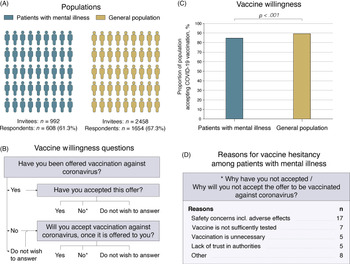
We conducted two questionnaire-based online surveys: one targeting randomly selected patients with mental illness from the psychiatric services of the Central Denmark Region (n = 992) (Kølbæk et al., Reference Kølbæk, Jefsen, Speed and Østergaard2021) and one targeting the general Danish population (n = 2458) (Sønderskov et al., Reference Sønderskov, Dinesen, Santini and Østergaard2020a) (Fig. 1A). Both were follow-ups of prior surveys (Sønderskov et al., Reference Sønderskov, Dinesen, Santini and Østergaard2020a, Kølbæk et al., Reference Kølbæk, Jefsen, Speed and Østergaard2021, Sønderskov et al., Reference Sønderskov, Dinesen, Santini and Østergaard2020b, Sønderskov Dinesen & Østergaard, Reference Sønderskov, Dinesen, Vistisen and Østergaard2021), and are described in detail in the Supplementary Material. The surveys were fielded from 9 February to 22 February 2021 (patient sample) and from 4 February to 21 February 2021 (general population sample). For each of the two surveys, an overall measure of weighted vaccine willingness was calculated based on the following questions: ‘Have you accepted this offer?’ (for those offered COVID-19 vaccination) and ‘Will you accept vaccination against coronavirus, once it is offered to you?’ (for those not yet offered COVID-19 vaccination) (Fig. 1B). Responding ‘Yes’ to either of these two questions was considered as vaccine willingness. We compared the weighted estimate of overall vaccine willingness for the patients with mental illness, and the weighted estimate for the general population using a two-sample test of proportions with a one-sided p-value (supplemented with a one-sided Fisher’s exact test when comparing small samples). We conducted equivalent comparisons of vaccine willingness for those who had been offered COVID-19 vaccination, and those who had not yet been offered COVID-19 vaccination, respectively. Finally, we performed multivariate logistic regressions for both the patient sample and the general population sample to identify correlates of vaccine hesitancy.
Vaccine willingness amongst patients with mental illness and the general Danish population. (A) Populations assessed in the survey, number of invitees, and respondents. (B) Vaccine willingness questions used in the questionnaire. (C) Vaccine willingness estimates (proportions) weighted for attrition. Lower vaccine willingness amongst patients with mental illness (84.8%) compared with the general population (89.5%), p < 0.001, a two-sample test of proportions with a one-sided p-value. Further details on questionnaire responses and weighted estimates can be found in the Supplementary Tables 3 and 4. (D) Reasons for vaccine hesitancy amongst patients with mental illness.

Results
Of the 992 patients with mental illness who were invited to participate, a total of 608 (61.3%) responded to the questions regarding vaccine willingness (Fig. 1A). Of the 2458 individuals from the general population panel invited to participate, a total of 1654 (67.3%) responded to the questions regarding vaccine willingness. Supplementary Tables 1 and 2 present the characteristics of the respondents. Vaccine willingness was high in both populations, albeit slightly lower amongst those with mental illness (84.8%) compared with the general population (89.5%) (Fig. 1C). This difference in vaccine willingness is statistically significant (p < 0.001). Figure 1D also reports the reasons for vaccine hesitancy amongst patients with mental illness.
The results of the logistic regression analyses are shown in Supplementary Tables 5 and 6. There was a strong and statistically significant positive association between younger age and vaccine hesitancy both amongst patients with mental illness (OR for ≤ first age quartile compared to > third quartile = 5.80, 95% CI = 1.63;22.39, p = 0.008) and amongst the general population (OR for ≤ first age quartile compared to > third quartile = 3.41, 95% CI = 1.48;7.84, p = 0.004). For patients with mental illness, divorce or repeal of the registered partnership was also positively associated with vaccine hesitancy (OR = 4.14, 95% CI = 1.50;11.94, p = 0.007), as was being born outside Denmark (OR = 4.51, 95% CI = 1.84;11.04, p = 0.001). No psychiatric diagnosis was found to be particularly strongly associated with vaccine hesitancy. For the general population, having children living in the household (OR = 1.60, 95% CI = 1.03;2.51, p = 0.038), having a low educational level (OR for primary and lower secondary school as the highest obtained level compared to long-cycle higher education = 3.36, 95% CI = 1.49;7.56, p = 0.003), and being absent from employment due to illness (OR = 3.87, 95% CI = 1.60;9.38, p = 0.003) were positively associated with vaccine hesitancy.
Discussion
COVID-19 vaccine willingness amongst patients with mental illness was high, albeit slightly lower than in the general population. Moreover, vaccine willingness in the general population was higher than in previous surveys of the Danish population (Lindholt et al., Reference Lindholt, Jørgensen, Bor and Petersen2020), which could be due to the safe implementation of the vaccination programme in Denmark that began on 26 December 2020, and was well underway by the time of survey collection in February 2021. This hypothesis is supported by recent reports from England and Wales, where vaccine hesitancy fell after the vaccination programme commenced (Moberly, Reference Moberly2021).
Patients with mental illness generally receive less preventive care than the general population (Lord et al., Reference Lord, Malone and Mitchell2010, Druss et al., Reference Druss, Rosenheck, Desai and Perlin2002, Mitchell et al., Reference Mitchell, Malone and Doebbeling2009). The reason for this imbalance is likely multifactorial. In the case of the COVID-19 vaccine, however, concrete and modifiable factors may be present. Indeed, the reported reasons for COVID-19 vaccine hesitancy amongst patients with mental illness suggest that addressing safety concerns more thoroughly may increase vaccine willingness in this population (Miles et al., Reference Miles, Williams, Luthy and Eden2020).
Here, the findings from our logistic regression analyses are informative. Across both samples, younger age was strongly associated with vaccine hesitancy, consistent with previous reports from other western countries (Murphy et al., Reference Murphy, Vallières, Bentall, Shevlin, Mcbride, Hartman, Mckay, Bennett, Mason and Gibson-Miller2021, Daly and Robinson, Reference Daly and Robinson2021, Robertson et al., Reference Robertson, Reeve, Niedzwied, z, Moore, Blake, Green, Katikireddi and Benzeval2021, Schwarzinger et al., Reference Schwarzinger, Watson, Arwidson, Alla and Luchini2021). Consequently, the difference in vaccine hesitancy between the two populations in this study may be partly explained by the fact that the sample of patients with mental illness was substantially younger [weighted median age (years) = 36, IQR = 26–50] than the general population sample [weighted median age (years) = 51, IQR = 34–65].
The most important limitations of this study are related to its survey-based design. Specifically, although our findings were weighted to be representative on a set of known parameters (see the Supplementary Material), we cannot rule out social desirability and non-response biases, which may have led to an overestimation of vaccine willingness in the present study. Furthermore, the data presented in this study were collected prior to the reports of venous blood clots in relation to the COVID-19 vaccine from Oxford–AstraZeneca, which led to a pause in the use of this vaccine in many countries including Denmark (Østergaard et al., Reference Sønderskov, Dinesen, Vistisen and Østergaard2021, Wise, Reference Wise2021, Schultz et al., Reference Schultz, Sørvoll, Michelsen, Munthe, Lund-Johansen, Ahlen, Wiedmann, Aamodt, Skattør and Tjønnfjord2021). In a follow-up survey of the general population sample after the reports of venous blood clots related to the Oxford–AstraZeneca vaccine, vaccine willingness appeared to be unaffected (Sønderskov et al., Reference Sønderskov, Dinesen, Vistisen and Østergaard2021). Whether the same is true for patients with mental illness remains unknown.
In conclusion, vaccine hesitancy does not appear to be a major barrier for the COVID-19 vaccination of patients with mental illness in Denmark. However, it could be a barrier in countries with lower general vaccine willingness (Lindholt et al., Reference Lindholt, Jørgensen, Bor and Petersen2020) and less trust in institutions, both of which are very high in Denmark. Importantly, previous estimates of vaccine willingness exhibit very large variation between countries (Lazarus et al., Reference Lazarus, Ratzan, Palayew, Gostin, Larson, Rabin, Kimball and El-Mohandes2020). We, therefore, strongly encourage replication studies in other countries to address this critical public health issue. Furthermore, we urge national health authorities worldwide to provide targeted information on COVID-19 vaccine efficacy and safety to patients with mental illness – especially amongst the younger – to increase vaccine uptake in this at-risk population.
Supplementary material
To view supplementary material for this article, please visit https://doi.org/10.1017/neu.2021.15.
Acknowledgements
The authors would like to thank Mia Buhl Povlsen, Bettina Nørremark, and Gitte Kobberøe from Aarhus University Hospital – Psychiatry for their assistance with the survey of the patients with mental illness.
Author contributions
Dr. Østergaard had full access to all data in the study and takes responsibility for the integrity of the data and the accuracy of the data analysis. Concept and design: Kølbæk, Dinesen, Sønderskov, Østergaard., Acquisition, analysis, or interpretation of data: Jefsen, Kølbæk, Gil, Speed, Dinesen, Sønderskov, Østergaard. Drafting of the manuscript: Jefsen and Østergaard. Critical revision of the manuscript for important intellectual content: Kølbæk, Gil, Speed, Dinesen, Sønderskov. Statistical analysis: Speed, Sønderskov. Obtained funding: Østergaard. Administrative, technical, or material support: Jefsen, Kølbæk, Gil, Speed, Sønderskov. Supervision: Kølbæk, Dinesen, Sønderskov, Østergaard.
Financial support
This study is funded by a grant from the Novo Nordisk Foundation to Østergaard (grant number: NNF20SA0062874). Jefsen is supported by a grant from the Health Research Foundation of Central Denmark Region (grant number: R64-A3090-B1898). Sønderskov is supported by a grant from the Danish National Research Foundation (grant number: DNRF144). Østergaard is supported by grants from the Lundbeck Foundation (grant numbers: R358-2020-2341 and R344-2020-1073), the Danish Cancer Society (grant number: R283-A16461), the Central Denmark Region Fund for Strengthening of Health Science (grant number: 1-36-72-4-20), the Danish Agency for Digitisation Investment Fund for New Technologies (grant number 2020-6720), and Independent Research Fund Denmark (grant number: 7016-00048B). The funders/sponsors had no role in the design and conduct of the study; collection, management, analysis, and interpretation of the data; preparation, review, or approval of the manuscript; and decision to submit the manuscript for publication.
Conflict of interest
Østergaard received the 2020 Lundbeck Foundation Young Investigator Prize. The remaining authors report no conflicts of interest.