Introduction
In today's arena, organizations need a thriving workforce to remain competitive and sustainable in the higher competitive global marketplace (Prem, Ohly, Kubicek, & Korunka, Reference Prem, Ohly, Kubicek and Korunka2017; Spreitzer & Porath, Reference Spreitzer and Porath2014). It is because workplace thriving, ‘the psychological state in which individuals experience both a sense of vitality and learning at work’ (Porath, Spreitzer, Gibson, & Garnett, Reference Porath, Spreitzer, Gibson and Garnett2012: 250), helps mitigate stress, absenteeism, burnout, depression, work disengagement, and ill-being, that may annually cost $84 billion to organizations (Forbes, 2013). More importantly, contemporary researchers argue that workplace thriving leads to several valued outcomes, such as improved performance, low burnout, organizational commitment, work engagement, and creativity (Gerbasi, Porath, Parker, Spreitzer, & Cross, Reference Gerbasi, Porath, Parker, Spreitzer and Cross2015; Jaiswal & Dhar, Reference Jaiswal and Dhar2017; Ren, Yunlu, Shaffer, & Fodchuk, Reference Ren, Yunlu, Shaffer and Fodchuk2015; Walumbwa, Muchiri, Misati, Wu, & Meiliani, Reference Walumbwa, Muchiri, Misati, Wu and Meiliani2018).
Realizing the importance of workplace thriving, an improved understanding of contextual enablers to promote it is of equal concern for individuals and organizations. Servant leadership (SL; Greenleaf, Reference Greenleaf1977), is the most studied leadership style of the last decade and has consistently proved its potential to explain additional variance (5–28%) beyond other positive leadership approaches, such as leader–member exchange, transformational, ethical, and authentic leadership, through being frequently linked to positive outcomes. Such outcomes include commitment, satisfaction, helping behavior, in-role performance, team performance, and organizational performance (e.g., Hoch, Bommer, Dulebohn, & Wu, Reference Hoch, Bommer, Dulebohn and Wu2018; Neubert, Hunter, & Tolentino, Reference Neubert, Hunter and Tolentino2016; Sousa & Van Dierendonck, Reference Sousa and Van Dierendonck2017). Similarly, numerous scholars contend that employees benefit from SL through improved wellbeing, which has been considered as an umbrella term for numerous positive concepts such as wellbeing, health, and happiness (e.g., Gotsis & Grimani, Reference Gotsis and Grimani2016). In light of this, the prime motivation of this study is to explore the untapped relationship between SL and workplace thriving – an indicator of wellbeing.
Additionally, although SL has been revealed to affect individuals' wellbeing through, for instance, the meaningfulness of work and trust in the leaders (Gotsis & Grimani, Reference Gotsis and Grimani2016; Jaiswal & Dhar, Reference Jaiswal and Dhar2017), the courses through which SL affects workplace thriving remain largely unexplored. Because agentic work behavior (i.e., task focus and heedful relating) serves as an engine of thriving (Spreitzer, Sutcliffe, Dutton, Grant, & Sonenshein, Reference Spreitzer, Sutcliffe, Dutton, Grant and Sonenshein2005), we suggest that these behaviors work as an underlying mechanism that explains how SL translates into workplace thriving. Similarly, we expect that employees with different levels of core self-evaluation (CSE) (Judge, Bono, Erez, & Locke, Reference Judge, Bono, Erez and Locke2005) – ‘basic assessments that individuals make about their competences, capabilities, and worthiness’ (p. 257), would likely to experience a greater influence from SL. Therefore, knowing that employees vary in the degree to which they thrive in the workplace (Spreitzer et al., Reference Spreitzer, Sutcliffe, Dutton, Grant and Sonenshein2005), we also consider the moderating role of CSE in our study.
To address these voids in research, this study seeks to extend the SL and thriving literature in at least three ways. First, we answer the call to test empirically whether contextual factors such as SL foster thriving (Jaiswal & Dhar, Reference Jaiswal and Dhar2017) and whether agentic work behaviors mediate this association. In doing so, we also respond to recent meta-analysis (Eva, Robin, Sendjaya, van Dierendonck, & Liden, Reference Eva, Robin, Sendjaya, van Dierendonck and Liden2018) inspiration to study the conservation of resources (COR; Hobfoll, Reference Hobfoll1989) as a foundation theory for examining SL–outcome relationships. To the best of our knowledge, the current research is the first study that investigates the relationship between contextual factors (i.e., SL), agentic work behaviors, and workplace thriving. Understanding how and why contextual factors nourish thriving is not only of research interest but is equally significant for organizations that wish to know how they can enhance the thriving workforce through different leadership styles.
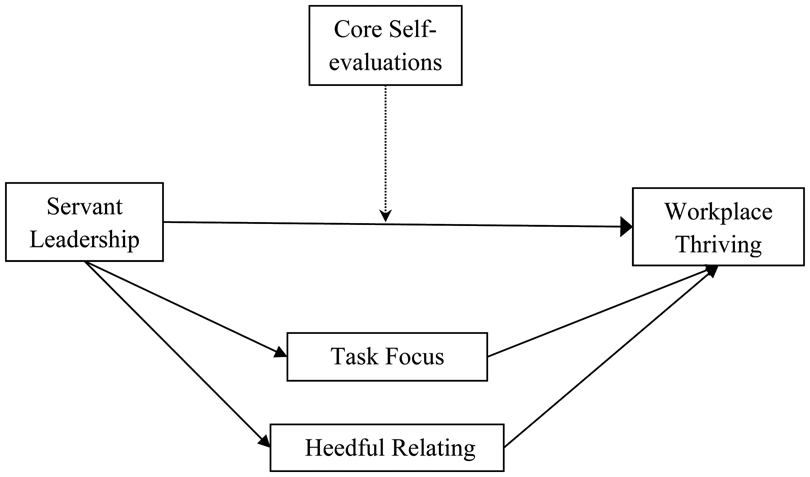
Second, to further enhance scholarly conceptions of the role of SL in promoting thriving at work, we suspect CSE as one factor that makes it easier to benefit from SL, with potentially positive linkages with valued outcomes. We believe that understanding the interaction between a leadership behavior (i.e., SL) and inter-individual differences (i.e., the level of CSE) concerning thriving should be a key focus of study because employees differ in their preferences for, and reaction to, leadership (Fiedler, Reference Fiedler1964). Hence, the current research should assist organizations in generating work context that fosters thriving at work. Finally, we amalgamate the literature on the social exchange theory (SET; Blau, Reference Blau1964) and COR (Hobfoll, Reference Hobfoll1989) theory to add new insights into the mechanisms and boundary conditions associated with the SL–thriving relationship. By addressing these significant issues, this study not only contributes to the extant literature, but also presents distinct insights for organizations to benefit from SL by nurturing a thriving workforce. Figure 1 illustrates the study model.
Hypothesized model.

Literature and Hypothesis Development
Servant leadership
The concept of SL has its roots in the seminal study of Greenleaf (Reference Greenleaf1977), which stated that leaders should see themselves as servants first. SL is an emerging leadership style and is described by Hale and Fields (Reference Hale and Fields2007) as ‘an understanding and practice of leadership that places the good of those led over the self-interest of the leader, emphasizing leader behaviors that focus on follower development, and de-emphasizing glorification of the leader’ (p. 397). Greenleaf explains his vision of how SL acts as a role model for followers, instills trust, and also communicates in a timely way, enabling leaders to know the desires, abilities, and potential of their followers (Liden, Wayne, Zhao, & Henderson, Reference Liden, Wayne, Zhao and Henderson2008). In doing so, servant leaders become aware of their follower's needs and objectives, eventually using that information to proactively satisfy followers' needs and allow them to accomplish tasks with their full potential. Similarly, SL behaviors are attributed with providing autonomy and direction in performing challenging tasks, as well as offering empathy, support, and positive feedback, along with valuable resources. Most importantly, SL primarily engages in fulfilling followers' needs before the leaders' needs and nurturing a psychologically safe climate in which individuals feel comfortable and experience a sense of empowerment to deliver more.
Remarkably, empirical evidence has shown that, as opposed to leaders using other positive styles (such as ethical, transformational, and authentic), servant leaders exhibit little evidence of leadership greediness. For instance, Van Dierendonck, Stam, Boersma, De Windt, and Alkema (Reference Van Dierendonck, Stam, Boersma, De Windt and Alkema2014) concluded that a transformational leader's behavior echoed a high will to be respected as a leader, whereas SL was more concerned about satisfying followers' psychological needs. Similarly, empirical evidence shows that when matched with other leadership approaches, SL plays a distinct significant role in predicting valued individual and organizational outcomes (Hoch et al., Reference Hoch, Bommer, Dulebohn and Wu2018; Neubert, Hunter, & Tolentino, Reference Neubert, Hunter and Tolentino2016; Sousa & Van Dierendonck, Reference Sousa and Van Dierendonck2017). Hence, we suggest that in the presence of SL, a supportive work environment will emerge, which in turn will foster employees thriving at the workplace.
Workplace thriving
Recently, the notion of workplace thriving has emerged and received much attention in positive organizational psychology (Kleine, Rudolph, & Zacher, Reference Kleine, Rudolph and Zacher2019; Prem et al., Reference Prem, Ohly, Kubicek and Korunka2017; Spreitzer & Porath, Reference Spreitzer and Porath2012). The thriving notion is deemed to be important because it helps as an adaptive function that assists employees in navigating and altering their work setting to enhance their self-growth (Spreitzer et al., Reference Spreitzer, Sutcliffe, Dutton, Grant and Sonenshein2005). Contemporary studies show that thriving leads to several valued organizational and individual outcomes, such as performance, better individual health, low burnout, affective commitment, and wellbeing (Gerbasi et al., Reference Gerbasi, Porath, Parker, Spreitzer and Cross2015; Hildenbrand, Sacramento, & Binnewies, Reference Hildenbrand, Sacramento and Binnewies2018; Ren et al., Reference Ren, Yunlu, Shaffer and Fodchuk2015; Walumbwa et al., Reference Walumbwa, Muchiri, Misati, Wu and Meiliani2018).
Spreitzer et al.'s (Reference Spreitzer, Sutcliffe, Dutton, Grant and Sonenshein2005) pioneering study and other empirical studies (e.g., Porath et al., Reference Porath, Spreitzer, Gibson and Garnett2012), explain how workplace thriving is similar, yet empirically and theoretically different from other associated constructs such as flourishing, resilience, subjective wellbeing, affectivity, and learning. For example, resilience concentrates on rebounding in the face of adverse circumstances, whereas workplace thriving can happen with or without such adversity. Individuals can experience learning and vitality (components of thriving) without essentially facing any substantial challenge or hardships (Spreitzer et al., Reference Spreitzer, Sutcliffe, Dutton, Grant and Sonenshein2005). Similarly, although the resilience term encompasses behavioral capabilities that let an individual bounce back from negative happenings, workplace thriving centers on the optimistic psychological experience of better learning and vitality to grow and develop oneself in the workplace (Spreitzer et al., Reference Spreitzer, Sutcliffe, Dutton, Grant and Sonenshein2005). He further suggests that in the presence of right enabling conditions and resources, employees will continue to thrive, even under adverse circumstances. We suggest these enabling conditions as individual and contextual factors that promote workplace thriving.
Servant leadership and workplace thriving
Workplace thriving is conceptualized as a psychological state which represents the combined experience of learning and vitality. Vitality refers to positive feelings based on existing energy and the feeling of aliveness to do work, whereas learning is gaining and applying knowledge to develop individual abilities (Porath et al., Reference Porath, Spreitzer, Gibson and Garnett2012). Spreitzer and colleagues emphasized that the joint experience of the two dimensions captures both the affective (vitality) and cognitive (learning) essence of individuals that they are improving in their personal growth (Spreitzer et al., Reference Spreitzer, Sutcliffe, Dutton, Grant and Sonenshein2005). Carver (Reference Carver1998), for example, suggested thriving as the psychological experience of growth that enhances effectiveness and self-knowledge. According to the socially embedded model of a thriving, the proximal work setting establishing of decision-making discretion, extensive sharing of information, and a climate of mutual respect and trust is fundamental in enabling workplace thriving.
A growing body of literature has emphasized the role of leadership on individual and organizational outcomes, considering it to be the most important of all contextual factors (Chen & Kanfer, Reference Chen and Kanfer2006). The contemporary research has found a positive association between SL and various valued outcomes such as employee engagement (Sousa & Van Dierendonck, Reference Sousa and Van Dierendonck2017), performance (Liden, Wayne, Liao, & Meuser, Reference Liden, Wayne, Liao and Meuser2014), organizational citizenship behavior (Newman, Schwarz, Cooper, & Sendjaya, Reference Newman, Schwarz, Cooper and Sendjaya2017), and unit-level thriving (Walumbwa et al., Reference Walumbwa, Muchiri, Misati, Wu and Meiliani2018). In this vein, we believe that SL can also be seen as a contextual facilitator of workplace thriving at an individual level specifically, as SL helps the subordinates by providing many opportunities to enrich their knowledge, skills, and abilities as well as provide feedback on their task effectiveness (Walumbwa, Hartnell, & Oke, Reference Walumbwa, Hartnell and Oke2010). Subordinates of such leaders are expected to show extra vitality as they are actively involved in their work and are more accountable for their specific job outcomes. Further, to remain devoted and perform effectively also helps employees to learn new skills (Spreitzer et al., Reference Spreitzer, Sutcliffe, Dutton, Grant and Sonenshein2005). Similarly, servant leaders consistently encourage their followers to take initiatives and to improve their performance (Chen, Zhu, & Zhou, Reference Chen, Zhu and Zhou2015).
The proposition that SL can be viewed as a contextual enabler of workplace thriving is in parallel with COR (Hobfoll, Reference Hobfoll1989). Based on COR, we argue that such supportive leadership behaviors stimulate the employees' pool of resources, which consequently aids in the development of workplace thriving as a personal resource (Gerbasi et al., Reference Gerbasi, Porath, Parker, Spreitzer and Cross2015). In particular, COR emphasizes the work context role as a facilitator of numerous employees' resources, and leaders have been well known as offering these resources, for example, through feedback and task significance (Piccolo & Colquitt, Reference Piccolo and Colquitt2006). Also, previous findings support the notion that servant leaders follow and guide their subordinates' activities, which motivate and help them to learn and grow (Spreitzer, Porath, & Gibson, Reference Spreitzer, Porath and Gibson2012), which ought to add valued resources and, in turn, enhance the levels of employee workplace thriving. Based on the above theory and arguments, we presume the following:
Hypothesis 1: SL is positively related to individual workplace thriving.
Servant leadership, agentic work behaviors, and workplace thriving
According to the socially embedded model (Spreitzer et al., Reference Spreitzer, Sutcliffe, Dutton, Grant and Sonenshein2005), agentic work behaviors are important for employee thriving and, therefore, such behavior is considered an ‘engine of thriving.’ Task focus illustrates the extent to which employees concentrate on their behaviors to achieving their given responsibilities and tasks (Brown, Westbrook, & Challagalla, Reference Brown, Westbrook and Challagalla2005). Individuals are said to be heedfully relating when they are attentive to other members and coordinate their actions with those around them (Druskat & Pescosolido, Reference Druskat and Pescosolido2002). The Spreitzer et al.'s (Reference Spreitzer, Sutcliffe, Dutton, Grant and Sonenshein2005) paper on the thriving framework and other recent empirical studies examine and signify the important role of agentic work behaviors in promoting employee workplace thriving (e.g., Niessen, Sonnentag, & Sach, Reference Niessen, Sonnentag and Sach2012; Paterson, Luthans, & Jeung, Reference Paterson, Luthans and Jeung2014).
Organizational leaders are suggested to be one of the important contextual factors in fostering an employee's workplace thriving. For example, the empirical findings of several studies highlight the notion that supervisor support or leadership is positively linked to employee workplace thriving (i.e., Hildenbrand, Sacramento, & Binnewies, Reference Hildenbrand, Sacramento and Binnewies2018; Paterson, Luthans, & Jeung, Reference Paterson, Luthans and Jeung2014; Walumbwa et al., Reference Walumbwa, Muchiri, Misati, Wu and Meiliani2018). Specifically, we believed that servant leaders with characteristics such as a high focus on nurturing their subordinates strongly emphasize their employees' task effectiveness, serving followers, and allowing their subordinates to initiate and think creatively, are more likely to foster employee workplace thriving. In line with the socially embedded model of thriving, we expect that trusting and encouraging employees to work in new ways should restore energy and enhance the knowledge and skills of employees (Katz-Navon, Naveh, & Stern, Reference Katz-Navon, Naveh and Stern2009).
Moreover, SET (Blau, Reference Blau1964) further provides support to our arguments. For instance, based on SET, Colquitt, Baer, Long, and Halvorsen-Ganepola (Reference Colquitt, Baer, Long and Halvorsen-Ganepola2014) found that when leaders treat employees well and provide them with opportunities to develop, the employees feel indebted to return the consideration in the form of valued outcomes. Similarly, because leaders are considered the ‘face’ of the organizations (Liden, Bauer, & Erdogan, Reference Liden, Bauer and Erdogan2004), and servant leaders have attributes such as developing others, fair treatment, providing direction, and stewardship, we believe SL will cause employees to feel highly motivated, more heedfully relating, purposeful at work, and energetic, which, in turn, enables employee workplace thriving. Based on the above empirical and theoretical evidence, we hypothesize the following:
Hypothesis 2: Task focus mediates the relationship between SL and workplace thriving.
Hypothesis 3: Heedful relating mediates the relationship between SL and workplace thriving.
Core self-evaluations as a moderator
Contingency theorists (e.g., Fiedler, Reference Fiedler1964) posit that the effectiveness of different leadership styles is contingent mainly on the attributes of individuals. Indeed, for decades, researchers have comprehensively discussed the role of an individual's attributes in their perception and response to different leadership styles. Therefore, to attain a clear comprehension of the relationship between certain leadership styles (i.e., SL) and outcomes (i.e., workplace thriving), and to check whether all individuals benefited equally from SL with regard to enabling workplace thriving, we considered employee CSE as a boundary condition.
Recent researchers have identified that people value available resources in different ways, depending on the match between the person and the particular resource (Halbesleben, Neveu, Paustian-Underdahl, & Westman, Reference Halbesleben, Neveu, Paustian-Underdahl and Westman2014). This is echoed in the understanding of significant resources (e.g., Ten Brummelhuis & Bakker, Reference Ten Brummelhuis and Bakker2012) as a management resource, which shows how certain individuals choose and utilize resources, and thereby identify their effective usage. In parallel to these arguments, we believe that CSE indicates the extent to which individuals benefit from SL, hypothesizing that heightened levels of workplace thriving appear for individuals high on CSE. Specifically, SL intellectually motivates an individual's cognition and behaviors (Walumbwa, Hartnell, & Oke, Reference Walumbwa, Hartnell and Oke2010) not simply by developing and empowering their capabilities but also by creating interpersonal trust and acceptance of potential failure (Van Dierendonck, Reference Van Dierendonck2011). Consequently, challenging oneself may become less threatening for individuals. Therefore, we expect that certain individuals will understand these leaders' SL behaviors more (and some will understand less), influencing their behaviors differently.
In conclusion, we believe that in the presence of SL behaviors, individuals with high CSE values are very likely to sense themselves as being capable of producing better outcomes, which in turn motivates them to learn new things; this leads to them benefit the most from being supervised by SL. Similarly, we argue that this subsequent fit between the organizational resource of SL and natural inclinations of high-CSE individuals should foster employee learning and vitality (components of thriving). Thus, we predict the following:
Hypothesis 4: Core self-evaluations moderates the association between SL and workplace thriving, such that the relationship is stronger for those with higher core self-evaluations and weaker for those with lower core self-evaluations.
Method
Participants and procedure
The respondents of this study were 260 full-time Chinese employees, who were taking part-time EDP (executive development program) classes at a large university in Beijing. The participants were from a varied range of organizations and different sectors. According to prior studies, drawing a sample from diverse functional groups help to enhance the generalizability of the study findings (Highhouse, Reference Highhouse2011).
We used different procedural remedies suggested by Podsakoff, MacKenzie, Lee, and Podsakoff, (Reference Podsakoff, MacKenzie, Lee and Podsakoff2003) to minimize common method variance (CMV) issue in the current study. First, a time lag between data collection is particularly required to minimize CMV issues, as advocated by Podsakoff et al. (Reference Podsakoff, MacKenzie, Lee and Podsakoff2003). Second, the dependent and independent measures were collected at separate times. Third, all scale items were randomly ordered for any single participant to counterweight the order of the questions. Usually, a time lag of 3 weeks is considered enough period for the participants not to remember their original answers in responding to the measures. To ensure respondents anonymity and match time 1 (T1), time 2 (T2), and time 3 (T3) surveys, the researchers assigned a unique identifier to each participant's responses.
Data were gathered in three phases, with a 3-week gap between each data collection. During the first phase (T1), respondents completed questionnaires regarding SL and the study's demographics variables. In the second phase of data collection (T2), the participants answered questions about both agentic work behaviors and CSE. The participants' responses regarding workplace thriving were collected in the third phase of data collection (T3). Initially, we distributed 295 questionnaires to the participants at T1, and 286 (97% response rate) responded. Three weeks later (T2), we distributed both agentic behaviors and CSE questionnaires among the respondents who responded in the T1 phase. Out of 286 respondents, a total of 270 (94% response rate) responded. Finally, in phase three (T3), questionnaires were distributed among participants who participated in T2 to answer workplace thriving questions. Of the final 270 participants who responded in T3, we excluded 10 respondents' questionnaires from the final responses because they failed to respond to all items in the survey. Finally, we used 260 matched samples in the data analysis (usable response rate was 88% of the initially distributed questionnaires).
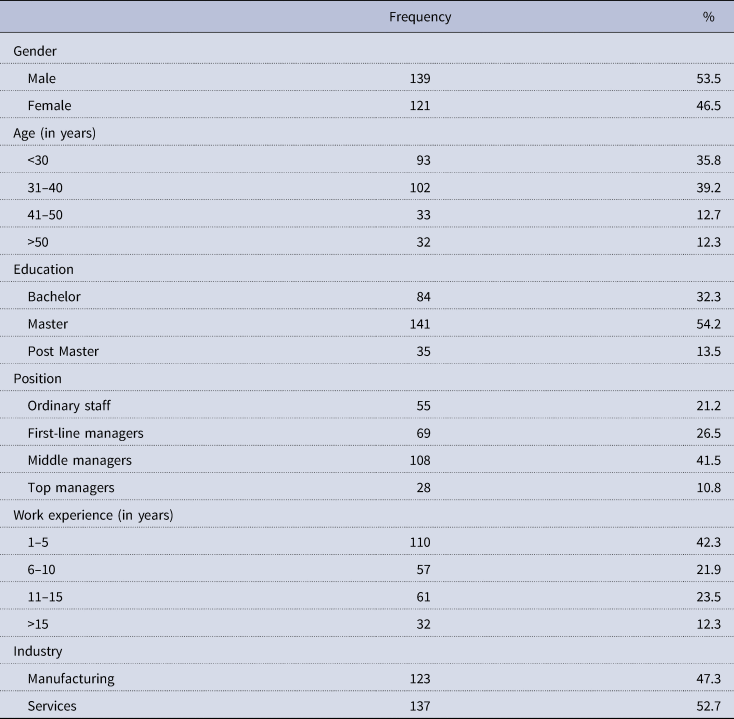
Among the 260 respondents, 53.50% were male, and 39.2% of respondents were from 31 to 40 years old, 54.2% had master's degrees, and 45.4% of the employees had experience ranging from 6 to 15 years. The majority of the respondents held positions of first-line and middle managers (68.0%).
Measures
Unless otherwise stated, all the multi-item measures of the study were validated in the previous studies which introduced them. Items were rated on a 5-point Likert scale from 1 (= strongly disagree) to 5 (= strongly agree). To develop composite measures for each of the variables, items are averaged within the scales. Initially, the English version of the questionnaire was converted into Chinese by two professors with relevant backgrounds and fluency in both English and Chinese languages. To confirm the accuracy of the Chinese version of the questionnaire, it was back-translated into English by the same professors. Accordingly, a few sentences were reworded to enhance their reflection of the true meaning of the English questions.
Servant leadership
The SL scale developed by Liden, Wayne, Meuser, Hu, Wu, and Liao (Reference Liden, Wayne, Meuser, Hu, Wu and Liao2015) is used in this study. The scale contains seven items, and the Cronbach's alpha stated in their study was .95. An example item is ‘My supervisor makes my career development a priority.’
Core self-evaluations
We assessed CSE at work employing a 12-item measurement scale developed by Judge, Erez, Bono, and Thoresen (Reference Judge, Erez, Bono and Thoresen2003). The Cronbach's alpha stated in their study was .81. An example item is ‘I am capable of coping with most issues.’
Agentic behaviors
Participants rated task focus by responding to a 4-item scale employed in Rothbard (Reference Rothbard2001). The Cronbach's alpha stated in that study was .83. An example item is ‘I focus a great deal of focus on my work.’ To collect responses for heedful relating, we adopted a 5-item scale from Bijlsma-Frankema, Rosendaal, and van de Bunt (Reference Bijlsma-Frankema, Rosendaal and van de Bunt2005). The Cronbach's alpha stated in their study was .89. An example item is ‘I know exactly how the actions of the fellows of my work team contribute to our success.’
Workplace thriving
To measure workplace thriving, we adopted Porath et al.'s (Reference Porath, Spreitzer, Gibson and Garnett2012) 10-item scale. The Cronbach's alpha stated in their study was .93. This measure consists of five items each for learning and vitality. Example items include ‘I find myself learning often,’ and ‘I feel alive and vital.’
Control variables
In our statistical analysis, we controlled for age, gender, educational level, and work experience because these variables may influence several of our study variables, including workplace thriving. For example, a meta-analytical study has shown that women, compared with men, report lower levels of energy and vitality (e.g., Purvanova & Muros, Reference Purvanova and Muros2010), one of the components of workplace thriving. Also, age might be linked to both components of workplace thriving. That is to say, work might be more fatiguing for older individuals (Uchino, Berg, Smith, Pearce, & Skinner, Reference Uchino, Berg, Smith, Pearce and Skinner2006) and hence more likely to reduce vitality. There are also suggestions that age is negatively linked to the willingness and ability to learn (Kanfer & Ackerman, Reference Kanfer and Ackerman2004). Gender was measured as a dichotomous variable (coded 1 = male, 2 = female). Age was measured in years (coded as 1 < 30, 2 = 31–40, 3 = 41–50, 4 > 50). Education was measured on a scale (1 = bachelor degree, 2 = master degree, 3 = post master degree). To measure the experience, we asked subordinates to report how many years they had worked with their organizations and coded the results as follows: 1 = 1–5, 2 = 6–10, 3 = 11–15, 4 > 15 (Table 1).
Sample demographics characteristics (n = 260)

Results
Confirmatory factor analysis
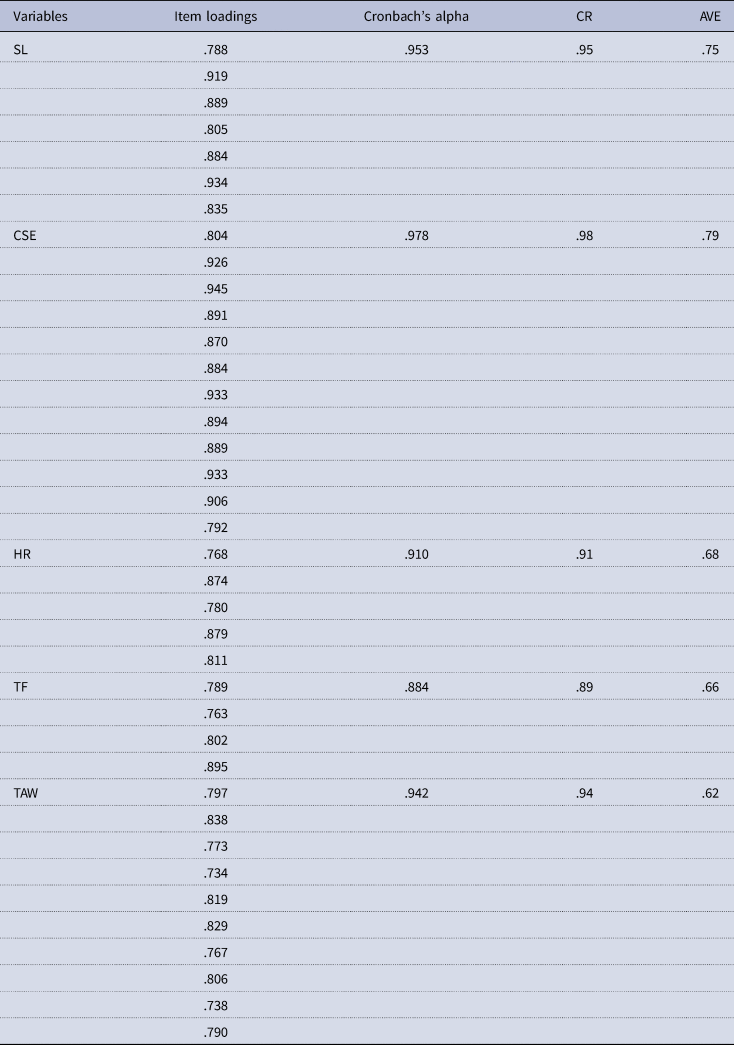
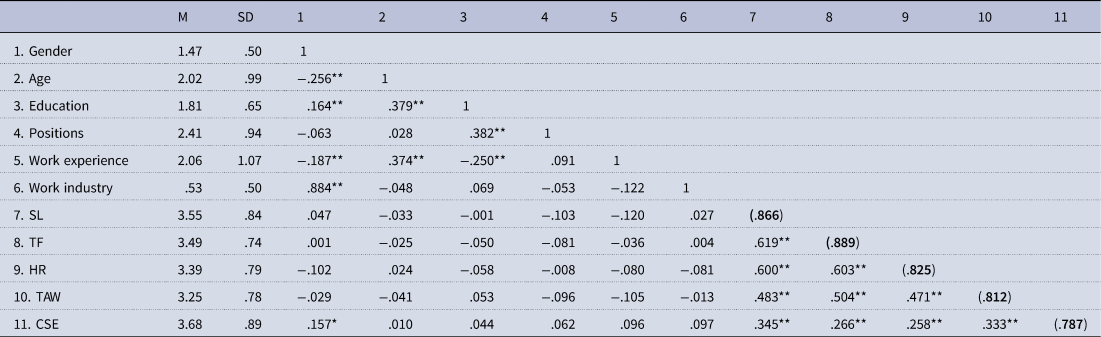
We utilize confirmatory factor analysis (CFA) to test the validity of the hypothesized constructs. The results of the overall CFA reveal an acceptable fit: (χ2 = 1,474.924, df = 655, χ2/df = 2.25, p = .000, CFI = .915, TLI = .909, IFI = .916, PCFI = .852, RMR = .035, RMSEA = .075). Moreover, all item's loadings were higher than the proposed standard of .70. To confirm convergent validity, we check Cronbach's alphas, composite reliability coefficient (CR), and average variance extracted (AVE) scores to indicate how items are interrelated. As illustrated in Table 2, all the Cronbach's alphas and CR values range from .884 to .978 and .89 to .98, respectively, and are above the threshold value of .70. Also, the AVE values ranged from .62 to .79, surpassing the benchmark figure of .50. Accordingly, these results show that the convergent validity of the hypothesized model was adequate. Finally, to confirm discriminant validity, we followed the Fornell and Larcker (Reference Fornell and Larcker1981) procedure and calculated the square root of AVE explained for the items which make up the scales in this study. As presented on the diagonal in Table 3, none of the intercorrelations among the study variables is greater than the AVE square roots; therefore, discriminant validity is demonstrated.
Reliability and validity assessment

AVE = average variance extracted; CR = composite reliability; CSE = core self-evaluations; HR = heedful relating; SL = servant leadership; TAW = thriving at work; TF = task focus.
Descriptive statistics

The bold values in parenthesis represent discriminant validity.
CSE = core self-evaluations; HR = heedful relating; SL = servant leadership; TAW = thriving at work; TF = task focus.
**Correlation is significant at the .01 level (two-tailed); *correlation is significant at the .05 level (two-tailed).
Descriptive statistics and intercorrelations
Table 3 elucidates the descriptive statistics as well as the means and standard deviations (SDs) of the study constructs. We also tested for the correlations of respondent's demographics (i.e., gender, age, work experience, education, position, and industry type) with the study variables and found no significant correlations with our major variables. Knowing this, we were satisfied that the demographic control variables revealed no meaningful relationship with the study variables in the analysis, so the results without demographics are reported (Spector & Brannick, Reference Spector and Brannick2011). Moreover, we ran analysis of variance to test whether there is a significant difference in the study variables regarding age, gender, education, position, and work experience. The results showed that there was no significant difference among study variables with respect to age, gender, education, position, and work experience. Therefore, our results were essentially equivalent with or without these control variables (Becker, Reference Becker2005). All the intercorrelations among variables were in the suggested directions.
Tests of hypotheses
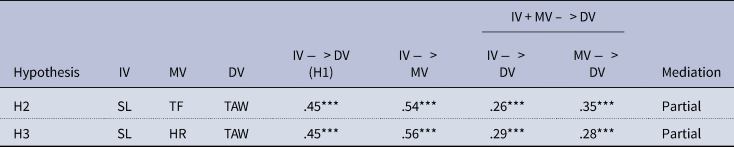
The first study hypothesis presumes that SL is positively related to workplace thriving. The study results in Table 4 support Hypothesis 1, as the total effect (c) indicates a positive, significant relation between SL and workplace thriving (β = .45, p < .001).
Mediation results through bootstrapping

DV = dependent variable; HR = heedful relating; IV = independent variable; MV = mediating variable; SL = servant leadership; TAW = thriving at work; TF = task focus.
***p < .001, **p < .01.
To check the mediating effect (Hypotheses 2 and 3), we adopted two approaches used by recent studies (Zhai, Wang, & Ghani, Reference Zhai, Wang and Ghani2019). Initially, we employed a bootstrap sampling method (bootstrap sample = 5,000). In doing so, we followed the recommendations of MacKinnon, Lockwood, and Williams (Reference MacKinnon, Lockwood and Williams2004) to produce asymmetric confidence intervals (CIs) for an indirect relationship. In comparison with other available models (i.e., Sobel test), bootstrap CI is considered to generate a more accurate estimation. Table 4 reveals the results of the mediating effects through bootstrapping. The results show that task focus mediated the relationship of SL and workplace thriving because the CI (.1112, .2852) did not contain zero. Consequently, Hypothesis 2 was accepted. Also, the mediating effects of heedful relating on the association between SL and workplace thriving were supported, with CIs of (.0794, .2433). Hence, Hypothesis 3 was also supported.
To further test whether the supported intervening effects partially or fully mediate the SL–thriving linkage and also to increase the robustness of the hypothesis testing, we followed Baron and Kenny's (Reference Baron and Kenny1986) procedures. According to their recommendations, three kinds of relationships should be significant for any valid mediating effects: (a) independent and dependent variables, (b) independent variables and mediator, and (c) the independent and dependent relationship controlling the mediator. Following these suggestions, if the independent and dependent variable relationship controlled by the mediator becomes nonsignificant, the relationship is considered full mediation (MacKinnon, Lockwood, Hoffman, West, & Sheets, Reference MacKinnon, Lockwood, Hoffman, West and Sheets2002). Conversely, if the first three conditions hold, then partial mediation exists. The results in Table 5 indicate the result of the three-step mediation test, as suggested by Baron and Kenny (Reference Baron and Kenny1986). In step 1, the relationship of SL and thriving at work was significant (β = .45, p < .001). Next, the relationship of SL with task focus (β = .54, p < .001) and heedful relating (β = .56, p < .001) were also significant. Finally, the relationship of SL and thriving was significant in the presence of task focus and heedful relating, indicating partial mediation. Thus, it can be concluded that task focus (Hypothesis 2) and heedful relating (Hypothesis 3) partially mediate the SL–thriving relationship.
Mediation results through Baron and Kenny procedure

DV = dependent variable; HR = heedful relating; IV = independent variable; MV = mediating variable; SL = servant leadership; TAW = thriving at work; TF = task focus.
***p < .001.
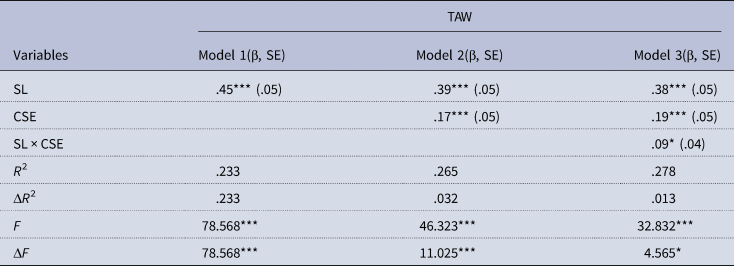
To test Hypothesis 4, we employed a stepwise hierarchical multiple regression analysis, as presented in Table 6. Hypothesis 4 proposed that CSE moderates the SL and workplace thriving relationship. Following Aiken and West (Reference Aiken and West1991) recommendations, we centered the independent variable and moderating variable before their interaction term. In the first step, we added SL, followed by adding CSE in the second step. The interaction term (SL × CSE) was added in the last step. The result of the interaction term was statistically significant (β = .09, p < .05), indicating that CSE moderates the SL and thriving relationship.
Results of hierarchical regression analysis

CSE = core self-evaluations; SE = standard error; SL = servant leadership; TAW = thriving at work.
***p < .001, *p < .05.
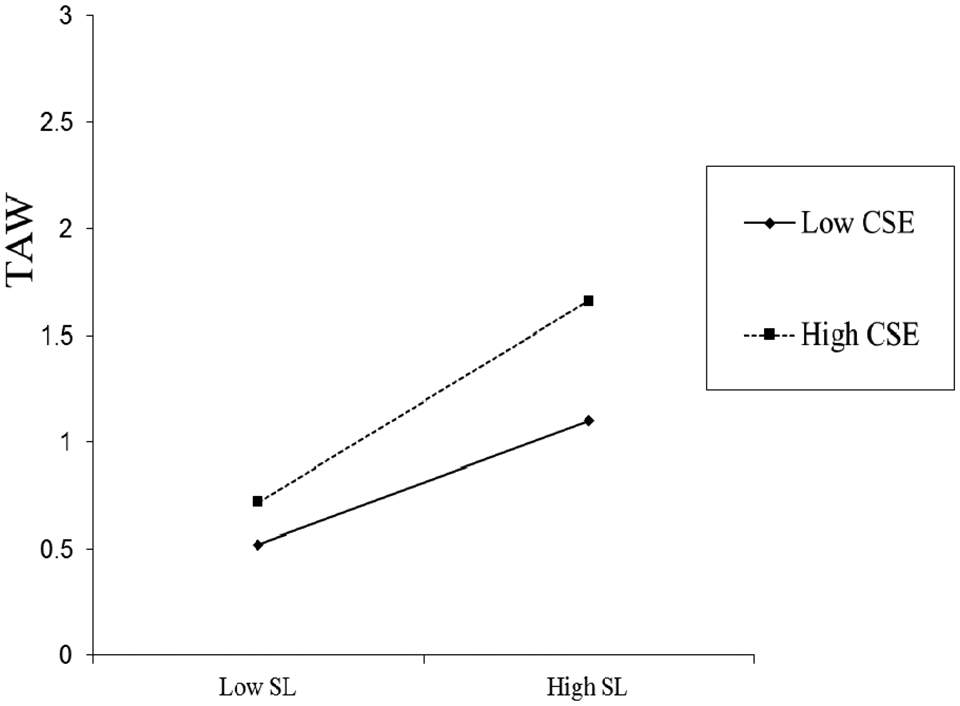
Figure 2 demonstrates the nature of the interaction that was attained by plotting values plus and minus one SD from the mean of self-evaluations to denote a high versus low level of CSEs. We conducted a simple slope test (Preacher et al., Reference Preacher, Rucker and Hayes2007) to locate SL on workplace thriving within high and low CSE levels (see Figure 2). As expected, the results reveal that when self-evaluations are high, the SL and workplace relationship is strengthened, and when self-evaluations are low, SL demonstrates less impact on employee workplace thriving. Thus, Hypothesis 4 was supported.
Plot of interaction between SL and CSEs.

Discussion
Using the tenets of SET (Blau, Reference Blau1964) and COR (Hobfoll, Reference Hobfoll1989), this study's purpose was to investigate that whether and how SL as a contextual enabler could fuel agentic work behaviors. These behaviors, collectively termed an ‘engine of thriving,’ in turn, foster employee workplace thriving. There is ample research evidence that illustrates how a servant leader's behaviors lead to positive outcomes (e.g., Hoch et al., Reference Hoch, Bommer, Dulebohn and Wu2018; Neubert, Hunter, & Tolentino, Reference Neubert, Hunter and Tolentino2016; Sousa & Van Dierendonck, Reference Sousa and Van Dierendonck2017; Walumbwa et al., Reference Walumbwa, Muchiri, Misati, Wu and Meiliani2018). In this regard, and also as per SET (Blau, Reference Blau1964), an enabling work environment provided by the presence of servant leaders facilitates individuals to focus more on their tasks, and be more attentive as well as better coordinate their actions with other organizational members; these actions ensure workplace thriving.
The current paper also provides substantial support for the buffering role of an individual's resources (i.e., CSE) whereas arguing that the potency of CSE is particularly salient for employees to take full advantage of their work context in the presence of servant leaders. Consistent with the COR theory (Hobfoll, Reference Hobfoll1989), our findings suggest that individuals with resources (indicated by high CSE values) are more inclined to acquire other resources, generating specific positive outcomes (such as workplace thriving). For individuals high in CSE, the positive influence stimulated by servant leaders was more distinct and vice versa. Most importantly, the results of the current study elucidate the COR perspective, by applying it as a basis for studying the relationship between positive leadership (i.e., SL) and thriving, as suggested by Eva et al. (Reference Eva, Robin, Sendjaya, van Dierendonck and Liden2018). In this way, the study results have also confirmed the earlier perspectives that positive support from leadership can promote employee thriving (Paterson, Luthans, & Jeung, Reference Paterson, Luthans and Jeung2014) and the personal growth of the employees at work (Sonenshein, Dutton, Grant, Spreitzer, & Sutcliffe, Reference Sonenshein, Dutton, Grant, Spreitzer and Sutcliffe2013). In the next section, we elaborate on the contributions of this study to theory and to practicing organizations.
Implications for theory
The results represent a few important theoretical contributions to the literature. Importantly, the current study amalgamates research on social exchange and COR theories, providing empirical support to fill a significant gap in our understanding of how SL behaviors translate to workplace thriving, and how individual characteristics such as CSE moderate the relationship between SL and thriving. Perhaps the most substantial contribution is the development of the notion of workplace thriving by presenting a significant new contextual enabler facilitating its occurrence: SL. This knowledge is imperative because recently, scholars have revealed that the leader's role in fostering workplace thriving had not been adequately addressed in the extent of thriving studies (Paterson, Luthans, & Jeung, Reference Paterson, Luthans and Jeung2014). In particular, our research suggests that leaders who emphasize developing their employees, serving others, and focusing on individual employee's task effectiveness, are more likely to foster workplace thriving.
Similarly, the current findings further illuminate the COR theory by examining it, for the first time, as underpinning theory to understand the relationship of positive leadership (i.e., SL) and outcomes (i.e., thriving) (Eva et al., Reference Eva, Robin, Sendjaya, van Dierendonck and Liden2018). Similarly, the current study results have confirmed the earlier perspectives that support from supervisors or leaders can promote their employees' thriving (Paterson, Luthans, & Jeung, Reference Paterson, Luthans and Jeung2014) and growth (Sonenshein et al., Reference Sonenshein, Dutton, Grant, Spreitzer and Sutcliffe2013).
Furthermore, by establishing the mediating role of the two agentic work behaviors in the SL–thriving relationship, this study offers valuable insights into the underlying mechanism through which SL effects employee workplace thriving. Specifically, results reveal that the effect of SL on thriving is indirectly translated through the agentic work behaviors of task focus and heedful relating. Hence, this research offers empirical confirmation that by putting attention on the development and wellbeing of their employees, positive organizational leaders (i.e., SL) can generate an environment that encourages individuals to initiate, take suitable risks, try untapped novel means of doing things, and be more likely to act agentically. Consequently, these agentic work behaviors lead to employees thriving in their workplaces. This line of argument is further echoed through SET, as noted by Greenleaf (Reference Greenleaf1998), that SL develops trust among employees, that stimulates them to reciprocate by exhibiting improved performance in the work settings.
Moreover, the study found that a key important personal factor, CSE, moderates the servant leader's effects on employee workplace thriving. In line with the core of CSE that, it is associated with an individual's capability to take full advantage of favorable situations (Chang, Ferris, Johnson, Rosen, & Tan, Reference Chang, Ferris, Johnson, Rosen and Tan2012), our findings reveal that the perception of an individual about servant leaders considerably improves their thriving only for individuals with high in CSE. Extending the findings of Bowling, Wang, and Li (Reference Bowling, Wang and Li2012), the study results confirm and contribute to the interactionist perspective by demonstrating the mutual effects of an organizational factor (i.e., SL) and a key personal disposition factor, CSEs.
Implications for practice
In addition to theoretical implications, the study also presents a few essential implications for practice concerning the use of SL to stimulate the thriving of employees at work. Our findings suggest that to take maximum advantage of the thriving workforce, decision-makers should actively pay full attention to the factors that promote workplace thriving. The model indicates that thriving at work can be elicited by practicing SL style, which enables subordinates to work agentically, which in turn assists leaders to nurture a thriving workforce. Thus, to nurture thriving employees, supervisors need to be consistent in exhibiting the behavioral characteristics of SL.
Further, organizations should keenly oversee the managers' selection and training programs, which is a basic method for leaders to learn and practice key SL behaviors such as empathy, persuasion, awareness, listening, and stewardship (Greenleaf, Reference Greenleaf1977; Van Dierendonck, Reference Van Dierendonck2011). It is well known that managers who concentrate on these behaviors are influential in fostering workplace thriving by providing emotional and other tangible assistance through their role modeling (Liden et al., Reference Liden, Wayne, Liao and Meuser2014).
Moreover, our findings that CSE moderates the SL–thriving relationship suggest that for organizations to achieve a thriving workforce, the unique talents of individuals (in particular, those with high CSE traits) must be recognized during selection processes. It suggests that employees are more likely to thrive at workplaces when they have confidence in their ability to master in different tasks (Kleine, Rudolph, & Zacher, Reference Kleine, Rudolph and Zacher2019). Because prior studies (e.g., Judge & Hurst, Reference Judge and Hurst2008) found that employees with higher CSE acquired knowledge and skills faster, managers should, therefore, pay attention to utilizing and developing such employees, as well as helping them to realize their full potential (Liden, Wayne, & Sparrowe, Reference Liden, Wayne and Sparrowe2000). Because SL focuses on developing employees in the areas of effectiveness, stewardship, and self-motivation, the individuals with high self-evaluation traits should be willing and capable of both initiating and playing a dynamic role in enhancing their performances (Seibert, Wang, & Courtright, Reference Seibert, Wang and Courtright2011), subsequently improving organizational performance.
Limitations and future work possibilities
The study also has certain limitations that could be addressed by future scholars. First, though the current study uses a time-lagged design over three periods, nevertheless, we cannot claim causality because it is not purely longitudinal. We, therefore, invite future scholars to adopt longitudinal or experimental studies to allow for stronger causal conclusions (Podsakoff et al., Reference Podsakoff, MacKenzie and Podsakoff2012). Second, prior research reveals the significance of contextual factors in promoting thriving (Paterson, Luthans, & Jeung, Reference Paterson, Luthans and Jeung2014; Walumbwa et al., Reference Walumbwa, Muchiri, Misati, Wu and Meiliani2018). One potential limitation of the current study is that we only studied a single contextual enabler (i.e., SL) in the context of thriving. In order to address this limitation and determine the degree to which SL explicates incremental variance in the workplace thriving beyond other leadership styles, scholars should consider ethical leadership, transactional leadership, authentic leadership, and leader–member exchange. This might help organizations to identify which leadership approach is most relevant to promote thriving in their particular work context.
Third, we examine only CSE as a moderating variable, and there might be other potential moderators that could account for significant variance in employee thriving at work. Knowing the key role of organizational perspective in fostering workplace thriving (Paterson, Luthans, & Jeung, Reference Paterson, Luthans and Jeung2014), we encourage scholars to explore how various organizational enablers synergistically interact with personal-level enablers to further facilitate workplace thriving. For instance, further studies should examine how certain aspects of work climate or culture may improve or inhibit the relationship between individual-level factors and thriving. Additionally, cultural values may affect the extent to which individuals thrive because these values help to gage the meaning of numerous motivational procedures as to individuals' wellbeing and self-worth. For example, a study revealed that dimensions of culture do influence transformation leadership effects across multiple countries (Zwingmann, Wegge, Wolf, Rudolf, Schmidt, & Richter, Reference Zwingmann, Wegge, Wolf, Rudolf, Schmidt and Richter2014). Hence, we suggest that our study should be replicated in other cultural contexts to generalize the theorized model further. Finally, our study findings reveal that agentic work behaviors partially mediate the SL–thriving relationship. As such, we provide a basis for future researchers to evaluate other intervening mechanisms to understand the SL and workplace thriving relationships fully.
Conclusion
In conclusion, this research adds several key contributions to theory and practice through further providing support for the significance of SL and empirically investigating unexplored factors related to the experience of workplace thriving. Specifically, we found that SL is directly and indirectly (via task focus and heedful relating) linked positively with individuals workplace thriving. Finally, we uncover that employees having high CSEs strengthens SL and workplace thriving relationships. Overall, we contributed to the goal of better understanding regarding SL and thriving, and its importance for contemporary organizations.
Acknowledgement
We thank all our research collaborators in Beijing, China. We also thank all the participants for their unique contribution to the study.
Funding
a) The research was supported by the National Natural Science Foundation of China (71271055), b) Later Stage Project of the Ministry of Education for Philosophy and Social Sciences (18JHQ090) and c) Beijing Municipal Key Programs of Education Sciences during the 13th Five-Year Plan Period(BAEA18043).
Muhammad Usman is a postdoctoral fellow at School of Management, Xiamen University, China. His research focuses on employee's workplace thriving, leadership, culture, and personality.
Yuxin Liu is a professor of psychology at the Business School of the University of International Business and Economics, Beijing, China. She received her PhD from Beijing Normal University. Her research focuses on employees' psychological well-being, thriving at work and work motivation.
Haihong Li School of Business Administration, Shandong Universtiy of Finance and Economics, 7366 East Second Ring Road, Lixia Distinct, Jinan 250014, P.R. China. Her research focuses on organizational behavior and human resources.
Jianwei Zhang is a professor of psychology at School of Humanities and Social Science at the Beijing Institute of Technology. He received his PhD from Beijing Normal University, Beijing, China. His research focuses on psychological well-being, team scientific creativity, and key competence.
Usman Ghani is a postdoctoral fellow at the College of Education, Zhejiang University, Hangzhou, China. His research interest focuses on leadership, knowledge management, and organizational behavior.
Habib Gul is a PhD Scholar in Business School, University of International Business and Economics Beijing, China. His research mainly focuses on leadership behavior dynamics, person-environment fit, cross-cultural management, and innovative work behavior.