INTRODUCTION
In the preindustrial world, iron was smelted mostly in the form of either bloomery or cast iron (Rostoker and Bronson Reference Rostoker and Bronson1990; Tylecote Reference Tylecote1992). In contrast to bloomery iron, whose carbon concentration is not significant in most cases, cast iron contains carbon in amounts up to approximately 4.3% based on weight. Depending upon the thermal conditions applied, carbon atoms in cast iron either take part in the precipitation of the graphite phase, producing gray, malleable and ductile cast iron, or serve as the major constituent of the cementite phase (Fe3C) in the formation of white cast iron (Verhoeven Reference Verhoeven1975). The high carbon concentration of cast iron distinguishes it from other iron-carbon alloys and its low melting temperature facilitates the fabrication of objects with complex shapes and allows for casting on a large scale. However, a high carbon content greatly reduces impact resistance, so that cast iron cannot be used to make critical functional items such as tools and weapons frequently subjected to impact loading. As such, it is primarily employed for the production of less important agricultural and domestic implements. The functionality of cast iron, however, is enormously expanded when it is transformed into steel by adjusting its carbon level by way of a variety of engineering processes designed for decarburization.
Mongolia is known for the early and continuous use of cast iron from the Xiongnu period (ca. 3rd century BC to 2nd century AD) onward, probably due to the neighboring technological example of China where an iron tradition based on the smelting of cast iron had been firmly established from the beginning of its iron production history in the mid-first millennium BC (Wagner Reference Wagner1996, Reference Wagner and Needham2008; Honeychurch Reference Honeychurch2013). It should be noted, however, that up until the Mongolian empire period (ca. 13th century AD), cast iron-technology was never dominant in Mongolia, but rather served as an auxiliary means of production in support of a traditional iron metallurgy based on bloomery technology (Park et al. Reference Park, Eregzen and Yeruul-Erdene2010; Park and Reichert Reference Park and Reichert2015).
Nevertheless, cast iron consistently played a significant role as the preferred material for making specialized items such as metal components of horse-drawn wagons and various farming and domestic implements (Eregzen et al. Reference Eregzen, Amartuvshin, Gordon and Park2007; Park et al. Reference Park, Chunag and Gelegdorj2008; Park and Reichert Reference Park and Reichert2015). According to Perlee (Reference Perlee1959, Reference Perlee1961), the use of cast iron in Mongolia was greatly expanded during the Khitan period (10th–12th century AD). In addition, the Khitan system of ironworking saw a notable transition when cast iron specialists added the use of mineral coal to replace charcoal in the smelting process (Park et al. Reference Park, Chunag and Gelegdorj2008). Strong evidence has been presented that this transition was carried forward into the subsequent Mongol imperial period (12th–14th century AD) to become the dominant practice in the cast iron industry of the Mongolian empire (Park and Reichert Reference Park and Reichert2015).
In light of the long history of cast iron exploitation in Mongolia with its pertinent technological transitions, one may expect it to be an important archaeological material reflecting regional and temporal variations in its application. One example is provided by recent research on a subset of iron objects excavated from the capital city of the Mongol empire, Karakorum (Park Reference Park2015). Carbon samples extracted from some of these iron objects were radiocarbon (14C) dated in order to demonstrate that coal-based smelting dominated the cast iron industry of that time. When these 14C data were combined with associated microstructural information, the results confirmed that coal-smelted cast iron was utilized as an input material for steelmaking conducted in charcoal-fired environments (Park Reference Park2015). Evidently, the use of charcoal in this process was carefully selected to improve product integrity by eliminating the introduction of additional defects associated with the use of mineral coal. The chronology of such cast iron objects and their derivative steel products could be inferred from 14C analysis on charcoal samples recovered from the same contexts as that of the respective artifacts.
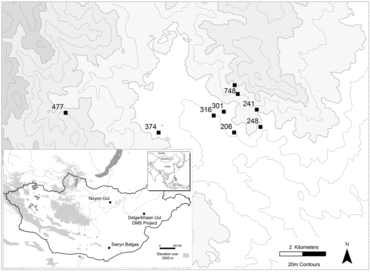
In the present article, we analyze 10 cast iron objects recovered by the Mongolian-American collaborative expedition to eastern Mongolia known as the Dornod Mongol Survey or DMS (Figure 1). Preliminary examination has revealed a variety of microstructural evidence required for the characterization of key historical engineering processes involving cast iron. These include smelting, steelmaking and diverse thermo-mechanical treatments. It was also determined that iron objects of varying chronological periods were included in one and the same artifact assemblage from a single phase site. This might be expected given the probable recycling of such useful material, which seems to have been a long established metallurgical practice in ancient Mongolia (Park et al. Reference Park, Honeychurch and Chunag2011). The difficulty of interpreting 14C data derived from recycled materials, however, constitutes a significant hurdle to obtaining the rich technological and contextual information available from cast iron artifacts.
Inset is a map of Mongolia showing geography and archaeological sites mentioned in the text. Full map displays the topographical position of the eight DMS sites studied at Delgerkhaan Uul. Elevations range from 1140 to 1260 m above sea level with 20-m contour intervals.

With this concern in mind, we performed 14C analysis of selected cast iron objects primarily from DMS sites with the specific purpose of comparing and contrasting dating results with engineering processes as inferred from microstructural analysis. We review the outcome below with regard to site periodization based on artifact typology and 14C analyses. The comparison provides analytical grounds for using 14C data as a means to probe the history of a given cast iron object and its multiple users through time—users who were often separated in time by more than a millennium.
COMMENTS ON ARTIFACTS
Figure 2 illustrates 12 cast iron objects selected for 14C analysis from those metallographically examined. These objects were recovered from the DMS survey area (Park et al. Reference Park, Honeychurch and Chunag2019a) as well as two other sites which are included for comparative purposes. Object #1 is a wheel axle cap excavated from the royal Xiongnu burial, labeled Grave #1, in the Sujigt valley at Noyon Uul, Tov province (Dorjsuren Reference Dorjsuren and Dorjsuren2003) while #2, a wheel bushing, is a surface find from the walled settlement at Sairyn Balgas in Omnogobi province with evidence of occupation from the Xiongnu period (Amartuvshin et al. Reference Amartuvshin, Monkhbayar, Badma-Oyu and Nyamkhuu2013: 12; Park et al. Reference Park, Honeychurch and Chunag2016) (Figure 1). These two objects provide useful comparisons but our primary focus is on objects #3–12 all of which have been recovered from DMS sites at Delgerkhaan Uul in Sukhbaatar province (Figure 1).
The general appearance of the cast iron objects under consideration. Object #1 is an axle cap for the horse-drawn wagon excavated from Grave #1 of the Xiongnu site at Noyon Uul of the Tuv province (Dorjsuren Reference Dorjsuren and Dorjsuren2003), #2 a broken axle hub recovered from the Xiongnu military outpost at Sairyn Balgas in the Omnogobi (South Gobi) province (Park et al. Reference Park, Honeychurch and Chunag2016), #3–12 fragments recovered by the authors (ChA and HW) from the site at DMS in the Dornod province. Objects #6, 9, 10, and 12 are distinguished from the other fragments in their peculiar surface irregularity characteristic of solidification from a partially molten state. The bars under the object numbers correspond to 5 mm except in #1 and 2 where they are 1 cm; the numbers labeling the objects are consistent with those in Table 1.

Careful examination of Figure 2 reveals that although the DMS objects are all in the form of small fragments, objects #6, 9, 10, and 12 are clearly distinguished from objects #3, 4, 5, 8, and 11 in terms of their surface characteristics. This difference arises from the distinctively irregular surface features consistently displayed only in the former group, which are characteristic of a solidification reaction from the partially molten state. Their peculiar surface features are diagnostic of a thermal treatment applied to these objects at temperatures slightly above the melting point. Surface irregularities are also visible in object #7. These, however, did not result from such a treatment but from non-uniform deterioration of the surface by oxidation. The DMS assemblage under consideration, therefore, consists of small pieces of cast iron that may or may not have had a specific thermal treatment applied subsequent to initial casting. This fact suggests the possibility that those fragments in as-cast condition served as a raw material for this thermal processing.
Using the same number system as found in Figure 2 and Table 1 provides brief information about each artifact in terms of its recovery site, mass, purpose and typological period, along with pertinent microstructure and 14C data. These 14C results will be presented in greater detail below. A notable aspect of Table 1 and Figure 2 is that the DMS site finds are small fragments weighing only 35 g or less with an average of only 17 g. Additionally, objects #9, 10, and 12 were found to have small pieces of charcoal attached to their surfaces, which were then labeled 9b, 10b, and 12b with the respective parent metal parts denoted by 9a, 10a, and 12a. Based on this, it is almost certain that the thermal treatment evident in these particular objects was produced in a charcoal-fired atmosphere. Most of the DMS site assemblages under consideration were dated typologically to the Khitan/Mongol period. DMS 206, 316, and 477, however, have no remains other than metallurgical ones indicative of periodization.
Summary information, including microstructure and 14C data, for the cast iron objects examined from the archaeological sites at Noyon Uul in Tov province, Sairyn Balgas in Omnogobi province and Delgerkhan Uul in Sukhbaatar province of Mongolia. The 14C measurements were made in the University of Arizona’s NSF-Arizona AMS Facility for 14C analysis (AA) and the Center for Applied Isotope Studies of the University of Georgia (UGAMS) in the USA, and the Christian-Albrechts-University’s Leibniz Laboratory AMS Facility (KIA) in Germany. The numbers labeling the objects are consistent with those in Figure 2.

ayr BP: year before present (AD 1950); b—: Not determined; cEH: Early Historical period; d?: Not determined; e––: Carbon samples originating from mineral coal.
SITE CONTEXTS
The DMS project is a multi-year survey and excavation effort designed to study the prehistory of eastern Mongolia in greater detail. The regional study area includes major centers of ancient habitation and mortuary activity including the area of Delgerkhaan Uul where the initial focus of field research has been concentrated. The local environment at Delgerkhaan Uul marks an ecotone between steppe and arid steppe where a confluence of two seasonal water ways ensures reliable water and pasture to support herd animals. For this reason, Delgerkhaan Uul is rich in pastoral nomadic campsites dating from the Bronze Age up to the 20th century. A systematic survey of approximately 50 km2 thus far has documented close to 200 such sites. In addition, evidence at Delgerkhaan Uul for both copper alloy and iron working is extensive and includes the presence of ores, manufacturing remains, and finished products.
The materials analyzed for this study were recovered from surface collections at eight artifact scatters, five of which are interpreted as seasonal habitations sites (DMS 241, 248, 301, 316, 374, 748) and three as exclusively metallurgical scatters (DMS 206, 316, and 477). Their location on the landscape is illustrated in Figure 1 showing a clustered group extending over about 8 km, suggesting a common use area at the time of the Khitan/Mongol era. These sites are low density artifact scatters of relatively small sizes ranging from 400 to 5500 m2 and containing in the case of the habitations, household remains such as pottery fragments, grinding stones, and small artifacts that include glass beads and coins. These artifact types, and especially instances of decorated pottery, are indicative of the Khitan/Mongol period and were therefore used to assign site chronologies prior to 14C analysis.
MICROSTRUCTURE EXAMINATION
Metallographic examination was done on one or more small specimens taken from each of the objects in Figure 2. They were mounted and then prepared following standard metallographic procedures of polishing and etching. A solution of 2% nitric acid by volume in methanol was used to etch the specimens for examination using an optical microscope. Carbon level was inferred from the microstructures observed and was reported according to weight fraction with an accuracy of 0.1%. The energy dispersive x-ray spectrometer (EDS) included with a scanning electron microscope (SEM) was used to check the presence of other minor elements within a detection limit of approximately 0.1%.
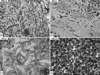
Typical microstructures observed in the metal fragments of Figure 2 are presented in Figures 3(a)–(d), optical micrographs taken from the specimens of objects #2, 11, 3, and 9, respectively. In all of these micrographs, key features developed during casting were well maintained, indicating that the objects were all cast to shape with no mechanical treatment applied after casting. The structure in Figure 3a is seen to consist of dark proeutectic dendrites precipitated in the background of white cast iron eutectic. The average carbon concentration of this specimen, as determined from the relative fraction of the two major constituents, is approximately 3.5% if the carbon content of dendrites and white cast iron eutectic is taken to be 0.77% and 4.3%, respectively. Similar structures were also observed in objects #1 and 8 with a slight difference in the size and fraction of the two constituents, reflecting variation in carbon contents and cooling rates.
Micrographs. (a)–(d) Optical micrographs showing the structure of objects #2, 11, 3, and 9 in Figure 2, respectively.

Figure 3(b) consists primarily of white cast iron eutectic, indicating that the given specimen was cast from alloys of near eutectic composition, 4.3% carbon. Objects #4, 5, and 7 were also found to have similar structures. Figure 3(c) presents another structure consisting entirely of dark graphite flakes embedded in a matrix of pearlite. This structure, termed gray cast iron eutectic containing 4.26% carbon, cannot be obtained in the casting of silicon-free cast iron alloys unless the solidification rate is extremely low. No silicon was detected in EDS analysis, indicating that a special technique was applied to the given object during casting, evidently in an effort to improve its impact resistance by suppressing the formation of brittle white cast iron structure.
Figure 3(d) represents structures observed consistently in objects #6, 9a, 10a, and 12a, all of which bear evidence of thermal treatments given in the partially molten state. The micrograph is filled almost completely with dark pearlite areas with a little cementite phase at their boundaries, allowing the average carbon level to be determined at around 2.0% or less. EDS analysis of this specimen and that from 10a detected the presence of 0.6–1.0% silicon (Si), 0.3–0.6% sulfur (S), and 0.4–0.5% phosphorus (P), suggesting that both of them were derived from coal-based smelting.
14C ANALYSIS
The cast iron objects in Figure 2 and the charcoal attached to the surface of objects #9, 10, and 12 were 14C dated using accelerator mass spectrometry (AMS). A metal piece of approximately 1 g was taken from each of the cast iron objects while 30 mg or more of charcoal was collected from each of the charcoal-bearing objects. The preparation of carbon samples and their 14C measurements were made at the University of Arizona’s NSF-Arizona AMS Facility for 14C analysis (AA) and the Centre for Applied Isotope Studies of the University of Georgia (UGAMS) in the USA as well as at the Christian-Albrechts-University’s Leibniz Laboratory AMS Facility (KIA) in Germany.
The 14C data are summarized in Table 1, where the 1σ 14C age was calculated from the values obtained in the measurement of 14C concentrations (Donahue et al. Reference Donahue, Linick and Jull1990) and given in years before present (yr BP) as of 1950. The calendar date was then computed using Calib Rev 7.1.0 (Stuiver and Reimer Reference Stuiver and Reimer1993; Stuiver et al. Reference Stuiver, Reimer and Reimer2017) in conjunction with the extended 14C database IntCal13 (Reimer et al. Reference Reimer, Bard, Bayliss, Beck, Blackwell, Bronk Ramsey, Buck, Cheng, Edwards, Friedrich, Grootes, Guilderson, Haflidason, Hajdas, Hatté, Heaton, Hoffmann, Hogg, Hughen, Kaiser, Kromer, Manning, Niu, Reimer, Richards, Scott, Southon, Staff, Turney and van der Plicht2013). The calibrated date within a 2σ probability range was provided for all objects except #9a and 10a where the 14C concentration was too low to represent their real age, indicating the use of mineral coal-based smelting in keeping with the prediction based on metallographic examination. Apart from these two cases, the calendar date in Table 1 ranges from the mid-4th century BC (#2) to mid-17th century AD (#9b). During this time period, cast iron was continuously used in Mongolia and the 14C data of the objects in question plausibly represent their real ages.
The date estimations based on typological grounds and 14C results are seen in objects #1, 2, 7, 9b, 10b, 11, and 12b to be in good agreement, whereas objects #9b, 10b, and 12b are charcoal samples whose 14C age should represent their real chronology. In objects #3, 4, 5, 6, and 12a, however, significant deviations are found between the ages inferred from the two sources of chronological evidence. It should be pointed out that the 14C-based age of these particular objects are always substantially older than its period assessment as based on typological grounds. Another fact of significance associated with these samples is that objects #6 and 12a are among those with evidence of thermal treatments responsible for the uniquely irregular surface topography and a significantly modified microstructure. These observations point to the possibility that their respective 14C concentrations may have been significantly modified by fuels used in such treatments.
DISCUSSION
The 14C data provided in Table 1 reveal that the metal objects under investigation all originated from charcoal-based smelting with the exception of two from the DMS sites, both of which derived from mineral coal-based smelting. The date of these coal-smelted objects was determined from the 14C age of charcoal samples recovered from their surface, and determined to be of the late Mongol period, while those from charcoal-based smelting were directly dated according to their 14C age. With the exception of an old wood effect, this date should represent the pertinent site chronology unless the given object was intrusive. The two Xiongnu period objects satisfy this expectation but the majority of the DMS metal fragments diverged significantly from their assigned typological period. The cause of this discrepancy becomes clear when we consider the 14C data in the context of microstructure and typological periodization.
The microstructure and 14C results in Table 1 reveal that the 14C age agrees with the proposed context-based periodization only in some, but not all of the objects that are in as-cast and unmodified condition. No such agreement however, is seen in those samples that were thermally treated and had their initial cast structure substantially altered. These objects have their carbon content consistently and significantly lowered, signifying that the treatment was intended to make steel from cast iron using a very small-scale process (Park et al. Reference Park, Honeychurch and Chunag2019b). In this process, carbon atoms flow in two opposite directions to and from a given specimen such that the net carbon flux promotes decarburization (Park Reference Park2015). It is impossible therefore to keep some of the original carbon atoms from being replaced by those introduced from the heat-treating atmosphere fired by burning charcoal of younger age. This counter flux inevitably brings about a notable increase in 14C concentration over the initial value set prior to the thermal treatment. A similar reaction may also be responsible for the 14C concentration of the coal-smelted objects, which is still quite significant when compared with the date of what would normally be expected from fossil fuels. A calculation based on different combinations of two carbon sources with known age showed that the 14C contribution from charcoal was 5% or less in objects #9a and 10a if the 14C age associated with the untreated cast iron objects is 50,000 yr BP or below, while it was approximately 14% or less if the real age of object #12a corresponds to 1500 yr BP or below.
These DMS metal objects were all recovered in the form of small fragments weighing only 35 g or less. In such a fragmentary state, cast iron is of little value and of little use in any practical application. However, given the small-scale technology discussed above, small pieces of cast iron could have readily been converted into steel. Provided that steel would have only been used for the most critical part of tools or weapons, even small quantities would have been sufficient for making these items. Cast iron fragments, therefore, likely constituted a relatively valuable commodity that had substantial utility if recycled. Given this situation, cast iron objects with multiple chronological contexts were likely collected, broken into small pieces and then utilized or accidentally deposited in a given work area or habitation site. The 14C data support this prediction by demonstrating that metal fragments dated no later than the proposed site periodization were in fact recovered from the majority of DMS sites in question. It is important to mention again that the proposed steelmaking process causes substantial modification in 14C concentrations in treated objects. The current 14C data of those treated, therefore, do not represent the actual date of their initial manufacture but may only be assigned the latest possible date for the original casting of those artifacts.
This seemingly confusing situation in which differing 14C ages combine with varied technological and archaeological contexts may be clarified by focusing on objects #11, 12a, and 12b—all from site DMS748 which dates typologically to the Khitan/Mongol period. First of all, the thermal treatment given to object #12a should be contemporaneous with the age of the charcoal that was used as the fuel source for this process. This expectation is confirmed by the age of object #12b, AD 14th century, which is within the range of the proposed typological site periodization. A substantially different 14C date for object #12a, determined to be from the 7th century AD, reveals that it was originally cast much earlier than the charcoal-based processing. This indicates that the object had been produced during an earlier period and then later recycled in the specialized steelmaking process proposed above. Given that 14C concentrations in cast iron become higher when processed in a young charcoal-fired environment, the difference in 14C ages between objects #12a and 12b must have been even greater before the thermal treatment. This implies that the date inferred from its current 14C age corresponds to the latest possible date when object #12a was initially made. Without such a treatment applied, therefore, 14C concentrations of cast iron may represent the actual date of its production. This prediction is supported in part by the 14C age of object #11, which indeed dates to the expected Khitan/Mongol period. However, this conclusion still maintains the possibility that object #11 could have been cast during the Khitan period and then recycled during the following Mongol period.
The 14C data for charcoal samples collected from objects #9a, 10a, and 12a, all of which were treated, show that the steelmaking technology in question was practiced from the late 13th century AD at the latest. We note that cast iron derived from both charcoal-based and coal-based smelting was used for steelmaking, as can be seen in objects #6 and 12a and objects 9a and 10a, respectively. The 14C data from the relevant metal and charcoal specimens reveal that the charcoal-smelted objects came from the Khitan period or earlier as opposed to those from coal-based smelting which date to the Mongol period or later. This result is in agreement with the evidence reported by Park et al. (Reference Park, Chunag and Gelegdorj2008) providing evidence for a significant technological transition during the Khitan period based upon the use of mineral coal instead of charcoal in smelting. This method later came to dominate in the cast iron technology practiced during the Mongol imperial period.
SUMMARY AND CONCLUSION
A collection of Mongolian cast iron objects recovered mainly from eight DMS archaeological sites at Delgerkhaan Uul in Sukhbaatar province was examined for their microstructure and 14C age. Estimation based on typological grounds placed the DMS sites of interest between the Medieval and Early Historic period, with the majority of them belonging to the Khitan/Mongol period. Our artifact assemblage also includes two cast iron objects from earlier Xiongnu period contexts as well as charcoal samples attached to the surface areas of three DMS metal objects.
The microstructure and 14C data presented above show that cast iron had long been used in Mongolia from the Xiongnu period onward, with the occurrence of a significant technological transition before the coming of the Mongol empire caused by the use of mineral coal in smelting. The 14C results reveal that the metal objects examined were all derived from charcoal-based smelting except for two from DMS sites dating to the Mongol period or later. In the charcoal-derived objects, however, significant discrepancies were noted between 14C ages and dates estimated from site contexts. The microstructure data show that this disagreement is associated with a thermal treatment applied for the purpose of transforming cast iron into steel by decarburization (Park et al. Reference Park, Honeychurch and Chunag2019a). Evidence was found in some DMS objects suggesting that small pieces of cast iron could readily have been converted to steel using this particular method. With this small-scale technique available, evidently by the late 13th century AD, we argue that cast iron in fragmentary form became an important item to be recycled as a raw material for the making of highly valued steel. Interestingly, recycling in later periods and the thermal treatment for steelmaking add to the uncertainty involved in the interpretation of the 14C age for a given cast iron object. However, when carefully interpreted in light of metallographic and other chronological approaches such as artifact typologies and site contexts, this uncertainty can be diminished and clarified. The end result is an improved understanding of the chronology, technology, and diverse uses of a given cast iron object across different time periods.
Cast iron has long been a material of practical significance in Mongolia ever since it was first used during the Xiongnu period. It therefore constitutes a critical source of archaeological evidence for the study of Mongolian history, which is not available otherwise. Through its recycling, cast iron served as a material medium that connected nomadic communities that existed during very different time periods. Cast iron technology played an underlying role in the shaping of several important periods of the Mongolian past and certainly influenced the development of eastern steppe economies, interaction networks, transportation methods, and weapons systems. Indeed, the diverse structures of states and empires founded on the Mongolian steppe, as well as the daily practices of herding households, were likely sensitized to the needs and efficiencies of cast iron metallurgy. Researchers have only begun to probe the complexities of metalworking traditions among ancient groups in Mongolia and key questions remain to be addressed by future research. For a few examples, we are particularly curious to know how the chronology, technology and role of cast iron observed at the DMS sites compare to those factors in other parts of Mongolia (cf. Park and Reichert Reference Park and Reichert2015). Were the processes documented by the DMS objects unique to the eastern region under consideration or common to Mongolia in general? In the process of answering such questions, we expect that cast iron technology will provide a venue to better understand interactions among nomadic communities on the eastern steppe as well as with communities in Siberia, China, and Central Asia, all of which had their own unique histories of cast iron technology and production.
ACKNOWLEDGMENTS
The DMS project would not have been possible without the generous collaboration of the Institute of History and Archaeology, Mongolian Academy of Sciences. The analysis and research presented here was financially supported by the National Research Foundation of Korea (NRF-2016- K2A9A2A19938859; NRF- 2017R1A2B4002082) and by the U.S. National Endowment for the Humanities (Grant RZ-249831-16).