North Korea dramatically announced its membership in the world's nuclear club with two weapons tests, the first in October 2006 and the second in May 2009. The South Korean government responded quite differently to each test. After the first test, the administration under Roh Moo-hyun adopted a conciliatory stance, downplaying tensions between the two Koreas. But nearly three years later, the new administration under Lee Myung-bak sharply departed from the earlier response and moved swiftly to strengthen its alliance with the United States (Fackler and Choe Reference Fackler and Choe2009). The critical question is: to what extent does the South Korean public support these policy changes?
Two major American media outlets have presented different answers. The New York Times reported that the second test pushed South Koreans away from engagement with North Korea and toward a stronger alliance with the United States (Fackler Reference Fackler2009). National Public Radio, on the other hand, reported that the weapons tests did not fundamentally change public opinion, with some people downplaying the tests, unmoved by the recent events, and others finding further proof of the North's hostility (Kuhn Reference Kuhn2009). The Times article nicely captured the ways in which increasing apprehension over North Korea's recent actions was pushing the vast majority of South Koreans closer toward the alliance, while the NPR piece highlighted a national division impervious to the heightened tension on the Korean peninsula. Although these two reports appear contradictory, they in fact each capture part of the story. To better understand the underlying dynamics, it is important to consider several questions:
• The Times identified North Korean aggression as a factor in changing South Korean attitudes toward the South Korean–U.S. (ROK–U.S.) alliance. Are other significant factors involved?
• Are there distinct groups within the South Korean public that are defined by a common outlook on foreign policy issues?
• If so, do certain factors affect only some groups but not others regarding their attitudes toward the alliance, as illustrated in the NPR report?
This article attempts to answer these critical questions based on an empirical analysis of South Korean public opinion. Using survey data I collected through Gallup Korea in March 2007, soon after the first nuclear test, this article will explore the factors that underlie public opinion.Footnote 1 I especially aim to identify what truly matters to each of the ideological groups concerning the alliance. In doing so, this article will not only delineate the characteristics of each group, but more importantly, will show what issues should be addressed to achieve solid public support for strengthening the relations between the United States and South Korea. Thus, the findings of this empirical analysis have significant policy implications for the future of the alliance.
THE MEANING OF PROGRESSIVE AND CONSERVATIVE
Any discussion about the present ideological divisions within South Korea must begin with the backdrop of the unresolved conclusion to the 1950–1953 Korean War. South Korea emerged from that conflict under a series of authoritarian regimes that used national security concerns to crack down on dissidents—specifically, people who did not adhere to the strict anti–North Korean line. South Koreans largely accepted this imposed monopoly of conservative ideology both because anti-Communist sentiments prevailed and because the American alliance guaranteed security.
The transition to democracy in 1987 and the accompanying expansion of civil liberties created room for ideological diversification, and as a result, during the first postauthoritarian decade, South Koreans as a whole moved leftward ideologically (Shin and Jhee Reference Shin and Jhee2005, 387). But it was not until the election of Kim Dae-jung, a former dissident and democracy activist, in 1997 that progressive ideas emerged as a viable alternative to traditional conservatism. President Kim pursued a completely new conciliatory approach to North Korea, the “Sunshine Policy,” which his successor Roh Moo-hyun continued, marking 10 years of progressive presidential rule.
Although it is true that the conservative-progressive divide encompasses more than foreign policy, addressing a variety of domestic and, particularly, economic issues, this article focuses on conservatives and progressives as defined by their foreign policy views. Specifically, the prevailing opinion is that a conservative views North Korea as a threat and the ROK–U.S. alliance as key to South Korea's security (Hahm Reference Hahm2007, 188–201; Shin and Burke Reference Shin and Burke2008, 163). A progressive, according to the same opinion, sees North Korea as a partner in national reconciliation and the alliance as an obstacle to inter-Korean détente. Progressives want to extricate South Korea from U.S. influence to pursue an independent policy toward North Korea (Shin and Burke Reference Shin and Burke2008, 159), while conservatives seek a stronger union with the United States.
What is missing in this discussion is any acknowledgement of a centrist group. In fact, many respondents in numerous public opinion polls place themselves somewhere in the middle on the progressive-conservative ideological spectrum. Yet, the current discussion pays scant attention to centrists. As a result of this neglect, centrists are little understood. In fact, some even reject the notion of their existence. For example, when South Korean president Lee Myung-bak spoke approvingly of the role of “middle-of-the-roaders,” his critics responded he was “chasing ghosts named centrists that in fact do not exist in Korean society” (Korea Herald 2009).
The findings of this study indicate that the most accurate picture of the South Korean public, with respect to foreign policy, consists of three groups: conservatives, progressives, and centrists. In coming to this conclusion, this study avoided relying on the self-identification of the survey respondents, because the definition of ideological groups is still evolving and unsettled. Rather, this study used cluster analysis to partition the survey participants into cohesive groups based on shared traits—in this case, a set of common answers to questions about North Korea, the United States, China, and Japan.Footnote 2 Cluster analysis of the data set has revealed that the optimal number of groups that are distinct and internally homogenous is three.
What is remarkable is that these three distinct groups closely resemble existing political definitions. The two clusters at opposite ends are specifically divided over the issues of North Korea and the United States—precisely the issues that conservatives and progressives dispute. The cluster between the two can be identified as the elusive centrists. Another statistical tool, regression analysis, allowed each group to be separately examined to find which factors have a significant impact on attitudes toward the ROK–U.S. alliance. Using regression analysis, this article will test hypotheses drawn from the current discussion, as found in the available literature, on what influences public attitudes toward the alliance. Together, cluster and regression analysis give this discussion solid empirical ground. The resulting picture radically modifies the current understanding of the nature of the progressive-conservative divide and sharpens the definitions of the three ideological groups that have emerged during the past decade. This empirically sound analysis will offer valuable guidance for the future of the ROK–U.S. alliance.
Several findings arise from this study. First, contradicting the commonly held view, it is not the case that the defining issue dividing South Koreans is their attitude toward the alliance. The assumption is that conservatives favor the alliance as a bulwark against North Korea, progressives want to disengage from the United States to pursue an independent policy toward North Korea (Shin and Burke Reference Shin and Burke2008, 159), and centrists fall somewhere in between. This study shows, however, that a considerable amount of support for the alliance exists among progressives, in spite of their anti-American sentiments and pro–North Korean attitudes. What distinguishes the various groups is not their opinions of whether the alliance ought to exist, but their degree of support for the alliance: conservatives want to strengthen the alliance, whereas progressives and centrists want to maintain the alliance as is. Although the three camps hold different opinions on the United States and North Korea, their beliefs all converge on the necessity of the alliance. This is a radical revision to a nearly universally held assumption.
Second, real differences between the groups are shown in the study. As assumed, each of the three groups sees North Korea differently—for conservatives and centrists, North Korea is a threat; for progressives, North Korea is a partner in inter-Korean détente. At a more fundamental level, what separates these groups are the ways in which their varying perceptions affect their attitude toward the alliance. Among conservatives and centrists, the more they see North Korea as a threat, the more likely they are to embrace the alliance, as the aforementioned Times article describes. That is not the case with progressives. How they perceive North Korea—as a greater or lesser threat—does not affect their view of the alliance. In other words, for progressives, the threat posed by North Korea is irrelevant to their evaluation. This progressive exception explains the seemingly strange fact that the deep national division did not weaken in response to North Korea's recent nuclear testing, as reported by NPR. This crucial difference suggests a deep bifurcation of South Koreans in terms of the raison d'être of the ROK–U.S. alliance. Conservatives and centrists value the alliance as a deterrent to the North's aggression, as originally conceived a half century ago, soon after the Korean War. Progressives do not share this conventional view of the alliance, which partially explains why progressives support the ROK–U.S. alliance in spite of their benign view of North Korea.
The findings also bring to light a similarity among the three groups. All three use the same yardstick in evaluating the alliance—the utility of the alliance in the promotion of reconciliation and cooperation between the two Koreas. Of course, they each view the alliance differently—conservatives believe the alliance is helpful, progressives that it is not helpful, and centrists are neutral. But in spite of these differences, within each group, there is a clear correlation between the United States' role in inter-Korean reconciliation and whether the alliance is thought of as a success. To South Koreans, regardless of their ideological orientation, the alliance is essentially tied to the ultimate goal of inter-Korean reconciliation. This finding strongly suggests that to build solid support for the alliance among South Koreans, the alliance should go beyond its original raison d'être and offer a positive vision for the future of the two Koreas, serving as a bridge linking South and North Korea. The alliance is expected to forge peace on the Korean peninsula, not just by deterring the North's aggression, but by helping the two Koreas reconcile and establish lasting peace. This is the new rationale suggested by this study in the post–Cold War era of the Sunshine Policy.
HYPOTHESES SUGGESTED IN ROK–U.S. ALLIANCE LITERATURE
The Role of a Geopolitical Strategy (H1)
Chaibong Hahm argues that geopolitical strategic thinking underlies conservatives' support for the alliance (Reference Hahm2007, 191–93). This view is informed by Korea's tumultuous modern history and its precarious place among stronger neighboring powers. First, in 1910, Korea was colonized by Japan. After Japan was defeated in World War II, Korea was divided, with the USSR controlling the north and the United States occupying the south. Five years later, Korea plunged into civil war, which left the country devastated and still divided. From this historical memory, Koreans came to especially value national independence and sovereignty.
To maintain its independence and peace, South Korea adopted a geopolitical strategy of nonalignment with China, Japan, and Russia and pragmatic alignment with the United States. Conservatives in South Korea believe that the United States is uniquely qualified as an alliance partner, because it is a distant power with no territorial ambitions on the Korean peninsula while still being invested in the Pacific region. From this strategic thinking, Hahm argues, conservatives have embraced the ROK–U.S. alliance for the past half-century (Reference Hahm2007, 191–93).
Hypothesis 1: Geopolitical considerations increase support for the alliance.
The Role of the United States in Korea's Modern History (H2)
Conservatives regard the United States as a benign outsider who rescued South Korea from certain conquest by North Korea in 1950. Furthermore, under the security umbrella of the ROK–U.S. alliance, South Korea experienced dramatic industrialization and democratization, rising from an impoverished country under military dictatorship to the world's thirteenth largest economy with a vibrant democracy (Hahm Reference Hahm2007, 188). For conservatives, the ROK–U.S. alliance is an unmitigated success story.
Progressives, who have emerged on the political scene more recently, maintain a radically different view of the United States. Progressives hold the United States largely responsible for the division of Korea and reject the heroic role that conservatives assign the United States in the history of the Korean War, believing instead that the country only injected itself into the conflict to protect its global interests. In the years that followed the war, the United States interfered in South Korean politics by supporting authoritarian rulers against the wishes of the South Korean people. In short, to progressives, the United States is not the disinterested, benign protector portrayed by conservatives but “a superpower bully” and a self-seeking meddler (Hahm Reference Hahm2007, 189). Whereas both progressives and conservatives seek unfettered national sovereignty, progressives believe that this goal can only be achieved with the end of U.S. interference in Korean affairs, while conservatives see U.S. involvement as a vital part of South Korea's independence (Hahm Reference Hahm2007, 196).
Hypothesis 2: A negative view of the role of the United States in Korean history decreases support for the alliance.
The Role of the ROK–U.S. Alliance in Inter-Korean Reconciliation (H3)
Inter-Korean relations took a new direction with President Kim Dae-jung's Sunshine Policy in the late 1990s. The Sunshine Policy was designed to reconcile the two Koreas through economic engagement. For progressives, engagement with North Korea and improvement of inter-Korean relations is the best way to achieve self-determination without interference from outside powers (Hahm Reference Hahm2007, 196). Over the past decade, progressive administrations under Kim Dae-jung and Roh Moo-hyun have implemented and expanded the Sunshine Policy.
Engagement with North Korea became more complicated after the 2002 revelation that North Korea had been secretly developing nuclear weapons. The ominous prospect of North Korean–led proliferation of nuclear weapons in a post–September 11 world was viewed as a direct threat to the security of the United States. When the United States unilaterally took aggressive steps to denuclearize North Korea, South Korean progressives saw in the ROK–U.S. alliance an obstacle to engagement with North Korea in two related senses. First, they held the United States itself responsible for the situation by giving a cornered North Korea little recourse other than to develop self-defensive nuclear weapons (Shin and Burke Reference Shin and Burke2008, 159). Second, the ongoing hostility between the United States and North Korea fostered the perception that the United States was an impediment to improved inter-Korean relations (Cha Reference Cha2003, 279–80; Cha Reference Cha and Steinberg2005, 126–27; Chae Reference Chae2005, 109–11).
Although South Korean conservatives are not knee-jerk opponents of the Sunshine Policy, they do harbor deep skepticism about the possibility that the North Korean regime will change (Shin and Burke Reference Shin and Burke2008, 155). Whatever else the Sunshine Policy might achieve, for conservatives, North Korea remains an ever-present threat and the alliance remains the key to national security. Therefore, for conservatives, any movement toward inter-Korean reconciliation should be safely pursued within the framework of the ROK–U.S. alliance.
Hypothesis 3: The perception that the ROK–U.S. military alliance is an obstacle to reconciliation between the two Koreas decreases support for the alliance.
Compatibility of U.S. and South Korean Interests (H4)
Progressives hold that there is a fundamental incompatibility between the priorities and interests of the two allies with regard to North Korea (Shin and Burke Reference Shin and Burke2008, 162). The United States views North Korea as a nuclear proliferation problem and has adopted a hard-line policy, while South Korea wishes to preserve peace on the peninsula through improved inter-Korean relations. For progressives, South Korea must choose between improved relations with North Korea and fidelity to the United States. Conservatives, on the other hand, believe that South Korea and the United States share fundamental interests regarding North Korea; that is, both countries view North Korea as a threat. For conservatives, North Korea's nuclear weapons pose a grave threat not only to the United States, but also to South Korea.
Hypothesis 4: The perception that the interests of South Korea and the United States are incompatible decreases support for the alliance.
The North Korean Threat (H5)
It is widely accepted that South Korean progressives and conservatives differ in their assessment of the threat posed by the North Korean military. Conservatives see North Korea as a threat. But progressives, influenced by the changed atmosphere of the Sunshine Policy, no longer see North Korea as a menace (Shin and Burke Reference Shin and Burke2008, 162). Because the original reasoning behind the alliance was that North Korea was a mortal threat, conservatives continue to value the alliance while progressives do not.
Hypothesis 5: The perception that North Korea is a threat increases support for the alliance.
Wariness of China (H6)
Finally, the China factor has an impact on attitudes toward the ROK–U.S. alliance. There are two ideas on this. One is that South Koreans, observing China's rise in economic and political power, increasingly favor closer ties with China over the United States. However, with little empirical support, this view has weakened over time (Chae and Kim Reference Chae and Kim2007; Kim, Parker, and Choi Reference Kim, Parker and Choi2006, 437; Kim and Lim Reference Kim and Lim2007, 78–79).
The second idea is that South Koreans eye China with suspicion. China's rise, far from being a cause for attraction, is instead viewed as a menace, especially with China's growing influence with North Korea (Kim and Lim Reference Kim and Lim2007, 79; Lee Reference Lee2008, 27). South Koreans are especially wary of China's intentions and possibly meddlesome role in a future Korean reunification. This concern has led South Koreans to seek closer ties to the United States as a counterbalance to China's growing influence on the future of the Korean peninsula.
Hypothesis 6: Wariness of China increases support for the alliance.
CLUSTER ANALYSIS (FINDING IDEOLOGICAL GROUPS)
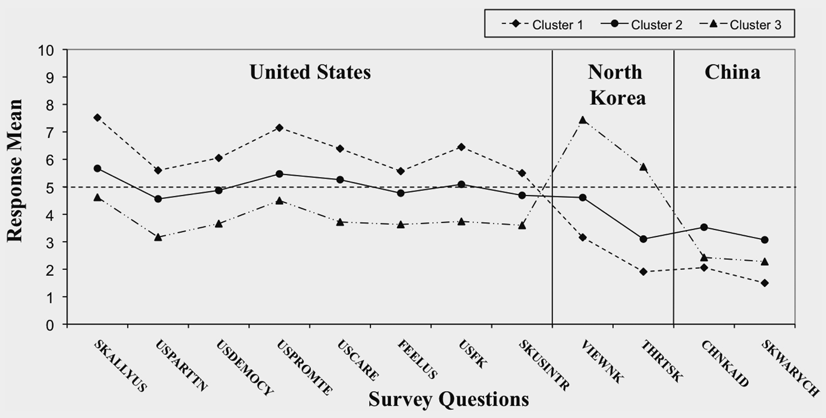
Figure 1 shows the results of the cluster analysis. The horizontal axis shows survey question areas related to the six hypotheses, organized by subject matter.Footnote 3 The vertical axis shows the response means, with 5 indicating a neutral response, values above 5 representing a favorable view of the subject, and values below 5 being unfavorable.
Profiles of Three Clusters

The three plotted lines represent the three distinct camps uncovered by cluster analysis. Cluster One (at 32% of the population) is readily identified as conservatives because of their favorable view of the United States and view of North Korea as a threat. Cluster Three (at 16%) matches the common description of progressives: an unfavorable view of the United States, a positive view of North Korea as a partner in inter-Korean détente, and a lack of alarm at North Korea's nuclear weapons. Cluster Two straddles the reference line. This cluster represents South Korea's centrists, who are by far the largest group at 52%. They hew to the middle viewpoints on the United States and North Korea, although they do side with conservatives regarding the threat posed by North Korean nuclear weapons. On China, all respondents expressed deep suspicions.
With respect to demographics, the consensus among analysts is that age is a crucial factor in a person's ideological orientation. Because the younger generation, unlike its parent generation, did not experience the Korean War or national poverty, they formed “a much more benign view of North Korea” (Hahm Reference Hahm2007, 189) and are “eager to liberate a proud, successful, prosperous Korea from foreign (read U.S.) influence” (Shin and Burke Reference Shin and Burke2008, 162). As a result, the younger generation supports progressive views and constitutes the majority of the progressive camp (Hahm Reference Hahm2007, 189).
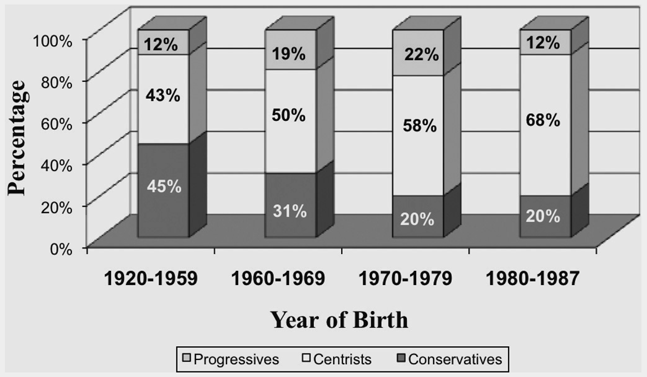
Figure 2, however, shows a quite different picture. The figure shows four age groups and the percentage breakdown for each ideology within each group. The figure reveals two interesting facts. First, centrists make up the largest segment in each age group, except for the oldest generation. Also, moderate views gain in popularity as age decreases, with the youngest group having the highest percentage of centrists. Second, when we compare the two ideological wings within each age group, we find that the oldest group has the largest disparity between each side (a 33% gap), with conservatives far outnumbering progressives. The three remaining age groups have far greater parity between the two ideological camps (ranging from 2% to 12%).
Age Groups Broken Down by Ideologies

From these observations, two conclusions can be drawn. First, the oldest age group is the most ideologically oriented, and they heavily tilt conservative. This finding is as expected from the literature. Second, the younger generation is made up of many more centrists and conservatives than commonly assumed. Note that in the youngest group, conservatives comprise a larger proportion than progressives. Especially of interest, this conservative tilt is also true for the so-called “386 generation” (1960–1969).Footnote 4 In the group with the largest progressive component (1970–1979), the size difference between the two ideological wings is almost negligible. This portrait of the younger generation—moderation and parity between ideologies—contradicts the commonly held view that the younger generation heavily slants progressive.
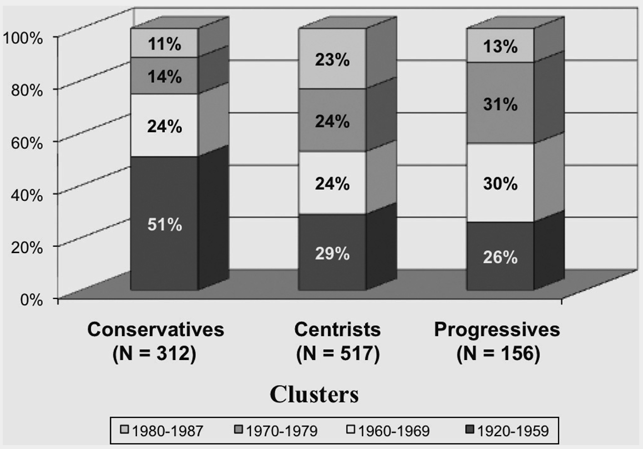
Figure 3, showing the percentage breakdowns for each age group, reveals an interesting difference among the ideological camps. Conservative political ideology draws a little more than half of its support base from the oldest age group, whereas centrist and progressive ideologies draw from all age groups roughly equally, indicating that age is not a factor in determining ideological orientation with centrists and progressives.
Ideologies Broken Down by Age Groups

REGRESSION ANALYSIS (TESTING HYPOTHESES)
Dependent Variable
The dependent variable is the attitude of South Koreans toward the ROK–U.S. alliance. To measure this outlook, the following survey question was used: “Keeping South Korea's relations with North Korea in mind, what is your view regarding whether South Korea should or should not transform its alliance relationship with the U.S.?” Respondents were asked to express their level of support for the alliance on an 11-point scale, with 0 meaning “terminate the alliance,” 5 meaning “maintain the current alliance,” and 10 meaning “strengthen the alliance.”
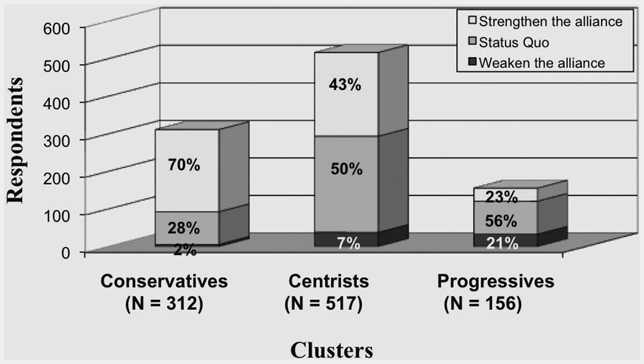
Figure 4 compares the three groups in terms of their attitudes toward the alliance. The height of each bar represents the number of respondents for each group. Each bar consists of three segments: the bottom segment represents individuals who want to either terminate or weaken the alliance (response scores 0–4), the middle represents those who wish to keep the alliance as it is (response score 5), and the top represents those who wish to strengthen it (response scores 6–10). Figure 4 shows that an overwhelming number of South Koreans, regardless of their ideological orientation, support the alliance, either wanting to keep it as is or strengthen it: 98% of conservatives, 93% of centrists, and 79% of progressives support the alliance.
View on the ROK-US Alliance

The figure also shows the clear differences between the groups. A large majority of conservatives (70%) want the alliance strengthened, whereas a majority of centrists and progressives (50% and 56%, respectively) believe that the alliance is fine as it is. These viewpoints are reflected in the higher median score of 8 that conservatives garner and the lower median of 5 associated with both centrists and progressives. Essentially, this means that conservatives want to strengthen the alliance, whereas centrists and progressives want the status quo.
Independent Variables
Six sets of independent variables are of interest:
• The role of a geopolitical strategy (H1)
• Views on the role of the United States in Korea's modern history (H2)
• Views on the role of the military alliance in inter-Korean reconciliation (H3)
• The perception of compatibility of U.S. and South Korean interests (H4)
• Perception of the North Korean threat (H5)
• Wariness of China (H6)
Measurement of these independent variables is detailed in the appendix.
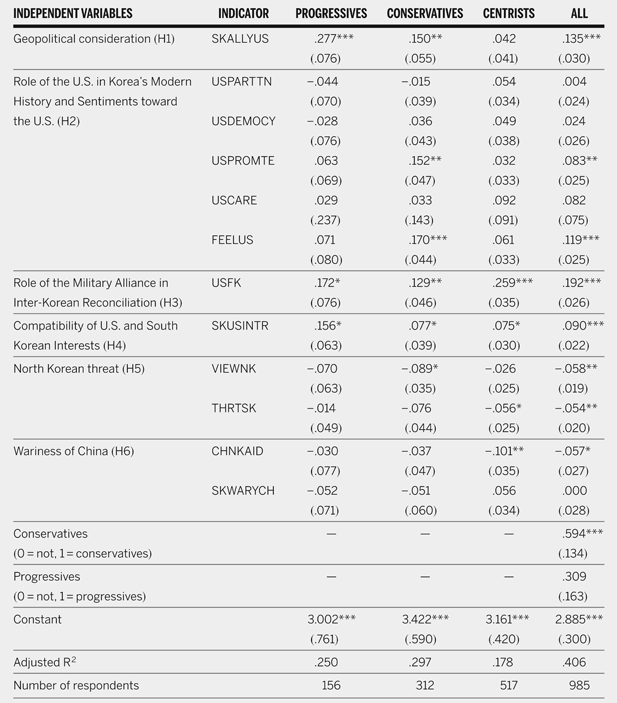
Because the dependent variable is continuous, this study uses ordinary least squares regression (OLS) to estimate the model. Each of the last four columns of table 1 records the results of a separate regression analysis. The survey questions measuring the independent variables are represented by the codes on the table in the Indicators column. Regression analysis, to put it very simply, reveals the relationship or lack of a relationship between any of these survey questions and the dependent variable (attitudes toward the ROK–U.S. alliance). Only the asterisked results represent correlations at statistically significant levels. The other results are not statistically significant, indicating no relationship.
Effects of Independent Variables on Attitudes toward the ROK–U.S. Alliance

Note: Each of the last four columns reports the unstandardized regression coefficients resulting from an OLS regression. Standard errors are in parentheses. Two dummy variables are included in an OLS regression for all.
* p < .05;
** p < .01;
*** p < .001
ATTITUDES TOWARD THE ROK–U.S. ALLIANCE: GROUP COMPARISON
Progressives: Anti-American but Pragmatic
Regression analysis done on the progressive cluster reveals that certain factors are unrelated to the alliance with the United States. Table 1 shows that the hypothesis about the role of the United States in Korea's modern history is not supported statistically (H2). None of the five indicators (USPARTTN, USDEMOCY, USPROMTE, USCARE, FEELUS) measuring this variable has a significant effect on the level of support for the alliance. For example, progressives who dislike the United States support the alliance as much as those who favor the United States (FEELUS). The converse is also true: progressives who like the United States are against the alliance at the same levels as progressives who do not. Simply put, progressives think about the alliance and the United States independently of each other. The same result is found with the other four indicators. Progressives do not allow their negative view of American involvement in Korean history or their putative anti-Americanism to factor into their judgment of the alliance. The surprising finding is that progressives are able to harbor anti-American sentiments and still support the alliance.
In a similar fashion, neither of the hypotheses related to North Korea or China are supported (H5, H6). Thus, for those progressives who support the alliance, their reason for this support is unrelated to their distrust of China. And regardless of their perception of North Korea as friend or foe, progressives assess the value of the alliance on other terms.
What then are these other terms? Three good predictors are the remaining variables related to the United States (H1, H3, H4), asterisked in table 1. Of these, geopolitical consideration (H1: SKALLYUS) has the strongest effect. Statistically speaking, for each one-unit increase in the belief that geopolitics should move South Korea to look across the Pacific for a counterbalancing power, there is a correlated increase in support for the alliance by 0.28 of a unit. And with each one-unit increase toward a positive view of the U.S. Forces in Korea (H3: USFK) and the compatibility between U.S. and South Korean interests (H4: SKUSINTR), there is a 0.17 and 0.16 increase in support for the alliance, respectively. Although apparently small, these unstandardized regression coefficients actually indicate a firm relationship (see table 1).
These findings indicate that the more convinced progressives are of the importance of a geopolitical strategy and the value of alignment with a distant United States, the greater their support for the alliance. Even among those progressives who do not accept the importance of a geopolitical strategy, the less strongly they feel the strategy to be unimportant, the more likely they are to support the alliance.
Similarly, the more progressives feel that the USFK help the two Koreas reconcile and cooperate, the higher their support for the alliance. Among those progressives who perceive the United States as an obstacle to inter-Korean reconciliation and cooperation, the less intensely they feel on this issue, the more inclined they are to support the alliance. Also, the more progressives perceive that South Korea and the United States have common interests regarding North Korea, the higher their support is.
These findings reveal the pragmatic nature of progressives. To progressives, factors such as sentiments toward the United States, whether or not North Korea is a threat, and suspicions of China, are irrelevant to their evaluation of the ROK–U.S. alliance. Their attitudes toward the alliance are primarily determined by their assessment of the geopolitical situation of South Korea and the utility of the alliance to inter-Korean reconciliation.
It therefore seems that progressives are creating a new rationale for the alliance. The purpose of alliance with the United States is not simply to deter North Korean aggression. Rather, the United States is cast as an honest broker between the two Koreas. This understanding is why, in spite of their anti-American feelings, progressives still value alliance with the United States.
Conservatives: Thoroughly Pro-American
Conservatives and progressives disagree on two key issues: the United States (and the role it has played in Korean history) and North Korea. But it is only among conservatives that these issues bear relevance to the alliance. As expected, conservatives have a positive view of the United States and its role in Korean history. What is interesting is that the more positively inclined conservatives are, the more they support the alliance (FEELUS). There is a strong correlation between how conservatives see the United States and how they see the alliance. Conservatives also credit the United States for South Korea's economic prosperity, and again, this view has significance for their evaluation of the alliance (USPROMTE). Likewise, with North Korea, which conservatives still regard as a threat, the issue bears weight on their feelings about the alliance (VIEWNK). The same is not true with progressives. Although they take the opposite view on these issues, their view of the United States and North Korea bears no relevance to how they look at the alliance.
What matters to South Koreans—both conservatives and progressives—are three factors: geopolitical consideration, inter-Korean reconciliation, and the compatibility of U.S. and South Korean interests. The more both conservatives and progressives are convinced of the importance of a geopolitical strategy, believe that the military alliance can be helpful in reconciling the two Koreas, and see common priorities and interests between the two countries in dealing with North Korea, then the more they are likely to support the alliance and want to strengthen it.
This finding has important policy implications for the future of the ROK–U.S. alliance. South Koreans increasingly see the alliance through the prism of its role in inter-Korean reconciliation. Many analysts argue that to continue to maintain the alliance, which was born during the Cold War, a new rationale needs to be found that goes beyond deterrence of North Korean aggression (Kim, Parker, and Choi Reference Kim, Parker and Choi2006, 439; Lee Reference Lee2008, 38). The findings of this study offer just such direction.
Centrists: The Inexplicable Middle
Centrists, who make up more than half of the respondents, exhibit a unique pattern of opinions towards the alliance. Two findings of the study stand out. First, geopolitical considerations do not influence centrist views of the ROK–U.S. alliance. Second, wariness of China and concern about North Korea's nuclear weapons lead them to support the alliance. Both results are puzzling. With regard to the first, centrists who believe in the strategic value of allying with the United States are just as likely to support or not support the alliance as are those centrists who do not believe in the alliance's strategic value. Statistically speaking, the two variables are unrelated. With regard to the second result, when examining the value of the alliance, centrists alone take into account their wariness of China. What accounts for this unique set of associations, which differs from conservatives and progressives? This finding needs to be further studied. For now, it appears that what makes centrists distinct, in part, is that they are influenced by a different set of factors than the other two groups in terms of evaluating the alliance.
All (Full Sample)
To see whether those factors that affected an individual ideological group also affected the whole sample, regression analysis was repeated with the whole sample. Notice that every independent variable found to be a good predictor for attitudes toward the alliance was also a good predictor for the entire sample. As expected, no inconsistencies were found between the analysis of the full sample and the analyses of the separate groups. But the results do demonstrate that only by breaking up the whole sample into ideological clusters can the individual characteristics of each group be revealed.
In addition, to compare groups against the dependent variable (attitudes toward the alliance), two dummy variables (conservatives and progressives) were included, with centrists as the reference group. The regression output shows that the conservative group variable is highly significant, indicating that conservatives are statistically different from centrists and, on average, want to strengthen the alliance far more than do centrists. On the other hand, progressives are not statistically different from centrists, indicating that their support for the ROK–U.S. alliance is not very different from that of centrists. These results confirm the findings illustrated in figure 4, in which the three groups are compared on the dependent variable.
CONCLUSION
Although this article provides a solid empirical basis for understanding South Korean attitudes, the study was based on a 2007 snapshot survey. For a more stable, long-term picture of South Korean attitudes, this study will, of course, need to be updated periodically. With that caveat in mind, this study uncovers four major important aspects of attitudes toward the ROK–U.S. alliance.
Strong Public Support for the Alliance Exists
Despite widespread anti-American sentiments in South Korea, an overwhelming majority (92%) is in favor of either keeping or strengthening the alliance. One important conclusion of this study is its statistical demonstration that anti-Americanism and support for the alliance can and do co-exist. South Koreans' pragmatism overrides anti-Americanism when it comes to the alliance. Conscious of East Asian geopolitics, South Koreans look to the United States as a partner for the security and stability of South Korea and Northeast Asia.
Traditional Rationale for the Alliance Is Still Valid
The North Korean threat is perceived as real among conservatives and centrists (together constituting 84% of survey participants) and thus still remains a basic foundation for the alliance. The primary goal of the alliance is to keep South Korea safe, specifically by both countries working together closely to denuclearize North Korea.
New Rationale Is Suggested
The findings also suggest that South Koreans, regardless of political orientation, evaluate the alliance in terms of whether it facilitates inter-Korean reconciliation. In other words, this study identifies a common ground that all three groups share regarding the alliance, and this common ground points to a new agenda for the alliance that goes beyond its traditional rationale. South Koreans expect the alliance to serve the ultimate endeavor of reconciliation with North Korea.
Generational Change Signals a Pragmatic Approach to the Alliance, Not a Progressive Tilt
The large majority of South Korea's current voting public are from a younger generation (those born in and after the 1960s). This make-up is quite different from that of preceding decades, when a thorough conservative ideology prevailed. But this shift does not mean a swing toward progressivism either. Rather, it means that South Koreans are becoming increasingly less ideological and more pragmatic in their approach to the ROK–U.S. alliance. What is relevant to South Koreans' attitudes toward the alliance is not their sentiments toward the United States or the issues and events of the past, but the utility of the alliance in solving critical issues of national security and reconciliation that the country now faces.
APPENDIX:
Independent Variable Descriptions
The Role of a Geopolitical Strategy (H1)
• SKALLYUS: Please rate how strongly you agree or disagree with the statement: “Surrounded by China, Japan, and Russia, South Korea should pursue a strategy of developing a close alliance with a distant power—the U.S.—in order to enhance its security” (0 = strongly disagree; 10 = strongly agree).
Views on the Role of the United States in Korea's Modern History (H2)
• USPARTTN: Please rate how strongly you agree or disagree with the statement: “The U.S. was responsible for the partition of the Korean peninsula after World War II” (0 = strongly agree; 10 = strongly disagree).
• USDEMOCY: Please rate how strongly you agree or disagree with the statement: “The U.S. was an obstacle to South Korea's democratization during the dictatorship of the 70s and 80s” (0 = strongly agree; 10 = strongly disagree).
• USPROMTE: Please rate how strongly you agree or disagree with the statement: “South Korea has been able to achieve economic prosperity because the U.S. military has protected South Korea from the North Korean military threat” (0 = strongly disagree; 10 = strongly agree).
• USCARE: In making policy decisions regarding the North Korean nuclear problem, to what extent do you think the U.S. takes into account the security interests of South Korea? (0 = not at all; 10 = great deal)
• FEELUS: How would you rate your feelings towards the United States? (0 = dislike very much; 10 = like very much)
Views on the Role of the Military Alliance in Inter-Korean Reconciliation (H3)
• USFK: Is the USFK (United States Forces Korea) a help or an obstacle to promotion of reconciliation and cooperation between South and North Korea? (0 = a big obstacle; 10 = a great help)
Perception of Compatibility of U.S. and South Korean Interests (H4)
• SKUSINTR: Do South Korea and the United States have divergent or common interests regarding North Korea? (0 = conflicting interests; 10 = common interests)
Perception of the North Korean Threat (H5)
• VIEWNK: Is North Korea a partner in inter-Korean détente or an ongoing military threat? (0 = an ongoing military threat; 10 = a partner in inter-Korean détente)
• THRTSK: Please rate the threat posed by North Korean nuclear weapons to South Korea (0 = a very serious threat; 10 = not a threat).
Wariness of China (H6)
• CHNKAID: Please rate how strongly you agree or disagree with the statement: “China is providing extensive economic aid to North Korea because China wants to influence the future unification process in the Korean peninsula” (0 = strongly agree; 10 = strongly disagree).
• SKWARYCH: Please rate how strongly you agree or disagree with the statement: “China's claim that Koguryo is a part of Chinese history (i.e., the ‘Northeastern Project’) is an expression of their territorial ambitions, and, thus, South Korea should be wary of China” (0 = strongly agree; 10 = strongly disagree).