


Justin's social context in the city of Rome may seem to have only a tenuous connection with his beliefs about God, his doctrine of the Logos and the other religious commitments for which he ultimately laid down his life. Perhaps, had Justin lived in Athens or Ephesus, he would have written much the same thing. This, after all, is a man deeply moved by Platonist philosophy and the “perception of immaterial things.” 1
Justin Martyr, Dialogue with Trypho (Dial.)2.
But of course, it is not at all clear that Justin's work would have taken the shape it did had it been written in Ephesus or Athens. Given the social-historical turn in scholarship on early Christianity over the last thirty years, we hardly need reminding that people are not disembodied intellects: they live in cities, their activities are constrained by bodily needs, they are caught up in webs of relationship with others and in the cross-currents of social, economic, and political forces. Justin, Marcion, and Valentinus were all expatriates from the eastern empire; all spoke and wrote in Greek; all sought students and cultivated study circles or “schools.” “Church Fathers” and “heretics” alike had to get up in the morning and procure their food and drink. They walked the streets of Rome, patronized markets, went to restaurants and baths, and visited other Christians. Justin in particular was hardly a stay-at-home bookworm. By adopting the philosopher's cloak, he advertised publicly his chosen vocation and sought to provoke interaction and debate. In the case of his Cynic opponent Crescens, these acrimonious debates were quite public in nature.2
Though it seems most unlikely that professional wrangling between two philosophers should have been a matter of imperial concern, as Justin seems to imagine (2 Apol. 3).
The paper has three distinct sections. In the first section, I examine the evidence for placing Justin's apartment over the “Bath of Myrtinus,” and go on to explore the nature of apartments connected with small neighborhood baths in Rome.3
To my knowledge, no study of Justin has discussed the significance of his location above a bath. Older works, e.g., L. W. Barnard, Justin Martyr: His Life and Thought (Cambridge: Cambridge University Press, 1967) or Eric Osborn, Justin Martyr (Tübingen: J. C. B. Mohr [Paul Siebeck], 1973) bypass the question entirely; Peter Lampe's recently translated work, From Paul to Valentinus: Christians at Rome in the First Two Centuries (ed. Marshall Johnson; trans. Michael Steinhauser; Minneapolis: Fortress Press, 2003), the most complete treatment of the social aspects of Justin's life in Rome, says only that his living above a bath “indicates a rented apartment” (259).
Apartments and Neighborhood Baths in Imperial Rome
At Justin's trial, Junius Rusticus, the praefectus urbi, asks where Justin meets with his students:
“Tell me, where do you meet, in what place?”
Justin said, “I have been living above the Bath of Myrtinus for the entire period of this, my second sojourn in the city of Rome; I know of no other meeting-place but here. Anyone who wished could come around to my home and I would share with him the words of truth.”

;


.
4Text of Recension A of the Acts of Justin from Herbert Musurillo, Acts of the Christian Martyrs (Oxford: Clarendon Press, 1972) 44; my translation. Giuseppe Lazzati, Gli sviluppi della letteratura sui martiri nei primi quattro secoli (Torino: Società Editrice Internazionale, 1956) provides critical text and extensive commentary. The details of the three recensions of the Acts will be addressed in what follows.
On the historical worth of the notice, see Gerd Lüdemann, “Zur Geschichte des ältesten Christentums in Rom,” ZNW 70 (1979) 103 (“nicht anzuzweifeln ist”). Gary Bisbee (“The Acts of Justin Martyr: A Form-Critical Study,” The Second Century 3 [1983] 157) concludes: “[I]t is probable that the Acts of Justin are ultimately derived from the commentaries of Justin's trial,” though not in any straightforward fashion; so also Lazzati, who finds their literary form shaped by liturgical forces (Sviluppi, 91). For views of and references to earlier commentators, see Bisbee, “Acts,” 131–32, with n. 11.
Justin was not the only ancient philosopher to lodge in such environs. A century earlier, Seneca also lived, as he says, supra ipsum balneum, “right above a bath,” while residing in Baiae. Fortunately, he has left a lively description of the experience:
So picture to yourself the assortment of sounds, which are strong enough to make me hate my very powers of hearing! When your strenuous gentleman, for example, is exercising himself by flourishing leaden weights; when he is working hard, or else pretends to be working hard, I can hear him grunt; and whenever he releases his imprisoned breath, I can hear him panting in wheezy and high-pitched tones. Or perhaps I notice some lazy fellow, content with a cheap rubdown, and hear the crack of the pummeling hand on his shoulder, varying in sound according as the hand is laid on flat or hollow. Then, perhaps, a ball player comes along, shouting out the score; that is the finishing touch. Add to this the arrest of an occasional troublemaker or thief, and the racket of the man who always likes to hear his own voice in the bathroom; add further, people who plunge into the swimming pool with unconscionable noise and splashing. Besides all those whose voices, if nothing else are good, imagine the hair-plucker with his penetrating, shrill voice—for purposes of advertisement—continually giving it vent and never holding his tongue except when he is plucking armpits and making his victim yell instead. Then you have the sellers of drinks with their varied cries, the sausage-man, the confectioner, and all the vendors of food hawking their wares, each with his own distinctive intonation.6
Ep. 56, translated by Richard Gummere (LCL), with a few modifications; see also Martial, Ep. 7.32.
The reliability of the reference has been questioned, e.g., by Miriam Griffin (Seneca: A Philosopher in Politics [Oxford: Clarendon Press, 1976] 5): “[D]id Seneca really stay in the bath-house at Baiae more than five minutes?” Francesca Romana Berno (L. Anneo Seneca. Lettere a Lucilio libro VI: le lettere 53–57 [Bologna: Patron, 2006] 232–34) argues that Seneca lived in close proximity to the baths in Baiae if not directly above them. This was brought to my attention by Andrea Balbo's review of Berno's book in Bryn Mawr Classical Review 2007.01.02.
For medianum apartments in Ostia, see Janet DeLaine, “Designing for a Market: ‘medianum’ Apartments at Ostia,” JRA 17 (2004) 147–76. An example of such an apartment in the city of Rome may be found at the remains of the insula located under Santa Maria in Aracoeli, on the Capitoline Hill; see James Packer, “La casa di Via Giulio Romano,” Bullettino della Commissione archeologica comunale di Roma 81 (1968–1969) 134–36. Glenn Storey (“Regionaries-Type Insulae 2: Architectural/Residential Units at Rome,” AJA 106 [2002] 411–34) argues that the term “insula” refers to a single apartment house, not an entire street block.
Martial is yet another intellectual who found lodgings near a bath. Apparently, the Baths of Stephanus were joined to Martial's living quarters on the Quirinal (Ep. 11.52.4: “scis quam sint Stephani balnea iuncta mihi”). But Martial may not have been in such close proximity to the palaestra as Seneca. The ambient noises he complains of emanate from schoolmasters, craftsmen, and beggars, so his windows must have overlooked a street, not an inner courtyard. Probably, the Baths of Stephanus are in the same apartment complex as Martial's apartment. Had he lived directly over the palaestra, he would surely have brought his pen to bear on the events unfolding beneath his window.
Seneca certainly had resources at his disposal that would allow him ample latitude when choosing lodgings, and Martial, impecunious poet though he was, did not rank among the poorest of the poor. We may therefore infer that living over or close to a bath would not necessarily be considered as lodging of last resort; a great deal would hang on the character and quality of the bath in question. It would be one thing to live above the luxuriously appointed Baths of Etruscus and quite another to be found above the dark and cramped Baths of Gryllus, which Martial describes as an “Aeolian cavern.”9
On the Baths of Etruscus, see Ep. 6.42; on those of Gryllus, Ep. 1.59, 2.14.
When describing Roman baths, a basic if somewhat ill-defined distinction can be made between thermae and balnea.10
For issues and literature, see Garrett Fagan, Bathing in Public in the Roman World (Ann Arbor, Mich.: University of Michigan Press, 1999) 14–19; Inge Nielsen, Thermae et Balnea: The Architecture and Cultural History of Roman Public Baths (2d ed.; Aarhus: Aarhus University Press, 1993) 3; Fikret Yegül, Baths and Bathing in Classical Antiquity (Cambridge, Mass.: The MIT Press, 1992) 43.
Given that our subject is the relatively humble neighborhood bath, what can be known about apartments supra balneum? One can easily find in cities other than Rome examples of apartments and bathhouses that share space in the same building complex. In Pompeii, a surviving inscription advertises for rent “the Balneum Venerium et Nongentum, tavernae, pergulae, and upper story apartments (cenacula).”11
CIL 4.1136=ILS 5742; translated and discussed by Fagan, Bathing, 318.
On the Casa di Giuseppe II, see Lawrence Richardson, Pompeii: An Architectural History (Baltimore: The Johns Hopkins University Press, 1988) 234–40; on the Sarno baths, Fagan, Bathing, 66–67.
Russell Meiggs, Roman Ostia (2d ed.; Oxford: Clarendon Press, 1973) 417–19.
Meiggs, Roman Ostia, 411.
Nielsen, Thermae, 2:77.
Meiggs, Roman Ostia, 411: “Rent from these apartments and from the shops might help to bridge the gap between bath receipts and the cost of maintenance.”
Unfortunately, in Rome, the site of primary interest, archeological remains of small public baths are nearly nonexistent. We know that such baths were commonplace; Martial makes offhand mention of several, as do other writers. The Curiosum and the Notitia—fourth-century descriptions of the fourteen Augustan regions of the city—rarely list the names of individual baths, though they do give the total number of baths for individual regions, e.g., eighty-six for Region I, eighty-five for Region II, etc. These numbers cannot be taken as precise, but both of these so-called “Regionary Catalogues” list numbers in the range of 800–900 small public baths in the city of Rome.17
Both catalogues give the total number of baths in the city as 856; however, when added up by regions, the Notitia yields 967, the Curiosum, 942.
Pliny the Elder remarks that Agrippa offered 170 balnea gratuita during his year as aedile; he then goes on to say the number has grown without limit. But this cannot be accepted unreservedly as the number of baths in the city; see Fagan, “Pliny Naturalis Historia 36.121 and the Number of Balnea in Early Augustan Rome,” CP 88 (1993) 333–35.
In addition, roughly twenty neighborhood baths in the city of Rome appear on the so-called “Marble Plan.”19
David Reynolds, “Forma Urbis Romae: The Severan Marble Plan and the Urban Form of Ancient Rome,” (Ph.D. diss.; University of Michigan, 1996); La pianta marmorea di Roma antica. Forma urbis Romae (ed. Gianfilippo Carettoni, Antonio Colini, Lucos Cozza, and Guglielmo Gatti; Rome: Quasar, 1960); see Herbert Bloch, “A New Edition of the Marble Plan of Ancient Rome,” JRS 51 (1961) 143–52 for a readily accessible review and history of the find; Emilio Rodríguez Almeida, Forma Urbis Marmorea. Aggiornamento Generale 1980 (Rome: Quasar, 1981); Tina Najbjerg and Jennifer Trimble, “The Severan Marble Plan since 1960,” Bullettino della Commissione archeologica comunale di Roma Suppl. (forthcoming). The Stanford Digital Forma Urbis Romae Project (SDFUR, hereafter) available at http://formaurbis.stanford.edu features web-accessible images of all available fragments together with useful and up-to-date commentary. All images of the plan used in the present paper are from this site and used with permission.
See Romolo Augusto Staccioli, “Terme Minori e Balnea nella Documentazione della ‘Forma Urbis,’” Archeologica Classica 13 (1961) 92–102. The count of twenty baths is from Reynolds, “Forma Urbis Romae,” 185.
The baths bearing the name of L. Licinius Sura, located on the Aventine Hill, rank among the largest of the neighborhood bathing establishments.
21See Laura Vendittelli's article, “Therma Sura,” in Lexicon Topographicum Urbis Romae (Rome: Quasar, 1993–2000); also Géza Alföldy's commentary on CIL 6.40690 and the commentary to frag. 21a, c, d. on SDFUR.

(68.15.3), the Regionary Catalogues label them as thermae, while the Marble Plan gives it the label “BAL.” Constructed in the early second century by Trajan's friend and advisor, L. Licinius Sura—or perhaps, constructed in his honor by Trajan himself—they feature at least one spacious palaestra, surrounded on three sides by columns. While the stone fragment preserves only a fraction of the layout, the remainder can be seen in one of the drawings preserved in Cod. Vat. Lat. 3439, folio 10:
22http://formaurbis.stanford.edu/fragment.php?record=100, accessed on 4/24/07.
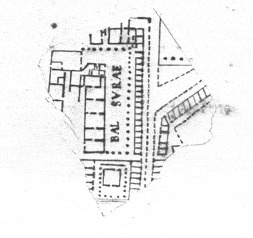
Just to the left of the colonnaded palaestra lies the series of interconnected rooms that make up the heart of the bath.23
When interpreting the Marble Plan, this configuration of interconnected rooms signifies the presence of a bath, even in the absence of the label “BAL”; so Staccioli, “Terme Minori,” 92, 97.
On the progression of bathing, see Fagan, Bathing, 10.
So Tina Najbjerg, in her commentary to the fragment on SDFUR.
See Luigi Pedroni, “Per una lettura verticale della Forma Urbis Marmorea,” Ostraka 1 (1992) 223–30.
Ep. 6.42 (trans. Shackleton Bailey).
Apart from the structure itself, the prominent placement of the bath at an intersection of major roads would have made it a neighborhood landmark. The avenue heading into the bath can no longer be assigned a name, but the street running parallel to the bath is the Clivus Publicus: in modern times, the Via di Santa Prisca, which runs over the Aventine Hill. Like so many streets in Rome, this avenue is lined with tabernae, a configuration that the Marble Plan shows to be utterly typical. The line of dashes running parallel to the street indicates the presence of a portico or arcade.28
Carettoni et al., Pianta, “Un portico a pilastri,” 79; Reynolds, “Forma Urbis Romae,” 176: “Dashes … always indicate arcades.”
James Packer, The Insulae of Imperial Ostia (Memoirs of the American Academy in Rome 31; Rome, 1971) 32–33.
Another neighborhood bath, much smaller in scale, offers interesting contrasts to the Baths of Sura:30
http://formaurbis.stanford.edu/fragment.php?record=499, accessed on 4/24/07.

This particular fragment, numbered 330 by Carettoni and by SDFUR, cannot be located with certainty in any one part of the city. It shows the remains of four apartment blocks, separated by two streets running at right angles to each other. The two on the lower left and right, respectively, are more completely preserved; remains of several rooms of the apartment block in the upper left corner are evident, while the slab preserves only one room and a stairway of the building on the upper right. The building of interest is the one in the lower left corner of the fragment. On the right side of this building, and parallel to the vertically running street, six interconnected rooms are clearly visible, signifying the presence of a small bath. The large square area at the center might serve as a palaestra, even though connections between the bath rooms and this area are not in evidence.31
Identified as a palaestra by Staccioli, “Terme Minori” 99.
Possibly, there is a stair at the bottom right corner of the insula, to the right of the small apse-like structure. See Plate 46 in Carettoni, Pianta.
A third and final example may be produced for a bath not quite so cramped as this last nor quite so spacious as the Baths of Sura. The fragment is numbered as 10g by Carettoni, and it is one of the largest extant pieces of the plan:33
http://formaurbis.stanford.edu/fragment.php?record=43, accessed on 4/24/07.

Unlike the last fragment, streets on this piece can be identified. The street zig-zagging more or less horizontally through the slab represents a stretch of the Clivus Suburanus, one of the major thoroughfares crossing Subura, the densely packed neighborhood running between and up the slopes of the Quirinal and Viminal Hills to the north and between the Cispian and Oppian Hills on the east. The vertically-running street, which bears left at the top of the fragment, cannot be identified. Running just to the left of this street lies the familiar series of interconnected rooms that signals the presence of a small bath. Adjoining these rooms is an open area with a colonnade. As with fragment 330, the rooms of the bath are separated from the street by a single wall; they are not in the middle of a surrounding compound, fronted with tabernae, as was the case with the Baths of Sura. This bath may represent an improvement over the baths in frag. 330, however, on account of the colonnaded palaestra. Entrance to the site may have been gained just at the point where the vertical street starts to bear left. Alternatively, this might have served as an exit, with the entrance somewhere just off the top of the fragment. The building appears to be a highly irregular, mixed-use site, with tabernae of all different sizes at points around the perimeter and variously sized rooms in the center. The presence of two stairways, marked by a “V,” strongly suggests the presence of apartments on upper floors, though as with the first two examples, no stairs can be seen that would indicate rooms directly on top of the bath rooms themselves. It would be surprising, however, if there were not a few levels of apartments directly overlooking the palaestra. A tenant of this building, descending the stairs near the corner, would emerge directly on the street, near a shop with two entrances on a sharply-angled corner. There is no telling what kind of shop this was, of course, but it is easy to imagine it as a popina, a restaurant where locals, passersby, inhabitants of the upper floors looking for a break from cramped living quarters, or bath house patrons might grab a morsel. The so-called “Thermopolium” on Via di Diana in Ostia gives some idea of what a relatively deluxe café might have been like. The corner location of this particular shop on the Clivus Suburanus, however, suggests something more in the nature of a stand-up snack shop or wine bar. The popina at the intersection of the eastern Decumanus and the Via della Fontana in Ostia, described by Meiggs as “somewhat like an espresso bar in function,” is probably a closer fit.34
Meiggs, Roman Ostia, 428–9 and Plate 29.
Consideration of sites such as these helps to create a concrete picture of what it would mean to live supra balneum. For someone in Justin's line of work, an apartment over a bath would have offered several advantages. While the ambient noise may have been every bit as bad as Seneca says, an apartment overlooking a palaestra may have offered the compensating advantage of light, even on the lower floors; apart from the overall boost in ambience (and expense, probably), this would be a distinct advantage to someone for whom reading and writing are critical. An apartment looking out on a constricted courtyard, walled around with insulae up to six stories in height would receive only dim and indirect light. Of course, if one's budget allowed for it, better to have a place overlooking an interior court that did not contain a noisy palaestra; there, one could hope for light without the noise; or at least, less noise. Even so, a lodger with windows opening on a central courtyard surrounded by apartments—especially without the benefit of glass to muffle the sound—could scarcely hope for much in the way of peace and quiet.
For a person trying to maintain social contacts, living on or about a neighborhood landmark would be most advantageous. This would have provided a recognizable address for prospective students and visitors wishing to locate Justin's apartment. Moderns can scarcely appreciate the difficulties posed by the absence of street signs, maps, and other forms of reliable information where directions are concerned. Ancient people found ways of coping, which tended to rely on prominent landmarks. Buildings such as temples would certainly have served this function: “Go to the temple of X and go down the street to the right….” Other neighborhood buildings such as baths also worked this way. The inscription upon a slave collar, still extant, bears this out: “[G]rab me and hale me back to the balneum Scriboniolum at Rome, since I have run away from Region XII.”35
Fagan, Bathing, 363.
Baths also tended to be nodes of social interaction. Meiggs's description of bathing at Ostia would have been true for baths generally:
At the baths the gossip and scandal of the town could be exchanged. They combined the amenities of swimming, bath, gymnasium, and community centre; and there was no need to hurry away, for food and drink could be bought on the premises.36
Meiggs, Roman Ostia, 404.
E.g., Titus (Suetonius, Tit. 8.2); Hadrian (Historia Augusta, Hadr. 17.5–7); Caracalla (Historia Augusta, Heliogab. 17.9; these references from Fagan, Bathing, 190.
E.g., Martial, Ep. 12.82.
On baths as sites for social leveling, see Fagan, Bathing, 212–19.
Finally, on the side of advantages, a bath in one's own building would lead to a concentration of necessary services, for example, food, water, and other necessities for the maintenance of personal hygiene. All but the wealthiest Romans—those who could manage private plumbing—would have collected their water from neighborhood fountains. Since baths required large amounts of water, they naturally tended to be found near water sources, and proximity to water would have been a great advantage to residents of the surrounding area. Any facility where personal needs and hygiene could be maintained would be a boon to the local neighborhood. In particular, the presence of latrines would have been a welcome convenience. Some insulae at Ostia had latrines, presumably for tenants, though nothing of this nature is preserved in Rome.40
Packer, Insulae, 10–11. See also Alex Scobie, “Slums, Sanitation, and Mortality in the Roman World,” Klio 68 (1986) 414–16.
On latrines in baths, see Meiggs, Roman Ostia, 412–3; Fagan, Bathing, figures 15, 17, 18; Yegül, Baths and Bathing, 411–13.
Would a person such as Justin have other reasons to visit a bath? Growing up in Flavia Neapolis and—if Eusebius may be believed—residing for some time in Ephesus, Justin would have been quite familiar with the intellectual culture surrounding the

.
42Eusebius, HE 4.11; for the cultural significance of the gymnasium in the Greek East, see Jean Delorme, Gymnasion: Étude sur les monuments consacrés a l'éducation en Grèce (Paris: Éditions De Boccard, 1960) and Yegül, Baths and Bathing, 6–29.

, displaying their particular form of artistic expression. While the Imperial thermae in Rome featured salons for these types of activities, the average Roman bath does not appear to carry a similar intellectual cachet; Martial, at least, never alludes to it. But for a person from the Eastern Empire accustomed to the intellectual culture of the gymnasium, locating a “school” in close proximity to a bath would have been entirely natural.
Among disadvantages, one might list the noisy environment, immortalized by Seneca. While the din in such a place could no doubt be significant, Seneca's tirade should be taken for the elitist carping it is, rather like someone nowadays complaining about the impossibility of finding good Pinot Noir. More importantly, Seneca makes much of the noisy environment because it serves his rhetorical aims; he clearly juxtaposes the quietness of Vatia's villa in Ep. 55 and the urban uproar of Ep. 56. The description in Ep. 55 is heavy with the language of seeing, Ep. 56, with language about hearing.43
Berno, Lettere, 232–3; again, via the review of Balbo, Bryn Mawr Classical Review 2007.01.02.
Martial, Ep. 3.36.5. For the shape of the Roman day, especially its variation from winter to summer, see John P. V. D. Balsdon, Life and Leisure in Ancient Rome (London: The Bodley Head, Ltd., 1969) 18–19.
According to Dio Cassius, 69.8, Hadrian forbade unisex bathing; at an earlier period, however, Martial accepts the practice as normal. See Roy Ward, “Women in Roman Baths,” HTR 85 (1992) 125–47 and Fagan, Bathing, 26–29.
In fact, a room supra balneum on the palaestra side would have offered a relatively generous amount of silence at nighttime hours as well. Bathing after eating was considered dangerous: Trimalchio's after-dinner bath was exceptional as the reaction of the guests indicates.46
Petronius, Sat. 73. But Juvenal, with disapproval, mentions a married woman who would patronize the baths at night (Sat. 6.419).
Another possible disadvantage—particularly for members of a proscribed cult—would seem to have been the public nature of the setting. Yet this may in fact be part of the attraction. Given the amount of traffic in and around the baths—patrons, clients, attendants, merchants, slaves, thieves, along with hawkers and barkers of all kinds—visitors from out-of-the-way places would have gone unnoticed. In a quieter neighborhood, the comings and goings of people might have attracted more notice from neighbors. Still, it does not appear that Justin was at all furtive about his public profile; apparently, he wore his philosopher's cloak with the express intention of provoking comment and conversation. Perhaps the Socrates that Justin claims was a “Christian before Christ” has served as an example, not just in his courageous defiance of political authority, but also in the public and social nature of his philosophical activity. In any event, a bath would have drawn a richly diverse range of people for Justin to approach or who in turn might have approached him.
By way of conclusion to the present section, we have seen that a location over or around a bathhouse would have offered several distinct advantages to a teacher such as Justin: relatively plentiful amounts of light, availability of important services, the status and convenience of being located near a local landmark, and contrary to Seneca's complaints about bath noise, a generous amount of quiet, relative to other possible locations. Of course, apartments even within the same building would have varied widely, as the insula under Santa Maria in Aracoeli demonstrates. But even a small room on an upper floor overlooking a bath would have the benefits of light and nighttime quiet.
From Myrtinus to Mamertinus
It remains to treat in somewhat greater detail the particular location of this so-called “Bath of Myrtinus” (or “Myrtinos”). The text of the Acts of Justin survives in three Recensions (A, B, and C). A and B are the earliest, with A dating perhaps from the third century and B—which appears to depend mostly on A—deriving from the fourth.
47So Lazzati, Sviluppi, 119.

). B gives his address as “above the bath of a certain Martinos son of Timiotinos,” (

) while C omits any mention of location. Recension B may represent an attempt to make sense of the odd name “Myrtinos,” which appears Greek rather than Latin in character. “Martinus/Martinos” is also unusual; the name comes into use among Christians during the fourth and fifth centuries, and it may have been during this time that it was integrated into the manuscript tradition as a way to make sense of Myrtinos.
48As a cognomen, Martinus is attested only four times, according to Heikki Solin and Olli Salomies, Repertorium nominum gentilium et cognominum Latinorum (Hildesheim: Olms-Weidmann, 1994) 359. For Christian instances, examples can be found in Diehl, Inscriptiones Latinae Christianae Veteres, e.g., 2349, 532, 861, 2586, etc.

. Unfortunately, no record of a “Bath of Myrtinos” (or of a “Bath of Martinos son of Timiotinus”) exists in the literary or archeological record.
49References to a Balneum Timothinum by Cesare Baronio (sixteenth century), or to a Thermae Timothinae Novati in the catalogues of Publius Victor and Sextus Rufus are not reliable, according to Lazzati and Franchi de' Cavalieri, as quoted in the entry s.v. “Balneum Timothinum” by Giuseppe De Spirito in the Lexicon Topographicum Urbis Romae; see also the article by Lawrence Richardson, in A New Topographical Dictionary of Ancient Rome (Baltimore: The Johns Hopkins University Press, 1992) 395, s.v. “Thermae Novati.”
Musurillo, Acts of the Christian Martyrs, 49.
Lampe, From Paul to Valentinus, 259, n. 6.
The curious name “Myrtinus/Myrtinos” suggests a point of beginning: as a personal name, it is unattested in the epigraphical literature.
52Not found in Rome, according to Heikki Solin, Die griechischen Personennamen in Rom: Ein Namenbuch (2d rev. ed.; Berlin: De Gruyter, 2003), though Rodolfo Lanciani mentions an inscription in the columbarium at Villa Pamfili naming a certain Pinaria Murtinis (Pagan and Christian Rome [New York: Benjamin Blom, 1967] 257). A freedman by the name of

is also found in an inscription from Pozzuoli; see W. Dennison, “Some New Inscriptions from Puteoli, Baiae, Misenum, and Cumae,” AJA 2 (1898) 385; reference located with the help of Peter M. Fraser, Elaine Matthews, A Lexicon of Greek Personal Names (Oxford: Clarendon Press, 1997) 3A:308. A number of names springing from the

- stem can be found in Fraser's four volumes, but of “Myrtinus” or “Myrtinos” there is no trace in Corpus Inscriptionum Latinarum, Inscriptiones Christianae Urbis Romae, Inscriptiones Graecae, or Supplementum Epigraphicum Graecum.

represents the adjectival form of

and can therefore be taken to mean “of myrtle.” While it is conceivable that there might have been a “Myrtle Bath,” such a name would be most unusual: given the status-conscious nature of ancient city life, anyone going to the trouble and expense of erecting a bath would be anxious to place their name before the public. Indeed, nearly all baths from the city of Rome whose original names are known go under a personal name, either that of the benefactor or someone whom the benefactor would like to honor (in a few instances, a deity).
53On the naming of baths, see Fagan, Bathing, 171–73; appendix 2 of that book lists all known baths in the city of Rome, based on various sources.

- stem can be adduced, e.g.,

, etc.
54See Pierre Chantraine, Dictionnaire étymologique de la langue grecque (Paris: Klinksieck, 1999) 724–5.
Twenty-three instances, according to Solin, Die griechischen Personennamen, 1179–80.
How to go from Mamertinus to

? A mistake of this nature might have entered the stream of textual transmission at one of several points. Proceedings from trials were generally taken down in shorthand on papyrus, then recorded on tabulae which could be kept and consulted as evidence in future trials or to document the presiding official's performance.
56Elizabeth Meyer, Legitimacy and Law in the Roman World: Tabulae in Roman Belief and Practice (Cambridge: Cambridge University Press, 2004) 242, 247; see also Bisbee, “Acts of Justin Martyr,” 137–38; among examples cited is P. Oxy. 237, which shows plaintiffs obtaining records of past trials and P. Oxy. 1654, which shows the fees paid to notaries for producing copies.
[C]ourt records became a regularly referred-to type of ‘proof’ in non-legal settings and the substratum of a literary ‘docudrama’ genre, Christian martyr acts; they were becoming sufficiently valuable to others that money (which went to the official's staff) could be made from the generation of copies.57
Meyer, Legitimacy and Law, 243.
This sequence of affairs is based on the assumption that the trial would have taken place in Latin, not Greek. Justin would have communicated better in Greek than Latin, but even though Junius Rusticus, the Stoic philosopher who mentored Marcus Aurelius, would have been capable of conducting his interrogation in Greek, it is most unlikely that formal legal proceedings—especially in Rome itself—would have taken place in Greek. See Naphtali Lewis, “On Roman Imperial Promulgations in Greek,” Scripta Classica Israelica 15 (1996) 208–11; on the use of Latin and Greek in the eastern provinces and in Rome, see John P. V. D. Balsdon, Romans and Aliens (Chapel Hill: University of North Carolina Press, 1979) 116–36, esp. 133.
True even for copying within Latin: Martin West (Textual Criticism and Editorial Technique [Stuttgart: Teubner, 1973] 26) gives as one example Catullus's annales Volusi, which becomes annuale suo lusi: “totally meaningless, but Latin words.”
One further observation about scribal practice makes the slip even more understandable. The sequence of characters BALNEUMMAMERTINI written scriptio continua, and in the capitalis rustica script in use for official documents during this period would offer an occasion well-suited for a case of simple haplography.
60“The capitalis remained in use as the basic alphabet in public records, for emphasis, and even for whole lists and texts (like the ‘Feriale,’ the list of official feasts of the garrison at Dura Europos …)”; so Bernhard Bischoff, Latin Palaeography; Antiquity and the Middle Ages (trans. Dáibhí Croínín and David Ganz; Cambridge: Cambridge University Press, 1990) 57.

) and is indistinguishable from the first half of a letter M (

). What our Greek-speaking translator would have seen, and what he could easily have produced might have looked like,

Given the similar morphology of M's and A's, it would have been quite easy to lose one's way amid these similar characters.
61These letters are taken from the Palatine Vergil (Pal. lat. 1631). For evidence of scribal stumbles over M's and A's, see fol. 32v.
See Richard Seider, Paläographie der lateinischen Papyri (2 vols.; Stuttgart: Anton Hiersemann, 1981) 2:37 and Plate 1.
In particular, P.S.I. 9.1027 (nr. 31), ca. 151; P. Oxford, Bodl. Lib. Ms. Lat. Class. c. 3 (nr. 32) sec. II m.; P. Oxy. 17.2088 (nr. 50), sec. II, as shown in the tables accompanying the article by Emanuele Casamassima, Elena Staraz, “Varianti e cambio grafico nella scrittura dei papyri latini,” Scrittura e Civiltà 1 (1977) 9–95.

of

might have been omitted. The syllable “

-” beginning a word would have struck Greek semantic sensibilities as quite unusual.
64LSJ lists only the extremely rare

, a kind of truffle. TLG pulls up “Merton,” father of Judas (

) mentioned by Josephus, (J.W. 6.92); a certain

is also found in a dedication from Phrygia (SEG 45, 1728); Solin, Griechische Personennamen and Fraser, Lexicon of Greek Personal Names list no instances of such a name in Italy or Greece.

etc., at least has a recognizable meaning in Greek.
65In ambiguous cases, scribes tended to produce something that was familiar as a word, even if it was completely inappropriate to the context. See West, Textual Criticism, 26.

might also have given rise to

the reading in Recension B, though most likely at a later period, as noted above. Any of these scribal missteps would explain how a named bath, known to have existed in the city of Rome became corrupted to the unknown and unlikely alternatives found in the manuscript tradition.
The general location of the Bath of Mamertinus in Region I of the Augustan city plan is known from the Regionary Catalogues, the Notitia and the Curiosum. In addition to giving the number of baths in each Region, they also list temples, markets, arches, the number of vicimagistri residing in each area, and other information relevant to each of Rome's fourteen Regions.66
Older edition by Henri Jordan, Topographie der Stadt Rom im Alterthum (2 vols.; Berlin: Weidmann, 1871) 2:540–74, superseded by the edition of Roberto Valentini and Giuseppe Zucchetti, in Codice topografico della città di Roma (Rome: Tipografia del Senato, 1940) 1:63–258.
So Arvast Nordh, Prolegomena till den romerska Regionskatalagen (Göteborg, 1936), as cited with general approval by Valentini and Zucchetti, Codice, 66–70.
Fagan (Bathing, 124) concludes, “the names probably denote separate buildings.” Valentini and Zucchetti (Codice, 90) assume that separate structures are meant.
So far, we have placed Justin's school on the southeast side of the city, somewhere within Region I. It may be possible to be still more precise about the location of the Bath of Mamertinus. The Curiosum reads as follows:
Aedem Honoris et Virtutis
Camenas
Lacum Promethei
Balneum Torquati
Thermas Severianas et Commodianas
Aream Apollinis et Splenis
Vicum Vitrarium
Aream Pannariam
Mutatorium Caesaris
Balneum Abascantis et Mamertini
Aream Carruces
Aedem Martis
Flumen Almonis
Arcum divi Veri et Traiaini et Drusi
The ordering of these sites is not entirely random. In spite of certain anomalies, there is a tendency for monuments and buildings to be listed according to the order in which a person walking away from the center of the city on a major thoroughfare—in this case, the Via Appia—would encounter them.69
This is noticed by Herman Geertman, “Ricercha sopra la prima fase di S. Sisto Vecchio in Roma,” Atti della Pontificia Accademia romana di archeologia; Rendiconti 41 (1968–9) 227. The same tendency is evident for other Regions in the Catalogues.
Emilio Rodríguez Almeida, “Area Carruces,” in Lexicon Topographicum Urbis Romae, 1:118.
So Geertman, “Ricerche,” 227; Rodríguez Almeida, ibid.; John Patterson “Via Appia,” (ed. Margaret Steinby; LTUR; Rome: Quasar, 1993–2000) 1:132 also situates the Area Carruces near the Mutatorium Caesaris; Giorgio Schneider Graziosi, “Un monumento quasi ignorato della regione prima” in Bullettino della Commissione archeologica della comunale di Roma 40 (1912) 204–22, locates the Area Carruces somewhat farther down the Via Appia, closer to the Aurelian wall.
Drawn from a map entitled “Roma Urbs Imperatorum Aetate,” by Giuseppe Grande and Francesco Scagnetti (issued by Didattica e Metodo SRL; 4th ed.; Rome: Quasar; 2000), used with the kind permission of Dr. Grande.
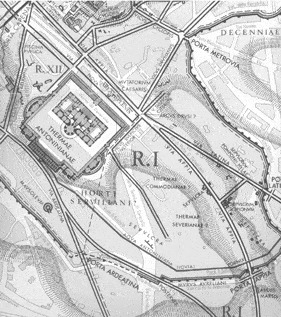
This placement is strengthened by a remark in the Liber Pontificalis, which records that Anastasius I erected a basilica “quae dicitur Crescentiana,” later known as San Sisto Vecchio, on a street called “Via Mamurtini.” Geertman argues on palaeographical grounds that this is a reference to a “Via Mamertini,” a reading preserved in two manuscripts.73
Geertman, “Ricerche,” 226. The manuscript tradition is quite corrupt: “Mamertina” also represented. See Le Liber Pontificalis (ed. Louis Duchesne; Paris: E. De Boccard, 1955) 1:218.
The bath itself may have been built by or named for Marcus Petronius Mamertinus, praefectus Aegyptii for the years 133–138 and subsequently praefectus praetorio in Rome during the years 139–142.74
Prosopographia imperii romani (editorial project of Deutsche Akademie der Wissenschaften zu Berlin; 2d rev. ed.; Berlin: Gruyter, 1933–1966) 6:109–10.
Edward Champlin, Fronto and Antonine Rome (Cambridge, Mass.: Harvard University Press, 1980) 10.
Like the Baths of Sura, the Bath of Mamertinus is one of twelve baths explicitly named in the Regionary Catalogues. The named baths must therefore have been relatively noteworthy, as small and otherwise undistinguished neighborhood baths would not be individually identified. The Marble Plan confirms this conjecture: in addition to the Baths of Sura, it also captures a piece of another bath named by the Curiosum and the Notitia, the Bath of Ampelidis.76
http://formaurbis.stanford.edu/fragment.php?record=224, accessed on 4/29/07.

The actual fragment is lost; all that remains is the Renaissance drawing. The exact location of this bath is unknown, though the Regionaries place it in Transtiberim, in Region XIV. The bathing rooms are not visible, but the bath does feature a generously sized palaestra. Thus, we may infer that if a bath is important enough to be explicitly named in the Regionaries, it almost certainly features a palaestra, like the Baths of Sura and those of Ampelidis. And so, when we think of the Bath of Mamertinus, we should think of a respectable, medium-sized neighborhood bath with a palaestra; perhaps not quite on the scale of the Baths of Sura, which the Regionaries label as a therma, but still, something better than the run-of-the-mill neighborhood bathhouse. Perhaps this is why Justin's succinct answer about the location of his apartment suffices, since the bath is relatively well-known, as was the family from which it took its name.77
Indeed, given the densely networked world of Roman ruling elites, it is almost certain that Junius Rusticus—suffect consul in 133—would have known M. Petronius Mamertinus, praefectus Aegypti from 138–142. There is also an explicit link with the orator Frontinus, who corresponded with Mamertinus and who, along with Rusticus, was a teacher of Marcus Aurelius.
Evidence from Justin's own writings
The case for placing Justin outside the Porta Capena could be strengthened if it were possible to show that elements of Justin's writings correspond to this particular location. Several points deserve mention. First, the Dialogue with Trypho presumes social contact with Jews and Jewish teachers, and an apartment in this spot places him in an area of the city well-known for its Jewish character.78
Significant numbers of Jews also made their homes in Transtiberim, as Philo observes (Leg. ad Gaium 155); see Lampe, From Paul to Valentinus, 38–39.
Sat. 3.12–16, The Satires of Juvenal (trans. Rolfe Humphries; Bloomington, Ind.: University of Indiana Press, 1952) 34. The “straw” and “basket” reference alludes to the way Jews kept food warm in order to avoid cooking on the Sabbath. Harry Leon, in The Jews of Ancient Rome (2d rev. ed.; Peabody, Mass.: Hendricksen, 1995) 137, 234–35, cautions against equating this beggars encampment with a “Jewish Quarter” of the city. The point is well-taken, but Jewish cemeteries along the Via Latina and the Via Appia point to a larger Jewish presence in the area.
See Leon, The Jews of Ancient Rome, 51–53; according to Leon, the large cemetery on Via Appia Antica came into use during the second century (65).
Justin's most substantial interaction with Jews is preserved in the Dialogue with Trypho, which features a long and certainly idealized conversation with a Jewish teacher and his students. It is set “in the walks of the xystus” (Dial. 1.1:

), which is a standard element of gymnasium and bath architecture. According to Vitruvius, the term is applied slightly differently by the Greeks (a covered portico) and the Romans (the area outside the portico); in both cases it represents areas within a palaestra congenial for walking and talking.
81Arch. 5.11.4. See the schematic in Yegül, Baths and Bathing, 15.
Dial. 1.3. Eusebius claims the Dialogue with Trypho is set in Ephesus (Hist. eccl. 4.18), though nothing within the text leads to this conclusion.
Justin's location along the Via Appia also fits nicely with passing remarks he makes about two aspects of Roman religious practice. In his Second Apology, he mentions the cult of Jupiter Latiaris—not something he would have learned about from reading Livy or Varro, most probably, but from his experience in the city. Christians, he says, are routinely charged with human sacrifice and drinking the blood of their victims. Even if that were true—which it most certainly is not—they would in no way be worse than the Romans who themselves use human blood for cult purposes:
For what reason then, should we not admit publicly that these practices (human sacrifice, drinking the victim's blood) are good and declare them to be divine philosophy, saying, that “we celebrate the mysteries of Kronos by killing a man and drinking his blood,” as it is said, performing the same rites as do you with that image to which you pay homage, which you sprinkle not only with the blood of animals but even with human blood, the men most esteemed among you—consul and magistrate—performing the rite with the blood from those having been slain.


.
832 Apol. 12.5; my trans. The text is from Alfred Blunt, The Apologies of Justin Martyr (Cambridge: Cambridge University Press, 1911); the translation “consul or prefect” is suggested in the notes, 126 n. 3. At the time of the feast, a special prefect was appointed (praefectus urbi feriarum Latinarum causa) while the praefectus urbi was in the Alban Hills, participating in the festival.
His mode of reference is somewhat elliptical: why not refer—as Tertullian and Minucius Felix do—directly to Jupiter Latiaris by name? It may be that he is making a mistake or simply doesn't know, as his knowledge of and sympathy towards Roman religious rituals seems to be roughly on par with Roman attitudes towards Christian beliefs and practices. Or perhaps he wants to make the point that this particular rite is so abhorrent to him and to other Christians that he will not refer to it by name but only with a dark and allusive gesture.
On the festival, see Howard Scullard, Festivals and Ceremonies of the Roman Republic (Ithaca, N.Y.: Cornell University Press, 1981) 11–15.
Tertullian, Apol. 9.5; Minucius Felix, Octavius, 30.4, 23.6; Porphyry, De Abstinentia 2.56.9.
However, Ittai Gradel, in “Jupiter Latiaris and Human Blood—Fact or Fiction?” Classica et Mediaevalia 52 (2002) 235–54, argues that human blood may in fact have been used, though an actual human sacrifice goes beyond the evidence. Other ancient writers (Tertullian, Minucius Felix) claim that the rite involved the blood of a criminal slain by beasts, and this might have been brought from elsewhere.
Lampe, From Paul to Valentinus, 267.
Placing Justin in the neighborhood of the Porta Capena may help to explain yet another allusion he makes to Roman religious practice. In 1 Apol. 64.1, he claims that demons have inspired people to set up images of Proserpina at springs, saying that she is the Daughter of Jupiter (


). The practice is not otherwise known.
89“Not literarily mentioned,” according to Lampe (From Paul to Valentinus, 267).
Other statues of lesser significance to the shrine—e.g., of the poet Accius—were present, according to Pliny the Elder, H.N. 34.19.
Barbette Spaeth reminds me that a painting of Proserpina has been found in the nymphaeum at the Roman houses under SS. Giovanni e Paulo.
The particular neighborhood also corresponds quite well with the international character of Justin's students. Justin himself was a native of Judea, and the Acts of Justin mentions the names and ethnic origin of his students: Euelpistis from Cappadocia, and Hierax, from Phrygia; Tatian, we know, came from Syria. While all of Rome was quite mixed ethnically, the region around the Area Carruces would have been especially so. As a focal point for heavy traffic in goods and services, for people waiting for things to be loaded or off-loaded, the area would have been something like an inland wharf, teeming with noise, traffic, and no doubt a richly varied cross section of people from all over the empire. When Juvenal makes his barbed remark about Jewish beggars, he is waiting with a friend who is having all his belongings packed on a four-wheeled cart in preparation for a move out of the city.
Locating Justin's school in this part of the city makes sense when one considers the kinds of real-life exchanges that must lie behind the stylized conversation in the Dialogue with Trypho; it coheres well with Justin's remarks about the festival of Jupiter Latiaris and to images of Proserpina at spring-heads, and to the immigrant constituency of his group. And finally, it coincides well with Lampe's findings about concentrations of Christians in specific parts of the city. As one of his five methods for localizing Christian communities in Rome, Lampe looks for concentrations of Titular Churches, on the assumption that these would have eventually grown up in parts of the city where Christians settled. Strikingly, the two titular churches in closest proximity to one another are the Tituli Fasciolae and Crescentianae (later, San Sisto Vecchio), both of which were on either side of the Via Appia, just past the Baths of Caracalla.92
Lampe, From Paul to Valentinus, 41.
Justin makes one topographical remark in 1 Apol. 26.2 (repeated in 56.1–4) that might appear to place him closer to Transtiberim, namely, his mistaken identity of the statue of the Sabine deity Semo Sancus situated on Tiber Island. He has apparently taken the statue and its inscription as referring to Simon Magus: SIMONI DEO SANCTO, “to Simon, the holy god.” The statue, he claims, is located on Tiber Island, “between the two rivers.” In 1574, a statue bearing the inscription, SEMONI SANCO DEO FIDIO was unearthed on Tiber Island, and it is generally believed that Justin has simply misread the inscription.93
So Lampe, ibid., 269.
In St. Justin Martyr: The First and Second Apologies (New York: Paulist Press, 1997) 136 n. 181, Leslie Barnard suggests that followers of Simon Magus in Rome might have used the statue in their own cultus.
If Justin is located by the Porta Capena, a further intriguing possibility arises. Based on epigraphical evidence—the Flavia Sophe inscription in the Epigraphic Collection at the Museo Nazionale Romano, the “Julia Evaresta” inscription, and another held in the Capitoline museum—it appears very likely that Christians of a Valentinian slant made their homes along the Via Latina, close to the three-mile marker.95
The Capitoline Inscription appears to have no specific name or number; it is on display in a corridor in the Capitoline Museum. All that remains of the Julia Evaresta inscription is a transcript taken by de Rossi, as the slab is lost. See Margherita Guarducci, “Iscrizione cristiana del II secolo nel Musei Capitolini,” Bullettino communale 79 (1963–4) 117–34; ibid., “Valentiniani a Roma,” Mitteilungen des Deutschen Archäologischen Institut, Römische Abteilung 80 (1973) 169–89; and also, “Ancora sui Valentiniani a Roma,” ibid. 81 (1974) 341–43; Peter Lampe, “An Early Christian Inscription in the Musei Capitolini,” Studia Theologica 49 (1995) 79–92 and ibid., From Paul to Valentinus, 298–307.
Conclusion
The goal of this study has been to lift Justin momentarily from the ranks of “church fathers” and “apologists,” and to restore him to the noisy, smelly, and crowded streets of Antonine Rome. The reader may judge whether the attempt to place Justin in Region I, or more narrowly, in a specific neighborhood near the Mutatorium Caesaris and the meeting point of the Via Appia and the Via Latina is successful. And yet, even if a location above the Bath of Mamertinus cannot be finally be proven, it is still an important result to learn of the advantages and disadvantages that an apartment over a neighborhood bathhouse would have offered to a teacher such as Justin. We do not clip Justin's Platonist wings or detract from the intellectual-historical approach to his work by paying close attention to the concrete and quotidian aspects of his life in the city of Rome. Indeed, such study promises to yield a more fully-rounded picture of Justin as a philosopher, teacher, and city-dweller: in short, as an actual human being.


