Introduction
Wellbeing in care homes is a notable issue. The ageing population means that the questions posed by Environmental Gerontology, namely how the physical and social environment affects an older person's quality of life, are becoming increasingly pressing (Geboy et al., Reference Geboy, Moore and Smith2012). Longer life expectancy is placing pressure upon health and social care services (Care Quality Commission, 2016). Care homes have been widely criticised for being too institutional (Carlstedt, Reference Carlstedt2019) and interviews with their residents have found that excessive regimentation and routine can undermine privacy, self-determination and individuality (Miller et al., Reference Miller, Looze, Shield, Clark, Lepore and Tyler2013; Klaassens and Meijering, Reference Klaassens and Meijering2015). The increase in care home residents and in care dependency and dementia has made it harder to provide good clinical care while also respecting residents’ autonomy and creating a homelike environment (Rijnaard et al., Reference Rijnaard, van Hoof, Janssen, Verbeek, Pocornie and Eijkelenboom2016; Klaassens and Meijering, Reference Klaassens and Meijering2015). Many older home-owners are reluctant to move to a care home because they associate their own home with independence and a sense of self. In some cases, older people are forced to move rather than choosing to do so (Gillsjö et al., Reference Gillsjö, Schwartz-Barcott and von Post2011).
How best to promote the wellbeing of older care home residents is a subject open to debate. This is in part because there are different ways to define wellbeing. Ryan and Deci (Reference Ryan and Deci2000) discuss different conceptualisations of wellbeing: namely hedonic wellbeing and eudaimonic wellbeing. The hedonic approach is concerned with happiness, attaining pleasure and avoiding pain (Kahneman et al., Reference Kahneman, Diener and Schwarz1999). On the other hand, the eudaimonic approach posits that living a worthy and virtuous life is more important than satisfying momentary desires.
National Institute for Health and Care Excellence (NICE) Guidelines concerning the ‘mental wellbeing of older people in care homes’ perhaps relate most to eudaimonic wellbeing, in particular in Statement 1 (‘Older people in care homes are offered opportunities during their day to participate in meaningful activity that promotes their health and mental well-being’) and Statement 2 (‘Older people in care homes are enabled to maintain and develop their personal identity) (NICE, 2013: 14). Numerous Occupational Science studies also provide evidence that engaging with meaningful activities can improve the lives of older people. Activities to have featured in such studies range from line-dancing (Owen-Booth and Lewis, Reference Owen-Booth and Lewis2019) to social activism (Fox and Quinn, Reference Fox and Quinn2012). While hedonic and eudaimonic wellbeing are separate approaches to wellbeing, they also overlap with one another. For example, Ryan and Deci (Reference Ryan and Deci2000) argue that eudaimonic wellbeing can foster hedonic wellbeing. In light of this, this research will consider both approaches to wellbeing instead of valuing one over the other.
Outside the care home environment, numerous studies indicate that animals, including animals kept as pets, can have a positive effect on both physical and psychological wellbeing. Research has found links between pet ownership and improved cardiovascular health (Friedmann et al., Reference Friedmann, Katcher, Lynch and Thomas1980; Ogechi et al., Reference Ogechi, Snook, Davis, Hansen, Liu and Zhang2016; Mubanga et al., Reference Mubanga, Byberg, Nowak, Egenvall, Magnusson, Ingelsson and Fall2017), lower rates of loneliness (Wood et al., Reference Wood, Giles-Corti and Bulsara2005) and higher rates of social interaction (Grandgeorge et al., Reference Grandgeorge, Tordjman, Lazartigues, Lemonnier, Deleau and Hausberger2012; Wood et al., Reference Wood, Giles-Corti and Bulsara2005). Literature indicates that pets may be particularly beneficial for older populations. Studies involving older adults have associated the presence of a dog and dog ownership with lower blood pressure and a reduced stress response (Friedmann et al., Reference Friedmann, Thomas, Cook, Tsai and Picot2007, Reference Friedmann, Katcher, Lynch and Thomas2013). Pet ownership amongst community-dwelling older adults has also been linked to higher rates of physical activity (Feng et al., Reference Feng, Dibben, Witham, Donnan, Vadiveloo, Sniehotta, Crombie and McMurdo2014) and slower decline in mobility (Thorpe et al., Reference Thorpe, Simonsick, Brach, Ayonayon, Satterfield, Harris, Garcia and Kritchevsky2006).
With regards to mental health, research suggests that the companionship pets provide is especially valuable for older adults. Companion animals have been found to reduce loneliness (Stanley et al., Reference Stanley, Conwell, Bowen and Van Orden2014) and can help older adults cope with the loss of family and friends (Krause-Parello and Gulick, Reference Krause-Parello and Gulick2015). An indirect effect of pet ownership for older adults can also be an increase in social interaction with other people (Scheibeck et al., Reference Scheibeck, Pallauf, Stellwag and Seeberger2011). Interviews with non-institutionalised older pet owners have also found that caring for a pet can provide pet owners with purpose, structure and a sense of fulfilment (Scheibeck et al., Reference Scheibeck, Pallauf, Stellwag and Seeberger2011; Basin, Reference Basin2018).
As well as pets offering general benefits to the older population, studies suggest that incorporating animals into care homes can improve wellbeing. The majority of literature concerns visiting animals and specifically Animal-assisted Interventions (AAI). AAI is a broad term that refers to both Animal-assisted Therapy (AAT) and Animal-assisted Activities (AAA). Research indicates AAI can improve social interaction within care homes and tackle the monotony resulting from institutionalisation (Edwards and Beck, Reference Edwards and Beck2002; Prosser et al., Reference Prosser, Townsend and Staiger2008; Fossey and Lawrence, Reference Fossey and Lawrence2013). While many care homes welcome visiting animals for AAI, fewer homes have a communal resident pet (i.e. an animal that lives in and is owned by the care home) (McNicholas, Reference McNicholas2008). This may be because staff worry that communal animals will increase their workload and may distract them from caring for human residents (Fossey and Lawrence, Reference Fossey and Lawrence2013). However, the limited research in this area has found that resident animals can have long-lasting positive effects, such as decreases in depression and problem behaviour among residents (Crowley-Robinson and Blackshaw, Reference Crowley-Robinson and Blackshaw1998; McCabe et al., Reference McCabe, Baun, Speich and Agrawal2002).
One growing and increasingly prevalent area of research is the benefits that AAI and resident animals can offer to care home residents living with dementia. Animals can provide a valuable opportunity for interaction as they are non-judgemental and communicate through body language (Tournier et al., Reference Tournier, Vives and Postal2017). AAT sessions with dementia residents in care homes have been associated with a reduction in neuropsychiatric symptoms of dementia (Richeson and McCullough, Reference Richeson and McCullough2003; Tournier et al., Reference Tournier, Vives and Postal2017) and an increase in self-perceived quality of life (Moretti et al., Reference Moretti, De Ronchi, Bernabei, Marchetti, Ferrari, Forlani, Negretti, Sachetti and Atti2011). Resident animals have been linked to a decrease in challenging behaviour and an increase in prosocial behaviour (McCabe et al., Reference McCabe, Baun, Speich and Agrawal2002). Recently, there has been a growth of interest in pet substitutes in care homes and in particular robotic pets. Robotic pets seem to be of particular benefit for those with cognitive impairments such as dementia (Moyle et al., Reference Moyle, Beattie, Draper, Shum, Thalib, Jones, O'Dwyer and Mervin2015). Studies of residents living with dementia have found that sessions with robotic pets can decrease stress and anxiety (Petersen et al., Reference Petersen, Houston, Qin, Tague and Studley2017), reduce depression and agitation (Jøranson et al., Reference Jøranson, Pedersen, Rokstad and Ihlebaek2015), and increase pleasure and interest (Libin and Cohen-Mansfield, Reference Libin and Cohen-Mansfield2004; Moyle et al., Reference Moyle, Cooke, Beattie, Jones, Klein, Cook and Gray2013).
While there is well-documented research regarding the benefits of visiting and resident pets and while research is growing in innovative areas such as artificial pet substitutes, there is a gap in research concerning personal pets in care homes. This is despite the large body of research linking personal pet ownership and wellbeing and the fact that 36 per cent of people over 65 are pet owners (Mintel UK, Reference Mintel2017). It may be that care home staff are worried about the potential workload that could come from welcoming personal pets. Care homes that allow residents to bring companion animals often only do so on the condition that residents are able to care for their pets themselves (Fossey and Lawrence, Reference Fossey and Lawrence2013). The policies of many care homes regarding personal pets are ambiguous and indicate ambivalence (Smith et al., Reference Smith, Johnson and Rolph2011).
Arguably, the trend is towards reducing staff labour rather than increasing it. Indeed, one reason that robotic pets have attracted so much interest is because they require less care and create fewer hazards than living animals (Bates, Reference Bates2019). In contrast to this, organisational culture movements such as the Eden Alternative argue that care homes should prioritise spontaneity and variety. The Eden Alternative advocates the introduction of children, plants and animals into care homes, all of which have the potential to create extra work (Thomas, Reference Thomas1996). However, even amongst care homes that subscribe to the Eden Alternative and allow resident communal pets, there are still only a novel few that welcome personal pets (Loughlin, Reference Loughlin2014).
Care homes that only accept AAI, communal pets and artificial pets fail to account for the benefits specific to having a personal live pet. The limited research in this area suggests that personal pets can be a source of companionship and activity, and can lead to friendships between residents (Smith et al., Reference Smith, Johnson and Rolph2011). A larger body of research documents how separating care home residents from their pets can be harmful. For example, legal analysis of instances where older adults have been forced to abandon their companion animals when entering care has found that forced separation amounts to a major bereavement and can have a detrimental effect on health and wellbeing (Fox and Ray, Reference Fox and Ray2019). Such negative findings call for more research into the experience of care home residents who are able to live with their personal pets.
To summarise, there is a substantial body of literature that indicates that animals can have a positive effect on wellbeing. While research documents the benefits of pets amongst non-institutionalised older adults as well as the benefits of visiting and shared communal animals in care homes, there is a lack of research that addresses how keeping a personal pet in a care home may impact wellbeing. In light of this, this study addresses the research question:
• What does the experience of keeping a personal pet in a care home mean for residents’ sense of wellbeing?
Method
Participants
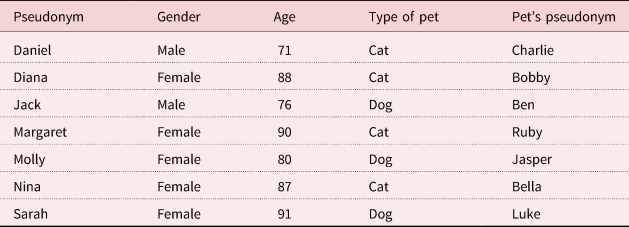
Seven participants (see Table 1) were recruited from four different care homes. Inclusion criteria were that participants were living with their personal pet in a care home for older people. Only one care home reported a resident with advanced cognitive impairments who owned a pet. In their gate-keeping role, care home staff excluded us from approaching this person for participation. Therefore, none of the residents had advanced cognitive impairments. As shown in Table 1, two men and four women aged between 71 and 91 years participated. Three participants had a dog and four participants had cats.
Participant characteristics

Interview schedule
A semi-structured interview schedule was developed. Questions at the start of the interview established basic facts about participants and their pets. Most questions were open-ended in order to allow the participants the opportunity to direct the interview. Following advice from Smith et al. (Reference Smith, Flowers and Larkin2009), participants were not asked the research question directly. Instead, the interview schedule was designed to prompt discussion of topics relevant to the research question so that this could be answered via analysis following the interview. Questions explored the following general areas: personal history of pets, positive and challenging aspects of keeping a pet in the care home, feelings of responsibility regarding one's pet, how pets affect interactions with staff and other residents, and opinions on communal pets.
Procedure and ethics
The research was conducted between April and June 2017. Before starting recruitment for this study, ethical approval was granted by the BPP University Research Ethics Committee. In order to address ethical challenges, the study procedure was guided by the Code of Ethics and Conduct (British Psychological Society (BPS), 2009) and the Code of Human Research Ethics and Conduct (BPS, 2014). Ethical issues identified included working with vulnerable adults and care home staff acting as gatekeepers for recruitment.
Potential care homes for inclusion were identified using a number of strategies, including an online search for ‘pet friendly care homes’ and via a charity for older people. Preliminary verbal consent was gained from the care home staff who had residents with pets and who were willing for their residents to take part. Staff described the study to participants who gave consent for the researcher to visit.
Semi-structured interviews were conducted in the care homes where the residents were living. A Disclosure and Barring Service Check was obtained before the researcher entered the care homes in order to safeguard older residents who are classified as vulnerable adults. All interviews were conducted by the first author and took place in the residents’ rooms. Before staff left the participants alone with the researcher, it was established that participants consented to this.
Participants were presented with an information sheet which detailed what the study would involve. As participants were from a vulnerable population group, we made sure to give them ample time to ask questions about the study after reading the information sheet so we could gain informed consent (BPS, 2014).
Participants were then presented with a consent form to sign if they wished to continue. The information sheet and consent form made it clear that participants were under no obligation to participate in the study and that participants were able to withdraw at any time before the submission of the report for examination. We were aware it was important to stress this in case the involvement of care home staff as gate-keepers put pressure on the participants (BPS, 2014).
Interviews were recorded on the first author's password-protected mobile telephone and lasted between 22 and 70 minutes. The audio-recordings were transcribed verbatim (although using pseudonyms to protect identity) and kept in password-protected files and were deleted after transcription.
Data analysis
The data collected were analysed using Interpretative Phenomenological Analysis (IPA). In comparison with thematic analysis, which can be used to address a wide range of research questions, IPA's theoretical framework means it is well-suited for specific types of research questions (Clarke et al., Reference Clarke, Braun, Hayfield and Smith2015). In accordance with its phenomenological philosophy, IPA is concerned with lived experience and how participants make sense of their world (Smith and Osborn, Reference Smith, Osborn and Smith2007). We chose IPA because we wanted to explore the experience of keeping a personal pet in a care home and what it means for residents’ sense of wellbeing. Personal pets in care homes is also an under-researched area and IPA is particularly suitable for novel topics (Smith et al., Reference Smith, Flowers and Larkin2009). IPA's idiographic approach also makes it fitting for studies with small sample sizes, such as ours, because it encourages researchers to complete detailed analysis of particular cases (Smith and Osborn, Reference Smith, Osborn and Smith2007).
IPA recognises and accepts that the researcher plays an active role in the research process. A two-stage interpretation process or double hermeneutic is involved in analysis, whereby the researcher is interpreting the participants interpreting their world. While both levels of interpretation can lead to rich analysis, the researcher should make attempts to focus on the participants’ experiences as the starting point for analysis (Smith and Osborn, Reference Smith, Osborn and Smith2007). As recommended by Smith et al. (Reference Smith, Flowers and Larkin2009), the first author kept a reflective diary in order to bracket assumptions during the interview process and initial stages of data analysis.
The present study followed the steps for analysis outlined by Smith and Osborn (Reference Smith, Osborn and Smith2007) and Smith et al. (Reference Smith, Flowers and Larkin2009). The first stage involved the first author reading the first transcript multiple times in an attempt to engage with the participants’ experiences. This was followed by open coding, whereby the researcher wrote down initial comments on the left-hand margin. As recommended by Smith et al. (Reference Smith, Flowers and Larkin2009), in order to retain a phenomenological focus, the initial notes were mainly descriptive. Following this, the researcher moved on to more interpretative noting, questioning the participants’ use of language and considering more abstract concepts and the wider context. Following this, the same transcript was re-read and emerging themes were noted on the right-hand margin. Care was taken to make sure the themes had an experiential focus. All the themes were then written on a separate piece of paper in chronological order and related themes were clustered together. This process was repeated for each transcript.
As advised by Smith and Osborn (Reference Smith, Osborn and Smith2007), analysis of preceding transcripts was used to orient analysis of following transcripts. However, the researcher also tried to remain open to new themes within each transcript plus differences between transcripts in line with IPA's idiographic commitment. Once each transcript was analysed, the researcher used mind maps to visualise master themes. A final table of master themes and sub-themes was then developed. In order to ensure trustworthiness of the findings, and in particular credibility, co-researchers independently read the transcripts and checked that the final table of themes created by the first author could be supported by the data.
Results
Overview
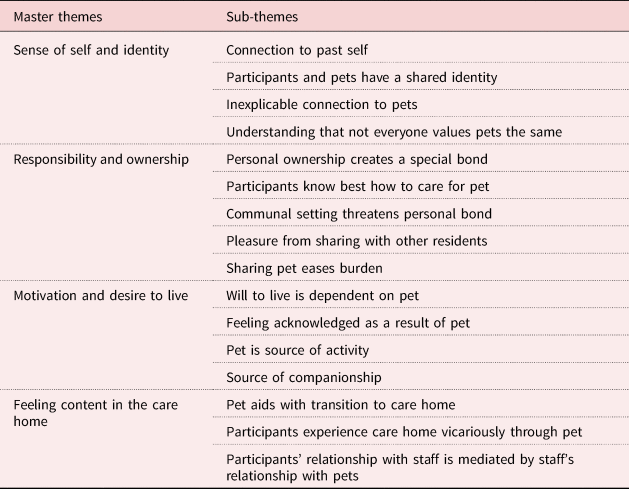
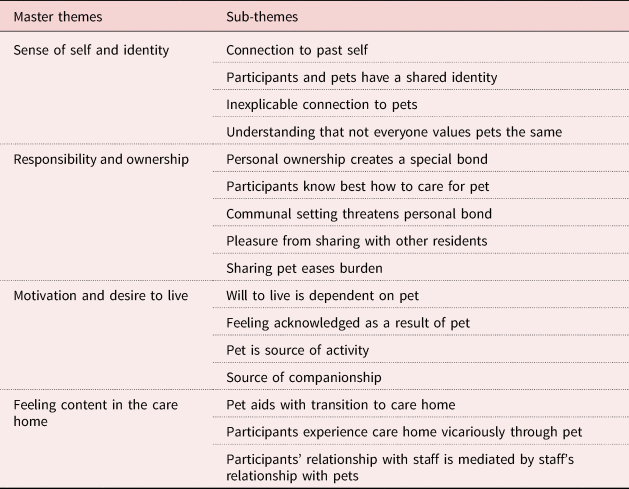
Analysis of the seven semi-structured interviews revealed four master themes that were relevant to participants’ wellbeing (see Table 2). These were: ‘sense of self and identity’, ‘responsibility and ownership’, ‘motivation and desire to live’ and ‘feeling content in the care home’.
Master themes and sub-themes
Sense of self and identity
Pets seemed to have a strong impact on the participants’ sense of self and identity. They played a part in participants’ connection to their past selves as well as how participants defined themselves in the present and in contrast to others.
Connection to past self
All of the participants saw their involvement with animals as a continuous aspect of their identity, linking their present and past selves.
The participants all had a history of pet ownership. All having grown up with pets and animals seemed to be a defining feature of their adult lives. One participant reflected upon his involvement with animals during his career while others reminisced about the communities they had lived in and the places they had visited with their pets. Participants reflected upon their status as pet owners as an enduring aspect of self, as illustrated by Daniel:
This is my fourth cat. Because my twin wanted a cat, goes out with the girls and it was left to me and Dad. I said: ‘You wanted a cat, you've got to look after it.’ He said: ‘You do it [Daniel], you're better at that stuff than me.’ Ever since then I've been the cat guy. (Lines 49–53)
Daniel remembers his brother's judgement of his ability to care for cats as a distinguishing characteristic. ‘Ever since then I've been the cat guy’ suggests that Daniel has accepted this judgement and sees his connection to cats as a permanent part of his identity.
Many residents spoke of current pets in relation to past pets as well as past human relationships. Some residents consciously reflected upon their pet as a valuable link to those they had lost. Jack explained how he lost both his wife and his third Airedale dog at around the same time. He saw his current dog as a way of connecting to both his past dog and spouse:
And so when I got this one I thought if I call him Ben, which is the name of the last one, who died, it would help remind me of my dog and my late wife you see because she picked the name. (Lines 34–37)
Participants and pets have a shared identity
Almost all residents clearly stated that they would not have moved to the care home if that meant leaving their pet, suggesting that they and their pet were an inseparable pair. Molly's straightforward statement is representative of the way that many residents spoke:
I wouldn't have gone anywhere without her. We come together, it's as simple as that. (Lines 16–17)
Many of the participants mentioned sharing experiences with their pet. Some residents discussed routine experiences, such as sharing meals and engaging in activities. Others described sharing longer-term experiences, as illustrated by Margaret, who discusses not being able to walk her cat due to the traffic outside the care home:
We lived in green fields and she grew up in freedom. But she's an old lady like me now. You grow old in the environment you live in, and the cat does the same, they're no different to human beings. (Lines 88–91)
Margaret's change from the pronoun ‘she’ to ‘we’ as well as her personification of the cat ‘as an old lady’ merges her cat's experience with her own experience. Her reasoning that her cat has ‘had her freedom’ and is adapting to ageing in the home may also reflect her feelings about the home.
Many of the participants spoke of their needs, feelings and characteristics together with their pets’ in a way that suggested they and their pet were interchangeable. For example, many participants answered questions concerning their own feelings or needs by discussing their pet's feelings or needs. Others expressed their characters through descriptions of their pet's characteristics, as illustrated by Sarah:
He really is extraordinary and that's why they love him because he really is dotty, like me. (Lines 316–317)
Inexplicable connection to pet
Several of the participants suggested that their relationship with pets was an inexplicable part of their identity. Some participants found it hard to reflect upon their relationship with their pet because they could not remember a time when they had been without a pet or imagine a situation in the future where their pet might be absent. Sarah's description of her love for dogs as an almost reflex reaction captures how several of the participants seemed to feel:
I mean, I haven't not had a dog since I was two … I mean truly but it was sort of automatic, I never gave it much thought, of course I would have a dog … But I can't tell you anything clever about them. (Lines 136–144)
Sarah's claim that her love for dogs is something she has never had to think about suggests she feels it is an instinctive part of her being. She may be unable to say ‘anything clever about them’ because they are an inextricable part of her. Just as one may struggle to analyse an impulse, Sarah cannot explain her connection to dogs.
Understanding that not everyone values pets the same
Several of the participants reflected upon their views regarding pets as subjective and therefore specific to their identity. They considered their feelings and actions to be rooted in their love for pets. For example, Nina, who volunteered to adopt her cat after another resident passed away, reasoned that others may have not wanted to adopt the cat because they did not share her love for animals:
You know people are funny aren't they? A dear little cat like that, anyway, I suppose everybody isn't a cat lover. (Lines 24–26)
Nina suggests that the behaviour of those who do not like pets is alien. She groups herself together with fellow animal lovers and distances herself from those who are indifferent.
Responsibility and ownership
As a group but also as individuals, participants were conflicted with regards to their desire to maintain responsibility for and a sense of ownership over their pet. They expressed a desire to keep their pets to themselves alongside a desire to share their pets with other residents and staff.
Personal ownership creates a special bond
All of the participants suggested that they felt a strong personal bond existed between them and their pet. The shared history between the participants and their pets, as well as the daily activities they experienced together, confirmed the private nature of their relationship and strengthened the participants’ feelings of ownership.
The importance of personal ownership was confirmed when participants were asked to give their opinions on communal animals. Some participants, while not explicitly averse to communal animals, displayed little interest in them in comparison to their own animal. Sarah's answer illustrates this:
Interviewer (I): So what's your relationship with the animals here that are communal?
Participant (P): Well, you just say ‘oh, hello darling you're so sweet but not as sweet as my Luke’ and then you move on. You're much closer surely to the one you feed and sleep with and walk with. (Lines 385–390)
Sarah suggests that she only takes a passing interest in communal animals because they are not her own. Shared activities between a pet and an owner create an intimacy that she suggests is absent in residents’ relationships with communal animals.
Resident knows how best to care for pet
Several participants made comments that implied that they felt that only they were capable of meeting their pet's needs. For example, participants claimed that only they understood how to feed or walk their pet. As a result, participants seemed to feel that their pets were reliant on them and that they therefore had a duty of care, as demonstrated by Daniel:
I: Was keeping [Charlie] with you important to you when you moved here?
P: It was important to me, because it's not her fault. I don't want her to go to someone else, I want her to stay with me, she knows me, I get her, so I want her to stay with me. (Lines 86–91)
‘It's not her fault’ implies that Daniel believes that if he gave his cat to ‘someone else’ she would suffer because he is the person who best understands her.
Communal setting threatens personal bond
Some residents suggested that their sense of ownership and responsibility for their pet was threatened by the communal nature of a care home, as demonstrated by Diana:
You still feel responsibility towards your own animal and a strange sense of possession even though you have to share him with everyone else … especially if we all live in one complex. (Lines 319–323)
Diana's description of her ‘sense of possession’ as ‘strange’ indicates that she believes that it is somehow at odds with the set-up of the care home. ‘Have to share’ implies that she feels almost forced to share her animal with others.
Participants suggested that their relationship with their pet was in some ways diluted because of sharing their pet's attention and affection with others. Nina's answer exemplifies this because she suggests that her sense of ownership is threatened by fellow residents:
I: Do you like having Bella here?
P: When she recognises me as owner but she goes all round getting food. (Lines 108–111)
Some residents, when asked about communal animals, were keen to defend the importance of a personal bond between pet and owner. For example, Margaret responded ‘Why do you have a child? You don't share it with other people’ (lines 163–164). Her analogy comparing a pet to a child attempts to make others understand how strange she finds the idea of sharing her pet. Her rhetorical question is somewhat defensive, suggesting she may feel threatened by the idea of communal animals.
Pleasure from sharing with other residents
Some participants were happy to share their pet with others as opposed to feeling possessive. One reason for this was that participants believed that other residents benefited from spending time with their pet. Participants also took pleasure in interacting with fellow residents as a result of their pet. Jack's account of his dog's relationship with a female resident exemplifies this:
She loves him and he does her … Every evening, I obviously go with them, they walk right to the end of this garden … You can sit there with him for a while and take in the evening air (laughs). I sit with the two of them every evening. It's very rare that we don't … if it's rained and then it's stopped we can still walk up there … It's lovely and it's good for her. (Lines 477–489)
Jack's laughter and his description of sitting and taking ‘in the evening air’ reflects how he finds joy in this shared experience. He stresses how he walks with his fellow resident every day despite the weather, suggesting it is a ritual of unassailable importance.
Sharing pet eases burden
As a result of various impairments, many participants were incapable of caring for their pet alone. To varying extents, participants relied on staff helping to deliver practical care for their pet. While one participant described her inability to care for her pet as a frustrating reminder of her old age, almost all residents seemed thankful for the opportunity to delegate responsibility.
Some of the participants suggested that they found feeling fully responsible for their pet in a communal setting to be emotionally distressing. A few residents worried about their pets disturbing others and feeling responsible.
On the plus side, some participants found sharing responsibility and ownership with other residents and staff to be liberating because they felt that their pet was less dependent on them. Diana, who lived in the home together with her husband, demonstrates this:
P: Our cat, I think, can hardly remember two years ago when he came, he now thinks of this purely as all his and all the residents are his and all the grounds are his.
I: Do you mind that at all?
P: No, I'm happy. We are happy for everybody to share him because when we die, we know he's still going to be loved and looked after. (Lines 356–363)
Motivation and desire to live
All of the participants’ pets seemed to play a part in making their owners want to stay alive and stay active. Pets made participants feel needed and acknowledged and were also a source of joy and companionship.
Will to live is dependent on pet
The possibility of having to live without one's pet seemed to distress most of the participants. When asked about how they would cope with pet loss or separation, many participants answered that they would rather not think about it. Participants’ attempts to avoid the topic were perhaps indicative of just how worried they were by it.
A few residents tried to take a stoic approach to pet loss, reasoning that they would be able to carry on despite being upset. For example, Molly claimed ‘I'd be devastated … but life's got to go on’ (lines 124–125). Other residents explicitly stated that they would no longer be able to live without their pet, as illustrated by Sarah:
What, if [Luke] died? Oh, I think I should die soon, really. I don't (pause), it sounds a terrible way to talk but I just don't know, I wouldn't be surprised. Yes, I love him that much. (Lines 253–255)
Feeling acknowledged
Many of the residents valued being paid attention to and feeling acknowledged, as illustrated by Nina's answer to the question below:
I: Is there anything that you find difficult about having her here at all?
P: Cats plunge their feet into you, she ladders my stockings and pricks my legs … I put up with that (laughs). Better than being ignored. (Lines 176–182)
Nina may take pleasure in the cat pricking her because the alternative is being paid no attention. Her laughter perhaps indicates her awareness of the irony that what for others is a nuisance is for her a welcome interaction.
Several of the participants appreciated their pet's ability to empathise with them. As illustrated by Margaret, participants felt that pets seemed to understand them and make them feel their feelings mattered:
When I've been down in the dumps, she knows because she comes and puts her paw on my cheeks and she's very sorry for me. (Lines 76–77)
Almost all of the participants seemed to take joy in the reciprocal nature of their relationship with their pet. For this reason, they valued engaging with their pet above other activities. Margaret, who enjoys gardening, answered that she preferred interacting with animals because ‘you can build up a relationship with an animal but you can't really build up a relationship with a garden’.
Source of activity
Most of the participants associated their pet with engaging in activity. Many participants discussed how they felt obliged to keep up with certain tasks, such as going on walks, for the sake of their pet. Other participants suggested that their pets encouraged them to stay motivated generally, as illustrated by Daniel:
She likes to be very close to me. When I woke up this morning her eyes were on me, saying you need to wake up and get on. (Lines 213–215)
Daniel personifies his cat, interpreting its stare as a kind of pep talk and a reason to keep on living.
Other participants found activities involving their pet were a way to pass the time pleasurably, as demonstrated by Jack. Jack suggests the variety provided by his pet enables him to break free from the monotony and emptiness of the care home routine:
It annoys me when you hear people at breakfast time, lunch time and evening meal, the first thing they're asked after they've finished their meal is shall we take you back to your room? Now what an existence … Having a pet, it gives you more to life … it's something new every day to do. (Lines 585–590)
Source of companionship
All of the participants indicated that their pets made them feel less alienated. Many of the participants implied that their pets were particularly important to them because of the loss of other relationships in their lives. Sarah's answer below illustrates this:
I: And when you were thinking about moving here was it important to keep your dog with you?
P: Well, well, my husband died and I lived in a house on my own … and then, I dunno, about six friends of mine died in the past year. (Lines 81–85)
Sarah does not make an explicit link between the loss of her husband and friends and the importance of keeping her dog. However, it is telling that she answers the question about the importance of keeping her dog by describing her experience of loss. This suggests that the two are connected.
Some of the participants clearly stated and others implied that they valued their relationship with their pet just as much, if not more, than their relationships with other humans. Many personified their pets, indicating their pets acted as substitutes for human relationships. For example, Margaret described her cat both as her ‘family’ and her ‘best friend’ (line 46).
Feeling content in the care home
The participants’ pets affected how satisfied they were with their current environment. Pets played a part in how at home participants felt and also seemed to affect how participants felt about other residents and staff.
Pet aids with transition to care home
Some of the participants discussed how their pets helped them adapt to life in the care home. All who discussed this suggested that their pets provided comfort, helping them feel secure and at home in a strange and potentially alienating place. Nina, when asked about the fact that some care homes see communal animals as a satisfactory substitute for personal animals, answered:
Leaving home is a trauma on its own, you're losing your home, you're cut off from friends if it's a distance. And it's a complete change in your life. And to take away the very thing that gives you stability and comfort is lacking in imagination. (Lines 215–219)
Nina's emotive language emphasises the distress that moving to a care home can cause. She suggests that a personal pet may be the only aspect of one's life that stays constant and so may be key to helping residents adapt to a new environment.
Participants experience care home vicariously through pet
Various participants took joy in the fact that other residents and members of staff liked their pet. Some of the participants seemed to imply that they felt welcomed and liked as a result of this, as illustrated by Diana:
I: What are your favourite things about having [Bobby] here – you said it makes it feel more homely?
P: Everybody likes him, you know, he goes round to see various people, all the people who make him welcome he visits and he thoroughly enjoys it. (Lines 169–174)
The question is directed at Diana and asks what about Bobby makes her feel at home. Her answer indicates that the fact that other people like Bobby and ‘make him welcome’ makes her feel welcomed and at home.
A couple of the residents mentioned feeling frustrated at not being able to easily take their pets on long walks due to the location of the care home. Difficulty meeting the needs of their pet seemed to lead to negative feelings regarding the home, as demonstrated by Sarah:
I: Have you always taken him for walks?
P: Oh always, oh god yes. I mean but if you live in a proper place with fields and the heath it's too easy but here's very difficult. (Lines 187–190)
The adjective ‘proper’ implies that Sarah feels that the care home is not really a home in the traditional sense. This may come from the belief that it is inconvenient for her pet.
Participants’ relationship with staff is mediated by staff's relationship with pets
All of the participants’ feelings towards members of staff were affected by how they felt staff treated their pets. On the whole, the residents were well disposed towards staff because staff liked their pets. Only one resident mentioned a staff member being afraid of his pet and therefore not wanting her to visit his room. However, he dismissed this example as unrepresentative of the staff as a whole. Some of the participants built friendly relationships with the staff based on a shared interest in animals. Various residents suggested that they felt well cared for because they believed that their pets were well cared for by staff. Nina, after reflecting she thought it was likely staff were asked if they liked animals as a prerequisite for working at the home, reflected:
This home is full of kindness. We can live on kindness, it's the first need I think. I mean if I was here and people were indifferent I couldn't stand it. (Lines 316–318)
Nina sees the attitude staff take towards pets as indicative of a generally caring and kind attitude that characterises the home as a whole.
Discussion
The present study addressed the research question ‘What does the experience of keeping a personal pet in a care home mean for residents’ sense of wellbeing?’ IPA of seven semi-structured interviews revealed four master themes. Each theme is discussed in turn below.
Sense of self and identity
A sense of self and identity emerged as a key theme and relates directly to Statement 2 of the NICE (2013) Guidelines on the ‘Mental wellbeing of older people in care homes’. It is also in keeping with qualitative research that has found pets to be a source of continuity in the identity of older pet owners as their lives undergo changes in other areas (Toohey and Rock, Reference Toohey and Rock2019).
Some of the research regarding animals in care homes suggests that visiting animals can provide a way for residents to reconnect with aspects of their identity. For example, visiting animal programmes have prompted residents of care homes to reminisce about the part that pets have played in their former lives and to share memories (Savishinsky, Reference Savishinsky1985; Prosser et al., Reference Prosser, Townsend and Staiger2008). However, on the whole, identity is not a major focus of the literature addressing animals in care homes to date, presumably because research mainly explores the impact of visiting and communal animals. The latter do not come into the care home with individual residents and therefore do not form a stable part of the identities of individual residents in the same way that, according to the present study, personal pets do. Participants seemed to value how their pets provided them with an ever-present link to their past and seemed to have a shared identity with their pets resulting from a shared history.
These findings have implications for eudaimonic wellbeing. Waterman (Reference Waterman1993) argues that in order to fulfil one's unique potential, a key aspect of eudaimonic wellbeing, it is essential to realise and live in line with one's true self. Participants in the present study suggested that owning a pet meant that they felt as if they were living in accordance with their true selves. This finding is pertinent given the criticism care homes have faced for quashing identity. Thomas (Reference Thomas1996), the father of the Eden Alternative, argues that care homes undermine individuality because they subscribe to medical models that are focused on diagnosis and treatment, rather than personal growth. Organisations such as the Eden Alternative advocate individualised care, however, research suggests that many care homes still fail to provide a person-centred care approach. In care homes characterised by batched living, all residents are expected to follow the same routine (Klaassens and Meijering, Reference Klaassens and Meijering2015). In contrast, in the present study, participants reported that their pets enabled them to pursue their own activities instead of being subject to the standard care home routine. Fox and Ray (Reference Fox and Ray2019) suggest that care homes are reluctant to allow residents to pursue individual interests because many care homes view residents as a homogenous and vulnerable group that must be protected from harm. They suggest that residents are separated from their companion animals because risk reduction is valued above identity.
Responsibility and ownership
The present study found that residents valued the personal bond they had with their pet and that this bond did not apply to their relationship with communal animals. This is in line with the small body of research that addresses personal ownership of pets in care homes. McNicholas (Reference McNicholas2008) interviewed care home residents with personal pets and found that many appeared indifferent to visiting and communal animals. While most research focuses on the benefits of visiting and residential pets, the results of the present study and McNicholas’ study suggest that personal pets may offer residents benefits that visiting and communal animals cannot provide.
On the one hand, participants in the present study felt that the communal nature of the care home threatened the bond they had with their pet. However, on the other hand, they also found that sharing their pet with others facilitated social connection. Limited existing research into personal pets in care homes also reports that companion animals can lead to friendships between residents (Smith et al., Reference Smith, Johnson and Rolph2011). More generally, interviews with care home residents have found that residents benefit from social interaction but can find it hard to relate to one another due to lack of common interests and age-related impairments (Buckley and McCarthy, Reference Buckley and McCarthy2009; Falk et al., Reference Falk, Wijk, Persson and Falk2013). The present day suggests personal pets may be able to bridge such gaps between residents.
Linked to the special bond that residents felt existed between them and their pet was the also the responsibility that participants felt for their pet. Interviews with non-institutionalised older pet owners have found that caring for a pet can provide older adults with a sense of fulfilment, purpose and structure (Scheibeck et al., Reference Scheibeck, Pallauf, Stellwag and Seeberger2011; Cole, Reference Cole2019). These findings reflect the belief of eudaimonic wellbeing theorists that regularly engaging in purposeful activities gives life meaning and direction (Ryff and Singer, Reference Ryff and Singer1998). Recent research suggests that care home residents’ lives often lack meaningful activity, which negatively impacts upon their wellbeing and quality of life (Smith et al., Reference Smith, Towers, Palmer, Beecham and Welch2018). Care home residents also report that they value autonomy and control (van Hoof et al., Reference van Hoof, Verhagen, Wouters, Marston, Rijnaard and Janssen2015; Rijnaard et al., Reference Rijnaard, van Hoof, Janssen, Verbeek, Pocornie and Eijkelenboom2016). In the present study, residents found meaning and purpose in their duty of care towards their pets. Instead of being dependent on others, they felt that their pets were dependent on them.
While in some ways participants benefited from feeling responsible for their pet, their wellbeing was also enhanced by sharing this responsibility. Research suggests that caring for a pet can be overwhelming as well as beneficial (Wisdom et al., Reference Wisdom, Saedi and Green2009). In this study, delegating responsibility meant that participants could care for their pet without feeling burdened by their duty of care. However, while participants benefited from extra help, research suggests that staff do not always welcome the additional workload resulting from personal pets (Fossey and Lawrence, Reference Fossey and Lawrence2013). The recent interest in robotic pets and pet substitutes is also in part fuelled by the need to reduce staff labour (Bates, Reference Bates2019).
Motivation and desire to live
The responsibility participants felt for their pets also contributed to participants’ motivation and desire to live. Overall, participants’ lives were enhanced because their pets gave them the attention, companionship and reasons for activity that they otherwise might have lacked. Pets made residents lives more pleasurable as well as more engaging, adding to both hedonic and eudaimonic fulfilment.
These findings are in line with other research that suggests that pets may help older adults cope with the challenges of later life, and in particular the loss of family and friends (Sharkin and Knox, Reference Sharkin and Knox2003). More recently, this has been evidenced by the well-publicised case of Bob Harvey, an 87-year-old man living in a Scottish care home with his wife and dog. Following the death of his wife, the care home in which he was living stated he would have to leave the home if he wished to continue living with his dog. Harvey chose to move into private accommodation, stating that his dog was key to helping him live following the loss of his wife (Fox and Ray, Reference Fox and Ray2019).
While residents of care homes are surrounded by other people, qualitative studies have found that they can find it hard to build relationships with others due to cognitive impairments and lack of shared interests (Buckley and McCarthy, Reference Buckley and McCarthy2009). In light of this, the familiar and unconditional support that pets provide older people may be especially valuable in a care home. In this study, many participants suggested that their pet was their most important relationship.
Alongside being a source of companionship, participants also identified their pets as a source of activity. In the present study, residents felt obliged to stay active because of their pet and also found that pets meant a wider variety of activities were available to them. This speaks to Statement 2 of the NICE Guidelines that references the opportunity to participate in meaningful activity as key to the wellbeing of older people in care homes. Occupational therapy, the field that focuses on enabling people to engage in activity, often directs its energy to helping older adults maintain independence in the community as opposed to going into care (De Coninck et al., Reference De Coninck, Bekkering, Bouckaert, Declercq, Graff and Aertgeerts2017). However, efforts need to be made to help adults who have entered care stay active. Research shows that activity programmes can improve residents’ quality of life (Dahlan and Ibrahim, Reference Dahlan and Ibrahim2017) but opportunities for recreation in care homes can be limited because of concerns over risk management (Klaassens and Meijiring, Reference Klaassens and Meijering2015).
Some of the positive findings of this study are present in research regarding visiting and residential animals. For example, AAT sessions in care homes with both live animals and robotic pets have been found to reduce levels of loneliness amongst residents (Banks et al., Reference Banks, Willoughby and Banks2008; Vrbanac et al., Reference Vrbanac, Zečević, Ljubić, Belić, Stanin, Brkljača Bottegaro, Jurkic, Skrlin, Bedrica and Žubčić2013). Studies also indicate that AAT can make residents’ lives more pleasurable, improving their perceived quality of life (Moretti et al., Reference Moretti, De Ronchi, Bernabei, Marchetti, Ferrari, Forlani, Negretti, Sachetti and Atti2011). However, there is a lack of research concerning the long-term effects of AAT and more follow-up assessments are needed (Souter and Miller, Reference Souter and Miller2007; Maujean et al., Reference Maujean, Pepping and Kendall2015). The present study concerned personal pets permanently living with participants and so personal pets may have a more lasting effect on residents’ life satisfaction.
While resident pets are just as permanent as personal pets and research reports have found that they can increase life satisfaction amongst residents, studies also indicate that communal animals can spend most of their time with staff or select residents (Filan and Llewellyn-Jones, Reference Filan and Llewellyn-Jones2006). In the present study, part of the reason personal pets were so central to participants’ lives was because they were so focused on those participants.
The finding that personal pets gave residents the motivation and desire to live has positive implications but also has a potentially harmful downside. In this study, participants felt that their lives were so enhanced by their pets that some indicated that they would not be able to live without them. Other research reports that older adults worry about the possibility of losing their pet or of their pets losing them (Cole, Reference Cole2019) and studies indicate that pet loss can have devastating effects on the mental and physical health of older adults (McNicholas, Reference McNicholas2008).
Feeling content in the care home
As well as improving residents’ feelings about their lives in general, the present study also indicated that personal pets improved how participants felt about their environment. In light of interviews indicating that older adults would only leave their own home if forced to do so, it is important to identify factors that help older adults adjust to life in a care home.
The limited research regarding personal pets in care homes has found that residents praise care homes that allow them to live with their pets (Smith et al., Reference Smith, Johnson and Rolph2011). Research also indicates that separating older adults from their pets can make their transition to life in care harder. McNicholas et al. (Reference McNicholas, Collis and Morley1993) found that residents who had been forced to give up their pets experienced problems with social integration as well as disruption in sleeping and eating patterns. More recent research has found that staff report a high proportion of residents who have been separated from their pets display noticeable signs of distress (McNicholas, Reference McNicholas2008) and an interview study assessing factors contributing towards anxiety and depression in care homes identified separation from pets at home as a stressor (Baldacchino and Bonello, Reference Baldacchino and Bonello2013).
Research into the effects of pet loss when moving into a care home, taken together with the findings of the present study, indicates that residents who are able to keep their pets may be better able to adapt to their environment. However, in the present study participants’ positive feelings about the care home in which they were living were dependent on their belief that staff and fellow residents liked their pet. Participants were also frustrated with aspects of the care home that did not fulfil their pets’ needs. Research indicates that in certain care homes, residents may find it more difficult to live with their personal pet. Staff focus groups suggest that the successful inclusion of animals in care homes depends on whether staff like pets (Fossey and Lawrence, Reference Fossey and Lawrence2013). Some care homes worry about the frailty of their residents and therefore view welcoming pets into a care home as irresponsible (Fox and Ray, Reference Fox and Ray2019). Interviews with care home residents suggest that the residents themselves may also be opposed to fellow residents having particular types of personal pets (McNicholas, Reference McNicholas2008). Therefore, the extent to which personal pets have a positive impact on how residents view their environment is dependent on a variety of factors.
Evaluation and implications for further research
The present study filled a gap in existing literature by focusing on the experience of keeping a personal pet in a care home. Study results indicated that this experience can have positive effects on care home residents’ wellbeing. Importantly, it discovered that personal pets in care homes may offer specific benefits that visiting and communal pets do not provide. In light of this, it may be advantageous to conduct further research into the potential benefit of personal pets in care homes, as opposed to adding to the already considerable research on residential and visiting pets.
In terms of transferability, this study provides a detailed account of the research process, including the steps involved in recruitment, the sample size and demographics, an account of the interview design and procedure, and a detailed account of data analysis. Generalisation is not the purpose of IPA studies because of IPA's phenomenological approach. However, quantitative research in this area could build on this study by producing more generalisable findings.
We were open to including participants with advanced cognitive impairments as we are aware that they make up a large proportion of the care home population (Moyle et al., Reference Moyle, Beattie, Draper, Shum, Thalib, Jones, O'Dwyer and Mervin2015). However, during recruitment we only identified one care home resident with advanced cognitive impairments living with a personal pet. Care home staff were unwilling for us to approach this resident. One reason that it may have been so difficult to recruit participants with advanced cognitive impairments is that care homes do not let these residents bring their personal pets into the home. Indeed, homes often only let residents live with personal pets if they have the capacity to care for their pets (Fossey and Lawrence, Reference Fossey and Lawrence2013). However, the wide-ranging research that documents the benefits of AAI for care home residents living with dementia suggests that personal pets may also be of value to care home residents living with dementia. While research documents that non-institutionalised adults living with dementia may become less involved in caring for their pets, it also suggests that that those living with dementia can maintain strong attachments to their pets (Connell et al., Reference Connell, Janevic, Solway and McLaughlin2007). Given the large and growing proportion of residents in care homes with dementia and the evidence documenting the benefits of animals for this population, it would be worth considering the feasibility of future research that considers whether older adults with dementia would benefit from being allowed to take their personal pets into care homes.
With regards to practice, the results of this study suggest that it may be advisable for more care homes to accept personal pets. However, this study indicated that the positive impact of a personal pet depends on various factors including the attitudes of staff and other residents. Therefore, more research is needed into how to ensure the successful implementation of personal pets in care homes. Finally, in light of the potentially devastating psychological impact of the death of a pet, research is also needed into supporting residents cope with pet loss in care.