MATERIAL EXAMINED
One specimen (ZSI/ANRC-5180) from Rutland Island (11°29.456′N–92°36.889E), collected 8 May 2010 from a depth of 5 m.
REMARKS
The continental shelf of Andaman and Nicobar Islands plays host to large areas of coral reefs which harbour rich poriferan diversity. However, detailed studies on these sedentary invertebrates are very scanty except for two reports which describe 84 species of sponges from this archipelago (Pattanayak, Reference Pattanayak2006, Reference Pattanayak2009). Damiria toxifera is a poecilosclerid sponge of the family Acarnidae, which has been recorded previously from the Seychelles by van Soest et al. (Reference van Soest, Zea and Kielman1994). The genus Damiria contains fistular sponges with apically spined tylotes as the only megascleres (Hooper & van Soest, Reference Hooper and van Soest2002). This genus was erected by Keller (Reference Keller1891) when the type species D. simplex was first described. Damiria toxifera differs from other species of this genus by the presence of toxas.
MATERIALS AND METHODS
The sponge specimen was collected by diving using SCUBA and the field photograph was taken using a Canon digital camera with an Ikelite water-proof housing. The specimen was preserved in absolute alcohol within 1 hour of collection. Forty-eight hours later the alcohol previously used was discarded and fresh alcohol was added for final preservation. Sponge sections were made using a razor blade and then kept inside clove oil until the section was translucent. Spicule preparations were made using nitric acid to dissolve the organic material in the sponge tissue to get the inorganic skeleton alone. The sections and the spicules were observed under a compound light microscope and photographed using a Canon digital camera. Spicule measurements were taken using an ocular micrometer which was calibrated using a stage micrometer.
TAXONOMIC REFERENCE
van Soest R.W.M., Zea S. and Kielman M. (1994) Damiria toxifera van Soest, Zea & Kielman. Bijdragen tot de Dierkunde 64, 163–192, figures 44–47.
DESCRIPTION
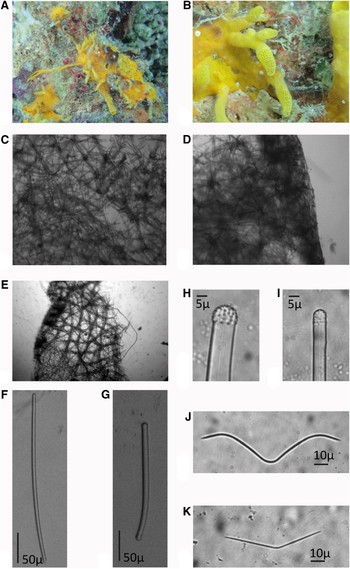
The specimen has a massive base with many fistules (Figure 1A), the larger, central ones were open, presumably being the oscules. The smaller ones arising from the sides end in a net-like transparent closed tube (Figure 1B). Some are rising perpendicular to the base and some are extending sideways possibly as a means of asexual propagation. The fistules measured up to 4 cm in length and around 2–3 mm in diameter. The diameter of the oscules measured up to 4 mm. The specimen observed was encrusting underneath a dead coral.
Damiria toxifera: (A) in situ photograph of specimen; (B) fistules; (C) choanosomal arrangement of tylotes in mostly rectangular meshes; (D) ectosomal tangential arrangement; (E) arrangement of tylotes in the apex of a fistule; (F) ectosomal tylote; (G) choanosomal tylote; (H) spined head of choanosomal tylote; (I) spined head of ectosomal tylote; (J, K) toxas.

Colour: yellow in life both externally and internally, translucent dirty white in alcohol.
Choanosomal skeleton: multispicular isotropic arrangement of rectangular meshes more or less haplosclerid-like but frequently confused and obscured in between (Figure 1C). Choanosomal skeleton is absent in the fistules.
Ectosomal skeleton: a tangential layer (Figure 1D) of inter-crossing tylotes with no particular order, except at the apex of the fistules where they form thick triangular and rectangular meshes (Figure 1E). Ectosomal tylotes (Figure 1F) slender and longer compared to the choanosomal ones (Figure 1G).
Megascleres: two size-classes of tylotes; robust, short ones measuring 199–224.3–248 × 10–11.3–13 µm and longer and thinner ones measuring 276–297.2–321 × 5–6–7 µm. Both tylotes have spined terminal ends (Figure1H, I).
Microscleres: toxas are relatively long 47–72–97 µm with a shallow curve (Figure 1J, K).
DISCUSSION
The present record of Damiria toxifera is a new addition to the poriferan diversity of the Andaman Sea. After an in-depth literature review it is pertinent to note that, not only the species but also the family Acarnidae and the genus Damiria are found to be new distributional records in Andaman and Nicobar Islands.