Rheumatic fever is a disease with worldwide distribution, albeit that the incidence varies significantly among different countries. In the past 50 years, a significant decrease has been observed in its prevalence and incidence in developed countries. In developing countries such as Brazil, however, rheumatic fever remains as the major cause of acquired cardiac disease among school children, adolescents, and young adults.Reference Mota1–Reference Meira, Castilho and Barros4
Data from the Brazilian Ministry of Health for 2005, collected through the Hospital Admission Authorization System, and representing at least 70% of the hospital admissions in the country, showed 2,390 hospital admissions due to acute rheumatic fever, 1,427 (59.7%) of which occurred in patients under the age of 20 years. In addition, during that year, 7,926 hospital admissions due to chronic rheumatic heart disease were observed, with 2,200 (27.7%) of these being in patients under the age of 20 years. In addition, 7,446 valvar prosthesis were inserted in patients of all ages.5
Rheumatic carditis is present in approximately half of the patients suffering acute rheumatic fever, and severe carditis or recurring outbreaks of the disease often result in severe lesions of the mitral or aortic valves, or both, producing chronic rheumatic heart disease.Reference Meira, Goulart, Colosimo and Mota6 Valvar lesions of rheumatic heart disease with significant haemodynamic repercussions cause cardiac failure, sometimes difficult to control with drugs. In this setting, either reparative surgery or valvar replacement is the treatment of choice. Mitral valvoplasty is not always possible in patients with rheumatic heart disease, which quite often causes severe valvar deformities, requiring the surgical implantation of prostheses.
The discussion about the type of prosthesis to be used in young patients dates back to the beginning of replacement of valves. The American Heart AssociationReference Bonow, Carabello and Chatterjee7 have recommended the use of mechanical prostheses in adolescent and young patients, based on studies showing a shorter durability of the biological valves in that age group.Reference Borman, Shimon, Deeb and Simcha8–Reference John, Ravikumar, Jairaj, Chowdhury and Krishnaswami11 In this study, we have analysed data on mortality, reoperation, haemorrhage, and strokes in children and adolescents undergoing valvar replacement according to the type of prosthesis implanted.
Materials and methods
Ours is a retrospective study, in which we assessed, through review of medical records, the progress of 73 consecutive patients under the age of 18 years with chronic rheumatic heart disease undergoing replacement of heart valves from January, 1996, to December, 2005, at the National Institute of Cardiology of the Ministry of Health, in Rio de Janeiro, Brazil.
The study was approved by the institution’s committee on ethics and research. All patients studied underwent clinical assessment in addition to laboratory exams, electrocardiography, chest radiography and cross-sectional echocardiography with colour Doppler. Clinical assessment of cardiac failure followed the recommendations of the New York Heart Association.12
Conventional techniques of extracorporeal circulation, hypothermia and cardioplegia were used in all surgeries. Replacement of the mitral valve included cordal preservation for all patients. The supraannular technique was not used. We excluded 2 patients who died intraoperatively, as the aim of the study was the survival after surgery. We divided our surviving patients after surgery into 52 receiving mechanical prostheses, with 6 undergoing simultaneous repair of the tricuspid valve, and 19 receiving biological valves, with 6 of these also undergoing simultaneous repair of the tricuspid valve. No patient needed enlargement of the aortic valvar orifice.
A multidisciplinary team decided which type of prosthesis should be implanted in each patient, giving preference to mechanical valves. Patients with poor access to health care, those with very unfavorable socioeconomic conditions, and young female patients who wanted to get pregnant, however, all received biological prostheses. This resulted from the great risk in prescribing such patients with anticoagulants drugs when adequate control of the anticoagulant state cannot be achieved.
All patients receiving mechanical prostheses were also receiving coumarin anticoagulation. Those receiving biological prostheses received coumarin for the first 3 months, but thereafter this was replaced by acetylsalicylic acid.
We inserted 27 porcine biological valves in 19 patients, using 16 Labcor valves (Labor Laboratorios Ltda, BH, Brazil); 8 Saint Jude Medical valves (Saint Jude Medical, Inc, MN, USA); and 3 Braile valves (Braile Biomédica Indústria, Comércio e Representações S.A., SP, Brazil). In the other patients, we inserted 68 double-disc mechanical valves, with 50 made by Carbomedics (Carbomedics, TX, USA), and 18 by Saint Jude Medical (Saint Jude Medical, Inc, MN, USA). The size of the prostheses implanted in the mitral and aortic positions ranged from 23 to 31 millimetres, and from 19 to 25 millimetres respectively.
Patients who had not been seen for more than 1 year were considered lost of follow-up.
Comparisons between the two groups were performed using the Fisher exact test. Mortality rates were estimated for each group considering as the denominator the sum of the time that each child remained under observation.
Survival analyses were carried out using the Kaplan-Meier method. As endpoints, we analyzed mortality, reoperation, haemorrhage, and thromboembolic complications. The survival curves were limited to 8 years of follow-up. The log-rank test was used to assess the statistical significance of the differences in survival between the groups. A p value of less than 0.05 was considered statistically significant. The Epiinfo program, (Epiinfo version 3.3, CDC, Atlanta, GA, USA) was used for to store data, using the Stata programme (Stata, version 9.0, StataCorp LP, College Station, TX, USA) for analysis.
Results
The median clinical follow-up was 36 months, with a range from 2 to 119 months. Of the 73 patients, 2 (2.7%) died during urgent surgery, with 1 patient requiring valvar replacement due to acute rupture of the mitral tendinous cords and cardiogenic shock; and another requiring reoperation of a biological mitral prosthesis due to severe obstruction and calcification. Overall mortality was 8.2%, with 6 of the patients dying in total. The population assessed for immediate and late results comprised 71 patients, 59 (80%) of whom were followed up.
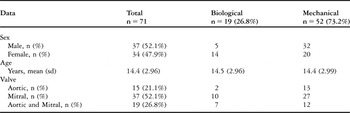
Baseline clinical and demographic characteristics, as well as the types of prostheses implanted, are shown in the Table 1. Approximately half of the patients were male, with ages ranging from 7 to 18 years, and a median age of 15 years. Most replacements were performed in the mitral position for both groups.
Baseline clinical and demographic characteristics according to the type of prosthesis.

Females predominated among those patients lost to follow-up (p = 0.06), but no significant difference was observed regarding the type of valve used (p = 1).
Mitral valvoplasty had already been performed prior to valvar replacement in 9 (12.7%) patients, 7 of whom received mechanical prostheses and 2 biological prostheses.
On preoperative clinical assessment, the distribution of the children and adolescents studied according to the functional classes of the New York Heart Association (NYHA) functional classes12 was that 29 (55.4%) of those receiving mechanical valves were in the third functional class, and 8 (15.4%) in the fourth class. For those receiving biological prostheses, 8 (42.1%) were in the third functional class, and 5 (26.3%) in the fourth class (p = 0.28).
Several complications occurred postoperatively in hospital, with 14 patients suffering haemorrhagic syndromes, 7 patients low output syndrome, 10 patients having severe arrhythmias, 7 patients pneumonias, 4 patients wound infections, 3 patients renal failure, 1 patient suffering a stroke.
Clinical assessment 6 months after surgery revealed that, for those having mechanical valves, only 7 (13.5%) patients remained in the third or fourth functional classes, while only 4 of those given biological valves remained in these classes. Two patients, one from each group, who died after 30 days due to left ventricular deficit were already in the fourth functional class before surgery. The mortality rate per 100 patient-years in those given mechanical valves was 0.96, being 5.4 for those receiving biological valves (p = 0.12).
Of the 71 patients surviving surgery, 2 (2.8%) died at the hospital during the first week, and both had undergone urgent surgery and were in the fourth functional class. One of those patients, who was under irregular anticoagulant medication, died after a reoperation to replace a thrombosed mechanical mitral valve. The second patient had undergone double replacement using biological valves due to rupture of the mitral tendinous cords, also having significant pulmonary arterial hypertension and chronic atrial fibrillation.
We lost 2 (2.8%) further patients with mitral prostheses, one biological and one mechanical, after 6 and 7 months. They had already suffered a significant deficit in systolic function in the immediate postoperative period as revealed by echocardiography, which persisted. No patient with an isolated aortic valvar lesion died.
Of the 52 children and adolescents followed up after insertion of mechanical valves, 5 (9.9%) underwent reoperation, all receiving a new mechanical valve, 4 due to thrombosis and 1 to infective endocarditis, over a period ranging from six to 105 months after the first surgery, the median interval being 61 months. Of the 19 patients undergoing biological replacement, 4 (20.5%) required reoperation, 3 due to stenosis and calcification of the prosthesis, and 1 due to infective endocarditis, over a period that ranged from two to 92 months, with a median of 37 months. All the patients requiring reoperation received mechanical valves.
Of the 19 patients with biological valves, only 1 had a small epistaxis, and no stroke was reported. Of the 52 patients with mechanical valves, 2 (3.8%) had more significant bleeds, 1 articular haematoma and 1 haemopericardium, and 4 (7.7%) had less significant bleedings, 3 with epistaxis and 1 suffering haematuria. In addition, 3 patients (5.8%) with mechanical valves, 2 in mitral and 1 in aortic position, had ischaemic nonfatal strokes over a period ranging from three months to seven years after the surgery.
Survival
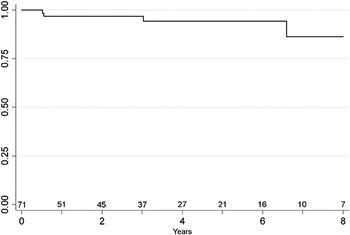
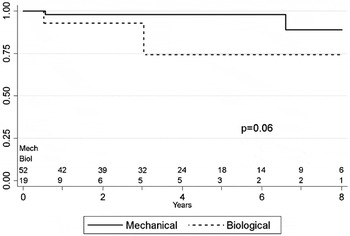
Survival analysis shows that, 96%, 93% and 86% of the patients were alive after 2, 4 and 8 years, respectively. When assessing for the type of prosthesis, survival 2, 4, and 8 years after implantation was 97%, 97% and 89% respectively, for those with mechanical valves, and 93%,72% and 72%, respectively, for those with biological valves, albeit that these differences were not statistically significant (p = 0.06) (Figs 1 and 2).
Overall survival of the total population studied.

Survival according to the type of prosthesis.

Reoperation
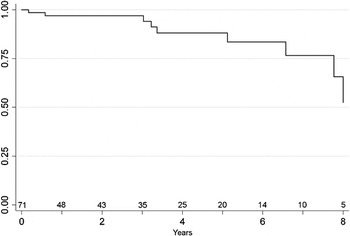
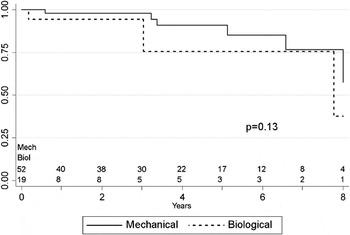
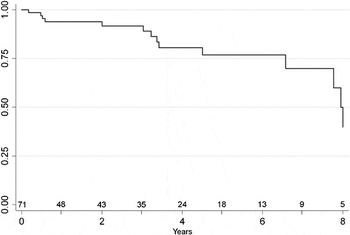
The assessment of the survival curves of all patients showed reoperation-free survivals of 96%, 87% and 44% after 2, 4, and 8 years, respectively (Fig. 3). Analysis according to the type of prosthesis used showed survivals of 98%, 90% and 45% 2, 4, and 8 years after implantation, respectively, for those with mechanical prostheses, and of 93%, 72% and 36%, respectively, for those with biological valves, but with no statistical significance (p = 0.13) (Fig. 4).
Reoperation-free survival of the total population studied.

Reoperation-free survival according to the type of prosthesis.

Combined endpoints
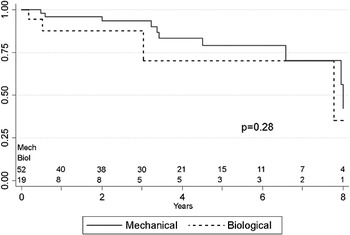
When considering combined endpoints for death, reoperation, haemorrhage and stroke, the analysis of the survival curves showed an event-free survival of 2, 4, and 8 years after surgery of 91%, 75% and 34%, respectively (Fig. 5). The analysis based on the type of prosthesis used showed survivals of 93%,78% and 34% 2, 4, and 8 years after surgery, respectively, for patients with mechanical prostheses, and of 86%, 67% and 33%, respectively, for those with biological prostheses, with no statistical significance (p = 0.28) (Fig. 6).
Event-free survival of the total population studied.

Event-free survival according to the type of prosthesis.

Discussion
Our data shows that mortality was higher among the patients receiving biological prostheses than among those receiving mechanical valves, albeit that the difference was of borderline statistical significance. Although the biological valves more often required reoperation, and complications related to haemorrhage and stroke were found only in patients receiving mechanical valves, such differences were also not of statistical significance. This may reflect the size of our cohort, and the relatively small number of events, leading to a reduced statistical power for identifying the differences between those receiving the different valves. The association between the type of prosthesis and the valvar anatomical position was not assessed due to the size of the sample.
We believe that the greater durability of mechanical prostheses, and the possible greater degeneration in biological prostheses, were decisive factors for the occurrence of a greater mortality by the end of 8 years in patients with biological prostheses.
All patients undergoing implantation of mechanical valves received coumarin as anticoagulant therapy. For some patients, the laboratory control of anticoagulation, assessed through International Normalized Ratio was difficult. The ideal values for the ratio varied according to the position of the prosthesis, being from 2.5 to 3.5 for mitral valves, and 2 to 3 for valves placed in aortic position. The reasons for that may be either an irregular use of medication, or difficulty in reaching the hospital for adequate laboratory control. This may account for the greater number of haemorrhagic and thromboembolic complications found in that group of patients.
Overall mortality in our study was 8.2%, similar to that reported by other researchers.Reference Atik, Pomerantzeff, Dias, Barbero-Marcial, Stolf and Jatene13–Reference Ibrahim, Cleland, O’Kane, Gladstone, Mullholland and Craig18 All hospital deaths occurred in patients undergoing urgent surgery, being, therefore, in the fourth functional class, or requiring reoperation. Mortality was greater after implantation of mitral than aortic valves, as reported from experience in Saudi Arabia.Reference Solymar, Rao, Mardini, Fawzy and Guinn19
The reduction in the proportions of patients remaining in the third or fourth functional classes after surgery shows the significant improvement in symptoms following surgery, results again similar to those reported by other authors.Reference John, Ravikumar, Jairaj, Chowdhury and Krishnaswami11 Even though the results did not reach statistical significance, the patients with mechanical prostheses had a longer reoperation-free survival as compared with those with biological prostheses, another finding in accordance with previous reports.Reference Borman, Shimon, Deeb and Simcha8, Reference Burdon, Miller and Oyer9, Reference Godoy, Branco and Soares20–Reference Bloomfield, Wheatley, Prescott and Miller24
Regarding the indications for reoperation, it proved necessary to replace 3 biological prostheses because of degenerative calcification leading to stenosis, and in 1 instance because of endocarditis. For mechanical prostheses, 4 needed replacement because of thrombosis, and another again because of endocarditis.
Assessment of the combined endpoints when using Kaplan-Meier curves showed that no more than one-third of the patients had survived free from all events after a period of 8 years. Comparable findings were reported following surgical treatment of children and adolescents in South Africa in the 1980s.Reference Antunes25, Reference Abid, Mzah, Euch and Ismail26 We found more thromboembolism in patients undergoing implantation of mitral compared to aortic prostheses, this being in accord with the results reported by in adults.Reference Bloomfield27
In conclusion, our patients receiving mechanical valves suffered lower mortality and had longer periods without reoperations. When taking significant morbidity into account, however, such as haemorrhages and stroke, the incidence of adverse events became similar, justifying our choice of biological prosthesis in those patients considered at risk for problems with anticoagulation or other difficulties, this approach also being well recognized by other authors.Reference Butchart, Moreno de la Santa, Rooney and Lewis28–Reference Van Doorn, Yates, Elliot, deLeval and Elliott32
Acknowledgement
Special thanks to Prof. Evandro Coutinho of the Escola Nacional de Saúde Pública- Fundação Oswaldo Cruz, for his inestimable collaboration and incentive, and to Stela Maris Costalonga, MD, for translating the manuscript into English.