In the section devoted to “Attention” in The Principles of Psychology (1890), William James describes how the “‘adaptation of the attention’” can alter our perception of an image so as to permit multiple visual formulations (417).Footnote 1 In his example of a two-dimensional drawing of a cube, we can see the three-dimensional body only once our attention has been primed by “preperception”: the image formed by the combination of lines has “no connection with what the picture ostensibly represents” (419, 418). In a footnote to this passage, however, James uses an example from Hermann Lotze's Medicinische Psychologie (1852), to show how a related phenomenon can occur involuntarily, and in states of distraction rather than attention:
In quietly lying and contemplating a wall-paper pattern, sometimes it is the ground, sometimes the design, which is clearer and consequently comes nearer. . .all without any intention on our part. . . .Often it happens in reverie that when we stare at a picture, suddenly some of its features will be lit up with especial clearness, although neither its optical character nor its meaning discloses any motive for such an arousal of the attention. (419)
James uses the formal illogicality of the wallpaper (its lack of compositional center prevents it from dictating the trajectory for our attention according to intrinsic aesthetic laws) to demonstrate the volatility of our ideational centers, particularly in moments of reverie or inattention.Footnote 2 Without the intervention of the will, James says, our cognitive faculties are always in undirected motion, which occurs below the strata of our mental apprehension. Momentary instances of focus or attunement are generated only by the imperceptible and purely random “irradiations of brain-tracts” (420). Attention, for James, is the artistic power of the mind; it applies “emphasis,” “intelligible perspective,” and “clear and vivid form” to the objects apprehended by the faculties of perception, it “makes experience more than it is made by it” (381). Reverie, a moment when attention has been reduced to a minimum, thus demands an alternative aesthetic analog, where composition is reduced to a minimum too.
The connection between ornament and distraction has deep roots in the nineteenth century, particularly among its most prominent aesthetic critics, John Ruskin, William Morris, and George Meredith. These authors each insisted that the ornamental arts were perceived best by a wandering, restless, distracted mind: best in that this is how they came to be noticed, and best because ornament's formal diffusiveness and semiotic impenetrability inculcated a different relationship between subject and perceived world. This paper argues that “distracting” aesthetics were significant to the way these thinkers framed the capacities of the conscious mind and the creative imagination, which could be activated by a certain “failure to attend.” From the writings of Ruskin, Morris, and Meredith, we can uncover a history of aesthetics in the Victorian period that runs counter to the narrative we have assumed from Walter Pater's “Conclusions” to The Renaissance: Studies in Art and Poetry (1873). Aesthetic awakening was not a matter of not “form[ing] habits,” and of promoting rigorous attention to smaller and more discrete units of time and experience (Pater 219). Rather, a more subtle and oblique entryway into our conscious imaginations works with, instead of against, distracted states.
Aesthetic “environments,” like James's wallpaper example above, have recently become something of interest to literary critics and philosophers in a similar respect. Douglas Mao has suggested that aesthetic writers of the late nineteenth and early twentieth centuries considered an “unconscious” engagement with “stealthy” ornamental forms fundamental to a child's socialization and to his aesthetic and moral development (45). In his recent work Aisthesis, Jacques Rancière argues that art has “ceaselessly redefined itself” throughout modern history, by incorporating vulgar and habitually perceived forms “most opposed to the idea of fine art” into its paradigm (xi, x). In these accounts, ornament is depicted as a form that is subtly or unconsciously inhabited by its perceivers, and politically consequential for its capacity to refuse – as Rancière recognizes in William Morris's prints – “the distinctions between the noble and non-noble arts” (Rancière 135). But distraction is a distinct mental state from the unconscious, and its vocabulary helps to define moments when the attention is pulled in multiple directions, or incoherently scattered, or even blocked. The problem of distraction is that we are too conscious of its effects: the sensations of being unfocussed, of mental restlessness, and of having one's eye drawn away from where we ought to look, are each an acute part of our privately lived cognitive experience, which Ruskin, Morris, and Meredith attempted to reclaim also as significant aspects of aesthetic perception.
I will begin by investigating Ruskin's endorsement of restless and distracted perception as the necessary mode of perceiving the divine abundance of nature in the intricacies of Gothic design. I will then move to Morris's provocative claim that the production of, and attention to, visual ornament produces egalitarian social cohesion by recalling habitual acts of labor; but also that the untranslatable “mystery” inherent to well-wrought patterns evokes the creative potential of the self. Finally, I will turn to George Meredith's The Egoist as a literary case study at the intersection of ornament and distraction, and suggest that reading Meredith's notoriously baroque novel requires something more diminutive and diffuse than “cognition” or “interpretation” in order to appraise it properly. In each part of this paper, ornament, and the attention not paid to it, is shown to be a robust and revealing modality of perception, which asserts a very different form of aesthetic engagement with its own unique set of attributes. Ornament's peripherality, and its status as the widely available art of the “every day,” alter how we consider art as received by the mind; it forces us to adjust our notion of what is intrinsic to aesthetic experience, and even qualifies what it is to be a beholder.
1. A Pre-History of Ornament and Distraction
The idea of ornament-as-distraction has been trenchant across the history of aesthetics, dating back primarily to Immanuel Kant's Critique of Judgment (1790). Kant distinguishes ornament (the parergon) from the pure aesthetic form (the ergon) because the former is not an “intrinsic constituent” of the art form, and should therefore be excluded from the application of judgment (72). Thus, the “gold frame” on a painting, the “drapery on statues,” and the “colonnades around magnificent buildings” may “increase our taste's liking” or elevate the “charm” we experience in looking at an art object, but they are nevertheless potential detractors to “a pure judgment of taste” (Kant 72). Kant echoes and disseminates a history of thinking of the ornamental in moral terms; because it yields no meaning to our critical eye, it is an unnecessary adjunct, and “distracting” for its incoherent and incommunicable excess. Ornament pulls the eye away from what it ought to be attending to; by confusing the mere charm of a work with its formal principles, it compromises the aesthetic purity of the object before us.Footnote 3
What connects ornament with distraction for Kant is an incommensurable relationship between parerga and erga, or more crudely, “parts” and “wholes.” Philologically speaking, attention is the modality of selecting parts and of drawing distinctions; it involves the “withdrawal from some things in order to deal effectively with others” (James 382); its grammatical conjunction is not “and,” but rather “or” (cf. North 3). The opposite of attention, distraction (or zerstreuung in German), is non-selective in nature; “the attention is dispersed so that the whole body is felt, as it were, at once, and the foreground of consciousness is filled, if by anything, by a sort of solemn sense of surrender to the empty passing of time” (James 382). If attention attempts to grasp an object so as to “take and possess it” (ad + tendere), distraction takes no external object (North 3).Footnote 4 It does not traffic in parts but rather in totalities, the wholeness of the body felt at once, and the scattered unity of sensory experience. To attend to ornament, in Kant's view, is to fail to draw important distinctions, to permit one's judgment to be confused and coopted by charm, and in effect, to be distracted.
And yet, even if Kant's selected examples of ornament do not contain an intrinsic relationship to form, this is not the same as saying they are wholly without purpose. Theorists who are interested in ornament's application have long maintained that it “refers” not to the art form, nor to the represented outside world, but rather to the psychological position of the beholder.Footnote 5 The gilt frame implies the artwork is “finished,” and the drapery on the statue, by contrast, implies that our perceiving of the object might never be complete.Footnote 6 Ornament (which shares an etymological origin with both the verbs “to order” and “to equip”) relates to the aesthetic through an indirect pathway, which first reflects how it is that we attend, or do not attend, to the aesthetic object before us. It is, as the art historian and archaeologist Oleg Grabar puts it, an “intermediary” agent, which is “not logically necessary to the perception of a visual message but without [it]. . .the process of understanding would be more difficult” (45, 230).
Theories of ornament mark some of the most poignant moments of intersection between perception and aesthetics in the Victorian period. Part of this phenomenon can be explained by the mere ubiquity of ornamental surfaces. Decoration is the art we inhabit, or as Wilde puts it, “the art to live with,” “the one art that creates in us both mood and temperament” (398). In his seminal tract The Grammar of Ornament (1856), the architect and designer Owen Jones argues that wallpaper, properly executed in color and pattern, should “when viewed at a distance. . .present a neutralised bloom” (7).Footnote 7 In accordance with this view, Jones ventures a total theory of aesthetics, and posits that “[t]rue beauty results from that repose which the mind feels when the eye, the intellect, and the affections, are satisfied from the absence of any want” (5). Jones's description of beauty's inherent restfulness resonates with the physiology of the beautiful as described by Edmund Burke a century earlier, where “a beautiful object presented to the sense” causes a proportioned effect of “relaxation in the body” (136).Footnote 8 In each account, beauty is described as aesthetically complacent, and it disperses any inclination on our part for attentive rigor. Our response is not sudden and confrontational (as is the case with the sublime), but diffuse, and produces a consenting equilibrium between subject and object, body and beautiful thing. It is for this reason that Jones advocates against the use of vulgar, too-accurately represented “natural objects” and in favor of geometric “conventional representations,” the former requiring a disruptive excess of mental exertion to perceive, while the latter effortlessly meets our expectations (6).Footnote 9
When describing the proper proportions for geometrical forms, Jones continues to parallel Burke's account of beauty's characteristic variation, declaring that “the proportion of. . .4 to 8, will be less beautiful than the more subtle ratio of 5 to 8; 3 to 6, than 3 to 7; 3 to 9, than 3 to 8,” etc (6). For Burke, “uniformity” and regularity invoke an intimation of “infinity,” and belong to the domain of the “sublime” (128-29). Beauty, by contrast, is less rigorous; it is apt to change under the eye, “continually varying its direction. . .by a very insensible deviation,” and evokes a corresponding idea of “weakness and imperfection,” which engenders an affecting tenderness on the part of the perceiver (Burke 140, 100). Ornamental irregularity, in Jones’ account, becomes the embodiment of a similarly “imperfect” figure: it appears to us as an irrational equation that cannot be resolved or made singular by our analytic faculty of attention. For Jones, this fundamental irregularity absolves us of any obligation to try to puzzle out ornamental meaning, for “[t]hose proportions will be the most beautiful which it will be most difficult for the eye to detect” (6). Diffuse and harmonious, ornament summons attention only to disperse it, to leave the beholder (which may yet be too strong a word) with little to think about.Footnote 10
2. Restless Visions: Ruskin and the Wandering Eye
Though Ruskin shared Owen Jones's particular view that good ornamental design should not be too rigorously attended to “for its own sake,” he was vociferously antagonistic towards the “conventional” patterns being produced en masse by Jones and his followers at the South Kensington Museum (Two Paths 268, 310).Footnote 11 Instead, ornamental arrangements ought to be “suggestive of those [forms] which are commonest among natural existences,” and so recall, in an unfeigned and subtle manner, the divinely ordained beauty found in nature (Seven Lamps 154). Ruskin was correspondingly sensitive to a type of ornamental redundancy in the natural world, to which it is impossible to attend in toto, saying “[t]he eye is continually influenced by what it cannot detect; nay, it is not going too far to say, that it is most influenced by what it detects least” (Stones II. 154). For Ruskin, the superfluity of ornament in nature typifies the infusion of the divine in the perceived world: it is an intimation of something not accessible to the understanding, but which renders visible “God's work, which He made for our delight and contentment in this world” (Stones I. 70).Footnote 12 Thus, the beauty of a bird's plumage, or the stripes on a zebra, are perfectly distinct from the animal's anatomical functions, and rather exist as gestural traces of the delight our creator had in his creation.Footnote 13 Ruskin upheld this “anagogic” (or extrinsically spiritual rather than intrinsically meaningful) account of natural ornament, which he would later defend even in the face of Darwinian accounts of its functionality in the physical world.Footnote 14
This theory of natural superabundance, as a glimpse of the unseen, is precisely what good ornamentation and sculpture must attempt to represent. When Ruskin stipulates that the architect avoid conventional patterns in his work and attempt rather to represent natural forms, he is not merely advocating for more accurate representation, but also for artists to fulfill this anagogic requirement. In this way, the Gothic “pointed arch was not merely a bold variation from the [Romanesque] round, but it admitted of millions of variations in itself; for the proportions of a pointed arch are changeable to infinity, while a circular arch is always the same” (Stones II. 208). Its apparent formal restlessness, or the contained potentiality for infinite variation, is what earns Gothic architecture its praise. It best embodies what Spyros Papapetros has described as ornament's “combinatory aptitude. . .not limited to the level of form,” or what Ruskin attributes to the “infinite” subtlety of God's creation (Papapetros 46; Stones II. 222).
Accordingly, Ruskin upheld that certain limits on our perception could be removed by means of a closer engagement with the dynamic potential of “good” ornamental forms. In a lecture titled “The Deteriorative Power of Conventional Art over Nations,” delivered to the students of the South Kensington Museum in 1858, Ruskin attempted to argue for a return to the natural and organic origins of ornament, by giving an account of the historical association between fanciful and highly abstract forms of decoration and social corruption:
Wherever art is practised for its own sake. . .there art has an influence of the most fatal kind on brain and heart, and it issues, if long so pursued, in the destruction both of intellectual power and moral principal; whereas art, devoted humbly and self- forgetfully to the clear statement and record of the facts of the universe, is always helpful and beneficent to mankind, full of comfort, strength, and salvation. (Two Paths 268)
A moment later, he returns to this description of art making as “self-forgetful,” and declares:
But a time has always hitherto come, in which, having thus reached a singular perfection, [art] begins to contemplate that perfection. . .and thus to forget her duty and ministry as the interpreter and discoverer of Truth. And in the very instant when this diversion of her purpose and forgetfulness of her function take place – forgetfulness generally coincident with her apparent perfection – in that instant, I say, begins her actual catastrophe; and by her own fall – so far as she has influence – she accelerates the ruin of the nation by which she is practised. (269; emphasis mine)
Ruskin's insistence on the self-forgetfulness of art echoes his advice to young artists in Modern Painters, where he exhorts the inexperienced artist to go to nature, and “neither to choose, nor compose, nor imagine, nor experimentalize; but to be humble and earnest in following the steps of nature, and tracing the finger of God” (Modern Painters I. 623). But as George Landow has observed, Ruskin's artist “does not merely record the facts of [natural] appearance. Rather, he treats his subject differently, ‘giving not the actual facts of it, but the impression it made on his mind’” (Modern Painters IV. 32; qtd. in Landow 63). That “art can remind man what he has lost and, to a degree, restore it,” Landow argues, is a “romantic theory of art” that Ruskin eventually applies to ornamental design “by making the workman an artist” (63; 81).Footnote 15 Art, therefore, and ornamental art most emphatically, seem to necessitate two stages: the first involves a act of partial self-abnegation before the divinely organized natural world, a “self-forgetting” of the artist as such, in order that he be able to “trace” in full everything that is visually available to him; and the second involves the subsequent application of the artist's own mental acumen, his “sympathies, sensibility, and imagination” which deepens the aesthetic effect of his work and his “phenomenological relations to his world” (Landow 65). As is clear from Ruskin's spiritual diction, the development of the artist aims to account for the biblical “fall” of nature and of art; the perceiving artist must submit, “humbly,” to the now obscured laws of the post-lapsarian world, before he can work to restore it.Footnote 16
While Ruskin's admonishment against “custom” and “convention” in the manufacture of art has some affinity with Pater's aestheticism and his insistence that our collective “failure” is in forming “habits,” Pater and Ruskin differ dramatically in their manner of describing how the self-imposed blindness of conventional or mechanical perception is to be avoided. Ruskin's descriptions of “self-forgetting,” of “tracing” and, as we see in Stones of Venice, of passing one's gaze over ornamental structures while “gliding” by on a gondola, do not seem to amount to Pater's desire to “burn always with this hard, gem-like flame” of mental acumen (Stones II. 39; Pater 219).Footnote 17 As David Wayne Thomas notes, Ruskin's aesthetics admit certain “‘balancing qualities,’” between trenchant formal obligations and imaginative freedom, which the Victorian critic read synecdochally from Gothic forms into the “self-restrained liberty” in the mind of the craftsman, who has partly surrendered himself to his obligation to sculpt the stone (Thomas 59).Footnote 18 Similarly, in her examination of Ruskin's “art of beholding,” Elizabeth K. Helsinger argues that while the artist's outward vision must never be subordinated to his inner thoughts when looking, a certain kind of mental “wandering away in thought from the thing seen” was nevertheless inevitable, and more surprisingly, “not necessarily a matter for concern” for the critic (57-58).Footnote 19 These descriptions of an artist's “partial” liberty, in his craft and in his perception, correspond not with Pater's idea of attention, but rather with the state of distraction, where cognition has been halfway coopted (either by his duties as a workman, or by his own imaginative tendencies) and diffused.
In contrast to Pater, Ruskin believed that attention and inattention operated along a continuum. In Stones of Venice (1851-53), he declares that while we have been led to believe that “methodical habits in daily life are seldom characteristic of those who either quickly perceive, or richly possess, the creative powers of art” there is in fact “nothing to hinder us from retaining our business habits, and yet fully allowing and enjoying the noblest gifts of Invention” (Stones II. 205). And Ruskin openly endorses the touches of habit as traces of lived experience in his appraisal of Northern Gothic architecture, which is more savage and crude than that of the South, “because the fine finger-touch was chilled away by the frosty wind, and the eye dimmed by the moor-mist, or blinded by the hail; this out-speaking of the strong spirit of men who. . .must break the rock for bread, and cleave the forest for fire, and show, even in what they did for their delight, some of the hard habits of the arm and heart that grew on them” (Stones II. 188; emphasis mine). Ornament reveals these inarticulate and unconscious tendencies of habit, or of inattention, at the same moment as it presents itself as the most refined and highly wrought aspects of architectural form. Habit and attention are thus inter-reliant in Ruskin's aesthetics: highly active attentive practices and unintended bodily impressions fuse in Gothic architecture to produce the perfect kind of “humble self-forgetfulness,” lived and experienced, beautiful and divine.
Ruskin's dialectic of attention and distraction is remarkably consistent with physiological theories held by psychologists in the decades that follow him. The codependence of attention and habit was of serious interest to William James, and to the philosopher and psychologist Franz Brentano (1838-1917), who both argued that attention, or our capacity to take notice, was in fact enabled through certain indirect (and so, like ornament, “not logically necessary”) movements of the body (Grabar 230). Footnote 20 “Pacing up and down in the study,” or “pricking up the ears,” says Brentano, could prime one's attentive faculties to focus more clearly on other objects, by merely recalling in the body obliquely related postures “under which [one] habitually tends to notice [things]” (42). James goes yet further, and argues that certain peripheral motions “of various unmeaning kinds” (like “playing with keys” or “vibrating [one's] foot”) are in fact necessary to divert “the overflow of emotional excitement during anxious and concentrated thought” (432-33). James's vocabulary is curiously reminiscent of Ruskin's: habit tempers excessive self-consciousness and enthusiasm by redirecting such impulses down irrelevant sensory pathways, so as to keep an open nerve-path for concentration. We must forget, or rather allocate some part of ourselves to self-forgetfulness, in order to remember; we must in some way be distracted in order to attend.
This unified continuum between inattention and artistic intention takes on particular significance in Ruskin's central description of St Mark's in The Stones of Venice. Ruskin attempts to capture the building's excessive “confusion of delight” in language (Stones II. 83):
[S]culpture fantastic and involved, of palm leaves and lilies, and grapes and pomegranates, and birds clinging and fluttering among the branches, all twined together into an endless network of buds and plumes; and in the midst of it, the solemn forms of angels, sceptered. . .their figures indistinct among the gleaming of the golden ground through the leaves beside them, interrupted and dim, like the morning light as it faded back among the branches of Eden. . . .And round the walls of the porches there are set pillars of variegated stones, jasper and porphyry, and deep-green serpentine spotted with flakes of snow, and marbles, that half refuse and half yield to the sunshine. . .the shadow, as it steals back from them, revealing line after line of azure undulation, as a receding tide leaves the waved sand; their capitals rich with interwoven tracery, rooted knots of herbage, and drifting leaves of acanthus and vine, and mystical signs, all beginning and ending in the Cross; and above them, in the broad archivolts, a continuous chain of language and of life. (Stones II. 82–83)
Ruskin's “continuous chain” produced by the conjunction “and” (there are twenty instances of it in the excerpted passage) is worthy of a momentary pause.Footnote 21 On one hand, it seems purely to produce the effect of superabundance, as ornament heaps upon ornament in infinite treasurable quantity. On the other, though, it betrays something of the distracted nature of this perceptual act. “And” is a weak conjunction, which implies neither order nor necessity, and imparts no syllogistic causality or proper orientation to our reading of it. Paul North has even gone so far as to say that “[m]asking rather than illuminating, “and” is a place-holder for something that not only lacks an interpretation but moreover does not seem to need one,” and may even be conceived of as the conjunction of distraction (North 111).Footnote 22 Ruskin's “and” suspends the viewer and reader in a similar position of disorientation before various dispersed points of interest, attempting, in the grammar of this description, to represent each ornamental enthusiasm in ecstatic simultaneity. Good ornament, “of which the eye is never weary, however meaninglessly or endlessly repeated,” prevents the eye or mind from arriving at a final state of repose: it is perceived only, and necessarily, in perpetual, restless motion (Stones I. 281). That St. Mark's abundant decoration begins and ends with the Cross (the figure of an addition sign, and the moment at which the infinite becomes symbolically possible) intimates that such a terminus or point of rest would be a kind of perceptual and spiritual failure. As with the example of the Gothic arch, the aim for good ornament is to inhibit our desire or ability to “finish” looking at it: decorative surfaces resist our attempts to hold them still in our minds, for the act of perception can never quite be complete (Tanner 103).Footnote 23
In an earlier moment in The Stones of Venice, while contemplating the phenomenon of “continuous ornament” characterized by “the alternation of shade with light. . .in equal succession,” Ruskin pauses and considers:
I hardly know whether to arrange [this] as an expression of a divine law, or a representation of a physical fact. . .the alternation of labor with rest, the mingling of life with death, or the actual physical fact of the division of light from darkness, and of the falling and rising of night and day, are all typified or represented by these chains of shade and light of which the eye never wearies, though their true meaning may never occur to the thoughts. (Stones I. 306–07)
Ruskin is instructing his readers to read “and” as a life-pulse, which invokes the infinitely subtle patterns and repetitions from which we are constituted imperceptibly. Continuity is thus a mingling of awareness with unawareness; moments of change are punctuated by moments of monotony, moments of thinking with moments of not-thinking.Footnote 24 Returning, for a moment, to the example of St Mark's, the cross hangs there as the “true meaning” undergirding these changes and variations. On the façade, it is the compositional vanishing point, where such pulses and lapses will be restored and reunited. But the ultimate typification is not yet here. The “and” is empty in anticipation of fulfillment: the eye, restless in anticipation of rest. Ruskin reclaims the distracting superfluity of ornament not merely as an indirect means of aesthetic awakening, but as divine typology.
3. Blurred Boundaries: Morris and the Aesthetics of Diffusion
In The Lesser Arts (1877), William Morris credits Ruskin's The Nature of Gothic for dismantling the “grievous nonsense” that had previously subordinated the decorative arts and the labor of its craftsmen (19). But despite sharing this common purpose, Morris's account of ornamental attention differs from Ruskin's in small but significant ways. Whereas Ruskin praised ornament's perceptual agitation, Morris believed that engaging with ornamental forms could produce a more diffuse and restful kind of conscious living.Footnote 25 Across his socialist literature in particular, Morris is a vocal advocate for a “habitual” mode of art experience. In Art and Socialism (1884) and Useful Work versus Useless Toil (Reference Cole and Cole1884), he denounces the stratification of art, which has constructed a social distinction between the privileged works we find in galleries and the decorative arts produced by craftsmen (Art and Socialism 96; Useful Work 186). For Morris, the call to social improvement requires that we “begin to build up the ornamental part of life – its pleasures, bodily and mental, scientific and artistic, social and individual – on the basis of work undertaken willingly and cheerfully, with the consciousness of benefiting ourselves and our neighbors by it” (Useful Work 186; emphasis mine).
I will return to what Morris thinks of as “the ornamental part of life” in a moment, but first it is important to note that this stratification, like the revolution Morris hopes for, maps social class onto heterogeneous modes of attention. Upper-class attention, which affords time for aesthetic experience in the galleries, is contrasted with the exhausting attentive demands of the working class, carrying out wearying toil (Useful Work 177).Footnote 26 Leisure, or how time is merely passed, is similarly wasteful for the wealthy, and only recuperative for the laborer (Useful Work 182). What Morris looks forward to, however, is not a redistribution of this loftier and rarefied form of aesthetic attentiveness, but rather a diffusion of attention across social boundaries, which restores body and mind, art and inner life and nature, to a gentle equilibrium. He does not aspire for everyone to be able to enter the galleries and gaze upon canonized paintings, but rather for everyone's homes to be so decorated as to deliver restful pleasure. Difference and stratification give way to a unified plenitude of sensual awareness and pleasure; an intimacy of “intense and overweening love of the very skin and surface of the earth on which man dwells;” the only “mood” which cannot be “exhausted” (News 158; ch. 18).Footnote 27
An important touchstone for Morris's advancement of the “ornamental part of life” is his notion that there existed a pre-commercialized moment of art-making, free from stratification, which was produced by “unconscious intelligence.” The desire to produce art at this utopic moment was derived from nothing more than the craftsman's idle sense of pleasure in the work he undertook. Thus in The Lesser Arts, Morris states:
I think that [contemporary artists] must begin by acknowledging that the ancient art, the art of unconscious intelligence, as one should call it, which began without a date, at least so long ago as those strange and masterly scratchings on mammoth-bones and the like found but the other day in the drift – that this art of unconscious intelligence is all but dead; that what little of it is left lingers among half-civilized nations, and is growing coarser, feebler, less intelligent year by year. . .(24)
Morris presents an idealized vision of art production as an unconscious intermingling of art-maker and art-object (in Morris's example the first ornamental carvings appear on bone, and so are in some sense an extension of the physical body). As he goes on to say in Useful Work versus Useless Toil, this kind of intimate and unthinking engagement with ornament is also nearly inextricable from its “useful” purpose:
The craftsman, as he fashioned the thing he had under his hand, ornamented it so naturally and so entirely without conscious effort, that it is often difficult to distinguish where the mere utilitarian part of his work ended and the ornamental began. Now the origin of this art was the necessity that the workman felt for variety in his work, and though the beauty produced by this desire was a great gift to the world, yet the obtaining variety and pleasure in the work by the workman was a matter of more importance still, for it stamped all labour with the impress of pleasure. (188)
The act of artistic composition has been reduced to a bare minimum, as the early artist chisels his mammoth bone, or fashions “the thing he had under his hand” simply because it is there. Artistic production comes to resemble mere distracted fiddling; a way of passing time, like Morris's idealized description of the poet as the “idle singer of an empty day” in “The Earthly Paradise” (1). Ornamental art, as Morris envisages it, also bears out a different relationship to temporality. Because it implies not a singular moment of inspiration, but a constant and minimal engagement with aesthetic enterprises, it is not to be apprehended in a singular exceptional moment, but to “fill” our every day. As Jonathan Hay writes, “decoration differs from representation in not primarily removing us mentally from the space and time in which we encounter it. . .instead, it moulds the very space and time of our encounter with its surfaces” (77). The egalitarian impulses of this kind of artwork, moreover, imply a new formation of the artist, where he is not attempting to represent himself, but rather to pass his time meaningfully, and so impress upon his work the pleasure he feels in the restfulness of his habits and situation. Footnote 28 This form of inattentive art making bridges significant demarcations – between work and pleasure, laborer and artist – and ultimately rejects what Jacques Rancière has called “the simplistic opposition between the useful object and the object of disinterested contemplation” (139). To build up the “ornamental part of life” is to produce social cohesion, and invokes what Paul North describes as “primal distraction,” a hypothesized inattentive state which implies “the existence of an infinitely inclusive collective without the need to count out its members or represent itself. . .which is furthermore neither revolutionary nor utopian” but “already here” (North 182–83).
In his most direct recommendations for how ornament should be carried out, Morris significantly modifies Owen Jones’ earlier call for “restful” patterns:
At the same time in all patterns which are meant to fill the eye and satisfy the mind, there should be a certain mystery. We should not be able to read the whole thing at once, nor desire to do so, nor be impelled by that desire to go on tracing line after line to find out how the pattern is made, and I think that the obvious presence of a geometrical order, if it be, as it should be, beautiful, tends towards this end, and prevents our feeling restless over a pattern. (Making the Best of it 155–56; emphasis mine)
Whereas Ruskin saw the unresolved “mystery” in ornamental forms as anagogic, enticing the observer towards divine contemplation, Morris instead suggests this mysterious element forms a part of restful being. By engendering questioning, but not the kind which we could aspire to resolve, ornament becomes a representation of what cannot be thought, but which can nevertheless be experienced. It is able to “fill” the eye and the mind with affirmative pleasure, while simultaneously withholding its meaning. Because it resists interpretation, there is nothing that can be “taken away” from an engagement with ornamental design: no epiphany can be distilled from its carefully wrought mystery. Ornament has no referent: it simply “is.” The irreducible mystery in ornamental design embodies Morris's claim that some high-reaching form of “hope” (of “rest,” of “product,” and of “pleasure in the work”) needs always to be present in acts of labor; hope being external to the work under hand, but whose presence is indirectly required in order to make labor and product structurally meaningful (Useful Work 176). Morris is not, then, refusing Kant's characterization of the status of ornament as parergon; rather, he is accepting the nature of ornament as a superadded supplement with only minimal demands of formal coherence. But in his thinking, “supplement” takes on deconstructive rather than Kantian connotations. Its hermeneutic mystery recalls what Jacques Derrida describes as the “lack” constituted by the ergon (the work), which makes the parergon (the ornament) necessary.Footnote 29 The open-endedness or limitlessness of ornament is always gesturing to something more, or to something outside of itself, at the same time as its apparent irreducibility renders these categories implicitly negligible.
That simple “being,” without the dialectics of internality and externality, or of utility and uselessness, can be a form of revelation seems nearly paradoxical. And yet, this is precisely what Morris means by replacing our capacity for rigorous attention and introspection with a diffuse engagement with pleasure and work. In his 1934 address at the opening of the William Morris Centenary Exhibition at the Victoria and Albert Museum, the Times literary critic Stanley Baldwin quoted one of the Morris's reportedly favorite phrases, “If a man is not thinking about himself he is himself,” a somewhat mischievous rephrasing of the Cartesian cogito ergo sum (qtd. in Weinroth 58). Morris uncouples introspection from authenticity, as it is in moments when self-consciousness is inaccessible that “being” becomes most authentic. Stephen Arata has observed that Morris's literary work attempted to reproduce this aspirational state of “diffused” attentiveness rather than concentrated effort, stating “in his own writing from the 1860s onward. . .Morris consciously endeavored to produce works that could be read without effort or concentration, works that could, in effect, be read idly” (Arata 197, 203). Moreover, this type of reading even echoes Morris's own compositional practices, as he would frequently compile his works while simultaneously carrying on other tasks. Arata cites an anecdote from J. M. Mackail's The Life of William Morris, where the author is reported to have said “If a chap can't compose an epic poem while he's weaving a tapestry. . .he had better shut up, he'll never do any good at all” (Mackail I. 186; qtd. in Arata 203). What Arata locates in Morris's literary works is embodied even more provocatively in the artist's prints, and in his theory of ornament more broadly. The limitlessness of ornament, and its mysterious potentiality, implies for Morris a corresponding limitlessness (or utopic de-particularization) of the self.Footnote 30 To be distracted is to be most in touch with this type of imaginative and social potential, though the capacity necessarily depends on our not attending to it.
Morris's and Ruskin's theories of ornament's relationship to consciousness and perception vary significantly, but they each suppose a manner of aesthetic engagement that belies attention as its structural center. A return to the organic or the natural as inspiration for ornament, which both these thinkers maintain, seems necessarily to mean a turning away from attention. As the psychologist Théodule-Armand Ribot states in The Psychology of Attention (1890), voluntary attention is an artificial creation, a “product of civilization” which willfully and energetically resists biological impulses towards “diffusion” and natural “instincts” (Ribot 2, 5, 36). If ornament is to engage meaningfully with the beholder (its psychological and aesthetic purpose), it must not demand attention, but must instead invoke more primal modes of mental cognition. The more peripherally and indirectly we look, the more in touch we are with the most important, natural truths.
4. The Egoist and the Problem of Disengagement
In one of his many essays and reviews of George Meredith's The Egoist, the critic W. E. Henley couches his description of the author's style in distinctly ornamental terms:
[H]e bristles with allusions, he teems with hints and side-hits and false alarms, he glitters with phrases, he riots in intellectual points and philosophical fancies; and though his style does nowhere else become him so well, his cleverness is yet so reckless and indomitable as to be almost as fatiguing here as everywhere. . .it is not that Mr. Meredith has forgotten anything in [Sir Willoughby Patterne's] composition but rather that there are certain defects of form, certain structural fault and weaknesses, which prevent you from accepting as conclusive the aspect of the mass of him. (62-63)Footnote 31
Henley strikes a chord in his ambivalent review of The Egoist, which has been repeated throughout much of its reception. The novel's excessively developed style is held up against its purported weaknesses on the level of structure or plot, a criticism which casts Meredith's novel back to the Kantian tension between the “charms” of ornament and the integrity of form. And indeed, summarizing The Egoist is disproportionately easy, as the five-hundred-page novel contains very little in the way of plot. The central protagonist, Willoughby Patterne (whose name, significantly, is meant to invoke “willow pattern” china) is engaged to Clara Middleton, after two failed engagements that play out over the first twenty pages of the novel.Footnote 32 The rest of the narrative is devoted to Clara's often quite comic attempts to disengage herself from Willoughby, and the various social entanglements, anxieties related to decorum, and even improbable accidents, which render this disengagement difficult. In this sharp division, between a minimalist plot, and highly baroque, ornamental, and obfuscating prose, descriptive passages are frenetically active, and it is the narrative events which offer the reader (to quote Gillian Beer) “point[s] of rest” (91).
The argument that follows will attempt to reclaim the novel's formal interests, using the grammar of ornament and the specific kind of attention it demands and simultaneously refuses. The inscrutability of Meredith's prose style, coupled with its (alleged) impoverished structure, seem to necessitate a category of “ornamental representation,” which attends to the very fact of these “faulty” or deficient links between description and plot, or between episodes and thematic wholes.Footnote 33 Considered this way, ornamental style requires a particular type of literary interpretation, which depends upon distraction, surface attention, and peripherality.
On the level of style, Meredith's affirmation of the dislocation of details from structure, or of description from meaningful substrata, reveals a new abundance of potential aesthetic engagement. The following passage, which takes place at a very early moment in Clara and Willoughby's engagement, occurs after the lovers have returned from a walk:
He placed himself at a corner of the doorway for her to pass him into the house, and doated on her cheek, her ear, and the softly dusky nape of her neck, where this way and that the little lighter-coloured irreclaimable curls running truant from the comb and the knot – curls, half-curls, root-curls, vine-ringlets, wedding-rings, fledgeling feathers, tufts of down, blown wisps – waved or fell, waved over or up or involutedly, or strayed, loose and downward, in the form of small silken paws, hardly any of them much thicker than a crayon shading, cunninger than long round locks of gold to trick the heart. (73; ch. 9)
On one hand, Meredith's descriptive imagery evokes strange, proleptic resonances: Clara's curls are “irreclaimable” and “run truant,” and so seem to foreshadow events in the novel, which narrates a broken engagement. Willoughby's reading of these curls as “wedding-rings” or “locks of gold to trick the heart” betrays similar kinds of relationships; a stylistic trope which charges even the most insignificant details (like single strands of hair) with potential micro-narratives, which are camouflaged, or hidden in plain sight, by Meredith's baroque prose. But these connections are not instantiated by the object in any literal way (to quote from another moment in The Egoist, “[i]dea there was none in that phrase”) but are merely engendered by formal recognition along a plane of loosened, associative thinking (75; ch. 10).Footnote 34 And further, it is not merely the content, but also the enthusiastic, oscillating, fanciful form of Willoughby's thoughts, which mimic the very shape of Clara's exquisite tendrils. The repetitive structure of the language (how vine-ringlets produces wedding-rings, for instance) imitates the contour of centrifugal displacement and return invoked by a spiral. Even the hyphens in this description refuse singular analysis, and are taken to mean multiple and oppositional things; at times they link ideas to catalyze new words and images (“root-curls”), and in other instances they suggest moments of linguistic lapse, or a failure to describe the “cunninger” shape of the curl, unequaled by a writer's tool. How many interpretations can be made of a single curl, and how many words one may find to describe them, depends only on how far one's mind is willing to wander – or spiral – away from what it is supposed to be attending to, or how many associations one can find to fill one's thoughts.
But this type of description, which suggests a wandering away from the object in order to take notice of it, necessitates a looser kind of attention than we typically aspire to in formal analysis. In Sensuous Surfaces, Jonathan Hay describes the manner in which surface ornament simultaneously defies and affirms strategies of aesthetic interpretation, by suggesting that “if art in general is a form of catalysis, inventing and making things happen, then decoration through resonances and linkages specifically catalyses connection between different orders of experience and different categories of being: in this sense, it is a wholly affirmative mode of art making” (84-85). Ornament implies a different relationship between object and image, or subject and metaphor; neither vehicle nor tenor, it nonetheless affirms the very processes by which vehicle and tenor connect. Willoughby's later formulation of his social world as a “trellis [that] decorated emptiness” speaks profoundly of the merely “intermediary” position of ornament's relation to aesthetic meaning (390; ch. 46). But, as we see in the passage above, this intermediary state contains a diffuse field of possible interpretations, narrative resonances, and formal relationships. To push the image yet further, the emptiness framed by the trellis may simultaneously be both a vacuity and a capacity for the very possibility of aesthetic engagement.
In another example of Meredith's descriptive prowess, we see just how far the tropes of dislocation and disorientation can wander. This passage, which begins simply with a declaration that “[r]ain was universal” quickly disintegrates into the following single sentence:
South-western rain-clouds, too, are never long sullen: they enfold and will have the earth in a good strong glut of the kissing overflow. . .at any moment they may break the veil and show soft upper cloud, show sun on it, show sky, green near the verge they spring from. . .it may mean fair smiling for awhile, or be the lightest interlude; but the watery lines, and the drifting, the chasing, the upsoaring, all in a shadowy fingering of form, and the animation of the leaves of the trees pointing them on. . .yielding but a leaf at most, and that on a fling, make a glory of contest and wildness without aid of colour to inflame the man who is at home in them from old association on road, heath, and mountain. (216; ch. 26)
The content of Meredith's description of rain clouds comes to be less relevant than the shape of it. His style is textural rather than referential, a way of seeing the forest but not the trees. In one way, the enthusiasm of this style represents the universality of the rain, but the abundance of detail pushes the act of describing to a degree of hyperbolic excess, venturing beyond a description of what is, and immediately into a register of potentiality, of what “may” be. If it refers to the universality of rain, this paragraph accomplishes this act of reference in a mediated and ornamental, rather than realistic and attentive, mode.Footnote 35 As readers, we are made to experience not the rain, but the futility of trying to produce a unifying interpretation of this dazzling description. Perhaps we can seize on certain “shadowy fingerings” of form, but it is too restless and agile to be analyzed. The sheer excess of fragmentary gerunds, “the drifting, the chasing, the upsoaring,” prohibit even grammatical rest, as though each word is capable of dissolving into atomized, torrential motion.
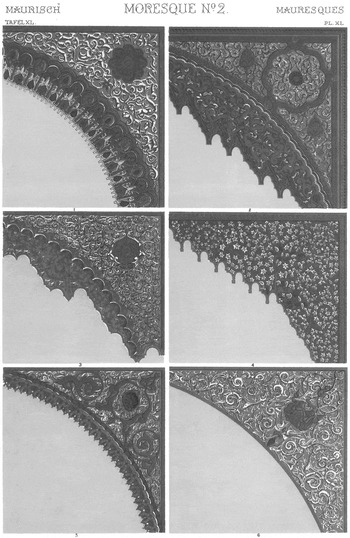
It is tempting to compare this passage to some of the plates from Jones's The Grammar of Ornament, particularly with his illustrations of Moorish arabesques, which seem to extend their dynamic and unending formal arrangements beyond the frame of the façade they are intended to adorn (Figure 1). Meredith's description of the rain clouds can be viewed as the linguistic analog to surface decoration in precisely this way. It is description that exceeds past the point of describing, language stretched to its utmost, an obsessively honed attention that has become distracted with its own potential energy. As our narrator puts it towards the end of the novel, the more avidly we attempt to attend, the more likely this attempt will lapse into something like the opposite of attention, such that “men who, setting their minds upon an object, must have it, breed imps,” the “invisible and amazing distractions” which surround and disrupt our attentive efforts (416; ch. 49). What Meredith describes as the “kissing overflow” of rain can in fact be thought of as the very definition of this hyperbolic style; it merely “kisses” what it is supposed to represent, and then abruptly turns to “overflow” its object with excessive, irreclaimable details.
Owen Jones. “Moresque No 2.” Illustration, from Owen Jones, The Grammar of Ornament (1856). Reprint, London: Bernard Quaritch, 1910. Photograph taken from author's personal collection.

This description of style as textural, dynamic, and only tangential to what it attempts to portray, however, becomes significant to some of the central puzzles and problems posed by The Egoist as a narrative. A moment of charged but distinctively fragmented dialogue between Clara and Willoughby on the topic of jealousy is thus described: “[h]e had actually, in this parabolic, and commendable, obscureness. . .struck the very point she had not named and did not wish to hear named, but wished him to strike” (104; ch. 13, emphasis mine). The moment is “struck,” but not uttered, it is language doing more than what it should (striking us, as if solid, like Meredith's textural excesses above), while simultaneously doing less (it is not representing the thing that is doing the striking). That Clara identifies the form of this language as “parabolic” is worthy of note, if only because it recalls the other arabesque curvatures that dominate Meredith's imagery. But it is yet more revealing as a structure if we contrast it with Meredith's introductory description of his comedy as a “mirror” (4; Prelude). If a mirror would suggest a reflection between sign and referent, something like two parallel lines, the parabola is rather constructed by an infinite number of tangents, “ta-ta-ta-ta ad infinitum,” as the Egoist himself would say (285; ch. 34). Parabolic signification, therefore, strikes the referent, and then instantly inclines away from it; it configures, therefore, this “too much” and “too little” type of representation that we find in Meredith's “textural” style, and of ornamental representation more generally. It is excessive, but not available to the kind of attention it requires; it demands notice, and then instantly subverts our attempts to look too closely.
The conjunction between excess and deficiency, and the fact of texture prevailing over text, is central to how modern thinkers conceive of the physiology of distraction. In The Work of Art in the Age of its Technological Reproducibility (1936), Walter Benjamin enigmatically declares that “the distracting element. . .is also primarily tactile” (Benjamin 39). Tactility, as a perceptive faculty, is characterized by its failure to perceive at the very moment of contact, as it is instantly habituated or “accustomed” to what it attempts to touch (North 163). In order to apprehend an object through the haptic sense, one must continuously glide over the touched object, and keep the sense stimulated by constant motion, and in this way, it is always dislocated (temporally and affectively) from what it attempts to perceive.Footnote 36
Meredith also considers the haptic sense as an important aesthetic register in his text. Dismembered hands are everywhere in The Egoist: they are clasped, shaken, and even “craved” at various points throughout the novel.Footnote 37 At an early moment in Clara and Willoughby's courtship, Willoughby reaches out to Clara, who experiences his touch “at a distance,” as follows: “He fondled her hand, and to that she grew accustomed; her hand was at a distance. And what is a hand? Leaving it where it was, she treated it as a link between herself and dutiful goodness” (51; ch. 7). Clara's rhetorical question could of course be answered in innumerable ways. Hands are fraught with symbolic, metaphoric, and synecdochic meaning throughout The Egoist, most obviously in connection with Willoughby's emphatic desire to take her “hand” in marriage. But Clara's urge to experience her hand “at a distance,” instead recalls Benjamin's description of haptic failure, and the phenomenon of distraction's tactility. As Clara's “growing accustomed” to Willoughby's hand indicates, failing to register the touch becomes a useful physiological means of distracting herself from her hand's excessive, formal signification.
The haptic nature of distraction thus helps to navigate the dynamics of interpretation in Meredith's novel of manners. Because parts, selves, and moments cannot be intrinsically understood but only apprehended vaguely and with relation to other persons in a complex social network, they similarly cannot be meaningfully isolated. Clara, who is but a constituted body of diverse “whims,” repeatedly fails to disengage herself from Willoughby because she cannot locate a single or functional moment of resolve (250; ch. 30).Footnote 38 Her strategy, which for much of the novel relies on self-deceptive techniques of procrastination, postponement, and a “convenient blindness” to her unhappy circumstances mimics something of our distracted, dislocated, and “haptic” experience of reading Meredith's elusive style (89; ch. 11). As descriptive fragments detach from what they are supposed to represent, and float farther afield from their objects, the reader feels some kind of proleptic hope that resolution will come in due time.Footnote 39 The difficulty or opacity of Meredith's descriptions engenders in us a feeling of temporarily postponed “potential” information (what Gary Handwerk calls “interpretative limbo”), rather than descriptive capture or resolution (171).Footnote 40 Thinking, or the act of interpretation, is suspended in momentary haptic blindness, and the restorative action of “reading on” is demanded in its place.Footnote 41 As our narrator says of Willoughby (in a manner which again enforces the connection between haptic perception and movement) “[w]hat to think, hung remoter. The thing to do struck him first” (123; ch. 15, emphasis mine).
In the social comedy that Meredith outlines, formal aesthetics are maintained as the primary structures of his narrative universe: “decoration” is so translated as “decorum,” and “distraction” is figured as a literal problem of “disengagement.” Meredith positions the entire matter of interpretation and understanding on the level of our attention to his text's surface, and at the moment of tactile, parabolic tangency. As Willoughby later laments, “[t]he mysteries of his own bosom were bare to him; but he could comprehend them only in their immediate relation to the world outside” (399; ch. 47), “immediate relation” invoking again the sudden and discrete moment of parabolic strike. Similarly, when Clara sighs for her inability to love Willoughby, our narrator declares that the “sigh was partly voluntary, though unforced; as one may with ready sincerity act a character that is our own only through sympathy” (296; ch. 35, emphasis mine). This point of outer peripherality, where the self lays tangent to the external, social world, becomes the new locus of attention and experience. Legibility is moved away from ideational centers, and rather towards what can be superficially perceived, even if momentarily, by other persons. In Meredith's baroque comedy, self is, effectively, only style; identity is not intrinsic, but only located in how one tangentially participates in the world, and in the marginal space where mental activity finds its language, though both too robust and too deficient.
5. Coda
In this paper I have intervened in two different cultural histories, ornament and distraction, which might each be thought to have greater traction in the Modern period. When cultural critics like Adolf Loos (whose lecture “Ornament and Crime” was first delivered in 1908) and Siegfried Kracauer (of the Frankfurt School, who wrote The Mass Ornament in 1927) looked at the decorative excesses of Victorian surfaces, they saw a form that was “a waste of labor” which acted as a heavy weight on modern economies, and which allied what could be immaculate form with “backwardness or degeneracy” (Loos 172, 170).Footnote 42 In describing the highly ornamental cinemas in Berlin, Kracauer observes that “[d]istraction – which is meaningful only as. . .a reflection of the uncontrolled anarchy of our world – is festooned with drapery and forced back into a unity that no longer exists,” and so connects the “pure externality” of ornament to the promulgation of an uncritical “mass” culture (327-28, 326). These modern critics are, in some way, the disenchanted progenitors of Mao's and Rancière's accounts of ornament as the means to a more harmonious form of social organization – which Rancière observes in the reconciliation of the decorative arts and industry in the years following Ruskin, where “art directly works towards the construction of a common manual and mental culture” (Rancière 145). And yet, as we see throughout this paper, the anxiety relating to ornament is not an invention of the twentieth century. John Ruskin and William Morris were equally concerned by the “vulgarity” in certain ornamental attempts, and with the idea that excessive decoration could be apotropaic, and ensnare cognition. But good ornament in the nineteenth century was always intended to outpace perceptive acts, in small but significant degrees. In this account, ornament may in fact be an aesthetic counterpart to what Wai Chee Dimock has called “weak” networks: the loose and wayward peripheral tangencies, which may be more significant to theory than concentrated geographies and formal definitions (733). In the realm of aesthetics, ornament serves much the same function: it recalls the divinity in nature (like Ruskin's Gothic façades), it reminds us of our connection to labor practices (like Morris's idle craftsmen), and it implies transnational relationships (like the Chinese willow pattern invoked in The Egoist) – but it does so indirectly, and in a way that is only subtly gestured at by its form. The kind of attention that is provoked by an engagement with ornamental design is similarly diffuse and inarticulate, but it is for these distracted qualities that it comes to be so central to Ruskin's aesthetic spirituality, to Morris's social theory, and even to Meredith's account of how we negotiate anxious and indecorous social scenarios. Distraction, and its aesthetic counterpart, have thus been entrenched in our discourse about the social world from the nineteenth century to the twenty-first – even if, and perhaps because, we have not paid attention to them.