Implications
Castration in male piglets is a painful practice at any age. Research on methods for reducing castration-related pain in piglets is still an issue of concern and interest. Our objectives were to evaluate the effectiveness of two protocols of local anesthesia (lidocaine and lidocaine+bupivacaine combination) as well as the use of meloxicam as a postoperative analgesic in alleviating pain related to castration. We found no advantage in using a mixture of lidocaine+bupivacaine compared with using lidocaine alone in alleviating the pain associated with castration. Meloxicam in combination with lidocaine was a good option to reduce castration-related stress during the immediate postoperative period.
Introduction
Surgical castration of male piglets is performed to prevent boar taint in carcasses and the aggressiveness of individuals (European Food Safety Authority (EFSA), Reference Fosse, Haga, Hormazabal, Haugejorden, Horsberg and Ranheim2004; Prunier et al., Reference Ranheim, Haga and Ingebrigtsen2006). According to the current Spanish animal welfare law, male piglets can be surgically castrated without anesthesia or analgesia up to 7 days of age (Commission Directive 2001/93/EC, Reference Cuvillon, Nouvellon, Ripart, Boyer, Dehour, Mahamat, L’hermite, Boisson, Vialles, Lefrant and de La Coussaye2001; Real Decreto 1135/2002, 2002). Despite this, many authors have shown that castration at any age, even during the neonatal period, is clearly a painful procedure (Taylor et al., Reference Tsai, Chang, Chou and Yeh2001; Prunier et al., Reference Ranheim, Haga and Ingebrigtsen2006; von Borell et al., Reference Carroll, Berg, Strauch, Roberts and Kattesh2009).
Pain in piglets is not an experience easily measured and quantified. Pain and distress can be assessed using physiological and behavioral responses (Molony and Kent, Reference Nyborg, Sørig, Lykkegaard and Svendsen1997). Castration induces physiological responses related to pain (Prunier et al., Reference Ranheim, Haga and Ingebrigtsen2006; von Borell et al., Reference Carroll, Berg, Strauch, Roberts and Kattesh2009) during castration and in the first hours immediately after the procedure (Prunier et al., Reference Ranheim, Haga and Ingebrigtsen2006; von Borell et al., Reference Carroll, Berg, Strauch, Roberts and Kattesh2009) and behavioral responses have been detected several days postoperatively (EFSA, Reference Fosse, Haga, Hormazabal, Haugejorden, Horsberg and Ranheim2004; Prunier et al., Reference Ranheim, Haga and Ingebrigtsen2006). The stress and pain associated with surgical castration can activate the hypothalamic–pituitary–adrenal axis and the sympathetic nervous system (SNS), stimulating the release of ACTH, which induces secretion of cortisol. Cortisol promotes the release of glycogen, increasing the concentration of serum glucose. The activation of SNS also produces pupillary dilatation, increase of blood pressure and heart rate, peripheral vasoconstriction and consequently a decrease in skin surface temperature (Molony and Kent, Reference Nyborg, Sørig, Lykkegaard and Svendsen1997). The extraction of the testis and severing the spermatic cords are the most painful moments of the procedure for the piglet (Taylor et al., Reference Tsai, Chang, Chou and Yeh2001).
Local anesthetics are drugs which reversibly inhibit the propagation of impulses along nerve fibers or peripheral nerves (Martin-Flores, Reference Molony and Kent2013). Lidocaine is a local anesthetic of the amide group that helps to reduce the perception of pain at the moment of castration (Haga and Ranheim, Reference Hansson, Lundeheim, Nyman and Johansson2005; Kluivers-Poodt et al., Reference Kluivers-Poodt, Zonderland, Verbraak, Lambooij and Hellebrekers2012). Intratesticular lidocaine diffuses into the spermatic cords 10 min after the administration and its effect lasts at least 1 h (Ranheim et al., 2005). Bupivacaine is a local anesthetic of a similar group as lidocaine but with a longer latency (~20 min) and long-lasting effect (6 to 7 h) (Martin-Flores, Reference Molony and Kent2013). The sensory blockade induced by a lidocaine–bupivacaine mixture combines the faster onset of lidocaine and the longer duration of bupivacaine. This combination is widely used in other species to provide a long-lasting analgesia with a shorter latency time and might offer an alternative to the short period of analgesia provided by lidocaine (Martin-Flores, Reference Molony and Kent2013). Currently, there are no maximum residue limits for the drug, and hence it is not licensed for use in the European Union (EFSA, Reference Fosse, Haga, Hormazabal, Haugejorden, Horsberg and Ranheim2004).
Meloxicam is a non-steroidal anti-inflammatory drug (NSAID) with a half-life of 2.7 h in piglets (Fosse et al., Reference Haga and Ranheim2008), which inhibits prostaglandin synthesis by selective blocking of the enzyme cyclooxygenase-2, conferring to this drug analgesic, antipyretic and anti-inflammatory properties (Engelhardt et al., 1995). It is well known that the use of NSAID such as meloxicam provide prolonged analgesia and relieves stress and pain associated with surgical castration (Keita et al., Reference Kielly, Dewey and Cochran2010; Hansson et al., Reference Ingvast-Larsson, Högberg, Mengistu, Olsén, Bondesson and Olsson2011; Kluivers-Poodt et al., Reference Langhoff, Zoels, Barz, Palzer, Ritzmann and Heinritzi2013). The aims of this study were to evaluate the physiological effects of (1) two different local anesthetic protocols in alleviating the pain associated with castration and (2) the use of meloxicam as an analgesic to reduce pain in the immediate postoperative period after those protocols.
Material and methods
This study was approved by the Ethical Committee for Animal Experiments, University of Zaragoza, Spain (reference number PI27/13). All piglets in this study would have been surgically castrated routinely regardless of this study. This study fulfills Spanish legislation for animal protection in experimentation and other scientific purposes, including teaching (Real Decreto 53/2013, Reference Reiner, Schollasch, Hillen, Willems, Piechotta and Failing2013). The personnel involved in this study were veterinarians with relevant expertise in the caring and handling of animals.
Animals and housing
This study was carried out on a Spanish commercial swine farm (February 2013) and involved 120 male piglets that were 4 to 7 days old and weighed 3 to 4 kg (3.75 kg±0.06; mean ± SEM). The piglets used in this study were Hypor genetics (Landrace sows×Large White boars) and belonged to 28 different litters. Sows were fed with a liquid diet twice a day. Water was provided ad libitum. The temperature was set to 24°C in the maternity room and 34°C under the heat lamp area for the piglets. The piglets were weaned at 21 days of age.
Experimental design
Litters from individual sows were randomly assigned to one of the four initial groups depending on the anesthetic protocol, which was applied 20 min before performing surgical castration. In all, 30 piglets were assigned to each of these initial groups. Piglets with abnormalities in the position of the testes (unilateral or bilateral cryptorchidism, scrotal hernias, etc.) or with signs of systemic disease were not included in the study. When there were >30 available piglets, they were chosen at random from the litter and assigned to one of the four corresponding treatment groups.
The groups were as follows: (1) traditional castration without local anesthesia or analgesia (TRAD), (2) handling (SHAM), (3) castration after intratesticular injection of lidocaine (LIDO) and (4) castration after intratesticular injection of a mixture of lidocaine and bupivacaine (LIDO+BUPI). For piglets in group 3, 0.4 ml of lidocaine 2% (Lidocaine injectable Braun 2%; B.Braun Medical SA, Barcelona, Spain) was injected into each testis and 0.2 ml was injected into the scrotal incision. For piglets in group 4, the procedure was the same except for the use of a mixture of lidocaine 2% and bupivacaine 0.5% (Bupivacaína Braun solution injectable 0.5%; B.Braun Medical SA) (1 : 1) as anesthetic.
Surgical castration of piglets was carried out after disinfecting the area with povidone iodine. The surgery was performed using a scalpel to make two incisions in the scrotum to extract the testicles and sever the spermatic cords. The area was sprayed with an antiseptic (Cloriven Spray, chlortetracycline hydrochloride 4%, w/w; Laboratorios e Industrias IVEN, Madrid, Spain), and an antibiotic (Cobactan® 2.5% Injection, 25 mg/ml cefquinome sulfate; Merck Sharp & Dohme Animal Health, S.L., Madrid, Spain) was administered to all the piglets.
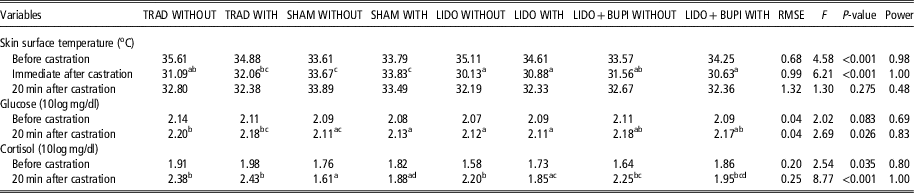
Immediately after castration, half of the piglets in each group randomly received 0.4 mg/kg i.m. meloxicam (Metacam® 20 mg/ml injection solution; Boehringer Ingelheim Vetmedica GmbH, Ingelheim/Rhein, Germany; Lot number: C21007B-01, expiration date: May 2013) subcutaneously behind the ear as postoperative analgesia (WITH). No postoperative treatment was applied to the remaining pigs (WITHOUT). In this way, eight treatment groups were finally created (15 piglets/group). No a priori power calculation was carried out for sample size determination, but the observed power for statistical analyses is shown in Tables 1 and 2. No placebo was used for animals who did not receive local anesthetic, with or without meloxicam. As a blind study, measures (of skin surface temperature, glucose and cortisol concentration) and data collection (about mortality and BW) were carried out by technicians not directly involved in the surgical treatment.
Observed arithmetic means, root mean square error (RMSE), F, P and power values for physiological variables measured in each treatment before and after castration in piglets

TRAD=traditional castration without local anesthesia or analgesia; SHAM=handling; LIDO=castration after intratesticular injection of lidocaine; LIDO+BUPI=castration after intratesticular injection of a mixture of lidocaine and bupivacaine; WITH=treatment with meloxicam; WITHOUT=treatment without meloxicam.
a,b,c,dValues within a row with different superscripts differ significantly at P<0.05.
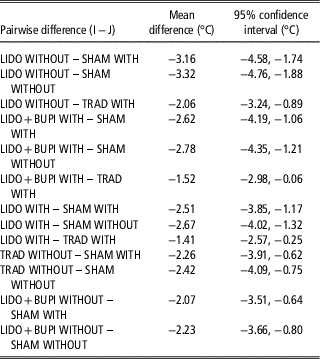
Mean difference and 95% confidence interval for significant pairwise comparisons, in skin surface temperature (°C) in piglets in response to castration with and without pain relief

I=first element in a pairwise difference; J=second element in a pairwise difference; TRAD=traditional castration without local anesthesia or analgesia; SHAM=handling; LIDO=castration after intratesticular injection of lidocaine; LIDO+BUPI=castration after intratesticular injection of a mixture of lidocaine and bupivacaine; WITH=treatment with meloxicam; WITHOUT=treatment without meloxicam.
Measurements
Skin surface temperature
Twenty minutes before castration (BC), piglets had their surface temperature (in the groin area) recorded via an IR thermometer (model PCE-IR 100; PCE Produktions und Entwicklungsgesellschaft mbH, Meschede, Germany). Before each use, the IR thermometer was allowed to self-calibrate with the ambient temperature in the maternity room (24°C). Immediately after castration (C), according to the procedure described above, the skin surface temperature was measured. Twenty minutes after castration (AC), another measurement of skin surface temperature was made in each experimental piglet.
Blood analysis
Twenty minutes before castration (BC), a blood sample was also taken from the cava cranialis vein for the first measurement of glucose and cortisol. Blood samples (5 ml) were collected into BD Vacutainer® Rapid Serum Tubes (Becton, Dickinson and Company, Franklin Lakes, NJ, USA). Twenty minutes after castration (AC), a second blood sample was taken for assessing glucose and cortisol concentrations. To prevent degradation, glucose determinations in blood samples were carried out in situ using a rapid test system (Accu-chek®; Aviva, Roche, Basel, Switzerland) and following the methodology based on the enzyme glucose dehydrogenase-pyrroloquinolinequinone. Blood samples for cortisol determination were centrifuged to separate plasma, and plasma samples were frozen and stored at −80°C. Cortisol determination was carried out on 5 consecutive days within 15 days after collection. A solid-phase, competitive chemiluminescent enzyme immunoassay (IMMULITE®/IMMULITE 1000 Cortisol; Global Siemens Healthcare, Erlanger, Germany) was used for the quantitative measurement of cortisol. The analytical sensitivity was 0.2 μg/dl. Cross-reactivity with other naturally occurring C21 steroids such as corticosterone was 8.6% and was undetectable; for 11-deoxycortisol and 11-deoxycorticosteron. The concentration of cortisol was calculated from a reference curve that ranged from 1 to 50 μg/dl. All cortisol assays were done in two batches; the calculated intra-assay coefficient of variation (CV) was 6.9%, and the inter-assay CV was 9.5%.
Performance
Twenty minutes before castration (BC), piglets from each group were weighed (in kg). BW was also recorded on days 4 and 11 post-castration (4 days AC and 11 days AC) and mortality was recorded over the 11-day post-castration period. Individual average daily weight gain (ADG) was calculated for three periods: the first 4 days AC (ADG1), 4 to 11 days AC (ADG2) and the first 11 days AC (AGD3).
Statistical analysis
The GLM procedure in SPSS software v. 19 (SPSS Inc., Chicago, IL, USA) was used for analyzing data; it can incorporate fixed and random effects, interactions and covariates (Petrie and Watson, Reference Prunier, Bonneau, Von Borell, Cinotti, Gunn, Fredriksen, Giersing, Morton, Tuyttens and Velarde2013). We considered treatment as a fixed effect and litter as a random effect. As we compared treatments for variables measured individually once at important times (before castration, immediately after castration, 20 min after castration, days 4 and 11 post-castration), previous individual data were incorporated as covariates. BC skin surface temperature was used as covariate when comparing C skin surface, and both BC and C skin surface temperatures were incorporated as covariates when comparing AC skin surface temperatures. For glucose and cortisol serum concentration (log10 mg/dl), BC values were considered as covariates when comparing AC values.
Data are presented as means and root mean square errors. Pairwise comparisons were performed only for data immediately and /or 20 min after the operation, when significant differences among groups were detected; a Bonferroni correction was applied for multiple comparisons. Whenever pairwise comparisons found significant differences, both effect measure (mean difference) and 95% interval confidence were estimated. A logarithmic transformation (10log) was used to normalize glucose and cortisol concentrations before statistical analysis. P-values <0.050 were considered to be statistically significant. Observed power for α=0.050 was also estimated.
Results
Skin surface temperature
Table 1 shows mean skin surface temperatures (BC, C and AC) for each treatment group. A significant difference among groups was found for C skin surface temperature, but no significant difference among groups was detected for AC skin surface temperature. Pairwise comparisons between group means for C skin surface temperature are also shown in Table 1. Table 2 shows the effect measure with the 95% confidence interval when a significant difference was detected in the pairwise comparisons. In general, a significant decrease in skin surface temperature was detected in all castrated pigs compared with SHAM WITH and WITHOUT, except temperature was similar between TRAD WITH and SHAM (WITH and WITHOUT) pigs. No significant differences were detected among TRAD WITHOUT and LIDO (WITH and WITHOUT) and LIDO+BUPI (WITH and WITHOUT) pigs, but skin temperature was higher in TRAD WITH than LIDO (WITH and WITHOUT) and LIDO+BUPI WITH.
Serum glucose concentration
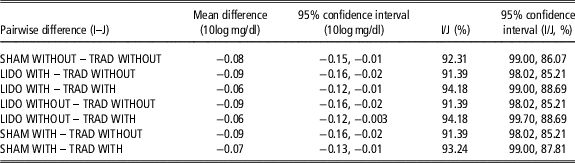
Table 1 shows mean glucose concentrations (BC and AC) for each treatment group. When comparing glucose concentration AC among groups, a significant difference was found. Pairwise comparisons between group means for glucose concentration AC are also shown in Table 1. Table 3 shows the effect measure with the 95% confidence interval when a significant difference was detected in the pairwise comparisons. Glucose concentrations were higher in TRAD (WITH and WITHOUT) compared with SHAM WITH pigs. A decrease in glucose concentrations were detected among LIDO (WITH and WITHOUT) and TRAD WITHOUT (8.61%), and among LIDO (WITH and WITHOUT) and TRAD WITH (5.82%). On the basis of the confidence intervals, the decrease would be ⩽1%.
Mean difference and 95% confidence interval for significant pairwise comparisons, in glucose concentration in piglets in response to castration with and without pain relief

I=first element in a pairwise difference; J=second element in a pairwise difference; TRAD=traditional castration without local anesthesia or analgesia; SHAM=handling; LIDO=castration after intratesticular injection of lidocaine; LIDO+BUPI=castration after intratesticular injection of a mixture of lidocaine and bupivacaine; WITH=treatment with meloxicam; WITHOUT=treatment without meloxicam.
Serum cortisol concentration
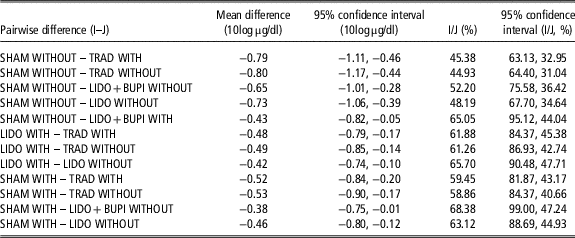
Table 1 shows mean cortisol concentrations (BC and AC) for each treatment group. A significant difference was found when comparing cortisol concentration AC among groups. Pairwise comparisons between group means for cortisol concentration AC are shown in Table 1. Table 4 shows the effect measure with the 95% confidence interval when a significant difference was detected in the pairwise comparisons. Cortisol concentrations were higher in TRAD (WITH and WITHOUT) than SHAM (WITH and WITHOUT) pigs. However, cortisol concentrations were lower in LIDO WITH than TRAD (WITH and WITHOUT) but similar to SHAM (WITH and WITHOUT) pigs. LIDO WITHOUT and LIDO+BUPI (WITH and WITHOUT) had higher cortisol concentrations than SHAM WITHOUT and similar levels to TRAD (WITH and WITHOUT) pigs.
Mean difference and 95% confidence interval for significant pairwise comparisons, in cortisol concentration in piglets in response to castration with and without pain relief

I=first element in a pairwise difference; J=second element in a pairwise difference; TRAD=traditional castration without local anesthesia or analgesia; SHAM=handling; LIDO=castration after intratesticular injection of lidocaine; LIDO+BUPI=castration after intratesticular injection of a mixture of lidocaine and bupivacaine; WITH=treatment with meloxicam; WITHOUT=treatment without meloxicam.
Mortality, BW and average daily weight gain
No mortality in any group was recorded at the day of castration. By 4 days post-castration, two piglets had died in each of the SHAM WITH and LIDO+BUPI WITH groups. In the 11-day period after castration, a total of 16 piglets had died (SHAM WITHOUT: three; SHAM WITH: three; LIDO+BUPI WITHOUT: three; LIDO+BUPI WITH: seven). After necropsy and isolation of the causative agents, Escherichia coli gastroenteritis with the presence of Coccidia was diagnosed as the cause of these casualties. A similar percentage (12% to 13%) of casualties due to this cause was recorded for the rest of the piglets (males and females) on the farm (data not shown); therefore, it is unlikely that the death of the experimental piglets was due to the experimental manipulations. Table 5 shows observed arithmetic means for the growth performance variables. No effect of treatment was found on BW or ADG.
Observed arithmetic means, root mean square error (RMSE), F, P and power values for weight and grown measured in each treatment before and after castration in piglets.

TRAD=traditional castration without local anesthesia or analgesia; SHAM=handling; LIDO=castration after intratesticular injection of lidocaine; LIDO+BUPI=castration after intratesticular injection of a mixture of lidocaine and bupivacaine; WITH=treatment with meloxicam; WITHOUT=treatment without meloxicam; C=Castration; AC=after castration; ADG1=average daily gain for castration 4 days after castration; ADG2=average daily gain for 4 to 11 days after castration; ADG3=average daily gain for castration 11 days after castration.
Discussion
Surgical castration in piglets is a very painful procedure, even during the neonatal period (Carroll et al., Reference Coetzee2006; Prunier et al., Reference Ranheim, Haga and Ingebrigtsen2006; von Borell et al., Reference Carroll, Berg, Strauch, Roberts and Kattesh2009). The use of regional anesthetic techniques seems to be more economical for handlers and safer for piglets than general anesthetic techniques (O’Connor et al., Reference O’Connor, Anthony, Bergamasco, Coetzee, Gould, Johnson, Karriker, Marchant-Forde, Martineau, McKean, Millman, Niekamp, Pajor, Rutherford, Sprague, Sutherland, von Borell and Dzikamunhenga2014). Stress or pain can cause SNS activation and, consequently, a decrease in skin temperature (Stewart et al., Reference Sutherland, Davis, Brooks and McGlone2005). Our results suggest that neither administration of local anesthetics or meloxicam prevented the decrease in skin surface temperature associated with castration. Similar results were found by Hansson et al. (Reference Ingvast-Larsson, Högberg, Mengistu, Olsén, Bondesson and Olsson2011) when skin surface temperature was measured around the castration site at 24 h after piglet castration. Bates et al. (Reference Bates, Karriker, Stock, Pertzborn, Baldwin, Wulf, Lee, Wang and Coetzee2014) found a lower cranial skin temperature in control piglets compared with piglets receiving transmammary-delivered meloxicam; however, the temperature differences were not significant in other anatomical sites (left ear, right ear and snout tip). Therefore, the measurement of temperature in the groin area might explain the failure in detecting effects of the local anesthetic and meloxicam on skin surface temperature.
Castration (TRAD) caused a significant increase in glucose concentration with respect to SHAM; this is likely due to the stress associated with castration. Similar results were found by Prunier et al. (Reference Ranheim, Haga and Ingebrigtsen2006). Meloxicam did not significantly influence glucose concentration. Similarly, in disbudded kid goats, no significant effect of meloxicam on glucose concentration was found (Ingvast-Larsson et al., Reference Keita, Pagot, Prunier and Guidarini2011). Glucose concentrations did not differ between SHAM and LIDO piglets, but a small difference was detected between LIDO and TRAD. No differences were detected in glucose concentrations between LIDO+BUPI and TRAD or between LIDO+BUPI and SHAM. Kluivers-Poodt et al. (Reference Kluivers-Poodt, Zonderland, Verbraak, Lambooij and Hellebrekers2012) found neither lidocaine nor meloxicam to have an effect on glucose concentration in the castration of piglets. In dogs undergoing ovariohysterectomy, Tsai et al. (Reference von Borell, Baumgartner, Giersing, Jäggin, Prunier, Tuyttens and Edwards2013) found no significant effect of lidocaine, meloxicam or their combination on glucose concentration. The lower glucose concentrations observed in LIDO compared with TRAD piglets could potentially be attributed to the beneficial effect of lidocaine as a local anesthetic. However, the lack of detectable difference in glucose concentration between LIDO+BUPI and TRAD or SHAM suggests that the combination of LIDO+BUPI is not better than LIDO alone at reducing glucose concentration within the first 20 min after castration.
On the basis of our results, when castration was carried out by the traditional method, meloxicam was not effective enough to significantly reduce cortisol concentrations within the first 20 min after castration. Our results show a significant decrease in cortisol concentration when administering lidocaine with meloxicam. Haga and Ranheim (Reference Hansson, Lundeheim, Nyman and Johansson2005) found that lidocaine reduced signs of nociception at castration in pigs. In contrast, Zankl et al. (Reference Zankl, Ritzmann, Zöls and Heinritzi2007) concluded that the intratesticular or intrascrotal injection of several local anesthetics (including lidocaine), 15 min before castration in pigs, did not result in a significant reduction of serum cortisol, considered by these authors as the only indicator of pain. Kluivers-Poodt et al. (Reference Kluivers-Poodt, Zonderland, Verbraak, Lambooij and Hellebrekers2012) found that lidocaine reduced serum cortisol concentration in response to castration in pigs, but they did not find a positive effect of meloxicam. LIDO+BUPI WITH showed a significant increase compared with SHAM WHITHOUT, a decrease close to the limit for significance when compared with TRAD WITH and no differences for the other comparisons of cortisol concentrations within the first 20 min after castration. Therefore, LIDO+BUPI in combination with meloxicam does not appear to be as effective as LIDO in combination with meloxicam at reducing the initial cortisol response to castration. The advantage of combining BUPI with LIDO is that it is longer acting; therefore, further research investigating the long-term effects of these different anesthesia protocols on the stress response of pigs to castration is warranted.
Regarding the use of bupivacaine as a local anesthetic in castration of piglets, we have only found two papers referenced in the literature. Nyborg et al. (Reference Ochroch, Mardini and Gottschalk2000) administered bupivacaine intrafunicularly and subcutaneously at the site of incision. In this case, the number of activated neurons was three times lower in pigs receiving the local anesthetic before castration than in those receiving an injection of saline. Sutherland et al. (Reference Taylor, Weary, Lessard and Braithwaite2010) applied a topical gel containing bupivacaine, among other local anesthetics, to the wound. In that study, the use of bupivacaine as a long-acting topical anesthetic was also insufficient to eliminate the pain associated with castration in the postoperative period. However, this result should not be directly compared with ours, as bupivacaine was applied topically after castration. Cuvillon et al. (Reference Engelhardt, Homma, Schlegel, Utzmann and Schnitzler2009) found that mixtures of bupivacaine with lidocaine induced a faster onset of peripheral nerve block and that the duration of the action was shorter than for bupivacaine alone. In accordance to our results, LIPO+BUPI did not result in a shorter latency time, but LIDO+BUPI might result in long-term positive effects on the stress response in pigs; unfortunately, farm management did not allow a longer follow-up of studied piglets. In dogs undergoing castration, the addition of local anesthetics (lidocaine+bupivacaine) did not impact pain scores relative to the saline placebo (Stevens et al., Reference Stewart, Webster, Schaefer, Cook and Scott2013). More research is needed to understand the relationships between LIDO and BUPI as effective methods of pain relief for castration in pigs.
Meloxicam does not alleviate incisional pain but does affect inflammatory pain caused by cytokines and prostaglandins as a consequence of damage to cell walls (Coetzee, Reference Coetzee2013a and 2013b). NSAID decrease prostaglandin production and modify cytokine ratios; as a consequence, NSAID attenuate the nervous system response to noxious stimuli (Ochroch et al., Reference Petrie and Watson2003). In accordance with these facts, previous research found that piglets receiving meloxicam preoperatively showed significantly lower cortisol levels 30 min to 4 h after castration than controls (Langhoff et al., Reference Martin-Flores2009), but there was no difference in vocalization during castration in meloxicam-treated and untreated piglets (Reiner et al., Reference Stevens, Posner, Jones and Lascelles2012). In the present study, meloxicam injected at the time of castration was not effective at reducing the stress response within the first 20 min after castration, however, meloxicam may have reduced the long-term postoperative stress caused by castration. Keita et al. (Reference Kielly, Dewey and Cochran2010) found a significant decrease in cortisol concentration 30 min (±5) after castration, proving that a significant pharmacodynamic effect could be observed within a very short time after the injection of meloxicam. Meloxicam also had a significant effect on behavioral responses 1 h to 5 days after castration (Keita et al., Reference Kielly, Dewey and Cochran2010; Hansson et al., Reference Ingvast-Larsson, Högberg, Mengistu, Olsén, Bondesson and Olsson2011; Kluivers-Poodt et al., Reference Langhoff, Zoels, Barz, Palzer, Ritzmann and Heinritzi2013). Meloxicam also caused a decrease in serum concentration of cortisol in piglets when sows, after farrowing, received meloxicam orally so that it was administered to piglets through maternal milk (Bates et al., Reference Bates, Karriker, Stock, Pertzborn, Baldwin, Wulf, Lee, Wang and Coetzee2014).
Outcomes observed at 24 h after castration may not be accurate indicators for NSAID activity (Ochroch et al., Reference Petrie and Watson2003; O’Connor et al., Reference O’Connor, Anthony, Bergamasco, Coetzee, Gould, Johnson, Karriker, Marchant-Forde, Martineau, McKean, Millman, Niekamp, Pajor, Rutherford, Sprague, Sutherland, von Borell and Dzikamunhenga2014). No effect of treatment on growth was detected; other authors described similar results (Carroll et al., Reference Coetzee2006), suggesting that growth rates are not a good indicator of acute pain in piglets. Only when surgical castration was carried out shortly after birth (1 to 3 days) was a decrease in the growth rate of the piglets observed (Kielly et al., Reference Kluivers-Poodt, Houx, Robben, Koop, Lambooij and Hellebrekers1999). Kluivers-Poodt et al. (Reference Kluivers-Poodt, Zonderland, Verbraak, Lambooij and Hellebrekers2012) found neither anesthetic nor meloxicam effects on mortality or growth in piglets.
In conclusion, using intratesticular lidocaine in piglets under 7 days of age reduces the acute stress caused by castration. The combination of intratesticular lidocaine and bupivacaine does not seem to be more effective than lidocaine alone within the initial 20 min postoperative period. The administration of lidocaine and meloxicam is the most appropriate treatment, among those tested, to reduce the stress associated with castration in the immediate postoperative period in these animals.
Acknowledgements
The authors thank Boehringer Ingelheim, Spain for financial support and for providing Metacam®. The authors also thank Dr M. Morales for quantitative measuring of serum cortisol.