Introduction
Data from the National Center for Education Statistics shows that nearly 8% of public school students in the U.S. – an estimated 3.7 million children – speak Spanish at home (McFarland, Husser, de Brey, Snyder, Wang, Wilkinson-Flicker, Gebrekristos, Zhang, Rathbun, Barmer, Bullock Mann & Hinz, Reference McFarland, Husser, de Brey, Snyder, Wang, Wilkinson-Flicker, Gebrekristos, Zhang, Rathbun, Barmer, Bullock Mann and Hinz2017). The heterogeneity of children's language skills within this population is widely documented (Bohman, Bedore, Peña, Mendez-Perez & Gillam, Reference Bohman, Bedore, Peña, Mendez-Perez and Gillam2010), as are the difficulties associated with identifying children with developmental language disorder (DLD) who are bilingual (Bedore & Peña, Reference Bedore and Peña2008). Sentence repetition (SR) tasks have emerged as a promising tool for the identification of bilingual children with DLD (Meir, Walters & Armon-Lotem, Reference Meir, Walters and Armon-Lotem2016; Thordardottir & Brandeker, Reference Thordardottir and Brandeker2013). Though different SR tasks vary with respect to length, complexity, and how they are scored, overall classification accuracy of bilinguals with DLD ranges from fair (>.80) to good (>.90) (Armon-Lotem & Meir, Reference Armon-Lotem and Meir2016; Fleckstein, Prévost, Tuller, Sizaret & Zebib, Reference Fleckstein, Prévost, Tuller, Sizaret and Zebib2016). Despite this utility as a diagnostic instrument, the mechanisms that underlie children's performance on SR tasks are not fully understood. The objective of the current study, therefore, is the following: first, to replicate previous research that has evaluated the classification accuracy of SR tasks with bilinguals; and second, to investigate predictors of children's performance – specifically, their verbal short-term memory and lexical ability. Extant research suggests that SR relies on skills from each of these domains (Ebert, Reference Ebert2014; Simon-Cereijido & Méndez, Reference Simon-Cereijido and Méndez2018); however, the relative contribution of these factors, and their vulnerability to differing levels of language exposure, has yet to be systematically explored with bilinguals.
Using SR to detect DLD
DLD is characterized by significant difficulty in the area of oral language in children who do not otherwise present neurological, perceptual, or cognitive delays (Leonard, Reference Leonard2014; Stark & Tallal, Reference Stark and Tallal1981). SR tasks have been shown to correctly identify high percentages of children with DLD (sensitivity) without incorrectly flagging TD children (specificity) (Archibald & Joanisse, Reference Archibald and Joanisse2009; Conti-Ramsden, Botting & Faragher, Reference Conti-Ramsden, Botting and Faragher2001). As a rule, tasks with sensitivity and specificity above .90 are considered “good” discriminators, while those with sensitivity and specificity between .80 and .90 are considered “fair” discriminators (Plante & Vance, Reference Plante and Vance1994). Using a SR task taken from the Clinical Evaluation of Language Fundamentals, Third Edition (CELF-3; Semel, Wiig & Secord, Reference Semel, Wiig and Secord1995), Conti-Ramsden and colleagues (Reference Conti-Ramsden, Botting and Faragher2001) detected DLD in 160 monolingual English speakers with sensitivity of .90 and specificity of .85, significantly better than both a nonword repetition task and a grammatical tense-marking task. Since then, a substantial body of work has corroborated the finding that English-speaking children with DLD perform more poorly on tasks of SR than TD children (Archibald & Joanisse, Reference Archibald and Joanisse2009; Briscoe, Bishop & Frazier Norbury, Reference Briscoe, Bishop and Frazier Norbury2001; Eadie, Fey, Douglas & Parsons, Reference Eadie, Fey, Douglas and Parsons2002; Everitt, Hannaford & Conti-Ramsden, Reference Everitt, Hannaford and Conti-Ramsden2013; Redmond, Reference Redmond2005; Riches, Reference Riches2012; Seeff-Gabriel, Chiat & Dodd, Reference Seeff-Gabriel, Chiat and Dodd2010).
Truly effective discriminators of impairment should extend to populations with diverse linguistic backgrounds. SR tasks have accurately differentiated children with DLD in non-mainstream dialects of English (Oetting, McDonald, Seidel & Hegarty, Reference Oetting, McDonald, Seidel and Hegarty2016) as well as in typologically diverse languages, such as Cantonese (Stokes, Wong, Fletcher & Leonard, Reference Stokes, Wong, Fletcher and Leonard2006) and Czech (Smolík & Vávru, Reference Smolík and Vávru2014). A growing number of studies has investigated the use of SR tasks with children acquiring two languages (Armon-Lotem & Meir, Reference Armon-Lotem and Meir2016; Ebert, Reference Ebert2014; Fleckstein et al., Reference Fleckstein, Prévost, Tuller, Sizaret and Zebib2016; Gutiérrez-Clellen, Restrepo & Simón-Cereijido, Reference Gutiérrez-Clellen, Restrepo and Simón-Cereijido2006; Meir et al., Reference Meir, Walters and Armon-Lotem2016; Simón-Cereijido, Reference Simón-Cereijido, Auza Benavides and Schwartz2017; Thordardottir & Brandeker, Reference Thordardottir and Brandeker2013; Tuller, Hamann, Chilla, Ferré, Morin, Prevost, Dos Santos, Abed Ibrahim & Zebib, Reference Tuller, Hamann, Chilla, Ferré, Morin, Prevost, Dos Santos, Abed Ibrahim and Zebib2018; Verhoeven, Steenge, van Weerdenburg & van Balkom, Reference Verhoeven, Steenge, van Weerdenburg and van Balkom2011; Ziethe, Eysholdt & Doellinger, Reference Ziethe, Eysholdt and Doellinger2013). Of these, two studies have used SR to detect impairment in Spanish-English bilinguals, with somewhat mixed results. A recent study by Simón-Cereijido (Reference Simón-Cereijido, Auza Benavides and Schwartz2017) used two SR tasks, one in English and one in Spanish, each with 21 sentences balanced for sentence length and sentence type across languages. Discriminant function analyses with 40 three-year-old bilinguals with DLD and 40 age-matched TD peers found that the Spanish SR task had good sensitivity (.93) and fair specificity (.80), whereas the English SR task had poor sensitivity (.59) but good specificity (.89). Working with slightly older preschoolers, Gutiérrez-Clellen et al. (Reference Gutiérrez-Clellen, Restrepo and Simón-Cereijido2006) used a grammatical task that combined 23 Spanish morphosyntactic cloze targets and 51 Spanish SR targets. These items, chosen to maximize differences between DLD and TD groups, yielded sensitivity and specificity, each, of .86 for four-year-olds and .94 for five-year-olds. The present study builds on their original bank of SR items, which has been expanded to include sentences suitable for older school-age bilinguals.
Predictors of SR performance
It is perhaps not surprising that children with DLD perform more poorly on SR tasks than their TD peers. What is less understood, however, are the mechanisms that drive these differences in performance. Experimental research into the nature of SR has concluded that it primarily taps children's grammatical knowledge, particularly their ability to comprehend and reconstruct syntactic structures (Kapantzoglou, Thompson, Gray & Restrepo, Reference Kapantzoglou, Thompson, Gray and Restrepo2016; Kidd, Brandt, Lieven & Tomasello, Reference Kidd, Brandt, Lieven and Tomasello2007; Polišenská, Chiat & Roy Reference Polišenská, Chiat and Roy2015; Riches, Loucas, Baird, Charman & Simonoff, Reference Riches, Loucas, Baird, Charman and Simonoff2010), a language domain that is profoundly and characteristically difficult for children with DLD. Nonetheless, recent work suggests that additional skills and processes, beyond grammar, may influence children's ability to accurately produce the targeted grammatical constructions (Moll, Hulme, Nag & Snowling, Reference Moll, Hulme, Nag and Snowling2015; Poll, Miller, Mainela-Arnold, Adams, Misra & Park, Reference Poll, Miller, Mainela-Arnold, Adams, Misra and Park2013; Riches, Reference Riches2012). These studies describe two main types of predictors: those that implicate memory and those that implicate language. The former emphasizes the role of verbal working memory in linguistic tasks and posits that problems in verbal memory will compromise children's performance on SR (Alloway & Gathercole, Reference Alloway and Gathercole2005; Ebert, Reference Ebert2014). The latter, in contrast, emphasizes that the storage of information in verbal memory is critically dependent on the quality of one's linguistic representations and, of relevance to the present study, of one's lexical representations (Allen & Hulme, Reference Allen and Hulme2006; Klem, Melby-Lervåg, Hagtvet, Lyster, Gustafsson & Hulme, Reference Klem, Melby-Lervåg, Hagtvet, Lyster, Gustafsson and Hulme2015; Melby-Lervåg & Hulme, Reference Melby-Lervåg and Hulme2010).
Theoretical accounts that integrate memory and language, such as Baddeley's (Reference Baddeley2000, Reference Baddeley2012) Multicomponent Model of Working Memory, are often invoked to make sense of the complex demands of SR tasks (e.g., Riches, Reference Riches2012; Smolík & Vávru, Reference Smolík and Vávru2014). Baddeley's model is comprised of a central control system of limited attentional capacity, termed the central executive, aided by two memory storage systems: (a) the phonological loop, responsible for maintaining verbal information and (b) the visuospatial sketchpad, responsible for maintaining visual information. A fourth component, the episodic buffer, was added to the model to act as an interface between the subsystems of working memory and long-term memory (LTM). Researchers stipulate that SR taps the capacity of the episodic buffer (Baddeley & Wilson, Reference Baddeley and Wilson2002), in particular, because the buffer integrates the information temporarily held in the phonological loop with the existing semantic and syntactic information held in LTM.
While Baddeley's framework is helpful for conceptualizing the linguistic and storage demands of SR, it does not account for bilingual-specific factors such as variation in first (L1) and second (L2) language knowledge and disparity in timing of L1 and L2 exposure (Genesee, Hamers, Lambert, Mononen, Seitz & Starck, Reference Genesee, Hamers, Lambert, Mononen, Seitz and Starck1978). Presumably, these factors will influence both a bilingual's working memory capacity (Thordardottir & Brandeker, Reference Thordardottir and Brandeker2013) and their long-term linguistic representations (Blom & Paradis, Reference Blom and Paradis2013), thus impacting their performance on SR tasks.
SR tasks and memory
Several studies have shown that children's performance on SR tasks is related to their performance on other memory tasks (Alloway & Gathercole, Reference Alloway and Gathercole2005; Baddeley, Hitch & Allen, Reference Baddeley, Hitch and Allen2009; Ebert, Reference Ebert2014; Poll et al., Reference Poll, Miller, Mainela-Arnold, Adams, Misra and Park2013; Riches, Reference Riches2012; Smolík & Vávru, Reference Smolík and Vávru2014; Willis & Gathercole, Reference Willis and Gathercole2001; Ziethe et al., Reference Ziethe, Eysholdt and Doellinger2013). Alloway and Gathercole (Reference Alloway and Gathercole2005) reported that children who performed well on a battery of simple and complex memory tasks also performed well on SR. Simple tasks, such as digit span or nonword repetition, measure one's ability to temporarily hold in mind phonological material. Complex tasks, such as backward digit span or listening span tasks, involve manipulation of stored material. Our study focuses on the simple storage of phonological material, given that this is the component of verbal memory that is used in much of the research on SR to date.
A common way to quantify simple STM storage is with a nonword repetition (NWR) task (e.g., Ebert, Reference Ebert2014; Hesketh & Conti-Ramsden, Reference Hesketh and Conti-Ramsden2013; Meir, Reference Meir2017; Smolík & Vávru, Reference Smolík and Vávru2014), which asks children to repeat a string of sounds that together form a nonce word, ensuring that the repetition of sounds depends on memory while minimizing reliance on existing lexical knowledge. However, a task that was once thought to be void of language experience is now considered to have the highest linguistic load of simple STM storage tasks (Meir, Reference Meir2017). Children's NWR is related to prosodic structure, segmental complexity, and phonotactic probability (Chiat, Reference Chiat, Armon-Lotem, de Jong and Meir2015). Deficits in phonological STM may affect children's ability to develop stable long-term grammatical representations (Adams & Gathercole, Reference Adams and Gathercole2000), which, in turn, may affect their accuracy when imitating sentences that contain those forms. According to early work in SR, children are only able to reproduce forms when they have some existing knowledge of that form (Carrow, Reference Carrow1974; Gallimore & Tharp, Reference Gallimore and Tharp1981).
Notably, STM storage appears to contribute more significantly to SR for children with impairment than it does for children with TD. In a study of 11-year-old children with and without a reported history of DLD, Hesketh and Conti-Ramsden (Reference Hesketh and Conti-Ramsden2013) found that children's performance on NWR was significantly predictive of SR performance only for children with a history of DLD, but not for TD controls. In younger children, Riches (Reference Riches2012) reported that NWR was a strong and significant predictor for six-year-old children with DLD, but not for age- or language-matched controls. One plausible explanation of this work is that, because children with DLD have impaired language skills, they rely on memory to complete SR tasks.
The contribution of memory on SR with bilinguals with DLD is less settled. Ziethe et al. (Reference Ziethe, Eysholdt and Doellinger2013) observed that SR scores for 15 four- and five-year-old German bilinguals with DLD were correlated with simple STM storage (r = .62, p = .07), albeit marginally significant, as measured by a forward digit span task. However, the association between memory and SR for bilingual children with TD was weak and insignificant. With a sample of monolingual (n = 81) and bilingual (n = 109) Hebrew and Russian learners, Meir (Reference Meir2017) evaluated whether group differences between bilinguals with TD and specific language impairment persisted on SR, after controlling for measures of verbal STM. Results showed that the effect of impairment persisted in both languages, even after controlling for children's forward digit span and NWR scores, with comparable effect sizes across memory tasks. Meir (Reference Meir2017) concluded that it is poor linguistic representations, and not memory, that explain the SR performance of bilingual children with DLD.
SR tasks and lexical knowledge
Considerable research has substantiated the notion that SR also taps children's lexical knowledge (Klem et al., Reference Klem, Melby-Lervåg, Hagtvet, Lyster, Gustafsson and Hulme2015; Moll et al., Reference Moll, Hulme, Nag and Snowling2015; Potter & Lombardi, Reference Potter and Lombardi1990; Simon-Cereijido & Méndez, Reference Simon-Cereijido and Méndez2018; Stokes et al., Reference Stokes, Wong, Fletcher and Leonard2006; Ziethe et al., Reference Ziethe, Eysholdt and Doellinger2013). Among bilinguals, there is evidence that a minimal amount of lexical knowledge may be necessary in order for bilinguals to be successful in SR in their weaker language (Simón-Cereijido, Reference Simón-Cereijido, Auza Benavides and Schwartz2017). A recent study with Spanish–English bilinguals explored the relationship between lexical measures and children's SR performance. With 61 TD preschoolers, Simon-Cereijido and Méndez (Reference Simon-Cereijido and Méndez2018) observed that a sizeable percentage of the variance in the SR scores in both English and Spanish was explained by children's scores on an expressive vocabulary test in the language tested (54% in English and 16% in Spanish). They attributed their findings to the large role that lexical knowledge plays in performance on SR, particularly among emerging bilinguals.
There is some, albeit limited, evidence that lexical knowledge contributes to the SR performance of bilinguals with DLD. A preliminary report of a SR task used with Spanish-English bilingual children reported that the number of individual words repeated correctly, as opposed to number of sentence structures repeated correctly, yielded the largest effect sizes between TD and DLD groups (Restrepo, Gorin, Gray, Morgan & Barona, Reference Restrepo, Gorin, Gray, Morgan and Barona2010). An investigation of bilingual children with DLD acquiring German found a strong, zero-order association (r = .70, p < .05) between children's expressive vocabulary scores and their performance on a German SR task (Ziethe et al., Reference Ziethe, Eysholdt and Doellinger2013); however, they did not report the strength of this association for TD bilingual controls. To our knowledge, no study has attempted to predict SR performance in bilinguals with DLD using both measures of verbal STM and lexical knowledge.
SR tasks and language experience
Finally, bilingual children's performance on any language task is at least somewhat related to their experience in that language. Even among SR tasks, which are purported to be less affected by exposure than lexical tasks (Armon-Lotem, de Jong & Meir, Reference Armon-Lotem, de Jong and Meir2015), children's experience in a language predicts their SR performance in that language (Thordardottir & Brandeker, Reference Thordardottir and Brandeker2013). What is particularly interesting about the effect of language exposure on SR is how it differentially relates to bilinguals with TD and those with DLD. Recent work with French bilinguals by Fleckstein et al. (Reference Fleckstein, Prévost, Tuller, Sizaret and Zebib2016) showed that language exposure was significantly and strongly correlated to performance on a SR task for children with TD (r = .48, p < .01), but not for those with DLD.
These results support the notion that, in order for bilinguals to comprehend and repeat the linguistic forms that are featured by SR tasks, they must first be able to identify those forms from the language input. Bilinguals with DLD have inherent difficulty with this, even when their experience in a language is extensive. Bilinguals with TD are inherently good at this, even when their experience in a language is limited (see Armon-Lotem, Reference Armon-Lotem2017). What's more, language experience is shown to be related to the skills that underlie SR, including verbal STM (Thordardottir & Brandeker, Reference Thordardottir and Brandeker2013) and lexical knowledge (Anaya, Peña & Bedore, Reference Anaya, Peña and Bedore2018).
Present study
Previous research asserts that tasks like SR are “the most sensitive and specific tool for screening language impairment in bilingual children” (Armon-Lotem, Reference Armon-Lotem2017, p. 34). Much of this utility comes from the fact that SR taps children's grammatical abilities, a finding that is robust in the literature. However, a broader view of SR suggests that children's performance may also be related to their verbal STM, lexical knowledge, and language experience. Recent work provides rationale for investigating the relative contribution of these skills on bilinguals’ SR performance concurrently. Meir and Armon-Lotem (Reference Meir and Armon-Lotem2017) showed that bilingualism was associated with decreased vocabulary and lower performance on NWR and SR tasks among typical L2 Hebrew speakers; however, the negative effect of bilingualism on verbal STM disappeared once vocabulary was accounted for.
The extent to which these skills may differentially affect the SR performance of bilinguals with and without DLD remains an open question: some studies provide evidence that children with DLD recruit resources from verbal STM to complete SR tasks (e.g., Ziethe et al., Reference Ziethe, Eysholdt and Doellinger2013); others have concluded that simple memory tasks are insufficient to explain the differences between children with DLD and those with TD (Meir, Reference Meir2017; Smolík & Vávru, Reference Smolík and Vávru2014); still others have found differential effects related to language exposure (Fleckstein et al., Reference Fleckstein, Prévost, Tuller, Sizaret and Zebib2016).
In addition to exploring these relationships, the present study assesses classification accuracy of two SR tasks, one in English and one in Spanish, with a population of school-age bilinguals with and without DLD. There is clinical relevance for evaluating the diagnostic accuracy of SR tasks in each language separately. In the U.S., where the current research was conducted, fewer than 10% of speech-language pathologists speak a language other than English (American Speech & Hearing Association, 2017). Therefore, to increase external validity, we compare diagnostic accuracy when SR tasks are administered in both languages, only in Spanish, and only in English. Specifically, we pose the following questions:
1) To what extent do verbal STM, lexical knowledge, and language experience explain variability in school-age Spanish-English bilinguals’ performance on SR tasks in Spanish and English? Do these predictors differentially relate to the performance of children with DLD versus those with TD?
2) How accurately do English and Spanish SR tasks identify school-age Spanish-English bilinguals with DLD from their TD bilingual peers?
Methods
Participants
Participants’ data comes from a longitudinal study of cross-linguistic outcomes of bilingual children with and without DLD (Bedore, Peña, Griffin & Hixon, Reference Bedore, Peña, Griffin and Hixon2016). Participants in the larger, longitudinal study (n = 361) were recruited from preschool, first-, and third-grade classrooms in two public school districts in central Texas. The present analysis is comprised of a sub-sample of children who fit the following criteria at year one of the longitudinal portion of the study: children who were between the ages of 6;10 and 9;11 (n = 217), had at least 20% exposure in each language (n = 160), and had complete SR data in both languages. This yielded a total of 136 children: 26 children in the DLD group and 110 children in the TD group.
Children's language experience in English varied widely across our sample. To obtain information about English experience, research assistants interviewed parents and teachers using the Bilingual Input-Output Survey of the Bilingual English Spanish Assessment (BESA; Peña et al., Reference Peña, Gutiérrez-Clellen, Iglesias, Goldstein and Bedore2018). To measure input, parents reported on the language their child was most likely to hear on an hour-by-hour basis during a typical weekday and a typical weekend day, and teachers reported on the language the child was most likely to hear on a half-hour basis during a typical school day. The daily hours spent in each language were then extrapolated to the remaining days of the week and summed. The total number of hours of input in English in a typical week was divided by the total number of hours of input overall (English plus Spanish), yielding a percentage of time the child spent hearing English in a typical week. To measure output, the process was repeated, but parents and teachers reported on the language the child was most likely to speak. Because children's input and output percentages were highly correlated (r = .98, p < .001), they were averaged to create a single variable, “English input/output.” We excluded functionally monolingual children (i.e., those with less than 20% exposure to their other language, Bedore, Peña, Summers, Boerger, Resendiz, Greene, Bohman & Gillam, Reference Bedore, Peña, Summers, Boerger, Resendiz, Greene, Bohman and Gillam2012) as these children lie on extreme ends of the spectrum of bilingualism (average English input/output in our sample for functionally monolingual English and Spanish speakers was 93% and 12%, respectively) and perform similarly to monolinguals.
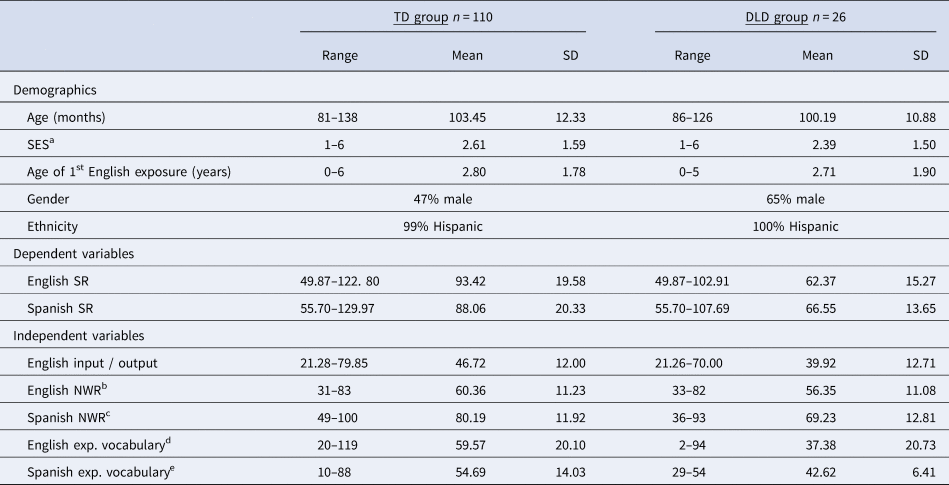
Demographic information, including information about language experience, is displayed in Table 1. Independent samples t-tests showed that DLD and TD groups did not differ significantly on the demographic variables, except for English input/output t(134) = −2.57, p = .011. Although participants in both groups reported greater exposure to Spanish than to English – overall, the average English input/output was 45.65% (SD = 12.26%) and the average Spanish input/output was 54.35% (SD = 12.26%) – children with TD reported slightly higher (7%) English input/output than the children with DLD. Parents of children with TD and DLD reported that children, on average, were first exposed to English at approximately 2 years 10 months of age. Families’ socioeconomic status (SES) was computed using mother's education. The average Hollingshead score for our sample was 2.50 (SD = 1.56), which corresponds to a junior high school (2) or partial high school (3) education (Hollingshead, Reference Hollingshead1975). Groups did not differ on SES, which has been shown to adversely affect both verbal STM and lexical knowledge in bilinguals (Meir & Armon-Lotem, Reference Meir and Armon-Lotem2017). Nearly all participants identified as Hispanic (99%). Twelve participants’ SES responses were missing at random and nine participants were missing data on ethnicity.
Descriptives of demographic, dependent, and independent variables, by group

a = Hollingshead score (Hollingshead, 1973); b = Nonword repetition task (Dollaghan & Campbell, Reference Dollaghan and Campbell1998); c = Experimental nonword repetition task in Spanish; d = Expressive One-Word Picture Vocabulary Test (EOWPVT: Brownell, Reference Brownell2000); e = Spanish Bilingual Edition of Expressive One-Word Picture Vocabulary Test (EOWPVT-SB: Brownell, Reference Brownell2001)
Procedures
Identification of DLD was carried out using a single-gate design in two phases, a screening phase and a confirmatory diagnostic phase, in order to reduce spectrum bias (Dollaghan & Horner, Reference Dollaghan and Horner2011). In the first phase, children were screened using the Bilingual English–Spanish Oral Screener (BESOS; Peña et al., Reference Peña, Bedore, Gutiérrez-Clellen, Iglesias and Goldstein2010a), an experimental version of a semantics and morphosyntax screener with good classification accuracy (Lugo-Neris, Peña, Bedore & Gillam, Reference Lugo-Neris, Peña, Bedore and Gillam2015). Children whose highest score fell below the 25th percentile on either the morphosyntax or the semantics subtest in their better language were considered to be at risk for DLD. Children at risk for DLD were oversampled (i.e., the prevalence of DLD in our sample exceeded the 7% in the population, Tomblin, Records, Buckwalter, Zhang, Smith & O'Brien, Reference Tomblin, Records, Buckwalter, Zhang, Smith and O'Brien1997) in order to reach adequate statistical power.
In the confirmatory diagnostic phase, DLD was confirmed if children met four of the following five indicators: (a) scored 1 SD below age norms on the BESOS screener in both languages, (b) scored 1 SD below age norms in both languages on the Bilingual English Spanish Assessment – Middle Extension (BESA-ME; Peña et al., Reference Peña, Bedore, Gutiérrez-Clellen, Iglesias and Goldstein2010b) semantics subtest, (c) scored 1 SD below age norms in both languages on the BESA-ME morphosyntax subtest, (d) scored 1 SD below age norms on both the English version of the Test of Narrative Language (TNL; Gillam & Pearson, Reference Gillam and Pearson2004) and an experimental version of the TNL adapted to Spanish (TNL-S; Gillam et al., in development), and (e) scored below an average of 4.25 (out of 5) in both languages on the Inventory to Assess Language Knowledge (ITALK) (Peña et al., Reference Peña, Gutiérrez-Clellen, Iglesias, Goldstein and Bedore2018). This resulted in a DLD group of 26 children. We identified children with typical language skills if they scored above -1 SD of the mean on two or more of these measures in at least one language. Additionally, all participating children scored within normal limits on the Universal Nonverbal Intelligence Test (Bracken & McCallum, Reference Bracken and McCallum1998) and passed an initial hearing screening administered by their school nurse.
Participants also completed assessments that examined their phonological STM and lexical knowledge. All testing occurred in a quiet space in children's schools in three or four sessions of 30 to 45 minutes. The order and language of testing was randomized across participants. All tests were administered by experienced research assistants following one-on-one training sessions with project staff, comprised of certified speech language pathologists who have worked with bilingual school-age children. Less than 10% of data for each variable of interest was missing by group, and missing data was deleted listwise.
Identification measures
BESOS. The Bilingual English–Spanish Oral Screener (BESOS; Peña et al., Reference Peña, Bedore, Gutiérrez-Clellen, Iglesias and Goldstein2010a) consists of two subtests, semantics and morphosyntax, in both English and Spanish. The semantics subtest uses receptive and expressive items to examine children's semantic breadth and depth, including functions, categories, definitions, characteristic properties, similarities and differences, and associations. The morphosyntax subtest measures grammatical constructions in each language that are challenging for children with DLD (e.g., past tense -ed, third person present tense -s, and copulas in English; articles, direct object clitics, and subjunctive in Spanish). Previous research using BESOS to predict DLD in first graders showed .95 sensitivity and .71 specificity when using a cut score of 1 SD below the mean in the child's best language (Lugo-Neris et al., Reference Lugo-Neris, Peña, Bedore and Gillam2015).
BESA-ME. A field test version of the Bilingual English Spanish Assessment-Middle Extension (BESA-ME; Peña et al., Reference Peña, Bedore, Gutiérrez-Clellen, Iglesias and Goldstein2010b) was administered during the confirmatory diagnostic phase of testing to confirm DLD status. The semantics subtest measures expressive and receptive semantic knowledge by targeting children's knowledge of repeated associations, category generation, functions, definitions, similarities and differences, and analogies. The English subtest consists of 23 semantics items and the Spanish subtest consists of 26. The morphosyntax subtest targets morphosyntactic constructions known to be difficult for children with DLD in each language (e.g., English: singular present tense and past tense; Spanish: adjective agreement and direct object clitics). The subtest presents 18 grammatical cloze items for English and 19 cloze items for Spanish, as well as six sentences in each language to be repeated in a SR task. The sentences contain 22 and 26 targets in English and Spanish, respectively, which are scored as correct if the child included the target word in his or her repetition. Preliminary analyses of classification accuracy of the BESA-ME using a composite of the semantics score in the better language and the morphosyntax score in the better language indicate 1.00 sensitivity and .87 specificity for second graders, and 1.00 sensitivity and .95 specificity for fourth graders (Bedore et al., Reference Bedore, Peña, Anaya, Nieto, Lugo-Neris and Baron2018).
TNL / TNL-S. The English Test of Narrative Language (TNL; Gillam & Pearson, Reference Gillam and Pearson2004) and the Test of Narrative Language - Spanish Experimental Version (TNL-S; Gillam et al., in development) assess children's narrative comprehension and production abilities. Though different stories are used for the English and Spanish versions, the structure of the test is parallel across languages. The test consists of six subtests in which the child is directed to retell a story he/she just heard, tell a story sequence based on a picture sequence, generate a story with a picture or respond to examiner questions. Standard scores (M = 100, SD = 15) were derived separately for the English and Spanish versions. For English, the TNL manual indicates a sensitivity of .92 and specificity of .87; sensitivity and specificity on the TNL-S showed sensitivity from .80 - .85 and specificity from .74 - .81 (Gillam et al., 2006).
ITALK. The Inventory to Assess Language Knowledge (ITALK; Pen˜a et al., Reference Peña, Gutiérrez-Clellen, Iglesias, Goldstein and Bedore2018) was used to measure parents’ and teachers’ perceptions of children's ability in each language. Parents and teachers rated children on a 5-point scale, from 1 (minimal proficiency) to 5 (high proficiency) in the following areas: vocabulary use, speech production (intelligibility), sentence production (utterance length), grammatical proficiency, and comprehension proficiency. The five scores in each language were averaged to yield a separate English and Spanish score based on parent and teacher reports. For cases in which a parent or teacher did not have knowledge of an area of one of the child's two languages, this was marked as “unknown” and was not included in the average (Gutiérrez-Clellen & Kreiter, Reference Gutiérrez–Clellen and Kreiter2003).
Predictor measures
Nonword repetition
Children completed NWR tasks containing 16 items in each language that increased in syllable length. In English, nonwords ranged from one to four syllables and were developed by Dollaghan and Campbell (Reference Dollaghan and Campbell1998). In Spanish, nonwords ranged from two to five syllables and were based on a list first developed by Calderón (Reference Calderón2003). Both NWR tasks contained low word-like nonwords for each language. The English list excluded later-developing sounds, consonant clusters, and tense vowels that occurred more than once in a word. The Spanish list excluded later-developing sounds, as well as syllables that occurred more than 200 times in the Alameda and Cuetos (Reference Alameda and Cuetos Vega1995) corpus, and it included only tense vowels. Previous work comparing both lists of nonwords showed that, because of the simpler CVCV phonological structure of Spanish, the difficulty across the English and Spanish tasks is not equivalent in bilinguals (Summers, Bohman, Gillam, Peña & Bedore, Reference Summers, Bohman, Gillam, Peña and Bedore2010). Therefore, the present study added five syllable nonwords to the original Calderón (Reference Calderón2003) items, in order to make the task difficulty more comparable across languages (the final list of Spanish NWR items is available in online supplementary materials, Supplementary Material).
A native bilingual adult male speaker digitally recorded nonwords in both languages. Stimuli were presented on a laptop computer with the use of headphones and instructions were provided in the language of the stimuli. Responses were recorded using a microphone and digital recorder. These recordings were then transferred to a computer and transcribed in English and in Spanish by bilingual research assistants. Transcriptions were scored for percentage of phonemes correct (PPC) following the protocol in Dollaghan and Campbell (Reference Dollaghan and Campbell1998). A consonant was scored as incorrect if it was omitted or deleted. Participants were not penalized for distortions. As part of data checking procedures, 10% of the NWR responses for the total sample was independently re-transcribed and scored; overall reliability at the phoneme level across languages was 83%, which is comparable to previous work reporting reliability between 83–85%, when utilizing the same strict criteria for agreement on voice, place, and manner of articulation (Krishnan, Alcock, Mercure, Leech, Barker, Karmiloff-Smith & Dick, Reference Krishnan, Alcock, Mercure, Leech, Barker, Karmiloff-Smith and Dick2013; Topbaş, Kaçar-Kütükçü & Kopkalli-Yavuz, Reference Topbaş, Kaçar-Kütükçü and Kopkalli-Yavuz2014). Three children with TD were missing English and Spanish NWR scores, at random, in our sample and were removed listwise from regression analyses.
Expressive vocabulary
The Expressive One-Word Picture Vocabulary Test (EOWPVT; Brownell, Reference Brownell2000) and Spanish Bilingual Edition (EOWPVT-SB; Brownell, Reference Brownell2001) were administered to assess lexical knowledge in English and Spanish, respectively. These are norm-referenced tests of single-word expressive vocabulary each consisting of 170 items that follow a developmental sequence. The EOWPVT and EOWPVT-SB present examinees with colored line drawings that depict an action, object, category, or concept, and examinees must label each drawing. Whereas the English EOWPVT was administered and scored according to the manual, the SB version was administered and scored only in Spanish, to reflect children's language-specific knowledge in Spanish. Basal and ceiling rules provided in the test manuals were used to compute raw scores. 11 children with TD were missing EOWPVT data and 16 were missing EOWPVT-SB data. They were not included in our examination of the first research question.
Sentence repetition measures
SR items target grammatical constructions that are challenging for children with DLD but are not easily elicited using a cloze task. SR items developed during pilot work for the Bilingual English Spanish Assessment (BESA; Peña et al., Reference Peña, Gutiérrez-Clellen, Iglesias, Goldstein and Bedore2018) – a language assessment tool for bilingual children ages four through six – formed the basis for the present study. In expanding the SR items for a school-age population, sentences from the BESA dataset that continued to show growth and reliably differentiate older TD and DLD children were retained (6 sentences in English and 4 sentences in Spanish) and new sentences were added (5 sentences in English and 6 sentences in Spanish). Examples of sentences that were retained include, in English, “The teacher wants to know who brought the snake” and, in Spanish, “La señora llamó a los bomberos cuando vio que salía humo del carro” [translation: The woman called the firemen when she saw that smoke was coming out of the car]. Both sentences are multiclausal and require children to mark verbs using various forms of tense and aspect. Examples of sentences that were added for use with school-age children include “Can she find a tank big enough for those fish?” and “Si tuviera un caballo, lo montaría todas las mañanas” [translation: If I had a horse, I would ride it every morning]. The new sentences in English SR included do insertion for negatives and questions with auxiliary; new sentences in Spanish included negative concord and subjunctive. The final SR task comprised 11 sentences in English and 10 sentences in Spanish. Given that sentences were selected based on their discriminant values (<.30), the final sentences differ across languages in terms of length and syntactic constructions. Sentences in English ranged in length from 6 to 11 words (average sentence: 8.91 words; 10.36 syllables). Sentences in Spanish ranged in length from 9 to 17 words (average sentence: 11.30 words; 20.80 syllables). Sentences for the English and Spanish tasks are described in detail in online supplementary materials (Supplementary Material).
SR tasks can be scored in various ways, depending on whether they are used for research or clinical purposes. In order to simulate clinical application, our SR items were scored during testing by research assistants using a dichotomous scoring scheme, similar to the scoring scheme prescribed by the Test of Language Development – Primary (TOLD-P-4; Newcomer & Hammill, Reference Newcomer and Hammill2008). Children received a score of 1 for each sentence repeated verbatim, with no additions, substitutions, or omissions, and a score of 0 for each sentence that deviated from the target sentence. Dichotomous scores were summed, for a maximum raw score of 11 in English and 10 in Spanish. Using a normative dataset of 614 bilingual children who received the same items, we derived standard scores based on the mean and SD for each age group (using one-year intervals). Standard scores had a mean of 100 and SD of 15. Bilinguals with balanced ability or dominance in English (n = 528) were included in the English SR norm; those with balanced ability or dominance in Spanish (n = 343) were included in the Spanish SR norm.
Analytical strategy
Prior to exploring concurrent relationships between variables and SR, we conducted zero-order correlations to explore the bivariate relationships between SR scores in both languages and language-specific NWR, expressive vocabulary, and percentage English input/output, by group. The Benjamini–Hochberg procedure was used to control the rate of false discovery (Benjamini & Hochberg, Reference Benjamini and Hochberg1995). Using this procedure, at a false discovery rate of 0.05, a correlation was considered significant when its p value was 0.016 or less. Next, hierarchical linear regressions were conducted as a follow-up analysis to the correlation analysis, as it allows us to assess the unique contribution of each independent variable to SR, relative to other predictors. After controlling for age, we entered English input/output, NWR in the language of testing, and expressive vocabulary in the language of testing into the regression, to find the combination of variables most highly associated with SR scores in each language. Finally, we ran receiver operating characteristic (ROC) curves with children's SR scores in English, Spanish, and the score from the language in which they scored highest. Sensitivity, specificity, and overall classification accuracy are reported for each task.
Results
Preliminary data analyses showed that our data were normally distributed. As seen in Table 1, on average, children with DLD scored lower than TD peers on all tasks. With respect to SR, the average child with DLD scored 59.21 (SD = 12.22) on the English SR task and 63.83 (SD = 8.76) on the Spanish SR task, which have a standardized mean of 100. In contrast, the average child with TD scored nearly 30 points higher in each language. Similar trends were observed with both NWR and expressive vocabulary, as children with DLD scored approximately one standard deviation below controls.
Research aim 1: Predictors of SR
Bivariate relationships
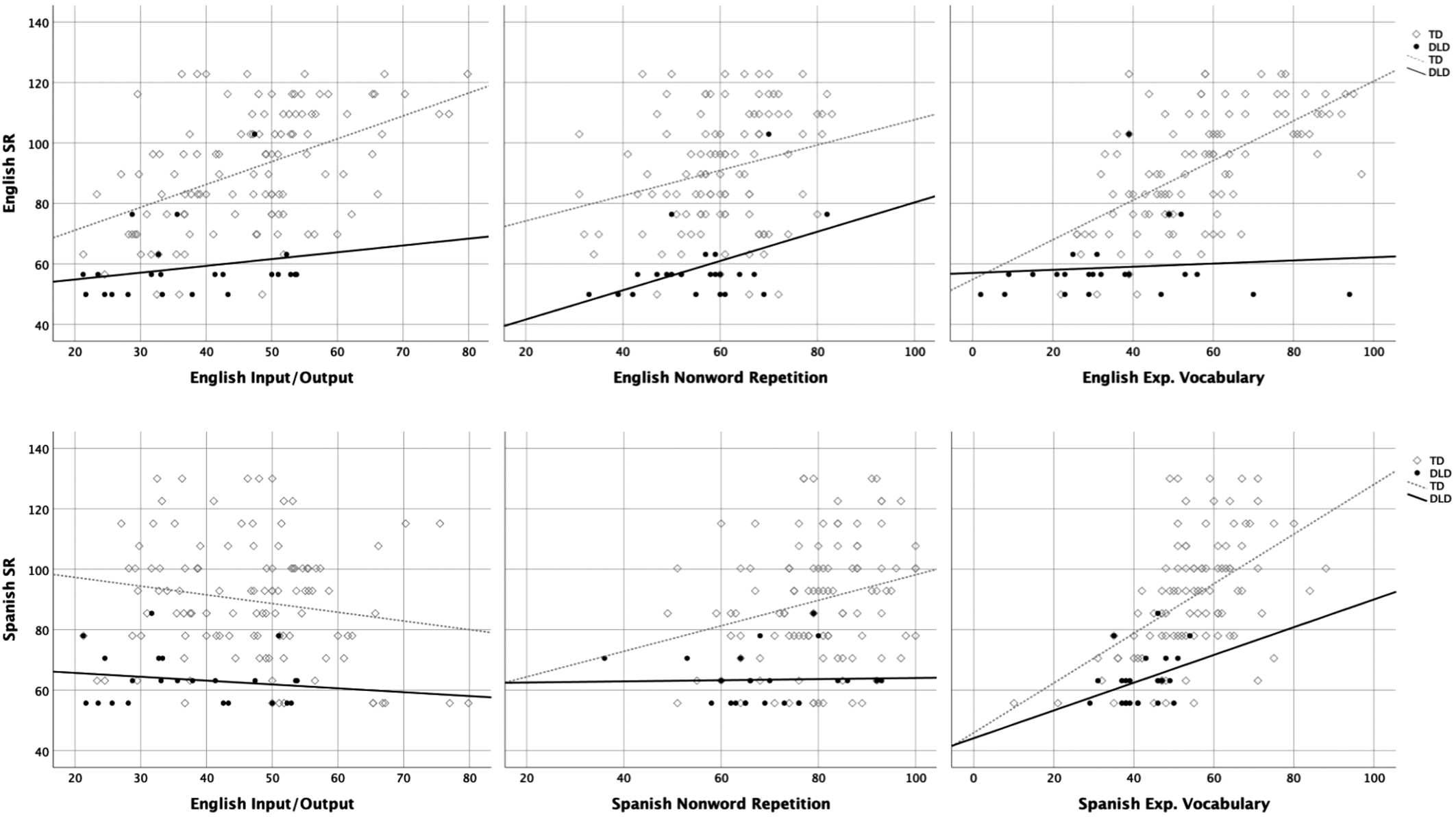
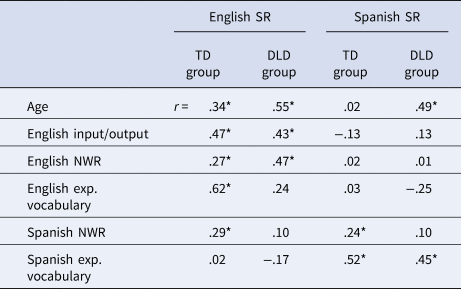
The first research question aimed to characterize the predictors of SR for school-age bilinguals. We first conducted zero-order correlations between SR and all independent variables, by group. The correlations for children in the TD and DLD groups are shown in Table 2. Age was significantly related to SR performance in both groups, with the exception of Spanish SR among TD children. Among children in the TD group, English SR was significantly correlated with all language-specific IVs, with English expressive vocabulary showing the strongest relationship to SR (r = .62, p < .001), follow by English input/output (r = .47, p < .001), and finally English NWR (r = .27, p < .05). Similar trends were observed in Spanish in the TD group, with the exception of English input/output, which did not correlate with TD children's SR performance in Spanish. Among children in the DLD group, the bivariate correlations with SR in both languages showed distinct patterns. Unlike their TD counterparts, English expressive vocabulary (r = .24, p = .228) was unrelated to the English SR performance of bilinguals with DLD and English input/output was just significant, with a Benjamini-Hochberg adjusted p-value of .050 (r = .43). However, the correlation between English NWR and English SR was strong and significant (r = .47, p < .05). Figure 1 features a scatterplot of this data. The non-associations between SR and expressive vocabulary in the DLD group are evidenced by flat black lines in the scatterplots; in contrast, the sloped dashed lines signify moderate-to-strong relationships between SR and language-specific IVs for children with TD. Finally, in addition to the bivariate correlations between predictors and SR, we also ran correlations to test for significant collinearity between age and English input/output. Age and English input/output significantly correlated among children with TD (r = .42, p < .001), but no relationship between age and exposure was found among children with DLD (r = −.12, p = .362).
Scatterplots of SR and language-specific predictors, by group

Bivariate correlations between SR scores and predictor variables, by group

* = Correlation is significant after controlling for false discovery rate at 0.05 (Benjamini & Hochberg, Reference Benjamini and Hochberg1995).
Hierarchical regressions
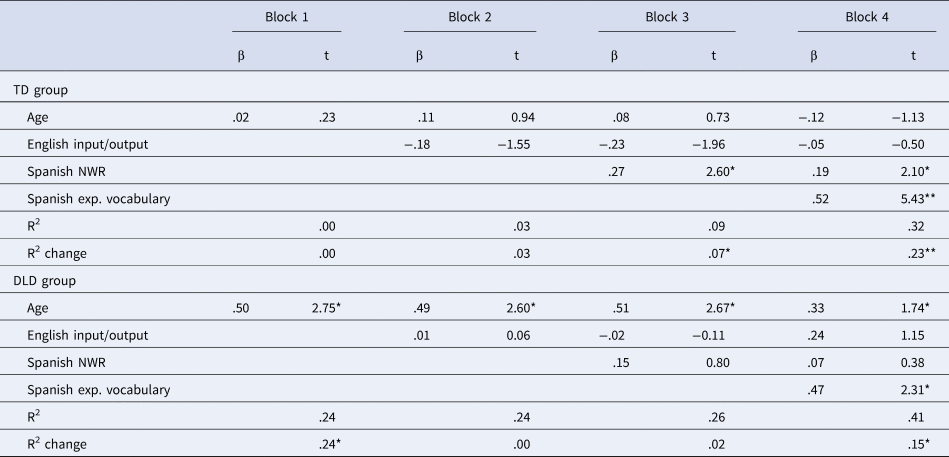
Given the significant bivariate relationships observed in Figure 1, our next step was to describe the relative contribution of each predictor to SR when examined concurrently. We conducted hierarchical regressions for each ability group, using forced entry of the following predictors in four blocks: (1) age, (2) English input/output, (3) NWR in the language of assessment, and (4) expressive vocabulary in the language of assessment. Because previous research has found that children's performance on SR is language specific, we did not test for cross-linguistic effects (Simon-Cereijido & Méndez, Reference Simon-Cereijido and Méndez2018). SR scores in English and Spanish were entered, in separate regressions, as the dependent variables. Upon running the regressions, we tested for multicollinearity using variance inflation factors (VIF) and tolerance. When VIF values exceed 4.0 or tolerance levels are less than .20, there may be a problem with multicollinearity (Hair, Black, Babin & Anderson, Reference Hair, Black, Babin and Anderson2014). For our data, all VIF values were less than 1.49 and all tolerance values were greater than .66.
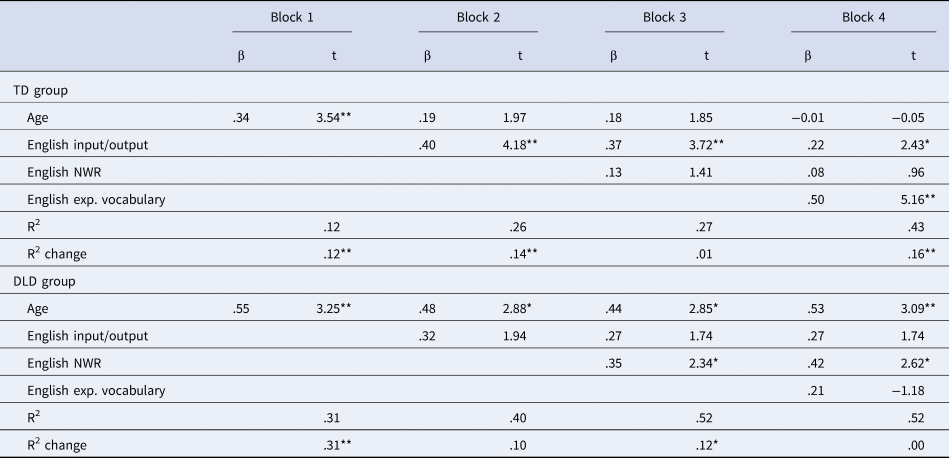
Predictor variables were added one block at a time in order to evaluate the unique contribution of each additional predictor to the model. In all four models, age was entered initially, at block 1, to control for developmental effects in all subsequent blocks. The English SR results with the TD group are shown in the upper part of Table 3. At block 1, age accounted for 12% (adjusted R2 = .11) of the variation in children's English SR scores, F (1, 95) = 12.53, p < .01. At block 2, English input/output was added to the model and significantly improved the variance accounted for to 26%, F (1, 94) = 17.43, p < .001, which made age insignificant. Part correlations for age and exposure, respectively, totaled .13 and .37, indicating that less than 2% of variance in English SR scores is uniquely explained by age. At block 3, English NWR was added to the model, which did not significantly improve the model, F (1, 93) = 1.99, p = .162, as it accounted for just .02% of additional variance. Finally, English expressive vocabulary was added at block 4 and yielded a significant improvement in the overall proportion of variance accounted for, F (1, 92) = 26.60, p < .001, explaining an additional 16% of the variance in children's SR abilities in English in the TD group. After 4 blocks, the resulting model accounted for approximately 43% of variability in children's English SR scores, with English input/output and English expressive vocabulary retaining individual significance.
Model summaries of regressions predicting English SR scores in TD and DLD groups

* = p < .05; ** = p < .01
Given the group differences observed in Figure 1, there is reason to suspect that the relationship between SR and the predictor variables may change relative to children's ability. For instance, bivariate correlations showed that English expressive vocabulary was strongly related to English SR among TD children (r = .47, p < .001) but was not related to English SR for children with DLD (r = −.13, p = .935). Hence, we ran an identical hierarchical regression with children with DLD, predicting their English SR scores (see bottom half of Table 3). Results contrasted with what was found in the TD group. At block 1, age accounted for 31% (adjusted R2 = .28) of the variation in children's English SR scores, F (1, 95) = 10.54, p < .01. At block 2, English input/output was added to the model but did not significantly improve the variability accounted for, F (1, 23) = 3.76, p = .065, though age remained significant. At block 3, English NWR was added to the model and increased the R2 to 52% (adjusted R2 = .46), F (1, 22) = 5.49, p = .029. Finally, the addition of English expressive vocabulary at block 4 did not result in significant improvement in the overall proportion of variance accounted for, F (1, 21) = 26.60, p = .253. Overall, the final model accounted for nearly half of the variability in SR scores of children with DLD, with age and NWR retaining individual significance.
The Spanish results for children with TD and DLD are shown in Table 4. Among children with TD, neither age nor English input/output explained variability in Spanish SR scores (adjusted R2 = .02). However, at block 3, Spanish NWR accounted for 7% additional variability, F (1, 90) = 6.77, p = .01. At block 4, Spanish expressive vocabulary accounted for an additional 23% of variability, F (1, 89) = 29.51, p < .001, resulting in a model that explained 32% of variance in Spanish SR scores (adjusted R2 = .29).
Model summaries of regressions predicting Spanish SR scores in TD and DLD groups

* = p < .05; ** = p < .01
Among children with DLD, age at block 1 was a significant predictor of Spanish SR F (1, 24) = 7.54, p =.01, accounting for nearly 24% of variability (adjusted R2 = .21). At block 2, English input/output did not contribute significantly to the model, R2 change = .00. Likewise, at block 3, the addition of Spanish NWR was not a significant predictor of SR scores in Spanish, contributing only 2% of additional variance. At block 4, Spanish expressive vocabulary accounted for an additional 15% of variability, F (1, 21) = 5.32, p = .031, resulting in a final model that explained 41% of variance in Spanish SR scores (adjusted R2 = .30).
Research aim 2: Classification accuracy
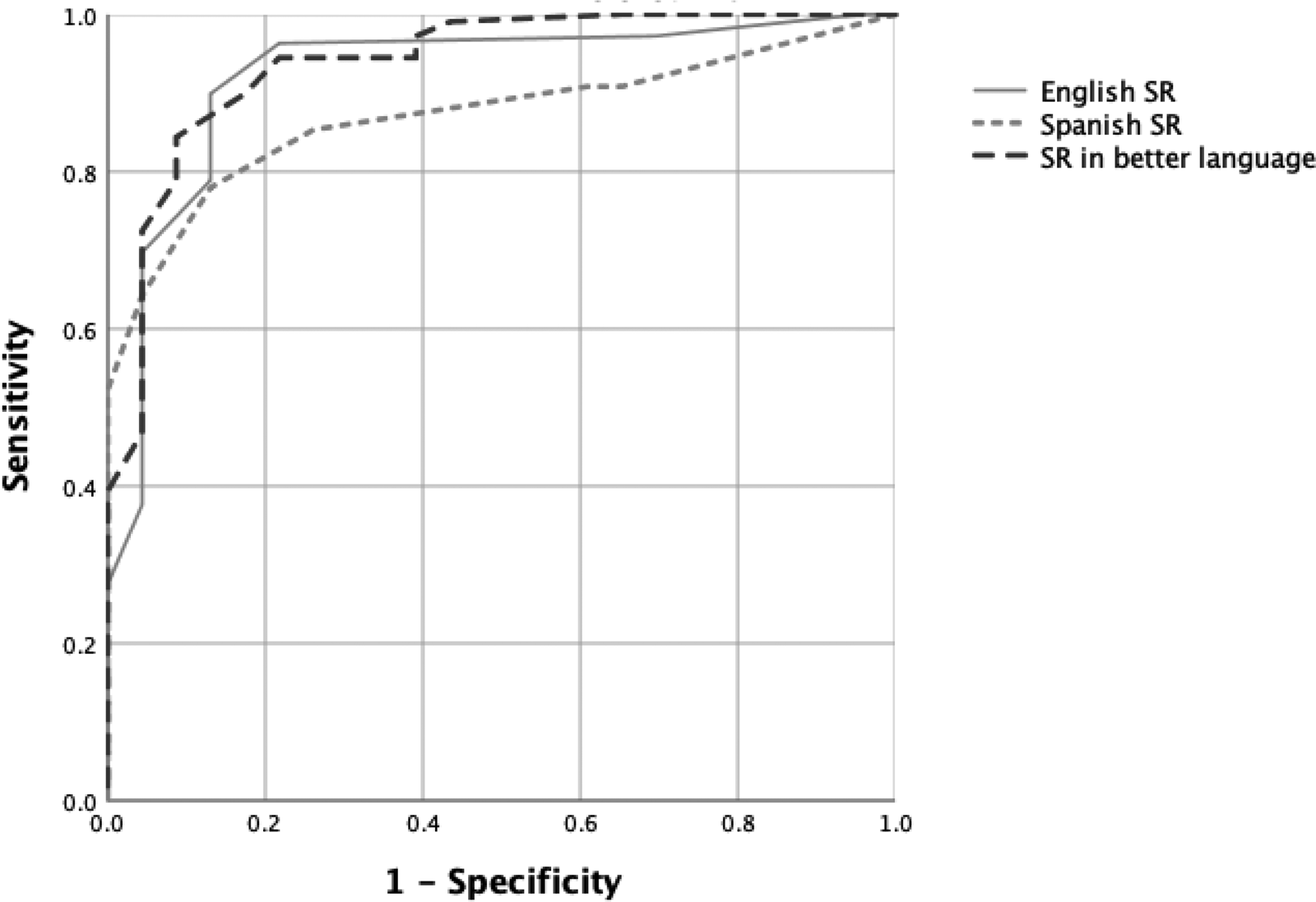
The second research question sought to assess the classification accuracy of our SR tasks. In addition to English and Spanish, we included a third metric “best language,” determined by comparing each child's performance in English and Spanish and inserting whichever score was higher. Receiver operating characteristic (ROC) curves were used to estimate cut scores that optimize sensitivity and specificity in English, Spanish, and best language. The optimal cut scores denote the probability threshold for classifying a child as having DLD. We then estimated the positive and negative likelihood ratios for each language using the optimal cut scores for each task. The positive likelihood ratio corresponds to the ratio of the probability of correctly classifying a child as having DLD and the probability of incorrectly classifying a child as having DLD (i.e., sensitivity / 1-specificity). The negative likelihood ratio corresponds to the ratio of the probability of incorrectly classifying a child as TD and the probability of correctly classifying a child as TD (i.e., 1-sensitivity / specificity) (McGee, Reference McGee2002). These results are reported in Table 5.
Results of ROC curves for SR tasks

Additionally, the area under the curve (AUC) was calculated to determine the classification accuracy of each SR task. Conceptually, the AUC is the probability that the SR task will rank a randomly chosen child with TD higher than a child with DLD. Typical benchmarks of AUC conclude that an AUC between .70 and .80 is considered an acceptable discriminator; an AUC between .80 and .90 is considered an excellent discriminator; and an AUC above .90 is considered an outstanding discriminator (Rice & Harris, Reference Rice and Harris2005).
The three ROC curves are shown in Figure 2. The AUCs for English, Spanish, and best language are equal to .92, .87, and .94, respectively, which indicate that SR is an excellent discriminator of impairment in Spanish and an outstanding discriminator of impairment in English and in a child's best language. Sensitivity and specificity are also reported in Table 5. Across all tasks, sensitivity estimates ranged from .86 to .91 and, specificity estimates, from .78 to .90.
ROC curves of SR tasks

Discussion
SR tasks have been shown to be an informative tool in discriminating children with and without DLD in both monolingual (e.g., Conti-Ramsden et al., Reference Conti-Ramsden, Botting and Faragher2001; Seeff-Gabriel et al., Reference Seeff-Gabriel, Chiat and Dodd2010) and bilingual populations (e.g., Meir et al., Reference Meir, Walters and Armon-Lotem2016; Tuller et al., Reference Tuller, Hamann, Chilla, Ferré, Morin, Prevost, Dos Santos, Abed Ibrahim and Zebib2018; Ziethe et al., Reference Ziethe, Eysholdt and Doellinger2013). Given the complex task demands inherent in SR, it is not unexpected that children with DLD perform consistently below TD controls on SR. However, pinpointing what contributes to their underperformance is more challenging. This is especially true for young bilinguals whose language experiences can vary greatly. Thus, the purpose of this study was twofold: first, to explore the memory and linguistic mechanisms that underlie SR for both children with DLD and TD; and, second, to evaluate the classification accuracy of SR tasks administered in English and Spanish with school-age bilingual children.
With respect to the first aim, extant literature shows that SR tasks require children to utilize both memory and language to varying degrees (Klem et al., Reference Klem, Melby-Lervåg, Hagtvet, Lyster, Gustafsson and Hulme2015; Riches, Reference Riches2012), and that language experience plays a role in the SR performance of bilingual children (Fleckstein et al., Reference Fleckstein, Prévost, Tuller, Sizaret and Zebib2016). Our results both support these previous findings and add nuance to them. Concurrently examining relationships between SR, memory, lexical knowledge, and experience in a hierarchical linear regression allowed us to disentange the unique contribution of each predictor. Several relationships that were statistically significant in a correlation analysis were no longer significant once we controlled for developmental and/or exposure effects. For example, among TD children, the bivariate correlation between English NWR and English SR was moderate and statistically significant (r = .27). However, after controlling for age and English input/output in our regression model, the contribution of NWR on English SR for TD children explained less than 1% of additional variance and was no longer a significant predictor of children's performance. This suggests, as previous research has found (Gibson, Summers, Peña, Bedore, Gillam & Bohman, Reference Gibson, Summers, Peña, Bedore, Gillam and Bohman2015; Summers et al., Reference Summers, Bohman, Gillam, Peña and Bedore2010), that language experience plays a large role in the efficiency of phonological STM among TD bilinguals, and that the relationship between NWR and SR is at least partially explained by that experience.
We also found evidence that memory differentially contributes to SR scores for children with TD versus those with DLD. Among our group with DLD, we observed a significant bivariate association between NWR in English and SR in English (r = .47), which replicated previous work by Ebert (Reference Ebert2014), who reported an association of comparable strength (r = .38) among a group of SE bilinguals with DLD similar in age to our participants. In contrast to what we found among TD children, the significant relationship between English NWR and English SR was maintained for children with DLD in the subsequent regression analysis. NWR accounted for 12% of additional variance in SR scores among the DLD group, after controlling for age and English input/output. These findings suggest that bilinguals with DLD recruit resources from phonological STM to complete SR in their L2 English, whereas bilinguals with TD do not.
Turning to linguistic predictors, our results also support the view that bilinguals with TD rely on lexical knowledge to support SR performance. We found a strong association between language-specific expressive vocabulary and SR tasks in our TD group. Expressive vocabulary in English and Spanish explained an additional 16% and 23% of variability in English and Spanish SR scores of TD children, respectively, after controlling for age, exposure, and phonological STM. However, as was true of NWR, it appears that lexical knowledge differentially affects bilinguals with TD and DLD. Whereas expressive vocabulary was a strong predictor of children's SR in both English and Spanish among bilinguals with TD, for the DLD group this result was only significant in Spanish (accounting for 15% of variability). For children with DLD, English expressive vocabulary explained no additional variance in English SR.
Indeed, this underscores an important finding: we observed striking variation in the relative influence of certain predictors on English SR scores across TD and DLD groups. Among children with TD, the strongest predictor of performance was English expressive vocabulary. Among children with DLD, the strongest predictor was English NWR. This finding suggests that limited L2 vocabulary knowledge may be a source of difficulty for bilinguals with TD on English SR tasks; however, as children acquire more vocabulary, English SR scores improve. In contrast, greater L2 vocabulary knowledge among children with DLD is not related to better performance on SR. Perhaps this is due to the heterogeneity of vocabulary knowledge in bilingual children with DLD, on the one hand, and to the difficulties with complex syntax that are more apparent in older children with DLD, on the other. The complex syntactic knowledge tapped by SR tasks (e.g., Polišenská et al., Reference Polišenská, Chiat and Roy2015) does not appear to correlate linearly with L2 lexical knowledge among school-age children with DLD.
Differential trends were also observed across groups for language exposure and English SR. Regression results showed distinct effects of exposure by group, such that exposure was a significant predictor of English SR in the final model among children with TD (t = 2.43, p = .017) but was not significant in the final model among children with DLD (t = 1.74, p = .096). This result replicates findings reported by Fleckstein et al. (Reference Fleckstein, Prévost, Tuller, Sizaret and Zebib2016), who also showed a significant bivariate relationship between exposure and SR for French bilinguals with TD but not those with DLD. Their results, and ours, reaffirm that the language-learning difficulties of bilinguals with DLD are neuro-developmental in nature, and are not a result of low L2 exposure.
We observed patterns with respect to predictors of children's SR performance across their two languages. For instance, in Spanish – the first language of children in our sample – the strongest predictor of Spanish SR was Spanish expressive vocabulary for children in both the TD and DLD groups, accounting for 23% and 15% of variability, respectively. Children with TD also recruited some resources from phonological STM in Spanish, as evidenced by the significant contribution of Spanish NWR. However, Spanish NWR was not significantly related to Spanish SR scores for children with DLD. This is particularly interesting, given that the sentences that comprise our Spanish SR task were, on average, longer than the sentences comprising the English SR task. If differing sentence lengths were to differentially recruit memory resources, we would have expected the Spanish task to relate more strongly with memory. With respect to English – the second language of children in our sample – regressions showed that expressive vocabulary and English input/output significantly contributed to SR among TD bilinguals; however, unlike in their L1, NWR was not significant. Among children with DLD, English SR performance was not predicted by expressive vocabulary, as in their L1, but by age and NWR. These differences across groups and languages may reveal differences in how children with DLD versus children with TD approach SR tasks, particularly in their second language. Whereas children with TD appeared to rely most heavily on the activation of recent lexical items, children with DLD, lacking lexical breadth in English, may have been more dependent on phonological STM to support SR in English.
The second research aim examined classification accuracy of SR tasks in English and Spanish. Given that SR requires the integration of skills from both memory and language, it has been shown to be a promising discriminator of impairment with bilinguals. Our results indicated AUCs of .92 and .87 for English and Spanish, respectively, indicating excellent discrimination capacity. The AUC improved to .94 when we utilized the SR score from the language in which each child scored the highest. The high sensitivity and specificity suggest that SR tasks could serve as an effective screener of language ability. This is particularly true when SR tasks are designed to contain grammatical targets that are typically problematic for children with DLD, thus maximizing differences between DLD and TD children, as these were. Although sensitivity on the SR task in children's best language was particularly high (.90), the English SR task by itself yielded acceptable levels of sensitivity (.86), which would apply to the English-only contexts in U.S. practice.
In sum, this work contributes to our theoretical understanding of DLD in bilinguals and, more specifically, the mechanisms that underlie SR performance in this population. Our results suggest that SR tasks differentially tap bilinguals’ memory and lexical knowledge, depending on the language ability status of the child and the language of the task. Previous research has posited that SR tasks measure children's capacity to retrieve and apply grammatical representations from LTM (e.g., Moll et al., Reference Moll, Hulme, Nag and Snowling2015; Poll et al., Reference Poll, Miller, Mainela-Arnold, Adams, Misra and Park2013; Riches, Reference Riches2012). Indeed, our results confirmed that, among children with TD and children with DLD, L1 grammatical representations, as measured by SR, were predicted most strongly by L1 lexical knowledge. Because bilinguals are still in the process of acquiring and stabilizing their L2 grammatical representations in LTM, it is possible that the mechanisms underlying SR performance in the L2 differ from the L1. In fact, among children with TD, L2 lexical knowledge was the strongest predictor of L2 SR, followed by their L2 experience. However, for children with DLD who present with severe difficulties in L2 syntax, L2 lexical knowledge did not predict L2 SR performance. Instead, their performance on SR was predicted most strongly by L2 verbal STM. Importantly, this performance was unrelated to their language experience, thus confirming the notion that DLD is not attributable to lack of experience in a language: rather, it reflects an innate difficulty with language-learning.
Implications for practice can be drawn from the first and second aims. Regarding the former, we observed that neither English exposure nor English expressive vocabulary were significantly related to the performance of children with DLD on SR tasks in English after controlling for age, even though both of these measures were significantly related to the performance of children with TD. This result suggests that “quick fixes,” like increasing children's exposure to English or improving their lexical naming, may not be sufficient to resolve their difficulties with complex tasks requiring both memory and language. Instead, integrative intervention approaches that embed vocabulary targets into larger noun and verb phrases are recommended (Bedore, Peña, Fiestas & Lugo-Neris, Reference Bedore, Peña, Fiestas and Lugo-Neris2020). Regarding the second aim, our results present a very efficient measure for screening school-age bilinguals for DLD – one that can be applied in under ten minutes and does not require laborious transcription.
The efficiency of our SR measure is also a limitation. We opted to use a dichotomous scoring scheme, which has high social validity, though it prohibited us from conducting an error analysis of challenging targets within each sentence. As recommended by Armon-Lotem and Meir (2017), and others, future research into SR should analyze these error patterns, taking note of how performance on specific targets may change with varying levels of language dominance. Given our limited power, we limited our analyses to within-language predictors. Future research should explore cross-linguistics of SR. Finally, while our results suggest differential effects of phonological STM and lexical knowledge, future research should further explore differences in how bilinguals with DLD and TD approach SR tasks using a variety of predictors. Because NWR is the most linguistically loaded of simple STM tasks, it is difficult to determine whether the significant contribution of NWR stems from the linguistic nature of the task. Until there is a body of research utilizing diverse tasks that vary in design, structure, and items, we cannot be certain the extent to which the differences in performance in this study are due to our particular tasks.
Supplementary Material
For supplementary material accompanying this paper, visit https://doi.org/10.1017/S1366728920000498
List of supplementary materials:
-
S1 – Spanish Nonword Repetition Items
-
S2 – Description of English Sentence Repetition Items
-
S3 – Description of Spanish Sentence Repetition Items
Acknowledgements
This work was supported by National Institute on Deafness and Other Communication Disorders (NIDCD) Grant R01DC010366, PI: Peña. This report does not necessarily reflect the views or policy of the NIDCD. We thank the many families, research associates, and research assistants who contributed to this work.