Introduction
Deterioration of soil health is a result of intensive agricultural practices (Triplett and Dick, Reference Triplett and Dick2008). Sustainable agricultural practices such as reduced tillage, crop residue management, adding organic matter, intercropping, and crop rotations help to improve soil health and reduce erosion (Klimek-Kopyra et al., Reference Klimek-Kopyra, Zając and Rębilas2013; Shah et al., Reference Shah, Farooq and Hussain2016; Shahzad et al., Reference Shahzad, Farooq and Hussain2016; Zając et al., Reference Zając, Oleksy, Stokłosa, Klimek-Kopyra, Styrc, Mazurek and Budzyński2014). Similarly, soil conservation techniques as no-tillage (NT) permit sowing with minimal soil disturbance. Due to less disturbance of the soil, NT improves the soil health by reducing erosion and chemical runoff, enhancing water infiltration and soil microbial activities, and decreasing the cost of production (Six et al., Reference Six, Feller, Denef, Ogle, De Moraes Sa and Albrecht2002).
Cotton sowing after wheat harvest using zero tillage saves 7–10 days and reduces the cost of production involved in seedbed preparation compared to conventional tillage systems. Transplanting cotton is not a very common practice in Pakistan, but it may be a technique to minimize the gap between wheat harvesting and cotton sowing. If sown early during the first half of March, cotton suffers from low soil temperature and low sunlight in early growing period resulting in poor crop stand (Bange and Milroy, Reference Bange and Milroy2001). Then, transplanting of cotton seedlings should avoid this limiting condition (Dong et al., Reference Dong, Li, Tang, Li and Zhang2007). However, wheat is harvested in late April while the optimum sowing time of Bt cotton is mid-March in Punjab, Pakistan (Shah et al., Reference Shah, Farooq, Shahzad, Khan and Hussain2017a). This results in an overlapping period of 30–45 days and transplanting of 30–45 days old cotton seedlings may be an option to manage this overlapping.
Nursery production and transplantation in plastic paper pot is economical and convenient (Jahromi and Mahboubi, Reference Jahromi and Mahboubi2012) as crop stands established by transplanting are uniform, can tolerate environmental/biological stresses, and achieve earlier maturity than directly seeded plants (Liptay et al., Reference Liptay, Bolton and Dirks1982). Moreover, as transplanting is done on ridges or beds, the crop may yield better due to efficient utilization of available resources such as irrigation and nutrients, and reduced crop lodging (Khan et al., Reference Khan, Yousaf, Hussain, Haq, Lee and Farooq2012). Light utilization by crops is improved by bed planted systems as well as weed control (Hobbs and Gupta, Reference Hobbs, Gupta, Ladha, Hill, Duxbury, Gupta and Buresh2003). A 4-year study using cotton transplantation in China demonstrated improvements in early bloom, boll retention, fiber quality, and economic gains (Dong et al., Reference Dong, Li, Tang, Li and Zhang2005).
In a recent study, the performance of transplanted Bt cotton was compared with directly seed sown under conventional and conservation tillage systems in cotton–wheat cropping systems (Shah et al., Reference Shah, Farooq and Hussain2017b). Transplanting 45-days-old cotton seedlings on beds after wheat harvest was the best option to get better cotton yield and system productivity of Bt cotton–wheat cropping system. However, in the aforementioned study, the performance of cotton crop was evaluated on the basis of yield and yield-related traits like boll weight, monopodial branches, sympodial branches, etc. Although important, information on the performance of already established cotton seedlings and traits associated with fiber development is missing in Shah et al. (Reference Shah, Farooq and Hussain2017b). Pre-established seedlings would have higher leaf area as compared to new emerging seedlings, which results in higher leaf area index (LAI), net assimilation rate (NAR), and crop growth rate (CGR); and also earlier start of reproductive growth, which may affect total biomass and fiber quality. Therefore, we investigated how transplanting of pre-established seedlings compensates the overlapping period in the wheat–cotton cropping system, taking into account not only crop allometry, but also fiber quality.
Materials and Methods
Field conditions and cropping systems
This field study was conducted during 2012 and 2013 at Multan (71.50°E, 30.26°N, 123 m asl) and Vehari (71.44°E, 29.36°N, 135 m asl), Pakistan. The climate of the experimental locations is semi-arid subtropical with cool winter and hot summer. Soil analysis was done each year before beginning the experiments (Supplementary Table S1).
The Bt cotton–wheat cropping systems were flat sown wheat (FSW)–conventionally tilled cotton (CTC) seed, FSW–zero tilled cotton seed (ZTC), ridge sown wheat (RSW)–ridge transplanted cotton (RTC) using 30 and 45 days old seedlings, and bed sown wheat (BSW)–bed transplanted cotton (BTC) also using 30 and 45 days old seedlings. In the case of ridge or bed sowing, field was prepared like flat sowing by cultivating the field twice with tractor mounted cultivator followed by planking. After that, about 15 cm elevated beds and ridges were prepared by moving soil from both sides according to the indicated dimensions with bed shaper. Ridges had rounded top while beds had leveled tops. Moreover, loose fertile soil in the case of beds and ridges improves crop growth due to minimal resistance to developing roots. The experiment was laid out following a randomized complete block design with split plot arrangement keeping the location in main plots and cropping systems in sub plots. The experiment was replicated three times with a net plot size of 3 × 5 m and row spacing of 0.75 m.
Crop husbandry
Pre-planting irrigation (100 mm) was applied by surface irrigation method using cut-throat flume prior to seedbed preparation. Bt cotton was planted on flat seedbed, ridges, or beds. The Bt cotton genotype MNH-886 was sown by maintaining a distance among plants of 0.2 m. Cotton was planted on March 5 and 20 for 30 and 45 days old seedlings, respectively. Polythene bags of 500 g soil capacity were used to grow plants and the 30 and 45 days old seedlings were transplanted on ridges or beds according to treatments. In both years, cotton was sown with single row cotton drill on flat seedbed on April 21 and 22 in Multan and Vehari, respectively.
Fertilizers were applied as 250 and 200 kg ha−1 nitrogen (N) and phosphorus (P) using urea and diammonium phosphate (DAP), respectively. All P and one-third N were applied at sowing while remaining N was applied in two equal splits during the first and second irrigations. Fertilizers applied at sowing were drilled in all treatments while N was side-dressed when applied at the first and second irrigations. Weeds were controlled manually and plants were maintained free of insects (other than boll worms) and diseases by using recommended insecticides when necessary. The first irrigation (75 mm) was applied 30 days after transplanting/sowing and subsequent irrigations (each of 75 mm) were applied at a fortnightly interval. Irrigation was withheld 20 days before of the final picking/harvest. Water volume was measured by using a cut-throat flume. Following recommended agronomic practices, the overall management of the experimental units was the same, except for treatments. The experiments were finished (final picking) each year on October 28 and 30 at Multan and Vehari, respectively.
Evaluations
Ten randomly selected plants from each plot were tagged and used in evaluations. Plant allometric data and dry weight per unit area were taken at fortnightly intervals starting at 30 days after planting and finishing at crop maturity. Seasonal LAI and CGR were estimated as the average of all measurements taken throughout the experimental time. Five randomly selected plants from each plot were cut, leaves were separated, and total leaf area was measured by using a leaf area meter (MK2, DT, Delta T Devices, Cambridge, UK). Afterwards, leaf area was used to estimate LAI (cm2 cm−2) following Watson (Reference Watson1947). CGR and NAR were estimated according to Hunt (Reference Hunt1978):
 $$CGR = {{{W_2} - {W_1}} \over {{t_2} - {t_1}}}$$
(1)
where W 1 is the total dry weight per unit land area at the first harvest and W 2 is the total dry weight per unit land area at the second harvest; and t 1 is the time taken to the first harvest and t 2 is the time taken to the second harvest.
 $$NAR = {{{\rm{Total \ dry \ matter}}} \over {{\rm{Leaf \ area \ duration}}}}$$
(2)
Leaf area duration (LAD) was calculated by the following equation:
 $$LAD = {{{L_1} + {L_2}} \over 2} \times {t_2} - {t_1}$$
(3)
where L 1 and L 2 are the LAI at time t 1 and t 2.
Plant height was measured from its base until the tip of the main stem and averaged. Total number of bolls present on 10 randomly selected plants were counted and averaged. Mature bolls were picked on regular intervals from each plot and total weight was expressed as seed cotton yield (Shah et al., Reference Shah, Farooq and Hussain2017b). Biological yield was estimated by considering the entire plants from each plot. After harvesting, aboveground material was sundried for seven days, weighed, and the biomass was added to the weight of already picked cotton. Harvest index (%) was calculated as a ratio of seed cotton yield per biomass production.
Randomly selected cleaned and ginned lint samples (5 g) were taken to evaluate the fiber quality. Prior to the fiber quality test, lint was conditioned at 65% relative humidity and 18–20 °C in an air-conditioned chamber using a humidifier. Afterwards, High Volume Instrument (HVI-900-SA; Zelwiger, Uster, UK) was used for determining fiber fineness (µg tex–1), fiber uniformity (%), fiber length (mm), fiber elongation (cm), fiber strength (g tex–1), and micronaire, following Moore (Reference Moore, Glade, Meyer and Stults1996).
Statistical analysis
The data collected were subjected to analysis of variance using the MSTAT-C software considering a split plot design (keeping locations in main plots and cropping systems in sub plots), with three replications. When significant differences were detected, mean values were compared by using the least significant difference (LSD) test at 0.05 probability level. Microsoft Office® Excel® 2013 (Microsoft, Inc., Redmond, WA, USA) program was used to calculate standard errors of growth parameters and to present data. Correlations among allometric and fiber quality traits were evaluated using the Sigmaplot® v. 12.0 software (Systat Software, Inc., San Jose, CA, USA).
Results
The allometric traits LAI, CGR, and NAR of Bt cotton were influenced by cotton–wheat cropping systems at both locations (Table 1). Transplanting of 45-days-old seedlings on beds following BSW increased bolls per plant compared with the other treatments. However, the lowest values of bolls per plant were recorded for ZTC following FSW (Table 1). In the cotton–wheat–cotton cropping systems, transplanting of 45-days-old Bt cotton seedlings on beds following BSW had significant positive effect on LAI, CGR, and NAR of Bt cotton during both years at Vehari. However, the lowest values of these variables were recorded in ZTC following FSW (Table 1). Location-wise performance of the Bt cotton indicated that the highest LAI, CGR, and NAR were observed at Vehari compared with Multan (Table 1).
Crop growth rate, leaf area index, and net assimilation rate of Bt cotton under different cotton–wheat cropping systems at two locations

FSW = flat sown wheat; ZTC = zero tilled cotton; CTC = conventional tilled cotton; RSW = ridge sown wheat; RTC = ridge transplanted cotton; BSW = bed sown wheat; BTC = bed transplanted cotton.
Means sharing the same letter, within a column or year, do not differ significantly at p < 0.05.
Different Bt cotton–wheat cropping systems significantly affected the plant height of Bt cotton at both locations (Table 2). BSW–BTC (45 days seedling) had taller plants compared to other treatments. However, the lowest heights were recorded in FSW–ZTC (Table 2). For plant height, cotton crop sown at Vehari performed better than at Multan during both years (Table 2). The interaction among Bt cotton–wheat cropping systems and locations had significant effect (p < 0.05) on the biological yield of Bt cotton during both years (Table 2). In 2012, BSW–BTC and RSW–RTC (30 and 45 days seedling) had the highest biological yield both at Multan and at Vehari locations, while during 2013, BSW–BTC (45 days seedling) produced maximum biological yield compared with all other cropping systems (Table 2). However, FSW–ZTC produced minimum biological yield at both locations during both years of experimentation (Table 2). Nonetheless, transplanted Bt cotton either on ridges or beds using 30- and 45-days-old seedlings performed better than ZTC and CTC, following FSW (Table 2). Transplanting of 30- and 45-days-old seedlings on beds and ridges after wheat harvest during late April recorded higher harvest index of Bt cotton compared with CTC and ZTC during both years and at both locations (Table 2).
Plant height, biological yield, and harvest index of Bt cotton under different cotton–wheat cropping systems at two locations

FSW = flat sown wheat; ZTC = zero tilled cotton; CTC = conventional tilled cotton; RSW = ridge sown wheat; RTC = ridge transplanted cotton; BSW = bed sown wheat; BTC = bed transplanted cotton.
Means sharing the same letter, within a column or year, do not differ significantly at p < 0.05.
Different Bt cotton–wheat cropping systems significantly affected the fiber quality traits of Bt cotton during both years at both experimental sites (Tables 3 and 4). The highest fiber fineness, fiber uniformity, and fiber length of Bt cotton were noted in Bt cotton–wheat cropping system of BSW–BTC (45 days seedling), whereas the lowest values of these variables were recorded by sowing Bt cotton as FSW–ZTC at both locations during both years (Table 3). Fiber elongation, fiber strength, and micronaire also followed a similar trend (Table 4). However, the comparison of locations demonstrated that crop sown at Vehari performed better than at Multan when considering the fiber quality parameters of Bt cotton (Tables 3 and 4).
Fiber fineness, fiber uniformity, and fiber length of Bt cotton under different cotton–wheat cropping systems at two locations

FSW = flat sown wheat; ZTC = zero tilled cotton; CTC = conventional tilled cotton; RSW = ridge sown wheat; RTC = ridge transplanted cotton; BSW = bed sown wheat; BTC = bed transplanted cotton.
Means sharing the same letter, within a column or year, do not differ significantly at p < 0.05.
Fiber elongation, fiber strength, and micronaire of Bt cotton under different cotton–wheat cropping systems at two locations

FSW = flat sown wheat; ZTC = zero tilled cotton; CTC = conventional tilled cotton; RSW = ridge sown wheat; RTC = ridge transplanted cotton; BSW = bed sown wheat; BTC = bed transplanted cotton.
Means sharing the same letter, within a column or year, do not differ significantly at p < 0.05.
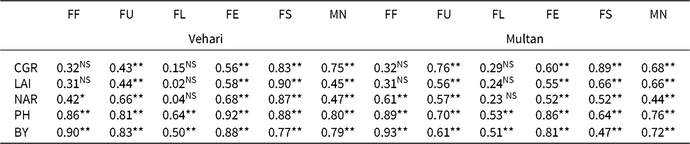
The correlation matrix between allometric traits and biological yield with fiber quality traits was calculated separately for both locations. With few exceptions, plant height and allometric traits showed significant (p < 0.05) positive correlation with most of the fiber traits (Table 5). Although the correlation of some traits was non-significant, for example, association of CGR and LAI with fiber fineness and fiber length and NAR with fiber length at both locations, it was always positive (Table 5).
Correlation matrix of allometric traits with fiber quality traits measures for two locations (for each location n = 36, i.e., 2 years × 6 treatments × 3 replicates)

FF = fiber fineness; FU = fiber uniformity; FL = fiber length; FE = fiber elongation; FS = fiber strength; MN = micronaire; CGR = crop growth rate; LAI = leaf area index; NAR = net assimilation rate; PH = Plant Height; BY = biological yield; HI = harvest index.
NS, *, and ** mean non-significant, significant at p < 0.05, and significant at p < 0.01, respectively.
Discussion
Transplanting of cotton seedlings may decrease the crop period without compromising its yield together with additional benefits like avoidance of thinning process and optimization of water use efficiency. Low temperature is one of the main challenges for cotton during the initial growing period so that germination decreases significantly (Shah et al., Reference Shah, Farooq, Shahzad, Khan and Hussain2017a). Therefore, transplanting of BT cotton is a pragmatic solution under unfavorable circumstances. For this, polythene bag is an economical and convenient alternative for production and transplanting of cotton seedlings (Jahromi and Mahboubi, Reference Jahromi and Mahboubi2012). In addition, it provides the opportunity for land preparation as well as management of the overlapping period in the cotton–wheat cropping pattern. As early crop sowing increases the duration of reproductive period and then enhances yield and fiber quality, transplanting of pre-established cotton seedlings after wheat harvest is an interesting option for cotton management and production. In Pakistan, the optimum time for wheat harvest is in late April, while the optimum time for Bt cotton sowing is mid-March. In this way, transplanting 30–45-days-old Bt cotton seedlings immediately after wheat harvest may be the best choice.
Benefits of transplanting cotton seedlings have been reported previously (Bange and Milroy, Reference Bange and Milory2004). However, such benefits in semi-arid climate of Pakistan are unclear due to conventionally late sowing of cotton. With introduction of Bt cotton in 2008, early sowing of cotton disturbed the cotton–wheat cropping system and new management practices are required to solve this problem. This study indicated that transplanting Bt cotton on beds by using 45-days-old seedlings after harvest of wheat performed better than the direct seeded early crop (Tables 1–3). Actually, transplanting of 45-days-old cotton plants gained more time, compared with ZTC or CTC after wheat harvest, to produce and use photoassimilates needed in flowering and boll maturation period, and resulted in better growth and fiber quality of Bt cotton (Tables 1–3). Ridges or beds provide loose fertile soil and thus promote root growth, which ultimately improves the nutrient and water uptake. Hence, ridge or bed sown crops have higher yield potential due to higher use efficiency of available resources like water and nutrients associated with low risk of lodging (Khan et al., Reference Khan, Yousaf, Hussain, Haq, Lee and Farooq2012; Shahzad et al., Reference Shahzad, Farooq and Hussain2016). Accordingly, transplanting of 45-days-old seedlings of Bt cotton on beds following BSW improved plant growth (Tables 1 and 2).
Nonetheless, higher biomass production of transplanted cotton was due to significant increase in allometric traits like CGR, LAI, and NAR (Tables 3 and 4). As transplanted cotton had growth period 45 days longer, plants presented higher LAI. Leaves are the units of plant assimilatory system and higher LAI means more interception of solar radiation, which increased photoassimilate production (given by NAR) and led to higher CGR as compared to ZTC and CTC after wheat harvest (Tables 1 and 2). The major reason behind these findings seems to be the establishment of early root system before transplantation. In fact, plants already had a root system of 45 days and had better opportunity to uptake water and nutrients (Mao et al., Reference Mao, Li, Hang, Wang, Li and Wang2008). Lesser crop growth of direct seeding (both ZTC and CTC after wheat harvest) was probably due to the delayed growth of cotton plants in the early phases compared to pre-established seedlings (Tables 1 and 2). However, transplanting had overcome this problem and provided a better crop start which resulted in higher LAI, CGR, and NAR leading to better crop growth and fiber quality compared to the conventional cotton crop (Tables 1–4).
Fiber quality parameters such as fiber length, fiber strength, fiber elongation, fiber fineness, and micronaire were improved in transplanted cotton, particularly on beds (Tables 3 and 4). Fiber quality of cotton is influenced by a number of factors, including those of genotypic and agronomic origins. Genotypic variation has a primary importance while agronomic management is secondary (Bednarz et al., Reference Bednarz, Shurley, Anthony and Nichols2005). Planting date has a major importance on fiber quality as it determines the duration of crop and affects cotton yield as well (Dai and Dong, Reference Dai and Dong2014). Cathey and Meredith (Reference Cathey and Meredith1988) found that late planting reduced micronaire but did not affect fiber length or strength. Then, seedling transplanting eliminated the chances of delayed crop sowing and resulted in improved fiber quality compared with the late sown conventional cropping. We found strong association between most of allometric and fiber quality traits and although some associations were not significant, all were positive (Table 5). This means that improvement in allometric traits also improves the fiber quality (Ahmad et al., Reference Ahmad, Faiz, Riaz, Bashir and Zeb2016). Therefore, transplanting of cotton in wheat–cotton cropping system may also improve fiber quality along with yield due to longer growth and development period (Dai and Dong, Reference Dai and Dong2014).
Conclusion
Our data revealed that transplanting Bt cotton under BSW–BTC (45 days seedling) improved plant growth and cotton fiber quality, supporting the initial hypothesis. Thus, transplanting Bt cotton after wheat is a viable option to manage the overlapping period between the two crops in cotton–wheat cropping system. These findings may help smallholders to make their Bt cotton–wheat cropping system more productive and profitable.
Supplementary material
To view supplementary material for this article, please visit https://doi.org/10.1017/S0014479719000073
Author ORCIDs
Muhammad Farooq 0000-0003-4368-9357
Acknowledgements
The authors are highly thankful to Higher Education Commission of Pakistan for providing financial support to this PhD project.
Financial Support
None.