INTRODUCTION
To communicate speakers rely—perhaps even take for granted—that most of the things they want to talk about have names and that they usually can retrieve those names easily. The ability to produce names is one of the most essential components of successful communication, and thus it is not surprising that picture naming is one of the most broadly measured skills in both clinical and experimental settings. Picture naming taps several cognitive skills (e.g., visual analysis; object recognition; semantic, lexical, and phonological processing) and is sensitive to a variety of cognitive impairments (Lezak, 1995). Studies also show picture naming skills are influenced by bilingualism. Researchers generally agree that bilingual children have smaller productive vocabularies than their monolingual peers (unless words from both languages are pooled in which case bilinguals have bigger vocabularies). Some have suggested that bilinguals “catch up” by adulthood (see review in Hamers & Blanc, 2000), but recent studies suggest otherwise. Cognitively intact adult bilinguals have more tip-of-the-tongue, or TOT, retrieval failures than monolinguals (Gollan & Acenas, 2004; Gollan et al., 2005a; Gollan & Silverberg, 2001), name pictures more slowly than monolinguals (Gollan et al., 2005b), and name fewer pictures correctly on standardized naming tests such as the Boston Naming Test, or BNT (Roberts et al., 2002). Importantly, these bilingual disadvantages were found even when bilinguals were tested exclusively in their dominant language (e.g., Gollan & Acenas, 2004).
An emerging consensus is that knowledge of two languages itself (not something correlated with bilingualism) affects picture naming (e.g., Gollan & Acenas, 2004; Gollan & Silverberg, 2001; Roberts et al., 2002). Gollan and her colleagues proposed that bilinguals have more difficulty producing words relative to monolinguals because bilinguals only speak one language at a time, divide use between two languages, and therefore use words particular to each language relatively less often than monolinguals (see also Mägiste, 1979; Ransdell & Fischler, 1987). Confirming this hypothesis, bilinguals retrieved names as well as monolinguals when materials were designed to consider bilingual variables. For example, bilinguals and monolinguals may be equated for use of proper names that seldom differ between languages. Although monolinguals have particular difficulty retrieving proper names, bilinguals did not have more difficulty with proper names, and bilinguals and monolinguals had similar numbers of TOTs for proper names (Gollan et al., 2005a).
Similarly, although bilinguals had more TOTs than monolinguals when trying to retrieve noncognates (i.e., words that have dissimilar names across languages such as muzzle and its Spanish translation bozal), bilinguals had the same number of TOTs as monolinguals when the picture names were cognates (Gollan & Acenas, 2004), which are translation equivalents with similar forms (e.g., pirámide is Spanish for pyramid). More fluent processing of cognates relative to noncognates, or “cognate effects,” have been reported using a variety of tasks including lexical decision (e.g., Caramazza & Brones, 1979), masked priming (e.g., Gollan et al., 1997), translation (e.g., de Groot et al., 1994), word association (van Hell & De Groot, 1998), and picture naming (Costa et al., 2000). Although cognate status has practically become a standard manipulation in experimental research on bilinguals (see review in Friel & Kennison, 2001), little to nothing is known as to whether cognate status may affect bilinguals' performance on standardized tests.
One study examined how bilingualism affects performance on the BNT. College-aged bilinguals who named similar numbers of BNT pictures correctly in Spanish and English (n = 25), or balanced bilinguals, also named a greater total number of pictures correctly if they were given credit for producing names in either language (Kohnert et al., 1998; see also Gollan & Silverberg, 2001). In contrast, bilinguals with much stronger naming scores in one than in the other language, or unbalanced bilinguals (n = 75), obtained equivalent scores with the “either-language” versus dominant-language-only scoring procedures. This either-language scoring method allowed bilinguals to use their relatively less-dominant language to name some pictures. Apparently, only relatively balanced bilinguals knew some pictures names in their nondominant language that they did not know in their otherwise more-dominant language.
The studies just reviewed demonstrated that bilingualism influences naming skills in young or middle-aged speakers. In the current study, we report preliminary data suggesting that bilingualism also affects naming scores in older bilinguals. It is important to determine how bilingualism affects naming in this population because older adults are frequently referred for neuropsychological evaluation and because confrontation naming is commonly used to diagnose cognitive status (e.g., naming scores improve discrimination of dementia from other forms of cognitive impairment; Mungas et al., 2005). To this end, we investigated whether older bilinguals would show the either-language scoring effects previously reported in college-aged bilinguals (Kohnert et al., 1998). In addition, because a large number of BNT pictures have Spanish–English cognate names (see the Methods section), we investigated whether older bilinguals' BNT scores are influenced by cognate status.
METHODS
Participants
A total of 29 cognitively healthy Spanish–English bilinguals (21 women) from the Hispanic cohort at the University of California, San Diego (UCSD) Alzheimer's Disease Research Center (ADRC) participated. Participants were recruited from the local community by a Spanish–English bilingual social worker by means of her attendance at Hispanic conferences, support groups, health resource fairs, Spanish-language flyers posted at such events, and through referrals from existing participants. Participants were classified as Hispanic if they spoke Spanish, had a Hispanic surname, or identified themselves as Hispanic. Participants were diagnosed as cognitively intact by two senior staff neurologists using criteria developed by the National Institute of Neurological and Communicative Disorders and Stroke (NINCDS) and the Alzheimer's Disease and Related Disorders Association (ADRDA; McKhann et al., 1984) and based on medical, neurological, and neuropsychological evaluations and several laboratory tests (to rule out dementia). The UCSD Internal Review Board approved all procedures, and participants provided written consent for their participation.
As part of their ongoing participation in research, Hispanic participants were screened for bilingualism over the phone or during their annual ADRC evaluation. There were approximately 41 cognitively intact participants in the Hispanic cohort at the time of data collection. Twenty-seven bilinguals rated themselves as having “fair” or better knowledge of both Spanish and English and 2 bilinguals with lower ratings (subjects 16 and 18; see Tables 2 & 3) were invited to participate in the study. The remaining Hispanic participants were excluded either because they could not be contacted during the time of study, or because of low self-ratings for speaking the nondominant language. Table 1 shows the characteristics of all 29 participants tested, and of the 10 most and 10 least balanced bilinguals tested (as described below). Fifteen were educated in the United States, 13 in Mexico, and 1 in Peru.
Mean (M) and standard deviation (SD) of participant characteristicsa

Method of classifying bilinguals into types
Perfectly balanced knowledge of both languages is rare (Kroll & de Groot, 2005), and there is no accepted standard for classifying bilinguals in terms of balance. Following Kohnert et al. (1998), we classified bilinguals as balanced versus unbalanced bilinguals in relative terms using BNT difference scores. We classified the 10 participants with the most (6 women) and least (8 women) similar BNT scores in Spanish and English as “balanced” and “unbalanced” bilinguals respectively (see column entitled “dominant minus nondominant” in Table 2). To examine the potential limitation of using an arbitrary cutoff for what qualifies as “balanced,” we also conducted statistical analyses that included all 29 bilinguals tested and considered degree of balance along a continuum (see Figures 2 & 4). In addition, we considered to what extent the results depend on the use of BNT difference scores to classify bilinguals into types by correlating the observed effects with alternative methods of classifying bilinguals (difference scores based on proficiency ratings, verbal fluency, reported daily use of each language, and also the ability to name pictures in both languages; see Tables 4 & 5).
Individual participants' number correct on BNT using different scoring methodsa

Relative to unbalanced bilinguals, balanced bilinguals reported less percent daily use of English, living in the United States for fewer years, lower self-rated ability to speak English, and higher self-rated ability to speak Spanish (see Table 1). These characteristics suggest that increased use of the language not dominant in the environment (Spanish in this case) leads to more balanced knowledge of two languages. Balanced and unbalanced bilinguals did not differ significantly in age, DRS scores (Mattis, 1988), or education level (see Table 1). However, there were three balanced bilinguals with less than 9 years of education (range, 6–16 years), whereas all unbalanced bilinguals had at least 11 years of education (range, 11–16 years). We address the influence of education, as described in the Data Analysis section below, to rule out the possibility that the effects of interest were caused by subtle differences in education level between groups.
Materials and Procedures
Participants were tested in their homes by two (one testing and one observing) proficient Spanish–English bilinguals. Participants were asked to name all 60 pictures in the BNT (Kaplan et al., 1983) first in the language they chose as dominant, and then in their less-dominant language. An experimenter recorded naming accuracy, and later verified coding using audiotaped recordings of the testing sessions. Naming trials were administered according to the standardized instructions, except that participants were asked to name all 60 pictures (as recommended by Kohnert et al., 1998, testing was not discontinued after eight failed naming trials, began at item #1 instead of item #30, and participants were credited only for pictures that they named). After the BNT, participants were tested on Spanish verbal fluency using the letters PMR. Spanish-dominant participants were also tested on FAS in English, and FAS scores in English for English-dominant participants were obtained from the most recent annual ADRC evaluation (Artiola i Fortuny et al., 1998, reported that FAS-English and PMR-Spanish are difficulty-matched).
Cognates in the BNT
Approximately half of the BNT pictures have Spanish–English cognate names. The exact proportion of cognates may differ slightly depending on how cognate is defined. For the current study, two independent raters who were proficient in Spanish and English determined cognate status (T.H.G.; R.I.M.). Such ratings are strongly correlated with other ways of determining cognate status (e.g., Friel & Kennison, 2001). The BNT items were originally normed using monolingual English speakers (Kaplan et al., 1983) and graded in difficulty with easy pictures at the beginning (e.g., item #1 is bed) and becoming progressively more difficult (e.g., item #60 is abacus). Because the BNT was not designed for use with bilinguals, the cognates and noncognates are not matched for difficulty, and pictures with cognate names were, on average, more difficult (had higher item numbers) than pictures with noncognate names. To illustrate, of the first 15 (the easiest items in the test) only 2 are cognates (e.g., flower which is flor in Spanish); however, 7 of the last 15 (the hardest items in the test) are cognates (e.g., abacus is ábaco in Spanish; cognates and noncognates are roughly difficulty-matched in items 30–60; see below). To consider how cognate status may affect naming skills, we selected as many cognates and noncognates as possible while matching for item number (see Appendix). We matched 22 cognates with a mean item number of 34.4 (SD = 14.7) to 22 noncognates with a mean item number of 34.3 (SD = 17.2; t < 1). These materials were also matched for difficulty based on published percent correct responses in monolingual English speakers (Roberts et al., 2002; t(42) = 1.09, p = .28) and monolingual Spanish speakers (Allegri et al., 1997; t(42) = 1.08, p = .29; excluding 5 of 22 cognate items that were different in the Allegri et al. version).
Scoring
For each participant, we obtained four BNT scores: total correct in each language (dominant and nondominant), total correct using either-language, and total named correctly in both languages. All but one participant had higher naming scores in the dominant language. The exception was a balanced bilingual whose scores in each language differed by just one; for this participant, we treated the higher score as “dominant.” Responses were classified as correct if participants produced any response classified as acceptable a priori (see lenient scoring method in Roberts et al., 2002) without being given a phonological cue.
Data Analyses Planned
We assessed scoring and cognate effects in two ways. To test for interactions between bilingual type (balanced vs. unbalanced) and each bilingual effect (scoring method and cognate), we compared the 10 most versus the 10 least balanced bilinguals in 2 × 2 analyses of variance (ANOVAs) with participant type as a between-subjects factor and scoring method (dominant-language vs. either-language) or cognate status (cognate vs. noncognate) as within-subjects factors. We also conducted analyses including all 29 bilinguals tested to assess whether each effect varied continuously with the degree of balanced bilingualism using “dominant minus nondominant language” BNT difference scores to predict the magnitude of scoring method or cognate effects. Additional analyses to examine the influence of education on the primary findings of interest include a regression model with education as an independent variable within the entire sample and a group comparison with an education matched subsample.
RESULTS
Group comparisons of the most versus least balanced bilinguals are shown in Figures 1 and 3, and the continuous analyses are shown in Figures 2 and 4. Data for each participant are shown in Tables 2 and 3 with participants listed in order from most to least balanced (see “dominant minus nondominant” column in Table 2).

The mean number of pictures that the 10 most balanced and 10 least balanced bilinguals named correctly (we classified bilinguals with the smallest Boston Naming Test difference scores as balanced and those with the biggest difference scores as unbalanced; see Table 2). Relative to unbalanced bilinguals, the balanced bilinguals benefited from being given the option to name pictures in either language (the either-language scoring effect), named more pictures in their nondominant language and in both languages, but named fewer pictures correctly in their dominant language.

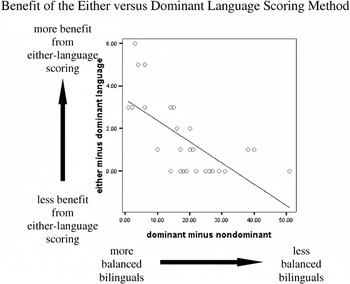
The relationship between degree of bilingualism and the benefit of the either language scoring method in all 29 bilinguals who participated in the study. On the x-axis are Boston Naming Test difference scores; the difference between number of pictures named correctly in the dominant language versus in the nondominant language. Smaller differences (further to the left) indicate more similar naming scores in the two languages. On the y-axis is the either-language scoring effect, the difference between the number of pictures named correctly in either-language versus in the dominant language. Bigger differences (further up) indicate greater benefit from the option to use either-language to name pictures. The figure shows that more balanced bilinguals derived greater benefit from the either-language scoring method.
Proportion that each individual participant named correctly of BNT pictures with cognate (n = 22) and noncognate (n = 22) names matched for difficulty using BNT item numbera

Scoring Method Effects
Balanced bilinguals differed from relatively unbalanced bilinguals in several ways (see Figure 1). Two findings reflect our method for dividing participants into groups: Relative to unbalanced bilinguals, the more balanced bilinguals (a) named more pictures correctly in their nondominant language [F(1,18) = 31.64, MSE = 47.84, ηp2 = .64, p < .01] and (b) named more pictures correctly in both languages [F(1,18) = 19.39, MSE = 53.47, ηp2 = .52, p < .01]. Despite their relatively strong knowledge of both languages, the balanced bilinguals nevertheless had one relatively more dominant language but the difference was smaller than in less-balanced bilinguals. On average, balanced bilinguals named 47.7 (SD = 6.8) and 40.2 (SD = 6.7) pictures correctly in the dominant and less dominant languages, respectively [F(1,9) = 19.74, MSE = 14.25, ηp2 = .69, p < .01]. Unbalanced bilinguals named 54.2 (SD = 4.9) and only 22.8 (SD = 7.1) pictures correctly in the dominant and nondominant languages, respectively [F(1,9) = 122.16, MSE = 40.36, ηp2 = .93, p < .01]. Interestingly, balanced bilinguals also produced fewer picture names in their dominant language than did the less balanced bilinguals [F(1,18) = 6.04, MSE = 34.98, ηp2 = .25, p = .02]. This finding resembles previous findings showing bilingual disadvantages relative to monolinguals in picture naming (e.g., Gollan & Silverberg, 2001; Roberts et al., 2002) and suggests that balanced bilinguals may be “more bilingual” and, therefore, also show greater bilingualism-related disadvantages than relatively less balanced bilinguals (who are more like monolinguals).
More importantly, the balanced bilinguals, but not the relatively unbalanced bilinguals, benefited from being given the option to name pictures in either language (black vs. striped bars in Figure 1). Furthermore, the naming disadvantage associated with balanced bilingualism was not significant using the either-language instead of the dominant-language score [F(1,18) = 2.10, MSE = 29.18, ηp2 = .10, p = .17]. The interaction between participant type and scoring method (either vs. dominant) was quite robust [F(1,18) = 25.96, MSE = 0.87, ηp2 = .65, p < .01]. Planned comparisons confirmed that balanced [F(1,9) = 31.14, MSE = 1.64, ηp2 = .78, p < .01] but not unbalanced bilinguals [F(1,9) = 2.25, MSE = .09, ηp2 = .20, p = .17] benefited significantly from use of the either-language instead of the dominant-language scoring method.
When all 29 studied bilinguals were included in a regression analysis, scoring method effects varied continuously with the degree of balance (see Figure 2), supporting the group comparison findings: the more similar naming skills in the two languages were, the greater was the benefit from either-language scoring method [r = −.67, p < .01]. Because there was some tendency toward a higher education level in unbalanced relative to balanced bilinguals (see Table 1) and education level (and correlated factors) can have a powerful influence on test performance (e.g., see Byrd et al., 2005), we repeated our continuous analyses with BNT difference scores (the measure of balance), years of education, and dominant-language scores (to rule out ceiling effects) entered simultaneously into a linear regression analysis. Confirming our hypotheses, scoring method [r = .59, p < .01], but not education level [r = .24, p = .10], and not dominant-language scores [r = .20, p = .21], was a significant predictor of the extent to which participants benefited from the either-language scoring method.
In addition, we repeated our 2 × 2 ANOVA in an age- and education-matched subset (n = 14) of the participants tested and obtained the same pattern of results reported above. Finally, although most (8 of 10) of the balanced bilinguals were Spanish-dominant, and most of the unbalanced bilinguals were English-dominant (see Table 2), the correlation between degree of balanced bilingualism and benefit from the either-language scoring method was present when including only Spanish-dominant participants [n = 15; r = −.74, p < .01] and also when including only English-dominant participants [n = 14; r = −.61, p = .02].
These analyses suggest that older bilinguals with similar naming skills in each language will benefit from the either-language scoring procedure (as Kohnert et al., 1998, reported for college-aged bilinguals) regardless of education level and language dominance. They also extend the original findings by showing a continuous relationship between the degree of difference between the two languages and the benefit from the alternative scoring procedure. In the next section, we describe a second bilingual effect on the BNT that also varied continuously with the size of BNT difference scores.
Cognate Facilitation Effects
Figure 3 shows the means comparing the 10 most balanced to 10 least bilinguals' naming scores for cognates and difficulty-matched noncognates, Table 3 shows the individual data, and Figure 4 shows the continuous analysis which included all 29 participants tested. There was a significant cognate effect in the nondominant language [F(1,18) = 62.74, MSE = .02, ηp2 = .78, p < .01], and no interaction such that balanced and unbalanced bilinguals showed similarly sized cognate effects in the nondominant language [F(1,18) = 2.09, MSE = .02, ηp2 = .10, p = .17]. Planned comparisons confirmed that both balanced [paired t(9) = 6.60, SE = .05, p < .01] and unbalanced bilinguals [paired t(9) = 4.60, SE = .05, p < .01] showed significant cognate facilitation effects in the nondominant language.

Percent correct picture naming responses for difficulty-matched cognate (n = 22) and noncognate (n = 22) Boston Naming Test pictures in the nondominant (upper panel) and dominant languages (lower panel) in the most balanced (n = 10) and least balanced (n = 10) bilinguals. Cognate facilitation effects are more robust in the nondominant language, and only balanced bilinguals showed significant cognate effects in the dominant language.

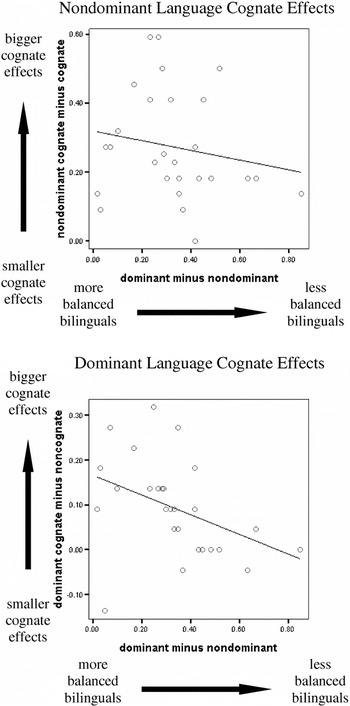
The relationship between the degree of bilingualism and cognate facilitation effects in the nondominant (upper panel) and dominant (lower panel) languages in the 29 bilinguals who participated in the study. On the x-axes are Boston Naming Test difference scores (total pictures named correctly in the dominant minus nondominant languages). Smaller differences (further to the left) indicate more similar naming scores in the two languages. On the y-axes are cognate effects (i.e., the difference the percentage of pictures named correctly with cognate vs. noncognate names). Bigger differences (further up) indicate bigger cognate facilitation effects. The figures show that cognate effects were bigger in more balanced bilinguals and particularly in the dominant language.
The dominant language also revealed a significant cognate effect [F(1,18) = 15.01, MSE = .004, ηp2 = .46, p < .01], however, in this case balanced bilinguals showed bigger cognate effects than unbalanced bilinguals as indicated by a significant interaction between bilingual type and cognate status [F(1,18) = 8.15, MSE = .004, ηp2 = .31, p = .01]. Planned comparisons confirmed that balanced [paired t(9) = 3.85, SE = .04, p < .01] but not unbalanced bilinguals [paired t(9) = 1.05, SE = .02, p = .32] showed significant cognate effects in the dominant language.
The analysis, including all 29 bilinguals tested, confirmed the results of the group comparisons (see Figure 4), more balanced bilinguals showed bigger cognate effects in the dominant language (r = −.41, p = .03), but all bilinguals showed cognate effects in the nondominant language (r = −.29, p = .17). The unbalanced bilinguals' smaller sized dominant language cognate effects could not be attributed to differences in education level or to ceiling effects. When all three variables were entered simultaneously as covariates in a regression analysis, the degree of balance was a marginally significant predictor of dominant language cognate effects [r = .38, p = .09] but education level [r = .06, p = .77] and dominant language BNT scores [r = .05, p = .83] did not even approach significance. In addition, a 2 × 2 ANOVA in the age- and education-matched subset (n = 14) of the participants tested produced the same pattern of results.
Interestingly, between items 30 and 60 there are 18 cognates [M item number 43.94; SD = 8.63] and 12 noncognates [M item number 47.83; SD = 8.90] that are roughly matched for difficulty based on item number [t = 1.19, SE = 3.26, p = 0.24]. We repeated our analyses of cognate effects including only the last 30 items and obtained the same pattern of results. Thus, bilingual BNT scores may be affected by cognate status even when adhering to the standardized administration procedure (beginning in the middle of the test; see the Methods section).
Others investigators have also found stronger cognate effects in the nondominant than in the dominant language (Costa et al., 2000; Roberts & Deslauriers, 1999; van Hell & Dijkstra, 2002). To explain why cognate effects are more robust in the less-dominant language, it can be assumed that cognate effects result from converging activation from lexical representations in each language onto phonemes that are needed to produce the word in both languages (Costa et al., 2000, 2005; Gollan & Acenas, 2004) and that the dominant language produces stronger activation to the phoneme level than the nondominant language. Our results further indicate that dominant-language cognate facilitation effects are more likely to be observed (see Figure 4) in bilinguals with more similar naming abilities in the two languages; in such bilinguals, the nondominant language is more likely to be powerful enough to have an effect on the dominant language.
Thus far, we reported that both the either-language scoring benefit and cognate facilitation effects are greater in bilinguals with more similar BNT naming scores. Before discussing the implications of these findings, we briefly consider the extent to which the results depend on the use of BNT difference scores as a means for classifying bilinguals as balanced or unbalanced.
Measures of Balanced Bilingualism
A limitation of the current findings (and those reported by Kohnert et al., 1998) is that we used BNT scores to classify bilinguals as balanced or not and the BNT was also the primary outcome measure. Table 4 shows alternative (noncircular) ways of measuring the degree to which knowledge of each language is similar (balanced) and how these measures relate to the above-reported effects. The first row reflects the findings reported above (the correlation between BNT difference scores and bilingual effects). The second through fourth rows show how the results generalize to alternative ways of measuring balanced bilingualism. The alternative measures were three difference scores (dominant minus nondominant language) using verbal fluency scores, self-ratings of proficiency, and self-reported estimates of daily use of each language. Notably, the only significant correlation (other than those in the first row) was between percent-of-daily-use of each language and the either-language scoring method. Bilinguals who reported more similar use of each language were more likely to benefit from the option to name in either language than bilinguals who reported using one language most of the time. In contrast, verbal fluency and self-rated language proficiency did not predict the either-language scoring benefit, and no measure (other than BNT difference scores) predicted the size of cognate effects.
Pearson bivariate correlations between measures of balanced bilingualism (difference scores) and scoring method effects and cognate effectsa

These results suggest that dominant-language cognate effects and the either-language scoring benefit (and in Kohnert et al., 1998) applies to bilinguals with similar naming scores, but does not generalize to all definitions of “balanced bilingualism”; bilinguals who may be considered “balanced” in some sense will not necessarily show the reported effects. Interestingly, they also suggest that different ways of quantifying bilingualism will reflect different aspects of proficiency in the two languages. Table 5 shows correlations between five different ways of measuring the degree of bilingualism and measures of ability in the nondominant and dominant languages. Included are four difference scores (where smaller differences equal “more bilingual”), and as a more idealized measure that reflects to what extent a person is bilingual for each individual picture, we also included the “both-languages” score (i.e., the number of pictures named in both languages; see Figure 1).
Pearson bivariate correlations between nondominant or dominant language scores or self-ratings and different ways of measuring balanced bilingualisma

Two aspects of these correlations are striking. First, the both-languages score is the only score that is significantly correlated with all of the other measures (i.e., the four difference scores). Second, increased proficiency in the nondominant language is consistently associated with a higher degree of bilingualism as measured by smaller difference scores and higher both-languages scores. Thus, the ability to name pictures in both languages and proficiency in the less-dominant language may turn out to be important for classifying bilinguals in terms of type. Although rather speculative at this point, these results make sense in that these same abilities also distinguish bilinguals from monolinguals (who cannot name pictures in more than one language, and who cannot speak anything but their dominant language).
DISCUSSION
Because they can communicate in two languages, bilingual speakers have a tremendous and obvious advantage in communicative competence relative to monolinguals. Bilingualism also incurs some nonlinguistic processing advantages (e.g., bilingualism protects against age-related decline in cognitive control; Bialystok et al., 2004). However, bilingualism also entails some processing costs, including reduced verbal fluency scores (Gollan et al., 2002; Rosselli et al., 2000) and lower BNT scores (Roberts et al., 2002). The current study suggests that older adults' naming skills are similarly affected by bilingualism as younger adults (Kohnert et al., 1998) and build on previously reported bilingual effects by suggesting that there is no “magic point” at which speakers become bilingual. Instead, bilingual effects on naming (including either-language scoring effects, dominant language cognate effects, and the dominant language naming disadvantage) are stronger in bilinguals who obtain more similar naming scores in each language. In future studies, it will be important to replicate these findings in part because of the small sample size we tested, but also to test for generalizability to other types of bilinguals (e.g., those who speak different languages, or learned their two languages in different ways).
In addition, the current study emphasizes the need for a theoretically motivated way of defining “balanced bilingual” abstractly, and it remains to be seen if such bilinguals will demonstrate an either-language scoring benefit and dominant-language cognate effects. Exploratory analyses (see Table 4) raised some important questions. For example, bilinguals who reported using both languages to similar (or balanced) extents in daily life, but not bilinguals who rated their ability to speak both languages as more similar, benefited from the either-language scoring procedure. Perfectly balanced knowledge of both languages is rare (Kroll & de Groot, 2005), and there is no accepted standard for classifying bilinguals in terms of balance. Further studies are needed to identify how to best classify bilinguals in terms of their knowledge of both languages for the purposes of deriving theoretical implications of bilingualism for cognitive processing, diagnosing cognitive impairment in bilinguals, and for predicting a priori how testing bilinguals in both languages will influence their test performance. Our preliminary analyses suggest that the ability to name pictures in both languages, and to speak in the nondominant language, capture many different aspects of what it means to be bilingual (these were correlated with all objective and subjective ways of quantifying the degree of bilingualism; see Table 5).
Investigations of what constitutes normal BNT performance for aging bilinguals are also necessary for identifying how naming skills change when cognitive functioning declines in bilinguals and may provide unique tools for diagnosis of cognitive impairment in bilinguals (tools that are not possible in monolinguals). For example, either-language scoring effects or cognate effects may be more sensitive to cognitive impairment than traditional (i.e., dominant language) naming scores. Of course the reverse is also possible, but given that bilinguals may outnumber monolinguals in the world (Kroll & de Groot, 2005), it is important to investigate these possibilities further.
The cognate effects we reported demonstrate how bilinguals' naming skills—even on standardized measures such as the BNT—may be affected by the specific combination of languages that they speak. Bilinguals who speak languages that do not have many cognate names may show even more pronounced effects that appear as naming “deficits” on tests that were not designed specifically for use with bilinguals. If the BNT is used as a measure of relative proficiency in each language (e.g., to match groups of bilinguals who speak different languages for degree of bilingualism), it will be important to consider cognate status.
Because unbalanced bilinguals did not show cognate effects in the dominant language, and did not benefit from either-language scoring, it may appear that nothing will be gained by testing relatively unbalanced bilinguals in both languages. However, we caution against this (seemingly easier) approach, because as just discussed, there is no standardized method for classifying bilinguals as balanced or unbalanced. Table 1 shows that balanced bilinguals in the current study did rate their ability to speak the dominant versus nondominant languages as more similar than unbalanced bilinguals (a difference of 1.5 vs. 2.7). However, we found that spoken-rating difference scores were not significantly correlated with BNT difference scores (see Table 5), and this suggests that spoken ratings were not perfect predictors of how balanced naming skills in the two languages were.
One broader implication of the current findings is that picture naming may be even more sensitive to subtle differences in language history than previously assumed. The BNT, a short, untimed, and relatively easy test of confrontation naming, was designed to differentiate cognitively intact from language-impaired individuals, with no thought to effects of bilingualism. Given this, one might have expected that the BNT would not be sensitive to differences in patterns of language use (i.e., bilingualism versus monolingualism) in cognitively intact speakers, who were thought likely to perform close to ceiling. However, the BNT provided a robust reflection of the cognitive system's history of learning and maintaining a doubled load in bilinguals with similar naming skills in the two languages. A better understanding of bilingualism itself, as well as of cognitive functioning more generally, will emerge in the process of studying how bilingualism interacts with picture naming skills and with other measures of cognitive functioning.
ACKNOWLEDGMENTS
This research was supported by Career Development Award DC00191 from NIDCD to Tamar H. Gollan, by an Individual Investigator Award from the State of California DHS Alzheimer's Disease Program to Terry L. Jernigan, by NIH/NIA grant P50 AG05131 to the University of California, and by a Research Enhancement Award Program from the Office of Research and Development Department of Veterans Affairs Medical Research Service. We thank Aida Miller for assistance with data collection. The information in this manuscript and the manuscript itself are new and original. These findings are not currently under review by any other publication, nor have they been published elsewhere, either electronically or in print. The authors have nothing to disclose regarding relationships that could be interpreted as a conflict of interest.
APPENDIX: DIFFICULTY-MATCHED COGNATE AND NONCOGNATE ITEMS IN THE BNT