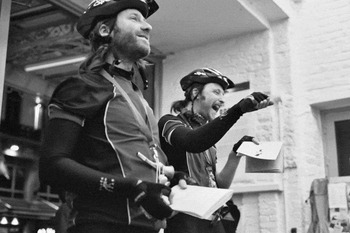
Ladies and Gentlemen, look at them for the last time [audience cheers]. It will never happen again. They've been riding for the last 24 days. They've been coming here for the last 24 days. You've been sitting here for 24 days. You are going to miss them so much. You will come back here tomorrow. And they won't be here. It's the end. Everybody say with me: [all together:] TO THE DOGS!Footnote 2
This emphatic address, delivered by Gregg Whelan to thunderous applause, marked the long-anticipated climax of a twenty-four-day event called To the Dogs, realized in the summer of 2004 at the KunstenFESTIVALdesArts theatre festival in Brussels.Footnote 3 By the time these closing words were spoken, Gregg Whelan and Gary Winters had already become an urban myth. Every day for twenty-four days, the two artists had carried out the same ritual: following a six-hour cycling tour around Brussels during the day, the duo gave a performance the same evening during which they narrated their experiences of the day to the audience. The compositional principle underlying their performance referred to a narrative device familiar from such children's games as ‘I Packed My Suitcase’.Footnote 4 The performers set a narrative time frame of five minutes for every day spent cycling, which was consequently the length of the first night's performance. On the second day, this was repeated and extended by a further five minutes, and so on. The final performance, lasting 120 minutes, comprised a complete set of all their stories. The audience was made a part of this twenty-four-day tour. For the price of a ticket, they were able to come each evening, hear the same stories one more time, and look forward to what the new day would bring. The stories mostly consisted of brief anecdotes. However, a more comprehensive story gradually appeared alongside these – that of the two performers themselves, eliciting from their urban environment another altered reality, passing through thick and thin and transforming every molehill adventure into a mountainous one. This story evolved by staging the passing of time towards a grand finale as an adventurous story, which the performers were about to be a part of. Each evening, the future end of the whole twenty-four-day event was evoked as a heroic resolution to the daily efforts of Whelan and Winters. The whole event – comprising the daily cycling tours, the daily performances and the performer's experiences told as anecdotes – was thus stylized as a myth that was always already present as a future past myth, even when the heroic deeds of the two long-distance cyclists and storytellers were far from being over.
Gregg Whelan and Gary Winters, To the Dogs, Brussels, May 2004, Photo: Michele Rossignol, permission by Lone Twin.

An abundance of postdramatic narrative practices can be observed in contemporary Western experimental theatre.Footnote 5 The specificity of these practices lies in exposing the performative – that is, the physical, the iterative, as well as the ephemeral – construction of narrative. To the Dogs represents a type of performance in which a playful interweaving of narrative and the structuring of time is put on show.Footnote 6 Besides stressing the temporality of the stories generated, To the Dogs in the first place deals with the time of the storytelling process and the act of following and experiencing a story as a performative event. It does so by highlighting the end that closes the event. In the following analysis, I will investigate the effect of this playing with time passing towards an end – an effect which I will be referring to as ‘anticipated nostalgia’: through the constant presumption of a wistful review of the ongoing event as already past, To the Dogs aims for, but never reaches, narrative closure. The latter, which paradoxically is about to be established, can be experienced as anticipated nostalgia – as a present reminiscing in the English future perfect tense: the event will have been – and seems to maintain its force even when this grand narrative is undermined by its open construction process. The reason for the tenacious effect of this consciously constructed narrative closure lies in an ongoing (self-)mythologization of the whole event, in which the spectators of the performances are included as characters.
Paul Ricoeur's phenomenological reflections on the function of the ending in processes of creating and following a story will serve as a springboard for my analysis. These processes, which Ricoeur defines as ‘emplotment’,Footnote 7 with reference to Aristotle's Poetics, imply two different temporal dimensions. Firstly, emplotment functions as an ordering principle, whereby a story's events are brought into a consecutive sequence. Secondly, emplotment takes place in the present, when the story's incidents are ‘grasp[ed] together’ to form ‘the unity of one temporal whole’. This ‘grasping together’ of the story's events demands a constant temporal anticipation and review, whereby the story's ending plays a prominent role. The act of following a story means ‘to move forward in the midst of contingencies . . . under the guidance of an expectation that finds its fulfilment in the “conclusion” of the story’. This ‘conclusion’ need not be logically contained in the preceding episodes. It should only be an ‘end point . . . from which the story can be perceived as forming a whole’ – an ‘end point’, though ‘far from being foreseeable, must finally be acceptable’. What Ricoeur describes here is the construction of a temporal wholeness and thus of seeming narrative closure. This process of ‘configuration’ requires temporal leaps: we read ‘the ending in the beginning and the beginning in the ending’. And just as the story's events are subsequently aligned with the ending, the latter is always already anticipated in the telling. The story's ending functions as the ‘pole of attraction’ before it is reached,Footnote 8 and as such radiates back from the prefigured future into the present of the narrative process. In To the Dogs the attraction of the ending represents both the means and the subject matter of its future-poetics, the process of seeking closure in an ongoing narrative event, which – in contrast to Ricoeur's reflections – is given a performative reality.
Anecdotes and hero myth: the stories and their endings
It is not the action of two performers cycling around the city which marks the actual performance of this twenty-four-day event, but rather its storytelling, which – as an open process of narrative construction – can be experienced live. And live storytelling is where Whelan and Winter's talent lies. Even when their ‘adventures’ of the cycling tours are not quite real ones, they are simply told as such in the spirit of Jerome Bruner's proposition: ‘adventures happen to people who know how to tell about them’.Footnote 9 Within their art of storytelling, two different types of narrative are constructed and interwoven: the everyday anecdote and the heroic story. They both function as narratives because a respective narrative ending is created throughout their performances as something immediately future.
Winter and Whelan ride in on folding bicycles through the open door of the foyer of the theatre, the Beursschouwburg. They stop in front of the audience, who are sitting on the foyer steps, awaiting the last of the twenty-four performances. The performers take off their jackets and Whelan begins in a casual tone: ‘It's the first day on the ring. We came up to a junction. A woman arrived in a car. She wound down her window and she said: “nice jackets”, [pause] which we took as a positive start [pause, audience laughs].’ Most of the stories told by Winters and Whelan are not much more interesting than this brief opening anecdote. They deal with nothing more than the encounters of both performers with the everyday life of Brussels. They tell about cordoned-off streets, singing car drivers, a man sitting on a park bench, crying. These mini-stories of the first day are followed by an odd ritual which, in what remains of this last twenty-fourth performance, is repeated a total of one thousand times: both performers simultaneously thrust their right arms, bent to a right angle, into the air to celebrate the events of the day as ‘toasts’: ‘To the woman who said “nice jackets”!’
The anecdote is considered a very small narrative unit with direct reference to reality and a cogent conclusion.Footnote 10 In most of Lone Twin's stories the miniature aspect of the anecdote initially appears on the level of content, when the linguistically sober description of the everyday world is divided up into small anecdotal units. Even if a few of the anecdotes suggest an everyday drama (such as the crying man), there is no clarification as to a before or after in these simple reports, which are juxtaposed in loose chronological succession. Thus they seem to correspond to an anecdotal style that Gabriele Brandstetter has ascribed to the autobiographical storytelling practices of 1990s experimental theatre. In this context, anecdotes are understood less as a series of narrative punchlines than as ruptures of the grand narrative, as anti-narratives in which conclusions can fail or be totally absent.Footnote 11 However, the anecdotes in To the Dogs elude this fragmentary dramaturgy. After each anecdote, the storytellers interrupt the narrative flow and fix the audience with an expectant look. The stories are presented like imaginary objects, placed in the space between the audience and the performers, whose expressions seem to say, ‘Isn't it wonderful? This is for you. Please take it!’ Winters and Whelan create a tension where there should not, actually, be one. This tension is only defused when the anecdotes are ‘handed over’ to the audience, who respond to the rhetorical pause through the common act of laughing. An additional ending to the stories presented is marked by the toasts, in which the anecdotal summary of the day is resumed once again. In this double ending, the accompanying arm thrusts resemble proud gestures of farewell to the stories now delivered to the public. These gestural and rhetorical means function as formal conclusions to anecdotes whose conclusions in terms of content are completely absent. They create an ending that establishes the illusion of a whole and make the small (anti-)stories – as the smallest narrative units – ‘acceptable after all’.Footnote 12
The performers appear as the narrators of their experiences, but are always also the characters of their narrated stories. This double function of being both rhapsodists and characters is used by Winters and Whelan to stylize themselves as the heroes of their own performance. The latter is turned into a grand story capable of absorbing all experiences and anecdotal narratives. On the level of time structure, this self-mythologization (and ‘myth’ is here initially understood in the Aristotelian sense as an ‘arrangement of the incidents’, as ‘a whole [with] a beginning and middle and end’Footnote 13) is implemented by the performers by turning the temporally defined end of the whole event (it will end after twenty-four days) into the future narrative ending of their own heroic story. They do so by frequently referring to the passing of time (‘To the last two days!’) as well as to the temporal end itself (‘It will be over. It will never happen again’), and thus intertwine the actual physical activity of which they speak with the process of emplotment. This mythologization of their own activities is taken even further when referring to mythological content. The cyclists’ movement through the city, described as a task that can only be accomplished under difficult conditions, creates the illusion of an adventurous journey. This ‘Ulysses on wheels’Footnote 14 is packed with emotional highs and lows. There are frequent reports on the physical pains caused by their daily exertions, the longing for a day off, doubts about the mission in a foreign land. The closer the performer–characters cycle towards the end, the more their initial doubts about the foreign city are converted into a sense of well-being. And when, in the last third of the 120-minute performance, Winters and Whelan call out ‘To “I feel at home!”’, they seem finally to have arrived as the future heroes of Brussels.
In the context of the hero myth, the anecdotes assume an additional function. Although the anecdotes are symbolically charged on a rhetorical level, they do not contribute to a veritable hero myth on the level of content. Nevertheless, the myth feeds on its anecdotally heterogeneous building blocks. Each anecdote functions both as a necessary component and as an ironic caesura of the myth. Instead of allowing the myth to be converted into pure irony, the form of closed myth is vehemently retained through the staging of the future ending. The performers seem to ignore their self-created contradiction between everyday life and myth, as if holding fast – with a quixotic, almost child-like naivety and stubbornness – to the credibility of this myth being constructed in actu.
The stories and their endings: recycled
All the stories in To the Dogs are embedded in a temporal structure of repetition and development. Stories are recycled. Every evening the stories of the previous days are repeated, generating a process of self-historicization. The retelling of an anecdote always also marks the retelling of the previous performances in which this anecdote was told. Thus a collective memory is established, which arises from the events of the storytelling performances themselves. As a result of the interweaving of history, heroic myth and its composition occurring in real time, a collective of viewers and performers is created whose shared time enters into the myth. The narrativization of the time spent together during the performances into a story about a collectively experienced ‘life-episode’ is also carried out through the anticipation of the end, and thereby of the time after the dissolution of this space of co-presence: ‘You'll come back here, but we won't be here’. In the storytelling performances that become daily collective rituals in which one's own (hi)stories are retold and developed further, To the Dogs realizes a further function which attests to the myth from an anthropological point of view – the production of a community.Footnote 15
The recycling principle brings into focus both the mechanism and the function of setting an ending. Every performance comes to an end, which is anticipated the following day as the already known ‘historical’ ending of the previous day, and finally extended a further five minutes after this ending. The act of ending is consequently exposed as a cut into the immediate future, whereby time is divided up into a before and an after the ending, into an ‘it will be’ and an ‘it will have been’. Thus the English future perfect tense as a linguistic tense, frequently employed as such by the performers for the construction of the heroic myth, is also realized here on the level of the temporal structure of the performance itself. The narrative principle underlying the mythologization of the whole event is reflected upon in each individual performance – the anticipation of an ending, and thus a time beyond it, from where what is currently being narrated is rounded off as a totality and turned, in advance, into a (hi)story.
Anticipated nostalgia: (not) closing the event
To the Dogs is an attempt at a live production of a closed narrative, in which the collectively shared time during the performances is configured as a unity and appears as the illusion of a real-time communal experience of the bicycle journey from start to finish. At the same time, however, the performers and the viewers find themselves in the middle of the act of configuration – in lay-bys, from where the flux of time configured as a linear story is stopped, fast-forwarded, rewound and repeatedly aligned with a future ending. The narrative act appears as a constitutive process, which – through the prefiguring of the ending – evokes a time-consciousness, thus becoming perceptible as anticipated nostalgia. Although all the participants find themselves in the middle of a process in which potentially anything is possible, the shared time configured as history/story is literally fore-closed and mourned in advance as past, and therefore made apparent simply as collective time happening. This collective time appears all the more exceptional the nearer the end of the event approaches – ‘it will never happen again’, as Whelan never tires of emphasizing. To the Dogs realizes a seeming contradiction, in which narrative closure and openness are interlinked by both narrating and implementing the process of narrative closing as live event in which, despite the discussion on the death of narrative, stories are not abandoned but consciously tested in their affective force in relation to the medium of live performance. Through the placing of a future ending as an act of narrativizing – which means in each repeated anecdote, in the whole event as hero myth as well as within an end-‘recycling’ time structure – the ephemeral quality of the performances can be experienced as time running out. Consequently, Lone Twin's performances also interrogate the discourse around live performance as irretrievable event being charged with narrativity and nostalgia. It emphasizes the afterlife each live performance evokes when released into a (future) time after its ending – a none-the-less narrative afterlife to which this paper testifies – ‘To saying “au revoir”! To saying “It was a pleasure to meet you”.’