School-aged athletes in the United States of America are required to obtain a pre-participation screening exam (PPSE) before participating in organised sports.Reference Bernhardt and Roberts 1 A controversial aspect of the PPSE is whether to include routine electrocardiograms (ECGs) to screen for cardiac problems that increase the risk of sudden unexplained death. Experts in cardiology disagree about whether routine ECG should be part of the PPSE.Reference Chaitman 2 , Reference Corrado and Thiene 3 In the United States of America, the American Heart Association and the American College of Cardiology recommendations state “Mandatory and universal mass screening with 12-lead ECGs in large general populations of young healthy people 12 to 25 years of age (including on a national basis in the United States of America) to identify genetic/congenital and other cardiovascular abnormalities is not recommended for athletes and nonathletes alike”.Reference Maron, Friedman and Kligfield 4
In contrast, the European Cardiology Society and many cardiologists in the United States of America believe that every athlete should have a routine 12-lead ECG in addition to history and physical examination.Reference Corrado, Pelliccia and Bjornstad 5 These differing opinions among experts have led to confusion among primary-care physicians about whether an ECG is reliable, efficacious, and an economically feasible screening test.Reference Chaitman 2 , Reference Corrado and Thiene 3 , Reference Drezner 6 – Reference Wheeler, Heidenreich, Froelicher, Hlatky and Ashley 11 We surveyed primary-care paediatricians to determine the different components that make up their PPSE.
Materials and methods
Study design
We performed a cross-sectional study of paediatricians affiliated to a single, paediatric, tertiary referral hospital within an academic centre. Paediatricians were contacted by e-mail to complete an internet survey from July 2010 to August 2010. The 30-question survey assessed the following domains: demographics, knowledge about sudden unexplained death, knowledge about current PPSE guidelines, current practice, and reasons why they might change practice. Depending on whether physicians routinely perform PPSE or routinely perform an ECG, respondents were prompted to appropriate follow-up questions. Respondents were not compensated for completing the survey, and participation was voluntary; this study was approved by our Institutional Review Board. All respondents practiced in the state of Illinois.
Missing data
When respondents skipped a question, the skipped response was removed from the numerator and the denominator for that question. Responses were not extrapolated from other data. Removing skipped responses, instead of extrapolating, resulted in different denominators between questions.
Statistical data analysis
We used two Likert scales. For questions in which the respondent was asked to indicate a level of agreement with a position statement, a five-position Likert scale was used: strongly agree, agree, neutral, disagree, and strongly disagree. When respondents were asked to rate their own comfort with a technique or evaluation, a five-position Likert scale was used, ranging between 1, “Not comfortable” and 5, “Very comfortable”, without definitions for the intermediate three values. For interpreting ECGs, Likert responses were dichotomised: 1–3 were assigned as “not comfortable” and 3–4 were assigned as “comfortable”. Fischer’s exact method was used to test the resulting 2×2 table. Responses to knowledge questions were tabulated as “correct/incorrect”, and Fischer’s exact method was used to compare the rates of correct answers between physicians who did and did not perform PPSE. Analyses were performed on Stata 12 (StataCorp LP, College Station, Texas, United States of America).
Results
Response rate and demographics
The response rate from paediatricians was 41% (205/498). In all, 79% (163/205) of the respondents reported that they currently perform PPSE. Nearly all physicians who performed PPSE were general paediatricians (99%, 161/163). The other two were hospitalists. Of the 163 respondents, only 13 performed an ECG during a PPSE (8%); the other 148 did not perform an ECG during a PPSE (92%). In all, 56% (92/163) were aware of a case where a student athlete in their own community had died of sudden cardiac death; seven (4%) had at least one athlete in their own practice die.
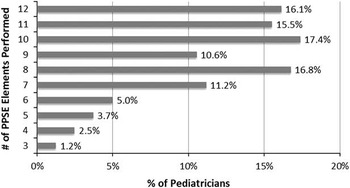
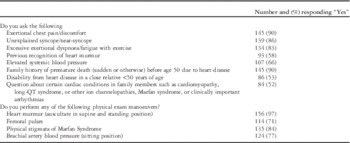
Of the paediatricians who responded that they performed PPSE, Table 1 lists how often the individual 12 elements of the PPSE recommended by the American Heart Association were routinely performed. Figure 1 shows how often paediatricians performed a combination of these elements.
Paediatrician performance of pre-participation screening exam (PPSE) elements (n=161).

Percentages of paediatricians who performed the 12 elements of the pre-participation screening exam (PPSE) screening.

n=161
Respondents were asked to provide their “next step” in response to an abnormal cardiac screening component during PPSE. If any of the screening elements were abnormal, paediatricians responded that they would obtain an ECG (69%, 112/163), obtain an echocardiogram (36%, 58/163), and/or refer the patient to a cardiologist (73%, 116/163). None of these responses to an abnormal cardiac screening varied on the basis of the paediatricians’ years in practice. Only 30% of the practitioners restricted the patient from sports activity on the basis of abnormal screening findings (49/163).
ECGs during screening physicals
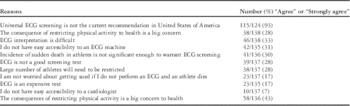
Among paediatricians who performed PPSE, 92% of them did not perform an ECG as part of the exam (148/161). Those who did not perform an ECG cited the American Heart Association recommendations as the primary reason (115/124, 93%). Other reasons explaining why paediatricians did not include an ECG as part of PPSE are listed in Table 2. Only 51/138 (37%) said that they could independently interpret an adolescent ECG.
Reasons why paediatricians do not include electrocardiogram (ECG) as part of the pre-participation screening exam.

Some respondents skipped questions, thus the denominator varies
Among the 8% (13/163) of paediatricians who included an ECG as part of their PPSE protocol, the reasons for doing so varied. In total, 85% stated that “electrocardiogram is a good screening test”; 39% worried about being sued if they did not perform an ECG. No statistically significant difference was found in the comfort of interpreting ECGs among paediatricians who performed and did not perform ECG (p>0.4 for all comparisons). Among the 13 respondents who ordered an ECG, 11 had the ECG interpreted by a cardiologist, one interpreted it without assistance, and one relied on the computerised ECG interpretation. Of those who included ECG in PPSE, 85% (11/13) had an ECG machine in their office or building, and 15% (2/13) had the patient drive to a laboratory or hospital to obtain the ECG.
Reasons to change practice
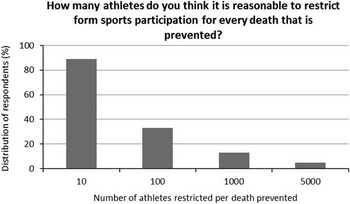
Paediatricians reported that they would likely change their practice if the costs of the tests were lower. The majority of paediatricians (82%, 82/100) stated that they would add an ECG to PPSEs if the total out-of-pocket patient cost for performance and interpretation was $10 versus 23% (23/100) if the total cost was $100. The majority of paediatricians who did not routinely perform an ECG stated that they would perform a routine PPSE ECG if they “had a fully computerised office electrocardiogram that can accurately interpret electrocardiograms” (93/139, 67%). When asked, “How many athletes do you think it is reasonable to restrict from sports participation for every death that is prevented?”, 89% (132/148) replied that they would restrict 10 patients to save one death, but when the number was increased to 100 patients, 1000 patients, and then 5000 patients fewer paediatricians endorsed ECGs at each step (Fig 2).
Athlete restriction to prevent death (n=148). Respondents were permitted to choose from among the four forced choices (10, 100, 1000, or 5000 deaths/life saved) and were allowed to select more than one answer or no answer at all. Therefore the percentages do not sum to 100%.

Knowledge
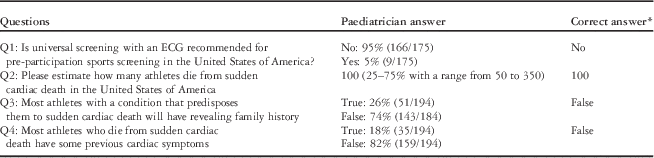
We asked a panel of questions to determine the knowledge base of the general paediatricians among the respondents. Table 3 shows responses of the paediatricians as well as the “correct answer” based on the literature. There was no statistically significant difference between those who performed or did not perform PPSE in answering these questions correctly (p>0.36 for all questions).
Knowledge base questions.

ECG=electrocardiogram
* Correct answer is based on references 12–20
Discussion
The vast majority of paediatricians in our survey did not include routine ECG as part of PPSE. Their knowledge-based testing scores demonstrated that they were familiar with the American Heart Association/American College of Cardiology guidelines. The low rate of using ECGs suggests that paediatricians are applying those guidelines to their practice, and they specifically referenced the guidelines as the most important reason for not performing ECG. A small minority of paediatricians regularly obtained ECGs, most of whom had ECG machines in their office and a system to obtain an interpretation by a cardiologist; however, even if ECGs were to be added to the recommendations for PPSEs, paediatricians identified multiple barriers to routine ECG use, including the lack of accurate interpretation, poor availability of office ECG, and potential inappropriate restriction of athletes.
A striking finding in our study was that over 80% of paediatricians did not perform all 12 elements of the PPSE as recommended by the American Heart Association. This is consistent with other studies, which have found low rates of adherence to these recommendations.Reference Pfister, Puffer and Maron 12 , Reference Wingfield, Matheson and Meeuwisse 13 The paediatricians in our survey demonstrated an excellent knowledge base on our fact-based questions and knew the guidelines; they reported using fewer than 12 of the recommended screening items in clinical practice. The low rate of self-reported adherence to the 12-element PPSE guidelines may be a more critical finding than the implications regarding ECG screening. More studies are needed to understand whether this low rate of adherence is related to perceived inefficacy of the current guidelines among practicing paediatricians, barriers to routine performance and documentation in the paediatric setting, or other barriers to education and implementation.
Over 50% of paediatricians have had a case of sudden death in a student athlete in their community, and 4% have had an athlete in their practice die of sudden death. Despite these personal experiences, only 30% of respondents restricted patients after an abnormality was found during PPSE. Many of the cardiovascular aetiologies of sudden death in young, competitive athletes have been associated with exercise.Reference Schmied and Borjesson 14 Although it remains unclear whether exercise restriction affects survival in many diseases, the best current understanding is that restriction should be performed until the exercise-associated causes of cardiovascular death have been excluded. Among respondents, referral to cardiology is the single most common intervention when an abnormal cardiac screening finding is identified, and therefore rates of exclusion should be higher compared with our survey. Further studies are needed to understand why patients are not restricted when an abnormality is found.
Paediatricians have a relatively accurate understanding of the epidemiology of sudden unexplained death in athletes. The vast majority of those surveyed correctly identified that universal screening is not recommended for PPSE in the United States of America and that most athletes who die suddenly will not have a revealing family history or previous symptoms.Reference Maron, Thompson and Ackerman 15 – Reference Corrado, Basso and Thiene 19 The median estimate for sudden unexplained death for athletes in the United States of America among respondents was 100 annual deaths. Given the lack of registry data and the potential variations in incidence of sudden unexplained death in athletes, it is difficult to determine a “correct” number for this question. Several large population-based studies suggest that the incidence is near 1.3 deaths per 100,000 patient-years across the population.Reference Wong, Roses-Noguer, Till and Behr 20 – Reference Driscoll and Edwards 22 When limiting that rate among 8 million self-reported athletes in the United States of America, 23 the estimate is around 100 athletes. This estimate is the median response from paediatricians, but the variability in paediatrician responses and the difficulty in determining a “correct” number highlight the need for a true population-based number. Some efforts are in place already, including the National Institute of Health Sudden Death in the Young Registry. 24 Areas where paediatricians have uncertainty are the same areas where the literature contains discrepancies and uncertainties.
When screening ECGss have been discussed in the literature, authors have pointed out to the high practical barriers against reliably performing and interpreting ECGs across the entire United States of America. The present study underscores the importance of these concerns. The paediatric practices surrounding our metropolitan centre represent a relatively high-access medical community; nevertheless, our survey respondents identified access to rapid and high-quality ECG readings and accurate ECG interpretation as the greatest hurdle to ECG implementation. The problems of access and interpretation that we observe in a metropolitan area may be amplified in areas with a lower concentration of medical resources and personnel. Demonstration projects, incorporating new and better approaches to screening and interpretations of ECG, might help answer questions about whether routine ECG is feasible and acceptably accurate.
Limitations
This was a survey-based study, taken from a relatively homogenous urban and suburban population; however, the strength of the study is that it used formal survey methodology with piloted questions and relevant skip methods to increase response rates. We achieved unusually high response rates and high completion rates in our survey.
Conclusion
The vast majority of general paediatricians associated with a tertiary paediatric centre do not routinely perform ECGs for PPSE, in agreement with the current American Heart Association/American College of Cardiology guidelines; however, we demonstrate a strikingly low rate of self-reported adherence to the 12-element recommended PPSE. This low rate of successful adoption of the 2007 American Heart Association/American College of Cardiology 12-element screening guidelines suggests that the public health discussion surrounding PPSE may benefit from focussing on the core features of history and physical, including the positive and negative predictive values of including each question and exam element, rather than a recurrent focus on the value of a screening ECG.
Everyone shares the goal of lowering the rate of sudden death in athletes. General paediatricians and other practice providers such as physician assistants and nurse practitioners are placed in the uncomfortable position of providing preventive care in the midst of ongoing discussion and disagreement among experts. This study demonstrates that general paediatricians know the data on sudden death and ECG screening and that they follow the current recommendations against routine ECGs during PPSE. This study, however, underscores the difficulty that paediatricians face when applying the current 12-element screening system. Further studies are needed to understand these practice gaps in order to achieve the goal of providing front-line providers with policy recommendations that are grounded in evidence-based medicine to ultimately decrease the rate of sudden death in young people.
Acknowledgements
None.
Financial Support
This research received no specific grant from any funding agency or from commercial or not-for-profit sectors.
Conflicts of Interest
None.
Supplementary Material
For supplementary material referred to in this article, please visit http://dx.doi./org/10.1017/S1047951116001529