Introduction
Major shifts in rice cropping system from irrigated to aerobic conditions and also from transplanting to direct sowing are essential in the climate change scenario. Rice cultivation is slowly shifting from irrigated to rainfed and it has been reported that 50% of rainfed rice area of India is under direct seeded rice (DSR) (Anandan et al., Reference Anandan, Anumalla, Pradhan and Ali2016). Seedling vigour is a vital trait for crop establishment, better survival, weed competition and nutrient use efficiency and also for normal growth under conditions of limited inputs and abiotic stresses. Quick germination and growth of seedling with high capacity to take nutrients have been shown to be important traits for DSR in rainfed lowlands where soil moisture and nutrients are often limited (Yamane et al., Reference Yamane, Garcia, Imayoshi, Mabesa-Telosa, Banayo, Vergara, Yamauchi, Sta. Cruz and Kato2018). Even though considerable genetic variation in seedling vigour exists in Oryza species it is difficult to enhance vigour traits in genotypes as the inheritance is quantitative and mostly dependent on environment and crop duration (Li and Rutger, Reference Li and Rutger1980; Redona and Mackill, Reference Redona and Mackill1996a). Understanding the genetic and molecular basis of traits related to seedling vigour is essential for crop improvement as it determines not only initial establishment but subsequent crop growth and yield.
Wild species are important donors in rice breeding programme as they have many beneficial alleles for rice improvement (Tanksley and McCouch, Reference Tanksley and McCouch1997; Wang et al., Reference Wang, Wang and Porter2002; Sarla et al., Reference Sarla, Bobba and Siddiq2003; Gur and Zamir, Reference Gur and Zamir2004; Swamy and Sarla, Reference Swamy and Sarla2008; Swamy et al., Reference Swamy, Kaladhar, Ramesha, Viraktamath and Sarla2011; Eizenga et al., Reference Eizenga, Prasad, Jackson and Jia2013) which were eliminated during domestication. The wild progenitor species Oryza nivara is easily crossable with cultivated rice and can be readily exploited in breeding programmes without embryo rescue procedures (Niroula and Bimb, Reference Niroula and Bimb2009) and has been used in inter-specific crosses as a source of new alleles (Wickneswari et al., Reference Wickneswari, Bhuiyan, Kalluvettankuzhy, Lim, Thomson, Kairudin and Abdullah2012; Haritha et al., Reference Haritha, Malathi, Divya, Swamy, Mangrauthia, Sarla, Mondal and Henry2018). O. nivara accessions have abundant genetic diversity (Joshi et al., Reference Joshi, Gupta, Aggarwal, Ranjekar and Brar2000; Sarla et al., Reference Sarla, Bobba and Siddiq2003; Juneja et al., Reference Juneja, Das, Joshi, Sharma, Yogesh, Patra, Bharaj, Sidhu and Singh2006); however, this species has not been used extensively in breeding programs for seedling vigour traits. In our previous studies O. nivara accessions were used as donors to develop backcross introgression lines (BILs) and Chromosome segment substitution lines (CSSLs) libraries in the background of popular Indian rice varieties (Kaladhar et al., Reference Kaladhar, Swamy, Babu, Reddy and Sarla2008; Swamy et al., Reference Swamy, Kaladhar, Reddy, Viraktamath and Sarla2014; Malathi et al., Reference Malathi, Divya, Sukumar, Raju, Rao, Tripura Venkata and Sarla2017). The introgression lines derived from these crosses have been extensively characterized using molecular markers and field evaluated for yield and other agronomically important traits (Thalapati et al., Reference Thalapati, Guttikonda, Nannapaneni, Babu, Reddy, Swamy, Batchu, Basava, Viraktamath and Sarla2014; Divya et al., Reference Divya, Subrahmanyam, Badri, Raju, Rao, Kavitha, Sukumar, Malathi, Revathi, Padmavathi, Babu and Sarla2016; Haritha et al., Reference Haritha, Sudhakar, Chandra, Ram, Divya and Sarla2016; Malathi et al., Reference Malathi, Divya, Sukumar, Raju, Rao, Tripura Venkata and Sarla2017; Prasanth et al., Reference Prasanth, Babu, Basava, Tripura Venkata, Mangrauthia, Voleti and Neelamraju2017). Previous reports indicated that wild species are an excellent source to introgress novel genetic variation for vigour into cultivars (Rangel et al., Reference Rangel, de Morais, Brondani, Rangel and Brondani2006; Borjas et al., Reference Borjas, Teresa and Prasanta2016; Eizenga et al., Reference Eizenga, Neves, Bryant, Agrama and Mackill2016). Though wild genotypes are known for their high vigour and establishment compared with cultivars, introgression lines derived from them have rarely been evaluated for seedling vigour. This study was undertaken to identify the BILs showing early seedling vigour and to determine if seedling vigour correlates with yield traits and their association with selected molecular markers.
Materials and methods
Plant material
Twenty-three rice genotypes including 14 high yielding BILs derived from BC2F6 of Swarna/O. nivara (14S, 14-3S, 148S, 166S, 166-1S, 166-2S, 248S, 65S, 70S, 75S, 24K, 250K, 3-1K, 7K) and nine high yielding cultivars of different maturity durations (IR64, Jaya, MTU1010, MTU1081, NLR34449, Sahbhagidhan, Swarna, Tellahamsa and Tulasi) were studied for various seedling vigour related traits (online Supplementary Table S1). S indicates lines originated from BC2F2 of the cross Swarna/O. nivara IRGC81848, an accession from Uttar Pradesh, India and K lines are from BC2F2 of Swarna/O. nivara IRGC81832, an accession from Bihar, India. These are the lines selected from the respective mapping population.
Assessment of seedling vigour-related traits
Seedling vigour is measured using different parameters such as germination rate (GR), coleoptile length, shoot-root length, shoot-root weight, plant height and tiller number (Redona and Mackill, Reference Redona and Mackill1996a, Reference Redona and Mackillb; Cui et al., Reference Cui, Peng, Xing, Xu, Yu and Zhang2002; Sun et al., Reference Sun, Wang and Sun2007; Wang et al., Reference Wang, Wang, Bao, Wang and Zhang2010). Screening of these BILs was conducted at laboratory conditions during Kharif 2013 along with checks. Seedling-vigour related traits such as seed germination percent (GP), seedling shoot length (SL), seedling root length (RL) and dry matter weight were determined by using the paper-roll test method (Zhang et al., Reference Zhang, Yu, Yu, Huang and Zhu2005b) and petridish method (Subudhi et al., Reference Subudhi, Leon, Singh, Parco, Cohn and Sasaki2015) with two replications. For the study, 70 well-filled grains of each genotype were first treated at 50 °C for 5 d to eliminate residual dormancy, surface-sterilized with 0.6% sodium hypochlorite solution for 15 min, rinsed three times with sterile distilled water and 2 sets containing 25 seeds of each genotype were kept for germination by soaking in sterile distilled water at 30 °C. Germinated seeds were counted at 7 d after incubation. Seed GP was calculated as the percentage of seeds germinated. Seed with both coleoptiles and radical protrusion ≥ the length of the seed itself was considered germinated.
Ten seeds for each replication were then placed equidistantly in sterile distilled water saturated blotter paper mounted on polythene film, each piece of paper is 50 cm long and 30 cm wide. These were rolled up carefully with their two distal edges tied with rubber bands to prevent seed removal; these seed-loaded paper rolls were vertically held in sealed polythene bags to avoid water evaporation and incubated at normal room temperature. At 7 d and 14 d after incubation 10 seedlings for each genotype were sampled to measure their SL and RL. Then the residual seed grains attached to the seedlings were removed and the seedlings were dried in an oven at 80 °C for 3 d. Dry matter weight of seedlings was measured and expressed as mg/10 seedlings. Root to shoot ratio was derived from dividing root dry weight by shoot dry weight (Cairns et al., Reference Cairns, Namuco, Torres, Simborio, Courtois, Aquino and Johnson2009). Seedling Vigour Index-1(SVI1) was calculated with the help of data recorded on seedling growth at 7 d and 14 d after sowing and germination percentage (GP) according to Kharb et al. (Reference Kharb, Lather and Deswal1994) using the formula:
 $$\eqalign{&{\rm Seedling \ Vigour} \; {\rm Index} \,1 \cr &\quad= \displaystyle{{\rm Seedling \ length} \times {\rm Germination \ percentage} \over {100}}}$$
Seedling Vigour Index-2 (SVI2) was estimated using seedling dry weight at 14 d after sowing by the formula adopted by Kharb et al. (Reference Kharb, Lather and Deswal1994)
 $$\eqalign{&{\rm Seedling \ Vigour \ Index \ 2 } \cr &\quad= \displaystyle{{\rm Seedling \ dry \ weight \times Germination \ percentage} \over {100 }}}$$
Field assessment of seedling vigour-related traits
Twenty-five-days-old seedlings were transplanted in the main field (one seedling/hill) during wet season (Kharif) 2013 and dry season (Rabi) 2014 under irrigated conditions at the experimental farm of Indian Institute of Rice Research (IIRR), Hyderabad following a randomized complete block design, with three replications with five rows per replication, 21 plants per row and a spacing of 15 cm between plants within each row and 20 cm between rows. The cultural practices, fertilizer application and plant protection measures were carried out as per standard package of practices during crop growth. Seedling vigour was obtained both for Kharif and Rabi season in terms of plant height and tiller number from the data taken at 30 d after transplanting and 60 d after transplanting and just before harvest. Observations on crop growth parameters and yield contributing traits were recorded at both pre-harvest and post-harvest stages (IRRI, 2013). At harvest, five plants in the middle of each replication were selected and yield-related traits including days to heading (DH), days to fifty percent flowering (DFF), plant height (PH), tiller number (TN), panicle number per plant (NPT), single plant yield (SPY), bulk yield (BY) and harvest index (HI) were evaluated. The average trait measurements from three replicates in both years were used for data analysis.
Genotyping
Young leaves were collected 20 d after transplantation and genomic DNA was isolated using CTAB method (Doyle and Doyle, Reference Doyle and Doyle1987). Purity and concentration of DNA were measured using Nano Drop ND-1000 Spectrophotometer (Wilmington, USA). 30 SSR markers linked to reported genes/QTLs (Quantitative Trait Loci) for seedling vigour traits (Zhang et al., Reference Zhang, Su, Li, Chen and Zhu2005a, Reference Zhang, Yu, Yu, Huang and Zhub; Lu et al., Reference Lu, Niu, Cai, Zhao, Liu, Zhu and Zhang2007) viz., qsv − 1, qsv−5, qsv−6 and qsv−8 were used to survey the selected 14 BILs compared with the recurrent parent. Polymerase chain reactions (PCR) were carried out in Thermal cycler (Veriti PCR, Applied Biosystems, USA) with the total reaction volume of 10 µl containing 25 ng of genomic DNA, 1× assay buffer, 200 µM of dNTPs, 1.5 mM MgCl2, 10 pmol of forward and reverse primer and 1 unit of Taq DNA polymerase (Thermo Scientific). PCR cycles were programmed as follows: initial denaturation at 94 °C for 5 min followed by 35 cycles of 94 °C for 45 s, 55 °C for 30 s, 72 °C for 45 s and a final extension of 10 min at 72 °C. Amplified products were resolved on 3% agarose gels prepared in 0.5× TBE buffer and electrophoresis was conducted at 120 V for 2 h. Gels were stained with ethidium bromide and documented using gel documentation system (Alfa imager, USA).
Statistical analysis
The field experiments were conducted in a completely randomized block design with three replications. Laboratory screening was conducted using three replications. Statistical analysis was carried out using PB Tools statistical software (version 1.4, http://bbi.irri.org/products) for test of significance. Multiple correlations between vigour and yield traits and for seasonal data and mean were also calculated.
Results
Phenotypic variation for seedling vigour-related traits
Kharif-2013
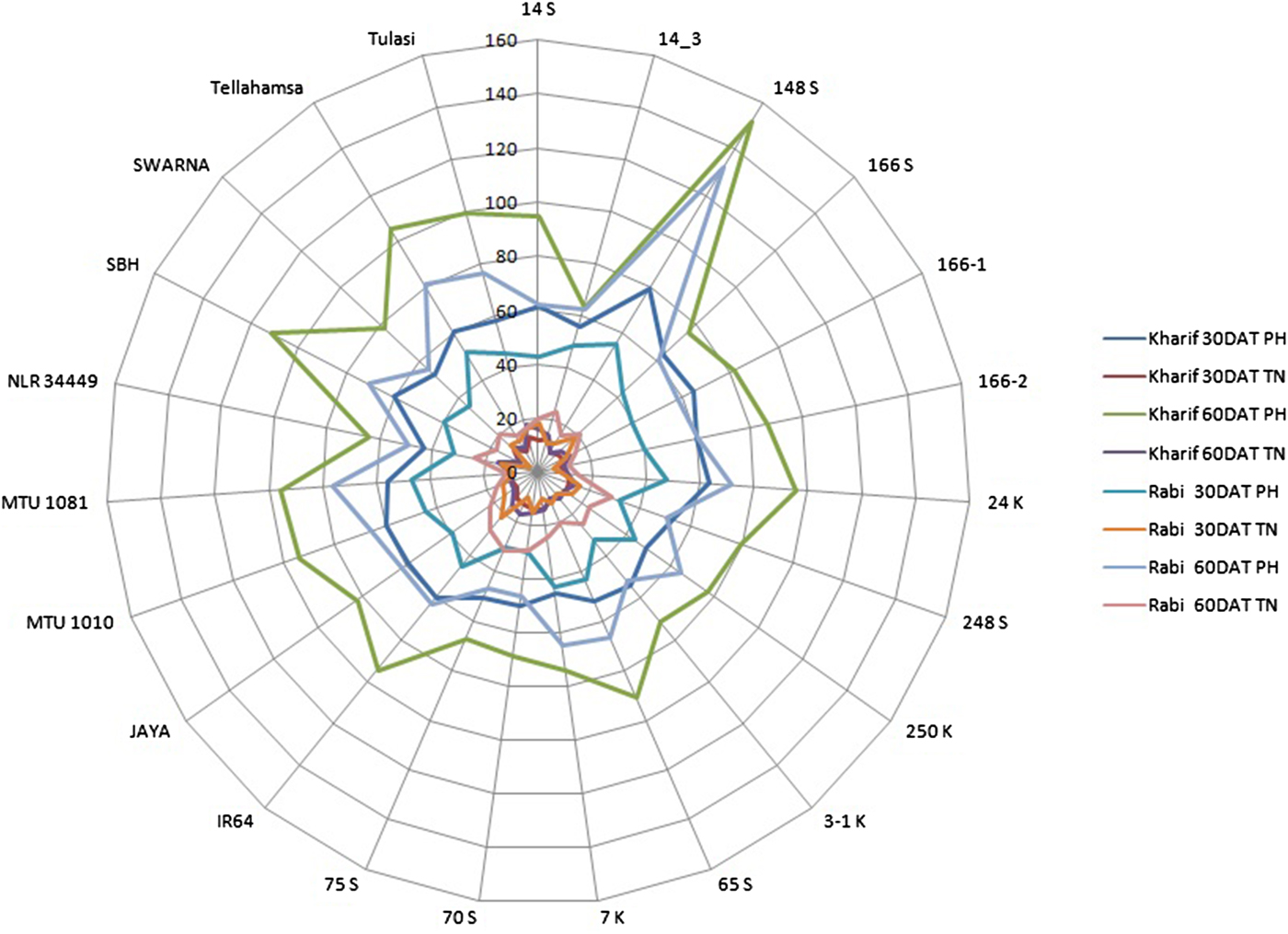
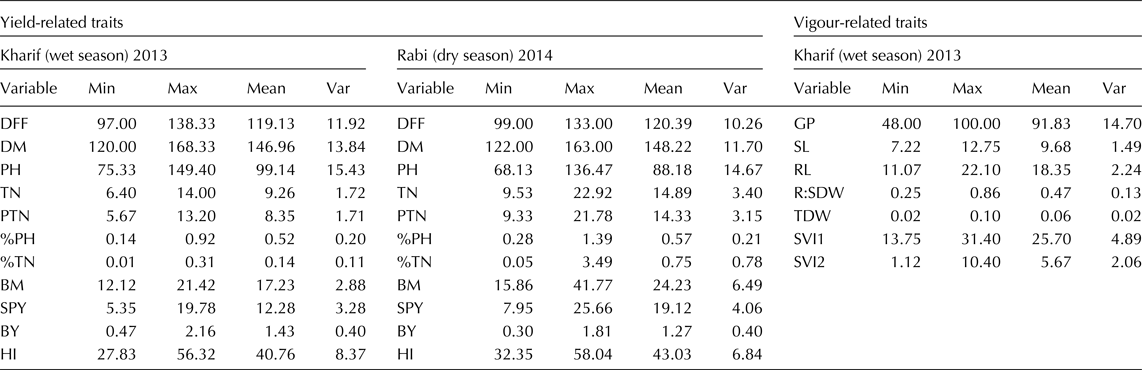
A wide range of variation was found among the set of BILs and cultivars for key traits related to seedling vigour and yield (Table 1). Among all, 148S was the earliest in days to flowering (97 d), days to maturation (120 d) and 7K was late in flowering (138 d) and days to maturation (168 d). 148S flowered 30 d earlier than parent Swarna. Among the nine cultivars, Tellahamsa was early in flowering (100 d) and early in days to maturation (125 d) (online Supplementary Table S2). 148S had the highest vigour for plant height throughout the growth stage (Fig. 1). It also had high SVI1 and high vigour for SL and total dry weight (TDW). Among other BILs, 7K showed high seeding vigour for RL and TDW and 75S showed high RL/SL ratio and vigour for tiller number. 166-1S had the highest RL among BILs and also highest SVI1. 14-3S had least SVI1 and SVI2 (online Supplementary Table S3). Considering yield traits, BY was high in 166S but SPY and HI was high in 14S. 14-3S showed high tiller number before harvest but it had the least SPY, biomass (BM) and HI. Among all the checks, Sahbhagidhan showed high vigour in terms of plant height and RL while Tulasi had high vigour in terms of tiller number and both showed high seedling vigour indices and comparatively higher yield levels.
Variation in plant height and tiller number in seedlings of popular varieties and Swarna ILs at 30 and 60 d after transplanting in field conditions.

Variability of 11 yield-related traits and seven vigour-related traits in Swarna × O. nivara BILs

BM, biomass; BY, bulk yield; DFF, days to fifty percent flowering; DM, days to maturity; GP, germination percentage; HI, harvest index; Min, minimum; Max, maximum; PH, plant height at maturity; PTN, productive tiller number at maturity; RL, root length; R:SDW, root shoot dry weight ratio; %PH, Percent increase in plant height; %TN, Percent increase in tiller number; SPY, single plant yield; SL, shoot length; SVI1, seedling vigour index-2; SVI2, seedling vigour index-2; TN, tiller number at maturity; TDW, total dry weight; Var, variance.
Rabi-2014
In Rabi season also, 148S had high vigour for PH and showed early flowering (99 d) and maturity (122 d). 7K was late in flowering (133 d) and maturity (163 d) among all the BILs. In addition, 248S and 3-1K also showed high vigour for plant height. 75S showed the highest vigour for tiller number at 60 d after transplanting followed by 3-1K, 7K and 14-3S (online Supplementary Table S4). 166S showed high SPY and high tiller number at 30 d after transplanting. Among all the BILs, 166-2S had the least vigour for tiller number. 14S showed high BY, HI and 7K had high BM among all the BILs. 14-3S showed the least SPY, BY and BM. Among checks, Sahbhagidhan showed high SPY and HI during rabi season and high SVI2 in laboratory conditions.
In case of TN at 30 d, 7K (Kharif-2013) and 166S (Rabi-2014) showed the highest number; at 60 d, 75S showed high TN in both seasons but at harvest 14-3S (Kharif -2013) and 70S (Rabi-2014) exhibited high TN. High productive tiller number at maturity (PTN) was observed in 14-3S during kharif 2013 and 70S in Rabi 2014. Similarly, phenotypic variation was observed for traits SPY, BY and BM between two seasons. 14S showed high SPY in Kharif 2013, while 166S in Rabi 2014. Likewise, 166S showed highest BY in Kharif 2013 and 14S in Rabi 2014.
Determining seedling vigour using paper-roll method
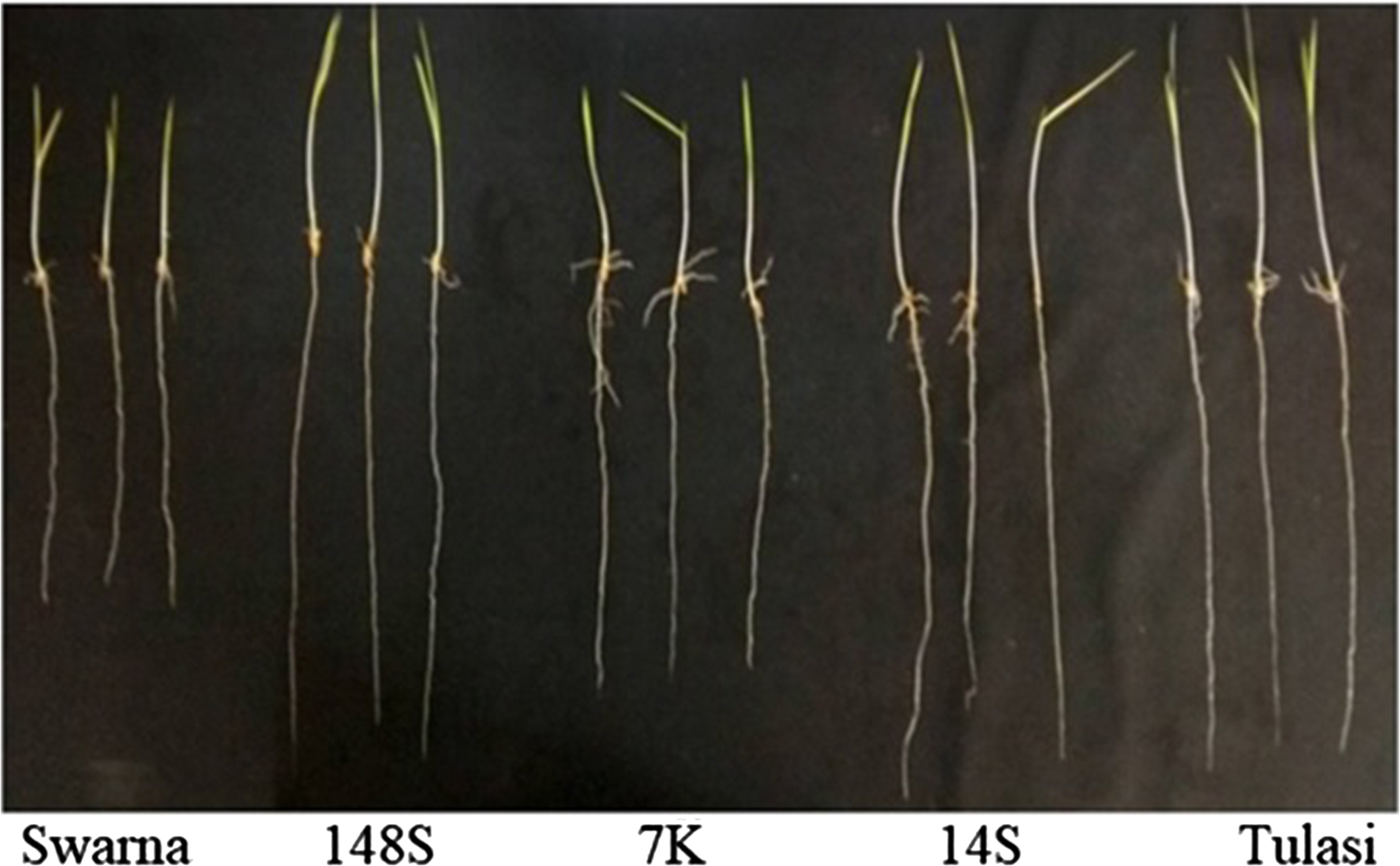
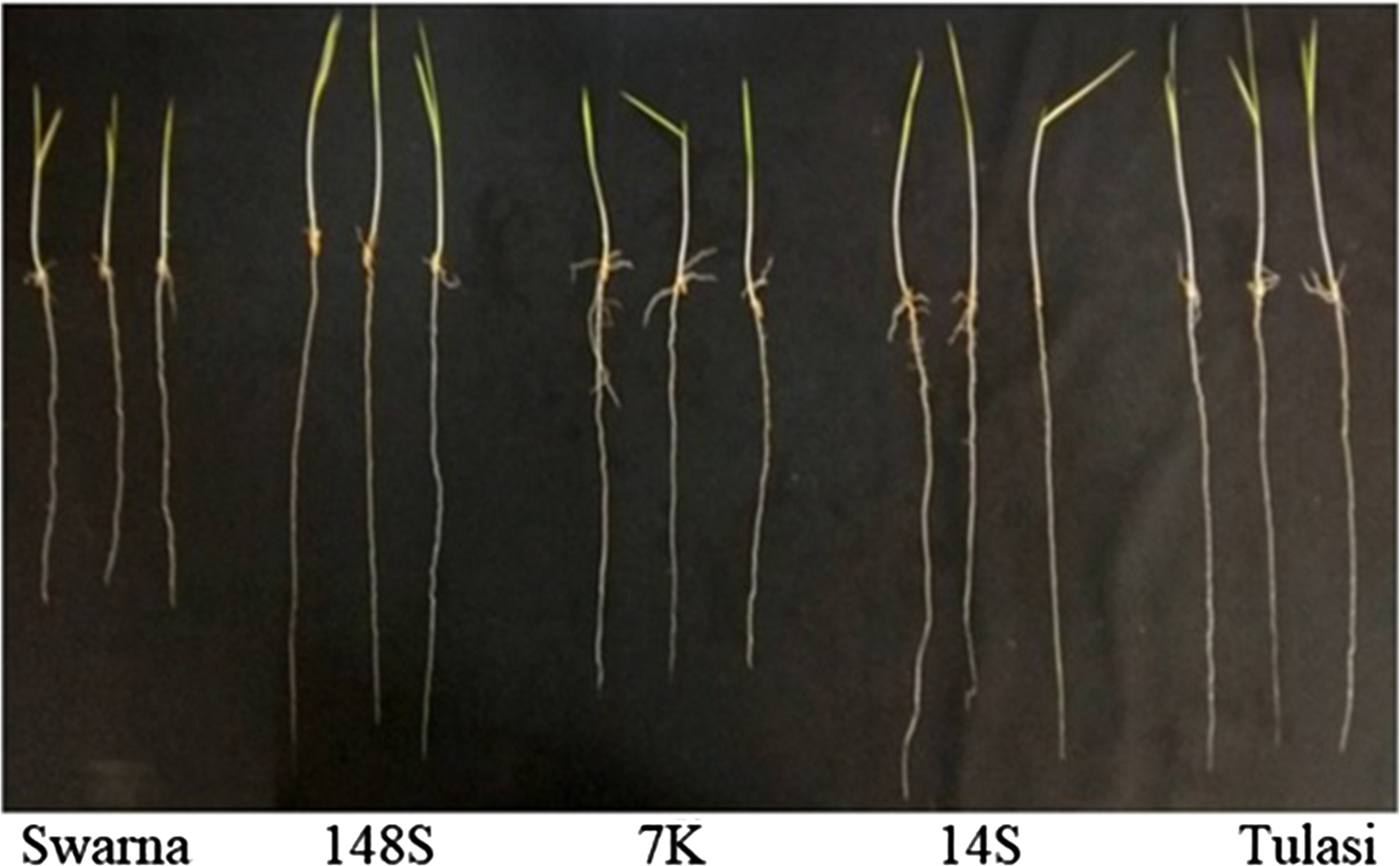
The results obtained from the paper-roll method for seedling vigour traits revealed that 148S showed good vigour in terms of SL at 7 and 14 d after sowing (Fig. 2) and shoot dry weight (SDW) and SVI1 at 14 d after sowing but it showed very less growth rate in SL at seedling stage among all the BILs and checks. 7K showed high vigour in RL at 7 and 14 d after sowing and low percentage of root elongation. 3-1K showed a high growth rate in RL and lowest RL at 7 d. 166S showed high growth rate in SL, high SVI2 and less vigour in SL and SVI1 at 7 d and RL at 14 d after sowing. 166-2S had highest RDW among the BILs. 14-3S showed less vigour in 14SL, SDW, 14SVI1, SVI2 among all the BILs. High root-shoot dry weight was observed in 75S, 65S, 248S, 166S and 166-2S. Highest TDW was found in 148S and 166S. At 7th and 14th d seedling stage, 148S showed the highest RL and SL among all BILs. However, the tremendous increase was observed from 7 to 14 d in SL in 166S and in RL in 3-1K and 248S. Among all the checks, high SDW, RDW, SVI1 at 7d, SVI2 at 14 d and less growth rate in RL and 14SVI1 was observed in Tulasi. MTU1081 showed good vigour in RL at 7 d and less vigour in terms of SL, RL, RDW, SVI1 and SVI2 at 14 d after sowing. MTU1010 showed high vigour in SL at 14 d and Sahbhagidhan in seedling RL at 14 d after sowing. Tellahamsa showed a high growth rate in seedling RL and SL (online Supplementary Table S4).
Variation in seedling vigour among three ILs, Tulasi and Swarna at 14 d after germination using paper roll method.
Correlation analysis
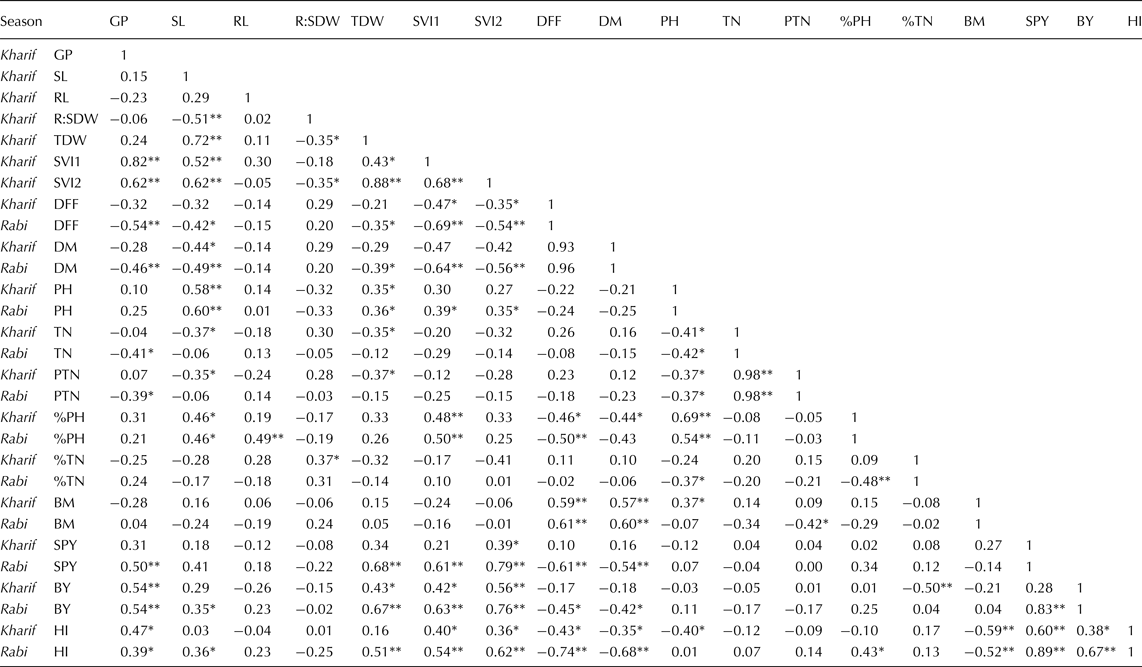
Correlation analysis (Table 2) revealed that germination% (GP) exhibited significant positive correlation with SPY, BY, HI and both seedling vigour indices. SL was positively correlated with root-shoot dry weight, TDW, SVI1 and SVI2. However, RL and root to shoot ratio were negatively associated with all other vigour parameters. SVI1 and SVI2 were positively correlated with germination%, SL and TDW. DFF and DM were positively correlated with BM but negatively with HI, percent increase in plant height (%PH) and seedling vigour indices in both the seasons. PH showed highly significant positive correlation with %PH and TDW but negative correlation with TN and PTN in both seasons. TN showed highly significant positive correlation with PTN in both seasons. SPY showed significantly positive correlation with HI and SVI2 in both seasons. BY showed significant positive association with GP, TDW and SVI2. Similarly, HI showed significant positive association with GP, SL, R:S DW, TDW, SVI1, SVI2, SPY and BY but showed a negative association with DFF, DM and BM.
Correlation matrix of yield and vigour-related traits of Swarna × O. nivara BILs using mean phenotypic data of two seasons Kharif (wet season) 2013 and Rabi (dry season) 2014

Significance levels: *P > 0.05, and **P > 0.01.
BM, biomass; BY, bulk yield; DFF, days to fifty percent flowering; DM, days to maturity; GP, germination percentage; HI, harvest index; PH, plant height at maturity; PTN, productive tiller number at maturity; %PH, Percent increase in plant height; RL, root length; R:SDW, root to shoot dry weight ratio; %TN, Percent increase in tiller number; SPY, single plant yield; SL, shoot length; SVI1, seedling vigour index-1; SVI2, seedling vigour index-2; TN, tiller number at maturity; TDW, total dry weight.
Genotyping using vigour-related SSR markers
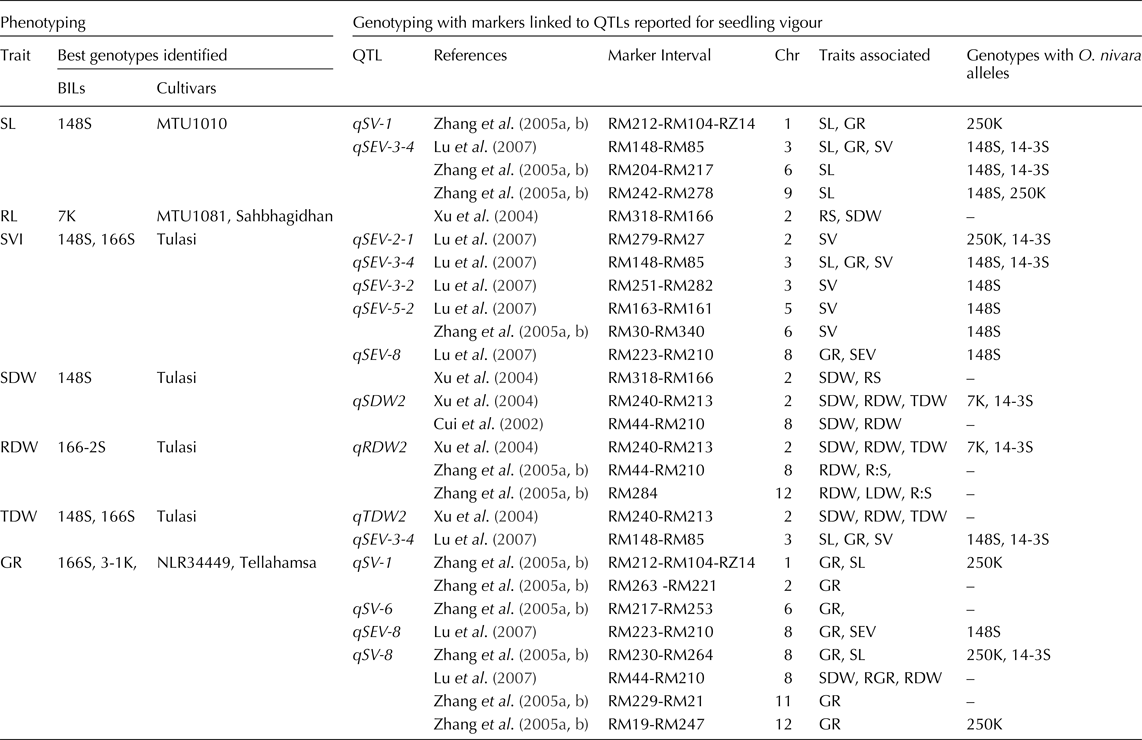
The lines were screened using 27 previously reported SSR markers for vigour related traits and distributed on all chromosomes except 4, 7 and 10 (online Supplementary Fig. S1). A total of 377 alleles were detected, of which Swarna homozygous alleles accounted for 51%, O. nivara homozygous alleles 37% and heterozygous alleles 38%. Considering the O. nivara alleles for vigour traits, 14S showed the highest percentage of O. nivara alleles followed by 65S. It may be noted that 14S is reported to have 72.6% of recurrent parent genome of Swarna using random genome-wide markers (Divya et al., Reference Divya, Subrahmanyam, Badri, Raju, Rao, Kavitha, Sukumar, Malathi, Revathi, Padmavathi, Babu and Sarla2016). Swarna alleles were higher in the most vigourous line 148S but 11% of its alleles were heterozygous. Highest percentage (27.5%) of heterozygous alleles were observed in another high yielding line 166S and its derived line 166-2S. 148S showed more allelic variation for the previously reported markers linked to GP, SL and seedling vigour compared with that seen in other BILs (Table 3). 7K and 14-3S showed O. nivara alleles for dry weight-related QTLs. Heterozygous loci for GP and SL were observed in 250K.
Genotypes with O. nivara alleles for markers linked to seedling vigour-related traits

GR, growth rate; RDW, root dry weight; RGR, root growth rate; RL, root length; R:S, Root shoot ratio; SDW, shoot dry weight; SEV, seedling early vigour; SL, shoot length; SV, seedling vigour; SVI, seedling vigour index; TDW, total dry weight.
Discussion
Seedling vigour is the indicator of ability of plants to accumulate dry matter, tolerance to water limitation and weed competition at an early stage especially in direct and dry sowing conditions (Quarrie et al., Reference Quarrie, Strojanovic and Pekic1999; Balasubramanian and Hill, Reference Balasubramanian, Hill and Pandey2002; Zhao et al., Reference Zhao, Atlin, Bastiaans and Spiertz2006; Mahender et al., Reference Mahender, Anandan and Pradhan2015; Yamane et al., Reference Yamane, Garcia, Imayoshi, Mabesa-Telosa, Banayo, Vergara, Yamauchi, Sta. Cruz and Kato2018). Genotypic variation for seedling vigour was identified among rice cultivars (Krishnasamy and Seshu, Reference Krishnasamy and Seshu1989; Redona and Mackill, Reference Redona and Mackill1996a, Reference Redona and Mackillb; Yamauchi and Winn, Reference Yamauchi and Winn1996; Huang et al., Reference Huang, Zhang, Chen, Cao, Jiang and Zou2017). There is enormous genetic diversity for crop growth and vigour in the available rice germplasm especially in landraces, wild and weedy species which can survive in more adverse environmental conditions (Yamauchi et al., Reference Yamauchi, Aguilar, Vaughan and Seshu1993; Redona and Mackill, Reference Redona and Mackill1996a, Reference Redona and Mackillb; Namuco et al., Reference Namuco, Cairns and Johnson2009).
In this study, variability in vigour traits was observed among BILs at two growth stages and in two seasons in field conditions. Invariably, 148S showed high seedling vigour in both seasons, but other BILs and cultivars showed seasonal variation for both vigour and yield traits. We previously reported that 148S is stable for days to flowering and days to maturity (DM) and 14S and 166S are stable for grain yield compared with Swarna (Divya et al., Reference Divya, Subrahmanyam, Badri, Raju, Rao, Kavitha, Sukumar, Malathi, Revathi, Padmavathi, Babu and Sarla2016). 148S showed good vigour in both paper-roll test method and in field conditions. 7K showed good vigour for RL at 7 and 14 d after sowing in paper-roll method and for TN at 30 d in field conditions in Kharif-2013. There are several studies on genotypic variability (Cruz and Milach, Reference Cruz and Milach2004; Sharifi, Reference Sharifi2010; Zhou and Stephens, Reference Zhou and Stephens2012; Anandan et al., Reference Anandan, Anumalla, Pradhan and Ali2016), mapping of QTLs (Redona and Mackill, Reference Redona and Mackill1996b; Cui et al., Reference Cui, Peng, Xing, Xu, Yu and Zhang2002; Fujino et al., Reference Fujino, Sekiguchi, Sato, Kiuchi, Nonoue, Takeuchi, Ando, Lin and Yano2004; Xu et al., Reference Xu, Li, Xue, Huang, Gao and Xing2004; Zhang et al., Reference Zhang, Yu, Yu, Huang and Zhu2005a, Reference Zhang, Su, Li, Chen and Zhub; Kanbar et al., Reference Kanbar, Janamatt, Sudheer, Vinod and Shashidhar2006; Lu et al., Reference Lu, Niu, Cai, Zhao, Liu, Zhu and Zhang2007; Zhou et al., Reference Zhou, Wang, Yi, Wang, Zhu and Zhang2007; Rebolledo et al., Reference Rebolledo, Dingkuhn, Courtois, Gibon, Clément-Vidal, Cruz, Duitama, Lorieux and Luquet2015; Subudhi et al., Reference Subudhi, Leon, Singh, Parco, Cohn and Sasaki2015) and marker-assisted gene pyramiding (Redona and Mackill, Reference Redona and Mackill1996b; Cui et al., Reference Cui, Peng, Xing, Xu, Yu and Zhang2002; Fujino et al., Reference Fujino, Sekiguchi, Sato, Kiuchi, Nonoue, Takeuchi, Ando, Lin and Yano2004) related to seedling vigour in rice. QTL hotspots for early vigour in dry DSR were identified on chromosomes 3 and 5 recently (Singh et al., Reference Singh, Yadav, Dixit, Ramayya, Devi, Raman and Kumar2017). Attention has been paid to introgression of beneficial alleles from wild rice into elite breeding lines (Multani et al., Reference Multani, Jena, Brar, Delos Reyes, Angeles and Khush1994; Brar and Khush, Reference Brar and Khush1997) through BIL approach (Monforte and Tanksley, Reference Monforte and Tanksley2000; Li et al., Reference Li, Thomson and McCouch2004). BILs can be developed through a series of backcrosses, containing wild segments in a cultivated genetic background (Tian et al., Reference Tian, Li, Fu, Zhu, Fu, Wang and Sun2006a, Reference Tian, Zhu, Zhang, Tan, Fu, Wang and Sunb; Tan et al., Reference Tan, Liu, Xue, Wang, Ye, Zhu, Fu, Wang and Sun2007; Barone et al., Reference Barone, Matteo, Carputo and Frusciante2009). These BIL populations can accelerate molecular breeding and improve the traits of agronomic importance without much linkage drag from wild species.
Previous studies focused mainly on the traits associated with seedling vigour, including RL, SL and dry weight which contribute to final yield and yield components (Regan et al., Reference Regan, Siddique, Turner and Whan1992; Redona and Mackill, Reference Redona and Mackill1996a, Reference Redona and Mackillb). Variability in seedling vigour depends on several component traits, environment interactions, stress at various crop stages and also post-harvest drying and storage conditions of seed (Bewley et al., Reference Bewley, Bradford, Hilhorst and Nonogaki2013; Guan et al., Reference Guan, Lu, Zeng, Zhang and Zhu2013). Laboratory screening procedures have been usually followed to measure seedling vigour in rice in most of the studies (Redona and Mackill, Reference Redona and Mackill1996a, Reference Redona and Mackillb; Zhang et al., Reference Zhang, Su, Li, Chen and Zhu2005a, Reference Zhang, Yu, Yu, Huang and Zhub). We used paper roll method in laboratory conditions to estimate seedling vigour. The rate of germination and rate of root and shoot growth determines seedling vigour. Both of them indicate nutrient uptake and carbohydrate accumulation in growth and development (Krishnasamy and Seshu, Reference Krishnasamy and Seshu1989; Redona and Mackill, Reference Redona and Mackill1996a, Reference Redona and Mackillb; Cui et al., Reference Cui, Peng, Xing, Xu, Yu and Zhang2002). It was observed that 148S attained maximum vigour within 7 d of germination, but other genotypes attained maximum vigour at 14 d. The vigorous phenotype among these BILs was contributed either by plant height, tiller number, BM, root parameters or their combinations. 148S has longer nodal root system with fine lateral roots. Nodal roots form the basic framework of the root system and fine lateral roots form the primary mechanism for absorbing water and nutrients (Gu et al., Reference Gu, Zhen, Hannaway, Zhu, Liu and Cao2017). The studies using petri plate and paper roll method showed the similar ranking of genotypes for vigour as ranking based on field studies indicating that environmental conditions had little effect in selecting the most vigorous genotypes.
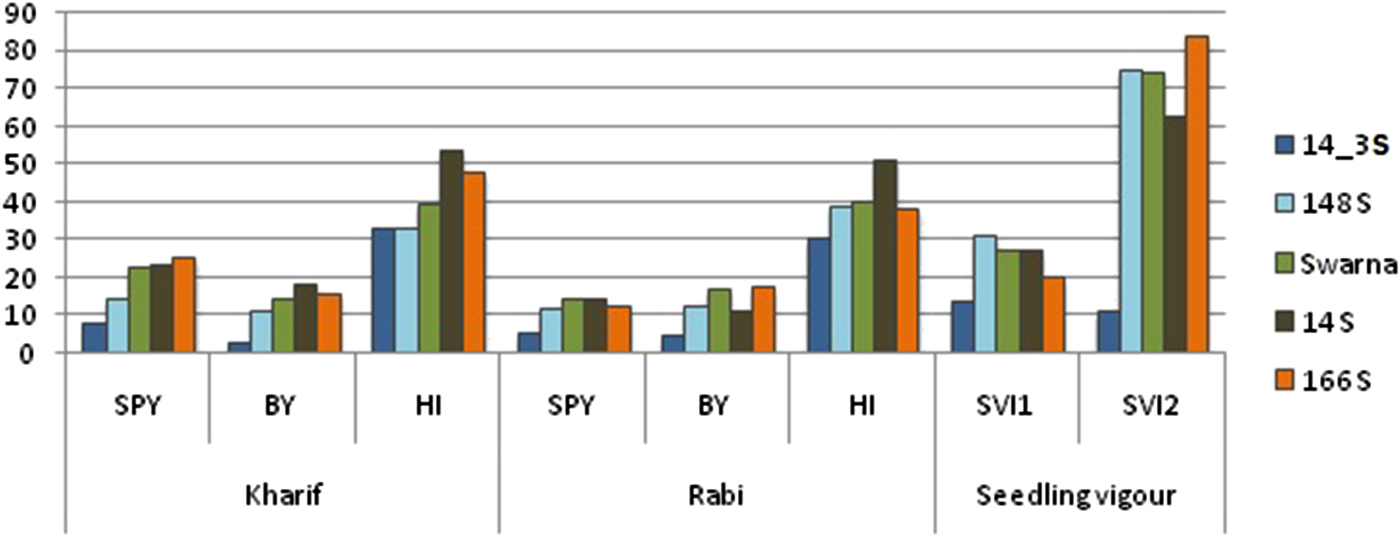
Association studies among yield and vigour traits using data from two seasons showed that DFF had a significant positive correlation with BM and negative correlation with HI, PH and SVI in both the seasons. PH was significantly correlated with SL in a positive direction but with tiller number and root/shoot dry weight ratio in a negative direction in both seasons. SPY exhibited a significantly positive correlation with HI in both seasons. This study revealed significant correlations among the seedling vigour traits in both seasons. Zhang et al. (Reference Zhang, Su, Li, Chen and Zhu2005a, Reference Zhang, Yu, Yu, Huang and Zhub) reported that SL is the best predictor of seedling vigour and a phenotypic indicator of plant vigour in rice. In our study, SL and RL were significantly correlated with shoot dry weight and root dry weight but in the negative direction. However, TDW showed a highly positive correlation with SL and seedling vigour indices in both seasons. Cui et al. (Reference Cui, Peng, Xing, Xu, Yu and Zhang2002) reported a positive correlation of maximum RL with RDW and SDW. They also reported strong correlation between amylase activity in germinated seed with seedling dry weight. Vigour is associated with amylase activity and breakdown of starch in the endosperm (Williams and Peterson, Reference Williams and Peterson1973; Sasahara et al., Reference Sasahara, Ikarashi and Kambayashi1986). SPY and BY showed correlation with SVI2 based on dry weight, while HI showed association with SVI1 that is based on seedling length in all the genotypes (Fig. 3). Singh et al. (Reference Singh, Yadav, Dixit, Ramayya, Devi, Raman and Kumar2017) reported strong correlations between early vigour and grain yield in Swarna/Moroborekan BC3F4 mapping population grown in field and glasshouse conditions.
Seasonal yield and seedling vigour index of four BILs compared with parent Swarna.

Molecular screening of BILs with 27 SSRs revealed 37% homozygous O. nivara introgressions and 38% of heterozygous alleles. 14S had the highest percentage (12%) of O. nivara introgression among BILs. Most of the high yielding BILs were identified to harbour QTL regions for vigour traits which were earlier reported. QTLs qSV-6 for GR, SL and RL were identified between marker interval RM217 and RM253 (Zhang et al., Reference Zhang, Su, Li, Chen and Zhu2005a, Reference Zhang, Yu, Yu, Huang and Zhub) and QTL qSEV-8 was identified for seedling vigour related traits between RM223 and RM210 (Lu et al., Reference Lu, Niu, Cai, Zhao, Liu, Zhu and Zhang2007). In this study, we found 14S, 148S, 3-1K and 250K have the complete QTL at chromosomal regions between RM217 and RM253 on chromosome 6 from O. nivara and 14S, 14-3S, 65S, 70S, 75S, 166S, 166-1S and 7K have the QTL region for seedling vigour from O. nivara at the chromosomal region between RM223 and RM210. Singh et al. (Reference Singh, Yadav, Dixit, Ramayya, Devi, Raman and Kumar2017) reported early vigour QTLs in BC3F4 lines derived from Swarna × Moroberekan using SNP genotyping and one QTL qEV6.1 for early vigour was identified on chromosome6.
Similarly, QTL region RM19-RM247 on chromosome 12 was reported to be associated with GR (Zhang et al., Reference Zhang, Su, Li, Chen and Zhu2005a, Reference Zhang, Yu, Yu, Huang and Zhub). 250K was found to have O. nivara alleles for the QTL at this chromosomal region. Thus, it is evident that BILs derived from O. nivara have potential alleles for seedling vigour and related traits. 14S and 166S, with higher seedling vigour were also found to be stable BILs for yield and 148S for earliness (Divya et al., Reference Divya, Subrahmanyam, Badri, Raju, Rao, Kavitha, Sukumar, Malathi, Revathi, Padmavathi, Babu and Sarla2016). Introgression lines can be shared with researchers under a Material Transfer Agreement (http://www.icar-iirr.org/). These BILs can be utilized to introgress seedling vigour traits into elite breeding lines for DSR.
Acknowledgements
This research was conducted in project (ABR/CI/BT/11) on Mapping Quantitative Trait Loci (QTLs) for yield and related traits using backcross inbred lines (BILs from Elite × Wild crosses of rice (Oryza sativa L.) as part of ICAR-National Professor Project (F. No: Edn/27/4/NP/2012-HRD) funded by Indian Council of Agricultural Research, New Delhi, India. These lines were developed in the Department of Biotechnology (DBT) New Delhi, India funded project BT /AB/FG-2 (Ph-II) 2009 to SN. The authors are grateful to the Director, ICAR-IIRR for providing facilities.
Supplementary material
The supplementary material for this article can be found at https://doi.org/10.1017/S1479262118000187.