Introduction
This study examines the response of low-income single mothers in Israel to a pension policy that creates inequality between underprivileged and privileged populations (Brander, Reference Brander2011; Spivak and Zemach, Reference Spivak and Zemach2017). It aims to demonstrate the effects of the neoliberal demand for economic autonomy from single mothers under market liberalisation processes and changes in national insurance and pension systems. This process of significant change in pension systems is part of policy in several Western countries, where individuals have been left with much greater responsibility for their own financial wellbeing (Bannier and Schwarz, Reference Bannier and Schwarz2017; Benish et al., Reference Benish, Haber and Eliahou2017; Bettio et al., Reference Bettio, Tinios and Betti2013; Frericks, Reference Frericks2013; Lurie, Reference Lurie2017). I use Israel as a case study in light of the transition in welfare policy directed at mothers, from the ‘working mum,’ whereby mothers are expected to be employed while putting their caring obligations first (Izraeli, Reference Izraeli, Lewis, Izraeli and Hootsmans1992), to the ‘self-sufficient’ mum, where all mothers are required to participate in the labour market regardless of their domestic and caring obligations (for other countries, see Breitkreuz and Williamson, Reference Breitkreuz and Williamson2012).
Welfare-to-work (hereafter WTW) programmes and their encouragement of pension savings are part of neoliberal practices, based on giving individuals entrepreneurial freedom and skills within an institutional framework characterised by strong private property rights, a free market and free trade (Harvey, Reference Harvey2005). The uniqueness of this paper lies in its examination of the demand for economic autonomy and ‘personal responsibility’ from single mothers, as participants in such programmes, at two distinct points of time. First, they are required to take responsibility in the present for their livelihood and support their children by entering the labour market or improving their wages. Second, they are subject to the demand for economic responsibility as citizens who care for their long-term future: that is, at retirement age. Specifically, based on interviews of 62 single mothers who participated in one WTW programme, as well as 20 trainers from the programme, the study looks at how the mothers experience imperatives regarding paid labour and pension savings and the demand that they become economically accountable, i.e. take responsibility not only for their present economic situation, but also for their old-age finances under multidimensional vulnerability. The research question is: what are the mothers’ expectations about their future retirement entitlements, and do they feel it is worth working in poorly paid jobs for this purpose?
The contribution of the research is twofold. On a theoretical level, the study seeks to add a layer to knowledge about WTW programmes in the neoliberal context, mainly with respect to participants’ economic responsibility for their pensions. On an empirical level, the study provides data on women's attitudes regarding their economic future at retirement age, of which there is little qualitative research.
The pension problem in a gender perspective
The financial disadvantages that women, and especially single mothers, face in retirement is well researched, as is the precarious financial situation of many older women in developed countries (Peeters and Wouter, Reference Peeters and Wouter2015; Tinios et al., Reference Tinios, Bettio and Betti2015), who have higher poverty rates than men (Bettio et al., Reference Bettio, Tinios and Betti2013; Bíró, Reference Bíró2013; Lloyd-Sherlock et al., Reference Lloyd-Sherlock, Corso and Minicuci2015). People are living in retirement for about 20–30 years, making it a significant part of their lives. Based on the ‘male breadwinner’ model, which became dominant after the Second World War in most European countries (Bonnet and Hourriez, Reference Bonnet and Hourriez2012; Tinios et al., Reference Tinios, Bettio and Betti2015), pension systems are designed so that male support of dependents continues even after his death, through survivor pensions (Bonnet and Hourriez, Reference Bonnet and Hourriez2012). This is true not only in Bismarckian systems (France, Germany, Italy), but also in northern Europe (Scandinavia and English-speaking countries).
So long as marriages were stable and the ‘male breadwinner’ model was dominant, women were covered financially by their husbands. However, in recent decades, women's participation in the workforce has increased sharply and divorce rates have risen significantly, which, in conjunction with the feminisation of poverty, makes the woman's place in the pension debate particularly acute. Women tend to be more economically vulnerable than men after divorce (Manting and Bouman, Reference Manting and Bouman2006; Raz-Yurovich, Reference Raz-Yurovich2013) and more financially vulnerable in retirement due to longer life expectancy and greater chances of chronic disease (DeVaney and Kim, Reference DeVaney and Kim2003; Suzman and Beard, Reference Suzman and Beard2016). More women than men are left alone at the age of retirement (Bíró, Reference Bíró2013; Lloyd-Sherlock et al., Reference Lloyd-Sherlock, Corso and Minicuci2015).
The gender gap in pensions is related to disparities between men and women with respect to career tracks: women tend to have poorer working conditions and a higher incidence of part-time work because they tend to hold the social role of primary caretaker of parents, children and other relatives (Bonnet and Hourriez, Reference Bonnet and Hourriez2012; Duvvury et al., Reference Duvvury, Léime, Callan, Price and Simpson2012; Lee and Tang, Reference Lee and Tang2015). On the whole, women do the housework without pay; they work fewer paid hours than men; and there is a gender gap in pay (Bonnet and Hourriez, Reference Bonnet and Hourriez2012; Ferrant et al., Reference Ferrant, Pesando and Nowacka2014; ISSP, 2012; Stier, Reference Stier, Muhlbauer and Kulik2010). This has expanded gender discrimination in the labour market into old age (Rögnvaldsdóttir and Pétursdóttir, Reference Rögnvaldsdóttir and Pétursdóttir2012). As a result, despite their participation in the labour market, women accumulate fewer retirement pensions and depend more than men on benefits provided by the state. Furthermore, low pay makes it very difficult for women to save up for retirement (Duvvury et al., Reference Duvvury, Léime, Callan, Price and Simpson2012) and makes them less likely to obtain sufficient retirement income (Rögnvaldsdóttir and Pétursdóttir, Reference Rögnvaldsdóttir and Pétursdóttir2012).
Welfare-to-work and pensions
A significant share of the scholarship criticising WTW programmes (Albelda, Reference Albelda2011; Bennet, Reference Bennet2017; Breitkreuz and Williamson, Reference Breitkreuz and Williamson2012; Korteweg, Reference Korteweg2003, Reference Korteweg2006; Pulkingham et al., Reference Pulkingham, Fuller and Kershaw2010; Wright, Reference Wright2012) focuses on their limited ability to generate stable working lives for those whose welfare support has been substantially restricted. Most of the critiques analyse the failure of such programmes to meet their stated goals, showing that participating mothers are offered part-time, low-wage jobs and given little additional help with childcare, occupational training and other issues, such as housing, education and health. Studies have also indicated that the working poverty of mothers is generated by repeated transitions in and out of paid employment (Albelda, Reference Albelda2011; Millar and Ridge, Reference Millar and Ridge2009). Employment opportunities available to them offer low pay and intensive or unconventional work hours, limiting their time to care for their children (Albelda, Reference Albelda2011).
Within this context, the transition in Israeli welfare policy – from encouraging the ‘working mum’ who is expected to put her caring obligations before her employment (Izraeli, Reference Izraeli, Lewis, Izraeli and Hootsmans1992) to focusing on the ‘self-sufficient’ mum who is required to work regardless of her domestic obligations – has had substantial implications for low-income single mothers. Potentially changing the view of women from mothers to workers and shifting toward gender sameness (but not necessarily gender equality), the policy has remained organised around a dual-earner model (Daly, Reference Daly2011), with negative implications for those lacking support (partners or policy solutions) to address this change in role focus.
The work history of poor mothers and its implications for their pensions
One of the premises in the field of the ‘working poor’ is that oppressed social categories, including women, are more vulnerable to labour-market experiences that lead to a ‘working poor’ quality of life (e.g. Kalleberg, Reference Kalleberg2011; Zeytinoglu and Muteshi, Reference Zeytinoglu and Muteshi2000). Moreover, many women are employed in physically demanding or taxing jobs (e.g. domestic, industrial and farm labour) that lead to an earlier departure from the paid labour force. This usually entails leaving the labour market permanently (Flippen and Tienda, Reference Flippen and Tienda2000; Jacobs et al., Reference Jacobs, Laporte, Van Houtven and Coyte2014), and it has significant explanatory power regarding poverty among the elderly. As Gonyea and Hooyman (Reference Gonyea and Hooyman2005) have shown, even a lifetime of employment does not guarantee a financially secure retirement, especially for the working poor. Ensuring future economic sustainability is increasingly important for the highly vulnerable group of single mothers (Peeters and Wouter, Reference Peeters and Wouter2015).
Single motherhood welfare and pension policy in Israel
Israel belongs to the Mediterranean welfare state regime, which has had limited success in alleviating poverty and overcoming social and economic gaps (Gal, Reference Gal2010). This situation is exacerbated by changes in welfare policy that impact the present and future financial situations of mothers.
Israel has traditionally had a pro-natal welfare policy and has one of the highest birth rates among OECD countries, with an average of 3.08 children per woman, compared to 1.68 in the OECD (OECD, 2017). Ajzenstadt and Gal (Reference Ajzenstadt and Gal2001) argue that Israel's welfare policy has been marked by a concern for national-demographic goals and has been less focused on mothers as individuals who require social rights.
Since the 1990s, a neoliberal economic policy has gained impetus, aimed at reducing the welfare state and marked by significant allowance cuts, the privatisation of social services and the privatisation of employment pensions. Two changes relevant to single mothers have occurred: the welfare reform of 2003, which affected family allowances at working age; and a profound reform of pensions, which began in the 1990s and continued into the twenty-first century.
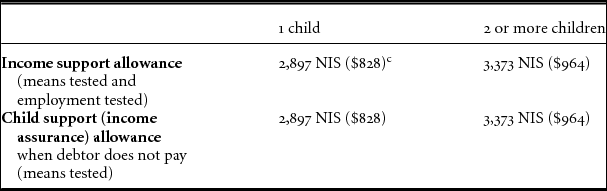
The welfare reform of 2003 introduced cuts in income support and child support (income assurance) allowances (by approximately one third), as well as in child benefits (by approximately one half). Consequently, these allowances became less accessible, especially to many low-income workers, who also lost entitlement to a supplementary allowance to their low wages as a result of cuts in the ‘disregard’ (Herbst and Kaplan, Reference Herbst and Kaplan2016) – a benefit that allows low-wage employees to both work and receive an allowance (Gal and Doron, Reference Gal and Doron2000). Cuts in the amount of the disregard affected the earning power of low-income workers, making it less lucrative to work, as many were no longer entitled to receive an allowance supplementing their wages. Indeed, there was a sharp drop of 53 per cent in the number of single-parent families receiving income support allowances between 2003 and 2016 (when this study was completed; on allowances in 2016, see Appendix, Table 1). The number of recipients of child support (income assurance) allowance also declined sharply during those years by 36 per cent. In 2016, 24.5 per cent of children in Israel (compared to 13.6 per cent in the OECD) and 26 per cent of single-parent families were living in poverty after taking allowances into account; moreover, in 14 per cent of poor families both spouses were working (Endeweld et al., Reference Endeweld, Gottlieb, Heller and Karady2017).
A second profound change was related to pension reform. The sources of income upon retirement in Israel form a three-pillar structure: (1) an old-age pension from National Insurance; (2) an employment pension based on the individual's earnings; and (3) personal savings (Lurie, Reference Lurie2017). This paper focuses on changes related to the first two. The following provides a brief chronology of the pension reform with respect to these two pillars.
The old-age pension from National Insurance (first pillar) was first enacted in the 1950s. It was available to women from age 60 and men from age 65, based on income tests; and to women from age 65 and men from age 70 without income tests. Enactment of the Retirement Age Law in 2004 and revision of the National Insurance Law (Consolidated Version) 1995 led to a gradual rise in the age of women's eligibility for old-age pensions. The minimum age of entitlement with income tests was now 62 for women and 67 for men, and age 70 for both genders without income tests. Further, minimum age for women dependent on income tests would continue to increase until (in 2020) it equalled the age of entitlement for men (both of which would increase to 70).
With regard to employment pensions (the second pillar), from the 1950s, public sector workers and working members of the Histadrut labour union (the largest and oldest labour organisation in Israel) enjoyed broad benefits of civil service pensions anchored in collective agreements, based on the defined benefit (DB)Footnote 1 model. Pension contributions were made by the employer (the state), rather than split between employer and employee. All other employers and employees were not required to make mandatory pension contributions.
As in many developed countries (Benish et al., Reference Benish, Haber and Eliahou2017; Frericks, Reference Frericks2013; Lurie, Reference Lurie2017), increased life expectancy and economic crises in Israel led to actuarial deficits in pension funds, which have in turn generated trends to reduce pension costs. Peleg (Reference Peleg2006) claims that the Israeli Ministry of Finance attacked the failed management of these funds, mainly by the Histadrut, with the aim of weakening the power of the union and its workers. In fact, pension privatisation is part of neoliberal logic. At any rate, this resulted in several changes in employment pensions, beginning in the 1990s. First, admission of newcomers to civil service pension funds was blocked. Second, pension funds were first nationalised and then sold to private insurance companies – as in Chile, which replaced its entire public pension system with privately managed pensions, but in contrast to most European countries, where funds are run by non-profit employee and employer organisations (Achdut and Spivak, Reference Achdut and Spivak2010; Peleg, Reference Peleg2006). Third, new pension funds moved from defined benefit (DB) to defined contribution (DC) plans,Footnote 2 similar to events in Germany, the UK, the US and the Netherlands (Bridgen and Meyer, Reference Bridgen and Meyer2014).
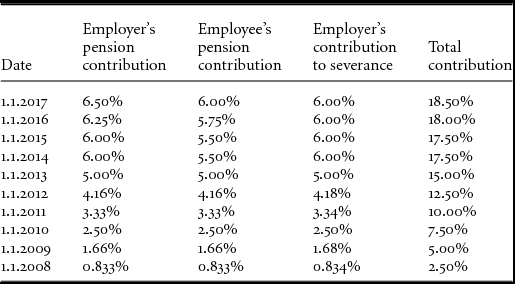
Finally, in an attempt to protect wage earners who were not insured under any pension arrangement (about one-third of the civilian labour force; CBS, 2009), enforcement of a collective agreement addendum in 2008 obliged employers and employees to start paying pension contributions (for contribution rates and details of this arrangement, see Table 2 in the Appendix). This is in keeping with most OECD countries, which have instituted mandatory pension savings (OECD, 2012, 2014).
The abovementioned reforms in Israel have led to entrenched gender and income inequalities. First, the move from a DB plan to a DC plan imposed risks and costs on savers, including investment risk, individual mortality risk, cohort mortality risk, salary risk and job tenure risk (Lurie, Reference Lurie2017). Second, privatisation of the funds significantly increased management fees, with the weakest workers now paying the highest fees (Bank of Israel, 2015), and led to the investment of pension funds in the stock exchange, so that the basic yield, which used to be guaranteed by the state via designated bonds, was considerably reduced (Achdut and Spivak, Reference Achdut and Spivak2010). Third, prior to the reform, the working poor could receive an old-age pension supplemented by an income support allowance for the elderly poor, but now they are required to make employee pension contributions from their meagre wages (Brander, Reference Brander2011). Fourth, tax credits for pension savings provide little relief for the poor, as low-income employees who do not reach the tax threshold (41.4 per cent of working men and 66.4 per cent of working women; Brander, Reference Brander2011; Ministry of Finance, 2015) cannot take advantage of these benefits. Finally, pension annuities are now calculated according to life expectancy, which decreases monthly benefits for retired women (Achdut and Spivak, Reference Achdut and Spivak2010; on other countries, see Frericks, Reference Frericks2013; Renga et al., Reference Renga, Molnar-Hidassy and Tisheva2010).
Labour market changes in Israel have also made employment pensions less reliable. The structure of the contemporary labour market includes a broad class of workers (mainly mothers) in sustained employment instability, with ‘precarious’ jobs reflected in lowered wages; involuntary temporary, part-time and/or seasonal employment; and deteriorating working conditions, without adequate social benefits (Benjamin, Reference Benjamin2016). Indeed, a study of OECD countries showed that the provision of pensions from low wages may significantly impair the quality of life of vulnerable groups in the labour market because present consumption is more significant than future needs (Olivera and Ponomarenko, Reference Olivera and Ponomarenko2017).
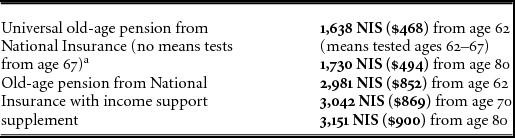
Moreover, the long-term benefits of employment pension savings in Israel are similar to the income support supplement to the National Insurance old-age pension. The maximum pension annuity expected for a woman joining the labour market at age 37 and working at minimum wage is 40 per cent of her earnings at age of pension (about 1800 NIS or $500),Footnote 3 while the income support supplement adds 1400 NIS ($400) to the old-age pension (see Tables 3 and 4 in the Appendix). As continuous full-time employment is virtually impossible for low-paid single mothers, the employment pension annuity may be considerably lower. In other words, even after saving for 30 years, which constitutes a significant deduction from their very low wages, women end up with a pension not far removed from what they would receive had they not worked. As the income supplement is state-financed, encouragement of these women to work and pay pension contributions saves the state in expenses.
These legislative changes ignore the affirmative action previously given to women for their ‘second shift’ as mothers, which means they work as both unpaid caregivers and paid employees, reinforcing the transition from the ‘working mum’ path to ‘self-sufficiency.’ As Pfau-Effinger (Reference Pfau-Effinger2005) pointed out, legal regulations and policies are embedded in a social context.
As elsewhere in liberal welfare states (e.g. the US and the UK), policy reform in Israel has been accompanied by a policy of ‘activation’ (Herbst, Reference Herbst2013). The 2003 reform outlined a policy of integrating mothers into the job market by enacting several WTW programmes. Mandatory activation programmes operated between 2005 and 2010 based on the Wisconsin model. In addition, non-mandatory activation programmes, which do not condition welfare allowances on acceptance of employment opportunities, have been operated by various tendered service deliverers. In this study, I examine one of these non-mandatory WTW programmes: Woman of Valor.
Welfare-to-work: Woman of Valor
The Woman of Valor programme comes under the auspices of the Ministry of Welfare and is de facto operated by NGOs. Offering preparatory workshops and brief training, the programme's aim is to deepen and improve the labour-market position of mothers from vulnerable groups by helping the unemployed find jobs and by helping the employed improve their existing work conditions (hours, salary, job security) and gain access to better job opportunities (Yaron-Ambia, Reference Yaron-Ambia2011). As part of their training, the mothers hear lectures on the importance of paid work, including the significance of pension savings, emphasising the connection between current employment and future pension. The non-mandatory nature of the programme means that welfare allowance is not revoked from participants who reject jobs offered to them (Herbst and Benjamin, Reference Herbst and Benjamin2016). However, like WTW programmes in other countries (Breitkreuz and Williamson, Reference Breitkreuz and Williamson2012; Korteweg, Reference Korteweg2006; Pulkingham et al., Reference Pulkingham, Fuller and Kershaw2010), Woman of Valor is part of a neoliberal project that places the responsibility for one's financial fate on the individual.
Initially developed for Jewish mothers who had immigrated from Ethiopia, the programme was expanded to include other groups of mothers with historically low labour-market participation, such as Jewish women originally from the former Soviet Union (from the Asian regions of Caucasus and Bukhara) and women residing in the periphery, the majority of whom are Mizrachi Jews and Israeli Palestinians.
The programme has evolved as a culturally sensitive activation project operating on a community level. Woman of Valor groups are formed in communities with high rates of families from a specific ethnic background. Almost all trainers share the same ethnic background as participants.
Trainers are recruited by a national trainer and by the Department of Social Welfare in the local authority. Job requirements include leadership and management abilities, good interpersonal skills, experience with teamwork, experience working with partners (e.g. employers, community centres, local authorities), the ability to adopt a culturally sensitive approach, and work experience in the field of employment.
Methodology
The study is part of a larger research project involving semi-structured, in-depth interviews, held between November 2011 and July 2015, of 20 trainers and 105 mothers (62 single, 43 married) participating in the Woman of Valor WTW programme. All study participants were immigrants from the former Soviet Union (hereafter FSU) and Ethiopia, as well as Israeli Palestinians and Mizrachi Jews (Jews originally from Asia and Africa and their descendants). Most of the mothers lived in poverty. In addition to their vulnerable ethnic status, most resided in Israel's periphery (characterised by less accessible public transportation, generally higher unemployment, and fewer available jobs than in the centre of the country). This article is based on interviews with the 62 single mothers and the 20 trainers.
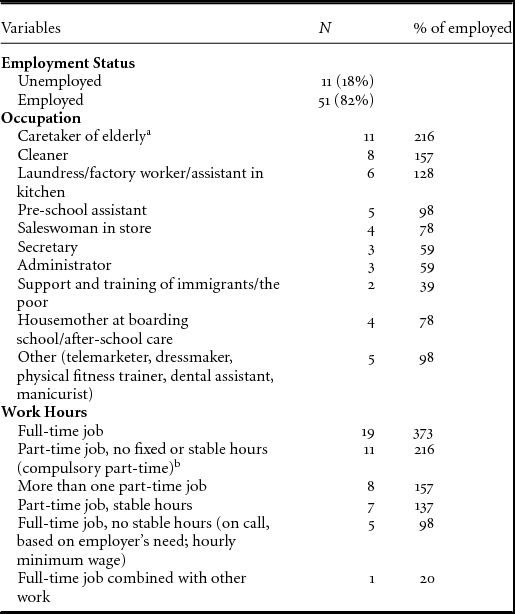
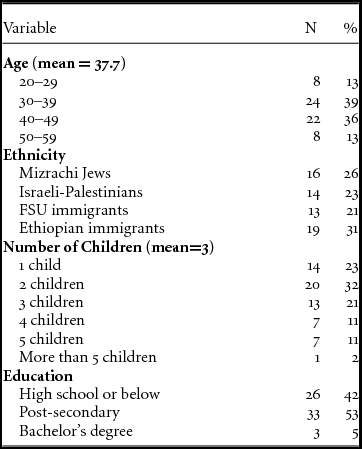
Some of the single mothers interviewed received survivor allowances, income support or child support (income assurance) from the National Insurance Institute. The vast majority (82 per cent) were employed.Footnote 4 Sixteen percent were living with their parents. The employment history of most mothers involved devoting more time to unpaid domestic work and less to paid jobs, reducing work hours in order to serve as primary caretaker for parents, children and other relatives. For detailed characteristics of the single mothers, see Tables 5 and 6 in the Appendix.
The mothers were asked about their children and motherhood; their financial knowledge about their salary and pension; and what they thought about their economic future as a result of labour-market participation. Those who were not employed when interviewed were asked how they believed working would impact their economic future. Sample questions (worded slightly differently for non-working mothers) included: Are there difficulties you face with your children on a daily basis owing to your increased participation in employment? How do your children feel about you being a working mother? Do you keep track of your pension statements? Do you know how much money you're entitled to when you retire? What do you know about your rights at your place of employment? Does the Woman of Valor programme give you information on your rights as an employee?
Trainers were asked such questions as: Do you believe the mothers in your Woman of Valor group have a chance for a better economic future because of the programme? How might the programme affect the mothers’ economic status when they reach the age of retirement?
Individual interviews, lasting one to two and a half hours, were mainly carried out in participants’ homes; some were held at the local community centre or at the women's workplace. The majority were conducted by the leading investigator (the author); the rest were performed by six research assistants. We all introduced ourselves personally and explained the research project, guaranteeing the respondent's confidentiality (see Monroe and Tiller, Reference Monroe and Tiller2001). Most interviews were conducted in Hebrew, but some were in Amharit, Russian or Arabic (depending on the participant's request and their native tongue) and translated into Hebrew for data analysis.
All interviews were recorded and transcribed. Following grounded theory, the recorded interviews were analysed thematically (Charmaz, Reference Charmaz2014). We conducted multiple readings and, based on systematic repetition in the data (Lieblich et al., Reference Lieblich, Tuval-Mashiach and Zilber1998), identified a number of units of prominent meaning, which became the main themes. This process of repetition allowed me to make implicit connections between the daily lived experiences of study participants and WTW initiatives explicit (see Breitkreuz and Williamson, Reference Breitkreuz and Williamson2012).
To achieve rigour (Lincoln and Guba, Reference Lincoln and Guba1985), the researchers corresponded after each interview on special issues and themes that had emerged. Each interview was thus analysed twice, once after conducting it and again after extracting the themes, by both the leading investigator and the research assistants (see Wertz et al., Reference Wertz, Charmaz, McMullen, Josselson, Anderson and McSpadden2011). After the first ten interviews, we stopped and examined new topics that had arisen, repeating this every ten interviews until we reached saturation (see Strauss and Corbin, Reference Strauss and Corbin1990).
Findings
I found two types of response to the WTW programme content and imperatives. The first was single mothers who believe they will have a better financial future thanks to the programme's encouragement of employment and thanks to the financial knowledge they have gained in the programme and through work experience. This group also includes trainers who believe in the programme's ability to guide mothers to better employment in the present and future financial security through their pensions. The second group is single mothers who were forced into working poverty but do not believe that employment betters their present or future; what they see is an exploitative reality which they choose to survive. The trainers who fall in this group also find themselves helpless in the face of such exploitation, which provides no financial security in the present or future.
Building the ‘moral’ mother who plans her future
The first group of single mothers believes that paid work is better than unemployment, even if the salary is very low. These mothers have clearly internalised the neoliberal message of working at any cost, as well as the WTW message that to work is equivalent to being moral. Miri, for instance, believes she has to be a self-sufficient mother who ensures herself an employment pension:
Sure, it's not a question at all. Who will give? The state? On what basis? We need to set [funds] aside and to pay for [pension and other private] insurance. I see older people and how they live on allowances, it's nothing, maybe it's enough to pay for electricity, gas and water. Not to mention property taxes and other life expenses. Sure, it [making pension contributions] affects my [future pension] benefits. And if you have no support, no rich kids or parents, no rich uncle – then you will not have anything in life (Miri, divorced, mother of two, Mizrachi descent, pre-school assistant).
Miri explains that each citizen has to worry about their own future and no one should rely on the state's old-age allowance. Everybody needs to make pension contributions if they want to be able to subsist. This echoes Korteweg's (Reference Korteweg2003) claim that WTW programmes attempt to transform welfare-reliant women into self-sufficient individuals and is reflected in the words of one of the interviewed trainers:
When you enter the job market, you slowly go through a process where you can also increase your salary. If a woman is now able to work only four or five hours, in another six months she might be able to work full time and earn more. After she learns something, then it can also get better – once she gets more experience and seniority. I mean, things get better as she persists and she'll probably become more literate. So I think she'll have a chance for a better economic future. To tell you that it will take them out of the poverty they are in – I'm not sure. We are still talking about a salary that's not high. [. . .]. But it's a better place (Adva, trainer, Mizrachi descent).
The WTW trainer speaks of gradual progress in wages, but she knows there is a chance the mothers in the programme will remain among the working poor.
Similarly, the trainer below explains the importance of work for investment in a pension plan for the future:
I tell them: ‘Now do what you want, but you should have a future and a paid pension. You have to think here of yourself, always think you need a pension, you need a regular job’ [i.e. steady work with a pay slip and employee benefits] (Ibtihag, trainer, Israeli Palestinian).
This Palestinian trainer encourages the mothers in her group to work, but she ignores the fact that, where they all live, it is difficult to find paid work because factories near their villages have closed, reducing employment options, especially for Israeli-Palestinian mothers (Mizrahi-Simon, Reference Mizrahi-Simon2016; OECD, 2010). Expressing a neoliberal rationale and the imperative of self-sufficiency, she emphasises the responsibility of the individual and disregards the enormous structural barriers that stand in the way of these single mothers. Thus, her narrative is reminiscent of the coercive discourse that Korteweg (Reference Korteweg2003) found among WTW trainers.
Understanding pension policy as worthless
The second group of single mothers chooses to work even though such employment barely allows them to eke out an existence. They work from lack of choice, but they also believe the state must change its policy in order to transform the economic situation. These women do not embrace the narrative that work creates a better economic future.
Dikla describes her difficulty subsisting in the present, as she is divorced with young children and the state does not provide subsidised care solutions for them. She does not envision a future of hope because her current salary does not allow her to save enough for retirement:
I think about these amounts [monthly pension upon retirement] quite a bit. And you can't, I don't think it would be possible to live with [such a pension], it will be very difficult. . . . But the sum is comical, symbolic. Especially since I'm not earning much, and when you look at how much I earn and the [pension] calculations are made on its basis. . . it's really not much. It would be good if [the situation] could change. [. . .] I would like to work in a more organised workplace, with good social benefits, and of course to have a higher salary than I earn today. [. . .] But even if I work full time, I have to worry about someone staying with my children until I get back. I have to pay for that, which means I get the same thing. I would be earning a little more, but the money would go to the babysitter (Dikla, divorced, mother of two, FSU descent, factory worker).
Bina not only claims that her future pension will be insufficient, but she also feels that policymakers are deceiving citizens. She does not believe that the present pension policy guarantees her a safer economic future:
All policy processes regarding pensions, everything that everyone [policymakers] does, is deceit. What will happen when we retire? Didn't you see that? What will we eventually get when we retire? I don't know what the worker will eventually get, I do not know that (Bina, divorced, mother of two, FSU descent, secretary).
In this regard, a discourse of ambivalence emerges from the trainers. Orit speaks of the imperative to send participants to work in the present, but is very skeptical of the ability of these women to subsist in the future and to arrange for an adequate pension:
Forget the future, right now it's difficult for them to hold their own. I don't see, I mean, it's as if the future. . . you know, it starts from the present. When the present gets better. . . . Instead, where they are at the moment does not guarantee them anything but temporary survival, I think (Orit, trainer, Ethiopian immigrant).
Throughout her interview, Orit spoke in a tone of despair, often expressing difficulty with the policy of sending Ethiopian mothers to work at any cost, usually in labour-intensive cleaning jobs at minimum wage, making it virtually impossible to make ends meet. Her discourse suggests she is unsure there is any point in the training she gives or the work she helps the mothers find.
Alona, another trainer, says that while the participants in her group are aware of the need to save for a pension and have insights about the structure of pension savings today, this will not necessarily lead them to a secure economic future. In fact, she learned from the mothers in her group that she herself does not have sufficient pension provisions:
Believe me, [the single mothers] know more about pensions than I do. I did understand thanks to them and I started to understand the importance of this issue of pension thanks to them, believe me. Because I do not have enough years of aggregation [. . . .] If someone starts working at the age of forty five, . . . what rights can she accumulate? What will be left for her from that? I want to tell you a little about myself [. . . .] [W]omen like us [trainers], we are engaged in personal empowerment and the capacity building of women, and we teach them that women are no less equal than men, and their wages should be earned and they must demand fair wages from employers. But they [her own employers] give us poor wages [. . . .] If I were not getting [additional pay] from the municipality, my situation would be worse. I bring home three thousand shekels [about $800 a month]. I mean, our employers and policymakers have to open their eyes. When they come to empower women, they have to first increase the trainers’ salaries and then talk about the empowerment of women in general (Alona, trainer, of Mizrachi descent).
Alona explains that it is not only mothers participating in the programme who have no hope for a good pension, but also the trainers themselves. She strongly voices opposition to existing economic policy, which undermines her own existence in both the present and the future. She thus refuses to embrace the neoliberal rationale or accept it as true; instead, she states the truth as she sees it. Indeed, all the trainers who reject the ‘custom-made’ employment solutions of neoliberalism insist that their non-conventional voices be heard and offer alternative thoughts.
Discussion
This study examined the perceptions of low-income single mothers participating in Woman of Valor (a non-mandatory Israeli WTW programme), as well as their trainers, regarding the imperative to generate money in the present and create pension savings for their economic future upon retirement, within the context of their maternal responsibilities. Based on their narratives, I looked at how single mothers and their trainers respond to the imperative to take part in the neoliberal project of the ‘self-sufficient mum’; their expectations of retirement entitlements; and whether they feel it is worth it to work in order to obtain these entitlements.
For low-income single mothers, the pension system in its current form – after changes in welfare policy – constitutes a risk to their economic future (Bonnet and Hourriez, Reference Bonnet and Hourriez2012; Duvvury et al., Reference Duvvury, Léime, Callan, Price and Simpson2012). While the WTW programme aimed at imparting knowledge and motivation to participate in economic life, not all mothers responded in the same way to its content and policy imperatives. In fact, the findings suggest that the imperative underlying the WTW programme plays out in different ways.
Some mothers and trainers believe that current employment will lead to change in the future, embracing the neoliberal discourse. In other words, WTW programmes sometimes succeed in reshaping a ‘new version’ of the female subject, leading mothers to assimilate the idea of the ‘self-sufficient mum’ that will lead her and her children to a more secure economic future. The interviews suggest that participation in this WTW programme raised awareness of the economic responsibility imposed on them in both the present and future. Such responsibility was particularly salient during the research period (2011–2016), which commenced only a few years after mandatory pension reform began to be implemented.
Other participants and trainers understand that the policy practice risks the positioning of impoverished mothers in the present and future. Indeed, some of the mothers tear away the veil covering the ‘sweet narrative’ of a better future by accepting bad jobs while demanding policy changes to protect their present and future. Similarly, the discourse of some of the trainers voices the difficulties they have with a policy that demands self-sufficiency, but ignores the distressed economic present and future that such self-sufficiency creates. Some trainers express a degree of resistance to this policy, which even exploits them through their own low wages and problematic employment conditions. The recent pension reform in Israel has hurt low-wage workers, imposing upon them concern for their economic situation not only in the present, but also in the future, effectively expanding gender and class discrimination into old age (Brander, Reference Brander2011). As was found in European countries, the privatisation of pension systems and increased dependency on market forces can reinforce socioeconomic inequalities (Olivera and Ponomarenko, Reference Olivera and Ponomarenko2017).
For low-income single mothers, even a lifetime of employment does not guarantee a financially secure retirement (Gonyea and Hooyman, Reference Gonyea and Hooyman2005), particularly since older women are more financially vulnerable (DeVaney and Kim, Reference DeVaney and Kim2003; Suzman and Beard, Reference Suzman and Beard2016). The move from the ‘working mum’ track to the imperative of the self-sufficient citizen has undermined the very limited welfare security those women had in the past, as that imperative has not been accompanied by Israeli policy that secures jobs with reasonable wages and working conditions, or that offers these mothers a sustainable future at pension age.
This policy enables the existence of a very fragile present and future. In the absence of adequate public care solutions in Israel (Holler and Gal, Reference Holler and Gal2011), and in the absence of jobs that enable sustainable living, present and future, the rhetoric of self-sufficiency and pension savings alone is not enough. Until it is accompanied by solutions that provide a decent present life and guarantee the future of poor mothers, this rhetoric remains an empty vessel.
The life course of these single mothers from ethnic minorities living in poverty does not necessarily fit into taken-for-granted scripts of women's lives, particularly those of married, middle-class mothers. I therefore argue for a specific solution to the pension problem from a working poverty standpoint. Existing feminist options (Belloni and Fornero, Reference Belloni and Fornero2008; Renga et al., Reference Renga, Molnar-Hidassy and Tisheva2010; Ståhlberg et al., Reference Ståhlberg, Kruse and Sundén2005) assume a gendered life cycle and a class position relatively distanced from mothers who suffered employment poverty prior to retirement. Instead, I claim that it is essential to provide single mothers with working conditions in keeping with the positive response that some of them have made to the policy call for their self-sufficient citizenship, in lieu of their current conditions that barely allow existence in the present and future. Such a positive response, together with their relentless efforts, is deserving of reward from the state, such as regulatory policies that guarantee adequate employment conditions, provision of greater job opportunities in the periphery through incentives to open factories there, better daycare solutions, and other measures to make jobs available that offer parents reasonable economic conditions both in the present and in terms of their future. Such a change in welfare policy could incentivise mothers to embrace labour-market participation as a valuable asset.
Acknowledgments
I want to express my gratitude to the interviewees, who shared their thoughts and emotions and contributed extraordinary insights that allowed me to conduct this study. I thank my dear colleagues, Professor Leah Achdut, Professor Orly Benjamin, Dr. Miri Endeweld, Dr. Amit Kaplan and Yael Bar Tzedek, for their invaluable support, enlightening conversations and feedback. I would also like to thank the research assistants, particularly for their sensitivity to the interviewees: Rachel Andesawo, Julia Benhaim, Najham Nasrallah, Einav Tsabari, Miri Rom-Shvartzvald and Michal Stein. I'm grateful to my editor, Helene Hogri, for her significant contribution. Finally, I thank the anonymous reviewers of this journal for their valuable comments and suggestions.
Appendix
AllowancesFootnote a for single mothers (under 55), by number of children (2016)Footnote b

Rates of mandatory contributions to pensions in Israel, 2008–2017

Monthly old-age pension benefits in Israel (2016)

MinimumFootnote a and median wagesFootnote b in Israel

Employment characteristics of participants (single mothers, N=62)

Demographics of participants (single mothers, N=62)