1. Introduction
The Stag Hunt is a multifaceted coordination problem. The Stag Hunt serves as a simple example of a situation in which considerations of optimality and of risk appear to recommend different courses of action. Lewis (Reference Lewis1969) uses the Stag Hunt to illustrate his theory of conventions as equilibria individuals follow given appropriate common knowledge. Taylor and Ward (Reference Taylor and Ward1982), Taylor (Reference Taylor1987), and Skyrms (Reference Skyrms2004) use the Stag Hunt and some of its variants as simple models of public good provision and, more generally, of forming and maintaining social contracts. In a Stag Hunt, each player either defects and gains a guaranteed minimum payoff or cooperates and gains a better payoff if enough of her partner players also cooperate. If too many in a Stag Hunt are cautious and defect, then one’s own payoff if one cooperates is worse than the guaranteed payoff of defecting. In a two-player Stag Hunt, if both cooperate they follow a payoff-dominant equilibrium, but the equilibrium in which both defect is often risk dominant (Harsanyi and Selten Reference Harsanyi and Selten1988).Footnote 1 Several important studies conclude that if a 2 × 2 game has a risk-dominant equilibrium, a population whose members’ strategies evolve over time according to dynamical updating processes will follow this equilibrium almost always (Kandori, Mailath, and Rob Reference Kandori, Mailath and Rob1993; Young Reference Young1998; Morris Reference Morris2000). According to this evolutionary analysis, such a population has good prospects of reaching the payoff-dominant equilibrium in a two-player Stag Hunt only if the payoff of this equilibrium is significantly greater than the guaranteed payoff of defecting. Indeed, according to this analysis, a population will follow the defecting equilibrium almost always if the payoff of the cooperating equilibrium is any value less than twice that of the guaranteed payoff of defecting!
In this article, I argue that a population’s prospects for evolving into an optimal equilibrium in which each player receives the payoff of the cooperating equilibrium improve dramatically when the strategy set of this Stag Hunt is expanded to include a punishment strategy. In this Augmented Stag Hunt, each player has the new option of punishing her partner if she has cooperated and her partner has defected. Since carrying out such punishment is costly to the punisher, the punishment strategy is weakly dominated. Introducing a new weakly dominated strategy might seem a move that should have no appreciable effect, since by definition in terms of expected payoff one never fares worse and sometimes fares better if one follows the weakly dominating strategy rather than the weakly dominated strategy. So it would seem that any rational player should simply disregard any of her weakly dominated pure strategies, and indeed, some refinements of the rationalizability concept do rule out certain strategy profiles that include a weakly dominated strategy (Stalnaker Reference Stalnaker1994, Reference Stalnaker1996; Herings and Vannetelbosch Reference Herings and Vannetelbosch1999). On the other hand, in some specific games it is implausible that rational players would indiscriminately discard all the weakly dominated strategies (Rubinstein Reference Rubinstein1991; Ben-Porath and Dekel Reference Ben-Porath and Dekel1992). Results from evolutionary game theory also indicate that one should not dismiss all weakly dominated strategies too quickly. Samuelson (Reference Samuelson, Binmore, Kirman and Tani1993, Reference Binmore, Kirman and Tani1997), Skyrms (Reference Skyrms1994, Reference Skyrms1996), and Harms (Reference Harms1997) have shown that in some games having weakly dominated strategies but no evolutionarily stable strategies, the weakly dominated strategies can persist and coexist with the weakly dominating strategies in populations that evolve according to a variety of dynamical processes.
One can read this article partly as complementing Samuelson’s, Skyrms’s, and Harms’s earlier work and taking their conclusions a step further. For the Augmented Stag Hunt game has a unique evolutionarily stable strategy, namely, the strategy of defecting; and yet when evolutionary dynamics are applied to this game, the weakly dominated punishing strategy not only survives but in a sense predominates, in that populations converge more often to polymorphic strategies that include the punishing strategy than they converge to the evolutionarily stable defecting strategy. So the results of this article lend more support to the view that dynamical attracting and stability concepts, rather than the better-known evolutionarily stable strategy concept, should be central in evolutionary game theory. One can also read this article as complementing earlier evolutionary analyses of coordination in 2 × 2 games cited above and Stag Hunt in particular (Skyrms Reference Skyrms2004) and of some extensions of the Stag Hunt (Golman and Page Reference Golman and Page2010a, Reference Golman and Page2010b; Wagner Reference Wagner2012). These earlier studies present models in which optimal equilibria of Stag Hunt and some of its related extensions are more likely to evolve than the “safe” equilibrium of mutual defection on condition that the optimal equilibrium payoff is sufficiently greater than that of the safe equilibrium. In this article, I present a model in which for any 2 × 2 Stag Hunt, even one in which the safe equilibrium is risk dominant, optimal equilibria of an Augmented Stag Hunt that extends this 2 × 2 game are more likely to evolve than the safe equilibrium given sufficient punishment costs. Additionally, since punishment costly to the punisher is the device that enhances the evolution of optimal equilibria in Augmented Stag Hunt, the results of this article lend theoretical support to the claim that altruistic punishment supports social coordination.
The remainder of this paper is structured as follows: In section 2, I introduce the Augmented Stag Hunt game. I give motivation for extending the 2 × 2 Stag Hunt into a 3 × 3 game that includes the additional and weakly dominated punishment strategy. Here I identify the Nash equilibria and the evolutionarily and neutrally stable strategies of the Augmented Stag Hunt. In section 3, I apply a well-known set of evolutionary dynamics, the replicator dynamics without and with mutation, to a series of numerical examples. I give examples in which the replicator dynamics has a larger basin of attraction for the polymorphic strategies that combine cooperation and punishment than for the defecting strategy. This phenomenon occurs even though in the Augmented Stag Hunt defecting is uniquely evolutionarily stable and also characterizes the game’s unique strict equilibrium, and even though defecting has by far the larger basin of attraction in the corresponding ordinary two-player Stag Hunt. These examples illustrate the more general phenomenon that an optimal equilibrium of mutual cooperation is more likely to evolve than the defecting equilibrium as long as the punishing strategy inflicts on a defector a net loss at least as great as the net loss the punisher absorbs by punishing. In section 4, I discuss general conclusions one may draw from this analysis and directions for future research. I provide mathematical proofs of the main claims of this article in the appendix.
2. An Augmented Stag Hunt
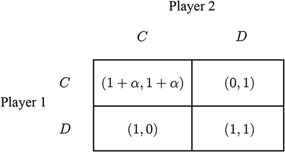
Figure 1 summarizes a two-player Stag Hunt coordination game in strategic form. A common interpretation of this game is inspired by Rousseau’s story of hunters hoping to catch a deer (Reference Rousseau and Gourevitch1755/1977, pt. II, para. 9). Adapting Rousseau’s story, each player cooperates (C) by hunting for a deer or defects (D) by hunting for a hare. Each player captures a hare for herself by defecting; but if both cooperate, then they capture a deer that they divide on the spot, and half a deer is worth more to each hunter than a hare. If one cooperates alone, then she comes away from the hunt empty-handed because she cannot capture a deer by herself. Defecting is consequently the “safe” strategy, and a player will be reluctant to cooperate unless she is sufficiently confident the other will cooperate. If a player cooperates and her partner defects, she will presumably be disappointed in her partner, since she trusted her partner enough to cooperate and run the risk of arriving at her worst possible outcome. A unilateral defector defects provocatively precisely because she has let her cooperating partner down. The figure 1 Stag Hunt has two strict Nash equilibria, (C, C) and (D, D), and a mixed Nash equilibrium:Footnote 2

Equilibrium (C, C) is payoff dominant for every value of α > 0; (C, C) is risk dominant if α ≥ 1 while (D, D) is risk dominant if the reverse inequality obtains. A strategy is an evolutionarily stable strategy (ESS) if when all in a population initially follow this strategy, a limited scale invasion of some other mutant strategy within the population cannot successfully invade this incumbent strategy. Since (C, C) and (D, D) are both strict Nash equilibria, C and D are both ESSs. In this game no other strategy is an ESS.
Stag Hunt in strategic form, α > 0.

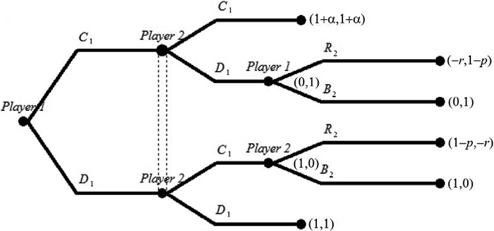
As the name suggests, a provocative defector might incite a punitive response from her now-angry partner. One might suppose that if a player cooperates alone in a given Stag Hunt, she will defect against her partner in future Stag Hunts. But I will not assume that players who engage in Stag Hunts can count on meeting the same partners over time or even that they can remember which strategies particular partners have followed in the past. Instead, I will consider the possibility of a more immediate punitive response to provocative defection. Suppose that the Stag Hunt interaction is extended as follows: If either player cooperates alone, once she realizes her partner has defected provocatively because she has received the payoff corresponding to leaving a hunt empty-handed, she can then punish her partner. Figure 2 summarizes a corresponding Augmented Stag Hunt game in extensive form.Footnote 3
Augmented Stag Hunt in extensive form: α > 0, r > 0, b > 0, and c ≥ 0.

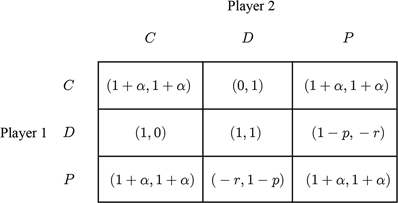
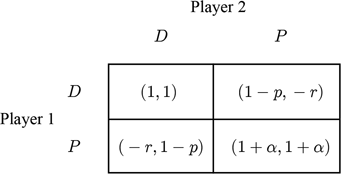
In the figure 2 game, each player’s initial move is either to cooperate (C 1) or to defect (D 1), the same as in the ordinary Stag Hunt. At each node following initial moves, each player receives an intermediate payoff. After the initial moves, if player i has cooperated and player j has defected provocatively, then player i can either acquiesce (B 2) and simply accept the associated loss of cooperating alone or punish (R 2), incurring a punisher’s cost r > 0 and inflicting a punishee’s cost p ≥ r on her defecting partner player j. More specifically, the punishee’s cost is p = br + c, where b ≥ 1 and c ≥ 0.Footnote 4 Figure 3 summarizes this game in strategic form.
Augmented Stag Hunt in strategic form: C = C 1, B 2-if-D 1, D = D 1, P = C 1, R 2-if-D 1, α > 0, r ≥ 0, and p ≥ 0.

In Augmented Stag Hunt, the pure strategies C and D in effect simply replicate cooperating or defecting, respectively, in the figure 1 ordinary Stag Hunt. The substantively new pure strategy is P, where a player first cooperates and then punishes if her partner has defected. This 3 × 3 symmetric game has five Nash equilibria in pure strategies and a large set of partially mixed Nash equilibria. The equilibrium (D, D) is a Nash equilibrium with payoff vector (1, 1),

is a partially mixed Nash equilibrium with payoff vector (1, 1), and any strategy profile of the form

is a Nash equilibrium with the optimal payoff vector (α, α). However, the suboptimal (D, D) is the only strict Nash equilibrium of this game, and D is the only ESS. In particular, none of the strategies that characterize a symmetric and an optimal Nash equilibrium of the Augmented Stag Hunt is an ESS. For a pure or polymorphic strategy xC ⊕ (1 − x)P cannot repel an invasion of any size of some other strategy yC ⊕ (1 − y)P, where x ≠ y. However, each strategy of the form xC ⊕ (1 − x)P is a neutrally stable strategy (NSS); that is, no invading mutant strategy can fare better than xC ⊕ (1 − x)P when xC ⊕ (1 − x)P is the incumbent strategy. Since r > 0, the acquiescing C weakly dominates the punishing P. Moreover, the pure strategy equilibrium (P, P) is not subgame perfect, since P requires player i to follow R 2 should the information set in which her partner has followed D be reached even though B 2 strictly dominates R 2 for player i. Put another way, the failure of subgame perfection shows that the P strategy fails to be modularly rational (Skyrms Reference Skyrms1996, chap. 2).
As will become clear in the examples below, punishment can increase the tendency of strategies of mutual cooperation in Augmented Stag Hunt to evolve, and punishment is particularly effective when the punishee’s net loss 1 − p is at least as great in absolute value as the punisher’s net loss −r, which is also the punisher’s cost multiplied by −1. For example, if b = c = 1, then a provocative defector’s punishee’s cost is r + 1; that is, all of the positive gain of defecting in ordinary Stag Hunt plus the punisher’s cost r and the punishee’s net loss and the punisher’s net loss are equal at −r. If, on the other hand, c = 0, then the punishee’s net loss 1 − br is not necessarily as great in absolute value as the punisher’s net loss −r. But if b > 1, the punishee’s cost is always greater than the punisher’s cost by a factor of b, and for a sufficiently high punisher’s cost the punishee’s net loss will exceed the punisher’s net loss. For example, if r = 1 + α and b = 5/2 and c = 0, then p = 5/2 · (1 + α) and the punishee’s net loss is −½ − (5/2)α, which is greater in absolute value than the punisher’s net loss when α > 0. This example reflects some of the models of altruistic punishment in the literature that assume the punishee’s cost is far greater in magnitude than the altruistic punisher’s cost.Footnote 5 I will discuss how P in Augmented Stag Hunt may be viewed as a form of altruistic punishment further in section 4.
3. Evolutionary Dynamics Applied to the Augmented Stag Hunt Game
How likely are particular strategies of the Augmented Stag Hunt to evolve over time? To address this question, in this section I apply discrete replicator dynamics to various specific cases of the figure 3 game. The discrete replicator is a common and mathematically tractable model of the evolution of strategies in a population whose members engage repeatedly over time in some type of interaction that can be summarized as an extensive or strategic form game. A number of authors (Skyrms Reference Skyrms1996; Börgers and Sarin Reference Börgers and Sarin1997; Schlag Reference Schlag1998) argue that the discrete replicator and its companion continuous replicator are suitable models of cultural evolution. The results discussed below for the discrete replicator are qualitatively similar to corresponding results for the continuous replicator, and consequently, below I will explicitly distinguish between the discrete and the continuous replicator only when necessary.Footnote 6 When the interaction in question is pairwise with symmetric structure, strategy evolution can be summarized with a one-population dynamical model in which individual members of a large population are selected at random to meet in a corresponding symmetric two-player game and the proportion of population members who follow a given pure strategy can be interpreted as the probability in a corresponding mixed strategy. The law of motion for a one-population deterministic discrete replicator dynamic is

where A is an n × n matrix normalized to have nonnegative entries that defines the symmetric two-player game with n pure strategies characterized by the unit vectors e1 = (1, 0, …, 0)T, …, en = (0, …, 0, 1)T ∈ ℝn and where xi(t) is the proportion of the population that follow the strategy of ei at period t and (x(t))T = (x 1(t), …, xn(t)).Footnote 7 At each period t the proportion xi(t) of ei followers in the population varies in direct proportion to the current expected payoff

of ei divided by the current overall average payoff (x(t))TAx(t) among the population. The proportion x(t) is a point in the n-dimensional simplex Δ of mixed strategies of the A game. To simplify the exposition below I will abuse notation slightly and occasionally write si = ei for a given pure strategy si of the A game and use the convex combination x 1s1 ⊕ ··· ⊕ xn sn that defines a mixed strategy in place of the vector (x 1, …, xn)T ∈ Δ that represents this mixed strategy. For example, in the two-player figure 1 Stag Hunt,

A rest point of the deterministic replicator is a dynamical equilibrium, that is, a point x = (x 1, …, xn) ∈ Δ such that x = φ(x) = (φ(x 1), …, φ(xn)). Any point x that characterizes a Nash equilibrium is a rest point of the deterministic replicator, though not all rest points are Nash equilibria.Footnote 8 For matrix A of the figure 1 Stag Hunt, e1, e2, and (1/(1 + α), α/(1 + α))T are the rest points of the deterministic replicator.
The law of motion for the discrete replicator dynamic with δ mutation rate is defined by

where δ ∈ (0, 1) and ξT = (ξ1, …, ξn) is selected at random from Δ. The replicator with a mutation rate δ > 0 tests the stability of the limit points of the deterministic replicator by introducing “noise” at the rate δ into the updating process.Footnote 9 One can interpret δ as a death rate or experimentation rate, so that at each period t a proportion δ of the population die and are replaced with new population members who follow a strategy chosen at random, or at each period δ of the population try some new strategy at random as an experiment rather than update their strategies according to the pressures of the deterministic replicator. Starting from an initial point x(0) ∈ Δ, the discrete replicator with or without mutation traces an associated orbit in Δ that is the sequence (x(t)). If an orbit of the discrete replicator converges, the limit is a Nash equilibrium. A strategy x* is asymptotically stable with pointwise strong basin of attraction

if every orbit starting from within

converges to x*. The noise in the replicator with mutation rate δ > 0 precludes rest points, but the orbits of this stochastic dynamic can still approach rest points of the deterministic replicator. An ESS of a symmetric two-player game is always asymptotically stable. For the figure 1 Stag Hunt, the respective basins of attraction of D and C for the replicator dynamics, both deterministic and with mutation in which δ → 0, are summarized by the half-open intervals [0, 1/(1 + α)) and (α/(1 + α), 1] and include the respective shares 1/(1 + α) and α/(1 + α) of the simplex; that is, the respective sizes of the basins of D and C are m(ΔD) = 1/(1 + α) and m(ΔC) = α/(1 + α).Footnote 10
For the Augmented Stag Hunt game, C = e1, D = e2, and P = e3. Given that p ≥ r, a satisfactory normalized payoff matrix is

As noted above, in the figure 3 game, D is the unique ESS and each member of the set

consisting of P, C, and the polymorphic strategies in which the proportion x ∈ (0, 1) of the population follow P and the remaining 1 − x follow C is an NSS. Since D is an ESS, D is an asymptotically stable strategy. What about the NSSs of Ξ? Because Ξ is a set of NSS states, each state x ∈ Ξ is Lyapunov stable; that is, if a deterministic replicator orbit begins in an open neighborhood containing x of points sufficiently close to x, it will not leave this neighborhood. But will such an orbit converge to an optimal NSS state? Every point x ∈ Ξ characterizes a Nash equilibrium and is consequently a rest point of the deterministic replicator. But it is far from intuitively clear that any point of Ξ should be an attractor of the replicator in any sense. Indeed, a point x ∈ Ξ cannot be asymptotically stable. For any open neighborhood of a polymorphic strategy x = xC ⊕ (1 − x)P with x ∈ (0, 1) will contain a point xϵ = (x + ϵ)C ⊕ (1 − x − ϵ)P for sufficiently small ϵ > 0, and xϵ is also a point in Ξ and is consequently itself a rest point of the deterministic replicator. By a similar argument, P is also not asymptotically stable. Moreover, the fact that C weakly dominates P suggests that any point that assigns positive weight to P should not have its weight “amplified” by a replicator law of motion, which in turn suggests that no orbit that begins outside Ξ should ever reach a point of Ξ that assigns positive probability to P. There remains the pure strategy C ∈ Ξ, but the presence of the P strategy renders (C, C) a nonstrict Nash equilibrium having the same associated expected payoff as all of the equilibria defined by the other points of Ξ. So it is not clear that C should attract any replicator orbits starting from anywhere in ΔΞ either.
So it is perhaps surprising that Ξ is an attracting set of the replicator dynamic with setwise basin of attraction ΔΞ. That is, every orbit that begins in ΔΞ eventually converges to a point of Ξ, though the orbits starting within ΔΞ in general approach different points of Ξ. Overall, replicator orbits starting from all but a negligible set of the entire strategy simplex all converge either to the ESS D or to an NSS in Ξ. Moreover, the basin of attraction ΔΞ of Ξ can be considerably larger than the basin of attraction ΔD of D, even for values of α that in ordinary Stag Hunt make the basin of attraction of C far smaller than that of D. These phenomena are easily illustrated with numerical examples. In all of the examples of this section, α = ¼, and I will continue using the interpretation inspired by Rousseau. These Augmented Stag Hunt examples contrast in interesting ways with the figure 1 ordinary Stag Hunt, where α = ¼, (D, D) is the risk-dominant equilibrium, and m(ΔC) = 1/5 and m(ΔD) = 4/5. To each of these numerical examples I will apply the deterministic discrete replicator and the discrete replicator with mutation rate δ = .01.
To set up a contrast with further examples below, I will first apply the deterministic replicator dynamic to the 3 × 3 game characterized by the matrix

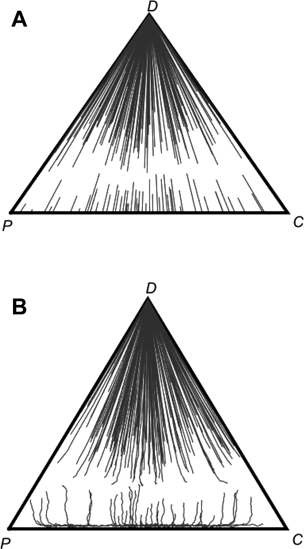
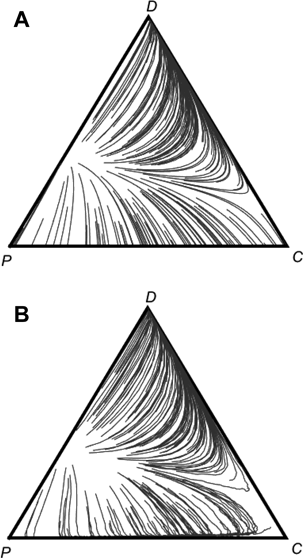
obtained from (3), where α = ¼ and r = p = 0. The A1 game is a “degenerate” Augmented Stag Hunt game in which there is no punisher’s or punishee’s cost associated with P. In this game, if either pure strategy P or C is deleted, the resulting 2 × 2 game is equivalent to the figure 1 Stag Hunt with α = ¼, so that P is effectively a copy of C. Consequently, each point x ∈ Ξ is effectively a “clone” of the acquiescing C strategy. Figure 4A depicts a phase diagram of the deterministic replicator dynamic applied to the triangular simplex of possible strategies, pure and mixed, of the A1 game.Footnote 11
A, Matrix A1, deterministic replicator; B, matrix A1, replicator with mutation, δ = .01.

In this game D is the unique ESS, m(ΔD) ≈ 0.75, and m(ΔΞ) ≈ 0.25.Footnote 12 The orbits starting in Δ but outside the boundary of ΔD converge to different strategies in Ξ. Each x ∈ Ξ not only is Lyapunov stable but also is a reachable point of the deterministic replicator; that is, x is the limit of at least one orbit that begins away from x, and ΔΞ is the basin of attraction of Ξ. Figure 4B depicts a phase diagram of the A1 strategy simplex for the replicator with mutation rate δ = .01. For this dynamic with mutation, the basins of attraction of D and Ξ are the same as those of the deterministic replicator, but orbits that converge to elements of Ξ converge only to polymorphic strategies. In other words, the pure strategies P and C are no longer reachable when the noise of mutation is added to the replicator. This phenomenon recurs in all the Augmented Stag Hunt examples below. Summarizing, the family of “clones” of C collectively have greater attracting power for the replicator in the A1 game than C has by itself in the figure 1 ordinary Stag Hunt with α = ¼, even though C is an ESS of this ordinary Stag Hunt and in the A1 game, none of the strategies of Ξ is an ESS. But the setwise basin of attraction ΔΞ is much smaller than the pointwise strong basin of attraction ΔD.
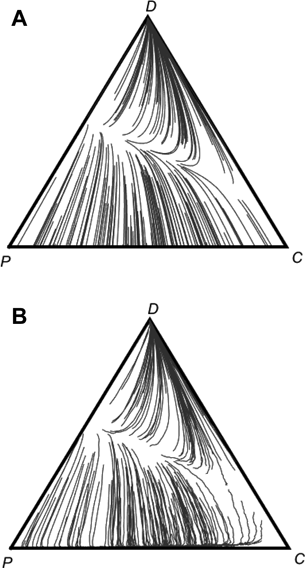
The attracting power of Ξ increases dramatically when r > 0, so that there are positive punishee costs and the corresponding game is a true Augmented Stag Hunt. For a first example of this phenomenon, I will consider an Augmented Stag Hunt in which α = ¼, r = b = 1, and c = 0, so that p = 1. In this example, the punisher’s and punishee’s costs are equal and amount to the value of a hare. From (3), a normalized payoff matrix that characterizes this Augmented Stag Hunt is given by

Figure 5A depicts a phase diagram of the replicator dynamic for the deterministic replicator dynamic applied to the A2 game.
A, Matrix A2, deterministic replicator; B, matrix A2, replicator with mutation, δ = .01.

For this Augmented Stag Hunt, m(ΔD) ≈ 0.56 and m(ΔΞ) ≈ 0.44. As was the case with the A1 game, for the A2 game, D is asymptotically stable and each point of Ξ is reachable by the deterministic replicator. Figure 5B depicts a phase diagram applied to the A2 game of the replicator dynamics with mutation. When mutation is added to the replicator, the basins of attraction of Ξ and D remain unchanged, and the pure strategies P and C become dynamically unstable while polymorphisms in Ξ continue to attract orbits. The results described so far are quite similar to those of replicator dynamics applied to the A1 game. But for the A2 game, the share of initial strategy points that converge to a strategy in Ξ is substantially larger than the corresponding share for the A1 game.
Next I apply the replicator dynamic to the Augmented Stag Hunt game with punisher’s cost r = ¼ and punishee’s cost p = 5/4. Here the punisher’s cost is the difference between the values of half a deer and a hare, and the punishee’s cost is the value of half a deer. Applying (3), an equivalent payoff matrix for this Augmented Stag Hunt is

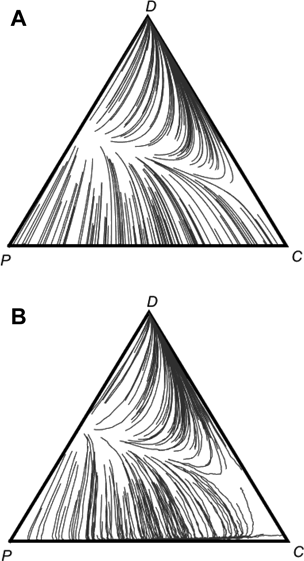
The A3 game is equivalent to the first numerical example in section 2. Figures 6A and 6B depict phase diagrams of the replicator without and with mutation for the simplex of the A3 game.
A, Matrix A3, deterministic replicator; B, matrix A3, replicator with mutation, δ = .01.

The results of the replicator applied to A3 are qualitatively similar to those of the previous A2 example except for the size of the basin of attraction. Again for the deterministic replicator, every point of Ξ is reachable, and only purely polymorphic points of Ξ are reachable for the replicator with mutation. And again, the presence of the punishing P results in the set of NSS polymorphisms of Ξ having greater attracting power for the replicator than the ESS D. But for the A3 game, m(ΔD) ≈ 0.32 while m(ΔΞ) ≈ 0.68. Now an NSS state of Ξ is substantially more likely to evolve according to the replicator than the ESS D. The reason the cooperating strategies of Ξ do so much better in this game than they do in the A2 game is the difference in net losses in the two games. In the A2 game, a punishee suffers the same cost 1 as the punisher, but the punisher suffers a net loss of −1 whereas the punishee suffers 0 net loss. In the A3 game, the punisher’s cost is α and punishee’s cost is 1 + α, so that in the end the net losses of the punisher and punishee are equal at −¼.
For a final pair of numerical examples, I consider Augmented Stag Hunts with α = ¼, b = 5/2, and c = 0. From (3), a matrix for such an Augmented Stag Hunt with punisher’s cost r = ½ is

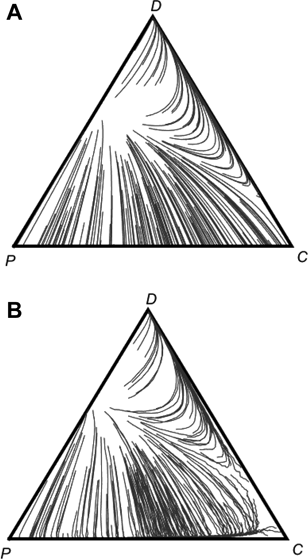
Figures 7A and 7B depict phase diagrams for the A4 game for the replicator without and with mutation.
A, Matrix A4, deterministic replicator; B, matrix A4, replicator with mutation, δ = .01.

For the A4 game, m(ΔD) ≈ 0.39 and m(ΔΞ) ≈ 0.61. The punisher’s cost is the value of half a hare, and the punishee’s cost p = 5/4 is the value of half a deer. But since the punishee keeps the value of the hare, the punishee’s net loss is only −¼. What if the punisher’s cost is increased? The matrix

summarizes an Augmented Stag Hunt with the same values for α, b, and c as the A4 game but where r = 5/4. The A5 game is equivalent to the second numerical example in section 2. Now the punisher’s cost is the value of half a deer, and the punishee’s cost is greater than the value of four hares. Figures 8A and 8B depict another pair of phase diagrams of the deterministic replicator dynamic and replicator dynamics with mutation rate δ = .01 applied to the A5 matrix.
A, Matrix A5, deterministic replicator; B, matrix A5, replicator with mutation, δ = .01.

For this game, m(ΔΞ) ≈ 0.74 and m(ΔD) ≈ 0.26. In this A5 game, the punishee’s net loss is −17/8, or a loss exceeding the value of two hares, which leads to the Ξ set for this game having even greater attracting power than the Ξ set of the A4 game. But note that in the A5 game, not only does C again weakly dominate P, but the outcome in which one player follows P and the other follows D is even worse for the P-follower than it is in the A4 game. Punishing might appear to be even more “irrational” in the A5 game than it is in the A4 game, but allowing for the presence of P-followers in the A5 Augmented Stag Hunt leads to even better prospects for the evolution of optimality than it does for the A4 game.
4. Discussion
In this article, I have explored how adding a weakly dominated strategy into a coordination game can actually enhance prospects for the evolution of coordination. The analysis of the Augmented Stag Hunt game shows that a population prone to converge to the suboptimal defecting equilibrium of the ordinary Stag Hunt has much better prospects for evolving into an optimal equilibrium when their strategy set is expanded to include the weakly dominated punishing strategy. In several of the section 3 examples, the basin of attraction of the strategies combining cooperation and punishment is substantially larger than that of the basin of the defecting strategy, even though in the corresponding ordinary Stag Hunt the basin of attraction of defecting is much larger than that of cooperating. This phenomenon generalizes across a wide class of Augmented Stag Hunts. When p − r ≥ 1, so that the punishee’s net loss is at least as great in absolute value as the punisher’s net loss, then the setwise basin of attraction of the NSSs of Ξ is larger than the pointwise strong basin of attraction of the ESS D for any value of α > 0,Footnote 13 even though the size of the basin of attraction of C in the ordinary Stag Hunt is α/(1 + α) → 0 as α → 0. One might find such a result doubly surprising, for not only is P weakly dominated by C, but introducing P effectively “demotes” C, which is an ESS in the ordinary Stag Hunt, to one of the NSS points of the expanded game, leaving D the only ESS of the expanded game. The weakly dominated P promotes cooperation so dramatically by introducing a secondary element of coordination into the Stag Hunt. Figure 9 highlights this by summarizing the 2 × 2 game that results when C is deleted.
Reduced figure 3 game.

This is a coordination game in which following D no longer guarantees one the minimum payoff of the (D, D) equilibrium and the respective basins of attraction of D and P are summarized by  and
 . When p − r ≥ 1, in the figure 9 game, P is risk dominant and can have much greater attracting power for replicator dynamics than C has in the corresponding ordinary Stag Hunt. Each of the polymorphisms of Ξ has a contribution from P that gives Ξ some additional “pull.” An individual NSS in Ξ has relatively weak attracting power, especially compared against the attracting power of the asymptotically stable D. But collectively these NSSs of Ξ can “win out” over the ESS D a substantial majority of the time.
The analysis here lends some theoretical support to claims that altruistic punishment can emerge and persist in human populations. Altruistic punishers inflict, at some positive costs to themselves, targeted punishment against those who fail to contribute to a public good or who violate a community norm. Altruistic punishment is sometimes styled the negative or “darker” side of strong reciprocity, since strong reciprocators are by definition predisposed to follow personally suboptimal strategies of acting for the benefit of their groups and punishing those who fail to do likewise. A now vast body of analytical models, experiments, and field studies support the hypothesis that groups of moderate size can sustain high levels of cooperation if some of their members have at least some strong reciprocator characteristics, including especially the tendency to punish altruistically.Footnote 14 But claims of strong reciprocity operating in “real-world” situations remain controversial.Footnote 15 One might regard punishing in the Augmented Stag Hunt game as a very generalized form of altruistic punishment. I say “generalized” because according to the usual account, altruistic punishers benefit their own groups at some costs to themselves, while the models explored here do not presuppose well-defined subgroups in the population. Much of the existing research on the evolution of strong reciprocity in general and altruistic punishment in particular emphasizes group selection models. Group selection is itself a highly controversial idea in evolutionary theory, although research on strong reciprocity has gone far toward establishing the respectability of group selection as a mechanism for explaining cultural evolution. But does strong reciprocity in a population necessarily presuppose well-defined and stable subgroups? The individual selection one-population models explored here suggest a negative answer to this question. A population whose members engage in the Augmented Stag Hunt can evolve into an optimal polymorphic state such that some are cooperators and some are punishers.Footnote 16 The punishers are altruistic in the sense that the “group” that reaps the benefits of their punishment is the entire population.
To extend the work in this article, one might explore which punishment functions produce the best results, in the sense of maximizing the basin of attraction of Ξ, and which of these functions reflect well those observed in experimental and field studies of public good provision. One might also investigate alternative strategy extensions of the Stag Hunt. In the Augmented Stag Hunt of this article, for a given population only provocative defection is punishable. But if the evolution of punishment of unilateral defection is possible, why not the evolution of punishment of unilateral cooperation? One way to argue for the exclusive focus on punishing defection here presupposes that players do not directly observe their partners’ moves and can only try to infer them from their own received payoffs. As I discussed briefly in the description of the Augmented Stag Hunt in section 2, a lone cooperator knows that her partner has defected provocatively because she has received the worst payoff of the corresponding ordinary Stag Hunt. A lone defector initially receives the guaranteed payoff of defecting and hence does not know whether or not her partner has cooperated unless her partner punishes her in the end for defecting provocatively. In terms of the Rousseau-inspired interpretation, in an Augmented Stag Hunt a lone cooperator knows that she has come away from the hunt with no game, but a defector who has bagged his hare does not know if his partner has either bagged a hare of her own or caught nothing unless he later suffers punishment. Hence only the prosocial punishment of provocative defectors would be likely to evolve because only the lone cooperators would know when to punish. Assuming that players do not observe the outcomes of all their intermediate moves may make sense in some evolutionary settings. But extensions of the Augmented Stag Hunt in which this assumption is relaxed should be explored, in order to investigate the possibility of both prosocial and antisocial punishment evolving in a population.Footnote 17 One might also want to investigate more complex games involving both prosocial and antisocial punishment in which individual punishers in the population can select levels of punisher’s costs they are willing to absorb in order to inflict individually desired levels of punishee’s costs.
Golman and Page (Reference Golman and Page2010a, Reference Golman and Page2010b) have already explored a different kind of extended Stag Hunt in a pair of striking recent essays. Rather than include a punishment option as I have done here, Golman and Page expand the set of pure strategies that can generate an optimal outcome in an n-player Stag Hunt and allow some of these strategies to be effective, so that they characterize an optimal and stable equilibrium with a payoff that grows linearly according to n, and others exploitable, so that they are vulnerable to an additional predatory strategy that effectively robs all of the gains produced by those who follow some exploitable strategy. The defecting and the effective strategies strictly dominate the exploitable strategies, and neither the predatory strategy nor the exploitable strategies survive evolutionary dynamics; but by including these strategies, Golman and Page obtain a generalized Stag Hunt in which the effective strategies are ESSs and the replicator basin of attraction of the effective strategies gradually increases to the whole strategy simplex as n → ∞. Golman and Page get this result partly by having the payoff of an effective strategy equilibrium grow without bound in n and partly by assuming that effective strategies, but not exploitable strategies, have a guaranteed minimum payoff lower than the defector’s guaranteed payoff but higher than the payoff of the predatory strategy or an exploitable strategy matched against defection. The Augmented Stag Hunt game of this article is simpler than the Goldman-Page n-player game, in that n = 2, and players can cooperate in exactly one way. And while the optimal payoff grows without bound in the Goldman-Page n-player game, in the Augmented Stag Hunt the payoff of the cooperating equilibria is of fixed value that need not even define a risk-dominant equilibrium of the ordinary Stag Hunt. Researchers in the future might investigate models that extend the Augmented Stag Hunt game to the n-player case but without incorporating all the assumptions of the more complex Golman-Page model.
As I indicated in the introduction, I believe that the analysis here lends even stronger support than Samuelson’s (Reference Samuelson, Binmore, Kirman and Tani1993, Reference Binmore, Kirman and Tani1997), Skyrms’s (Reference Skyrms1994, Reference Skyrms1996), and Harms’s (Reference Harms1997) earlier studies to the view that dynamical attracting power and dynamical stability concepts, rather than the ESS concept, are the true cornerstones of evolutionary game theory. An allied conclusion is that NSSs, and in particular polymorphic NSSs, can play a much more positive role in the evolutionary analysis of social coordination than has previously been thought. Skyrms (Reference Skyrms1996, chap. 1) and Sugden (Reference Sugden2004, chap. 4) have shown that division games that are special cases of the Nash bargaining problem (Nash Reference Nash1950, Reference Nash1953) can have polymorphic strategies that characterize dynamically stable and suboptimal Nash equilibria. In this context, suboptimal polymorphic strategies can tend to impede the emergence of an optimal ESS. In the Augmented Stag Hunt, the polymorphic strategies have a beneficial effect, leading to a much higher incidence of optimal equilibria, even though these polymorphisms are “merely” NSSs. In the Augmented Stag Hunt context, optimal polymorphic strategies can tend to suppress the emergence of a suboptimal ESS. Again, this happens because the set Ξ has a larger replicator basin of attraction than the ESS D. The ESS concept was central to launching evolutionary game theory, much as the Nash equilibrium concept was the first important solution concept in classical game theory. But perhaps the ESS concept is better viewed as a refinement, albeit a very important refinement, of a family of more general solution concepts that are limit points or limit sets of evolutionary dynamics.
Appendix Formal Model
The definitions of ESS and NSS and the concepts related to the replicator dynamics in this appendix are based on those presented in Weibull (Reference Weibull1995) and Sandholm (Reference Sandholm2010). A single population model is characterized by the n × n matrix

where A defines the payoffs of a symmetric two-player game with pure strategy set {s1, …, sn}, and aij and a ji are the row player 1’s and column player 2’s respective payoffs at outcome (si, sj). The simplex of all possible strategies is the set

A (pure or mixed) strategy x = (x 1, …, xn)T ∈ Δ can be equivalently written as x = x 1e1 + ··· + xn en. Taylor and Jonker’s (Reference Taylor and Jonker1978) original analysis of evolutionary stability motivates the following definition: A strategy x ∈ Δ is an NSS if, and only if, for every strategy y ∈ Δ in which y ≠ x there exists

such that

for all

, and x is an ESS if the inequality (A1) is strict. Maynard Smith (Reference Maynard Smith1982) gives an alternative definition of ESS equivalent to and sometimes more convenient than the Taylor-Jonker definition that generalizes straightforwardly to the NSS concept: A strategy x ∈ Δ is an NSS if for all y ∈ Δ

and

and x is an ESS if the inequality in Reference Morris(A1b) is strict. Equation (A1a) is the equilibrium condition of an NSS and (A1b) is the weak stability condition of an NSS; and when for x the inequality of (A1b) is strict, then x satisfies the strict stability condition of an ESS.
Below for the Augmented Stag Hunt game of section 2 and section 3, the pure strategies C, D, and P are respectively characterized by the unit vectors e1, e2, e3 ∈ ℝ3, and the set of convex combinations of P and C is characterized by the set

It is straightforward to identify the NSS and the ESS points of Δ for the Augmented Stag Hunt.
Proposition A1. In the Augmented Stag Hunt, D is an ESS, each strategy in Ξ is an NSS, and no other strategies are NSSs.
Proof. To check the NSS and ESS conditions, it is convenient to use the rescaling of matrix (3) given by

First note that the Nash equilibria of the Augmented Stag Hunt are characterized by the strategy set

so any strategy that lies outside ΔNE cannot be an NSS. Next note that while

characterizes a symmetric Nash equilibrium, for any ϵ ∈ (0, 1),

so there is no

such that inequality (A1) is ever satisfied, and hence

is not an NSS.
The equilibrium (D, D) is a strict Nash equilibrium, so D automatically satisfies the equilibrium and the strict stability conditions of an ESS. To show that any strategy in Ξ is an NSS, let x = x 1e1 + x 3e3 ∈ Ξ and consider any strategy y = y 1e1 + y 2e2 + y 3e3 ≠ x.
By direct computation,

and

Since y 1 + y 3 ≤ 1 and p > 0, we have xTAx ≥ yTAx, and (A1a) is satisfied. To check condition (A1b), we consider three exhaustive (but possibly nonexclusive) cases: (i) If x 3y 2 ≠ 0, then from (A2a) and (A2b) we have xTAx > yTAx, so (A1b) obtains vacuously. (ii) If x 3y 2 = 0 and y 1 + y 3 < 1, then from (A2a) and (A2b) we again have xTAx > yTAx, so again (A1b) obtains vacuously. (iii) If x 3y 2 = 0 and y 1 + y 3 = 1, then y 2 = 0 and

so (A1b) is satisfied. QED
The laws of motion for the replicator dynamics are given in the text by (1) and (2). A set  is a pointwise strong basin of attraction of x* ∈ Δ for the replicator if
 implies that the deterministic replicator orbit (z(t)) with initial point z0 converges to x*, that is, z(t) → x* as t → ∞. A set ΔV ⊆ Δ is a setwise basin of attraction of the set V ⊆ Δ for the replicator if z0 ∈ ΔV implies that the deterministic replicator orbit (z(t)) with initial point z0 converges to some point in V,
 .
Since D is an ESS, D is asymptotically stable, but it must be shown which points of the strategy simplex Δ constitute the pointwise strong basin of attraction of D. Since the points of Ξ are NSS points, each point of Ξ is Lyapunov stable; but since in general a Lyapunov stable point is not necessarily an attractor of the replicator, it must be shown directly that at least some points in Ξ are reachable, and it must also be shown which, if any, points of Δ form a basin of attraction for the points of Ξ. The geometric representation of the strategy simplex is helpful in completing these tasks. The equilateral triangle Δ2 with vertices e1, e2, and e3 represents the A strategy simplex Δ. Note that for a given z = (z 1, z 2, z 3)T ∈ Δ2 − {e2},

where

and

; that is, z is a mixture of the ESS e2 and the NSS

Note also that for a given x = (x, 0, 1 − x)T ∈ Ξ, given the mixture

by solving

for

, one obtains

The graph

of the function f : [0, 1] → [0, 1] defined by

defines a curve

in Δ2 with end points

and

corresponding, respectively, to f(0) and f(1). The curve

forms the boundary of two regions

and

that characterize equivalent subsets ΔD ⊂ Δ and ΔΞ ⊂ Δ, where e2 ∈ ΔD and for z = (z 1, z 2, z 3)T ∈ Δ − {e2}, z ∈ ΔD if

and z ∈ ΔΞ if

. The point a12 along the e1, e2 edge of Δ2 defines the partially mixed Nash equilibrium that is a mixture of C and D. The point a12 is an unstable rest point of the deterministic replicator dynamic. The point b23 along the e2, e3 edge of Δ2 does not define a Nash equilibrium, but it is another unstable rest point of the deterministic replicator dynamic. Note that the sets

,

, and

are pairwise disjoint and that

.
Proposition A2. For the deterministic replicator dynamic, (a) ΔD is the pointwise strong basin of attraction of D, and (b) ΔΞ is the setwise basin of attraction of Ξ.
The proofs of parts a and b are similar, so only the proof of part b is given.
Proof. By (1), for any x(t) = (x 1(t), x 2(t), x 3(t))T ∈ Δ, for the matrix A of the Augmented Stag Hunt the laws of motion are


and

Let z0 = (z 1(0), z 2(0), z 3(0))T ∈ ΔΞ − Ξ. We consider the following three cases.
Case i: z 3(0) = 0, so that z0 lies along the edge joining e1 and e2. In this case the replicator dynamic is equivalent to the dynamic applied to the 2 × 2 figure 1 game. Since z0 ∈ ΔΞ, z 1(0) > 1/(1 + α), so z0 → e1 as t → ∞.
Case ii: z 1(0) = 0, so that z0 lies along the edge joining e2 and e3. In this case the replicator dynamic is equivalent to the dynamic applied to the 2 × 2 figure 9 game. Since z0 ∈ ΔΞ, z 3(0) > (p + α)/(1 + r + p + α), so z0 → e3 as t → ∞.
Case iii: z 1(0) ≠ 0 and z 3(0) ≠ 0, so that

, the interior of ΔΞ. Since z0 is an interior point of Δ, either the orbit (z(t)) starting at z0 converges to a Nash equilibrium or this orbit diverges. Let us rewrite z0 as

where x = (x 1, 0, 1 − x 1) ∈ Ξ and

according to (A3). Since z0 ∈ ΔΞ,

as defined by (A4). Hence we have

Applying (1) to z 2(0), we obtain

Applying essentially the same argument to each subsequent z 2(t + 1) for t ≥ 1, more generally, z 2(t + 1) ≤ z 2(t) ≤ z 2(0); that is, the sequence (z 2(t)) is nonincreasing. Since (z 2(t)) is bounded away from 1, (z(t)) does not converge to the ESS e2.
We now claim that (z(t)) does not converge to the mixed Nash equilibrium defined by

For since (z 2(t)) is nonincreasing, z(t) → a12 implies that z 1(t) ↑ 1/(1 + α), z 2(t) ↓ α/(1 + α),and z 3(t) → 0, which in turn from (A6a) and (A6b) implies that

or

If z 3(t) → 0, (A6e) implies that for some T 1, αz 1(t) > z 2(t) for t ≥ T 1. But if z 1(t) ↑ 1/(1 + α) and z 2(t) ↓ α/(1 + α), then we must also have for some T 2 that αz 1(t) ≤ z 2(t) for t ≥ T 2; so we have a contradiction for t ≥ max{T 1, T 2} and so z(t) → a12 cannot obtain.
Since (z 2(t)) is nonincreasing, the sequence (z 1(t) + z 3(t)) is nondrecreasing since z 1(t) + z 2(t) + z 3(t) = 1 for every t. So if the orbit (z(t)) diverges, then it must be the case that for some ϵ* > 0

for infinitely many values of t > 0 and

for infinitely many values of t > 0. But by the definition (1) of the replicator dynamic, this last claim can obtain only if

for infinitely many values of t > 0 and

for infinitely many values of t > 0. By (A6a) and (A6b), in fact,

for every value of t ≥ 0. Hence (z(t)) must converge, and since we have ruled out e2 and a12 as possible limits, (z(t)) must converge to a strategy in Ξ. QED
The following result gives lower bounds on the size of the basin of attraction ΔΞ of the NSS points in Ξ.
Proposition A3. (a) If p > αr, then

(b) If αr ≥ p, then

Proof. Part a: The line joining a12 and b23 divides the Δ2 into a triangular region MD with vertices e2, a12, and b23 and a trapezoidal region M Ξ with vertices e1, e3, a12, and b23. The size of MD is

Taking the second derivative of f(x) defined by (A5),

for all x ∈ [0, 1] given the assumption that p > αr. So f is concave over [0, 1], and consequently the line joining a12 and b23 is bounded from above by the boundary

of ΔΞ. So M Ξ ⊆ ΔΞ and, hence,

Part b: The line joining a12 and

divides Δ2 into an equilateral triangular region ND with vertices e2, a12, and a23 and a trapezoidal region N Ξ with vertices e1, e3, a12, and a23. The size of ND is

The first derivative of f(x) defined by (A5) is

for all x ∈ [0, 1] given the assumption that αr ≥ p, so f achieves its maximum at f(1). Hence in Δ2 the boundary

of ΔΞ is bounded from below by the line joining a12 and a23, so N Ξ ⊆ ΔΞ and hence

QED
Corollary A4. If p − r ≥ 1, then m(ΔΞ) > m(ΔD).
Proof. It suffices to show that m(ΔΞ) > ½. First note that (2α + α2)/(1 + α)2 > ½ for any

. If α ∈ (0, p/r), then by part a of proposition A3,

If α ∈ [p/r, ∞), then by part b of proposition A3,

since

QED