

Introduction
In 2003, two groups of economists published papers that spawned what has become an influential new movement applying behavioural economics to public policy. One set of economists titled their paper ‘Regulation for Conservatives’ (Camerer et al., Reference Camerer, Issacharoff, Loewenstein, O'Donoghue and Rabin2003); the other titled theirs ‘Libertarian Paternalism’ (Thaler & Sunstein, Reference Thaler and Sunstein2003). Both titles reflected the similar motivations of the teams (which was not coincidental, because both drew inspiration from the same 1997 meeting, in which Matthew Rabin proposed the idea): to identify an approach to public policy that would appeal across the political spectrum. Later codified and popularised in a book whose title became synonymous with the philosophy of the approach, Sunstein and Thaler (Reference Thaler and Sunstein2008) defined a nudge as “any aspect of the choice architecture that alters people's behaviour in a predictable way without forbidding any options or significantly changing their economic incentives. To count as a mere nudge, the intervention must be easy and cheap to avoid.”
The application of nudges in public policy has enjoyed significant successes. Unquestionably the most prominent of these, across all domains of application, is the use of defaults to increase enrolment in defined contribution retirement savings plans (Madrian & Shea, Reference Madrian and Shea2001), and secondarily the use of automatic escalation to encourage higher savings rates (Thaler & Benartzi, Reference Thaler and Benartzi2004) and smart defaults to increase the likelihood that the funds are invested sensibly (Carroll et al., Reference Carroll, Choi, Laibson, Madrian and Metrick2005). These ideas and research findings have had a major impact on retirement savings policies worldwide, including the Pension Protection Act of 2006 in the USA and the introduction of pension auto-enrolment in Britain beginning in 2012 (Morrison, Reference Morrison2013). Building on this success story in savings and bolstered by the establishment of so-called ‘nudge units’ worldwide, the nudge agenda has positioned behavioural economics at the centre of public policy.
We applaud the introduction of behavioural insights into public policy. Yet we worry that the popularity of nudges has had unintended consequences that need to be recognised and responded to. Behavioural economics has diverse implications for public policy – of which the application of nudges is just one. While this viewpoint was clearly stated by the advocates of the nudge approach in the book that, more than any other publication, has inspired the adoption of behavioural insights by politicians and government officials (Thaler & Sunstein, Reference Thaler and Sunstein2008), this broader perspective has, we believe, become ‘lost in translation’. Among politicians and commentators, the appeal of nudges appears to have overshadowed alternative ways in which policy can and should be informed by behavioural economics; indeed, in policy and journalistic circles, nudges are often seen as synonymous with the application of behavioural economics to public policy.Footnote 1 This usage is embodied in the informal label, ‘nudge unit’, which has become the shorthand for policy teams applying behavioural insights to government policy (e.g. the Behavioural Insights Team in the UK and the Social and Behavioral Sciences Team in the USA) (Halpern, Reference Halpern2015). We suspect that this label also encourages governments and journalists to view behavioural insights as relevant primarily to policy implementation (i.e. designing ‘nudges’ to ensure that the policy works smoothly). Yet the two groups of economists mentioned above both had a much broader agenda, seeing behavioural insight as central to understanding policy challenges and as integral to formulating policy responses.
The power of ‘nudges’ may have had the unintended effect of encouraging policy makers to channel behavioural economics into a narrower range of policy problems than it has the potential to address, and focus on a narrower range of policy solutions than it has the potential to provide (see also Bubb & Pildes, Reference Bubb and Pildes2014). In this paper, we argue that policy-makers should take the concept of a ‘nudge’ not as encapsulating the role of behavioural economics in policy, but rather as a single concrete and powerful illustration of a much broader range of behaviourally informed policy tools – as was intended by the originators of the approach. We also hope that this paper will help newcomers to the field of behaviourally inspired policy to view behavioural factors as central to all elements of the policy-making process.
Nudges in perspective
A taxonomy of policy interventions

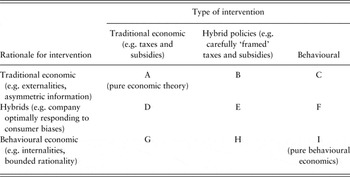
The rationale for interventions can be to solve a problem that arises from economic factors, behavioural factors or a hybrid of the two. The type of intervention can involve traditional economics levers, behavioural nudges or a hybrid of both. Traditional economic theory has focused on Cell A. The paradigmatic ‘nudge’ belongs to Cell I. As Table 1 indicates, there is considerable scope for policy analysis and formulation that draws on both economic and behavioural factors – and indeed, effective policy on any complex issue is likely to require the deployment of interventions from many or even all cells.
Table 1 illustrates our basic argument. The rows of the table represent the reasons for intervening at the policy level: policy interventions can be justified on traditional economics grounds, behavioural grounds or both (an intersection we discuss in detail below). Traditional economic grounds include externalities (e.g. second-hand smoke from cigarettes) and information asymmetries (e.g. situations in which laypeople are not in a good position to judge the competence of professionals). Behavioural grounds include internalities (delayed costs and benefits that people impose on themselves but fail to internalise) (Herrnstein et al., Reference Herrnstein, Loewenstein, Prelec and Vaughan1993; Gruber & Köszegi, Reference Gruber and Köszegi2001; Abaluck, Reference Abaluck2011); for example, the health consequences of smoking can be considered an internality to the extent that people do not take them into account. Internalities would also include the purchase of an inexpensive but inefficient appliance as a result of failing to fully account for delayed energy costs (see Gabaix & Laibson, Reference Gabaix and Laibson2005; Allcott et al., Reference Allcott, Mullainathan and Taubinsky2014). We defer discussion of the middle row of Table 1 (i.e. of reasons for interventions that involve both economic and behavioural rationales).
The columns of the table represent the type of intervention. Traditional economic interventions include taxes, subsidies and mandatory disclosure of information (to deal with problems arising from information asymmetries). Behavioural economic interventions include, most prominently, nudges. Again, we delay discussion of the middle category of interventions (the middle column of Table 1), involving both economic and behavioural aspects.Footnote 2
Our central point in this paper is that, despite the aims and objectives of its originators, discussions of behavioural economics and public policy have, in practice, tended to focus on Cell I of Table 1 – that is, nudges that are justified on behavioural grounds. Yet, Cell I is only one of eight cells – indeed, all cells other than Cell A – that have a behavioural element.
Consider Cell C: one might want to discourage a particular activity, such as smoking, due to externalities (e.g. because of concerns about second-hand smoke or because non-smokers have to bear much of the health care costs of treating smokers). Although the rationale for intervention in these situations can be cast in purely economic terms, nudges might still be one effective, or at least cost-effective, response to the problem, as we discuss below.
Or consider Cell G, in which there is a behavioural economic rationale for an intervention, but the type of intervention is of the traditional economic variety (see O'Donoghue & Rabin, Reference O'Donoghue and Rabin2003, Reference O'Donoghue and Rabin2006, for a discussion of this situation). Smoking can again be used to illustrate the point. Interventions to discourage smoking could be justified not only on the basis of externalities (as discussed in reference to Cell C), but also internalities. Smokers might fail to fully internalise the costs of smoking due to misestimation of risks (Slovic, Reference Slovic2001), present bias (O'Donoghue & Rabin, Reference O'Donoghue and Rabin1999) or the intangibility of consequences (Rick & Loewenstein, Reference Rick and Loewenstein2008), including the impact of current smoking on future dependency (Herrnstein & Prelec, Reference Herrnstein, Prelec, Loewenstein and Elster1992; Gruber & Köszegi, Reference Gruber and Köszegi2001). However, despite the fact that the rationale for intervention is behavioural, the most effective intervention might still be a standard economic one, such as a heavy tax on cigarettes. Indeed, the question of whether behavioural factors can justify ‘hard’ government action, rather than the ‘libertarian’ paternalism of nudges, in which choices are merely made more or less easily available or appealing, is an active area of debate. Some theorists argue that behavioural biases justify, or perhaps even require, drastic government intervention in the lives of individual citizens, far beyond current government intervention (e.g. Conly, Reference Conly2013). Others argue that conventional legislative or economic actions by the state can sometimes be justified from the point of view of the individual citizen as helping people protect themselves against self-control problems (e.g. Levmore, Reference Levmore2014a, Reference Levmore2014b; Allcott & Sunstein, Reference Allcott and Sunstein2015) and other cognitive biases (Sunstein, Reference Sunstein2014; Bar-Gill & Sunstein, Reference Bar-Gill and Sunstein2015).Footnote 3 Taking account of these viewpoints requires the process of policy formulation to be open to input from behavioural insights as well as traditional economic and social scientific analysis.
As these examples illustrate, there is no logical connection between whether the rationale for intervention is behavioural or traditional economic (or a combination) and the type of response (again economic, behavioural or a hybrid) that is most efficaciously applied.
The intermediate categories (column BEH and row DEF) add further dimensions to our argument. Focusing on the type of intervention, the impact of traditional economic interventions, such as taxes and subsidies, can be enhanced by carefully framing them in ways that magnify their impact (e.g. see McCaffery & Baron, Reference McCaffery and Baron2006; Finkelstein, Reference Finkelstein2009). For example, it may be critically important whether an intervention is implemented as a loss (tax) or a gain (subsidy) (e.g. Convery, McDonnell & Ferreira, Reference Convery, McDonnell and Ferreira2007; Homonoff, Reference Homonoff2012; Fryer et al., Reference Fryer, Levitt, List and Sadoff2012), even when the two should, according to economic logic, have equivalent impact. Likewise, it may matter a lot whether a sales tax or subsidy is separated from, or integrated with, the baseline price of the good (Chetty et al., Reference Chetty, Looney and Kroft2009). Consider an employee wellness programme that rewards employees for losing weight, quitting smoking or simply participating. Economically equivalent rewards could take the form of cash payments, reductions in insurance premiums, points redeemable for gifts or charity contributions (Imas, Reference Imas2014). They could be delivered as fixed amounts or lottery payments, and, if the latter, as a high-probability low-payoff lottery, a low-probability high-payoff (longshot) lottery or a combination of the two (see Volpp et al., Reference Volpp, Pauly, Loewenstein and Bangsberg2009; John et al., Reference John, Loewenstein, Troxel, Norton, Fassbender and Volpp2011). Employees motivated to change their own behaviour could also be asked to deposit their own money into a fund that would be matched if they accomplished their goal or lost if they did not (a ‘deposit contract’) (Volpp et al., 2008). Individuals could be paid individualistically or combined into pairs or groups and paid incentives that play on altruism, promote cooperation or elicit competition (e.g. Schofield et al., Reference Schofield, Loewenstein, Kopisc and Volpp2015). Any one of these factors, among myriad others suggested by behavioural theory and research, can have a large influence on the ultimate impact of the tax or subsidy on behaviour. Such psychologically informed traditional economic interventions are depicted in the table by the centre column containing Cells B, E and H.
With regard to the rationale for the intervention, hybrids are also widespread. For example, traditional economic analysis would suggest that firms often exploit weaknesses in consumers for their own profit. Since profit-seeking firms are unlikely to care about, or at least fully internalise, the costs they impose on society, their actions often generate externalities that can justify interventions such as regulation or taxes. Moreover, to the extent that firms are exploiting consumer weaknesses, this rationale has a behavioural dimension; in effect, firms are exploiting consumer internalities.Footnote 4 In these not-infrequent situations, intervention can be justified both on traditional economic and behavioural grounds. The middle row of Table 1, Cells D, E and F, encompasses situations in which human frailties are exploited by profit-maximising firms, with the different cells reflecting the type of policy response to the problem. This middle row might include, therefore, policy responses to financial offers such as payday loans, rent-to-own contracts, ‘teaser rate’ loans or substantial penalties on overdrawing bank accounts or making less than the minimum payment on credit cards, all of which are designed to extract payments from imperfectly rational, and typically financially strapped, individuals. Determining the likely effectiveness of regulatory changes or other policy levers will require a hybrid of behavioural analysis (e.g. will consumers notice and respond to clear interest rate information on payday loans?) and conventional economic analysis (e.g. how will consumers change their borrowing habits if payday loans are outlawed, and how will firms react to such regulatory changes?). Indeed, we suspect that most aspects of consumer and firm behaviour will best be analysed using a combination of behavioural and conventional methods (e.g. see Gabaix & Laibson, Reference Gabaix and Laibson2005; Barr et al., Reference Barr, Mullainathan and Shafir2009; Heidhues et al., Reference Heidhues, Kőszegi and Murooka2016).
Thus, behavioural economics has applications to public policy considerably beyond the ‘nudges’ of Cell I. Identifying behavioural policy with ‘nudges’ risks ignoring the seven other cells that encompass applications of behavioural economics to public policy. Doing so can have a number of adverse consequences. The first is that focusing on Cell I implicitly assumes that problems are caused by psychological shortcomings of individuals. Although the ‘Regulation for Conservatives’ paper initially began by critiquing historic forms of paternalism that focused on categories of individuals deemed incompetent at making self-interested decisions (e.g. children) and endorsed a “paternalism which focuses on situations rather than persons,” it later made what we now view as a mistake, which was to attribute the need for paternalism to individual deficiencies: “By cataloguing a list of common decision-making errors that even highly competent, well-functioning people make in predictable situations, this research potentially broadens the scope of situations in which paternalistic policies could usefully be developed” (Camerer et al., Reference Camerer, Issacharoff, Loewenstein, O'Donoghue and Rabin2003: 1214). Such an approach implicitly blames the individual, or at least deficiencies in individual decision-making, for problems that are often structural in nature.
More broadly, human behavioural characteristics that are typically assumed to be largely invariant across time and place are poor candidates to explain social problems that vary significantly between and within nations and over time. For example, many of the problems currently plaguing the United States, such as high rates of obesity and low rates of saving, are relatively recent phenomena, and are unlikely to have arisen from a recent increase in time discounting or the prevalence of present bias (Brownell et al., Reference Brownell, Kersh, Ludwig, Post, Puhl, Schwartz and Willett2010). Almost all explanations that have been offered for the emergence of these problems are structural. For example, explanations offered for the recent explosion in obesity include changes in the absolute and relative prices of fresh and packaged foods, decreased time available for food preparation, increasing snacking, and increased portion sizes (Cutler et al., Reference Cutler, Glaeser and Shapiro2003). Although many researchers have identified present bias as a (or even the) cause of obesity, none to our knowledge has proposed that the recent increase in obesity is due to a change in the prevalence of present bias.
It remains possible, of course, that obesity might be countered, to some extent, by appropriate nudges, even if the origin of the problem is structural. We suggest, though, that structural factors will typically overwhelm light-touch behavioural interventions – and that the most promising policy directions will include addressing the root cause of structural problems head on. Given how difficult it is for people who are actively attempting to lose weight to maintain significant weight loss in the long-term, even when they are participants in weight loss programs (e.g. Polivy & Herman, Reference Polivy and Herman2002), it seems prima facie highly unlikely that displaying healthy foods more prominently in stores, or using smaller plates and cutlery, will be sufficient to reduce the problem of obesity substantially. Indeed, advocates of nudges to combat obesity (Oliver & Uber, Reference Oliver and Ubel2014) stress that nudges can only be a small (albeit potentially useful and cost-effective) part of the solution.
One appeal of nudges is that they promise quick fixes for problems that often call for more fundamental and far-reaching interventions (Loewenstein & Ulbel, Reference Loewenstein and Ulbel2010). Thus, while deeper reforms were blocked by political gridlock and straightened financial circumstances, the Obama administration was able to press ahead with nudge-type interventions across a range of policy domains.Footnote 5 Yet President Obama's executive order committing the USA to “using behavioral science insights to better serve the American People” has a much broader remit (across the full range of cells in Table 1). It is important that the appeal and feasibility of nudges do not distract policy-makers from engaging with this wider agenda.
Another related appeal of nudges is the hope that they may be more effective, as well as more palatable, than government edicts. For example, former UK Prime Minister David Cameron commented that “…behavioural economics can transform people's behaviour in a way that all the bullying and all the information and all the badgering from a government cannot possibly achieve.”Footnote 6 This viewpoint could be extrapolated to the conclusion that more ‘heavy-handed’ policy interventions may be unnecessary.Footnote 7 We stress, however, that this is a conclusion that is not endorsed by many advocates of applying behavioural insights to public policy.
In sum, while nudges sometimes offer effective policy levers, for many of society's problems, behavioural interventions alone will be ineffective. Taxes, subsidies, legislation and regulation – in short, the traditional policy instruments discussed in economic analysis – are often the best ways to change behaviour, and may be required to ‘move the needle’ on a variety of behaviour-related problems. Nevertheless, even in such situations, behavioural insights can help to make the policies more effective and to reduce unintended consequences.
Three illustrative applications: smoking, obesity and retirement saving
We illustrate the utility of the framework represented in Table 1 by applying it to three policy domains to which nudges have been commonly applied: smoking, obesity and retirement saving. For each of these, we show that the rationales for intervention span the rows of Table 1, and that the potential forms that interventions could take span the columns of Table 1. In addition, we use each problem domain to highlight a particular insight into the application of behavioural economics and research findings to public policy.
Smoking
As we have already outlined, smoking provides an excellent illustration of many of the points in this paper. The justifications for policies to discourage smoking span the range represented by the rows of Table 1: externalities (row ABC; e.g. impacts of second-hand smoking and the health care costs that smokers impose on others, balanced by reduced welfare support costs due to curtailed life-expectancy) and internalities (row GHI; e.g. imperfect appreciation of health risks, present bias, intangibility and perhaps a tendency for young people to devalue longevity because, from the perspective of youth, living at an advanced age has little appeal). Cigarette companies are also notorious for marketing by preying on human susceptibilities, and for fine-tuning their products to maximise their addictive characteristics (row DEF).
By the same token, policies to combat smoking also span the range of interventions defined by the columns of Table 1. The high taxes that many states and nations impose on cigarettes are a classic traditional economic intervention (column ADG), whereas the graphic warning labels on cigarette packs, which do not primarily impart information but seem designed more to elicit powerful negative emotions, could better be classified as a behavioural intervention (column CFI). Bans on advertising are intended, in part, to counteract the cigarette companies’ attempts to present smoking as a glamorous activity; bans on smoking in public places increase the small but immediate costs of smoking; and bans on the display of cigarettes in stores (implemented recently in New York City) make it slightly more awkward to purchase them and also remove cues that might otherwise induce craving in smokers who are trying to quit (Bernheim & Rangel, Reference Bernheim and Rangel2004). Clearly, these strategies span the space between purely economic and purely behavioural interventions (column BEH).
Beyond the range of different interventions that have been introduced to combat smoking, it is also worth noting the sheer number of different interventions that are possible and indeed have been implemented. In isolation, it is likely that none of these interventions would have had much impact on smoking rates, but the combination does appear to have had a major impact. Adult smoking rates in the USA have declined from approximately 42% in 1965 to 17% in 2014, and rates among high school students have declined from a peak of approximately 36% in 1997 to the current rate of approximately 16% (Centers for Disease Control and Prevention, 2012).
The question of how different interventions aggregate is interesting and important. On the one hand, as perhaps illustrated by the case of smoking, it is possible that different interventions aimed at the same problem can have a super-additive effect. This could occur if, for example, a multifaceted response is more likely to result in a change in norms, or if there is some kind of threshold of apathy or complacency that needs to be exceeded for people to change their behaviour. On the other hand, multiple interventions, especially if aimed at different target behaviours, could potentially divide individuals’ attention and lead to fatigue, resentment and possibly even a consequent backlash from intervention-weary individuals.
Obesity
Like smoking, obesity imposes both externalities in the form of health care costs that are borne by the population, and internalities in the form of health consequences to individuals themselves. Obesity rates have risen dramatically not only in the United States, but also worldwide. Obesity increases the risk of chronic conditions such as diabetes and heart disease, and, in the USA, accounts for an estimated 5–15% of annual deaths and $150 billion in annual health care costs (Flegal et al., Reference Flegal, Graubard, Williamson and Gail2005; Finkelstein et al., Reference Finkelstein, Trogdon, Cohen and Dietz2009).
Obesity is also well represented in the middle row of Table 1, illustrated by, for example, Coca Cola's selective funding of influential dietary scientists who blame the problem of obesity on lack of exercise rather than excessive sugar (O'Connor, Reference O'Connor2015), ‘supersizing’ practices by the fast food industry and efforts by processed food companies to design snacks that cater to consumers’ evolutionarily programmed taste for salt, fat and other cheap but unhealthy ingredients.
Obesity's coverage on the intervention dimension of Table 1 is, however, far more skewed. Until very recently, almost all interventions aimed at obesity have focused on information provision. For example, the 1990 Nutrition Labeling and Education Act standardised nutrition labels on packaged foods in the USA. More recent policies guiding obesity-targeted information provision include, prominently, recent regulations (part of the Affordable Care Act in the USA) mandating calorie posting at chain restaurants. Although behavioural economists have in some cases treated information provision as a form of nudge, and a team providing a rival perspective has repackaged information provision, and consumer education more broadly, with the catchy label ‘boosts’ (Grüne-Yanoff & Hertwig, Reference Grüne-Yanoff and Hertwig2016; Hertwig & Ryall, Reference Hertwig and Ryall2016), informational policies such as calorie labelling can be viewed as examples of traditional economic policies. Traditional economics can justify such information provision if food companies have an incentive to conceal information and individual consumers do not have a large enough incentive to unilaterally seek it out. However, while information provision can be viewed as a conventional economic intervention, behavioural economists have played a role in proposing and testing ways of enhancing the impact of such labels [e.g. by presenting calorie information as traffic lights (Downs et al., Reference Downs, Wisdom and Loewenstein2015) or in terms of minutes one would have to work out on a treadmill to burn the calories off (Jue et al., Reference Jue, Press, McDonald, Volpp, Asch, Mitra, Stanowski and Loewenstein2012)].
Even more squarely in the wheelhouse of behavioural economics are efforts at modifying choice architecture (e.g. positioning of food at cafeterias) (Hanks et al., Reference Hanks, Just and Wansink2013), as well as efforts championed by former New York mayor Michael Bloomberg (but overturned by the New York State Assembly) to ban the sale of giant-sized drinks,Footnote 8 and mandatory warning labels proposed in California stating that ‘Drinking beverages with added sugar(s) contributes to obesity, diabetes, and tooth decay’ (a similar label has been proposed for New York). Based on the existing empirical literature, we are sceptical that any of these interventions (see Oliver & Ubel, Reference Oliver and Ubel2014), at least when considered alone, will make much, if any, dent on the problem of obesity. Other initiatives, falling more into the conventional economics category, involve taxing sugar in sugar-sweetened beverages (implemented in 2013 in Mexico, and set to go into effect in Britain in April of 2017 against strong pressure from business) (Martin, Reference Martin2016).
In thinking about possible interventions that could have an impact on the so-called ‘obesity epidemic’, it is worth considering the fact that obesity is a relatively recent problem in the USA and other countries, and, as Brownell and co-authors (Reference Brownell, Kersh, Ludwig, Post, Puhl, Schwartz and Willett2010) point out, its cause is almost certainly structural (e.g. due to changing prices and portion sizing). It is, as we noted earlier, very unlikely that the problem resulted from a sudden population-wide increase in present bias or any of the other behavioural effects it has been attributed to, and the human drive for high-energy foods has presumably remained constant during this period. Given that the causes of the problem [i.e. the thing(s) that changed, resulting in the problem's emergence] are structural (e.g. rather than self-control problems, which are presumably a stable feature of human behaviour in general, and food consumption in particular), removing those structural causes is likely to be the most effective policy remedy. As long as food companies fail to internalise either the externalities or internalities that their foods produce, and prices of high-energy foods remain at historic lows, it seems unlikely that there will be much change in the magnitude of the problem. What we need, then, are regulations or taxes and subsidies that realign the food industry's incentives so that businesses internalise the health consequences they are imposing on individuals and society (e.g. health care costs). Faced with incentives that are more closely aligned with its customers, and with society as a whole, the food industry might channel its considerable creativity into the service of offering healthy and palatable products.
It is not trivial to design such incentives, but two approaches seem possible. One would be to tax ingredients based on some index of the externalities and internalities they produce. By such a standard, sugar and fats, and particularly trans fats, might be obvious targets. In 2011, Denmark did institute a ‘fat tax’ on foods containing more than 2.3% saturated fats, but rescinded it the following year after droves of Danes crossed into neighbouring Germany to stock up on high-fat foods. Although this example does present a cautionary tale, shopping in neighbouring countries is much more difficult for most consumers in the USA and the UK.
Another, albeit very partial, approach might be to target the problem of what could be called non-linear pricing. Grocery stores, movie theatres, fast food establishments and other food-sellers often price large quantities at a much lower per-unit price than small quantities. This makes sense for the sellers because the cost of raw ingredients is only a small fraction of the cost of the food items themselves. However, it ignores the fact that externalities and internalities increase in a much more linear, or possibly even accelerating, fashion with portion size. Moreover, the discounted large portions are likely to be especially attractive to deal-conscious lower-income consumers, who also tend to suffer from greater obesity and generally worse health. Taxes of the type described in the previous paragraph might help on this front, but another approach would be to impose regulations on these industries to ban non-linear pricing and related pricing ‘mechanics’ (e.g. ‘buy one get one free’ deals).
Retirement saving
In 2013, the National Institute on Retirement Security released a report on household retirement savings in the USA answering in the affirmative the question posed by its title, ‘The Retirement Savings Crisis: Is it Worse Than We Think?’ (Rhee, Reference Rhee2013). Analysing savings rates in relation to historical trends, access to employer-sponsored retirement accounts, and household income, they concluded that the US savings situation is dire from both a historical and international perspective. When all US households were included, the report found a median retirement account balance of $3000 for all working-age households and $12,000 for near-retirement households. Both figures are obviously dramatically below the median household single-year income, which means that these households will have to rely heavily on social security benefits to fund their retirement. Worse, but not surprisingly, the report found a strong correlation between account ownership (i.e. having a retirement savings account) and wealth. These findings provide new support for the well-established fact that tax-protected, defined benefit retirement programs disproportionately benefit high-income earners, who can afford to participate, are in higher tax brackets at which the tax credits for saving are much more lucrative. These individuals would be much more likely to save sufficiently than those with lower incomes even in the absence of such benefits.Footnote 9
The situation in the UK is no better. A 2013 report on global retirement savings, conducted by HSBC, found that, among the countries it examined, the UK had the largest retirement savings shortfall – the difference between how many years savings are expected to last and the expected length of retirement – at 12 years. The USA was 13th on this list, at 7 years (‘The Future of Retirement’, 2015).
A traditional economist might ask why people should need any kind of special program to save for their own retirement. Why should people not be expected to plan for the future and save accordingly? According to the life-cycle theory of standard economics (Modigliani, Reference Modigliani1966), people should carefully optimise their lifetime consumption and savings in order to achieve a roughly balanced flow of consumption over time. If this theory were correct, one would expect the pensions crisis to be self-correcting: people would reduce their spending and increase their saving in response to any future shortfall. Yet there has been no sign that such a self-correction is occurring. When it comes to under-saving, we suggest that behavioural economics provides better explanations for the problem than does traditional economics.
Many of the causes of under-saving are factors that could be considered internalities, including present bias (Laibson, Reference Laibson1997), the intangibility and perceived proportional insignificance of individual contributions to a retirement fund (Rick & Loewenstein, Reference Rick and Loewenstein2008) and the forces of social comparison (e.g. Duesenberry, Reference Duesenberry1949; Frank, Reference Frank1985), which motivate people to match others’ spending, even if it means sacrificing future consumption. There may also be some role for factors best captured by the hybrid rationales represented by the middle row of Table 1, especially for low-income individuals. A wide array of economic actors that benefit from low savings or debt are expert at playing on the weaknesses of, particularly, low-income individuals: payday loan companies, rent to own establishments, pawn shops, credit cards and, regrettably, banks (which earn substantial revenues from overdrafts and other charges incurred mainly by disadvantaged customers). Yet some businesses, such as investment houses, and even the same banks that charge egregiously high overdraft fees, do benefit from individual savings and investment, so this is not a domain in which there is a complete misalignment of consumer and commercial interests.
Turning to the intervention side, retirement savings has been the big success story for behavioural economics and public policy, especially when behaviourally inspired policies are compared to those that arose from traditional economic thinking. Research showing that defaulting people into contributing to defined contribution retirement plans increased contributions (Choi et al., Reference Choi, Laibson, Madrian, Metrick and Wise2004) has led to such defaults being introduced in countries around the world (e.g. in the Pension Protection Act of 2006 in the USA and in 2012 in the UK). The original research demonstrating the benefits of defaults also found that they were especially beneficial to lower earners, who have traditionally been much less likely to make such contributions. Research showing the benefits of automatic escalation has not led to as widespread implementation of this feature, but has produced outsized gains in saving where it has been introduced (Beshears et al., Reference Beshears, Choi, Laibson and Madrian2013). The magnitude of these effects is especially impressive when it is compared to the impact of the traditional approach to promoting saving, namely tax breaks. Such tax breaks primarily benefit those in high tax brackets (i.e. the affluent), who are already likely to save adequately, because these benefits are delivered in the form of tax deductions rather than credits. Moreover, beyond their regressivity, existing research suggests that tax breaks have very little impact on saving. One important study of savers in Denmark (Chetty et al., Reference Chetty, Friedman, Leth-Petersen, Nielsen and Olsen2014) found that every 100 euros of tax breaks led to only a single euro of incremental savings. The same research also found that increasing retirement saving through defaults had virtually no offsetting negative impact on other forms of saving.
While this could be considered a win for behavioural economics, it is not necessarily a win for the soft, choice-preserving approach embodied in nudges. This is because more heavy-handed policies that remove individual choice seem to produce superior outcomes to nudge approaches that stop short of “forbidding any options” and that are “easy and cheap to avoid” (features of nudges described by Sunstein & Thaler, Reference Thaler and Sunstein2008). An instructive comparison is between the Australian and US retirement systems.
In the USA, there are a number of approved ways that individuals can withdraw from their retirement savings accounts before retirement without penalty. For example, expenditures on education, disability or medical expenses and home purchases are all approved reasons to take money from a traditional IRA savings account (‘IRA Withdrawal Rules’, n.d.). These options make it all too easy for those who do save for retirement to prematurely deplete their accounts. Moreover, there is no requirement that individuals save for retirement at all – and indeed, as we saw above, many do not.
In contrast, Australia's ‘superannuation’ system, introduced in 1992, includes two policies that directly address these deficiencies in the US system. First, in Australia, withdrawing from a retirement savings account before retirement is forbidden under any circumstances. Second, saving for retirement is compulsory. Employers are required to contribute 9% of total income, and employees are required to put aside 3%, to an employee's retirement savings plan. While by definition such mandatory policies violate the ‘forbidding any options’ stipulation of a nudge, they have proven much more effective at inducing savings for retirement. Pension assets in Australia currently total $1.5 trillion, with more than 90% of workers participating. By contrast, the USA, with a population 14-times greater than that of Australia, has total savings not even twice as great: only $2.8 trillion (Agnew, Reference Agnew2013; Summers, Reference Summers2013).
Because many Americans do not have defined contribution retirement plans, and because many of those who do have very little savings in them, many Americans rely on social security benefits for a large part of their total retirement income, even as that pool of resources stretches thinner. According to the Social Security Administration, 48% of married couples and 71% of unmarried persons rely on social security benefits for more than half of their retirement income, and 21% of married couples and 43% of unmarried persons rely on social security for more than 90% of their retirement income. For a very large fraction of Americans, therefore, social security, perhaps the paradigm of a heavy-handed policy, is, and will continue to be for the foreseeable future, the main, or even sole, source of income in retirement.
There is another point worth making in connection with retirement: before auto-enrolment and auto-escalation became widespread as a result of the Pension Protection Act, the defined contribution approach to retirement was failing badly by any measure. The impact of defaults and auto-enrolment breathed new life into a failing system. Whether this is a good thing depends on what would have happened if these behavioural ‘fixes’ had not appeared on the scene. Given the state of politics in the USA, it is entirely likely that nothing would have been done, and that, in the absence of auto-enrolment, current and future American retirees would be even worse off. Nonetheless, it is quite possible that, absent these illusory fixes to the defined contribution approach, a more heavy-handed, and ultimately superior, paternalistic scheme such as that implemented in Australia might have emerged.
In the case of pensions, we suggest that nudges can contribute substantially to fixing a ‘broken’ policy by helping people to make better choices. But behavioural economics, more broadly, should in the longer term also help shape the formulation and direction of policy. Often, we suspect, the behaviourally appropriate policy will involve the reduction of choice by legislation: hard paternalism may, in many instances, be more effective than soft paternalism. We should be concerned if politicians and journalists form the impression that a good nudge is generally better than good legislation.
Three major issues of our time: inequality, climate change and the changing nature of employment
Smoking, obesity and retirement saving are paradigmatic, and by no means trivial, problems to which behavioural economics solutions can be, and to varying extents have been, applied. But their significance is dwarfed in comparison to other issues facing the world. In our view, the top three problems facing the world are climate change, income and wealth inequality both within and between nations, and changes in the nature of employment on the scale of the agricultural and industrial revolutions. What, if anything, does behavioural economics have to say about these problems?
Each of these problems can be viewed as quintessentially economic in nature and, hence, can to a large extent be explained in conventional economic terms. Climate change can be viewed as an almost paradigmatic illustration of externalities detrimental to a common good. The greenhouse gases that any individual emits have an imperceptible impact on climate change, but activities that produce greenhouse gases (e.g. driving, heating and air conditioning) have immediate and noticeable benefits to the individual's personal well-being. The same is true even at the country level; the cost to any one country of unilaterally reducing its emissions would almost certainly exceed the benefits to that country of maintaining the activities that produce the emissions. Further relevant economic factors include time-discounting (the benefits of greenhouse gas use are immediate while the negative impacts are decades away) and risk and uncertainty in relation to climate forecasts. The most obvious remedies to minimise climate change also fall squarely into the domain of traditional economics. Carbon taxes and emissions trading are both intended to induce carbon emitters to internalise the environmental impact of their activities. Thus, as recognised by Thaler and Sunstein (Reference Thaler and Sunstein2008) in their chapter on climate change, the starting point for discussion is firmly in the domain of economic analysis and policy (Cell A in our Table 1).
Income inequality is to some extent a function of the changing structure of the economy. For example, both globalisation and the expansion of mass communication have contributed to the shift towards what has been called the “Winner Take All Society” (Frank & Cook, Reference Frank and Cook1995). Under this paradigm, a small number of ideas, innovations and businesses can, in part due to the expansion of global markets as well as network externalities, take hold and become globally dominant to the benefit of their originators. There is also, more generally, an increased premium placed on intellectual as compared with physical capabilities and a more uneven distribution of capabilities in the former than in the latter, especially after taking account of variable investments in education. The forces at work here are again naturally modelled using standard economic analysis.
The coming revolution in work (e.g. Frey & Osborne, Reference Frey and Osborne2013; Brynjolfsson & McAfee, Reference Brynjolfsson and McAfee2014) is due to what are likely to be spectacular extensions of automation along with associated changes in the structure of the economy. For example, the future of truck-driving, which employs approximately 3 million people in reasonably well-paying jobs in the US alone, is threatened by the rapid development of self-driving trucks, and employment is similarly jeopardised for the large number of individuals driving cars for a living (e.g. cab, limousine, Uber and Lyft drivers). Similarly, many traditional skilled professional jobs in law, accountancy and perhaps aspects of medicine have already begun to be, and will continue to be, eroded by ever more seamless and sophisticated computer systems, as well as becoming increasingly vulnerable to outsourcing. While predictions remain difficult, technological progress and its impact has also long been a topic of economic analysis (e.g. Mansfield, Reference Mansfield1983).
Although each of these problems has important economic elements, each also incorporates important behavioural dimensions, both in diagnosing the problem and in prescribing appropriate solutions.
Let us first examine climate change. While the economic concept of externalities helps to explain why the problem exists, it fails to account for the slowness with which the world has responded to the problem. While international agreements and national government action had, until the recent presidential election in the USA, been gathering pace (Nachmany et al., Reference Nachmany, Fankhauser, Davidová, Kingsmill, Landesman, Roppongi, Schleifer, Setzer, Sharman, Singleton, Sundaresan and Townshend2015), such moves have lagged well behind scientific and economic analysis (e.g. Stern, Reference Stern2007), and face considerable challenges if global temperature increases are to be kept within acceptable levels (Rogelj et al., Reference Rogelj, den Elzen, Höhne, Fransen, Fekete, Winkler, Schaeffer, Sha, Riahi and Meinshausen2016). Behaviour change at the level of the individual citizen has not played a substantial role in policy, and it seems unlikely to do so under current systems. Government action has instead involved regulation (e.g. on buildings, automobiles and appliances), subsidies for green energy and international treaties, including ‘cap and trade’ deals.
Collective action problems are undeniably difficult to solve, but can be addressed by behavioural interventions. For example, during times of war, nations have played on patriotism, fear and hatred in order to band together and elicit from citizens and soldiers far greater sacrifices than those that would be required to reverse climate change. Humanity currently faces a threat comparable to that posed by the most hostile human enemies, but nations have so far failed to exact even modest sacrifices from citizens. Most people care profoundly about their children, and even their children's children; why are we, as individual citizens, so passive in the face of a problem that poses such a grave threat to current and future generations?
Insights from psychology can help to address this riddle. Research on emotion suggests that emotions tend to respond to outcomes that are immediate, certain and vividly imaginable. Climate change has none of these properties (see Loewenstein & Schwartz, Reference Loewenstein and Schwartz2010). Research on information avoidance shows how people selectively attend to, interpret and remember information in a fashion that reinforces their existing beliefs, a tendency that may go far in explaining the prevalence of climate change denial. George Marshall (Reference Marshall2015), in a book about climate change aptly titled Don't Even Think About It, quotes Harvard psychologist Daniel Gilbert, to the effect that climate change is “a threat that our evolved brains are uniquely unsuited to do a damned thing about.”
Some behavioural economists have proposed nudges such as giving people information about their neighbours’ energy usage as tools for reducing energy consumption (Schultz et al., Reference Schultz, Nolan, Cialdini, Goldstein and Griskevicius2007). Indeed, one company, O-Power, has emerged to help utilities to do just that. But, while such nudges are helpful, they are unlikely to make much of a dent in the problem of global warming (e.g. see Allcott, Reference Allcott2015). It is, perhaps, conceivable that energy-intensive behaviours could be targeted as socially unacceptable, using a combination of behavioural campaigns and measures (e.g. naming and shaming of people consuming large amounts of energy). But a purely behavioural approach powerful enough to have any chance of large-scale success would be politically explosive (just imagine government campaigns comparing flying to smoking, or large mandatory labels showing pictures of crumbling ice-sheets on high-fuel consumption cars), economically inefficient and liable to backfire. Interventions of this scale might feel less like being nudged and more like being repeatedly jabbed in the ribs with a stout stick.
Behavioural science has an incredibly important contribution to make in combating climate change, but it will not primarily come in the form of nudges. Dramatically shifting behaviour across the population of individual consumers and businesses requires strong action, and traditional economic theory provides guidance concerning how CO2 emissions can be reduced at least cost, using legislation and incentives. A key role of behavioural science will be to propose ways of explaining and implementing such policies in order to make them both maximally effective (e.g. by segregating a carbon tax from other payments) and politically feasible. To have a serious impact on the problem of climate change, there is no way to escape the necessity for stronger policies that either change prices (e.g. a carbon tax or cap and trade) or involve regulation (e.g. far more stringent standards on automobile fuel efficiency, as well as new standards for residential and commercial construction). Indeed, since 2008 in the UK, there has been an independent statutory body, the Committee on Climate Change, which is tasked with evaluating current government legislation and incentives in meeting national targets (e.g. reducing CO2 emissions to just 20% of 1990 levels by 2050). In the USA, regulatory standards in the automotive and construction sectors have also been tightened considerably.
Behavioural measures can strengthen and complement conventional policy measures rather than merely provide a ‘light touch’ alternative. A carbon tax or cap and trade scheme that is substantial enough to seriously impact behaviour will dramatically increase the price of energy-intensive activities and hence, hopefully, reduce energy use and stimulate innovations and investment in green technologies. But it will also generate very substantial revenue streams. These revenue streams hold the potential to make the ‘medicine’ of price increases on greenhouse gas-intensive activities go down in a somewhat more delightful way. The generated revenue could be used to reduce other prices (ideally those associated with low-emission activities), to offer abatements on other types of disliked taxes or even to solve other pressing problems such as the deficiency in retirement savings. Behavioural economists should use their integrated understanding of economics and psychology to design ways of returning the revenue streams to people in ways that make taxes and regulations more politically acceptable and perhaps in some measure popular. Moreover, the benefits of reducing fossil fuel consumption in terms of air pollution, health improvements, increasing biodiversity and so on, need to be carefully integrated into the case for, and the programme of, government action. Indeed, in light of recent and projected declines in the cost of solar and wind energy, combined with improvements in battery storage and ‘smart grid’ technologies (e.g. Goodall, Reference Goodall2016), there may even be some long-term economic upsides to switching away from fossil fuels.
We now turn to inequality. While the problem may seem to be an inevitable consequence of technological change and globalisation, the fact that inequality varies dramatically across countries and has risen and fallen over different historical periods suggests that it is not immutable and that there may be points of traction. Sweden and the other Scandinavian countries demonstrate that, through a coordinated package of policies that involve taxes, safety-nets and cultural norms about pay differentials, it is possible to achieve high levels of income equality without much if any sacrifice of aggregate income (see Bjorklund & Freeman, Reference Bjorklund, Freeman, Freeman, Topel and Swedenborg1997).
The first, and necessary, step in tackling inequality is for people to recognise it as a problem and to believe that it is amenable to change. Inequality, like climate change, is in part a function of political decisions, including, most obviously, tax rates and the generosity of transfer programmes. It also reflects cultural norms, such as the acceptability of huge pay differentials within a firm. Moreover, even when holding the magnitude of income inequality constant, other societal factors can mitigate the consequences of inequality (Lind, Reference Lind2016). For example, universal free health care can reduce the consequences of low incomes for health care, and high-quality free public schools can reduce the consequences of low income for education (and offer commensurate opportunities for upward mobility). Whether inequality is tolerated, and whether measures to reduce inequality and its consequences are put into place, will depend on the attitudes of citizens, at least in democratic regimes (and undoubtedly to some extent even in authoritarian ones). However, these attitudes are barely discussed, let alone studied, by economists. Rather, the topic of attitudes and attitude change lies squarely in the domain of behavioural science. Those looking to move beyond pure economics and apply behavioural science to the problem of inequality have a significant opportunity to do so. In particular, behavioural science provides insight into how to best inform the population about the problem of inequality in a way that conveys its severity, communicates its causes and identifies potential solutions. Moreover, behavioural science has a key role in exploring the psychological impacts of inequality: the degree to which disadvantaged groups feel marginalised; the degree to which a sense of social cohesion is reduced; potential impacts on citizens’ sense of security, fellow-feeling or trust; and other issues that are difficult to even express in the language of mainstream economics. None of these roles for behavioural science conflict with nudge principles, yet they have a very different emphasis.
Lastly, consider problems associated with transitions in the nature and availability of work. It is, of course, controversial whether the changes wrought by increases in computing power, advances in robotics and developments in artificial intelligence will lead to a crisis of mass unemployment. However, these developments, like previous technological advances, are already indisputably having a huge impact on a wide range of professions. The potential for automation to transform employment is substantial: one influential study argued that nearly half of all employment in the developing world is ‘at risk’ of being displaced through automation (Frey & Osborne, Reference Frey and Osborne2013). What will employment look like in the society of the near-future? How will people find meaning in their lives if many, if not most, of the jobs that currently provide much of that meaning no longer exist? It has been argued that recent developments, such as Britain's unexpected vote for Brexit and the recent election of Donald Trump, reflect feelings of disenfranchisement – the feeling of having been left behind by economic developments – on the part of a large fraction of the populations of both countries.Footnote 10 If this analysis is correct, and the same forces that led to these developments continue to intensify, then radical changes will need to be enacted in order to avoid massive political and economic instability. To be successful, the policies that lead to these changes will need to be both economically and psychologically informed. Any major structural upheaval in society will have both winners and losers, and will involve large adjustments in expectations about what counts as valuable work and a worthwhile life. The nature of these upheavals and the adjustments that societies make will be hugely complex processes that will be difficult to predict, let alone control, just as the agricultural or industrial revolutions reshaped society in ways that could not be forecast. Despite, or perhaps exactly because of, this unpredictability, however, behavioural science can play an important role in helping society to adjust to these changes in ways that enhance the quality of life, rather than, as would be the economic policy-maker's default, focusing on narrow objectives of economic efficiency. The enormous gains in prosperity produced by previous technological revolutions have had extraordinary social costs and generated huge social turbulence. The coming transition to widespread automation is the first technological revolution in which policy responses may potentially be guided by an understanding of human behaviour to minimise potential disruption and disenfranchisement and to help enrich, rather than impoverish, the quality of human life.
Conclusion
Economic theory has been, until recently, the dominant perspective applied to public policy. The rise of behavioural economics, and in particular the popularity of policies based on ‘nudges’, has provided a highly successful and welcome counterweight, framing problems and solutions in behavioural terms. In this paper, we note, however, that nudges are part of a larger repertoire of policy interventions that draw on behavioural economics. We also stress that behavioural factors should be far more deeply embedded in the process of policy formulation, in addition to focusing on the effective implementation of existing policies. While we have seen some examples in this paper of behavioural justifications for conventional ‘heavy-handed’ policies of regulation and taxation, we believe that existing government efforts to introduce insights from behavioural science into public policy do not go nearly far enough.
Rather than reflecting the broad agenda that underpinned the approach (Camerer et al., Reference Camerer, Issacharoff, Loewenstein, O'Donoghue and Rabin2003; Thaler & Sunstein, Reference Thaler and Sunstein2003, Reference Thaler and Sunstein2008), policy and research has, with notable exceptions, initially focused on a narrow interpretation of the role of behavioural insights in the form of nudges that provide behavioural solutions to behavioural problems. Researchers in behavioural economics and practitioners of public policy should exploit a far wider and more nuanced range of ways in which traditional economics and behavioural economics can be combined. We argue, in particular, that economic problems may have behavioural solutions, and that behavioural problems may have economic solutions. Moreover, understanding many of society's problems and formulating policy solutions will involve hybrids between traditional and behavioural economics, rather than pure application of either. The rise of behavioural economics should therefore be seen as supplementing, rather than overturning, traditional economic analysis and policy methods. Effective behavioural policy, and especially policies targeting the problems that pose the most significant challenges to the current generation, will require a fluid and flexible combination of insights from both traditions.
Acknowledgements
We thank Andrew Lewis, Alex Imas, Adam Oliver, Cass Sunstein, Cassandra Taylor and Richard Thaler for helpful comments and suggestions. Nick Chater was supported by ERC grant 295917-RATIONALITY, the ESRC Network for Integrated Behavioural Science (grant number ES/K002201/1), the Leverhulme Trust (grant number RP2012-V-022) and RCUK Grant EP/K039830/1.