





Introduction
Depression is a profound public health problem (Gutiérrez-Rojas et al., Reference Gutiérrez-Rojas, Porras-Segovia, Dunne, Andrade-González and Cervilla2020), with 400 million adults affected globally (World Health Organization, 2021), and a yearly economic burden of $236–$326 billion (Greenberg et al., Reference Greenberg, Fournier, Sisitsky, Simes, Berman, Koenigsberg and Kessler2021). Further, depression is an independent risk factor for multiple chronic diseases, including cardiovascular disease [CVD] and diabetes (de Geus, Reference de Geus2021; Dong, Zhang, Tong, & Qin, Reference Dong, Zhang, Tong and Qin2012; Mezuk, Eaton, Albrecht, & Golden, Reference Mezuk, Eaton, Albrecht and Golden2008), and is a predictor of all-cause mortality (Cuijpers et al., Reference Cuijpers, Vogelzangs, Twisk, Kleiboer, Li and Penninx2014; Mezuk et al., Reference Mezuk, Eaton, Albrecht and Golden2008; Mutz, Choudhury, Zhao, & Dregan, Reference Mutz, Choudhury, Zhao and Dregan2022). Depression is a heterogeneous condition varying in symptoms, intensity, duration, and recurrence across patients (Davidson, Rieckmann, & Rapp, Reference Davidson, Rieckmann and Rapp2005; Jesulola, Micalos, & Baguley, Reference Jesulola, Micalos and Baguley2018). Effective depression care must therefore address both its substantial population burden and the diverse clinical needs of affected patients arising from its clinical heterogeneity.
Collaborative care is an evidence-based primary care model characterized by patient-centered team care, population-based management, measurement-based treatment to target, evidence-based interventions, and accountability for clinical outcomes (Huffman et al., Reference Huffman, Niazi, Rundell, Sharpe and Katon2014; Miller et al., Reference Miller, Jensen, Hoffman, Osborne, McEvoy, Grote and Moses-Kolko2020). These components are implemented through structured collaboration among primary care, behavioral health, and psychiatric clinicians, systematic symptom monitoring, scheduled case review, and stepped treatment adjustment (Kappelin, Carlsson, & Wachtler, Reference Kappelin, Carlsson and Wachtler2022). Collaborative care improves depression outcomes relative to usual care (Schillok et al., Reference Schillok, Gensichen, Panagioti, Gunn, Junker, Lukaschek, Jung-Sievers, Sterner, Kaupe, Dreischulte, Ali, Aragonès, Bekelman, Herbeck Belnap, Carney, Chwastiak, Coventry, Davidson, Ekstrand and Schillok2025). Most depression trials, however, evaluate intervention efficacy using a binary diagnostic variable and/or total symptom scores, which may obscure meaningful variation in symptom-level effects (Boschloo et al., Reference Boschloo, Bekhuis, Weitz, Reijnders, DeRubeis, Dimidjian, Dunner, Dunlop, Hegerl, Hollon, Jarrett, Kennedy, Miranda, Mohr, Simons, Parker, Petrak, Herpertz, Quilty and Cuijpers2019; Cuijpers et al., Reference Cuijpers, Miguel, Harrer, Plessen, Ciharova, Papola, Ebert and Karyotaki2023). Growing evidence demonstrates the importance of disaggregating depression into individual symptoms or symptom dimensions (Fried & Nesse, Reference Fried and Nesse2014; Shell et al., Reference Shell, Crawford, Cyders, Hirsh and Stewart2024).
Factor analysis, network analysis, and item-level modeling represent three common approaches to disaggregating depression at the symptom level. Factor analysis groups symptoms into latent dimensions based on shared variance (Kline, Reference Kline2014). For instance, meta-analytic work suggests that depressive symptoms commonly cluster into affective, cognitive, and somatic dimensions (Shafer, Reference Shafer2006). In contrast, network analysis conceptualizes symptoms as interconnected nodes, focusing on symptom interactions rather than an underlying latent factor (Rydin et al., Reference Rydin, Milaneschi, Quax, Li, Bosch, Schoevers, Giltay, Penninx and Lamers2023). Network analysis has demonstrated strong interconnections between depressive symptoms, with nearly half the variance in each symptom explained by the other symptoms (Hartung et al., Reference Hartung, Fried, Mehnert, Hinz and Vehling2019). Conversely, item-level modeling evaluates treatment effects directly on individual symptoms and can detect symptom-specific intervention effects that may be obscured when outcomes are aggregated into total scores (Gilbert, Kim, & Miratrix, Reference Gilbert, Kim and Miratrix2023). For example, a patient-level item analysis of 13 placebo-controlled duloxetine trials found that reductions in total depression scores were driven primarily by cognitive – affective symptoms such as depressed mood and guilt, while several somatic symptoms changed minimally, illustrating how meaningful symptom-specific effects can be masked when outcomes are aggregated (Lisinski et al., Reference Lisinski, Hieronymus, Näslund, Nilsson and Eriksson2020).
Building on this work, studies have begun to examine individual symptom changes across treatment modalities, revealing that different symptoms show varying responsiveness to intervention (Ebrahimi et al., Reference Ebrahimi, Borsboom, Hoekstra, Epskamp, Ostinelli, Bastiaansen and Cipriani2024; Fried & Nesse, Reference Fried and Nesse2015). For example, pharmacological trials indicate that affective symptoms (e.g. depressed mood and anhedonia) respond more reliably to selective serotonin reuptake inhibitors, whereas somatic symptoms (e.g. sleep disturbance and fatigue) are less responsive or worsen due to treatment-related side effects (Boschloo et al., Reference Boschloo, Hieronymus, Lisinski, Cuijpers and Eriksson2023; Hieronymus, Lisinski, Nilsson, & Eriksson, Reference Hieronymus, Lisinski, Nilsson and Eriksson2019). Similarly, psychotherapy trials demonstrate symptom-specific effects (Fournier et al., Reference Fournier, DeRubeis, Hollon, Gallop, Shelton and Amsterdam2013; O’Driscoll et al., Reference O’Driscoll, Buckman, Saunders, Ellard, Naqvi, Singh, Wheatley and Pilling2023). For instance, cognitive-behavioral therapy (CBT) has been shown to reduce anxiety-related and cognitive symptoms such as worry and concentration difficulties, whereas person-centered experiential counseling may preferentially improve negative self-evaluative belief (O’Driscoll et al., Reference O’Driscoll, Buckman, Saunders, Ellard, Naqvi, Singh, Wheatley and Pilling2023). A meta-analysis of 17 randomized trials further found that antidepressants produced larger improvements than CBT in several symptoms including depressed mood, guilt, suicidal thoughts, and psychic anxiety (Boschloo et al., Reference Boschloo, Bekhuis, Weitz, Reijnders, DeRubeis, Dimidjian, Dunner, Dunlop, Hegerl, Hollon, Jarrett, Kennedy, Miranda, Mohr, Simons, Parker, Petrak, Herpertz, Quilty and Cuijpers2019).
Symptom-level analyses are clinically important because specific symptoms differentially impact functioning (Fried & Nesse, Reference Fried and Nesse2015). In a study of 3,703 outpatients with depression, depressed mood accounted for a substantial proportion of overall impairment, whereas symptoms such as hypersomnia contributed minimally (Fried & Nesse, Reference Fried and Nesse2014). Symptoms also differentially affect functional domains, with loss of interest linked to social impairment and fatigue linked to difficulties with home management. Further, residual symptoms, notably sleep disturbances, fatigue, and increased appetite/weight gain commonly persist after successful treatment and independently predict both depression relapse and adverse cardiometabolic outcomes (Carney, Freedland, Steinmeyer, & Rich, Reference Carney, Freedland, Steinmeyer and Rich2023; Luppino et al., Reference Luppino, de Wit, Bouvy, Stijnen, Cuijpers, Penninx and Zitman2010). Together, these findings highlight the value of examining symptom-level treatment responses. Such analyses can clarify mechanisms of therapeutic action and inform precision mental health approaches that tailor treatment to individual patients (Deisenhofer et al., Reference Deisenhofer, Barkham, Beierl, Schwartz, Aafjes-van Doorn, Beevers, Berwian, Blackwell, Bockting, Brakemeier, Brown, Buckman, Castonguay, Cusack, Dalgleish, de Jong, Delgadillo, DeRubeis, Driessen and Cohen2024; Scala, Ganz, & Snyder, Reference Scala, Ganz and Snyder2023).
Despite growing interest in symptom-level intervention effects, few depression trials assess improvements at the individual symptom level. Accordingly, the present study examined symptom-specific effects of a modernized collaborative care intervention for depression in primary care patients. Using data from the eIMPACT trial, a randomized controlled trial conducted in a safety net healthcare system, we examined the 12-month effects of the intervention on individual depressive symptoms assessed by the Hopkins Symptom Checklist-20 (SCL-20) and Patient Health Questionnaire-9 (PHQ-9).
Methods
Trial overview
This report presents a secondary analysis of data from the eIMPACT trial, a randomized controlled trial conducted from 2015 to 2020 at the primary care clinics of Eskenazi Health, a safety net healthcare system in Indianapolis, IN (Stewart et al., Reference Stewart, Patel, Polanka, Gao, Nurnberger, MacDonald, Gupta, Considine, Kovacs, Vrany, Berntson, Hsueh, Shell, Rollman and Callahan2023). The eIMPACT trial examined depression treatment effects on CVD risk, indexed by brachial flow-mediated dilation, autonomic function, systemic inflammation, and platelet activation. Baseline and 12-month assessments were conducted in person at an Indiana Clinical and Translational Science Institute clinical research center. During these visits, participants completed questionnaires and physiological assessments. Participants provided written informed consent at the start of the pre-treatment visit. At the pre-treatment visit following the baseline assessments, participants were randomized 1:1 to 12 months of the eIMPACT intervention or usual primary care for depression. Randomization was stratified by age group (50–59 years, ≥60 years) and sex (male, female), and was conducted using computer-generated sequences with variable block sizes (2 and 4). Allocation was concealed using sequentially numbered opaque envelopes. Outcome assessors were blinded to treatment assignment, but participants and interventionists were not. Retention was high and balanced between both groups (93% for the intervention group; 92% for the usual care group). Full trial methods are reported elsewhere (Stewart et al., Reference Stewart, Patel, Polanka, Gao, Nurnberger, MacDonald, Gupta, Considine, Kovacs, Vrany, Berntson, Hsueh, Shell, Rollman and Callahan2023), and the protocol and statistical analysis plan are available at ClinicalTrials.gov (NCT02458690). Adverse events were monitored as described in the primary trial report, with no between-group differences observed. The eIMPACT trial was approved by the Indiana University Institutional Review Board and the Eskenazi Health Research Committee. Patients or the public were not involved in the design, conduct, reporting, or dissemination of this trial. The dataset and code supporting the main results are available through NHLBI BioData Catalyst and indexed in dbGaP (phs003283.v1.p1).
Participants
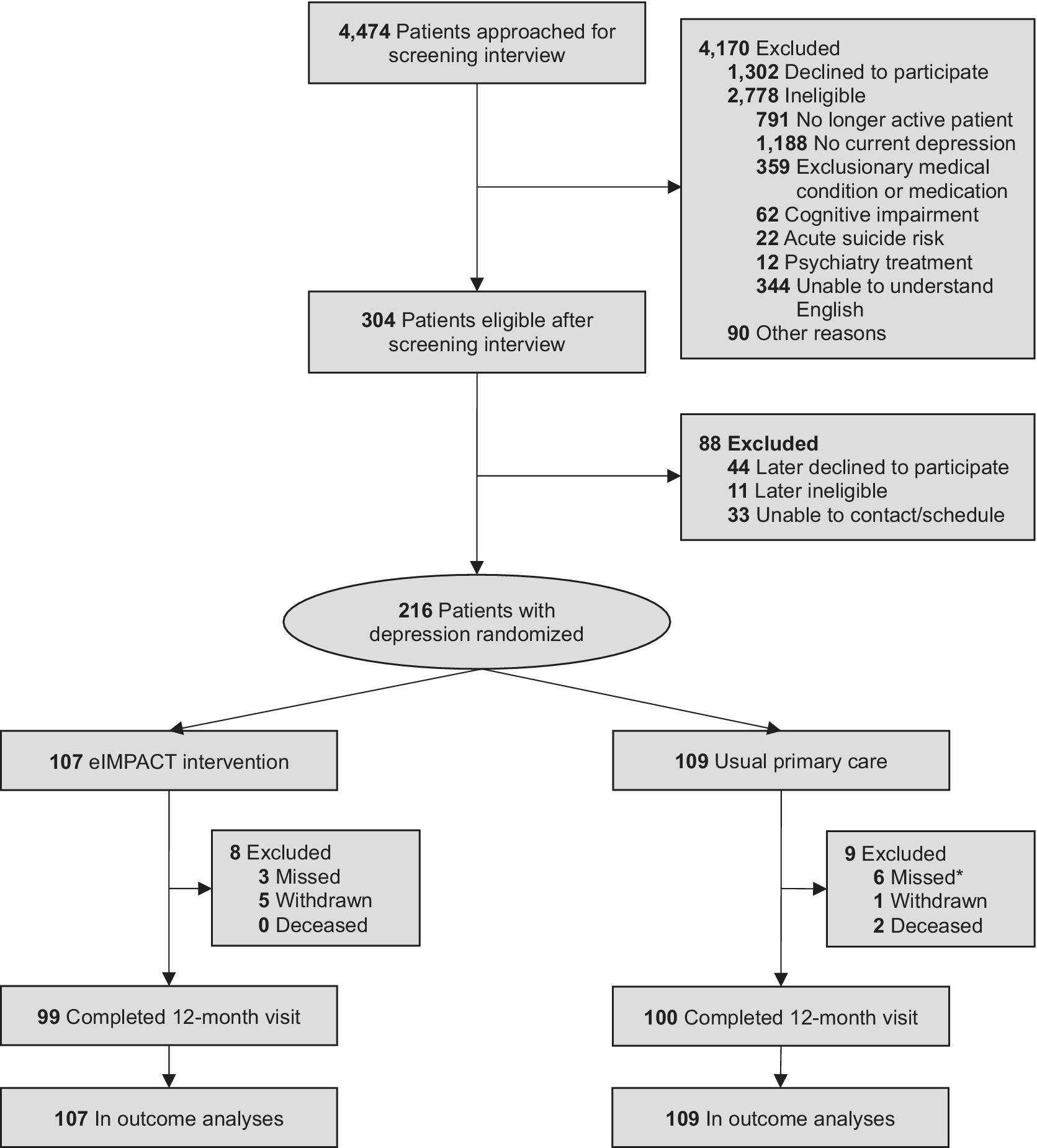
During the recruitment period (8/3/15 to 7/31/18), 216 participants were enrolled from eight Eskenazi Health primary care clinics and randomized to eIMPACT (n = 107) or usual care (n = 109; see Figure 1). Eligible participants were ≥ 50 years, currently depressed, and at elevated CVD risk. Current depression was defined as a PHQ-9 score of ≥10 (Kroenke, Spitzer, & Williams, Reference Kroenke, Spitzer and Williams2001) and a PHQ-9 major or other depressive disorder diagnosis (endorsing depressed mood and/or anhedonia; Kroenke & Spitzer, Reference Kroenke and Spitzer2002). CVD risk factors were abstracted from the electronic health record (EHR) and included hypertension, hypercholesterolemia, diabetes, or smoking within the past 5 years. Participants were classified as having elevated CVD risk if they were ≥ 60 years with at least one risk factor or 50–59 years with at least two risk factors. Patients were not eligible if they had clinical CVD, HIV/AIDS, chronic kidney disease, or active cancer/ongoing cancer treatment; were pregnant; were receiving continuous treatment for a systemic inflammatory condition in the past 3 months; were using anticoagulants; had severe cognitive impairment (Callahan et al., Reference Callahan, Unverzagt, Hui, Perkins and Hendrie2002); were diagnosed with bipolar disorder or a psychotic disorder; were at acute risk for suicide; were receiving ongoing depression treatment from a psychiatrist outside of Eskenazi Health; or were unable to understand English.
CONSORT flowchart of screening, enrollment, randomization, and follow-up for the eIMPACT trial. Note: Participants were screened and enrolled from August 13, 2015 to July 31, 2018. Data collection ended on July 31, 2020. *For two of these participants, 12-month survey data were obtained.

Figure 1. Long description
The flowchart begins at the top center with 4,474 Patients approached for screening interview.
An arrow points right to a box for 4,170 Excluded, which includes 1,302 Declined to participate and 2,778 Ineligible. Ineligibility reasons are listed as 791 No longer active patient, 1,188 No current depression, 359 Exclusionary medical condition or medication, 62 Cognitive impairment, 22 Acute suicide risk, 12 Psychiatry treatment, 344 Unable to understand English, and 90 Other reasons.
The main flow continues down to 304 Patients eligible after screening interview. An arrow points right to 88 Excluded, consisting of 44 Later declined to participate, 11 Later ineligible, and 33 Unable to contact or schedule.
The flow reaches an oval labeled 216 Patients with depression randomized. From here, the path splits into two columns.
Left Column (e IMPACT intervention):
- 107 eIMPACT intervention.
- An arrow points right to 8 Excluded: 3 Missed, 5 Withdrawn, 0 Deceased.
- 99 Completed 12-month visit.
- 107 In outcome analyses.
Right Column (Usual primary care):
- 109 Usual primary care.
- An arrow points right to 9 Excluded: 6 Missed, 1 Withdrawn, 2 Deceased.
- 100 Completed 12-month visit.
- 109 In outcome analyses.
Intervention group
Participants randomized to the intervention group received 12 months of the eIMPACT intervention, a collaborative care intervention that provides established depression treatments through a multidisciplinary team aligned with patient preference. It is a modernized version of the IMPACT intervention (Unützer et al., Reference Unützer, Katon, Callahan, Williams, Hunkeler, Harpole, Hoffing, Della Penna, Noël, Lin, Areán, Hegel, Tang, Belin, Oishi and Langston2002) that uses a stepped, flexible, treat-to-target approach. The original IMPACT trial included Wishard Health Services, now Eskenazi Health, as a study site providing precedent for evaluating collaborative care in this safety-net health system setting.
To reduce treatment barriers, the eIMPACT intervention integrates remotely delivered CBT options: (1) Beating the Blues US (BtB; Workpartners UPMC, Pittsburgh, USA), an internet CBT program (Marks, Cavanagh, & Gega, Reference Marks, Cavanagh and Gega2007) delivered with regular support from a behavioral health clinician (Shim, Mahaffey, Bleidistel, & Gonzalez, Reference Shim, Mahaffey, Bleidistel and Gonzalez2017), and (2) Problem Solving Treatment in Primary Care (PST-PC), a manualized telephonic CBT (Hegel, Barrett, & Oxman, Reference Hegel, Barrett and Oxman2000). BtB consisted of eight weekly internet-based sessions, and PST-PC consisted of 6–8 weekly 30-minute sessions delivered primarily by phone, with in-person sessions available when preferred. Additional psychological components of the eIMPACT intervention included psychoeducation, behavioral activation, and antidepressant adherence support, which were delivered via phone or FaceTime. The eIMPACT intervention also refined IMPACT’s antidepressant algorithm to minimize CVD risk.
All intervention components were delivered individually. Intervention materials included the BtB program and worksheets, PST-PC treatment manual and worksheets, depression education materials, and the modified IMPACT antidepressant treatment guidelines. Earbud headphones were available for participants completing BtB remotely. Additional details on intervention materials are provided in Stewart et al. (Reference Stewart, Patel, Polanka, Gao, Nurnberger, MacDonald, Gupta, Considine, Kovacs, Vrany, Berntson, Hsueh, Shell, Rollman and Callahan2023) and the trial protocol.
The intervention team consisted of a master’s level behavioral health clinician (depression clinical specialist), a supervising psychiatrist, a primary care liaison, and the participants’ usual primary care providers. The intervention process followed the IMPACT collaborative care manual (Unützer et al., Reference Unützer, Katon, Callahan, Williams, Hunkeler, Harpole, Hoffing, Della Penna, Noël, Lin, Areán, Hegel, Tang, Belin, Oishi and Langston2002), apart from the modifications described above. The depression clinical specialist presented cases to the intervention team, communicated treatment recommendations to participants and their usual primary care providers, and collaborated with primary care providers to implement treatment plans. Primary care providers wrote all antidepressant prescriptions, while pharmacotherapy was managed jointly with the intervention team. During active treatment, the depression clinical specialist contacted participants every 1–2 weeks to deliver the psychological components of the eIMPACT intervention and to monitor depressive symptoms, treatment engagement, and medication side effects. When participants achieved remission, defined as a ≥ 50% reduction in PHQ-9 score and fewer than three depressive symptoms sustained for ≥6 weeks, the depression clinical specialist developed a relapse prevention plan and followed participants by telephone every 2–4 weeks.
Cases were reviewed regularly by the intervention team to guide treatment changes, and fidelity to the eIMPACT algorithm was assessed and recorded during team meetings. Treatment contacts and clinically relevant updates, including medication side effects, were documented in the EHR and communicated to primary care providers as needed. Given the eIMPACT intervention structure, the combination and sequence of treatment components varied across participants in the intervention group, reflecting individualized paths through the treatment algorithm that were adapted over time based on symptom response and patient preference. Supplementary Figure S1 displays the eIMPACT intervention structure and reports actual receipt of intervention components and contacts as intervention process variables. No substantive modifications were made to the intervention during the trial.
Usual care group
Participants randomized to the usual care group received current primary care for depression over 12 months. At randomization, participants were informed of their depression and group assignment, encouraged to follow up with their usual primary care provider, and given a list of local mental health services. Their providers received a letter or EHR message noting the group assignment, encouraging depression follow-up, and providing the same resource list. Eskenazi Health primary care clinics use a team-based care approach, which includes embedded master’s level behavioral health clinicians and affiliated psychiatrists who provide brief counseling and medication management. No care restrictions were placed on participants in either group (see Stewart et al., Reference Stewart, Patel, Polanka, Gao, Nurnberger, MacDonald, Gupta, Considine, Kovacs, Vrany, Berntson, Hsueh, Shell, Rollman and Callahan2023 and Supplementary Figure S1).
Assessments
Depressive symptoms were assessed at the pre-treatment and 12-month post-treatment visits using the SCL-20 (Derogatis et al., Reference Derogatis, Lipman, Rickels, Uhlenhuth and Covi1974) and the PHQ-9 (Kroenke et al., Reference Kroenke, Spitzer and Williams2001). The SCL-20 is a 20-item measure of depression severity rated from 0 (“not at all”) to 4 (“extremely”). A total score is calculated by averaging the items, yielding a mean score ranging from 0 to 4 with higher values indicating greater severity. The SCL-20 has high internal consistency (Cronbach’s α > 0.90) and demonstrated sensitivity to treatment-related change in primary care samples (Derogatis et al., Reference Derogatis, Lipman, Rickels, Uhlenhuth and Covi1974; Unützer et al., Reference Unützer, Katon, Callahan, Williams, Hunkeler, Harpole, Hoffing, Della Penna, Noël, Lin, Areán, Hegel, Tang, Belin, Oishi and Langston2002). However, its sensitivity and specificity for detecting major depressive disorder are not well established and may be lower than those of other commonly used scales (O’Connor et al., Reference O’Connor, Butcher, Hansen, Kleiboer, Murray, Sharma, Thekkumpurath, Walker and Sharpe2010). In contrast, the PHQ-9 is a 9-item measure wherein items are scored 0 (“not at all”) to 3 (“nearly every day”) and summed to produce a total score of 0–27, with higher scores reflecting greater severity. The PHQ-9 is aligned with Diagnostic and Statistical Manual of Mental Disorders criteria and has shown high sensitivity (88%) and specificity (88%) for major depressive disorder at a cutoff score of ≥10 in primary care populations (Kroenke et al., Reference Kroenke, Spitzer and Williams2001; Kroenke & Spitzer, Reference Kroenke and Spitzer2002; Manea, Gilbody, & McMillan, Reference Manea, Gilbody and McMillan2012). Although both the SCL-20 and PHQ-9 assess depressive symptoms and show good internal consistency, they differ at the item level. Prior work has demonstrated moderate correlations between the two measures and differences in their underlying factor structure (Lee, Schulberg, Raue, & Kroenke, Reference Lee, Schulberg, Raue and Kroenke2007). To aid interpretation of our primary analyses, we mapped SCL-20 and PHQ-9 items to shared clinical symptom constructs based on item wording and original scale descriptions (see Supplementary Table S2).
During the pre-treatment visit, sociodemographic factors, physical and mental health variables, and current medications were assessed. These variables are reported to characterize the cohort, provide baseline depression treatment context for interpreting intervention effects, and identify baseline imbalances addressed through covariate adjustment in the primary models. Sex and race were self-reported. Due to small cell counts, race was recoded as Black, White, or Other (Table 1). Education was recorded as highest grade completed. Total household income and baseline psychotherapy/counseling for depression were assessed by self-report. Baseline antidepressant medication use was coded by trial staff from reported medications. After 5 minutes of rest, three seated blood pressure readings were obtained 2 minutes apart, and baseline systolic blood pressure was calculated as the mean of the final two readings (Perloff et al., Reference Perloff, Grim, Flack, Frohlich, Hill, McDonald and Morgenstern1993).
Baseline characteristics of participants in the eIMPACT trial

Table 1. Long description
The table consists of five columns: Characteristic, All (N equals 216), Intervention (n equals 107), Usual Care (n equals 109), and p-value.
Sociodemographic factors:
- Age in years, M (S D): All 58.7 (5.7), Intervention 58.5 (6.0), Usual Care 58.9 (5.4), p equals 0.62.
- Sex, n (%): Female: All 169 (78.2), Intervention 83 (77.6), Usual Care 86 (78.9); Male: All 47 (21.8), Intervention 24 (22.4), Usual care 23 (21.1); p equals 0.81.
- Race, n (%): Black/African American: All 107 (49.5), Intervention 56 (52.3), Usual Care 51 (46.8); White: All 97 (44.9), Intervention 45 (42.1), Usual care 52 (47.7); Other race: All 12 (5.6), Intervention 6 (5.6), Usual Care 6 (5.5); p equals 0.70.
- Ethnicity, n (%): Hispanic or Latino/a/x: All 10 (4.6), Intervention 5 (4.7), Usual Care 5 (4.6); Not Hispanic: All 206 (95.4), Intervention 102 (95.3), Usual Care 104 (95.4); p equals 0.98.
- Education, years, M (S D): All 12.8 (2.3), Intervention 13.1 (2.5), Usual Care 12.6 (2.0), p equals 0.09.
- Annual household income, n (%): Under $10,000: All 98 (45.6), Intervention 44 (41.1), Usual Care 54 (50.0); $10,000 to $14,999: All 37 (17.2), Intervention 16 (15.0), Usual Care 21 (19.4); $15,000 to $24,999: All 45 (20.9), Intervention 21 (19.6), Usual Care 24 (22.2); $25,000 to $39,999: All 25 (11.6), Intervention 18 (16.8), Usual Care 7 (6.5); $40,000 plus: All 10 (4.7), Intervention 8 (7.5), Usual Care 2 (1.9); p equals 0.04.
- Hypertension, n (% yes): All 164 (76.3), Intervention 82 (76.6), Usual Care 82 (75.9), p equals 0.90.
- S B P, mmHg, M (S D): All 135.7 (19.7), Intervention 133.0 (18.9), Usual Care 138.4 (20.2), p equals 0.04.
- D B P, mmHg, M (S D): All 80.9 (11.8), Intervention 79.7 (11.0), Usual Care 82.1 (12.5), p equals 0.14.
Baseline mental health variables:
- Depressive disorder, n (% yes): All 125 (58.1), Intervention 64 (59.8), Usual Care 61 (56.5), p equals 0.62.
- SCL-20 total score, M (S D): All 1.9 (0.7), Intervention 1.9 (0.7), Usual Care 2.0 (0.7), p equals 0.30.
- PHQ-9 total score, M (S D): All 15.1 (5.0), Intervention 14.7 (5.2), Usual Care 15.4 (4.8), p equals 0.33.
- Antidepressant medication use, n (% yes): All 124 (58.5), Intervention 63 (61.2), Usual Care 61 (56.0), p equals 0.44.
- Psychotherapy/Counseling for depression, n (% yes): All 35 (16.3), Intervention 20 (18.9), Usual Care 15 (13.8), p equals 0.31.
Note: All variables had complete data except (n): education (215), income (215), depressive disorder (215), antidepressant medication use (212), and psychotherapy/counseling for depression (215). p-values are from χ2 tests for categorical variables and independent samples t tests for continuous variables comparing the intervention and usual care groups. SBP, systolic blood pressure; DBP, diastolic blood pressure; SCL-20, Hopkins Symptom Checklist-20; PHQ-9, Patient Health Questionnaire-9.
a Due to some low cell counts, race was recoded into a 3-level variable: Black/African American, White, and Other Race; Other Race includes participants who self-identified as American Indian/Alaska Native (n = 1), Asian (n = 1), multiracial (n = 8), or another race (n = 2).
Data analysis
Chi-square tests for categorical variables and independent samples t tests for continuous variables were performed in SPSS 28 to assess baseline imbalance. Education, income, and systolic blood pressure were included as covariates in primary models, given baseline imbalances between treatment groups reported in the main outcomes paper (Stewart et al., Reference Stewart, Patel, Polanka, Gao, Nurnberger, MacDonald, Gupta, Considine, Kovacs, Vrany, Berntson, Hsueh, Shell, Rollman and Callahan2023). Intervention effects on individual depressive symptoms were evaluated using two path-analytic structural equation models in Mplus – one for the SCL-20 (see Figure 2) and one for the PHQ-9 (see Figure 3). Each model specified treatment group as a predictor of 12-month residualized difference scores for all individual items (Castro-Schilo & Grimm, Reference Castro-Schilo and Grimm2018). This allowed simultaneous estimation of all individual item intervention effects while accounting for intercorrelations among items (Muthén & Muthén, Reference Muthén and Muthén2017). All randomized participants were included, with full information maximum likelihood estimation utilized to handle missing data. Variances and covariances among outcome variables were freely estimated to permit FIML estimation. A two-tailed p < 0.05 was considered statistically significant. Sensitivity analyses re-estimated both path-analytic models among participants who self-reported a baseline depression history given evidence that depression history is associated with more persistent depressive symptoms and poorer cognitive functioning (Matcham et al., Reference Matcham, Simblett, Leightley, Dalby, Siddi, Haro, Lamers, Penninx, Bruce, Nica, Zormpas, Gilpin, White, Oetzmann, Annas, Brasen, Narayan, Hotopf and Wykes2023; Semkovska et al., Reference Semkovska, Quinlivan, O’Grady, Johnson, Collins, O’Connor, Knittle, Ahern and Gload2019).
Effect of the eIMPACT intervention, versus usual care, on individual depression items of the Hopkins symptom checklist-20 (SCL-20). Note: Forest plot of results from the path analytic structural equation model simultaneously estimating the effect of the eIMPACT intervention on each SCL-20 item. Standardized betas (βY) and confidence intervals are bolded for items that showed statistically significant between-group improvement. A negative β value indicates superior outcomes in the intervention group. The model was adjusted for baseline education, income, and systolic blood pressure. Figure created in R using forestplot package (Gordon, Lumley, & Gordon, Reference Gordon, Lumley and Gordon2019) after importing Mplus output via the MplusAutomation package (Hallquist & Wiley, Reference Hallquist and Wiley2018). CI, confidence interval.

Figure 2. Long description
A forest plot with a vertical null line at 0. The x axis at the bottom represents the Standardized Beta with a 95 percent C I, ranging from negative 1.2 to 0.4. Values to the left of 0 favor the eIMPACT Intervention, while values to the right favor Usual Care.
Items with statistically significant improvement (bolded) include:
* 2. Feeling low in energy or slowed down: negative 0.54 [-0.84, -0.24]
* 5. Crying easily: negative 0.56 [-0.87, -0.24]
* 6. Feeling of being trapped or caught: negative 0.66 [-0.97, -0.35]
* 7. Blaming yourself for things: negative 0.57 [-0.88, -0.26]
* 9. Feeling blue: negative 0.62 [-0.92, -0.32]
* 10. Worrying too much about things: negative 0.50 [-0.83, -0.17]
* 11. Feeling no interest in things: negative 0.52 [-0.83, -0.21]
* 12. Trouble falling asleep: negative 0.70 [-1.04, -0.35]
* 13. Feeling hopeless about the future: negative 0.67 [-0.95, -0.38]
* 14. Thoughts of death or dying: negative 0.63 [-0.90, -0.36]
* 16. Awakening in the early morning: negative 0.53 [-0.88, -0.19]
* 17. Sleep that is restless or disturbed: negative 0.50 [-0.86, -0.15]
* 18. Feeling everything is an effort: negative 0.66 [-0.99, -0.34]
* 19. Feelings of worthlessness: negative 0.57 [-0.87, -0.27]
* 20. Feelings of guilt: negative 0.55 [-0.84, -0.27]
Non-significant items include:
* 1. Loss of sexual interest or pleasure: negative 0.03 [-0.39, 0.34]
* 3. Thoughts of ending your life: negative 0.04 [-0.18, 0.10]
* 4. Poor appetite: negative 0.15 [-0.47, 0.18]
* 8. Feeling lonely: negative 0.08 [-0.39, 0.23]
* 15. Overeating: negative 0.21 [-0.50, 0.08]
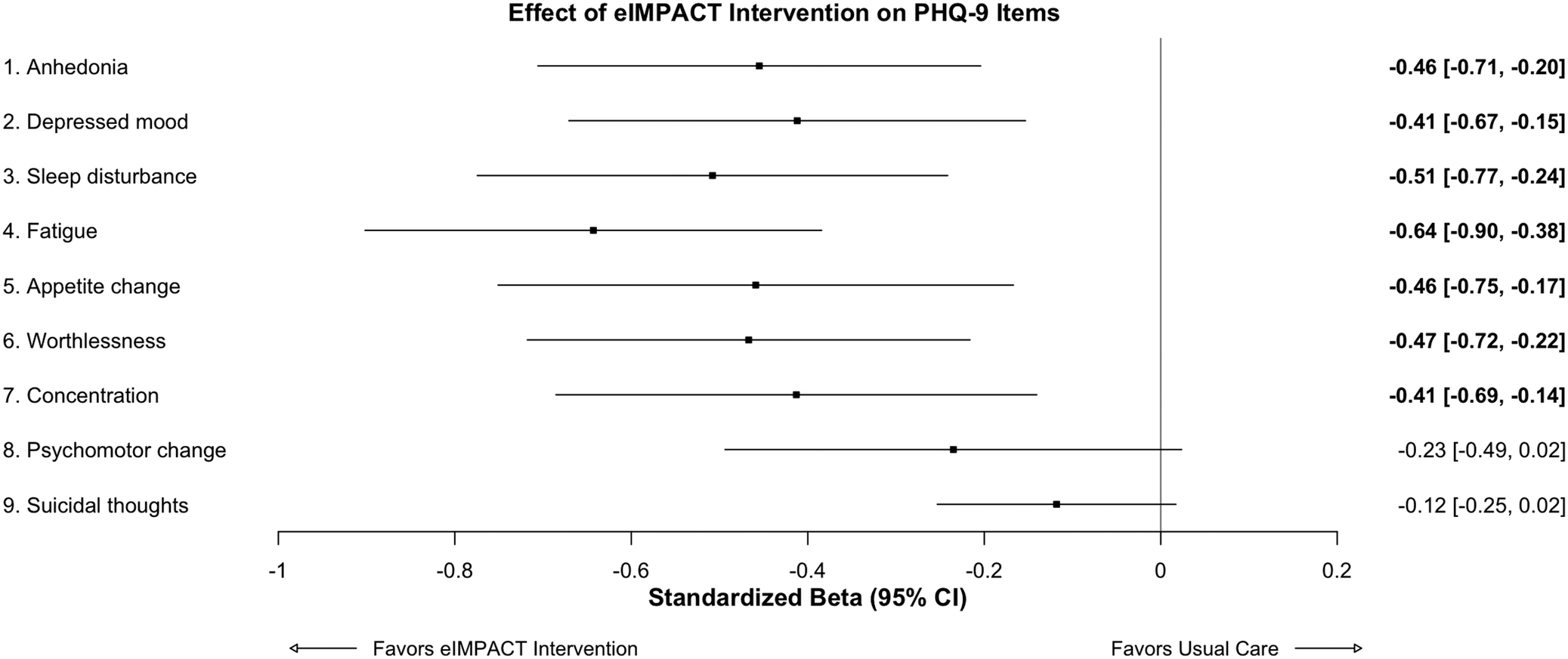
Effect of the eIMPACT intervention, versus usual care, on individual depression items of the Patient Health Questionnaire-9 (PHQ-9). Note: Forest plot of results from the path analytic structural equation model simultaneously estimating the effect of the eIMPACT intervention on each PHQ-9 item. Standardized betas (βY) and confidence intervals are bolded for items that showed statistically significant between-group improvement. A negative β value indicates superior outcomes in the intervention group. The model was adjusted for baseline education, income, and systolic blood pressure. Figure created in R using forestplot package [82] after importing Mplus output via the MplusAutomation package [83]. CI, confidence interval.

Figure 3. Long description
The x-axis represents the Standardized Beta with a 95 percent C I, ranging from negative 1 to 0.2. A vertical line at 0 indicates no effect. Values to the left of 0 favor eIMPACT Intervention, while values to the right favor Usual Care.
From top to bottom, the nine items are:
* 1. Anhedonia: Beta negative 0.46 [negative 0.71, negative 0.20].
* 2. Depressed mood: Beta negative 0.41 [negative 0.67, negative 0.15].
* 3. Sleep disturbance: Beta negative 0.51 [negative 0.77, negative 0.24].
* 4. Fatigue: Beta negative 0.64 [negative 0.90, negative 0.38].
* 5. Appetite change: Beta negative 0.46 [negative 0.75, negative 0.17].
* 6. Worthlessness: Beta negative 0.47 [negative 0.72, negative 0.22].
* 7. Concentration: Beta negative 0.41 [negative 0.69, negative 0.14].
* 8. Psychomotor change: Beta negative 0.23 [negative 0.49, 0.02].
* 9. Suicidal thoughts: Beta negative 0.12 [negative 0.25, 0.02].
Items 1 through 7 are bolded, indicating statistically significant improvement as their confidence intervals do not cross the zero line. Items 8 and 9 cross the zero line and are not bolded.
Standardized betas (βY) were computed to aid interpretation of model results. These coefficients express the change in the dependent variable, in standard deviation units, for each one-point increase in the independent variable (Muthén & Muthén, Reference Muthén and Muthén2017), which here reflects a change from the usual care group to the intervention group. βY can be interpreted as effect size estimates of relative between-group differences using thresholds aligned with Cohen’s d (Nieminen, Reference Nieminen2022). A commonly used heuristic for a clinically meaningful between-group difference is βY ≥ 0.50 (a medium effect; Cuijpers et al., Reference Cuijpers, Turner, Koole, Van Dijke and Smit2014). To aid interpretation in raw item units, we also report a distribution-based benchmark for clinically meaningful magnitude of change for each item, defined as 0.5 times the pooled baseline SD (Supplementary Tables S3 and S4; Bloom et al., Reference Bloom, Kaplan, Mojica, Strauss, Gonzalez-Lomas, Campbell, Alaia and Jazrawi2023; Norman, Sloan, & Wyrwich, Reference Norman, Sloan and Wyrwich2003). Whereas βY summarizes between-group effects in standardized units, these benchmarks show what a moderate effect represents in this sample’s raw metric.
Results
Participant characteristics
As can be seen in Table 1, the mean age of participants was 59 years, with a range of 50–78 years. The sample comprised 78% female and 50% Black/African American. Incomes were generally low, with 46% reporting an annual household income of <$10,000. Baseline blood pressure measurements were elevated, with mean systolic/diastolic blood pressure of 136/81 mmHg, which is within the stage 1 hypertension range (Muntner et al., Reference Muntner, Shimbo, Carey, Charleston, Gaillard, Misra, Myers, Ogedegbe, Schwartz, Townsend, Urbina, Viera, White and Wright2019).
The majority of participants (58%) reported a previous diagnosis of depression. The mean baseline SCL-20 score was 1.9. While the SCL-20 does not have established clinical thresholds, the observed mean aligns with those from other samples with depression (Steffens et al., Reference Steffens, Snowden, Fan, Hendrie and Unützer2006; Unützer et al., Reference Unützer, Katon, Callahan, Williams, Hunkeler, Harpole, Hoffing, Della Penna, Noël, Lin, Areán, Hegel, Tang, Belin, Oishi and Langston2002). Baseline PHQ-9 scores were also elevated, with a mean of 15.1, which falls in the moderately severe depression range (Kroenke et al., Reference Kroenke, Spitzer and Williams2001). Frequency of antidepressant use was high, with 59% of participants reporting current antidepressant use at pre-treatment (81% lifetime history). Only 16% reported current psychotherapy/counseling for depression at pre-treatment (58% lifetime history). The treatment groups were balanced on most baseline factors. However, the intervention group had somewhat higher incomes, marginally higher education, and lower systolic blood pressure.
Item-level descriptive statistics and arithmetic difference scores
Baseline SCL-20 item means span 0.28 (suicidal ideation) to 2.88 (restless sleep) on a 0–4 scale (see Table 2). Over 12 months, both groups numerically improved on 19 of 20 items. The intervention yielded the largest absolute improvements, particularly for feeling hopeless about the future (−1.08) and trouble falling asleep (−1.03). Usual care produced absolute improvements of −0.05 to −0.88 on most items but was the only group to exhibit an increase in symptom severity (thoughts of death or dying: +0.17).
Hopkins Symptom Checklist-20 (SCL-20) and Patient Health Questionnaire-9 (PHQ-9) item-level pre-treatment, post-treatment, and change scores by treatment group

Table 2. Long description
The table is divided into two main sections: 20 items from the Hopkins Symptom Checklist (S CL-20) and 9 items from the Patient Health Questionnaire (P HQ-9).
Column Structure:
* SCL-20 items: Row labels.
* Intervention (n equals 107 pre, 99 post): Pre-treatment M (S D), Post-treatment M (S D), and Pre-post arithmetic difference M (S D).
* Usual care (n equals 109 pre, 102 post): Pre-treatment M (S D), Post-treatment M (S D), and Pre-post arithmetic difference M (S D).
Key SCL-20 Data Trends:
* Item 10 (Worrying too much): Intervention group improved from 2.79 to 1.85 (difference of minus 0.97); Usual Care improved from 3.03 to 2.46 (difference of minus 0.54).
* Item 13 (Feeling hopeless): Intervention group improved from 1.94 to 0.82 (difference of minus 1.08); Usual Care improved from 2.01 to 1.60 (difference of minus 0.44).
* Item 14 (Thoughts of death): Intervention group improved (minus 0.47), while Usual Care showed a slight increase (plus 0.17).
Key PHQ-9 Data Trends:
* Item 1 (Anhedonia): Intervention group difference of minus 0.89 versus Usual Care difference of minus 0.48.
* Item 4 (Fatigue): Intervention group difference of minus 0.86 versus Usual Care difference of minus 0.38.
* Item 9 (Suicidal thoughts): Intervention group difference of minus 0.28 versus Usual Care difference of minus 0.11.
Overall, the Intervention group consistently shows larger negative arithmetic differences (greater symptom reduction) compared to the Usual Care group across nearly all items.
Note: Pre-to-post change values were computed as: post-treatment value – pre-treatment value. As higher item scores denote greater symptom severity, a negative change value indicates improvement, whereas a positive value indicates worsening. Observed ns for each SCL-20 outcome were (pre-treatment; post-treatment; pre-to-post change): item 1 (216, 200, 200), item 2 (216, 200, 200), item 3 (215, 200, 199), item 4 (214, 196, 194), item 5 (208, 192, 185), item 6 (215, 199, 199), item 7 (216, 199, 199), item 8 (214, 200, 198), item 9 (210, 198, 192), item 10 (213, 198, 196), item 11 (214, 200, 198), item 12 (212, 200, 196), item 13 (213, 200, 197), item 14 (214, 200, 198), item 15 (216, 199, 199), item 16 (215, 199, 198), item 17 (216, 200, 200), item 18 (215, 200, 199), item 19 (216, 200, 200), and item 20 (216, 199, 199). Observed ns for each PHQ-9 outcome were (pre-treatment; post-treatment; pre-to-post change): item 1 (216, 201, 201), item 2 (216, 201, 201), item 3 (216, 201, 201), item 4 (216, 201, 201), item 5 (216, 201, 201), item 6 (216, 201, 201), item 7 (216, 201, 201), item 8 (216, 201, 201), and item 9 (216, 201, 201). SCL-20, Hopkins Symptom Checklist-20; PHQ-9, Patient Health Questionnaire-9.
Baseline PHQ-9 item means range from 0.36 (suicidal thoughts) to 2.49 (fatigue) on a 0–3 scale (see Table 2). Both groups numerically improved on every item, yet the intervention yielded larger absolute improvements of −0.81 to −0.89 on anhedonia, sleep disturbance, fatigue, appetite changes, and worthlessness compared with −0.37 to −0.48 for usual care. The usual care group showed the smallest absolute improvements on psychomotor changes (−0.06) and suicidal thoughts (−0.11). Baseline item-level comparisons between groups were small and nonsignificant (see Supplementary Table S5), indicating minimal baseline imbalance. These descriptive statistics provide context for the relative effects tested in the primary path analytic models.
Path analytic model results
Results from the path analytic structural equation model for individual SCL-20 items showed that, compared to the usual care group, the intervention group exhibited greater 12-month improvement in 15 of 20 items (see Figure 2 and Supplementary Table S3). Medium-to-large effects were observed for several symptoms – namely, feeling trapped/caught, trouble falling asleep, hopelessness, and feeling everything is an effort (βY range = −0.66 to −0.70). Additionally, medium effects were observed for low energy, crying easily, blaming self, feeling blue, worrying, having no interest in things, thoughts of death or dying, early morning awakening, disturbed sleep, worthlessness, and guilt (βY range = −0.50 to −0.63). The following symptoms met our distribution-based threshold for clinically meaningful between-group improvement: low energy, feeling trapped/caught, feeling blue, trouble falling asleep, hopelessness, thoughts of death or dying, and feeling everything is an effort. In contrast, the intervention did not produce greater improvements than usual care in loss of sexual interest or pleasure, thoughts of ending your life, poor appetite, feeling lonely, or overeating (βY range = −0.03 to −0.21).
Generally consistent results were obtained from the path-analytic structural equation model for individual PHQ-9 items, which indicated that the intervention group showed greater 12-month improvement in 7 of 9 items compared to the usual care group (see Figure 3 and Supplementary Table S4). Medium effects were observed for sleep disturbance (βY = −0.51, 95% CI = −0.77 to −0.24) and fatigue (βY = −0.64; 95% CI = −0.90 to −0.38), and a small-to-medium effect was observed for loss of interest or pleasure (βY = −0.46, 95% CI = −0.71 to −0.20), all three of which met our clinically meaningful between-group threshold. Small-to-medium effects favoring the intervention group were observed for depressed mood, appetite changes, self-critical thoughts, and trouble concentrating (βY range = −0.41 to −0.47). No group differences were observed for psychomotor changes (βY = −0.24, 95% CI = −0.49 to 0.02) or suicidal ideation (βY = −0.12, 95% CI = −0.25 to 0.02).
Discussion
In a sociodemographically diverse cohort of primary care patients with depression, modernized collaborative care for depression, largely delivered via digital and telephonic CBT, produced greater improvement than usual care in most individual depressive symptoms, with notable exceptions. Compared to usual primary care for depression, the eIMPACT intervention yielded clinically meaningful improvements in the following symptoms as measured by the SCL-20: low energy, feeling trapped/caught, feeling blue, trouble falling asleep, hopelessness, thoughts of death or dying, and feeling everything is an effort. Further, significant improvements were observed in crying easily, self-blame, worrying, feeling no interest in things, awakening in the early morning, sleep that is restless or disturbed, worthlessness, and guilt. For the PHQ-9, clinically meaningful between-group differences were also observed in loss of interest or pleasure, sleep disturbance, and fatigue, with further significant improvements found for depressed mood, self-critical thoughts, trouble concentrating, and appetite changes. Collectively, these findings indicate that modernized collaborative care produces comparatively greater, and broadly consistent, symptom-level improvements across affective, cognitive, and somatic dimensions of depression than usual care. However, several symptoms including suicidal ideation (both scales), loneliness (SCL-20), loss of sexual interest or pleasure (SCL-20), poor appetite (SCL-20), overeating (SCL-20), and psychomotor changes (PHQ-9) were not better addressed by modernized collaborative care than usual care and may represent targets for adjunctive care. Absolute improvement was negligible for suicidal ideation, loss of sexual interest, and poor appetite in both groups; equivalent across groups for loneliness and overeating; and numerically greater in the intervention group for psychomotor change. These findings have important implications for future research and clinical practice.
Our findings extend prior research by demonstrating symptom-specific effects within a collaborative care framework. Collaborative care is now a first-line, scalable approach for integrating mental health into primary care, as it reliably outperforms usual care on depression outcomes (Archer et al., Reference Archer, Bower, Gilbody, Lovell, Richards, Gask, Dickens and Coventry2012; Community Preventive Services Task Force, 2012). Collaborative care approaches vary in their components and intensity with which they are delivered. A recent individual participant data meta-analysis found that patient-centered team care (e.g. shared decision-making and family involvement), population-based management (e.g. patient registries and proactive follow-up), measurement-based treatment to target (e.g. systematic symptom monitoring and stepped treatment adjustment), evidence-based interventions (e.g. manualized psychotherapy), and accountability for clinical outcomes (e.g. multidisciplinary care coordination and case review) were each associated with greater improvement in depression, with the largest association observed for therapeutic treatment strategy (Schillok et al., Reference Schillok, Gensichen, Panagioti, Gunn, Junker, Lukaschek, Jung-Sievers, Sterner, Kaupe, Dreischulte, Ali, Aragonès, Bekelman, Herbeck Belnap, Carney, Chwastiak, Coventry, Davidson, Ekstrand and Schillok2025). The eIMPACT intervention incorporated patient-centered care, measurement-based treatment to target, evidence-based psychotherapy and pharmacotherapy, and multidisciplinary care coordination, situating the present findings within a collaborative care model that included several core components associated with improved depression outcomes. Consistent with earlier trials, core affective symptoms such as depressed mood and anhedonia showed robust relative improvement, whereas treatment group differences were not observed on somatic symptoms like appetite changes (Bauer-Staeb, Griffith, Faraway, & Button, Reference Bauer-Staeb, Griffith, Faraway and Button2023; Chekroud et al., Reference Chekroud, Gueorguieva, Krumholz, Trivedi, Krystal and McCarthy2017; Erickson, Williams, Bombardier, & Fann, Reference Erickson, Williams, Bombardier and Fann2024; Snippe et al., Reference Snippe, Doornbos, Schoevers, Wardenaar and Wichers2021). Our results confirm that even when evidence-based psychotherapy and pharmacotherapy are combined, certain symptoms remain difficult to resolve. These findings derive from a sociodemographically diverse safety-net primary care sample of predominantly low-income and racial/ethnic minority patients, populations disproportionately affected by depression and often underrepresented in trials (Bailey, Mokonogho, & Kumar, Reference Bailey, Mokonogho and Kumar2019; Vyas et al., Reference Vyas, Donneyong, Mischoulon, Chang, Reynolds and Okereke2020).
Compared to usual care, modernized collaborative care did not produce consistent relative improvements in symptoms of suicidal ideation, loneliness, appetite changes, psychomotor changes, and sexual dysfunction. Several explanations may account for this pattern. First, suicidality and psychomotor disturbance may reflect more severe or treatment-resistant features of depression requiring higher levels of care or specialized intervention (Fried & Nesse, Reference Fried and Nesse2015). Second, appetite changes, especially increased appetite and overeating, may reflect atypical or immunometabolic depression subtypes, which often respond less well to treatment and carry greater cardiometabolic risk (Penninx et al., Reference Penninx, Lamers, Jansen, Berk, Khandaker, De Picker and Milaneschi2025; Shell et al., Reference Shell, Crawford, Cyders, Hirsh and Stewart2024). Third, loneliness may require interventions that directly target social disconnection, as it is only modestly correlated with depressive symptom severity and often persists despite depression improvement (Cacioppo et al., Reference Cacioppo, Hughes, Waite, Hawkley and Thisted2006; Erzen & Çikrikci, Reference Erzen and Çikrikci2018). This interpretation aligns with recent public health guidance identifying loneliness as a national health concern (Jaffe, Reference Jaffe2023). Fourth, a methodological factor likely limited detectable change in suicidality, as patients at acute risk were excluded. Analysis of item-level distributions suggests a floor effect for SCL-20 item 3 (median and interquartile range of zero; 80% of responses were zero), whereas SCL-20 item 14 and PHQ-9 item 9 retained sufficient variability to detect change (see Supplementary Table S5). Fifth, symptoms including appetite changes, agitation, and sexual dysfunction are well-documented side effects of antidepressant medications (Fried & Nesse, Reference Fried and Nesse2015). Thus, the antidepressant component of the eIMPACT intervention may have inadvertently contributed to the maintenance or exacerbation of these symptoms in some patients, and they could persist until pharmacotherapy is withdrawn (Edinoff et al., Reference Edinoff, Akuly, Hanna, Ochoa, Patti, Ghaffar, Kaye, Viswanath, Urits, Boyer, Cornett and Kaye2021; Oliva et al., Reference Oliva, Lippi, Paci, Del Fabro, Delvecchio, Brambilla, De Ronchi, Fanelli and Serretti2021; Winter, Curtis, Hu, & Clayton, Reference Winter, Curtis, Hu and Clayton2022). Approximately one-third of participants in each group were prescribed a new antidepressant or had a dosage adjustment during the trial (Supplementary Table S6), and 59% were on an antidepressant at baseline, which may have contributed to the persistence of these symptoms. Sensitivity analyses among participants reporting a baseline depression history yielded a generally similar pattern of findings, although intervention effects for anhedonia (PHQ-9 item 1; SCL-20 item 11), several core affective symptoms (SCL-20 items 5, 7, and 20), and trouble concentrating (PHQ-9 item 7) were attenuated and no longer reached statistical significance (see Supplementary Tables S7 and S8). While the change in significance may reflect reduced statistical power, these changes in effect size may be consistent with prior evidence linking depression history with more persistent depressive symptoms and poorer cognitive functioning (Matcham et al., Reference Matcham, Simblett, Leightley, Dalby, Siddi, Haro, Lamers, Penninx, Bruce, Nica, Zormpas, Gilpin, White, Oetzmann, Annas, Brasen, Narayan, Hotopf and Wykes2023; Semkovska et al., Reference Semkovska, Quinlivan, O’Grady, Johnson, Collins, O’Connor, Knittle, Ahern and Gload2019). Overeating (SCL-20 item 15) was the notable exception, with a larger intervention effect than in the full sample (βY = −0.45 vs. −0.21) that reached statistical significance. Overeating is characteristic of atypical and immunometabolic depression phenotypes (Penninx et al., Reference Penninx, Lamers, Jansen, Berk, Khandaker, De Picker and Milaneschi2025), but these findings should be interpreted cautiously given the exploratory nature of these analyses and the smaller subgroup sample size.
Two cross-measure discrepancies deserve comment. First, modernized collaborative care improved passive suicidality (i.e. a desire to be dead; SCL-20 item 14) more than active suicidality (i.e. a desire to kill/hurt oneself; SCL-20 item 3 and PHQ-9 item 9, which also assesses passive suicidality). While a floor effect for active suicidality likely accounts for this pattern, active and passive suicidality are separate constructs (Wastler et al., Reference Wastler, Khazem, Ammendola, Baker, Bauder, Tabares, Bryan, Szeto and Bryan2023) that may respond differentially to treatment (Bingham et al., Reference Bingham, Rothschild, Mulsant, Whyte, Meyers, Banerjee, Szanto, Flint and Group2017). Second, the intervention improved the PHQ-9 item combining poor appetite and overeating but not the separate SCL-20 items. This may be because, phenomenologically, noticing that “something is different” (i.e. salience of a change) is easier than determining the direction of a change (i.e. valence). This is plausible in light of two lines of evidence. First, depression is associated with impaired interoception – the ability to identify and interpret bodily signals – such that patients with depression are better at identifying somatic signals but worse at interpreting them (Harshaw, Reference Harshaw2015). Second, neuroscience research shows that the salience network (which identifies and prioritizes stimuli) responds to hunger and to post-meal fullness with comparable magnitude (Seeley, Reference Seeley2019). Together, these findings provide potential explanations for why the double-barreled PHQ-9 item registered improvement, while the two more precise SCL-20 items did not.
Our findings have important implications for research and clinical practice. Regarding clinical practice, routine depression care should include item-level monitoring so that persistent symptoms can trigger targeted adjunctive treatments. Proactively managing lingering residual symptoms such as sleep disturbance, fatigue, or appetite changes is critical as they can impair functioning and predict depression relapse and cardiometabolic risk (Carney et al., Reference Carney, Freedland, Steinmeyer, Rubin and Rich2018; Gilsanz et al., Reference Gilsanz, Kubzansky, Tchetgen Tchetgen, Wang, Kawachi, Patton, Fitzpatrick, Kop, Longstreth and Glymour2017; Kwasny et al., Reference Kwasny, Włodarczyk, Dywel, Szarmach, Strandberg and Cubała2023; Luppino et al., Reference Luppino, de Wit, Bouvy, Stijnen, Cuijpers, Penninx and Zitman2010). While we cannot glean optimal reassessment intervals from our study, clinical protocols suggest reassessing symptoms 2–4 weeks after initiating care and again by 8–12 weeks to consider targeted add-ons (Ridout, Vanderlip, & Alter, Reference Ridout, Vanderlip and Alter2023; Unützer et al., Reference Unützer, Katon, Callahan, Williams, Hunkeler, Harpole, Hoffing, Della Penna, Noël, Lin, Areán, Hegel, Tang, Belin, Oishi and Langston2002). Digital behavioral interventions such as CBT for insomnia (Lu et al., Reference Lu, Zhang, Zhang, Huang, Huang, Wang, Wu, Mao and Huang2023; Zhou et al., Reference Zhou, Ritterband, Bethea, Robles, Heeren and Rosenberg2022), exercise programs (Motl & Sandroff, Reference Motl and Sandroff2020), and lifestyle management programs (Mitchell et al., Reference Mitchell, Fabry, Ho, May, Baldwin, Blanco, Smith, Michaelides, Shokoohi, West, Gotera, El Massad and Zhou2023) have demonstrated effectiveness for improving these symptoms, evidence of cost-effectiveness (Darden et al., Reference Darden, Espie, Carl, Henry, Kanady, Krystal and Miller2021; Mitchell et al., Reference Mitchell, Fabry, Ho, May, Baldwin, Blanco, Smith, Michaelides, Shokoohi, West, Gotera, El Massad and Zhou2023), and are potentially scalable options. Future research should prioritize symptom-level analyses and evaluate treatments that embed symptom-targeted modules within collaborative care, such as CBT for insomnia (Glozier et al., Reference Glozier, Christensen, Griffiths, Hickie, Naismith, Biddle, Overland, Thorndike and Ritterband2019), peer-support programs for loneliness (Shankman et al., Reference Shankman, Funkhouser, Klein, Davila, Lerner and Hee2018), mindful eating for appetite symptoms (Winkens et al., Reference Winkens, Van Strien, Brouwer, Penninx and Visser2019), or distress tolerance modules or neuromodulation for suicidal ideation (Chen et al., Reference Chen, Lyu, Wang, Huang, Yang, Zhang, Wei, Shi, Kong, Chen, He, Yang, Fang, Douiri and Hong2024). As eIMPACT was delivered as an adaptive care package, implementation should be guided by local capacity, clinician expertise, and patient preferences, while future work should determine which components, sequences, and doses drive symptom-specific benefit. Pragmatic and implementation trials will be needed to determine optimal symptom-based triggers, sequencing, and cost-effectiveness when such modules are integrated into collaborative care workflows.
This study has several strengths. It uses data from a randomized controlled trial conducted in a real-world, safety-net healthcare system with a racially and socioeconomically diverse sample, historically underrepresented in depression trials (Ruiz-White et al., Reference Ruiz-White, Kramer, Philips, Wong, Lonergan and Moreno2023). Depression was assessed via two validated measures, and the analytic approach allowed simultaneous estimation of item-level effects while accounting for inter-item associations. However, limitations also should be noted. First, findings estimate the effect of eIMPACT as delivered, not the independent effects of its component parts, which limits attribution of symptom-specific effects to individual intervention components. Second, depression symptoms were assessed by self-report, rather than clinician-administered diagnostic interview. Self-report tools are vulnerable to recall error, social desirability bias, and contamination from medical comorbidities, whereas structured interviews allow clinicians to clarify responses and rule out differential diagnoses (Leavens et al., Reference Leavens, Patten, Hudson, Baron and Thombs2012; Shankman et al., Reference Shankman, Funkhouser, Klein, Davila, Lerner and Hee2018; von Siemens et al., Reference von Siemens, Jörres, Behr, Alter, Lutter, Lucke, Söhler, Welte, Watz, Vogelmeier, Trudzinski, Rief, Herbig and Kahnert2019). Third, generalizability may be limited by the study sample and setting. Findings may be most applicable to middle-aged and older adults with elevated CVD risk in an urban safety-net health system. In addition, household income was collected categorically and was not adjusted across recruitment years or indexed to household size, limiting comparisons of the cohort’s economic circumstances across populations and time periods. Fourth, the study’s sample size may also limit generalizability. Although powered to detect moderate effects on the primary and secondary outcomes, the sample may have been insufficient to detect smaller and potentially clinically meaningful symptom-specific effects. Fifth, because functional outcomes were not assessed, we were unable to anchor statistical improvement to functional benefit. Sixth, given that multiple item-level tests were conducted within each instrument, findings should be interpreted with awareness of multiple-testing risk; however, considering conservative family-wise error control using Bonferroni correction within each instrument (20 SCL-20 items, α = 0.0025; 9 PHQ-9 items, α = 0.0056) yielded substantively similar conclusions with only SCL-20 items 16 and 10 changing significance status (see p-values in Supplementary Tables S3 and S4). Seventh, psychiatric comorbidity was assessed using brief lifetime self-report items, including a heterogeneous anxiety-spectrum item encompassing several distinct disorders, an item assessing alcohol or drug problems, and an item assessing any other psychiatric disorder or psychological problem. Although these variables did not differ between treatment groups, they do not provide a comprehensive assessment of psychiatric comorbidity. Thus, although bipolar and psychotic disorders were exclusionary, we could not examine whether specific psychiatric comorbidities contributed to the persistent symptom domains.
Conclusion
Disaggregating depression into individual symptoms reveals patterns of symptom change not apparent in total scores, and highlights opportunities for developing more targeted care. In the eIMPACT trial, modernized collaborative care yielded larger improvements than usual care in a wide range of depressive symptoms across cognitive, affective, and somatic dimensions, yet suicidality, loneliness, sexual dysfunction, and psychomotor changes showed no-to-minimal improvements. These residual symptoms impede daily functioning, elevate depression relapse risk, and heighten the risk of cardiometabolic diseases, underscoring the need for more individualized strategies. Aligning with the goal of precision mental health, routine item-level monitoring can signal when a patient requires targeted adjunctive interventions such as CBT for insomnia, peer-support programs to build social connection, mindful-eating interventions, or interventions addressing suicidality. Future work should embed such symptom-triggered modules within collaborative care algorithms, test their impact on functional recovery and long-term health, and in so doing bring depression treatment closer to being individually optimized.
Supplementary material
The supplementary material for this article can be found at http://doi.org/10.1017/S0033291726105765.
Data availability statement
The original data and statistical code that support the primary findings of the eIMPACT trial are available at NHLBI BioData Catalyst through NIH’s database of Genotypes and Phenotypes (dbGaP) under the accession number phs003283(http://www.ncbi.nlm.nih.gov/projects/gap/cgi-bin/study.cgi?study_id=phs003283.v1.p1).
Author contribution
Conceptualization: C.A.C., A.L.S., J.C.S.; data curation: C.A.C., A.L.S., J.C.S.; formal analysis: C.A.C., M.K.W.; funding acquisition: J.C.S.; investigation: K.L.M., C.M.C., J.I.N. Jr.; methodology: C.A.C., J.C.S.; resources: J.C.S.; supervision: J.C.S.; visualization: C.A.C., Z.M.J.; writing – review and editing: C.A.C., M.K.W., A.L.S., Z.M.J., J.Y., K.L.M., C.M.C., J.I.N. Jr., J.C.S.; writing – original draft: C.A.C., Z.M.J., J.Y., J.C.S. All authors read and approved the final manuscript.
Funding statement
This work was supported by the National Heart, Lung, and Blood Institute of the National Institutes of Health (NIH) under Award Number R01 HL122245. The content is the sole responsibility of the authors and does not necessarily reflect the official views of the NIH. The funding agencies were not involved in the conduct of the eIMPACT trial, or the design, analysis, interpretation, or writing of this manuscript.
Competing interests
The authors declare no conflicts of interest.




 Open access

