1. Introduction: How to Integrate Developmental and Evolutionary Biology—Why Innovations Matter
In his provocatively titled “Evo-Devo or Devo-Evo—Does It Matter?” (Reference Hall2000), Brian Hall lists several major outstanding questions for linking evolutionary and developmental biology, including:
• How does variability coexist with stability (within and between species)?
• How is development “programmed” (how is the collective behavior of cells transmitted between generations)?
• Do we need to invoke other (nongenetic) modes of inheritance?
• Do we need to invoke other (nongenetic) modes of evolution?
Hall identifies Evo-Devo, or evolutionary developmental biology, as research that is “undertaken against the background of the gene as the hereditary unit (i.e., as the unit of transmission of heredity)” (Reference Hall2000, 177). This style of research, sometimes referred to as “Hoxology” (disparagingly by its critics, with fondness by its fans; see, e.g., Gould Reference Gould2002), is primarily directed at understanding the often evolutionarily highly conserved genetic resources involved in development. As Hall notes, if such research is adequate to fully answer the four questions above, then research which does “not place primary emphasis on genes as the only units of evolutionary change” (Reference Hall2000, 178), that is, Devo-Evo (developmental evolutionary biology), will not prove to be a necessary part of the project of integrating developmental and evolutionary biology.
The difficulty with any list of “outstanding questions” is that different interpretations of the questions will tend to lead to different views about what would constitute an adequate answer to those questions. In this article, I argue that attention to evolutionary innovations—new qualitatively distinct traits—can sharpen the focus of these questions and make clearer exactly what is at stake in the Evo-Devo/Devo-Evo debate. It seems certain, for example, that nongenetic modes of inheritance and evolution have been found, but what matters is the significance of these nongenetic systems, and that is still very much an open question. Many authors have argued that the effects of such systems are both small and relatively rare (see Rosenberg Reference Rosenberg2006 for an excellent summary of these arguments). However, if such systems prove important for at least some major evolutionary innovations, then the significance of those systems will be at least partially independent from the question of how often such systems make a difference in extant populations. Indeed, a focus on innovations may reveal ways in which attention to the most common sources of heritable variation in extant populations is misleading; it may turn out that while understanding most variation and local adaptations in extant populations does not require Devo-Evo, understanding the sources of heritable variation more generally does.
2. On the Very Idea of Devo-Evo
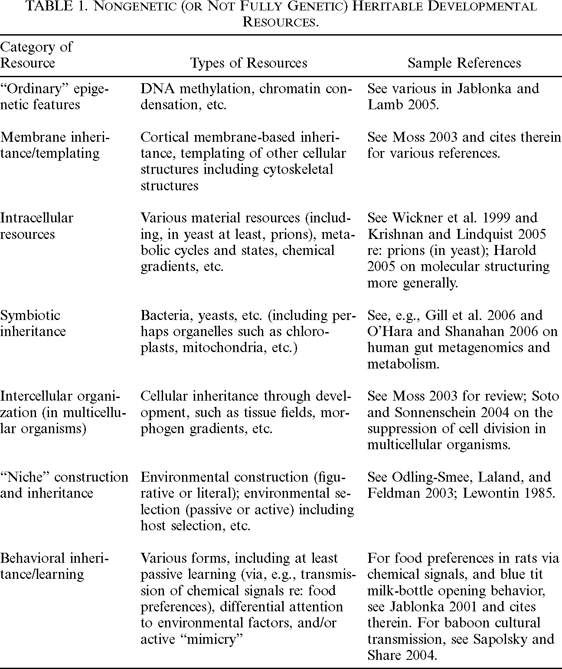
One potential criticism of Devo-Evo is that a research program that recommends shifting attention away from “ordinary” genetic systems of inheritance would lack focus. Hall, for example, claims that “it is difficult to imagine what a developmental evolutionary biology would be like” (Reference Hall2000, 178). Developmental systems theory (DST), as one articulation of a “Devo-Evo” approach, has faced similar criticisms (see. e.g., Robert, Hall, and Olson Reference Robert, Hall and Olson2001, 959). “Extended inheritance” is generally considered one of DST's central tenets—organisms, DST points out, inherit a heterogeneous set of “developmental resources” (see Table 1) which interact to construct that organism's life cycle; ontogeny is initiated and maintained by multiple entities and influences (see Robert et al. Reference Robert, Hall and Olson2001 for a brief review; Oyama, Griffiths, and Gray Reference Oyama, Griffiths and Gray2001; Robert Reference Robert2004; and Jablonka and Lamb Reference Jablonka and Lamb2005 for details). But how does one study such a diverse set of resources? While no one disputes the necessity of a variety of “resources” for development, they are generally regarded as fundamentally different than genetic resources, and evolutionarily insignificant.

| Category of Resource | Types of Resources | Sample References |
|---|---|---|
| “Ordinary” epigenetic features | DNA methylation, chromatin condensation, etc. | See various in Jablonka and Lamb Reference Jablonka and Lamb2005. |
| Membrane inheritance/templating | Cortical membrane-based inheritance, templating of other cellular structures including cytoskeletal structures | See Moss Reference Moss2003 and cites therein for various references. |
| Intracellular resources | Various material resources (including, in yeast at least, prions), metabolic cycles and states, chemical gradients, etc. | See Wickner et al. Reference Wickner, Edskes, Maddelein, Taylor and Moriyama1999 and Krishnan and Lindquist Reference Krishnan and Lindquist2005 re: prions (in yeast); Harold Reference Harold2005 on molecular structuring more generally. |
| Symbiotic inheritance | Bacteria, yeasts, etc. (including perhaps organelles such as chloroplasts, mitochondria, etc.) | See, e.g., Gill et al. Reference Gill, Pop, DeBoy, Eckburg, Turnbaugh, Samuel, Gordon, Relman, Fraser-Liggett and Nelson2006 and O’Hara and Shanahan Reference O’Hara and Shanahan2006 on human gut metagenomics and metabolism. |
| Intercellular organization (in multicellular organisms) | Cellular inheritance through development, such as tissue fields, morphogen gradients, etc. | See Moss Reference Moss2003 for review; Soto and Sonnenschein Reference Soto and Sonnenschein2004 on the suppression of cell division in multicellular organisms. |
| “Niche” construction and inheritance | Environmental construction (figurative or literal); environmental selection (passive or active) including host selection, etc. | See Odling-Smee, Laland, and Feldman Reference Odling-Smee, Laland and Feldman2003; Lewontin Reference Lewontin1985. |
| Behavioral inheritance/learning | Various forms, including at least passive learning (via, e.g., transmission of chemical signals re: food preferences), differential attention to environmental factors, and/or active “mimicry” | For food preferences in rats via chemical signals, and blue tit milk-bottle opening behavior, see Jablonka Reference Jablonka, Oyama, Griffiths and Gray2001 and cites therein. For baboon cultural transmission, see Sapolsky and Share Reference Sapolsky and Share2004. |
The reason for this would seem to be straightforward—indeed evolution is often defined as changes in gene frequencies within populations (standard textbooks providing this definition include, e.g., Curtis and Barnes Reference Curtis and Barnes1989; Futuyma Reference Futuyma1998; Freeman and Herron Reference Freeman and Herron2004). The argument is that only heritable changes matter to evolution, and genes are the (only) units of heredity, so the only changes in populations that have evolutionary consequences are those that involve genetic changes. On this view, the fact that multiple different kinds of resources are necessary for development is irrelevant—what matters is heritable variation, and this view assumes that (at least) the vast majority of heritable variation is straightforwardly genetic. Wolport, for example, argues against the evolutionary significance of genetic imprinting, noting that “because there is no change in the genetic information, and it involves only an inherited change in gene transcription, it is very hard to see its possible evolutionary significance, and what can it achieve that is not done by conventional alterations to the developmental programme by changes in DNA” (Wolpert Reference Wolpert1998 240; see also, e.g., Rosenberg Reference Rosenberg2006)
One way, then, to bring focus to a Devo-Evo approach is to distinguish between those developmental resources that are necessary for development and are regularly present during development and those developmental resources that vary in ways that can be of evolutionary significance. Natural selection demands only that there be heritable variation associated with fitness differences; if heritable nongenetic developmental resources vary in ways associated with fitness differences, then these resources will be of (at least local) evolutionary significance. How important such resources are will depend not just on how common such variation generally is but also on how important such variation has been.
But to focus on heritable differences is to focus on only part of the problem facing the integration of developmental and evolutionary biology; explaining the relative stability of development is key, too. While the lack of variation in some resources used in development may be exogenous to that organism's developmental system, in other cases the lack of variation is actively maintained by the organism itself. Further, many developmental resources do vary, and yet those variations don’t end up mattering much to development. Some obvious examples include the genetic variation that is revealed in cryptic variation (see examples below) and, for example, the kind of compensatory plasticity that results in some developmentally delayed organisms “catching up” when the resources become available (see Mangel and Munch Reference Mangel and Munch2005, and below). What mechanisms make this possible?
3. Stability and Variation in Evolution
In order for development to succeed “normally,” the resources necessary for development must either not vary (or at least not vary in ways that matter with respect to the normal range of developmental outcomes) or variation in the resources necessary for development must be buffered or countered by other aspects of the developmental process. DST is sometimes criticized for (at least potentially) making too much of resources that while important, don’t vary in ways that matter to evolution. Wolport, for example, writes: “The key question relates to transgenerational epigenetic inheritance. If there had been no transgenerational epigenetic inheritance how would this have affected evolution? It is hard to see, apart from imprinting, that it would have been different in any significant way. … [Even] imprinting plays a very minor role in evolution” (Wolpert Reference Wolpert1998, 240). While it is true, for example, that, the structure of the human skeletal system depends critically on biomechanical forces that would not be present in the absence of gravity,Footnote 1 gravity is not generally regarded as an “interesting” developmental resource, in large part because there is no significant variation in it (on Earth, anyway), and no “work” needs to be done to maintain its ordinary developmental effects from generation to generation.Footnote 2
But as proponents of Devo-Evo approaches point out, other developmental resources that don’t vary significantly within a population don’t vary because they are actively maintained by and depend upon the organisms in question. For example, the formation of cell membranes require other membranes as templates, and the stability of membrane formation in such systems is explained (in part) by the accuracy with which membranes are recreated from those templates (Moss Reference Moss2003). But when those templates are changed, so too can the membranes formed from them (this phenomenon is particularly well established in various ciliates; see Landman Reference Landman1991 for review). Integrating evolutionary and developmental biology would seem to require understanding how the stability of such resources evolved.
One entry into the evolution of stability are those cases in which stability breaks down, revealing cryptic variation. Variation in developmental resources can be hidden in a variety of ways; when the potential phenotypic effects of this variation are revealed, previously hidden variation is exposed. The existence of hidden developmental variation can be the result of active buffering mechanisms—systems that seem to have evolved in order to limit the effects of particular kinds of variations on development, such as the HSP system—or it can be a side effect of other developmental processes that happen to suppress variation, such as epistasis and genetic redundancy.
The existence of cryptic genetic variation—genetic variation that can have phenotypic consequences but generally doesn’t—is the focus of a long-standing research tradition, dating back at least to Waddington's work in the 1950s (see Lewontin Reference Lewontin1985). Recent work on the HSP90 systems in both Drosophila and Arabidopsis revealed extensive cryptic variation (see, e.g., Rutherford and Lindquist Reference Rutherford and Lindquist1998; Mitchell-Olds and Knight Reference Mitchell-Olds and Knight2002; Queitsch, Sangster, and Lindquist Reference Queitsch, Sangster and Lindquist2002); the phenotypic effects of the variation normally hidden by the HSP systems is in many cases quite radical. While the initial studies focused on hidden genetic variation, hidden epigenetic variation has also been revealed (see, e.g., Pigliucci Reference Pigliucci2003; Sollars et al. Reference Sollars, Lu, Xiao, Wang, Garfinkel and Ruden2003; True and Lindquist Reference True and Lindquist2004). Importantly, the phenotypic variations exposed by breakdowns in these “chaperone” systems can then be stabilized by selection; selection on particular novel phenotypes can result in those phenotypes being developmentally maintained even when the chaperone systems are reintroduced into the developmental system. In the case of genetic variation, this is probably by the selection of multiple genes that, individually, are suppressed but together are expressed even when the buffering systems are functioning normally again (see, e.g., Rutherford and Lindquist Reference Rutherford and Lindquist1998). In the case of epigenetic variation, the mechanisms involved remain somewhat less clear, but it seems plausible that the suppression of the buffering systems make the epigenetic states less stable, and different potentially stable epigenetic states are exposed; selection can act on those potentially stable states, and when the buffering systems are reintroduced, the new stable states are maintained (see Pigliucci Reference Pigliucci2003 for review).
Cryptic variation can also be exposed when unusual developmental events reveal phenotypic plasticity not normally seen. The most famous example of this is perhaps bipedalism in goats, made famous by Slijper (Slijper Reference Slijper1942). Here, a particular developmental abnormality (reduced forelimbs) results in a behavioral change (bipedalism) that releases normally cryptic compensatory plasticity in everything from skeletal form to the organization of internal organs; similar changes have been reported in cases of bipedalism in dogs and macaques monkeys. Amundson (Reference Amundson2006) reminds us of cases of fish that survive early extreme injuries (e.g., the complete loss of their tails) and are caught later in their lives as apparently healthy adults; in some cases, these fish have developed radically different morphologies, compensating for the missing parts. In the case Amundson cites (originally from Gunter and Ward Reference Gunter and Ward1961), the shortened “croaker” fish's fin structure closely resembles that of a “normal” ocean sunfish (though ocean sunfish are much larger). It is not unreasonable to suppose that the same kind of compensatory plasticity that permits croaker fish to take on these forms could have been involved in the evolution of the ocean sunfish. West-Eberhard (Reference West-Eberhard2003) has argued that plasticity (both cryptic and ‘ordinary’) can be a significant source of evolutionary novelties; the plastic responses can be stabilized by changes in the developmental environments and further stabilized by “ordinary” genetic changes that can serve both to “fine-tune” the new phenotype and to buffer it from developmental variations.
None of this yet shows that a Devo-Evo approach, rejecting the centrality of the gene as the basic unit of heredity and evolution, will be necessary for integrating developmental and evolutionary biology. Cryptic variation is, after all, cryptic; its significance to evolution is therefore very much in question. Two questions then present themselves: first, how common is heritable variation in nongenetic resources? And second, how important has such variation been in evolutionary history?
4. Variation, Stability, and Innovations in the History of Life
Some important lessons emerge from the consideration of cryptic variation. The first is simply that significant cryptic variation exists in several systems of heredity. The second is that this variation at least can, under some conditions, be released/exposed and subsequently stabilized by selection. Finally, and most importantly, the lack of “visible” variation (for some trait, in some system of heredity) in a population during one historical period or in one environment is not good evidence for a lack of variation more generally. Of course, this is not yet evidence that such hidden variation is in fact often involved in evolutionary change or involved in significant evolutionary changes. So what lines of evidence might suggest that such variation actually is more important than Evo-Devo approaches focused on genes as the primary basis of heritable variation, and hence evolution, credit?
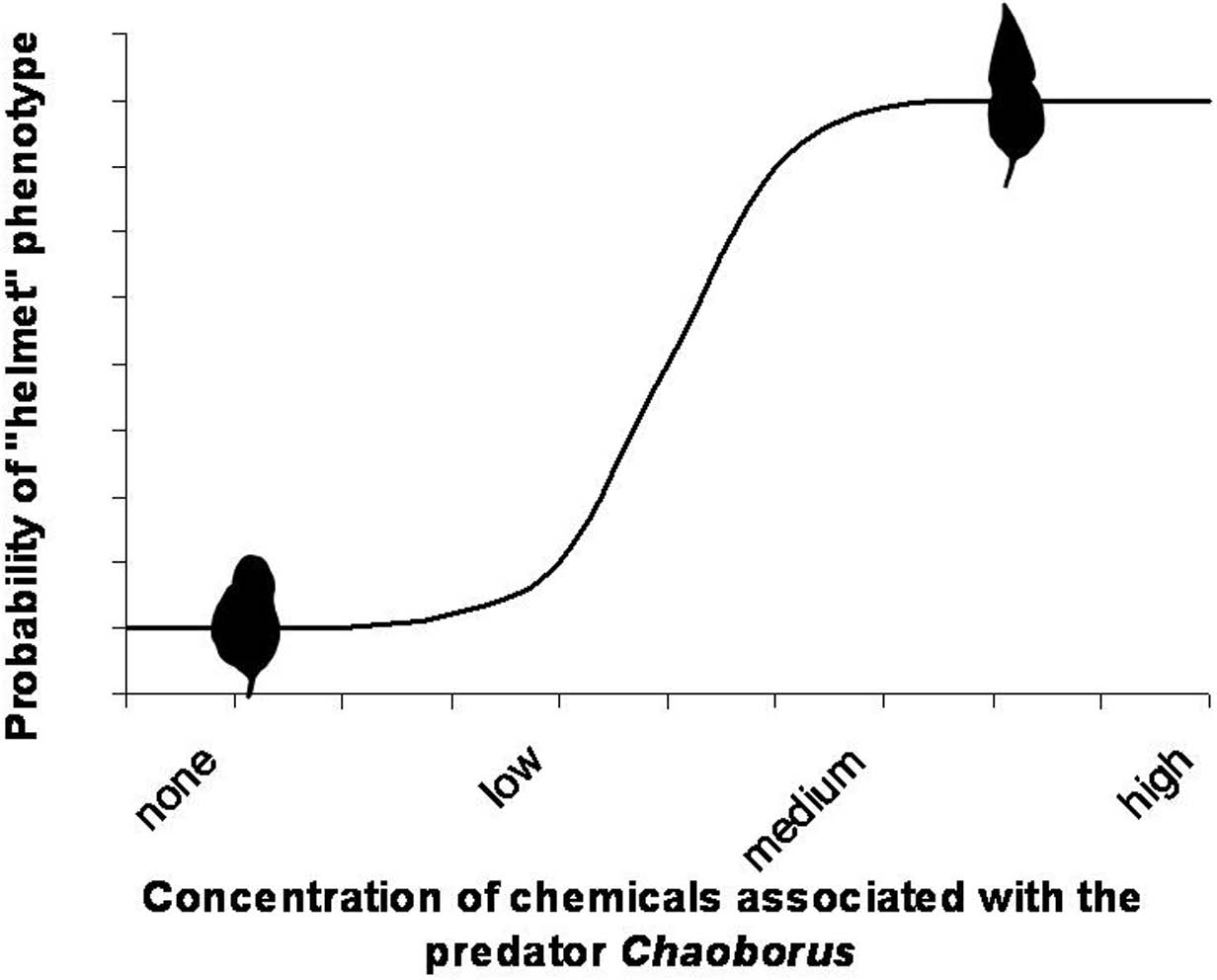
One hint is that both adaptive regulatory plasticity and developmental stability require more and more sophisticated developmental resources than development otherwise would. Regulatory plasticity (aka “developmental conversion”) occurs when different development pathways, which result in different phenotypes, can be triggered by environmental signals. In some ways, it is surprising how common regulatory plasticity is; after all regulatory plasticity demands the same development pathways that each final phenotype would require, as well as additional mechanisms to sense the environmental signal and to direct development down one of the available pathways (Figure 1). Relatively well-studied examples include such diverse phenomena as sexual plasticity in fish such as Teleosts (Bass, Matthew, and Grober Reference Bass, Matthew and Grober2001), predator avoidance in Daphnia, shade avoidance in many plants, leaf-form plasticity in semi-aquatic plants, and many others (see Pigliucci Reference Pigliucci2001 for more examples and discussion).
Developmental conversation in Daphnia pulex. Here, an environmental trigger (the presence of a chemical associated with Chaoborus, one of Daphnia's predators) sends development down one of two distinct pathways; the “helmet” phenotype makes Daphnia harder for Chaoborus to consume (see Parejko and Dodson Reference Parejko and Dodson1991). Note that regulatory plasticity/developmental conversion requires access to both the developmental resources for each possible phenotype, plus additional systems to detect the environmental variation and “switch” development down the correct pathways.

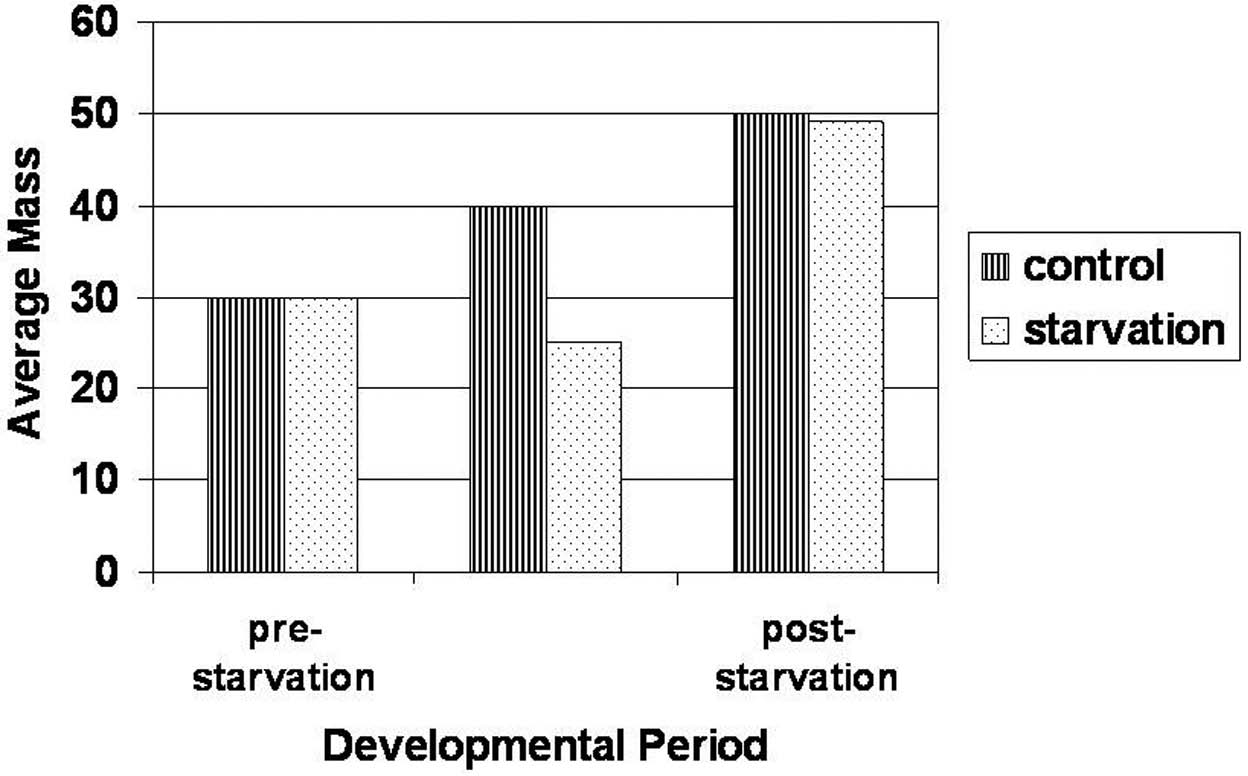
Similarly, recovering from environmental insults and producing the “standard” phenotype would seem to require that additional mechanisms be in place, above those that “normal” development require (Figure 2). As Schlichting and Pigliucci note, the ability of organisms to produce offspring that are relevantly similar to themselves despite the wide variety of environmental variations encountered “requires the capacity to exert accurate and precise control over the expression of the genetic template” (Reference Schlichting and Pigliucci1998, 300). One underappreciated implication of this is that the ancestral state for most developmental pathways was very likely unbuffered and unstable in the face of environmental variation. The phenotypic differences resulting from these variations might have had significant heritable components; given this, the stability of particular phenotypes could be selected for or the ability of the trait to vary systematically might itself be selected for. Stability, whether generated by developmental canalization, buffering mechanisms, or other systems, is itself therefore a significant evolutionary adaptation.
Compensatory growth in minnows. The ability to recover from environmental insults and maintain stable development in the face of serious disruptions of the available developmental resources may require additional developmental resources that work to ensure that development stays on (or gets back on) track. While some kinds of stability are likely the passive result of development, others are more likely actively produced adaptations to variation. Here, juvenile minnows (Phoxinus phoxinus) that undergo a period of starvation rapidly gain mass (and length) when food becomes available again, “catching up” to minnows raised without starvation (see Zhu et al. Reference Zhu, Cui, Ali and Wootton2001); the costs (in fitness) of this kind of compensatory growth are not well understood but likely include oxidative damage and other developmental flaws (e.g., weakened scales are observed in some fish after compensatory growth; see Mangel and Munch Reference Mangel and Munch2005).

It is unclear to what extent the mechanisms underlying stable development overlap with the mechanisms involved in phenotypic plasticity or with those that permit adaptive phenotypic accommodation (for discussion, see, e.g., Pigliucci Reference Pigliucci2002; Casal et al. Reference Casal, Fankhauser, Coupland and Blázquez2004). But whatever mechanisms produce stability, such mechanisms impose limits on the phenotypic variation produced by many different development resources, including but not limited to “ordinary” genetic resources. Most of the changes in developmental systems that are buffered in these ways will be relatively small quantitative changes, whether the buffering is the result of active systems or the passive side effect genetic networks (see Gibson and Wagner Reference Gibson and Wagner2000). But breakdowns in the systems that provide stability nevertheless occur and may be very important for major evolutionary transitions (see, e.g., Wagner Reference Wagner2005). When stability returns, the changes in the developmental pathways can produce stable qualitatively different phenotypes; these new pathways can involve both the expression of previously suppressed genetic and nongenetic heritable variation.
There are a number of lines of evidence that suggest that heritable nongenetic variation may have played an important role in (at least some) important evolutionary innovations; these include the production of the first eukaryotic cells and of multicellularity (Koufopanou Reference Koufopanou1994; Cavalier-Smith Reference Cavalier-Smith2000). If so, then certainly nongenetic heritable resources have had very important evolutionary consequences. And, as noted above, research on cryptic variation has tended to support the view that heritable nongenetic variation is relatively common. So why then has evolutionary biology focused on genetics to the exclusion of other heritable developmental resources?
A large part of the answer must surely be the focus on quantitative differences engendered by the so-called modern synthesis and by contemporary quantitative genetics research (see, e.g., Robert et al. Reference Robert, Hall and Olson2001; Robert Reference Robert2004; West-Eberhard Reference West-Eberhard2005; Pigliucci and Kaplan Reference Pigliucci and Kaplan2006). Genetic differences associated with phenotypic differences under “ordinary” developmental conditions are currently the most convenient entry into quantitative variation. It may even be the case that genetic variations are the most common kind of resource in which variations are associated with phenotypic variations under “ordinary” developmental conditions.
But qualitative changes in phenotypes—the sort associated with evolutionary innovations and novelties—may be produced by very different mechanisms than those that produce quantitative changes (see, e.g., Pigliucci and Murren Reference Pigliucci and Murren2003; West-Eberhard Reference West-Eberhard2003, Reference West-Eberhard2005; Gavrilets Reference Gavrilets2004); qualitative changes are also, unfortunately, much harder to study. But qualitative changes may involve significant changes in nongenetic developmental resource more often, or in more profound ways, than do quantitative changes. Until more is known about the mechanisms that generate evolutionary innovations, it will not be clear to what extent attention to nongenetic modes of inheritance and evolution will prove to be important in integrating evolutionary and developmental biology or, for that matter, to the understanding of the history of life more generally.
5. Conclusions: Is Devo-Evo Necessary? “Wait and See, but Keep Looking.”
Will adopting a perspective that takes seriously nongenetic modes of inheritance and the role of nongenetic variation in evolution prove to be a necessary part of the task of integrating developmental and evolutionary biology? If one focuses attention only on the highly conserved genetic resources related to development and the “minor” (mostly quantitative) changes associated with “ordinary” developmental variation, the temptation may be to reject Devo-Evo as at best unnecessary, and at worst, as an untractable distraction. But the successful integration of developmental and evolutionary biology must surely promise more than that, and understanding how the particular robust systems that currently support minor quantitative changes arose demands understanding the source of both the more radical qualitative changes that produce evolutionary innovations and the mechanisms that permit the new forms generated to become stabilized. So far, at least, more traditional Evo-Devo research, focused on genetic variation and the gene as the primary unit of heritable change in evolution, has done little to explain either major evolutionary transitions or the genesis of stable developmental systems more generally (Schlichting and Pigliucci Reference Schlichting and Pigliucci1998; Pigliucci and Murren Reference Pigliucci and Murren2003; West-Eberhard Reference West-Eberhard2003, Reference West-Eberhard2005; Gavrilets Reference Gavrilets2004).
It would of course be premature to claim that Devo-Evo approaches (such as DST) will solve these problems; so far, the perspectives recommended by these approaches have yielded only suggestive evidence and hinted at potential lines of research regarding a very few major evolutionary innovations. But these approaches, more so than the “standard” Evo-Devo ones, do serve to focus attention on the difficulties facing any explanation of how qualitative change can coexist with robust developmental stability. For that reason alone, it is worth paying serious attention to the potential insights provided by Devo-Evo approaches; these best highlight some of the most interesting problems currently facing organismal and evolutionary biology.