1. Introduction
Language-specific effects on cognition have long been investigated and demonstrated on monolingual speakers to varying extent and under different circumstances (see Filipović, Reference Filipović2019 for a recent comprehensive overview). However, there are significantly fewer studies on how the two typologically different languages affect cognition in bilingual language users (Bassetti & Cook, Reference Bassetti, Cook, Bassetti and Cook2011; Pavlenko, Reference Pavlenko2011, Reference Pavlenko2014; the most recent critical discussion in Bassetti & Filipović, Reference Bassetti and Filipović2021). Whereas the majority of the world's population is bilingual to some degree (Grosjean, Reference Grosjean and Nicol2001), research on language has tended to theorize the typical language user as being monolingual (see Vaid & Meuter, Reference Vaid, Meuter, Cook and Wei2016). Thus, there is an urgent need for more research in this area that would focus on bilinguals and multilinguals and the effects that two or more languages have on various aspects of cognition (i.e., concepts, categories, and memories).
Bilingual language processing has been studied largely in order to investigate the similarities and differences in comparison to monolingual language processing, and many relevant variables have been identified in this context, such as age of acquisition, frequency of use and proficiency and degrees of activation of each language. The degree of activation was said to be one of the main variables that can help us understand the malleable and adjustable nature of bilingual processing, yet surprisingly little research has been focused on this variable (Grosjean, Reference Grosjean and Nicol2001; Filipović, Reference Filipović2011, Reference Filipović, Filipović and Pütz2019, Reference Filipović2020, Reference Filipović2021; Green & Abutalebi, Reference Green and Abutalebi2013). As Grosjean (Reference Grosjean and Nicol2001) explains, when only one of the languages is active it creates a monolingual mode where the activation of the other language is low but not completely absent, and the speakers in monolingual mode use the language similarly to monolingual speakers of the language if their proficiency allows that. On the other hand, when the speakers are in a bilingual modeFootnote 2, whereby the two of the languages are active to a similar degree in a communicative situation, the speakers would produce different outputs – for example, they will be more likely to gravitate towards a linguistic common ground (i.e., patterns that work in both languages; see e.g., Filipović, Reference Filipović, Filipović and Pütz2014, Reference Filipović2019).
Becoming bilingual results in documented changes in linguistic behavior and cognitive outcomes, which makes bilingual outputs different from those of the respective monolingual groups. Some experimental studies demonstrated that learning a new language resulted in changes in speakers’ conceptualization and underlying classification patterns (e.g., for placement terms Casasola, Bhagwat & Burke, Reference Casasola, Bhagwat and Burke2009; for linguistic gender Boroditsky, Schmidt & Phillips, Reference Boroditsky, Schmidt, Phillips, Gentner and Goldin-Meadow2003; for color terms Athanasopoulos, Reference Athanasopoulos and Pavlenko2011; for taste terms O'Mahony & Ishii, Reference O'Mahony and Ishii1986; for causal reasoning Cunningham, Vaid & Chen, Reference Cunningham, Vaid, Chen, Cook and Bassetti2011). However, these studies did not control for the language mode or aim to keep their bilingual participants in a dual language condition where the two languages would actively compete on-line. Here we are interested precisely in what happens when a bilingual speaker is required to use both languages in a single act of communication, such as translating from one language into another.
There is some prior research that did control for language mode in the experimental setup. Filipović (Reference Filipović2011) tested episodic memory for motion events in Spanish–English bilingual speakers when they were in a bilingual mode. In English, a motion event is defined as a change of location and lexicalized by a manner verb + path particle construction (e.g., “run into”) while in Spanish it is rendered via path verbs + optional manner adjuncts (e.g., “entrar [corriendo]” = “enter [running]”). The Spanish pattern is also licensed in English, while the reverse is not the case: the English pattern is ungrammatical in Spanish. Keeping both languages active (by instructing participants and communicating with them in one language and asking them to respond in the other), Filipović (Reference Filipović2011) demonstrated that Spanish–English bilingual speakers rely on the shared, Spanish pattern on motion lexicalization regardless of which language (Spanish or English) is used for verbalization, and more so if they are balanced bilinguals. If the mode of activation is not bilingual, we can expect linguistic behaviors that are more in line with the language currently in use (all modulated by proficiency levels; see Filipović, Reference Filipović2019, for details). Shared pattern preference has also been reported in cases where proficiency in both languages is high enough as well as when the frequency of use of both languages habitually is equally high (e.g., Dussias, Reference Dussias and Nicol2001, Reference Dussias2003; Fernandez, Reference Fernandez, Heredia and Altarriba2002; Fernandez, de Souza & Carando, Reference Fernandez, de Souza and Carando2017; Hohenstein, Eisenberg & Naigles, Reference Hohenstein, Eisenberg and Naigles2006). In this study we investigate whether and how bilingual processing efficiency (Filipović, Reference Filipović, Filipović and Pütz2014; Filipović & Hawkins, Reference Filipović and Hawkins2013, Reference Filipović and Hawkins2019) is manifested in a dual language setting: namely, a translation production task and a subsequent related confidence judgment task performed by Turkish–English bilingual speakers with a focus on the linguistic property of evidentiality, which indicates the source for information content expressed in an utterance.
Efficiency is the main function of everyday communication according to Hawkins (Reference Hawkins2004, Reference Hawkins, Gil, Sampson and Trudgill2009, Reference Hawkins2014), whereby the message intended by the Speaker is delivered to the Hearer fast in time with minimal processing effort necessary in the specific communicative situation. When the situation requires two languages to be used and processed at the same time, the role of efficiency comes into prominence even more and becomes affected by additional pressures. Bilingual efficiency mechanisms are particularly remarkable if we have in mind that they are able to communicate in both languages simultaneously, with or without code switching. Recent behavioural (Filipović, Reference Filipović2019; see also Filipović, Reference Filipović, Filipović and Pütz2014, for overview) and cognitive neuroscience studies (Pliatsikas, DeLuca & Voits, Reference Pliatsikas, DeLuca and Voits2020) have shown that early bilinguals exhibit higher level of efficiency than the late bilinguals. This is expected as a result of the longer experience with juggling two languages and the fostering of efficient patterns in order to resort to either one or both languages instantly. It is not only the age of acquisition factor that affects bilingual efficiency in language processing. In order to account for the multiple (linguistic, personal and situational) factors that affect bilingual language acquisition and use, Filipović and Hawkins (Reference Filipović and Hawkins2013, Reference Filipović and Hawkins2019) proposed the Complex Adaptive System Principles (CASP) for Bilingualism model, which we introduce next.
1.1 Complex Adaptive System Principles (CASP) for Bilingualism
CASP for Bilingualism is a theoretically-informed (Hawkins, Reference Hawkins2004, Reference Hawkins2014; Filipović, Reference Filipović, Filipović and Pütz2014; Filipović & Hawkins Reference Filipović and Hawkins2013, Reference Filipović and Hawkins2019) and empirically-driven (Hawkins & Filipović, Reference Hawkins and Filipović2012) multi-factor predictive and explanatory model of bilingual linguistic behavior. It consists of five general principles (i-v), some of which compete and some that collaborate in bilingual language acquisition, processing and use:
i. Minimize Learning Effort: As all language learners bilingual speakers prefer to minimize learning effort in learning grammatical rules and lexical properties. They minimize the effort when the grammatical and lexical properties are shared in both of their languages. If the properties are frequently used in both languages, the effort in learning is minimized better.
ii. Minimize Processing Effort: Bilingual speakers tend to minimize processing effort just as all other language learners when processing grammar and lexicon. Thus, even though they learn complex grammatical structures or lexical items, they prefer to use the simpler versions if possible. The simpler structures are learned, used and accessed more easily and more frequently than the complex ones.
iii. Maximize Expressive Power: Bilingual speakers want to maximize their expressive power as other language learners. They want to express and formulate all their thoughts with the same degree of competence in each language. This principle somewhat contradicts with previous two principles because to have a maximum expressive power, language learners might need to acquire, use and process complex linguistic structures. This contradiction among the principles leads them to compete in communication, and results in different outcomes depending on the different speaker and situation profiles.
iv. Maximize Efficiency in Communication: Bilingual speakers prefer to maximize efficiency in communication. However, this requires a trade-off between minimizing learning and processing effort and maximizing expressive power. Although speakers tend to use simple linguistic structures, sometimes they need more complex structures to increase the expressive power (Hawkins, Reference Hawkins2004). To have an efficient communication, speakers use simple grammar or lexicon when possible, and complex ones when necessary (i.e., when the complex unit is necessary. e.g., pick out a referent from an environment faster, in a single turn rather than multiple (simpler) turns).
v. Maximize Common Ground: Bilingual speakers maximize common grammatical and lexical representations in two languages. When two languages have the same grammatical structure or lexical items, bilinguals prefer to use those shared properties more frequently. When the languages do not share a common structure or meaning, bilinguals then tend to create a common ground by introducing a new structure from one language into the other or by discarding it from the language that has it.
Here we give a succinct illustration of how CASP for Bilingualism help us predict and explain communicative outputs in bilingual language learning and use in the current investigative context. The precise interaction among these principles (i.e., their competition vs. collaboration) is guided by three types of factors (Filipović & Hawkins, Reference Filipović and Hawkins2013, Reference Filipović and Hawkins2019): linguistic typological factors (i.e., the features that do or do not exist in the grammars and lexicons of each language), internal factors (such as respective proficiency, dominance and relative frequency of use of each language) and external factors (such as the characteristics of the specific communicative situation including audience, purpose and context of acquisition and use; see Filipović, Reference Filipović2019, for detailed discussion and numerous examples). According to the principles outlined above, we can expect that the bilinguals who are proficient enough in both Turkish and English will maximize their expressive power in both their languages and try to render the evidential meanings in both their languages, especially in a task when both languages are active, like the one at present (translation). The principle of Maximize Common Ground and Maximize Efficiency in Communication will drive the bilinguals to find a shared pattern by matching Turkish grammatical evidentiality to English lexical equivalents and to have this information available, accessible and expressible in both languages. However, the principles of Minimize Learning Effort and Minimize Processing Effort would be in competition with the other principles and would pull in the opposite direction: namely, discouraging the consistency in learning and in use of forms and meanings that are semantically or syntactically complex or that are not shared or not required in one of the two languages (in this case, the firsthand vs. non-firsthand evidential marking). In line with the CASP for Bilingualism model, the extent to which the bilinguals would provide evidentiality information in both languages in translation depends on the internal factors such as their proficiency and knowledge of usage patterns for each language-which is different for our two groups and external factors such as the level of activation of each language, in this case dual language condition/bilingual mode, which is the same for both our groups.
Language typology is the starting point in any research of this kind because it is fundamental to establish whether the category in question (i.e., evidentiality) is present in both languages or not, whether it contains the same category members, whether it is grammaticalized, whether the category has the same functions in both languages and whether it is obligatory or optional, and if the latter, how frequently it is used. Once this is established, we can then progress to determining how the specific characteristics of participants (early vs. late Turkish–English bilinguals) and communicative situation (bilingual mode) interact with the specific typological contrasts and affect the content and form of the linguistic outputs (in this case, translations and related judgments). Since the main aim of the present research is to examine the differences of bilingual language processing with regards to evidentiality in Turkish–English bilingual speakers, we turn to a detailed discussion of the relevant typological contrasts next.
1.2 Evidentiality
Evidentiality is a linguistic category that is most often defined as the coding of source of knowledge about a past event (Aikhenvald, Reference Aikhenvald2004), e.g., whether the event was experienced firsthand, or by hearsay or inference (non-firsthand). In some languages, such as Turkish, evidentiality is marked in the grammar (-di for firsthand, -miş for non-firsthand, see Tosun & Vaid, Reference Tosun and Vaid2018 for detailed review of Turkish evidentiality); thus, speakers of this language always have to indicate their source of information when describing a past event. For example, a past event must be uttered as “Adem elmayı yedi (Adam ate the apple)” if the speaker witnessed it. If it was heard or inferred it must be uttered as “Adem elmayı yemiş (Adam ate the apple apparently)”. By contrast, in some other languages, such as English, evidentiality is an optional feature, left up to the speaker's discretion, and coded lexically or constructionally rather than in the grammar.
Monolingual acquisition of evidential forms and meanings in Turkish takes place in early childhood (Aksu-Koç, Ögel-Balaban & Alp, Reference Aksu-Koç, Ögel-Balaban, Fitneva and Matsui2009). Aksu-Koç and her colleagues (Aksu-Koç, Reference Aksu-Koç1988; Aksu-Koç et al., Reference Aksu-Koç, Ögel-Balaban, Fitneva and Matsui2009) investigated the age of emergence of evidential markers in Turkish. Aksu-Koç found that Turkish-speaking children generally produce the firsthand source marker around the age of eighteen months and two years. They start using the non-firsthand source marker to indicate inference from results around the age of two years. They acquire the reportative usage of the non-firsthand marker between the ages of two and three years. Last, they acquire the use of non-firsthand markers to indicate inference from reasons at the age of three. However, Öztürk (Reference Öztürk2008) found that Turkish-speaking children use the reportative source earlier than the inferential source. She explains her findings with reference to the Turkish discourse tradition of fairy tales, which are told in the non-firsthand source form representing the reportative source. Other research on Turkish monolingual speakers’ evidentiality acquisition found that monolingual speakers between the ages of three and six produced evidential morphemes accurately but had difficulty comprehending evidentially marked utterances (Öztürk & Papafragou, Reference Öztürk and Papafragou2016; Ünal & Papafragou, Reference Ünal and Papafragou2016, Reference Ünal and Papafragou2018). The age of acquisition of evidentials in Turkish therefore seems to be early but the findings about exactly how early it happens may vary, as pointed out by Aksu-Koç et al. (Reference Aksu-Koç, Ögel-Balaban, Fitneva and Matsui2009, p.18–19), and this is due to the different kinds of data used to support the relevant research findings (e.g., earlier acquisition reported in spontaneous production vs. later acquisition reported in experimental (and cognitively more demanding) elicitations; see also Öztürk, Reference Öztürk2008).
On the other hand, it has been noted that the acquisition of evidentiality is vulnerable to incomplete acquisition by bilinguals. Heritage speakers of Turkish have less sensitivity to evidentiality marking, as compared to Turkish speakers in Turkey, using sentence comprehension (Arslan, De Kok & Bastiaanse, Reference Arslan, De Kok and Bastiaanse2017), eye-movement-monitoring experiments (Arslan, Bastiaanse & Felser, Reference Arslan, Bastiaanse and Felser2015), sentence production (Schmid & Karayayla, Reference Schmid and Karayayla2020), and naturalistic speech production tasks (Arslan & Bastiaanse, Reference Arslan, Bastiaanse and Bayram2020; Karayayla, Reference Karayayla, Brehmer, Treffers-Daller and Berndt2020). The findings demonstrated that Turkish heritage language speakers tend to consider the direct evidential form as a default version of past tense and they often produce direct evidentials even where indirect evidentials might be more appropriate (Arslan, Reference Arslan2020; Arslan & Bastiaanse, Reference Arslan, Bastiaanse and Bayram2020). Further, L2 learners of Turkish demonstrated similar difficulties in acquiring different uses of non-firsthand form (Kaili, Çeltek & Papadopoulou, Reference Kaili, Çeltek, Papadopoulou and Gürel2016; Kaya-Soykan, Antonova-Unlu & Sagin-Simsek, Reference Kaya-Soykan, Antonova-Unlu and Sagin-Simsek2020). All these studies use the Interface Hypothesis to explain this finding since the use of the indirect evidentiality requires the activation of the external domain of pragmatics.Footnote 3
It is possible that this typological contrast of presence vs. absence of a grammatical category in the two languages is potentially difficult to master in heritage or second language acquisition (Hawkins & Filipović, Reference Hawkins and Filipović2012). It is also possible that the high frequency and obligatoriness of a concept or a category in a second language may actually heighten the learners’ awareness of this category and make it easy to master, especially when learning such a language in an instruction-based setting (Koster & Cadierno, Reference Koster and Cadierno2019). According to Givón (Reference Givón2009) evidentiality as a linguistic property can be learned easily by a second language (e.g., Turkish) learner whose first language does not have this property (e.g., English) because it is frequently used in Turkish whenever a past event is narrated. However, evidentials are notorious for their multiple meanings within a single language as well as across different languages that have them (Aikhenvald, Reference Aikhenvald, Aikhenvald and Dixon2003, Reference Aikhenvald2004), so their acquisition may not be so straightforward. A study by Kaili, Çeltek and Papadopoulou (Reference Kaili, Çeltek, Papadopoulou and Gürel2016) cites -miş as difficult to acquire by L1 Greek learners of L2 Turkish, which the authors say can be attributed to the multifunctionality of this suffix (hearsay, inference, mirativity, or pragmatic purposes). Saratsli, Bartell and Papafragou (Reference Saratsli, Bartell and Papafragou2020) demonstrated the effect of frequency on learning in an artificial language learning task. Their findings show that not all evidential meanings are equally easy to acquire: the more frequently expressed meanings of evidential markers are acquired more easily and used more accurately by second language learners. In any case, what is important for us to stress at present is that translating between a language that has grammatical evidentiality and the one that does not is bound to generate difficulties. In Turkish a single non-firsthand marker covers various sources of evidence such as hearsay, inference, or assumption (Aikhenvald, Reference Aikhenvald, Aikhenvald and Dixon2003, Reference Aikhenvald2004; Aikhenvald & Dixon, Reference Aikhenvald and Dixon2003; but see Palmer, Reference Palmer2001 for the discussion on assumption being classified under epistemic modality), and it may be difficult to decide in translation into English which one was intended by the Turkish speaker. In English the options are numerous for encoding each of the corresponding meanings of the Turkish non-firsthand evidential. This is due to the fact that the linguistic means used to express lack of direct evidence comprise diverse elements such as modal verbs (e.g., may, might), adverbs (e.g., apparently, seemingly) and constructions (e.g., it seems/looks like). Further complications arise from the variety of other functions that these words or constructions have in both languages with and without grammatical evidentiality, such as their role in indicating culturally appropriate politeness (i.e., distancing from the content so as not to appear too direct; Filipović, Brown & Engelhardt, Reference Filipović, Brown and Engelhardtin press).
A Turkish–English bilingual can translate from English to Turkish more readily because there is one marker available for different non-firsthand sources. However, translating from Turkish to English is more challenging due to the various different expressions that can be used to translate a single non-firsthand marker in Turkish (Filipović, Reference Filipović2017a). A similar challenge was observed and demonstrated in translating between Turkish and Swedish (Csató, Reference Csató, Csató, Parslow, Thiesen and Türker2009) and also in the contexts of language learning and use (Arslan et al., Reference Arslan, Bastiaanse and Felser2015).
According to the CASP for Bilingualism model, when both languages of the bilingual speaker are active in a specific communicative situation such as the act of translating, the bilingual mind will be efficient and maximize common ground by relying more readily on the shared resources (structures and meanings). For example, Turkish–English bilinguals would tend to express various non-firsthand sources of their information by including the corresponding English modal verbs, adverbs, or constructions in their narratives as they did in Turkish with the suffix -miş. This tendency would be modulated by individual learner proficiency in each language, frequency, recency and contexts of use. Slobin (Reference Slobin, Güven, Akar, Oztürk and Kelepir2016) states that if the bilingual speaker does not use the language with evidential marking often (e.g., because they live in a country where the main language does not have evidential marking) when the speaker is exposed to an evidential language such as Turkish recently and proficient enough in it, she would subsequently tend to express evidential meanings in her other, non-evidential language (English) more frequently. This outcome is predicted by the CASP principles of Maximize Common Ground and Maximize Expressive Power (see Filipović & Hawkins, Reference Filipović and Hawkins2019, for details; see also Filipović, Reference Filipović2019, for further examples).
When a bilingual is in a monolingual mode, the linguistic outputs are likely to be different. For example, when in Turkish monolingual mode a speaker would pay close attention to the source of knowledge for narrated events, while on the other hand, when in English monolingual mode, she may pay less attention to the source of knowledge, and this will particularly be the case when the proficiency is high enough in both languages so that single language control can be exercised more successfully. A study of evidentiality by Tosun, Vaid and Geraci (Reference Tosun, Vaid and Geraci2013) used a cross-linguistic paradigm and tested the memory of Turkish–English bilingual speakers in a source memory task where participants were presented sentences in firsthand and non-firsthand forms and later asked to recognize these sentences in an old-new task along with the source monitoring task. It was found that early bilinguals acted like Turkish monolingual speakers when they were tested in Turkish and like English monolingual speakers when they were tested in English. They would disregard or discard the non-firsthand information as less relevant more readily if tested in Turkish than if tested in English. However, late L1 Turkish–English bilingual speakers kept behaving like Turkish monolingual speakers even when they were tested in English; that is, they recognized non-firsthand information less accurately than firsthand information because the former was more readily dismissed since the source was not reliable and they had difficulties remembering the non-firsthand sources of information. This result is understandable considering the profile of the late and early bilingual speakers in the Tosun et al. (Reference Tosun, Vaid and Geraci2013) study. The early bilingual speakers were heritage language learners who learned and spoke Turkish only at home, and English anywhere else; thus, they were English-dominant bilingual speakers with more limited experience of Turkish than the late bilinguals. The late bilingual speakers were emigrant speakers with Turkish as their L1 who learned English by a formal (school) education. They spent most of their lives speaking only Turkish and had limited (work-related) experience with English. Thus, we can say that the Tosun et al. (Reference Tosun, Vaid and Geraci2013) study demonstrated the different influence of evidentiality marking on categorization of information (i.e., more vs. less reliable) and on memory for sources of information by different bilingual speakers in a monolingual mode. The results indicate that early bilinguals were able to control the influence of their other language better than the late bilinguals whose stronger language (Turkish) influences the performance in their weaker language (English). However, the results are likely to be different when bilinguals are put in a bilingual mode.
One of the most common methods of keeping bilingual speakers in the bilingual mode is a translation task. When they are asked to translate from one language to another, they are forced to use both of their languages actively at a given time and search for matching meanings as well as adequate forms in each language under time pressure. Further, a translation task helps us to find out what the consequences of linguistic typological differences may be in practice, in real-life situations, and especially in delicate social situations, such as cross-linguistic communication and interpreting in legal or medical contexts. It is already demonstrated (Filipović, Reference Filipović2007, Reference Filipović, Freeman and Smith2013; Rojo & Cifuentes-Férez, Reference Rojo, Cifuentes-Férez and Ibarretxe-Antuñano2017) that interpreters have to work under high pressure to keep the same content and expressive power between the languages in a legal context where sometimes a single word can be of vital importance. Thus, being aware of the typological differences and their effect on real-life outcomes provides us with alertness about the specific aspects of interaction in specific professional environments that require more caution.
It has also been shown that evidentiality does not only convey the source of knowledge, but also some degree of epistemic certainty (see; Aikhenvald, Reference Aikhenvald2004; Aksu-Koç, Reference Aksu-Koç2016; Arslan, Reference Arslan2020; Plungian, Reference Plungian2001; Tosun & Vaid, Reference Tosun and Vaid2018; Willett, Reference Willett1988). Aikhenvald (Reference Aikhenvald2004) states that the view of “information source” as the core meaning of evidentiality is limited (Aikhenvald, Reference Aikhenvald2004, p. 179) and other recent studies in the field have made similar points (Cornillie, Reference Cornillie, Diewald and Smirnova2010; Guentchéva, Reference Guentchéva2018). Our study also examines whether the “source of information” is indeed retained as the core meaning by bilinguals and whether it also underlies the judgements about epistemic certainty regarding the understanding about whether a particular event occurred as described (i.e., firsthand source marking = more speaker certainty; non-firsthand source marking = less speaker certainty). This epistemic difference in the expressed levels of speaker certainty has already been shown to influence individuals’ decision-making process with regard to their judgments about reliability and trustworthiness of a witness testimony (in a context of jury judgement; see Filipović, Reference Filipović2016). Consequently, information about the source of knowledge in legal settings, and different levels of epistemic certainty that are related to it, should not be left to translators to decide on, especially in the cases where a translation decision is difficult or impossible without further clarification because of the many possible translation equivalents for one item in the original language (as in the case of the Turkish non-firsthand morpheme -miş) and the function of the context is to facilitate the understanding of the intended meaning of an evidential statement.
1.3 Present research
This study investigated the linguistic behavior of Turkish–English bilingual speakers with regard to coding of evidentiality in a bilingual mode (dual language activation condition). The bilingual mode was created by utilizing a translation task in which participants were asked to translate simple declarative sentences in both directions. The stimuli contained sentences in the two languages with firsthand and non-firsthand information source markings (grammatically in Turkish, lexically in English). Further, the study examined whether Turkish–English bilingual speakers would attribute a different epistemic load to the different evidential expressions by making different confidence judgments about whether the described events actually happened. As it was demonstrated that age of acquisition (early vs. late) influences how Turkish–English bilingual speakers treated evidential information in a memory task (Tosun et al., Reference Tosun, Vaid and Geraci2013) so this study included age of acquisition as one of the factors. The residence country of both early bilinguals (heritage Turkish–English speakers) and late bilinguals (late L2 English learners with Turkish as the L1 acquired in Turkey) was an English-speaking one (the US or the UK).
It is expected that our participants may attempt to maximize common ground, since this is the most efficient option when both languages are needed in the same communicative situation, and that they will try to express evidential meanings in both English and Turkish. The task (bidirectional translation) encourages a search for meaning equivalence and the bilingual mode (dual language condition) ensures that both languages are equally activated for task performance. We hypothesize that translation accuracy in terms of the inclusion of appropriate evidentiality information in translation will be lower for non-firsthand sentences than for firsthand sentences (Hypothesis 1). This is due to findings in the previous literature that report a higher level of difficulty in mastering nonfirst-hand source marking compared to first-hand source marking and to the higher level of attrition and incomplete acquisition for nonfirst-hand marking as well (see Section 1.2). We also hypothesize that the direction of translation will have an effect on how often bilinguals pay attention to the difference between firsthand and non-firsthand meanings (Hypothesis 2). We expect more accuracy in the translation of evidential expressions from English to Turkish because Turkish obliges speakers to decide which of the two evidential morphemes they need to add to the verb in every instance. In translation from Turkish to English, they will pay less attention to evidential suffixes in Turkish because the target language (English) does not oblige them to express the source of knowledge, and the principle of Minimize Processing Effort may detract from the tendency to maximize common ground by consistently expressing evidentiality in both languages (Filipović & Hawkins, Reference Filipović and Hawkins2019). This assumption is motivated by the well-documented fact that bilinguals opt for a “least effort” option (i.e., what they can get away with, as it were) in acquisition and usage, and we assume here also in translation (see a recent review on avoidance in bilingualism in Filipović, Reference Filipović2019, in relation to this point). Another reason why we may not get evidentiality expressed consistently in translation outputs by bilinguals is motivated by something that previous translation studies have shown: namely, that not all the nuances from one (source) language are necessarily rendered in translation into another (target) language – on purpose, it seems, because that would go against the narrative flow or the natural-sounding rhetorical style of the target language (Slobin, Reference Slobin, Shibatani and Thompson1996, Reference Slobin, Gentner and Goldin-Meadow2003, Reference Slobin, Hickmann and Robert2006). Thus, for these two reasons it is not guaranteed that bilingual speakers will consistently try to find and express equivalent meanings in both their languages. This is precisely one of the key questions in this study, i.e., whether there is competition or collaboration between our two principles, Minimize Processing Effort on the one hand (reflected in only expressing evidentials when obligatory and in line with the usage habits of a specific language) and Maximize Common Ground that could lead to either addition (enhanced effort) or omission (reduced effort) of the relevant meanings in both languages in order to bring them closer together.
Further, translating into English was expected to be more of a challenge due to the multiple possible meanings of the non-firsthand evidential marker in Turkish (see Filipović, Reference Filipović and Ibarretxe-Antuñano2017b; Givón, Reference Givón2009; Tosun & Vaid, Reference Tosun and Vaid2018). When translating into Turkish, all the possible lexical or constructional English markers of non-firsthand evidentiality have one translation equivalent – miş, which makes translation in that direction easier and more straightforward. However, we need to bear in mind that some bilingual individuals or groups may indeed focus on rendering evidentiality information in both languages precisely because the two languages are very different with respect to this category, which would make it more salient. Previous literature in the context of bilingual acquisition has argued that fluent English-Turkish bilinguals who often use both languages tend to overuse the appropriate adverbs and modals in English to mark the equivalents of the evidential meanings in Turkish (Slobin, Reference Slobin, Güven, Akar, Oztürk and Kelepir2016). Similarly, translators and interpreters may have more readily accessible translation equivalents for evidentiality and use them more consistently. In the context of translation, to our knowledge, this has not been tested before. The CASP for Bilingualism model predicts such different outcomes based on who (e.g., heritage bilingual or professional translator) is speaking to whom (e.g., monolinguals or other bilinguals) and under what circumstances (e.g., single vs. dual language condition; see Filipović, Reference Filipović2019 for details and numerous examples).
We also hypothesize that age of acquisition would influence the translation accuracy of our bilinguals (Hypothesis 3). Our early (heritage) bilinguals were heritage speakers who were born and residing in an English-speaking country and who learned both English and Turkish from an early age (0–5 years old). Heritage language speakers are normally those who are born in a country that has a dominant language that is different to their home (heritage) language (Montrul, Reference Montrul2002; Pascual y Cabo & Rothman, Reference Pascual y Cabo and Rothman2012; Polinsky & Kagan, Reference Polinsky and Kagan2007). They perform differently to their monolingual peers and their linguistic outputs are shaped by a number of factors, such as age of acquisition of each language, amount of input, attitude and frequency and purpose of use (De Houwer, Reference De Houwer and Clark1997; Schmid & Karayayla, Reference Schmid and Karayayla2020; Unsworth, Reference Unsworth2013). The early (heritage) bilinguals in our study acquired both of the languages simultaneously or learned the second language very early in their lives (typically when they start schooling at the age of 4 or 5). They use English more frequently due to their English-speaking environments and use Turkish mainly at home: thus, they are English-dominant speakers. Although our participants’ language proficiency was not tested formally, they were asked to make self-judgments about their language proficiency (see Section 2.1. for more details). Based on that information and on what we know from the literature about heritage and immigrant bilingualism it was safe to assume that our early (heritage) bilinguals had less exposure to Turkish and lower level of proficiency in that language than our late (immigrant) bilinguals. Our late bilinguals were late learners of L2 English with Turkish as their L1 who emigrated from Turkey to either the US or the UK. Although they are fluent in English and use it in daily professional interactions, they are Turkish-dominant because they have more experience with Turkish.
We would expect our late L1 Turkish-L2 English bilingual speakers to translate the evidential expressions more correctly than early (heritage) bilinguals, since late bilinguals were shown in prior research to have a stronger focus on L1 Turkish categories even when speaking L2 English (see Tosun et al., Reference Tosun, Vaid and Geraci2013). This assumption is also supported by a related finding from another study (Tokac, Arslan & Nickels, Reference Tokac, Arslan and Nickels2021), which demonstrated that heritage Turkish–English bilinguals were slower and less accurate than L1 Turkish-L2 English migrant bilinguals in evidentiality processing. Tokac et al. (Reference Tokac, Arslan and Nickels2021) argue that the early acquisition of English by heritage bilinguals may have hindered the complete acquisition of Turkish evidentiality. The same study also showed that there is an overall better performance/earlier acquisition for evidentiality marking of the firsthand than the non-firsthand information source (see Schmid & Karayayla, Reference Schmid and Karayayla2020 and also Arslan et al., Reference Arslan, Bastiaanse and Felser2015, for a report about the predominance of the Turkish firsthand evidential marker -di as the default past tense marker).
With regard to the confidence judgments of evidential expressions (Hypothesis 4), the participants in our study would be expected to notice the differences of epistemic value between the firsthand and non-firsthand sources and have higher confidence ratings for firsthand sources than for non-firsthand sources (in line with Tosun & Vaid, Reference Tosun and Vaid2018) but we expect this distinction to be more significant in our late (L1 Turkish) bilingual group than in the early (L1 English) group.
2. Method
This study aimed to investigate the effects of different types of Turkish–English bilingualism on bidirectional translation accuracy and epistemic judgments in relation to the evidentiality distinctions of firsthand vs. non-firsthand source of information.
2.1 Participants
A total of 53Footnote 4 participants were recruited to the experiment from various locations of USA and UK. A language background questionnaire was utilized to detect the bilingual participants’ language history and their age of acquisition. Thirty-three of them were early Turkish–English bilingual speakers (11 females) with the mean age of 18.03 (SD = 6.9). They were heritage learners who learned and spoke Turkish at home and learned and spoke English at school or outside of home. Most of the early bilingual participants (82%) stated that their English was better than their Turkish. The rest stated that their English was as good as their Turkish. Out of 7-point scale they judged their Turkish proficiency as 5 (including reading and writing) and English proficiency as 7. Early bilinguals also indicated that approximately 75% of the time they used English on a daily basis. A total of 20 participants were late Turkish–English bilingual speakers (9 females) with the mean age of 23.25 (SD = 9.01). They learned Turkish as their mother language in Turkey. Later they moved to the US or UK for educational or economic purposes and learned English there. A total of 60% of the late bilingual participants stated that their English was worse than their Turkish. The other 40% stated that their English was as good as their Turkish. They judged their Turkish proficiency as 7 and English proficiency as 5.5 out of 7-point scale. Their English and Turkish use in daily basis balanced out more equally. They used Turkish approximately 45% of the time while using English 55% daily.
2.2 Materials and measures
The stimuli consisted of 80 simple declarative, transitive sentences each containing a verb in the past tense. Half of the sentences were presented in Turkish while the other half were presented in English. For half of the Turkish sentences (20 sentences), the past tense suffix used was the firsthand form:
(1) Suna eski koca- sı- nı affet-ti.
Suna old husband- POSS.3.SG-ACC forgive-EVID.
Suna forgave her ex-husband.
For the remainder (20 sentences) the non-firsthand past tense suffix was used:
(2) Suna eski koca- sı- nı affet-miş.
Suna old husband- POSS.3.SG-ACC forgive-EVID.
Suna apparently forgave her ex-husband.
Similar to Turkish stimuli, for the English sentences, half of the sentences (20 sentences) were presented in firsthand form sentences and simply contained the verb in past tense (e.g., Sue forgave her ex-husband). The other half of the English sentences (20 sentences) were in non-firsthand form and contained one of the following expressions to give the meaning: it appeared, it seemed, must have, it looked like, and apparently (e.g., It seemed Sue forgave her ex-husband). Stimuli were blocked by language with language order counterbalanced. Per language, firsthand and non-firsthand sentences were presented in a fixed random order. Also, for each language the particular sentences chosen to be in firsthand vs. non-firsthand form were counterbalanced across participants.
2.3 Design and procedure
The study had a 2 (AoA: Early vs Late) × 2 (Direction: Turkish to English vs English to Turkish) × 2 (Source: Firsthand vs Non-firsthand) mixed design. Age of acquisition was the between-subjects variable and other variables were manipulated as within subjects. The dependent variables were participants’ translation accuracy and confidence ratings.
The experiment was conducted through Qualtrics. Participants received the language background questionnaire first. Then they were instructed to imagine themselves as a professional translator to complete a certified translation for legal use in court. They were asked to provide complete, true and precise translation of a source document. The order of the translation direction was counterbalanced. After translating each sentence, to measure the epistemic load of the evidential sources they were asked to make confidence judgments, which involve how confident they felt about whether the reported event actually took place on a scale of 1 to 5, 1 being not at all confident, 5 being extremely confident. The experiment took approximately an hour to complete, and participants received their compensations as they submitted their completed forms.
2.4 Data coding
Two coders (the first author and a Turkish–English bilingual assistant who was not aware of the purpose of the study) independently judged the accuracy of the translated sentences. Any attempt to indicate the source of knowledge (e.g., additional adverbs, modals, phrases, perfect tense for English, -miş or -di suffix for Turkish translations) for both sources and both directions was marked as an accurate response. Some of the most common phrases used by the participants to convey evidential meanings are “gorunuse bakilirsa” [apparently/seemingly] and “gibi gorunuyor” [it seems like]. These constructions should be followed by -mis for a grammatically consistent meaning. If the sentence with these phrases was completed by -di, it was not considered correct translation. Thus, overall, the suffixes -di and -mis and their combinations with evidentiality-signaling phrases were used to determine response accuracy. The interrater accuracy was significantly high enough to validate the consistent coding, r (78) = .89, p < .001.
3. Results
The translation accuracy was computed as the mean proportion of correct indication of the source knowledge. The confidence judgment was computed as the mean rating of participants’ confidence. A 2 (AoA: Early vs Late) × 2 (Direction: Turkish to English vs English to Turkish) × 2 (Source: Firsthand vs Non-firsthand) repeated measures ANOVA with AoA as a between-subject factor was conducted separately for the two dependent variables. A series of t-tests were conducted as post-hoc analyses.
3.1 Translation accuracy results
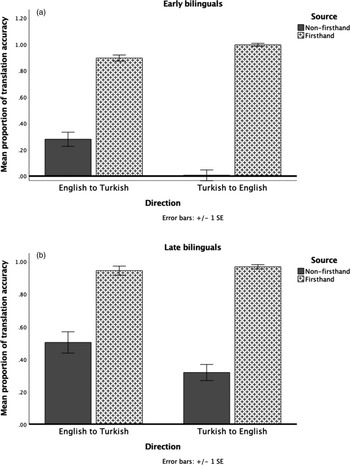
The results are summarized in Table 1 and Figure 1. Source main effect was significant, F (1, 45) = 391.66, p < .001, ηp2 = .897. The sentences with the firsthand expression (M = .95, SD = .09) were translated significantly more accurately than those with non-firsthand expressions (M = .25, SD = .28). Direction main effect was significant, F (1, 45) = 19.47, p < .001, ηp2 = .302. The sentences which were translated from English to Turkish (M = .64, SD = .21) were translated significantly more accurately than those from Turkish to English (M = .55, SD = .16). AoA main effect was significant, F (1, 45) = 19.36, p < .001, ηp2 = .301. Late bilingual speakers (M = .68, SD = .23) translated significantly more accurately than early bilingual speakers (M = .54, SD = .09).
This figure depicted the mean translation accuracy across the source of knowledge and translation direction. Plot a depicted the scores of early bilinguals and Plot b of late bilinguals.

Mean Translation Accuracy across Translation Direction, Source of Knowledge and Age of Acquisition

Note. Standard deviations were reported in parenthesis.
Source by AoA interaction was significant, F (1, 45) = 14.32, p < .001, ηp2 = .241. The difference between firsthand (Mearly = .95, SDearly = .06; Mlate = .96, SDlate = .07) and non-firsthand (Mearly = .14, SDearly = .11; Mlate = .41, SDlate = .31) sources were significantly apparent for both early and late bilingual speakers [t (27) = 30.17, p < .001 for early bilinguals; t (18) = 7.46, p < .001 for late bilinguals]. When we compare early bilingual speakers to late bilingual speakers in translating non-firsthand sentences, late bilinguals (M = .41, SD = .31) significantly more accurately translated non-firsthand sources than early bilinguals (M = .14, SD = .11, t (45) = 4.29, p < .001). However, the difference was not there when translating firsthand sentences, t (45) = .52, p = .61).
Source by Direction interaction was significant, F (1, 45) = 29.23, p < .001, ηp2 = .394. Regardless of the translation direction the difference between firsthand and non-firsthand translation accuracy was significant [t (49) = 11.12, p < .001 for English to Turkish; t (47) = 21.22, p < .001 for Turkish to English]. Comparing the accuracy of the same sources in different directions there were significant differences as well. For non-firsthand sources, translating from English to Turkish (M = .37, SD = .3) revealed more accurate translations than from Turkish to English (M = .13, SD = .26; t (46) = 5.78, p < .001). For firsthand sentences there was a reverse effect of direction. Translating from Turkish to English (M = .98, SD = .06) revealed more accurate translations than from English to Turkish (M = .91, SD = .12; t (46) = 3.36, p = .002).
Direction by AoA interaction [F (1, 45) = .02, p =.87, ηp2 = .001] and Source by Direction by AoA interaction [F (1, 45) = 2.36, p =.13, ηp2 = .05] were not significant.
3.2 Confidence judgment results
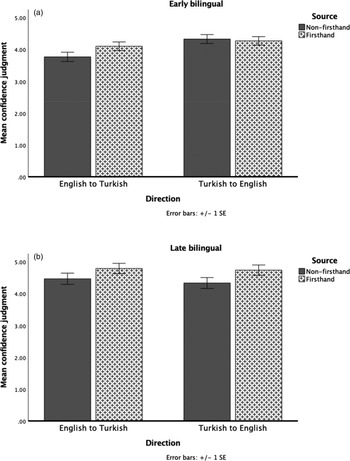
Source main effect was significant, F (1, 45) = 27.71, p < .001, ηp2 = .38. The sentences with the firsthand expressions (M = 4.43, SD = .76) were given with significantly higher confidence ratings than those with the non-firsthand expressions (M = 4.2, SD = .79). AoA main effect was significant, F (1, 45) = 5.71, p = .021, ηp2 = .113. Late bilingual speakers (M = 4.59, SD = .28) gave the sentences overall higher confidence ratings than early bilingual speakers (M = 4.12, SD = .92). Direction main effect [F (1, 45) = 3.01, p = .09, ηp2 = .063] was not significant.
Mean Confidence Ratings across Translation Direction, Source of Knowledge and Age of Acquisition

Note. Standard deviations were reported in parenthesis.
Source by AoA interaction was significant, F (1, 45) = 5.61, p = .022, ηp2 = .11. The difference between firsthand (Mearly = 4.19, SDearly = .84; Mlate = 4.77, SDlate = .17) and non-firsthand (Mearly = 4.05, SDearly = .85; Mlate = 4.41, SDlate = .33) sources was significantly apparent for both early and late bilingual speakers [t (27) = 2.56, p = .016 for early bilinguals; t (18) = 4.31, p < .001 for late bilinguals] although the difference was larger for late bilinguals. When comparing early bilingual speakers to late bilingual speakers in the confidence ratings for firsthand sentences, we see that the late bilinguals gave significantly higher confidence ratings than early bilinguals, t (45) = 2.94, p = .005. However, there was no difference in the confidence ratings for non-firsthand sentences, t (45) = 1.73, p = .091).
Source by Direction interaction was significant, F (1, 45) = 4.85, p = .033, ηp2 = .097. Participants marked confidence differences between firsthand (M = 4.35, SD = .83) and non-firsthand (M = 4.04, SD = .88) sources when they translated from English to Turkish, t (48) = 5.43, p < .001. However, this difference was not there when translating from Turkish to English (Mfirsthand = 4.41, SDfirsthand = .77; Mnon-firsthand = 4.31, SDnon-firsthand = .73; t (48) = 1.48, p = .146). If we compare the confidence judgments for the same sources in different translation directions, there was a significant difference with regard to non-firsthand sentences. When translating from Turkish to English (M = 4.33, SD = .74) confidence scores were higher than when translating from English to Turkish (M = 4.05, SD = .84; t (46) = 2.64, p = .011). For firsthand sentences there was not such difference between the two translation directions (MTurkish-to-English = 4.47, SDTurkish-to-Englishd = .73; MEnglish-to-Turkish = 4.39, SDEnglish-to-Turkish = .78; t (46) = 1.08, p = .286).
Direction by AoA interaction was significant, F (1, 45) = 8.54, p =.005, ηp2 = .16. When participants were asked to translate from English to Turkish, the late bilingual speakers (M = 4.65, SD = .21) had higher confidence ratings than the early bilinguals (M = 3.88, SD = .95; t (47) = 3.58, p < .001). This difference disappeared when translating from Turkish to English, (Mearly = 4.25, SDearly = .88; Mlate = 4.54, SDlate = .24; t (47) = 1.41, p = .165). The early bilinguals revealed higher confidence ratings when translating from Turkish to English than from English to Turkish, t (27) = 2.94, p = .007. However, the late bilinguals did not show such difference, t (18) = 1.83, p = .083.
This figure depicted the mean confidence ratings across the source of knowledge and translation direction. Plot a depicted the scores of early bilinguals and Plot b of late bilinguals.

Source by Direction by AoA interaction was significant, F (1, 45) = 11.36, p =.002, ηp2 = .202. The late bilingual speakers demonstrated the source effect in confidence judgments – firsthand sentences elicited higher confidence ratings than non-firsthand sources regardless of the translation direction (t (19) = 3.74, p = .001 for English to Turkish; t (18) = 4.53, p < .001 for Turkish to English). Further, these bilinguals did not demonstrate any difference within the same source in different translation direction (t (18) = 2.06, p = .054 for non-firsthand; t (47) = 1.22, p = .239 for firsthand). By contrast, the early bilingual speakers on the other hand displayed a different pattern in their confidence judgments. They demonstrated source effect when they translated from English to Turkish (t (28) = 3.96, p < .001) where they had higher confidence judgments for the firsthand sentences than non-firsthand sentences; but they did not show the same effect when translating from Turkish to English (t (29) = 1.38, p = .179). Further, when rating non-firsthand sources they demonstrated a direction effect – that is, they had higher confidence ratings when translating from Turkish to English than from English to Turkish, t (27) = 3.7, p < .001. However, this difference disappeared when judging firsthand sentences, t (27) = 1.43, p = .165.
4. Discussion
Our results demonstrate that the typological contrasts in the languages of bilingual speakers influence translated content and the related judgements. The selected typological difference in this research was evidentiality (source of knowledge), which is grammatically marked in Turkish, and which makes those speakers habitually and obligatorily aware of the relevant distinctions, resulting in the mention of the source of knowledge whenever they talk about past events. In English, on the other hand, there is no grammatical marking of evidentiality, and the speakers have the option to indicate it via lexical and constructional means.
It was predicted that bilingual speakers may tend to maximize common ground between their languages and maximize expressive power in both languages by providing some information about evidentiality in both their languages, even when one of the two languages does not oblige them to do so (Hypothesis 1). This was very much expected in this context in particular due to the nature of the task (translation task), which encouraged a more focused search for equivalent meanings (see Filipović, Reference Filipović2019), but it is also detected in other types of tasks (i.e., categorization and memory; see Filipović, Reference Filipović2019 for a recent overview). However, the two bilingual groups maximized common ground differently, due to their different proficiency in the two languages and the different acquisition and usage experiences with each language (see internal factors; Filipović & Hawkins, Reference Filipović and Hawkins2013, Reference Filipović and Hawkins2019), so our Hypothesis 3 was also confirmed.
The late bilingual speakers treated both Turkish and English similarly under the dual language condition in our tasks. When translating from English to Turkish, they mentioned the source of knowledge for non-firsthand sources half of the time. When translating from Turkish to English, they mentioned the source of non-firsthand evidence less, one third of the time. These findings are consistent with the anecdotal personal experiences (Slobin, Reference Slobin, Güven, Akar, Oztürk and Kelepir2016), experimental investigations (e.g., Filipović, Reference Filipović2011) and theoretical expectations (Filipović & Hawkins, Reference Filipović and Hawkins2013, Reference Filipović and Hawkins2019), which all point to bilinguals having “figured out” what may constitute the linguistic common ground and how it can be expressed in both their languages. This “figuring out” is more likely to occur when bilinguals are proficient enough in both languages and when both languages are currently active (bilingual mode/dual language activation). However, the bilinguals in our study did not maximize common ground all of the time, because another principle, Minimize Processing Effort, was also in operation, encouraging the speakers to use simpler and shorter forms, especially when longer and more complex structures are not required (as in Turkish to English translations). These results are consistent with those in Polinsky and Scontras's (Reference Polinsky and Scontras2020) study as they argued that heritage learners tend to reanalyze language structures which require demanding resources for processing. Furthermore, the external factor of social (English-speaking) environment may also have contributed to this result of less evidentiality information in translation into English in line with the usage patterns and habits in that language (see e.g., Dussias & Sagarra, Reference Dussias and Sagarra2007 and Filipović, Reference Filipović2019, for more discussion on the role of external factors).
It is important to highlight that CASP for Bilingualism predicts different outputs depending on whether bilingual speakers are in monolingual (single language activation condition) vs. bilingual (dual language activation condition) mode. Although the nature of this experiment meant that we could not test bilingual speakers in a monolingual mode, other experimental investigations (e.g., Tokac et al., Reference Tokac, Arslan and Nickels2021) demonstrated that Turkish–English bilingual speakers who are tested only in one language (Turkish) notice the grammatical violations of the non-firsthand evidential marker more frequently (~63%) than the bilingual speakers in the current study, who were in a bilingual mode. We can conclude here that a bilingual mode has different effects on speakers’ behaviors from a monolingual mode and that, in line with CASP for Bilingualism predictions, there is significantly more maximizing common ground in a bilingual than monolingual mode.
The early bilingual speakers’ performance was somewhat different than late bilinguals’. When translating from English to Turkish they indicated the source information of non-firsthand evidence less than one third of the time (28%). When translating from Turkish to English they almost never mentioned the source of non-firsthand information. In other words, early bilinguals did not pay attention to the evidential information when the target language, which is also their stronger language (English), did not require that information to be obligatorily encoded. When it was required by the grammar (i.e., when translating to Turkish) they did not completely ignore the evidential meanings, but they still paid significantly less attention to it than their late bilingual counterparts. These findings support CASP for Bilingualism model, which predicts that different levels of proficiency and frequency of use would lead to such differences in performance (see Putnam & Sánchez, Reference Putnam and Sánchez2013 for additional review on heritage speakers in particular). Recall that our early bilinguals acquired English and Turkish simultaneously and were living in an English-speaking environment. Their acquisition path of Turkish is that of heritage speakers, whereby their Turkish is the weaker and less used language. CASP for Bilingualism (Filipović & Hawkins, Reference Filipović and Hawkins2013, Reference Filipović and Hawkins2019) predicts that in cases of unbalanced proficiency, the result of maximizing common ground is more likely to be phasing out (leading to omission rather than addition) of categories from the weaker language that do not exist in the stronger language. In contrast, if a category exists only in the stronger language, these speakers would make more effort to “add” the relevant meanings into their weaker language too (as our late bilinguals did). “Adding” of grammatical information into the language that does not require it can also be characteristic of some early bilingual outputs as well, but only if proficiency and frequency of use are balanced and both languages are equally active habitually as well as when they are used in a single communicative situation (see Filipović, Reference Filipović2018).
We also have to note here the role of the language of the environment, which is English for both our populations. The fact that the evidentiality information is not more frequently present in our late bilingual population with L1 Turkish may be a reflection of the influence of the living environment (see Dussias & Sagarra, Reference Dussias and Sagarra2007) – the daily use of English is gradually erasing the need for insistence on the specification of the source of knowledge. In addition, the English words and constructions used as equivalents for the Turkish evidentials by our bilinguals appear to have another, more salient, pragmatic function, expressing epistemic distancing from the content as another function of -miş suffix. This is usually done for reasons of preference for indirectness and for lack of commitment and can be strongly motivated by culture-specific politeness norms (Terkourafi, Reference Terkourafi2014, for a discussion). This function may be on the rise in all bilingual contexts where the living environment is an English-speaking one (Filipović, Brown & Engelhardt, Reference Filipović, Brown and Engelhardtin press). This focus on the mirativity function of evidentiality, rather than source of knowledge indication, is supported by the fact that miş has a documented pragmatic extension of epistemic distancing, disowning of responsibility function (Slobin & Aksu, Reference Slobin, Aksu and Hopped1982; see also Johanson, Reference Johanson, Aikhenvald and Dixon2003).
The difference between early and late bilingual speakers was apparent in the understanding of the epistemic implications related to the different evidential meanings and the related confidence judgments (Hypothesis 4). Regardless of the translation direction, late bilinguals judged the sentences containing non-firsthand sources to be reflecting lower level of confidence about whether an event occurred as described than the sentences with firsthand source markers. The epistemic value of the source of knowledge (confidence ratings in this case) has long been discussed in the linguistic literature (for detailed information see Aikhenvald, Reference Aikhenvald2004) although a limited number of empirical investigations has been conducted to date. The few prior investigations revealed consistent results with the present study – that is, that firsthand sources have higher degree of epistemic value than non-firsthand sources (see Arslan, Reference Arslan2020; Tosun & Vaid, Reference Tosun and Vaid2018).
On the other hand, the early bilingual speakers in the present study acted similarly to the late bilingual group when they received the sentences in English – that is, they rated firsthand sentences as expressing more speaker certainty about the described event than non-firsthand sentences. However, they did not demonstrate this evidentiality effect when they received the sentences in Turkish. They judged both firsthand and non-firsthand sentences at the same confidence rate. This finding is consistent with their translation accuracy results as well. They did not pay much attention to the source of information when translating from Turkish to English. It appears that the Turkish evidential distinctions may not be fully acquired in heritage acquisition and evidentials are assuming a more pragmatic function for these bilinguals, perhaps being viewed as expressions of the speaker stance (e.g., distancing from the content of the statement) similar to some English usage norms (see Filipović, Brown and Engelhardt (Reference Filipović, Brown and Engelhardtin press) for a related finding with regard to certain monolingual and bilingual speakers of Japanese and English).
These findings are consistent with other investigations in the literature with different experimental stimuli. Tokac and her colleagues (Reference Tokac, Arslan and Nickels2021) tested early and late bilingual speakers in an evidentiality mismatching task in which they were presented a critical sentence with either first or non-firsthand marker along with an antecedent sentence describing the source. The critical and antecedent sentences’ source either matched or did not match. Participants were asked to indicate whether the two sentences were matched. They found early (heritage) bilinguals noticed the violations of non-firsthand source marker less frequently and longer in time than late (migrant) bilingual speakers.
Another variable that influenced our bilingual speakers’ behaviors was the translation direction. As per our Hypothesis 2, our participants, regardless of their AoA, translated non-firsthand information more accurately from English to Turkish than from Turkish to English. Similar findings were observed in previous research on translating from Turkish to Swedish (Csató, Reference Csató, Csató, Parslow, Thiesen and Türker2009). As we explained in the Introduction, this difference is probably due to the way the non-firsthand sources are encoded – Turkish grammar offers one suffix (-miş) that covers all the different word or phrasal evidential elements in translations from English; although it is possible to indicate the non-firsthand source with other lexical or constructional elements. Furthermore, the English expression of evidentiality may be more marked (e.g., in sentence-initial or sentence-early position) and noticeable to speakers because they are individual words not just a suffix as the Turkish -miş. Thus, both the single translation equivalent in Turkish and the noticeability of the key words in the English stimuli could have contributed to this result.
In fact, sentence parsing by our participants might provide another explanation for the effect of translation direction. When a non-firsthand evidential meaning was given in a phrase such as it seemed, or it looked like, participants probably parsed the sentence as a complex sentence and considered the evidential phrase as being marked itself as firsthand (e.g., it seemed). Although it was not manipulated as a variable in the study, it was observed that participants revealed more accurate non-firsthand translation from English to Turkish when the sentence had apparently as an adverb or must have as a modal. Apparently was also the most common preferred expression when they translated non-firsthand sources from Turkish to English. Future investigations should focus on this aspect to clarify the factors that may affect language processing in bilingual speakers’ mind, such as the different words and structures as equivalents in English for the Turkish evidential morphemes and possible effect of their different positions in the sentence. Alternatively, a translation task requires some level of metalinguistic skills – to keep the bilingual mode active, future studies may include a code-switching design.
5. Conclusions and further research
The distinction between Turkish and English on how evidentiality is encoded in each language impacts Turkish–English bilinguals’ understanding and level of awareness about the source of information in past event narration. This effect is also modulated by the experience with the languages, specifically age of acquisition and the frequency of use of the weaker (L2) language. We detected different effects of different L1s on processing information and conveying that information into different L2s and the effect of the language of the environment (L2) on the possible decline of the L1-only feature (Turkish evidentiality).
It is important to note that early (heritage) language speakers and late (migrant) bilinguals who may have had substantial, some or no formal training in their L2 all demonstrate different language acquisition and processing of grammatical phenomena (Benmamoun, Montrul & Polinsky, Reference Benmamoun, Montrul and Polinsky2013; Pascual y Cabo & Rothman, Reference Pascual y Cabo and Rothman2012). In the future it is important to include L2 learners as well, who have different characteristics from the two populations of unbalanced bilinguals in the current study (see Montrul, Reference Montrul2010, for heritage vs. L2 speakers’ characteristics). It is possible that L2 speakers may have heightened awareness of the evidentiality distinctions due to formal instruction so that they exhibit even higher awareness of the relevant typological contrasts than monolingual speakers and the bilingual groups considered here (as was reported in previous research on some other grammatical and lexical domains; e.g., Koster & Cadierno, Reference Koster and Cadierno2019, on the verbalization of, and memory for, different posture configurations). As we indicated earlier, another bilingual population (for example, translators and interpreters) may behave differently in this task because they are likely to have a higher level of awareness about meaning equivalence, as well as habits of consistency in the expression of the same meanings in both languages. This is because these bilinguals use both their languages often and frequently have both of them active in the same communicative situation. Including this population in the context of the present research would add an important dimension to our insights about the palette of bilingual linguistic behaviours and the internal and external conditions that underlie them (see Filipović, Reference Filipović2019, for more discussion and empirical exemplification).
Bearing in mind that the majority of the world's population consists of bilingual speakers (Bassetti & Filipović, Reference Bassetti and Filipović2021; Grosjean, Reference Grosjean and Nicol2001), this study began with the premise that the typical language user is in fact bilingual rather than monolingual. Moreover, given that bilinguals differ in their particular languages, and in the circumstances in which they acquire and use them, the study allows us to make conclusions about how each of these variables matters. In further work we hope to extend the scope of investigation to consider other language pairs and typological differences as well as other types of bilingual populations (L2 learners, balanced bilinguals, professional translators and interpreters) in order to see how the multiple factors involved interact and affect linguistic outputs and related judgements.
Considering both how easily bilingual individuals miss the information in translating procedure and how important the effect that this missed information might create may be on the audience, it is clearly understood that understanding bilingual language processing and cross-linguistic communication has real-life relevance. In our study, even though we asked our participants to translate the information as accurately as possible, as if the information was a part of an eyewitness testimony, they failed to indicate the source of information correctly more than half of the time. This simply demonstrated that it could be quite common to omit vital information in a situation where this particular information is of crucial importance – for example, when eyewitness testimony needs to be translated. We also have to emphasize that we did not test professional translators here – that would be a worthwhile further line of investigation in this domain. However, our findings still bear practical relevance to the current situation in many parts of the world, where interviewing victims, witnesses and suspects involves unprofessional interpreting by bilingual speakers who are relatives, community interpreters or heritage bilingual police officers (see e.g., Filipović & Abad Vergara, Reference Filipović and Abad Vergara2018, on US police officers acting as interpreters). Further contribution of this work is to the field of language pedagogy because teaching a language is not only about teaching the meanings and rules in that language, but also about the linguistic and cognitive habits of framing the world (objects and events) around us (Cook, Reference Cook, Bassetti and Cook2011), and habitual inclusion vs. exclusion of certain information detail as well as reliance on specific cultural frames and patterns in intercultural communication (Sercombe & Young, Reference Sercombe, Young, Bassetti and Cook2011).
Acknowledgments
This research was partially supported by PSC CUNY Research Award to the first author. The authors are grateful to our research assistant Mustafa Batman for all of his efforts to collect data.
Competing interest statement
The authors declare none.
Statement of data availability
The data supporting the findings of this study are available from the corresponding author on request.
Appendix A: List of the stimuli