Introduction
Omnivory, i.e. the habit of feeding from more than one trophic level, is very widespread among arthropods. Many omnivores consume both animal prey and plant material, such as leaves, fruit, pollen or nectar (Coll & Guershon, Reference Coll and Guershon2002; Eubanks & Styrsky, Reference Eubanks, Styrsky, Wäckers, van Rijn and Bruin2005) and the availability of plant food may influence the omnivore's impact on prey populations. Plant-feeding by omnivores can affect the omnivore's dispersal and distribution (Eubanks & Denno, Reference Eubanks and Denno1999; Wanner et al., Reference Wanner, Gu and Dorn2006), per capita consumption of prey (Eubanks & Denno, Reference Eubanks and Denno2000; Robinson et al., Reference Robinson, Jonsson, Wratten, Wade and Buckley2008), sex ratio (Berndt & Wratten, Reference Berndt and Wratten2005), longevity (Lingren & Lukefahr, Reference Lingren and Lukefahr1977; Tylianakis et al., Reference Tylianakis, Didham and Wratten2004; Lee & Heimpel, Reference Lee and Heimpel2008) and fecundity (Fouly et al., Reference Fouly, Abou-Setta and Childers1995; Tylianakis et al., Reference Tylianakis, Didham and Wratten2004; Lee & Heimpel, Reference Lee and Heimpel2008). These are all factors that may affect the omnivore's impact on prey populations.
The effect of plant resources on omnivorous arthropods and their ability to suppress prey populations depends on whether the omnivore feeds on plant material and prey in successive life-stages (life-history omnivory) or the same life-stage (true omnivory) (Wäckers & van Rijn, Reference Wäckers, van Rijn, Wäckers, van Rijn and Bruin2005). Parasitoids are usually life-history omnivores, where the larvae feed on their insect host, whereas adults feed from sugar resources such as floral or extrafloral nectar (Jervis & Kidd, Reference Jervis, Kidd, Jervis and Kidd1996; Polis & Strong, Reference Polis and Strong1996; Wäckers & van Rijn, Reference Wäckers, van Rijn, Wäckers, van Rijn and Bruin2005). For parasitoid species which do not host-feed, plant-derived sugars may be the only source of nutrition for the adults. The presence of accessible and nutritionally-suitable nectar sources can, therefore, greatly increase their longevity and/or reproductive capacity (Tylianakis et al., Reference Tylianakis, Didham and Wratten2004; Wäckers & van Rijn, Reference Wäckers, van Rijn, Wäckers, van Rijn and Bruin2005) and, thereby, increase the impact of these omnivores on their prey. This is particularly likely with synovigenic species which, in contrast to pro-ovigenic species, can continue to mature eggs after eclosion so feeding can increase egg maturation as well as the time available (before death) to parasitise hosts (Flanders, Reference Flanders1950; Jervis & Kidd, Reference Jervis and Kidd1986). In contrast, some ladybeetles and lacewings are true omnivores, consuming nectar or pollen in addition to prey during the same life stage (Coll & Guershon, Reference Coll and Guershon2002). For such species, plant material and prey are often at least partly substitutible; some prey may be required for reproduction and/or maximum rate of development, but only one resource type is required for maximum longevity (Kiman & Yeargan, Reference Kiman and Yeargan1985; Limburg & Rosenheim, Reference Limburg and Rosenheim2001; Lundgren & Wiedenmann, Reference Lundgren and Wiedenmann2004). The impact of plant material on true omnivores, and hence their prey, is, therefore, less straightforward than for life-history omnivores and will depend on how plant resources and prey are distributed in space and time (van Rijn & Sabelis, Reference Van Rijn, Sabelis, Wäckers, van Rijn and Bruin2005). Presence of an alternative food may reduce per capita consumption of prey (Wei & Walde, Reference Wei and Walde1997; Eubanks & Denno, Reference Eubanks and Denno2000). However, an omnivore that can feed on both plants and prey may be less likely to starve or emigrate when prey is scarce (Pimm & Lawton, Reference Pimm and Lawton1978; Eubanks & Denno, Reference Eubanks and Denno1999). During periods with low density of prey, provision of plant resources can help to decouple the dynamics of the omnivorous predator from that of the prey and, thereby, increase the omnivore's ability to exert top-down control (Polis & Strong, Reference Polis and Strong1996; Eubanks & Styrsky, Reference Eubanks, Styrsky, Wäckers, van Rijn and Bruin2005). In general, we can predict that presence of suitable plant resources will increase the impact of life-history omnivores on their prey; but the effect on prey populations consumed by true omnivores could be positive, negative or negligible.
This understanding of the role of plant resources in omnivore-prey dynamics can be exploited in pest management. If plant resources are scarce in agroecosystems, the efficacy of omnivorous biological control agents may be compromised. Altering management to increase availability of plant resources may, therefore, enhance biological control. Based on this hypothesis, increasing the abundance of flowering plants to provide nectar and pollen is a commonly proposed technique for conservation biological control (Landis et al., Reference Landis, Wratten and Gurr2000; Gurr et al., Reference Gurr, Wratten and Altieri2004). Several studies have shown that densities of beneficial natural enemies (White et al., Reference White, Wratten, Berry and Weigmann1995; Pontin et al., Reference Pontin, Wade, Kehrli and Wratten2006) and parasitism rates of pests (Tylianakis et al., Reference Tylianakis, Didham and Wratten2004; Ellis et al., Reference Ellis, Walter, Tooker, Ginzel, Reagel, Lacey, Bennet, Grossman and Hanks2005; Lavandero et al., Reference Lavandero, Wratten, Shishebor and Worner2005) can increase close to flowers. In most cases, such studies have considered the effect of flowers on natural enemies of arthropod pests, while ignoring potential inadvertent effects on other species in the food web (Lavandero et al., Reference Lavandero, Wratten, Didham and Gurr2006). However, the pests themselves may also exploit the flowering plants (Baggen et al., Reference Baggen, Gurr and Meats1999; Lavandero et al., Reference Lavandero, Wratten, Didham and Gurr2006); and the beneficial natural enemies are often attacked by intraguild predators and (hyper-) parasitoids (Polis & Holt, Reference Polis and Holt1992; Rosenheim, Reference Rosenheim1998), which may feed on floral resources. A recent study has shown that availability of flowers can increase fecundity and longevity of hyperparasitoids attacking primary aphid parasitoids (Araj et al., Reference Araj, Wratten, Lister and Buckley2008), but little else is known about how floral resources affects interactions between third and fourth trophic level omnivores.
We studied a true omnivore, the brown lacewing Micromus tasmaniae Walker (Neuroptera: Hemerobiidae), operating at the third trophic level, and a life-history omnivore, the parasitoid wasp Anacharis zealandica Ashmead (Hymenoptera: Figitidae), operating at the fourth trophic level. These species are common in agroecosystems in New Zealand (Leathwick, Reference Leathwick1989) and serve as a convenient model system. In a series of laboratory experiments of adult M. tasmaniae, Robinson et al. (Reference Robinson, Jonsson, Wratten, Wade and Buckley2008) studied how availability of flowering buckwheat, Fagopyrum esculentum Moench (Polygonaceae), and pea aphids, Acyrthosiphon pisum Harris (Homoptera: Aphididae), affected longevity, oviposition and predation rate by the lacewing. In the absence of aphid prey, availability of buckwheat flowers prolonged lacewing longevity compared to the water control, but oviposition rates remained low. When aphids were available, presence of buckwheat decreased the predation rate by lacewings; and, in one of two experiments, buckwheat increased lacewing fecundity. The quantity of aphids available was lower in the experiment where a positive effect of floral provision on fecundity was detected, and it was, therefore, suggested that floral resources would affect the lacewings mainly when prey is limited. However, as several factors differed between the two experiments, the cause of the differing results could not be determined conclusively.
A. zealandica parasitises all instars of M. tasmaniae larvae (Leathwick, Reference Leathwick1989). The adult feeds on floral nectar and is synovigenic (Robinson, unpublished data). No host-feeding has been observed in A. zealandica, implying that it is a life-history omnivore. The species demonstrates koinobiont development, and parasitism does not affect the consumption of aphids by lacewing larvae (Robinson, unpublished data). The effects of the parasitoid on the lower trophic levels, therefore, only occur once the parasitised pupae eclose as parasitoids rather than lacewings.
If flowers improve lacewing longevity and fecundity mainly when aphid prey are scarce, as suggested but not demonstrated by Robinson et al. (Reference Robinson, Jonsson, Wratten, Wade and Buckley2008), and the lacewing parasitoid always benefits from flowers, which can be expected from a life-history omnivore, this could lead to lower population density of lacewings in the field if flowers are provided when the prey density is high. We conducted laboratory and field cage experiments to test (i) if the effect of providing flowers on lacewing fecundity depends on prey density, (ii) if providing flowers increases longevity of the parasitoid and (iii) if the effect of flowers on lacewing populations can be negative at high prey density and if this translates into changes in aphid density and crop yield. The aphid density decreased to a very low level towards the end of the field cage experiment; and we were, therefore, also able to test if this change in prey availability coincided with a change in the effect of floral availability on lacewing density.
Materials and methods
Culturing of insects and plants
Cultures of M. tasmaniae and A. zealandica for the experiments were maintained in the laboratory on a diet of pea aphids (for M. tasmaniae) and honey solution (for M. tasmaniae and A. zealandica) at 20±2°C and with a 16-h day length. Cultures of pea aphids were maintained under similar conditions on broad beans, Vicia faba L. (cv. Coles Dwarf and Evergreen). Buckwheat (cv. Katowase) for both the lab and field experiment was grown in a greenhouse prior to the experiments.
Effect of flowers and prey density on lacewing oviposition
The effect of flowers and different densities of prey on the number of eggs oviposited by M. tasmaniae were studied in the laboratory. Male-female pairs of newly-emerged (<32 h), food-deprived adult lacewings were assigned to one of five treatments: (i) buckwheat flowers and water; (ii) few aphids and water; (iii) buckwheat flowers, few aphids and water; (iv) many aphids and water; and (v) buckwheat flowers, many aphids and water. Each treatment was replicated ten times. At the onset of the experiment, the lacewings were paired to allow mating and each pair of lacewings was transferred to a 9-cm plastic Petri dish containing a damp dental roll (100% cotton), two water-filled microcentrifuge tubes with pierced lids, the base of a 5-cm Petri dish rimmed with polytetrafluoroethylene (Fluon) and a square piece of black cloth. In treatments with aphids, the small Petri dish contained pea aphids and in treatments with flowers, each microcentrifuge tube had an inflorescence of buckwheat inserted into it. Cut inflorescences of buckwheat increase longevity of the parasitoid Aphidius ervi Haliday to a similar extent as flowers on living plants (Wade & Wratten, Reference Wade and Wratten2007). The black cloth was used as a substrate for oviposition and almost all eggs were laid there. For the first five days, treatments with buckwheat were provided with two inflorescences of buckwheat, treatments with few aphids received ten aphids and those with many aphids had 100 aphids per day. By the sixth day, most females had started ovipositing. On this day, the male lacewing was removed from each dish to reduce the within-treatment variability in resources available for the females. At this time, the amount of buckwheat and aphids provided each day was halved.
The number of aphids provided was chosen so that it was considerably lower and higher, in the few and many aphids treatments, respectively, than the number that lacewings consume per day when feeding under similar laboratory conditions (range 9–25 per day: Robinson et al., Reference Robinson, Jonsson, Wratten, Wade and Buckley2008). Inflorescences of buckwheat always had at least two flowers in full bloom, in an attempt to provide an unlimited supply of nectar for the lacewing. Aphids provided were second or third instars. The experiment was run for 28 days and the number of eggs oviposited was counted daily. If lacewings died during the experimental period, their longevity was noted. Flowers and aphids were changed every day and the cloth was changed every day eggs had been laid. The flowers and dental rolls were provided with water and the Petri dishes were kept clean. The experiment was run between June and October 2006 in culture rooms with a temperature of 20±2°C and a 16-h day length.
The effect of buckwheat and different densities of aphids on the number of eggs oviposited by the lacewings were analyzed with an ANOVA and significantly different means were separated by LSD at P⩽0.05. To test if there was an interaction between density of aphids provided and floral provision, orthogonal contrasts were used. To meet assumptions of normality and equal variances, this analysis was conducted on square root transformed data.
Effect of flowers on parasitoid longevity
The effect of buckwheat flowers on longevity of the lacewing parasitoid A. zealandica was studied in the laboratory. Newly-emerged (<32 h) female and male parasitoids were assigned to one of two treatments: (i) buckwheat flowers and water; and (ii) water only. Both treatments were replicated seven times for females and nine times for males. At the onset of the experiment, each parasitoid was transferred to a container consisting of the lower parts of two 9×2-cm Petri dishes taped together. Each container was provided with a damp dental roll, and flower treatments were provided with a cut inflorescence of buckwheat inserted into a microcentrifuge tube containing water. When inserted, the inflorescence always had at least two flowers in full bloom with droplets of nectar visible. Survival of the parasitoids was recorded and buckwheat inflorescences were changed daily. The dental roll was kept damp and the Petri dish was kept clean. The experiment was conducted between August and October 2006 in culture rooms with a temperature of 20±2°C and a 16-h day length. To test the effect of buckwheat on the longevity of the parasitoids, an ANOVA was conducted with floral provision and sex of the parasitoid as factors. The response variable was log10 transformed to meet assumptions for the model.
Effect of flowers on insect population dynamics
In order to study the effect of flowering buckwheat on the population dynamics of the parasitoid A. zealandica, the lacewing, M. tasmaniae, pea aphids, A. pisum, and on yield of alfalfa, a field cage experiment was carried out in a alfalfa field (cv. Kaituna) at the Horticultural Research Area at Lincoln University, close to Christchurch, New Zealand. The experiment was run from 27 January to 19 May 2006, when the buckwheat died due to frost. Each field cage (basal area: 1.8×1.8 m, height: 2.0 m) was provided with 25 adult pea aphids, ten pairs of adult lacewings and four pairs of adult parasitoids. Treatments were: (i) buckwheat and (ii) no buckwheat, and there were 12 replicates of each treatment arranged as a randomized block design. The number of lacewings and parasitoids introduced were close to average densities of these species previously found in alfalfa fields in late summer and autumn (Leathwick, Reference Leathwick1989).
Before the start of the experiment, the alfalfa foliage in the field was cut and removed. Two to three days later the cages were set up. The cages consisted of a metal frame and a net (BioMesh™, minimum mesh size: 0.28×0.78 mm). To minimize movement of arthropods in and out of the cages, the bottom part of the net was covered with a 5–10-cm layer of soil. When cages had been set up, they were sprayed inside with dichlorvos (Nuvos™, 0.175% concentration, ca. two litres per cage) to kill arthropods present. Six days after spraying, clip cages (Noble, Reference Noble1958) containing a few pea aphids were set up overnight on the alfalfa in a sub-set of the cages to indicate whether pesticide residues were present. In a preliminary trial, the survival of adult lacewings and their parasitoid following spraying with dichlorvos was assessed in a similar way. All insects survived for 12 h in both trials, and several aphids produced offspring. On 27 January, seven days after spraying, when about 5 cm of alfalfa growth was present in the cages, 25 adult pea aphids were introduced to each cage. The aphid populations were allowed to establish and increase before the first pair of lacewings (of a total of ten pairs) was introduced on 31 January. Due to a limited supply of lacewings and parasitoids, all individuals could not be introduced at once. Introduction of adult lacewings continued for several weeks, with the last females being introduced 9 March. Introduced lacewings initially comprised only lab-reared, newly-emerged adults (<32 h), but later they were caught from the alfalfa surrounding the field cages. Two of the ten lacewing pairs introduced to each cage were lab-reared. Adults of A. zealandica were introduced between 18 February and 3 April, totalling four pairs of which two were lab-reared, newly emerged (<32 h) and two pairs originated from the alfalfa surrounding the cages.
Each cage in the buckwheat treatment was provided with a 5-l pot with 10–16 plants of flowering buckwheat that was changed every two weeks to ensure that open flowers were continuously available. In the cages, each pot was irrigated with a dripper set by a timer and was standing on a tray to avoid irrigation affecting the alfalfa. The timer was set so that the tray was unlikely to overflow with water unless it was raining. The tray was covered with plastic to avoid insects drowning.
The ground area inside each cage was divided into four quadrants of equal size. The alfalfa in the quadrants was cut in succession so that there was young growth available throughout the experiment and to minimize alfalfa flowering, which could influence the experiment by providing nectar and pollen. Starting one week after the field was initially cut, the squares were cut at one-week intervals; so, from 17 February onwards, the alfalfa in each quadrant had been growing for four weeks when cut. From the mid-March, the cutting interval was successively increased to seven, nine and ten weeks, respectively. This was done as the growth rate of alfalfa decreased during the course of the experiment. On 13 April, 5 May and 19 May, a sample of 0.068 m2 was randomly taken from the cut alfalfa in each cage, dried for three days at 70°C and then weighed to the nearest 0.1 g to get an estimate of alfalfa yield. The remaining cut alfalfa was left inside the cages for several weeks to allow the insects within it to recolonise the uncut alfalfa.
Insects were sampled weekly throughout the experiment, apart from one week when the weather was too wet, with a suction sampler with a 0.02 m2 opening. A sample was taken by lowering the nozzle vertically to the ground then running the machine for approximately three seconds. Each week prior to cutting the alfalfa, 16 samples were taken from each cage, (four from each quarter). All aphids, adults of M. tasmaniae and A. zealandica, as well as any unwanted arthropods in the samples, were counted immediately on a tray without removing them from the cage. Few lacewing larvae were caught with the suction sampler, so they were not included in the analyses. It is possible that the suction sampler was inefficient at sampling them, and first instar larvae are likely to have been overlooked due to their small size. When there were more than 200 in a sample, the number of aphids was estimated. After counting, the study species were released back into the cage and unwanted species were killed. The inside of the net of each cage was also searched weekly for unwanted arthropods and they were killed.
In order to interpret the results appropriately, it was necessary to know whether the populations of adult lacewings and parasitoids were composed entirely of introduced individuals, or if they could have included insects which had developed from eggs laid during the experiment. To determine this, the temperature was measured at ground level inside four of the cages and compared to temperature sums for the lacewing determined by Leathwick (Reference Leathwick1989). It was estimated that the first adult offspring of the introduced lacewings would emerge around 12 March. In this paper, samples taken only from that point onwards are included in the statistical analyses. The duration of the pupal stage of A. zealandica is twice as long as that of the lacewing in the laboratory at 20°C; and, by taking this into account, we estimated that the first adult offspring of introduced parasitoids would emerge around 2 April.
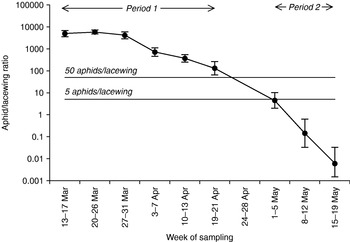
The effect of buckwheat on the density of adult lacewings, aphids and unwanted arthropods was tested with repeated-measures ANOVA. For adult lacewings, the density of aphids was included as a covariate. Both the density of aphids and parasitoids may affect the lacewings; but, since the parasitoids feed on buckwheat (i.e. they are affected by treatment) whereas pea aphids do not, only the density of aphids is suitable as a covariate. For adult lacewings, the data set was first analysed for the whole experiment extending from 13 March to 19 May. This revealed a significant interaction between treatment and time and the data set was, therefore, also analysed for two different periods separately. The number of aphids per adult lacewing (aphid per lacewing ratio) was much higher than the high density treatment used in the laboratory experiment (50 aphids per lacewing) during the first six weeks of the field cage experiment but then declined below the level of the low density treatment (five aphids/lacewing) during the last three weeks (fig. 1). This decline probably represents a change from aphids being a plentiful resource to a very limited one for the lacewings, and it was, therefore, decided to use this as the cut-off point analysing the period before and after that separately.
Mean number of aphids available per adult lacewing (aphid per lacewing ratio) in the field cage experiment. The aphid per lacewing ratio was log10 (x+0.001) transformed to improve normality. Back-transformed means and 95% confidence limits are presented. The horizontal lines indicate aphid per lacewing ratios of 5 and 50, which correspond to the low and high aphid density treatments in the laboratory experiment. During the first period, the mean aphid per lacewing ratio was higher than the high density treatment and during the second period it was lower than the low density treatment.

The effect of buckwheat on aphid density was tested for the whole experiment and for each of the two periods separately. The number of unwanted arthropods was analysed for the whole experiment.
The density of adult parasitoids (A. zealandica) was often low so repeated-measures ANOVA was unsuitable. One-way ANOVA was, therefore, conducted on mean densities of parasitoids per cage for the whole experimental period. Alfalfa biomass was also analysed with one-way ANOVA. The three sampling dates were analysed separately since they represented growth of different ages and were, therefore, not comparable.
To satisfy the assumptions for equal variance and normal distribution for the ANOVA models, all analyses except those of biomass of alfalfa and density of parasitoids were conducted on square root transformed data.
Results
Effect of flowers and prey density on lacewing oviposition
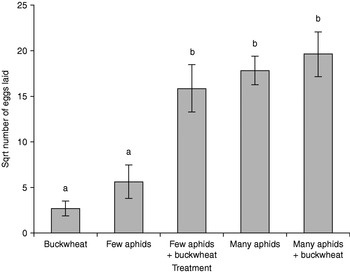
There was a significant effect of treatment on the number of eggs oviposited during the 28-day laboratory experiment (F 4,45=15.33, P<0.001; fig. 2). Orthogonal contrasts showed that both the density of aphids provided and the presence of buckwheat significantly increased the number of eggs oviposited (aphids: F 1,45=16.68, P<0.001; buckwheat: F 1,45=9.48, P=0.004). There was a significant interaction between the density of aphids provided and buckwheat provision (F 1,45=4.68, P=0.036) with buckwheat significantly increasing the number of eggs oviposited when few aphids were present but not when there were many aphids. Few eggs were laid when buckwheat was provided alone.
The effect of buckwheat and aphid density on the number of eggs oviposited per female lacewing over 28 days. Values are mean±SE of square root transformed variates. Different letters above the bars indicate significant differences between treatments.

Most of the lacewings survived throughout the experiment, so statistical comparisons of longevity between the treatments were not possible.
Effect of flowers on parasitoid longevity
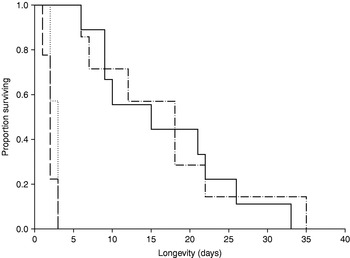
Buckwheat flowers had a strong positive effect on the longevity of adult A. zealandica in the laboratory (F 1,28=23.7; P<0.001; fig. 3). There was no difference between sexes (F 1,28=0.67; P=0.42) and no interaction between buckwheat provision and sex (F 1,28=0.79; P=0.38). All parasitoids provided with water only (control) died within three days, whereas those also receiving buckwheat lived for 6–35 days (females) and 6–33 days (males). On average, longevity increased 7–8 times when parasitoids were provided with buckwheat compared to water only (fig. 3).
Longevity of female and male parasitoids, with and without buckwheat (————, with flowers, males; –– · –– · ––, with flowers, females; — — —, without flowers, males;................, without flowers, females).

Effect of flowers on insect population dynamics
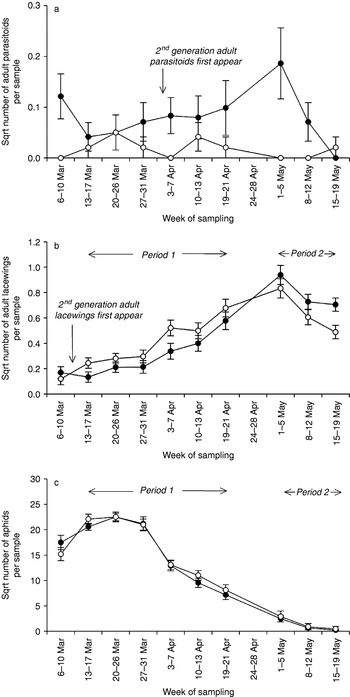
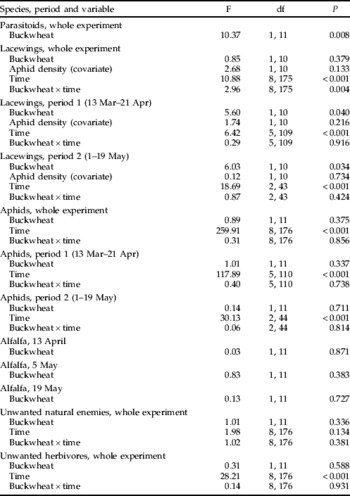
The mean number of lacewing parasitoids was significantly higher in the buckwheat cages than in the control cages during the experimental period (table 1; fig 4a). Untransformed densities (mean±SE) of parasitoids during the experiment ranged from 0±0 to 0.089±0.038 per sample in buckwheat cages and from 0±0 to 0.016±0.011 in control cages.
Results from the field cage experiment. Number of (a) adult parasitoids, (b) adult lacewings and (c) pea aphids per suction sample (0.02 m2). Values are mean±SE of square root transformed variates. Statistical analyses were conducted on data from 13 March onwards because no effect of buckwheat on lacewing density was expected before that. Results from 6–10 March are presented as a reference. Periods 1 and 2 are based on aphid per lacewing ratios (fig. 1) (—•—, buckwheat; —○—, control).

ANOVA results for the effect of buckwheat on the number of adult parasitoids, adult lacewings, aphids, unwanted arthropods and the growth of alfalfa in the field cage experiment. Lacewings, aphids and unwanted natural enemies and herbivores were analysed with repeated measures-ANOVA, parasitoids and growth of alfalfa with one-way ANOVA. The number of aphids was included as a covariate for the analyses of lacewings. The analysis of parasitoids was conducted on average numbers per cage over the whole experiment. All analyses include a block factor, but block effects are not presented.

There was a significant interaction between treatment (buckwheat provision) and time on the number of adult lacewings when the whole experimental period was analysed (table 1; fig. 4b). When the first period (13 March–21 April) was analysed separately, there was a significant negative effect of buckwheat on adult lacewings density (table 1; fig 4b); and, during the second period, the effect was opposite, with significantly more adult lacewings in the buckwheat cages (table 1; fig 4b). Untransformed densities (mean±SE) of adult lacewings ranged from 0.046±0.025 to 1.00±0.12 per sample in buckwheat cages and from 0.094±0.025 to 0.72±0.12 in control cages.
There was no effect of buckwheat on the density of aphids over the whole experiment and also not during the first or second periods when they were analysed separately (table 1; fig 4c). Untransformed densities (mean±SE) of aphids ranged from 0.2±0.2 to 517±43 per sample in buckwheat cages and from 2.8±2.8 to 513±34 in control cages. There was also no effect of buckwheat on the yield of alfalfa at any of the three sampling dates (table 1). Unwanted natural enemies consisted mainly of generalist, epigeal species, such as spiders, harvestmen and staphylinid beetles; and, among unwanted herbivores, alfalfa weevils and the alfalfa flea Sminthurus viridis (L.) (Collembola: Sminthuridae) were most common. There was no significant effect of buckwheat on the number of neither unwanted natural enemies nor unwanted herbivores in the cages (table 1).
Discussion
Floral provision and prey density
The results of both the laboratory and field cage experiments supported our hypothesis that the effect of floral resources on the true omnivore lacewing M. tasmaniae depend on prey density. In the laboratory, provision of flowering buckwheat increased the number of eggs oviposited when the density of prey provided was low but not when it was high. Availability of flowers can also strongly increase longevity of the lacewings when prey is absent (Robinson et al., Reference Robinson, Jonsson, Wratten, Wade and Buckley2008). Almost no eggs were laid when only flowers were provided in our laboratory experiment, implying that lacewing populations would not persist in the long term without access to prey. When a low density of prey was provided, there was a large positive effect of buckwheat flowers on the number of eggs oviposited; few were laid when lacewings had access to a low density of prey only and the number increased about five times when buckwheat was also available. This suggests that buckwheat will not only help lacewings survive periods with low density of prey, but that it can also help them maintain a high rate of oviposition as long as some prey are available.
In the field cage experiment, the effect of floral provision on adult lacewing density changed over time, and this change coincided with a rapid decrease in aphid prey availability at the end of April. There was a negative effect of flowers on lacewing density initially, when the prey density was high; but, when the prey density had declined to low levels, the effect of flowers on lacewing density became positive. This change in the effect of flowers was probably a consequence of the prey density falling from a level where the lacewings were not directly affected by the buckwheat due to an abundance of prey to a level where prey were sufficiently scarce for the lacewings to benefit from the presence of the floral resources. The later positive effect of buckwheat was probably caused by starvation of lacewings in the control cages when the aphid populations collapsed, while lacewing survival was maintained by feeding on floral resources in cages where buckwheat was provided. The initial negative effect of buckwheat on lacewing density was probably caused by increased parasitism rates by A. zealandica. The density of parasitoids was significantly higher in the buckwheat treatment during the field cage experiment. The first adult offspring of the introduced parasitoids were expected to appear around 2 April. After that date, there was an increase in the number of parasitoids caught in the buckwheat cages, whereas catches in the control remained low (fig. 4a). This suggests that parasitism rates were indeed considerably higher in the presence of buckwheat. However, it should be acknowledged that parasitism rates were not measured directly in this experiment, so our evidence that differences in parasitism rates between treatments affected lacewing populations remain circumstantial. Because of low availability of late instar lacewing larvae and the risk of disrupting the population dynamics of lacewings, parasitoids and aphids, we considered direct measurement of parasitism rates impractical.
The laboratory experiment showed that the presence of buckwheat flowers can strongly increase parasitoid longevity. The aphids in both the control and buckwheat cages produced considerable quantities of honeydew. The much lower populations of parasitoids in the control cages suggests that they were either unable to feed on this resource or it was nutritionally inferior compared with floral nectar. The suitability of honeydew as a food source varies among parasitoid species but, for the majority honeydew, is less attractive and an inferior food source compared with nectar; and consumption may be limited by high viscosity (Wäckers, Reference Wäckers2000; Faria et al., Reference Faria, Wäckers and Turlings2008; Wäckers et al., Reference Wäckers, van Rijn and Heimpel2008).
There was no effect of floral provision on the density of aphids and, consequently, also not on alfalfa yield in the field cage experiment. The aphid density was allowed to increase to a high level before the lacewings were introduced, so it is not surprising that the effects on lacewings did not transfer to lower trophic levels. The predator density was probably too low in relation to that of aphids during most of the experiment to reduce prey populations. It remains to be tested whether this can occur when the aphid density is lower.
Conclusions and implications for biological control
The availability and quality of both plants and prey affect the foraging and fitness of omnivores, and this may influence their ability to reduce populations of their prey (Crum et al., Reference Crum, Weiser and Stamp1998; Agrawal et al., Reference Agrawal, Kobayashi and Thaler1999; Eubanks & Denno, Reference Eubanks and Denno1999). This work showed that the relative availability of plant resources and prey can also affect the interaction between omnivores at the third and fourth trophic levels, in particular when different types of omnivory are represented at each trophic level.
The results highlight the difficulty in predicting how floral provision will affect a true omnivore's ability to reduce prey populations. Floral resources can decrease the predation rate by a true omnivore (Wei & Walde, Reference Wei and Walde1997; Robinson et al., Reference Robinson, Jonsson, Wratten, Wade and Buckley2008) and this might negatively affect biological control. Our study showed also that the population density of a true omnivore may be negatively affected by floral provision. This occurred when a parasitoid life-history omnivore at the fourth trophic level benefited from plant resources irrespective of prey availability, but the benefit to a true omnivore lacewing at the third trophic level occurred only at low prey density. Our results are in agreement with the prediction that floral provision will benefit a true omnivore primarily when prey is scarce (Pimm & Lawton, Reference Pimm and Lawton1978; Eubanks & Denno, Reference Eubanks and Denno1999). However, it is not clear how floral provision will affect the lacewing's ability to reduce prey populations during such conditions. Although floral provision will improve lacewing longevity and fecundity when prey is scarce, this will be counteracted by decreased predation rate (Robinson et al., Reference Robinson, Jonsson, Wratten, Wade and Buckley2008).
Flowering plant species, to be used as subsidies in CBC trials, have often been selected solely based on their potential to attract and increase the fitness of natural enemies of herbivorous pests (Hickman & Wratten, Reference Hickman and Wratten1996; Tooker & Hanks, Reference Tooker and Hanks2000), but some studies have considered potential side-effects on the pests (Baggen et al., Reference Baggen, Gurr and Meats1999; Lavandero et al., Reference Lavandero, Wratten, Didham and Gurr2006). The current work shows that potential effects on antagonists of biological control agents also need to be considered (see also Araj et al., Reference Araj, Wratten, Lister and Buckley2008). More effective biological control may be achieved if flowering plants can be selected that benefit only the natural enemies of pests and not their antagonists or the pests themselves.
Acknowledgements
We thank Merv Spurway, Don Heffer, David Jack and Warwick Mottram for providing and preparing the field site. Salah-Eddin Araj, Suzanne Blyth, Susie Clearwater, Myles Mackintosh, Jo Randell and Dane Riding are thanked for help with field work. Alison Lister and Chris Frampton are thanked for statistical advice. Christer Björkman, Raphael Didham, Jason Tylianakis and two anonymous reviewers are thanked for valuable comments on previous versions of this manuscript. The project was sponsored by The Swedish Research Council for Environment, Agricultural Sciences and Spatial Planning with a post-doctoral grant to MJ, by the New Zealand Foundation for Research, Science and Technology (FRST; LINX0303) and by Lincoln University.