Implications
This experiment provides novel insights on mechanisms by which estrous expression near the time of artificial insemination improves reproductive function and performance in Bos indicus cows. Cows that expressed estrus (EST) had enhanced ovarian function and initial pregnancy development, which promoted embryo-mediated processes responsible for pregnancy signaling to maternal tissues. These responses are known to increase pregnancy success in beef females, across B. indicus and Bos taurus breeds. Hence, management strategies to promote estrous expression are beneficial to reproductive and overall efficiency of beef cattle operations.
Introduction
Reproductive efficiency is a critical response in cow–calf operations, and contributes to the number of cattle available for beef production. Given the increasing worldwide demand for beef, management to optimize reproductive efficiency in cow–calf systems is warranted to ensure profitability of cattle producers (Lamb et al., Reference Lamb, Dahlen, Larson, Marquezini and Stevenson2010) and meet the global demand for animal protein (FAO, 2009). Fixed-time artificial insemination (FTAI) is an example of such management, and directly contributed to the recent advances in beef production in the United States (Patterson et al., Reference Patterson, Cooke, Dahlke, Funston, Hall, Lamb, Lauderdale, Perry and Van Eenennaam2016). Yet, understanding the mechanisms that optimize pregnancy success to FTAI is still needed to encourage its adoption by cattle producers (Lamb et al., Reference Lamb, Dahlen, Larson, Marquezini and Stevenson2010).
Expression of EST near the time of FTAI is known to increase pregnancy success in beef and dairy cattle (Pereira et al., Reference Pereira, Sanches, Guida, Rodrigues, Aragon, Veras, Borges, Wiltbank and Vasconcelos2013; Rodrigues et al., Reference Rodrigues, Cooke, Cipriano, Silva, Cerri, Cruppe, Meneghetti, Pohler and Vasconcelos2018). This outcome has been attributed to several factors, including improved ovarian function, embryo development, as well as pregnancy establishment and maintenance (Davoodi et al., Reference Davoodi, Cooke, Fernandes, Cappellozza, Vasconcelos and Cerri2016; Rodrigues et al., Reference Rodrigues, Cooke, Cipriano, Silva, Cerri, Cruppe, Meneghetti, Pohler and Vasconcelos2018). More specifically, Larimore et al. (Reference Larimore, Amundson, Bird, Funnell, Kruse, Bridges and Perry2015) reported advanced growth and quality of embryos recovered on day 6 of gestation from cows that expressed EST before FTAI. Early embryonic development is critical for establishment and maintenance of the pregnancy, particularly via the interferon-tau (IFNt) cascade (Ealy and Yang, Reference Ealy and Yang2009). Accordingly, Rodrigues et al. (Reference Rodrigues, Cooke, Cipriano, Silva, Cerri, Cruppe, Meneghetti, Pohler and Vasconcelos2018) reported greater blood messenger RNA (mRNA) expression of interferon-stimulated genes (ISG) on day 20 of gestation in B. indicus cows that expressed EST near the time of FTAI. The ISGs have been used to gauge IFNt response and conceptus development (Fricke et al., Reference Fricke, Carvalho, Lucy, Curran, Herlihy, Waters, Larkin, Crowe and Butler2016), given that IFNt synthesis upregulates mRNA expression of ISGs in circulating leukocytes (Stevenson et al., Reference Stevenson, Dalton, Ott, Racicot and Chebel2007).
Davoodi et al. (Reference Davoodi, Cooke, Fernandes, Cappellozza, Vasconcelos and Cerri2016) reported greater conceptus size, but similar IFNt mRNA expression in conceptuses collected from B. indicus cows that expressed EST during the FTAI protocol. However, Davoodi et al. (Reference Davoodi, Cooke, Fernandes, Cappellozza, Vasconcelos and Cerri2016) collected conceptuses on day 19 of gestation, whereas the IFNt-based processes responsible for pregnancy signaling to maternal tissues occur around day 15 to 17 of gestation (Ealy and Yang, Reference Ealy and Yang2009). Based on this rationale, we hypothesized that estrous expression near the time of FTAI will result in enhanced conceptus development and IFNt-signaling cascade on day 15 of gestation; the beginning of the pregnancy recognition period. Hence, this experiment compared ovarian, uterine and conceptus factors associated with pregnancy establishment in B. indicus beef cows according to estrous expression during the FTAI protocol.
Material and methods
Animals and estrous expression
This experiment was conducted in a commercial cow–calf operation located in Aruanã, GO, Brazil. All animals were cared for in accordance with acceptable practices and experimental protocols reviewed and approved by the Oregon State University Institutional Animal Care and Use Committee. Moreover, cows evaluated herein were part of a companion project focused on fatty acid supplementation after FTAI, and fully described by Cipriano et al. (Reference Cipriano, Cooke, Rodrigues, Silva, Bohnert, Marques, Vasconcelos, Pires and Cerri2016). Pertaining to the current experiment, 100 lactating multiparous Nelore cows (mean±SE; initial BW=430±5 kg, initial body condition score (BCS)=2.87±0.02; age=8.5±0.2 years; days postpartum=152±1 days) were enrolled in an estrous synchronization+FTAI protocol (Meneghetti et al., Reference Meneghetti, Sa Filho, Peres, Lamb and Vasconcelos2009) from day −11 to 0. Cows received a 2 mg intramuscular injection of estradiol benzoate (Gonadiol; Zoetis, São Paulo, SP, Brazil) and an intravaginal progesterone (P4) releasing device (CIDR, containing 1.9 g of P4; Zoetis) on day −11, a 12.5 mg intramuscular injection of prostaglandin F2α (Lutalyse; Zoetis) on day −4, P4 device removal in addition to 0.6 mg intramuscular injection of estradiol cypionate (Zoetis) and 300 IU intramuscular injection of equine chorionic gonadotropin (Novormon; Zoetis) on day −2, and FTAI on day 0. Cows were inseminated on day 0 by the same technician, using semen from the same sire and collection. Estrous detection aids (Estrotect; Rockway Inc., Spring Valley, WI, USA) were applied on day −2 to all cows, and occurrence of EST was recorded at FTAI. Estrus was defined as removal of >50% of the rub-off coating on the patch. Overall, 39 cows expressed EST (EST), 55 did not express EST (NOEST) and six cows lost their patch and were removed from the experiment.
Sampling
During the experimental period (day −11 to 30), cows were maintained in Panicum maximum pastures and received supplementation as described by Cipriano et al. (Reference Cipriano, Cooke, Rodrigues, Silva, Bohnert, Marques, Vasconcelos, Pires and Cerri2016). Cow BW and BCS (Wagner et al., Reference Wagner, Lusby, Oltjen, Rakestraw, Wettemann and Walters1988) were assessed on day −11 of the experiment. Blood samples were collected immediately on days 7 and 15 of the experiment from either the coccygeal vein or artery into blood collection tubes (Vacutainer, 10 ml; Becton Dickinson, Franklin Lakes, NJ, USA). Samples were placed immediately on ice, centrifuged (2500×g for 30 min; 4°C) for plasma harvest, and stored at −20°C on the same day of collection. Transrectal ultrasonography (7.5-MHz transducer; 500 V, Aloka, Wallingford, CT, USA) was performed concurrently with FTAI (day 0) to verify dominant follicle diameter, and concurrently with each blood collection to estimate corpus luteum (CL) volume (days 7 and 15). Corpus luteum volume was estimated using the formula for volume of a sphere; volume=4/3π×(D/2)3, where D is the maximum luteal diameter. Cows diagnosed without the presence of a CL on day 0, but with a CL greater than 0.38 cm3 in volume on days 7 and 15 were classified as responsive to the estrous synchronization protocol (Cooke et al., Reference Cooke, Cappellozza, Guarnieri Filho, Depner, Lytle, Jump, Bohnert, Cerri and Vasconcelos2014; Cipriano et al., Reference Cipriano, Cooke, Rodrigues, Silva, Bohnert, Marques, Vasconcelos, Pires and Cerri2016). This criterion was based on the smallest diameter of a functional CL detected in B. indicus-influenced cows following induced ovulation, as reported by Figueiredo et al. (Reference Figueiredo, Barros, Pinheiro and Soler1997). Only cows that responded to the estrous synchronization protocol and that were successfully classified according to estrous expression remained in the experiment (EST, n=36; NOEST, n=48).
Upon ultrasonography on day 15, cows that responded to the estrous synchronization protocol were randomly selected within each estrous expression group (EST, n=29; NOEST, n=30) for conceptus collection and endometrial biopsy. Conceptus collection was performed via transcervical flushing of the uterine horn ipsilateral to the CL as described by Ribeiro et al. (Reference Ribeiro, Monteiro, Bisinotto, Lima, Greco, Ealy, Thatcher and Santos2016) and Brandão et al. (Reference Brandão, Cooke, Schubach, Marques, Bohnert, Carvalho, Dias, Timlin, Clark-Deener, Currin, Jump, Pohler, Cerri and Mercadante2018). Up to five flushings of phosphate-buffered saline (20 ml each) were performed if no conceptus tissue was recovered. The recovered conceptuses were transferred to a sterile 100×15 mm Petri-dish (CRAL Artigos para Laboratórios Ltda., São Paulo, Brazil) and measured for length. Following conceptus collection, endometrial biopsy was performed in the uterine horn ipsilateral to the CL according to Cerri et al. (Reference Cerri, Chebel, Rivera, Narciso, Oliveira, Amstalden, Baez-Sandoval, Oliveira, Thatcher and Santos2011) and Brandão et al. (Reference Brandão, Cooke, Schubach, Marques, Bohnert, Carvalho, Dias, Timlin, Clark-Deener, Currin, Jump, Pohler, Cerri and Mercadante2018). Conceptus and endometrial samples were stored in 5-ml sterile cryogenic tubes (CRAL Artigos para Laboratórios Ltda.) containing 2 ml of RNA stabilization solution (RNAlater; Ambion Inc., Austin, TX, USA). On day 20, blood samples were collected from the non-flushed cows (EST, n=7; NOEST, n=18) from either the coccygeal vein or artery into PAXgene tubes (BD Diagnostics, Sparks Glencoe, MD, USA) for whole blood RNA extraction. Pregnancy status of the non-flushed cows was evaluated via transrectal ultrasonography (5.0-MHz transducer; 500 V, Aloka) on day 30.
Laboratorial analyses
Plasma samples were analyzed for P4 concentrations using a chemiluminescent enzyme immunoassay (Immulite 1000; Siemens Medical Solutions Diagnostics, Los Angeles, CA, USA). Samples were analyzed within a single assay, with intra-assay CV of 5.6% and minimum detectable concentration of 0.1 ng/ml.
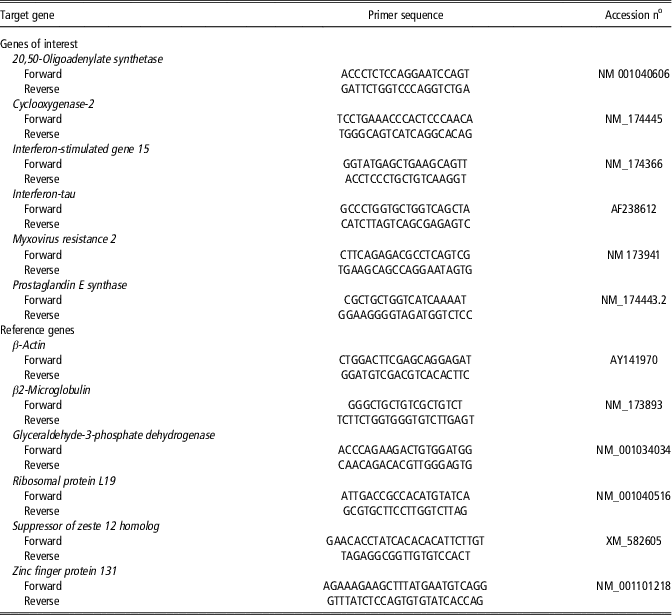
Total RNA was extracted from tissue samples collected from cows that had a conceptus using the TRIzol Plus RNA Purification Kit (Invitrogen, Carlsbad, CA, USA). Total RNA was extracted from whole blood samples using the PAXgene Blood RNA Kit (Qiagen, Valencia, CA, USA). Quantity and quality of isolated RNA were assessed via UV absorbance (NanoDrop Lite; Thermo Fisher Scientific, Wilmington, DE, USA) at 260 and 260/280 nm ratio, respectively (Fleige and Pfaffl, Reference Fleige and Pfaffl2006). Extracted RNA (100 ng for conceptus, 200 ng for endometrium, 120 ng for whole blood) was reverse transcribed using the High Capacity cDNA Reverse Transcription Kit with random hexamers (Applied Biosystems, Foster City, CA, USA) as described by Brandão et al. (Reference Brandão, Cooke, Schubach, Marques, Bohnert, Carvalho, Dias, Timlin, Clark-Deener, Currin, Jump, Pohler, Cerri and Mercadante2018). Real-time reverse transcription PCR was completed using the Fast SYBR Green Master Mix (Applied Biosystems) and gene-specific primers (20 pM each; Table 1) with the StepOne Real-time PCR system (Applied Biosystems) according to Cooke et al. (Reference Cooke, Arthington, Araujo, Lamb and Ealy2008). Responses were quantified based on the threshold cycle (C
T
), the number of PCR cycles required for target amplification to reach a predetermined threshold. The C
T responses were normalized to the geometrical mean of C
T values of the reference genes glyceraldehyde-3-phosphate dehydrogenase and ribosomal protein L19 (conceptus), suppressor of zeste 12 homolog and zinc finger protein 131 (endometrium) and β2-microglobulin and β-actin (whole blood). The CV for the geometrical mean of reference genes across all samples was 1.7% in the conceptus, 2.4% in endometrial samples and 2.1% in whole blood samples. Results are expressed as relative fold change (
 $$2^{{{\minus}\Delta \Delta C_{{\rm T}} }} $$
).
Primer sequences and accession number for all gene transcripts analyzed by real-time reverse transcription PCR

Sources are described in Cipriano et al. (Reference Cipriano, Cooke, Rodrigues, Silva, Bohnert, Marques, Vasconcelos, Pires and Cerri2016).
Statistical analysis
All data were analyzed using cow as experimental unit, with the MIXED or GLIMMIX procedure of SAS (SAS Institute Inc., Cary, NC, USA) for quantitative and binary data, respectively. Satterthwaite approximation was used to determine the denominator degrees of freedom for the tests of fixed effects, and cow(estrous expression) as random effect. The model statement used for cow BW, BCS, days-postpartum, dominant follicle diameter, presence of conceptus, conceptus length, and all endometrial and conceptus gene expression results contained the effect of estrous expression. The model statement used for blood gene expression results contained the effects of estrous expression, pregnancy status on day 30, and the resultant interaction. The model statement used for CL volume and plasma P4 concentrations contained the effects of estrous expression, day, and the resultant interaction. The specified term for the repeated measure analyses was day, cow(estrous expression) was the subject, and the covariance structure used was autoregressive, which provided the best fit for these analyses according to the Akaike information criterion. Results are reported as least square means, and separated using least square differences. Significance was set at P⩽0.05 and tendencies were determined if P>0.05 and ⩽0.10
Results
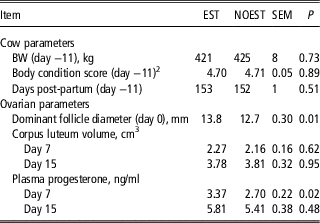
The interaction of estrous expression (EST or NOEST) with the treatments imposed by Cipriano et al. (Reference Cipriano, Cooke, Rodrigues, Silva, Bohnert, Marques, Vasconcelos, Pires and Cerri2016) was tested across all variables investigated, and no significant interactions were observed (P⩾0.51). Hence, results reported herein were independent of the nutritional treatments from Cipriano et al. (Reference Cipriano, Cooke, Rodrigues, Silva, Bohnert, Marques, Vasconcelos, Pires and Cerri2016). Cow BW, BCS and days postpartum on day −11 were similar (P⩾0.51) between EST and NOEST cows (Table 2). Diameter of the dominant follicle on day 0 was greater (P=0.01) in EST v. NOEST cows (Table 2). An estrous response×day interaction was detected (P=0.03) for plasma P4 concentrations, which were greater (P=0.02) on day 7 for EST v. NOEST cows, but similar (P=0.48) between groups on day 15 (Table 2). Conversely, no estrous response effects were noted (P⩾0.62) for CL volume (Table 2).
Cow and ovarian parameters according to estrous expression (EST=estrous behavior, n=36; NOEST=no estrous behavior, n=48) in Bos indicus beef cows during a fixed-time artificial insemination (FTAI) protocolFootnote 1

1 Cows were assigned to a estrous synchronization+FTAI protocol (Meneghetti et al., Reference Meneghetti, Sa Filho, Peres, Lamb and Vasconcelos2009) from day −11 to 0 of the experiment. An estrous detection patch was attached to the tailhead of each cow on day −2, and estrous expression was defined as removal of >50% of the rub-off coating from the patch on day 0 (FTAI).
2 According to Wagner et al. (Reference Wagner, Lusby, Oltjen, Rakestraw, Wettemann and Walters1988).
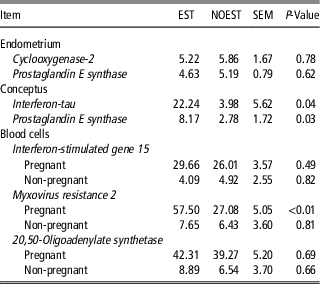
A similar proportion (P⩾0.65) of EST and NOEST cows had a conceptus on days 15 and 30 of the experiment (Table 3). Conceptuses collected from EST cows had increased (P=0.03) length compared with conceptuses collected from NOEST cows (Table 3). Expression of prostaglandin E synthase and IFNt mRNA were greater (P⩽0.04) in conceptuses collected from EST v. NOEST cows (Table 4). No estrous expression effects were detected (P⩾0.62) for mRNA expression of cyclooxygenase-2 and prostaglandin E synthase in endometrial samples (Table 4).
Pregnancy responses according to estrous expression (EST=estrous behavior, n=36; NOEST=no estrous behavior, n=48) in Bos indicus beef cows during a fixed-time artificial insemination (FTAI) protocol1 , 2

1 Cows were assigned to a estrous synchronization+FTAI protocol (Meneghetti et al., Reference Meneghetti, Sa Filho, Peres, Lamb and Vasconcelos2009) from day −11 to 0 of the experiment. An estrous detection patch was attached to the tailhead of each cow on day −2, and estrous expression was defined as removal of >50% of the rub-off coating from the patch on day 0 (FTAI).
2 On day 15, cows (EST, n=29; NOEST, n=30) were assigned to conceptus collection via transcervical flushing, followed by endometrial biopsy in the uterine horn ipsilateral to the corpus luteum (Cerri et al., Reference Cerri, Chebel, Rivera, Narciso, Oliveira, Amstalden, Baez-Sandoval, Oliveira, Thatcher and Santos2011; Ribeiro et al., Reference Ribeiro, Monteiro, Bisinotto, Lima, Greco, Ealy, Thatcher and Santos2016). On day 30, pregnancy status was verified by transrectal ultrasonography in cows not assigned to conceptus collection (EST, n=7; NOEST, n=18).
Expression of genes associated with pregnancy establishment in the endometrium, conceptus and blood according to estrous expression (EST=estrous behavior, n=36; NOEST=no estrous behavior, n=48) in Bos indicus beef cows during a fixed-time artificial insemination (FTAI) protocol1 , 2

1 Cows were assigned to a estrous synchronization+FTAI protocol (Meneghetti et al., Reference Meneghetti, Sa Filho, Peres, Lamb and Vasconcelos2009) from day −11 to 0 of the experiment. An estrous detection patch was attached to the tailhead of each cow on day −2, and estrous expression was defined as removal of >50% of the rub-off coating from the patch on day 0 (FTAI).
2 On day 15, cows (EST, n=29; NOEST, n=30) were assigned to conceptus collection via transcervical flushing, followed by endometrial biopsy in the uterine horn ipsilateral to the corpus luteum (Cerri et al., Reference Cerri, Chebel, Rivera, Narciso, Oliveira, Amstalden, Baez-Sandoval, Oliveira, Thatcher and Santos2011; Ribeiro et al., Reference Ribeiro, Monteiro, Bisinotto, Lima, Greco, Ealy, Thatcher and Santos2016). Additional blood samples were collected for whole blood RNA extraction (day 20) and pregnancy status was verified by transrectal ultrasonography (day 30) in cows not assigned to conceptus collection (EST, n=7; NOEST, n=18).
An estrous response×pregnancy status interaction was detected (P<0.01) for blood mRNA expression of the ISG myxovirus resistance 2 on day 20 of the experiment (Table 4). Expression of this ISG was similar (P=0.81) within cows diagnosed as non-pregnant on day 30, but greater (P<0.01) for EST v. NOEST cows diagnosed as pregnant. Estrous response, however, did not impact (P⩾0.69) mRNA expression of the ISGs interferon-stimulated gene 15 and 20,50-oligoadenylate synthetase (Table 4). Moreover, mRNA expression of all ISGs were greater (P<0.01) in pregnant v. non-pregnant cows across both estrous expression groups (Table 4).
Discussion
Reproductive function of beef females is largely modulated by nutritional status and interval from calving (Vasconcelos et al., Reference Vasconcelos, de Sá Filho and Cooke2014). Given the similar BW, BCS and days postpartum between EST and NOEST cows on day −11, the estrous expression effects on reproductive responses reported herein should not be associated with these variables. The greater dominant follicle diameter noted in EST cows is coherent with the existing literature (Carvalho et al., Reference Carvalho, Martins, Lamb and Vasconcelos2016; Rodrigues et al., Reference Rodrigues, Cooke, Cipriano, Silva, Cerri, Cruppe, Meneghetti, Pohler and Vasconcelos2018), and typically result in increased preovulatory estradiol concentrations in cows that express EST. Although estradiol was not evaluated in this experiment, estrous expression is primarily determined by circulating concentrations of this steroid, which triggers the hypothalamus to initiate estrous behavior (Allrich, Reference Allrich1994). Accordingly, estrous expression has been considered a biomarker for estradiol concentrations in beef females (Perry et al., Reference Perry, Smith, Lucy, Green, Parks, MacNeil, Roberts and Geary2005; Larimore et al., Reference Larimore, Amundson, Bird, Funnell, Kruse, Bridges and Perry2015), whereas dominant follicle diameter and circulating estradiol have been positively associated with pregnancy success in beef cattle (Perry et al., Reference Perry, Smith, Lucy, Green, Parks, MacNeil, Roberts and Geary2005; Pohler et al., Reference Pohler, Geary, Atkins, Perry, Jinks and Smith2012).
Ovulation of a larger follicle often yields a larger CL and greater P4 synthesis (Vasconcelos et al., Reference Vasconcelos, Sartori, Oliveira, Guenther and Wiltbank2001). Rodrigues et al. (Reference Rodrigues, Cooke, Cipriano, Silva, Cerri, Cruppe, Meneghetti, Pohler and Vasconcelos2018) reported greater CL size on day 7 after FTAI, which resulted in greater serum P4 concentration in B. indicus cows that expressed estrous behavior during the FTAI protocol. Similar outcomes were detected herein for plasma P4 concentration on day 7, although differences noted for dominant follicle diameter at FTAI were not translated into greater CL volume in EST cows. Yet, preovulatory estradiol promotes proliferation of follicular granulosa cells, which differentiate into luteal cells after ovulation and are responsible for 80% of progesterone secretion by the CL (Murdoch and Van Kirk, Reference Murdoch and Van Kirk1998). Hence, the CL of EST cows were likely capable of synthesizing more P4 on day 7 after FTAI compared with CL from NOEST cows, while this outcome disappeared by day 15 after FTAI. Nevertheless, circulating P4 concentrations on day 7 after breeding has been shown to modulate pregnancy success in beef and dairy females (Demetrio et al., Reference Demetrio, Santos, Demetrio and Vasconcelos2007; Rodrigues et al., Reference Rodrigues, Cooke, Cipriano, Silva, Cerri, Cruppe, Meneghetti, Pohler and Vasconcelos2018).
The proportion of cows that had a conceptus on days 15 and 30 did not differ between EST and NOEST, although this experiment was not designed nor had the statistical power to compare pregnancy rates between groups (Pereira et al., Reference Pereira, Sanches, Guida, Rodrigues, Aragon, Veras, Borges, Wiltbank and Vasconcelos2013; Rodrigues et al., Reference Rodrigues, Cooke, Cipriano, Silva, Cerri, Cruppe, Meneghetti, Pohler and Vasconcelos2018). Yet, estrous expression near the time of FTAI enhances uterine environment for embryo development (Davoodi et al., Reference Davoodi, Cooke, Fernandes, Cappellozza, Vasconcelos and Cerri2016), whereas estradiol promotes secretion of oviductal glycoproteins (Buhi, Reference Buhi2002) and endometrial nutrients that contribute to early conceptus growth (Gray et al., Reference Gray, Taylor, Ramsey, Hill, Bazer, Bartol and Spencer2001). Embryo development during the initial 11 days of gestation is also dependent on the histotroph as a source of nutrients, enzymes and growth factors (Forde et al., Reference Forde, McGettigan, Mehta, O’Hara, Mamo, Bazer, Spencer and Lonergan2014), whose secretion and composition are directly regulated by circulating P4 (Brooks et al., Reference Brooks, Burns and Spencer2014). Indeed, Forde et al. (Reference Forde, Carter, Fair, Crowe, Evans, Spencer, Bazer, McBride, Boland, O’gaora and Lonergan2009) reported that circulating P4 concentrations during the initial 7 day of gestation were positively associated with conceptus size on day 14 of gestation. Collectively, these research findings corroborate the greater conceptus length observed in EST cows on day 15 of gestation herein, likely as a result of increased preovulatory estradiol and post-FTAI progesterone concentrations in cows that expressed EST (Perry et al., Reference Perry, Smith, Lucy, Green, Parks, MacNeil, Roberts and Geary2005; Rodrigues et al., Reference Rodrigues, Cooke, Cipriano, Silva, Cerri, Cruppe, Meneghetti, Pohler and Vasconcelos2018).
Size and stage of development of the conceptus during the pregnancy recognition period are critical for establishment and maintenance of the pregnancy (Ealy and Yang, Reference Ealy and Yang2009). The conceptus initiates the IFNt-based processes responsible for pregnancy signaling to maternal tissues, including production of prostaglandins from the two-series, such as prostaglandin E2, which modulate synthesis and endometrial activity of IFNt. Accordingly, mRNA expression of prostaglandin E synthase and IFNt were greater in conceptuses from EST cows, supporting our hypothesis that estrous expression during the FTAI protocol promotes the IFNt-signaling cascade on day 15 of gestation. Conversely, mRNA expression of cyclooxygenase-2 and prostaglandin E synthase in the endometrium were not impacted by estrous expression. Davoodi et al. (Reference Davoodi, Cooke, Fernandes, Cappellozza, Vasconcelos and Cerri2016) reported that cyclooxygenase-2 and oxytocin mRNA expression, genes that regulate prostaglandin F2α biosynthesis, were downregulated in the endometrium of cows that expressed EST during the FTAI protocol. Yet, Davoodi et al. (Reference Davoodi, Cooke, Fernandes, Cappellozza, Vasconcelos and Cerri2016) collected samples on day 19 after FTAI, while results from this experiment suggest that estrous expression does not modulate prostaglandin-related genes in endometrial tissues on day 15 of gestation. Supporting this rationale, dramatic increases in endometrial mRNA expression of cyclooxygenase-2 and prostaglandin E synthase are observed near day 15 of the bovine estrous cycle, which stabilize after day 16 (Arosh et al., Reference Arosh, Parent, Chapdelaine, Sirois and Fortier2002). Such robust response, which is inherent to the bovine estrous cycle, may have prevented the detection of estrous expression effects on these genes on day 15 of gestation herein, but not on day 19 in Davoodi et al. (Reference Davoodi, Cooke, Fernandes, Cappellozza, Vasconcelos and Cerri2016).
Expression of ISGs in whole blood can be used to assess conceptus development and IFNt production from day 15 to 22 of gestation, as well as pregnancy diagnosis 18 days after breeding (Fricke et al. Reference Fricke, Carvalho, Lucy, Curran, Herlihy, Waters, Larkin, Crowe and Butler2016). More specifically, IFNt production by the conceptus upregulates mRNA expression of ISGs, particularly myxovirus resistance 2, in body tissues such as whole blood cells (Stevenson et al., Reference Stevenson, Dalton, Ott, Racicot and Chebel2007). Accordingly, mRNA expression of all ISGs reported herein were upregulated in pregnant cows across EST and NOEST groups. Yet, only myxovirus resistance 2 was upregulated in EST v. NOEST cows, despite differences detected for conceptus length and IFNt mRNA expression on day 15 of gestation. Rodrigues et al. (Reference Rodrigues, Cooke, Cipriano, Silva, Cerri, Cruppe, Meneghetti, Pohler and Vasconcelos2018) also noted that estrous expression during near the time of FTAI upregulated mRNA expression of myxovirus resistance 2 in pregnant cows on day 20 of gestation, without similar outcomes for interferon-stimulated gene 15 and 20,50-oligoadenylate synthetase. The reasons for such outcomes herein and in Rodrigues et al. (Reference Rodrigues, Cooke, Cipriano, Silva, Cerri, Cruppe, Meneghetti, Pohler and Vasconcelos2018) are unclear, despite the beneficial impacts of estrous expression on conceptus development in beef females.
Conclusions
Results from this experiment provide novel information about the mechanisms by which estrous expression near the time of FTAI improves reproductive function and performance in B. indicus cows. Cows that expressed EST had greater dominant follicle diameter at FTAI, greater plasma P4 concentration 7 days later, increased length and mRNA expression of IFNt-related genes in 15-day old conceptuses, resulting in increased mRNA expression of the ISG myxovirus resistance 2 on 20 of gestation. All these responses are known to increase pregnancy success to FTAI in beef females, across B. indicus and B. taurus breeds (Cipriano et al., Reference Cipriano, Cooke, Rodrigues, Silva, Bohnert, Marques, Vasconcelos, Pires and Cerri2016; Brandão et al., Reference Brandão, Cooke, Schubach, Marques, Bohnert, Carvalho, Dias, Timlin, Clark-Deener, Currin, Jump, Pohler, Cerri and Mercadante2018; Rodrigues et al., Reference Rodrigues, Cooke, Cipriano, Silva, Cerri, Cruppe, Meneghetti, Pohler and Vasconcelos2018). Collectively, this experiment demonstrates that estrous expression increases pregnancy rates to FTAI by enhancing pregnancy establishment events, including IFNt-based processes responsible for pregnancy signaling to maternal tissues. Hence, management strategies and synchronization protocols that promote expression of EST near the time of FTAI are warranted to optimize reproductive efficiency of beef females.
Acknowledgments
Dr Reinaldo F. Cooke is also affiliated as permanent professor to the Programa de Pós-Graduação em Zootecnia/São Paulo State University (UNESP), School of Veterinary Medicine and Animal Science, Botucatu 18168-000, Brazil. Results reported herein were preliminarily published as a conference abstract by Schubach et al. (Reference Schubach, Cooke, Brandao, Marques and Cerri2018).
Declaration of interest
No conflict of interest to report.
Ethics statement
All animals were cared for in accordance with acceptable practices and experimental protocols reviewed and approved by the Oregon State University Institutional Animal Care and Use Committee.
Software and data repository resources
No software, data or models were deposited in official repositories.