The idea that politicians respond in hyper-active ways to public outrage in times of crisis is one of the most central ideas in the literature on policy-making, crisis and risk (Boin et al. Reference Boin, t'Hart, Stern and Sundelius2005; Breyer Reference Breyer1993). At a certain level of public attention, politicians are required to be seen to do something (or, to use President Obama's phrase, to look for some ‘ass to kick’Footnote 1). Despite the agreement about the linkage between crisis, public attention and subsequent regulatory response, less agreement exists as to whether there is a linkage between the direction of argumentation that dominates in the media and the content of the subsequent regulatory response (should it be forthcoming in the first place). Three well-known views assume a direct link between direction of public attention and subsequent regulatory or policy response:
– the view that responses to risk follow particular national attitudes or national ‘policy styles’. Institutional frameworks are said to embed and reinforce particular approaches and policy beliefs. In particular, in the area of regulation and risk, some observers have argued that the US, given its ‘individualist’ culture, is likely to respond in less precautionary ways than European countries – both in terms of dominant themes in public discourse and in terms of actual regulatory response (Vogel Reference Vogel2003; Kelman Reference Kelman1981, but Wiener Reference Wiener2003).
– the view that responses to risk in the case of heightened public attention follow the proverbial ‘knee jerk’ or ‘Pavlovian politics’ type of pattern in which politicians in media heat respond to public demands for ‘zero tolerance’ by engaging in immediate action (Breyer 1992; Hood and Lodge Reference Hood and Lodge2005).
– the view that responses reflect dominant paradigms. The prominence of risk-based regulation is widely said to characterise the ‘regulatory state’, whose underlying policy preferences are said to have shifted towards efficiency (Majone Reference Majone1994, Reference Majone1997) and ‘neo-liberalism’. Therefore, both public as well politicians’ responses are said to reflect an individualist way of life in that excessively intrusive state action or prohibition are rejected, and emphasis is placed on regulated self-regulation and product information (Power Reference Power2007).
This article explores the direction of argumentation (others may call this the trajectory of ‘media frames’) in comparative context, and enquires whether dominant advocacy about regulatory instruments is reflected in eventual regulatory response. This article compares the responses to food scandals in three countries, Denmark, Germany and the United States. Based on a methodology derived from grid-group cultural theory, this article finds that the cross-national argumentation patterns (as reflected in views expressed in the print media) are shaped by a dominance of hierarchical claims (pointing to the knee-jerk response pattern). In contrast, neither ‘neo-liberal’ paradigms nor cross-national differences appear prominently. The content of regulatory responses however are somewhat more differentiated, with only limited congruence between the direction of of public argumentation and the direction of regulatory responses. The rest of this article progresses in five steps. First, the three literatures introduced above are discussed. Second, the grid-group cultural theory-based methodology is being introduced. The third section briefly considers the national cases, the spinach, tomato/jalapeños and peanut scandals in the United States of 2006–9, the Gammelfleisch scandal in Germany of the same year and the gammel koed and raspberry scandals in Denmark, again of 2006. The fourth section presents the results and the concluding section points to wider implications.
Three Approaches Towards Responses to Risk
The area of risk and regulation has attracted contrasting and competing literatures. One widely-held assumption is that when the going gets tough, politicians will seek to respond to public pressure (as articulated in the media) to act. While therefore pandering to public views, it is less clear whether there is a direct linkage between the demands and criticisms that dominate public argumentation (as expressed, for example, in the media) and the direction of the regulatory response.
A range of literatures assume a link between dominant worldviews within policy domains and regulatory instruments, especially in those public policy accounts relating to agenda-setting (Mazur Reference Mazur2009). Related interest focuses on the assessment of policy moods and the ‘thermostat’ model (Wlezien Reference Wlezien1995) or on how ‘advocacy coalitions’ (Weible and Sabatier Reference Weible and Sabatier2009) are seen as seeking to institutionalise their preferences in actual policy responses. Similarly, Kingdon's streams model places a strong emphasis on ‘policy mood’ as part of the ‘policy windows’ that need to be open for a policy to make it onto the government agenda (Kingdon Reference Kingdon1995). In contrast, in their seminal study of risk regulation regimes, Hood and colleagues explore the extent to which variations in regime can be explained by overall media salience (Hood et al. Reference Hood, Rothstein and Baldwin2001). Focusing on select risks in the UK context, they find little evidence of a relationship between salience and regulatory regime, but they only focus on salience rather than the direction of argumentation. Without seeking to provide an exhaustive or mutually exclusive account, this section explores the three literatures noted in the introduction in more detail. Each of these three accounts offers a distinct answer to this article's animating question: how do different national systems, in terms of direction of public attention and subsequent regulatory response, respond to food scandals?
According to the national patterns approach, clear national differences emerge as a result of institutional setting. National institutions matter and so does national ‘culture’ (Hofstede Reference Hofstede1991, Kagan Reference Kagan2001, Reference Kagan2007). The area of risk seems particularly appropriate for expecting the importance of ‘national’ factors to feature prominently (Skogstadt Reference Skogstadt2006), given the high degree of sensitivity and public attention paid to risk and public policy, especially during periods of heightened attention during scandals and crises. A wide-ranging literature has paid attention to national features in policy-making, whether in terms of ‘style’ (Richardson et al. Reference Richardon, Gustafsson and Jordan1982; Vogel Reference Vogel1986), in terms of exploring sectoral and/or national policy patterns (Freeman Reference Freeman1985) or in terms of policy-making and regulation (Gormley and Peters Reference Gormley and Peters1992; Kagan Reference Kagan2000; Löfstedt and Vogel Reference Löfstedt and Vogel2002; Kollman and Prakash Reference Kollman and Prakash2001; Howlett Reference Howlett2000).
Therefore, distinct and uniform national patterns should emerge in response to food scandals, if stable national institutional characteristics are that significant. A widespread diagnosis has traditionally been that US and EU approaches differ markedly, whether in terms of the US being initially more precautionary and aggressive (until the 1980s) or more lenient and permissive (since the 1980s) (Vogel Reference Vogel2003: 562; Swedlow et al. Reference Swedlow, Kall, Zhou, Hammitt and Wiener2009). Such differences were also diagnosed with regard to adversarial (US) versus co-operative enforcement styles (Kelman Reference Kelman1981; Kagan Reference Kagan2007: 101–4), or in terms of ‘laggards’ and ‘leaders’ regarding the adoption of environmental regulations at different time periods (Lundqvist Reference Lundqvist1980; Vogel Reference Vogel2003). Differences have been assessed in terms of ‘adversarial legalism’ (Kagan Reference Kagan2001) that is said to differentiate US from European legal traditions, with the US style conditioned by widespread scepticism, if not hostility to governmental and legal authority (Kagan Reference Kagan2007: 108; Lipset Reference Lipset1997). Developments over the past decade or so are said to have challenged the idea of inherently ‘national’ responses. On the one hand, regulatory responses are said to be increasingly differentiated in terms of how exposed a particular domain is to the international market (Lütz Reference Lütz2004; Garth and Dezelay Reference Garth and Dezelay1995). On the other hand, Vogel (Reference Vogel2003: 579–80) has argued that national distinctiveness reflects a mixture of contextual political constellations and, more importantly, the extent of perception of regulatory failure in light of scandals. National distinctiveness is therefore a product of a particular time period rather than an inherent national characteristic. Rejecting any clear-cut pattern, Wiener (Reference Wiener2003; Wiener and Rodgers Reference Wiener and Rodgers2002) has pointed to diversity in terms of ‘precaution’ between the US and the EU. This article questions to what extent public attention and/or regulatory responses reflect national differences (also Swedlow et al. Reference Swedlow, Kall, Zhou, Hammitt and Wiener2009).
If one accepts this (admittedly contested) national pattern view, then one should expect that responses in Germany are more hierarchical (emphasising tighter federal controls and shifting regulatory authority from Land to federal level). In Denmark a mostly egalitarian response should be expected (in social-democrat Scandinavian tradition; placing an emphasis on information exchange, mutuality-based professionalism and a scepticism towards markets, possibly adding some hierarchical ingredients in terms of demands for tighter controls and more extensive market intervention) (Jann Reference Jann1983). In the US case, a dominantly individualist argument should be expected that emphasises consumer transparency, a belief in self-regulation and product recalls (Jann Reference Jann1983; Kagan Reference Kagan2001, Reference Kagan2007). Even if these national stereotypes are contested, one should nevertheless expect a broadly consistent response within the national settings over the short time frame that this study covers.
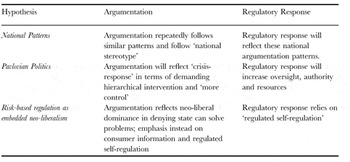
H1 (the national pattern): The comparative perspective reveals different national-cultural biases towards the regulation of food safety at times of crisis.
In contrast, approaches that predict ad hoc ‘knee jerk’ or Pavlovian responses to policy problems discount the importance of national institutions and suggest that when under pressure, politicians – regardless of time and place – will turn to similar (hierarchical, top down) measures to please anxious publics (Hood and Lodge Reference Hood and Lodge2005). According to Stephen Breyer (Reference Breyer1993), risk and regulation are engaged in a ‘vicious circle’ in which demanding publics are met by regulation-eager politicians and regulators that want to go the ‘final mile’ to achieve 100 per cent certainty. What remains are regulatory tombstones that impose inappropriate costs on involved parties while public attention shifts to the next risk. Related, the term ‘Pavlovian response’ captures a style of politico-administrative behaviour that exhibits patterns similar to those found by psychologist Ivan Pavlov: he found that dogs could be conditioned to behave in particular ways when stimulated by a particular set of circumstances. Politics, risk and crisis represent an analogous set of circumstances – whereas dogs salivate at the sound of the bell (conditioned in believing that the sound of the bell means food), politicians legislate as equivalent to salivation; food scandals represent the bell and the expectation of reduced (or redirected) media pressure is the equivalent of food (Hood and Lodge Reference Hood and Lodge2005: 142–3). In other words, we should expect all three countries and their scandals to display hierarchical demands for regulatory action followed by a supply of a hierarchical regulatory response.
H2 (Pavlovian politics): At times of crisis, demands for hierarchy dominate and lead to the adoption of hierarchical regulatory measures.
Others emphasise international policy trends that reflect wider secular trends. Risk-based regulation is said to have emerged as part of a wider hegemony of neo-liberal ideas underlying the regulatory state (Majone Reference Majone1994, Reference Majone1997; Power Reference Power2007). Governments move, as an extension of the more formalised and specialised institutional control machinery of the regulatory state, towards a growing reliance, as a regulatory strategy, on organisational risk management: private organisations are to control risks with regulatory bodies assessing the reliability and robustness of these processes of self-control (Black Reference Black2005). In the area of food safety and risk regulation (especially post-BSE), the idea of ‘risk-based regulation’ has been particularly prominent and this move is said to have been part of a wider paradigm change in the way states relate to individual consumers in the area of risk (Power Reference Power2007). Risk-based regulation has been interpreted to be an important aspect of wider public and private organisational trends towards ‘risk management’ and an expression of a move towards individualist understandings of risk. The management of risk is pushed into organisations through the adoption of managerial and regulatory frameworks, thereby causing uncertain effects. Furthermore, risk-based regulation makes the individual responsible for their conduct, it therefore implies a greater reliance on ‘transparency’ and ‘informed consent’ when it comes to the consumption of products. As Power (Reference Power2007: 23) suggests: ‘we are all exhorted to become our own risk manager in areas of lifestyle, of financial security, of emotional commitment’. In this market-based society, customers are to make informed choices, rather than be prevented from engaging in harmful behaviour. The idea of an increased emphasis on market-type arguments and individualism appears particularly appropriate for the domain of food with its great emphasis on demanding transparency regarding the production chain from ‘field to fork’.
If risk-based regulation is therefore an expression of a greater individualism in the regulation of markets and risk (Power Reference Power2007), then we would expect a dominance of individualism (and the hybrid hierarchy-individualism, given the emphasis on enforced self-regulation) among the argumentation concerning how to control food safety across our three episodes. Similar regulatory responses should be noticeable across the three countries, namely one that emphasises primarily individualism and one that emphasises the importance of enforced self-regulation.Footnote 2
H3 (neoliberalism): The age of risk-based regulation is characterised by a continued dominance of individualist and hierarchy-individualist claims that also strengthens existing moves towards risk-based regulation.
Table 1 summarises the above discussion. The next section explores the methodology that allow for a comparison between direction of argumentation and the regulatory response's content, based on grid-group cultural theory.
Overview

As noted, food safety has become a domain in which risk-based regulation has become of central importance, both in the US and across the EU. In the case of the EU, the food hygiene packages of the early 2000s, passed in the wake of the BSE scandals, informed wider changes in national regulatory approaches towards food safety (see 882/2004/EU and 178/2002/EU in particular). It has been at the heart of the ‘hazard-based’ approach in the US, especially in food, where there has been a move from a traditional ‘sniff and poke’ inspection style. Similarly, in the European Union, risk-based regulation has become the prescribed approach in the area of food safety. In the UK, risk-based regulation has spread across regulatory regimes from food to health and safety and to finance.
National developments related to changes towards the so-called HACCP (Hazard Analysis and Critical Control Points) approach in international food safety. HACCP is a management-based regulatory strategy (Coglianese and Lazar Reference Coglianese and Lazer2003) that seeks to assess food safety in terms of individual potential hazards and ‘critical points’ through which such hazards can be mitigated. HACCP points to the limitations of traditional regulatory inspection regimes, whether it is the ‘end of pipe’ environmental inspection style or the ‘sniff and poke’ meat inspection style that is seen as irrelevant given contemporary understandings of the complexities of food safety and potential sources of contamination (Andersen et al. Reference Andersen, Hald, Nielsen, Sporon Fiedler and Noerrung2007). The internationalisation of food production further increased the pressure on regulatory approaches. On the one hand, internationalisation and specialisation along the food production chain caused substantial problems in terms of traceability. On the other hand, following the BSE scandals, consumers were said to be increasingly sceptical and distrustful not only against food safety in general, but also regulatory activity in particular (Ansell and Vogel Reference Ansell and Vogel2006; Lodge and Wegrich Reference Lodge and Wegrich2011).
Food scandals in the US, Denmark and Germany are well suited to assess comparatively claims regarding risk and public policy. Whereas in the Danish and German cases, the dynamics of argumentation regarding appropriate regulatory responses in the case of meat inspections are explored, in the case of the United States attention turns to the cases of contaminated spinach, tomatoes and peanuts. This has been a largely event-driven case selection, as all of these events have been regarded as major in the past few years and have been used to fundamentally question the regulatory regimes in operation – especially the peanut case was utilised by the Obama administration to justify a revision of the existing regime in US food safety.
Method
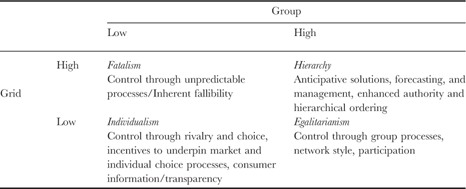
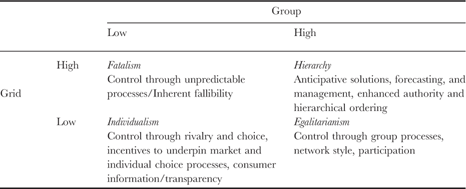
To investigate the above hypotheses in the context of public argumentation in the print media and in terms of actual regulatory responses, a methodology was derived from grid-group cultural theory (Douglas Reference Douglas1992; Dake Reference Dake1991; Hoppe Reference Hoppe2007; Sjöberg Reference Sjöberg1998, for this variant of cultural theory, see Thompson et al Reference Thompson, Ellis and Wildavky1990; Thompson et al. Reference Thompson, Verweij and Ellis2006; 6 Reference 6 2004; Verweij et al. Reference Verweij, Douglas, Ellis, Engel, Hendricks, Lohmann, Ney, Rayner and Thompson2006; Lodge et al. Reference Lodge, Wegrich and McElroy2010).Footnote 3 Cultural theory has attracted considerable interest in the study of regulatory tools (see Hood Reference Hood1996, Reference Hood1998; Hood et al. Reference Hood, Scott, James, Jones and Travers1999; Hood et al. Reference Hood, James, Peters and Scott2004). It focuses on fundamentally different understandings about the nature of the world and underlying cause-effect relations and points to the diagnosis and advocacy of different policy problems and solutions. Exploring the extent to which arguments and regulatory responses reflect particular worldviews (i.e. individualism, egalitarianism, hierarchy, fatalism) offers an ideal way to ‘audit’ (Swedlow Reference Swedlow2002: 273–5) and explore dominant biases: it offers a theoretically-grounded tool that provides for sufficient diversity to assess the different claims set out in the previous section. Table 2 summarises the key regulatory claims that are associated with distinct cultural worldviews in the well-known 2 × 2 tables developed in Hood et al. (Reference Hood, Scott, James, Jones and Travers1999, Reference Hood, Rothstein and Baldwin2001, Reference Hood, James, Peters and Scott2004).
Overview of Cultural Theory and Regulatory Argumentation & Responses
The media coverage of the various food safety scandals was analysed. Claims that demanded particular types of regulatory action were extracted and coded according to their cultural bias, thus the database includes claims (e.g. ‘the problem is the lack of enforcement powers’), the person making the claim (e.g. ‘John Smith, Green Party’), date, and the source have been recorded (see, Simon and Xenos Reference Simon and Xenos2000; Chong and Druckman Reference Chong and Druckman2007; deVreese and Semetko Reference deVreese and Semetko2001). This allows for a comparison of individual and organisational arguments (or ‘frames’) over time, and a comparison between news sources.
The newspaper articles were taken from Nexis news. In the German case, 508 claims were investigated over the period 2001–7 (the below concentrates on a subset in order to concentrate on key periods under consideration), in the US case, 406 claims and in the Danish case 261 claims. For the German case, the analysis was able to rely on a broad selection of nationally significant newspapers and magazines (apart from the Frankfurter Allgemeine Zeitung), thereby enhancing confidence that the study was able to capture most of the expressed opinions of actors across the political and interest group spectrum. The Danish case was restricted to Politiken and Boersen (due to availability). In the US case, problems of syndication and regionalisation require some difficult choices. The analysis concentrates on three nationally significant newspapers (Washington Post, New York Times, US Today) and, to enhance coverage, three regional newspapers in the affected areas (Houston Chronicle, Bradenton Herald and the Monterey County Herald).
Coding is inherently problematic and is open to biases on many dimensions. First, bias occurs by looking at the media alone – which in itself may be regarded as representing dominant views. However, the spread of the sample (especially in the US and Germany), the fact that all these events were perceived to represent an evocative moment that disrupted sub-domains and support for this judgement derived by background interviews, increases confidence that this source of potentially systematic bias has been largely controlled for.Footnote 4 Indeed, the database does not reveal any particular linkage between particular media source and dominance of particular actors or claims (apart from the US local papers that give particular coverage to local affected actors). Second, the media may just be interested in ‘outrage’ and not display views that show reluctance to react to problems. While such a pattern is possible, the collected views display a more differentiated pattern. The media is an important stage for arguments to appeal for support, therefore it is a meaningful site to explore argumentation patterns and to investigate the extent to which there is a linkage between direction of argumentation in the media and regulatory content. Third, bias occurs in the reading and extraction of claims, third, bias occurs in the coding and third, bias occurs in the interpretation of the results. To mitigate the problem of bias, the ‘four eye’ principle was utilised in coding claims, first ‘double-blind’ and then, at the second stage, through a process of mutual adjustment via discussion.
In terms of coding, claims were linked to hierarchy when these implied the potential improvement of controls via enhanced authority, more resources and tougher sanctions (i.e. a high grid/high group response). Claims were associated with fatalism when these either advocated elements of surprise and unpredictability as effective means of control or suggested an impossibility of controlling capitalist food processing and production, given also scientific uncertainty (high grid/low group response). Claims defined as representing individualism advocate market-related processes that enhance individual choice or the autonomy of market participants (such as self-regulation) (a low grid/low group response), while claims linked to egalitarianism point to demands for mutuality and professional norms as well as ‘network-based’ governance arrangements (a low grid/high group response). Hybrids were identified when a single statement included two claims from different worldviews.
As the Appendix suggests, the classification scheme largely follows the framework established by Christopher Hood (see Hood Reference Hood1998; Hood et al. Reference Hood, Scott, James, Jones and Travers1999, Reference Hood, James, Peters and Scott2004), although with some differences. For example, demands for incentivising whistleblowers were classified as a fatalist response rather than as an egalitarian one (a choice which was supported by background interviews). Calls for transparency when related to enhanced product information provisions were labelled as individualist, although, of course, transparency as a word also is often used by egalitarian advocates. The coding frame emerged as a result of Hood's framework and was initially adjusted inductively during the analysis of the German case study (Lodge et al. Reference Lodge, Wegrich and McElroy2010). The coding frame was open to include further categories or to allow for modification in coding should the other two national cases reveal claims that did not fit the existing frame, but this was not required. In itself, this finding raises interesting questions regarding grid-group cultural theory, especially the status of hybrids, but these are outside the scope of this article.
The National Cases Introduced
All three countries witnessed substantial crises in food safety regulation between 2005 and 2009. In the US case of e.coli-contaminated spinach, five people died with far more than hundred people become seriously ill, in the case of the ‘hot peppers’ two deaths were suspected and 266 were hospitalised, while in the case of the salmonella-contaminated peanuts, 8 people died and 666 illnesses were reported (across 45 states; more than half of them being children). In the Danish cases, the Norovirus affecting imported raspberries killed five and caused serious illness among over 1000 people. In contrast, nobody seem to have died in Germany. Denmark is the one case that directly involved a ministerial resignation, whereas in the other cases, neither politicians nor officials seem to have suffered a similar fate. And the German case provides the one example of a more immediate legislative response to public pressure than the other two cases, whereas the regulatory response package remained stuck within the legislative process in the US (at the time of writing).
Turning to the individual cases, the German Gammelfleisch scandal emerged in the context of earlier scandals, in particular one involving the sale of K3 labelled meat as ‘fresh produce’ in late 2005.Footnote 5 The actual Gammelfleisch scandal was triggered by an anonymous call by a mushroom picker who had discovered incriminating documents in a forest in late August. Subsequently, the police discovered significant amount of putrid meat in a Munich storage facilities that previous inspections had failed to notice. It was revealed that the company had delivered its meat across Germany and Europe, especially to kebab houses. Further raids across Germany revealed that the Bavarian incident was hardly a one-off. Regarding political conflict, the then federal minister for agriculture, Horst Seehofer, criticised in particular the lack of enforcement and proper implementation at the Land level, whereas the Land governments rejected the idea that greater co-ordination with federal government involvement would greatly facilitate control quality. One week after the initial discovery, an intergovernmental meeting agreed on a 13 point framework programme for a revised inspection regime. This was to facilitate a better cross-Land understanding of quality management, better information sharing and to advance the understanding of principles of risk-based regulation. In March 2007, the federal government passed legislation to enhance consumer information rights, thereby granting citizens the right to enquire about results of inspections. In late 2007, the Land governments agreed to a revised edition of the AVV Rüb, a directive that had initially been introduced in 2004 to allow for the implementation of EU provisions. Previously no such procedural device had existed in the food safety domain. This directive strengthened further the emphasis placed on risk-based regulation at the Land level, introduced the idea of a federal-wide risk classification scheme, while other ideas, such as rotation and the four-eyes principle were also advocated. In many ways, these ideas reflected long-standing ideas within the food safety domain.
In the case of contaminated spinach in the US, the problem was revealed after a number of e.coli infected patients had required medical help. The spinach-related crisis emerged in the context of a series of e.coli outbreaks in food (21 since 1995) that had caused seven fatalities and led to over 1000 seriously ill people. Overall, at least three people, elderly or young children, died in this incident with nearly 150 people falling ill between August and late September 2006. Packed salad bags from Salinas Valley in California that produced most spinach for the US market were subsequently established as the source of the e.coli outbreak.Footnote 6 The Food and Drug Administration advised against the purchase of packed spinach in mid-September (lifted in October) and, in March 2007, issued voluntary guidelines (it was argued that the FDA had not issued regulations since 2001).
Investigations as to the source of the e.coli outbreak remained inconclusive, with some attributing the contamination to the closeness of cattle, others held free-roaming deer and boar responsible, while others blamed lacking water supply or human sources of contamination. In terms of regulatory issues, the industry argued that to regain trust, the regulatory regime needed to move from a regime that relied on rare inspections, to one of voluntary self-certification that was endorsed by state or federal regulators. Californian opposition politicians, but also some federal (Democrat) politicians called for greater mandatory powers over the leafy green industry, arguing also that the regime should be brought in line with the safety regime for meat, that not only was administered much more resource-intensively by the US Department of Agriculture (a regime in place since 1906), but that also had shown improvement (despite regular recalls) in terms of overall safety record after a more punitive approach had been adopted following the cases of contaminated Hamburgers in the early 1990s (‘Jack in the Box’-scandal). The fresh produce industry was accused of having paid insufficient attention to a long-standing and recurring problem.
The FDA and the industry argued that existing mandatory powers were sufficient, that the regulatory regime was working well, and that any response should wait until the ‘science of e.coli’ was better understood. Federal government politicians appear not to have been involved in these debates, although there were clear divisions between former FDA officials suggesting that the reduction in resources and the fragmentation of regulatory authority were to blame for a decreasing safety record of the fresh produce food industry, whereas current officials suggested that a risk-based regulatory approach relying on self-regulation by industry was likely to provide for a rational regulatory regime. By 2008, a ‘mandated’ self-certification regime existed for Californian growers, the Leafy Green Agreement, which was based on voluntary membership, and established certain standards on its members. Critics suggested that these standards largely benefited large rather than small produces, caused environmental damage and hardly provided for an improvement in terms of regulatory standard.
The spinach case was followed, in 2008, by the FDA's call to stop consuming tomatoes that were suspected to have been contaminated by salmonella after illnesses were reported. This case was regarded as the largest food-borne outbreak of salmonella over the previous ten years. After no ‘smoking tomato’ was being found and people continued to fall ill despite the ban on tomatoes, attention shifted to imported food from Mexico, in particular hot (chilli) peppers (jalapeños). Attention not just focused on problems with the tracing system (captured at an earlier time by the powerful tomato industry)Footnote 7, but also on the FDA's apparent surprise by the fact that 90 per cent of tomatoes were repacked during various processing stages, thereby strengthening opponents of the FDA (especially in its incarnation during the Bush administration). These criticisms were put forward by the same actors as during the spinach episode.
The peanut case of 2008/9 involved the ‘Peanut Corporation of America’ (a family owned company) in particular that had operated at the ‘low end’ of the peanut market. Salmonella was found in a peanut processing plant and the firm later went into administration. This particular case revealed the widespread and complex distribution of peanuts across the US food-chain, especially as the contamination affected peanut paste. In addition, the case revealed one plant (in Plainville, Texas) that had not been licensed and therefore had gone uninspected, whereas in the case of a further plant in Georgia, FDA inspectors later found dead rats, rat faeces, and bird feathers in the plant's air filtration system. This plant had been inspected by state inspectors (from the Georgia Department of Agriculture that acted on behalf of the FDA). In addition, this case provided insights into the problematic nature of ‘private audits’ of plant safety regimes, namely that the firm ‘gamed’ the system and that the results were not being made public. Advocates of legislative change highlighted that the FDA was required to use antiterrorist legislation to achieve the release of the firm's records.
In the Danish case, the trigger of the 2006 meat scandal was a radio programme that revealed that one particular firm ‘Thuin Koed Engros’ had sold more than three tons of putrid meat to diverse hotels and restaurants. Later inspections revealed the presence of nearly five tons of putrid meat in the storage facilities of that firm. This followed an earlier incident involving Norovirus-contaminated raspberries that occurred during the period May-September 2005. The agency was criticised for its responses to prevent further distribution of the contaminated raspberries in 2005 and the failure to carry out the inspection programme specified in the performance contract with the ministry (in the gammel koed episode). Following earlier criticisms that the agency not only had failed to send clear instructions to the raspberry importer but had also failed to appropriately engage with the EU-wide rapid alert system. At that point, the minister avoided public criticism. However, during the gammel koed episode, the minister was attacked for limited attention and supervision of the agencies’ action, in particular in the face of an apparent breach of the performance agreement (Resultatkontrakt) between the ministry and the agency as well as audit reports pointing out these problems. Under the pressure of a populist right wing opposition party demanding more control and blaming the minister, a blame game between the agency and the minister ensured. The subsequent public and political debate was focused on accountability for control failures rather than on regulatory or organisational responses to this failure. The minister was accused of inaction and cutting the agency's resources. Two investigations, one by a parliamentary committee, the other by the audit office, suggested that the agency had failed to fulfil its inspection requirements (couched in broad terms in the Resultatkontrakt), but also voiced criticisms regarding the minister's oversight activities. As a result, the minister resigned in mid-December 2006.
In all three cases, therefore, risk-based regulation was at the centre of concerns regarding food safety. In the German case, the regulatory response was to advance principles of risk-based regulation and for some, scandals such as Gammelfleisch, were a result of a regime in transition (therefore, there was a strengthening of regulation in ‘hierarchy-individualist’ direction). In the case of the US, the FDA initially highlighted the importance of a response informed by risk-based regulation and regulated self-regulation before the debate turned on the fragmented nature of the regulatory regime and the need to strengthen mandatory powers in the light of the failure of the private audit of self-regulation in the peanut case (with the regulatory proposals turning hierarchical). In Denmark, the regime of risk-based regulation, organised through an agencified arrangement, came under pressure largely for political reasons, leading to a reverse of earlier regulatory positions (and therefore moving in hierarchical direction).
Argumentation and Regulatory Responses
This section returns to the analysis of the three hypotheses set out earlier. First, this section considers argumentation patterns and explores the extent to which these patterns indicate agreement with any of the three hypotheses, then the discussion moves to regulatory responses.
Argumentation
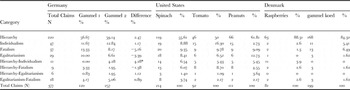
Table 3 provides for a descriptive statistical overview of the overall argumentation patterns across the different food scandals in the three states.
Comparing Argumentation Patterns

H1 The comparative perspective reveals different national-cultural biases towards the regulation of food safety at times of crisis.
Based on national stereotype, it was argued earlier that the following should be expected: a particularly hierarchical argumentation pattern in the German case, an individualist argumentation pattern in the US case, and an egalitarian argumentation pattern in the Danish case.Footnote 8 Maybe the Danish case is unrepresentative as it concentrated primarily on minister-agency relations. However, the administrative arrangements as well as the overall argumentation pattern did not comply at all with expectations regarding the Danish national stereotype. Hierarchy dominates throughout the raspberry and putrid meat incidents.
The German case appears to follow (hierarchy-dominated) stereotype, although the underlying move towards individualist and hierarchical-individualist arguments is surprising as German public administration is said to be characterised by ‘mutuality’ and co-operative relationships, vertically within government, and between regulators and the regulated (Fachbruderschaften). In addition, interviewees claimed that the Gammelfleisch case provided for a very good example of typical German blame-shifting patterns, the federal level blaming insufficient implementation by the Länder, whereas the Länder blamed the federal level for insufficient legislative instruments. However, when looking at two actors, namely the then federal and the Bavarian agricultural ministers (Seehofer and Schnappauf respectively), then these two actors do not seem to have engaged in blame shifting exclusively.Footnote 9
The overall argumentation pattern in the US, with its clear dominance of hierarchy across the three episodes, does not follow the (contested) stereotype of predominant individualism. Egalitarian arguments became more prominent (although not statistically significant), namely the requirement for a higher degree of professional values in the conduct of inspections. The ‘individualism’ that played a significant role in argumentation in the ‘tomato’-case primarily was largely about avoiding domestic regulation and shifting responsibility to the traceability of ‘imports’.
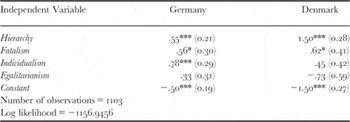
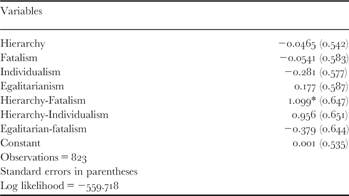
This message is also supported when looking at the national patterns more analytically. Using a multinomial logit, Table 4 points to the differences across countries (using the US as a baseline). This particular analysis features the four main worldviews only, as the number of hybrid claims in the Danish case is very small.Footnote 10 The analysis suggests that Denmark is not more egalitarian than the US (instead, it is more hierarchical) and Germany is both more individualist and hierarchist than the US in its argumentation patterns. In other words, there is no support for the stereotypes expected under the national pattern claim.
Multinomial Logit: Comparing National Argumentation Patterns

*** p < 0.01, * p < 0.1.
US is the base outcome.
An inclusion of hybrids, and then focusing on the US and Germany only (as Denmark has too few hybrid claims), similarly does not support the claim that distinct national styles matter. Table 5 provides the analysis, using a regular logit model. Here statistical significance disappears.
Logit Analysis: comparing US and German argumentation
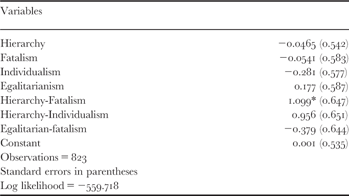
*** p < 0.01, ** p < 0.05, * p < 0.1.
H2 At times of crisis, demands for hierarchy dominate and lead to the adoption of hierarchical regulatory measures
The basis of this claim is that politicians everywhere ‘salivate’ by responding with similar hierarchical regulatory responses under the pressure of the media. As a result, instruments that are said to characterise the age of the regulatory state, namely risk-based regulation, are ignored and their underlying normative assumptions (an individualist understanding of risk) show little embeddedness.
Hierarchy dominates during times of crisis across all episodes and countries, and it does so in a statistically significant way (as represented through Pearson chi-square). The Pavlovian claim holds especially for the Danish case. Here hardly any other type of argument apart from hierarchical seems to have been made. As already noted, while there was considerable criticism of the regulatory regime, this criticism concentrated on the relationship between minister and agency rather than on the underlying principles of risk-based regulation. Nevertheless, the findings of the various enquiries that highlighted the lack of actual enforcement by the agency as well as the lack of ‘self-control’ revealed problems in the implementation of risk-based regulation. However, argumentation in the media seems not to have extended to such issues, but to have concentrated on the problems of ministerial oversight and funding cuts.
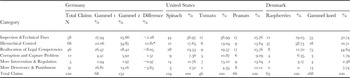
Table 6 allows for a closer look at the hierarchical sub-claims across the three states reveals a more diverse pattern than a mere advocacy of ‘more hierarchy’.
Comparing Hierarchical Subclaims

It is notable that among the hierarchical claims in both Germany and the US, claims advocating either ‘more resources’ or ‘stronger controls’ dominated other arguments, even in the case of Germany where debates regarding the allocation of legal competencies are usually seen as key battleground for blame games. A ‘blame pattern’ was clearly dominant in the case of Denmark (see Table 6) with 44.64 per cent of all claims in the gammel koed episode centring on boundary issues between agency and minister. In the US case, the demand for a more far-reaching approach than the mere strengthening of existing approaches followed revelations regarding the peanut-salmonella incident was noticeable (as seen in the rise of claims relating to ‘more deterrence & punishment’). When considering the actors making these claims, this trend was not related to the changing political landscape.
In short, there is substantial support for the claim that scandals and crisis provoke demands or claims of a hierarchical nature. However, such a claim needs to be qualified in two ways. First, the sub-claims provide for a more diverse pattern that move beyond a simple ‘more hierarchical control’ Pavlovian claim. Second, it is not just argumentation that matters; as is discussed below: when it comes to actual regulatory responses, then political systems did not respond in similar ‘Pavlovian’ or ‘knee jerk’ ways.
H3 The move towards risk-based regulation is characterised by a tendency to emphasise individualist and hierarchy-individualist claims
Across the three cases, there is a clear dominance of hierarchical claims throughout the respective episodes. None of the three countries show clear support for H3. In particular, in Denmark, argumentation is largely based on concerns regarding hierarchical modes of regulation. In other words, the Danish case involves a debate regarding the limitations of risk-based regulation (expressed through hierarchical claims) rather than an affirmation of the supposedly underlying ‘neo-liberal values’ said to be inherent in risk-based regulation, as suggested by Power (Reference Power2007).
In the German case, too, hierarchy dominates throughout the two Gammelfleisch episodes. There is, however, some ground for not dismissing H3 in the case of Germany, because of the (statistically significant) rise of hierarchy-individualist claims over the period under investigation, while ‘individualist’ claims also were ‘second’ in terms of overall claims. A further reason for not dismissing H3 in the case of Germany is the actual regulatory response (discussed below), in particular the AVV Rüb, which reflected an affirmation of risk-based regulation.
In the US cases, there is similarly a clear dominance of hierarchical claims. There is a significant rise of individualist claims in the ‘hot pepper’ case, which is followed by a very sharp decline during the peanuts scandal. This rise of individualist claims during the ‘tomato/jalapeños’ scandal relates to arguments demanding industry to develop better tracing systems themselves: especially in the case of imported fruits and vegetables from Mexico. In the earlier spinach case, these claims related to demands for a voluntary system of ‘regulated self-regulation’. Such individualist and hierarchy-individualist arguments paled into near insignificance when it came to the salmonella-contaminated peanuts. Here market participants were regarded as potentially criminal and willing to undermine attempts at instituting safety through self-auditing systems. Equally, even when looking at the organisation that should be most supportive of risk-based regulation, namely the FDA, there is little to support H3: Apart from the hot pepper case, the FDA makes largely hierarchical arguments regarding the need for tighter controls, while also highlighting the inherent limitations in providing ‘complete’ safety in the light of some ‘black sheep’ in the industry and the complexities of modern food processing.
In short, the dominance of hierarchy across all the three national cases offers only very little support for the strong version of H3, that regards risk-based regulation as representing universal value changes towards individualism. This limited support relates to argumentative patterns in Germany and the subsequent regulatory change, whereas in the US there was a distinct fading away of such themes. In Denmark the debate involved criticism of those values that would be represented if H3 was to be confirmed.
Regulatory responses
This section returns to regulatory content. As noted earlier, Germany embraced further risk-based regulation, Denmark witnessed the resignation of a minister, whereas the response in the US was initially (in the spinach-case) on the basis of an industry agreement. Subsequent legislative proposals were of a more hierarchical nature by strengthening the authority of the FDA, the response was related in particular to the change to the Obama administration.
The Danish case reflects the type of argumentation patterns that were observed earlier, namely the dispute (and blame-shifting) between agency and minister leading to the ministerial scalp ending up on the media spikes. More widely, the changes were those predicted by ‘Pavlovian politics’: the performance agreement between agency and ministry was altered, increasing inspection frequency (without much consideration of risk) and sanctions were raised. Both Germany and the US did not display such patterns. Although the German case points to immediate responses (through federal-intergovernmental framework agreements), the responses largely followed earlier initiatives that focused on expanding the scope of risk-based regulation. The German responses did not follow the administrative stereotype of hierarchy that is mixed with considerable ‘mutuality’ on the ground and within domains. In other words, the German regulatory response supports H3.
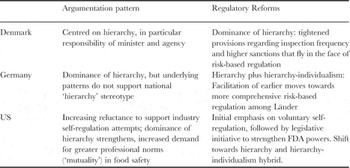
In the US case, the initial response, to rely on regulated self-regulation followed H3. The subsequent package that had passed the US House and had moved to the Senate in summer 2009 provided for substantial ‘hierarchical’ ingredients, namely an increase in inspection rates financed by industry fees; the creation of a register, enhanced powers for the FDA to mandate recalls and to be able to set safety standards, as well as demands to enhance the possibility to trace food along the production chain (Washington Post, 31 July 2009). This legislative move (with Congress delaying its passing throughout 2010) was accompanied by the issuing of guidance provisions to safeguard against the distribution of tainted food (both from the FDA and the US Department of Agriculture that was responsible for meat facilities). The link between tougher ‘intervention’ powers and the issuing of guidance (instead of mandatory regulatory standards) was seen as pointer to future developments in US food safety inspections.Footnote 11Table 7 provides for a summary of this section.
Argumentation and Regulatory Responses

Conclusion
Much has been said about the responsive ways in which governments respond to public concern, especially in the areas of risk. Less has been said about the direction of both policy argumentation and of regulatory response, and whether these are linked, at least in terms of similar direction. This article has utilised a methodology derived from grid-group cultural theory to investigate media argumentation. This method allows for the ‘auditing’ of claims, both at the aggregate and the individual level. Despite the many potential biases that are associated with this method (not uncommon to such exercises), the limitations of focusing on the print media as a site for argumentation, and the small number of ‘snapshot’ cases under consideration, this methodology allows for distinct insights into the plural worldviews that characterise the diagnosis of problems and the advocacy of solutions. The area of food safety may be regarded as a specific domain given that it raises fears and anxieties about personal safety and health. However, such characteristics resemble many other risk regulation areas in which scandal and public anxiety are expressed in calls for ‘more regulation’. Indeed, many argue that therefore instruments need to be devised to prevent such constellations leading to knee-jerk or Pavlovian responses. In this sense, exploring argumentation and regulatory responses in the area of food safety regulation does have wider implications for the study of risk and public policy.
This article considered three often used, but also contested claims, that ‘national styles’ matter, that in crisis, politicians respond in similar hierarchical ways to claims for more hierarchical controls, and that broad paradigms shape policy argumentation and regulatory instrument choice. This article has found no strong support for any one of these three claims in the sense of the direction of argumentation accounting for the content in regulatory responses. Exploring the evolution of the regulatory responses would require a different research lens, one that utilised ‘process-tracing’ and a more institutionalist angle (as provided in the chapters by Ansell & Vogel Reference Ansell and Vogel2006). Such accounts, using different methodologies, could explore alternative accounts that look at different types of ‘responsiveness’ to particular demands, whether this includes accounts stressing the importance of special interests, or those noting how institutions ‘filter’.
In terms of argumentation, all three states witnessed dominance of hierarchy-related claims (although of diverse nature). Their regulatory responses varied, between those that re-emphasised risk-based regulation (Germany), those that emphasised strengthened regulatory authority (USA) and those that resulted in more intensive and punitive inspections (Denmark). There is some limited support for the suggestion that the biases evident in argumentation patterns went in the same direction as subsequent regulatory responses; but, apart from Denmark, only if one looks at the pattern of non-hierarchy-related claims. Thus, the German argumentation patterns point to a rise in hierarchy-individualist claims over time and the US-case sees a decline in individualist claims (and a further rise in hierarchy). Both of these patterns go in the same direction as subsequent regulatory change.
In contrast to those who argue that risk-based regulation is an expression of an embedded neo-liberal paradigm, this article finds limited support for this particular view. The German case suggested that there was somewhat of a growing support for the type of ideas on which risk-based regulation is based (the rise of hybrid claims based on hierarchy-individualism), but these trends were not very strong. The regulatory response, however, strengthened risk-based regulation. In the US, risk-based regulation and support for its premises allowed for the adoption of a stronger ‘regulation of self-regulation’ regime in the case of spinach. However, following the ‘hot pepper’ and the ‘peanut’ cases, such responses became increasingly under challenge. Combined with a change in President (and a shift away from an explicitly non-regulatory agenda at the apex of FDA), this led to an increased acceptance of arguments demanding hierarchical interventions. The US case therefore offers support to those who oppose static national patterns approaches. In Denmark, risk-regulation appeared as a complete failure, given funding issues and non-compliance by agency and industry alike. In other words, risk-based regulation may have been a cross-national theme, but the way in which national systems ‘digested’ crises varied considerably.
In conclusion, this article has developed a methodological angle on dominant debates regarding policy and risk that have dominated the literature. By developing a lens that captures the contestation between different worldviews regarding policy problems and solutions, it allows for a more considered assessment as to the dominance of particular national stereotypes (such as those of ‘adversarial legalism’), universal paradigms (such as ‘neo-liberalism’) or ‘Pavlovian politics’ and their influence on policy change that have been particularly widespread in the literature on policy and risk.
Acknowledgements
I am grateful to Kai Wegrich and Gail McElroy for their comments and generous support, especially with coding.
Appendix: Coding Frame
Hierarchy – command and control
1 – H1: inspection and technical fixes in control/oversight (include early warning system, more resources)
2 – H2: assertion of hierarchical control, hierarchical oversight (task force)/critique of absent hierarchical control
3 – H3: reallocation of legal competencies
4 – H4: corruption and capture
5 – H5: need for more intervention and regulation of the market
6 – H6: need for more deterrence and punishment
Fatalism – control through unpredictable processes
7 – F1: whistleblower
8 – F2: rotation
9 – F3: unannounced inspections
10 – F4: impossible job
11 – F5: powerlessness of individual consumer
12 – F6: problem mafia-type organization
Individualism – control through rivalry and choice
13 – I1: consumer/product transparency
14 – I2: naming and shaming
15 – I3: self-regulation by firms themselves
16 – I4: no intervention in markets/price signal
17 – I5: product recall
18 – I6: non-state actor controls
Egalitarianism – control through group processes
19 – E1: professional norms
20 – E2: local and decentralized economy
21 – E3: mutual information exchange
22 – E4: markets encourage cheating/dangers of naming and shaming strategy
Hierarchy and Fatalism
23 – H&F1 unannounced oversight/inspections
24 – H&F2 inevitable black sheep but overall system ok
Hierarchy & Individualism
25 – H&I1: increase in inspections financed by industry
26 – H&I2: regulated self-regulation
27 – H&I3: increase relational distance
28 – H&I4: penalties and transparency
Hierarchy & Egalitarianism
29 – H&E1: localized inspections
30 – H&E2: persuasion as enforcement strategy
31 – H&E3: distaste for individual punishment
32 – H&E4: controls revealed inherent problem
Egalitarianism & Fatalism
33 – E&F1: price competition among supermarkets
34 – E&F2: lack of professionalism in the field inevitable
35 – E&F3: big industry will never display professional norms