


1. Introduction
Morphology as a component of grammar has often found itself in an uncomfortable position. In many models of grammar, morphology is situated between syntax and phonology, and often leans toward either of these domains. Within structuralist morphology, two basic approaches for description at the morphological level were identified, called item and arrangement and item and process by Hockett (Reference Hockett1954).Footnote 1 Both ap-proaches have been explored and compared in subsequent theoretical and empirical work. In classical generative grammar as outlined by Chomsky (Reference Chomsky1965) and Chomsky & Halle (Reference Chomsky and Halle1968), the choice and the order of morphemes is determined by syntax, while the formal spell-out of these morphemes is part of phonology. Thus, while in structuralist conceptions of grammar phonology, morphology, and syntax constitute three basic separate levels relevant for the description of language, each with their own units and principles, other models propose different assignments of morphology, up to the extent in which morphology as a distinct part of grammar completely disintegrates. Some theories of morphology, in other words, often address a more abstract level, one in which relevant units, morphemes, are combined in a way analogous to the model provided by syntax—phrase structures, corresponding rules, and their categories are the main ingredients of such a model. In other theories, word forms are described at the level of morphophonological alter-nations, and morphology is basically concerned with the relations between words.
The basic idea of the present paper is that, first, both of these approaches capture important generalizations valid for morphological objects, so that these need to be described on both levels. The second claim is that morphological phenomena regarded as marginal are of particular importance in the study of the relation between these two morphological levels. Morphological objects (in short: words) are con-sidered marginal exactly if the structures assumed on the two levels defined, morphosyntax and morphophonology, are not isomorphic, or not even close to isomorphic.
Several examples, all taken from the derivational morphology of present-day German, are used below to illustrate and exemplify these two proposals. Investigating a set of relevant cases from one reasonably well studied language, instead of sampling a few isolated cases from diverse languages, may help avoid the impression that the problem is marginal in the sense of being irrelevant. In particular, sections 4–8 treat synthetic compounds (doppelbödig ‘double floored’), conversion (dampfen/Dampf ‘steam, v./steam, n.’), linking elements (so-called “Fugenmorpheme,” as in Kinderwagen ‘baby carriage’), truncations or “i-Bildungen” (Student/ Studi ‘student’), and finally circumfixation (Ge-renn-e ‘running around, n.’). These are prototypical examples of what were called “ill-behaved morphs” by Anderson (1992:51), and the following is an inquiry into the nature of their ill-behaved manner. The types of so-called marginal morphology discussed here are in fact close to Anderson's list of problematic cases for morpheme-based morphology.
2. A Two-Level Model of Morphology
As outlined in section 1, morphology is often construed either as an abstract syntax of morphemes and similar units or as a more concrete spell-out of word forms. Taking up the claim that there is room for both of these approaches, this section now identifies some core properties of these different levels of morphology.Footnote 2
2.1. The Syntax of Morphology
The abstract and morpheme-based approach to morphology is most directly represented in theories of word syntax as developed and exem-plified in the work by, for example, Selkirk (Reference Selkirk1982) and di Sciullo & Williams (Reference di Sciullo and Williams1987), as well as Höhle (Reference Höhle1982) and Olsen (Reference Olsen1986) for German. In such theories, the properties listed in 1 are typically taken as crucial for morphology and are explored further in the focus of analyses.
(1) Word-syntactic properties
• head-modifier relations
• phrase-structural hierarchies
• abstract morphemes
• categorial constraints
• relevance for semantic interpretation
The syntagmatic/structural relations addressed in 1 are usually expressed in terms of phrase-structure trees, analogous (or even identical) to those in phrasal syntax, with morphemes and their categorial specifications as terminal elements. Furthermore, the head-modifier and hierarchical relations are usually stated between morphemes and their higher-order combinations. That is, the model is one of the item-and-arrangement type. The categories and constraints referred to are usually those of part-of-speech, and the resulting analyses are of the sort illustrated in 2, using a complex word that allows for two different structural interpretations based on an identical string of morphemes. Under one structural analysis, the word umweltfreundlich can be paraphrased as ‘friendly to the environment’ (2a), but there is a second potential interpretation of this adjective: ‘pertaining to a friend of the environment’, in which the word-syntactic structure would treat the affix as sister to the base Umweltfreund ‘friend of the environment’ (2b). Such structural ambiguities for a given string of morphemes are exactly those which can easily be expressed in a word-syntactic analysis. Heads of constituents are repre-sented by double lines in 2, following a notation further explained in section 3 below.Footnote 3
(2) Two morphological analyses
a. ‘friendly to the environment’

b. ‘pertaining to a friend of the environment’

The general approach to morphology in such analyses includes an em-phasis on the literal meaning, the compositionality, and abstractness of morphological objects. It is also obvious that the properties listed in 1 receive a straightforward treatment in structural descriptions of this type. The productivity of such derivational and compositional word formation in German, the existence of constraints in terms of structural properties such as word classes, and the straightforward representation of structural ambiguity by means of different structures provide the major arguments for analyses of this type. For compounding at least, the phrase structure approach admits the possibility of recursion and unlimited combination, properties that exist, in principle at least, for German compounds. The type of analysis and structure exemplified here is called “morpho-syntactic” in the following, in spite of any other usages connected to this term.
A more sophisticated variant of a morphosyntactic approach is repre-sented by Distributed Morphology (see Halle & Marantz Reference Halle, Marantz, Hale and Keyser1993 or Embick & Noyer Reference Embick and Noyer2001), in which word-syntactic structures are formed by the principles of syntax, with terminal elements being supplied at a later stage by a vocabulary of roots and of highly underspecified non-root morphemes. Distributed Morphology is briefly discussed in relation to the present approach in section 9.
2.2. The Phonology of Morphology
The first view outlined in the previous section can also be characterized as treating “morphemes as things.” The alternative is to treat “mor-phemes as rules” (both terms taken from Spencer Reference Spencer1991:12–20). There is a different side to morphology, which is not adequately captured in word-syntactic analyses and leads to lexeme-based approaches such as those by Aronoff (Reference Aronoff1976), Anderson (Reference Anderson1992), and Haspelmath (Reference Haspelmath2002) (for German, see also Becker Reference Becker1990, Neef Reference Neef1996b, 1998). These approaches, though differing considerably from each other in detail, look at words as items with more holistic properties and as items related to each other paradigmatically, not syntagmatically. The focus of analyses within such a framework is on morphological properties such as those listed in 3.
(3) Morphophonological properties
• concrete morphs, or no morphs at all
• prosodic and other output-oriented constraints
• domains for morphophonological rules
• word-level generalizations
• relations between words
As a case in point, consider the word-based rule stated in 4 for the example used in 1 above, the adjectival derivation in German marked by final -lich. This rule—in the form of a bidirectional implication—avoids any reference to a suffix -lich, and relates the two words bidirectionally. Basically, there is one statement for the formal change (of whatever sort, in this case the addition of a string of phonemes), and a second statement on the associated semantic change:Footnote 4
(4) Rule for adjectival -lich in word-based morphology

In this treatment, freund is not a constituent part of freundlich, and not even a morpheme (though perhaps a stem). The rule only states that the noun in question enters into the relation specified here with another word that ends in a string consisting of the segments true for lich. Categories and their hierarchical relation are not completely abandoned, but usually restricted to the surface categories of the word and its stem, largely following (Aronoff Reference Aronoff1994). The analyses I develop below follow the format of this proposal. Note, however, that most specific proposals for word-based morphology are explicitly designed for patterns of inflectional, paradigmatic morphology (see Aronoff Reference Aronoff1994, Stump Reference Stump2001, and Blevins Reference Blevins2006 for recent proposals).
2.3. Interfaces in Morphology
The basic claim of the present paper is that both approaches sketched above are partially right; that is, there is room for both. In order to sub-stantiate this claim it is necessary to develop three points: first, to present evidence for both types of representations and, second, to show that they are crucially distinct from each other. Third, it is important to at least sketch the relationship between the two types of representations.Footnote 5
Note that phrase structures as in 1 and word-level descriptions as in 4 both specify the relative position of units such as -lich, namely to the right of its base. In other words, the linear order of elements is encoded in both types of structures. The question is whether this redundancy should be eliminated. Given that the word-based rule is focused more on the form of linguistic items, it makes sense to propose that linear order is actually not part of the information encoded in word-syntactic structures. In the following, structures such as that given in 1 are supposed to be un-ordered in terms of the temporal dimension.
This view gives a new interpretation for the well-known generaliz-ation on the position of morphological heads. Heads, singled out in 1 by double lines, are regularly placed on the right side of the construction they belong to in Germanic languages (see Williams Reference Williams1981 and Spencer Reference Spencer1991 for discussion, among many others). But if such structures are atemporal, the rule stating that each head is placed on the right of its sister node must come from elsewhere. An obvious candidate is the morphophonological structure as postulated above. The generalization expressed in the Righthand Head Rule (5) correlates two concepts, head status and righthand order. It can thus be formulated as a rule regulating the relation between the head element of morphosyntax and the righthand member of a binary structure in morphophonology.
(5) Righthand Head Rule
The word-syntactic head is realized as the righthand element of the morphophonological structure.
In section 3 below, I take such rules as an instance of an interface rule in the sense proposed by Jackendoff (2002:6). In other words, the head property is a crucial element of the word-syntactic structure, and the left-to-right (more precisely: temporal) order is a crucial element of the morphophonological structure. If the morphophonological item corre-sponding to this head is placed to the right of its sister element (as required by 5), the item obeys this interface rule and is well formed (at least in this respect).
The distinction between the two types of morphological structure postulated above is easily overlooked, simply because the two often coincide to a large extent or even completely. However, as we proceed into the topics of the following section, it will become obvious that the two types of structures are not generally isomorphic. One question in morphological debates seems to be which of several structural descriptions should be regarded as the correct one. The present paper argues that they may both be correct to some extent, in that each of them captures important generalizations. In the following, a few central cases, all taken from the morphology of present-day German, are discussed, sometimes rather briefly. It is not my intention in the present paper to give in-depth analyses of the different morphological patterns, but rather to focus on the mismatch between the two types of structures sketched above.
3. A Parallel Model of Grammar
In order to follow the program outlined above, it is necessary to use a grammatical framework that is encompassing enough and flexible, but still restrictive. For reasons to become clear below, the framework to be used will be the parallel model of grammar proposed in recent years by Jackendoff (Reference Jackendoff2002). Introducing this model, Jackendoff first focuses attention on a number of representations on distinct levels, in particular, the levels of phonology, syntax, and semantics. For the simple sentence The little star's beside a big star, these representations are as in 6. Note that linguistic units corresponding to each other in the three structures are co-indexed by subscript letters (a–j) between units of phonology and syntax, and by subscript numbers (1–13) between units of syntax and semantics. Comparison of these units co-indexed across structures reveals that they are not isomorphic. For example, the auxiliary verb (subcript f) is a clitic within the coda of a syllable in 6a, while it constitutes the head V of the verb phrase in 6b, and even serves as the top-level predicate in 6c. Further details and assumptions implemented in this three-level description are not relevant here. I also leave out a fourth type of structure proposed by Jackendoff, the non-linguistic representation of spatial relations, probably as part of cognitive short-term memory.
(6) Levels of representations in Parallel Grammar (Jackendoff Reference Jackendoff2002:6)
a. Phonological Structure
b. Syntactic structure
c. Semantic/conceptual structure
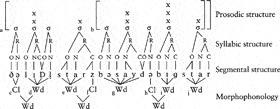
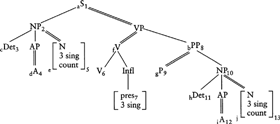

Most ingredients of 6 are rather uncontroversial or, if not, are not crucial for present considerations. What is crucial, however, is the over-all architecture of the grammar, the parallel grammar formalism: the relation between the structures on the three levels postulated is not derivational, but one of equal weight and parallel status. Representations are assumed to co-exist, and the over-all grammaticality of a linguistic expression is regulated by formation rules for each type of structure plus so-called interface rules stating the preferred correspondence between elements in all the different structural representations. (For a first example of a preference rule, see the Righthand Head Rule in 5 above.) Co-existing representations of the type illustrated in 6 are given in 7 together with an indication of rules referring to bilateral restrictions assumed to hold between these structures (the interface rules).
(7) Architecture of grammar and types of grammatical rules
(Jackendoff Reference Jackendoff2002:125)
The feature distinguishing this model of grammar from that of standard generative grammar (to the extent that such a standard model exists at all) is that representations on all grammatical levels have the same status or value; the grammar is not conceived as being, in Jackendoff's termin-ology, “syntactocentric.” Given that there is no derivational relationship between components of grammar, there must be some other mechanism to ensure the cohesion of grammatical components and the over-all wellformedness of linguistic expressions. The interface rules as postu-lated in 7 provide exactly such a mechanism, though content and form of this final type of rules are not worked out extensively by Jackendoff (Reference Jackendoff2002). The few examples provided state preferences between different types of structures (see below). I briefly discuss such interface rules in the analyses (see 8 and 23).
Finally, we note that little room is provided for morphology in this model (but see Jackendoff Reference Jackendoff2002:chapter 6.2 in which a conception to morphology similar to the present one is sketched). The only reference to morphology in the introductory example in 6 is the sub-structure referred to as “morphophonology” in 6a. In the following, this underspecified conception of morphology is expanded considerably.
4. Case Study 1: Synthetic Compounds
There are several classes of words for which vigorous debates have been conducted on the appropriate analysis of their structure. One such class is that of synthetic compounds in German, also known as “Zusammen-bildungen.”Footnote 6 In 8, a number of examples are presented from adjectives and nouns. Compared to simple binary compounds, these compounds have a second part which carries a derivational affix. I refer to the three principal parts of such synthetic compounds with A, B, and C. “A” may itself be complex; “C” is the final derivational affix, that is, adjectival -ig in 8a and nominal -er in 8b.
(8) Synthetic compounds
a. doppelbödig ‘double floored’
zweimotorig ‘twin engined’
unverhältnismäßig ‘disproportionate’
rechtsseitig ‘on the right’
b. Appetithemmer ‘appetite blocker’
Warmduscher ‘wimp’
Muntermacher ‘stimulant’
Heimlichtuer ‘secretive person’
The status of part B is contested: is it primarily combined with A or with C? As noted in the substantial body of literature on such complex words, synthetic compounds are special because the construction [A B C] does not divide into a binary division [[A B] C] or, alternatively, [A [B C]] in an obvious way. The reason is that the complex part [A B] does not exist on its own, and neither does the subpart [B C] in many of the cases. For this reason and others, the structures of such synthetic compounds are a matter of debate, and several competing analyses have been proposed. These analyses usually argue for the correctness of one of the two com-peting structural divisions. Thus, Lieber (Reference Lieber1983) argues for the correctness of [[A B] C], while the structure [A [B C]] is argued for by di Sciullo & Williams (Reference di Sciullo and Williams1987). Similarly, Höhle (1982:98) argues for [[A B] C] for the German cases represented in 8a, and Fleischer & Barz (1995:chapter 2.3.24) for those in 8b, while Leser (1990:56) concludes that the structure (if any) must be [A [B C]].
Basically, the situation just outlined is represented by the much discussed bracketing paradoxes: there are reasons for and against both types of structure. The claim here is, of course, that the bracketing paradox is resolved by admitting that both structural analyses are correct to some extent. They both capture important generalizations, and there-fore need to be represented in the grammar. Thus, the compound Munter-macher is represented appropriately by the two structures given in 9, using the notation introduced above with reference to the concept of parallel grammar proposed by Jackendoff (Reference Jackendoff2002), including a co-indexing of corresponding elements in the two different structures. 9a is motivated by the interpretation of the complex word: agentive or instru-mental nominalization of the -er-type applies to the base as a whole, and the word Muntermacher as a whole normally denotes an instrument of stimulation (such as a substance), while the second part Macher ‘maker’ in isolation normally denotes a person. In contrast, 9b is motivated by the form: the suffix -er subcategorizes for verb stems, and while both munter ‘jolly’ and macher ‘maker’ can occur as free forms, muntermach can not.Footnote 7
(9) Structures of synthetic compound Muntermacher ‘stimulant’
a. morphosyntax
b. morphophonology
Although there are terminal elements in these trees that are in a one-to-one correspondence, the two representations are not isomorphic at all: 9a is left-branching, 9b is right-branching. Furthermore, the stem forms and affix forms are contained as terminal elements in 9b only. Linear order is represented in 9b, but not in 9a. Another way of representing the double face of synthetic compounds would be to erect the two different tree structures over one set of terminal elements, but in two planes of representation. As this does not fully bring out the different properties assumed for the types of structures (the lack of both linear order and of phonological spell-out for the morphosyntactic structure), two com-pletely autonomous representations as in 9 are to be preferred.
The structures in 9 make use of the types of order and/or dominance relations discussed above, and the notation for these is summarized in 10. Recall that co-dominance in 9a is assumed not to imply linear order (representation on a two-dimensional plane forces us to use some left-to-right order). For the sake of convenience, the segmental representation of morphs at the bottom of 9b is purely orthographical, with no attention paid here and in the following to the proper phonological content.
(10) Notational conventions
One remaining question is what the interface rules in the sense intro-duced in 7 might be like. The exemplifications presented by Jackendoff (Reference Jackendoff2002) are basically of two types: preferred correspondences between partial structures (p. 50), and preferred inferences drawn from a particular representation (p. 272f.). The latter one is mostly used for specifying the relation between linguistic and non-linguistic representations, and therefore is of no concern in the present context. As for the former (also instantiated by the Righthand Head Rule in 5 above), a preference rule suitable for present purposes would be to state that an instance of a lexical category is realized as a stem (fulfilled in 9), or that both lexical categories and stems may be complex (branching) while affixes should not be complex. Again this is fulfilled in 9, but not for items corresponding to each other. (More proposals on interface rules are made in 23 below.)
A class of complex words related to synthetic compounds are the backformations (“Rückbildungen”) of German. Verbs such as staub-saugen ‘vacuum-clean’ or notlanden ‘emergency-land’ are generally supposed to be treated as a marked type of morphology based on cor-responding complex nouns bearing an additional affix; Staubsauger ‘vacuum cleaner’ and Notlandung ‘emergency landing’ provide the (syn-chronic or diachronic) input for the verbs not showing the suffixes -er and -ung, respectively (see Fleischer & Barz Reference Fleischer and Barz1995:chapter 5.3.5 and, in particular, Becker Reference Becker1993). The latter two nominal compounds are syn-thetic ones of the type analyzed in this section: both [[staub] [saug er]] as well as [[staub saug] er] seem inadequate.
The two structures postulated in 9 for synthetic compounds can provide an immediate explanation for the existence as well as the marked status of backformations. Backformations take an element from the morphosyntactic structure as a starting point, even when the morpho-phonological structure does not single out this complex as a unit. Thus, staubsaug ‘vacuum-clean’ can be subject to verb formation, even when it does not exist as a unit in the morphophonology of the noun Staub-sauger. According to this interpretation, backformation is actually closely related to conversion, discussed in the next section.
5. Case Study 2: Conversion
Conversion is defined as derivation without any overt marker for the change in word class and meaning, in particular without any affix. It is therefore generally regarded as a marked type of morphology, and is even viewed with some suspicion as its analysis may involve the crucial participation of “zero elements,” that is, morphemes without any phono-logical content (for surveys and discussion of views, see Bergenholtz & Mugdan Reference Bergenholtz, Mugdan, Booij, Lehmann and Mugdan2000 and Bauer & Valera 2005). However, there is good evi-dence from various and diverse languages for the existence of conversion as a morphological pattern. Furthermore, while the direction of con-version is sometimes hard to determine, it is also true that the direction is often very clear on semantic, historical, or other systematic grounds. Examples are presented in 11 following a classification according to input/output pairs of lexical categories and their productivity (increasing from 11a–c) in present-day German.
(11) (11) Types of conversion in German (Wiese Reference Wiese, Kaufmann and Stiebels2002)Footnote 8
a.
b.
c.
The justification for postulating two types of V and A conversion into nouns (11a&c) comes from the fact that input (stem vs. infinitive), gender assignment, and productivity (unproductive vs. completely pro-ductive) show very different properties between these two groups. The last set of examples, 11c, is often set apart from the examples in 11a,b as syntactic transposition as opposed to purely morphological conversion (see Eisenberg Reference Eisenberg1998:281, Eschenlohr Reference Eschenlohr1999, and the contributions in Bauer & Valera 2005). However, the defining property of conversion, a change in word class without a formal marker, holds for both types. It is also true for all conversions (as well as for affixal derivation) that the derived words display features of both their input and their output categories. Thus, all deverbal nouns (those of 11a&c) are sensitive to the argument structure of the underlying verb, and the deadjectival nouns of 11c must be assigned the inflectional markers for case and number of weak adjectives, not of the resulting noun.
Furthermore, there is, at least in general, evidence for the direction of conversion in all of these types. The evidence is both semantic (addition of semantic features for the righthand forms with respect to the lefthand forms) as well as formal (vowel ablaut). It is unclear whether ablauting examples such as bind(en), Band ‘bind, v.’, ‘ribbon’ or schließ(en), Schloss ‘close’, ‘lock, n.’ should be included in the domain of conversion because of their internal changes known as vowel ablaut. One reason for treating these as additional instances of conversion belonging to 11a is that, in fact, band and schloss are identical to strong verb forms of the respective verb: band ‘bind, past tense’, (ge)schloss(en) ‘close, past tense/perfect participle’. That is, the existence of nouns phonologically identical to strong/irregular verb forms provides evidence for the con-nection between nouns and the verbs they derive from. Given the fact that this type of “conversion” is unproductive, it does not damage the present line of reasoning if ablauted nouns are not included in the list of noun conversion.
Finally, particular feeding relationships can be observed to the exclusion of others. Note, for example, that Bagger from 11b can be converted into the verb, and that this denominal verb (as any other verb in its infinitival form) can be converted into the noun das Baggern following the V-to-N pattern of 11c, denoting an event of excavating.
By definition, words exemplifying conversion have no word-internal marker related to the change in word class (and semantics). The two different structures involved in denominal derivation of the type 11b are given in 12. As with the synthetic compounds above, 12a is motivated by the semantic properties of the derived form. The verb contains the noun as an internal argument, and conversion largely follows the same seman-tic patterns as affixal derivation (see also Reis Reference Reis1983:128f.). At the same time, the morphophonological form is just what it is: simple with no affix. Crucially, the verbal head Vc in 12a has no counterpart in the morphophonological representation given in 12b:
(12) Denominal derivation
(Bagger → bagger(n) ‘excavator—use an excavator’)
a. morphosyntax
b. morphophonology
The markedness (or marginality) of conversion is not represented in either of the two structures, each of which is as simple and prototypical as could be. According to 12a, the word structure is identical to the structure for any affixed denominal verb; according to 12b, the word is identical to any simplex word. It is only the mismatch between the two (the missing counterpart to Vc in 12b) that makes conversion a special case in morphology. The dubious and much debated zero morpheme is not part of 12, but it appears indirectly because the verbal head Vc in 12a has no partner in 12b.
Current morphological theory presents a number of alternative treatments. A purely word-based treatment of conversion, for example, will treat the two words (noun and verb in the case under consideration) as equals, related via a morphological rule such as 13, formulated simi-larly by Haspelmath (2002:169) for the baggern-type of conversion.
(13) Word-rule for conversion
Yet another analysis is proposed by Booij (2005:39) who treats denominal verb conversion by means of the rule in 14. This rule gives additional structure to the derived verb (the top-level V), but refrains from proposing the word-syntactic head given in 12a.
(14) Rule for N/V conversion
Above, an asymmetry was noted between the “input” and the “output” of conversion: semantically, the output of conversion contains the meaning of the input, but not vice versa. In this way, conversion is again similar to affixal derivation, a fact expressed in 12a. In an analysis such as that of 13, the two related words are treated as symmetrical partners in a relation between words. It is hard to see how a word-based relational rule for conversion would handle the semantic asymmetry. In contrast, rule 14 converts a noun into a verb, and also recognizes the role of the embedded noun in the semantic structure of the derived verb (see also Booij Reference Booij2005:39), but the close parallel between category change by means of affixation and category change by means of conversion (for which only the phonological material of the affix is missing) is lost.
6. Case Study 3: Linking Elements
While conversion, in the present proposal, has a morphosyntactic cate-gorial head item with no morphophonological partner, the so-called linking element or linking morpheme (Fugenmorphem) found within many German compounds represents the converse case: morpho-phonology without word syntax or, in other words, not a zero morph but an empty morph.Footnote 9 The different types, functions, and distributions of such linking elements, as exemplified in 15, are of no further concern here (see Ramers Reference Ramers, Dürscheid, Ramers and Schwarz1997 and Fuhrhop Reference Fuhrhop1998 for detailed discussion). For present purposes, it is sufficient to provide a basic outline within the framework introduced here.
(15) Linking elements in German compounds
The endings given under (15a–d) constitute the largest group of linking elements in German, found in N-N-compounds. Of these, -en, -e, and -er are identical to the plural markers of the respective nouns that precede them. However, there is only an unsystematic relation to a plural inter-pretation: a Hund-e-leine ‘dog leash’, for example, is not normally designed for more than one dog, although the plural form of Hund ‘dog’ is Hunde ‘dogs’. While -en, -e, and -er are formally identical to the plural marker for the word they follow, the linking element -s occurs only if its base does not allow for the plural marker -s.Footnote 10 Furthermore, the linking element -s is very often found with feminine nouns, which never allow for a genitive singular suffix -s. In short, the relation between linking elements and their morphosyntactic context is weak and unsystematic.
Once again, the present analysis will keep the word-syntactic and the morphophonological structures both simple and separate from each other, but relies on the difference between the two in order to express what is odd about linking elements. Assuming that, as shown in 16a for Lösungsmittel ‘resolvent’, the linking element -s has no counterpart at all in the word syntax, while it is present in the morphophonological structure (16b), the essential property of linking elements is expressed rather directly:
(16) Structures for -s as a linking element
a. word syntax
b. morphophonology
The defining feature of linking elements is that they serve no syntactic and/or semantic function: no change in word-class, no addition of core semantic features.Footnote 11 The lack of co-indexing for the linking element and the co-indexing between Nb in 16a and the two stems in 16b expresses this fact directly. The lack of a semantic contribution of linking elements justifies its exclusion from the word syntax and does not preclude the possibility that they may well have a function if seen in a wider sense, such as signalling the compound-internal boundary. It is not of crucial importance whether in 16b there are two stem layers or one with ternary branching. In fact, one formal difference between word syntax and morphophonology could be that only the former requires strict binary branching, while the latter does not.
In the a-morphous framework proposed by Anderson, the linking elements of German are introduced by means of Word Formation Rules. For -s and -en, Anderson (1992:53) proposes a rule introducing these elements into N-N compounds. However, there seems to be no formal way of distinguishing this rule, which as explicitly stated by Anderson does not add to the meaning of the compound, from other rules of the same format that do have consequences for meaning.
7. Case Study 4: Hypocoristic Truncation
Truncational morphology subtracts from the base, rather than adding to it as is much more common for morphology. Truncation is therefore a primary candidate for exceptional morphology: the parallel between form and meaning upon which the morphematic approach to complex words is based seems to be severely damaged. In the following, the productive pattern of so-called i-Bildungen (“i-formations”) in German are dis-cussed, summarizing an analysis presented in Wiese Reference Wiese2001. Words from this class are presented in 17 together with the corresponding full forms (called “base words” in the following), demonstrating that i-Bildungen are words that can indeed be coined from many nouns in German:
(17) Truncation forms and full forms in German
The properties of such truncation forms have been rather thoroughly explored in recent work by Reference NeefNeef (1996b), Féry (Reference Féry1997), Itô & Mester (Reference Itô, Mester, Miglio and Morén1997), and Wiese (Reference Wiese2001), the sudden interest in them stemming primarily from the increased interest in prosodic morphology arising from Optimality Theory. The morphosyntactic properties of the pattern can be summarized rather easily. First, there is a broad hypocoristic meaning associated with i-Bildungen. Second, apart from the addition of a hypocoristic meaning, i-Bildungen retain all of the morphosyntactic properties in comparison with their corresponding base word. That is, word class, gender, and semantic features are not changed at all in truncations. In line with this observation, i-Bildungen from personal or family names (as in 17a) remain names, and common nouns (as in 17b) remain common nouns.
If this claim about word class retention is true, then the conclusion should be that the base word is to be interpreted as the morphological head, because only this assumption ensures an immediate explanation for the transfer of all morphosyntactic features.Footnote 12 The suffix -i should not be regarded as the head, because it is the base word itself that determines the category of the truncation form. The fact that all i-Bildungen take -s as the plural suffix does not provide evidence for -i as a morphological head, because in fact all nouns ending in a full vowel not carrying primary word stress take this plural suffix.
Assuming that there is no head at all is implausible as well, as again it would not explain the morphosyntactic and semantic correspondence between base and truncation form. By this reasoning, the base word needs to be included in the morphosyntactic structure of the truncation from—although it is not realized at the surface. The structure in 18 implements this proposal choosing Nc as the invisible but otherwise quite active morphological head of a hypothetical noun. In other words, German truncation forms are analyzed as regular compounds, but with an unrealized head.
(18) Word syntactic structure of German truncations
At the same time, the suffix -i contributes the hypocoristic meaning to the new form, and should thus not be disregarded in the over-all word syntactic structure. The morpheme referred to by HYP (bearing the hypocoristic meaning) has no word-class by itself; Nb and Nd are taken to be nouns, using the most common type of such formations. (Recall that the whole, Na, is a noun because its head, Nc, is.)
The morphophonological properties, in contrast, are not those of the base word at all. Rather, there is a particular set of properties pertaining just to this type of truncation forms. The two most significant such properties are that the resulting word consists of a bisyllabic trochee, and that the segmental information is a partial representation of those of the base word. I do not include a discussion here of how to characterize the sequence of segments chosen in the i-Bildung: Reference NeefNeef (1996b), Féry (Reference Féry1997), and Wiese (Reference Wiese2001) have proposed slightly different solutions to this issue relying on prosodic notions such as maximal sequences, possible codas, and preferred syllable contacts. It is important to note, furthermore, that i-Bildungen do not generally involve subtraction: monosyllabic names, for example, always keep the full segmental sequence, as in the personal name Hans – Hansi. This confirms the view that i-Bildungen are not truncations in a literal sense. Rather, the material of the base word is used up to the limit defined by the prosodic principles mentioned above.
The morphophonological structure—given in 19 for the personal name Andreas with three internal consonants /ndr/ of which two (/nd/) are kept in the hypocoristic form Andi—is the domain over which generalizations such as those just discussed must be stated. The structure is rather straightforward.
(19) Morphophonological structure of truncation Andi (Andreas)
The mismatch between the two structures 18 and 19 consists in the fact that Nc in 18 has no counterpart in 19. In that sense, i-Bildungen are like conversions. What is not brought out clearly in 19 is the fact that the stem material, /and/, originates from the non-realized head by a copy mechanism. Full or partial copies of the segmental sequence of the base are achieved by the mechanism used in many analyses of reduplication (see McCarthy & Prince Reference McCarthy and Prince1994, 1995). For this reason (and others), German truncation is explicitly related to reduplication in Wiese Reference Wiese2001.
8. Case Study 5: Circumfixation
A final type of morphological structure that is routinely treated as a marked case is that of circumfixation, defined as one abstract morpheme distributed over two discontinuous positions in morphophonology, and thus appearing like a bracket around its base. One pattern representing putative circumfixation from German is illustrated in 20. For the right type of base (probably agentive verbs), the pattern exemplified here is productive. The meaning of the nouns in question is that of an iterative event, plus a pejorative component.Footnote 13
(20) Circumfixation in noun formation
Classifying a particular morpheme as a circumfix literally means that it cannot be represented by a standard tree structure, because of its dis-continuous nature with respect to its base (see the example given in 21). The noun-forming affix is by definition realized both initially and finally.
(21) Circumfixation in the standard analysis
Alternatives to the analysis in 21 are available but seem implausible: both a ternary structure, as proposed by Olsen (Reference Olsen1991), as well as a hierarchical structure (one of the affixes attaches to the complex formed by the other two elements) miss the crucial point that the two parts form one morpheme, that is, a circumfix. The latter option for analysis, how-ever, naturally leads to the observation that the two parts which make up the circumfix are identical to items that are uncontroversially individual affixes of German, namely ge- and -e. All other putative cases of circumfixation in German show the same property, in particular ge-X−t for the past participle, with X for any regular verb stem.Footnote 14 In the framework proposed here, the alternative to the ternary structure or to a non-standard structure involving crossed lines as in 21 is to rely on two distinct representations, one for the word syntax and one for the morpho-phonology. These two structures are given, for the same word, in 22.
(22) Two-level analysis of circumfixation
The word syntax of the word is again one of a straightforward deverbal noun. The nominalizing head, Nc in 22a, associated with the meaning of an action noun plus an iterative and pejorative meaning, corresponds to Pfc and Sfc in 22b and thus stands in a one-to-many correspondence to these affixes. Motivation for 22b (in contrast to the alternative in which the prefix is attached first, and then the suffix) comes from the fact that a prefix such as ge-, just as any other native suffix in German, does not interact with the following stem material.
An alternative analysis of the circumfixed words in 22 could start from the claim made by Reference NeefNeef (1996a) that the prefix ge- in these words contributes to the meaning of the whole word separately from the suffix. According to his analysis, ge- means “zusammenhängende Vielheit” (connected multitudinous). This would provide rather convincing evi-dence that the prefix ge- and the suffix -e are in fact to be taken as separate morphological entities, both contributing individually to meaning and form of the word. According to this view, there probably are no circumfixes in German (a view not shared by Neef, who points out that the two elements are still required to co-occur). The word syntactic structure in 22a would have to be enlarged by a prefix, increasing the isomorphy between the two relevant structures.
The other potential circumfix in German is ge-X-t/en for the past participles of verbs, with X as the verb stem. Both potential cases of circumfixation, noun formation as in 20 and past participle formation as in ge-kauf-t ‘buy, past participle’, display the additional complication that prefixal ge- is subject to prosodic conditioning: ge- requires the following syllable to bear main stress of the word, compare ge-red-et ‘talk, past part.’ to diskutiert ‘discuss, past part.’ (with final stress), but not *gediskutiert. However, while ge- is simply missing for the past participles, nouns of the type in 20 are impossible with non-initial stress: *Ge-diskutier-e, *Diskutiere ‘discussion’. Thus, the case for a circumfix is again dubious. Circumfixation in general can be seen as another prim-ary case of a morphological pattern with non-isomorphic structures in the sense discussed here, but the evidence for clear cases of circumfixation proper is surprisingly weak, a point also discussed by Anderson (1992: 53).
9. Conclusion
The survey of the two types of structural representations presented as applied to a few crucial phenomena of German morphology allows for a number of possible interface rules regulating the relation between morphosyntactic and morphophonological structures. Just as the Right-hand Head rule given in 5 above states a preferred relation between morphosyntactic heads and the placement of their morphophonological realizations, other such interface rules express similar preferred cor-respondences. A small preliminary selection is offered in 23. As the case studies presented in this paper have tried to demonstrate, all of these correspondence rules may be violated.
(23) (23) Possible interface rules between morphosyntax and morphophonology
a For each constituent X in morphosyntactic structure, there is a stem or affix in morphophonological structure.
b For each stem and affix in morphophonological structure, there are word class features in morphosyntactic structure.
c Daughters in a morphosyntactic tree are adjacent in a morphophonological structure.
The present paper has studied a set of marked morphological pheno-mena from the derivational morphology of present-day German. This is not to say that there are no other such phenomena: metathesis, sub-traction, infixation, and reduplication constitute other clear candidates of what could be added to the list, though not easily found in German.Footnote 15 In all of these cases, it appears to be the case that the morphophonological structure does not match the word-syntactic structure in a one-to-one fashion—presupposing, of course, that there is indeed motivation for the latter structure. But, if there is, the two-level approach advocated here may serve as a frame of reference to define some specific types of markedness or marginality in morphology. Proposing these two levels is not new by any means. However, it has not been recognized, to my knowledge, how broad its scope of application may be. Furthermore, the study of marginal morphology can serve as an important heuristic in order to establish the crucial properties of the two levels involved. The general approach followed here advocates a division of labor for specific linguistic representations, rather than an all-embracing role for some type of representation.
In morphological theory, phenomena of the sort discussed here are occasionally drawn upon for the “deconstruction” of morphology, in particular by Lieber (Reference Lieber1992). In this work, most of the morphological patterns referred to above are used as evidence for a grammatical theory that dissolves morphology as a grammatical component sui generis. In a related fashion, Anderson (Reference Anderson1992) argues for a process-based morphology without morphemes on the basis of an almost identical set of phenomena. The present paper proposes that such moves are not necessary. Further-more, given that there are also generalizations pertaining to morphemes, the decision to keep abstract morphemes has clear advantages as well. The proposal sides with the view also argued for by Bat-El (Reference Bat-El, Doleschal and Thornton2000), who points out that there is a slightly more complex type of grammatical morphology in which the relation between distinct structures is marked in that it is not isomorphic. Given that structural levels each follow their own principles, such a complex relation is to be expected.
In Distributed Morphology, morphologically complex words are defined by means of abstract word structures to which phonological forms (called “vocabulary items” in the terminology of Distributed Morphology) can be assigned at a later stage. These vocabulary items can be underspecified with respect to morphosyntactic features, just as the terminal elements in the morphophonological structures presented above are empty with respect to such features. The two (or more) resulting structures in Derivational Morphology are derivationally ordered, each of them following very different properties. In comparison to Distributed Morphology, the present proposal for a two-level morphology does not rely upon a derivational sequencing of representations, but prefers a parallel-structure approach. Note that the interface rule in 23a is a constraint from morphosyntactic structure toward morphophonological structure, while 23b is a constraint in the opposite direction. It is not obvious how such mutual dependencies can be modeled in an approach relying on the derivational sequencing of information flow.


