A key aspect of the developmental psychopathology approach to the study of child disorders is the concept that psychopathology develops through the interactions of risk factors and psychological processes extending across multiple levels, from genetics to larger societal systems (Masten, Reference Masten2006), a perspective known as a “multiple levels of analysis” approach (Cicchetti & Blender, Reference Cicchetti and Blender2006; Cicchetti & Curtis, Reference Cicchetti and Curtis2007). Examining the role that genetic factors can play in the development of child psychopathology is an important aspect of this approach. Genetic factors may play a role in sequential processes known as developmental cascades, sequences of events in which interactions and transactions between specific variables, within and across domains or levels (e.g., genetic, physiological, cognitive, etc.) of functioning, have a cumulative effect on the developing organism (Masten & Cicchetti, Reference Masten and Cicchetti2010). The direction of these effects may vary, with some effects being direct and unidirectional, whereas others are bidirectional or indirect. The cumulative effect of these cascading processes can be significant. Explicating these cascading processes may help elucidate where prevention or intervention is needed to have maximum impact on altering a negative cascade or promoting a positive one.
Genetic factors may initiate the cascade process in multiple ways, by operating across levels and domains. Through their effects on early childhood temperamental and cognitive characteristics, genes may serve as early control parameters (Cox, Mills-Koonce, Propper, & Gariepy, Reference Cox, Mills-Koonce, Propper and Gariepy2010), influencing how infants and young children experience their surroundings as well as eliciting differences in parenting (evocative gene/environment correlations). Polymorphic or epigenetic variations also might lead to individual differences in the impact of environmental factors (Gene × Environment [G × E] interactions). As described more specifically below, certain allelic variations might potentiate the impact of risk factors in various domains or have a protective function. These genetic effects, operating in conjunction with contextual, family, parent, and child factors across domains and functional levels may then have long-term negative (or positive) cascading effects that contribute to the development of psychopathology, as well as its stability over time. In some cases, such genetic effects may begin to impact the child's functioning in early childhood, but it is equally plausible that the expression of these genetic effects, and the cascading processes they initiate, could occur in any developmental period.
Currently, there is a greater appreciation of the multifactorial nature of psychological disorders and the influence of G × E effects on the development of disorder (Rutter, Moffitt, & Caspi, Reference Rutter, Moffitt and Caspi2006). It now appears that single genetic mutations only account for rare cases of a few psychiatric disorders. Instead, it is more common that (a) genes involved in the susceptibility to psychological problems are common allelic variations; (b) direct effects of these allelic variations are small; (c) because the increased risk will be incremental, effects are more likely to be detected with dimensional rather than categorical outcome measures; and (d) genetic effects may increase the probability of developing a disorder through their exposure to, or sensitivity to, risk factors in the environment (Rutter et al., Reference Rutter, Moffitt and Caspi2006). Moffitt, Caspi, and Rutter (Reference Moffitt, Caspi and Rutter2005) note that conditions for which there are modest direct genetic effects but large individual differences in developing psychopathology are most appropriate for studying G × E interactions.
Quantitative genetic designs, including twin studies, suggest that genetic factors make a substantial contribution to child and adolescent anxiety (Eaves et al., Reference Eaves, Silberg, Meyer, Maes, Simonoff and Pickles1997; Sweeney & Pine, Reference Sweeney, Pine, Ollendick and March2004), depression (Auerbach et al., Reference Auerbach, Geller, Lezer, Shinwell, Belmaker and Levine1999; Eaves et al., Reference Eaves, Silberg, Meyer, Maes, Simonoff and Pickles1997; Gutierrez et al., Reference Gutierrez, Arias, Gasto, Catalan, Papiol and Pintor2004; Lakatos et al., Reference Lakatos, Nemoda, Birkas, Ronai, Kovacs and Ney2003; Tadic et al., Reference Tadic, Rujescu, Szegedi, Giegling, Singer and Moller2003; Tsuang, Taylor, & Faraone, Reference Tsuang, Taylor and Faraone2004), and oppositional defiant behavior (Bartels et al., Reference Bartels, Hudziak, van den Oord, van Beijsterveldt, Rietveld and Boomsma2003; Burt, Alexandra, Krueger, McGue, & Iacono, Reference Burt, Alexandra, Krueger, McGue and Iacono2001; Eaves et al., Reference Eaves, Silberg, Meyer, Maes, Simonoff and Pickles1997; Hudziak, Derks, Althoff, Copeland, & Boomsma, Reference Hudziak, Derks, Althoff, Copeland and Boomsma2005). Although twin studies can be used to estimate overall genetic contributions, there is increasing interest in identifying the specific genes associated with the development of disorders. Significant main effects for a few candidate genes associated with anxiety and depression have been found, mostly in adult studies, but they do not account for large proportions of variance in phenotypic expression. Following the criteria described above (Moffitt et al., Reference Moffitt, Caspi and Rutter2005), it is clear that greater emphasis should now be placed on identifying G × E interactions for symptoms of these disorders. The best approach to studying G × E involves a molecular genetic approach (Rutter et al., Reference Rutter, Moffitt and Caspi2006), and assessment of effects is enhanced when the outcomes are measured as continuous variables (Rutter et al., Reference Rutter, Moffitt and Caspi2006). Key candidate genes that have been identified include the serotonin transporter gene (5-HTT, also known as solute carrier family C6, member 4 or SLC6A4), the dopamine receptor D4 gene (DRD4), and the monoamine oxidase A gene (MAOA), all of which have been associated with relevant symptomatology in prior studies as discussed below.
Gene × Environment Effects for 5-HTT, DRD4, and MAOA
5-HTT: Main effects
The serotonin system plays an important role in emotional behavior (Munafo, Clark, & Flint, Reference Munafo, Clark and Flint2004). The short variant of the 5-HTT linked polymorphic region (5-HTTLPR) long polymorphic repeat is associated with reduced transcriptional activity of the 5-HTT gene (Collier et al., Reference Collier, Stober, Li, Heils, Catalano and DiBella1996), leading to reduced serotonin removal at the synaptic cleft.
Main effects for 5-HTTLPR and anxiety/neuroticism have been found in three of four recent meta-analyses (Munafo et al., Reference Munafo, Clark and Flint2004; Munafo et al., Reference Munafo, Clark, Moore, Payne, Walton and Flint2003; Schinka, Busch, & Robichaux-Keene, Reference Schinka, Busch and Robichaux-Keene2004; Sen, Burmeister, & Ghosh, Reference Sen, Burmeister and Ghosh2004). In studies of anxiety with children, main effects for 5-HTTLPR have been somewhat inconsistent. Two studies found an association between the genotypes containing the short/long allele (s/l) or s/s allele and anxiety during stranger approach (Auerbach, Faroy, Ebstein, Kahana, & Levine, Reference Auerbach, Faroy, Ebstein, Kahana and Levine2001), and for the s/s genotype with fear on laboratory tasks (Hayden et al., Reference Hayden, Doughtery, Maloney, Durbin, Olino and Nurnberger2007). In contrast, Arbelle et al. (Reference Arbelle, Benjamin, Golin, Kremer, Belmaker and Ebstein2003) found that the long form of 5-HTTLPR was associated with shyness. For adult depression, one meta-analysis indicated a main effect of 5-HTTLPR on suicidal behavior (Anguelova, Benkelfat, & Turecki, Reference Anguelova, Benkelfat and Turecki2003), although two subsequent studies of adults suggested no association with depression (Kang, Namkoong, & Kim, Reference Kang, Namkoong and Kim2008; Kunugi et al., Reference Kunugi, Hattori, Kato, Tatsumi, Sakai and Sasaki1997). There do not seem to be any studies of main effects of 5-HTTLPR on child depression or externalizing problems, but Twitchell et al. (Reference Twitchell, Hanna, Cook, Stoltenberg, Fitzgerald and Zucker2001) found an association between the presence of a short allele (s/l or s/s) and increased behavioral disinhibition and negative affect in 7- to 16-year-old children. Given these weak associations G × E studies of 5-HTTLPR are appropriate and needed.
G × E studies for 5-HTTLPR effects on adult depression have primarily examined interactions with stressful life events and child maltreatment. Overall, the results for stressful life events are somewhat inconsistent. Two meta-analyses (Munafo, Durrant, Lewis, & Flint, Reference Munafo, Durrant, Lewis and Flint2009; Risch et al., Reference Risch, Herrell, Lehner, Liang, Eaves and Hoh2009) contradict Caspi et al.'s (2003) early finding that the effects of stressful life events on depression was greater when a short allele was present. Although both of these reports have been criticized on methodological grounds (Karg, Burmeister, Shedden, & Sen, Reference Karg, Burmeister, Shedden and Sen2011; Kramer, Reference Kramer2009), a third meta-analysis also calls into question whether stressful life events increase the risk for depression when the short allele is present (Karg et al., Reference Karg, Burmeister, Shedden and Sen2011). Karg et al. examined three types of stressors: stressful life events, child maltreatment, and stressful life events among individuals with a medical condition. They found only marginal support for 5-HTTLPR moderating the relationship between stressful life events and depression (i.e., the results were significant but not stable when any one of several different studies were removed from analysis). In contrast, there was strong support that 5-HTTLPR moderates the relationship between child maltreatment and depression, as well as between stressful life events and depression in individuals with medical conditions. Thus, the evidence is stronger for interactions between 5-HTTLPR and child maltreatment, and 5-HTTLPR and life stress when a medical condition is present than for an interaction between 5-HTTLPR and life stress alone.
In studies examining interactions of 5-HTTLPR with other risk factors, the results are also somewhat contradictory. In one report, the s/s form of 5-HTTLPR coupled with poor social support increased behavioral inhibition, a precursor to social anxiety (Fox et al., Reference Fox, Nichols, Henderson, Rubin, Schmidt and Hamer2005). In contrast, another report (Barry, Kochanska, & Philibert, Reference Barry, Kochanska and Philibert2008) examining the interaction effects of 5-HTTLPR and maternal responsivity on child attachment security found that higher levels of maternal responsivity were associated with higher levels of attachment security in s/s and s/l infants but not in l/l infants. For externalizing problems, the short form of 5-HTTLPR plus exposure to childhood adversity increased violent adult behavior (Reif et al., Reference Reif, Rosler, Freitag, Schneider, Eujen and Kissling2007), and the combination of low socioeconomic status (SES) with the short form of 5-HTTLPR coupled with the long form of DRD4 increased aggression (Nobile et al., Reference Nobile, Giordo, Marino, Carlet, Pastore and Vanzin2007), but the interaction of SES and 5-HTTLPR alone on externalizing behavior was not significant. Other contextual factors (e.g., SES), as well as parenting practices and their interaction with 5-HTTLPR, have not been studied in children.
DRD4 gene
DRD4 codes for the D4 subtype of the dopamine receptor, which inhibits adenylyl cyclase. Consistent associations have been found between the 7-repeat allele of DRD4 and attention-deficit/hyperactivity disorder (ADHD; Faraone, Doyle, Mick, & Biederman, Reference Faraone, Doyle, Mick and Biederman2001; Gizer, Ficks, & Waldman, Reference Gizer, Ficks and Waldman2009), and between DRD4 and comorbid ADHD with conduct disorder (Holmes et al., Reference Holmes, Payton, Barrett, Harrington, McGuffin and Owen2002). The 7-repeat allele was associated with the presence of oppositional defiant disorder (ODD) among children with ADHD (Kirley et al., Reference Kirley, Lowe, Mullins, McCarron, Daly and Waldman2004). In addition, a relationship was found between DRD4 and novelty seeking (a trait associated with externalizing problems) for the long form (5+ repeats) of DRD4 (Schinka, Letsch, & Crawford, Reference Schinka, Letsch and Crawford2002), and poorer behavioral inhibition was observed on a laboratory stop-signal task for college students with the 7-repeat allele.
The results for the main effects of DRD4 on internalizing problems are less consistent. One study reported an association between the short form (2 repeat) of DRD4 and unipolar, but not bipolar, depression in adults (Leon et al., Reference Leon, Croes, Sayed-Tabatabaei, Claes, Van Broeckhoven and van Dujin2005). Other studies report no association between DRD4 and depression (Kang et al., Reference Kang, Namkoong and Kim2008) or suicide attempts (Persson et al., Reference Persson, Geijer, Wasserman, Rockah, Frisch and Michaelovsky1999; Zalsman et al., Reference Zalsman, Frisch, Lewis, Michaelovsky, Hermesh and Sher2004). DRD4 was not associated with shyness in 7-year-olds (Arbelle et al., Reference Arbelle, Benjamin, Golin, Kremer, Belmaker and Ebstein2003).
G × E studies for DRD4 in children show interactions and contextual variables, parenting, and the presence of the DRD4 7-repeat polymorphism in relation to externalizing behavior, including ADHD. Maternal insensitivity was associated with higher externalizing behavior in toddlers only in the presence of the DRD4 7-repeat polymorphism (Bakermans-Kranenburg & van IJzendoorn, Reference Bakermans-Kranenburg and van IJzendoorn2006), whereas race moderated the relationship of DRD4 with parental warmth–responsiveness. In African Americans (Propper, Willoughby, Halpern, Carbone, & Cox, Reference Propper, Willoughby, Halpern, Carbone and Cox2007), high parental warmth–responsiveness was associated with lower externalizing behavior when the long form of DRD4 was absent. The long forms of DRD4 along with low SES have been associated with aggression (Nobile et al., Reference Nobile, Giordo, Marino, Carlet, Pastore and Vanzin2007).
MAOA gene: Main effects
MAO is an enzyme involved in the metabolism of biological amines, including the monoaminergic neurotransmitters serotonin, dopamine, and norepinephrine (Jacob et al., Reference Jacob, Muller, Schmidt, Hohenberger, Gutknecht and Reif2005). MAO contributes to controlling amine disposability at the synaptic cleft, deaminating serotonin and norepinephrine (Gutierrez et al., Reference Gutierrez, Arias, Gasto, Catalan, Papiol and Pintor2004). The short allele is associated with low activity. Because the MAOA gene is X linked, males (XY) carry only a single MAOA allele, whereas females (XX) carry two, one of which is subject to random X-chromosome inactivation in each cell. Thus, high-activity boys have a single long or “high-activity” allele, that is, high/–, whereas high-activity girls are high/high, with a single long allele active in each cell.
Studies examining the main effects for MAOA and adult internalizing disorders have shown mixed results, with MAOA associated with anxiety in some studies (Gutierrez et al., Reference Gutierrez, Arias, Gasto, Catalan, Papiol and Pintor2004; Tochigi et al., Reference Tochigi, Hibino, Otowa, Kato, Marui and Ohtani2006) but not in others (Arbelle et al., Reference Arbelle, Benjamin, Golin, Kremer, Belmaker and Ebstein2003; Eley et al., Reference Eley, Tahir, Angleitner, Harriss, McClay and Plomin2003; Jacob et al., Reference Jacob, Muller, Schmidt, Hohenberger, Gutknecht and Reif2005; Syaglio et al., Reference Syaglio, Stober, Grassle, Reimer, Knapp and Jungkunz2001). There are similar mixed results for depression, with depression (Tochigi et al., Reference Tochigi, Hibino, Otowa, Kato, Marui and Ohtani2006) associated with MAOA in some studies and not in others (Gutierrez et al., Reference Gutierrez, Arias, Gasto, Catalan, Papiol and Pintor2004). Adult male suicide victims were more likely to carry the high-activity MAOA variant, but no association was found for females (Du et al., Reference Du, Faludi, Palkovits, Sotonyi, Bakish and Hrdina2002).
Results for main effects on adult externalizing behaviors are also mixed. Although the low-activity alleles of MAOA are associated with greater violence (Reif et al., Reference Reif, Rosler, Freitag, Schneider, Eujen and Kissling2007), and carrying the low-activity variant is associated with cluster B personality problems (Jacob et al., Reference Jacob, Muller, Schmidt, Hohenberger, Gutknecht and Reif2005), no main effects for MAOA were found for criminal activity in male adolescents (Nilsson et al., Reference Nilsson, Sjoberg, Damberg, Leppert, Ohrvik and Alm2006) or antisocial behavior (Huizinga et al., Reference Huizinga, Haberstick, Smolen, Menard, Young and Corley2006; Widom & Brzustowicz, Reference Widom and Brzustowicz2006). In 8- to 17-year-old girls, however, low-activity MAOA increased risk for conduct disorder (Prom-Wormley et al., Reference Prom-Wormley, Eaves, Foley, Gardner, Archer and Wormley2009).
Interaction effects for MAOA and stressors, maltreatment, or early adversity have been reported, primarily in studies with adults. G × E interactions have been found for MAOA and adversity (Prom-Wormley et al., Reference Prom-Wormley, Eaves, Foley, Gardner, Archer and Wormley2009), life trauma (Frazzetto et al., Reference Frazzetto, DiLorenzo, Carola, Proietti, Sokolowska and Siracusano2007), and child maltreatment (Taylor & Kim-Cohen, Reference Taylor and Kim-Cohen2007). More complex interactions have also been noted, with high MAOA activity buffering the effects of early adversity on later antisocial behavior in Whites but not in non-Whites (Widom & Brzustowicz, Reference Widom and Brzustowicz2006). Kinnally et al. (Reference Kinnally, Huang, Haverly, Burke, Galfalvy and Brent2009) reported that adult women having lower activity MAOA (s/s or s/l) who were exposed to early family stressors, but who had good parental care, showed lower impulsivity/aggression than when parental care was poor.
Among adolescents, Nilsson et al. (Reference Nilsson, Sjoberg, Damberg, Leppert, Ohrvik and Alm2006) found that low-activity MAOA, along with either poorer residence or violent victimization, was associated with greater criminal activity in male adolescents. Another study (Foley et al., Reference Foley, Eaves, Wormley, Silberg, Maes and Kuhn2004) found low-activity MAOA plus adverse environment was associated with increased conduct disorder in 8- to 17-year-olds. However, Huizinga et al. (Reference Huizinga, Haberstick, Smolen, Menard, Young and Corley2006) found no main effect for MAOA on antisocial behavior, and no significant MAOA × Child Maltreatment interaction on antisocial behavior.
Most studies show an association among poor environment, poor mental health, and the presence of the low-activity MAOA variant. In women whose MAOA activity was low, those who had been exposed to early stressors even with good parental care had the highest level of depression (Kinnally et al., Reference Kinnally, Huang, Haverly, Burke, Galfalvy and Brent2009). Cicchetti, Rogosch, and Sturge-Apple (Reference Cicchetti, Rogosch and Sturge-Apple2007) found that depressive symptoms increased for maltreated males only if they had the low-activity MAOA variant. Other data (Kim-Cohen et al., Reference Kim-Cohen, Caspi, Taylor, Williams, Craig and Moffitt2006) indicate that, in boys, low MAOA activity plus exposure to physical abuse predicted more mental health problems. Eley et al. (Reference Eley, Sugden, Corsico, Gregory, Sham and McGuffin2004), however, found a nonsignificant relationship between MAOA and cumulative environmental risk on adolescent depression.
To summarize, for 5-HTT, DRD4, and MAOA, there is some evidence for G × E interactions with externalizing and internalizing problems (anxiety, depression, or both). However, the range of environmental risk factors explored is still very limited, focusing on stress and child maltreatment but generally not examining a more comprehensive range of contextual or parenting behaviors that have been empirically shown to be associated with those disorders. In addition, the number of studies with children is relatively small; to date there are no G × E studies examining early onset of symptoms in preschool children, limiting our understanding of the timing at which the phenotypic symptoms of these disorders are manifest.
Environmental Risk Factors for G × E Analyses
General models of development such as Bronfenbrenner's (Reference Bronfenbrenner1979) bioecological model, as well as models of the development of psychopathology, such as Campbell's (Reference Campbell1990) model of externalizing behaviors and Cicchetti and Toth's (Reference Cicchetti and Toth1998) transactional model of childhood depression, all suggest that a variety of psychosocial factors, ranging from more distal to more proximal, can contribute to the development of psychopathology. This is consistent with the “multiple levels of analysis” concept. In reviewing relevant studies, Smeekens, Riksen-Walraven, and van Bakel (Reference Smeekens, Riksen-Walraven and van Bakel2007) identified four domains of risk: (a) contextual characteristics (e.g., stress), (b) parental characteristics (e.g., psychopathology), (c) parenting (e.g., hostility), and (d) child characteristics (e.g., temperament). Psychosocial factors from the first three categories may be appropriate for studying G × E effects.
Many of the contextual, parent, and parenting psychosocial risk factors have been found to be associated with more than one type of symptom; they have been associated with externalizing symptoms, such as symptoms of ODD, and internalizing symptoms, such as symptoms of anxiety and depression. Psychosocial factors contributing to multiple types of symptoms in both internalizing and externalizing categories may be components of a general diathesis for the development of psychopathology. It is also possible, however, that psychosocial risk factors contributing to different types of psychopathology may have specific effects when interacting with specific genes. G × E effects for these psychosocial risk factors may be different for symptoms of externalizing (e.g., symptoms of ODD) than internalizing (e.g., anxiety and depression), and they may differentiate between different symptoms of internalizing disorders as well. This further highlights the importance of expanding the range of psychosocial risk factors included in G × E studies to provide more specific models of these different types of symptoms.
We used the existing literature to identify a set of psychosocial risk factors associated with symptoms of both internalizing and externalizing disorders from each of the environmental domains noted by Smeekens et al. (Reference Smeekens, Riksen-Walraven and van Bakel2007), including contextual, parent, and parenting domains. Contextual variables associated with both internalizing and externalizing symptoms include SES (Evans, Reference Evans2004), conflict (Zimet & Jacob, Reference Zimet and Jacob2001), and stress (Grant, Compas, Thurm, McMahon, & Gipson, Reference Grant, Compas, Thurm, McMahon and Gipson2004). The association between maternal depression and child psychopathology is well documented for internalizing (Cummings, Keller, & Davies, Reference Cummings, Keller and Davies2005; Goodman et al., Reference Goodman, Rouse, Connell, Broth, Hall and Heyward2011) and externalizing disorders (Goodman et al., Reference Goodman, Rouse, Connell, Broth, Hall and Heyward2011; Kim-Cohen, Moffitt, Taylor, Pawlby, & Caspi, Reference Kim-Cohen, Moffitt, Taylor, Pawlby and Caspi2005). Among parenting variables, parental hostility (Heller & Baker, Reference Heller and Baker2000) and lack of parental warmth or support (Hipwell et al., Reference Hipwell, Keenan, Kasza, Stouthamer-Loeber and Bean2008) are associated with both externalizing and internalizing problems. Parental scaffolding skills are associated with effortful control (Lengua, Reference Lengua2006), components of which are associated with internalizing and externalizing symptoms (Hoffman, Crnic, & Baker, Reference Hoffman, Crnic and Baker2006).
In addition to examining the empirical literature to identify appropriate psychosocial variables to include, we also were mindful of the criteria outlined in several reports as being ideal for selecting plausible environmental pathogens (Moffitt et al., Reference Moffitt, Caspi and Rutter2005; Moffitt, Caspi, & Rutter, Reference Moffitt, Caspi and Rutter2006; Rutter et al., Reference Rutter, Moffitt and Caspi2006). Given the present state of research in this area, not all of these criteria can be met, but selecting environmental pathogens meeting as many of these criteria as possible increases chances of finding significant G × E effects, while also reducing false positives. However, choosing only environmental pathogens meeting all of these criteria is likely to restrict the range of G × E effects to a very few possibilities and increase the chance that G × E effects important to a specific disorder will be missed. Thus, researchers must strike a balance in their choice of environmental pathogens to study, and adherence to these criteria may differ if the research goal is to establish that G ×E interactions exist or to explicate factors contributing to a particular disorder.
Moffitt et al. (Reference Moffitt, Caspi and Rutter2006) and Rutter et al. (Reference Rutter, Moffitt and Caspi2006) suggest that disorders chosen should be ones for which there is (a) evidence of substantial environmentally mediated risk, (b) a clear association between the outcome variables and the risk factors, and (c) risk factors that show variability in their effects on those outcome variables. As noted above, the types of symptoms chosen to examine in the present report (symptoms of anxiety, depression, and oppositional behavior) have all been closely related to a number of environmental risk factors. The psychosocial variables (contextual, parent, and parenting) that we selected all have been demonstrated to be related to these disorders, thereby meeting the second criterion. The relationships between these risk factors and outcomes all show considerable interindividual variability, thereby meeting Rutter et al.'s (2006) third criterion. Moffitt et al. (Reference Moffitt, Caspi and Rutter2006) argue that the environmental factors studied must be measurable, and there are reasonable measures for each of the environmental factors in the present study.
Other criteria for the ideal environmental risk factors in G × E studies are harder to achieve. The ideal environmental risk factors are those showing some plausible effect on the biological systems associated with the disorder (Moffitt et al., Reference Moffitt, Caspi and Rutter2006). Ideally, there would be sufficient information about the biological pathways that may be linking the genetic and environmental factors so that highly specific hypotheses could be examined. Unfortunately, however, more research is needed on most environmental factors to meet these criteria (Rutter et al., Reference Rutter, Moffitt and Caspi2006), and this criterion is often not achievable (Moffitt et al., Reference Moffitt, Caspi and Rutter2006). There are preliminary data, however, indicating that environmental risk factors of SES, stress, and conflict have some effects on the biological systems associated with disorder. That is, stress in early childhood can have an effect on neurotransmitter systems (DiMaio, Grizenki, & Joober, Reference DiMaio, Grizenki and Joober2003), suggesting that early environmental characteristics associated with stress and its amelioration may be good candidates for G × E analyses. Caspi et al. (Reference Caspi, McClay, Moffitt, Mill, Martin and Craig2002) demonstrated a G × E interaction for stress and 5-HTT, and the dopamine system is also affected by stress (Caspi et al., Reference Caspi, McClay, Moffitt, Mill, Martin and Craig2002; Chinta & Anderson, Reference Chinta and Anderson2005). In addition, significant deviations from ideal parenting in the form of child maltreatment have been found to be moderated by 5-HTTLPR interacting with social support (Kaufman et al., Reference Kaufman, Yang, Douglas-Palumberi, Houshyar, Lipschitz and Krystal2004). Caspi et al. (Reference Caspi, McClay, Moffitt, Mill, Martin and Craig2002) also showed a G × E interaction for MAOA and parental maltreatment of children. G × E interactions with other types of parenting behaviors that are less severe than child abuse have not been extensively examined, but exposure to problematic parenting practices such as hostile and insufficiently supportive parenting is associated with the development of psychopathology, shows variability in its impact on the development of child disorder, and is likely to be mildly to moderately stressful for the child. In such circumstances, genetic factors could play both a risk and a protective role in relationship to the development of child disorders. Because exposure to less than optimal parenting practices is very common, a fuller understanding of G × E with regard to those practices could have widespread public health implications.
It is more difficult to establish that the environmental pathogen has causal effects. Since random assignment of participants to studies of putative risk factors is unethical, Moffitt et al. (Reference Moffitt, Caspi and Rutter2006) suggest that support for a causal relationship can only be indirect, that is, derived from treatment studies (a) showing that altering the risk factor improves the disorder, or (b) capitalizing on naturally occurring experiments demonstrating that putative risk factors alter the prevalence of disorder, or (c) adoption or twin studies indicating that an environmental factor for which the siblings were discordant influences outcome. Establishing that each of the risk factors included in the present study has a specific causal effect is particularly difficult. There is ample evidence from treatment studies that altering parenting practices improves outcomes (Beauchaine, Webster-Stratton, & Reid, Reference Beauchaine, Webster-Stratton and Reid2005; Kazdin, Reference Kazdin1997; Webster-Stratton, Reid, & Hammond, Reference Webster-Stratton, Reid and Hammond2004). Such studies, however, tend to focus on changing a number of parental attitudes and behaviors at once, so treatment studies generally do not provide causal evidence specific to particular parental practices. This is also true with regard to naturally occurring experiments or twin/adoption studies. There is support from studies of naturally occurring events to support poverty as having a causal relationship to child psychopathology (Costello, Compton, Keeler, & Angold, Reference Costello, Compton, Keeler and Angold2003) although the mechanisms through which changes in income (reduced stress, conflict, etc.) has effects are less clear.
Rutter et al. (Reference Rutter, Moffitt and Caspi2006) maintain that proximal measures of environmental pathogens are likely to be more productive in demonstrating G × E effects than are distal factors. This assertion, however, can be tested empirically, and the present report includes both proximal and distal factors.
Moffitt et al. (Reference Moffitt, Caspi and Rutter2006) argue that the effect of a single environmental factor is likely to be small, so examining cumulative effects may be more productive in G × E studies. This guideline, of course, must be considered in the context of the overall purpose of the study. If the goal is to demonstrate that there are G × E effects, then cumulative indices of environmental risk are valuable. If the goal, however, is to determine if there are specific effects associated with different risk factors, then a cumulative index is not appropriate. Finally, Moffitt et al. (Reference Moffitt, Caspi and Rutter2006) caution that it is possible that G × E effects could be age specific, and we were mindful in drawing inferences from the findings of this study that the findings may be specific to the preschool period, the age group of the study participants.
Gene–environment correlations (rGEs)
Although awareness of possible rGEs is not new (Plomin, DeFries, & Loehlin, Reference Plomin, DeFries and Loehlin1977), the first rGE for a specific gene was not reported until 2006 (Dick et al., Reference Dick, Agrawal, Schuckit, Bierut, Hinrichs and Fox2006). Although attention to the role of rGE as part of the gene–environment “interplay” in developmental psychopathology is increasing (Belsky, Bakermans-Kranenburg, & Van IJzendoon, Reference Belsky, Bakermans-Kranenburg and van IJzendoon2007; Kim-Cohen et al., Reference Kim-Cohen, Caspi, Taylor, Williams, Craig and Moffitt2006; Rutter et al., Reference Rutter, Moffitt and Caspi2006), studies measuring rGEs are still uncommon (Jaffee & Price, Reference Jaffee and Price2007), particularly with children. G × E effects involve differences in the effects of one variable on an outcome as function of the level of the other variable; rGE occurs when genetic factors influence the individual's exposure to an environmental risk (Lau & Eley, Reference Lau and Eley2008). Typically, rGE and G × E effects are studied independently, although awareness is growing that they should be studied jointly because the presence of rGEs could increase apparent G × E effects (Lau & Eley, Reference Lau and Eley2008).
The present study
The aims of the present study were to examine G × E interactions across a range of theoretically relevant (contextual, parent, and parenting) factors that have been associated with symptoms of both internalizing (e.g., anxiety and depression) and externalizing disorders (e.g., ODD); identify G × E effects; and determine whether these interactions are specific to, or generalized across, disorders. We examined main effects, rGEs, and G × Es for three target genes, 5-HTT, DRD4, and MAOA, which are involved in pathways thought to be important in the domains under study and that had been associated with internalizing, externalizing, or both kinds of symptoms in prior analyses. Rather than being exclusively causal, we expect that variants in these genes contribute to pathway disruption and that positive associations will eventually permit the identification of additional pathway-associated genetic factors that can likewise lead to disruption and the emergence of behavioral phenotypes. Consistent with the “multiple level of analysis” approach, we included risk factors across multiple domains, including contextual (e.g., SES, conflict, and stress), parental psychopathology (e.g., depression), and parenting (e.g., supportive-engagement, hostility, and scaffolding skills). Risk factors selected have been found to be related to the outcome measures of symptoms of psychopathology and met most guidelines suggested by Moffitt et al. (Reference Moffitt, Caspi and Rutter2006) for environmental factors worth studying in G × E analyses.
Studying several risk factors and outcomes simultaneously offers advantages over studies focusing on only one or two risk factors and single types of symptoms. First, a review of the specificity of contextual risk factors across child and adolescent disorders suggests that most studies have found that such risk factors are nonspecific and are associated with more than one form of psychopathology (Shanahan, Copeland, Costello, & Angold, Reference Shanahan, Copeland, Costello and Angold2008), a pattern consistent with the concept of multifinality. Such studies, however, typically included few risk factors and often only one disorder. Examining G × E interactions may help identify interaction effects specific to disorders that would not be detected when examining either genetic main effects or environmental main effects alone. Second, we sought to examine whether individual risk factors had specific effects. Studies examining a single environmental risk factor may encounter the omitted variables problem in which variables correlated with the risk factor being studied are not included in the tested model. When variables correlated with the environmental factor under study are omitted, the effects of the omitted variables on the outcome measure may be attributed to that environmental factor, possibly biasing estimates of causal parameters and affecting the significance levels of the specific relationships included in the model (Cicchetti & Curtis, Reference Cicchetti and Curtis2007; Tomarken & Waller, Reference Tomarken and Waller2003). For example, when Fox and colleagues (2005) examined the interaction of 5-HTT and maternal social support on behavioral inhibition, the environmental effects were attributed to social support. If social support was associated with parenting style, which was not assessed in that study, the effects attributed to social support actually may have been due to parenting attitudes and behavior.
For the variables examined in the present study: (a) SES effects on child psychopathology are associated with maternal depression, parenting practices such as harsh discipline, and family conflict (Grant et al., Reference Grant, Compas, Thurm, McMahon, Gipson and Campbell2006); (b) the effects of family conflict and stressful life events on the development of psychopathology may be mediated by parenting (Grant et al., Reference Grant, Compas, Thurm, McMahon and Gipson2004) and parental depression (Monroe, Slavich, & Georgiades, Reference Monroe, Slavich, Georgiades, Gotlib and Hammen2009); and (c) maternal depression may increase child psychopathology through its association with parental hostility (Bor & Sanders, Reference Bor and Sanders2004) and poorer maternal scaffolding skills (Hoffman et al., Reference Hoffman, Crnic and Baker2006). If, say, a G × E effect was found for a study that examined only parental depression as the environmental risk factor for externalizing problems, effects that might be due to correlates of depression (e.g., SES, conflict, and stress) might be misattributed to parental depression per se; if parental hostility was the only risk factor, effects attributable to parental depression might be misattributed to parental hostility, and so on. Such misattributions could have profound effects on intervention planning.
Although it is virtually impossible to include all potential correlates from a model, when few or none are included, the chances of identifying specific effects associated with that variable of interest decrease. Presently, the study of single environmental factors is common in G × E studies (Bakermans-Kranenburg & van IJzendoorn, Reference Bakermans-Kranenburg and van IJzendoorn2006; Barry et al., Reference Barry, Kochanska and Philibert2008; Caspi et al., Reference Caspi, McClay, Moffitt, Mill, Martin and Craig2002; Caspi et al., Reference Caspi, McClay, Moffitt, Mill, Martin and Craig2002, Reference Caspi, Sugden, Moffitt, Taylor, Craig and Harrington2003, Reference Caspi, Moffitt, Cannon, McClay, Murray and Harrington2005; Cicchetti et al., Reference Cicchetti, Rogosch and Sturge-Apple2007; Fox et al., Reference Fox, Nichols, Henderson, Rubin, Schmidt and Hamer2005; Haberstick et al., Reference Haberstick, Lessem, Hopfer, Smolen, Ehringer and Timberlake2005; Huizinga et al., Reference Huizinga, Haberstick, Smolen, Menard, Young and Corley2006; Kochanska, Philbert, & Barry, Reference Kochanska, Philbert and Barry2009; Nobile et al., Reference Nobile, Giordo, Marino, Carlet, Pastore and Vanzin2007; Sheese, Voelker, Rothbart, & Posner, Reference Sheese, Voelker, Rothbart and Posner2007; Widom & Brzustowicz, Reference Widom and Brzustowicz2006), albeit not in all (Kaufman et al., Reference Kaufman, Yang, Douglas-Palumberi, Houshyar, Lipschitz and Krystal2004; Propper et al., Reference Propper, Willoughby, Halpern, Carbone and Cox2007; Wakschlag et al., Reference Wakschlag, Kistner, Pine, Biesecker, Pickerr and Skol2009). In the present study, we examined the potential effects of omitted variables by comparing G × E effects resulting from analysis of a single interaction versus those in which multiple G × E interactions were examined simultaneously.
Method
Participants
Participants were part of the first wave of a longitudinal study of risk factors for oppositional–defiant behavior, anxiety, and depression in preschoolers. The main study was funded by the National Institute of Mental Health to examine a large set of psychosocial risk factors for these disorders. The first wave of data collection occurred when the children were 4 years old, with a community sample of 796 children. Additional funding was obtained to assess G × E interactions in a subsample of participants, and saliva samples were collected from a consecutive sample of 175 non-Hispanic White children (59.90%). The sample included 97 boys (55.4%) and 78 girls (44.6%). The mean age was 4.40 years (range = 3.87–5.08 years) at the time of assessment. Although all SES groups were represented, the sample was skewed in the direction of the higher Hollingshead SES groups (90.9% higher two SES groups). Children were excluded from the study if (a) the child exhibited an autism spectrum disorder, (b) the parent did not speak Spanish or English, (c) the child had not lived with the same primary caretaker for the prior 6 months (because otherwise the caretaker may not have had sufficient experience to report on the child's functioning), (d) the child obtained a standard score on a language screen less than 70 at baseline, or (e) the child was enrolled in a classroom for the intellectually disabled. Because the sample sizes were smaller and differences in allelic distributions make combining race/ethnic groups difficult, only data on the single largest subsample, non-Hispanic Whites, are included in the present report.
Genetic factors
For the 5-HTT promoter variant 5-HTTLPR, most prior studies have grouped genotypes according to a dominant short allele (s/s, s/l versus l/l) model (Reif et al., Reference Reif, Rosler, Freitag, Schneider, Eujen and Kissling2007; Schmidt, Fox, & Hamer, Reference Schmidt, Fox and Hamer2007) or a dominant long allele (s/s versus s/l, l/l) model (Auerbach et al., Reference Auerbach, Faroy, Ebstein, Kahana and Levine2001; Hayden et al., Reference Hayden, Doughtery, Maloney, Durbin, Olino and Nurnberger2007), with short and long representing 14 or 16 repeat lengths, respectively, usually without providing a clear rationale for the choice made. Others have examined the three different genotypes (s/s, s/l, l/l) separately (Caspi et al., Reference Caspi, Sugden, Moffitt, Taylor, Craig and Harrington2003; Chipman et al., Reference Chipman, Jorm, Prior, Sanson, Smart and Tan2007). Choosing the three-group approach in the present study was problematic because using three groups required dummy coding, increased the number of G × E analyses because of the dummy coding, and made understanding the meaning of the interactions difficult. Thus, this approach was not feasible in the present study. The dominant short allele model (s/s, s/l vs. l/l) was chosen and examined in the present report.
For DRD4, most studies have classified the DRD4 exon III VNTR genotypes into two groups based upon the presence or absence of the 7-repeat allele (Bakermans-Kranenburg & van IJzendoorn, Reference Bakermans-Kranenburg and van IJzendoorn2006; Faraone et al., Reference Faraone, Doyle, Mick and Biederman2001; Leon et al., Reference Leon, Croes, Sayed-Tabatabaei, Claes, Van Broeckhoven and van Dujin2005), whereas a few others (Schmidt et al., Reference Schmidt, Fox and Hamer2007) have grouped DRD4 genotypes as short (s/s; 2–5 repeats) and long (s/l, l/l; 7–8 repeats). In the present study, agreement between the two approaches was high (κ = 0.75), and the former approach was used. Both genders were combined for 5-HTT and DRD4 analyses.
Since the work of Deckert et al. (Reference Deckert, Catalano, Syagailo, Bosi, Okladnova and Di Bella1999), many studies (Cicchetti et al., Reference Cicchetti, Rogosch and Sturge-Apple2007; Eley et al., Reference Eley, Sugden, Corsico, Gregory, Sham and McGuffin2004; Nilsson et al., Reference Nilsson, Sjoberg, Damberg, Leppert, Ohrvik and Alm2006; Reif et al., Reference Reif, Rosler, Freitag, Schneider, Eujen and Kissling2007; Sjoberg et al., Reference Sjoberg, Nilsson, Wargelius, Leppert, Lindstrom and Oreland2007; Syaglio et al., Reference Syaglio, Stober, Grassle, Reimer, Knapp and Jungkunz2001; Widom & Brzustowicz, Reference Widom and Brzustowicz2006) have classified MAOA alleles with 3 or fewer repeats as low activity (2.6 and 3 repeats) and those with more than 3 (3.5, 4, 5) repeats as high activity. This classification approach is straightforward for boys, who have only one MAOA allele. The approach, however, is more problematic for girls. Because they have two MAOA alleles, girls can be homozygous (low/low or high/high) or heterozygous (low/high), with heterozygous girls comprising a mosaic of cells expressing either the low or high allele due to X-inactivation. Studies have differed in their approach to heterozygosity, with some studies excluding heterozygous females (Cicchetti et al., Reference Cicchetti, Rogosch and Sturge-Apple2007; Nilsson et al., Reference Nilsson, Sjoberg, Damberg, Leppert, Ohrvik and Alm2006; Widom & Brzustowicz, Reference Widom and Brzustowicz2006) and others not describing how heterozygous females were dealt with (Syaglio et al., Reference Syaglio, Stober, Grassle, Reimer, Knapp and Jungkunz2001). For MAOA, Sjoberg et al. (Reference Sjoberg, Nilsson, Wargelius, Leppert, Lindstrom and Oreland2007) found that patterns for heterozygous females are similar to those for females homozygous for the low-activity allele. More recently, Wakschlag et al. (Reference Wakschlag, Kistner, Pine, Biesecker, Pickerr and Skol2009) combined the heterozygotes (low/high) with the low-activity (low/low) group and found significant effects for MAOA × Prenatal Exposure to Cigarette Smoke. In that study, a three-level genotype classification for girls showed similar patterns for homozygous low-activity girls and heterozygous girls, supporting the approach of classifying these together as a lower activity group. Although the functional consequences of MAOA expression-level mosaicism are unknown, it is thus possible to hypothesize that a threshold percentage of high-expressing cells, presumably greater than 50%, is necessary for the system to perform in a manner that is functionally distinct from that of low/low individuals. Following Wakschlag et al. (Reference Wakschlag, Kistner, Pine, Biesecker, Pickerr and Skol2009), for MAOA, genotypes were classified as low versus high activity, reflecting the presence of a single high-activity 3.5- or 4-repeat MAOA-VNTR allele for boys (i.e., low-activity boys had a single 2.6 or 3 allele; high-activity boys, 3.5 or 4) or two high-activity alleles for girls (low-activity girls had 2.6/3, 2.6/3.5, 2.6/4, 3/3, 3/3.5, 3/4; high-activity girls, 3.5/3.5, 3.5/4, 4/4).
Measures
Risk factors
As part of the longitudinal study design, multiple measures were used for several risk factors. To reduce the number of predictors in the present report, composite measures were created for those risk factor and outcome measures by converting each measure to standard scores and calculating the sum of the standard scores to create composite measures. All measures were questionnaires completed by a parent except the National Institute of Child Health and Human Development Three Boxes task, which was observer rated.
SES and demographics
A demographic questionnaire providing information concerning education and employment to be coded into the Hollingshead Four-Factor Index of Social Status (Hollingshead, Reference Hollingshead1975) was completed by the parent.
Life stress
The parental life stress composite measure (α = 0.80) was derived from: (a) the Perceived Stress Scale (Cohen, Kamarck, & Mermelstein, Reference Cohen, Kamarck and Mermelstein1983), which correlates well with other measures of life stress and shows high internal consistency (0.84) and test–retest reliability (0.86); (b) the total stress score of the Parenting Stress Index Short Form (Abidin, Reference Abidin1995), with high internal consistency (i.e., αs > 0.90) and test–retest reliability coefficients of 0.65–0.96 (Lessenberry & Rehfeldt, Reference Lessenberry and Rehfeldt2004); and (c) the McCubbin Family Changes & Strains Scale,, a measure with an α of 0.79 (McCubbin, Thompson, & McCubbin, Reference McCubbin, Thompson and McCubbin1996).
Family conflict
A composite family conflict scale (α = 0.71) was created from: (a) the McCubbin Family Distress Index (McCubbin et al., Reference McCubbin, Thompson and McCubbin1996), α = 0.87; (b) the well-known Family Environment Scale conflict scale (Moos & Moos, Reference Moos and Moos1981); and (c) the McCubbin Family Problem Solving/Communication Scales, α = 0.89 (McCubbin et al., Reference McCubbin, Thompson and McCubbin1996).
Caretaker depression
The composite caretaker depression measure (α = 0.89) was derived from (a) the Center for Epidemiological Studies–Depression Scale (Radloff, Reference Radloff1977), with high internal consistency (>0.85), moderate reliability (0.45–0.70), and high correlations with other depression scales (Radloff, Reference Radloff1977); and (b) the widely used Beck Depression Inventory (Beck & Steer, Reference Beck and Steer1987; Beck, Ward, Mendelson, Mock, & Erbaugh, Reference Beck, Ward, Mendelson, Mock and Erbaugh1961), average internal consistency (α) of 0.86 in clinical samples (Beck, Steer, & Garbin, Reference Beck, Steer and Garbin1988).
Parental support and hostility
The Parent Behavior Inventory (Lovejoy, Weis, O'Hare, & Rubin, Reference Lovejoy, Weis, O'Hare and Rubin1999), used to assess parental support and hostility, includes factor-analytically derived subscales of support/engagement (α = 0.83) and hostility/coercion (α = 0.87).
Support/scaffolding
The National Institute of Child Health and Human Development Three Boxes task (NICHD Early Childhood Research Network, 1999) was used to assess parental support/scaffolding skills. This task assesses the parent's skill in helping the child complete tasks that are too difficult to accomplish without parental assistance, as well as a free-play, parent–child activity. The 15-min interaction is videotaped and coded by independent observers. Ratings are made on 7-point Likert scales of caretaker supportive presence, quality of assistance, cognitive stimulation, respect for autonomy, caretaker confidence, and hostility. A composite measure of caretaker support/ scaffolding (α = 0.81) was created by summing scores on these scales (with hostility reverse-coded). Coders were trained to 80% reliability with two master coders, and a random sample of 20% of the tapes was double-coded to assess interrater reliability (mean reliability of 0.74).
Measures of internalizing and externalizing symptoms
Three measures assessed symptoms of ODD: the Diagnostic Interview Schedule for Children–Parent Scale—Young Child (DISC-YC), the Child Symptom Inventory (CSI) ODD Scale, and the Eyberg Child Behavior Inventory (ECBI). Anxiety symptoms were measured by the DISC-YC generalized anxiety scale, the CSI generalized anxiety scale, and the CSI separation anxiety scale, and depressive symptoms were measured by the DISC-YC major depression scale, the CSI major depression scale, and the CSI dysthymia scale. The αs for the composite measures were 0.95 for symptoms of ODD, 0.70 for depression, and 0.78 for anxiety.
DISC-YC
The young children's DISC-YC (Fisher & Lucas, Reference Fisher and Lucas2006) is a developmentally appropriate adaptation of the DSM-IV based, structured parent interview, the DISC-YC parent self-report. Symptom counts for each disorder were used. High levels of agreement are obtained for concrete, observable symptoms, and test–retest reliabilities for the DISC-YC are high. Overall reliability of symptom scales is acceptable to high (test–retest reliability for ODD = 0.88; for anxiety and depression scales = 0.57–0.81; C. Lucas, personal communication, 2006).
CSI
The CSI parent inventory (Gadow & Sprafkin, Reference Gadow and Sprafkin1997, Reference Gadow and Sprafkin2000) is a DSM-IV derived behavior problem checklist. Overall reliability of symptom scales is acceptable to high for the ODD scale (α = 0.70; test–retest, 0.90); anxiety scales (α = 0.70–0.83; test–retest, 0.65–0.77); and depression (α = 0.70–0.74; test–retest, 0.51–0.53).
ECBI
The ECBI assesses parental report of ODD symptoms (test–retest reliability = 0.86–0.88; interrater reliability = 0.79–0.86; internal consistency = 0.88–0.95; Eyberg & Pincus, Reference Eyberg and Pincus1999).
Procedure
Children were recruited from 23 pediatric practices in Cook County, Illinois, and 13 Chicago Public Schools with preschool programs. Recruitment occurred when the children were approximately 4 years old. Parents who expressed interest at initial contact were subsequently contacted by telephone, with 47.8% of those expressing interest agreeing to participate in the longitudinal study. When funding was obtained to collect the DNA samples, a consecutive sample of children and parents were also asked to provide DNA samples. There were 82.3% of the non-Hispanic White families approached to provide the DNA sample who agreed to do so (N = 175).
All data were collected during home visits. After scheduling the visit, questionnaires were mailed to the family. At the visit, there was an observation period followed by administering the Three Boxes task followed by the DISC-YC interview, either in English or Spanish. Parents then completed the remainder of the questionnaires. Subsequently, a saliva sample was obtained. The child expectorated approximately 2 ml into an Oragene sample container (DNA Genotek, Ontario); in resealing the container, 2 ml of preservation buffer was released, allowing for long-term, room temperature storage. The total duration of the home visit was about 2.5 hr. Procedures were approved by the institutional review boards of the authors' institutions.
In the laboratory, DNA was extracted from 2 ml of the sample using standard Oragene protocols and reagents. DNA quality and quantity were ascertained using a NanoDrop spectrophotometer. For each locus, a polymerase chain reaction (PCR) was carried out in a 10 ml volume containing 50 ng of genomic template, 1 mM deoxyribonucleotide triphosphates, and 0.5 mM of each primer, one of which was 5′ fluorescently labeled, using reaction and amplification conditions, with slight modifications, as described for 5-HTTLPR and DRD4 variable number tandem repeat (VNTR; Kim et al., Reference Kim, Badner, Cheon, Kim, Yoo and Kim2005). PCR for MAOA upstream VNTR utilized TaqGold (Applied Biosystems) polymerase and included 1% DMSO in the manufacturer's buffer with 2.5 mM MgCl2. Following a 2-min hot start at 94°C, cycling conditions were 1 min at 95°C, 1 min at 62°C, and 1.5 min at 72°C for 35 cycles. Primer sequences were as follows: for 5-HTTLPR, 5′-NED-CTGAATGCCAGCACCTAACCCCTAATGT-3′ and 5′-GTTTCTTGGGGAATACTGGTAGGGTGCAAGGAGAA-3′; for DRD4-VNTR, 5′-FAM-GCGACTACGTGGTCTACTCG-3′ and 5′-GTTTCTTGGTCTGCGGTGGAGTCTG-3′; for MAOA-uVNTR, 5′-PET-ACAGCCTGACCGTGGAGAAG-3′ and 5′-GTTTCTTGAACGTGACGCTCCATTCGGA-3′ (Haberstick et al., Reference Haberstick, Lessem, Hopfer, Smolen, Ehringer and Timberlake2005). Post-PCR products were diluted in deionized formamide and added to 0.5 ml of ROX-labeled size standard. PCR products were injected and detected by laser-induced fluorescence on an Applied Biosystems 3730xl Genetic Analyzer at the Children's Memorial Research Center Sequencing Core Facility. Approximately 20% of samples were confirmed for accuracy of allele calls by gel electrophoresis and/or reextraction of DNA, including but not exclusively any with low signal intensity, unusual allele size, or those with limited initial saliva collection volume. Sample numbers were blinded for subject phenotype.
Data analyses
Hardy–Weinberg equilibrium was assessed using likelihood ratio tests. Univariate analyses of variance were used to assess rGEs. G × E effects were examined using hierarchical multiple regression analyses. In the multiple interaction analyses, genotype and main effects for each risk factor were entered at the first step, and the interaction of genotype with each risk factor was entered at the second step. In the single interaction analyses, genotype and main effect for a specific risk factor were entered at the first step, and the interaction of genotype with that specific risk factor was entered at the second step. A separate analysis was then conducted for each risk factor. In the multiple interaction analyses, for the analyses of 5HTT and DRD4, there was power of 0.80 to detect a medium (0.12) effect size with p = .05; for MAOA, power was 0.80 to detect a medium effect size (boys, 0.23; girls, 0.30) with p = .05. In analyses of single G × E effects for 5HTTLPR and DRD4, power was 0.80 to detect a small to medium (0.07) effect size with p = .05; for MAOA, power was 0.80 to detect a medium effect (boys, 0.12; girls, 0.15). The Statistical Package for the Social Sciences 18.0 was used for analyses.
Because the interactions of several risk factors and target genes were examined, and both rGE and G × E were investigated, the experiment-wise number of comparisons was large, and corrections were made for multiple comparisons. Bonferroni comparisons are highly conservative, so the somewhat less conservative Holm (Reference Holm1979) procedure was used to achieve more balance between Type I and II errors; for the present study, the Holm procedure requires p < .008 for each set of single/multiple interactions. We note all comparisons achieving traditional significance levels but only consider findings to be statistically significant if they remained significant after correcting for multiple comparisons. We describe the relationship between variables for each variable for which the interaction was significant at the p < .05 level, but conduct formal post hoc probing only for those interactions significant after correcting for multiple comparisons. Post hoc probing and figures presenting G × E effects were prepared following Aiken and West's (Reference Aiken and West1991) procedures.
Results
Genotypes and allele frequencies
Genotypes and allele frequencies are presented in Table 1. For 5-HTTLPR (96.0% genotyped successfully), cell frequencies were as follows: s/s (n = 32); s/l (n = 93); l/l (n = 43). For DRD4 (98.8% genotyped successfully), cell frequencies were 7-repeat present (n = 37) and 7-repeat absent (n = 136). For MAOA (98.3% genotyped successfully), cell frequencies for boys were low activity (n = 33) and high activity (n = 61); for girls, low activity (n = 45) and high activity (n = 33).
Genotypes and allele frequencies for each target gene

Note: 5-HTT, serotonin transporter gene; s, short; l, long; DRD4, dopamine receptor D4 gene; MAOA, monoamine oxidase A gene.
Hardy–Weinberg equilibrium
The distribution of genotypes was in Hardy–Weinberg equilibrium for 5-HTTLPR, c2 (1) = 2.1, p = .16; for DRD4, c2 (36) = 47.03, p = .49; and for MAOA, c2 (6) = 2.82, p = .67.
rGE
The association between DRD4 and caretaker hostility was significant, F (1, 171) = 4.12, p = .044, with the 7-repeat present variant associated with greater caretaker hostility. DRD4 was not significantly associated with any of the other environmental factors. For 5-HTTLPR, only the association of 5-HTTLPR with caretaker depression was significant, F (1, 167) = 5.87, p = .017, with higher levels of depression associated with the l/l variant. For boys, only the association of MAOA with SES was significant, F (1, 93) = 7.39, p = .008, with lower activity associated with lower SES. MAOA for boys was not associated with stress, conflict, caretaker depression, support/engagement, caretaker hostility, or scaffolding. For girls, none of the associations between MAOA and environmental risk factors were significant. After correcting for multiple comparisons, none of the rGEs was significant.
Correlations between risk and outcome variables
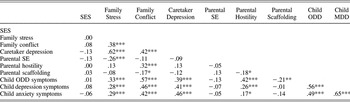
Bivariate correlations between environmental risk factors and outcome variables are presented in Table 2. Significant correlations were noted between risk factors for stress, conflict, and caretaker depression. A moderately high correlation was found for stress and caretaker depression. Outcome measures were moderately correlated with one another. Multicollinearity statistics were reviewed; there were no indications of multicollinearity.
Correlations of risk factors and measures of child psychopathology (N = 175)

Note: SES, socioeconomic status; SE, supportive engagement; ODD, oppositional defiant disorder; MDD, major depressive disorder.
*p < .05. **p < .01. ***p < .001.
DRD4
Main effects
None of the main effects for DRD4 were significant for symptoms of ODD, depression, or anxiety (effect sizes for all main effects and G × E are available online).
G × E for ODD, depression, and anxiety symptoms
There were no significant multiple or single G × E interactions for DRD4 for any type of symptom.
5-HTTLPR
Main effects
None of the main effects for 5-HTTLPR was significant for symptoms of ODD, depression, or anxiety.
G × E for ODD symptoms
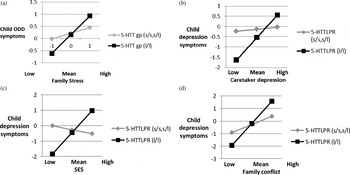
In the multiple interaction analyses, none of the G ×E interactions were significant for ODD symptoms. In single interaction analyses, there were significant interactions for 5-HTTLPR × SES, t (167) = 2.25, p = .026, with an increase in ODD symptoms as SES increased for the l/l group); 5-HTTLPR × Conflict, t (167) = 2.44, p = .016, with a greater increase in ODD symptoms as conflict increased for the l/l group; 5-HTTLPR × Caretaker Depression, t (167) = 2.66, p = .009, with a greater increase in ODD symptoms as caretaker depression increased for the l/l group; and 5-HTTLPR × Stress, t (167) = 2.79, p = .006. Only the 5-HTTLPR × Stress interaction was significant after correcting for multiple comparisons (Figure 1a; see Table 3 for a summary of the regression analyses). In post hoc probing, the slopes of the lines for the s/s, s/l group and the l/l group both differed significantly from zero. There was an increase in ODD symptoms as stress increased for both the s/s, s/l and l/l groups but with a significantly greater increase for the l/l groups.
Serotonin transporter linked polymorphic region gene (5-HTTLPR) interaction effects on symptoms of oppositional defiant disorder (ODD) and depression in children: (a) 5-HTTLPR × Family Stress, multiple interaction analysis; (b) 5-HTTLPR × Caretaker Depression, multiple interaction analysis; (c) 5-HTTLPR × Socioeconomic Status, single interaction analysis; (d) 5-HTTLPR × Family Conflict, single interaction analysis. For the environmental risk factors, the low value is –1 SD and the high is +1 SD.

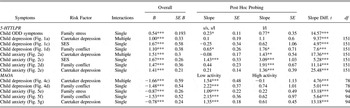
Slopes, standard errors, t- and p values for post-hoc probing of interactions significant after correcting for multiple comparisons

Note: 5-HTTLPR, serotonin transporter linked polymorphic region gene; s, short; l, long; ODD, oppositional defiant disorder; SES, socioeconomic status; MAOA, monoamine oxidase A gene.
*p < .05. **p < .01. ***p < .008.
G × E for depressive symptoms
In the multiple interaction comparisons, the 5-HTTLPR × Caretaker Depression interaction was significant, t (167) = 3.07, p = .003 after correcting for multiple comparisons (Figure 1b). In post hoc probing, the slopes of the lines for the s/s, s/l group and the l/l group did not differ from zero, but the slopes of the two lines were significantly different from one another, indicating that there was a greater increase in child depression symptoms as caretaker depression increased for the l/l group than for the s/s, s/l group. In this interaction, and in others for which one or both of the slopes of each regression line did not differ from zero, but the difference between the slopes was significant, the standard error was large enough that the slope did not differ from zero, but the differences in the two slopes were large enough to differ significantly.
In single interaction analyses, the 5-HTTLPR × SES interaction was significant t (167) = 2.88, p = .005, after correcting for multiple comparisons (Figure 1c). The slopes of the lines for neither the s/s, s/l group nor the l/l group differed from zero, but the slopes of the two lines were significantly different from one another, t (167) = 4.97, p < .0001. There was an increase in child depression symptoms as SES increased for the l/l group in comparison to the s/s, s/l group.
The 5-HTTLPR × Conflict interaction was also significant, t (167) = 3.12, p = .002 (Figure 1d), after correcting for multiple interactions. The slopes for both groups differed from zero and were significantly different from one another. There was a greater increase in child depression symptoms as a function of family conflict in the l/l than in the s/s, s/l group. The 5-HTTLPR × Caretaker Depression interaction, t (167) = 3.83 p = .001, was also significant after correcting for multiple comparisons, closely following the pattern in Figure 1b.
G × E for anxiety symptoms
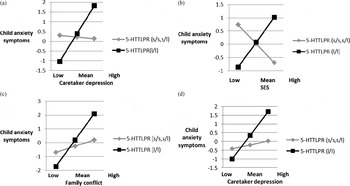
In multiple interaction analyses, both the 5-HTTLPR × Stress interaction, t (167) = 2.56, p = .025, with a greater increase in anxiety symptoms as stress increased for the l/l group, and the 5-HTTLPR × Caretaker Depression interaction, t (168) = 5.12, p =.001, were significant, but only the 5-HTTLPR × Caretaker Depression interaction was significant after correcting for multiple comparisons (Figure 2a). The slope for the s/s, s/l group was not significantly different from zero but was significant for the l/l group. The two slopes were significantly different from one another. Again, there was a greater increase in child anxiety symptoms in the l/l group than in the s/s, s/l group as a function of caretaker depression.
Serotonin transporter linked polymorphic region gene (5-HTTLPR) interaction on child anxiety symptoms: (a) 5-HTTLPR × Caretaker Depression, multiple interaction analysis; (b) 5-HTTLPR × Socioeconomic Status, single interaction analysis; (c) 5-HTTLPR × Family Conflict, single interaction analysis; (d) 5-HTTLPR × Caretaker Depression, single interaction analysis. For the environmental risk factors, the low value is –1 SD and the high is +1 SD.

In single interaction analyses, the 5-HTTLPR × Stress interaction, t (167) = 2.26, p = .025, showed a greater increase in anxiety symptoms as stress increased for the l/l group, but it was not significant after correcting for multiple comparisons. However, there were significant interactions for the 5-HTTLPR × SES interaction, t (167) = 2.96, p = .004; the 5-HTTLPR × Conflict interaction, t (167) = 3.12, p = .002; and the 5-HTTLPR × Caretaker Depression interaction, t (167) = 5.42, p = .001, that remained significant after correcting for multiple comparisons. In the 5-HTTLPR × SES interaction (Figure 2b), slopes for both groups differed from zero and were significantly different from one another. The pattern was similar to that for the interaction with SES and child depression, with child anxiety symptoms increasing as a function of SES for the l/l group and declining for the s/s, s/l group. In the 5-HTTLPR × Conflict interaction (Figure 2c), the slope for the s/s, s/l groups did not differ from zero, whereas the slope for the l/l group was significantly different from zero. The two slopes were significantly different from one another. There was a more rapid increase in child anxiety symptoms as a function of family conflict in the l/l group. In the 5-HTTLPR × Caretaker Depression interaction (Figure 2d), the slope for the s/s, s/l group did not differ from zero, whereas the slope for the l/l group was significant, and the two slopes were significantly different from one another. There was a greater increase in child anxiety symptoms as a function of caretaker depression in the l/l group.
MAOA
Main effects
None of the main effects for MAOA for boys or girls were significant for ODD, depression, or anxiety symptoms.
G × E for ODD symptoms
For ODD, none of the interactions were significant in either multiple or single interaction analyses for boys or girls.
G × E for depressive symptoms: Boys
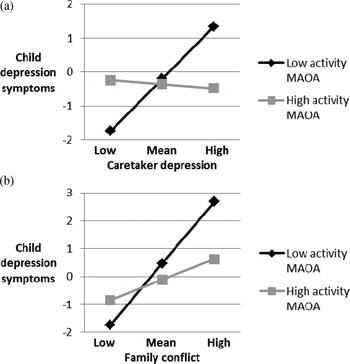
In the multiple interaction analyses, the MAOA × Caretaker Depression interaction was significant after correcting for multiple comparisons, t (94) = 2.81, p = .006 (Figure 3a). The slope for the low-activity MAOA group differed significantly from zero, whereas the slope for the high-activity group did not. The two slopes differed significantly from one another, with child depression symptoms increasing as caretaker depression increased only for the low-activity MAOA group.
Monoamine oxidase A gene (MAOA) interaction effects on child depression symptoms for boys: (a) MAOA × Caretaker Depression, multiple interaction analysis; (b) MAOA × Family Conflict, single interaction analysis. For the environmental risk factors, the low value is –1 SD and the high is +1 SD.

In single interaction analyses, the MAOA × Conflict interaction was significant, t (94) = 2.72, p = .008 (Figure 3b) after correcting for multiple interactions. The slope for the low-activity MAOA group differed significantly from zero, whereas the slope for the high-activity group did not. The two slopes differed significantly from one another. There was a more rapid increase in child depression symptoms as a function of family conflict in the low-activity MAOA group.
G × E for depression symptoms: Girls
In both multiple interaction and single interaction analyses, none of the interactions were significant.
G × E for anxiety: Boys
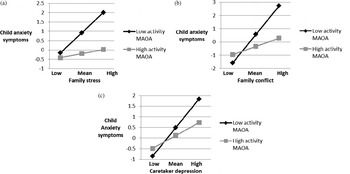
In multiple interaction analysis, none of the interactions were significant. In single interaction analyses, however, there were three interactions that were significant after correcting for multiple comparisons. For the MAOA × Stress interaction, t (94) = 3.39, p = .001 (Figure 4a), the slope for the low-activity MAOA group differed significantly from zero, with a greater increase in child anxiety symptoms as a function of family stress in the low-activity MAOA group. The slope for the high-activity group was not significant. The two slopes differed significantly from one another. Similarly, for the MAOA × Family Conflict interaction, t (94) = 2.94, p = .004 (Figure 4b), the slope for the low-activity MAOA group differed significantly from zero, indicating an increase in child anxiety symptoms as a function of family conflict in the low-activity MAOA group. The slope for the high-activity group was not significant. The two slopes differed significantly from one another. The pattern recurred for the MAOA × Caretaker Depression interaction, t (94) = 3.12, p = .002 (Figure 4c). The slope for the low-activity MAOA group differed significantly from zero, with an increase in child anxiety symptoms as a function of caretaker depression in the low-activity MAOA group. The slope for the high-activity MAOA group was not significant. The two slopes differed significantly from one another.
Monoamine oxidase A gene (MAOA) interaction effects on child anxiety symptoms for boys: (a) MAOA × Family Stress, single interaction analysis; (b) MAOA × Family Conflict, single interaction analysis; (c) MAOA × Caretaker Depression, single interaction analysis. For the environmental risk factors, the low value is –1 SD and the high is +1 SD.

G × E for anxiety symptoms: Girls
In both single interaction and multiple interaction analyses, none of the interactions were significant.
Co-occurrence of rGE and G × E
Although none of the rGEs were significant after correcting for multiple comparisons, the association of 5-HTTLPR with caretaker depression was significant prior to that correction. This raises the possibility that the 5-HTTLPR × Caretaker Depression effects on child depression and child anxiety symptoms were due to the association of 5-HTTLPR with caretaker depression. To try to disentangle these effects as much as possible, we followed the suggestion of Jaffee and Price (Reference Jaffee and Price2007) and the procedure of Dick et al. (Reference Dick, Agrawal, Schuckit, Bierut, Hinrichs and Fox2006) by examining the effects separately for each genetic subgroup, thereby reducing the effects of rGE. That approach involved examining the slopes of each of the genotypes. Essentially, Dick et al. argue that if the two genotypes are correlated with an environmental factor, then any G × E effect that was found could be attributed to the correlation between the genotypes and that environmental factor. However, if each group is examined separately, the effects of the correlation will be reduced because (a) if the correlation was entirely responsible for the effect, then the slopes of the lines for each group would not differ significantly from zero; and (b) if the slope did differ from zero for either (or both) genotypes, then the effects could not be due solely to the rGE effect. Thus, finding a significant slope suggests that the effects are not entirely due to rGE and that some G × E is likely to be present. Although this approach is not entirely definitive because the relative contributions of rGE and G × E cannot be quantified, it is an improvement over ignoring the possibility that rGE can completely account for the G × E effect.
Following the Dick et al. (206) procedure, we examined the slopes for each genotype separately. For the child outcome of depression, in the multiple interaction analysis (Figure 1a), neither slope was significant (Table 3). Thus, the G × E interaction in the multiple analysis may have been due to the rGE effects. For the child outcome of anxiety, however, the l/l slope was significant for both the single (Figure 2e) and the multiple (Figure 2a) analysis, and the G× E effect cannot be fully explained by rGE effects. Since the rGE effects were not significant for the other G × E effects that were significant after correcting for multiple comparisons, rGE was unrelated to those G × E effects.
Discussion
The approach to studying the role of genetic factors in the development of psychopathology has evolved from a focus on the main effects of genes to the interactions between genotypes and psychosocial variables. The gene–environment “interplay” is complex and can involve rGEs of various types (passive, active, or evocative) as well as true G × E interactions. Studying the relationships between these factors is still in a nascent state: Studies of main effects of various genes have been occurring with adults for many years and the number of such studies with children are increasing; studies of G × E interactions in children are also increasing, but still relatively uncommon; and concept papers discussing rGE in developmental psychopathology have emerged, but there are still very few studies that have measured rGE or attempted to show how it is related to G × E in children. Even more unusual are studies of these phenomena in preschoolers. Studies with older children afford researchers the opportunity to investigate genetic factors when certain disorders like anxiety or depression have become relatively common. Studies of younger children allow for the examination of problems, such as the development of symptoms of ODD, that are relatively common in that age group, as well as the early emergence of symptoms of disorders, such as anxiety and depression, which are likely to increase in severity over time. Furthermore, studying G × E in young children may shed light on how genetic factors may initiate a cascading process that operates across levels and domains, and how risk factors associated with both externalizing and internalizing disorders may contribute differentially to the occurrence of such symptoms in interaction with genetic factors.
Main effects
None of the main effects for the three target genes were significant for anxiety, depression, or ODD symptoms. This is not entirely surprising since good candidate genes for G × E studies should not have very powerful main effects. Although each of the target genes had shown main effects on psychopathology in prior work, the results were often inconsistent, a pattern suggesting that G × E effects may be particularly relevant for that gene and environmental factors related to that disorder. In addition, main effects have typically been identified in samples with older children and adults rather than the preschool age group included in this study. This suggests that absence of significant main effects in the present study may reflect a developmental phenomenon, with main effects emerging later, or alternatively, that what may have appeared to be main effect in studies with older children may be because these studies did not include G × E effects that may have appeared earlier in development.
G × E effects
5-HTTLPR
There was a consistent pattern of effects among the significant findings. For each significant G × E effect for symptoms of anxiety, depression, and oppositional behavior, there were significant differences in the slopes of the lines for the two groups, s/s, s/l versus l/l, with greater increases in symptoms as a function of the environmental risk factor for the l/l group. In comparison to the s/s, s/l group, the l/l genotype appeared to be both a risk and a protective factor, with fewer symptoms in children with the s allele when the environmental risk was low and more problems at higher levels of environmental risk.
There have been many studies examining G × E effects for family adversity, stress, or child maltreatment on depression, and these studies yield conflicting results. Almost all of these studies have been conducted with adult or older adolescents (Uher & McGuffin, Reference Uher and McGuffin2008). Caspi et al.'s (2003) early study examining stress in young adults found that the s/s, s/l genotypes were more strongly related to depression than was the l/l genotype. Two meta-analyses (Munafo et al., Reference Munafo, Durrant, Lewis and Flint2009; Risch et al., Reference Risch, Herrell, Lehner, Liang, Eaves and Hoh2009) did not find support for this relationship. A third meta-analysis (Karg et al., Reference Karg, Burmeister, Shedden and Sen2011) also failed to support Caspi et al.'s original finding for 5-HTTLPR × Life Stress but did support such an interaction for 5-HTTLPR × Child Maltreatment and 5-HTTLPR × Life Stress among adults with a medical problem.
In reviewing the available studies on G × E interactions of 5-HTTLPR with stress and environmental adversity (Uher & McGuffin, Reference Uher and McGuffin2008, Reference Uher and McGuffin2010), Uher and McGuffin concluded that G × E interactions for 5-HTT may differ across developmental levels. They note that the interaction of s/s, s/l with increased stress resulting in higher levels of depression seems to be prominent in studies of young adults, but that pattern has not been found in studies with adolescents (Uher & McGuffin, Reference Uher and McGuffin2008). Along with the results of the Arbelle et al. (Reference Arbelle, Benjamin, Golin, Kremer, Belmaker and Ebstein2003) report, the results of the present study suggest that the effects on behavior problems in young children may be quite different than that in young adults, with the l/l variant in conjunction with higher levels of stress, conflict, and adversity.
Potential developmental differences in 5-HTTLPR × E interaction patterns and underlying mechanisms are only beginning to be investigated. A recent report (Wiggins et al., Reference Wiggins, Bedoyan, Peltier, Ashinoff, Carrasco and Weng2011) indicates that there may be developmental differences in the influence that 5-HTTLPR has on resting-state default network connectivity. That study found that connectivity strengthens the most with increasing age in a sample of 8- to 19-year-olds among individuals with particular variants of the l/l genotype and strengthens the least in the s/s group. At age 8, the groups showed similar levels of connectivity. Further research is needed to determine whether the level of connectivity is similar, or even lower, in preschool children with the l/l genotype. Such developmental changes in neural networks would contribute to the developmental differences in G × E that both Moffit et al. (Reference Moffitt, Caspi and Rutter2006) and Uher and McGuffin (Reference Uher and McGuffin2008) suggest may exist.
Uher and McGuffin (Reference Uher and McGuffin2008) also argue that studies are needed that simultaneously explore a number of adverse outcomes. The present study identifies an association of increased risk for the l/l genotype across different types of adversity as well as different types of child behavior and emotional problems in young children.
In addition to developmental differences, epigenetic factors may also contribute to differences in outcomes in G × E studies. Van IJzendoorn, Caspers, Bakermans-Kranenburg, Beach and Philbert (Reference van IJzendoorn, Caspers, Bakermans-Kranenberg, Beach and Philibert2010) found that the association of the 5-HTTLPR genotype with unresolved loss or trauma in adults was moderated by the level of methylation of the 5-HTT promoter-associated CpG islands. Methylation of the alleles that carried the long (l/l) variant of 5-HTT seemed to hamper the protective effect sometimes associated with that variant, such that higher levels of methylation of that variant were marginally related to more unresolved loss or trauma. In addition, Although the short variant of 5-HTT may be associated with increased risk, this was only true when levels of methylation of that allele were low, perhaps indicating that high methylation of the s/s genotype drives individuals into a separate mechanism of coping with trauma (van IJzendoorn et al., Reference van IJzendoorn, Caspers, Bakermans-Kranenberg, Beach and Philibert2010). Caveats to interpretation of such studies, however, include (a) patterns of methylation may differ across samples, and differences in methylation may contribute to differences in G × E findings across studies (van IJzendoorn et al., Reference van IJzendoorn, Caspers, Bakermans-Kranenberg, Beach and Philibert2010); (b) patterns of methylation may differ throughout development and may mask, or amplify, the impact of genetic variation or G × E response on phenotype differentially depending on developmental stage; and (c) environmental factors can themselves cause changes in DNA methylation or other chromatin modifications, leading to altered gene expression in a way which might itself be dependent on underlying genetic variation (de Rooij et al., Reference de Rooij, Costello, Veenendaal, Lillycrop, Gluckman and Hanson2011). Greater attention to epigenetic modifications may contribute to our understanding of G × E effects in future research (Schroeder, Krebs, Bleich, & Frieling, Reference Schroeder, Krebs, Bleich and Frieling2010). Similarly, meta-analytic reviews need to be cognizant that sample differences in underlying methylation or other epigenetic patterns may affect study homogeneity when combining studies for analyses.
MAOA
In previous studies, main effects for MAOA have been inconsistent for anxiety (Arbelle et al., Reference Arbelle, Benjamin, Golin, Kremer, Belmaker and Ebstein2003; Eley et al., Reference Eley, Tahir, Angleitner, Harriss, McClay and Plomin2003; Gutierrez et al., Reference Gutierrez, Arias, Gasto, Catalan, Papiol and Pintor2004; Jacob et al., Reference Jacob, Muller, Schmidt, Hohenberger, Gutknecht and Reif2005; Syaglio et al., Reference Syaglio, Stober, Grassle, Reimer, Knapp and Jungkunz2001; Tochigi et al., Reference Tochigi, Hibino, Otowa, Kato, Marui and Ohtani2006), depression (Gutierrez et al., Reference Gutierrez, Arias, Gasto, Catalan, Papiol and Pintor2004; Tochigi et al., Reference Tochigi, Hibino, Otowa, Kato, Marui and Ohtani2006), and externalizing behaviors (Huizinga et al., Reference Huizinga, Haberstick, Smolen, Menard, Young and Corley2006; Jacob et al., Reference Jacob, Muller, Schmidt, Hohenberger, Gutknecht and Reif2005; Nilsson et al., Reference Nilsson, Sjoberg, Damberg, Leppert, Ohrvik and Alm2006; Prom-Wormley et al., Reference Prom-Wormley, Eaves, Foley, Gardner, Archer and Wormley2009; Reif et al., Reference Reif, Rosler, Freitag, Schneider, Eujen and Kissling2007; Widom & Brzustowicz, Reference Widom and Brzustowicz2006). The present study extends these findings, showing no main effects for MAOA on internalizing or externalizing behavior in young children.
A number of significant interactions were found for MAOA in boys. For child anxiety, the interactions for MAOA × Caretaker Depression, MAOA × Family Stress, and MAOA × Family Conflict were all significant. There was also a significant MAOA × Family Conflict effect in the single interaction analysis for child depression.
For child depression symptoms, the MAOA × Caretaker Depression interaction was significant. However, this interaction was significant only in the multiple interaction analysis and not in the single interaction analyses, a pattern that may be consistent with suppression effects. As a result, this finding must be interpreted with caution.
In prior studies of G × E interactions for MAOA, low-activity MAOA has been associated with more psychopathology, and significant findings occur more often in samples of males than females. Low MAOA activity in 7-year-old boys, plus exposure to physical abuse, predicted more mental health problems (Kim-Cohen et al., Reference Kim-Cohen, Caspi, Taylor, Williams, Craig and Moffitt2006). Symptoms of depression increased for maltreated males only if they had the low-activity MAOA gene (Cicchetti et al., Reference Cicchetti, Rogosch and Sturge-Apple2007). Low-activity MAOA interacting with adversity (poorer residence or victimization) was associated with higher rates of criminal activity in adolescent males (Nilsson et al., Reference Nilsson, Sjoberg, Damberg, Leppert, Ohrvik and Alm2006), and low-activity MAOA plus adverse environment was associated with increased conduct disorder in adolescents (Foley et al., Reference Foley, Eaves, Wormley, Silberg, Maes and Kuhn2004). The present study found significant, nonspecific effects in boys on depression and anxiety, for MAOA × Caretaker Depression, MAOA × Stress, and MAOA × Family Conflict. Consistent with most prior studies, there was a greater increase in symptoms for the low-activity MAOA group. These G × E interactions affecting symptoms of anxiety and depression in preschoolers may have long-term cascading effects that contribute to the presence of these symptoms in later childhood, adolescence, and adulthood. Therefore, a potentially effective way to prevent these negative cascading effects in boys may be to develop intervention strategies that focus on decreasing family conflict, caregiver stress, and depression.
The present study found no significant G × E interactions for MAOA for girls, and previous studies have shown inconsistent G × E effects for MAOA with girls. Although Kinnally et al. (Reference Kinnally, Huang, Haverly, Burke, Galfalvy and Brent2009) found a significant G × E interaction, with women whose MAOA activity was low, and who were exposed to early stressors showing higher levels of depression, Eley et al. (Reference Eley, Sugden, Corsico, Gregory, Sham and McGuffin2004), found a nonsignificant relationship between MAOA and cumulative environmental risk on depression for adolescent girls. Du et al. (Reference Du, Faludi, Palkovits, Sotonyi, Bakish and Hrdina2002) found that, Although adult male suicide victims were more likely to carry the high-activity MAOA variant, no association was found for females, and Jacob et al. (Reference Jacob, Muller, Schmidt, Hohenberger, Gutknecht and Reif2005) found a weaker relationship between MAOA and cluster B personality types for women than for men. It is difficult to account for these gender differences in G × E effects, except to speculate that there may be a third, unmeasured factor that is more prevalent in boys that interacts with the low-activity MAOA gene and/or stress, family conflict, and caregiver depression. It is possible, for example, that higher activity level in boys exacerbates family conflict and caregiver depression, thereby potentiating the G × E effect.
DRD4
Although MAOA and 5-HTTLPR show some significant G × E effects for symptoms of anxiety, depression, and oppositional behavior, DRD4 showed no effect for any type of symptoms or environmental risk factor in either multiple interaction or single interaction analyses. Previous data indicate a main effect for DRD4 and ADHD, which made it a likely candidate for study, but the lack of significant findings in the current study suggests that this gene may be linked specifically to ADHD in young children and not to internalizing or ODD type externalizing symptoms.
Results specific to each disorder
As the correlations indicate, stress, family conflict, caretaker depression, and caretaker hostility were all associated with all three symptom types. This is consistent with a common diathesis model. The pattern differs for G × E, however, suggesting that certain G × E interactions may be specific to internalizing or externalizing symptoms in young children.
Only one interaction was significant for symptoms of ODD, the 5-HTTLPR × Stress interaction. The significant interactions for conflict and caretaker depression were associated with anxiety, depression, or both, but not with symptoms of ODD. Thus, although all three variables are correlated with the three symptom types, the G × E interactions of 5-HTTLPR with conflict and caretaker depression may contribute to the specificity of the occurrence of anxiety and depression rather than symptoms of ODD. Similarly, the 5-HTTLPR × SES interaction was also significant for anxiety and depression and not ODD, and may be specific to those two internalizing disorders.
For boys, there were significant MAOA × Conflict and MAOA × Caretaker Depression interactions that were significant for both depression and anxiety but not for symptoms of ODD, and they may have contributed to the development of those internalizing but not externalizing symptoms. However, the MAOA × Family Stress interaction was significant for anxiety but not for depression.
Thus, most of the significant interactions for 5-HTTLPR and MAOA were consistent with a common diatheses model for the internalizing disorders of anxiety and depression but not for ODD symptoms, whereas the MAOA × Conflict interactions might lead to differences in the presence of anxiety and depression in young children.
rGE
A number of rGEs were significant, but none remained significant after correcting for multiple comparisons. Taking a conservative approach, we examined whether rGE effects that were not significant after correcting for multiple comparisons could explain the G × E effects that were significant. Among all the G × E effects that were significant, only the 5-HTTLPR × Caretaker Depression effect for child depression symptoms may have been attributed to rGE.
Relatively specific and nonspecific effects
The present study included a broad range of theoretically relevant and empirically based environmental risk factors. When studies examine only one or two risk factors in isolation, the “omitted variable” problem is likely to be present, in which the effect size of the particular variable included in the model may be inflated because it is correlated with other, unmeasured variables. We addressed this problem by conducting analyses that included G × E interactions for multiple G × E interactions simultaneously in the regression analyses and comparing the results to those in analyses when one G × E effect was examined at a time. This allows for a comparison of specific effects for an environment risk factor with the constellation of effects for that risk factor, plus any correlates of that risk factor that may influence the outcome measure but were not included in the model. If results are significant in single interaction analyses but not in multiple interaction analyses, then it is possible that the effects of the environmental risk factor are present but not specific, that is, are influenced by the correlates of that risk factor that are not included in the regression model. Of course, no model can include all possible relevant variables, so it is best to conceptualize the significant effects as relatively specific or nonspecific.
For 5-HTTLPR effects on both child depression and child anxiety symptoms, there was a specific G × E effect for 5-HTTLPR × Caretaker Depression, whereas interactions of 5-HTTLPR with SES and family conflict were nonspecific. For 5-HTTLPR effects on symptoms of ODD, the 5-HTTLPR × Stress effect was nonspecific. For MAOA in boys, the G × E effect of MAOA × Caretaker Depression on child depression symptoms was relatively specific, whereas interaction of MAOA × Family Conflict on child depression symptoms was nonspecific. For anxiety symptoms, the interactions of MAOA with family stress, family conflict, and caretaker depression were all nonspecific. For the nonspecific effects, correlates of the risk factor (Table 1) may have also been contributing to the G × E effect (e.g., effects of stress also may reflect the influence of family conflict, caretaker depression, and parental support, etc).
As Moffit et al. (Reference Moffitt, Caspi and Rutter2006) note, G × E effects may be developmentally specific. The present study utilized a cross-sectional design with young children and provides a “snapshot” of the role of the gene–environment interplay in a community sample of 4-year-olds. Early experience is likely to have important long-term effects, psychopathology can vary over time, and it is likely that the gene–environmental effects will change as the children develop. Longitudinal investigations will be important to assess such changes in the gene–environment relationships over time. Nevertheless, these early manifestations of the multidomain interplay of gene and environmental effects may have long-term cascading influences on the development and stability of psychopathology in older children, adolescents, and adults that needs further exploration.
There were some important limitations to this study. Because of the large number of analyses that were performed, other analyses of interest involving gene–gene interactions and G × G × E interactions could not be performed. In addition, it is not always clear how genotypes should best be grouped, and different grouping patterns (e.g., recessive pattern for 5-HTTLPR) may have led to different results, as may further refinement of grouping based on putative allele-variant activity levels, such as subtyping the 5-HTTLPR long allele into high (lA) and low (lG) activity and grouping accordingly (Hu et al., Reference Hu, Lipsky, Zhu, Akhtar, Taubman and Greenberg2006 ) or inclusion of other functional polymorphic variants within the MAOA gene (Rosenberg et al., Reference Rosenberg, Templeton, Feigin, Lancet, Beckmann and Selig2006). The significant finding in this study to the 5-HTTLPR l/l group without such subtyping, however, speaks toward the strength of this association.
The present study extends our knowledge of the gene–environment interplay in developmental psychopathology, extending our understanding of both rGE and G × E effects. It demonstrates the role that genetic factors can play in potentiating and protecting the child from specific environmental risks, setting in motion a cascade of events that may have lasting positive or negative effects. Increasing our understanding of the role that genetic factors play in the development of psychopathology can have important implications for preventive and intervention work in the future. The pathways by which differences in genotypes for these target genes, in interaction with different environmental risk factors, lead to differences in phenotypic expression of psychopathology are not well established (Kinnally et al., Reference Kinnally, Huang, Haverly, Burke, Galfalvy and Brent2009). The MAOA enzyme, for example, is known to affect oxidation and inactivation of the monoamines serotonin, dopamine, and norepinephrine in the central nervous system (Kinnally et al., Reference Kinnally, Huang, Haverly, Burke, Galfalvy and Brent2009). This process may be differentially affected in interaction with environmental events, but it is not clear how the resulting biochemical changes, in turn, affect psychological processes resulting in increased psychopathology. Further study of the G × E effects on endophenotypes associated with the development of psychopathology is an important direction for future research (Uher & McGuffin, Reference Uher and McGuffin2008). In addition, the results of genetic and G × E findings may be specific to race/ethnic groups, and future studies are needed to determine if these specific findings can be replicated in samples with different races and ethnicities (Bakermans-Kranenburg & van IJzendoorn, Reference Bakermans-Kranenburg and van IJzendoorn2011).