Introduction
How does the career plateau influence the behavioral variables of employees? Behavior is generally affected by not only attitude, but also many other variables. Therefore, one cannot be certain that the career plateau will have a consistent negative relationship with behavioral variables even if such a relationship exists with attitudinal variables (Milliman, Reference Milliman1992; Allen, Russel, Poteet, & Dobbins, Reference Allen, Russel, Poteet and Dobbins1999; Tremblay & Roger, Reference Tremblay and Roger2004). A few researchers (Ference, Stoner, & Warren, Reference Ference, Stoner and Warren1977; Elsass & Ralston, Reference Elsass and Ralston1989; Rotondo & Perrewé, Reference Rotondo and Perrewé2000; Hurst, Kungu, & Flott, Reference Hurst, Kungu and Flott2012) have already made such claims; they argued that employee response to the career plateau can be negative or positive. Moreover, Badiane (Reference Badiane2016) argued that there is no significant correlation between career plateau and citizenship behavior.
Even so, previous studies have considered this question with limited interest. Thus, it is necessary to identify this dualistic response of employees. This study focused on organizational citizenship behavior (OCB) to address this question, both theoretically and empirically. OCB, as explained later, is a behavior that appears in various contexts over a diverse set of objectives. Therefore, it can help us observe the dualistic response of employees to the career plateau.
This study had three specific goals. First, a curvilinear model of the relationship between the career plateau and OCB was established, and the same was verified both theoretically and empirically. Many researchers (e.g., Korsgaard, Meglino, Jeong, & Lester, Reference Korsgaard, Meglino, Jeong and Lester2010; Astakhova, Reference Astakhova2015; Rapp, Bachrach, Rapp, & Mullins, Reference Rapp, Bachrach, Rapp and Mullins2014; Lam, Ashford, Liang, & Lee, Reference Lam, Ashford, Liang and Lee2015) studied nonlinear relationships to gain new insights that can be missed by traditional linear models, and in a similar spirit, the present study applied the nonlinear model to understand the relationship between the career plateau and OCB.
Second, the subdimensions of the career plateau and OCB were thoroughly inspected. Both are constructs with several subdimensions. In such cases, it could not be assumed that all subdimensions of the career plateau and OCB share similar relationships among each other; it was necessary to inspect the relationships between each subdimension separately. As noted earlier, OCB is a comprehensive concept encompassing different behaviors that positively affect an organization, and its various subdimensions differ considerably from one another in terms of content, motivation, and effects. This study inspected two subdimensions of the career plateau and five subdimensions of OCB to assess the relationship between them.
Third, the moderating variables that affect the relationship between the career plateau and OCB were explored. Previous studies have already considered the influence of many moderating variables on this relationship, but because this study assumed a nonlinear relationship, a re-examination appeared worthwhile. To do so, both organizational commitment and job involvement were considered while trying to confirm the existence of a moderating effect on the relationship between the career plateau and OCB. The present study believed that these factors may affect the two subdimensions of the career plateau differently: the structural plateau may be more closely related to organizational commitment, and the content plateau, to job involvement.
Theoretical Background and Hypotheses Development
Career plateau and employee response
Career plateau is a concept that represents the state where there is no more upward mobility regarding job or position (Milliman, Reference Milliman1992). Many scholars (Milliman, Reference Milliman1992; Allen et al., Reference Allen, Russel, Poteet and Dobbins1999) have showed the negative effect of the career plateau on employee attitude. Milliman (Reference Milliman1992) who conducted a comprehensive exploration of the above-mentioned factors and resulting effects of the career plateau, found that job satisfaction and organizational commitment were negatively affected by it.
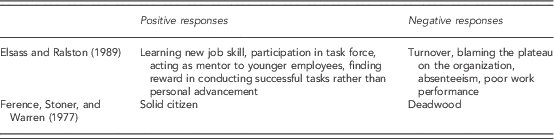
Although the negative effect of the career plateau on employee attitude has been consistently confirmed, studies on the relationship between behavior and the career plateau show mixed results. For example, Ference, Stoner, and Warren (Reference Ference, Stoner and Warren1977) classified employees experiencing the career plateau into two types. The first is the solid citizen state, where the employee maintains high productivity despite the career plateau, and the second is the deadwood state, characterized by low productivity. Elsass and Ralston (Reference Elsass and Ralston1989) explored the coping responses of employees experiencing career plateaus. The first response is transition, where the employee actively changes his role to overcome the career plateau. The second response is reappraisal, where the employee tries to overcome the cognitive dissonance by consciously changing his desire or values. The third response is defense, where one tries to overcome the discomfort arising from the stress caused by the career plateau. As Table 1 shows, positive and negative reactions coexist in all these responses. Employee response to the career plateau is diverse, and there are positive and negative reactions from the viewpoint of organizations as well.
Dualistic employee response to the career plateau in early studies

Interestingly, the study confirmed that the positive reactions listed in Table 1 are very similar to OCB in terms of their content and characteristics. These actions come about owing to the discretion of employees, and they positively affect organizational efficiency, which closely conforms to the definition of OCB. This led to the conjecture that OCB can result from a positive reaction to the career plateau.
OCB as a response to the career plateau
OCB is an ‘individual behavior that is discretionary, not directly or explicitly recognized by the formal reward system, and that in the aggregate promotes the effective functioning of the organization’ (Organ, Reference Organ1988).
Employees can display negative behaviors such as slowdown and expressing dissatisfaction to overcome the career plateau, but they can also display positive behaviors that help the organization. For example, employees can work harder to create a good impression with their superiors, who can help them overcome the career plateau. Employees can also learn new work-related skills to get promotions or changes in their responsibilities. They can modify their values to overcome cognitive dissonance and refocus their emphasis from individual success to organizational success. If one uses OCB to understand these positive reactions, one can think of OCB as being the result of the career plateau. It would then be necessary to identify the conditions resulting in positive behaviors such as OCB, as well as the theoretical foundation for the occurrence of such behaviors. Social exchange theory, the most general explanation of the motivation for OCB, can help answer these questions.
Instrumental motive of OCB: expected reciprocity
The key theories that explain the motivation for OCB can be classified into social exchange models and non-exchange models. As the name suggests, social exchange models are based on the social exchange theory, first discussed by Homans (Reference Homans1961) and then by Blau (Reference Blau1964), who assert that OCB stems from the norms of reciprocity, where one repays as much as they have been paid. Non-exchange models try to explain the manifestations of OCB that cannot be explained by social exchange models. They assert that OCB depends on factors such as values, personalities, mood, and presiding norms.
It is unclear which of these approaches is better. However, previous studies consistently noted the significant effect of cognitive factors such as job satisfaction, organizational commitment, awareness of fairness, and perception of organizational support (Coyle-Shapiro, Reference Coyle-Shapiro2002; Restubog, Bordia, & Tang, Reference Restubog, Bordia and Tang2007; Zhao, Wayne, Glibkowski, & Bravo, Reference Zhao, Wayne, Glibkowski and Bravo2007; Akan, Allen, & White, Reference Akan, Allen and White2009), and social exchange theory seems to have some grounds for truth. As such, researchers consider social exchange theory as a general framework for explaining OCB.
While the core logic of social exchange theory rests on the norms of reciprocity, this does not mean that one just repays what has been received previously. Norms of reciprocity can be divided into obligation to reciprocate and expected reciprocity (Coyle-Shapiro, Reference Coyle-Shapiro2002; Cropanzano & Mitchell, Reference Cropanzano and Mitchell2005; Korsgaard et al., Reference Korsgaard, Meglino, Jeong and Lester2010). Obligation to reciprocate is a reactive action that repays benefits received from the organization via behaviors such as OCB. Expected reciprocity is a forward-looking behavior in that future benefit is expected from positive actions toward the organization.
Even though the OCBs stemming from these differing motivations look similar at first glance, they have very different motives, and the executive environment and preceding factors differ as well. Obligation to reciprocate comes into play when an employee of the organization has already earned satisfaction. Expected reciprocity, on the other hand, is likely to occur when an employee member is unsatisfied because forward-looking actions are often goal-oriented, and it often involves improving the current state of affairs or overcoming barriers. Korsgaard et al. (Reference Korsgaard, Meglino, Jeong and Lester2010) empirically show the difference between obligation to reciprocate and expected reciprocity. Employees with different orientations manifest OCB through the obligation to reciprocate, but employees who exhibit OCB through expected reciprocity are more focused on individual reward. Using this logic, the present study can explain how employees experiencing the career plateau can show positive reactions such as OCB, namely, by expected reciprocity. Elsass and Ralston (Reference Elsass and Ralston1989) showed that positive reactions of employees could come about as a way to overcome their personal career plateaus. The present study noted that such positive responses are similar to OCB and that OCB can be manifested as a result of expected reciprocity. This implies the existence of an ambivalent relationship between the career plateau and OCB.
Curvilinear relationship between the career plateau and OCB
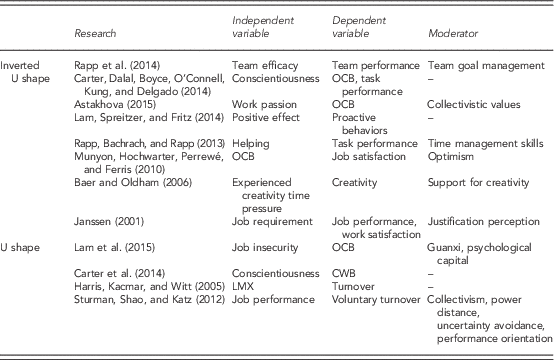
Although the career plateau can trigger a positive reaction like OCB, it is still difficult to determine whether an employee’s level of OCB increases depending on the level of his/her career plateau. Elsass and Ralston (Reference Elsass and Ralston1989) mentioned some positive behaviors are reactions to the career plateau, but they did not deny that the career plateau also results in various negative behaviors. Many recent studies observed that employee satisfaction, commitment, and other attitudes become negative owing to the career plateau. Job satisfaction and organizational commitment have been recognized as attitude variables having significant effects on OCB. Based on the above results, it is intuitively posited that the career plateau has a direct and positive, rather than a negative, effect on attitude variables related to OCB. If so, it can be surmised that the relationship between these two variables is curvilinear, which is difficult to explain with a linear model. Recently, many researchers attempted to identify a curvilinear relationship between variables in the field of organization behavior. These studies are similar in that they considered the relationship between target variables to be quadratic. These studies referred to either a U-shaped or an inverted U-shaped relationship with regard to the shape of the function’s graph. The inverted U-shaped relationship usually appears in a research model wherein the nature of the relationship (i.e., positive or negative) between the independent and dependent variables changes depending on the level of the independent variable (i.e., whether it is low or high). This inverted U-shaped relationship is sometimes known as the law of diminishing return. Rapp, Bachrach, and Rapp (Reference Rapp, Bachrach and Rapp2013) showed the existence of an inverted U-shaped relationship between helping behavior and task performance. They found that helping behavior has a positive effect on task performance under normal conditions, but when employees have poor time management skills, there is observe an inverted U-shape between helping behavior and task performance. These researchers later identified the same inverted U-shape in the relationship between team efficacy and team performance. They attributed this curvilinear relationship to immoderate confidence and vanity (Rapp et al., Reference Rapp, Bachrach, Rapp and Mullins2014). Astakhova (Reference Astakhova2015) investigated the relationship between employee passion and OCB, and found that harmonious passion follows an inverted U-shape against OCB, while obsessive passion has a curvilinear relationship under high levels of collectivism. This result implies that an employee’s passion is not always beneficial for his/her organization, and very high levels of passion could be harmful to his/her nontask behaviors. Unlike the inverted U-shaped relationship, studies about the U-shaped relationship are relatively few. Lam et al. (Reference Lam, Ashford, Liang and Lee2015) used the U-shaped curve to explain the dubitable relationship between job insecurity and OCB. They argued that there are two motivations for expressing OCB, one being the obligation to reciprocate, and the other, expected reciprocity. Under low levels of job insecurity, OCB is triggered by the motivation of obligation to reciprocate, and employees are willing to pay the organization back with their positive behavior to the extent of the positive effects they have experienced from their organization. Accordingly, OCB is negatively related to job insecurity. However, when job insecurity is high, employees exhibit citizenship behavior motivated by expected reciprocity. This type of motivation leads people to exhibit positive behavior for profit, rather than favor, to be received in the future. When employees perceive high levels of job insecurity, they search for ways to resolve this unstable situation. In this case, the employees are likely to use nontask behaviors, such as OCB, as the solution. In this type of motivation, OCB is ‘political’ rather than ‘reciprocative.’ Aside from the above-mentioned research, several studies have analyzed the quadratic curvilinear relationship between the target variables (summarized in Table 2).
Two types of quadratic curvilinear studies

Note. OCB=organizational citizenship behavior.
The curvilinear model has some advantages over the linear model. First, it is possible to locate hidden relationships that cannot be identified via a linear model. This point is readily applicable to hierarchical regression analysis. For example, Astakhova (Reference Astakhova2015) found that the relationship between harmonious passion and OCB is expressed via a quadratic curve, but the same analysis also showed that a linear model that excludes the quadratic term presents a negative linear relationship only. If the researcher does not assume such a (curved) relationship and conducts the analysis using a linear regression model only, the existence of the positive relationship between the two variables would remain hidden. Notably, Lam et al. (Reference Lam, Ashford, Liang and Lee2015) presented a more dramatic ending, which identified the hidden relationship between the independent and dependent variables. Before their paper was published, scholars in this field could not attain consistent results about the relationship between job insecurity and OCB. Some researchers argued that the relationship between the variables is positive, whereas others presented the contrary or even showed that the relationship is irrelevant. Lam et al. (Reference Lam, Ashford, Liang and Lee2015) successfully identified the reason for the inconsistent results of past studies by assuming a curvilinear relationship between job insecurity and OCB. As past efforts had focused only on the linear model, it was natural that the results would be inconsistent. Hierarchical regression is composed of several stages, each of which uses the results of the linear regression analysis to arrive at the final model. Most studies on the curvilinear relationship showed significant results when assuming a linear relationship between the research variables. Of course, it is advantageous for researchers to apply a single-dimension model from a macroscopic viewpoint. However, the curvilinear model is more useful to identify complex relationships between research variables. The second merit is that a curvilinear model allows a higher coefficient of determination. Since this model contains a term with a high order in the regression function, it is more successful at addressing the variance of samples compared with the linear model. Moreover, the curvilinear model provides opportunities to explore a research framework different from the linear model. This shifts the researcher’s view from the problem of ‘positive or negative’ to that of ‘what is the best level,’ which implies that the relationship between the variables is not unconditionally fixed as either good or bad. Accordingly, researchers have argued that a career plateau could cause both positive and negative responses; this study focused on this ambivalent issue by assuming a curvilinear relationship between the career plateau and OCB. In the study, the positive and negative relationships alternate according to the level of the career plateau. It is difficult to perceive that a weak career plateau can be a significant obstacle that should be eliminated. Employees may perform positive nontask behaviors with the motivation of obligation to reciprocate; thus, employees oblige their colleagues or organizations to the extent of the benefits received from them. Therefore, in this section, career plateau and OCB have a negative relationship. On the contrary, when an employee has already reached his/her career plateau, he/she considers this as a situation that should be resolved. Thus, he/she searches for ways to exit the situation, and the OCB is more likely to depend on the motivation of expected reciprocity. For example, such employees could help their colleagues and boss for political purposes, the aim being to attain favorable evaluations. Under this situation, OCB may increase proportionately with the career plateau. These relationships appear on the regression graph as U-shaped curves and can be applied to all five subdimensions of OCB.
Hypothesis 1: The structural career plateau and OCB have a U-shaped curvilinear relationship.
Hypothesis 1-1: The structural career plateau has a U-shaped curvilinear relationship with altruism.
Hypothesis 1-2: The structural career plateau has a U-shaped curvilinear relationship with conscientiousness.
Hypothesis 1-3: The structural career plateau has a U-shaped curvilinear relationship with courtesy.
Hypothesis 1-4: The structural career plateau has a U-shaped curvilinear relationship with civic virtue.
Hypothesis 1-5: The structural career plateau has a U-shaped curvilinear relationship with sportsmanship.
Hypothesis 2: The content career plateau and OCB have a U-shaped curvilinear relationship.
Hypothesis 2-1: The content career plateau has a U-shaped curvilinear relationship with altruism.
Hypothesis 2-2: The content career plateau has a U-shaped curvilinear relationship with conscientiousness.
Hypothesis 2-3: The content career plateau has a U-shaped curvilinear relationship with courtesy.
Hypothesis 2-4: The content career plateau has a U-shaped curvilinear relationship with civic virtue.
Hypothesis 2-5: The content career plateau has a U-shaped curvilinear relationship with sportsmanship.
Moderating effects of organizational commitment and job involvement
To identify the curvilinear relationship between the career plateau and OCB in detail, the moderating effects of organizational commitment and job involvement were investigated. Organizational commitment has long been studied with regard to OCB in companies and employee job satisfaction (Williams & Anderson, Reference Williams and Anderson1991). As per the old definition of Mowday, Porter, and Steers (Reference Mowday, Porter and Steers1982), organizational commitment is a concept regarding the level of an individual’s identification and absorption with one’s organization. Because of conceptual closeness, organizational commitment has been the target of many studies focusing on antecedents, mediators, and moderators. In reality, these studies reported a positive relationship between organizational commitment and OCB (Moorman, Niehoff, & Organ, Reference Moorman, Niehoff and Organ1993; Organ, Podsakoff, & MacKenzie, Reference Organ, Podsakoff and MacKenzie2006). Based on the positive effect of organizational commitment on OCB, it was expected that employees’ organizational commitment would lend a steeper curve to the curvilinear relationship between the career plateau and OCB. When employees are strongly committed to their organizations, they tend to keep a positive relationship with their organizations. Thus, when this tendency faces a career plateau higher than a particular level, these employees are likely to perform various proactive behaviors, such as OCB, to resolve this situation.
In this study, job involvement was used as a moderator with organizational commitment. This is because the career plateau has two dimensions; organizational commitment could exert a moderating effect on the relationship between both dimensions of the career plateau and OCB. Of the two dimensions of the career plateau, the structural one is relevant to the organizational system or promotion, and therefore, it is likely to be influenced by organizational commitment, not by the job. On the contrary, the content career plateau may focus on the employee’s individual job or task, and thus, it is difficult to say that the relationship between the content career plateau and OCB is moderated by organizational commitment. Consequently, job involvement was added as another moderating factor. Job involvement relates to an employee’s specific belief about his or her current job (Kanungo, Reference Kanungo1982), and it was expected that employees having a high job involvement level would show a more deeply curved relationship between the content career plateau and OCB.
Hypothesis 3: When organizational commitment is high, the structural career plateau and OCB have a more deeply curved U-shaped relationship, and when organizational commitment is low, the structural career plateau and OCB have a smoother U-shaped curved relationship.
Hypothesis 4: When job involvement is high, the content career plateau and OCB have a more deeply curved U-shaped relationship, and when job involvement is low, the content career plateau and OCB have a smoother U-shaped curve relationship.
Method
Participants
The population of this study is employees in Korean enterprises. Thus, researchers used convenience sampling method via mail and selected nine enterprises as all corporates are in different regions for diminishing the regional bias. In total, 300 questionnaires were equally distributed (33–34 questionnaires per one corporate) to the Korean enterprises, but only 242 were returned. For accurate analysis, 28 questionnaires were eliminated after examining the responses for the reverse questions and missing values, and thus, the final analyses were conducted using the data of 214 questionnaires. The sample had respondents of both genders, and various ages, positions, and tenures. There were slightly more male subjects (116 or 54.2%) than female (98 or 45.8%), with the majority of the respondents belonging to their 30s (116 or 54.2%), followed by those in their 20s (79 or 36.9%). The number of respondents in their 40s (16 or 7.5%) and 50s (3 or 1.4%) were far fewer in number. Similarly, the positions held by the respondents clearly followed the pyramid structure observed in many organizations. In terms of position, the respondents comprised 127 general employees (59.3%), 50 assistant managers (23.4%), 22 section heads (10.3%), and 15 department heads (7.0%). The sample had relatively equal tenure distribution involving 49 respondents having under 2 years (22.9%) of experience, 70 with 3–5 years (32.7%) of experience, 66 from 6 to 10 years (30.8%) of experience, and 29 (13.6%) with over 11 years of experience in the same organization.
Operationalization and measurements
Independent variables
When an employee reaches his/her career plateau, a promotion or being assigned a role with increasing responsibility are no longer possible, and he/she stagnates at his/her job (Tremblay, Roger, & Toulouse, Reference Tremblay, Roger and Toulouse1995). The career plateau involves two subdimensions according to its target of perception. The first is the structural career plateau, which means that employees perceive that they cannot rise to a higher rank or position in their job and organization. The second is the content career plateau wherein employees no longer feel a sense of accomplishment, challenge, and possibility of growth in their jobs, so much so that they feel no motivation to do their job although they may be in line for a promotion. Milliman’s measurement (Reference Milliman1992, p. 91) composed of 12 items was employed to analyze both the structural and the content career plateaus.
Dependent variables
OCB is the sum of employee behaviors performed in a discretionary manner, and they are not directly and explicitly recognized by the formal reward system. Moreover, these behaviors also promote the organization’s aggregate effectiveness (Organ, Reference Organ1988). To measure this concept, the 24 measures developed by Podsakoff, MacKenzie, Moorman, and Fetter (Reference Podsakoff, MacKenzie, Moorman and Fetter1990) were used, which were redesigned after considering the observations of Schwab (Reference Schwab1980) and Churchill (Reference Churchill1979). These items include the five following dimensions of Organ’s (Reference Organ1988) classification: altruism, conscientiousness, courtesy, civic virtue, and sportsmanship.
Moderators
This study employed two variables, organizational commitment and job involvement, as the moderating variables to test the moderation effects in the relationship between the career plateau and OCB. Using the definition of Mowday, Steers, and Porter (Reference Mowday, Steers and Porter1979), organizational commitment is described as the employee’s willingness to contribute to the organization’s well-being. This commitment was measured using 15 items of the Organizational Commitment Questionnaire (OCQ) introduced by Mowday, Steers, and Porter (Reference Mowday, Steers and Porter1979). The other moderating variable, job involvement, refers to the employee’s belief about his/her relationship with his/her present job (Kanungo, Reference Kanungo1982). This concept was measured by the Job Involvement Questionnaire (JIQ) developed by Kanungo (Reference Kanungo1982).
Control variables
One of the most important points regarding causal inference between target variables concerns which external factors are controlled. In this analysis, employee tenure and position were considered. When an employee earns more tenure and a higher position, he/she becomes more familiar with the organization and perceives a higher level of responsibility. These feelings could be transformed into positive attitudes and performance like OCB. In addition, tenure could have a significant relationship with the content career plateau because older employees are likely to feel bored with their jobs as they are skilled at them. Employees with long tenure could also face the structural career plateau. A study on the relationship between antecedents related to career and the outcomes of job rotation showed a negative correlation between tenure and promotion rate, job rotation rate, and personal development (Campion, Cheraskin, & Stevens, Reference Campion, Cheraskin and Stevens1994). The variable employee position was also controlled for the same reason. Apart from tenure and position, some demographic factors, such as gender, age, and education were employed as control variables. Thus, the research model had five control factors, and these factors were inserted into the regression equations.
Results
To test the research hypotheses, the analysis was composed of two steps. The curvilinear relationships between the two dimensions of the career plateau and the five subdimensions of OCB were examined in the first step, and the moderating effects of organizational commitment and job involvement were identified in the second step. The reliability and validity of the variables were tested in each of the steps, and the factor structures formed in the first step of the analysis were used in its second phase.
Step 1: Analysis of the curvilinear relationship between the career plateau and OCB
Confirmatory factor analysis, and reliability and validity of the research variables
Confirmatory factor analysis was performed to examine the convergent validity, discriminant validity, and fit index of this measurement model via AMOS 21.0. First, items with standardized regression coefficients under 0.50 were eliminated. In doing so, the standardized regression coefficients ranged from 0.650 to 0.867. The model fit index was also adequate (χ2/df=1.756, root mean residual=0.046, comparative fit index=0.938, Tucker–Lewis index=0.920, root mean square error of approximation=0.060 [upper limit of a 90% confidence interval for the population value of root mean square error of approximation (HI90)=0.071]). Using standardized regression coefficients derived from the confirmatory factor analysis, the Average variance extracted (AVE) and concept reliability were calculated and used to test the convergent and discriminant validity of the measures. Table 3 shows the AVE and reliability values of the study variables. AVE values ranged from 0.511 to 0.649, and reliability values from 0.742 to 0.846, all of which indicated the adequacy of the research analyses.
Average variance extracted (AVE) values and concept reliabilities of the variables

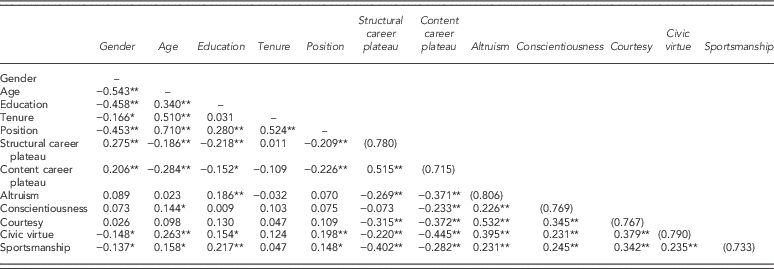
Next, the discriminant validity of those latent variables was examined by comparing the AVE values with its correlation coefficients. Although all the variables could be distinguished as independent of one another, it is necessary that this distinguishability be proved by way of mathematical statistics. To prove discriminant validity in a measurement model containing latent variables, the square root of the AVE for each latent variable must exceed any of the bivariate correlations involving the latent variables. Table 4 shows that the correlation coefficients of all the measures, including the control variables, and the square root values of the AVE are shown within parentheses. The smallest AVE value is 0.715, and the highest correlation coefficient is 0.532. Thus, discriminant validity is satisfied.
Discriminant validity test with average variance extracted (AVE) and correlation coefficients

Note. Values in the parentheses are the square root of each AVE value.
*p<.05; **p<.01.
Hierarchical regression analyses and hypotheses testing
Based on the pretest results, the research hypotheses were examined through hierarchical regression analyses. Before inserting the explanatory variables into the regression equations, those variables were modified via mean centering to avoid possible multicollinearity issues wherein the independent variables are highly correlated with each other. In this study’s model, the squared term and the interaction term were used, both of which are likely to trigger the multicollinearity problem, and thus, the above-mentioned treatment was necessary. In the first step, the hierarchical regression analysis was composed of three models. For the first model, the control variables were inserted as explanatory factors into the regression equation. This first model was to serve as a baseline for comparison, to identify the increase in the coefficient of determination and the significance of the F value. A single term for the career plateau was inserted additionally in model 2. The regression coefficient of this single term provides important information; the one-dimensional relational sign between the independent and dependent variables was based on the assumption that the relationship is not two-dimensional. It also functioned as a comparison for the final step. Given below is this study’s hierarchical regression model. This model was analyzed 10 times because there are five independent variables and two dependent variables.
 $$\matrix{ {{\rm Model}\,{\rm 1\,\colon\,}} \hfill & {{\rm OCB}\, {\equals}\, {\rm \beta }_{{\rm 0}} {\plus}{\rm \beta }_{{\rm 1}} \cdot {\rm C}{\plus}{\rm {\varepsilon}}} \hfill \cr {{\rm Model}\,{\rm 2\,\colon\,}} \hfill & {{\rm OCB}\, {\equals}\, {\rm \beta }_{{\rm 0}} {\plus}{\rm \beta }_{{\rm 1}} \cdot {\rm C}{\plus}{\rm \beta }_{{\rm 2}} \cdot {\rm CP}{\plus}{\rm {\varepsilon}}} \hfill \cr {{\rm Model}\,{\rm 3\,\colon\,}} \hfill & {{\rm OCB}\, {\equals}\, {\rm \beta }_{{\rm 0}} {\plus}{\rm \beta }_{{\rm 1}} \cdot {\rm C}{\plus}{\rm \beta }_{{\rm 2}} \cdot {\rm CP}{\plus}{\rm \beta }_{{\rm 3}} \cdot {\rm CP}^{{\rm 2}} {\plus}{\rm {\varepsilon}}} \hfill \cr } $$
where CP=career plateau, OCB=organizational citizenship behavior, C=control variables.
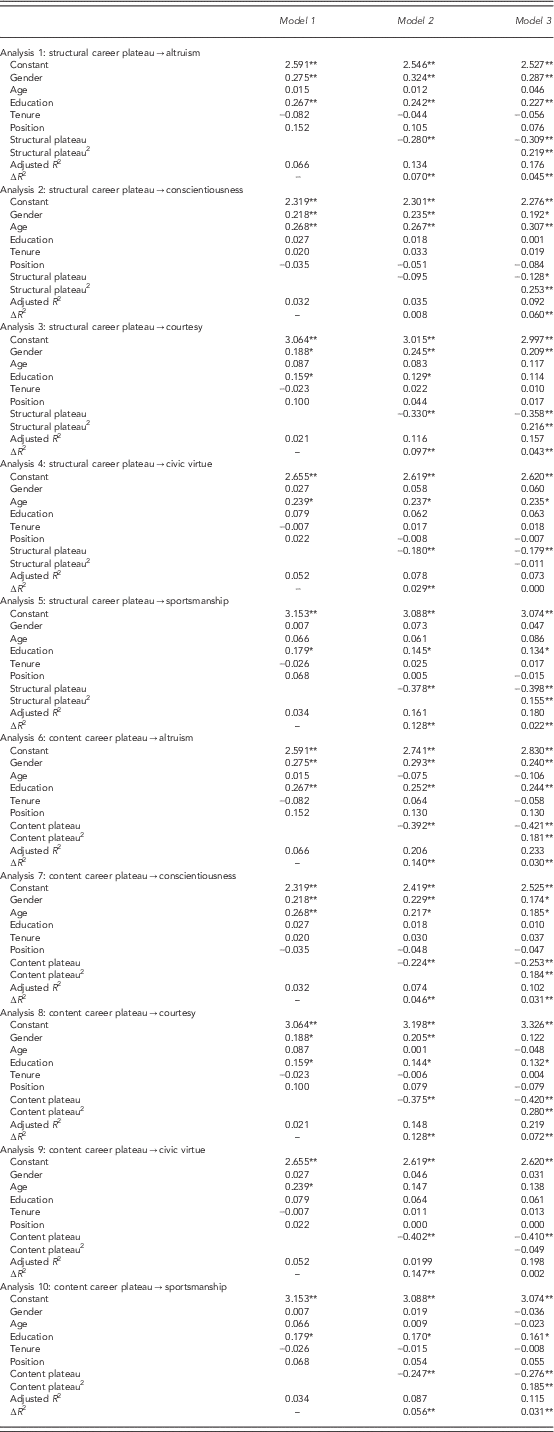
Before checking the results of the regression analyses, the values of the variance inflation factor (VIF) and the Durbin–Watson statistic were verified. As the variance inflation factors of these regression models ranges from 1.071 to 1.119, the multicollinearity issue could be ruled out. The Durbin–Watson statistic for testing autocorrelation ranges from 1.708 to 1.955. Table 5 provides the results of the regression analyses, wherein all the t-tests are conducted using a one-tailed test because this study intended to identify the directions of the curved relationship between the career plateau and citizenship behavior.
Results of the hierarchical regression analysis

Note. N=214, *p<.05; **p<.01.
A closer look at the results of the regression analyses, particularly the control variables, shows that gender has a significant effect on altruism, courtesy, and conscientiousness, and age affects conscientiousness and civic virtue. Education is also related to three subdimensions of OCB, but tenure and position have no significant effect on any of its subdimensions.
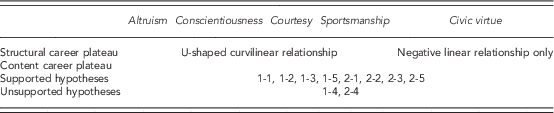
The results of the regression analyses indicate that values are paired according to the two dimensions of the career plateau. In the case of altruism (see analyses 1 and 6), the two dimensions of the career plateau show significant regression coefficients for the independent variable for both the normal and the squared terms (β of structural plateau2=0.219, β of content plateau2=0.181, p<.01), and the adjusted R 2 and variation in R 2 are adequate. In the case of the other three independent variables, the results of the regression analyses are the same as those in the case of altruism, and all the models display acceptable values for the adjusted R 2 and variation in R 2. However, interestingly, civic virtue alone does not have a significant coefficient for the squared terms of both career plateau dimensions (β of structural2=−0.011, β of content2=−0.049, p>.05), although it does report a significant coefficient with the single terms (β of structural=−0.179, β of content=−0.410, p<.01). In short, the two dimensions of the career plateau show significant positive coefficients with regard to all subdimensions of OCB except civic virtue. The positive coefficients of the squared terms mean that the relationship between the independent and dependent variables is curved and U-shaped. Civic virtue alone has a significant negative coefficient with a single term, and thus, the career plateau has a negative linear relationship with this dimension. Therefore, hypotheses 1-4 and 2-4 are not supported, but all the other hypotheses of step 1 are supported (Table 6).
Results of the hierarchical regression analysis – step 1

To compare the relationship between civic virtue and the structural career plateau with the other relationships between the four subdimensions of OCB and the structural plateau, two graphs (Figure 1) were drawn that show the difference between the curvilinear relationship of altruism and the linear relationship of civic virtue. One should not focus on the absolute values of the graphs in Figure 1; rather, their shapes are important. These phenomena are discussed in the concluding section, namely, why the four subdimensions of OCB are curved while that of civic virtue is not. However, the moderator effects of two kinds of engagement on the four curved relationships were investigated before discussing the results of step 1.
The two relationships of the structural plateau with altruism and civic virtue

Step 2: Examining the moderator effects of organizational commitment and job involvement on the four curvilinear relationships
Confirmatory factor analysis, and reliability and validity of the research variables
Pretests were performed in the same manner as in step 1, and the same factor structure of the previous analysis was used for minimizing the statistical difference between the two analyses. However, as the second step examines the moderator effects on the curvilinear relationships, civic virtue, a dependent variable in the previous analysis was excluded. To test convergence validity, the standardized factor weights of all research variables involving organizational commitment and job involvement were reviewed. The results show that the factor weights range from 0.621 to 0.887, which are suitable for conducting the analysis, and the model fit indices are also adequate (χ2/df=1.617, root mean residual=0.052, comparative fit index=0.936, Tucker–Lewis index=0.924, root mean square error of approximation=0.054 [HI90=0.063]). Because the factor structure of the previous analysis was retained, the established variables have the same factor weights as the results from step 1. Thus, those variables show similar outcomes in the current test of conceptual reliability and validity. Therefore, only the outcome values of the newly inserted variables, organizational commitment and job involvement, were checked. Table 7 presents the values for conceptual reliability and validity of the two variables. As displayed in the table, AVE and conceptual reliability are both appropriate for the analysis, and the AVEs satisfy the criterion of discrimination validity (over 0.408 at least).
Average variance extracted (AVE) and reliability of the newly inserted variables

Hierarchical regression analyses and hypotheses tests
Cohen, Cohen, West, and Aiken (Reference Cohen, Cohen, West and Aiken2003), who identified the significance of the moderator by hierarchically inserting the moderator and interaction terms into the regression equations and comparing them, were followed to examine the moderator effects of organizational commitment and job involvement on the four relationships.
 $$\matrix{ {{\rm Model\ 3\,\colon\,}} \hfill & {{\rm OCB}\, {\equals}\, {\rm \beta }_{0} {\plus}{\rm \beta }_{1} \cdot {\rm C}{\plus}{\rm \beta }_{2} \cdot {\rm CP}{\plus}{\rm \beta }_{3} \cdot {\rm CP}^{2} {\plus}{\rm {\varepsilon}}} \hfill \cr {{\rm Model\ 4\,\colon\,}} \hfill & {{\rm OCB}\, {\equals}\, {\rm \beta }_{{\rm 0}} {\plus}{\rm \beta }_{{\rm 1}} \cdot {\rm C}{\plus}{\rm \beta }_{{\rm 2}} \cdot {\rm CP}{\plus}{\rm \beta }_{{\rm 3}} \cdot {\rm CP}^{{\rm 2}} {\plus}{\rm \beta }_{{\rm 4}} \cdot {\rm OC}{\plus}{\rm \beta }_{{\rm 5}} \cdot {\rm JI}{\plus}{\rm {\varepsilon}}} \hfill \cr {{{\vskip -10pt\rm Model\ 5\,\colon\,}}} \hfill & \matrix{ {\rm OCB}\, {\equals}\, {\rm \beta }_{{\rm 0}} {\plus}{\rm \beta }_{{\rm 1}} \cdot {\rm C}{\plus}{\rm \beta }_{{\rm 2}} \cdot {\rm CP}{\plus}{\rm \beta }_{{\rm 3}} \cdot {\rm CP}^{{\rm 2}} {\plus}{\rm \beta }_{{\rm 4}} \cdot {\rm OC}{\plus}{\rm \beta }_{{\rm 5}} \cdot {\rm JI} \hfill \cr \qquad \quad{\plus}{\rm \beta }_{{\rm 6}} \cdot {\rm CP} \cdot {\rm OC}{\plus}{\rm \beta }_{{\rm 7}} \cdot {\rm CP} \cdot {\rm JI}{\plus}{\rm \beta }_{{\rm 8}} \cdot {\rm CP}^{{\rm 2}} \cdot {\rm OC}{\plus}{\rm \beta }_{{\rm 9}} \cdot {\rm CP}^{{\rm 2}} \cdot {\rm JI}{\plus}{\rm {\varepsilon}} \hfill \cr} \hfill \cr } $$
where CP=career plateau, OCB=organizational citizenship behavior, C=control variables, OC=organizational commitment, JI=job involvement.
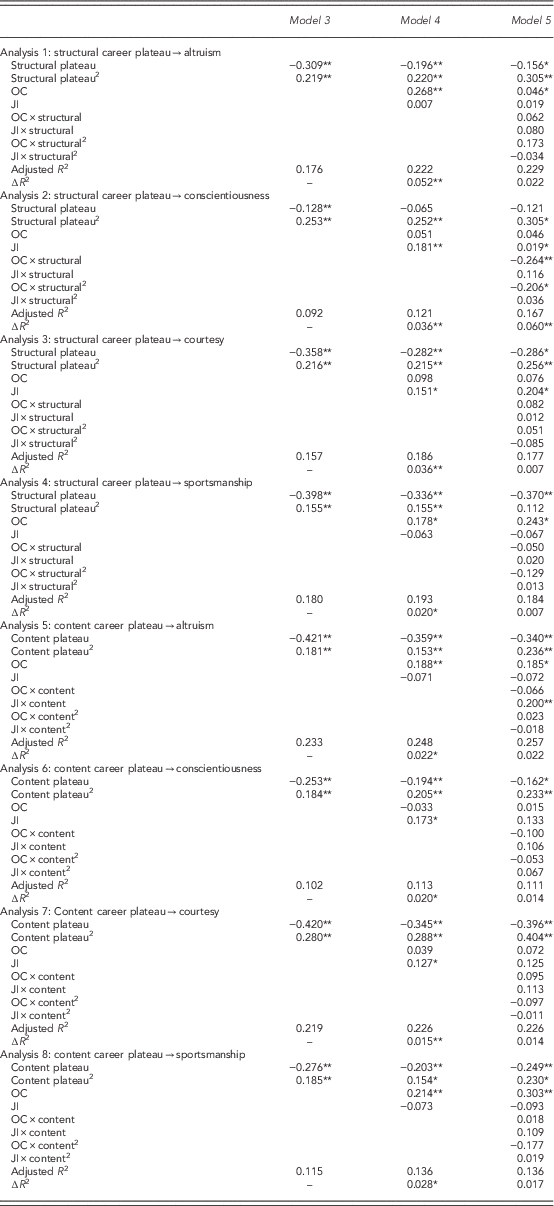
Before examining the results of the regression analyses, the values of variance inflation factor and the Durbin–Watson statistic for multicollinearity and autocorrelation were checked. it was found that the variance inflation factors range from 1.071 to 2.636, and the values of the Durbin–Watson statistic range from 1.726 to 2.022. Both ranges indicate stable values. According to the results of the regression analyses, organizational commitment and job involvement have only two moderating effects on the four cases. One of the variables has no effect on the degree of the curve and influences the linear portion, as indicated by the significant coefficient of the normal interactive term (see analysis 5 in Table 8). Although, the moderating effect on the degree of the curve is shown in analysis 2, the direction of the effect is not consistent with our expectation and the hypothesis. None of the cases except the above-mentioned two have any moderating effect on the curved relationships between the career plateau and OCB. Therefore, hypotheses 3 and 4 are not supported. Table 8 shows the results of the hierarchical regression analyses. Although the control variables were inserted into those analyses, the results do not appear in this paper owing to space limitations.
Results of the hierarchical regression analysis

Note. OC=organizational commitment, JI=job involvement.
N=214, *p<.05; **p<.01.
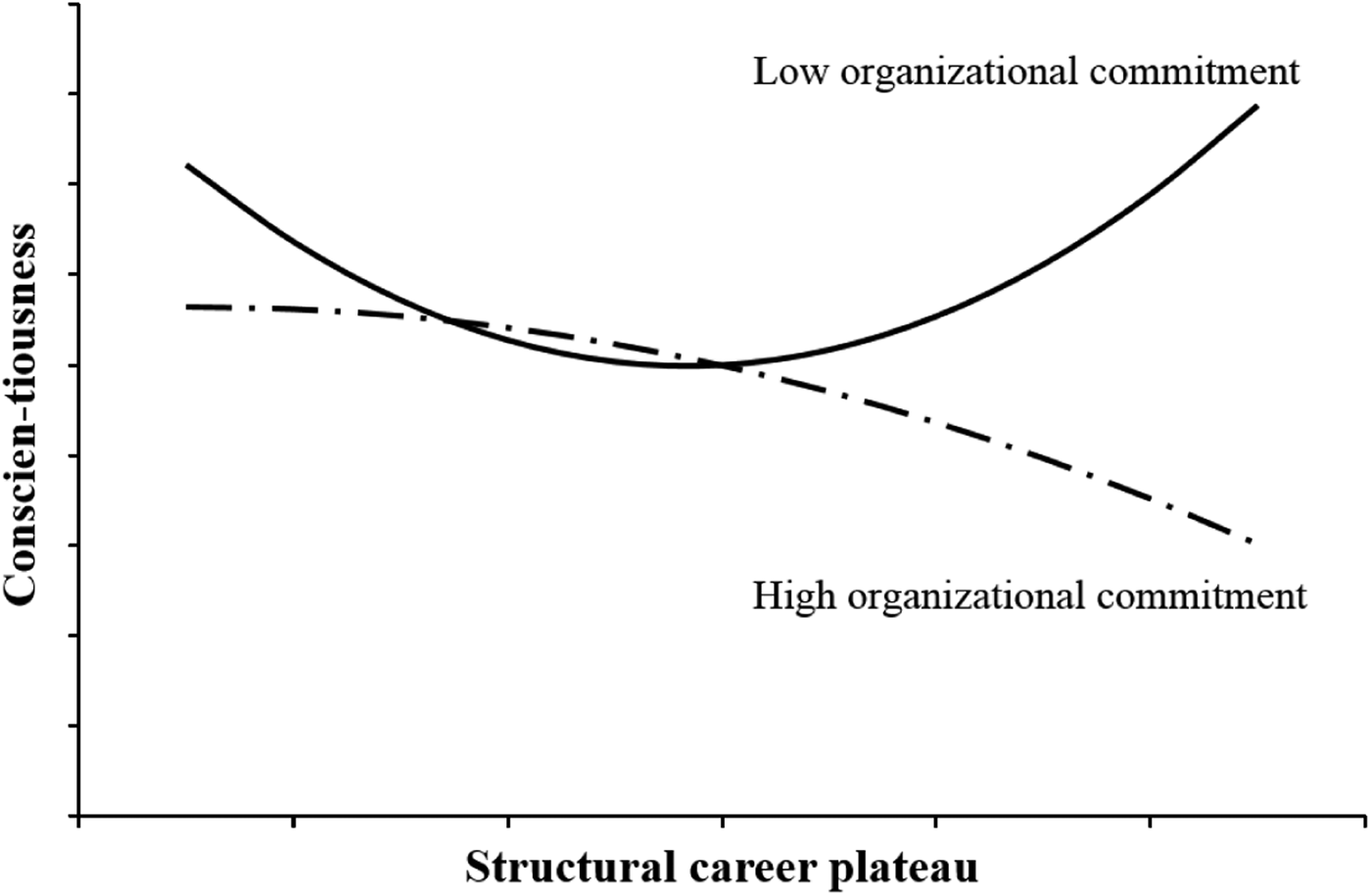
In sum, the result of analysis 2, which shows a significant coefficient of the squared interaction term, indicates that organizational commitment has a moderating effect on the relationship between the structural career plateau and conscientiousness. Moreover, this effect is negative (β of commitment×structural plateau2=−0.206, p<.05), which implies that when the organizational commitment is low, the relationship between the structural career plateau and conscientiousness is U-shaped, but when the commitment is high, the relationship changes into an inverted U-shape. Figure 2 displays these changes in the relationship.
The moderating effect of organizational commitment on the relationship between structural career plateau and conscientiousness

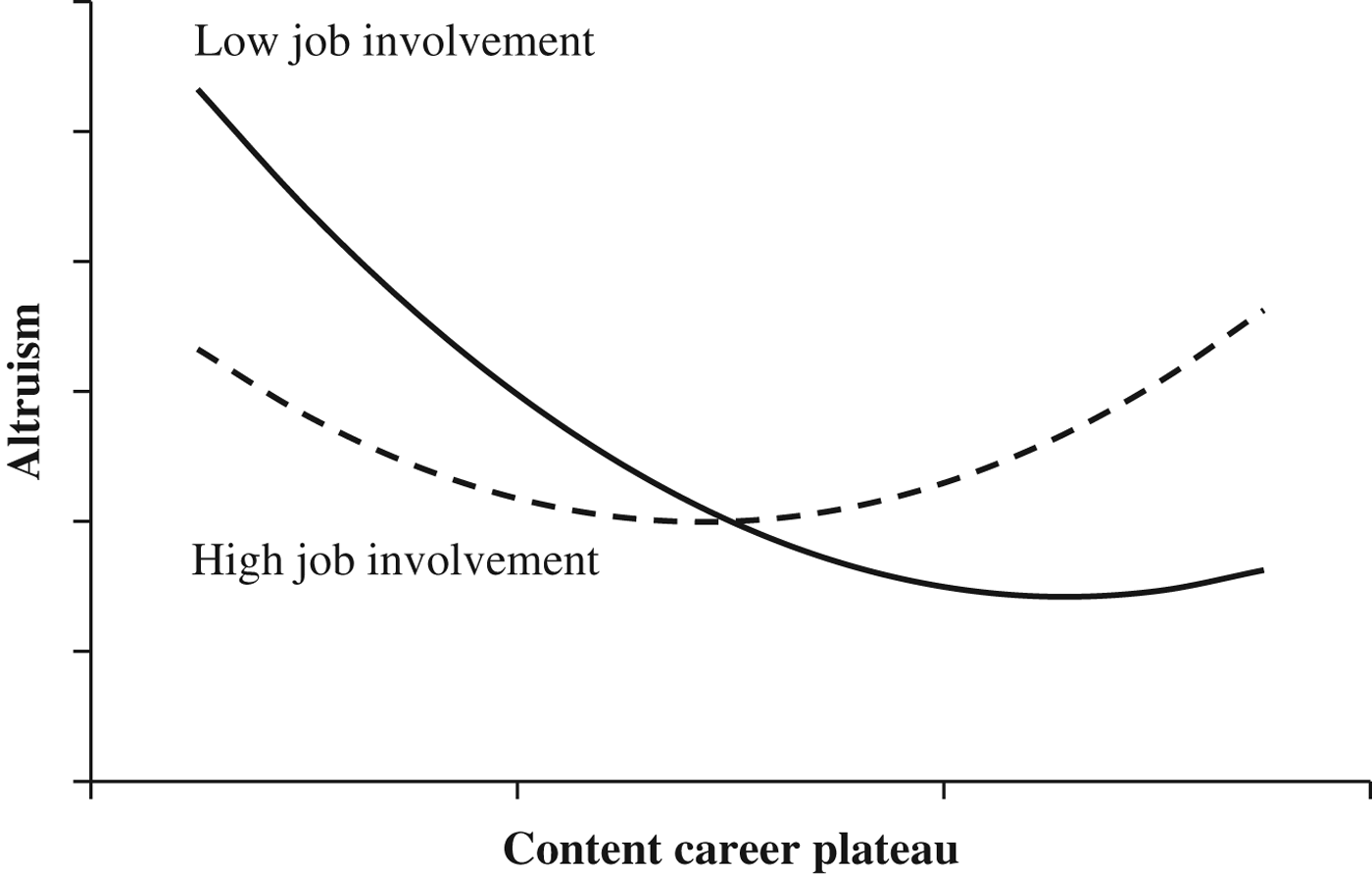
On the other hand, analysis 5 results in a significant coefficient of the normal interaction term of the content career plateau and job involvement, but the coefficient of the squared interaction term (squared content career plateau×job involvement) is not significant. A review of the effect of the moderator in the quadratic function shows that the moderator’s significant coefficient on the quadratic term is related to the degree of the curve. However, a moderator’s coefficient on the linear term has no bearing on the degree of the curve, although it does have a relationship with the position on the graph of the regression function. The coefficient of content career plateau×job involvement is significant and positive (β of involvement×content plateau=0.200, p<.01), which means that if job involvement increases, the position of the relationship between the content career plateau and altruism on the regression graph moves to the upper left. Moreover, the movement implies that total level of altruism increases, and the timing of the altruism rebound moves left (Figure 3).
The moderating effect of job involvement on the relationship between content career plateau and altruism

The analysis in step 2 focused on whether the two variables of organizational commitment and job involvement cause the curve in the relationship between the career plateau and OCB to become more well defined. However, no such effect was observed; rather, organizational commitment has the opposite effect, as it causes the relationship between the structural career plateau and conscientiousness to change into an inverted U-shape. In sum, the results of the analyses display unexpected outcomes, wherein only two of the total of eight analyses show significant regression coefficients. Thus, the results do not indicate that organizational commitment and job involvement have moderating effects on the curvilinear relationships between the career plateau and OCB.
Summary and discussion of the results
From step 1, it was found that altruism, conscientiousness, courtesy, and sportsmanship are related to two career plateaus via a U-shaped nonlinear relationship. This implies that OCB decreases when an employee is experiencing a low level of career plateau. However, when experiencing a higher level of career plateau, four OCB subdimensions, except civic virtue, increase. In addition, it was found that these actions are goal oriented and based on the expectation of reward. This result begs the question as to the traditional linear relationship between OCB and other variables, such as perception of fairness, job satisfaction, psychological contract, personality variables, and value variables, considered by previous studies. While the revealed nonlinear relationship cannot be extended to all related variables, it is important to note that some relationships may have been overlooked by traditional linear models.
The second significant result concerns the relationship between the career plateau and civic virtue. Civic virtue has a negative relationship with the structural and content plateaus. Unlike the other four subdimensions of OCB, civic virtue has a negative relationship with the career plateau. When one interprets the nonlinear relationship of OCB as resulting from goal-oriented actions, this implies that civic virtue is perceived as an inappropriate sentiment to overcome the career plateau. Civic virtue is a representation of one’s macroscopic interest and engagement towards the organization. Civic virtue can take diverse forms such as paying attention to changes in the organization, participating in meetings, and actively protecting the organization from outside threats. Because of this diversity, civic virtue has assumed different names. Organ (Reference Organ1988) used ‘civic virtue,’ Graham (Reference Graham, Dienesch and Van Dyne1994) referred to ‘organizational participation,’ and George and Brief (Reference George and Brief1992) used ‘protecting the organization’ (Organ, Podsakoff, & MacKenzie, Reference Organ, Podsakoff and MacKenzie2006). Civic virtue differs from the other four subdimensions in that it is focused on the organization. If an employee exhibits OCB to overcome the career plateau, the goal is to approach someone who can help the employee overcome the career plateau, for example, a manager who has the power to decide jobs and positions. However, because civic virtue focuses on the best interests of the organization, this action is the least effective for conveying one’s competence to others. One can see that civic virtue is caused more often by the obligation to reciprocate rather than expected reciprocity.
Step 2 showed that our predictions were wrong, which may be a more fruitful result. First, there was no moderating effect of organizational commitment and job involvement on all nonlinear relationships between the career plateau and OCB. Higher engagement was expected to increase the slope of the U-shaped curve, but the result was to the contrary. Engagement did not have a moderating effect on most relationships, except conscientiousness for the structural plateau and altruism for the content plateau. Furthermore, the moderating effect on the content plateau–altruism relationship was found to be of the first order, which is not related to nonlinearity. These results show that an element other than engagement is the core reason for the rebounding of OCB owing to the career plateau. As shown by Lam et al. (Reference Lam, Ashford, Liang and Lee2015), psychological capital, personality, experience, and culture are other variables that may have a moderating effect.
Another interesting result from step 2 is that of the peculiar moderating effect found on the relationships between the structural plateau and conscientiousness, and the content plateau and altruism. First, regarding the relationship between the structural plateau and conscientiousness, as organizational commitment increases, the U-shaped curve flattens. When organizational commitment reaches a certain level, the relationship becomes negative, and when it attains the highest Likert scale, conscientiousness increases as the level of the structural plateau becomes higher. This result can be interpreted as follows. Organizational commitment, in simple terms, denotes the love of an employee for his/her organization. When employee is attached to the organization, he/she expresses love for it via conscientiousness and does not depend on others to recognize this sentiment, which is not based on expected reciprocity. Therefore, even if the level of the structural plateau increases, conscientiousness does not come into play as an instrument to overcome the career plateau; higher organizational commitment only brings more despair, which further reduces conscientiousness. On the other hand, those with low organizational commitment do not expect much from the organization, and it is unlikely that their actions are based on the obligation to reciprocate. These employees have more psychological capacity and a greater ability to use conscientiousness to overcome the structural plateau. Organizational commitment had moderating effect on the relationship between the structural plateau and conscientiousness only, while job involvement had a moderating effect on the content plateau–altruism relationship only. However, this moderating effect did not apply to the nonlinear part of the relationship, but to the overall relationship. The first-order term in the quadratic equation specifies the location of the curve. In the content plateau–altruism relationship, as job involvement increased, the whole curve moved to the northeast direction of the graph. This means that employees with high job involvement have high altruism, and their altruism levels rebound more quickly. Conversely, those with low job involvement show a rebound of altruism when the level of the content plateau gets much higher and that of altruism is low overall. The content plateau refers to one’s identity in his/her job. Stress from the job plateau is likely to be overcome through advice from co-workers. Such interactions with co-workers may stem from the instrumental realization of altruism; those who are more attached to their current jobs may make such efforts much earlier than others.
Conclusion
Theoretical implications
The results lead to the following theoretical implications. First, empirical evidence on the nonlinear relationships pertaining to OCB was provided. The estimation of the nonlinear relationship using multiple regression helped us understand complicated human behavior. However, research on nonlinear relationships regarding OCB and organizational behavior as a whole is scarce. Notably, no study has explored the nonlinear relationships with regard to OCB in the Korean context. Although a past study has identified nonlinear relationships among the variables of interest in the field of organizational behavior, this study is more specific as it pinpointed the nonlinear relationship between the career plateau and OCB. Such nonlinear identifications help improve the understanding of the complex interaction between different variables of organizational behavior.
Second, on the motivation for OCB, it was noted that the obligation to reciprocate and expected reciprocity can dominate each other. Causal analysis using linear models only identified fragmental effects over the sample. However, the quadratic curve estimation used in the present study can better identify how OCB is modified by the changes in the level of the career plateau. It was noted that the manifestation of OCB is not consistent and is affected by the environment. The possibility of changing OCB over time was also explored, as well as the manner in which OCB can help employees in the political sense. Future studies may focus on how OCB resulting from the obligation to reciprocate differs from goal-oriented OCB.
Third, each subdimension of OCB was analyzed. Most researchers agree that these subdimensions are not similar in any sense. This study used all five subdimensions of OCB suggested by Organ (Reference Organ1988), and found that only civic virtue did not have a nonlinear relationship with the career plateau. The results confirmed the differences between the various subdimensions of OCB.
Practical implications
With the exception of civic virtue, four OCB behaviors were reinforced when the career plateau was above a certain level. This shows how employees try to overcome obstacles, and implies that reaching a certain level of the career plateau can be helpful in drawing out active participation of employees. If one cannot escape from the career plateau because of the pyramid structure, it may be prudent to use the plateau to promote participation. However, one should be aware of the fact that civic virtue did not show a rebound. Managers should thus be reminded that civic virtue is always reduced with higher levels of the career plateau.
The study found that organizational commitment and job involvement of the employee did not have any effect on the rebounding of OCB. Other variables, such as organizational culture or personal traits, may affect the rebound. Therefore, managers should cultivate an active and challenging culture to help employees overcome obstacles. Although it is known which personality trait causes the rebound, managers should be careful to select employees who can merge into the prevailing culture of the organization.
Limitations and future research
The first limitation of this study is that a good moderating variable could not be identified. Engagement was not a satisfactory enough moderating variable. Other variables may have provided better results. Second, the study did not take account of time. The study agenda concerned the change in OCB reaction. If time series data were used, more information could have been obtained to base the conclusions upon. These limitations lead to suggestions for future studies, including horizontal and vertical expansions of the nonlinear relationship. The horizontal expansion would apply nonlinearity to other diverse concepts and logic. A vertical expansion would entail employing a higher order of nonlinearity or using mediational or multilevel analysis. For example, Harris, Kacmar, and Witt (Reference Harris, Kacmar and Witt2005) explored the possibility of using a cubic function in regression analysis. Regression using multinomial functions may have better explanatory power than linear regression, and this advantage needs to be exploited. Second, future studies could focus on the difference between the various subdimensions of OCB. Although OCB is a heavily researched topic, most previous studies considered OCB as a whole. It was found that the subdimensions of OCB may differ significantly, and this fact deserves more attention. Future studies should address this concern and try to consider the characteristics of each subdimension. Finally, the importance of identifying moderating variables was underscored. The study could not exactly detect moderating variables for the nonlinear relationship between the career plateau and OCB. However, the candidate variables include personality, organizational culture, and job characteristics. Future studies may employ these variables to find a moderating variable, and to further clarify the nonlinear relationship of OCB with the obstacles faced by employees within their organizations.