Introduction
Prior research indicates that perceptions of cognitive dysfunction and reduced performance on cognitive tests are related to poorer workplace outcomes in people with multiple sclerosis (pwMS) including unemployment, reduced work hours, negative work events, and/or changed expectations about future employment (Beatty, Blanco, Wilbanks, Paul, & Hames, Reference Beatty, Blanco, Wilbanks, Paul and Hames1995; Benedict, Rodgers, Emmert, Kininger, & Weinstock-Guttman, Reference Benedict, Rodgers, Emmert, Kininger and Weinstock-Guttman2014; Benedict et al., Reference Benedict, Wahlig, Bakshi, Fishman, Munschauer, Zivadinov and Weinstock-Guttman2005; Edgley, Sullivan, & Dehoux, Reference Edgley, Sullivan and Dehoux1991; Honan et al., Reference Honan, Brown, Hine, Vowels, Wollin, Simmons and Pollard2012; Honan, Brown, & Hine, Reference Honan, Brown and Hine2014; Rao, Leo, Ellington, et al., Reference Rao, Leo, Ellington, Nauertz, Bernardin and Unverzagt1991). Cognitive dysfunction is a common (Khan, McPhail, Brand, Turner-Stokes, & Kilpatrick, Reference Khan, McPhail, Brand, Turner-Stokes and Kilpatrick2006; Rao, Leo, Bernardin, & Unverzagt, Reference Rao, Leo, Bernardin and Unverzagt1991) and often disabling consequence of MS that can occur at any phase in the illness, even in the early stages (Jønsson et al., Reference Jønsson, Andresen, Storr, Tscherning, Soelberg Sørensen and Ravnborg2006; Schulz, Kopp, Kunkel, & Faiss, Reference Schulz, Kopp, Kunkel and Faiss2006). While employment, is an important contributor of quality of life (QOL) in pwMS (Aronson, Reference Aronson1997; Benedict et al., Reference Benedict, Wahlig, Bakshi, Fishman, Munschauer, Zivadinov and Weinstock-Guttman2005; Miller & Dishon, Reference Miller and Dishon2006). However, as detailed below, few studies have evaluated the relative contribution of perceived and actual cognitive changes to employment in pwMS or how these changes may be augmented by depressed feelings, which are also common in MS patients (Arnett, Barwick, & Beeney, Reference Arnett, Barwick and Beeney2008).
There are also mixed findings in the literature evaluating the relationship between cognitive test performance and perceived cognitive difficulties. While most prior studies have found little or no relationship between these factors (Beatty & Monson, Reference Beatty and Monson1991; Benedict, Munschauer, et al., Reference Benedict, Munschauer, Linn, Miller, Murphy, Foley and Jacobs2003; Lovera et al., Reference Lovera, Bagert, Smoot, Wild, Frank, Bogardus and Bourdette2006; Maor, Olmer, & Mozes, Reference Maor, Olmer and Mozes2001; Taylor, Reference Taylor1990), when the measures of self-reported cognition correspond closely to the specific cognitive domains being tested, significant relationships have been detected (Chiaravalloti & De Luca, Reference Chiaravalloti and De Luca2003; Goverover, Genova, Hali, Chiaravolloti, & DeLuca, Reference Goverover, Genova, Hali, Chiaravalloti and DeLuca2014; Matotek, Saling, Gates, & Sedal, Reference Matotek, Saling, Gates and Sedal2001; Randolph, Arnett, & Freske, Reference Randolph, Arnett and Freske2004; Randolph, Arnett, & Higginson, Reference Randolph, Arnett and Higginson2001). In this study, perceived general cognitive problems and prospective memory problems were evaluated separately as measures of perceived cognitive difficulties.
Many previous studies of employment in pwMS have examined only employment status as a work outcome. However, the use of this dichotomous variable has been criticised for lacking the ability to detect more subtle changes in the workplace (Benedict et al., Reference Benedict, Rodgers, Emmert, Kininger and Weinstock-Guttman2014; Benedict & Walton, Reference Benedict and Walton2012; Honan et al., Reference Honan, Brown, Hine, Vowels, Wollin, Simmons and Pollard2012). Thus, in this study, reduced work hours and a change in the type of work performed since diagnosis due to MS were examined.
Several studies indicate that perceived cognitive functioning may be more strongly associated with mood or depression levels than cognitive test performance (Benedict et al., Reference Benedict, Cox, Thompson, Foley, Weinstock-Guttman and Munschauer2004; Christodoulou et al., Reference Christodoulou, Melville, Scherl, Morgan, Macallister, Canfora and Krupp2005; Gold, Schulz, Monch, Schulz, & Heesen, Reference Gold, Schulz, Monch, Schulz and Heesen2003; Lovera et al., Reference Lovera, Bagert, Smoot, Wild, Frank, Bogardus and Bourdette2006; Maor et al., Reference Maor, Olmer and Mozes2001; Middleton, Denney, Lynch, & Parmenter, Reference Middleton, Denney, Lynch and Parmenter2006). Depression is also a strong independent predictor of QOL in pwMS (Janardhan & Bakshi, Reference Janardhan and Bakshi2002; Janssens et al., Reference Janssens, van Doorn, de Boer, van der Meché, Passchier and Hintzen2003; Lobentanz et al., Reference Lobentanz, Asenbaum, Vass, Sauter, Klösch, Kollegger and Zeitlhofer2004) and lifetime prevalence estimates of major depression are as high as 50% in this population (Chwastiak et al., Reference Chwastiak, Ehde, Gibbons, Sullivan, Bowen and Kraft2002; Sadovnik, Reference Sadovnik1996; Schubert & Foliart, Reference Schubert and Foliart1993).
In addition, depression has been found to be related to reduced cognitive performance in pwMS. For example, it has been consistently found to be related to tasks involving central executive function or tasks with high attentional capacity demands (e.g., Reading Span test, PASAT, SDMT, Visual Elevator Task, Tower of London) (Arnett, Higginson, & Randolph, Reference Arnett, Higginson and Randolph2001; Arnett, Higginson, Voss, Bender, et al., Reference Arnett, Higginson, Voss, Bender, Wurst and Tippin1999; Arnett, Higginson, Voss, Wright, et al., Reference Arnett, Higginson, Voss, Wright, Bender, Wurst and Tippin1999; Niino et al., Reference Niino, Mifune, Kohriyama, Mori, Ohashi, Kawachi and Kikuchi2014), although no relationships have typically been reported between depression and performance on learning and memory tasks (Arnett, Higginson, Voss, Bender, et al., Reference Arnett, Higginson, Voss, Bender, Wurst and Tippin1999; Arnett, Higginson, Voss, Wright, et al., Reference Arnett, Higginson, Voss, Wright, Bender, Wurst and Tippin1999; Karadayi, Arisoy, Altunrende, Boztas, & Sercan, Reference Karadayi, Arisoy, Altunrende, Boztas and Sercan2014; Niino et al. Reference Niino, Mifune, Kohriyama, Mori, Ohashi, Kawachi and Kikuchi2014; Sundgren, Maurex, Wahlin, Piehl, & Brismar, Reference Sundgren, Maurex, Wahlin, Piehl and Brismar2013). Only one study has found that severely depressed pwMS performed worse on a task of verbal learning (Selective Reminding Task) than mildly depressed pwMS (Demaree, Gaudino, & De Luca, Reference Demaree, Gaudino and De Luca2003).
However, prior research has typically not found a relationship between depression and work status in pwMS (Beatty et al., Reference Beatty, Paul, Wilbanks, Hames, Blanco and Goodkin1995; Benedict et al., Reference Benedict, Wahlig, Bakshi, Fishman, Munschauer, Zivadinov and Weinstock-Guttman2005), although there are indications that depression may be related to more subtle work problems such as formal reprimands or reduced working hours (Benedict et al., Reference Benedict, Rodgers, Emmert, Kininger and Weinstock-Guttman2014). In addition, the relationship between perceived cognitive difficulties and cognitive impairment may vary as a function of depression severity. Bruce and Arnett (Reference Bruce and Arnett2004) recently found that the relationship between perceived everyday memory and performance on verbal memory and attention/concentration tasks differed depending on depression severity; such that the non-depressed pwMS tended to overestimate, moderately depressed pwMS accurately estimated, and mildly depressed pwMS tended to underestimate their memory ability. However, depression remains untested as a potential mediator between perceived cognitive difficulties, actual cognitive test performance, and work outcomes in pwMS.
To summarize, perceived cognitive difficulties in pwMS does not tend to accord with their cognitive test performance. Nonetheless, perceived cognitive difficulties and cognitive test performance are both related to depression and employment outcomes in pwMS. However, the extent to which perceived cognitive difficulties and cognitive test performance are independently related to work outcomes and the influence of depression remains unclear. Thus, the aim of the current study was to examine the relationships between perceived cognitive difficulties, cognitive test performance, depression severity, and workplace outcomes in pwMS. Perceptions of cognitive difficulties in the workplace, as opposed to perceptions of general cognitive difficulties, were measured in this study. This is because the subjective experience of cognitive difficulties in the workplace setting may differ from that experienced in other settings (e.g., social settings), and may affect work outcomes differently as a result (Honan et al., Reference Honan, Brown, Hine, Vowels, Wollin, Simmons and Pollard2012).
Finally, a measure of cognitive awareness accuracy was computed and used as an additional predictor in the analyses in this study. That is, standardized general cognitive and prospective memory test scores were compared to the standardized scores for the participant’s perceived abilities in these domains, and the difference score was used as an indicator of the accuracy with which they perceived their functioning in this domain, similar to the approach used by Bruce and Arnett (Reference Bruce and Arnett2004) who evaluated participants who over- or under-estimated their cognitive abilities. An awareness of one’s difficulties is an important indicator of rehabilitation readiness and an important catalyst of rehabilitative change (Ownsworth et al., Reference Ownsworth, Stewart, Fleming, Griffin, Collier and Schmidt2013). Awareness of functional impairments has also been demonstrated in individuals with traumatic brain injury (TBI) to be an important determinant of employment outcomes (Sherer et al., Reference Sherer, Bergloff, Levin, Walter, Oden and Nick1998).
The following hypotheses were tested: (1) stronger cognitive test performance will be negatively associated with poorer work outcomes; (2) higher perceived cognitive difficulties will be associated with poorer work outcomes (over and above cognitive test performance); (3) cognitive awareness accuracy (difference score between perceived and actual cognition) will be associated with poorer work outcomes; and (4) depression will mediate and/or moderate the relationships between perceived cognitive difficulties, cognitive test performance, cognitive awareness accuracy, and the work outcomes.
Methods
Participants
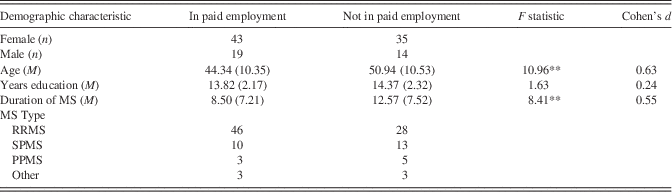
Ethics approval for the study was obtained from the ethics committees of the University of New England and MS Australia (ACT, NSW, Vic). The research was carried out in accordance with the Helsinki Declaration. One-hundred twenty community-derived pwMS who were currently or previously employed participated in the study. Nine cases were deleted due to excessive missing data on the work-difficulties questionnaire (>50%), leaving a final total of 111 (33 males, 78 females) participants. More than half (56%) were in full- or part-time paid employment (n=28 full-time, 34 part-time). For the remainder, the average time since last paid employment was 4.92 years (SD=4.33).
Participants were recruited via invitation letters (sent through the Australian ACT/NSW/Vic MS Society) and advertisements placed in the society’s InTouch magazine. Study exclusion criteria included age of less than 18 years, unable to read and speak English or a diagnosis of a psychotic, or bipolar or related disorder, or MS relapse in the past 2 weeks. Additional demographic information stratified by employment status is provided in Table 1.
Participant Demographic Characteristics Stratified by Work Status with Comparisons Statistics
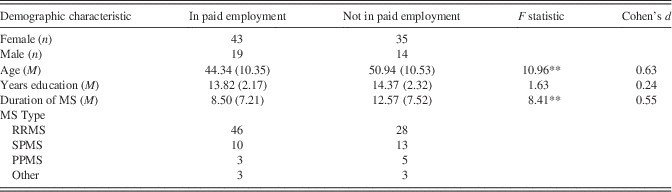
Note. Standard deviation values are shown in brackets. MS type where possible was confirmed by treating neurologists using McDonald’s 2010 criteria (Polman et al., Reference Polman, Reingold, Edan, Filippi, Hartung, Kappos and Wolinsky2005; Reference Polman, Reingold, Banwell, Clanet, Cohen, Filippi and Wolinsky2011). Where this was not possible, self-reported MS-type was used.
*p<.05.
**p<.01.
M=Mean; PPMS=primary-progressive MS; RRMS=relapsing-remitting MS; SPMS=secondary-progressive MS.
Procedure
The study questionnaire that asked participants about their MS disease characteristics, employment, and work difficulties was mailed to the participants. Completed questionnaires were collected when cognitive testing and interview to clarify MS diagnosis was undertaken (within 2-weeks of questionnaire being sent to participants).
Cognitive Test Measures
Cognitive tests were selected for the following reasons: (1) they measure cognitive domains commonly affected in pwMS; (2) they possess reasonable psychometric properties and have been validated in MS populations; (3) they measure similar cognitive domains as the cognitive difficulty items on the MSWDQ; and (4) when combined, they form a relatively brief battery of tests. Lengthy administration may be particularly problematic in pwMS due to fatigue (Macallister & Krupp, Reference Macallister and Krupp2005).
Cambridge Prospective Memory Test
The Cambridge Prospective Memory Test (CAMPROMPT; Wilson et al., Reference Wilson, Emslie, Foley, Shiel, Watson, Hawkins and Evans2005) is an ecologically valid 25-min measure of prospective memory that includes three event- and three time-based tasks. Examples include remembering at the end of the test, where objects were hidden at the beginning of the test (i.e., event-based cue), or reminding the examiner not to forget their keys 7 min before test completion (i.e., time-based cue). Various paper and pencil-based distracter tasks are completed during the test. The CAMPROMPT has excellent interrater reliability (r=.99), adequate test–retest reliability over 7–10 days (Kendall’s Tau-b=.64), and it is moderately correlated with other measures of everyday memory, attention, and executive functioning (Wilson et al., Reference Wilson, Emslie, Foley, Shiel, Watson, Hawkins and Evans2005), and can distinguish the performance of those with MS from healthy controls (Foley, Wilson, & Shiel, Reference Foley, Wilson and Shiel2004).
Screening Examination for Cognitive Impairment
The Screening Examination for Cognitive Impairment (SEFCI; Beatty, Paul, et al., Reference Beatty, Paul, Wilbanks, Hames, Blanco and Goodkin1995) is a 25- to 30-min test battery used to assess cognitive functioning in pwMS that includes: learning and delayed recall of a 10-word list (three learning trials followed by a 10- to 12-min delay); oral version of the Symbol Digit Modalities Test (SDMT; Lezak, Howieson, & Loring, Reference Lezak, Howieson and Loring2004; Smith, Reference Smith1982); and Vocabulary and Abstraction Scales of the Shipley Institute of Living Scale (SILS; Harnish, Beatty, Nixon, & Parsons, Reference Harnish, Beatty, Nixon and Parsons1994; Zachary, Reference Zachary1994). The Vocabulary Scale was excluded in this study as verbal reasoning is often unaffected in MS. The SEFCI has high sensitivity (86%) and specificity (90%) in distinguishing pwMS with and without cognitive impairment (Beatty, Paul, et al., Reference Beatty, Paul, Wilbanks, Hames, Blanco and Goodkin1995). It is a routine method of screening for cognitive impairment in pwMS (Brown et al., Reference Brown, Tennant, Sharrock, Hodgkinson, Dunn and Pollard2006), and it is comparable to the Neuropsychological Screening Battery for Multiple Sclerosis (NPSBMS) in terms of its ability to detect cognitive impairment (Aupperle, Beatty, Shelton, & Gontkovsky, Reference Aupperle, Beatty, Shelton and Gontkovsky2002; Solari, Mancuso, Motta, Mendozzi, & Serrati, Reference Solari, Mancuso, Motta, Mendozzi and Serrati2002).
Auditory Consonant Trigrams test
The Auditory Consonant Trigrams test (ACT; Stuss, Stethem, & Pelchat, Reference Stuss, Stethem and Pelchat1988; Stuss, Stethem, & Poirier, Reference Stuss, Stethem and Poirier1987) is a task of working memory that requires a person to maintain information in mind while they attend to alternative stimuli that compete for attentional resources (Fleming, Goldberg, Gold, & Weinberger, Reference Fleming, Goldberg, Gold and Weinberger1995). Three letters are recalled following a delay, during which the person is required to count backward by threes (i.e., 100-97-94) for varied periods of time (i.e., 9, 18, and 36 s). Performance on this task is correlated highly (r=.83) with the Paced Auditory Serial Addition Test (PASAT; Ozakbas, Ormeci, Akdede, Alptekin, & Idiman, Reference Ozakbas, Ormeci, Akdede, Alptekin and Idiman2004), which is a longer and more difficult working memory task argued not to be ideal for pwMS (Brooks et al., Reference Brooks, Giraud, Saleh, Rodrigues, Daia and Fragoso2011).
Zoo Map Test
The Zoo Map test (Wilson, Alderman, Burgess, Emslie, & Evans, Reference Wilson, Alderman, Burgess, Emslie and Evans1996), from the Behavioural Assessment of the Dysexecutive Syndrome (BADS), is a spatial planning task that requires a demonstration of how a person would visit a series of designated locations, while adhering to several rules. A high-demand planning version of the task is completed followed by a low-demand version that provides step-by-step instructions. Performance on the test is moderately correlated with similar tests of planning ability (e.g., Porteus mazes), it can discriminate between neurological patients (e.g., traumatic brain injury & MS) and controls, and it is predictive of clinicians’ ratings of everyday role-functioning in neurological patients (Norris & Tate, Reference Norris and Tate2000).
Self-Report Measures
Work outcomes
Participants provided information on their current employment status (paid work vs. not in paid work) and whether their work hours had reduced since diagnosis due to their MS, and if so, the proportion of this reduction. Response options included: “there has been a small reduction (i.e., around 25%),” “there has been a moderate reduction (i.e., around 50%),” “there has been a large reduction (i.e., around 75%),” and “I no longer work at all (i.e., a 100% reduction).” Participants were asked whether the type of work they performed had changed since diagnosis due to their MS (yes, no, unsure).
Multiple Sclerosis Work Difficulties Questionnaire
The Multiple Sclerosis Work Difficulties Questionnaire (MSWDQ; Honan et al., Reference Honan, Brown, Hine, Vowels, Wollin, Simmons and Pollard2012), a 50-item self-report scale of work difficulties with 12 subscales, assesses how frequently a pwMS has experienced workplace difficulties over the past 4 weeks in their current or most recent job. Respondents are asked to rate the difficulties using 5-point scales, ranging from never to almost always. In this study, only scores on the “general cognitive difficulties” (six items; e.g., “I had trouble concentrating on a task”) and “prospective memory difficulties” (five items; e.g., “I forgot about a deadline I had to meet”) subscales were used. The subscales are reported to have high internal consistency, with Cronbach’s alphas of .89 to .92, respectively (Honan et al., Reference Honan, Brown, Hine, Vowels, Wollin, Simmons and Pollard2012).
Beck Depression Inventory-Fast Screen
The Beck Depression Inventory-Fast Screen (BDI-FS; Beck, Steer, & Brown, Reference Beck, Steer and Brown2000) is derived by summing seven items in the BDI-II (Beck, Steer, & Brown, 1996) including: sadness, loss of pleasure (anhedonia), suicidal ideation, pessimism, past failure, self-dislike, and self-criticalness. Vegetative items, which may overlap with the symptoms of MS, are not included. The scale has been validated for use in pwMS (Benedict, Fishman, McClellan, Bakshi, & Weinstock-Guttman, Reference Benedict, Fishman, McClellan, Bakshi and Weinstock-Guttman2003). Scores of 0–3 indicate nil/minimal depression, 4–6 indicates mild depression, 7–9 indicates moderate depression, and 10–21 indicates severe depression. In this study, moderate and severe categories were combined due to low numbers in these groups.
Data Analysis
A composite general cognitive standardized score was calculated by summing z-scores (transformed from the raw scores and based on the mean results of the current sample) on the SDMT, Word List Learning (sum of three learning trials), Word List Delay, ACT, SILS Abstraction Scale, and Zoo Map Test. The internal consistency of the composite measure was high with a Cronbach’s α of .82. In addition, two difference scores of cognitive awareness accuracy were calculated to examine the degree to which: (1) composite cognitive test scores matched the scores on the “perceived cognitive difficulties” subscale of the MSWDQ; and (2) prospective memory (CAMPROMPT) scores matched the scores on the “prospective memory difficulties” subscale. These difference scores were calculated by subtracting standardized z-scores (transformed from the raw scores) of cognitive test performance (multiplied by −1 to correct for directional effects) from the perceived cognitive difficulty standardized scores. Positive values indicated there was an underestimation of cognitive abilities (i.e., perceived cognitive difficulties were higher than actual cognitive difficulties), whereas negative values indicated an overestimation of cognitive ability (i.e., perceived cognitive difficulties were lower than actual cognitive difficulties).
Data was analyzed using IBM SPSS, version 22.0 for Windows. T-tests were used to evaluate differences between pwMS in paid employment and those who were not employed. Stepwise multiple regression and logistic regression analyses were used to examine the relationship between cognitive test performance, perceived cognitive difficulties, and the work outcomes, controlling for age and gender. Total years of education was not significantly related to the composite general cognitive score [F(6,104)=1.75; p=.120] or the CAMPROMPT [F(1,109)=0.31; p=.860], and was, therefore, excluded from all analyses.
Except where indicated all assumptions for t-tests and regressions analyses were met. Missing self-report data were replaced by values imputed using the expectation maximization algorithm in SPSS’s Missing Value Analysis module. Less than 5% of the data was missing in each variable, thus, the results of the analyses are unlikely to be affected by this estimation procedure (Tabachnick & Fidell, Reference Tabacknick and Fidell2013).
Moderation effects were examined using standard regression analyses and SPSS syntax developed by O’Connor (Reference O’Connor1998). As recommended by Cohen, Cohen, West, and Aiken (2003), independent variables were centered about the mean to improve interpretability of the output and multicollinearity diagnostics, but the dichotomous depression group moderator variable was not centered.
Mediation effects were assessed using the guidelines of Shrout and Bolger (Reference Shrout and Bolger2002). For a mediational effect to be present: (1) a significant relationship must be present between the predictor and mediator variables; (2) a significant direct relationship must be present between the mediator and dependent variables, while controlling for the predictor variable; and (3) the indirect path from the predictor variable to the dependent variable via the mediator must be significant. In general, when a significant relationship remains between the predictor variable and dependent variable, after controlling for the mediator, “partial” mediation has occurred, whereas a non-significant relationship indicates a “full” mediation effect. Indirect effects were assessed using the Sobel test (Sobel, Reference Sobel1982).
Results
Comparison Analyses and Correlations
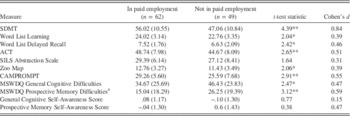
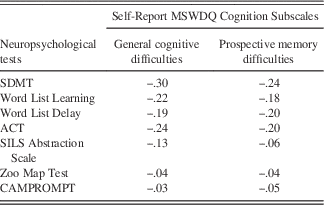
Cognitive test scores, perceived cognitive difficulties, and cognitive awareness accuracy for pwMS in/not in paid employment were compared using independent samples t-tests (see Table 2). PwMS in paid employment scored higher on all the cognitive tests relative to those who were unemployed, with the exception of the SILS Abstraction scale. There was no difference in cognitive awareness scores of the two MS patient groups. Spearman correlations between cognitive test performance and cognitive difficulties are reported in Table 3. Small-to-moderate negative correlations were found between scores on the SDMT, Word List Learning, Word List Delay and ACT, and the two cognitive self-report subscales, although there were negligible associations between the CAMPROMPT and the cognitive difficulties subscales.
Neuropsychological Test Scores, Self-Report Subscale Scores, and Self-Awareness Scores Stratified by Work Status with t-Test Comparisons
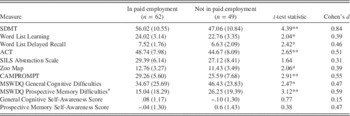
Note. Standard deviation values are shown in brackets.
a Due to violation of normality assumption, the MSWDQ Prospective Memory Difficulties variable was re-run following transformation with no difference in results. Only the original comparison statistic for this variable is reported.
*p<.05.
**p<.01.
ACT=Auditory Consonant Trigrams test; CAMPROMPT=Cambridge Prospective Memory Test; MSWDQ=Multiple Sclerosis Work Difficulties Questionnaire; SDMT=Symbol Digit Modalities Test; SILS=Shipley Institute of Living Scale.
Spearman Correlations Between Neuropsychological Tests and Self-Reported Cognition
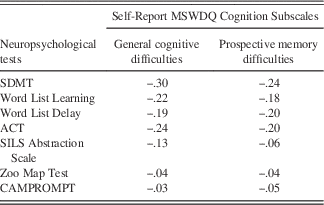
ACT=Auditory Consonant Trigrams test; CAMPROMPT=Cambridge Prospective Memory Test; MSWDQ=Multiple Sclerosis Work Difficulties Questionnaire; SDMT=Symbol Digit Modalities Test; SILS=Shipley Institute of Living Scale.
Logistic Regression Analyses Predicting Unemployment Status
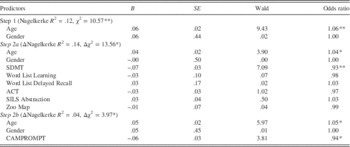
Two stepwise logistic regressions were conducted to examine whether cognitive test performance and perceived cognitive difficulties could predict unemployment status, after controlling for age and gender at Step 1. The six general cognitive tests (i.e., SDMT, word list learning & delayed recall, ACT, SILS Abstraction Scale, Zoo Map Test) were entered at Step 2 in the first analysis, and the CAMPROMPT was entered at Step 2 in the second analysis, see Table 4. The six general cognitive tests accounted for 14.0% of the variance in unemployment, but only the SDMT predicted unique variance in unemployment status. In the second logistic regression, the CAMPROMPT accounted for only 4.2% of the variance in employment status.
Summary of Stepwise Logistic Regression Analyses Investigating the Relationship Between Objective Test Performance Predicting Work Status
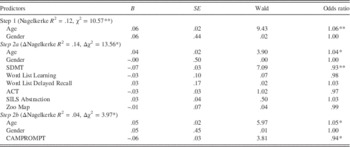
Note. Step 2a and 2b are the results from two separate stepwise logistic regression analyses. For this analysis, “in paid employment” was coded as 1 and “not in paid employment” was coded as 2, thus odds ratio values above 1 are representative of the likelihood of being unemployed.
*p<.05.
**p<.01.
ACT=Auditory Consonant Trigrams test; CAMPROMPT=Cambridge Prospective Memory Test; SDMT=Symbol Digit Modalities Test; SILS=Shipley Institute of Living Scale.
In each analysis, the two respective perceived cognitive difficulty subscale scores were entered at Step 3. χ2 difference tests indicated that perceived general cognitive difficulties did not account for additional variance in employment status over and above general cognitive test performance [χ2(1)=2.78; p=.095]. However, perceived prospective memory difficulties accounted for an additional 12.5% of the variance over and above actual prospective memory performance [χ2(1)=12.45; p<.001; OR=1.41].
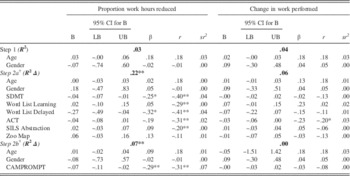
Stepwise Multiple Regression Analyses Predicting Other Employment Outcomes
Two stepwise multiple regression analyses were conducted to examine the ability of cognitive test performance and respective perceived cognitive difficulties to predict the proportion of work hours reduced since diagnosis. In each analysis, age and gender were entered at Step 1. In the first analysis, the six general cognitive tests were entered at Step 2, and in the second, the CAMPROMPT was entered at Step 2, see Table 5. The six general cognitive tests accounted for 21.6% of the variance in the proportion of work hours reduced, and the SDMT and Word List Delayed recall predicted unique variance in the proportion of work hours reduced. All test scores (with the exception of the Zoo Map test) were negatively correlated with this outcome variable. The CAMPROMPT predicted 7.3% of the variance in the proportion of work hours reduced. At step 3, perceived general cognitive difficulties and prospective memory difficulties accounted for an additional 6.3% [FΔ(1,101)=9.33; p=.003] and 16.2% [FΔ(1,106)=23.42; p<.001] of variance in the proportion of work hours reduced, respectively.
Summary of Stepwise Multiple Regression Analyses Investigating the Relationships Between Objective Test Performance and Work Outcomes
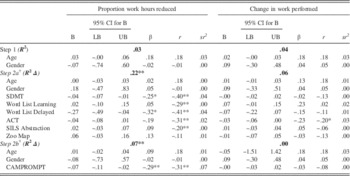
Note: Step 2a and 2b are the results from two separate stepwise regression analyses. Beta values (B) and standardised beta regression coefficients (β) are reported. † a and b refer to variables included at Step 2 in alternative analyses.
*p<.05.
**p<.01.
ACT=Auditory Consonant Trigrams test; CAMPROMPT=Cambridge Prospective Memory Test; LB=lower bound; SDMT=Symbol Digit Modalities Test; SILS=Shipley Institute of Living Scale; sr=semi-partial correlation; UB=upper bound.
However, none of the six cognitive test scores [FΔ(1,102)=.36; p=.231] or the CAMPROMPT [FΔ(1,107)=.81; p=.266] predicted variance in the change in the type of work performed, and neither perceived cognitive difficulties [FΔ(1,101)=.10; p=.148] or perceived prospective memory difficulties [FΔ(1,106)=.10; p=.149] predicted additional variance in this outcome measure.
Finally, stepwise multiple regression analyses were performed to examine the extent to which cognitive awareness accuracy predicted the work outcomes. After controlling for age and gender (entered at Step 1), neither cognitive awareness accuracy [FΔ(1,107)=.32; p=.571] or prospective memory awareness accuracy [FΔ(1,107)=1.95; p=.166] were related to the work hours reduced variable, and neither cognitive awareness accuracy [FΔ(1,107)=.95; p=.332] or prospective memory awareness accuracy [FΔ(1,107)=.65; p=.422] were related to the change in work performed.
Comparison by Depression Severity Group
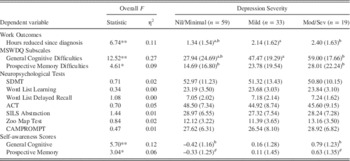
A χ2 analysis indicated that depression severity did not differ according to work status (i.e., employed, unemployed) [χ2(2)=1.16; p=.560]. One-way analyses of variance (ANOVAs) were then conducted to evaluate differences across depression severity groups in reduced work hours, perceived cognitive difficulties, cognitive test performance, and cognitive awareness accuracy, see Table 6. Mild- and moderate/severe-depression severity groups had reduced their hours to a greater extent than the minimal-depression group (Bonferroni adjusted critical value of .017 was used). The mild- and moderate/severe-depression groups also reported more perceived cognitive difficulties, whereas the moderate/severe-depression group reported more perceived prospective memory difficulties, relative to the minimal-depression group. The moderate/severe-depression group also had better cognitive awareness accuracy than the minimal-depression group. That is, depressed pwMS generally underestimated their cognitive abilities, whereas the minimal-depression group somewhat overestimated them. Findings approached significance for prospective memory awareness accuracy (p=.037), but there were no group differences in cognitive test performance.
Summary of Analysis of Variance with Descriptive Statistics for Depression Severity Groups
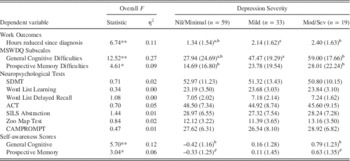
Note. Post-hoc comparisons were performed using Tukey’s Honestly Significant Difference and a Bonferroni-adjusted probability value of .017. Standard deviation values are shown in brackets. In Self-Awareness scores, positive values represented an underestimation of cognitive abilities (i.e., perceived cognitive difficulties were lower than actual cognitive difficulties) and negative values represent an overestimation of cognitive ability (i.e., perceived cognitive difficulties were higher than actual cognitive difficulties).
a Mild Depression group is significantly different from the Nil/Minimal Depression group.
b Moderate/Severe Depression group is significantly different from the Nil/Minimal Depression group.
# The p-value for the comparison between Nil/Minimal and Moderate/Severe Depression groups for Prospective Memory Self-Awareness was .037. η2=eta-squared (variance accounted for in DV by IV).
*p<.05.
**p<.01.
ACT=Auditory Consonant Trigrams test; CAMPROMPT=Cambridge Prospective Memory Test; MSWDQ = Multiple Sclerosis Work Difficulties Questionnaire; SDMT=Symbol Digit Modalities Test; SILS=Shipley Institute of Living Scale.
Depression Moderation Analyses
A series of three-way moderation regression analyses were conducted to ascertain whether the relationships between perceived cognitive difficulties, cognitive test performance, cognitive awareness accuracy, and the proportion of work hours reduced (the dependent variable), each varied as a function of depression level. In each analysis, the predictors included the independent variable, group dummy variables, and independent variable by group dummy variable interaction terms. In all cases, the interaction term was not significant, indicating that depression severity did not moderate between high perceived cognitive difficulties, cognitive test performance, or cognitive awareness accuracy, and the proportion of work hours reduced, and it did not moderate the relationship between perceived cognitive difficulties and cognitive test performance.
Depression Mediation Analyses
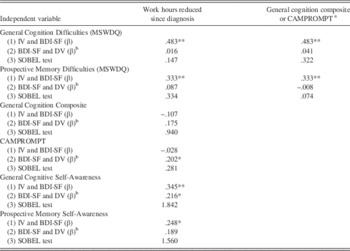
Finally, a series of mediational analyses were conducted to ascertain whether depression scores mediated the relationship between high perceived cognitive difficulties, cognitive test performance, cognitive awareness accuracy, and the proportion of work hours reduced. Using criteria devised by Shrout and Bolger (Reference Shrout and Bolger2002), depression scores were shown not to mediate any of the above relationships. Depression scores also did not mediate the relationship between perceived cognitive difficulties and actual test performance, see Table 7.
Summary of Mediation Analyses with Beck Depression Inventory-Short Form as Mediator
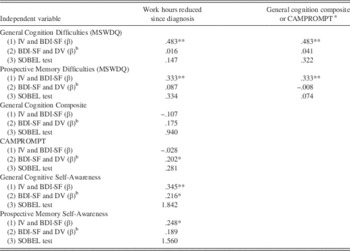
a The General Cognitive Composite score was used as a DV in the General Cognition Difficulties (MSWDQ) mediation analysis and the CAMPROMPT was used as a DV in the Prospective Memory Difficulties (MSWDQ) mediation analysis.
b β controlling for the IV. Sobel test indicates significance of the indirect relationship via the mediator.
*p<.05.
**p<.01.
β=standardized beta values; BDI-SF=Beck Depression Inventory Short Form (the mediator variable); DV=dependent variable; IV=independent variable.
Discussion
This study examined relationships between self-reported cognitive difficulties in the workplace, cognitive test performance, cognitive awareness accuracy, depression severity, and adverse employment outcomes. Consistent with the results of previous studies (Beatty, Blanco et al., Reference Beatty, Paul, Wilbanks, Hames, Blanco and Goodkin1995; Benedict et al., Reference Benedict, Wahlig, Bakshi, Fishman, Munschauer, Zivadinov and Weinstock-Guttman2005), the results of this study demonstrated that actual cognitive test performance is associated with withdrawal from work. Specifically, general cognitive decrements (measured by tests assessing cognitive domains known to be most affected in pwMS including processing speed, abstract reasoning, working memory, delayed memory, learning, and visual planning) predicted 14% and 22% of the variance in unemployment and reduced work hours since diagnosis due to MS, respectively. Slower cognitive processing speed was a strong predictor of unemployment and reduced work hours, whereas poor delayed-recall memory was the strongest predictor of reduced work hours. However, prospective memory performance predicted little of the variance in the work outcomes (4% and 7%, respectively), although the association was still significant.
In addition, the results indicate that a person’s perceived cognitive difficulties in the workplace predict the adverse work outcomes, regardless of actual cognitive abilities. That is, perceived cognitive and prospective memory difficulties were related to reduced work hours since diagnosis, after controlling for test performance on the cognitive and prospective memory tasks. Furthermore, perceptions of prospective memory difficulties at work (but not general cognitive difficulties) were related to being unemployed, independent of actual prospective memory performance. Prior studies have indicated that the perception of cognitive abilities is related to work outcomes (Edgley et al., Reference Edgley, Sullivan and Dehoux1991) and that objectively measured cognition can contribute to work outcomes more than one’s perception of their cognitive difficulties (Benedict et al., Reference Benedict, Rodgers, Emmert, Kininger and Weinstock-Guttman2014). However, this study is the first to demonstrate that perceived cognitive difficulties are related to work outcomes independent of actual cognitive ability.
However, cognitive appraisal accuracy (measured in this study using difference scores between perceived and actual cognition) was not shown to predict the employment outcomes, suggesting that pwMS may make decisions about work irrespective of their insight into their cognitive abilities; for example, they may respond to cognitive effort or cognitive fatigue instead. Few studies have previously examined cognitive appraisal accuracy as a predictor of work outcomes, although one study has previously shown that cognitive awareness accuracy was related to employment in individuals with TBI (Sherer et al., Reference Sherer, Bergloff, Levin, Walter, Oden and Nick1998). Nonetheless, it is possible that other methods of calculating cognitive appraisal accuracy such as discrepancy scores between self- and informant-reports (e.g., Goverover et al., Reference Goverover, Genova, Hali, Chiaravalloti and DeLuca2014) may yield differing results.
Finally, the influence of depression (excluding somatic symptoms) was examined on the relationship between cognitive test performance, perceptions of general cognitive and prospective memory difficulties, cognitive appraisal accuracy, and the work outcomes in pwMS. Contrary to the results of other studies (Arnett et al., Reference Arnett, Higginson and Randolph2001; Niino et al., Reference Niino, Mifune, Kohriyama, Mori, Ohashi, Kawachi and Kikuchi2014; Sundgren et al., Reference Sundgren, Maurex, Wahlin, Piehl and Brismar2013), depression was not shown to be related to actual cognitive test performance. However, consistent with prior results (Benedict et al., Reference Benedict, Cox, Thompson, Foley, Weinstock-Guttman and Munschauer2004; Christodoulou et al., Reference Christodoulou, Melville, Scherl, Morgan, Macallister, Canfora and Krupp2005; Gold et al., Reference Gold, Schulz, Monch, Schulz and Heesen2003; Lovera et al., Reference Lovera, Bagert, Smoot, Wild, Frank, Bogardus and Bourdette2006; Maor et al., Reference Maor, Olmer and Mozes2001; Middleton et al., Reference Middleton, Denney, Lynch and Parmenter2006), depression severity was shown to be linearly related to perceptions of general cognitive and prospective memory difficulties. That is, pwMS who experienced greater cognitive/memory difficulties in the workplace also reported more severe depression.
However, while depression severity was related to cognitive appraisal accuracy in the general cognitive domain, it did not predict prospective memory appraisals. Nonetheless, consistent with the findings of Bruce and Arnett (Reference Bruce and Arnett2004), non-depressed pwMS tended to underestimate their general cognitive difficulties (i.e., overestimate their cognitive ability), although we failed to show that pwMS with mild depression underestimated their cognitive ability or that pwMS with moderate depression provided more accurate ratings. Rather, pwMS with moderate-to-severe depression tended to overestimate their cognitive difficulties.
The study results revealed that depression severity was related to reductions in work hours but not employment status in pwMS. These results are consistent with both other studies that demonstrate no relationship between depression and employment (Beatty et al., Reference Beatty, Paul, Wilbanks, Hames, Blanco and Goodkin1995; Benedict et al., Reference Benedict, Wahlig, Bakshi, Fishman, Munschauer, Zivadinov and Weinstock-Guttman2005), and a more recent study demonstrating a relationship between depression and more subtle negative changes at work (Benedict et al., Reference Benedict, Rodgers, Emmert, Kininger and Weinstock-Guttman2014). Depression did not, however, moderate the relationships between perceived cognitive difficulties, cognitive test performance, and cognitive appraisal accuracy to the work outcomes. That is, the cognitive variables were related to the work outcomes, but the relationships did not generally vary as a function of depression. Depression also did not mediate the relationship between perceived and actual cognition. Taken together, the results suggest that targeting depression in psychological therapy may help to improve work outcomes in pwMS, in particular, in regards to unemployment and reduced work hours due to MS. However, a person’s perceived and actual cognition and their insight into their difficulties also need to be targeted.
Study Limitations
Several study limitations should be kept in mind when interpreting the results. First, retrospective reports of perceived cognitive difficulties were provided by some respondents who were not currently employed. Thus, some bias may have occurred in the recall of past work difficulties, especially in the participants with actual memory deficits (for review, see Amato, Zipoli, & Portaccio, Reference Amato, Zipoli and Portaccio2006). Second, most of the participants in this community-based sample reported none/minimal depression (53%) or only mild depression (30%), with only a small proportion reporting moderate-to-severe depression (17%). While this distribution is somewhat consistent with other MS samples (Chwastiak et al., Reference Chwastiak, Ehde, Gibbons, Sullivan, Bowen and Kraft2002), only a small number of participants had severe depression, possibly resulting in the failure to detect significant results due to the skewed score distribution. Third, a relatively brief neuropsychological testing protocol was adopted for this study. Whether the use of a more comprehensive neuropsychological test battery would have produced similar findings regarding its relative prediction of work outcomes remains unknown. However, given most prior studies have found little or no relationship between cognitive test performance and self-reports of cognitive function (Beatty & Monson, Reference Beatty and Monson1991; Benedict, Munschauer, et al., Reference Benedict, Munschauer, Linn, Miller, Murphy, Foley and Jacobs2003; Lovera et al., Reference Lovera, Bagert, Smoot, Wild, Frank, Bogardus and Bourdette2006; Maor et al., Reference Maor, Olmer and Mozes2001; Taylor, Reference Taylor1990), we anticipate similar findings. Finally, the cross-sectional nature of this study precludes any causal inferences being drawn, thus, it cannot be asserted that perceived or actual cognitive difficulties or depression have contributed to the adverse work outcomes in pwMS.
Conclusion
Perceived cognitive difficulties in the workplace and actual cognitive impairment, but not cognitive awareness accuracy, were shown to be related to adverse work outcomes in pwMS (i.e., unemployment, reduced work hours due to MS). While depression severity was not related to unemployment it was related to more subtle work changes, reducing the proportion of hours worked. Depression did not moderate or mediate the relationship between perceived or actual cognitive difficulties to adverse workplace outcomes. Nonetheless, depression did influence perceptions of cognitive difficulties in the workplace and cognitive awareness accuracy. Taken together, the results highlight the need to address actual cognitive difficulties, perceptions of cognitive difficulties, and levels of depression, in vocational rehabilitation programs. More specifically, cognitive perceptions and depressive symptoms might be explored in the clinical psychology and neuropsychology setting with a view to better preparing MS patients for possible changes in their work in the future.
Acknowledgment
This research was supported by a Multiple Sclerosis Research Australia Project Grant. There are no conflicts of interest to declare.