


On November 5, 2024, Republican Donald J. Trump clinched a second term as U.S. president by assembling a coalition that included many people of color (PoC), narrowly edging out Democrat Kamala Harris in the popular vote. Non-trivial shares of Black, Latino, and Asian adults have long identified as Republicans, as recorded by high-quality surveys of these populations since the 1980s (McClain and Johnson Carew Reference McClain and Carew2018). Yet the central tendency within these electorates trends toward Democrats, a fact prompting many to wonder why some Black, Latino, and Asian adults would vote for a party and candidate that are explicitly hostile to PoC’s well-being. This question has taken on renewed urgency in light of widespread deportation raids targeting Latino communities, rollbacks of civil rights and voting protections, and reductions in benefits disproportionately relied upon by low-income communities of color—all political objectives spearheaded by President Trump’s second administration (2025–2029) and his GOP supporters in Congress and the Supreme Court (Gooding and McCarty Reference Gooding and McCarty2025; McDonnel and Sanchez Vidal Reference McDonnel and Sanchez Vidal2025; Mulvihill and Superville Reference Mulvihill and Superville2025).
One perspective suggests that false consciousness drove many PoC to back the GOP in 2024 (Marx and Engels Reference Marx and Engels1989), with the unequal standing of their own racial or ethnic groups receding in importance (Jost et al. Reference Jost, Banaji and Nosek2004, Reference Jost2019; see also Sidanius and Pratto Reference Sidanius and Pratto1999). This implies that perhaps Republican PoC did not really understand what they were doing by backing the GOP. Yet growing research convincingly shows that many PoC genuinely hold racially conservative views due to their personal values and socio-economic backgrounds, which motivates them to see racial matters differently than most of their racially liberal peers (e.g., denial of racism, Alamillo Reference Alamillo2019; see also Pérez et al. Reference Pérez, Alhambra, Nguy, Bielskis, Chabane, Gudino, Katz, Liu, Mojica and Zhou2024b, Reference Pérez, Rogbeer, Tran, Huynh, Ortiz, Crossley, Halili, Lee, Lempert, Morel and Passananti2025). Nevertheless, a distinct possibility holds that PoC’s postures toward racial intolerance reflected short-term expressive responding to partisan cues rather than unerring ideological convictions (Graham and Huber Reference Graham, Huber, Barker and Suhay2022; Malka and Adelman Reference Malka and Adelman2023). The basic idea here is that Republican PoC reported strong levels of racial intolerance to conform to their party’s norms and support the GOP’s electoral prospects.
Our research note adjudicates between these two accounts. If Republican PoC firmly endorsed the GOP’s intolerant agenda, then the 2024 campaign—which revolved around “culture war” issues like immigration, race relations, sexual orientation, and abortion (Fraga et al. Reference Fraga, Velez and West2025; O’Brian Reference O’Brian2024; Velez Reference Velez2024)—should have produced strong and lasting relations between Republican partisanship and reports of conservative postures that predispose individuals toward intolerance (Federico and Malka Reference Federico, Malka, Huddy, Sears, Levy and Jerit2023; Jost Reference Jost2006; Jost Reference Jost2019, Reference Jost2021; Kteily and Brandt Reference Kteily and Brandt2025). These include authoritarianism (a durable preference for social conformity and submission to authority), social dominance orientation (a lasting preference for intergroup hierarchies), and system justification (a stable preference for the status quo). While often used to explain White support for oppressive politics, these postures also exist among many PoC, which explains how mass support for social inequalities arises (authoritarianism) (Stenner Reference Stenner2005), how these inequities are collectively enforced (social dominance) (Sidanius and Pratto Reference Sidanius and Pratto1999), and why these systems of oppression are so persistent (system justification) (Jost Reference Jost2019).
Authoritarianism, in particular, has received growing attention beyond its traditional White American context, with recent work documenting its political relevance among racial and ethnic minorities both in the United States (Henry Reference Henry2011; Saavedra et al. Reference Saavedra Cisneros, Carey, Rogers and Johnson2023) and in comparative perspective (Stenner Reference Stenner2005), underscoring its diverse applicability to the present study. One hypothesis, then, is that Republican partisanship during the 2024 presidential campaign was associated with higher reports of these postures among some PoC (H1), with this stronger association establishing a firm opinion foundation for political efforts that visibly harm disadvantaged groups in U.S. society, including PoC’s own racial or ethnic groups.
An alternative perspective, however, suggests that expressive responding better characterizes observed patterns in reports of these three postures among PoC (Bullock et al. Reference Bullock, Gerber, Hill and Huber2015; Connors Reference Connors2020; Graham Reference Graham, Huber, Barker and Suhay2022; Malka and Adelman Reference Malka and Adelman2023). Here, individuals are motivated to voice attitudes that are congenial to their own political party. Partisanship therefore motivates partisans to engage in a “brief, biased sampling of considerations from long-term memory (Malka and Adelman Reference Malka and Adelman2023: 1198)” that places their party in a positive light, suggesting these kinds of survey reports are fleeting and amenable to change in light of new information or situational pressures.
The nature of campaigns makes it plausible that they induce short-term pressures to respond in a party-consistent manner. Campaigns galvanize and coordinate the activity of partisan ingroups and outgroups (Haslam et al. Reference Haslam, Reicher and Platow2020; Turner et al. Reference Turner, Hogg, Oakes, Reicher and Wetherell1987), thereby forming and cementing a winning voter coalition (Aldrich Reference Aldrich1995; Downs Reference Downs1957). This implies strong signaling dynamics where individuals enhance their party’s coordination efforts by sharing perspectives espoused by their co-partisans and leaders (Prior et al. Reference Prior, Sood and Khanna2015). This is a critical but low-stakes process. It is critical because the expression of partisan attitudes delineates the boundaries of “who” is a real Republican or Democrat (Turner et al. Reference Turner, Hogg, Oakes, Reicher and Wetherell1987). It is low stakes because expressive attitudes do not guarantee genuine commitment to the behavioral implications of one’s stated preferences (Kuran Reference Kuran1995). Thus, our second hypothesis (H2) is that PoC’s reports of authoritarianism, social dominance, and system justification during the 2024 campaign were situationally induced, rather than deeply rooted in ideological commitments to actively harm racially stigmatized groups. Table 1 lists these two predictions.
Hypotheses about partisanship and PoC’s postures toward intolerance

Table 1. Long description
A table comparing the impact of Republican partisanship on reports of authoritarianism, social dominance orientation, and system justification before and after election day. The table has two rows and two columns. The columns are labeled H1 and H2. The rows are labeled with hypotheses about the impact of stronger Republican partisanship. Row 1: H1, Stronger Republican partisanship increases reports of authoritarianism, social dominance orientation, and system justification before election day. Row 2: H2, Stronger Republican partisanship weakens reports of authoritarianism, social dominance orientation, and system justification after election day.
Our brief report tests both claims by drawing on all three (3) waves of the 2024–2025 Survey Panel of People of Color (SPPoC): a unique dataset that interviewed a large sample of Black, Latino, and Asian adults (N = 3,267) both before and after the 2024 presidential election. Using validated measures of partisanship, authoritarianism, social dominance orientation, and system justification, we estimate a series of cross-lagged panel models (CLPMs) that yield two new insights. First, as predicted (H1), we find that greater Republican partisanship among PoC in June 2024 (Wave 1) is significantly associated with higher reported levels of authoritarianism, social dominance orientation, and system justification in December 2024 (Wave 2). These patterns are robust to key covariates and time-invariant confounding. Second, consistent with (H2), we learn that partisanship’s relevance to individuals’ downstream positions on these postures withered significantly after seven (7) months into the new Trump administration (Wave 3, July 2025), once its ideological agenda directly and visibly started to harm various PoC through deportation raids, civil rights violations, reduced benefits for low-income families, and other political actions (McDonnel and Sanchez Vidal Reference McDonnel and Sanchez Vidal2025; Mulvihill and Superville Reference Mulvihill and Superville2025). We find weak evidence that each posture constrains partisanship. Together, these results suggest that PoC’s expression of authoritarianism, social dominance orientation, and system justification better reflected campaign effects rather than an unerring commitment to intolerance among Republican PoC. We discuss our results’ implications for research on the nature of PoC’s partisanship in a polarized polity.
Research Design
We evaluate our pre-registered hypotheses by leveraging the 2024–2025 SPPoC, which interviewed Black, Latino, and Asian adults, for a total sample of N = 3,267. Our pre-registration is reported in section 1 of our online appendix (OA.1). SPPoC interviews occurred in June 2024 (Wave 1), December 2024 (Wave 2), and July 2025 (Wave 3). We undertook this panel study in collaboration with the National Opinion Research Center, which manages AmeriSpeak—a probability-based panel with respondents selected via stratified random sampling to enhance representativeness and generalizability.Footnote 1
Each 10-minute wave measured authoritarianism with two forced-choice items about child-rearing values, which invited respondents to select between pairs of desirable traits in children. Unlike earlier authoritarianism measures (Pérez and Hetherington Reference Pérez and Hetherington2014), these items are cross-racially valid, which enables comparisons across (non-) White adults (Engelhardt et al. Reference Engelhardt, Feldman and Hetherington2023). Respondents selected which trait they thought was more important for a child to have. The items read: “Would you say it is more important for a child to be curious or good mannered” (0 = curious, 1 = good mannered) and “Would you say it is more important for a child to be loyal or open-minded” (1 = loyal, 0 = open-minded). Means (M) and standard deviations (SD) summarize the average level and variability of each of the scales we measured within each wave, while Spearmans correlation coefficients (ρ) measuring strength of association between measures, standard errors (SE) indicating precision of estimated correlations. Responses were positively and significantly correlated within waves (W1: ρ = .385, SE = .027, p < .001; W2: ρ = .553, SE = .024, p < .001; W3: ρ = .551, SE = .025, p < .001). We created scales averaging replies to both items within each wave on a 0–1 range (W1: MAUTH = .387, SD = .354; W2: MAUTH = .284, SD = .355; W3: MAUTH = .282, SD = .351).
We also measured social dominance orientation (SDO) with two items. One item asked participants to report their (dis)agreement with the statement “Some groups of people are simply inferior to other groups” (1 = strongly disagree, 7 = strongly agree). A second reverse-worded item asked respondents to report their (dis)agreement with “Groups at the bottom are just as deserving as groups at the top.” This item pair is significantly correlated within waves (W1: ρ=.307, SE = .021, p < .001; W2: ρ = .306, SE = .025, p < .001; W3: ρ = .339, SE = .024 p < .001). We created another set of averaged scales per wave in their original 7-point metric (W1: MSDO = 2.567, SD = 1.310; W2: MSDO = 2.623, SD = 1.308; W3: MSDO = 2.589, SD = 1.320).
We tapped system justification by asking participants to report their (dis)agreement (1 = strongly disagree to 7 = strongly agree) with another item pair: “Everyone has a fair shot of wealth and happiness” and “Most individuals who want to get ahead can make it if they are willing to work hard.” These were also highly correlated per wave (W1: ρ = .688, SE = .011, p < .001; W2: ρ = .710, SE = .013, p < .001; W3: ρ = .716, SE = .012, p < .001). We again created averaged scales per wave in their original metric (W1: MSJ = 4.497, SD = 1.664; W2: MSJ = 4.536, SD = 1.642; W3: MSJ = 4.435, SD = 1.678).
To measure our main predictor—partisan identity—we used a standard item from American National Election Studies (ANES), which arrays individuals on a scale running from 1 (strong Democrat) to 7 (strong Republican), inclusive of partisan “leaners.” We also measured a suite of Wave 1 covariates, including respondents’ race/ethnicity (Black = 1/0, Asian = 1/0, Latinos = reference category), age (in years), college education (1 = bachelor’s degree or more, 0 = high school or less), gender (1 = male, 0 = all others), and nativity (1 = born in the United States, 0 = born outside the United States). About 36%, 29%, and 36% of our sample are Black, Asian, and Latino, respectively, with an average age of 49 years. An estimated 49% of respondents are college-educated, while 40% are male and 70% are native-born (unweighted). Finally, 7% of Black adults, 28% of Latino adults, and 22% of Asian adults reported leaning toward or identifying with Republicans.Footnote 2
Prima facie evidence for possible interdependencies between partisanship and these predispositions appears in their instability across waves. Weighted cross-wave correlations indicate that between 26% and 41% of each predisposition—authoritarianism (AUTH), SDO, and system justification (SJT)—measured in June 2024 persists to July 2025 (AUTH: r = 0.512; SDO: r = 0.620; SJT: r = 0.639; PID: r = 0.822), with estimated stabilities approaching unity after correcting for random measurement error (Wiley and Wiley Reference Wiley and Wiley1970). Full stability models are reported in OA.6. To further examine the sources of this instability, we model Republican partisanship’s influence on PoC’s reports of authoritarianism, social dominance orientation, and system justification through a series of CLPMs (Little Reference Little2024), which test whether prior levels of Republican partisanship predict later levels of each posture. Our primary models pool across all three sampled populations, since previous theoretical and empirical work establishes that the mega-category people of color operates as a coherent and meaningful ingroup across its constituent Black, Latino, and Asian members (Engelhardt et al. Reference Engelhardt, Pérez, Goldman, Huo, Nteta and Tropp2025; for meta-analytic evidence, see Pérez et al. Reference Pérez, Vicuna and Ramos2024a). Our approach is also methodologically motivated: pooling capitalizes on the statistical power appropriate for a research question concerning people of color broadly rather than subgroup-specific dynamics.
For interested readers, OA.7 reports analyses indicating that our pooled results are not driven by a single subgroup. Additional analyses in OA.8 examine Democratic and Republican PoC separately, although statistical power for these exploratory results is substantially reduced.
By design, our models eliminate the threat of confounding from factors that do not change in our time frame (Little Reference Little2024). Thus, our main models do not include demographic covariates. We test the robustness of this approach to the inclusion of these covariates (OA.3). All models are estimated in a structural equation modeling framework with the observed variance/covariance matrix as input and manifest variables as predictors and outcomes. We report standardized coefficients to facilitate comparisons. All reported p-values are two-tailed, unless indicated otherwise.
Results
(H1) predicts that during the pre-election period, stronger Republican party identification (PID) significantly predicts how much authoritarianism, social dominance orientation, and system justification PoC express. We assess this by estimating PID’s influence on each posture toward intolerance, with PID at Wave 1 impacting expressions of each posture at Wave 2, and PID at Wave 2 impacting each posture at Wave 3. Our models relax the stationarity assumption (Little Reference Little2024), allowing us to empirically observe whether any trends in the first period (W1–W2) similarly arise in the post-election period (W2–W3).
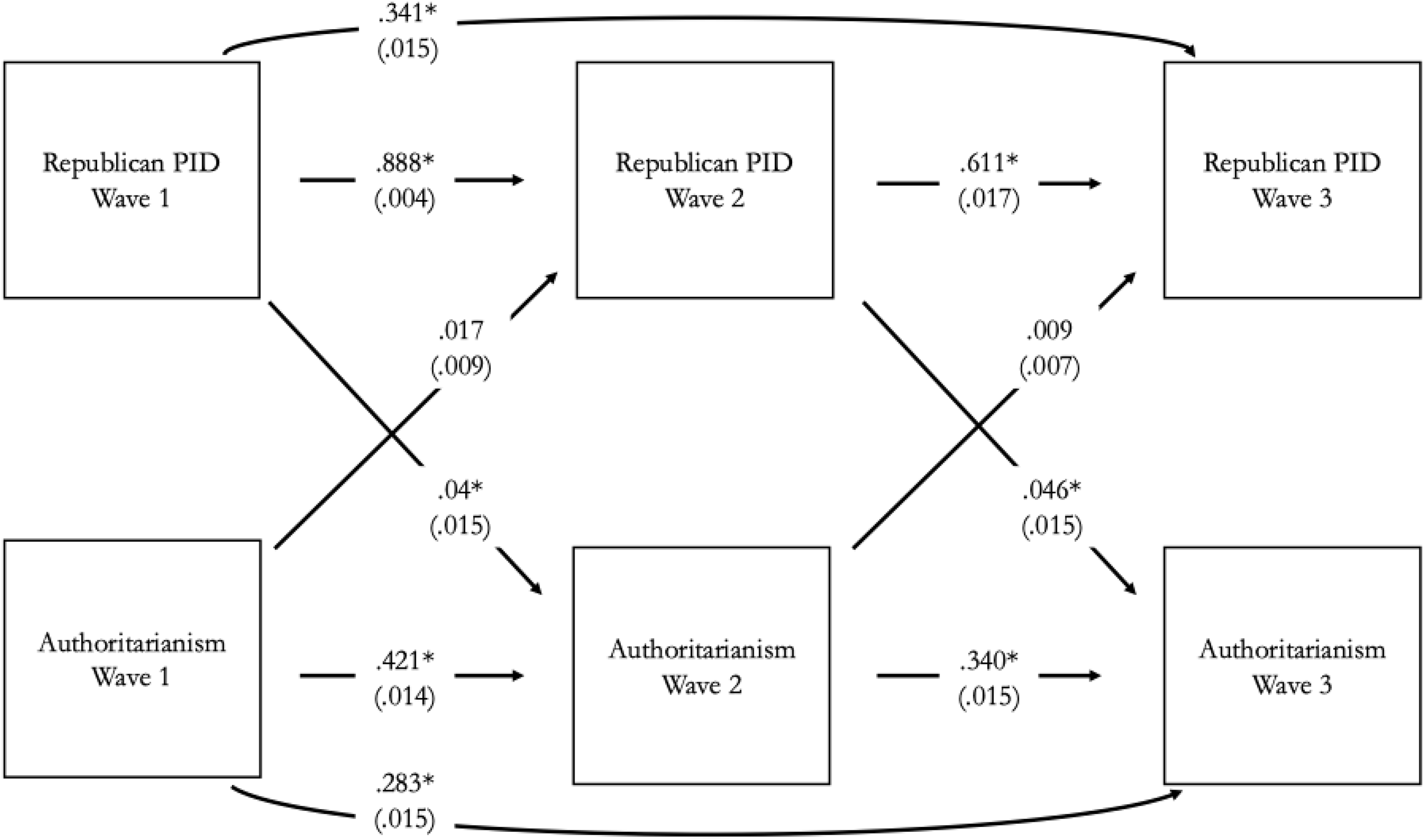
We visually display our model results for each posture. Figure 1 centers on authoritarianism levels before and after election day. Model fit was assessed using commonly reported fit indices, including the Comparative Fit Index (CFI, Tucker-Lewis Index (TLI), Root Mean Square Error of Approximation (RMSEA) with its confidence interval (CI), and Standardized Root Mean Square Residual (SRMR). This model fits the data very well (CFI/TLI: 1.00/1.00; RMSEA [90%CI]: .00 [.00, .02]; SRMR = .001). We find that in the period between Wave 1 (June ’24) and Wave 2 (December ’24), a standard deviation shift in Republican partisanship is associated with a small increase in reported authoritarianism (.040, SE = .015, p < .001), independently of previous authoritarianism levels, which supports (H1). In turn, we see that in the post-election period, this relationship is statistically comparable, with Republican PID again increasing reports of authoritarianism (.046, SE = .015, p < .001).
Temporal relations between Republican PID and authoritarianism.

These two coefficients fall in the small range by conventional standards but are practically meaningful in context (Orth et al. Reference Orth, Meier, Bühler, Dapp, Kraus, Messerli and Robins2024). Although our pre-registration only recorded the direction of our anticipated relationships, we reason that in the context of racially intolerant attitudes among PoC—a mega-group generally characterized as highly racially progressive (Pérez Reference Pérez2021)—a small boost in intolerant attitudes within this segment of America’s adult population is likely to be felt, especially in presidential elections with razor-thin margins of victory. Consistent with this, the 99% interval for partisanship’s effect on authoritarianism in the pre-election period [.001, .080] and post-election [.008, .084] cannot rule out effects closer to d ∼ .10 (Rainey Reference Rainey2014), which are common in the published literature on political attitudes among PoC (see Pérez et al. Reference Pérez, Vicuna and Ramos2024a for meta-analytic evidence). Moreover, empirical distributions of CLPM effect sizes indicate our confidence intervals contain small-to-moderate effects (Orth et al. Reference Orth, Meier, Bühler, Dapp, Kraus, Messerli and Robins2024). Thus, we interpret these effects as substantively small but practically meaningful for PoC.
Critically, and in contrast to the other two constructs examined below, partisanship’s association with authoritarianism does not seem to attenuate in the post-election period. The coefficient remains statistically comparable across both periods (0.040 pre-election; 0.046 post-election), and constraining these two coefficients produces no meaningful change in model fit. In contrast, we find weak evidence of bi-directional effects, with authoritarianism (Wave 1) displaying substantively tiny effects on PID, in both periods, which are essentially zero and statistically unreliable despite our large sample size (authoritarianismwave 1 → PIDwave 2 (.017, SE = .009, p < .063) (authoritarianismwave 2 → PIDwave 3 (.009, SE = .007, p < .227). Inclusion of covariates does not change our inferences here (OA.3).
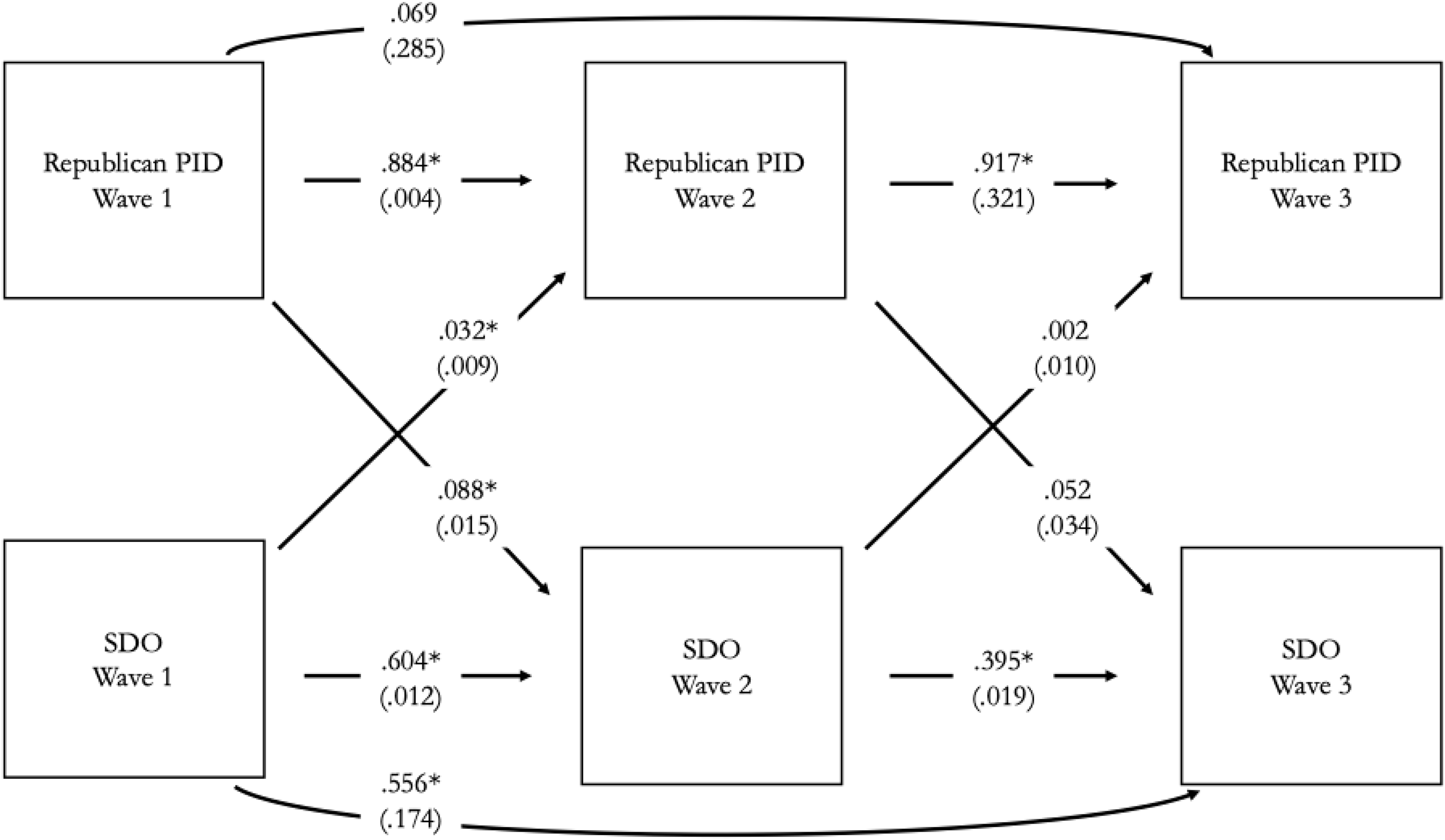
Turning to SDO (Figure 2), we find another well-fitting model yielding results consistent with both our predictions (CFI/TLI = 1.000, .999; RMSEA [90%CI] = .011 [.000, .032]; SRMR = .003). Specifically, we find that a standard deviation shift in pro-Republican partisanship (Wave 1) is associated with a small but reliable increase in PoC’s reports of social dominance of close to one-tenth of a standard deviation (Wave 2) (.088, SE = .015, p < .001). This effect, however, drops in size and statistical significance (.052, SE = .034, p < .131) in the post-election period (Wave 3), with a weaker and unreliable coefficient nearly half the size of the one emerging in the pre-election period. If we constrain these two coefficients to equality, we observe a slight weakening of model fit based on a marginal increase in chi-square (1.065, p < .151, one-tail). Moreover, SDO’s estimated stabilities indicate that SDO levels in June 2025 align more closely with SDO levels in June 2024 than in December 2024, bolstering our inferences here about possible fleeting effects from partisanship to SDO. Ultimately, these patterns provide strong support (H1) but slightly weaker support for (H2), as the post-election attenuation for SDO is suggestive but not definitive.
Temporal relations between Republican PID and social dominance.

Figure 2. Long description
A diagram of the temporal relations between Republican party identification and social dominance orientation over three waves. The diagram includes boxes and arrows to represent the relationships and flow between different variables across three waves. Panel A: The first box on the top left is labeled Republican PID Wave 1. An arrow points to the next box labeled Republican PID Wave 2 with a value of 0.884 and a standard error of 0.004. Another arrow points from Republican PID Wave 1 to SDO Wave 2 with a value of 0.032 and a standard error of 0.009. Panel B: The box labeled SDO Wave 1 has an arrow pointing to SDO Wave 2 with a value of 0.604 and a standard error of 0.012. Panel C: The box labeled Republican PID Wave 2 has an arrow pointing to Republican PID Wave 3 with a value of 0.917 and a standard error of 0.321. Another arrow points from Republican PID Wave 2 to SDO Wave 3 with a value of 0.002 and a standard error of 0.010. Panel D: The box labeled SDO Wave 2 has an arrow pointing to SDO Wave 3 with a value of 0.395 and a standard error of 0.019. Another arrow points from SDO Wave 2 to Republican PID Wave 3 with a value of 0.052 and a standard error of 0.034. The diagram also includes arrows indicating the flow from Republican PID Wave 1 to Republican PID Wave 3 with a value of 0.069 and a standard error of 0.285, and from SDO Wave 1 to SDO Wave 3 with a value of 0.556 and a standard error of 0.174.
In addition, we find weak evidence of a bi-directional influence between SDO and PID in either period. In the interval between W1 and W2, a standard deviation increase in social dominance orientation is associated with a small but reliable increase in Republican partisanship (.033, SE = .009, p < .001), with this pattern further decreasing and becoming substantively and statistically indistinguishable from zero by Wave 3 (.009, SE = .008, p < .259). Inclusion of covariates does not alter our conclusions about (H1) and (H2) with respect to social dominance orientation (OA.3).
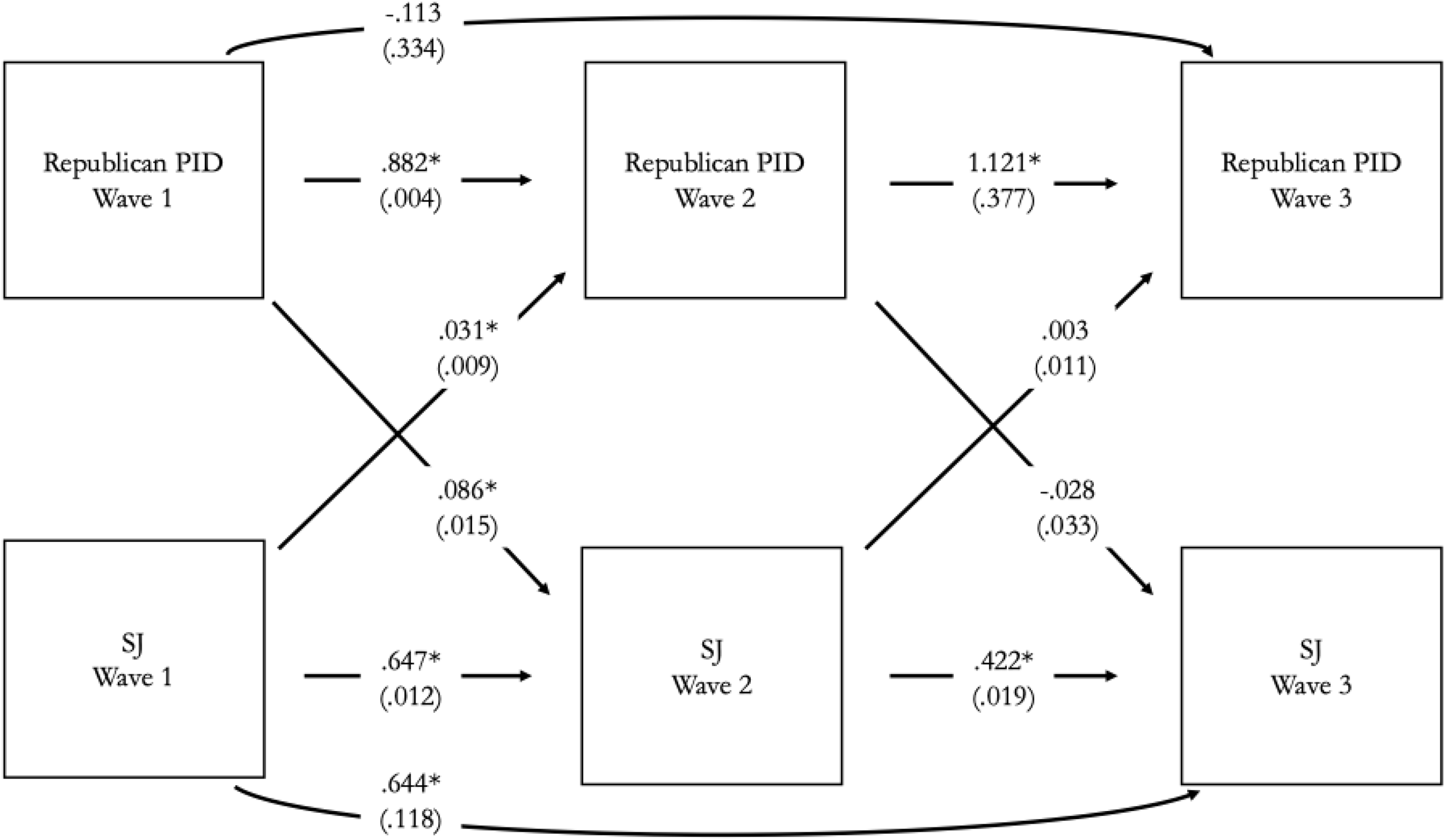
Finally, when we analyze system justification (Figure 3), we yield another well-fitting model (CFI/TLI = 1.000/.999; RMSEA [90%CI] = .019 [.000, .042]; SRMR = .003). Our estimates here provide further support for our claims. As predicted (H1), we find that a one-unit increase in pro-Republican partisanship was associated with a meaningful and reliable increase in reports of system justification in the pre-election campaign period (W1–W2) (.086, SE = .015, p < .001). Second, consistent with (H2), this effect becomes negative and unreliable by Wave 3 (−.030, SE = .033, p < .358). If we constrain these two coefficients to equality, we yield a highly significant increase in chi-square (10.397, p < .001, one-tailed), clearly suggesting this downward trend in coefficients is statistically and substantively meaningful. This is again supported by SJ’s estimated stability coefficients, which show that June 2025 SJ aligns more closely with June 2024 SJ than December 2024, indicating limited carryover from election-specific shifts. We also, again, find weak evidence of system justification constraining Republican partisanship levels among PoC, with system justification weakly affecting partisanship in the pre-election campaign period (W1–W2)(.032, SE = .009, p < .001) and even more weakly and unreliably in the post-election period (W2–W3) (.014, SE = .008, p < .079). Once more, inclusion of covariates does not alter our inferences here (OA.3).
Temporal relations between Republican PID and system justification.

A complementary set of analyses examines whether the 2024 electoral context also produced mean-level shifts in each predisposition (OA.4). Average levels of authoritarianism, social dominance, and system justification are largely stable across waves, with no substantively large shifts attributable to the election or its aftermath. This pattern is consistent with the expressive responding interpretation. If Republican PoC had genuinely converted to more authoritarian or hierarchical worldviews in response to Trump’s campaign, we would expect to see rising means among those individuals, yet Figure OA.5 shows that mean levels for Republican-identifying PoC remain relatively consistent across all three waves. The cross-lagged effects we report therefore reflect genuine attitude-partisanship covariation above and beyond any mean-level trends.
Disaggregating these patterns by partisan identity group sharpens this interpretation further. As shown in OA.5, Republican PoC consistently report higher mean levels of each of the predispositions than their Democratic counterparts across all three waves, yet both groups exhibit relatively consistent trajectories over the study period. This helps to rule out the possibility that the cross-lagged effects we observe are simply artifacts of one group driving average trends and reinforces the interpretation that partisanship and these predispositions are genuinely intertwined for Republican PoC in ways that differ from their Democratic counterparts.
Conclusion
The 2024 election raised new and important questions about PoC and the support that some of them lent to the re-election of President Donald Trump, a GOP standard-bearer with racially hostile attitudes and policy stances toward PoC. One of these uncertainties involves the degree to which PoC support for 2024’s Republican presidential candidate reflected an unerring ideological adoption of intolerant postures—consistent with false consciousness accounts (Marx and Engels Reference Marx and Engels1989; see also Alamillo Reference Alamillo2019; Jost Reference Jost2019; Pérez et al. Reference Pérez, Alhambra, Nguy, Bielskis, Chabane, Gudino, Katz, Liu, Mojica and Zhou2024b)—rather than expressive responding to items measuring various wellsprings of intolerance. Our battery of tests, with original longitudinal data on the three major populations of color in the United States (Pérez Reference Pérez2021), indicates that Republican PoC’s expression of these postures was largely—though not uniformly—expressive (e.g., Bullock et al. Reference Bullock, Gerber, Hill and Huber2015; Connors Reference Connors2020; Graham Reference Graham, Huber, Barker and Suhay2022). The evidence is clearest for system justification and more suggestive for SDO, while authoritarianism’s association with Republican partisanship proved more durable across the post-election period, consistent with its deeper dispositional roots. From this perspective, Republican PoC appear to have voiced agreement with these postures because they were congenial to their party’s campaign stances on culture war issues, including race and racism, immigration, and gender politics (O’Brian 2024)—a form of partisan cheerleading that, for at least some constructs, weakened once the Trump administration’s agenda began to visibly harm communities of color. Taken as a whole, our findings reveal that there are clear limits to what Republican partisans of color are willing to endorse ideologically, even in a highly polarized era, and that those limits vary in meaningful ways across the psychological foundations of political intolerance.
Supplementary material
The supplementary material for this article can be found at https://doi.org/10.1017/rep.2026.10096.
Funding statement
We received support in the form of a grant from the Russell Sage Foundation.
Competing interests
The authors declared no potential conflicts of interest with respect to the research, authorship, and publication of this article.



 Open access

