Introduction
High rates of psychotropic medication use have been reported in Australian nursing homes, particularly of antipsychotics (24–29%) and benzodiazepines (15–37%) (Draper et al., Reference Draper2001; Roberts et al., Reference Roberts2001). Our own Tasmanian prevalence study, which collated medication chart data from 2,389 nursing home residents in 2006, reported a 21% and 42% rate of antipsychotic and benzodiazepine use, respectively (Westbury et al., Reference Westbury, Jackson and Peterson2009). These medications are often prescribed to manage the behavior of residents with dementia, to treat anxiety and to regulate sleep despite uncertain efficacy and potentially severe adverse effects, such as falls and resultant hip fractures with benzodiazepines, and increased risk of cerebrovascular events and death associated with antipsychotic therapy (Madhusoodanan and Bogunovic, Reference Madhusoodanan and Bogunovic2004; Ballard et al., Reference Ballard, Waite and Birks2006; Schneider et al., Reference Schneider, Dagerman and Insel2006). In 1995, an Australian Senate Committee suggested that “the lack of monitoring, or review of psychotropics, led to high levels of these agents being prescribed for excessive periods, for little apparent benefit” (Australian Senate, 1995). One of their recommendations was that pharmacists should become more involved in the monitoring and review of psychotropic medication (Australian Senate, 1995).
Research has shown that successful interventions to reduce psychotropic prescribing rates in nursing homes are often multidisciplinary, involving nursing staff, physicians and pharmacists (Schmidt et al., Reference Schmidt, Claesson, Westerholm, Nilsson and Svarstad1998; Roberts et al., Reference Roberts2001; Monette et al., Reference Monette2008). For example, the combined strategies of a clinical pharmacist medication review and education for nursing staff led to a decrease in both antipsychotic and benzodiazepine use in one Australian study (Roberts et al., Reference Roberts2001). Pharmacist-led multidisciplinary case conferencing also proved an effective strategy to reduce antipsychotic and benzodiazepine use in Swedish nursing homes (Schmidt et al., Reference Schmidt, Claesson, Westerholm, Nilsson and Svarstad1998). A recent review of intervention studies to reduce psychotropic prescribing concluded that the involvement of nursing home staff is crucial as they have a key role in influencing therapeutic decisions and overall patient management (Nishtala et al., Reference Nishtala, McLachlan, Bell and Chen2008). Strategies aimed primarily at physicians attending nursing homes, such as one-on-one educational visits (“academic detailing”) or audit feedback, appear to have limited impact on psychotropic prescribing rates (Ray et al., Reference Ray, Blazer, Schaffner and Federspiel1987; Crotty et al., Reference Crotty2004).
In Australia, a federally funded service to provide pharmacist-conducted medication reviews to all Australian nursing home residents has been available since 1998 (Department of Health and Ageing, 2007). National professional practice standards for medication use in nursing homes were published in 2002 which endorse strategies designed to promote “quality use of medicines” (QUM), including nursing staff education by pharmacists and medication audit and feedback programs, referred to as “drug use evaluation” (DUE) measures (Australian Pharmaceutical Advisory Council, 2002). Although these QUM strategies are endorsed by Australian professional bodies, and several studies have shown they can promote appropriate psychotropic use, there has been limited training for pharmacists on the effective delivery of these techniques. There is also no coordinated DUE, review and staff education package available that targets antipsychotic and benzodiazepine prescribing in nursing homes.
The objective of this research was therefore to design, implement and evaluate a multi-strategic, inter-disciplinary intervention to reduce and promote appropriate usage of antipsychotics and benzodiazepines in nursing homes: the RedUSe (Reducing Use of Sedatives) project. The key strategies involved DUE measures and feedback, nursing staff education and medication review as promoted by Australian professional bodies (Australian Pharmaceutical Advisory Council, 2002; Royal Australian College of General Practitioners, 2005). The strategies of RedUSe were coordinated and delivered by pharmacists and were primarily targeted at nursing home staff, although physicians, residents and relatives were also involved.
Methods
Research design
Our 2006 prevalence study provided information on psychotropic use which was used to calculate the number of homes required for the study to be sufficiently powered to detect statistical significance (Westbury et al., Reference Westbury, Jackson and Peterson2009). To detect a 10% reduction with an average benzodiazepine prescribing rate of 42% (SD8), a total of at least 12 nursing homes were required in each group for a pre- and post-intervention comparison (at a power of 80%, p = 0.05).
The study design was a controlled trial conducted in 25 nursing homes in Tasmania. The intervention group comprised 13 Hobart nursing homes while 12 control nursing homes were located in Launceston (the two cities are geographically 180 km apart). This trial structure was chosen as it was thought if intervention and control homes were in the same locality, pharmacists, nurses and physicians involved with intervention homes may service control homes as well, with the associated risk of intervention information spreading to control homes. After recruitment, the two groups were statistically compared to ensure matching of baseline variables.
The primary outcome measure in the RedUSe project was the prescribing rates of antipsychotics and benzodiazepines in the nursing homes. Secondary measures were prevalence rates of psychotropic agents overall, multiple psychotropics and antidepressants, and the number of dosage reductions/cessations of antipsychotics and benzodiazepines. Although anti-cholinesterases, anticonvulsants and clonazepam are often prescribed as psychotropic agents, they were excluded from our psychotropic measures as indication for use was often uncertain. Lithium carbonate, clozapine and zuclopenthixol were also excluded as these agents are restricted to schizophrenia or bipolar management. Data on psychotropic drug use at each nursing home were collected at baseline, 12 and 26 weeks.
Data measurement
As an integral part of the RedUSe project, a dedicated medication audit program (DUE tool) was developed and installed at each community pharmacy supplying the participating aged care homes. The customized RedUSe program assimilated community pharmacy prescribing information from nursing home medication packaging programs; such as ‘FredPak’® and ‘Meditrax’®. Community pharmacies supplying nursing homes use these packing programs to prepare and label residents’ medications into individualized blistered packs, which are delivered to the homes and subsequently administered to residents by nursing staff.
The “data-mined” medication and dosing details were subsequently verified against each resident's medication chart by trained community pharmacists. Psychotropic medications that were not packed, such as antipsychotic wafers or liquid preparations, were added to the database, as were all “prn” or “as required” doses. If “prn” psychotropic agents were administered four or more days per week over the past month they were included in prevalence counts. The outcome measures were then calculated utilizing de-identified data obtained from this DUE. The computer program also generated a five-page report for each nursing home listing psychotropic prevalence rates which were “benchmarked” graphically alongside rates reported in Sydney and Tasmania (Snowdon et al., Reference Snowdon, Day and Baker2005; Westbury et al., Reference Westbury, Jackson and Peterson2009).
Recruitment of participants
After full ethical approval was granted in April 2008, all nursing homes in Hobart and Launceston, were invited to participate. Two specialized homes, catering exclusively for dementia patients with challenging behaviors, were excluded as these homes were known to have disproportionate rates of psychotropic medication use. Nursing homes serviced by more than one pharmacy, and pharmacies not employing a computerized nursing home packaging system, were excluded due to the data collection methodology. Both the nursing home and supply pharmacy had to agree to participate before the nursing home was accepted into the study. Recruitment continued until sufficient numbers of homes entered the trial. A steering committee was established for the RedUSe project and involved key research representatives from the University of Tasmania, the aged care sector, Alzheimer's Australia, consumer groups, and various professional bodies. The role of this committee was to provide input into the project's strategies and facilitate the delivery of RedUSe to nursing homes.
Intervention
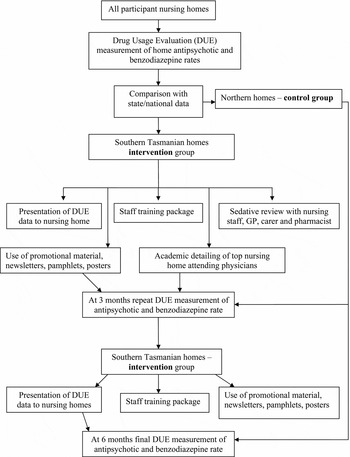
The strategies of the RedUSe project included consciousness raising, two DUE cycles, educational sessions, academic detailing and a targeted sedative review. A flowchart illustrating the strategies of RedUSe is illustrated in Figure 1. The primary focus was on informing health professionals and other participants about the risks and modest benefits associated with antipsychotics for dementia, and benzodiazepines for sleep disturbance and anxiety management in older people, and promoting regular review of these agents. Non-pharmacological approaches for managing behavioral and psychological symptoms of dementia (BPSD) and sleep disturbance were also advocated. Guidelines based on recommended best practice regarding antipsychotics and benzodiazepines were developed with the assistance of a local geriatrician and old age psychiatrist (Royal Australian College of General Practitioners, 2000; International Psychogeriatric Association, 2004). Pamphlets about benzodiazepines were developed for residents and their relatives with the assistance of senior aged care nurses, a consumer representative and Alzheimer's Australia.
The RedUSe trial strategy implementation flowchart.

Consciousness raising
The RedUSe project was announced and promoted at a large conference for nursing home staff on dementia held by Alzheimer's Australia. Participant intervention nursing homes were asked to provide the names of all physicians attending their home, along with the number of residents for which each physician was responsible. RedUSe Guidelines were sent to the 147 physicians servicing the 13 intervention homes. Each nursing home was also sent several laminated RedUSe guidelines to affix to notice boards in nursing stations and attach to medication trolleys. All of the nursing home clinical nursing leads, participant pharmacists, attending physicians and members of the steering group were invited to the official launch where the project was introduced, and a guest speaker, prominent old age psychiatrist/researcher Professor John Snowdon, gave a talk about best practice in the use of antipsychotics and benzodiazepines in nursing homes (Snowdon et al., Reference Snowdon, Day and Baker2005).
Educational strategies
Ten community pharmacists entering the intervention arm of the study received two days’ training. The first training session covered antipsychotic and benzodiazepine therapeutics and recommended best practice for the management of challenging behavior in dementia, anxiety and sleep disturbance. At the second education session, pharmacists were given instruction on the strategies involved with the RedUSe project. Sixteen attending nursing home physicians participated in an individualized academic detailing session with a researcher which covered geriatric psychotropic use and the strategies that form part of RedUSe.
Two training sessions were developed for the nursing staff at the intervention homes with the assistance of university educators and an external reviewer. The first training session was scheduled approximately 3–4 weeks after the baseline DUE measure. Community pharmacists delivered all nursing staff education; promoting evidence-based use of antipsychotics and benzodiazepines. The DUE results for each nursing home were also presented during the session and discussion regarding sedative use was encouraged. The second training session was held 3–4 weeks after the second DUE measure (performed at 12 weeks). This session reinforced information from the first session and the follow-up DUE results were presented to staff. A total of 102 nursing staff attended the first educational session and 70 nursing staff attended the second session. Half (n = 50) of the nurses attending the first session also attended the follow-up session.
Other educational/promotional materials included three RedUSe newsletters, which were distributed to all nursing homes and members of the steering group every two months, and an educational pamphlet for relatives and residents about benzodiazepines which was provided to intervention homes.
Sedative reviews
When the first computerized DUE measure was conducted, the program generated an individual “sedative review” form for each resident prescribed regular doses of antipsychotics and/or benzodiazepines. This sedative review outlined the resident's details, psychotropic doses currently taken and included three sections: one for pharmacist recommendations, another for nurses’ comments and a final section for physicians’ comments. These forms were intended to foster interdisciplinary communication about residents’ psychotropic medication and promote review as currently recommended (American Psychiatric Association, 2007; International Psychogeriatric Association, 2004).
Analysis
The antipsychotic, benzodiazepine, overall psychotropic, multiple psychotropic and antidepressant prevalence rates of all participating aged care homes at baseline, 12 and 26 weeks were calculated, grouped and then statistically analyzed. Similarly, the dosage variance, or the number of antipsychotic and benzodiazepine doses decreased, ceased, increased or unaltered, for each aged care home and group were calculated and statistically analyzed.
Independent-samples t-tests and the Fisher's exact test were used to determine significant differences in nursing home characteristics between control and intervention homes. Paired t-tests and repeated measures analysis of variance (R-ANOVA) were used to test for differences in continuous level outcome variables for baseline, 12- and 26-week comparisons between control and intervention nursing homes. Dose variations were tested with a two-way, χ2 test, which was also used to compare the difference between the number of residents reducing/ceasing antipsychotics and benzodiazepines in the intervention and control home groups. Analyses were performed using StatView, v 5.0 (SAS Institute Inc., Cary, NC) and SPSS (Statistical Program for Social Sciences) version 15. All tests were two-sided and p-values < 0.05 were considered statistically significant.
The RedUSe project was registered as a controlled trial at the Australian New Zealand Clinical Trials Registry (registration number: ACTRN12608000221358). Approval for the trial was granted by the Human Research Ethics Committee (Tasmania) Network (approval number H0009858).
Results
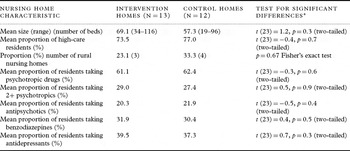
The average number of residents in the 13 intervention and 12 control nursing homes over the three data collection periods was 898 and 693, respectively, resulting in an average total of 1,591 residents per measure (range 1,575–1,605). Table 1 outlines the characteristics of the participating nursing homes and mean baseline psychotropic use for both groups. There were no statistically significant differences found between control and intervention home characteristics or psychotropic use at baseline.
Baseline characteristics of participating nursing homes

*None of the differences is statistically significant (p < 0.05).
Prevalence rates
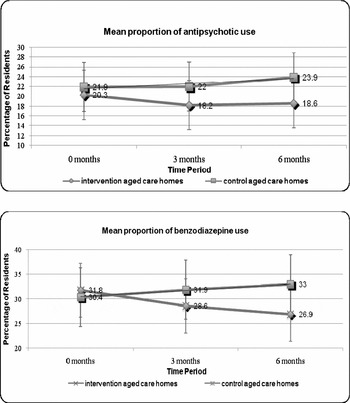
The changes in the mean proportion of antipsychotic and benzodiazepine use over time are shown in Figure 2. Both antipsychotic and benzodiazepine prevalence decreased in the intervention homes, whereas the prevalence rates of these agents increased in the control homes over the same period. There was a statistically significant decrease in the mean proportion of benzodiazepines used in intervention nursing homes from baseline (M = 31.8, SD = 8.6) to 26 weeks (M = 26.9, SD = 8.6), t (12) = 3.7, p < 0.005 (two-tailed). The decrease in the mean proportion of antipsychotic use in intervention homes from baseline (M = 20.3, SD = 8.7) to 26 weeks (M = 18.6, SD = 8.4) was also significant: t (12) = 2.2, p < 0.05 (two-tailed). Results of the two-way, repeated measures ANOVA showed a statistically significant effect of the intervention on benzodiazepine use (p < 0.01) and also on antipsychotic use (p < 0.05).
Mean proportion of antipsychotic and benzodiazepine use in intervention vs. control nursing homes over time.

There were no statistically significant differences in either benzodiazepine or antipsychotic prevalence rates in the control nursing homes from baseline to 26 weeks; baseline mean (M) benzodiazepine use: (M = 30.4, SD = 9.6) to 26 weeks (M = 33.0, SD = 7.7), t (11) = −1.5, p = 0.2 (two-tailed); baseline mean antipsychotic use: (M = 21.9, SD = 7.9) to 26 weeks (M = 23.9, SD = 9.3), t (11) = −1.3, p = 0.2 (two-tailed).
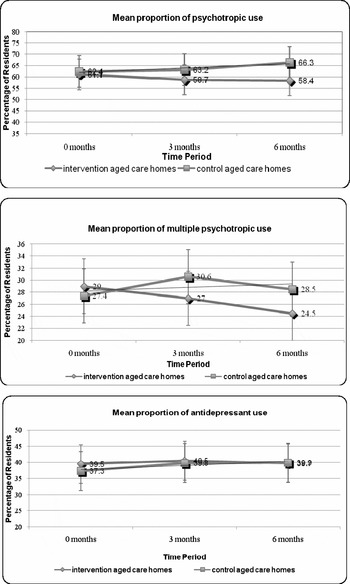
We also evaluated the impact of RedUSe on the prevalence of overall psychotropic, multiple psychotropic and antidepressant use (see Figure 3). Both overall psychotropic and multiple psychotropic agent use decreased in the intervention homes, whereas both measures increased in control homes over the trial period. There was a statistically significant decrease in the mean proportion of residents taking psychotropic agents in intervention homes from baseline (M = 61.1, SD = 11.9) to 26 weeks (M = 58.4, SD = 12.3), t (12) = 2.4, p < 0.05 (two-tailed). A two-way R-ANOVA test confirmed a statistically significant effect of the intervention on overall psychotropic use (p = 0.005).
Mean proportion of psychotropic, multiple psychotropic and antidepressant use in intervention vs. control nursing homes over time.

The decrease in the mean proportion of multiple psychotropic use (i.e. use of two or more psychotropic agents) in intervention homes from baseline (M = 29.0 SD = 9.3) to 26 weeks (M = 25.5, SD = 7.6) was also significant: t (12) = 2.7, p < 0.05. Results of the two-way, repeated measures ANOVA confirmed a statistically significant effect of the intervention on the use of two or more psychotropic agents (p = 0.01).
Although increases in psychotropic measures in the control homes were seen over the trial, these were not significant: Mean psychotropic use: baseline (M = 62.4, SD = 9.2) to 26 weeks (M = 66.3, SD = 10.8), t (11) = −1.8, p = 0.09 (two-tailed); baseline mean multiple psychotropic use (i.e. use of two or more psychotropic agents): (M = 27.4, SD = 8.0) to time 26 weeks (M = 28.5, SD = 8.9), t (11) = −0.7, p = 0.5 (two-tailed).
Finally, there was no significant impact of the RedUSe trial from baseline to 26 weeks on antidepressant use in either nursing home group; intervention home mean antidepressant use: baseline (M = 39.5, SD = 9.9) to time 26 weeks (M = 39.7, SD = 8.8), t (12) = −0.1, p = 0.9 (two-tailed), and control home mean antidepressant use: baseline (M = 37.3, SD = 6.6) to 26 weeks (M = 39.9, SD = 10.0), t (11) = −1.4, p = 0.2 (two-tailed).
Dose variation
The medications and dosages of residents with three measures of medication use at baseline, 12 and 26 weeks had their dosage “tracked” for this analysis of dosage variance.
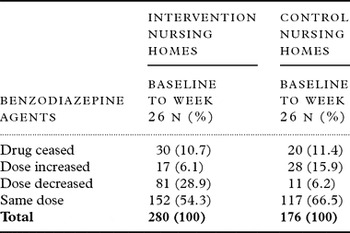
A total of 280 residents in intervention homes and 176 residents in control homes were taking benzodiazepines at baseline. Table 2A shows the dosage variation in both intervention and control nursing home groups. The difference between benzodiazepine dose variations in the intervention and control groups was found to be very significant when tested with a two-way χ2 test (χ2 = 41 (df = 3), p < 0.0001). When the number of intervention residents who had had their benzodiazepine dose stopped or reduced was compared to control home residents’ dosing data, there was a marked and significant difference (39.6% vs. 17.6%, χ2 = 23.4 (df = 1) p < 0.0001).
Variation in residents’ use of benzodiazepines in intervention vs. control nursing homes throughout the RedUSe trial

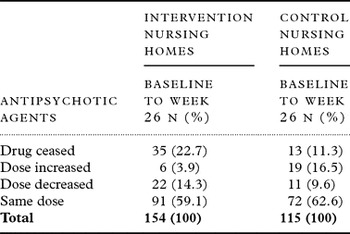
A total of 154 residents were taking antipsychotics at baseline in the intervention nursing homes. In the control homes, 115 residents were taking antipsychotics at baseline. Table 2B outlines the dosage variation of antipsychotic medication in both intervention and control home groups. In the intervention homes, antipsychotic doses were more likely to have been stopped or reduced, and doses less likely to have been increased than in control homes. The difference in antipsychotic dose variations between the intervention and control groups was found to be very significant (χ2 = 17.4 (df = 3), p < 0.0005). When we specifically examined the number of residents who had had their antipsychotic dose stopped or reduced over the duration of the RedUSe trial, there was a substantial difference between the intervention and control homes (36.9% vs. 20.9%, χ2 = 7.4 (df = 1), p < 0.01).
Variation in residents’ use of antipsychotics in intervention vs. control nursing homes throughout the RedUSe trial

Discussion
The RedUSe project is the first Australian intervention study to evaluate the impact of currently recommended pharmacist-led QUM strategies on nursing home psychotropic medication rates. The RedUSe project strategies, including staff education and review, successfully reduced benzodiazepine and antipsychotic use in our intervention nursing home group. This finding corroborates the positive effect of previous intervention studies which utilized similar strategies (Ray et al., Reference Ray, Blazer, Schaffner and Federspiel1987; Schmidt et al., Reference Schmidt, Claesson, Westerholm, Nilsson and Svarstad1998; Roberts et al., Reference Roberts2001). Clinical audit and feedback by physicians were shown to have limited impact on nursing home antipsychotic use in one Australian study (Crotty et al., Reference Crotty2004). However, the use of medication audits, or DUEs, have proved an effective strategy in the hospital setting, with one research team utilizing DUEs reporting an improvement in benzodiazepine prescribing over a three-month period (Woodward, Reference Woodward2006). The positive outcomes of the RedUSe project suggest that the use of DUEs, supported by staff education and psychotropic review, can also promote appropriate psychotropic use in the nursing home setting.
The RedUSe project also had a positive impact on reducing the use of overall psychotropic and multiple psychotropic medications in nursing homes. This is a significant finding as multiple psychotropic use was reported as the highest ranked medication-related risk factor for falls in this setting (Fonad et al., Reference Fonad, Robins Wahlin, Winblad, Emami and Sandmark2008). A recent review of intervention studies to reduce psychotropic use in nursing homes noted that research is still needed to provide evidence of benefit from reducing the prescription of these agents on resident health outcomes (Nishtala et al., Reference Nishtala, McLachlan, Bell and Chen2008). Therefore, subject to ethical approval, we aim to evaluate in future analyses whether the reduction found in antipsychotic and benzodiazepine use had a positive impact on residents’ fall rates.
Several researchers have suggested that when antipsychotic and benzodiazepines are reduced other agents may be prescribed to produce substitute effects (Avorn et al., Reference Avorn1992; Ray et al., Reference Ray, Blazer, Schaffner and Federspiel1987). For this reason we evaluated the impact of the project on antidepressant prevalence as some of the antidepressant agents can be used for their sedating properties (Conn and Madan, Reference Conn and Madan2006). We can report that substitute prescribing of alternate agents in place of antipsychotics and benzodiazepines did not appear to occur as antidepressant use in the intervention homes was consistent throughout the trial.
The majority of guidelines on the use of antipsychotics for BPSD stress the importance of holding regular reviews of the usage and trialing of dose reduction/cessation every 6–12 weeks (International Psychogeriatric Association, 2004; Royal Australian College of General Practitioners, 2005). Prescriptions for benzodiazepines should generally be time-limited with long-term users of benzodiazepines encouraged to reduce dosage at regular intervals (Royal Australian College of General Practitioners, 2000). A recent follow-up of the DART-AD (Dementia Antipsychotic withdRawal Trial) found that long-term antipsychotic users (>12 months) with dementia had a significantly increased risk of mortality (Ballard et al., Reference Ballard2009). The researchers of this trial emphasized “the urgent need to put an end to unnecessary and prolonged prescribing” of antipsychotic agents. It is therefore pleasing to observe that one of the outcomes of the RedUSe project was a marked increase in the number of antipsychotic and benzodiazepine dosages reviewed, with a more than doubling of dose reductions/cessations in intervention homes when compared to control homes.
This study has several limitations. First, it has proved difficult to identify which of the strategies of the RedUSe project had greater impact on reducing antipsychotic and benzodiazepine use. To do this, researchers would have to test individual strategies in separate intervention studies. Previous research had shown that a multifaceted approach involving nurses, physicians and pharmacists appeared to offer the greatest chance of success and so for this reason we decided to adopt a similar approach. Another potential limitation of the project was limited physician participation. For example, although over 140 physicians were invited to the launch event, only 18 attended. Many of the physicians approached for an academic detailing session also declined to participate or did not attend pre-arranged sessions. This lack of participation was most likely due to the high workload of physicians, and a degree of professional education “saturation”. The fact that a significant reduction of sedative use occurred in spite of the lack of physician participation is further evidence of the significant influence nursing staff exert on the utilization of psychotropic medication in the nursing home setting. Finally, in any intervention project it is important to examine the degree to which the strategies are acceptable to the health professionals involved in its implementation. For this reason, we recently conducted two focus groups, one for nurses involved with the project, and the second for pharmacists coordinating the RedUSe strategies. We hope to report on the outcomes of these focus groups at a later date.
Conclusion
The RedUSe project led to a statistically significant reduction in the proportion of residents in nursing homes receiving benzodiazepines and antipsychotics. The number of antipsychotic and benzodiazepine dosages that were stopped or reduced in intervention homes was double that reported in the control nursing homes. Our findings suggest that QUM strategies, coordinated through community pharmacies and incorporating the dissemination of local data on medication use, offer an effective approach to reducing psychotropic use in nursing homes.
Conflict of interest
None.
Description of authors’ roles
J. Westbury designed the project, developed the RedUSe educational materials, coordinated and managed the project, collected and analyzed the data, and wrote the paper. S. Jackson helped to design the study and recruit participants, and commented on drafts of the paper at all stages. P. Gee developed, trialed and analyzed the computerized DUE. G. Peterson supervised the project, led the statistical analysis and commented on drafts of the paper at all stages.
Acknowledgments
The RedUSe program was funded by the Australian Government Department of Health and Ageing as part of the Fourth Community Pharmacy Agreement through the Fourth Community Pharmacy Agreement Grants Program managed by the Pharmacy Guild of Australia. The researchers wish to thank Professor John Snowdon, Liz Musgrove, Dr Martin Morrissey, Clare Westin, Kim Fitzmaurice and Dr Jane Tolman, members of the advisory committee, and the pharmacists and nursing staff whose support and enthusiasm for the project made the RedUSe project possible.