The environment is always a witness to, and often a victim in, conflicts. And conflicts always have environmental contexts that shape them. Framing and evaluating these linkages is essential to understanding conflict realities and seeking solutions to mend the suffering of violence.
Armed conflict and the environment are integrally related in complex and multivalent ways. Finding ways to navigate this complexity, whether in the daily news cycle or in choosing how to vote based on environmental or geopolitical conflict dispositions, is difficult but increasingly essential. The purpose of this book is to present a parsimonious – that is, a simple and effective – framework for understanding the primary areas of concern and connection between the environment and conflict. It aims to serve as a tool to help deconstruct the complexity and aid understanding without doing away with the distinctiveness of each case. Unfortunately, there is a pressing need for such a framework, and more so all the time.
The world is increasingly in conflict. Globally the rate of interstate and intrastate conflicts has begun increasing again in the last decade, after years of tapering off following the Cold War period [1]. For example, the annual average number of state-based and non-state-based conflicts between 1990 and 2000 was about 75. Between 2013 and 2023, that number climbed to 133. Today over 8 million people are estimated to be displaced by conflict each year, with a total of almost 120 million people forcibly displaced due to persecution, conflict, and violence [2]. The underlying causes of this progression of conflict are not entirely clear, although factors such as growing food and broader environmental insecurity [3], the effects of the COVID-19 pandemic [Reference Hendriks4], geopolitical competition and corresponding militarization [5], and growing global inequality [6] are widely thought to be at least contributors.
While much progress has been made in recent decades to improve the human condition, that progress appears to be slowing in certain arenas and potentially degrading in many places around the world today [Reference Gupta7]. While conflict is on the rise, rates of positive peace – a broad concept of peace that is more than just a lack of violence – have also begun to drop off [6]. In other words, human security and flourishing are beginning to diminish alongside rising rates of violent conflict. While not necessarily causal, the two are multivalently interconnected.
As rates of conflict are increasing globally, so, too, are rates of global environmental risk, and mostly from human causes [Reference Persson8, Reference Romanello9, Reference Fuller10]. Human-produced environmental challenges collectively form the single largest source of early human mortality. It is estimated that around 9 million deaths a year are attributable to human-produced toxic pollution, especially air pollution [Reference Rentschler and Leonova11]. And environmental risks displace an estimated 24 million people a year [12], mostly from rural to urban areas and to still ecologically precarious locations – that is, areas at risk of industrial pollution or other environmental hazards [Reference Adger13].
For much of the world’s population today, conflict and environmental stresses and hazards – independently, intersectionally, and cumulatively – are critical or even primary determinants of human security. While environmental factors do not always play a role in initiating conflict, conflicts always have environmental implications. The complex intersections and co-evolution of conflict and environmental dynamics have long been part of the human story [Reference Fuentes and Fry14, Reference Fry and Soderberg15]. But the multitude of ways in which they interact and affect people today, and the potential for some of these effects to persist for many generations, is a newer wrinkle in the story. For example, in the ongoing war of Russian aggression still unfolding at the time of this writing, asbestos insulation, known to cause several serious illnesses such as asbestosis, mesothelioma, and lung cancer, has been dispersed across Ukraine from tens of thousands of destroyed buildings [16]. This contaminant, which does not biodegrade, directly degrades the environment and, without active and costly remediation, subsequently threatens human health for a time period well beyond the likely duration of the conflict [Reference Marcantonio, Katsos and Miklian17]. No matter the victor, the spoils may be spoiled by this contamination, along with other toxins from unexploded ordnance, destroyed industrial facilities, and numerous other risk streams associated with our modern, highly modified human environments [Reference Lawrence, Stemberger, Zolderdo, Struthers and Cooke18].
Again, the relationship between the environment and conflict is a two-way street: the environment affects conflict, just as conflict affects the environment. The people inhabiting the doubly conflicted space are caught in the tension between violence and environmental risk. And the externalities emanating from conflicts can have effects well outside the bounds of the conflict area. Consider the greenhouse gas (GHG) emissions just from Russian and Ukrainian tanks, jets, and transport trucks, which estimates for the first 18 months of the war put at 32 million tons of carbon dioxide equivalent. To put this in perspective, this is roughly double the annual GHG emissions of Costa Rica [19]. Military operations are notoriously high-emission. In fact, military emissions account for 5.5 percent of all GHG emissions annually [20]. The US military, which has been a prominent actor in recent conflicts in various regions, is the single largest emitting organization globally, emitting every year the equivalent of 270 million cars on the road. Any conflict, from the Russian war of aggression in Ukraine to continued actions from dissident groups such as the National Liberation Army (ELN) and Revolutionary Armed Forces of Colombia (a case study further explored in Chapter 7), will almost always involve multiple environment-conflict linkages simultaneously.
Current research and policies offer varying interpretations of the “ecologically connected” conflicts and violence that have developed alongside increasing human-environmental risks and challenges. It comes as no surprise, then, that the relationship between the environment and conflict – two constituent components of human history and the story of human development [Reference Fuentes and Fry14, Reference Fagan21, Reference Potts22] – has been posited and tracked in a variety of ways. Myriad theories about the relationship between the environment and conflict have been levied over the three decades since the end of the Cold War, when environment-conflict linkages began to come to the fore [Reference Marcantonio and Fuentes23]. These interpretations span a wide spectrum: from corporation-driven violence for extractive purposes [Reference Homer-Dixon24, Reference Welch25]; to the resource curse [Reference Sachs and Warner26], both past and present, with purported “green economy conflicts” [Reference Månsson27, Reference Bergius, Benjaminsen, Maganga and Buhaug28, 29]; to environmental impacts as a form or vector of violence in and of themselves [Reference Nixon30, Reference Navas, D’Alisa and Martínez-Alier31, Reference Marcantonio32]; to climatic change and corresponding stresses as potential drivers of conflict or “threat multipliers” [Reference Abrahams33, Reference Scartozzi34, Reference Dahm, Meijer, Kuneman and van Schaik35]. The intersections and effects, and the corresponding pursuit of policy and practice interventions, are thus complex, and parsing the complexity is no simple task.
Although synthesizing the complexities is not easy, particularly for those unfamiliar with the literature – as a majority of people, understandably, are – still, a general understanding of the issues is essential. It can contribute importantly to many ongoing political debates and unfolding interstate and intrastate conflicts – conflicts that are, again, increasing in frequency. In other words, the salience and importance of understanding these linkages is increasingly necessary for policymakers, researchers, and everyday citizens alike, as they all have a say in shaping how they are prioritized (or not).
Therefore, it is critical to have a parsimonious typology to synthesize and frame multivalent connections between environment and conflict challenges. That is, a framework that is simple, relevant, and consistent enough to be applied broadly while not disposing of the details necessary to make informed decisions or at least cursory analyses. The proposed framework is not high-resolution enough to form implementable interventions or enter deeply into the nuances of each environment-conflict linkage. This is by design. Instead, it provides a starting point to clarify these complex issues and to open a path to deeper engagement when needed. For most people this is likely not the case; for those for whom it is, tools and analytical methods beyond this framework will be needed and can be found in much of the literature referenced throughout this book.
The rest of this chapter presents important concepts and information necessary to set the foundation for engaging the proposed framework. An overview of environmental thinking and key environmental concepts, environment-conflict-specific concepts, and convergences and divergences of evidence and practice is provided to give the reader working knowledge of the materials and information necessary to fruitfully apply the proposed framework. With this foundational knowledge set, the five-part framework is then presented with concise summaries for each pillar, setting the stage for the rest of the book’s explorations and accounts. The chapter closes with a roadmap of the rest of the book.
1.1 Environmental Thinking with Policy and Practice Implications and Distinctions
The environment and conflict linkages, literature, and policy and practice approaches do not exist in a vacuum. They are connected to all sorts of other fields of study, policy programs to address other challenges (such as vector-borne disease and HIV), and the language and concepts used to talk and learn about these topics. To best understand the environment-conflict nexus and the framework presented in this book, a foundational knowledge of related concepts, together with their distinctions and implications, is important, especially for applying the framework beyond the contexts and cases discussed here. What follows is a concise presentation of several concepts of import to enable a better grasp and command of the framework and the situations to which it can be applied – and how best to interpret and orient on the results it yields.
1.1.1 Policy, Management, and Practice
There are key distinctions between policy, management, and practice that are important to understand in order to evaluate environment-conflict linkages. Some policies, due to design, can contribute to conflict onset, even when they are constructed to prevent or buffer conflict. For example, a resource-sharing agreement in a formal peace agreement, like the provisions for oil revenue sharing in the 2005 Sudanese Comprehensive Peace Agreement, was intended to prevent conflict between stakeholder factions. Instead, a lack of buy-in and weak enforcement, for this and other provisions, led to minimal implementation and conflict relapse in 2011 [Reference Roach36]. Policy can be designed for governance at varied scales – international, regional, national, subnational, or local – and by entities ranging from governments to businesses to non-government organizations or other institutions that govern. Thus, governance is not necessarily government, but rather refers to the norms, institutions, and processes that determine how power and responsibilities over resources are exercised, how decisions are made, and how different people participate in these processes. Policy forms and shapes governance, which has myriad interconnections with the environment-conflict nexus – many of which will be discussed throughout this text. Policy alone, no matter how well crafted, is insufficient for institutions to effectively address the challenges of environment-conflict linkages [Reference Lame and Marcantonio37].
While policy can (though often does not) dictate how its aims are to be achieved “on the ground,” management and implementation programming do the work of carrying out policy, regardless of the source. Management refers to the rulemaking and day-to-day implementation of programs to achieve the aims or attain the standards specified by policies. While policy lays out the vision and mission as to what is to be done, management provides the objectives and strategies to actually accomplish them. In environmental circles, adaptive management is increasingly applied, as it explicitly integrates active learning and adjusts management programming to respond to ever-evolving complex environmental challenges and environmental conflict management [Reference Fisher38] – and thus has direct relevance as an approach to environment-conflict linkages as well.
For effective governance, whether regarding environmental and conflict intersections or both simultaneously, thus requires the synchronization of policy and management practices [Reference Bruch, Wolfarth and Michalcik39]. One of the recurring challenges is the “lack of” effective implementation of policies: lack of will to enforce, lack of resources to regulate, lack of prioritizing environmental challenges over other options. For example, in post-war Sierra Leone extensive environmental policies were adopted and institutions such as the Ministry of the Environment and the Environmental Protection Agency were founded. But due to a lack of political will to enforce protections in extent rural areas, a lack of funding to support monitoring and enforcement, and the prioritization of economic development over rural livelihoods and health, the robust policies on the books were not implemented. This led to a proliferation of environmental degradation and risks in the same areas where much of the war was fought, impacting populations there [Reference Marcantonio, Field, Sesay and Lamberti40].
Before, during, and after conflicts, many interests compete for funding, focus, and resources more generally. Many of these tend to take precedence over environmental and natural resource management. Most peace agreements – a form of formal policy and governance – do not even include environmental provisions, even in instances where environmental issues may have contributed substantially to the conflict [Reference Joshi, Quinn and Regan41, 42]. Synchronization across policy, management, and governance more broadly is, therefore, critical to effectively framing and addressing environment-conflict linkages.
1.1.2 Natural Resource Management and Environmental Management
Just as there are clear distinctions, in addition to interactions, between policy and management regarding environment-conflict linkages and beyond, so, too, are there differences between the “what’s” – that is, what in the environment is being addressed. Environmental work can generally fall into two camps: natural resource management and environmental management. These are synthetic categories – like most language, they have been invented simply to help facilitate a more efficient, shared understanding – but they are important nonetheless, and they are broadly employed in environmental regulatory circles [Reference Lame and Marcantonio37]. Natural resource management focuses primarily on access to and distribution of resources and environmental services. In most environment-conflict linkages literature, natural resource management issues have been the dominant focus – for example, water access conflicts, food security conflicts, or conflicts over high-value or, today, “transition” minerals.
Environmental management is about protecting human health and the environment, with a focus on the production of toxic and non-toxic pollutants. When extracting, processing, using, and disposing of resources – which is tracked through a life cycle analysis [Reference Ciambrone43] – pollution is produced. Toxic pollution directly harms the human body when taken in through inhalation (breathing), ingestion (eating or drinking), or dermal absorption (through skin, although this pathway is possible only for a subset of pollutants). For example, a civilian or even the operating crew is exposed to toxic pollution when they breathe in the particulate matter (PM) from the exhaust of a Ukrainian T-84 tank patrolling the lines in Eastern Ukraine – a damaging respiratory irritant with other health impacts like dementia and even violent behavior [Reference Burkhardt44, Reference Bondy, Roth and Sager45, Reference Maher46]. Non-toxic pollution is pollution that does not harm the human body directly, though it may harm non-human species, but it can cause environmental risks that do directly harm humans. The dominant example of this is greenhouse gases (GHGs) like carbon dioxide that are causing a range of effects in the Earth System, such as climate change and resulting phenomena like deadly heatwaves and extreme weather events [Reference Raymond, Matthews and Horton47, Reference Mora48, Reference Romanello49]. Environmental management is also relevant in pre-conflict contexts for reducing environmental injustices that might contribute to conflict, and similarly in post-conflict contexts. For example, remediating – that is, removing or reducing – toxic remnants of war like unexploded ordnance, or implementing environmental regulations for industrial and other production that tends to grow as conditions stabilize.
1.1.3 Acute and Chronic Impacts and Risk
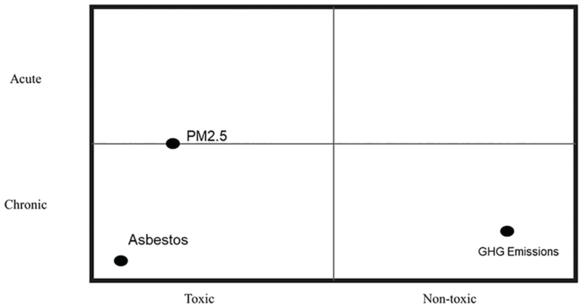
The constellation of interactions and impacts from environment-conflict linkages can have acute and/or chronic impacts across time and geographic space. Acute impacts or events are those with immediate, often severe effects on the environment and human health. For example, Russian soldiers quickly experienced radioactive poisoning after digging trenches in Chernobyl during the initial invasion of Ukraine in 2022 [Reference Roblin50], or the respiratory and other impacts that caused high levels of hospitalizations during the Kuwaiti oil fires in 1991 [Reference Tuomisto, Wilson, Cooke, Tainio and Evans51]. Chronic impacts or events are slower moving in producing their full effect, which unfolds over long periods of time. For example, the health effects of exposure to Agent Orange on communities in Vietnam – where more than 19 million gallons of the toxic defoliant were sprayed across 20 million acres of land between 1961 and 1971 – range from leukemia to congenital (birth) disorders to wasting syndrome, and persist in some areas today, five decades later [52]. Acute and chronic impacts or events are also interrelated. For example, GHG emissions causing climate change lead to predominantly chronic warming around the globe today, punctuated by acute events to which they contribute, such as extreme heat waves [Reference Clarke, Otto, Stuart-Smith and Harrington53]. To frame the varied acute and chronic impacts and their toxic and non-toxic pollution drivers, Figure 1.1 provides a simple typology. Sorting these impacts or events that can arise from, or even contribute to, environment-conflict linkages can then facilitate the risk assessment process and discernment of implications.
A simple framework for categorizing environment-conflict risks regarding acute versus chronic impacts, considering time and intensity, and whether those impacts and risks are from toxic or non-toxic pollutants, as a means to begin thinking about environment-conflict linkages as causes and consequences of these impacts and risks.
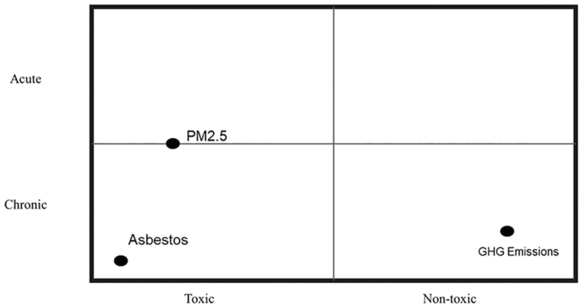
Figure 1.1 Long description
The matrix shows the following data. P M 2.5 lies in the second quadrant representing acute impacts caused from toxic pollutants. Asbestos lies in the third quadrant representing chronic impacts caused from toxic pollutants. G H G emissions lies in the fourth quadrant representing chronic impacts caused from non-toxic pollutants.
To interpret potential acute and chronic risks from environment-conflict impacts or interactions and their implications for human health, the general formula to calculate risk is: risk = hazard ∗ vulnerability. The hazard includes the base probability and severity of a risk. Probability is the likelihood of a risk being realized, while severity is the impact of that risk – that is, the likely damage caused. The risk of a person or group being impacted by a hazard is then mediated by their vulnerability. Vulnerability can be defined as the net outcome of exposure to a risk and the capacity to mitigate, adapt to, or otherwise evade the risk. The capacity, and really the capability as well, to reduce a risk might be a material resource, such as water filters or an N95 face mask, or an immaterial resource, such as relationships or even knowledge or information. So, a more nuanced equation would be: risk = (probability ∗ severity) ∗ (exposure – capacity). In environment-conflict linkages, which are nested in wider socio-ecological systems, these risks are rarely static, making them challenging to evaluate accurately [Reference Fisher38].
Another parallel calculation in toxicology is: risk = frequency ∗ dose. Here both how often you are exposed to a particular hazard and how much of it you are exposed to change the risk characterization. Acute impacts are often high in impact but low in frequency, whereas chronic events are often lower (or slower) but repetitive and cumulative in impact. And while risks can be calculated to a certain extent, perceptions of risk and preferences for accepting risk may vary widely from those estimates, meaning that objective calculations alone are insufficient for effectively assessing environment-conflict linkages [Reference Blaikie, Cannon, Davis and Wisner54]. Whether considering the possibility of environmental stresses affecting the likelihood of conflict onset or the possible health impacts from neglected environmental management in a conflict zone, framing and assessing acute and chronic risks and impacts is a key part of understanding and evaluating environment-conflict linkages.
1.1.4 Ecological Sovereignty: Spillover and Beyond Boundary Effects
Near conflict-affected areas, neighboring areas are often concerned about conflict spillover. Especially with more diffuse non-state actor groups whose networks and actions may operate with clear geographic ties, such spillover can be of particular concern, permeating state or regulatory boundaries. Considering environment-conflict linkages, the environmental risks produced in a conflict zone have the potential to extend well beyond the geographic bounds of the conflict. Consider, for example, the estimated 130 million tons of carbon dioxide emissions from the Kuwaiti oil fires in the 1991 Gulf War, amounting to about 2 percent of the global total and making a substantial contribution to the GHGs driving anthropogenic climate change [Reference Hobbs and Radke55]. The fire also caused toxic pollutants such as sulfur dioxide, PM, and carbon monoxide to drift well beyond the state boundaries of Kuwait to the broader Persian Gulf region. Permeation of national boundaries like this is common in conflict and conflict-related activities – from heavy metal-laden water in the Dnipro River from untended subsurface mines in Eastern Ukraine due to Russian-backed separatist occupation [Reference Hook and Marcantonio56], to radiological contamination from nuclear weapon testing in the South Pacific [Reference Schoenberger, Fuentes, Lederach and Marcantonio57]. In short, environment-conflict linkages have the potential to cause risks well beyond the locations in which they take place, posing potential challenges to ecological sovereignty. Ecological sovereignty is the right of a state to have freedom of control over its natural resources and environmental protection [Reference Schrijver and Schrijver58]. This sovereignty can be infringed in a variety of ways, particularly by conflict, with its potential for expansive and long-lasting effects. Thus, environment-conflict linkages may not be relevant only to the state(s) or entities in conflict, but to surrounding state(s) and populations as well.
1.1.5 Connections to Contemporary Environmental Concepts
Increasing rates and multiplying forms of global environmental change have accompanied a milieu of environmental concepts to understand human-environment interactions. Each of these concepts looks at human and ecological changes and how they interplay and unfold in relationship to one another. The fields engaging with such concepts range from the physical to the social sciences, but they are increasingly interdisciplinary in nature and application. All of the terms can be applied to understanding the environment in conflict. One of the most widely used terms is sustainability. Because it is so widely used, it has come to mean many things, broadly stretching from economic to social to ecological sustainability. The numerous definitions make it challenging to pin down what it represents [Reference Ruggerio59]. So much so that it has even been argued that the UN Sustainable Development Goals are not actually sustainable, for example [Reference Hickel60]. But as it relates to environment-conflict linkages, a lack of sustainability could contribute to conflict onset or perpetuation, or building a sustainable peace could be a key aim of a post-conflict peace agreement – for example, the 2016 Colombian Peace Agreement [Reference Florez, Quinn, Menjura and Marquez61]. Sustainable systems are often described as resilient. Resilience originates in the field of ecology and has been defined many ways, but can generally be understood as the ability to sense, recognize, adapt, and absorb variations, changes, disturbances, disruptions, and surprises [Reference Hollnagel, Woods and Leveson62].Footnote 1 Regarding environment-conflict linkages, it might refer to the ability to absorb or rebound from environmental degradation from war, or for social institutions to mediate environmental disturbances that might contribute to conflict onset and avoidance.
In response to environment-conflict impacts or interconnections, people and social structures may be unable or even unwilling to rebound, and may instead adapt. Their plasticity, that is their capacity to morph or adapt, may be constrained by either environmental or conflict stressors, or by both simultaneously and interactively. Adaptation is adjustment in ecological, social, or economic systems in response to actual or expected climatic or other environmental stimuli and their effects or impacts [64]. Adaptive capacity is the potential or ability of a system, region, community, household, or individual to adapt to the effects or impacts of environmental change [65]. Adaptation can be a forced, chosen, or mixed pathway, depending on contexts. It could take the form of migration, like the estimated 24 million people and 6 million people displaced annually due to environmental and conflict hazards, respectively. Both the numbers of displaced people and the frequency of these stressors are on the rise [12]. Adaptation could also take the form of changes in agricultural production systems to use drought-tolerant seeds or irrigation in response to weather shocks. It could be digging wells to access groundwater because of conflicts and contestations between communities and herders over (decreasing) surface water access [Reference Adams, Thill, Kuusaana and Mittag66]. Importantly, adaptations are not all equal, in that they might impact another person or group’s ability to adapt, or have further deleterious effects in the short and/or long term – a reality of contemporary challenges that we also see evinced throughout human evolutionary history [Reference Fuentes and Fry14, Reference Adger, Arnell and Tompkins67, Reference Smit and Wandel68]. Adaptation and adaptive capacity play a critical role in the interplay of environment-conflict linkages, and adaptation and adaptive capacity are often constrained or limited by environment-conflict linkages.
Mitigation is action to reduce or remove a risk [Reference Lame and Marcantonio37]. As in adaptation, something different or new is done. To remove a risk that exists, the action of remediation – the process of reversing the environmental damage, such as filtering water contaminated by conflict activities or appropriately disposing of the hazardous waste produced from a destroyed building – can be employed during and especially in the aftermath of conflict.
The most important consideration in engaging any of the numerous concepts related to natural resources, environmental management, and human relationships is to understand how the term is being utilized in any given instance. Each of the concepts can be useful in framing and defining factors of environment-conflict linkages, as will be demonstrated in different parts of this book. Alongside such concepts, it is important to understand the lineage of concepts that directly engage environment-conflict linkages by design, and the next section is dedicated to them.
1.2 Chronology of Concepts: Key Environment-Conflict Conceptions from 1980 to Present
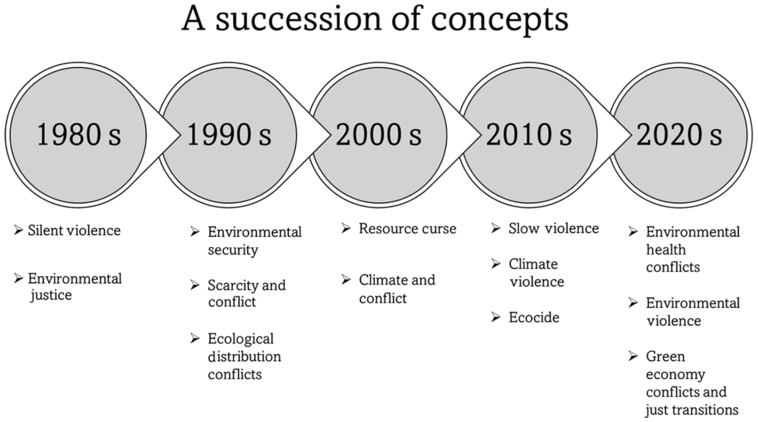
Just as there is a series of concepts related to human-environmental interactions that are useful for understanding environment-conflict linkages, there is also a plethora of mutually informing concepts that have directly targeted framing the environment in conflict (Figure 1.2). There is a very long history of reflections on this relationship, reaching as far back as, and surely even before, Greek philosophers like Hippocrates, who wrote “On Air, Waters and Places” between the fourth and fifth century BC, and Plato, whose “Timaeus” was written in 360 BC. For our purposes here, however, we shall focus on the last four decades, during which numerous contemporary concepts have emerged, contributing to current understandings, policies, and ways of thinking about environment-conflict linkages.
Terms of the last four decades explicitly framing aspects of environment-conflict linkages. Previous work may have employed earlier configurations of these concepts, but the specified time periods indicate when they generally emerged as complete tools directed at environment and conflict contexts.
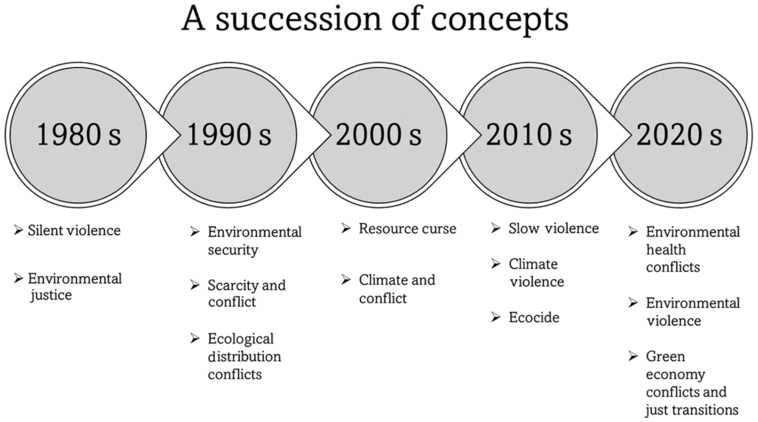
Figure 1.2 Long description
The timeline shows the following details. In the 1980s, the concepts were silent violence and environmental justice. In the 1990s, the concepts were environmental security, scarcity and conflict, and ecological distribution conflicts. In the 2000s, the concepts were resource curse and climate and conflict. In the 2010s, the concepts were slow violence, climate violence, and ecocide. In the 2020s, the concepts were environmental health conflicts, environmental violence, and green economy conflicts and just transitions.
The 1960s and 1970s saw growing questions about resource scarcities and human drivers and responses to them, especially arising from a growing global population. For example, Paul Ehrlich’s proclamation of a looming “population bomb,” corresponding human demand for resources, and questions about sustainability and social responses such as conflict and strife [Reference Ehrlich69]. These questions more broadly implicated resource access and (inter)national security, as well as human responses to growing environmental challenges. Concurrently, general awareness of toxic pollution was growing, nurtured by elucidations from books like Rachel Carson’s [Reference Carson70] Silent Spring, and corresponding policy responses multiplied in response. As an outgrowth of this, two poignant concepts emerged in the 1980s. Michael Watts [Reference Watts71], drawing on fieldwork and historical records of northern Nigeria focused on causes and consequences of famine, argued for recognizing silent violence as a driver of famine. Food insecurity, he argued, was not caused by an insufficient total food production to feed the population but rather structural forces – silent violences – such as state policies and market extraction that shaped food provisioning systems. Food insecurity could bring with it numerous forms of social struggle, including potential conflict, but its core cause was silent violence.
Concomitantly, taking its cue in particular from Carson’s work, the concept of environmental (in)justice emerged – that is, the unequal distribution of environmental risk, the benefits of its production, and the power to shape or resist it. Robert Bullard’s [Reference Bullard72] seminal study quantifying the unequal impacts of toxic pollution risk along racial categories – what is often referred to as environmental racism – ignited an awareness of toxic pollution and unequal experiences of it.
With the end of the Cold War era between 1989 and 1991, concerns around national security, globalization, and meeting growing resource demands reoriented many scholarly and policy communities toward environmental change and concern. These concerns were accelerated by growing awareness of climate change and other environmental challenges like the depletion of the ozone layer from the release of fluorinated gases – namely the refrigerant chlorofluorocarbons [Reference Jackson73]. The result was the establishment of the UN Environment Programme (UNEP), the initiation of the UN Framework Convention on Climate Change (UNFCCC) and the Intergovernmental Panel on Climate Change (IPCC), as well as the signing of the Montreal Protocol on Substances that Deplete the Ozone Layer in 1987.
Coevolving with these policy outcomes were concepts regarding human-environment interactions and growing rates of environmental instability. Environmental security emerged in national security contexts, especially in the United States. For example, the Clinton administration established the first Under Secretary of Defense for Environmental Security, a post filled by Sherry Goodman, whose recent book detailing this history, Threat Multiplier, typifies this security focus in both name and contents [Reference Goodman74]. Goodman would lead the way in promoting environmental security from a security perspective – that is, environmental issues as they relate to national security and global stability [Reference Butts, Goodman and Nugent75, Reference Goodman and Baudu76]. This securitization of the environment and environmental challenges, as many claimed, was partly in response to increasing accounts of resource scarcity and conflict, such as Thomas Homer-Dixon’s [Reference Homer-Dixon77] Environment, Scarcity, and Violence, which built on his earlier work exploring resource scarcity and conflict in cases including Rwanda, Lesotho, China, El Salvador, and many more [Reference Homer-Dixon24].
While concerns about environmental security and resource access began to take off in scholarly, policy, and practice circles, environmental justice issues also grew more pressing. Environmental risks due to globalized, dramatically increasing extraction, production, and consumption galvanized the most encumbered communities to vie for their rights and resist these pernicious risks in what were labeled ecological distribution conflicts (EDCs) [Reference Martinez-Alier78, Reference Martinez-Alier79]. In conflicts of this kind, political and social unrest, and potential direct violence, arise not only as a function of the unequal environmental risks to human health and the degradation of the environments communities rely on for their livelihoods, but also because of the lack of return for the communities most affected by the risk-production processes [Reference Martinez-Alier, O’Connor, Alier, Costanza and Bonilla80, Reference O’Connor, Martinez-Alier, Faucheux, O’Connor and van der Straaten81]. In other words, the same communities bear all the risks and none of the rewards. At the same time, public awareness and scientific data relating to the potential toxic effects of industrial production, especially from chemical manufacturing sites, were growing, as the legal battles of the day testify. Consider the numerous cases filed against DuPont for Teflon contamination (PFOA or perfluorooctanoic acid) beginning in 1998 [82], and the ongoing cases still before the courts today as plaintiffs seek damages for the health impacts of these “forever” chemicals. The global expansion of similar contaminating industrial production processes and corresponding risks has added to the list of more “traditional” extraction operations associated with EDCs, with globalized supply chains moving the raw goods and products in what has been termed ecologically unequal exchange [Reference Givens, Huang and Jorgenson83] – again creating an inverse relationship between risks and rewards, with conflict implications.
Exploration of environment-conflict linkages in the late twentieth century only began to grow at the start of the twenty-first century. Growing capabilities in tracking and measuring environmental phenomena – from global climate change, through globally distributed and aggregated weather monitoring, to remote sensing tools for resource detection and monitoring extraction – have enabled growing interest in environmental security questions and environment-conflict linkages. The resource scarcity and conflict vein has given rise to the ideas of a resource curse or the paradox of plenty [Reference Bannon and Collier84]. The central thesis refers to the failure of many resource-rich countries to benefit fully from their natural resource wealth, and of governments in these countries to respond effectively to public welfare needs, with conflict over the resources being one of the chief obstacles to achieving these outcomes. In this model, rather than scarcity driving conflict, it is competition over abundant resources contributing to conflict. From this emerges the scarcity-abundance duality, in which both are seen as potential contributors to conflict, depending on the contexts [Reference Abrahams33, Reference Mildner, Lauster and Wodni85]. A recent valence of this concept is the growing demand for critical minerals – rare earths and metals needed for electronics and battery production – as part of the sustainability or green economy transition, potentially fomenting green economy conflicts [Reference Scott and Smith86]. Of particular concern is the inverse relationship between the locations of these resources and the end consumers, resulting in one group’s “sustainability” coming at the risk of another’s survival, resurging questions of environment-conflict linkages in pursuit of just transitions [Reference Stevis87].
Another contributor to this duality was growing interest in and evidence of climate and conflict linkages. Varied linkages have been explored between climate impacts and potential direct violence, from heat contributing to violence to extreme weather events and shock (e.g., crop failure from flooding) facilitating or possibly causing conflict [Reference Scartozzi34, Reference Mach88]. The debates around mediating factors such as formal and informal institutions, attribution to climate versus other factors, and other as yet unresolved aspects of climate and conflict abound (as will be discussed in depth in Chapter 2), resulting in an active research area with many policy, practice, and even everyday life implications. As technologies have evolved, empirical evidence has been pushed to increasingly local levels to better understand causal mechanisms and pathways between climate change impacts and conflict contexts.
The field of climate and conflict arose to place the focus on climate change impacts as they contribute to direct violence as an outcome, just as ecological distribution conflicts characterize a similar pathway from environmental risk to violence. Scholars, practitioners, and policymakers have recently progressed, to an extent, to thinking of climate impacts and toxic pollution as forms of violence. Rob Nixon’s [Reference Nixon89] concept of slow violence focuses on chronic environmental risks that result in a violence that occurs gradually and out of sight – a violence of delayed destruction that is dispersed across time and space, an attritional violence that is typically not viewed as violence at all. The construction of slow violence draws out the underlying inequality at the heart of these risks, as those who produce them are often not those who experience them, with a particular focus on wealth and minority identity markers as primary lines of separation between the exposed and the responsible [Reference Nixon30]. While climate change is considered in this construction, the dominant focus tends to be toxic pollution risk – and, for both, on slower acting, purportedly less visible forms of harm. Concurrent with this spotlight on slow violence, the UN Environmental Assembly adopted the first resolution dedicated to the health and environmental risks posed by conflict pollution, also referred to as the toxic remnants of war [Reference Weir90]. A factor also incorporated by Nixon, the resolution identified and publicized the need for swift action – monitoring, enforcement, and technical assistance – to assess and mitigate pollution in the areas affected by armed conflict or terrorism in order to protect human health and the environment [91].
During this same period, conceptions of climate violence also emerged, judging the effects of climate change as a form of violence [Reference O’Brien92]. The violence of climate change, like Nixon’s slow violence, is often tied to the idea of structural violence – that is, arising from formal and informal institutions and policies that result in harm to one group in favor of another [Reference Galtung93]. In the case of climate violence, this is often along lines of marginality such as race, ethnicity, socioeconomic status, the global south/north divide, and other mechanisms that often beget or define inequality. The key shift or progression in these concepts (i.e., slow violence and climate violence) is the move from environmental challenges as contributing to conflict to environmental challenges as a form of violence in and of themselves. In this vein, along with slow and climate violence, the concept of ecocide gained traction, capturing violence to the environment through human action. The term has its origins in military conflicts, specifically the use of Agent Orange in Vietnam, in Barry Weisberg’s [Reference Weisberg94] Ecocide in Indochina: The Ecology of War. Ecocide includes “unlawful or wanton acts committed with knowledge that there is a substantial likelihood of severe and either widespread or long-term damage to the environment being caused by those acts” [95]. Despite recent attempts, ecocide has not been internationally recognized as a criminal act nor added to the Rome Statute that the International Criminal Court is responsible for enforcing. However, laws addressing ecocide have been adopted by 15 individual countries and the European Union bloc, with Vietnam the first country to codify ecocide in its domestic law in 1990 [96].
Like slow violence and climate violence, newly developed concepts have tended to look at risks to human health from environmental change as a form of violence or as begetting direct violence. For example, the concept of environmental health conflicts, an outgrowth of environmental distribution conflicts and slow violence, focuses on conflict and contestations arising from environmental injustices that have been realized in negative health outcomes [Reference Navas, D’Alisa and Martínez-Alier31]. These conflicts present specific characteristics, such as removal of the polluting entity (e.g., the mining operation polluting a waterway) being insufficient for addressing concerns, often demanding remediation of risk to prevent further maladies and protect human health. The concept of environmental violence similarly focuses on assaults on human health from human-produced pollution as a vector of violence [Reference Marcantonio32]. Environmental violence conceptualizes the direct harm to human health from human-produced toxic and non-toxic pollution (recall the earlier discussion of this differentiation), in excess of what is needed to meet human material and other consumption needs, as a form or vector of violence [Reference Marcantonio and Fuentes23].
Pollution production always has and likely always will be a part of the human story. But this concept draws out one particular aspect of it: the immense excess pollution intentionally and, often, legally produced by a relatively small group of humans that goes well beyond sustainable thresholds and the meeting of human needs, directly detracting from the health and flourishing of those least responsible for it and most often most vulnerable to it. The concept highlights the fact that most pollution is visible and monitorable with the technological tools available today, such that when pollution is not “seen,” it is a choice rather than an impossibility occluding the view. Pollution associated with a person’s production and consumption of a good exists and is generally knowable, no matter how physically distant – just like the pollution produced by a conflict far away.
All of the concepts mentioned here have not faded; rather, they have progressively developed and remain relevant. Through interrogation, empirical evaluation, and reconceptualization to varying degrees – each with its disciples and detractors – they have evolved, permeated out from their academic roots into policy and practice circles, and won and lost favor and followers throughout. Each has its own direct and indirect connections to environment-conflict linkages – for example, “resource scarcity” potentially triggering conflict onset, or the toxic remnants of war damaging human health long after the guns stop. The five-part framework presented here is a complement to these concepts, reconciling them in a simple, generalized analytical tool designed as a starting point for evaluating the environmental considerations and contexts in the analysis of any conflict.
1.3 The Framework: An Overview
The proposed framework is a tool to think with. It serves to parse these complex issues and linkages between conflict and environmental inputs and outcomes. It was developed from the broad-ranging literature on the linkages between environmental challenges and conflict, past and present, but offers a novel, parsimonious method to frame these intersections – something not readily found in the literature to date. Whether a citizen concerned about the growing news coverage about the GHG emissions from the Russian war of aggression in Ukraine contributing to anthropogenic climate change, or a policymaker or civil servant working in an adjacent area such as human assistance in natural disaster response operations and wanting to understand the conflict connections and implications of their practice, any interested person can use this framework to obtain a grounded starting point of engagement.
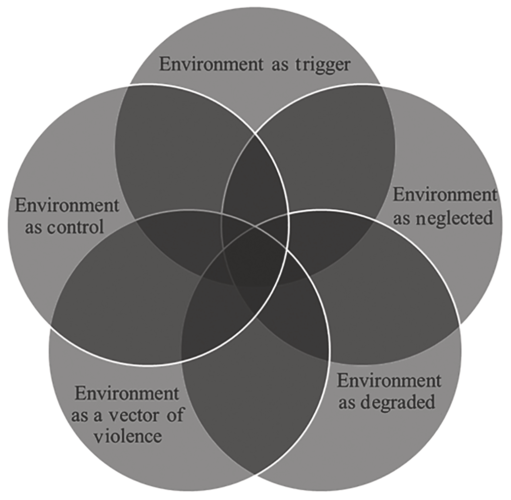
The five categories of the framework are: (1) the environment as trigger – contributing to the onset of conflict; (2) the environment as neglected – before, during, and/or after conflict occurrence; (3) the environment as degraded – environmental damage and risk production during the conduct of conflict and potentially in the aftermath; (4) the environment as control – a mechanism of coercion over a population in a conflict setting; and (5) the environment as a vector of violence – environmental hazards directly harming human health (see Figure 1.3). These categories are not mutually exclusive and often are present simultaneously in a conflict setting [Reference Marcantonio97, Reference Marcantonio and Hook98], amplifying the importance of understanding the implications of each and their intersections. As the vignette from Afghanistan in the Prologue demonstrated, a trash burn pit that includes radio batteries and cardboard Meals-Ready-to-Eat boxes alike can produce GHGs and remnant non-combusted materials that degrade the environment locally and beyond, while also producing toxic emission hazards that directly harm those in the immediate area who breathe it in, potentially acutely and chronically depending on any pre-existing health conditions. While these vectors of harm are simultaneous, the risk profiles and implications are differentiable and, thus, need to be considered separately and interactively. And they potentially require very different mitigation, reduction, or remediation interventions.
A framework for the environment in conflict.
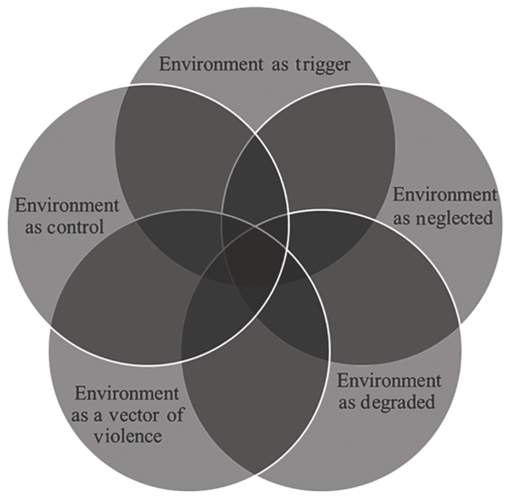
Figure 1.3 Long description
The diagram shows the following details. The five pillars are the environment as trigger, the environment as degraded, the environment as neglected, the environment as control, and the environment as a vector of violence. The circle of each pillar overlaps with each of the circles of the other pillars, highlighting that while each concept is distinct, they do have overlapping interconnections with the other pillars of the framework.
In the rest of this section, a summary of key contexts regarding each environment-conflict linkage is provided as a base presentation of the framework. A short overview of how the linkages will be elaborated on in subsequent chapters is also provided to “tee up” the rest of the book. Notably, the discussion of the pillars in this section and in the subsequent chapters of the book is comprehensive of the literature but not exhaustive of all the literature. In other words, the descriptions are not systematic literature reviews of each, but rather provide comprehensive syntheses of the emerging key points for each pillar. Also, it is not necessary for the pillars to be read in sequential order, as they are designed to stand alone, but with interactivity and overlaps with other pillars – that is, they are distinct, if not always independent. Again, this framework is a tool to start from and then dig deeper if wanted.
To begin thinking about what can be done to prevent, reduce, or remediate the occurrence of these five linkages or their effects, environmental peacebuilding is explored as an apt intervention. Environmental peacebuilding has emerged as a potential proactive buffer against, reactive response to, and potential disruptor of these environment-conflict linkages. To point to challenges is only half the analytical battle; discerning and determining what can be done about them – that is, building peace – is the other half: the framework serves both. The environmental peacebuilding-conflict linkage is, thus, explored and evaluated similarly to the five environment-conflict linkages in this initial overview, and then in depth in Chapter 7.
1.3.1 The Environment as Trigger
Perhaps the most common way to conceptualize the natural environment’s link to conflict has been the environment as a trigger for conflict. In this linkage, the environment is a physical artifact that directly influences social relationships and triggers violent conflict when there are too many or too few resources. Here, the linkage between environment and conflict has two primary types: competition over abundant resources [Reference Bannon and Collier84, Reference Bohmelt99, Reference Buhaug and Gates100, Reference Collier and Hoeffler101, Reference Gemenne, Barnett, Adger and Dabelko102, Reference Humphreys103, Reference Watts104] and competition over scarce resources [Reference Homer-Dixon24, Reference Homer-Dixon105, Reference Burrows and Kinney106, Reference Devlin and Hendrix107, Reference Hendrix and Glaser108, Reference Hsiang and Burke109, Reference Miguel, Satyanath and Sergenti110, Reference Raleigh and Urdal111]. As one environmental driver and potential trigger, climate change can impact the rates of abundance or scarcity of a resource – for example, a flood destroying crops before harvest or warmer temperatures at higher latitudes increasing agricultural productivity and, thus, competition for the land.
This linkage is often modeled in acute modes that affect resource access or production for livelihoods, often referred to as a shock [Reference Buhaug, Croicu, Fjelde and von Uexkull112, Reference Salehyan and Hendrix113], or in more chronic modes, such as through sustained drought [Reference von Uexkull114, Reference Uexkull, Croicu, Fjelde and Buhaug115, Reference Anderson116]. The presence of high-value minerals and other resources in abundance, or land grabbing and resource scarcity for the surrounding population, have also proven to be sources of conflict – although this is not always the case, as they can also give rise to cooperation [Reference Dell’Angelo117, Reference Dell’Angelo, D’Odorico, Rulli and Marchand118, Reference Abrahams119, Reference Mack120]. These linkages are still actively debated [Reference Mach121, Reference Mach and Kraan122, Reference Buhaug123, Reference O’Loughlin, Linke and Witmer124, Reference Salehyan125, Reference Salehyan126], but scholars tend to agree that environmental factors exacerbate or extend socially produced tensions – which include political or economic processes – rather than being the single causal mechanism of violent conflict, thus acting as a “threat multiplier” or contributing factor [Reference Barnett, Castree, Hulme and Proctor127]. Understanding these differences as an individual type and how they interact with other environment-conflict linkages is essential in the rapidly changing Earth System we all inhabit [Reference Rockström128].
In Chapter 2, the junctures and disjunctures of the environment as a trigger are explored. It will highlight where there is currently consensus in scholarly and practitioner circles about this interaction, where there are disagreements and what they are, and why these matter for understanding the environment in conflict. The chapter will also explore the various modes of environmental stress that might contribute to the onset of conflict. One of the key questions will be: with environmental stresses increasing globally, will their cumulative effect yield different results in future environmental conditions than they have historically? And what might matter most in mediating these outcomes? To contextualize this framework, two case studies will be employed: the increasing rate of farmer-herder conflicts in West Africa and beyond; and the contribution of climate change to recent conflict onset in Darfur, Sudan. The cases highlight the potential for environmental factors to contribute to conflict, but also how these conflicts are often mediated by social, political, and economic institutions and norms.
1.3.2 The Environment as Degraded
Just as environmental factors can shape the path to violence, conflict can shape the environment, creating a reciprocal positive feedback loop where each negatively impacts and increases the other [Reference Lawrence, Stemberger, Zolderdo, Struthers and Cooke18, Reference Biswas, Austin and Brush129, Reference Weir130, Reference Levy and Sidel131]. The degradation of the environment from warfare and its constituent activities comes in many forms: air pollution from the building of vehicles and the follow-on emissions from those vehicles as they maneuver as part of the conduct of war [Reference Lewtas132, Reference Masiol, Mallon, Haines, Utell and Hopke133]; trash and surface waste that collects and remains uncollected, promoting disease and the contamination of water resources [Reference Epstein134]; soil and water pollution from the scattering of toxic unexploded ordnance from deposited munitions [Reference Frost135]; and/or particulates and other hazardous air pollutants emitted from destroyed and smoldering buildings [Reference Pacheco-Torgal, Jalali and Fucic136, Reference Zeig-Owens137]. The list is long and encompasses every stage of conflict, from violence escalation to post-war rebuilding [Reference Marcantonio, Katsos and Miklian17, Reference Machlis, Hanson, Machlis, Hanson, Spiric and McKendry138]. The ongoing conflict in Ukraine, the most environmentally monitored conflict in history, is a clear and well-documented example of the impacts of conflict on the environment [Reference Hook and Marcantonio139, Reference Marcantonio140]. Understanding these processes and how they can be reduced and/or reconciled before, during, and in the aftermath of conflict is a critically important lens, especially as levels of conflict seem to be increasing globally [Reference Themner141].
Chapter 3 explores the direct ecological degradation of conflict and its implications during and in post-conflict settings. The distinctiveness of this pillar is that the ecological harms are “direct.” Examples may include: the chemical dispersion from exploded and unexploded materials of a glide bomb fired into Ukraine; the pollution produced from the destruction of that bomb hitting its target; or the destruction of an industrial factory releasing noxious gas in the air and contaminants in the water, like the Azovstal Iron and Steel Works in Ukraine [142]. One frequently occurring example could be land mined to restrict movements, contaminating the soil and potentially groundwater systems for generations to come, as has happened in Angola, Azerbaijan, and Vietnam, to name but a few of the countries with more than a million mines still nestled beneath their soil [143]. In short, the environment is degraded from the direct actions of conflict, resulting in environmental destruction. The degradation then poses direct environmental risk and public health impacts for human and non-human species. Factors such as how this can impact environmental media, what organizations and databases track and measure these impacts and how, the timescale associated with different toxic remnants of war, and others are discussed in the chapter to highlight the varied and potentially long-lived effects of a degraded environment. The case studies Agent Orange in Vietnam, the mass destruction of Gaza, and the unfolding environmental destruction in Ukraine (with the latter two cases discussed in conjunction with the environment as a vector of violence at the end of Chapter 6) are used to contextualize the environment as degraded.
1.3.3 The Environment as Neglected
During conflict, the environment is degraded not only by the violent activities that occur and increase, it is also degraded through neglect. This may be due to a lack of institutional and regulatory capacity to manage environmental risks because of conflict restraints, economic challenges, inaccessibility, or other priorities taking precedence in a conflict. Conflict-related activities can prevent local and national environmental managers from conducting their regulatory activities due to the inability to move about freely and safely in their area of responsibility. Extraction sites, for example, are often located in remote rural areas, where accessing them for regulation and management can be dangerous work when conflict actors operate in the vicinity. This is often the case, for example, with the artisanal mines of Congo [Reference Krauser144] or in Eastern Ukraine before the 2022 invasion [52]. Environmental management and remediation are also often expensive and, therefore, may not be a top priority for allocating funding or personnel that may be needed elsewhere. Environmental neglect can be passive and unintended, or active and intentional due to competing demands or perverse incentives. For example, sustainable water management of the North Crimean Canal was intentionally neglected to deprive Crimea of water, leading to chemical air pollution from the Crimean Titan factory in Armyansk [Reference Vynogradova145]. Neglect can also be as simple as halting trash collection services, allowing the build-up and festering of surface waste, the promotion of contaminants, and the spread of related diseases like cholera and typhoid [Reference Marcantonio97, Reference Ozaras146, Reference Simpson147]. Understanding modes and causes of environmental neglect in conflict contexts is essential to mapping and measuring the effects of violence and what needs to be done to restore or rebuild institutional capabilities and capacities in its aftermath to construct sustainable peace. Thus, it is a critical lens for understanding the environment in conflict.
Chapter 4 explores the different pathways by which the environment as neglected in conflict unfolds. The chapter appraises the institutions that mediate this process; the constraints and limitations that impact the capability, capacity, and will to regulate, or the choice or forced outcome of neglect; and the possibilities and tradeoffs of remediation during and in post-conflict settings. Unless there exists the capability, capacity, and will to maintain environmental management in a conflict setting – and necessarily all three – environmental neglect will ensue. This is not necessarily always suboptimal, for example when there are limited resources and tradeoffs between investing in other human-flourishing impacting programs and sometimes costly environmental remediation. This further complicates this category but reinforces the need to understand it and its interrelationship with the other four components of the framework. The cases of the 2014 occupation of Eastern Ukraine by Russian-backed separatists, the debacle of the FSO Safer oil tanker off the coast of Yemen in the Red Sea, and the environmental impacts of the Mozambique Civil War are employed to explore how different outcomes, from water pollution to destruction of biodiversity, can result from environmental neglect caused or contributed to by conflict.
1.3.4 The Environment as Control
In the absence of protection and provision of environmental services, militants or other organized groups that wield coercive power are often able to seize control of local environments in order to control the population living in a contested area [Reference Hough148, Reference King149]. By controlling the production and flow of essential environmental resources and services, the controller can force people to bend to newly imposed laws, regulations, or other coercive demands, whatever form that may take [Reference Dreazen150]. The environment is instrumentalized as a tool of control – a tool of war.Footnote 2 Militant groups have even intentionally destroyed resources and environmental service infrastructure to increase the reliance on – and value of – the resource they control [Reference Hough148], a phenomenon that has increased in frequency in the last few decades. In Somalia, for example, Al Shabab has leveraged water as a mechanism of control over rural populations, denying the scarce resource to those who did not conform to their ideologies and restrictive rules [Reference Mueller151]. Daesh (or the Islamic State of Iraq and Syria – ISIS) also weaponized water in urban and rural communities throughout Iraq and Syria to quell discontent and enforce strict adherence to their decrees [Reference King149]. In Afghanistan, the Taliban leveraged water distribution in gravity-fed irrigation systems for poppy and food production as a mechanism of control over populations to ensure adherence to opium production. Land, water, fish stocks, and other environmental resources and services can all serve as levers of control if secured and controlled by a coercive group. Understanding how environmental resources and services can become a mechanism of control and influence is critical to understanding broader conflict dynamics and population responses, just as it is essential for mapping the conflict-environment linkage.
Chapter 5 explores the contours of the environment as a mechanism of control. Taking the “long view,” throughout human history, enclosure of resources (i.e., comprehensive control) has been utilized as a tool of coercion to force one group to do another’s will [Reference Fry152]. In conflict contexts, the environment as control can have an amplified effect on everyday life, as people’s agency tends to be constrained by the conflict. Their range of options to migrate, to seek alternative livelihoods or resources, or even carry out any range of everyday activity can be significantly curtailed. The use of the environment as a mechanism of control thus takes on an amplified role in conflict contexts, particularly when lethal outcomes abound, and interacts with the other environment-conflict linkages. The case studies include the centuries-long deployment of control over land and food production as a mechanism of control in Ireland and the instrumentalization of water in Syria and Iraq by Daesh.
1.3.5 The Environment as a Vector of Violence
Most investigations into the environment-conflict linkage look at direct violence – for example, armed conflict between two or more actors. However, environmental vectors of harm, such as toxic pollution that directly assaults human health and anthropogenic climate change that causes myriad direct and indirect stresses on the human body, are increasingly being framed as a form of violence whether they occur in an active-conflict setting or not [Reference Marcantonio and Fuentes23, Reference Nixon30, Reference Fuentes, Lederach and Marcantonio153]. Whether it is called slow violence [Reference Nixon30, Reference Navas, D’Alisa and Martínez-Alier31], ecological violence [Reference Navas, Mingorria and Aguilar-González154, Reference Stretesky and Lynch155], environmental violence [Reference Marcantonio and Fuentes23], or another term is used, the general thrust of these concepts is recognizing human-produced risks to human health as a form of violence. Many reference the statistics on human-produced risks, such as the estimated 9 million people who die as a result of toxic air pollution each year [Reference Fuller10]. Often, these concepts have at their core an accounting of inequality, recognizing the inverse relationship between the groups of humans predominantly producing these risks and those exposed to and suffering from them [Reference Marcantonio, Javeline, Field and Fuentes156]. Engaging these topics often raises questions of intentionality, scale, and similar issues, each of which must be dealt with in its own fashion. These concepts are gaining traction, as recent declarations by the UN Human Rights Council [157] and the UN General Assembly [158] making access to a safe, clean, and healthy environment a human right make clear. Understanding how these risks might be conceptualized as themselves a form of violence or conflict, in and external to settings of armed conflict, is critical to evaluating the spectrum of ways humans are directly harming other humans today.
Chapter 6 explores environmental vectors of violence, especially those produced in the contexts of armed conflict. The chapter also explores the potential to consider environmental violence in areas of negative peace and in post-conflict contexts – that is, in areas where direct violence is generally absent [Reference Galtung93]. Whereas the environment as degraded and environment as neglected focus on environmental degradation and damage that result in varied human health risks, the environment as a vector of violence looks at the often immediate, especially realized risks to or assaults on human health during the conduct of war and beyond. For example, as noted earlier, more people die annually in Sierra Leone today from human-produced toxic pollution from mining than the average annual deaths during the civil war there. To investigate these vectors of violence emerging from the environment as degraded, the chapter looks at the cases of toxic air, water, and soil pollution permeating Ukraine in the unfolding Russian war of aggression and the potential uninhabitability of Gaza from the currently still unfolding crisis, to understand the environment as a vector of violence in active-conflict settings and critical post-conflict considerations.
1.3.6 Possibilities of Environmental Peacebuilding
Environmental peacebuilding is the study and practice of utilizing environmental issues as a vehicle for peacebuilding [Reference Ide159]. While much attention has been given to their contributions and connections to conflict, the dominant mode of human actions in response to environmental challenges throughout our evolutionary history has been cooperation [Reference Fuentes and Fry14]. Recognizing this reality and mobilizing the possibilities it can open up, environmental peacebuilding is about innovating and exploring the way in which the many environmental challenges we face can be harnessed to foment positive social, political, economic, and, of course, environmental outcomes.
Environmental peacebuilding has predominantly focused on cooperation and peacebuilding between nations, such as through water-sharing agreements between nations – sometimes referred to as “hydrodiplomacy” – as a mechanism to prevent conflict over environmental issues or as a response to them [Reference Conca and Dabelko160, Reference Ide161]. More recent work has pushed to scale down scholarship and programming to understand and practice environmental peacebuilding at the local level, and current empirical evidence remains not robust and inconsistent [Reference Ide162, Reference Krampe163]. Environmental peacebuilding has also predominantly focused on natural resource management, with much less coverage of environmental management (recall the differences between the two laid out previously), but recent efforts have reasserted contamination and the toxic remnants of war as important considerations for the field [Reference Marcantonio97]. Environmental peacebuilding has a role to play in pre-, ongoing, and post-conflict contexts, just as it has the potential to address each of the five environment-conflict linkages of the framework, individually and collectively.
Chapter 7 will explore the ways in which environmental peacebuilding has sought to facilitate peacebuilding in different conflict stages and settings. From peace-positive programming through NGOs, to environmental assessments as a tool for peacebuilding, to environmental provisions in formal peace agreements, the activation of the environment as a centrifuge for peacebuilding has many valences, modes, and scales. The chapter will explore these tools and concepts and more, drawing on cutting-edge scholarship and practice while presenting numerous cases to highlight ground-level implications and outcomes of environmental peacebuilding.
1.4 What Is to Come: Mapping the Rest of the Book
The environment-in-conflict framework parses the complex linkages between different modes of environment-conflict interactions and outcomes. Importantly, it also provides initial starting points for approaching them, as well as implications and actions that can be taken to address them. Whether it is identifying forms of the environment as degraded, such as contaminated agricultural fields that require immediate remediation to protect human health and promote food security in the aftermath, or identifying potential environmental mechanisms of control in pre-conflict settings, which can then be worked on to protect and diversify them, the starting point to action is mapping these with the framework. Then, once the linkages and implications are evaluated, actions such as environmental peacebuilding, peace-positive development and programming, and even environmental provisions for formal peace agreements can begin to be pursued. This makes the framework a tool with direct benefits to policymakers, development workers, and international organizations alike. But it also allows everyday citizens to more easily comprehend the complexities of the conflict and how their actions – whether through voting, making consumer decisions, or embracing lifestyle choices regarding their ecological footprint – might connect to a particular conflict and its environmental aspects. The book will, thus, deploy the framework to not only show a way to frame and think about environmental linkages in a conflict but also to provide practical potential pathways of action. It will not stop at just thinking about these challenges but will move beyond to what might be done about them, providing readers with a pathway out of despair and disconnection and toward direct engagement with possibilities.
The next five chapters will comprehensively but not exhaustively build out each of the five parts of the framework. The key components of each part will be discussed and assembled to set the conditions for effectively applying it to analyze a conflict context. However, each chapter is not a systematic review of the literature of each part. After the key components are brought together, as noted earlier, each chapter will include at least three case studies highlighting the valences and varied outcomes of each pillar in past or unfolding conflicts. Rather than stop at identifying the challenge points within environment-conflict linkages, environmental peacebuilding is explored in Chapter 6. The concluding chapter works through macro- and micro-trends emerging in contemporary conflicts with environmental implications, and concerns and possibilities for the future of environment-conflict linkages and environmental peacebuilding as an antidote.
Again, the environment is always a witness to, and often a victim in, conflicts. And conflicts always have environmental contexts that shape them. Framing and evaluating these linkages is essential to understanding conflict realities and seeking solutions to mend the suffering of violence.