Van den Boom's (Reference Van den Boom1994) intervention for low socioeconomic status Dutch mothers and their highly irritable infants increased infant attachment security by 300% compared to control group infants. Belsky (Reference Belsky1997a, Reference Belsky, Ellis and Bjorklund2005) advanced a differential susceptibility interpretation of these findings, suggesting that the dramatic impact of the intervention may have emerged because, by focusing on highly irritable newborns, van den Boom may have examined only infants who were most susceptible to rearing influences. Belsky's interpretation is reasonable given meta-analytic findings indicating that the effects of attachment-based interventions are typically more moderate (Bakermans-Kranenburg, van IJzendoorn, & Juffer, Reference Bakermans-Kranenburg, van IJzendoorn and Juffer2003). Given the importance of infant attachment security to later developmental outcomes (NICHD Early Child Care Research Network, 2006; Sroufe, Egeland, Carlson, & Collins, Reference Sroufe, Egeland, Carlson and Collins2005; for a review, see Thompson, Reference Thompson, Cassidy and Shaver2008), we sought to determine whether we could again find such dramatic effects with a similarly brief intervention and whether by expanding the irritability criterion we could extend the benefits of intervention to more infants.
We also set out to broaden the conceptual relevance of this work by examining the interaction between infant irritability and treatment for evidence of differential susceptibility. Differential susceptibility requires that susceptible infants, compared to other infants, are more negatively affected by unsupportive environments and more positively affected by supportive environments. Therefore, the ability to detect differential susceptibility hinges on researchers' ability to identify what constitutes a supportive or unsupportive environment for particular infants. Both theory and research point to ways that maternal attachment style, in interaction with treatment and infant irritability, may contribute to whether the caregiving environment is supportive or unsupportive for specific infants (Mikulincer & Shaver, Reference Mikulincer and Shaver2007). Thus, examining whether maternal attachment style moderates the interaction of infant irritability and treatment to affect infant attachment security can inform both our understanding of “what works for whom” (Roth & Fonagy, Reference Roth and Fonagy2005, p. 1) with regard to attachment-based interventions and our understanding of differential susceptibility. Accordingly, the goal of this study was to examine, for the first time, how infant irritability and maternal attachment style work together as moderators of the efficacy of an attachment-based intervention. In doing so, we looked for evidence of differential susceptibility to rearing influences.
Differential Susceptibility: Correlational and Experimental Examinations
Most developmental psychologists assume that not all children are affected equally by their caregiving environments, an assumption supported by the large body of Temperament × Environment (T × E) research (Rothbart & Bates, Reference Rothbart, Bates, Eisenberg, Damon and Lerner2006). Early work testing T × E interactions identified temperamentally negative infants as a group of infants at risk for negative developmental outcomes (for a review, see Belsky, Reference Belsky, Ellis and Bjorklund2005). Two theories have been developed more recently about neurobiological sensitivity: the differential susceptibility hypothesis (see Belsky Reference Belsky1997a, Reference Belsky, Ellis and Bjorklund2005; Belsky, Bakermans-Kranenburg, & van IJzendoorn, Reference Belsky, Bakermans-Kranenburg and van IJzendoorn2007; Belsky & Pluess, Reference Belsky and Pluess2009) and the theory of biological sensitivity to context (see Boyce & Ellis, Reference Boyce and Ellis2005; Boyce et al., Reference Boyce, Chesney, Alkon-Leonard, Tschann, Adams and Chesterman1995; Ellis, Essex, & Boyce, Reference Ellis, Essex and Boyce2005; Obradović & Boyce, Reference Obradović and Boyce2009). Both perspectives suggest that this emphasis on high negative reactivity solely as a risk factor for poor developmental outcomes is mistaken. According to these evolutionary-based theories, it may instead be more appropriate to view high reactivity as both an advantage and a detriment to development, depending on the child's environment. For example, the differential susceptibility hypothesis has specified “that some children, for temperamental or genetic reasons, are actually more susceptible to both (a) the adverse effects of unsupportive parenting and (b) the beneficial effects of supportive rearing” (italics in original text; Belsky et al., Reference Belsky, Bakermans-Kranenburg and van IJzendoorn2007, p. 300). Furthermore, Belsky et al. stipulated that differential susceptibility exists when T × E interactions meet specific requirements: a cross-over interaction where outcomes for susceptible children compared to less susceptible children are disproportionately worse in negative conditions and disproportionately better in positive conditions.
Since the publication of the theoretical specifications of the neurobiological sensitivity construct, several longitudinal correlational studies have found support for this hypothesis by reporting data within a single sample indicating that child outcomes (e.g., externalizing, social competence, adjustment) for temperamentally negative children compared to less negative children were not only adverse in negative environments but also enhanced in positive environments (e.g., Bradley & Corwyn, Reference Bradley and Corwyn2008; Kochanska, Aksan, & Joy, Reference Kochanska, Aksan and Joy2007; Pluess & Belsky, Reference Pluess and Belsky2009; Stright, Gallagher, & Kelley, Reference Stright, Gallagher and Kelley2008; van Zeijl et al., Reference Van Zeijl, Mesman, Stolk, Alink, van IJzendoorn and Bakermans-Kranenburg2007; for theoretical and empirical accounts of differential susceptibility using genotypic and endophenotypic markers of susceptibility, see Belsky & Pluess, Reference Belsky and Pluess2009; Boyce & Ellis, Reference Boyce and Ellis2005; Ellis, Boyce, Belsky, Bakermans-Kranenburg, & van IJzendoorn, Reference Ellis, Boyce, Belsky, Bakermans-Kranenburg and van IJzendoorn2011 [this issue]; Obradović & Boyce, Reference Obradović and Boyce2009).
Clearly, the existing research provides important support for the differential susceptibility hypothesis, but future experimental studies that manipulate the caregiving environment would provide a more comprehensive understanding of how temperamentally negative infants are differentially susceptible to rearing influences. Three experimental studies have provided data relevant to the claims of the differential susceptibility hypothesis. Van Zeijl et al. (Reference Van Zeijl, Mesman, van IJzendoorn, Juffer, Koot and Alink2006) conducted an attachment-based intervention for 1- to 3-year-old children designed to reduce their high levels of externalizing behavior. The intervention proved to be efficacious; however, the findings indicated that children with mother-reported difficult temperament were not differentially affected by the intervention (i.e., child temperament did not moderate intervention efficacy). As the authors note, it is possible that the dimension of negative temperament used in this study (mother-reported “difficultness”) is not a marker of differential susceptibility. Other dimensions of negative temperament, such as fearfulness (Kochanska et al., Reference Kochanska, Aksan and Joy2007), emotional reactivity (Belsky, Reference Belsky, Ellis and Bjorklund2005; Klein Velderman, Bakermans-Kranenburg, Juffer, & van IJzendoorn, Reference Klein Velderman, Bakermans-Kranenburg, Juffer and van IJzendoorn2006), and negative emotionality (Blair, Reference Blair2002), may be more relevant markers of differential susceptibility.
In another study, the only experimental study with attachment security as the outcome, Klein Velderman et al. (Reference Klein Velderman, Bakermans-Kranenburg, Juffer and van IJzendoorn2006) tested whether highly reactive infants (based on mother report at 6 months) showed evidence of differential susceptibility to intervention. Intervention did not influence infant attachment nor did infant reactivity moderate the influence of intervention, findings that did not reveal differential susceptibility as it was later defined (Belsky et al., Reference Belsky, Bakermans-Kranenburg and van IJzendoorn2007). In order to probe further for evidence that highly reactive infants were more susceptible to the effects of intervention, Klein Velderman et al. looked within the intervention group only to determine whether infants were differentially susceptible to their mothers' change in sensitivity from pre- to postintervention. Results revealed that experimentally induced increases in maternal sensitivity were related to increases in attachment security only for the most reactive infants. This finding that temperamentally negative infants profited more from the beneficial effects of intervention than less negative infants supports one component of the differential susceptibility hypothesis: negative temperament enhances development in a positive environment. It is important to note that this study utilized only 81 infants and their mothers who were (tentatively) classified as insecure on the Adult Attachment Interview; whether the same pattern of results exists for all mothers is yet to be tested.Footnote 1
Finally, similar support of this development-enhancing component of the differential susceptibility hypothesis emerged from an intervention study in which low birth weight children and their parents received a broad spectrum of early intervention services (Blair, Reference Blair2002). It was again only children with high (mother reported at 12 months) negative emotionality who benefited from intervention; less negative infants received no benefit. Thus, findings from two of the three experimental studies support the development-enhancing prediction of differential susceptibility, indicating that it may be inappropriate to consider negative temperament solely as a risk factor for negative outcomes. It is also important to recognize that in some instances temperamentally negative infants profit more from the beneficial effects of caregiving interventions than do less negative infants (Belsky & Pluess, Reference Belsky and Pluess2009; Boyce & Ellis, Reference Boyce and Ellis2005).
Maternal Attachment Styles as Moderators of the Expected Treatment × Irritability Effect
The central idea of the differential susceptibility hypothesis is that susceptible infants have less optimal outcomes than other infants when the environment is negative and more optimal outcomes than other infants when the environment is positive. As such, the more that researchers can understand about what constitutes a negative or positive environment for a particular infant, the better issues of differential susceptibility can be examined. A central part of the infant's environment is his or her mother, and consideration of attachment theory and research suggests ways in which maternal attachment style may moderate an expected Treatment × Irritability interaction to influence outcome. To date, no study has examined these constructs together to determine whether a three-way interaction of treatment, irritability, and maternal attachment style predict child outcomes.
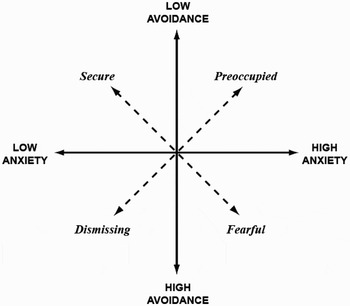
Self-report measures of adult attachment style (e.g., the Experiences in Close Relationships Scale [ECR]; Brennan, Clark, & Shaver, Reference Brennan, Clark and Shaver1998) tap two underlying factors: attachment avoidance and attachment anxiety. Attachment avoidance has been conceptualized as the degree to which individuals are uncomfortable with closeness and intimacy and are reluctant to rely on others for comfort and support (Fraley & Shaver, Reference Fraley and Shaver2000). Attachment anxiety has been conceptualized as the degree to which individuals are vigilant to cues of rejection and abandonment from close others. Individuals high on attachment anxiety have low thresholds for detecting such cues, making worries about rejection and abandonment particularly salient (Fraley & Shaver, Reference Fraley and Shaver2000). Attachment anxiety and avoidance can be represented orthogonally in two-dimensional space. As Figure 1 shows, rotating these scales 45 degrees yields two dimensions: one labeled the secure–fearful dimension and a second labeled the dismissing–preoccupied dimension. This rotation allows exploration of how the Treatment × Irritability interaction may vary across the four adult attachment style patterns that Bartholomew identified (i.e., the secure, dismissing, preoccupied, and fearful patterns; Bartholomew, Reference Bartholomew1990; Bartholomew & Horowitz, Reference Bartholomew and Horowitz1991; see Fraley & Shaver, Reference Fraley and Shaver1997; Mohr, Gelso, & Hill, Reference Mohr, Gelso and Hill2005).
Attachment anxiety and avoidance scales rotated 45 degrees to form a secure–fearful dimension and a dismissing–preoccupied dimension. Adapted from “Adult Romantic Attachment: Theoretical Developments, Emerging Controversies, and Unanswered Questions,” by R. Fraley and P. Shaver, Reference Fraley and Shaver2000, Review of General Psychology, 4, 132–154. Copyright 2000 by American Psychological Association. Adapted with permission.

For each maternal attachment style, there are various ways that treatment and irritability may interact. For example, more dismissing mothers (i.e., mothers whose low attachment anxiety and high avoidance place them on the dismissing end of the dismissing–preoccupied dimension) may be especially averse to infant irritability because the irritability increases the infant's demands for contact and closeness. Highlighting the discomfort that highly dismissing parents feel when faced with increasing distress and related needs for comfort, Edelstein et al. (Reference Edelstein, Alexander, Shaver, Schaaf, Quas and Lovas2004) reported that parents high in avoidance became less responsive as their children's distress increased during a medical inoculation. Consequently, a highly irritable infant whose mother is high on dismissing attachment may face a particularly unsupportive caregiving environment compared to a moderately irritable infant with such a mother. Intervention may be particularly effective for highly dismissing mothers and their highly irritable infants because these mothers may be especially motivated to learn how to effectively calm and soothe their infants and also because highly irritable infants may be particularly susceptible to their mother's increased responsiveness to their distress. In contrast, highly dismissing mothers' strong need for independence, distrust of others, and discomfort with self-disclosure (Mikulincer & Nachshon, Reference Mikulincer and Nachshon1991) may make it difficult to form the sort of relationship with the intervener that would facilitate intervention progress.
More preoccupied mothers (i.e., mothers whose high attachment anxiety and low avoidance place them on the preoccupied end of the dismissing–preoccupied dimension) may not find highly irritable infants aversive because these mothers enjoy closeness and intimacy. These mothers may instead be averse to calmer, less needy infants whose demeanor the mother may misinterpret as a sign of rejection. Thus, it is possible that moderately irritable infants of highly preoccupied mothers may face a more unsupportive caregiving environment than a highly irritable infant with such a mother would face. An intervention that helps highly preoccupied mothers interpret their moderately irritable infants' independent behaviors as healthy exploration rather than as a personal rejection may be particularly effective for these dyads. In contrast, highly preoccupied mothers' need for acceptance and hypervigilance to signs of rejection (Mikulincer, Birnbaum, Woddis, & Nachmias, Reference Mikulincer, Birnbaum, Woddis and Nachmias2000; Mikulincer, Gillath, & Shaver, Reference Mikulincer, Gillath and Shaver2002) may create an emotionally turbulent intervention environment that derails progress.
Mothers high on security (i.e., mothers whose low attachment anxiety and low avoidance place them on the secure end of the secure–fearful dimension) may be able, without intervention, to serve as a secure base and safe haven for either a highly irritable or moderately irritable infant because these mothers are not overly concerned with being rejected and are also comfortable with contact and closeness. The possibility that more secure mothers may not need intervention was supported by Robinson and Emde's (Reference Robinson and Emde2004) finding that intervention promoted maternal sensitivity only for more insecure mothers. In contrast, intervention may be particularly effective for more secure mothers because their interpersonal behaviors facilitate forming a productive relationship with the intervener and are supportive of making progress towards intervention goals (e.g., Cyranowski et al., Reference Cyranowski, Bookwala, Feske, Pilkonis, Frank and Kostelnik2002; Eames & Roth, Reference Eames and Roth2000; Kivlighan, Patton, & Foote, Reference Kivlighan, Patton and Foote1998; Mallinckrodt, Coble, & Gantt, Reference Mallinckrodt, Coble and Gantt1995; Parish & Eagle, Reference Parish and Eagle2003; Satterfield & Lyddon, Reference Satterfield and Lyddon1995).
Finally, more fearful mothers (i.e., mothers whose high attachment anxiety and high avoidance place them at the fearful end of the secure–fearful dimension) may have difficulties with both highly irritable and moderately irritable infants because these mothers are high on both attachment anxiety and attachment avoidance, thus resembling in some ways both highly dismissing and highly preoccupied mothers. As such, intervention may be ineffective for highly fearful mothers because of the complexity inherent in treating a mother who may be uncomfortable with both highly irritable and moderately irritable infants. Like highly dismissing mothers, they may prefer that the infant express little distress; yet at the same time, these mothers may not be motivated to soothe the infant because of a tendency (characteristic of highly preoccupied mothers) to feel rejected when the infant is calm and engaging in independent exploration. In addition, because these highly fearful mothers may present interpersonal behaviors associated with both high levels of avoidance and high levels of attachment anxiety, intervention progress may be hampered by difficulties in the relationship with the intervener.
Given the many ways that the Treatment × Irritability interaction could vary across maternal attachment styles, an important next step in moving this literature forward is to examine the interaction of Treatment × Irritability × Maternal Attachment Style as a predictor of infant attachment security. Doing so has important implications for our understanding of what works for whom and of differential susceptibility.
The Circle of Security–Home Visiting—4 Intervention (COS-HV4)
The COS-HV4 intervention developed for this study (Cooper, Hoffman, & Powell, Reference Cooper, Hoffman and Powell2000) consisted of four home visits. The intervention can be viewed as including and extending the central elements of van den Boom's (Reference Van den Boom1994) intervention for mothers of irritable infants. Following van den Boom (Reference Van den Boom1994), and because of meta-analytic evidence that intervention is most effective when it begins when infants are older than 6 months of age (Bakermans-Kranenburg et al., Reference Bakermans-Kranenburg, van IJzendoorn and Juffer2003), we intervened when infants were in the second half of their first year. Central to the intervention is the concept of the parent as a secure base who provides the infant with a sense of felt security. The intervention begins with helping the mother enhance her observation skills by helping her to understand what it is that infants need and to recognize infant signals related to these needs and then focuses on helping the mother to select and implement sensitive responses.
This intervention is designed to help mothers attend to both infant attachment and exploratory behaviors (e.g., the intervention highlighted the importance of soothing a crying infant as well as the importance of fostering the infant's play in a supportive and nonintrusive way). For some mothers, the intervention involved learning to simplify and slow down their behavior while following the baby's signals rather than overstimulating the baby and being intrusive. Some mothers worked on recognizing and responding sensitively to infant cues of distress more quickly, and others focused on allowing the infant to explore. The intervention also examined the ways that the mother's cognitive and affective responses to the baby's behavior may influence her behavior and explored with the mother the possibility of making changes. The intervention was tailored to the individual characteristics of each particular infant and mother, and the approach was one in which the intervener was curious, supportive, and nonjudgmental.
Like van den Boom's (Reference Van den Boom1994) intervention for irritable infants, the intervention was conducted in the home with the baby present so that feedback about infant signals and maternal responses could be provided as they occurred. An important extension of the van den Boom approach was the inclusion of video feedback, an intervention technique that emerged in the field of infant intervention subsequent to van den Boom's original intervention (e.g., Egeland & Erickson, Reference Egeland, Erickson, Sameroff, McDonough and Rosenblum2004; Juffer, Bakermans-Kranenburg, & van IJzendoorn, Reference Juffer, Bakermans-Kranenburg and van IJzendoorn2008; McDonough, Reference McDonough, Sameroff, McDonough and Rosenblum2004). Video feedback allows a focus on selected key (and sometimes fleeting) aspects of maternal behavior: video review of sensitive behavior can allow the mother to view herself as capable of being sensitive, and review of problematic behavior provides the mother the chance to reflect and talk about the situation with perhaps greater calmness than she felt at the time.
The Present Study
The present study is a randomized controlled trial (RCT) evaluating a brief attachment-based intervention aimed at increasing infant–mother attachment security for irritable infants from economically stressed families. Such infants have previously been found to be at risk for insecure attachment (van den Boom, Reference Van den Boom1994). In order to determine whether we could replicate the dramatic effects of van den Boom's brief intervention for a wider range of infants by expanding the irritability criterion, we enrolled only newborns in the top 20% of newborn irritability as assessed with the Neonatal Behavioral Assessment Scale (NBAS; Brazelton & Nugent, Reference Brazelton and Nugent1995). Within this sample of irritable infants, we identified two groups: highly irritable infants (who met the irritability criterion used in van den Boom's study) and moderately irritable infants. This distinction allowed us to address the following goals when evaluating the intervention.
First, we sought to determine whether we could intervene with the economically stressed mothers of irritable infants to increase the rate of infant attachment security. In order to examine whether infants were differentially susceptible to the effects of an experimental manipulation of their caregiving environment (i.e., intervention), we examined whether level of infant irritability moderated the effect of intervention on infant attachment security. In this first analysis we examined the interaction of Treatment × Infant Irritability without considering potential effects of maternal attachment in order to parallel tests of differential susceptibility in previous studies of attachment-based interventions. We hypothesized that the intervention would lead to greater rates of attachment security overall compared to the control condition (Hypothesis 1). We also hypothesized that irritability would moderate the effect of intervention such that, in line with predictions of the differential susceptibility hypothesis, intervention would be more efficacious for highly irritable infants (Hypothesis 2). If the differential susceptibility hypothesis is correct, we should observe a cross-over interaction indicating highly irritable infants to be the most likely to be securely attached as a result of intervention and the least likely to be securely attached when placed in the control group.
Second, we conducted two exploratory analyses assessing the moderating roles of maternal attachment styles, and examined the three-way interaction of treatment, infant irritability, and maternal attachment style to determine whether the Treatment × Irritability interaction differs across levels of maternal attachment styles. We hypothesized that the Treatment × Irritability interaction would be moderated by (a) the secure–fearful attachment dimension (Hypothesis 3) and (b) the dismissing–preoccupied attachment dimension (Hypothesis 4), yet previous theory and data, described above, precluded specification of the exact nature of these interactions. Examination of three-way interactions involving the role of maternal attachment style in moderating the expected Treatment × Irritability interaction enhanced our ability to understand treatment efficacy and to detect differential susceptibility across a variety of dyadic contexts by allowing us to have greater understanding of both positive and negative environments for highly irritable and moderately irritable infants.
In sum, the present study adds to the literature in several important ways. This is the first study since van den Boom (Reference Van den Boom1994) to examine whether a brief home-based intervention with irritable infants can have dramatic effects in increasing infant secure attachment. We also examine whether the effects would extend to a greater number of infants by expanding the irritability criterion. Moreover, in addition to being among the first to examine whether infants are differentially susceptible to intervention effects on attachment security, the present study is the first to examine whether maternal attachment style moderates a hypothesized interaction between treatment and irritability in the prediction of infant attachment security, which is an important next step in understanding both “what works for whom” and issues of differential susceptibility. In addition, our observational assessment of newborn infant temperament has substantial advantages over the parent-report measures and observations of older infants used in previous examinations of the differential susceptibility hypothesis.
Method
Participants
Participants were 220 irritable infants and their economically stressed mothers recruited at birth from 14 hospitals within a large metropolitan area. Mothers were considered economically stressed if they met one of two criteria: (a) earned less than $41,000 or (b) if living with the baby's father, had a combined income of less than $45,000 (up to $50,000 if both incomes had a Hollingshead [Reference Hollingshead1975] occupational prestige score of 6 or lower [technicians and semiprofessionals]). In addition to being economically stressed, dyads also had to meet the following eligibility criteria in order to be screened for irritability: (a) first-born infant, (b) full-term infant, (c) uncomplicated pregnancy, (d) no more than routine medication during delivery, (e) birth weight of at least 5 lb. (2260 g, M = 3294.46 g, SD = 412.70 g, range = 2262–4423 g), (f) mother at least 18 years of age (M = 24.06 years, SD = 5.23 years, range = 18–39 years), and (g) mother sufficiently fluent in English to participate in the intervention and respond to questionnaires.
One thousand one hundred three infant–mother dyads met eligibility criteria and were screened for irritability with two separate NBAS examinations (Brazelton & Nugent, Reference Brazelton and Nugent1995) administered in the home within the first 30 days postpartum. Scores on the peak of excitement, rapidity of buildup, and irritability items were averaged to form an irritability composite score as identified by Kaye (Reference Kaye1978); mean irritability composite scores for the first and second NBAS administrations were 6.51 (SD = 0.92, range = 4.00–9.00) and 5.19 (SD = 0.92, range = 1.00–9.00), respectively. Infants whose combined irritability composite scores placed them in the top 20% were considered irritable, resulting in 220 infant–mother dyads. Mothers were not told of their infants' status as irritable in order to avoid contributing to a negative maternal perception.
Most mothers (57.3%) were married or living with the infant's father at enrollment, and most mothers (77.3%) had not obtained a college degree. Infants' (98 girls, 122 boys) race/ethnicity was 43.2% African American/Black, 20.5% White, 18.6% more than one race, 14.1% Hispanic, 2.7% Asian, 0.5% Native American/Alaska Native, and 0.5% Hawaiian Native/Pacific Islander. Most dyads' (51.9%) annual household income was less than $31,000 with 72% of mothers having an income between $14,000 and $45,000. On average, participating families' annual income was approximately 200% of the federal poverty line.
Study design and procedure
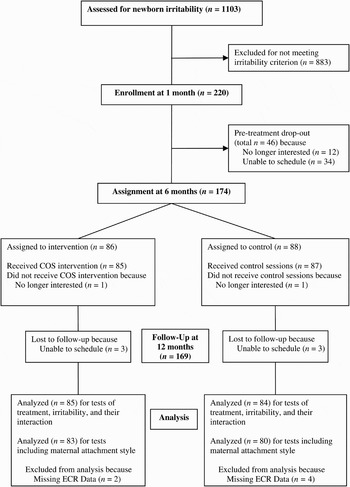
Data reported here were collected in two phases. First, during the newborn phase, we visited dyads in their homes twice during the infant's first month. We administered the NBAS each time; at the first visit, mothers provided demographic information and completed a self-report measure of adult attachment (ECR; Brennan et al., Reference Brennan, Clark and Shaver1998). Dyads who met eligibility criteria were enrolled in the study at infant age 1 month (n = 220). Second, at infant age 12 months, mothers and their infants participated in the laboratory Strange Situation procedure (Ainsworth, Blehar, Waters, & Wall, Reference Ainsworth, Blehar, Waters and Wall1978). Between the two phases of data collection, dyads, all of whom had been randomly assigned to either the intervention or control group, received three intervention or control visits when infants were between 6.5 and 9 months of age (the intervention group also received a brief fourth follow-up visit). See Figure 2 for a flowchart of participant rates of completion/attrition at each study phase. Using appropriate univariate tests (i.e., chi-square test or t test), we found no differences between dyads with complete data versus those with incomplete or missing data on any baseline demographic variables for infants (i.e., infant irritability, birth weight, sex, race/ethnicity, delivery type) or mothers (i.e., maternal age, education, married/living with the infant's father, and household income). Similarly, we found no differences between intervention and control groups on any baseline demographic variables.
Flow chart detailing enrollment, participant retention, and experimentation processes. COS, Circle of Security; ECR, Experiences in Close Relationships Scale.

Intervention and control treatment groups
Intervention group
Participants assigned to the intervention condition received the COS-HV4 intervention (Cooper et al., Reference Cooper, Hoffman and Powell2000). The aim of the intervention was to enhance maternal sensitivity by first helping the mother improve her observation skills and understanding of infant needs, and then helping her to select and implement sensitive responses while examining what at times stands in the way of sensitive responsiveness. The COS-HV4 intervention developed for this study consisted of three 1-hr home visits that occurred approximately every 3 weeks when infants were between 6.5 and 9 months of age. Approximately 2 weeks later, a brief fourth visit occurred during which the home visitor gave the mother a copy of videotapes used in the intervention and provided the mother with an opportunity to discuss the intervention and any ongoing parenting concerns.
The COS-HV4 derives from the Circle of Security Protocol (COS; Hoffman, Marvin, Cooper, & Powell, Reference Hoffman, Marvin, Cooper and Powell2006) originally designed as a 20-week group intervention for parents of preschoolers. The goal in developing the COS-HV4 intervention was to create a brief intervention appropriate for mother–infant dyads that could be delivered in an individual home visiting intervention and that retained all of the key elements of the 20-week group intervention. In the 20-week group format, after two initial sessions spent learning about infants' attachment and exploratory needs through the COS graphic, each mother is the focus of the group session for 2 weeks, during which time she reflects on her own parenting while observing videoclips of her interacting with her baby; during the remaining sessions, mothers observe, support, and learn from other mothers as the other mothers are the focus of the intervention. The individualized format created for the present study contained an initial session during which mothers learned about the COS graphic, followed by two sessions in which mothers reflected on their own parenting in ways that were in large part comparable to the two individual-focus sessions of the 20-week model. A brief fourth session allowed for consolidation of learning and celebration of changes. In sum, use of an individualized format and one-on-one attention allowed for delivery of all of the central elements of the COS intervention in fewer total sessions.
Each home visit was scheduled with the baby present and rested, and (except for the initial session) began with a review of the previous session. The intervener and mother then watched and discussed clips from videotapes of the mother and her infant that had been filmed on a previous day (mothers had been asked to “go about your normal routine” for a 30-min session in the home). In addition, mother–infant interactions (both infant cues and maternal responses) that occurred during each home visit were also discussed.
Each session had a specific focus as follows. The first session focused on engaging the mother affectively, forming an intervener–mother alliance, helping the mother understand her importance as a secure base to her infant and her success at providing her infants with a sense of security, and improving the mother's skills at recognizing her baby's signals related to both attachment and exploration. The second visit extended the focus on the importance of maternal sensitive responsiveness to the infant's signals. At the same time, the intervener began to help the mother identify which infant signals were more difficult for her to respond to. As in the 20-week group format, an individualized treatment plan was developed for each mother. The mother's perceptions, along with the intervener's observational assessments, formed the basis for tailoring the intervention to meet the specific needs of each mother and infant. Some mothers found sensitive responsiveness particularly difficult when the baby wanted contact or comfort, whereas other mothers had difficulty instead when the baby was interested in independent exploration. During this session, the intervener also introduced the idea that all parents are insensitive sometimes, and that such behavior is human, forgivable, and something that can be thought about, discussed, and changed. In the second session, the mother was shown a number of videoclips of her interacting with her infant, including some in which she responded sensitively to her infant and one in which she struggled to be sensitive. The goal of this session was to introduce the mother to exploration of an area in which she struggles to respond sensitively to her infant, while at the same time supporting her capacity for sensitivity.
The focus of the third session was exploration of the psychological factors that at times interfere with the mother's capacities to respond sensitively (a teaching of the concept of defensive processes through the user-friendly metaphor of “Shark Music”). Specifically, the intervener discussed with the mother the ways that her cognitive and affective responses to the baby's behavior may influence her behavior. The goal was to increase the mother's reflective capacity so that she could consider new options when confronted with situations in which she finds sensitive responsiveness to be difficult. Mothers were also provided “homework” between sessions (e.g., to explain infant needs to a friend, to attempt to observe infant needs during daily interactions).
An intervention protocol manual was created, and four master's level and two doctoral level clinicians provided the intervention. Each participant in the intervention group was visited by the same intervener for all four sessions. In order to ensure fidelity, intervention videotapes for each participant were supervised on an ongoing basis by one of the developers of the COS-HV4 and by the first author. Before beginning the study, the first author participated in initial general intervention consultations with van den Boom.
Control group
Participants assigned to the control group received three 1-hr psychoeducational sessions, following the same time line as intervention group participants. Sessions, all by the same visitor (a female graduate student who was not an intervener), addressed caregiving topics typically of concern to new parents (i.e., sleep, feeding, play). Mothers were given relevant readings from popular press materials at the conclusion of each home visit. Like the intervention group participants, the control group participants were also videotaped in the home at the end of each visit. Participants in the control group, however, were not shown videoclips of their interactions with their infants.
Measures
NBAS
This 20-min structured examination assesses newborn infants' behavior with 28 behavioral items and 18 reflex items (Brazelton & Nugent, Reference Brazelton and Nugent1995). Infants whose irritability composite score (i.e., average of infants' peak of excitement, rapidity of buildup, and irritability items) for both exams was 6 or greater were considered highly irritable (van den Boom, Reference Van den Boom1994). Four research assistants who were trained and certified as reliable by the Brazelton Institute administered the NBAS exams. Coders were blind to additional information. Two NBAS examiners simultaneously and independently coded 96 (8.7%) randomly selected NBAS administrations. Intercoder reliability for the irritability composite score was high (intraclass correlation = .96). Disagreements were resolved by conference.
ECR
This 36-item self-report measure taps attachment anxiety and avoidance within the context of past and current relationships with important others (Brennan et al., Reference Brennan, Clark and Shaver1998). The avoidance subscale (18 items; α = 0.86) assesses the extent to which individuals are uncomfortable with intimacy, relying on others, and self-disclosure. The anxiety subscale (18 items; α = 0.92) measures the extent to which participants are fearful of rejection, abandonment, and being unloved. Mothers rated each item on a 7-point scale ranging from disagree strongly (1) to agree strongly (7). Summary scores for mothers' attachment-related anxiety and avoidance were generated by calculating a mean of the items for each subscale. Good psychometric properties of this widely used measure of adult attachment have been well established (Brennan et al., Reference Brennan, Clark and Shaver1998; Crowell, Fraley, & Shaver, Reference Crowell, Fraley, Shaver, Cassidy and Shaver2008; Fraley, Waller, & Brennan, Reference Fraley, Waller and Brennan2000; Mikulincer & Shaver, Reference Mikulincer, Shaver, Cassidy and Shaver2008).
Following Fraley and Shaver (Reference Fraley and Shaver1997; see also Mohr et al., Reference Mohr, Gelso and Hill2005), we mathematically rotated mothers' avoidance and anxiety scores to create scores on two dimensions. One dimension was characterized at one end as secure (i.e., low avoidance, low anxiety) and at the other end as fearful (i.e., high avoidance, high anxiety); scores on this dimension, referred to as the secure–fearful dimension, were calculated by adding avoidance and anxiety scores (α = 0.90). The second dimension was characterized at one end as dismissing (i.e., high avoidance, low attachment anxiety) and at the other end as preoccupied (i.e., low avoidance, high anxiety); scores on this dimension, referred to as the dismissing–preoccupied dimension, were calculated by subtracting anxiety scores from avoidance scores (α = 0.81).
Strange Situation procedure
This 20-min laboratory procedure assesses infant attachment quality with two brief separations from and reunions with a parent (Ainsworth et al., Reference Ainsworth, Blehar, Waters and Wall1978). Classifications are based principally on infants' behavior during the two reunions. Securely attached infants demonstrate strong proximity-seeking and/or contact-maintaining behaviors on reunion, whereas insecure–avoidant infants actively avoid proximity and interaction on reunion with the parent, and insecure–ambivalent infants show angry resistant behaviors on reunion (Ainsworth et al., Reference Ainsworth, Blehar, Waters and Wall1978). Infants classified as insecure–disorganized appear to lack a coherent attachment strategy, and display behaviors in the presence of mother that lack an observable goal or explanation (Main & Solomon, Reference Main, Solomon, Brazelton and Yogman1986). For the present study, infants in the three insecure groups were combined into one insecure group. Three reliable coders blind to additional participant information classified all Strange Situation procedures. A randomly selected 34% (n = 58) of cases were coded independently by two of these coders; coder agreement for the four-way group placement was 79% (κ = 0.69, p < .001) and for the secure/insecure group placement was 86% (κ = 0.72, p < .001). Disagreements were resolved by conference or by a fourth expert coder who coded no additional cases. Reliability and validity data about the Strange Situation have been described extensively (Ainsworth et al., Reference Ainsworth, Blehar, Waters and Wall1978; Lyons-Ruth & Jacobvitz, Reference Lyons-Ruth, Jacobvitz, Cassidy and Shaver2008; Solomon & George, Reference Solomon, George, Cassidy and Shaver2008).
Results
Data analytic plan
Examination of our hypotheses required three separate hierarchical logistic regression analyses predicting the probability of infant attachment security. First, in line with previous research examining differential susceptibility it was necessary to conduct a regression analysis to examine the effects of treatment, irritability, and their interaction without partialling out any variance because of maternal attachment. This analysis centered on testing our first hypothesis that intervention would be efficacious in increasing the rate of secure attachment for all infants and our second hypothesis that irritability would moderate the effect of intervention such that intervention would be more efficacious for highly irritable infants. We tested these a priori directional hypotheses using one-tailed tests; all other tests were two tailed.
Second, in order to determine whether the Treatment × Irritability interaction would vary as a function of the secure–fearful maternal attachment dimension (Hypothesis 3), we conducted a separate hierarchical logistic regression analysis with treatment, infant irritability, the secure–fearful maternal attachment dimension, all two-way interactions among these predictors, and the three-way interaction. Third, in order to determine whether the Treatment × Irritability interaction varied as a function of the dismissing–preoccupied maternal attachment dimension (Hypothesis 4), we conducted a hierarchical logistic regression analysis (similar to that of the second regression) with treatment, infant irritability, the dismissing–preoccupied maternal attachment dimension, all two-way interactions among these predictors, and the three-way interaction. For analyses involving maternal attachment style, we tested the significance of the change in chi-square values for each block and the three-way interaction using two-tailed tests because we had no directional hypotheses. For each of these three-way interactions, we evaluated the Treatment × Irritability interaction at 1 SD above and 1 SD below the mean of the two continuous maternal attachment dimensions (Aiken & West, Reference Aiken and West1991), which permitted examination of Treatment × Irritability effects for mothers who had higher scores on the secure, fearful, dismissing, and preoccupied attachment style patterns that Bartholomew (Reference Bartholomew1990) identified (i.e., mothers who fell at each end of each attachment style dimension).
We probed only the highest order interaction of each regression analysis (Aiken & West, Reference Aiken and West1991) for evidence of intervention efficacy and for evidence of differential susceptibility by conducting pairwise comparisons of the odds of being secure across groups. The resulting odds ratio, which is the odds of being secure for one group divided by the odds of being secure for another group, is a measure of effect size between the two groups being compared. An odds ratio of 1.00 indicates that the likelihood of being secure is equal for the two groups; the further the odds ratio is from 1.00, in either direction, the larger the effect between the two groups. Although with odds ratios there are no standardized cutoffs to determine whether the effect is small, medium, or large (Valentine & Cooper, Reference Valentine and Cooper2003), we interpret odds ratios that are >2.00 or <0.50 as indicating meaningful effects (i.e., the odds must be at least twice as high in one group vs. the other; odds ratios of 2.00 and 0.50 are equal in magnitude, but opposite in direction). In all cases, we first examined intervention efficacy within each level of irritability and compared the odds of being secure for the intervention group to the odds of being secure for the control group. We then examined the interactions for evidence of differential susceptibility by comparing the odds of being secure for highly irritable infants to the odds of being secure for moderately irritable infants within each treatment group.
Distribution of infant attachment classifications
In the control group, the attachment distribution was as follows: 42 (50.00%) infants were secure, 14 (16.67%) were avoidant, 13 (15.47%) were ambivalent, and 15 (17.86%) were disorganized/unclassifiable. In the intervention group, the attachment distribution was as follows: 51 (60.00%) infants were secure, 9 (10.59%) were avoidant, 13 (15.29%) were ambivalent, and 12 (14.12%) were disorganized/unclassifiable. Because of small and unequal cell sizes when broken down even further by infant irritability level, we combined insecure groups and conducted our analyses at the level of secure versus insecure infant attachment.
Relations between demographic variables and key study variables
Across each demographic variable, a few significant associations emerged with key study variables. Specifically, highly irritable infants were more likely than moderately irritable infants to come from families with annual incomes greater than $31,000 (55.8% compared to 39.3% of moderately irritable infants), χ2 (1, N = 169) = 3.95, p < .05; and, girls were more likely than boys to be securely attached (67.5% compared to 44.6% of boys), χ2 (1, N = 169) = 8.94, p < .01. Accordingly, we controlled for income and infant sex by including them as covariates in the first block of each of our hierarchical logistic regression analyses. No demographic variables were related to the secure–fearful or dismissing–preoccupied dimensions.
The effect of treatment and infant irritability on infant attachment security
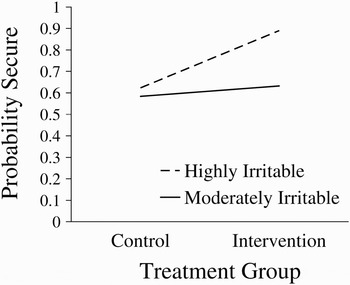
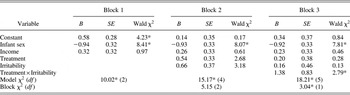
Our analysis examining only the main effects of treatment (Hypothesis 1), irritability, and their interaction (Hypothesis 2) without inclusion of maternal attachment revealed no main effects of treatment group (B = 0.44, ns, one tailed) or infant irritability (B = 0.55, ns, two tailed) on infant attachment security. As expected, there was a significant Treatment × Irritability interaction (B = 1.38, p < .05, one tailed; see Table 1). As such, we graphed and probed this interaction to examine both intervention efficacy and differential susceptibility as described in the data analytic plan (see Figure 3).
The probability of infants being classified as secure as a function of treatment assignment and infant irritability.

Summary of hierarchical logistic regression analysis for predicting secure infant attachment with treatment and irritability

Note: N = 169. All tests of the model χ2 are two-tailed tests with the exception of the χ2 for Block 3, which is a theory-driven a priori one-tailed test. For infant attachment, 0 = insecure, 1 = secure; for treatment group, 0 = control, 1 = intervention; for irritability, 0 = moderately irritable, 1 = highly irritable; for infant sex, 0 = girl, 1 = boy; and for income, 0 = under $31,000, 1 = over $31,000.
*p < .05.
Intervention efficacy
An intervention effect emerged only for highly irritable children, who had an 89% probability of being secure with intervention, but only a 62% probability of being secure in the control group (odds ratio [OR] = 4.87). For moderately irritable infants, no intervention effect emerged: 63% probability of being secure with intervention versus 58% probability in the control group (OR = 1.23).
Differential susceptibility
Given that we found a significant Treatment × Irritability interaction, we graphed and probed the interaction to determine whether the results supported the differential susceptibility hypothesis. Specifically, we examined whether, compared to their moderately irritable counterparts, highly irritable infants showed better outcomes (i.e., greater likelihood of secure attachment) in better conditions (i.e., the intervention group), and worse outcomes (i.e., less likelihood of secure attachment) in worse conditions (i.e., the control group). Within the intervention group, highly irritable infants had a greater likelihood of being secure (89%) than moderately irritable intervention infants (63%; OR = 4.69); however, in the control group, highly irritable and moderately irritable infants were equally likely to be classified secure (62% to 58%, respectively; OR = 1.18). As Figure 3 shows, highly irritable infants benefited when in the intervention group yet did not suffer adverse effects when in the control group, findings that support one side of the differential susceptibility hypothesis.
Treatment × Irritability × Secure–Fearful maternal attachment style dimension
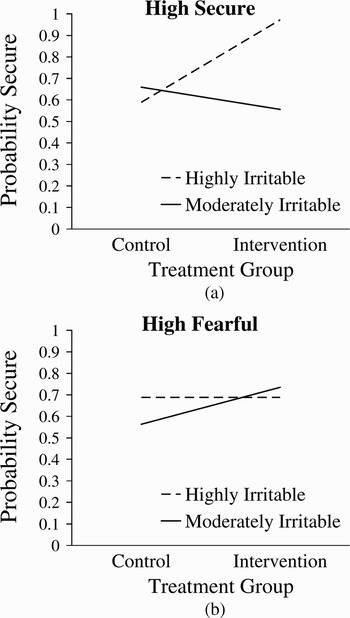
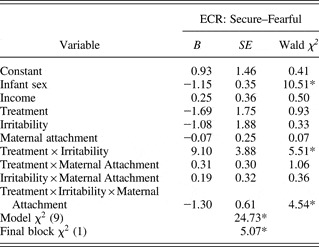
For the ECR secure–fearful dimension (see Hypothesis 3), a significant three-way Treatment × Irritability × Secure–Fearful interaction emerged (B = −1.30, p < .05; see Table 2). As such, we graphed and probed the interaction at 1 SD below the mean to examine effects for more secure mothers and at 1 SD above the mean to look at effects for more fearful mothers (M = 5.89, SD = 1.65, range = 2.62–10.86; see Figure 4).
The probability of infants being classified as secure as a function of treatment assignment, infant irritability, and the secure–fearful maternal attachment style dimension. (a) The effects when mothers are higher on the secure side of the dimension (i.e., at 1 SD above the mean), and (b) the effects when mothers are higher on the fearful side (i.e., at 1 SD below the mean).

Final block of hierarchical logistic regression with treatment, irritability, and secure–fearful maternal attachment style dimension

Note: N = 163. All tests of the model χ2 are two-tailed tests. In the interest of space, and because earlier blocks were not significant, we present only the final block of the regression equation (the full table is available from the first author). For infant attachment, 0 = insecure, 1 = secure; for treatment group, 0 = control, 1 = intervention; for infant irritability, 0 = moderately irritable, 1 = highly irritable; for infant sex, 0 = girl, 1 = boy; and for income, 0 = under $31,000, 1 = over $31,000. ECR, Experiences in Close Relationships Scale.
*p ≤ .05.
Intervention efficacy
We explored this significant three-way interaction to determine for whom the intervention was efficacious. When mothers were more secure, there was an intervention effect for the highly irritable infants (who had a 97% probability of being secure with intervention, but only a 59% probability in the control group; OR = 24.94); moderately irritable infants, however, were equally likely to be secure in the intervention (57% probability) and control groups (66% probability; OR = 0.69). When mothers were more fearful, we found that highly irritable infants were equally likely to be secure in the intervention group (69% probability) and in the control group (69% probability; OR = 1.01); similarly, for moderately irritable infants, no effect of intervention emerged (74% probability of being secure with intervention, and 61% probability in the control group; OR = 1.88).
Differential susceptibility
When mothers were more secure, we found evidence that highly irritable infants benefited when in the intervention group but did not suffer adverse effects when in the control group (see Figure 4a). Specifically, we found that within the intervention group, highly irritable infants were more likely to be classified secure (97% probability) than moderately irritable infants (57% probability; OR = 27.71); within the control group, highly irritable infants and moderately irritable infants were equally likely to be classified secure (59% compared to 66%, respectively; OR = 0.76). When mothers were more fearful, we found no differences between highly irritable infants and moderately irritable infants either within the intervention group (69% and 74% probability of being classified as secure, respectively; OR = 0.76) or within the control group (69% and 61% probability of being classified as secure, respectively; OR = 1.42; Figure 4b).
Treatment × Irritability × Dismissing–Preoccupied maternal attachment style dimension
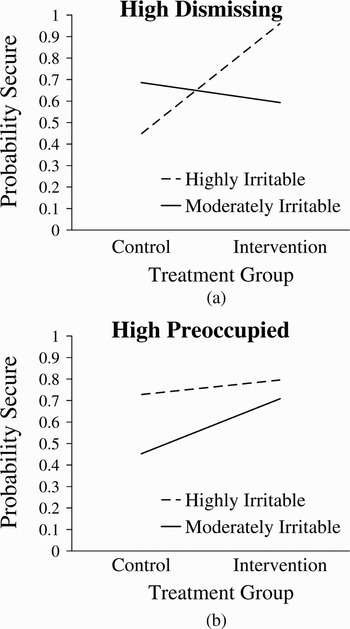
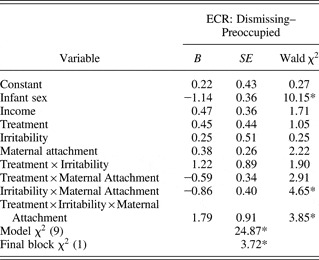
For the ECR dismissing–preoccupied dimension (see Hypothesis 4), there was a significant three-way Treatment × Irritability × Dismissing–Preoccupied interaction (B = 1.79, p < .05; see Table 3). As such, we graphed and probed the three-way interaction at 1 SD above the mean to look at effects for more dismissing mothers and 1 SD below the mean to look at effects for more preoccupied mothers (M = 0.19, SD = 1.27, range = −3.11–4.44; see Figure 5).
The probability of infants being classified as secure as a function of treatment assignment, infant irritability, and the dismissing–preoccupied maternal attachment style dimension. (a) The effects when mothers are higher on the dismissing side of the dimension (i.e., at 1 SD above the mean), and (b) the effects when mothers are higher on the preoccupied side (i.e., at 1 SD below the mean).

Final block of hierarchical logistic regression with treatment, irritability, and dismissing–preoccupied maternal attachment style dimension

Note: N = 163. All tests of the model χ2 are two-tailed tests. In the interest of space, and because earlier blocks were not significant, we present only the final block of the regression equation (the full table is available from the first author). For infant attachment, 0 = insecure, 1 = secure; for treatment group, 0 = control, 1 = intervention; for infant irritability, 0 = moderately irritable, 1 = highly irritable; for infant sex, 0 = girl, 1 = boy; and for income, 0 = under $31,000, 1 = over $31,000. ECR, Experiences in Close Relationships Scale.
*p ≤ .05.
Intervention efficacy
For more dismissing mothers, intervention was efficacious for highly irritable infants (who had a 96% probability of being secure with intervention, but a 45% probability in the control group; OR = 30.60). The intervention was not efficacious, however, for moderately irritable infants of more dismissing mothers (59% probability of being secure with intervention vs. 69% probability in the control group; OR = 0.67). In contrast, when mothers were more preoccupied, there was no intervention effect for highly irritable infants (80% probability of secure with intervention vs. 73% probability of secure without intervention; OR = 1.45). There was instead an intervention effect for moderately irritable infants (who had a 71% probability of being secure with intervention, but a 45% probability in the control group; OR = 2.95).
Differential susceptibility
We also probed this interaction to examine whether patterns of differential susceptibility emerged when mothers were more dismissing and more preoccupied. When mothers were more dismissing, we found evidence for both components of the differential susceptibility hypothesis. Under better conditions (i.e., the intervention), highly irritable infants, compared to moderately irritable infants, were more likely to be secure (96% probability versus 59% probability, respectively; OR = 17.03). Under worse conditions (i.e., the control group), highly irritable infants, compared to moderately irritable infants, were less likely to be secure (45% probability vs. 69% probability, respectively; OR = 0.37). Thus, as Figure 5a indicates, for more dismissing mothers, a cross-over interaction between treatment and irritability emerged that is similar to the prototypic graphical representation of differential susceptibility (Belsky et al., Reference Belsky, Bakermans-Kranenburg and van IJzendoorn2007).
When mothers were more preoccupied there was no evidence that highly irritable infants had either more beneficial outcomes with intervention or more adverse outcomes when in the control group than their moderately irritable counterparts. In particular, when their mothers received the intervention, highly irritable and moderately irritable infants were equally as likely to be classified as secure (80% and 70% probability of being secure, respectively; OR = 1.60). We did, however, find that moderately irritable infants in the intervention group were more likely to be securely attached (71% probability of being secure) compared to moderately irritable infants in the control group (45% probability of being secure; OR = 3.25). In other words, it was the moderately irritable infants who were at risk for insecure attachment when their mothers were more preoccupied (see Figure 5b).
Discussion
A central purpose of this RCT was to examine whether, in line with the work of van den Boom (Reference Van den Boom1994), our brief COS-HV4 intervention would successfully increase the rate of secure attachment in a sample of irritable infants after widening the previously used more stringent criterion for irritability (van den Boom, Reference Van den Boom1994). Moreover, a key conceptual contribution of the paper was a two-pronged examination of the differential susceptibility hypothesis. First, we conducted a test of differential susceptibility by simply examining the interaction between treatment group and infant irritability in predicting later infant attachment security, testing whether the most highly irritable infants were more susceptible to environmental influence resulting in both adverse effects in a hypothesized negative environment (control condition) and beneficial effects in a hypothesized positive environment (intervention condition). Second, we contributed to theory on differential susceptibility by offering a more refined perspective on what constitutes a negative or positive environment for particular infants. This closer examination of the factors that may contribute to the quality of the environment is crucial because detection of differential susceptibility relies on the proper identification of supportive and unsupportive environments. Mothers may respond differently to infants who vary in irritability and differently to intervention depending upon the mothers' own attachment style. For this reason, we conducted analyses examining whether maternal attachment styles moderated the interaction of treatment and irritability to predict later infant attachment outcomes. The results revealed support for the differential susceptibility hypothesis and provided important new insights into “what works for whom” with regard to attachment-based intervention. The present findings are the first from an experimental design with a phenotypic marker to evidence differential susceptibility, as well as the first to evidence differential susceptibility with infant attachment as the outcome.
Interpreting the Treatment × Irritability interaction in terms of treatment efficacy
We first examined treatment efficacy without including the effects of maternal attachment styles. Contrary to expectation, no main effect of the intervention emerged. As expected, however, we did find a significant Treatment × Irritability interaction effect such that for infants who were similarly irritable to those in van den Boom's (Reference Van den Boom1994) study, intervention was efficacious. Moreover, our results revealed that only the high irritable infants benefited from intervention; expanding the irritability criterion to include more infants did not result in more infants benefiting from intervention. As described below in the section on the three-way (Treatment × Irritability × Maternal Attachment Styles) interaction, the results were much richer once the moderating role of maternal attachment style was examined.
Interpreting the Treatment × Irritability interaction in terms of differential susceptibility
The differential susceptibility hypothesis proposes that some children are particularly susceptible to both positive and negative rearing influence. We examined this hypothesis by providing a brief parenting intervention (i.e., a hypothesized positive environment) to economically stressed mothers of irritable infants (a hypothesized negative environment for infants in the control group; van den Boom, Reference Van den Boom1994). We began by following the course of researchers who, focusing on phenotypic markers, have tested the differential susceptibility hypothesis by examining two-way T × E interactions (i.e., our examination of this issue focused on the two-way interaction of infant irritability as the temperament component and treatment group as the environmental component). Consistent with Blair's (2002) findings, we found that intervention was effective only for highly irritable infants: in better conditions (i.e., in the intervention group), highly irritable infants had significantly better outcomes than their moderately irritable counterparts. Highly irritable infants in the control group, however, were not disproportionately worse than their moderately irritable counterparts. Thus, our two-way findings support only one component of the differential susceptibility hypothesis. These findings are also consistent with those of Klein Velderman et al. (Reference Klein Velderman, Bakermans-Kranenburg, Juffer and van IJzendoorn2006), who found that positive caregiving influences (i.e., experimentally induced increases in maternal sensitivity) led to positive child outcomes (i.e., attachment security) only for highly reactive infants.
It is possible that this study's failure to find support for the risk-promoting prediction of the differential susceptibility hypothesis (like Klein Velderman et al.'s study, 2006) reflects floor effects in the attachment outcome variable. Although infant–mother dyads were selected because they were considered at risk of developing insecure attachments (i.e., irritable infants with economically stressed mothers; van den Boom, Reference Van den Boom1994), the infants in our control group had rates of security comparable to those found in community samples (see van IJzendoorn, Schuengel, & Bakermans-Kranenburg, Reference Van IJzendoorn, Schuengel and Bakermans-Kranenburg1999), and thus being in the control group may not have constituted a condition sufficiently negative to reveal differential adverse effects (i.e., the negative condition does not seem to have been particularly negative). Nevertheless, the present two-way findings add to a growing body of research that indicates that children with negative temperaments are more susceptible than other children to positive rearing influences. Moreover, our findings support Belsky's (1997a, 2005) proposal that van den Boom's (Reference Van den Boom1994) selection of infants who were most susceptible might account for the dramatic increase in attachment security in the intervention group in her study.
It is not clear why the rate of attachment security in the control group of this sample selected for elevated irritability and family economic stress was similar to that of a normative population. It may be that because our sample was an economically stressed sample, rather than an impoverished sample (the lowest income in our sample was $14,000), infants in this group were not at greater risk for insecurity as they would have been had the families been living in poverty. We attempted to match the inclusion criteria used in van den Boom's (Reference Van den Boom1994) study, but it may be that the meaning of economic stress differs across cultures. There may also be unknown cultural factors in parental caregiving and familial living situations (e.g., living with extended family members) in some subgroups of the present diverse sample that provided some protection to the infants that were not present in van den Boom's homogenous Dutch sample.
In a sample with a control group showing higher rates of insecurity, there are a variety of possible outcomes related to both treatment efficacy and differential susceptibility. It is possible that treatment could fail to be effective for any group of infants in a sample with higher rates of insecurity. In contrast, a main effect of treatment could emerge; normative rates of security in the control group make it difficult for the intervention group to “outperform” the control group. In terms of differential susceptibility, being in a control group with higher rates of insecurity may constitute a condition that is sufficiently negative to reveal differential adverse effects for highly irritable infants, meeting the requirements for differential susceptibility; alternately, equally low levels of security for both highly irritable and moderately irritable infants could emerge, revealing no evidence of differential susceptibility.
Treatment × Irritability × Maternal attachment styles: The role of maternal attachment styles in positive and negative environments for highly irritable and moderately irritable infants
Examination of the differential susceptibility hypothesis hinges on understanding as precisely as possible what constitutes a positive caregiving environment and what constitutes a negative caregiving environment (Ellis et al., Reference Ellis, Boyce, Belsky, Bakermans-Kranenburg and van IJzendoorn2011 [this issue]). Thus, in addition to examining the effects of treatment across different levels of infant irritability, we provide the first examination of how maternal attachment styles interact with treatment and infant irritability to predict infant attachment security. By rotating attachment anxiety and avoidance into two dimensions (secure–fearful and dismissing–preoccupied), we were able to examine the Treatment × Irritability interaction across the four adult attachment patterns that Bartholomew identified (1990; Bartholomew & Horowitz, Reference Bartholomew and Horowitz1991; see Fraley & Shaver, Reference Fraley and Shaver1997; Mohr et al., Reference Mohr, Gelso and Hill2005). Significant three-way interactions emerged for both dimensions; probing of these interactions revealed meaningful group differences in the Treatment × Irritability interaction across three of the four adult attachment style patterns with respect to treatment efficacy and in two of the four adult attachment style patterns in terms of differential susceptibility.
For instance, when mothers were high on security (i.e., high on the secure end of the secure–fearful dimension, with both low attachment anxiety and avoidance), the intervention was efficacious only for the highly irritable infants. The Treatment × Irritability interaction for these mothers echoed the finding for the sample as a whole in that highly irritable infants showed beneficial effects with intervention, but not adverse effects in the control group, whereas moderately irritable infants were relatively unaffected by intervention. It is striking that 97% of highly irritable infants in the intervention group developed secure attachments. The failure of highly irritable infants in the control group to show adverse effects once the role of more secure maternal attachment was taken into account may be because the caregiving environment is relatively positive when mothers are high on attachment security, and therefore, the control condition was not sufficiently negative to evidence differential susceptibility. More secure mothers are comfortable with closeness but not overly concerned with abandonment or rejection (Mikulincer & Shaver, Reference Mikulincer and Shaver2007); as such, it is likely that these mothers are able to serve as a secure base and safe haven without intervention and regardless of their infants' level of irritability.
When mothers were high on the dismissing end of the dismissing–preoccupied dimension (i.e., with low attachment anxiety and high avoidance), again the intervention was efficacious only for the highly irritable infants. Evidence of differential susceptibility emerged from the Treatment × Irritability interaction for these mothers with highly irritable infants again in terms of beneficial effects with intervention, yet now also in terms of adverse effects in the control group. The effect of intervention was again striking, with 96% of highly irritable infants classified secure when their mothers received intervention yet only 45% classified secure when their mothers did not receive intervention; moderately irritable infants were relatively unaffected by treatment, with their rates of security hovering around 60% in both groups. We propose that the adverse effects in the control group emerged here for the first time because for mothers high on attachment avoidance, the caregiving environment in the control group constitutes a sufficiently negative environment for highly irritable infants within which differential susceptibility would emerge. Our reasoning is as follows: highly dismissing mothers display discomfort with closeness (Mikulincer & Shaver, Reference Mikulincer and Shaver2007) and become less responsive when others, including their own children, show more distress (Edelstein et al., Reference Edelstein, Alexander, Shaver, Schaaf, Quas and Lovas2004; Feeney & Collins, Reference Feeney and Collins2001; Simpson, Rholes, & Nelligan, Reference Simpson, Rholes and Nelligan1992). These characteristics would make it particularly difficult for irritable infants, who evidence heightened distress and who could benefit from physical contact, to experience their mothers as a secure base and safe haven, leaving them therefore, with a reduced likelihood of developing a secure attachment. Thus, it is the combination of a highly irritable infant with a mother who is uncomfortable with closeness and with infant distress that appears to reduce the likelihood of infant security.
One way to conceptualize these data regarding the infants of mothers high on dismissing attachment style is to consider the degree of match between the mother's attachment and her infant's temperament: a mismatch occurs if a mother's attachment style is at odds with her infant's temperament. The intervention may have been particularly effective for the highly dismissing mothers of highly irritable infants (as opposed to such mothers of moderately irritable infants) both because highly irritable infants are more susceptible to changes in the environment and because highly dismissing mothers with highly irritable infants are more motivated to use the intervention than those with infants who are moderately irritable in order to ease the burden of a mismatch that is experienced as aversive by such mothers.
It may be that the degree of match is particularly important in the context of economic stress; mothers in the present study were selected because they were experiencing the dual stressors of economic strain and caring for an irritable infant. Previous research has found no main effect for irritability on later infant attachment, but has indicated that risk of insecure attachment increases when high infant irritability occurs in the context of additional stressors (for a review, see Vaughn, Bost, & van IJzendoorn, Reference Vaughn, Bost, van IJzendoorn, Cassidy and Shaver2008). It may be that the dual stress of a mismatch in the context of an additional stressor such as economic strain is necessary to increase the likelihood of insecure attachment. Future research could focus on the role of such additional stressors.
In contrast to results for mothers high in dismissing attachment, when mothers had higher levels of attachment anxiety (i.e., either more preoccupied or more fearful), highly irritable infants showed neither beneficial nor adverse effects (i.e., no support for differential susceptibility) in either treatment condition. It may seem odd, however, that an intervention effect emerged for the moderately irritable infants of mothers high in preoccupied attachment (high attachment anxiety, low attachment avoidance), but again, it is important to evaluate the environmental conditions for these infants to determine whether the conditions were sufficiently positive and negative for all dyads. Mothers with high attachment anxiety are overly concerned with rejection and abandonment (Mikulincer & Shaver, Reference Mikulincer and Shaver2007) and may misinterpret the independent exploratory behavior of a moderately irritable infant as a personal rejection, a feeling that might lead to insensitive behavior. In contrast, because highly irritable infants show fast-paced signaling (van den Boom, Reference Van den Boom, Nugent, Lester and Brazelton1991) and higher levels of distress that reflect increased attachment-related demands, highly preoccupied mothers may be able to effectively parent these infants without intervention because of their comfort with closeness and eagerness for contact with others (Mikulincer & Shaver, Reference Mikulincer and Shaver2007). As such, for highly irritable infants, having a high preoccupied mother in the control condition may not constitute a particularly negative environment. It may be surprising to think of moderately irritable infants as a risk group, but the present data suggest that these moderately irritable infants can be at risk in the context of a mismatch between infant temperament and maternal attachment style. By giving highly preoccupied mothers a brief intervention that may help them to interpret their moderately irritable infants' independent behaviors in more benign ways (e.g., as exploration rather than as a rejection of the mother), these at risk moderately irritable infants were able to develop secure attachments at rates comparable to those of community samples. Thus, it may be that both maternal attachment and infant irritability interact with treatment such that, once again, mothers who experience a mismatch may be more amenable to treatment than mothers who experience an attachment style-temperament match.
Taken together, the results of both three-way interactions involving maternal attachment styles as moderators of the Treatment × Irritability interaction in predicting infant attachment outcomes reveal the complexity of the infant's environment. Researchers need to keep in mind that not only are all infants not equally susceptible to positive and negative environmental influences, but also what constitutes positive and negative environmental influences may vary across children.
Convergence of results with findings from previous attachment intervention research
Findings that the COS-HV4 intervention is efficacious mesh with previous research examining other versions of the COS intervention. One study using a pre- and posttest longitudinal design with preschoolers found support for the efficacy of a group version of the COS (Hoffman et al., Reference Hoffman, Marvin, Cooper and Powell2006). A second study tested the COS perinatal protocol in a jail-diversion program without a control or comparison group, but found rates of security in the treated high-risk sample that compared favorably to typical rates of security in nonclinical community samples (Cassidy et al., Reference Cassidy, Ziv, Stupica, Sherman, Butler and Karfgin2010). The present study, however, is the first to test the efficacy of a COS protocol in an RCT and provides stronger evidence of the efficacy of COS.
It is also important to examine the present findings in the context of previous research related to attachment and clinical intervention. Our results may help to shed light on meta-analytic findings of typically modest intervention effects for attachment-based interventions (Bakermans-Kranenburg et al., Reference Bakermans-Kranenburg, van IJzendoorn and Juffer2003) because they suggest that consideration of differential susceptibility may make an important contribution to the attainment of larger intervention effect sizes. Moreover, although some previous research has found that maternal insecurity may interfere with the clinical relationship (e.g., Mallinckrodt et al., Reference Mallinckrodt, Coble and Gantt1995), maternal insecurity in the present study did not appear to interfere with intervention efficacy, at least when the infant's temperament was a mismatch for maternal attachment style (see also Robinson & Emde's, 2004, findings of intervention effects only for insecure mothers). It may be that particular contexts, such as mother–infant mismatches, help to motivate participation in intervention.
Additional meta-analytic findings that interventions of fewer than 16 sessions tended to be more efficacious than longer ones suggest that the answer to questions about the best length for intervention should be “less is more” (Bakermans-Kranenburg et al., Reference Bakermans-Kranenburg, van IJzendoorn and Juffer2003). Our intervention was brief and proved to be efficacious as well. It is not clear why a brief intervention may work better than longer ones, but van IJzendoorn, Bakermans-Kranenburg, and Juffer (Reference Van IJzendoorn, Bakermans-Kranenburg, Juffer, Berlin, Amaya-Jackson and Greenberg2005) argued that it may be easier to meaningfully engage parents for a shorter time span (especially because most parents think that parenting should come naturally). We note, however, that although meta-analytic findings have demonstrated the superiority of short-term interventions even with “multiproblem” families, longer term interventions also have been shown to be efficacious (e.g., Lieberman, Van Horn, & Ippen, Reference Lieberman, Van Horn and Ippen2005; Toth, Rogosch, Manly, & Cicchetti, Reference Toth, Rogosch, Manly and Cicchetti2006). Particularly with very high-risk populations with very low rates of security (e.g., children exposed to domestic violence or maltreated children), longer and more intensive intervention may be needed. It was also suggested by meta-analytic findings that interventions with more limited goals, such as changing mothers' behavior, showed better outcomes than more broad-based intervention efforts (e.g., attempting to change mothers' attachment representations on the Adult Attachment Interview; Bakermans-Kranenburg et al., Reference Bakermans-Kranenburg, van IJzendoorn and Juffer2003). The fact that COS-HV4 was efficacious and focused on relatively limited goals is consistent with these earlier meta-analytic findings. Nevertheless, in addition to a focus on changing maternal behaviors, the COS intervention also attended to improving maternal reflective functioning and maternal emotion regulation in response to infant cues; Berlin, Zeanah, and Lieberman (Reference Berlin, Zeanah, Lieberman, Cassidy and Shaver2008) argued that inclusion of these two goals can also be important components of intervention. Further, Berlin et al. (Reference Berlin, Zeanah, Lieberman, Cassidy and Shaver2008) emphasized the importance of the relationship with the intervener. The COS-HV4 intervention attended to the mother–intervener relationship even within the context of a very brief intervention. For example, the intervener discussed maternal strengths at the beginning and end of each session in order to help mothers feel supported in exploring challenges, and the intervener nonjudgmentally modeled reflective functioning.
Clinical implications, limitations, and future directions
Results suggest that when a low rate of security in the control group indicated that a particular type of dyad (i.e., a highly dismissing mother with a highly irritable infant, a highly preoccupied mother with a moderately irritable infant) was at increased risk of infant insecure attachment, the COS-HV4 intervention was especially efficacious. As described above, we interpreted the patterns of risk and differential treatment outcomes that emerged from the three-way Treatment × Irritability × Maternal Attachment Styles interactions partly in terms of matches and mismatches between maternal attachment and infant temperament. This interpretation of the results would imply that interventions should be geared towards specific dyads, a goal inherent in the COS approach, rather than taking a one size fits all approach. Given that we were able to help the infants of highly secure, highly dismissing, and highly preoccupied mothers, we were successful in that goal.
Our results suggest that a brief intervention with relatively limited intervention goals can have a dramatic effect on rates of attachment security in particular contexts, and that it could be worthwhile to make such brief preventive interventions more widely available, especially considering empirical evidence linking infant attachment insecurity and childhood psychopathology (e.g., NICHD Early Child Care Research Network, 2006; Shaw, Keenan, Vondra, Delliquadri, & Giovannelli, Reference Shaw, Keenan, Vondra, Delliquadri and Giovannelli1997; Sroufe et al., Reference Sroufe, Egeland, Carlson and Collins2005). In line with Berlin et al. (Reference Berlin, Zeanah, Lieberman, Cassidy and Shaver2008), our results further suggest that in addition to working to change maternal behavior, there may be great value in a focus on improving maternal reflective functioning and maternal emotion regulation, as well as attention to the mother–intervener relationship. Further research will be needed to identify which components of the intervention were central to the observed improvement in rates of secure attachment.
It is important to remember that there are limits to the generalizability of the results given that the present study focused on an economically stressed community sample of mothers and infants with elevated levels of newborn irritability. Our findings speak only to the differences between highly irritable and moderately irritable infants. Our sample did not include infants with low levels of irritability, and thus we are unable to draw conclusions about the influence of treatment or maternal attachment styles for such infants. Future research could examine issues of intervention effectiveness and differential susceptibility in these infants. We expect that similar match–mismatch relationships between mothers and infants would emerge; that is, low irritable infants with highly preoccupied mothers may be at risk of developing insecure attachments, and may disproportionately benefit from intervention, whereas with highly dismissing mothers, these infants may be at lower risk. There is no reason to believe that inclusion of a broader range of infant irritability would reveal evidence of differential susceptibility for a Treatment × Irritability interaction.
In addition, future research could extend the current study in several important ways. For example, it is important to determine whether other infant characteristics interact with maternal attachment to place infants at risk of developing insecure attachments. We would expect that behaviorally inhibited infants (who exhibit fearful, shy behavior) would be at risk of developing insecure attachments when paired with a highly dismissing mother, whereas behavioral inhibition may not present the same difficulties for highly preoccupied mothers who enjoy closeness. In addition, further research will be needed to examine whether the COS-HV4 can help mothers with clinical symptoms that place them at greater risk than mothers in the present sample, and what results would emerge with other populations (e.g., high poverty, fathers). A further topic for future research is examination of whether the COS-HV4, like the original 20-week COS intervention, is efficacious in promoting secure attachment after an insecure attachment has formed. Future research could, for example, assess infant attachment at 12 months, provide the COS-HV4 intervention, and reassess attachment at 18 months. Moreover, further research is needed to test whether it is possible to design a COS intervention that could help the dyads not helped by the current intervention (e.g., moderately irritable infants of highly dismissing mothers).
Finally, given that identification on a dyadic level of infants most at risk of developing insecure attachments may help clinicians provide the most efficacious intervention, future research could prove useful in identifying mismatched dyads. Although the ECR is a relatively easy, inexpensive measure to administer as a screening procedure, assessing infants with two NBAS exams is time intensive and costly. Future research could devise and test other ways of identifying mismatched dyads, perhaps using other measures of infant temperament (e.g., recruiting infants from a “fussy baby clinic”). It may be helpful to pursue research on potential underlying biological markers of temperament, either genotypic or endophenotypic markers, (e.g., physiological responses to distress in stressful tasks) in order to explore whether biological markers can be used to better match intervention to mother–infant dyads.