INTRODUCTION
At Independence in 1966, Botswana was a poor, undeveloped and seldom heard of part of the world. Forty years later, it is regarded as a growth miracle (Samatar Reference Samatar1999), a sign of hope for sub-Saharan Africa, and as an exemplar of prosperity and success. The country experienced a staggering GDP per capita increase of 13% per annum in the years 1980–89 (Mpabanga Reference Mpabanga and Salkin1997), and a long-run growth over the last four decades that even surpasses the performance of the Pacific Asian tigers (Leith Reference Leith2005: 4, Table 1.1). Simultaneously, the government has managed to establish one of the longest running multiparty democracies on the continent. The question is frequently posed how a country that used to be among the poorest, situated in the most underdeveloped and conflict-ridden continent in the world, could achieve outstanding growth paired with political stability. The explanation for the success story is found mainly in limited colonial influence, good political institutions, wise leaders and prudent economic policy (see e.g. Acemoglu et al. Reference Acemoglu, Johnson, Robinson and Rodrik2003; Beaulier & Subrick Reference Beaulier and Subrick2006; Harvey & Lewis Reference Harvey and Lewis1990; Iimi Reference Iimi2006; Leith Reference Leith2005; Mpabanga Reference Mpabanga and Salkin1997; Owusu & Samatar Reference Owusu and Samatar1997; Samatar Reference Samatar1999).
In this article Botswana's economic performance is, however, analysed not from the viewpoint of stability and growth, but from that of structural change and development. The position is taken that while commendable advances have been achieved during the last four decades, these need to be complemented with technological innovations, significant productivity increase, change in economic and political structures, a significant rise in living standards for the poor, and a more equal distribution of resources, incomes and opportunities, for there to be long-run sustainable opulence with substance. It is necessary to distinguish between growth and development. Botswana's significant economic and political advances make up a clear case of growth without development, as long as such change has not taken place.
The diamond-led economic growth record of Botswana is truly impressive, and the country is presently classified as an upper-middle-income country with an estimated GNI per capita of US$5,900 in 2006 (World Bank 2008a). Although average GDP growth rates have been levelling off and falling below 4% per annum (World Bank 2008b), no immediate end to further economic expansion is in sight. The most serious socio-economic threat is the estimated 24% prevalence of HIV/AIDS in the productive population aged 15–49 (World Bank 2008a), resulting in a 35-year life expectancy, and infant and under-five mortality rates at 87 and 120 respectively (ibid.). This gives the country the unique and deplorable combination of impressive growth with diving social indicators.
As part and parcel of the successful growth, Botswana is also associated with political progress. Independence was peaceful, and compared with other African leaders, the Botswana political elite has shown an ability to govern both peacefully and prudently (see e.g. Acemoglu et al. Reference Acemoglu, Johnson, Robinson and Rodrik2003; Beaulier & Subrick Reference Beaulier and Subrick2006; Hill Reference Hill1991; Leith Reference Leith2005). The country has a high regulatory quality, and is considered by many not only to be the least corrupt country in Africa, but as on par in this regard with Western Europe (Robinson & Parsons Reference Robinson and Parsons2006: 107–10). This view is, however, being contested as increasing mismanagement and corruption on the part of the power elite has been documented (Makgala Reference Makgala2006).
In the midst of this peaceful growth miracle, there thus exist serious deficiencies. Apart from a degree of elite capture, these include concerns over high and unchanging inequalities, poor and neglected rural areas, high unemployment rates, failure in limiting the AIDS epidemic, discrimination against minority groups such as the San and a weak civil society (see e.g. Allen & Heald Reference Allen and Heald2004; Good Reference Good1993, Reference Good1994; Gulbrandsen Reference Gulbrandsen1996; Heald Reference Heald2006; Lekoko & van der Merwe Reference Lekoko and van der Merwe2006; Makgala Reference Makgala2006; Nthomang Reference Nthomang2004; Phaladze & Tlou Reference Phaladze and Tlou2006; Wikan Reference Wikan2004). Dual development and contradictory indicators are typical of a country experiencing pre-modern growth without structural change and development. A holistic structural analysis that recognises Botswana's socio-economic institutional structure as partly pre-modern underscores the ambiguity in the growth process, and is necessary for drawing up strategies for turning growth into development.
GROWTH OR DEVELOPMENT
Kuznets (Reference Kuznets1973) argued that in our time the end goal for any society is to reach ‘modern economic growth’ (MEG), thereby leaving the pre-modern growth process behind. This modernisation, which is the equivalent of development, is characterised by technological advances, high rates of growth, a rise in productivity, and structural transformation of the economy, society and ideology. Depending on its causes and characteristics, growth may be more or less likely to promote such processes of structural change, and societies can experience growth while staying pre-modern. Botswana is an example of a small country possessing exceptionally valuable resources, allowing the state to provide its population with increasing rents. Such types are not representative in Kuznets' original model of MEG, where they are treated as atypical cases. Building on Kuznets, using comparative history and comparative economic development, Adelman and Morris (Reference Adelman and Morris1997: 833) elaborate on the modernisation argument, taking the position that all processes of economic development are multifaceted and non-linear. Recognising variations in possible paths to modernisation and development does not, however, contradict stipulating a uniform end goal. In their categorisation, Botswana falls into a typology of agricultural, primary-export oriented, sharply dualistic and land-abundant countries. Within this group, the characteristics of existing natural resource endowments and degrees of government autonomy from tribal domestic elites and colonial powers determine patterns and sequence of structural change.
A theoretical approach to the potential development process of this category of economies is offered by a modified Lewis model. Lewis (Reference Lewis1954, Reference Lewis1979) stipulates a closed economy, where population is large relative to capital and natural resources and, consequently, there is an unlimited supply of labour. As this labour leaves the subsistence sector where marginal productivity is negligible, zero or even negative, and moves into the capitalist sector with significantly higher productivity, structural change and economic modernisation are realised. The industrialisation process is at the heart of the capitalist sector, but this also includes capitalist agriculture, and Lewis was highly concerned with raising agricultural productivity in order to prevent the creation of a dual economy. The original Lewis model must be restated for the analysis of economies of the Botswana type to an open-economy model, where export incomes from primary products are invested to achieve industrialisation and agricultural transformation (Adelman & Morris Reference Adelman and Morris1997: 838). Such substitution for poor capital accumulation in other sectors, specifically agriculture, is the primary opportunity for catching up offered to natural resource-dependent developing countries (Gerschenkron Reference Gerschenkron and Gerschenkron1962).
MEG marks a distinct economic epoch, and is separated from the pre-modern structure by six characteristics: (1) high rates of per capita and population growth; (2) high rate of rise in productivity; (3) high rate of structural transformation of the economy; (4) rapid change in social and ideological structures; (5) participation in a globalised economy; and (6) a significant level of modern technology. At the same time as MEG represents a new structure, it also comprises the continuation of old trends, albeit in an accelerated form, and this makes the break between the pre-modern and the modern difficult to identify and analyse (Kuznets Reference Kuznets1973: 248–9). The conventional Botswana success story, resting on significant growth rates due to high earnings from diamond exports, corresponds to only two of the above stated characteristics. However, the structural analysis provided in this article is concerned for all of the above presented characteristics of MEG, the presence of which would signify a break with the pre-modern growth process.
Technological advance, productivity increase and structural change in patterns of production raise the income levels, while the distribution of resources and incomes via a modernised institutional structure leads to widespread improvements in human welfare. It is in the nature of development that all segments of society significantly benefit from economic gains. With such a demanding definition of development, there is only a very exclusive group of mostly Pacific Asian countries that have become developed since World War II. A lesson from the last 50 years is, however, that economic development of developing countries is possible (Adelman Reference Adelman, Andersson and Gunnarsson2003: 17–18). The growth performance and improvements in infrastructure and human capital that are characteristics of Botswana's success are significant, but they depend on export earnings from primary production, and the country has not reached development as defined above. The second issue to be investigated is then how pre-conditions for a transformation can be created, and whether there are any implications from the Botswana case for other natural resource-abundant countries striving for development.
There is a clear connection between theories on MEG on the one hand, and development on the other. Although Kuznets only used the term development explicitly in the sense of self-sustained growth, together with structural change in production and technological advance, the redistribution of resources is implicit in the model. Kuznets (Reference Kuznets1955) hypothesised that societies prior to MEG are characterised by fairly equally distributed low levels of income and a high incidence of poverty. During the process of structural change, inequality temporarily increases, but in the modern economy the higher levels of income will be distributed to all levels of society, leading to significantly improved living conditions. Equity, defined as equal opportunities for all members of society and an avoidance of deprivation in outcomes (World Bank 2006: xi), is both a means of reaching development and the goal of development itself. In the case of Botswana, the point of departure involved high poverty rates, combined with high degrees of inequality and growth. Adelman and Morris (Reference Adelman and Morris1997) claim that the individual starting point is decisive for the development process, and for Botswana a conscious strategy of fairness, improvements of living standards and inclusion would then be imperative for reaching equity in development.
ECONOMIC STRUCTURAL CHANGE
Hirschman (Reference Hirschman1958) argued that in a small country with an economy dominated by a valuable natural resource, growth usually has few linkages to other aspects of the economy and society, unless there is active government involvement to substitute for stagnating sectors. Technological advance and innovation need to be paired with a flexible and encouraging institutional structure, in order to produce a significant increase in productivity. The general technological level of industry in Botswana has, however, stayed low, and productivity has not experienced any significant increase with the exception of the mining sector. In fact, the increase in Total Factor Productivity is brought about mainly by increase in factor input of capital and skilled and unskilled labour, and less than 10% of the growth in output in the 1980s and 1990s was due to increases in productivity (Leith Reference Leith and Salkin1997a: 29–30). Unfortunately, mining employs only 4% of the labour force, is not complemented by other forms of industry, and has not encouraged or contributed to technological advance, via either imported technology or domestic innovations (Gaolathe Reference Gaolathe and Salkin1997: 412–13; Mpabanga Reference Mpabanga and Salkin1997: 373; RoB 2004a: 12, Fig. 2.4). It mainly has spin-off effects on the public sector via government employment (Good Reference Good1993) and spending. The service sector has at present expanded to 45% of GDP (World Bank 2008a), becoming the largest sector as increased incomes allow for increased demand from government and the public for certain services and goods. Most consumption goods are imported from the Southern African Customs Union (SACU) (RoB 2003: 114), which lowers market incentives for domestic producers.
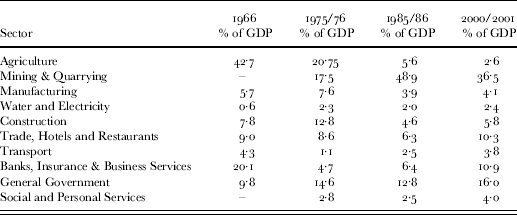
In 1968 agriculture dominated the economy, representing over 40% of GDP, only to decline to less than 2% in 2006; it continues to hold a very modest position. Mining instead expanded from 8% of GDP in 1974/75 to 53% in 1988/89, only to shrink again to roughly 35% in 2002 (Leith Reference Leith and Salkin1997a: 24; 2005: 5, Table 1.1; Siwawa-Ndai Reference Siwawa-Ndai and Salkin1997: 343, Table 2; World Bank 2008a). These changes represent, however, a shift in balance in the economy, rather than a rise of new sectors, export goods or modes of production. The industrial sector has grown significantly in relative terms, but this is mainly due to the expansion of the mining sector, while manufacturing persists at roughly 4% of GDP, with figures falling over the last two decades (Mpabanga Reference Mpabanga and Salkin1997: 371; RoB 2003: 28, Table 3.1; Siwawa-Ndai Reference Siwawa-Ndai and Salkin1997: 347). Botswana's contemporary economy is thus not substantially more diversified than was the case at Independence (Leith Reference Leith2005: 100; Siwawa-Ndai Reference Siwawa-Ndai and Salkin1997). The government's efforts to diversify have failed, and left the economy vulnerable in the long term.
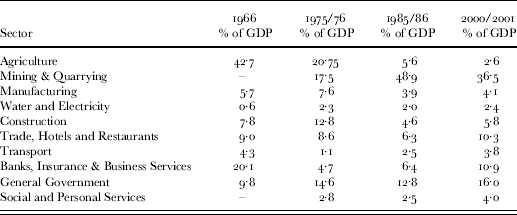
In 1966, government policy established that the role of the state would be one of providing infrastructure and education, while it was up to the private sector to develop manufacturing. The Botswana Meat Commission (BMC) abattoir completely dominated the manufacturing sector at Independence, accounting for over 90% of output and employment. Starting from the mid-1970s there has, however, been an intra-sectoral diversification and significant overall growth in value added, but not in relative terms in percentage of GDP; much of the growth can be attributed to the very low starting point (Harvey & Lewis Reference Harvey and Lewis1990: 159–69; Owusu & Samatar Reference Owusu and Samatar1997: 275). The government did appreciate the need to expand beyond mining and agriculture into high productivity industry, and a number of assistance schemes have been launched over the years. Unfortunately these became subject to increasing abuse and subsequently failed (Leith Reference Leith2005: 99–100). When it came to expanding beyond the traditional and well-established sectors, Botswana exposed itself as resembling other corrupt African countries from which it is generally set apart. The inference must be that industry has not experienced significant technological advance or innovation, achieved much increase in productivity or undergone structural change, and therefore cannot be considered as part of a transformation to MEG.
Low levels of technology and productivity unfortunately also characterise the agricultural sector, which is further restrained by a hostile environment (RoB 2003: 178–82; Silitshena & McLeod Reference Silitshena and McLeod1998, chs. 9–10). Only 4% of the country's area is suitable for agriculture (Parson Reference Parson1984: 4), and absolute agricultural production could never be expected to become high in a country that is as climatically challenged as Botswana, with roughly two-thirds of the country comprising the Kalahari Desert. In the 1930s, Batswana farmers grew 90% of the country's cereals consumption, but production decreased and in the 1980s the figure was 50%. Consequently, in 1991 the Botswana government abandoned its previous goal of self-sufficiency in food production, and instead adopted a policy of food security (Silitshena & McLeod Reference Silitshena and McLeod1998: 88–9). The country is today totally dependent on SACU for imports, while fields and animals yield even below the requirements for subsistence, and many households depend on complementary off-farm incomes (Gulbrandsen Reference Gulbrandsen1996: 2–3).
The advancement of cattle rearing has been the most prominent government venture in the agricultural sector, in colonial times and after Independence. Already in the late 1920s and 1930s, the colonial administration started borehole drilling schemes, as beef exports were conceived as the only comparative advantage of the Bechuanaland Protectorate (see e.g. Carlsson Reference Carlsson2003: 153–7;Footnote 1 Lawry Reference Lawry1983: 2; Parsons & Crowder Reference Parsons and Crowder1988; Peters Reference Peters1994, ch. 3). This assumption turned out to be valid, in the sense that until the present the country's only significant agricultural export has been beef, and it will continue to be so in the foreseeable future. At Independence, beef represented 85% of Bechuanaland's total export earnings, a figure that had dropped to 2% in 2006 (Colcough & McCarthy Reference Colcough and McCarthy1980: 32; Harvey & Lewis Reference Harvey and Lewis1990: 78–82; Leith Reference Leith and Salkin1997b: 530; RoB 2007). In 1975 the Botswana government negotiated favourable conditions from the Beef and Veal Protocol of the Lomé Convention, which guaranteed exports to Europe with high profits due to significant reductions in tariffs (Harvey & Lewis Reference Harvey and Lewis1990: 78–82; Siwawa-Ndai Reference Siwawa-Ndai and Salkin1997: 363). The independence government has continued in the footsteps of its colonial predecessors: constructing water sources, subsidising veterinary services, distributing vaccines, building veterinary fences, and setting up the BMC as a monopsony buyer of cattle and exporter of meat (Acemoglu et al. Reference Acemoglu, Johnson, Robinson and Rodrik2003: 101; Lawry Reference Lawry1983: 14). The livestock sector presently contributes 80% to agricultural GDP, but ranching in Botswana is a low technology sector, and not much has happened in terms of technological advance since the introduction of modern boreholes and the establishment of the Lobatse abattoir in 1954. Despite its decreasing relative contribution to the economy and low productivity, the cattle sector is continuously expanding as the numbers of animals increase, although there have been severe setbacks in drought years. At the same time there is a polarisation in cattle ownership, with increasing numbers of small-scale farmers without cattle at the one end, and large holders at the other (Gulbrandsen Reference Gulbrandsen1996: 3; Peters Reference Peters1994: Silitshena & McLeod Reference Silitshena and McLeod1998, ch. 11). The continued striving by the large cattle-holders to amass more animals can be explained by the high social status that is still associated with cattle, and by the export profits channelled to individual cattle holders by the BMC. From a national economic and environmental sustainability point of view, this expansion of the cattle sector is unwarranted, as natural resources such as water and land are being heavily exploited while returns are modest.
In the general model for MEG, productivity increase in subsistence agriculture resulting in agricultural transformation should generate capital and free labour that can move over to industry and other capitalist sectors, thereby becoming a starting point for structural change (see e.g. Lewis Reference Lewis1954; Mellor Reference Mellor, Lewis and Kallab1986). However, in the case of Botswana it would not be realistic to expect the agricultural sector to initiate MEG. In order to avoid creating a dual economy with a disadvantaged countryside, it is still important for there to be an agricultural transformation including an adoption of new farming methods, which could increase productivity and raise standards of living. When the agricultural sector is failing to fill its role as the engine of MEG, other more successful sectors – in the case of Botswana the mining industry – could substitute for its shortcomings in forming capital, thereby becoming the engine of development (Gerschenkron Reference Gerschenkron and Gerschenkron1962).
Botswana has been urbanising quickly for the last four decades, and has moved from 4% living in urban settlements at Independence (Gulbrandsen Reference Gulbrandsen1996: 19) to 58% at present (Leith Reference Leith2005: 13, Table 1.2; World Bank 2008b). This could be viewed as a sign of structural change, but although urbanisation entails a profound reorganisation of the population and has implications for various aspects of human development, it is not equivalent to growth in the industrial or capitalist sectors in which high productivity is found. Lewis' original model is often misunderstood, and quoted as an argument for economic development centred on a process of labour moving from agriculture to industry, and urbanisation equalling industrialisation. Both industry and agriculture are part of the capitalist sector, and although the subsistence sector is primarily associated with pre-modern agriculture, it is common in developing countries for subsistence sectors to expand also in urban areas, the most evident case being informal self-employment. Botswana's prime engine of growth, the diamond sector, is neither located in the urban areas, nor does it have significant links to other sectors of industry. The urban settlements are instead attracting labour that finds employment within the government administration, service sector, household employment, trade, and so on, some of it in the formal and some in the informal sector. Labour is thus mainly moving from subsistence agriculture to non-capitalist urban sectors, and provides yet another indicator that structural change and MEG are not present.
Since the early 1990s, a serious unemployment problem has been registered, with 18% unemployment in 2005/06 (RoB 2006: 2), and as long as the industrial sector is not expanding, the figure will probably not improve significantly. With high urban unemployment rates, as in the case of Botswana, individuals' motives for migrating to the urban areas can be questioned, but also explained in a satisfactory fashion. Urbanisation becomes rational behaviour at the individual level, as economic models shift focus from full employment equilibrium to expected rather than actual contemporary and future urban wages (Todaro Reference Todaro1969) and relative deprivation (Stark Reference Stark1991). Instead of being a sign of modernisation, urbanisation should in the Botswana case be perceived as a symptom of a dual economy with a poor and neglected rural sector.
Lipton (Reference Lipton1977) points out that the most important class conflict in developing countries today is that between the rural poor, and urban groups experiencing improvements in living standards and human capital. There is an urban bias favouring the larger cities and industry at the expense of the countryside and agriculture, which drives a process creating dual economies. It is damaging because it is counter-productive to both an efficiency norm, implying an allocation of resources to maximise long-run output, and an equity norm, distributing income so as to maximise welfare. As long as most of the poor are located in the rural areas, and agricultural production is characterised by low levels of technology and productivity compared with the urban sector, the highest returns will be on investments made in the rural sector. Urban bias thus slows down both growth and development. In Botswana most agricultural production has been in the private sector, and the government has merely provided a framework of infrastructure, administration, education and utilities. While government spending on agriculture has been small compared with that in urban areas (Harvey & Lewis Reference Harvey and Lewis1990: 252–3), private investments have not succeeded in compensating for the lack of government involvement.
Rapid urbanisation can also be explained by historical migration patterns, revealing that the Batswana have a long tradition of moving in order to farm, to find pasture, and for wage employment. In the rural areas, each household may have as many as three dwellings – in the village, at the arable fields and by the cattle post – and household members move between them depending on season and assignments. With the colonial era came the demand for payment of taxes, and new labour migration patterns were established as the men left in large numbers to find employment in the mines of neighbouring South Africa (Schapera & Comaroff Reference Schapera and Comaroff1991: 24). This had severe negative impacts on agricultural production, and caused social unrest and disrupted family units (Colcough & McCarthy Reference Colcough and McCarthy1980, ch. 7). These patterns of temporary movement within the rural areas and between the rural and urban are still in place. As in the case of urbanisation, however, neither can be associated with labour moving from subsistence to national capitalist sectors, nor do they promote structural change.
MANAGING NATURAL RESOURCES
The economic history of Botswana is to a large extent the story of natural resource management, generous gifts and limiting scarcity, which thus have an inescapable place in a structural analysis. It is most unlikely that the Botswana growth miracle could have occurred unless diamonds had been found at Independence, and the government had nationalised all sub-soil mineral resources in 1967, thereby gaining control over future revenues. Historical circumstances provided a combination of a perfect resource that is valuable, storable and cheap to transport, and perfect timing, assuring uncontested incomes to the newly established government. Without diamonds, the country could very well have had a functioning institutional structure offering economical and political stability, but it is hard to imagine any other way of achieving comparable consistent growth. Parallel with its diamond deposits, the country has severe constraints to economic expansion. It is landlocked, resulting in high transport costs, it has no internationally competitive wage advantage, the climate is unfriendly to agricultural expansion and intensification, and there are no other comparatively valuable natural resources.
Until the 1970s, economists in general had a favourable view of abundant natural resources. Many developing countries that became independent in the decades after World War II possessed great wealth in primary products, and this was understood as almost a guarantee for future growth. The actual outcome, however, was other than expected, as the following decades saw the economic growth and development of the Newly Industrialising Economies in East Asia, stagnation in Latin America and economic and political failure in sub-Saharan Africa. The empirical evidence from most resource-abundant countries has for the last 30–40 years included corrupt leaders selling off natural assets and pocketing the profits, individuals and international companies becoming wealthy while governments stayed poor, and financial policies unable to control exchange rates and inflation. Meanwhile, low wages have become a stronger comparative advantage than resource wealth. In theory, abundant natural resources are still believed to promote growth by allowing for investments in infrastructure and human capital (see e.g. Sachs & Warner Reference Sachs and Warner1999), but from the 1990s onwards there has also been a lively debate focusing on negative aspects such as the natural resource curse (see e.g. Leite & Weidman Reference Leite and Weidmann1999; Sachs & Warner Reference Sachs and Warner1995), and Dutch disease (see e.g. Corden & Neary Reference Corden and Neary1982; Hill Reference Hill1991).
Sachs and Warner (Reference Sachs and Warner1995) have shown that there is generally a negative correlation between natural resource endowments and economic growth. This is a paradox, since incomes from natural resources raises wealth and purchasing power over imports and, hence, should also raise investment levels and growth rates. The explanations given for the failure of many resource-abundant countries vary, and include higher prevalence of indolence, rent seeking, conflict between stakeholders, corruption, and predation, compared with economies relying on other comparative advantages. While being the eighteenth largest resource exporter in the world (Iimi Reference Iimi2006: 6), Botswana has managed to avoid both the resource curse and Dutch disease, by creating a long-term plan for the extraction of natural resources and good policy for continued growth (Hill Reference Hill1991; Iimi Reference Iimi2006). This achievement makes it a member of a very exclusive group of developing countries, including only a few others such as Mauritius and Malaysia (Sachs & Warner Reference Sachs and Warner1995).
The standard explanation for Botswana's successful management of incomes from its diamonds has some compulsory elements. The government has extracted diamonds wisely and negotiated a 50–50% deal with the South African mining company De Beers, thus ensuring significant revenues for the country. As a result, diamonds account for roughly 30% of GDP, 70% of export revenues and 50% of government revenue (RoB 2003: 28, Table 3.1, 205, Table 11.1, 206, Table 11.3). By comparison with other African states, Botswana's leaders have mostly been honest, and elite corruption was rare until the 1990s. The government has shown great prudence in the management of diamond incomes, keeping expenses consistent in boom years and building up foreign exchange reserves, thereby being able to compensate for bust years. This strategy, combined with proper management of the exchange rate, has also meant that real exchange rate appreciation has been under control, which has been positive for the export sector. Through fiscal policy the government has avoided external debt problems, and has maintained a stable growth rate over time (Hill Reference Hill1991). There is a general consensus on the shrewdness of government fiscal policies, both in building international reserves, but also in investing in key sectors such as infrastructure, education and health care. Government actions have been in line with IMF recommendations and have certainly assured growth. Much praise is given to the government for this achievement, but the relevance of the Dutch disease debate for the structural analysis is questionable. It is agreed that Botswana does not suffer from Dutch disease, although all the typical pre-conditions are present. The country has a dominating and lucrative tradable natural resource sector that supports a growing non-tradable service sector, while the tradable manufacturing sector is relatively weak. The greater the income from natural resource exports the higher the demands for the non-tradable sector, and consequently the less capital and labour is available for the manufacturing sector (Corden & Neary Reference Corden and Neary1982; Iimi Reference Iimi2006: 5). What sets Botswana apart from the typical Dutch disease syndrome is the fact that at Independence Botswana had an insignificant manufacturing sector, which consequently could not be ruined by the allocation of capital and labour to other sectors. It would, however, be fair to claim that the country is caught in a natural resource trap. As long as diamonds dominate government revenues, there is an indirect discrimination against a diversification of the economy, there are few incentives for industrialisation and productivity increase, and consequently the process of structural change is hindered.
Absurd as it may seem, HIV/AIDS may well not lead to economic collapse in Botswana, because the mining sector may not be too severely affected, as it needs a workforce of only 8,000 paid employees (RoB 2004a: 24, Table 2.1). Growth could then continue in the midst of human tragedy and social collapse. Of course, although the mining sector may be unaffected, the epidemic makes it even less likely that MEG will appear in the near future, due to the immense stress on society at large and on the economy outside the mining industry.
Long before diamonds were discovered, the Botswana economy was centred on cattle. Access to land and water resources was thus the key for creating wealth, guaranteeing future incomes and setting up patron–client relationships. The Tswana had a unique settlement pattern, with the population concentrated in larger villages surrounded by arable fields, with the grazing ranges situated further away. Natural resources used to be communally owned, and each household was allocated land and water resources by the chiefs according to its needs. Individuals were given private user rights to arable fields and water sources, while cattle were grazed on communal ranges, and each household privately owned and controlled its own production (see e.g. Carlsson Reference Carlsson2003: ch. 5; Colough & McCarthy Reference Colcough and McCarthy1980: ch.1; Peters Reference Peters1994).
Communal ownership of natural resources, combined with private user rights to resource units and private ownership of production, is a property rights system common to rural communities in sub-Saharan Africa (see e.g. Berry Reference Berry1994; Carlsson Reference Carlsson2003: ch. 5; Ensminger Reference Ensminger, Drobak and Nye1997; Perrings Reference Perrings1992). While the property rights institutions in rural Botswana have not experienced significant structural change, individuals have struggled with one another within the institutional frameworks, conducting negotiations and taking advantage of positions of power (Carlsson Reference Carlsson2003). These power struggles have concentrated resources in the hands of the wealthier segments of society, while at the same time upholding a minimal basic needs level for the poor that is guaranteed by traditional property rights (see e.g. Carlsson 2003; Peters Reference Peters1994).
In customary Tswana land tenure, resources belonged to the tribe and were kept in trust by the chief, who was also in charge of land policy. In 1968 the implementation of the Tribal Land Act meant that the tribal land remained as communal property, but the allocation responsibilities were removed from the chief and assigned to newly established Land Boards which were to follow traditional allocation principles (Gulbrandsen Reference Gulbrandsen1984: 7–9). In the 1970s, the government became increasingly concerned with the issue of overgrazing, and in 1975 the Tribal Grazing Land Policy was launched, dividing all land into three categories: communal, private and wildlife reserves. It was argued that the move of larger herds to fenced-off private farms would reduce the pressure on the communal grazing range. With these two land tenure reforms, the government took over responsibility for land distribution from the tribal authorities and allocated private land to the largest cattle holders, while not doing much to promote grazing management among smallholders on communal land (Lawry Reference Lawry1983: 19–25).
In a dry country such as Botswana, water is a scarce key resource for all economic activities, both agricultural and industrial. In the densely populated south-eastern parts of the country, there is likely to be a shortage in water by the year 2020 if demand continues to increase at the present rate (Silitshena & McLeod Reference Silitshena and McLeod1998: ch. 5). Still, little is being done to promote conservation and hinder pollution in rural and urban areas, although progressive water fees have been introduced primarily in the urban settlements. There may be several reasons for the political unwillingness to be more forceful in using pricing and command and control measurements in order to reduce water use. One is a dread of losing political support; another is a principle of securing the poor the rights to free clean water for drinking purposes. Instead of reducing demand and preventing pollution, the government has relied on increasing supply through various water development projects, but it can be questioned whether current policy either represents a sustainable strategy or promotes a more efficient use of water resources (Carlsson Reference Carlsson2003; Rahm et al. Reference Rahm, Swatuk and Matheny2006).
Traditionally, wealth was measured in cattle and, by controlling cattle and lending them to kin and other tribe members, chiefs bought political loyalty and access to labour resources (Lawry Reference Lawry1983: 3). Access to and income from cattle are still central to both the urban elite and rural dwellers. Due to the economic elite's interest in investing in cattle, the national herd has increased to a point threatening both grazing and water resources. Colcough and McCarthy (Reference Colcough and McCarthy1980: 22) estimate that the national herd grew tenfold from the beginning of the twentieth century, reaching 3 million head by 1978. The numbers then decreased during the 1980s due to droughts, and reached 2 million in the early 1990s (Silitshena & McLeod Reference Silitshena and McLeod1998: 122,, Table 11.1), only to increase again to 3 million at present (Rahm et al. Reference Rahm, Swatuk and Matheny2006: 159). The solution to overgrazing has been to extend further into the Kalahari desert, and to extend private tenure (Lawry Reference Lawry1983: 11). As the large cattle holders and the political elite are the same, there is modest political will to protect natural resources and to inflict efficiency demands on the cattle sector. The number of animals is increasing and so is production, but productivity has not been improved to any significant degree and structural change is absent.
INEQUALITY AND DEVELOPMENT
Growth is valued not because it further enriches the already well-off, but because it gives an opportunity to significantly and lastingly improve standards of living for the majority, including the poor. For a country to achieve the characteristics of development, poverty must be alleviated, income levels be considerably improved, and resources and opportunities be distributed by a modern state in order for all segments of society to benefit (Adelman Reference Adelman, Andersson and Gunnarsson2003: 17–18). Traditional unequal distribution of resources and incomes, and a dual economy with discriminated sectors and groups within society, define a society as prior to MEG.
The systematic relationship between economic growth and income inequalities has been discussed theoretically and investigated empirically ever since Kuznets (Reference Kuznets1955) presented his inverted U-curve, and there is today a consensus that no straightforward relation can be established (World Bank 2006: 44, Box 2.6). There is, however, an inseparable link between equity, defined as equal opportunities for all, and avoidance of absolute deprivation (ibid.: 18–19). Equity likewise plays an important role in promoting development, as it frees people from the poverty trap and strengthens the political institutional structure. By ensuring higher overall levels of income and the support of a modern state, the rural poor can afford to turn away from being risk minimisers and instead become utility optimisers, contributing to the economy through their human capital capacities and raised productivity, and bringing considerably increased supply and demand to the domestic market (Lipton Reference Lipton1968). All members of society represent assets in human and social capital, and in order to create sustainable prosperity these resources should be made use of to the fullest. Equitable institutions include all individuals in the development process, offering them equal opportunities by protecting their property rights and giving them equal treatment before the law. Causation, however, runs both ways, and the increased capabilities of individuals result in higher demands on a well-functioning modern institutional structure in both economic and political terms (World Bank 2006: ch. 6).
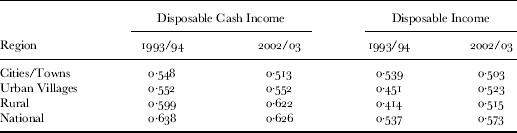
Developing countries with significant mineral resources and abundant land tend to be less equal in resource distribution than others (Bourguignon & Morrisson Reference Bourguignon and Morrisson1990: 1127–8), and Botswana fits this characterisation. By international standards, income divides are high in Botswana. They have been so in historical perspective, and have probably increased during the decades of exceptional growth. Today Botswana has one of the highest levels of income inequality in the world, together with some Latin American and sub-Sahara African nations (Good Reference Good1993: 203; Jefferis Reference Jefferis and Salkin1997: 493–6). The current national GINI coefficient as assessed by UNDP (2006) is 0.6.
Despite substantial growth, 47% of the population lives below the national poverty line (UNDP 2006), and there are reports of prevailing and even increasing rural poverty, at least in certain regions (see e.g. Gulbrandsen Reference Gulbrandsen1996; Wikan Reference Wikan2004). The fact that the divide between the richest and the poorest groups in society is widening may not in itself be a severe reason for concern. What is disturbing is that the divergence is combined with high unemployment, continued high poverty rates and discrimination against certain groups, specifically the San (see e.g. Curry Reference Curry1987; Good Reference Good1993). Together, this reflects an institutional inequality where government policies tend to favour elites in various ways, while denying the majority of the population equal opportunities (Engerman & Sokoloff Reference Engerman and Sokoloff2002; World Bank 2006: 107–8). Even worse, contemporary inequalities appear to be inherent in the socio-economic structure going back in history (see e.g. Good Reference Good1994: 205; Peters Reference Peters1994; Wylie Reference Wylie1990), and there is no structural change.
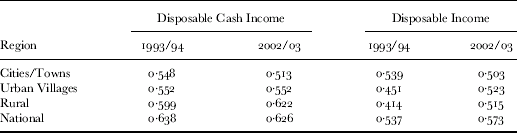
Unemployment rates are important for equity, since a prominent way of eradicating poverty is through growth, resulting in formal employment and increasing real wages (Quibria Reference Quibria2002). Much of the explanation for the Pacific Asia miracle rests on equal opportunities and distribution of resources. The unemployed in Botswana are primarily youths and individuals with little or no education, possibly with a higher proportion of women. A fundamental requirement for making demand meet supply appears to be to increase the level of education, specifically university degrees, in the workforce (Siphambe Reference Siphambe2003).
There has been both a trickle down from the wealthier segments of society, and a political consciousness of the need to fight high poverty rates. As a result, poverty in terms of income levels has improved from 59% of individuals being poor in 1985 (Jefferis Reference Jefferis and Salkin1997: 484, Table 2) to 47% in 2005 (UNDP 2006). These figures may stand out in a regional context, but have not been achieved through structural change. It is important to keep in mind that attitudes towards inequality and poverty are rooted in normative values, and that distribution of resources and incomes are subject to conscious government policies. Government policy on distribution of wealth in Botswana has mainly been the equivalent of a basic needs system, giving support to the poor via food-for-work programmes that have been running during droughts since 1965 (Colcough & McCarthy Reference Colcough and McCarthy1980: 133), as well as providing health care and education free of charge until recently.
During the colonial era, the British spent little in excess of administrative costs in the Bechuanaland Protectorate. The independence government has, however, spent about 40% of GDP primarily on infrastructure and human capital, a figure that is one of the highest in Africa and comparable with Norway (Acemoglu et al. Reference Acemoglu, Johnson, Robinson and Rodrik2003: 85; Leith Reference Leith2005: 85, Fig. 3.9). In 1966, there were only 12 kilometres of paved roads (Acemoglu et al. Reference Acemoglu, Johnson, Robinson and Rodrik2003: 80), while today this figure is almost 9,000 kilometres. There are 85 airports, over a million telephone subscribers out of a population of 1·7 million, 60,000 internet users (CIA 2008), and 95% of the population has access to improved water sources (World Bank 2008b). The British considered education to be a tribal responsibility, and at Independence there were fewer than two dozen Batswana who had received university education and 100 who had completed secondary school (Acemoglu et al. Reference Acemoglu, Johnson, Robinson and Rodrik2003: 80–3; Colough & McCarthy Reference Colcough and McCarthy1980: 28). Today adult literacy rates are 81%, and more than 5% of the population has completed tertiary education (World Bank 2008a, 2008b). Contemporary health indicators are severely negatively affected by the rampant HIV/AIDS epidemic, which makes them difficult to evaluate. It is, however, relevant to point out that although they were good they were never exceptional, and that less has been spent on health improvement than on education (Leith Reference Leith2005: 86, Fig. 3.10). In the early 1990s, before the impact of HIV/AIDS, the best figures recorded for life expectancy and infant mortality were 65 years and 45 out of 1,000 births respectively (Leith Reference Leith and Salkin1997a: 23, Fig. 2; 2005: 13, Table 1.2).
Government policy has given better results than can be detected simply from levels of income poverty, as it has improved human capital and the capabilities of the poor. In a broader based approach the concept of capability poverty can be used, in which case Botswana scores much more favourably, with 30% suffering from capability poverty in 1996 according to UNDP, as opposed to 46% being income poor in the same year (Jefferis Reference Jefferis and Salkin1997: 492–3). The actions of the Botswana government in improving capabilities have thus been commendable, but they have not automatically generated dynamic processes of increasing productivity and are not equivalent to equity. Indeed, the reliance on government welfare programmes has made many rural destitutes passive, and cemented existing structures (see e.g. Nthomang Reference Nthomang2004; Wikan Reference Wikan2004).
In the agricultural sector, poverty is a matter more of access to resources than of income levels, and since smallholders are mainly subsistence farmers, their standards of living are difficult to estimate. A minimal access to resources is generally guaranteed within the traditional property rights systems, where key resources such as water and land have a strong public goods dimension (Carlsson Reference Carlsson2003: 101–7). Batswana farmers are vulnerable and prone to poverty due to limiting climatic and soil conditions and recurring droughts. This weakness of the agricultural sector has implications for poverty reduction on a national level, as traditional agriculture is only estimated to be able to support 15–20% of the labour force, thereby augmenting the pressure on other sectors for offering employment (Jefferis Reference Jefferis and Salkin1997: 478).
Distribution of wealth is to a high degree associated with distribution of cattle, which has a long history of being very unequal, with the traditional chiefs and their relatives being the largest cattle holders (Colcough & McCarthy Reference Colcough and McCarthy1980: 22; Lawry Reference Lawry1983: 6). Cattle continue to be amassed by a minority of large holders, while the number of cattleless smallholders is increasing. In the 1940s only 10% of households had no cattle, while in 1993/94 that figure was 57%. In 1990 33% of cattle holders had on average six beasts each, while 35 commercial farms, representing 0·6% of cattle holders, held above 4,000 head on average, and 19 farms held more than 10,000 (Good Reference Good1993: 223–4; Silitshena & McLeod Reference Silitshena and McLeod1998: 127). After Independence, the traditional economic elite moved into the new state, establishing a strong connection between large cattle holders and government. In the early years of Independence, two-thirds of the members of the National Assembly were large or medium sized cattle owners (Samatar Reference Samatar1999: 69–70).
There is a well-documented and uncontested history of the economic and political elite being one and the same in Botswana (see e.g. Acemoglu et al. Reference Acemoglu, Johnson, Robinson and Rodrik2003; Good Reference Good1993; Peters Reference Peters1994; Wylie Reference Wylie1990). Very few Europeans ever settled in the Bechuanaland Protectorate as they saw little future in either agriculture or mining, and only 3% of farm land came under European control (Colcough & McCarthy Reference Colcough and McCarthy1980: 7). This marginal colonial influence allowed the Tswana political and economical institutional structure to stay strong, and to guarantee a continuity in the social structure of the pre-colonial, colonial, and post-colonial era (Acemoglu et al. Reference Acemoglu, Johnson, Robinson and Rodrik2003; Colcough & McCarthy Reference Colcough and McCarthy1980: ch. 1).
That the political and economic elite are identical is presented by some researchers as a decisive factor explaining Botswana's economic success (see e.g. Acemoglu et al. Reference Acemoglu, Johnson, Robinson and Rodrik2003: 104). Maintaining the status quo has, however, allowed this elite to protect its own interests, and there is no reason to assume that it would act according to anything other than its own self-interest (Kaufmann & Kraay Reference Kaufmann and Kraay2002: 204). The political elite is further connected to the leading bureaucrats, who share common economic interests in cattle and commerce (Good Reference Good1994: 499). This overlap between the wealthy, the political leaders and the bureaucracy explains the lack of interest in equity in resource and income redistribution.
The theory of MEG, however, implies that growth has to lead to shifts in the economic position of various groups attached to particular production sectors. Hence, old economic elites have to be challenged and transformed or replaced, in order for new production sectors to appear, together signifying a break with old economic and social structures (Kuznets Reference Kuznets1973: 252). Such change may not be welcome in the eyes of the elite. While pre-modern growth is in their best interest, it is questionable whether they are motivated to promote development, as this requires structural change and not the continuity of existing political institutions.
If the elite is interested in maintaining the status quo, the demand for change and equity may come instead from the grass-roots level, but this does not appear to be the case in Botswana, as there are no sizeable social movements or contesting political parties (Good Reference Good1994: 518). Political stability, consensus building and economic growth appear to have dampened the opposition. Diamonds have kept all content and happy, as there has been some for all, and a lot for a few.
ANALYSIS AND IMPLICATIONS
As sub-Saharan African countries became independent in the mid-1950s through to the beginning of the 1970s, there was a great optimism for the future. Income levels were higher than in many Asian regions and on par with Latin America, the continent held great riches in natural resources and Africans were finally free to form their own destiny. Unfortunately, the continent soon became troubled by ethnic and racial conflict, political unrest, violent crime, ravaging poverty, economic failure and resignation, predatory leaders and rampant corruption. Political and economic stagnation, decline, and chaos have been widespread experiences since the 1970s, and the overall economic crisis triggered the introduction of the Structural Adjustment Programmes in the 1980s. Since then, the continent's aspirations have been lowered. Stability and growth have been viewed not just as acceptable or sufficient achievements, but even as the best imaginable result, while development has been reduced to an almost forgotten utopia.
It is in this context that Botswana has qualified to be depicted as an exceptional success story. What the country has experienced for the last 40 years is export-led growth combined with political stability. It is not enough, however, to rest content with describing only the Botswana growth miracle, without discussing its fundamental socio-economic structure and possible future improvements. The key issue is MEG, development and structural change.
Despite impressive growth, political stability, improved infrastructure, prudent financial management, material modernisation and investments in human capital, Botswana is at present also experiencing a decline in population, there is no significant increase in productivity, little economic, social or ideological transformation, and only sporadic introduction of high levels of modern technology. Hence, four out of six characteristics of MEG are missing, and the inference must be that Botswana is a case of pre-modern growth and not development, while the socio-economic structure is being cemented and hailed as stability. Although continuity is an active process and may contain dynamic institutional change, it does not amount to a break with earlier structures, and the lack of structural change is the reason behind faltering development indicators. The advances that have been made are indeed very promising, but they are only pre-conditions for turning growth into development, while there are few signs that structural change is promoted either by agriculture or industry, by the elite or the grass-roots level. Neither is equity part of Botswana's strategy, although it is a necessary ingredient in development.
Botswana has experienced a profound change in factor relative price, due to a massive increase in capital primarily from diamond exports, and the success of the mining sector has the potential of becoming a window of opportunity for development. This sector could substitute for missing capital formation in the low producing agriculture, and help transform agriculture as well as diversify industry. In order for this to be realised, however, the government has to step up and take on the challenge to become a developmental state.
The success of Pacific Asia provides several important lessons concerning economic development. It shows that development is possible, and that a developmental state can create the institutional structure necessary for subsequent development. Through intentional policy choices, countries such as Botswana can shift from a trade-led, natural resource intensive, limited industrialisation with narrow based growth, to a broader development strategy. Further, although development is a process that entails a discontinuous break with earlier structures, it is also path-dependent in that each country has a unique economic, political, and social history, and an existing institutional setting. All development strategies must take this into account. The economic and political institutional structures are of equal importance in this process of development, and are closely linked to one another (Adelman Reference Adelman, Andersson and Gunnarsson2003: 17–21).
Botswana offers lessons for other natural resource dependent developing countries, in the importance of prudent management in avoiding the natural resource curse and Dutch disease, as well as the blessing of leaders who have been relatively modest in their rent seeking. It can thereby be a model for how to achieve important pre-conditions for development, but it cannot be a model for actual development, since there has been no transformation into modernisation. The progress of Botswana is truly commendable, but the goal for any society must be development through MEG, and the next step is to leave the safe haven of stability and growth to venture into structural change and development. With a developmental state promoting equity and bringing prosperity to all segments of society, Botswana could use its diamond wealth to diversify industry, transform agriculture, and become a modern society. This is necessary for long-run economic sustainability because it is development and not diamonds that lasts forever.