1. Introduction
The word stress system of Modern Standard German is rather complex, and the many exceptions to any proposed stress assignment rule have provoked a long-lasting debate on whether syllable weight determines the stress position in German words, and if so, how (for an overview see Jessen 1999). Our paper presents the results of an experimental pseudoword production task designed to further our understanding of possible factors influencing the way native German speakers assign word stress. We investigated possible structural properties that affect word stress in order to contribute to psycholinguistic models of phonological encoding in general and to the controversial issue of German word stress assignment in particular.
According to metrical stress theory (Alber 1997, 2005; Giegerich 1985; Hayes 1995; Kager 1995; Liberman & Prince 1977; Liberman 1975; Nespor & Vogel 1986; Selkirk 1980; Trommelen & Zonneveld 1999), one function of stress is the hierarchical organization of rhythmic units. In this respect, stress is a relation between prominent and weak syllables that is realized via phonetic parameters such as fundamental frequency (F0), duration, and intensity. The relational property of stress can be expressed on the basis of metrical feet that assign strong and weak syllables to metrical patterns. Within metrical theory as adopted by Hayes (1995), the crucial prosodic parameter of a language is its foot type according to which syllables are grouped into a prosodic word (trochee, such as báda ‘dog’ in Wargamay or iamb, such as cocó ‘house’ in Semiole/Creek; both examples taken from Hayes 1995). It is generally accepted that Modern Standard German is a trochaic language (for instance, Jessen 1999), and that only one of the final three syllables may bear main stress (“three syllable window;” for instance, Giegerich 1985, Wiese 2000).
In the following sections, we discuss different structural properties of the word that have been argued to play a role in stress assignment, including the rhyme structure of the last two syllables (section 1.1), the rhyme structure of the antepenult (section 1.2), onset structure (section 1.3), and orthographic complexity (section 1.4).Footnote 1
1.1 Quantity-Sensitivity
Languages are commonly classified to have either quantity-sensitive or quantity-insensitive stress systems. In quantity-sensitive systems, the structural properties of a syllable matter, that is, more complex syllable rhymes are more likely to bear stress. Quantity is language-specifically defined through vowel length and/or coda consonants. In quantity-insensitive systems, it is assumed either that stress is assigned to words by a default rule, or that it is phonemically or lexically specified.Footnote 2,Footnote 3 There is a considerable debate whether German constitutes a quantity-sensitive or a quantity-insensitive system (see Eisenberg 1991, Féry 1998, Giegerich 1985, Kaltenbacher 1994, Vennemann 1991, Wiese 2000).
In the currently most fine-grained psycholinguistic model of phonological encoding, Levelt and colleagues (for example, Levelt et al. 1999) have argued for the existence of a default stress in German (analogous to Dutch). Their corpusbased observations lead them to conclude that penultimate stress is the default stress pattern, whereas the other patterns have to be stored as part of the idiosyncratic phonological representation of a word. However, despite the fact that there seems to be certain preference for penultimate stress in German words, the position of main stress in monomorphemic words is remarkably variable. A corpus analysis based on the CELEX lexical database (Baayen et al. 1995) performed by Féry (1998) revealed that 73% of German bisyllabic words are stressed on the penult. Yet, considering only words with two full vowels, the majority (61%) of words were stressed on the final syllable. In addition, within her corpus, stress position depends on the rhyme complexity of the final syllable—in contrast to predictions solely based on a default rule and/or lexical retrieval. Similar distributions were found for trisyllabic words that did not show a dominant preference for penultimate stress either.
Some phonologists agree with Levelt and colleagues’ claim that penultimate stress is the default stress in German. Hence they deny influence of syllable structure on stress assignment (Eisenberg 1991, Kaltenbacher 1994, Wiese 2000). Others argue that stress is assigned on the basis of the rhyme structure of the penultimate and final syllable (Féry 1998, Giegerich 1985, Vennemann 1991, Zonneveld et al. 1999).
Note that all the abovementioned phonologists act on the assumption that stress is assigned to words by one or more strict symbolic rules, constraints, or parameters. Janssen (2003) provides data that challenge this strict position. She investigated German stress assignment in a production task with trisyllabic pseudowords and observed the following tendencies:Footnote 4
(i) The penult receives stress if the final syllable is open (−V) or if the penult is closed (−VC).Footnote 5
(ii) The final syllable receives stress if the final syllable is complex (−VCC).
(iii) The antepenult receives stress if the penult is open (−V) and the final syllable is closed (−VC).
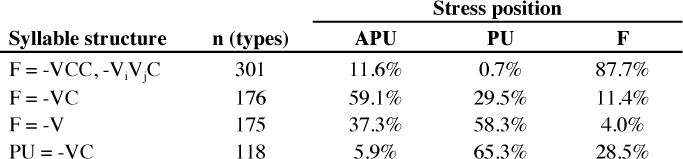
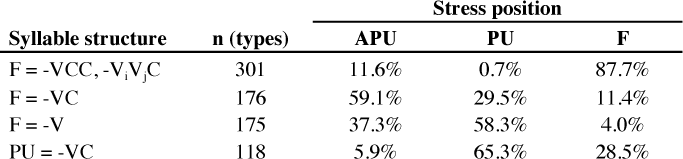
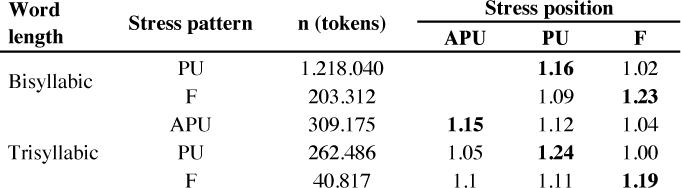
Crucially, Janssen (2003) found a significant variance both within and across speakers. She observed gradual distribution rather than strict application of unambiguous rules. Janssen (2003) complemented her empirical findings with a CELEX-based (Baayen et al. 1995) corpus analysis of existing trisyllabic German words and found similar tendencies: Trisyllabic words with a closed penult or an open final syllable were mainly stressed on the penult, words with a complex final syllable were mainly stressed on the final syllable, and words with a simple closed final syllable and an open penult were mainly stressed on the antepenult (see table 1 below). Again, correlations in the corpus turned out to be rather weak, that is, there were many exceptions to the proposed quantity sensitive generalizations.
Note that variability in Janssen's (2003) data was to a large extent due to ambiguity between antepenult and final stress. Pseudowords which tend to attract final stress showed a secondary preference for antepenult stress and those which tend to attract antepenult stress, showed a secondary preference for final stress. However, penult stress is hardly an option in these cases. The status of long vowels (−VV) was not investigated in her study because of difficulties in representing them orthographically in a pseudoword production task (see Janssen 2003 for a discussion of this methodological problem). However, closed final syllables containing a diphthong (−ViVjC) elicited a high proportion of final stress comparable similar to words with a complex rhyme (−VCC).
Distribution of stress patterns within a corpus of German trisyllabic monomorphematic words.Footnote 6
Experiments utilizing event-related potentials reported by Domahs et al. (2008) provide further justification for the assumption that stress assignment in German is sensitive to structural properties of the penult and the final syllable. The participants in their study listened to existing words realized either with the correct main stress position (LExikon ‘lexicon’) or with a wrong main stress position (*LeXIkon and *LexiKON). Stress violations of words with a closed final syllable (for example, LExikon) were compared to stress violations of words with an open final syllable (for example, RIsiko ‘risk’). Violations of stress patterns that involved final stress revealed differential brain responses, an enhanced positivity effect for stress of a final light syllable, and no positivity for stress of a final heavy syllable. The asymmetrical results lead to the conclusion that the final stress is instantiated by certain structural conditions.
There is also clinical evidence: Janssen & Domahs (2008) reported data from a patient with primary progressive aphasia, who over-applied different stress patterns depending on the rhyme structure of the last two syllables when reading aloud. Words with an open final syllable tended to be stressed on the penult, while words with a closed final syllable—on the final syllable. Thus, in reading, stress assignment was regularized, while the segmental structure of stimulus words was mainly spared. Interestingly, in the repetition task the pattern was reversed: While metrical structure (that is, stress pattern and number of syllables) remained largely preserved, responses were massively distorted at the segmental level. Crucially, in the repetition task, structures were also regularized: The patient tended to add consonants in the rhyme of stressed syllables and to omit consonants in the rhyme of nonprominent syllables. Thus, in both reading aloud and repeating, the patient associated stressed syllables with a more complex rhyme structure than nonstressed syllables.
Considering the recent empirical findings summarized so far, we assume that stress assignment in German is—at least to some extent—quantity-sensitive. It is clear, however, that German is not quantity-sensitive in the classical sense like Latin (see Kaltenbacher 1994, Wiese 2000). Yet, when German speakers process word stress they appear to be sensitive to different structural complexities of the rhyme. This is an important insight in evaluating psycholinguistic speech production models: The model proposed by Levelt et al. (1999) assumes independent routes for segmental and metrical processing. Since a metrical pattern is retrieved prior to the syllabification of phonological forms, such an account is not able to capture languages such as German, in which prosodic encoding is sensitive to certain segmental or structural properties of rhymes. In the present paper, we provide experimental support for a stress system that is sensitive to the rhyme structure of the last two syllables, but we also explore other possible influencing factors.
1.2 Antepenult Rhyme Structure
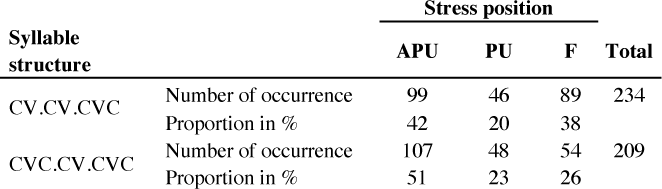
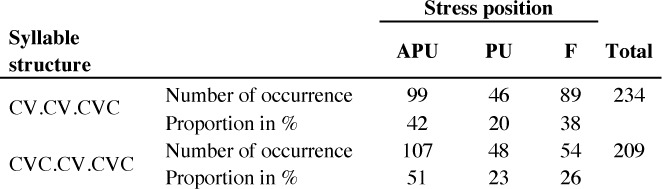
Authors advocating a quantity-sensitive account of German stress assignment propose that the rhyme structure of the last two syllables determines the position of main stress. Most phonologists of German—explicitly or implicitly—proceed from the assumption that the position of main stress is assigned starting from the right edge of a word. As a consequence, it seems that a possible influence of the antepenultimate syllable structure is ignored or rejected. Interestingly, however, within the data provided by Janssen (2003), there are numerical—albeit not significant—tendencies that indicate that the structure of the antepenult may play some role as well (see table 2).Footnote 7 A closed antepenult both increased the probability of the stressed antepenult (by about 9%) and decreased the probability of the stressed final syllable (by about 12%). Thus, the structure of the antepenult may have some—albeit weak—influence on the assignment of antepenultimate versus final stress.
Selected distribution of stress patterns across different syllable structures in a pseudoword production task.Footnote 8
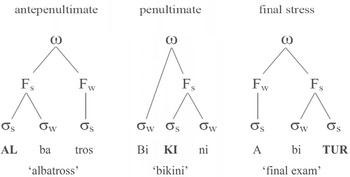
Many phonologists agree on what metrical templates of mono-morphematic trisyllabic words look like (see, for example, Alber 1997, Domahs et al. 2008, Hayes 1995). Domahs et al. (2008) provide empirical evidence that words with antepenultimate stress and words with final stress have the same foot structure. These words only differ in whether the left foot or the right foot is strong within the prosodic word (see figure 1 below).
In fact, there are certain words in German that are ambiguous with respect to stress position, that is, stress can fall either on the antepenult or final syllable (for instance, MARzipan versus MarziPAN ‘marzipan’, HOrizont versus HoriZONT ‘horizon’, TElefon versus TeleFON ‘telephone’). This ambiguity provides additional evidence for the claim that antepenult and final stress words share the same metrical structure. Recall that Janssen (2003) and Janssen & Domahs (2008) observe this kind of ambiguity between antepenult and final stress in production data, too. It may be speculated that the antepenult is not relevant for building up different foot structures, but it may be relevant for the position of main stress within the same foot structure (antepenultimate versus final stress).
Metrical templates underlying trisyllabic words with different stress patterns.Footnote 9

1.3 Onset Structure
Generally, quantity-sensitive languages make a distinction of quantity within the rhyme of certain syllables. For a long time it has been believed that the structure of the onset has no effect on stress assignment. For example, Halle & Vergnaud (1980:93) stated: “[I]n all languages known to us, stress assignment rules are sensitive to the structure of the syllable rime, but disregard completely the character of the onset.” Other authors took similar positions (see, for instance, Clements & Keyser 1983, Hayes 1995).Footnote 10 However, there seem to be stress systems that consider the structure of the onset. Everett & Everett (1984) show that in Pirahã, the status of onset consonants appears to affect stress assignment. In Western Aranda, words with three or more syllables receive initial stress when they begin with consonants but not when they begin with vowels (Davis 1988). Kelly (2004) challenged the assumption that English stress assignment is onset-insensitive. He has demonstrated that in a large corpus of bisyllabic real words, the incidence of trochaic stress increases signifycantly with the number of consonants in word onset position (see Arciuli & Cupples 2007 for similar findings). Furthermore, English speakers assign trochaic stress significantly more often to bisyllabic pseudowords with a complex onset than to words which contain a simple onset. Crucially, Kelly observed no clear-cut categorical distinction between onset weight categories; that is, unlike in Pirahã or Western Aranda, a particular onset structure did not imply a particular stress pattern. Rather, he observed a probabilistic correlation between onset complexity and word stress position.
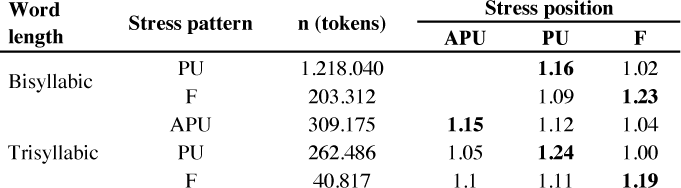
In an in-depth corpus analysis of German conducted by Mengel (2000), stressed syllables were generally more likely to have a complex onset than unstressed syllables (see table 3). Mengel's corpus analysis suggests a correlation between stress position and onset structure of the stressed syllable in German.Footnote 11
Onset complexity (mean number of orthographic elements) of stressed and unstressed syllables.
To our knowledge, no experimental study has been conducted yet to investigate this aspect of German stress assignment. On the one hand, traditional analyses neglect an impact of onset structure on stress assignment. On the other hand, data-oriented models predict a probabilistic correlation between lexical patterns (operationalized by Mengel's corpus analysis) and stress assignment to novel words. Although the observed tendencies in Mengel's data are very weak and not comparable to the significant impact of onset structure observed in the English lexicon reported by Kelly (2004), we assume that the effect of onset complexity found in the German corpus might be reflected in pseudoword production as well.
1.4 Orthographic Weight
Although the perception and production of word stress is a spoken language phenomenon, orthographic information may interact with the online computation of stress in reading. So far this possibility has been largely ignored given that the German spelling system appears not to encode any prosodic information. Interestingly, however, several authors working on English (Arciuli & Cupples 2006, 2007; Arciuli et al. 2010; Kelly et al. 1998; Seva et al. 2009) have demonstrated that in English bisyllabic words, there are some orthographic cues probabilistically related to word stress (for similar results restricted to double letter spellings see also Smith & Baker 1976). This points to possible interaction between stress assignment and orthography, which could also play a role in German.
The concept of orthographic syllable weight was introduced for German in Domahs et al. 2001 and Eisenberg 2006 to explain the systematic distribution of some phenomena of German spelling, such as the insertion of a silent lengthening. Domahs et al. (2001) demonstrate, based on a patient study, that graphemic weight indeed influences the assignment of word stress. It should be mentioned here that German orthography is to some extend ambiguous. For instance, vowel length cannot always be deduced from the orthographic form. The question arises whether phonological information presented in the visual modality interferes with orthographic complexity: Are phonemes that correspond to a trigraph treated as more complex compared to phonemes that correspond to a single graph? It seems at least possible that orthographic representation influences phonological and/or metrical encoding in reading aloud. If there were indeed orthographic cues for stress assignment, psycholinguistic models of reading aloud would have to integrate this type of information to simulate stress assignment accurately.
1.5 The Gradual Character of Stress Assignment
Given the high variability within the German lexicon (see table 1) and in the responses obtained by Janssen (2003), it seems unlikely that stress assignment in German can be captured by strict rules, constraints, or parameters based on the rhyme structure of the last two syllables alone, as proposed in generative accounts. Gradual distribution poses serious problems for models that rely on strictly symbolic mechanisms. So far several experimental studies in different languages have substantiated the variant and gradual character of stress assignment (for Dutch: Ernestus & Neijt 2008, Janssen 2003; for Spanish: Barkanyi 2002, Eddington 2004, Face 2000, Waltermire 2004; for English: Guion et al. 2003; for Russian: Crosswhite et al. 2003).
Usage-based and connectionist models provide alternative accounts of stress assignment that can capture gradual distribution (see, for example, Arciuli et al. 2010; Daelemans et al. 1994; Eddington 2000, 2004; Gupta & Touretzky 1994; Seva et al. 2009). In these data-oriented accounts, the information about word stress position is stored lexically. Stress in novel words could be assigned based on similarity to existing words in an analogical, exemplar-based manner. Additionally, stress regularities emerge probabilistically on the basis of individual items stored in the lexicon, via abstraction and generalization that could be applied to novel words. The present study provides new data able to constrain theories on stress assignment.
2. The Present Study
Previous research has shown that there is indeed an interaction between syllable structure and word stress information in German word processing (for experimental evidence see Domahs et al. 2008, Janssen 2003, Janssen & Domahs 2008, Tappeiner et al. 2007). However, the rhyme structure of the last two syllables alone cannot accurately account for the high variability of the data. Therefore, the present study aims to explore other structural properties that could potentially exert some influence on the stress assignment in German. To address this issue, we use a production task similar to the one described in Janssen 2003, in which participants are asked to read aloud pseudowords. In a pseudoword experiment, it is assumed that the participants are not able to retrieve lexical information but are forced to use implicit knowledge about the regularities of their linguistic system (for pseudoword experiments on stress assignment see Guion et al. 2003, Janssen 2003, Kelly 2004, Tappeiner et al. 2007).
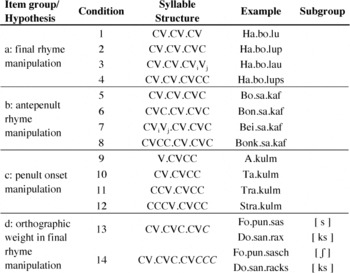
In this experiment, we hypothesized that four structural properties of the pseudowords influence word stress assignment: a) rhyme complexity of the final syllable, b) rhyme complexity of the antepenult, c) onset complexity of the (word initial) penultimate, and d) orthographic weight of the final syllable. First, our goal was to replicate the main aspect of Janssen's (2003) findings. We examined the role of rhyme complexity of the final syllable by systematically varying its structure.Footnote 12 However, in addition to Janssen's (2003) three-way distinction of open, closed, and complex rhyme we introduced a fourth structure to determine how a final syllable with a diphthong influences stress assignment. In consequence, there were four degrees of rhyme complexity of the final syllable, as depicted in table 4 below (see item group a; in item group d, the syllable structure column refers to the orthographic structure, that is, the final segments are orthographic segments).
In line with the results of Janssen (see tendencies i to iii above), we make the following predictions: Condition 1 should elicit mainly penultimate stress, condition 2 should elicit mainly antepenultimate stress, and condition 4 should elicit mainly final stress. We hypothesize further that with increasing rhyme complexity of the final syllable, the frequency of final stress should increase, while the frequency of penultimate stress should decrease.
So far, however, little empirical work has addressed the question of whether or not diphthongs (−ViVj) attract stress. Phonologists usually assume that diphthongs behave like long vowels (VV) but disagree on whether or not they constitute stress-attracting syllables. While Giegerich (1985) adopts the view that diphthongs, like long vowels, form stress-attracting syllables, other phonologists classify diphthongs as stress-rejecting (see, among others, Féry 1998 and Vennemann 1990, 1991). Consequently, according to Féry 1998 and Vennemann 1990, 1991, condition 3 should elicit stress assignment patterns similar to condition 1. However, Giegerich's (1985) account predicts similar stress assignment patterns for conditions 3 and 2.
Item groups, conditions, and the corresponding structures of sets of experimental items.

So far, the assumption that the structure of antepenult is irrelevant to stress assignment in German has not been questioned. Thus, the second goal of the present study is to fill this gap by examining the role of antepenult rhyme in stress assignment. The four-way distinction within rhyme complexity of the final syllable (see item group a) was used for the antepenult syllable, too, as shown in table 4 (item group b).Footnote 13
According to Janssen's (2003) data, we expect an increasing tendency towards antepenultimate stress and a decreasing tendency towards final stress from condition 5 to condition 6. Moreover, if the antepenult also exerts a more general influence on stress assignment through different rhyme complexities, our predictions are as follows: The increasing rhyme complexity of the antepenult should trigger an increase in the frequency of stressed antepenult and a decrease in the frequency of penultimate and final stress (conditions 5 to 6 to 8). Again, there are no straightforward predictions regarding the role of a diphthong syllable (condition 7). According to our predictions regarding the influence of the final syllable's rhyme structure, we expect stress patterns similar to the ones in condition 5 (following Féry 1998 and Vennemann 1990, 1991) or 6 (following Giegerich 1985).
In this study, we also address the question of whether the German stress system is sensitive to the structure of syllable onsets. To answer this question, we investigated the influence of the onset of the penult in bisyllabic pseudowords. There were four degrees of onset complexity of the penult syllable as shown in table 4 (item group c). If onset structure is a relevant factor for stress assignment, we expect an increase in penultimate stress with increasing number of onset consonants in the prefinal syllable. In other words, the frequency of penultimate stress assignment should increase monotonically through conditions 9 to 12 illustrated in table 4. Based on the corpus analysis in Mengel 2000, we assume that the onset effect may be small but still noticeable.Footnote 14
Finally, in the present study we also investigate the possible interplay between orthographic cues and stress assignment: Does “orthographic syllable weight” have any impact on stress assignment, as suggested by Domahs et al. (2001) and Eisenberg (2006)? According to these authors, graphemes such as <s> and <sch>—both encoding only one phoneme, [s] and [?], respectively—should have different orthographic syllable weights. If orthographic syllable weight, indeed, plays some role in stress assignment, both graphemes might be associated with gradually different distributions of stress patterns. We examine the role of orthographic encoding by designing pseudowords with identical phonological syllabic structure but different orthographic weights, just like the examples in table 4 (item group d). There were two degrees of orthographic complexity of the final syllable, realized in two different grapheme contrasts as depicted in table 4 (item group d).
If orthographic weight does have an effect on stress assignment, we expect a significantly different distribution of stress patterns related to conditions 13 versus 14. Specifically, if orthographic complexity constitutes something similar to visual quantity, we expect that the frequency of final stress should significantly increase and the frequency of penultimate stress should significantly decrease from 13 to 14. Note that according to Janssen 2003, words with a closed penult and closed final syllable predominantly receive penultimate stress. If the final syllable is complex, stress tends to fall on the final syllable. We hypothesize that the orthographic representation of the final syllable structure influences the phonological interpretation, modulating the distributions observed by Janssen (2003).
3.1 Method
3.1 Participants
Forty monolingual native speakers of German (30 women, 10 men) participated in our experiment. All subjects were students at the University of Cologne. Their mean age was 23 (ranging from 18 to 48). Participants were paid for participation.
3.2 Stimuli
Overall, there were 280 experimental stimuli (80 bisyllabic and 200 trisyllabic, see appendix A). The following selection criteria have been applied to avoid potential interference with factors external to our experimental manipulation: All stimuli obeyed the general rules of German phono- and graphotactics. However, the investigated structural properties of the pseudowords (see section 2) made it necessary to use stimuli that are somewhat unusual as monomorphemic German words (for example, words with a complex antepenult; but see note 18).
Relevant syllable boundaries were unambiguous. Moreover, we used full vowels, which are able to attract stress. As reduced vowels are not able to attract stress in German, and because of the preference for reduced vowels in final position (mainly in open and closed syllables), we avoided <e> as nucleus of the final syllable. Additionally, we limited as much as possible the occurrence of grapheme <e> in the other positions. We avoided <e> as single nucleus of the final two syllables, but it appeared frequently in conditions 3 and 7 as part of diphthong <ei>.
We tried to avoid analogies with real words as much as possible: Formal associations with existing words could interfere with stress assignment, so we tried to create pseudowords that would not elicit associations with either existing native or non-native words or morphemes. To this end, we avoided direct lexical neighborhood (Coltheart et al. 1977). Furthermore, we let five native speakers check our stimuli for formal associations with existing German words. Items for which at least one of the raters reported associations with existing German words were excluded. However, as the mechanisms of analogy between pseudowords and existing words are not completely understood at this point, we cannot rule out analogical interference entirely (see section 5). Note that to reduce the risk of lexical analogy we resorted to pseudowords that were in some sense atypical. For instance, we excluded several frequent word endings, such as −an, −art, or −ank, and used pseudowords with infrequent final consonants, such as Habolup.
Crucially, across conditions within each item group, only one parameter was manipulated. For example, only rhyme complexity of the final syllable was systematically manipulated within each item group. All other parameters (that is, syllable structure of the penult and antepenult, vowel quality of all syllables, consonant grid of the rest of the pseudoword) remained constant.Footnote 15 The other item groups were designed analogically, such that only one structural property in one syllable position was manipulated within each item group (see table 4).
In a pilot study, highly consistent rhythmic patterns emerged among a number of participants, which indicates that those participants used the same stress pattern more or less persistently. We tried to avoid such rhythmic patterns by using filler items. Therefore, experimental items were interspersed with 50 filler items. These filler items were designed to elicit some expected stress pattern with high probability (using syllable structure, form similarity to existing words, as well as orthographic cues for vowel lengthening and shortening). Originally, we proposed to use another set of 40 experimental items to investigate the impact of the onset structure of word-final syllables on stress assignment. However, because of frequent wrong or ambiguous syllabification, these items could not be analyzed. Therefore, we reclassified them as filler items, in addition to the 50 pseudwords originally designed as filler items, which resulted in a total of 90 filler items.
3.3 Procedure
Participants were comfortably seated in front of a computer screen in a well-illuminated room. They received instructions and were presented with five training items. After the training phase, the actual experimental items were presented in written form. Every participant had to read aloud 80 experimental and 70 filler items. Note again, that no participant had to produce any two corresponding members of a particular four-way distinction.
In every trial, participants saw the stimulus for three seconds centered on the screen in isolation. This was done in order to familiarize the participants with each item and prevent erroneous syllabification and pronunciation. After the familiarization phase, the same stimulus was presented in a constant carrier sentence for five seconds (Ich habe gehört, dass Peter … gesagt hat. ‘I have heard that Peter said…’Footnote 16,Footnote 17). Participants were asked to read the whole sentence aloud.
Between blocks, the participants had to perform a working memory task (digit span tasks that took about one or two minutes) to further reduce the probability of experimental patterning. After one block of pseudowords and one block of working memory tasks, there was an obligatory break of 30 seconds. Subsequent to the experiment, participants were asked for comments. In general, participants considered the task to be easy and did not guess the aim of the study. They did not report any difficulties. The overall experimental procedure (including instruction and interview) took approximately 40 minutes.
3.4 Analysis
Responses of the participants were recorded using a Sony ECM-MS907 electret microphone on an Aiwa AM-F70 mini disc recorder and digitally processed at 44.1kHz and 16bit mono. The first author and an independent experienced rater listened to the recorded responses and coded them for main stress position. The transcriptions were compared, and items for which the transcribers disagreed about the position of main stress were excluded from the analysis. Although there were only two raters, they agreed in their judgment in 97.75% of all cases. That equals a Cohen's kappa value of 0.95, which is an “(almost) perfect” match in terms of interrater reliability (Landis & Koch 1977:165). This indicates that the raters coded stress placement with a high degree of reliability.
Furthermore, all items which were produced incorrectly with respect to their segmental structure (for instance, Ha.bol.pu instead of Ha.bo.lup, Wa.pa.le.u instead of Wa.pa.leu) and all items produced syllable-by-syllable were excluded. However, responses that only changed segmental features, such as the vowel quality, but preserved syllabic structure (for instance, Ha.bo.la instead of Ha.bo.lu) were included in our analysis. In this way, a total of 4.25% of the original data were excluded from the analysis (2.25% judges’ disagreement and 2% structural errors).
Eighty critical items were produced by each of the 40 participants and transcribed as specified above. After classifying the position of the main stress of the target items, a ratio of stress position was calculated using the following method: The number of responses for each stress position per item was divided by the number of total analyzable responses for that item, resulting in a proportion of responses per each stress position and pseudoword. These proportions were arcsine-transformed, producing scores that approached a normal distribution and had a constant variance (Woods et al. 1986:220).
Arcsin-transformed proportions of all three possible stress patterns were subjected to repeated measurements of variance (ANOVAs) for global analysis and post-hoc paired t-tests to achieve specific contrasts. As we tested specific hypotheses (see section 2), all t-tests were performed one-tailed, if not stated otherwise. T-tests were Bonferroni-corrected for repeated testing. Moreover, we performed listwise and stepwise linear regression analysis on arcsin-transformed proportions of all three possible stress patterns as dependent variables using different sets of predictors as specified in section 4. We performed item-based and subject-based analysis. Both yielded the same principal pattern of results. For the sake of brevity, we only report the results of item-based analysis.
4 Results and Discussion
4.1 Rhyme Structure of Final Syllable
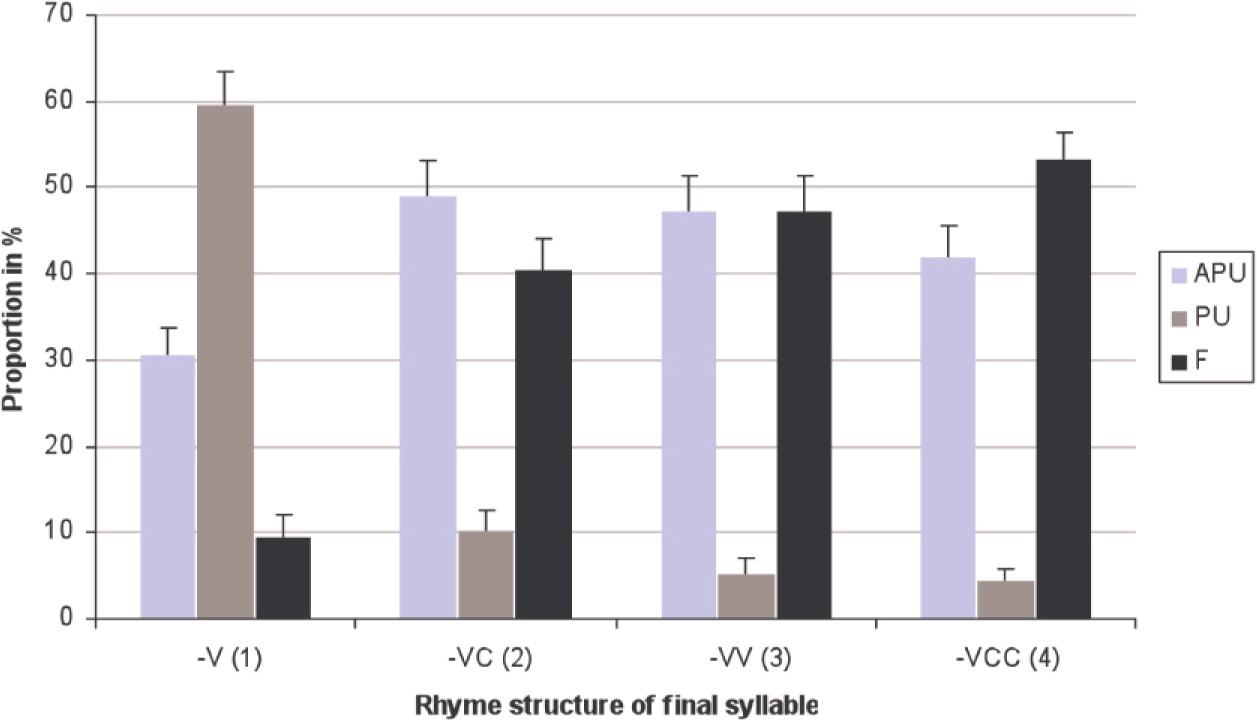
First, consider the distribution of stress assignment across the first four item categories, which were manipulated for final syllable structure (item group a, condition 1 through 4 in table 4; see figure 2 below). There was a significant main effect of final rhyme structure for both, the distribution of penultimate and final stress (F(3,57)≥|28.540|; p<.001), and a marginally significant effect for antepenultimate stress (F(3,57)=2.380; p=.079). Apparently, the most important difference was the one between an open and a closed rhyme. This difference was significant for the distribution of penultimate and final stress (t(19)≥6,757; p<.001). For the distribution of antepenultimate stress, the difference was only significant before the Bonferroni adjustment (t(19)=−2.392; p=.014). The proportion of items with antepenultimate stress increased from 30.8% to 49.1%, the proportion of items with penultimate stress decreased from 59.6% to 10.3%, and the proportion of items with final stress increased from 9.6% to 40.6%.
In line with Janssen's (2003) findings, words with an open final syllable (−V) were mainly stressed on the penult (see also Ernestus & Neijt 2008). Words with a closed syllable (−VC), a diphthong syllable (−ViVj) or a complex syllable (−VCC) showed a preference for antepenultimate or final stress. The present data indicate also that there is no difference between a closed syllable, a diphthong syllable, and a complex syllable. Although there is no inferentially detectable difference between a closed and a complex rhyme, there is a numerical increase of final stress. Words with a complex rhyme were stressed mainly on the final syllable (53.3%), while words with a closed rhyme were stressed mainly on the antepenult (49.1%).
Distribution of stress assignment for four types of trisyllabic pseudowords manipulated for final rhyme structure.
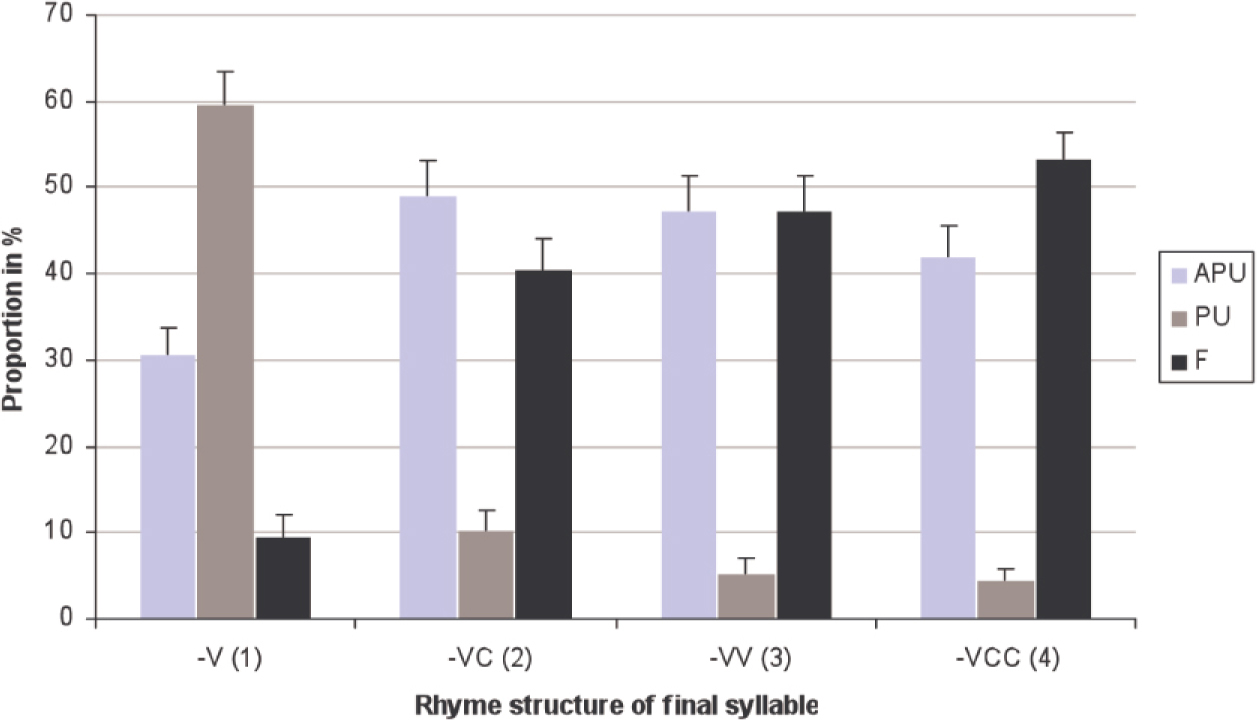
Thus, syllables with a diphthong (-ViVj) seem not to behave like simple open syllables, as Féry (1998) and Vennemann (1990, 1991) suggest. In line with Giegerich (1985), the high proportion of final and antepenultimate stress in condition 3 led us to conclude that diphthongs attract stress, similarly to closed and complex codas. Indeed, there was no significant difference between syllables with diphthongs on the one hand, and syllables with closed or complex rhymes, on the other. Descriptively, in terms of complexity, diphthong syllables are placed between the two latter categories, which leads to a balanced proportion of antepenultimate and final stress.
To sum up, open final syllables do not attract stress. In case of an open final rhyme, German speakers assign stress mainly to the penult. In case of a closed rhyme, a diphthong, or a complex rhyme, stress is mainly assigned to the antepenult or final syllable. The penult rejects stress in these cases. Whether the antepenult or final syllable is stressed may depend—at least partly—on the structure of the final syllable.
4.2 Antepenult Rhyme Structure
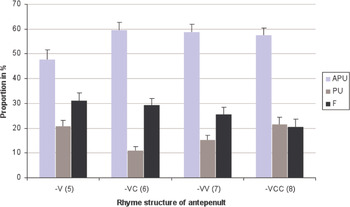
Consider the distribution of stress assignment when complexity of the antepenult is manipulated (item group b, condition 5 through 8 in table 4; see figure 3). The main effect of antepenult rhyme structure was not significant. However, both Janssen's (2003) data and the results of our analysis of the first four item categories (see section 4.1) suggest that the most important difference between syllable structures with respect to stress assignment could be the difference between an open and a closed rhyme. A post-hoc paired t-tests confirmed that this difference was indeed significant for the distribution of antepenultimate (t(19)=−2.026; p=.028) and penultimate (t(19)=2.944; two-tailed p=.008) stress. The mean proportion of items with antepenultimate stress increased from 47.8% to 59.6%, while the mean proportion of items with penultimate stress decreased from 21.0% to 11.0%.
Distribution of stress assignment for four types of trisyllabic pseudowords manipulated for antepenult rhyme structure.

Contrary to the traditional assumption that antepenult rhyme complexity does not play a role in stress assignment, the present data suggest that the structure of the antepenult does have a significant influence on stress assignment. Interestingly, the structure of the antepenult seems to be relevant not only for the proportion of antepenultimate vs. final stress as hypothesized. It also seems relevant for the generation of foot structure: A closed antepenult attracts significantly more antepenultimate stress and significantly less penultimate stress than an open antepenult.
Note that—similarly to our findings reported in section 4.1—words with a complex antepenult (−VCC) elicited numerically fewer instances of final stress than words with a close antepenult (−VC). Again, words with a diphthong occupy an intermediate position between words with simple and complex consonantal codas. In general, with increasing antepenult complexity final stress becomes less likely.Footnote 18 Considering the results discussed so far, the influence of antepenult rhyme structure may be less important than the influence of the final syllables.
4.3 Onset Structure
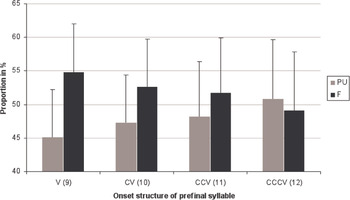
Now let us consider the distribution of stress positions within pseudowords in item group c, condition 9 through 12 in table 4 (see figure 4) that shows the manipulation of penultimate onset structure in bisyllabic words. There was no significant main effect of penultimate onset structure. However, with increasing number of onset consonants, the mean proportion of penultimate stress increased monotonously.
Distribution of stress assignment for four types of bisyllabic pseudowords manipulated for penultimate onset structure.

The present production data should lead to the conclusion that onset structure is irrelevant for stress assignment in German. However, even though our results showed no significant effect, there are interesting descriptive tendencies. The proportion of stress assigned to the penultimate syllable increased numerically with increasing onset complexity of the penult (from 45.1% to 47.3% to 48.3% to 50.9%).
Mengel's (2000) corpus analysis suggests that the correlation between the complexity of onset structure and word stress in the German lexicon is small, too. We assume that this correlation may nevertheless influence the performance of native German speakers—albeit weakly—when they have to assign stress to novel words.
Based on our results we keep the null-hypothesis. However, given the weak correlation between onset complexity and word stress in the lexicon, we speculate that onset complexity may indeed play a role in the German stress system, but its impact on stress location—if any—is not as substantive as that of rhyme structure.
4.4 Orthographic Complexity
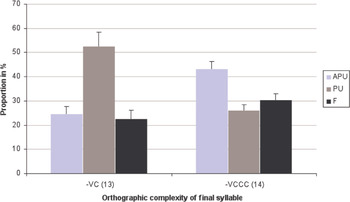
In addition to the observed effects of phonological structure on the assignment of main stress in pseudowords, we also investigated a potential impact of orthographic weight on stress assignment. To do so, we manipulated the orthographic rhyme complexity of the final syllable in words with heavy penults. Consider the distribution of stress within item group d, condition 13 through 14 in table 4 (see figure 5 below) that shows the manipulation of orthographic complexity of the final rhyme. There was a significant effect of orthographic complexity of the final rhyme structure on the distribution of antepenultimate, penultimate, and final stress (t(19)≥2.653; p≤.008). Between a simple (such as <s>) and a complex orthographic rhyme (such as <sch>), the proportion of items with antepenultimate stress increased from 24.7% to 43.4%, the proportion of items with penultimate stress decreased from 52.7% to 26.1%, and the proportion of items with final stress increased from 22.6% to 30.6%.
Thus, our data provide evidence for an influence of orthographic complexity. If the rhyme of the final syllable was coded with a simple orthographic consonant, penultimate stress was preferred. However, if the rhyme was coded with a complex orthographic structure, there was no preference for penultimate stress and the proportion of nonpenultimate stress increased. Recall that the predictions based on the findings of Janssen (2003) were as follows: Most phonological words with a closed penult and a closed final syllable receive stress on the penult. Most phonological words with a closed penult and a complex final syllable receive stress on the antepenult and final syllable. That is exactly what our data reflect for orthographic complexity. Interestingly, the orthographic rhyme complexity of the final syllable has a considerable impact on antepenult stress distribution and less so on final stress distribution. We propose the following interpretation of these findings. In line with the metrical analysis of Alber (1997; see figure 1), the increased orthographic weight of the last syllable does not attract main stress position per se but increases the probability of building up a foot on its own. As a consequence, word stress distribution shifts from a preference for penult stress to a preference for nonpenult stress (that is, antepenult and final). Obviously, orthographic complexity “contaminated” phonological complexity—at least in the rhyme of final syllables. This can be seen as further justification for the assumption that syllable complexity affects word stress assignment in German.
Distribution of stress assignment for two types of trisyllabic pseudowords manipulated for orthographic complexity.

4.5 The Interplay of Different Structural Factors
The experiment discussed above not only replicated previous results with respect to the impact of known structural factors on stress assignment in German (that is, the rhyme structure of the final syllable). It also provided evidence for the influence of additional structural factors (that is, rhyme complexity of the antepenult syllable and orthographic complexity). The influence of onset complexity seems to be weak at best. One may ask how these different factors interact. We address this question utilizing regression analysis.
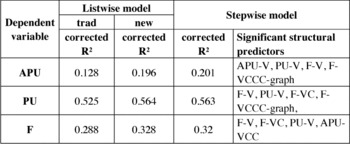
First, we applied listwise linear regression analyses to arcsinetransformed proportions of antepenultimate, penultimate, and final stress in all experimental trisyllabic pseudowords (n=200) as dependent variables. We investigated whether the “new” predictors reported in sections 4.2–4.4 are able to account for more variance than models relying only on the “traditional” predictors proposed in quantity-sensitive accounts of German stress assignment. The traditional predictor is the rhyme structure of penultimate and final syllable (penultimate: V and VC, final: V, VC, ViVj, VCC, all dummy coded). New predictors include the rhyme structure of the antepenult as well as the orthographic structure of the final syllable (antepenult: V, VC, ViVj, VCC, orthographic structure final syllable: <VC>, <VCCC>, all dummy coded). As table 5 shows, for all three stress patterns, more variance is explained using the new structural predictors as compared to traditional predictors alone. However, the improvement was very small (from 3.9% to 6.8% difference).
Afterwards, we applied stepwise linear regression analysis to the same dependent variables using the full set of predictors (traditional and new). The results revealed by the stepwise models were similar to the listwise models including new predictors. Crucially, a variable coding rhyme complexity of the antepenultimate syllable entered the model both for antepenultimate and for final stress. Moreover, a variable coding orthographic complexity entered the models for penultimate and final stress (see table 5).Footnote 19
Regression analysis of structural predictors of stress assignment.

In sum, the structural complexity of the antepenult and the orthographic complexity of the final syllable also seem to contribute to the variance in German word stress assignment. Most notably, the models including the new predictors explain more variance for antepenultimate stress than models including only the traditional predictors. This may be particularly due to the inclusion of structural properties of the antepenult. Furthermore, as discussed above, orthographic complexity has a significant impact on the generation of foot structure, which in turn leads to an increase in the number of occurrences of antepenultimate stress.
In general, most of the variance in the distribution of penultimate stress is explained. This observation seems to be in line with the analysis of German stress assignment proposed by Domahs et al. (2008). In the case of a final closed or complex syllable, the assignment of main stress seems to be largely ambiguous between final and antepenultimate position. However, in the case of an open final syllable, main stress is predominantly assigned to the penultimate position. Thus, our model predicts more than 56% of the metrical build up of the pseudoword productions, but it fails to predict accurately which of the feet is the strong foot of the phonological word.
5 General Discussion
The findings presented in this paper have some implications for current theories of phonological knowledge and for psycholinguistic models of speech production and reading. Most importantly, it was shown that several factors that affect stress assignment in German have been neglected so far. Considering Janssen's (2003) findings and our present data, we conclude that the rhyme structure of each syllable within the “three syllable window” (Giegerich 1995, Wiese 2000) influences the assignment of stress. As noted above, the variance in the distribution of penultimate stress could be best explained in terms of the rhyme structure of the last two syllables.Footnote 20 However, there is still a high degree of variance in the distribution of final versus antepenultimate stress that can only partly be explained in terms of the rhyme structure of the final syllable and the antepenult. Additionally, the orthographic realization of phonological structures has been shown to be potentially relevant too: Orthographically complex rhymes are more likely to build up a strong foot on its own than orthographically simple rhymes, irrespective of their phonological structure. Our regression analysis suggests that there are multiple factors affecting German stress assignment. However, there is still a significant degree of variance that cannot be explained in terms of the investigated structural properties alone. Even though within our data, penultimate is the most predictable stress position, more than 40% of the variance related to penultimate stress assignment still could not be explained. Substantial variation found both among speakers and within items is in line with the findings reported in a number of studies on German stress assignment (see, for example, Ernestus & Neijt 2008, Janssen 2003, Tappeiner et al. 2007).
In general, our data provide strong evidence for a quantity-sensitive German stress system. Accounts that deny quantity-sensitivity and propose a default stress (Eisenberg 1991, Kaltenbacher 1994, Wiese 2000) are not able to explain our data. As noted in the introduction, it is clear that German is not quantity-sensitive in the classical sense. Heavy syllables do not simply attract stress; they increase the probability of building up a particular kind of foot structure. The foot structure then determines, to some extent, the possible main stress positions within a word. Native German speakers appear to be sensitive to structural properties of the rhyme when they have to assign stress to novel words.
In addition to the sensitivity to rhyme structure, the data revealed that penultimate stress is not the predominant stress pattern in German. Psycholinguistic models of speech production that assume a default stress in which metrical information does not interact with segmental information, seem inadequate for languages such as German. As was discussed in the introduction, the speech production model proposed by Levelt et al. (1999) suggests independent routes for segmental and metrical processing. However, our data suggest an interaction between segmental and metrical information rather than parallel independent encoding (see also Janssen & Domahs 2008 for further discussion).
Yet, our findings also pose several problems for traditional theories of stress assignment in German that do assume a quantity-sensitive stress system (Féry 1998, Giegerich 1985, Vennemann 1991, Zonneveld et al. 1999). First, the data suggest that stress assignment is not influenced by the rhyme structure of the final two syllables alone: Rhyme structure of the antepenult and orthographic complexity have to be considered as well. Second, there does not seem to be a categorical distinction between heavy and light syllables. Rather, different rhyme structures gradually elicited different stress patterns. Third, the high variability both within and across speakers, as well as the observation that different structural properties have different impact on stress assignment could not be captured by a rigid model of grammatical competence.
Furthermore, we have shown that if the penult is open and the final syllable is closed, penult tends to reject stress in favor of antepenultimate and final stress. If both the final and the penult are closed, penult rejects stress only in case of a complex final syllable (see Janssen 2003). This suggests that the structures of different syllables interact with one another. This interaction between different factors was also shown for English stress assignment (Guion et al. 2003).
Besides the generative rule-based accounts of stress assignment mentioned above, it is possible to model our findings in a constraint-based account, such as Optimality Theory (OT; Prince & Smolensky 2004). Such an approach might be able to capture multiple factors affecting word stress assignment (see Alber 1997, Féry 1998, Knaus & Domahs 2009 among others for OT-based analyses of the German stress system). However, within OT it would be difficult to capture the substantial degree of variability both within and across speakers.
The interaction between different factors as well as the observed high variance suggest gradual competing distribution rather than categorical rules. The structural properties discussed in this paper do not strictly implicate a particular stress pattern. Rather, they increase the likelihood of stress being assigned to a particular position. Thus, no single stress pattern was realized in 60% or more of all cases under any structural condition. Corpus analyses (for instance, Féry 1998, Janssen 2003, Mengel 2000) have shown that such gradual correlation of stress position and syllable structure exists in the German lexicon, too: In the corpus of Janssen 2003, trisyllabic words with an open final syllable were mainly stressed on the penult (58.3%), words with a complex final syllable were mainly stressed on the final syllable (87.7%), and words with a simple closed final syllable were mainly stressed on the antepenult (59.1%). Our pseudoword production data show a similar distribution: Words with an open final syllable were mainly stressed on the penult (59.6%), words with a complex final syllable were mainly stressed on the final syllable (53.3%), and words with a simple closed final syllable were mainly stressed on the antepenult (49.1%). Although the distribution is not exactly the same, the tendencies in the corpus data are reflected, to some extent, in the production data. Similar reflections of statistical distributions in the lexicon were found for Dutch (Janssen 2003), Spanish (Barkanyi 2002, Eddington 2004, Face 2000, Waltermire 2004), English (Guion et al. 2003), and Russian stress assignment (Crosswhite et al. 2003). Note also that some degree of variance might be due to the fact that stress is a relational property in the sense that each syllable interacts with all other syllables. Therefore, properties such as syllable structure, syllable position, and number of syllables may all contribute to the complexity of the stress system. To sum up, our data speak in favor of multiple cues at work in stress assignment, resulting in gradual distribution, which seem to reflect patterns in the German lexicon.
Despite high variability and gradual distribution, the metrical build up in groups of pseudowords within our data seems to be relatively clear (see figure 1). In case of a closed penult and/or open final syllable, the penult and final syllable are very likely to build up a bisyllabic trochaic foot, surfacing as penultimate stress. In case of a final closed or complex syllable (or a syllable with a diphthong), the final syllable is very likely to build up a foot on its own. However, the assignment of main stress in these cases is largely ambiguous between final and antepenultimate position and depends only to some extent on the complexity of the antepenult and final syllable (see Domahs et al. 2008). This finding is also confirmed by our regression analysis: Our model accounts for 56% of the variance of penultimate stress assignment. This coincides with the metrical build up (APU/F versus PU) in 56% of our data. The predictions for main stress position of antepenult and final stress are considerably worse (20% and 32%, respectively).
There seems to be a strong correlation between stress patterns stored in the mental lexicon (as operationalized by corpus analyses) and stress assignment in the pseudoword production of our participants. This apparently reflects knowledge of stress distribution in which syllables with certain structures are more or less likely to build up certain metrical structures. From such correlations we infer that German speakers have possibly learned such distributional tendencies and use their knowledge probabilistically when assigning stress to novel words. This account is consistent with recent findings that human infants are able to detect and learn statistical patterns based on the available input (for example, Saffran et al. 1996). There is a growing body of evidence on the ability to detect statistical cues to acquire language patterns (see Gomez 2007 for a recent overview).
However, the knowledge of abstract distributional patterns might not be the only factor affecting stress placement. Guion et al. (2003) show that stress assignment in English pseudowords is influenced by existing phonologically similar words; that is, stress can be assigned by analogy. Plag (2010) provides further evidence that the constituent family—that is, a group of compounds that share the same right or left constituent—is an independent significant predictor of noun stress in English corpora. It is a well-known fact that analogy to existing words drives certain linguistic behavior (for instance, Baayen 2003, Bybee & Moder 1983, Koepcke 1988). Such influence of existing words can be characterized as an exemplar-based effect on stress assignment.
In a broader sense, these ideas are compatible with the usage-based model of phonology proposed by Bybee (2001). In her model, phonological categories and patterns emerge from the actual productions and perceptions of individual lexical items stored in the lexicon. In this theory, generalizations are described as schemas or nonprocess statements about stored items. Schemas are seen as organizational patterns that emerge from statistical regularities in the lexicon. Crucially, in this view, any statistical regularity can be learned and be applied in a novel context. This could include the distribution of stress across words of different length, lexical class, and syllable structures, as well as the patterning of stress across phonologically and semantically similar forms in an analogical, exemplar-based process.
In this model, the process of stress assignment to novel words could be best described as follows: When speakers read a novel (pseudo)word, the auditory and/or visual representations of existing words that best match the presented word, including their stress pattern, are activated (for example, Bybee 1985). It is assumed that both the frequency of occurrence and the number of similar words (so called “gangs”) influence the analogical process (Bybee 2001, Eddington 2000, Skouson 1995). Even though we tried to minimize possible analogies to real words (see section 3), the variance within the present data may be partly due to analogy. The stress pattern of one of the activated words or of a particular gang of words is extended to the novel word. In addition, generalizations of certain formal correlations could emerge from the lexicon and be applied to the novel words. Our data suggest that syllable structure is an important statistical cue for stress assignment in German words. The concept of quantity-sensitivity must then be understood as a statistical correlation between syllable structure and stress pattern that has been generalized over the lexicon, at least to some degree. However, given that syllable structure mainly determines foot structure and has a rather small impact on the position of main stress within a metrical structure, we have to assume that metrical generalizations over words with identical metrical patterns (that is, foot structures) are clearer than generalizations over words with identical main stress positions.
The present data imply that within psycholinguistic models of speech production in languages such as German, the metrical frame has to be sensitive to the segmental level (Janssen & Domahs 2008). Connectionist accounts seem to be able to explain the co-occurrence of quantity-sensitive stress assignment and stress variation. Within the connectionist framework, it is proposed that the statistical regularities in stress assignment are learned in the same way as, for instance, the regularities in the orthography-to-phonology mapping (Harm & Seidenberg 1999, 2004, Plaut et al. 1996, Seidenberg & McClelland 1989). Previous attempts in connectionist and other data-driven frameworks have shown that generalization of lexical stress assignment is possible without an appeal to explicit linguistic rules (Arciuli et al. 2010, Daelemans et al. 1994, Gupta & Touretzky 1994). Recently, Seva et al. (2009) provided a connectionist model that made accurate predictions of human performance in reading English real and pseudowords. After exposure to a corpus of real words, their connectionist model mapped written words onto stress position with a high degree of accuracy. This indicates that statistical correlations between letters and stress position are potentially available to the processsing system. Seva et al.'s (2009) model offers an important first step toward being able to simulate all relevant aspects of word reading. Crucially, it indicates that a probabilistic approach to stress assignment can capture human performance on stress assignment for both real words and pseudowords.
Arciuli et al. (2010) provide converging evidence for such a probabilistic approach to stress assignment in learning to read. First, they performed a corpus analysis of children's reading materials. According to their results, the letters at the beginning and ending of a word carry substantial information that helps determine stress assignment with a high degree of accuracy. Second, a behavioral study has demonstrated that 5–12 year-old children are sensitive to these statistical properties. In a third step, the authors exposed a computational model to age-appropriate words comparable to the input of 5–12 year-old children. Based on this input the model learned to map orthography onto stress position for bisyllabic words and performed qualitatively similar to children learning to read. This kind of triangulation of corpus analysis, behavioral data, and computational modeling provide converging evidence for the probabilistic nature of linguistic behavior such as stress assignment.
To conclude, given the high variance and the probabilistic patterns within the present data, our findings suggest that complex language systems such as the German stress system cannot be explained by strict symbolic rules or constraints.
Data-oriented accounts could, in principle, explain the observed findings. These accounts acknowledge that humans are equipped with a powerful learning mechanism and, crucially, act on the assumption that language is learnable to its full extent. The assignment of a linguistic category, such as word stress, could be explained in terms of the following mechanism: Based on statistical regularities within the learned lexicon, generalizations are made and applied to novel words.
However, the question arises, how exactly does such a probabilistic system work. What do generalizations look like and how do they interact with more concrete exemplar-based analogies? When is an abstract generalization applied and when is the application more exemplar-based in nature? For example, our data show that a closed antepenult is significantly more likely to attract stress than an open antepenult. However, the lexicon seems not to provide the speaker with such a statistical pattern (see Janssen 2003). Furthermore, data-oriented approaches have to answer a more general question: Why does the language user choose some properties over others for building analogies? Note, however, that this kind of problem also exists in all rule-based frameworks. Rules and constraints make crucial reference to some properties but not to others. Clearly, further research is needed to provide potential computational models with sufficient data from corpus analyses and behavioral data. These models may shed light on possible generalizations in human language.
The main finding of our study is that we may have to extend the concept of quantity-sensitivity: In addition to phonological quantity we have to consider something like visual quantity defined by orthographic complexity. As was further shown, in languages such as German, quantity-sensitivity does not imply a clear-cut distinction between two quantity categories, heavy and light, but rather a gradual likelihood of “strong” and “weak” in relation to heavy and light syllables. In other words, the more segments (phonological or orthographic) the syllable bears, the more likely it is to be strong within a prosodic word. This correlation can be captured in terms of probabilities but not in terms of categorical rules in the mental lexicon. Phonological as well as psycholinguistic models of stress assignment have to consider this extended notion of quantity-sensitivity to describe stress systems accurately.
APPENDIX A: EXPERIMENTAL ITEMS


APPENDIX B: REGRESSION ANALYSIS
Regression analysis on structural predictors of stress assignment. Dependent variables (proportion of occurrence) were arcsin-transformed mean proportions of stress patterns produced for 200 trisyllabic items; trad.=traditional predictors; new=new predictors (see text); V=open syllable, VC=syllable with simple consonantal coda, VCC=syllable with complex consonantal coda, VCCC-graph =syllable with supercomplex orthographic coda.