Introduction
The impact of mental disorder is known to extend beyond the individual to the next generation. Offspring of parents with mental disorder experience an elevated risk of a range of adverse outcomes (Hay et al. Reference Hay, Pawlby, Sharp, Asten, Mills and Kumar2001; Webb et al. Reference Webb, Abel, Pickles, Appleby, King-Hele and Mortensen2006; Dean et al. Reference Dean, Stevens, Mortensen, Murray, Walsh and Pedersen2010). Increased occurrence of behavioural difficulties in childhood, including the presence of conduct disorder, is a consistent finding (Beck, Reference Beck1999; Vostanis et al. Reference Vostanis, Graves, Meltzer, Goodman, Jenkins and Brugha2006; Donatelli et al. Reference Donatelli, Seidman, Goldstein, Tsuang and Buka2010). Within individuals, the link between severe mental disorder and risk of crime and violence is well established (Fazel et al. Reference Fazel, Gulati, Linsell, Geddes and Grann2009, Reference Fazel, Lichtenstein, Grann, Goodwin and Langstrom2010), whereas the propensity to offend is itself known to be influenced by a range of familial factors (Smith & Farrington, Reference Smith and Farrington2004; Frisell et al. Reference Frisell, Lichtenstein and Langstrom2010). That parental mental disorder might be one such familial factor is suggested by several previous studies (Moffitt, Reference Moffitt1987; Tehrani et al. Reference Tehrani, Brennan, Hodgins and Mednick1998; Monahan et al. Reference Monahan, Steadman, Robbins, Silver, Appelbaum, Grisso, Mulvey and Roth2000) whereas high-risk cohort studies focusing specifically on psychotic parents have also found elevated rates of conviction among offspring (Heston, Reference Heston1966; Silverton, Reference Silverton1988).
The aim of the current study was to compare rates of criminal conviction among both male and female offspring of parents diagnosed with a broad spectrum of mental disorders to those among offspring without parental mental disorder in a population-based sample. We also aimed to examine the role of parental and offspring gender, the nature of parental disorder, the impact of having two mentally disordered parents, and the potential explanatory role of both parental criminality and family socio-economic position (SEP), all in relation to conviction in offspring in general and to rates of conviction for serious first offences.
Method
Study sample
Using data from the Danish Civil Registration System (CRS; Pedersen et al. Reference Pedersen, Gotzsche, Moller and Mortensen2006), a random sample was taken from the total population of all those living at some point in Denmark since 1968, obtained by selecting precisely 25.00% of each gender from those born on each day within each year. Our sample consisted of all persons reaching their 15th birthday, the youngest age at which a criminal conviction can be obtained in Denmark, on or after 1 January 1981 and before the end of the follow-up period at the end of 2006. The CRS contains data for each individual on a range of information including the Central Population Register (CPR) numbers of parents. CPR numbers are personal identifiers assigned to all people living in Denmark, ensuring accurate linkage between registers.
Assessment of mental disorder in parents
Parents, linked by their CPR number to the Psychiatric Central Register (containing data on admissions to psychiatric hospitals since 1969 and out-patient contacts since 1995; Munk-Jorgensen & Mortensen, Reference Munk-Jorgensen and Mortensen1997), were classified as having mental disorder if they had any mental disorder diagnosis prior to the beginning of offspring follow-up. For parents who obtained more than one primary diagnosis prior to the start of follow-up, the primary diagnosis from the latest contact was assumed most valid on the basis that it reflects a clinical view based on the longest possible period of clinical observation and to avoid the assumptions inherent in using a hierarchical approach to diagnosis. Parental mental disorder exposure groups were defined on the basis of the gender of the affected parent and the number of affected parents, to produce the following four mutually exclusive categories (with the last forming the reference group): both parents mentally disordered, mother mentally disordered, father mentally disordered, and no history of parental mental disorder. For examination of parental disorder severity, those parents with any mental disorder were further classified into those with psychotic disorders (all non-affective and affective psychoses) and those with other mental disorder. Six specific parental disorder diagnostic groups were also examined: schizophrenia and spectrum disorders, bipolar disorder, affective disorders, anxiety and somatoform disorders, personality disorders, and substance misuse disorders.
Assessment of criminal conviction in offspring
Each individual was followed from their 15th birthday until the end of 2006 for the occurrence of a first criminal conviction. Individuals were also censored if they died or emigrated. The CPR number was used to link all offspring study members to the National Criminal Register, which contains data on convictions registered since 1980. We included only those convictions for crimes listed either in the penal code or in special legislation regarding firearms or illegal substances, excluding convictions resulting only in a fine. For analyses involving conviction for a serious offence, all first convictions of a violent or sexual nature were included.
Considering the role of family SEP and parental criminality
Family SEP was considered as a potential confounder of the association, acting both as a risk factor for parental mental disorder (in line with the ‘social causation’ theory; Costello et al. Reference Costello, Compton, Keeler and Angold2003) and, independently, as a risk factor for offspring conviction. Father's educational attainment was chosen as the measure of family SEP on the theoretical basis that, as a measure of SEP, it is less likely than other measures, such as parental income or current occupation, to be influenced by the onset of mental disorder, except where onset occurs early in the course of education (Miech et al. Reference Miech, Caspi, Moffitt, Wright and Silva1999). Information on educational attainment was obtained from the Integrated Database for Longitudinal Labour Market Research (Statistics Denmark, 2007), which contains annually updated information on educational attainment since 1980 and information obtained from the population and housing census conducted in 1970.
On the basis that mental disorder in parents is likely to be associated with criminality in parents and that, in turn, parental history of criminality might increase risk of criminality in offspring, parental criminality was considered as a factor that might account for at least a proportion of the association between parental disorder and offspring conviction, whether by acting as a confounder or a mediator or a combination of both. Information on parental criminality was obtained by linking the CPR number for each parent with the Central Criminal Register, as for offspring. The same rules regarding inclusion of specific offences was applied as for offspring. Parental criminality was defined on the basis of either parent having a history of any convictions prior to their offspring's 15th birthday.
Statistical analysis
A total of 412 117 people were followed from their 15th birthday until first conviction, death, emigration from Denmark, or the end of 2006, whichever came first. The incidence rate ratios (IRRs) for conviction were estimated using a proportional hazards regression model (Clayton & Hills, Reference Clayton and Hills1993) and data were analysed in SAS version 9.2 (SAS Institute Inc., USA). Ratios were based on comparison between each parental disorder exposure group and the reference category. All associations were stratified by birth year and all models were adjusted for having a missing register link to either parent or for the death or emigration of either parent. Rate ratios were obtained for all offspring combined and separately by offspring gender where possible. Interaction by the number of affected parents, gender of affected parent and gender of offspring was formally tested. The basic model was adjusted for father's educational attainment by addition to the regression model. Further adjustment was made for parental criminality by addition of a dichotomous variable to the regression model. Given that only parental offending occurring after 1980 (the earliest year of criminal data availability) was included, all analyses that included parental criminality also included adjustment for parental age (paternal and maternal). This was on the basis that older parents would have a greater likelihood of being misclassified as non-offenders, having committed offences prior to 1980 but not since. Parental age was measured in 5-year age bands and based on age attained by the start of offspring follow-up. Because of the number of variables included in the model, potential cohort effects were accounted for by adjusting for 5-year bands in the regression model rather than analyses being stratified by calendar years in the simpler models. In analyses of parental mental disorder severity (psychotic versus non-psychotic), exposure groups were also defined on the basis of the number of affected parents. For analyses of specific parental disorder diagnoses, it was not possible to further differentiate exposure groups by number or gender of affected parents. Exposure groups were not mutually exclusive, and consequently analyses were adjusted for the possibility of having two disordered parents.
Analyses were repeated for conviction for a serious first offence as the outcome of interest. The Kaplan–Meier product-limit estimator was used to estimate the proportion of offspring who committed an offence as a function of age in days (cumulative incidence) for male and female offspring separately (Clayton & Hills, Reference Clayton and Hills1993).
Results
Descriptive results
Of the 412 117 offspring, almost 10% had at least one parent with mental disorder (n=39 940). More than 5% of offspring were convicted of an offence during follow-up (almost 2% for a serious first offence).
Incidence of any conviction
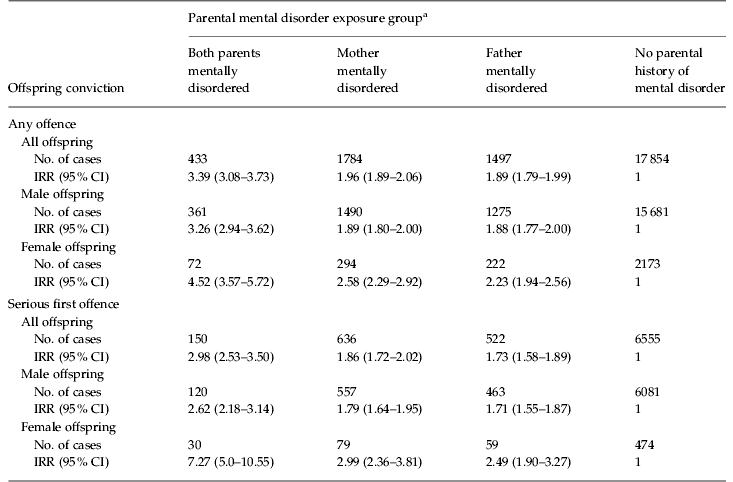
Offspring with at least one parent with any mental disorder had twice the rate of conviction of those without parental disorder (IRR 2.03, 95% confidence interval (CI) 1.96–2.10]. When exposure status was defined by gender and number of affected parents (Table 1), offspring with two affected parents had the highest relative rate (IRR 3.39, 95% CI 3.08–3.73). Although the absolute risks of conviction were lower for female offspring, the effect of parental disorder seemed to be greater than for males (interaction by offspring gender p<0.0001). Rate ratios were similar for offspring with either a disordered father or disordered mother (p>0.05 for all analyses) and there was no evidence of interaction by number of affected parents (p>0.05 for all analyses).
Incidence rate ratios (IRRs) for any and serious offspring conviction according to history of parental mental disorder (including separately by offspring gender)

CI, Confidence interval.
All analyses adjusted for calendar year and missing parent (due to either unknown mother or father, or death or emigration of either parent).
a p<0.0001 for all comparisons.
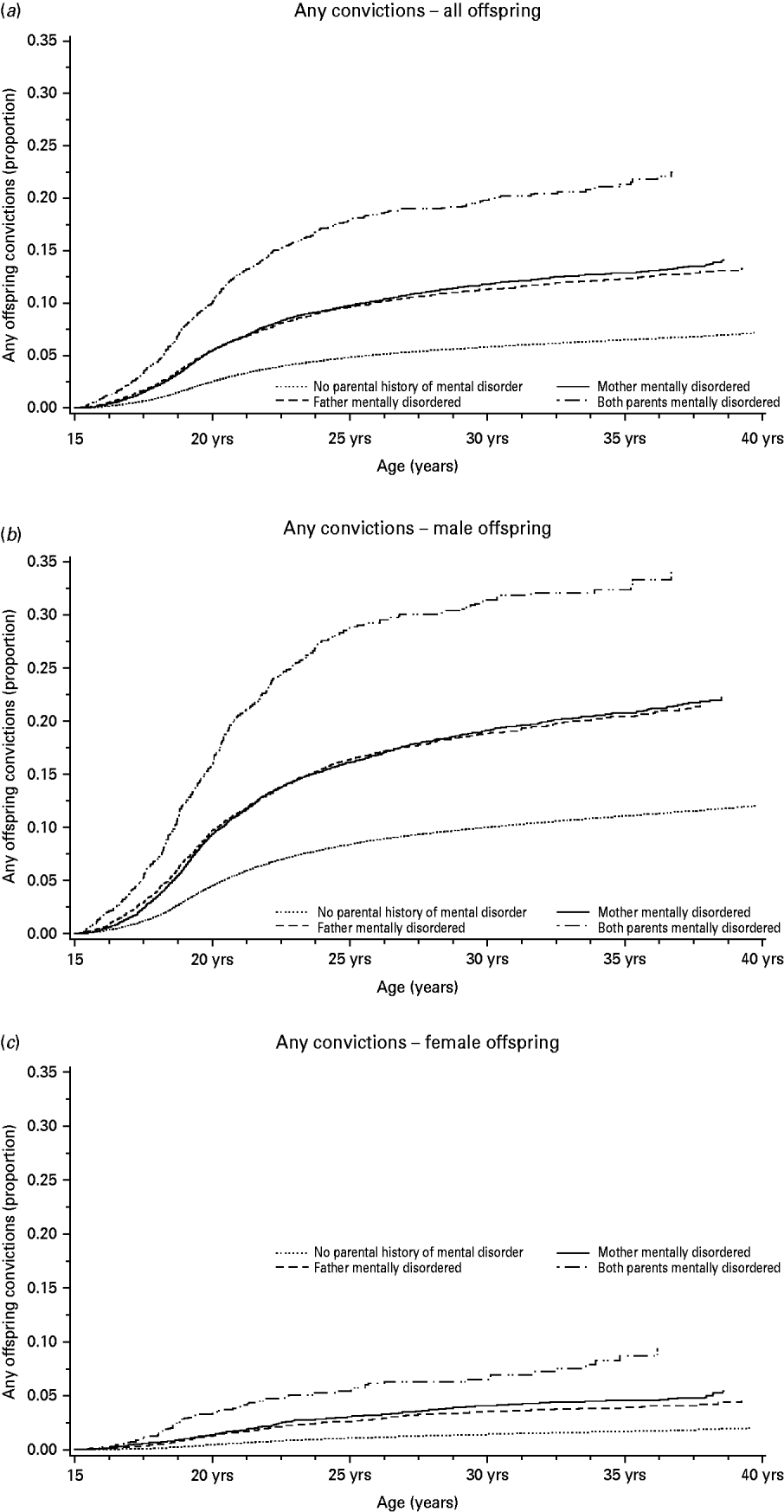
The cumulative incidence of any conviction is presented in Fig. 1. A similar pattern of conviction over time is seen in all groups. The pattern of cumulative conviction is similar for male and female offspring whereas absolute risks are higher for males. It is noteworthy that, by their mid-thirties, more than one-third of male offspring born to two disordered parents have been convicted for an offence (one-fifth of those with one disordered parent).
Cumulative incidence of any offspring conviction: (a) all offspring; (b) male offspring; (c) female offspring.

Incidence of serious first conviction
As was the case for any conviction, offspring with parental history of mental disorder had elevated rates of serious first conviction compared to those without disordered parents (IRR for those with at least one disordered parent was 1.89, 95% CI 1.78–2.00). A similar pattern of associations by parental gender, offspring gender and number of affected parents was seen (Table 1). Of note, the strength of associations seemed to be greater for serious conviction for female offspring only (the opposite seemed to be true for male offspring). The association between parental disorder and serious first conviction was particularly strong for female offspring with two disordered parents (basic model IRR 7.27) but the estimate was based on the smallest number of cases (n=30), resulting in relatively poor precision (95% CI 5.0–10.55). Again, no evidence for statistical interaction by number of affected parents was found (p>0.05 for all) and little difference was seen between the effects of maternal compared to paternal disorder (p>0.05 in all cases) but the effect of parental disorder did differ by offspring gender (p<0.0001).
The cumulative incidence patterns for serious conviction mirrored those for any conviction at lower absolute levels. By their mid-thirties, more than 12% of males born to two disordered parents have been convicted of a serious first offence (approximately 7–8% of those born to one disordered parent).
Adjustment for family SEP and parental criminality
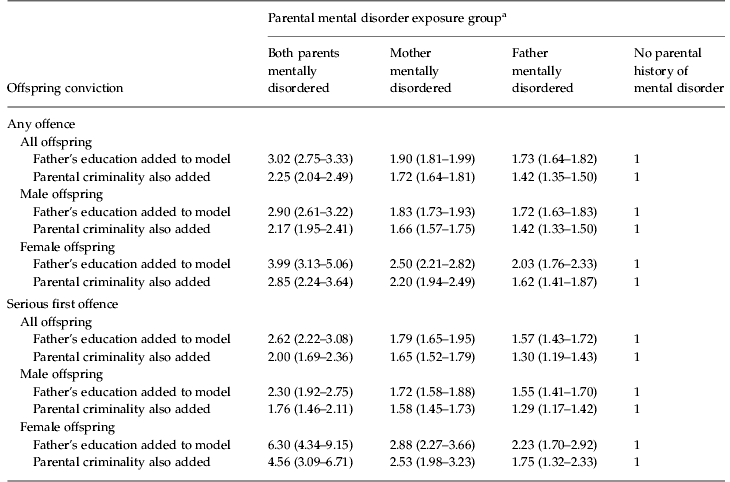
When the basic model was further adjusted for father's educational attainment (Table 2), effect sizes were lowered in all cases but the significant associations between parental mental disorder and offspring conviction persisted and the patterns described earlier remained intact. This was true for both conviction of any first offence and conviction of a serious first offence.
Incidence rate ratios (IRRs) for any and serious offspring conviction adjusting for family socio-economic position (SEP) and parental criminality

Values given as IRR (95% confidence interval).
All analyses adjusted for calendar year and missing parent (due to either unknown mother or father, or death or emigration of either parent); parental age included in the model for all analyses involving parental criminality.
a p<0.0001 for all comparisons.
Within the sample as a whole, 21 303 offspring (5.17%) had at least one parent with a history of conviction prior to their 15th birthday (and after 1980, the time point from which criminal data were available). Of those 39 940 offspring with parental history of mental disorder in the sample, 6913 (17.31%) also had parental history of criminality. In all cases, when adjustment was made for parental criminality, the strength of the association between parental mental disorder and offspring offending was further attenuated but the adjusted associations remained significant (Table 2). The proportion of the association attributable to confounding (and/or mediating) by parental criminality was greatest for those with two disordered parents (approximately 25% of the association lost after adjustment). Approximately 20% of the association between paternal disorder and offspring offending was lost after adjustment for parental criminality whereas adjustment for parental criminality had the least impact on associations with maternal disorder (approximately 10%). The same patterns following adjustment were seen for serious first offending. There was some evidence of a slightly increased impact of adjustment for parental criminality on risk for female offspring.
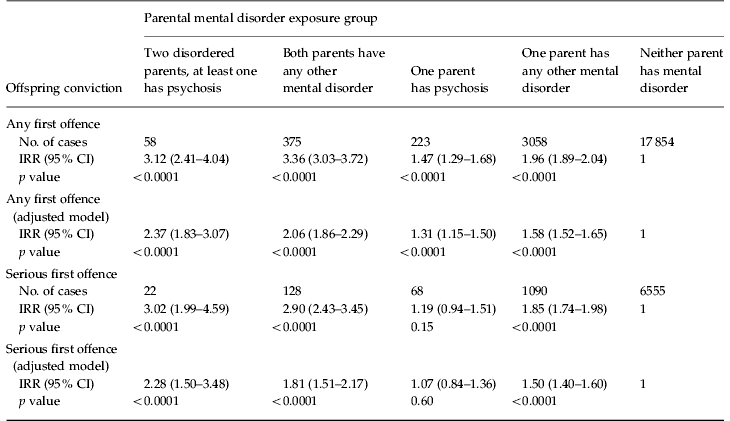
Impact of the nature of parental mental disorder
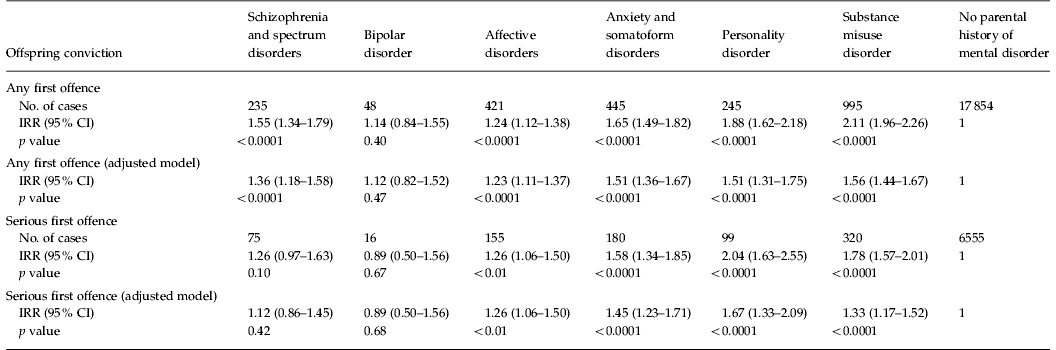
Those born to parents with psychotic disorders (non-affective and affective psychoses) were more likely to be convicted than those without parental mental disorder but so too were those born to parents with a range of other non-psychotic mental disorders (Table 3). The strength of associations was in fact slightly greater for the latter in most cases and no significant association at all was found between having one parent with psychotic disorder and offspring conviction for serious conviction. When six specific parental disorder diagnostic groups were compared to those without parental history of mental disorder, the strongest associations were found for offspring born to parents with substance misuse disorders, personality disorders and anxiety/somatoform disorders (Table 4). Associations were also found for those born to parents with schizophrenia spectrum disorders and affective disorders, at least for any offence, but not bipolar disorder.
Incidence rate ratios (IRRs) for any and serious conviction for all offspring according to nature of parental mental disorder: psychosis versus other disorder

CI, Confidence interval.
All analyses adjusted for missing parent (due to either unknown mother or father, or death or emigration of either parent, calendar year and father's educational attainment; exposure groups are mutually exclusive; adjusted model includes parental criminality and parental age (calendar period in 5-year bands).
Incidence rate ratios (IRRs) for any and serious conviction for all offspring according to parental mental disorder diagnosis

CI, Confidence interval.
All analyses adjusted for missing parent (due to either unknown mother or father, or death or emigration of either parent), calendar year and father's educational attainment; exposure groups are not mutually exclusive and consequently adjustment is made for having two disordered parents; adjusted model includes parental criminality and parental age (calendar period in 5-year bands).
Discussion
In a population-based cohort study of 412 117 individuals, we found that those born to parents with a history of mental disorder had an elevated risk of criminal conviction. For the first time in a population-based sample we have also established that the association holds for both male and female offspring, and for those with a history of maternal or paternal mental disorder. Those offspring with a history of mental disorder in both parents were at even greater risk.
Main findings
Although this study represents the first attempt to examine the association between parental mental disorder and offspring conviction in detail and on such a large population-based scale, some of our findings can be compared to those obtained from previous studies. Violent criminality has been shown to be associated with maternal history of in-patient psychiatric contact (Tehrani et al. Reference Tehrani, Brennan, Hodgins and Mednick1998) whereas non-violent conviction has been linked to parental history of both mental disorder and criminality in a study of male adoptees (Moffitt, Reference Moffitt1987). In our study, we found an effect of parental disorder on both any and serious first conviction among offspring but the strengths of the associations were not higher in the latter analyses. This seems to be in contrast to what has been assumed to be true for individuals with mental disorder (i.e. that the magnitude of conviction risk is greater for more serious offences) but may perhaps only be true in the particular case of homicide (Fazel et al. Reference Fazel, Gulati, Linsell, Geddes and Grann2009). In the MacArthur Violence Risk Assessment study of 939 male and female psychiatric patients, violence (including arrests for violence) during follow-up after hospital discharge was not associated with either paternal or maternal history of psychiatric admission but was associated with paternal drug use and paternal excessive drinking (Monahan et al. Reference Monahan, Steadman, Robbins, Silver, Appelbaum, Grisso, Mulvey and Roth2000). Although lack of power may have been a limitation in this study, parental mental health status data were obtained through offspring self-report and thus the detection of parental substance misuse is likely to have been better than was possible in our study.
We also found an association between parental psychosis and offspring conviction, in line with previous studies of offspring born to psychotic parents (Heston, Reference Heston1966; Silverton, Reference Silverton1988), but rate ratios were not higher than for those with other parental disorder. It is likely that parents of convicted offspring in the other mental disorder group were dominated by individuals with personality disorders, substance misuse and anxiety/somatoform disorders because analyses of a range of specific parental diagnoses indicated that the association was strongest for offspring with a parental history of such disorders. The risk for offspring born to parents with severe disorders may also not be as high as expected because such offspring may be more likely to be subject to state intervention and less likely to live with a disordered parent, potentially protecting against future offending.
No previous studies have examined the impact of gender, in parents and offspring, in relation to the association between parental disorder and offspring conviction. Surprisingly, we found very similar rate ratios for conviction among those with a disordered father compared to a disordered mother. This finding may reflect the relative importance of genetic factors, in line with adoption studies of criminality (Brennan et al. Reference Brennan, Mednick and Jacobsen1996; Moffitt, Reference Moffitt1987), because an additional effect of being raised by a disordered parent, more likely to be true of mothers, is not seen. In fact, the notion of a shared genetic vulnerability existing for a spectrum of externalizing mental and behavioural abnormalities is gaining increasing support (Hicks et al. Reference Hicks, Krueger, Iacono, McGue and Patrick2004). The importance of environmental factors, including parenting style and child-rearing environment, should not be underestimated, however, because it is likely that mothers paired with a mentally disordered father do not represent a random sample of the population with regard to such factors.
In contrast to the impact of gender in parents, we did find that the magnitude of rate ratios was much higher for female compared to male offspring. This probably reflects the fact that women in the general population have very low rates of offending so any factor that increases the propensity to offend is likely to have a greater impact on female risk. The same narrowing of the gender gap in offending is seen among those who themselves suffer from mental disorder (Dean et al. Reference Dean, Walsh, Moran, Tyrer, Creed, Byford, Burns, Murray and Fahy2006; Fazel et al. Reference Fazel, Gulati, Linsell, Geddes and Grann2009).
We consistently found that rates of conviction were much higher for offspring with two disordered parents, although without evidence of interaction. Although small in number, the absolute risks of conviction for offspring in this group were striking: more than one-third of males were convicted of any offence and around 12% were convicted of a first violent or sexual offence.
Finally, we considered SEP, as reflected in father's educational attainment, and parental criminality as factors that might explain the relationship found between parental disorder and offspring conviction. For all comparisons, adjustment for father's education reduced the strength but did not eliminate the associations. Although father's educational attainment is arguably a good marker of those socio-economic factors that might confound the association of interest, we cannot exclude the possibility of residual confounding, or the possibility that it might also be acting as a mediator in cases where paternal mental disorder onset limits subsequent educational attainment. Parental criminality was also considered likely to increase risk of offending in offspring through genetic or environmental pathways, thus confounding and/or mediating any apparent association between parental disorder and offspring offending. The possibility of cross-assortative mating among individuals with mental disorder also justifies consideration of criminality in either parent when examining offending risk in offspring. If not considered, an apparent association between parental disorder and offspring offending may in fact be due to the increased likelihood of parents with mental disorder to pair with criminal partners. Adjustment for parental criminality was, however, limited to the extent that criminal conviction data were only available from 1980 and thus a proportion of parents who offended prior to this date would have been wrongly classified as non-criminal, leading to the potential for residual confounding. Notwithstanding this limitation, almost one-fifth of offspring with parental history of mental disorder also had a parental history of criminality. As with the father's educational attainment, adjustment for parental criminality reduced but did not eliminate the association between parental disorder and offspring offending in all analyses. Parental criminality accounted for a greater proportion of the association for those born to two disordered parents, perhaps unsurprising given the increased likelihood of having at least one criminal parent if both parents are mentally disordered. Parental criminality accounted for more of the main association for those born to disordered fathers than disordered mothers, and seemed to account for a slightly greater proportion of the main association for female offspring. It was not possible to determine whether confounding by parental criminality was due mainly to cross-assortative mating or to the co-occurrence of disorder and criminality in the same parent(s) but it certainly seems that the gender of the disordered parent is important in this regard. The role of parental criminality in addition to parental mental disorder was also considered in a Danish adoption study of offspring offending (Moffitt, Reference Moffitt1987). In this study, the combination of parental mental disorder and parental criminality was found to be a potent risk factor for offspring offending to the extent that the 1% of adoptees born to parents with such dual risk were responsible for 12.2% of overall adoptee convictions. It seems likely that the inter-relationships between parental disorder, parental criminality, offspring disorder and offspring criminality are complex and potentially involve both shared genetic and environmental pathways.
Strengths and limitations
The size of the dataset, the nature of the data available and the duration of follow-up possible enabled us to examine patterns of conviction in offspring with parental mental disorder to an extent not previously possible. Offspring were selected from a random sample of the entire Danish population, minimizing the potential effects of any selection, response or attrition biases, which are often a problem in studies of mental disorder and criminality.
Limitations inherent to register-based studies apply to our study to the extent that we were only able to examine offending behaviour that resulted in conviction and our parental mental disorder information was based on service contact and diagnoses made by clinicians. Although we included parental mental health service contact prior to any possibility of offspring conviction (aged 15 years) so as to establish the temporality of any association found, we could not take account of offending behaviour or parental disorder not reflected in the register data.
Reliance on conviction data leads to an underestimate of the true rate of offending behaviour, particularly for less serious offences, and additionally, this underestimation may not be unbiased. The focus of the research described in this paper is on understanding the link between parental disorder and risk of offspring first offence. When considering the findings for a serious first offence, it should be noted that this does not reflect risk of serious offending more generally because many serious offenders will have committed a previous less serious offence.
An advantage of our study is that we had information on both out-patient, at least after 1995, and in-patient mental health service contacts. However, the potential for misclassification of parents with mental disorder as non-disordered remains for the following groups: those with no service contact after 1969, those with only out-patient contact prior to 1995, and those who had either no contact with any service or service contact at the level of primary care only. Parents misclassified in this way are more likely to have had less severe disorder. Overall, such misclassification will have reduced our ability to find an effect of parental disorder on offspring conviction. Given we used very broad categories of mental disorder for most analyses, any error arising from reliance on routine clinical diagnoses will have been limited.
We had incomplete data on a small proportion of offspring (6.69%) due to parental absence from the registers (due to death or emigration of at least one parent, for example). Given that these offspring had higher rates of conviction, we controlled for the potential confounding effect of parental absence from the registers in all analyses.
Conclusions
In this population-based cohort study, rates of conviction were consistently elevated among offspring with parental history of mental disorder, irrespective of parental gender, offspring gender, severity of parental disorder, number of affected parents, and also after adjustment for family SEP and parental criminality. Although the strength of the association varied in relation to these factors, the pattern of variation was consistent: higher rates for those with two disordered parents, higher rates for female offspring, and similar rates for paternal versus maternal disorder. The findings from this study support the importance of familial factors in determining risk of conviction, adding parental mental disorder to the list of such factors, and highlight the particular vulnerability for criminality of offspring with parental history of mental disorder. From a clinical perspective, the findings point to a need for clinicians and other professional groups working with mentally disordered adults to be mindful that the majority will also be parents and that an obligation of care extends to their offspring. This study adds further weight to recent calls for research demonstrating poor outcomes for offspring of those with mental disorder to be translated into policy and practice to prevent the intergenerational transmission of adversity (Ramchandani & Stein, Reference Ramchandani and Stein2003).
Acknowledgements
K. Dean was funded for this work by the Institute of Social Psychiatry. K. Dean and R. M. Murray acknowledge financial support from the National Institute for Health Research (NIHR) Biomedical Research Centre for Mental Health at the South London and Maudsley National Health Service (NHS) Foundation Trust and the Institute of Psychiatry, King's College London. H. Stevens, E. Agerbo and P. B. Mortensen are supported financially by the Danish National Research Foundation and in part through a collaborative agreement with the Centre for Basic Psychiatric Research, Aarhus Psychiatric Hospital.
Declaration of Interest
R. M. Murray has received speaker fees from Lilly, Janssen, BMS and AstraZeneca. K. Dean has received speaker fees from Janssen.