When I came to Spain, and for some time afterwards, I was not only uninterested in the political situation but unaware of it. I knew there was a war on, but I had no notion what kind of a war … As for the kaleidoscope of political parties and trade unions, with their tiresome names—PSUC, POUM, FAI, CNT, UGT, JCI, JSWU, AIT—they merely exasperated me. It looked at first sight as though Spain were suffering from a plague of initials …
— George Orwell, Homage to CataloniaIntroduction
As Orwell discovered on arriving in Barcelona in the midst of the Spanish civil war, politics on the ground have a way of unsettling the categories that structure our understanding of conflicts. Rather than a united front against fascism, he found an alliance of competing socialist, communist, anarcho-syndicalist, and liberal parties and associated militias; Catalan, Basque, and Galician nationalists split across these ideological divides and between competing autonomist, separatist, and conservative political agendas and Catholic and anti-clerical tendencies; and an assortment of nationalities and ideological rivalries in the international brigades—and that was only the side of the Republican government. Though these sorts of internal divisions are fundamental to conflict dynamics, we frequently think of conflicts in terms of cohesive actors bound by the shared identities and interests of the groups they claim to represent: Chechens and Russians; Israelis and Palestinians; Iraq's Shia, Sunni and Kurdish communities; Tamils and Sinhalese in Sri Lanka; and the National Transitional Council opposition and Gaddhafi loyalists in Libya. But “actorness” is seldom something we can take for granted in politics, especially in civil wars. One observes, for example, internecine fighting between Chechen factions, a Palestine divided between dominant Fatah and Hamas parties, rivalry between factions competing to represent Iraq's Shia, Sunni, and Kurdish communities, the role of pro-state Tamil paramilitaries in the defeat of the Tamil Tigers in Sri Lanka, and the tenuous unity of the rebel opposition during the recent Libyan uprising. There is great diversity in the ways movements can be internally divided and in the implications this variation has on how conflict unfolds.
How do we conceptualize this fragmentation? And how does variation in fragmentation affect important conflict processes? In this paper, we conceptualize fragmentation in a way that distinguishes among three dimensions along which movements fragment or cohere: (1) the number of organizations in a movement; (2) the degree of institutionalization across these organizations; and (3) the distribution of power among them. By clearly defining these dimensions and linking them to empirical indicators and measures, it becomes possible to compare degrees and types of fragmentation, both within and across movements. After conceptualizing fragmentation, we theoretically connect specific dimensions of fragmentation to variation in conflict processes. We focus on infighting, as it is one of the most serious consequences of fragmentation and disunity. Many prevailing theories of conflict cannot make sense of infighting, as the assumption of a two-sided conflict between unitary actors meets the reality of complex struggles involving numerous actors, and action moves from the macropolitical cleavage to local conflicts where narrow feuds, personal ambitions, and private motives predominate.Footnote 1
A number of recent studies suggest that fragmentation plays a key role in conflict. Recent works have connected variation in fragmentation to the onset of violence,Footnote 2 the direction, targets, or types of violence,Footnote 3 and the likelihood and durability of peace settlements.Footnote 4 But ways of assessing fragmentation and its corresponding implications vary widely. This study aims to bring coherence to the emerging research program on fragmentation and armed conflict. Valid concepts are the starting point for sound theories,Footnote 5 yet research on fragmentation in civil wars has reached little consensus when it comes to this first step in theory building. This matters both because our assessments of how internally divided movements are rely on the indicators we use to measure fragmentation, and because a focus on certain dimensions of the concept draws our attention to some questions while blinding us to others.
We emphasize the fragmentation of movements engaged in armed struggles against the state, drawing on diverse examples such as Chechnya, Darfur, and Sri Lanka. Yet the scope of the conceptual exercise in this paper is not limited to civil wars. Political anthropology and sociology have long debated the role of factionalism and intra-group conflict in social change and the organizational structure of gangs.Footnote 6 Political scientists recognize that actorness or lack thereof has important implications for political parties,Footnote 7 social movements,Footnote 8 labor politics,Footnote 9 and ruling parties in authoritarian states.Footnote 10 Indeed, fragmentation will have consequences for any movement that acts in the pursuit of a collective interest on behalf of a particular group, as each organization within the overarching movement finds itself in a “dual contest”: a contest in the pursuit of the common good for the group as a whole and a contest over private advantages with other factions in the movement.Footnote 11
The article proceeds in three parts. First, we conceptualize fragmentation in terms of three constituent dimensions. Our purpose here is mainly conceptual, but in the interest of theory building we offer preliminary conjectures on the sources of variation in these core attributes of fragmentation. Second, we illustrate the explanatory power of conceptualizing fragmentation in this way by showing how variation in these dimensions matters for infighting within movements. Third, we conclude with a call for greater attention to the causal dynamics of fragmentation in violent conflicts, raise questions for further research, and point to connections beyond the civil war literature.
Conceptualizing Fragmentation
One of the most promising avenues of research on intrastate conflict looks beneath abstract “groups” to alliances, organizations, networks, and even individuals. Much previous research assumes stable group boundaries and identities, moving (with more or less justification) from a challenge to state authority to the existence of relatively unified movements acting on behalf of bounded, non-state groups.Footnote 12 Interactions between the state and non-state actors are important and revealing. But the aggregate properties of abstract groups seldom tell us “who is killing whom, or who allies with whom across which political or territorial divides”.Footnote 13
In contrast, recent work regards actors not as unitary or coherent challengers, but as a shifting set of actors who share a central identity but who have malleable allegiances and potentially divergent interests.Footnote 14 This shift reflects a reaction against “groupism,” or “the tendency to treat ethnic groups, nations and races as substantial entities to which interests and agency can be attributed”.Footnote 15 Rather, the identities, interests, and boundaries of groups are treated as an outcome of contentious processes, as well as their cause. The questions motivating this literature thus ask why, given the multiplicity of competing identities and conflicting interests in any given society, movements mobilize around particular identities, and why conflicts take place along particular issues. Similarly, others have asked why some groups form cohesive movements, while others remain internally divided on these fundamental matters.Footnote 16
This paper helps us think about these questions by conceptualizing fragmentation. Our focus is intra-movement dynamics, or more precisely, the interaction of organizations mobilized around a collective identity in pursuit of particular interests related to this identity in a fundamental way. This focus includes movements comprised of organizations mobilizing on the basis of ethnic, tribal, clan, linguistic, or national identities, as well as movements acting in the name of ideological identities strong enough to engender a crucial sense of shared interests and common fate. Three elements require elaboration here. First, we define a movement in terms of appeals to a shared identity and the sense of common fate this engenders. In doing so, we allow for substantial disagreement over interests, rather than presuming that movements necessarily possess “common purposes and solidarity”.Footnote 17 Second, the relevant interests are “particular” to some group in the sense that they exclude members of other groups, making for us-versus-them thinking (e.g., Igbo versus Hausa versus Yoruba, or Abkhaz versus Georgian). Third, organizational membership in the movement requires that interests relate to the shared identity in a fundamental way, excluding those that invoke it only tangentially. Thus, a movement represents an underlying group in whose name and interest it—and its constituent organizations—claims to act. Indeed, such claims themselves are an attempt to draw the boundaries around this constituency. A group's precise membership and interests are up for grabs, and contesting these boundaries and interests is an important source of internal division and conflict.
In this article, we draw many of our examples from non-state self-determination movements, which typically organize around ethno-nationalism. Importantly, however, our analysis has implications beyond the categories of non-state actors, ethno-political movements, or even struggles at the level of the state. First, though sovereign states generally enjoy advantages in terms of power, institutionalization, and external recognition that generate greater degrees of unity than the non-state actors challenging them, they are also the site of intense competition between rival organizations with conflicting identities and interests, as our opening example of Republican Spain amply demonstrates. Indeed, sometimes a state intentionally delegates even the use of violence to non-state groups—militias—and one can think of the relationship between the state and its militias in terms of fragmentation.Footnote 18
Second, nested within identities mobilized at the national level are innumerable sub-identities that divide along the lines of region, clan, tribe, caste, ideology, or some other basis; in some cases, national identities might be part of broader supra- or transnational identities, as with the Kurds, Basques, or Muslim Ummah. In the final years of the Barre regime in Somalia, for example, the Isaaq clan family managed to present a unified front under the Somali National Movement, only to see tensions erupt into an intra-Isaaq civil war after the collapse of the state. The salience of sub-clan, clan, and clan family identities shifted through the course of the conflict, generating multiple alliances and movements at different levels. Our focus on fragmentation in struggles occurring between states and non-state actors is not intended to deemphasize the salience of these other identities.
Finally, our discussion can apply equally to ethnic, ideological, and class-based movements. Ethnic boundaries represent potentially potent cleavages for conflict, and ethnicity's capacity for social mobilization is generally deemed greater than that of class or ideology.Footnote 19 But despite ethnic identities' powerful potential in mobilizing people and hardening group boundaries, most ethno-political movements resemble ideological movements in that they encompass a wide variety of factions rivaling one another for leadership and influence.
While recent studies have connected variation in fragmentation to important civil war processes and outcomes, fragmentation has been defined and measured in different ways across these studies. One approach has been to consider fragmentation in terms of the number of organizations competing for dominance in the overall movement representing the group, with an increase in the number corresponding to an increase in fragmentation.Footnote 20 A related approach focuses on splits in existing organizations,Footnote 21 while others have conceived of fragmentation in terms the degree of institutionalization among organizations in a group.Footnote 22
While these two approaches capture important dimensions of fragmentation, they each miss something of the larger conceptual picture. Focusing on a specific aspect of fragmentation simplifies the process of theorizing (and expedites the coding of datasets). But much theoretically significant variation is lost. Attention to the number of organizations, for instance, ignores institutional channels that potentially attenuate the politics of inter-organizational competition. Encompassing institutions, like the Palestine Liberation Organization (PLO), or the United Democratic Front (UDF) in the anti-apartheid struggle in South Africa in the 1980s, can alter the characteristics and consequences of numerous competing organizations in divided movements. Inversely, institutional representation of some organizations but not others, or exclusionary institutions that represent only one subset of the group, are likely to have different effects on conflict dynamics. Even marginal organizations outside institutions seeking to create a united front can have important impacts through spoiling behavior or co-optation into government counterinsurgency efforts. In Palestine, Hamas remained outside the PLO, while South African security services supported the Inkatha Freedom Party (IFP) against the African National Congress and its allies in the UDF.
Moreover, little attention has been paid thus far to the distribution of power across organizations.Footnote 23 It clearly matters whether power within the movement rests with one dominant organization or with numerous, more or less equally-powerful ones, and whether powerful organizations participate in institutional umbrellas or are hostile to them. In South Sudan's most recent civil war, for example, southern resistance shifted between a fragmented movement in which power was dispersed, and a more cohesive one in which the Sudan People's Liberation Movement/Army (SPLM/A) was dominant. Moreover, the split between a powerful splinter group and the rump SPLM/A, leading to a widespread and bloody internal struggle, was a pivotal moment in the conflict.
Finally, much of the literature has focused on more the behavioral consequences of fragmentation rather than the concept itself, discussing intragroup infighting and strategic interaction with government forces,Footnote 24 and spoiling behavior around peace settlementsFootnote 25 or in response to repression.Footnote 26 Infighting, defection, and spoiling are certainly causally linked to fragmentation, but they do not constitute fragmentation; a movement can be fragmented without violently turning against itself or having differences over peace settlements escalate to violence. We argue that it is best to explicitly leave these processes and outcomes—along with others such as outbidding or recruitment, which are clearly causally linked to fragmentation—out of the concept. Doing so creates theoretical opportunities to untangle the mechanisms that connect fragmentation to these processes.
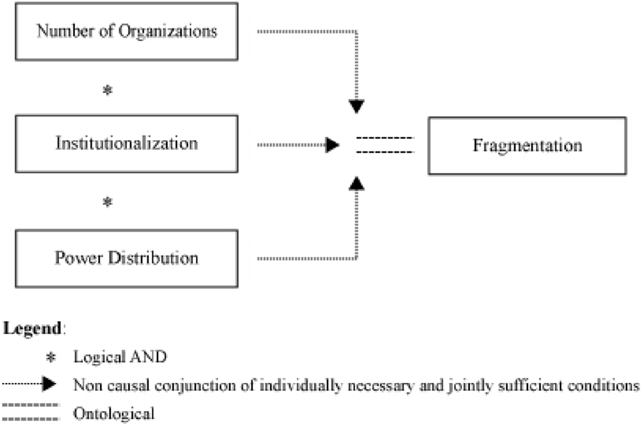
Many of the ways scholars have defined fragmentation are largely complementary and provide the building blocks of a better conceptualization. We therefore build on this previous work in conceptualizing fragmentation as a multidimensional concept.Footnote 27 Subsequently, we explain fragmentation's three constitutive dimensions and their measures and indicators, and provide preliminary theory-building conjectures on why groups are more or less fragmented in terms of these core properties. Notably, while the literature has paid relatively little attention to conceptualizing the negative values of fragmentation, namely cohesion,Footnote 28 we consider fragmentation as a scale ranging from unified to fragmented, and on different dimensions. With this multidimensional concept, we can capture the reality of fragmentation as a characteristic that can change over time, with the degree and type of fragmentation shifting as organizations are eliminated and new ones emerge, institutions coordinate actions in the larger struggle or become irrelevant, and power within the group is dispersed across organizations or concentrated within one of them. Figure 1 represents this concept, illustrating the links between the number of organizations, their institutional connections to one another, and the distribution of power across organizations.
Fragmentation as a Multidimensional Concept

Number of Organizations
One core dimension of fragmentation involves the number of organizations in a movement operating on behalf of the group they claim to represent. Fragmented movements differ according to whether they are divided between a few or many competing organizations, whereas cohesive groups unite in one organization. Splintering within non-state actors, especially in civil wars, is common. In most self-determination struggles since the 1960s, for example, movements challenging the state contain more—and often many more—than one organization.Footnote 29 One study concluded that splintering occurred in almost half of all civil wars since 1989.Footnote 30
Measuring the number of organizations entails identifying organizations within the broader movement that recognize no higher command authority, have their own leadership and organizational structure (including resources and memberships), and actively make demands related to the group's collective aims or status. The demands of different organizations do not need to be identical, and can even to some degree conflict with one another. Some organizations may encompass subsets of the overarching group (for example, the wealthier or poorer strata of an ethnic group, or specific tribes in a larger ethnic or regional identity), but the organizations that count when determining boundaries and membership should all claim to represent an overlapping, collective identity and pursue interests particular to it. Relevant organizations can also vary in term of the strategy they employ, including armed factions, paramilitary organizations, political parties, trade unions, and civic organizations mobilized around these claims. Importantly, this count should exclude institutions that merely coordinate among existing independent organizations, such as “fronts” or “coordinating committees,” which we include under the dimension of institutionalization below.
The existence of multiple organizations within the same movement can suggest underlying disagreements over collective interests or the means to achieve them. The link between these organizations (and the logic behind linking them together in a movement) is that all are mobilized around a collective identity in the pursuit of interests particular to this identity and the shared interests and common fate it engenders. For example, organizations in the Corsican self-determination movement all seek to influence the status of the island within France at the expense of the French government's authority, and the island's Corsican population as a whole cannot be excluded from any changes that are achieved. Yet, individual organizations within the Corsican movement have different ideas about the extent to which power should be devolved, how this should be pursued, and to whom authority ultimately should be passed. Moreover, clan-based ties and struggles between individual leaders within the movement over time have contributed as much as any proclaimed divergence over tactics and aims to the multitude of Corsican organizations.Footnote 31
As we note above, a variety of factors affect the number of organizations competing to represent the group. In addition to any divergence over interests and strategy, intragroup pluralism, particularly as a legacy of local political competition, ideological divides, or social and geographic cleavages, is a primary source of division—just as social structures may shape political party factionalism. Organizational factors, such as discipline and internal control, are also crucial in preventing defections and factional splits. Processes endogenous to conflict, such as leadership rivalries, counter-insurgency strategies aimed at divide-and-rule or leadership decapitation, and the shift from guerilla warfare waged by small, isolated groups to large-scale conventional warfare, can also be linked to changes in the number of organizations. Conversely, a process of factional amalgamation, the preferences of external patrons for unity, or solidarity in the face of repression from a common enemy can decrease the number of independent groups.Footnote 32
In wartime Poland, for instance, pre-war political cleavages within the Jewish community divided resistance to the German occupation across numerous organizations. Electoral competition in pre-war Poland created Jewish parties that provided a basis for the mobilization of armed resistance, but fragmented the community into militarist, conservative, centrist, and left-wing parties. But regardless of their political and ideological differences, all of these organizations were concerned about the political status of Polish Jews. By late 1942, after most of the community had been deported to labor or death camps, “it was Jewish certainty of common death that enabled cooperative Jewish resistance”.Footnote 33 Numerous Jewish organizations came together at this crucial period, amalgamating around the right-wing Jewish Military Union and the leftist Jewish Combat Organization, which coordinated resistance and fought together in the doomed Warsaw Ghetto uprising in spring 1943.Footnote 34
The number of distinct organizations in a group (and the role that their divergent interests can play) is one important component of fragmentation. Yet simply counting the number of organizations assumes that each of these organizations is equivalent to one another and that the relationship between them is similar across different cases. The second and third dimensions of our conceptualization directly address these two concerns.
Institutionalization
A key characteristic distinguishing more fragmented movements from more cohesive ones is the absence, weakness, or strength of institutions coordinating the actions of different organizations representing the group. Institutions can be broadly considered the rules of the game in a society, or “the humanly devised constrains that construct human interaction”.Footnote 35 Existing works address institutionalization in the context of cohesion and fragmentation to varying degrees,Footnote 36 but institutionalization is often implicit and requires greater attention. This is particularly true because while many states tend to develop and maintain strong institutions, there is much greater variation in the ability of non-state movements to do so.
Institutions can include both formal and informal rules, such as norms, routines, customs, and traditions, and all political actors can be evaluated on the degree to which they are institutionalized. Contemporary states tend to be highly institutionalized, with “sticky” rules and decision-making structures that determine how politics works; even many “weak states” are generally more institutionalized than the opposition movements challenging them.Footnote 37 In contrast, the level of institutionalization varies quite widely for non-state actors, be they self-determination movements or other types of social movements. Importantly, even movements divided among numerous independent organizations can act with a degree of cohesion when they cooperate through strong overarching institutions, such as regional governments, popular fronts, unity teams, resistance movements, central committees, rebel governments-in-exile, or liberated zones.
For empirical measures and indicators to compare institutionalization across cases, it may be necessary to focus on formal institutions despite the importance of informal institutions in many contexts, such as Pashtunwali among Pashtuns, blood vendetta for some groups in the Caucasus, or the Somali customary law system xeer. Institutions vary in breadth, or how encompassing they are in their membership, and depth, or how constraining they are for member organizations. This variation allows us to distinguish informal political coalitions and loose alliances from more robust institutional arrangements. For a movement to be strongly institutionalized, the overarching institution linking organizations must be both broad in its memberships and deep in the extent to which it constrains its members' autonomy. Highly institutionalized movements look more like states, in that respected rules coordinate and constrain the actions of most important organizations in the movement (breadth) through formal rules and structures, including mechanisms for monitoring and enforcement (depth). Conversely, weakly institutionalized movements are restricted to only a narrow sub-set of organizations in the movement and lack rules and mechanisms to monitor and constrain their members.Footnote 38
At times, institutions that encompass numerous independent organizations evolve into independent organizations in their own right through amalgamation of the organizations they previously coordinated. For example, many decolonization movements, such as the Liberation Front of Mozambique (FRELIMO) or National Liberation Front in Algeria (FLN), were created through the merger of smaller organizations. Command authority is the appropriate empirical indicator to understand this relationship: when an organization recognizes an institution's higher authority, the organization ceases to exist as a totally independent organization and the institution itself becomes an organization representing the group. By contrast, organizations that ally themselves with other organizations but do not fully amalgamate their command structures under a common leadership should still be counted as independent.Footnote 39 The relationship between the ANC, the Congress of South African Trade Unions (COSATU), the South African Communist Party (SACP), and Umkhonto we Sizwe (MK) illustrates these differences. The ANC, COSATU, and the SACP began as independent organizations, but quickly formed an alliance—a form of weak institutionalization—in the circumstances of underground struggle. As their memberships blurred and institutionalization became far stronger, the ANC evolved into an institutional linchpin, even though all three organizations retained their independence. The MK, however, which was originally set up as an independent organization drawing on ANC and SACP members, lost its independence as it was gradually subsumed by the ANC and became its armed wing.Footnote 40
The relative degree of institutionalization often reflects the institutional endowments of the movement in question and the group they represent. Control of (some) state institutions, like regional parliaments, or access to structures in civil society, like social networks and civic organizations, can provide an infrastructure for coordinating actions (especially for regionally concentrated separatist groupsFootnote 41) and allow for greater unity.Footnote 42
The degree to which a movement is institutionalized may be, to some extent, endogenous to the dispute it is engaged in. The strength of the state contesting a movement's aims, its tolerance for independent institutional structures in civil society, and its strategies for managing resistance might explain some of the variance in the strength of institutions across different groups. In democratic settings, for instance, regional legislatures often coordinate behavior among different organizations representing the non-state group concentrated in that region and allow for a high degree of institutionalization of the non-state actor. Conversely, strong authoritarian states are likely to prove a less conducive environment for institution building. Some states may seek to promote institutional links between rival organizations in order to have viable interlocutors in peace negotiations, while others deploy strategies of divide-and-rule that target institutional links between opposition groups. Thus, the context of the dispute, particularly the type of state the movement faces and the strategies that state is willing and able to employ, should influence the degree to which a movement is institutionalized.
Other sources of variation in institutional strength endogenous to conflict include the type of warfare and the role of outside actors. The type of warfare in a conflict often creates different incentives to create bridging institutions: conventional warfare requires centralized command, while forms of asymmetric warfare are more amenable to autonomous organizations operating locally across isolated fronts. Moreover, external actors might also play important roles in the institutional strength of ties between organizations. Outsiders often push factions to create institutional structures fostering greater unity, as the Organization of African Unity's Liberation Committee attempted to do with movements fighting colonial rule and apartheid.Footnote 43 State sponsors offering sanctuary to rebel governments-in-exile frequently assist with institution building, at times by deploying their intelligence and security services to fend off defections and splits. But outside states can also undermine efforts to create overarching institutions so as to keep clients weak, pliable, and dependent on continued support in proxy wars.
The war in Nagorno-Karabakh, an autonomous region of Azerbaijan in the Soviet Union, illustrates the importance of institutionalization. When fighting broke out in 1988, the Armenian side was divided among a number of militias, with as many as fifty paramilitary groups fighting a separatist insurgency against Azerbaijani and Soviet forces, and governments in Armenia and Karabakh pursuing different aims.Footnote 44 Although political competition was intense between competing Armenian organizations, disparate groups of communists and radical nationalists gradually came together around the war in Karabakh. In late 1992, military rule under a State Defense Committee built on the bureaucratic structure of the Karabakh autonomous region, mobilizing its resources and integrating informal militia for conventional warfare. Various Armenian militias were absorbed into a formal military that coordinated closely with the forces of newly independent Armenia. In Azerbaijan, however, the post-Soviet government remained internally divided between competing factions. Successive governments in independent Azerbaijan never managed to overcome these internal divisions and properly organize the competing militias, or the patriot-businessmen who mobilized them (most of whom regarded the war in Karabakh as secondary to the struggle for power in Baku). When a ceasefire held in 1994, the Armenian victory owed much to levels of institutionalization that were able to first coordinate and then integrate different factions into a single organization.
In sum, the degree of institutionalization of a movement characterizes the ties between organizations that it comprises. In weakly institutionalized movements, organizations work alone, with little coordinated action. Strongly institutionalized movements will look more like states, with a higher degree of cooperation and more regulated interaction between organizations. In movements that fall between these extremes, we should see coordinating institutions and structures that at times fail to be as constraining or self-reinforcing as they are in strong states. Thus the degree of institutionalization in many movements will fluctuate.
Distribution of Power
Groups also vary in terms of the distribution of power across organizations in the group. In a very basic sense, we can consider a group as more fragmented when power is dispersed across multiple factions within the group. Conversely, where a group with numerous organizations is dominated by one powerful organization, the consequences of being internally divided are diminished, as “weaker” organizations have a limited ability to influence either other factions or the larger dispute.
There are multiple conceptions of power. These range from thinking of power as an asymmetric relationship of influence,Footnote 45 to the broader definition of power as the production, in and through social relations, of effects that shape the capacities of actors to determine their circumstances and fate.Footnote 46 We are unlikely to add anything substantive to what has already been said in the voluminous literature on power beyond the observation that careful scholarship requires attention to the many forms of power that define what is possible for actors in particular situations. The power of organizations comes from material resources like money, manpower, and arms, which are useful in direct compulsion, but is also shaped by ideational factors, such as a sense of legitimacy, popular support, public opinion, and leadership. Power is contextual, with the prevailing type of conflict often determining which sorts of capabilities and endowments matter. During periods of peaceful electoral competition, for instance, the ability to get supporters to the polls puts a premium on broad popular support and organization, whereas in periods of fighting, military skill, motivation, weapons, and access to supplies might matter far more than popular support.
In terms of empirical indicators, scholars assessing power in the international relations literature have tended to look at military figures, the ability to extract resources, and GDP.Footnote 47 For non-state actors, large-n studies have used troop numbers as one empirical indicator of rebel capacity,Footnote 48 while the social movement literature assesses movement strength through resources such as societal support, members, money, infrastructure and facilities, access to policy makers, and external support.Footnote 49 But there is reason to doubt the utility of relying exclusively on material proxies, given the wide variety of factors shaping power and the effectiveness with which organizations make use of the resources available to them.Footnote 50 Indeed, the context in which the dispute occurs will affect the utility of different instruments of power. In active civil wars, for example, military strength plays a more central role in determining relative power across organizations. Yet in non-conflict situations, or even post-conflict situations, resorting to arms can delegitimize an organization, effectively limiting its influence. Non-material factors like ideology, political institutions, culture, legitimacy, and links to local communities all shape relative power. Pearlman, for instance, examines whether a movement has popularly-shared goals, which one can think of as a form of organizational power based on a consensus over objectives.Footnote 51 Given that key to any power relationship is the ability of one actor to influence the acts of another, one potential solution to the problem of identifying empirical indicators is to embrace the problem of endogeneity and use outcomes to infer power distributions ex post: the results of elections, splits, battles, bargaining, and other turning points can all reveal information about relative power and perceptions of power.
Measuring the relative power of competing organizations is a difficult task for case-oriented researchers with expertise on a particular conflict, a challenge compounded for researchers comparing many cases. Nonetheless, it is possible to estimate whether power is concentrated or dispersed across organizations within a movement, and whether some organizations are clearly more powerful than others. At the most basic level, this could be a dichotomous measure that assesses whether power is concentrated in one organization or not, while a more fine-grained measure would distinguish among different configurations (such as unipolar, bipolar, and multipolar). The high margins of error involved in such an estimate have to be weighed against the consequences of excluding this crucial attribute of fragmentation. Arguably, the theoretical payoff from including estimates of the distribution of power within the group outweighs the costs of measurement errors.
The sources of variation in the distribution of power within groups are numerous, but reflect three general categories. First, internal to the movement, the dispersion or concentration of power often reflects patterns in intragroup politics, variable access to power resources, different levels of organizational efficiency and cohesion, historical and sometimes path-dependent legacies, alliances across organizations, and realignments within the movement. Second, external to the movement, shifts in outside support (including the intervention of outside actors and government support for collaborating factions) can quickly and radically alter existing power distributions. Third, the distribution of power within the movement also interacts with institutionalization and the number of organizations. Because institutions constrain actors, organizations operating in a more strongly institutionalized movement will be inhibited in the ways that they can exercise power. For example, a militant wing of a political party will be more constrained in using force against the party it is connected to than it would be in attacking an organization it has no institutional ties to. The degree of institutionalization can also shape the distribution of power within a movement. In a weakly institutionalized movement, where the institutions do not encompass all organizations, the power of the coalition of organizations that are linked through institutions versus those organizations operating outside these institutions can contribute to the creation of rival blocs. Thus, to assess fragmentation, the distribution of power within the group must be considered in tandem with the number of competing organizations and the institutional ties between them.
In Kosovo in the early 1990s, for example, power was concentrated in the pacifist Democratic League of Kosovo (LDK), an elite-led movement with massive popular support that harnessed Albanian nationalism to resist Serbian rule. The party won unofficial elections in 1992 in a landslide, then organized a boycott of state institutions and created a parallel state structure for Kosovar Albanians, who acknowledged its leadership role in the movement. The LDK's dominance over weaker and more militant competitors in the movement gave way to a short period of uncertainty and rough parity between Kosovo Albanian organizations when an initially small number of militants around the Kosovo Liberation Army (KLA) launched an insurgency in 1997. Within a year, popular support on the ground and in the diaspora shifted from the LDK to the militant KLA. The KLA's dominance grew after it gained access to arms depots in neighboring Albania and became the main beneficiary of NATO intervention in 1999.Footnote 52 After the war, however, with the UN administration insisting on multi-party democratic institutions, power was again dispersed across political parties based on wartime organizational structures and allegiances, splitting the KLA into successor parties led by ex-commanders.
The distribution of power among organizations is integral to conceptualizing fragmentation, and is intimately linked to institutionalization and the number of organizations in the movement. Movements with more centralized power will be more cohesive, but the exercise of different types of influence is contingent on the ties between organizations and the larger context of the dispute.
Mapping Fragmentation and Cohesion
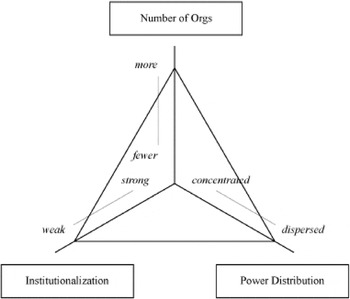
Our goal here is to create a conceptual map of types of fragmentation that can guide theorizing about its effects on conflict. Fragmented movements are not all the same, and we will argue that we can identify important patterns of fragmentation. Putting these three properties together—number of organizations, institutionalization of the movement, and distribution of power—yields a three-dimensional concept of fragmentation represented visually in Figure 2 below: the vertical leg is the number of organizations; the line to the left is the degree of institutionalization; and the line to the right is the degree to which power is distributed among the organizations.
Three Dimensions of Fragmentation
Note: The figure illustrates the shapes that fragmentation can take, based on the group's characteristics on each of the dimensions.

At any time, a movement can be placed on each axis of this three-dimensional space. If the group is extremely fragmented, it is divided into multiple organizations, with each holding a share of power, and with fewer binding institutional links between them, as in Figure 3a below. As we move inward on each dimension, the movement becomes more cohesive as organizations amalgamate or are eliminated, institutional links become broader and deeper, and a single organization ultimately comes to dominate political life, as illustrated in Figure 3b below. Few groups achieve this high degree of cohesion, but some come close.
Extreme Fragmentation on Three Dimensions

Extreme Cohesion on Three Dimensions

The Eritrean liberation movement, for example, eventually attained a remarkable degree of cohesion under the Eritrean People's Liberation Front (EPLF). During the 1970s, the Eritrean Liberation Front (ELF) suffered a series of defections that led to multiple contenders for leadership of the Eritrean resistance movement fighting for independence from Ethiopia. With the absence of institutional ties between these organizations, and with each organization relatively evenly matched, the movement was extremely fragmented, as in Figure 3a. However, after two of the factions united to create the EPLF, power shifted to this organization. By the early 1980s, the EPLF became the dominant force by pushing the ELF out of Eritrea and integrating its splintered remnants.Footnote 53 This left the sort of cohesive movement depicted in 3b.
In moving from a high degree of fragmentation in the mid-1970s to a high degree of cohesion in the 1980s, the movement passed through various types of fragmentation. Like most movements, the Eritrean liberation movement was not merely fragmented but fragmented in different ways as organizational divisions, institutionalization, and the distribution of power changed. Based on a group's position on each of the dimensions, we can imagine different “triangles” representing different types of fragmentation, with their own causes and consequences. Below, we explore these types of variation and their implications for infighting in more detail.
Implications: Hypotheses on Fragmentation and Infighting
To demonstrate the utility of our conceptualization, we focus on probabilities and patterns of infighting, defined as violent conflict between organizations belonging to the same movement. While both policy makers and scholars have tended to focus on violence between the state and its challenger groups, violence within these groups is a common feature in civil wars and accounts for a significant share of the violence in many conflicts. Infighting is potentially one of the most significant consequences of fragmentation. Infighting undermines a movement's capacity for collective action and diverts energy away from the pursuit of public, political aims and towards the pursuit of private advantage. It also alters the targets of violence, redirecting violence away from the state the movement is challenging and back towards rival organizations.Footnote 54
Variation in the type of fragmentation suggests unique hypotheses that connect fragmentation to infighting. We focus on the probability and pattern of infighting: probability refers to the likelihood that at any given time organizations in the same movement will engage in armed conflict with one another; pattern indicates who fights whom and with what consequences in terms of the spread and extent of violence. A basic assumption we make here is that while all organizations are motivated to some extent by the collective interests that constitute them as a movement, there are often incentives for turning conflict inward. Incentives for infighting can result from the desire of each particular organization to simultaneously achieve some private benefit, such as access to power, influence, resources, positions, or leadership within the movement. Winning the struggle can matter less than which organization delivers the victory and enjoys the spoils. Infighting can also arise from incentives relating to the collective benefits for the group they represent; specific organizations may be committed to a particular vision of the collective goal (such as independence, as opposed to greater autonomy) or to a strategy (armed conflict versus non-violent direct action) that brings them into conflict with other organizations. Alternatively, some groups can use disagreements about collective aims as a cover for the pursuit of private advantages. Thus, the pursuit of collective interests tends to push organizations towards cooperation, while the pursuit of private advantages and divergent interests pull them towards competition.
Given this tension, we explore here how different patterns of fragmentation lead to different propensities toward violent infighting, and the pattern that fighting is likely to follow. Of course, infighting can cause changes in fragmentation: violence may alter the number of organizations, shift the distribution of power among them, and erode or strengthen the institutional bonds that coordinate and constrain them. Moreover, just as patterns of cohesion and fragmentation have multiple causes, including infighting, there are multiple reasons organizations in a movement turn their guns on one another beyond the constraints and opportunities presented by the number of organizations, distribution of power, and institutionalization in a movement. In the interest of theory building, we bracket these important considerations to discuss baseline hypotheses about how fragmentation impacts infighting, and return to the question of endogeneity in the conclusion. To illustrate, we focus on cases well known to the authors that illustrate different configurations of fragmentation, the process through which changes in fragmentation occur, and the plausibility of our hypotheses. We include cases that vary along the dimension of interest selected from diverse geographical settings. In addition, the cases vary on other variables linked to fragmentation and infighting, such as counterinsurgency policy, geography, types of violence and warfare, ethnic fractionalization, and state strength and regime type. While the cases are not designed to test our approach, they do illustrate varying types of fragmentation and its dynamic nature.
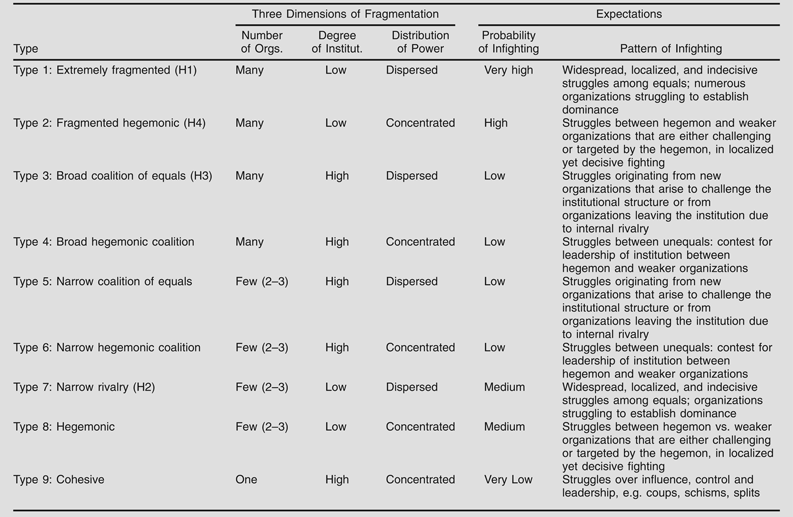
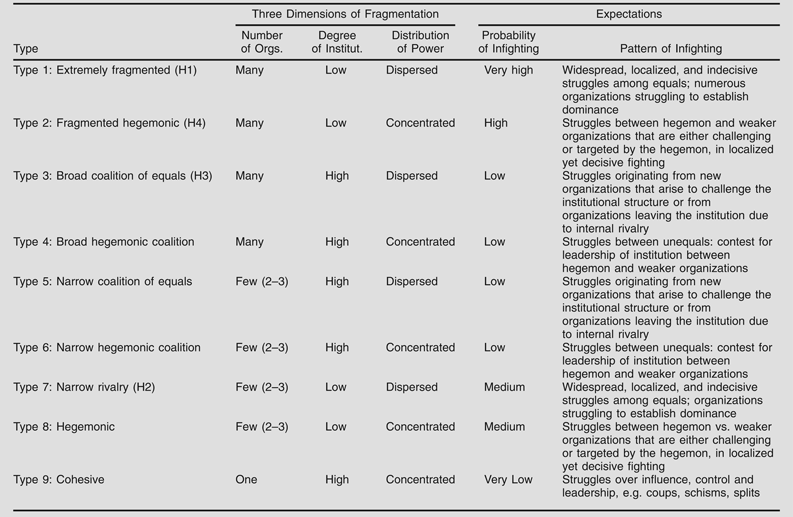
Systematically examining the possible combinations of our three dimensions yields a number of possible configurations of fragmentation. We include a typological table in an appendix at the end of this article that explores the multitude of possible combinations and baseline predictions.Footnote 55 Here, however, we begin by focusing on the relative size of the triangles presented in figures 3a and 3b. Our basic assertion is that the greater the degree of fragmentation on each dimension (i.e. the greater the size of the triangle), the greater the probability of infighting. As we move along each dimension towards the center of the figure (indicating greater cohesion on each dimension), the probability of infighting shrinks, but the pattern of fighting will be shaped both by the size of the triangle and its shape—its symmetry/asymmetry. Returning to the diagram in figure 3a, we see a case of extreme fragmentation, characterized by multiple organizations with only weak institutional links between them and a relatively even distribution of power among them. Thus, we hypothesize that the greater the degree of fragmentation on each dimension (the larger the triangle), the greater the chance of violent infighting (H1a). Moreover, we hypothesize that the pattern of infighting in such an extremely fragmented movement (represented by a large symmetrical triangle) will be widespread and encompass most organizations in conflict with one another in small-scale, localized, indecisive engagements (H1b). In such highly fragmented movements, internal competition will be intense, as each of the multiple organizations competes against others for various advantages in localized struggles throughout the community. This contest among multiple organizations is particularly likely to escalate to violent infighting, as there is neither an organization dominant enough to exercise a degree of hegemony within the movement, nor overarching institutions to coordinate the political aims of competing organizations, constrain personal ambitions, mediate conflicts between organizations, police other organizations, and enforce collective rules and decisions. Thus in the absence of concentrated power and strong overarching institutions, movements consisting of multiple organizations are likely to be characterized by an encompassing struggle for power and dominance. Yet because no organization is particularly strong relative to the others, violence is likely to be characterized by small-scale but widespread engagements. The weak power of these organizations makes it unlikely that they will eliminate one another; in the event that they do, the low barriers to entry in the movement are likely to see new organizations arise in their place. At various periods, this sort of extreme fragmentation has characterized the Darfurian, Chechen, and Sri Lankan Tamil movements. These movements have moved into or out of this type of extreme fragmentation as a result of changes on one or more of the dimensions, with implications for the probability and pattern of infighting.
Proliferating Organizations: The Splintering of Resistance in Darfur
Moving beyond the size of the triangle to also consider its shape, we explore some of the possible consequences of change along each dimension. First, moving inward along the first dimension in the triangle can shape the effects of fragmentation: reducing the number of organizations. We hypothesize that, holding constant a high degree of fragmentation on other dimensions, movements with fewer organizations will have a lower probability of infighting (H2a). Movements with fewer organizations have a limited number of potential dyads in which incompatibilities, rivalries, and local disputes might provoke infighting. The pattern of infighting in such groups is also expected to be different than extremely fragmented groups in so far as it involves fewer organizations. Yet as in extremely fragmented groups, fighting between the few competing organizations is likely to be widespread as organizations and their supporters from across the community are drawn into the fighting, while the relatively even dispersion of power between the groups creates conditions for large-scale violence. Thus, to the degree that we see infighting in movements with few organizations, we expect it to be widespread and encompassing (H2b).
The splintering of Darfur's opposition in western Sudan illustrates a movement going through changes in number of organizations and how such variation affects infighting.Footnote 56 When the rebellion in Darfur was launched in 2003, it was initially organized around two dominant organizations in a non-institutionalized alliance, the militarily powerful Sudan Liberation Army (SLA) and the Justice and Equality Movement (JEM). Quickly, however, underlying political differences came to the fore and military cooperation between the SLA and JEM broke down, resulting in rivalry between the two organizations that led to a series of clashes that the leaders of the organizations managed to contain, as we would expect in a movement that only has a few organizations (H2a and H2b). Between 2005 and 2006, the SLA further fragmented into numerous factions, partly as a result of differences over a peace settlement, and JEM suffered from defections and splits, leading Darfur's opposition to become extremely fragmented (approximating figure 3a above). The lines of division in the conflict became even blurrier as former rebels were co-opted into the government's counterinsurgency, and some of the government's local proxies defected to the rebels. As this multi-side violence escalated and spread across Darfur, it became difficult for organizations to remain outside the fray. As existing organizations split and new ones emerged, fighting became widespread, though largely indecisive, consisting largely of isolated clashes between small splinter groups—consistent with our expectations in H1a and H1b. Repeated efforts to forge cooperation and build coalitions between these groups have failed, and the opposition movement remains extremely fragmented with generalized conflict among constituent organizations.Footnote 57
Institutional Decay: The Rise and Fall of the De Facto Chechen State
Increasing the degree of institutionalization in an extremely fragmented movement, i.e. moving toward the center on the institutionalization leg of the triangle, will also change the probability and pattern of infighting. Indeed, a high degree of institutionalization will mitigate the conflict-promoting effects of numerous organizations and a dispersion of power within the movement. A high degree of institutionalization coordinates action and steers intragroup power struggles through non-violent channels, making the probability of infighting low. Moreover, even when tension exists over leadership within the institution, the existence of encompassing institutions enables such struggles to be resolved through non-violent means. We hypothesize then that holding constant a high degree of fragmentation on other dimensions, an increasing degree of institutionalization will reduce probability of violent infighting among organizations (H3a). This reflects both common adherence to and respect for rules and the constraining nature of binding institutions. In the unlikely event that infighting does occur in the context of a highly institutionalized movement, we hypothesize that conflict will originate from new organizations that arise to challenge the structure or from organizations that attempt to exit the institution due to internal rivalry (H3b).
The Chechen case illustrates how changes in the institutionalization dimension shape the probabilities and patterns of infighting over time. In 1990, the emerging nationalist movement in Chechnya looked like a broad coalition of more or less equally-influential organizations under the institutional umbrella of the Chechen National Congress.Footnote 58 Its radical branch, led by General Dzhokhar Dudayev, soon came to dominate, consolidating its control over the movement's armed wing, the National Guard. By summer 1991, institutionalization also increased as the National Congress coordinated mass pro-Chechen independence protests. Dudayev was elected president of the Chechen Republic in November 1991, boosting his position and further institutionalizing the movement by giving it access to the electoral arena. Consistent with our expectations for an institutionalized movement (H3a), 1990–1991 was a period without any significant infighting among the different Chechen nationalist organizations. However, the National Congress coalition became increasingly fragile as Dudayev's economic program and bid for independence stalled. By 1993, Dudayev's former allies challenged his leadership, leading him to dissolve the Chechen parliament, essentially eliminating formal institutional ties among the various actors. Thus in the time period leading up to Moscow's invasion of Chechnya in December 1994, the Chechen nationalist movement was characterized by many organizations and little institutionalization. While military power was still concentrated in Dudayev's National Guard, power was increasingly dispersed among other armed organizations. As expected, this was a period of infighting, primarily in the form of clashes between those loyal to Dudayev and his opponents.
The outbreak of war with Moscow reunified the movement under the command of Dudayev and his National Guard, and the movement once again looked like a broad coalition of organizations, dominated by one strong organization, and with some degree of institutionalization in the form of military and political coordination. Yet institutionalization was relatively weak, relying on shared opposition to the Russian threat, and that weakness quickly became evident when the war ended in 1996. Indeed, consistent with our expectations of how the pattern of infighting in an institutionalized movement will be shaped by organizations leaving due to internal rivalries for the structure's leadership (H3b), the 1997 presidential elections in Chechnya pitted former warlords from the resistance against one another. While the losers of the elections initially rallied behind the elected president, Aslan Maskhadov, they soon became challengers, effectively eroding the president's state-building efforts to institutionalize Chechen politics. Thus in the absence of any institutionalization and in the presence of numerous, more or less equally-powerful organizations, Chechnya became in 1997–1998 the scene of widespread and indecisive struggles among former warlords fighting for leadership in the movement, consistent with hypotheses H1a and H1b.Footnote 59 Had Maskhadov's state-building efforts succeeded, then, per expectations for a highly institutionalized movement (H3a), it is likely that Chechnya would have seen much less violent infighting.
Predation and Centralizing Power: The LTTE in Sri Lanka
Finally, changes in the distribution of power between organizations have implications for the likelihood and pattern of infighting. Where there are multiple organizations with weak institutional ties, moving from dispersed power to a concentration of power in one dominant organization shifts the movement from extremely fragmented to what we could consider a more hegemonic movement. While still fragmented, the presence of a dominant organization alters and attenuates the consequences of internal divisions. In this type of movement, more powerful organizations can police other organizations, deter violent challenges from weaker rivals, and provide incentives to ally or amalgamate, thus rendering the chances for violent infighting lower than in extremely fragmented groups. Thus, we hypothesize that holding constant a high degree of fragmentation on other dimensions, the existence of a dominant organization will reduce the probability of violent infighting among organizations as compared to an extremely fragmented movement (e.g. the one represented in figure 3a) (H4a). Furthermore, we hypothesize that the pattern of fighting in movements in which power is concentrated will involve the dominant organization fighting select organizations, either those challenging the strongest organization or targeted by it, in localized yet decisive fighting (H4b). When stronger organizations target weaker ones for elimination, infighting is likely to be more localized. But it is also likely to be more consequential than the sort of engagements that characterize infighting between numerous equally weak organizations: on the one hand, violence might be one-sided as powerful groups eliminate weaker challengers, while on the other it might undercut the dominance of the most powerful faction. In either case, the process of infighting itself is likely to have serious consequences for the important dimensions of fragmentation—interacting with both the number of organizations and the distribution of power—and thus affect future infighting.
The Tamil self-determination movement in Sri Lanka demonstrates how shifts in power in the movement affect infighting. Numerous organizations have claimed to represent the Tamil community since the outbreak of violence in the early 1970s, including political parties and trade unions linked in fronts, and a number of armed factions, namely the “Tamil Five” set of armed groups that emerged in the mid-1970s and a scattering of smaller local groups.Footnote 60 Consistent with the logic of our first hypotheses (H1a and H1b), beginning with the turn to violence until the mid-1980s, infighting consisted of localized clashes between weak paramilitary groups competing over recruits, turf, and influence. By 1986, however, the increasingly powerful Liberation Tigers of Tamil Eelam (LTTE) attempted to eliminate contending organizations, including both rival armed groups and non-violent organizations, in a ruthless campaign of fratricidal bloodletting that attempted to physically eliminate the leadership of rival organizations, including a number of the LTTE's former allies and political mentors. Though it could not completely eradicate all rival organizations, by the late 1980s the LTTE had defeated or weakened all other claimants to leadership of the Tamil nationalist movement, ruling the territory and population under its control in a highly authoritarian manner. The ensuing period of LTTE dominance, consistent with hypotheses H4a and H4b, was characterized by a reduction in infighting as the LTTE shifted toward relatively selective violence against the leaders and cadres of the remaining paramilitary groups, assassinations of more moderate Tamil politicians, informers, and LTTE-defectors. A major increase in intra-Tamil fighting followed a defection from within the LTTE that dispersed power between the LTTE in the north, and the ex-LTTE commander Colonel Karuna in the east. The fighting that followed eventually led to the LTTE being driven from the east in 2007 and finally defeated in 2009.Footnote 61
We have highlighted four possible types of fragmentation with our mapping by altering each of the three dimensions we argue are critical to understanding fragmented movements. Table 1 recounts each configuration and our hypotheses on the probability and pattern of infighting.
Hypotheses on Fragmentation

This mapping of fragmentation suggests the interplay between the three dimensions and how the effect of each is likely to be conditioned by the others. For example, the chance of infighting in movements consisting of few organizations is likely to be highly conditional on institutionalization: the absence of institutions that coordinate these organizations' behavior or enforce rules means there are fewer checks on conflicts escalating into violence. Moreover, because only a few organizations dominate politics in the group, the stakes are that much higher and violence has the potential to escalate quickly as organizations mobilize their respective followers, whose fortunes are often linked to those of the organizations they support. To the degree that we see infighting in movements consisting of few organizations, the pattern of infighting—who fights whom—will be determined by the distribution of power among them. We can also imagine other constellations of the three dimensions, and the typological table in the appendix provides an overview of these.
New Research Directions
This article contributes to the growing literature that disaggregates actors in armed conflicts. Yet the implications of our study go beyond non-state actors in violent settings, to both state and non-state groups engaged in contentious politics, whether violent or non-violent.
Rather than attributing singular agency to movements composed of diverse and often competing organizations, the emerging scholarship on fragmentation in civil wars pays far closer attention to politics within movements and the groups they represent. Our multidimensional conceptualization of fragmentation can enhance explanations of important conflict processes, suggesting that movements can be divided in different ways, with distinct causes and effects. Theoretically and empirically, we focus on how different types of fragmentation shape violent infighting in self-determination struggles. Fighting between organizations ostensibly struggling in the interests of the same community is perhaps the most serious consequence of fragmentation. Infighting diverts groups from the aims for which they claim to be fighting, undermining their potential for collective action and redirecting energy and violence inwards towards the community they represent. At the same time, provoking infighting by flipping factions has become central to counterinsurgency dynamics, making it important to understand how movements cohere and the consequences of fragmenting them.Footnote 62
Our conceptualization can also contribute to explanations of other conflict processes. Defection, collaboration, and side-switching are common features of armed conflicts that often reflect the strength of movement institutions and the relative power of different organizations as much as the literature's current focus on state policy. Examining patterns of fragmentation can also enhance our understanding of how groups respond to repression—which organizations are targeted, how repression affects internal power balances, and the ways state power impacts institutional ties between organizations. The onset of conflict is often triggered by fragmentation as organizations engage in violent outbidding, either to mark their emergence, to adopt new strategies and aims that depart from institutionalized consensus, or even to attack rivals claiming to represent the same group. Similarly, fragmentation shapes the outcome of conflicts, including the ways in which the state accommodates opposition movements, and the degree to which concessions to the movement actually bring about peace. Though our focus on infighting emphasizes the negative consequences of fragmentation, some movements intentionally embrace decentralization, raising further questions about how the structure of movements and campaigns impacts their success.
As we review in this article, a burgeoning research program has already begun to demonstrate the effects of fragmentation on conflict processes. While the research program needs a more coherent conceptualization of fragmentation, it nonetheless strongly suggests that there are limitations to an approach employing large-n cross-sectional studies with variables capturing country-level characteristics, such as regime type, wealth, inequality, ethnic divisions, terrain, and so forth. In and of itself, a large-n approach is not the problem. Indeed, as the literature on fragmentation in armed conflicts has been driven by careful case-specific studies, some of them relying on statistical analysis within one case, a large-n approach across cases is essential to assessing the generalizability of findings. The challenge, however, is that for large-n analysis, collecting data on the number of organizations, how institutionalized their relationships are, and their relative power over time is a highly labor-intensive and time-consuming task even when studying just one movement. Our study provides guidelines for systematic data collection across three dimensions of actor fragmentation. Expanding this conceptual exercise to cover a broader range of movements offers opportunities for comparison. For instance, if ethnic identity provides a more potent base for mobilizing around a focal point compared to non-ethnic identities, is there a difference between ethnic and non-ethnic movements in terms of fragmentation dynamics? What determines patterns of ad-hoc alliance formation and deeper institutionalized cooperation within movements? How do armed and unarmed organizations interact within these movements?
The research program has primarily focused on the effects of fragmentation, but as we argue, these effects depend on how a movement is fragmented. Future research could also systematically examine the roots of variation in the character and causes of fragmentation. Such questions have methodological implications, calling for greater theoretical and empirical attention to causal mechanisms in the study of violent conflicts.Footnote 63 Questions about mechanisms bring up tricky theoretical concerns about endogeneity. Indeed, to the degree that the outcome we are interested in explaining is violent infighting—or related dynamic processes such as defection or alliance formation—it is almost inescapable that violence itself is as much a cause of fragmentation as its effect. Disentangling endogenous relationships, both theoretically and empirically, is a challenge for further research on fragmentation and contentious politics more generally. The interaction of the three dimensions of fragmentation may also shape one another; for instance, an organization's resources may influence whether its leaders see a need to cooperate with other organizations by forming institutional bonds, or similarly, the emergence of a new actor might upset existing institutional cooperation. Nonetheless, infighting tends to be both sporadic and its outcomes unpredictable, making it useful to reason from the degree and type of fragmentation in a movement to infighting, rather than the other way around, bearing in mind that infighting is a process with repercussions for movement unity.
While our focus is on fragmentation in movements engaged in armed struggles, for peaceful groups, too, such as non-violent social movements and political parties, there is variation across the three dimensions of fragmentation conceptualized here. Social movement scholars use the term ‘social movement organizations’ to distinguish among the often numerous organizations that represent one movement, and they have long argued that these organizations sometimes act in unison, while at other times they find themselves pitted against one another.Footnote 64 This literature addresses questions about why, how, and along which lines some movements fragment into different organizations, how fragmented movements institutionalize to form coalitions, and the effects of movement fragmentation. For us, this literature is an excellent starting point for further theorizing the causal mechanisms that foster change along the three dimensions we highlight here. In turn, our study provides a stronger conceptual starting point for thinking systematically about movement fragmentation. For example, our inclusion of the power dimension of fragmentation calls attention to how the distribution of resources within the nuclear disarmament movement may have not only caused and been a consequence of intra-movement competition, but also shaped the ways in which this competition played out.Footnote 65 In contemporary US politics, both the Tea Party and Occupy Wall Street movements encompass numerous organizations, each confronting dilemmas about institutionalization and possible cooptation by more powerful establishment organizations. In sum, beyond specific cases, the three-dimensional conceptualization of fragmentation can help researchers to think more systematically through the concept's implications for both violent and more peaceful conflicts.
Fragmentation and Infighting: Probabilities and Patterns