


Wedges and frames, two much-studied strategies of American political combat, are generally thought to be partisan weapons, meant to manipulate voters into making trade-offs that favor the political actor wielding them.
In wedge politics, one side in a political conflict presents the electorate with a more attractive trade-off between two issue positions than the other side is offering (Hillygus and Shields Reference Hillygus and Shields2008, 73). Consider, for example, a Republican candidate who favors Conceal-and-Carry and opposes raising the minimum wage. Using guns as a wedge, she will try to win over those (working-class) voters who prefer to sacrifice their preference for the Democratic position on raising the minimum wage in exchange for her position on loosening gun regulation. Those faced with a wedge, then, are asked to make a “trade-off” (Hillygus and Shields Reference Hillygus and Shields2008, 26; Trubowitz Reference Trubowitz2011, 28).
With framing, one side in a political conflict shows how its position on a particular issue, which seems unattractive based on one value dimension, becomes attractive based on a second (Chong and Druckman Reference Chong and Druckman2007). Consider, for example, a Republican politician opposed to the estate tax. If he frames that opposition as promoting the value of helping the wealthy, it is of course unattractive to voters who might—if it were framed as a way of promoting the value of intergenerational bonds between family members—approve of it (Meagher Reference Meagher2013). Such reframing, too, is a “trade-off” (Lahav and Courtemanche Reference Lahav and Courtemanche2012, 478; Sniderman and Theriault Reference Sniderman, Theriault, Saris and Sniderman2004, 141) between value dimensions, not—as with wedges—between issue positions. In opposing estate taxes, the voter sacrifices his equality values in order to satisfy his values in the domain of the family.Footnote 1
Wedge and frames thus display symmetry. Wedges pose trade-offs between issue positions, whether within or across value dimensions. Frames, conversely, pose trade-offs between value dimensions, whether within or across issue positions.Footnote 2 Even if not the topic of joint analysis, wedges and frames appear together in many studies that examine issue positions in tandem with value dimensions in American politics (see, e.g., Shafer and Claggett, Reference Shafer and Claggett1995).
My inquiry here, though, explores whether there exists anything comparably schematic to wedges and frames at work in attempts by American politicians not to score a victory at the expense of the other but create win-win resolutions of policy disputes, not to polarize but to find consensus, not to cater to the extremes of their own parties but moderate them. Despite the seeming paucity of such efforts in contemporary US politics, there is at least one such scheme and it is to be found across a range of policy domains. If we were to give it a name analogous to a wedge or a frame, we might call it a “bridge.” It involves using a new value dimension to create a bridge between two issue positions that might otherwise pose a trade-off on an initial value dimension and a new issue position to create a bridge between two value dimensions that might otherwise pose a trade-off on an initial issue position.
Bridges, Wedges, and Frames: An Illustration
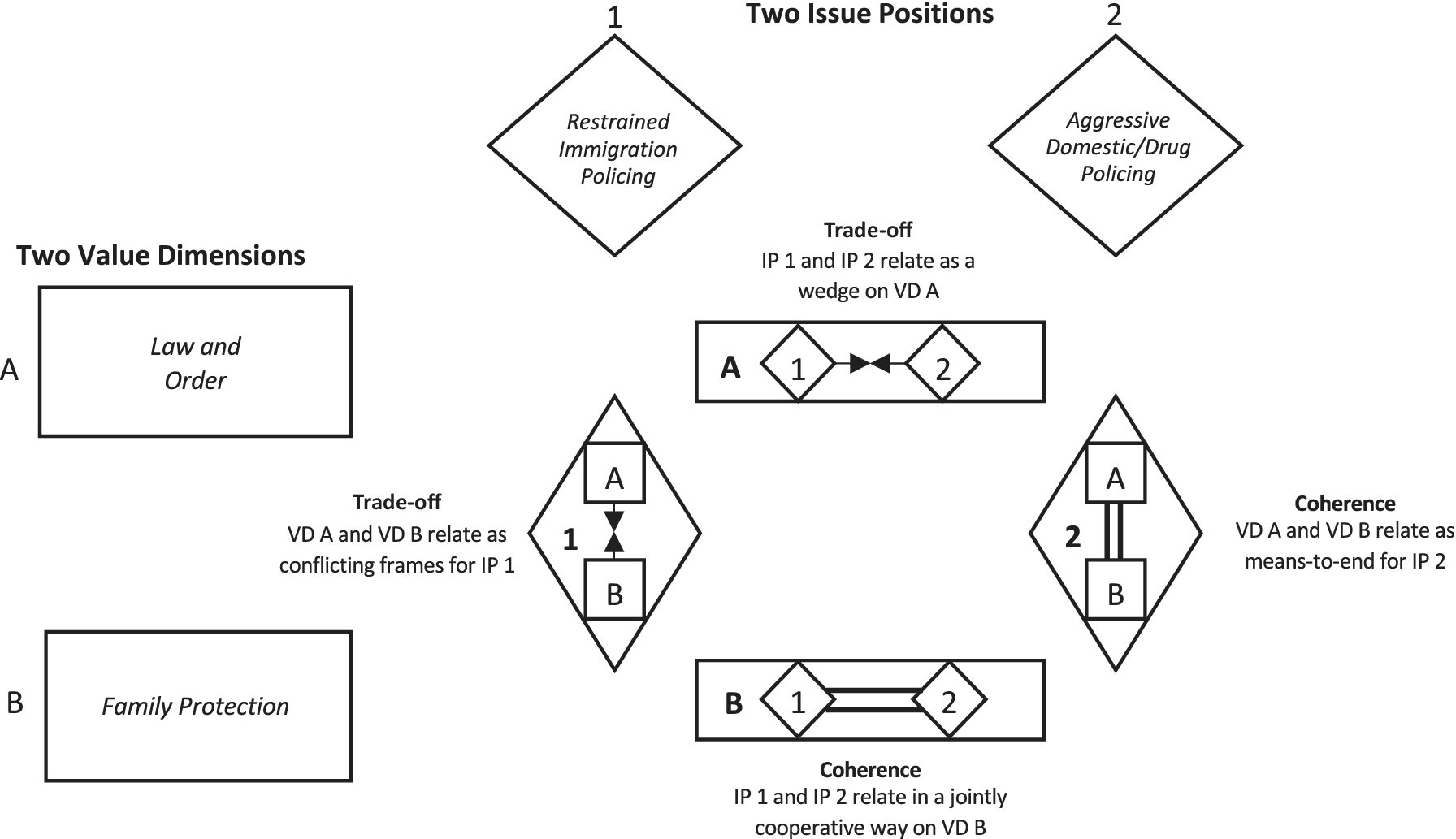
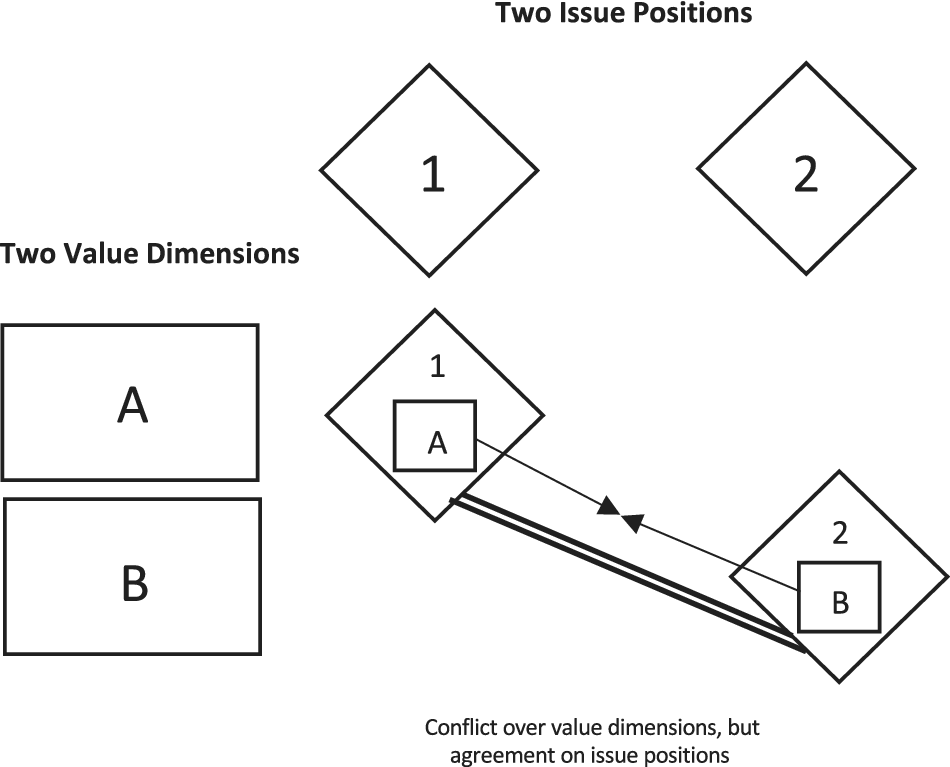
Consider an example. In 2011, Paul Bridges, the Republican mayor of Uvalda, Georgia, adopted two issue positions—rigorous and committed policing of domestic and drug-related violence and restrained and compassionate policing of illegal immigration—that, for his conservative base, posed a trade-off on the value dimension “law and order” (Shoichet Reference Shoichet2011). Voters who cared about law and order were being asked to forego a certain amount of that value via his immigration issue position in return for Bridges’s delivering a certain amount of that same value via his domestic/drug-crime-policing position (Bridges Reference Bridges2011a, Reference Bridges2014a). Bridges confronted them with a trade-off; it was, in effect, a wedge—except a wedge directed by a moderate at the more entrenched members of his own side instead of by a staunch partisan at wavering voters on the other.
However, Bridges advanced a second value dimension, call it “protecting families,” on which his two issue positions did not pose a trade-off but instead cohered (Bridges Reference Bridges2011b, Reference Bridges2014b). His issue position of rigorous domestic/drug-crime-policing, Bridges argued, would protect families from household and neighborhood violence (Bridges Reference Bridges2011c, Reference Bridges2011d; Kennedy Reference Kennedy2011). His issue position of restrained immigration policing, meanwhile, would contribute to the preservation of immigrant families, shielding them from being split up through deportation. “The Republican Party I joined years ago stood for protection of the family” Bridges said; that’s why he had always adopted the issue position of rigorously supporting the police “on their mission to protect” and “enforce the peace” (Political Transcript Wire 2012). But at the same time, he maintained, that same value dimension of protecting the family would be promoted by his other issue position of restrained immigration policing, since rigorous immigration enforcement would actually “put [those] values under attack” by “break[ing] up … families” (Bridges Reference Bridges2014a, Reference Bridges2011a). With Bridges’s approach, his two issue positions, which pose a trade-off—a wedge—on one of the two value dimensions, law and order, cohere on a second—family protection—jointly contributing to it.
Bridges, however, offered a trade-off-effacing innovation not just in the domain of wedges, but in the arena of framing as well. He didn’t, as a traditional reframe would do, simply suggest that his voters change their view of his restrained immigration-policing issue position in and of itself, by framing it in the value dimension of family protection, where it would be evaluated positively, instead of in the value dimension of law and order, where it would be evaluated negatively. Bridges also used his rigorous domestic/drug-violence-policing issue position to cast the entire relationship between the two value dimensions, “law and order” and “protecting families,” not simply as a trade-off—as they seem to be on his immigration-policing issue position—but as cohering in a means–ends relationship, the law-and-order value dimension being subordinate to the family-preservation value dimension.
After all, when it came to his issue position of rigorous domestic/drug-crime policing—where the two value dimensions both offered positive frames—voters could readily see how the point of the value dimension of law and order is to “serve,” as Bridges put it, the value dimension of family protection (Shoichet Reference Shoichet2011). Family protection, he stressed, is the “mission” of law enforcement. We don’t protect families in order to preserve law and order; we pursue the value of law and order to serve the value of family protection.
If, as it does on Bridges’s issue position of policing domestic/drug crimes, an aggressive stance on the means value dimension of law and order promotes the end value dimension of family protection, then where a restrained approach to law and order promotes family protection—as it does with Bridges’s issue position of compassionate immigration policing—that’s what should be indicated. It makes no sense, Bridges said, to be a law-and-order zealot when it comes to immigration policing, turning “honest Georgia citizens” who hire or marry undocumented immigrants “into lawbreakers,” if doing so will only “risk [family] separation” (Bridges Reference Bridges2014a, Reference Bridges2011a), as if the value of family protection were subordinate to the value of law and order instead of the other way round.
Had Bridges simply reframed his less-accepted immigration-policing issue position alone, as with traditional reframing, he would have been relying on his voters’ believing that the value lost on the “law and order” dimension is dominated by the value gained on the “family protection” dimension: a trade-off between two value dimensions in which the first value would be sacrificed for the second. But by reframing his more-accepted domestic-crime-policing issue position too, he argued that the entire value dimension of law and order is ultimately dominated by—is meant to serve, as a means to an end—the value dimension of family protection, not the other way around. While in a traditional reframe, the two value dimensions pose a trade-off on the single issue position being offered, with Bridges’s approach, the two value dimensions are shown, on the second issue position being offered, to cohere more fundamentally as means and ends, not just conflict as in a simple reframe.
Schematically, Figure 1 explicates what Bridges did, both with wedges and with frames.
Bridges’s Outreach to Less Moderate Republicans

This hybrid of wedges and reframes—in which two issue positions (as with wedge politics) get placed simultaneously on two value dimensions (as happens with reframing)—is, I will argue, an as-yet untheorized rhetorical form of political outreach, or consensus-building, in American politics: one that is used across policy domains. When political actors, whether politicians or advocates, try to show how the same two issue positions occupy the same two value dimensions, they are usually reaching out noncombatively, whether to more extreme members of their own party, as did Bridges, or to moderate supporters of the other party. In effect, they are superseding, mitigating, or eradicating the polarizing aspects of wedges and reframing.
In what follows, I first distinguish this bridging discursive structure from some major contemporary normative-theoretic frameworks for understanding compromise in American politics. I then set out the article’s methodology. The following section examines the structure’s presence across a number of American political debates, developing a broad typology of some of its different manifestations. A final part concludes.
Wedges, Frames, and Democratic Compromise
A good deal of recent political theory focuses on the meaning and legitimacy of compromise in democratic politics. In this section, I situate the discursive structure of bridging within its major strands.
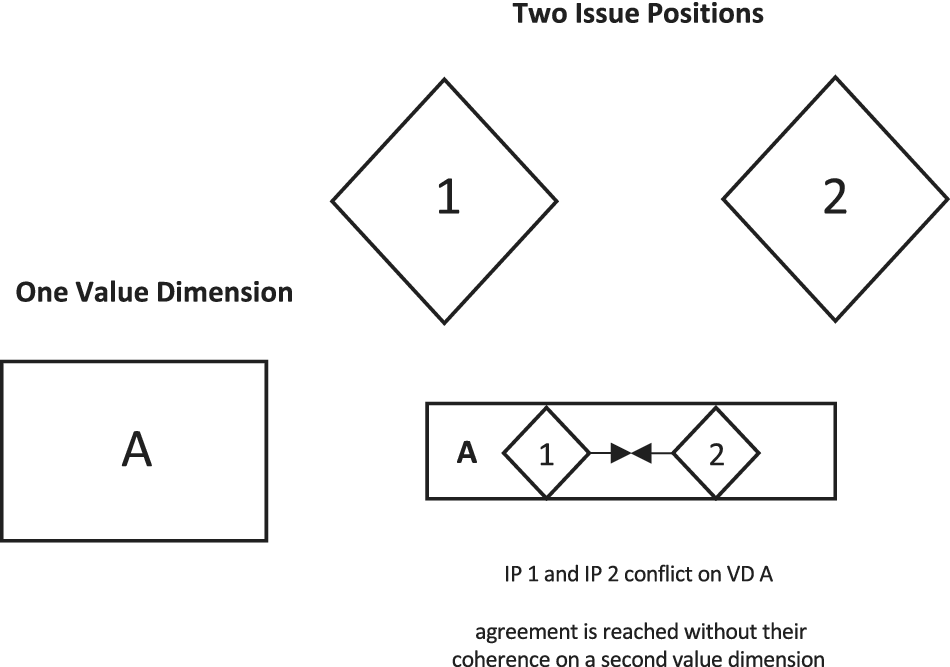
Some theorists, to begin with, equate a legitimate compromise simply with one in which each side gets more than it gives up, a variant of logrolling.Footnote 3 But if that were all there was to it, then whenever the issue position each side receives is more valuable to it than the issue position it cedes, there would be never be any felt need for a second value dimension, one that dissolves the trade-off between the two issue positions altogether, aligning them in jointly promoting that value. Instead, only one value dimension would ever be necessary to gain agreement on the two different issue positions. Had he been governed by a logrolling approach, for example, Bridges would have rested content with having merely offered a wedge, a trade-off, as long as the value in terms of law and order that his voters were gaining, via his rigorous domestic/drug-policing issue position, was worth the value they were giving up via his restrained immigration-policing issue position. In making outreach, however, Bridges went beyond this to advance a second value dimension, family protection, on which the two issue positions cohered.Footnote 4Figure 2 depicts this form of logrolling compromise:
Logrolling Compromise

Other theorists analyze democratic compromise as a form of “overlapping consensus.” Here, two different sides harbor two very different value dimensions which, however, agree in supporting the same issue position. Think of liberals who value free speech (but not political incorrectness), and conservatives who value political incorrectness (but not licentious speech), who both take the position that there should be no curbs on campus expression.
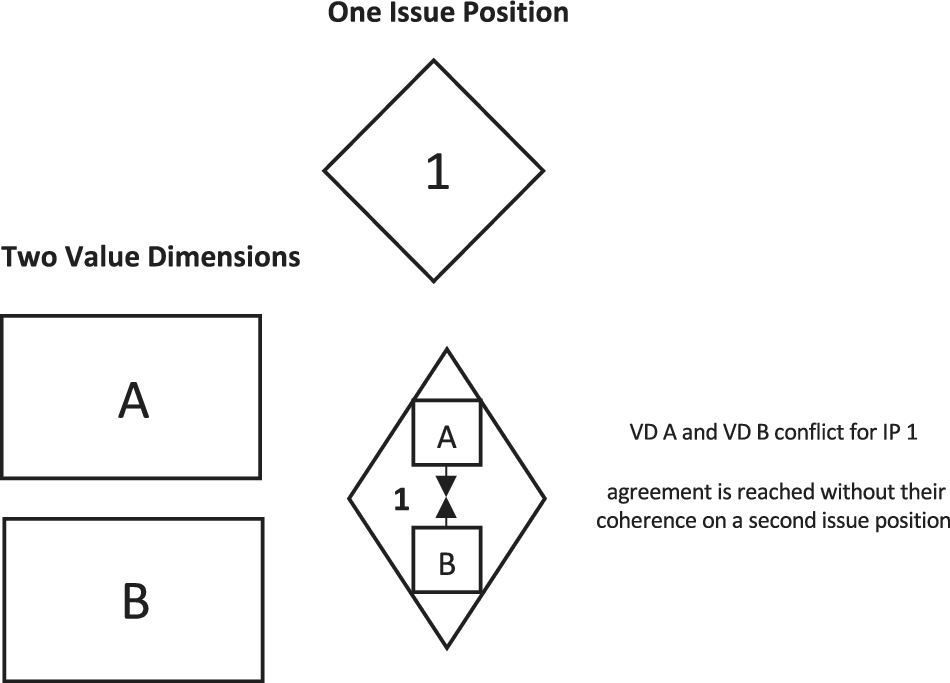
In effect, such an overlapping consensus constitutes a kind of reframing. Each side evaluates the issue position based on how it promotes the value dimension—the frame—it prefers as distinct from the one it doesn’t. There is agreement on an issue position, but the value dimensions remain unreconciled—in conflict. In Bridges’s case, he would have been happy simply if his voters had accepted his issue position of restrained immigration policing based on its serving the family-protection value dimension they harbored, without trying to reconcile them to its simultaneously serving a frame—less-than-rigorous law enforcement—that they didn’t value. The bridging structure that I will examine, by contrast, involves those making outreach going further and showing, by reference to a second issue position, how the two otherwise conflicting value dimensions cohere in a means–ends relationship (see related discussion in Goodin Reference Goodin2008, 229). Figure 3 illustrates the “overlapping consensus” compromise.
Overlapping Consensus

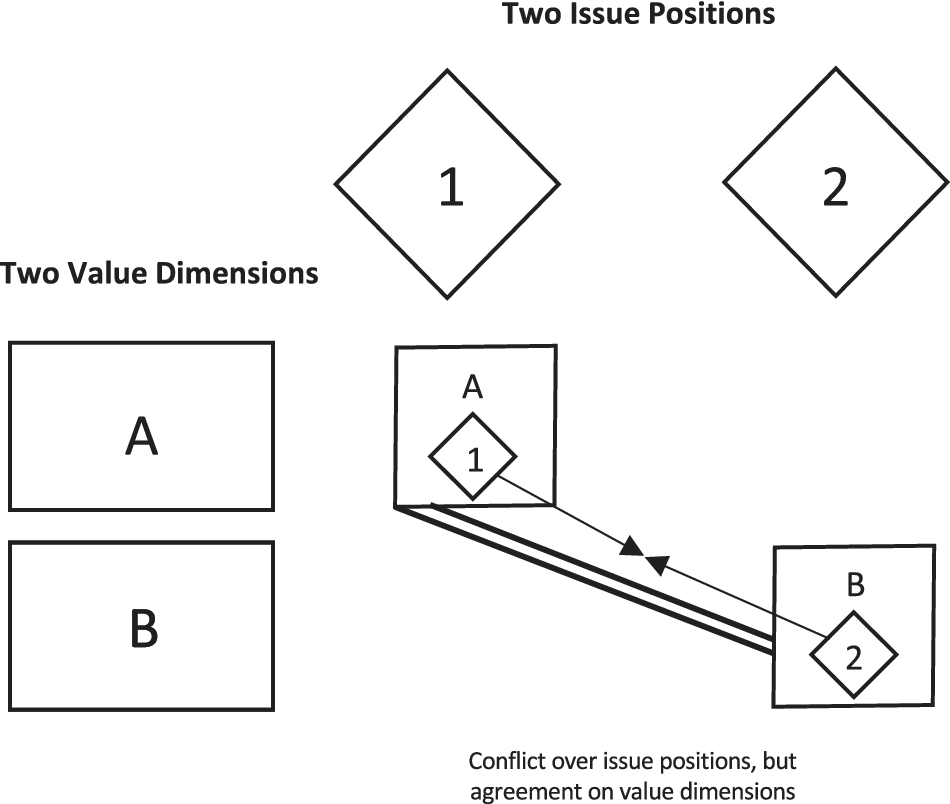
Still other theorists analyze a legitimate compromise as whatever results as long as each side advances its issue position based on values that the other can agree to, even if each ultimately prefers its own issue position (see the critical discussion in Richardson and Bohman Reference Richardson and Bohman2009). Pro-choice advocates, for example, would advance their position based on the value of personal autonomy—a value that pro-life advocates accept—rather than on any value that denies that the fetus is a human being. Pro-life advocates, for their part, would advance their position based on the value of human life, a value that pro-choice advocates accept, rather than on any value that involves divine command. In such cases, value dimensions are jointly shared across sides even if their issue positions remain in conflict (see Figure 4). But in the case of the bridging outreach strategy I will be examining here, the point, as it was for Bridges, is to find a shared value dimension that dissolves the conflict between the issue positions.
Values the Other can Accept

Finally, other theorists, in analyzing a legitimate compromise, make use of the idea of an “integrative” agreement as discussed in the negotiation literature. If a cake must be divided, a solution is integrative—“no party loses”—if one side wants only the spongy part and the other only the icing (Warren and Mansbridge Reference Warren, Mansbridge, Mansbridge and Martin2016, 156). In such integrative agreements, the issue positions do not conflict—both are fully realizable together—even if the value dimensions underlying them are not shared across sides (one side values sweetness but not sponginess, the other sponginess but not sweetness). Each side can agree to the other getting what it wants, even though—or precisely because—their underlying values differ. But again, in the bridging outreach strategy I am examining here, the point, as it was for Bridges, is to find a shared issue position that dissolves the conflict between value dimensions (see, relatedly, White and Ypi Reference White and Ypi2016, 146). Figure 5 depicts an integrative agreement.
Integrative Agreement

As the preceding discussion suggests, there is symmetry within some major normative-theoretic approaches to democratic compromise, which, taken together, imply a missing synthesis. With logrolling, agreement is reached between the sides over two issue positions, even though those issue positions remain in conflict on the single value dimension on which they’re considered. With overlapping consensus, agreement is reached over the single issue position being considered, despite the conflict between the two value dimensions each side brings to it. With “values the other can agree to,” agreement is reached on the two value dimensions being advanced while conflict remains between the two issue positions. And with “integrative agreement,” agreement is reached on the two issue positions being advanced even though the two value dimensions remain in conflict.
All have their roles, but they cumulatively suggest the possibility of something overarching, something absent in the literature but present, I argue, in American political discourse. It is a mode of outreach—a structural effort to forge compromise—in which the issue positions that conflict on one value dimension are rendered coherent on a second and, equally, the value dimensions that conflict on one issue position are rendered coherent on a second.
Methodology
“Rhetoric represents the currency of politics, in that everything important passes through it,” Mark Smith (Reference Smith2009, 22, 33) says, and “parsimony in studying rhetoric [can] lead to new insights into politics.” The analysis of rhetoric, or discourse, embraces a diversity of methodological approaches that unfold along at least two basic spectrums. Some analyses incorporate a critical approach (Dryzek and Niemeyer Reference Dryzek and Niemeyer2008, 481), while others remain closer to thick description (Botting and Houser Reference Botting and Houser2006). Some focus on “text as text” (Hawkesworth Reference Hawkesworth2003) while others treat text as data (Parthasarathy, Rao, and Palaniswamy Reference Parthasarathy, Rao and Palaniswamy2019).
To situate the task in which I am engaged, methodologically, within these spectrums, I rely on an observation made by Rogers Smith (Reference Smith1988, 91, 102, 104–6): “If one is attempting an interpretive narrative that shows [certain] structures of thought and argument to be visible in [the] text” of political discourse, one does so by focusing “on a few major cases that seem representative instead of documenting how those structures are visible in all or most of the relevant cases” (see also Dixit and Londregan Reference Dixit and Londregan1996, 1143).
For the purposes Smith sets out—namely, to make a certain argumentative structure visible in the text of discourse in order to “build up a comprehensive portrait of political life”—using a text-as-text and thick, descriptive approach is, Smith (Reference Smith1988, 90, 91) says, appropriate (see also, e.g., Fischer and Gottweis Reference Fischer and Gottweis2012). The same applies for the broader purposes of converting that structure into independent or dependent variables amenable to the analysis of its persuasive effect or the circumstances in which it is most likely to emerge. As King, Keohane, and Verba (Reference King, Keohane and Verba1994, 34) note, “it is hard to develop [causal] explanations before we know something about the world and what needs to be explained on the basis of what characteristic.” And if the characteristic in question is a certain structure in the world of public discourse, then a “text-as-text” and a “thick, descriptive” approach (Maynard and Mildenberger Reference Maynard and Mildenberger2016, 579) is appropriate for identifying it.
Riker’s study of the heresthetical structure he identified in American political discourse exemplifies this methodology. As Riker (Reference Riker1983, 56) said, his goal was to “provide an open-ended set of categories for events that have not heretofore been systematically characterized.” And to capture that structure, he adopted a text-as-text and thick, descriptive approach to a series of cases. My inquiry here is whether there exists a structure comparably schematic to heresthetics at work when American political actors seek to discursively forge consensus, not polarization, and I do so by using the same text-as-text and thick, descriptive methodology.
My examination takes the form of a “rational reconstruction” of discourse, which—while referring to the actual rhetoric of participants—explicitly brings out a formal structure it displays, in this case a certain mode of outreach, which for those participants might remain unrecognized as such (Habermas Reference Habermas1979, 13). Such rational reconstruction “helps agents recognize their own practices in a more articulate way [and its] normative force … is due, in part, to the fact that practitioners already, at least implicitly, accept them” (Kelly Reference Kelly2001, 6). Because the arguments being analyzed here are politically contentious, they will provoke differing views as to their normative and empirical validity (they are also conveyed at varying levels of policy specificity). But as Smith (Reference Smith1988, 90) emphasizes, the project of analyzing and identifying argumentative structures is an inquiry separate and apart—necessary and precedent to—“the work of empirical political scientists and normative theorists,” whose agenda involves providing a normative critique of those structures or an empirical analysis of argumentative soundness in given cases.
Variations on the Theme
Carbon Tax and Deregulation
In 2008, Representative Bob Inglis, a Republican, adopted two issue positions—(i) broad opposition to business regulation and (ii) support for a carbon tax—that, to his base, posed a trade-off, a wedge, on what might be called the value dimension of “relieving burdens on businesses.” In voting for him, they had to accept some burden by way of the tax in order to relieve some burden by way of deregulation, and many weren’t happy (Rosen Reference Rosen2009). But Inglis also advanced another value dimension, call it “spurring economic growth,” on which he spent much time showing that both deregulation and a carbon tax would jointly cohere in advancing: deregulation by enabling businesses to channel new revenue to investment and a carbon tax by compelling businesses to innovate. On this value dimension, far from the two issue positions posing a wedge, they cohere: “[R]egulatory … reforms [will] make the United States economy more competitive, innovative and robust,” Inglis said (Becker Reference Becker2016), while a “[c]arbon tax” would likewise “deliver innovation” and “grow the economy” (Inglis Reference Inglis2018; Targeted News Service 2016).
Also, Inglis emphasized that the value dimension of “relieving burdens on businesses” and the value dimension of “spurring growth” are not simply two different frames for analyzing issue positions. Instead, they cohere as means to an end: relieving burdens on business is a tool for spurring growth; spurring growth is not a tool for relieving burdens on businesses. On one of Inglis’s two issue positions—his deregulatory position—this is evident. It’s obvious that the value dimension of “relieving burdens on business” is meant to advance the value dimension of “spurring growth.” “[G]overnment shrinking [and abolishing] regulations that are cumbersome,” he said, “get[s] innovation happening” (Emmett and Kennedy Reference Emmett and Kennedy2018; Randazzo Reference Randazzo2013).
And so when it comes to Inglis’s issue position of a carbon tax, where a sacrifice of value on the “relieving-burdens-on-business” dimension yields value on the “spurring-growth” dimension, that is what should happen, since—as his issue position of deregulation shows—the two values relate as means to an end. “We need to impose a tax on … carbon dioxide” to get “the things we want more of, income and jobs” (Inglis and Laffer Reference Inglis and Laffer2008). Unfortunately though, Inglis noted, “in the political world we have sort of fallen in love with the concept of the girl rather than the girl,” by which he inelegantly meant that the value of removing government burdens on business has taken supremacy over the value of spurring growth, when it should be the other way round (Political Transcript Wire 2009). Inglis’s deregulatory issue position helped him convert the two frames, the “disburdening-business” value dimension and the “spurring-growth” value dimension, from a mere trade-off into a proper means–ends, subordinate–superior relationship, and that is how they should be seen on his carbon-tax issue position as well.
Inglis’s outreach thus involved his using a second value dimension (spurring growth) to make coherent two issue positions that posed a wedge on a first (not burdening business), and it involved using a second issue position (cutting regulation) to convert into a coherent means–ends relationship two value dimensions that posed a mere reframe on a first (imposing a carbon tax).
Abortion Rights and Social Assistance
Turn now from moderate conservatives like Bridges and Inglis, trying to win over more traditional conservatives to the case of a moderate liberal trying to win over progressives. In the 1990s, Pennsylvania’s Democratic governor Robert Casey confronted his liberal supporters with what, on the value dimension of “women’s rights,” was a trade-off: accept his issue position of placing hedges on abortion—a 24-hour delay and mandatory counseling on adoption—in exchange for his deeply progressive positions on other issues that promoted women’s rights, for example, expanding social programs in the form of Medicaid, nutrition support, and child care.
Instead, though, of simply relying on the “wedge” idea that on the “women’s-rights” value dimension his supporters would think the trade-off between his two issue positions was worth it, Casey advanced another value dimension on which those two issue positions posed no trade-off but instead fell into alignment. Calling it the Democratic Party’s traditional focus on “protecting the most vulnerable,” Casey argued that his anti-abortion issue position would promote that value; after all, Casey asked, what’s more vulnerable than the fetus? Meanwhile, his issue position of expanding social programs would also have advanced that same value by aiding vulnerable families. “No nation,” Casey (Reference Casey1995) declared, “can truly progress by leaving behind its most vulnerable members,” and so we must “offer … women meaningful alternatives to abortion and children and families the help they need to have a real chance to live decent, healthy and happy lives.” The “protecting-the-vulnerable” value dimension was meant to ease the sense of trade-off, of wedge, between Casey’s two issue positions, opposition to abortion and aid to children and families, which existed on the “women’s-rights” value dimension. Instead, on the “protecting-the-vulnerable” value dimension, his two issue positions jointly cohered.
But there was more. For when it came to his issue position on circumscribing abortion, Casey wasn’t simply relying on the “reframing” idea that the value gained on the dimension of “protecting vulnerable” fetuses is worth the trade-off—the value sacrificed—on the dimension of “women’s rights.” He was using his other issue position, namely his support for a variety of social programs, to argue that the entire value dimension of “women’s rights” is, itself, to be measured by how it generates value on the dimension of “protecting the vulnerable.” The value dimension of “women’s rights” and the value dimension of “protecting the vulnerable” relate as means to ends, not simply as two coequal different frames. We give people rights to protect them when they’re vulnerable; we don’t protect them when they’re vulnerable in order to give them rights. As a Democrats for Life spokesperson described Casey’s position, “Democratic causes [such as] women’s rights” are meant to “express concern for those who are most vulnerable.” That subordinate–superior relationship is evident in issue positions that correct for “the harsh consequences of our economic system,” such as progressive Medicaid, nutrition support, and childcare policies. And it should apply as well, Democrats for Life argued, for those issue positions that show “respect for life” such as “pro-life laws” (Mackura-Tromski Reference Mackura-Tromski1998).
Black Lives Matter and Gun Rights
Consider a second case of moderate Democrats reaching out to more liberal ones. It involves “Liberals for Guns” (LFG), a group of otherwise liberal Democrats who hold conservative views on the Second Amendment akin to the National Rifle Association. Liberals for Guns members—and members of like-minded groups, such as the Liberal Gun Club—take (among others) the following two issue positions: while supporting (i) minimal gun regulation, they also advocate for (ii) Black Lives Matter.
In its outreach to more progressive liberals, whom they know support (ii) Black Lives Matter but oppose (i) minimal gun regulation, LFG must deal with the reality that those two issue positions assume the relationship of a trade-off on an important value dimension: call it “preventing innocent deaths.” Issue position (ii), supporting Black Lives Matter, reaps value on that dimension by encouraging police officers to observe proper restraint in dealing with young black men, thus reducing gun violence. But for progressive liberals, issue position (i), minimizing gun regulation, represents a sacrifice of value on that dimension—preventing innocent deaths—by making it easier for people to commit gun violence. Therefore, progressive liberals, in being asked to join in the work of LFG, conceive of (i) and (ii) as a wedge on the value dimension of “preventing innocent deaths.”
In response, LFG advances a second value dimension. Call it “addressing root causes of violence.” On this value dimension, LFG argues, its two issue positions, (i) minimizing gun regulation and (ii) supporting Black Lives Matter, do not form a trade-off but rather cohere. Issue position (ii), supporting Black Lives Matter, advances the value dimension of “addressing root causes of violence” by encouraging governments to grapple with urban crime not through rigid law enforcement but by marshaling education, counseling, work opportunities, and other programs targeted more directly at the social and economic roots of law-breaking. As a Liberal Gun Club officer says in support of Black Lives Matter, “[w]e should be looking at … systemic poverty and racism … .” (Holloway Reference Holloway2017).
As with issue position (ii), supporting Black Lives Matter, so with issue position (i), minimizing gun regulation. It too, LFG argues, advances the “addressing root causes” value dimension (Badger Reference Badger2011), by redirecting our attention to the underlying sources of gun violence. Minimizing gun regulation encourages governments to address the misuse of guns not through the rote enforcement of regulation but through social work, counseling, therapy, and other programs designed to deal with the mental conditions—the root causes—that make the private possession of guns dangerous. As a statement by the Liberal Gun Club puts it, “We favor root-cause mitigation for violence prevention [such as] stronger mental health care … rather than focusing on prohibiting or restricting [guns]. We believe that additional regulation is too often political window dressing and does not serve to resolve the ills for which it is claimed as a cure” (Liberal Gun Club n.d.a).
On this value dimension, then—that is, “addressing root causes of violence”—the issue position that liberals traditionally support—namely (ii) Black Lives Matter—and the one they traditionally oppose but that LFG supports—(i) minimizing gun regulation—are said to come together. The trade-off, the wedge between the two issue positions that progressive liberals see on the “preventing-innocent-deaths” value dimension, disappears. “We spend billions every year to ramp up enforcement [and] crack down on poor neighborhoods (largely comprised of people of color),” the Liberal Gun Club (n.d.b.) says; likewise “we have strong gun laws in LA, Chicago, New York, and other major cities … . What haven’t we done? Invested in these areas and given them a hand up … .”
The LFG’s outreach approach also converts the relationship between those two value dimensions, “addressing root causes” and “preventing innocent deaths,” into a means–ends connection. Importantly, though, it’s the value dimension that reconciles the two issue positions, “addressing root causes,” that is the means, and the value dimension on which progressive liberals see a wedge between them, “preventing innocent deaths,” that is the end. Nevertheless, the outreach has the same ultimate effect.
To those liberals whom LFG are trying to win over, it’s clear that on issue position (ii)—supporting Black Lives Matter—the value dimension “addressing root causes” relates to the value dimension “preventing innocent deaths” not just as one frame to another but as subordinate value to superior value—as a means to an end. The reason that we should address the root causes that place young black men at risk of committing crime, as Black Lives Matter recommends, is precisely so that we can prevent innocent deaths at the hands of police gun violence. We should “look at ideas like community-based policing [and] fair housing policies,” the Liberal Gun Club (n.d.b.) says, in order to minimize the “risk that conflictual encounters will erupt in violence.”
And so, LFG argues, the same means–ends relationship between the two value dimensions, “addressing root causes” and “preventing innocent deaths,” should apply with its other issue position, (i) minimizing gun regulation. Rigorous regulatory enforcement is no more effective in dealing with gun violence than rigorous law enforcement is with violence involving young black men. “Blanket bans” on guns, the Liberal Gun Club says, are merely like “popping painkillers”; they address only the “symptoms of violence.” “Addressing root causes and combating stigma,” by contrast, is like “surgery” to deal with “chronic knee pain”; it will most effectively prevent innocent deaths (Liberal Gun Club n.d.b).
As noted, LFG’s outreach argument, in one key way, varies the structure that the Bridges, Inglis, and Casey cases exhibit. With LFG, it’s the subordinate value dimension—the “means” value dimension of “addressing root causes”—that reconciles the two issue positions, (i) minimizing gun regulation and (ii) Black Lives Matter, not the end value dimension of “preventing innocent deaths,” where they pose an a priori a wedge for progressive liberals. After all, even if addressing the root causes that lead young black men or gun owners alike to commit crime is more effective than law or regulatory enforcement in preventing innocent deaths, it’s nevertheless the case that law enforcement causes innocent deaths in the case of young black men while regulatory enforcement prevents it in the case of gun violence.
Even so, the LFG argument possesses a compensating strength. Consider the Bridges case. When it comes to Bridges’s issue position of rigorous domestic/drug policing, it is by promoting the means value dimension of law enforcement that we advance the end value dimension of family protection. But when it comes to his issue position of restrained immigration policing, it is by sacrificing on that means value dimension that we promote the end value dimension. In the LFG case, by contrast, it is by promoting the means value dimension, addressing root causes, that we advance the end value dimension, preventing innocent deaths, for both issue positions, Black Lives Matter and minimizing gun regulation, equally. In which case, LFG contends, the two issue positions do attain reconciliation—they form much less of a wedge than progressive liberals think—on that end value dimension as well.
Mandates for Health Care, Subsidies for Health Care
The discourse I have examined thus far involves moderates in one party or the other reaching out to less moderate co-partisans. I now elaborate its structure by turning to a joint endeavor by moderates in both parties to reach out to their less moderate co-partisans, but in an effort to forge a bipartisan agreement between them.
In 2017 the Problem Solvers, a bipartisan group of forty members of Congress, announced a “compromise” proposal on health care: one that its chief architects described as a difficult one, but a tribute to what legislators on both sides could achieve in a collaborative spirit. Republican Problem Solvers, on the one side, gained Democratic Problem Solvers’ agreement to raise the threshold of the mandate requiring employers to cover employees’ health care. Instead of requiring all businesses with more than fifty employees to provide coverage, the compromise would have mandated only those businesses with more than 500 employees to do so, thus removing an unspecified number of Americans from work-based insurance coverage and necessitating that they seek it on the new government-created individual exchanges or else go without. Call this issue position (i): raising the mandate threshold for business coverage of employees.
Democratic Problem Solvers, meanwhile, won assent from Republican Problem Solvers to, among other things, guaranteed assistance for poorer households to pay deductible and co-pay expenses (cost-sharing reduction or “CSR” funding). Call this issue position (ii), ensuring government support for the financially needy to get health coverage (Jones Reference Jones2017, 6).
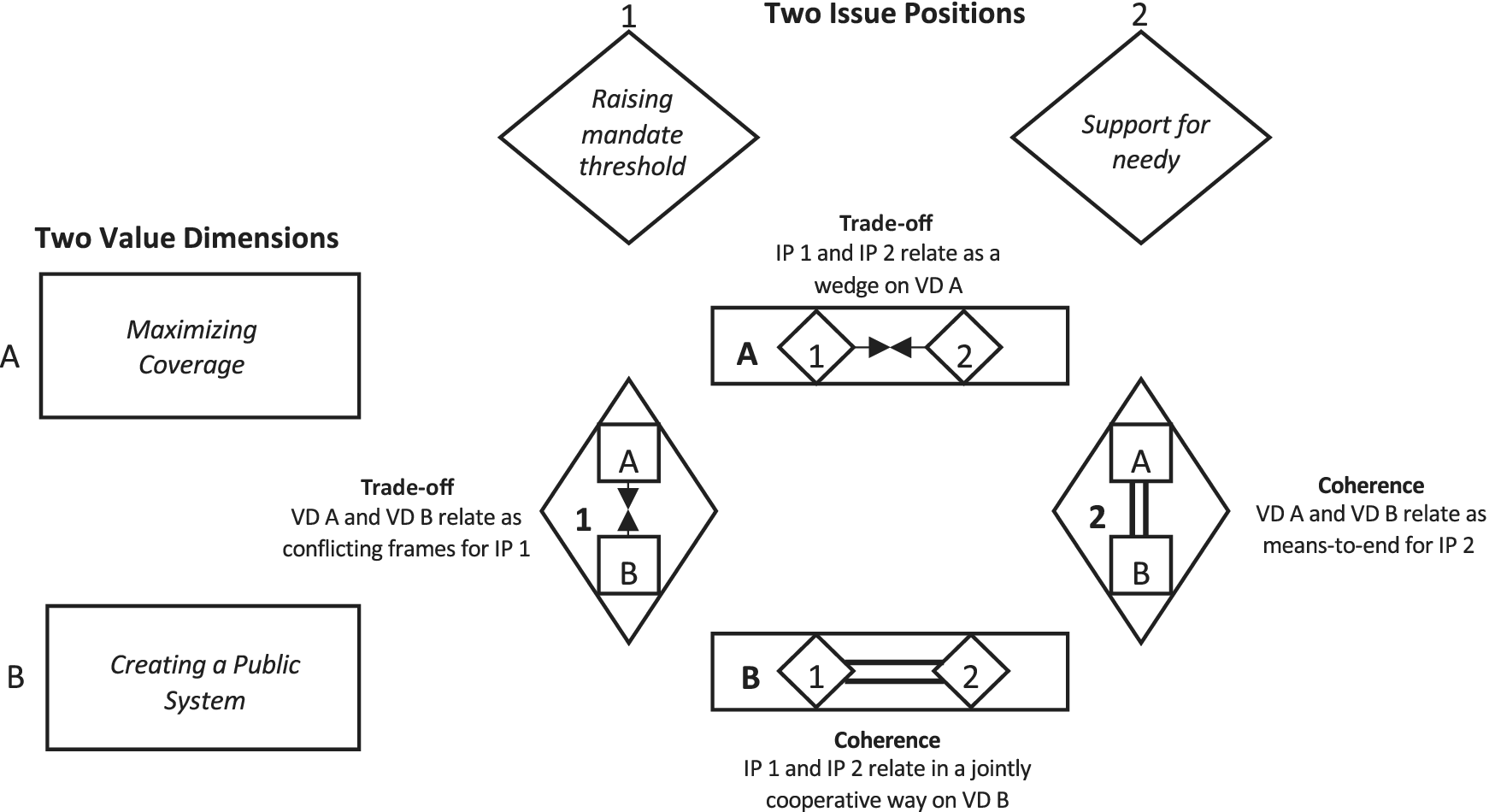
In reaching out to their caucus and base, Democratic Problem Solvers knew that their more liberal colleagues would view the two issue positions—(i) raising the mandate threshold for business coverage and (ii) ensuring government support for the needy to get coverage—as posing a wedge, a trade-off, on a value dimension of crucial importance to them, “maximizing coverage” (Wikler Reference Wikler2017). Some Americans could lose coverage through issue position (i), the relaxed employer mandate, while others would gain coverage through issue position (ii), ensuring government support for those less well-off to purchase insurance.
How then did Democratic Problem Solvers try to win their party’s assent? Rhetorically, it was by pointing out how these two issue positions, which form a trade-off on the value dimension “maximizing coverage,” work together to create value on a second value dimension that Democrats harbor; call it “creating a universal, public health-insurance system.” A McKinsey report, cited by Democratic Problem Solvers, explicitly argued that the two issue positions, raising the business mandate threshold and guaranteeing subsidies for needy Americans, far from posing a wedge, in fact work together to encourage people to seek coverage through government-run exchanges. Those exchanges, in turn, advance the value of universal public health insurance: the “universal” part, since exchanges are available to individuals regardless of their work circumstances, and the “public” part, since they are government-run. As the Report said,
subsidies [for] the lowest-income workers [and] reduc[ing] the social-equity advantage of employer-sponsored insurance [encourages] workers to obtain coverage … on today’s individual market … because of the subsidies, many low-income employees will be able to obtain better health coverage, for less out of pocket, on an exchange than from their employer (Kadner Reference Kadner2017; Singhal, Stueland, and Ungerman Reference Singhal, Steuland and Ungerman2011).
As Democratic Problem Solver Representative Jim Himes elaborated, to promote the government-run individual insurance market in this way—via the twin issue positions of raising the business mandate threshold and ensuring support for the needy—is to directly advance the value of universal public health insurance. “For starters,” Himes said to his fellow Democrats, we must “stabilize individual insurance markets … [f]rom there, we should [proceed to] universal coverage … .” (Himes Reference Himes2017; Sadin Reference Sadin2017). The joint issue positions of raising the employer mandate and ensuring support for the financially needy—though they form a wedge on the value-dimension of “maximizing coverage”—cohere in advancing, via the strengthening of government-run open-to-all exchanges, the value dimension of “creating a universal, public health care system.”
As for those two value dimensions of “maximizing coverage” and “creating a universal, public, health-care system,” they are shown, on issue position (ii), ensuring support for the financially needy, to relate as means to ends. “Universal care, that is our goal,” Representative Nancy Pelosi said; “We think the Affordable Care Act,” which brought coverage to millions of Americans, “is a path to that … and that’s why we want the cost-sharing reduction payments to be made permanent” (Pelosi Reference Pelosi2017). However, if the value dimension of creating a universal public health-insurance system is the end goal and the value dimension of coverage maximization a means to that end, then—where necessary—it is reasonable to modulate the value of maximizing coverage when doing so would advance the value of moving toward a universal, public system. And that is precisely what the Problem Solvers compromise would do, Democratic Problem Solvers argued to their more liberal colleagues, via its other issue position of raising the mandate threshold on business coverage. True, some might lose coverage as a result of the raised mandate threshold since (among other things) buying insurance on the individual “exchanges could … lead to higher transaction fees,” as a Booz and Company report quoted by Democratic Problem Solvers conceded. But what ultimately matters is that “[h]ealth insurance in the United States is at the cusp of a major transition from an employer-driven payor model to a model directly involving many more employees and consumers [via] health insurance exchanges” (Kapur et al. Reference Kapur, Ashish, Minoo and Paolo2012).
By placing the two issue positions on the value dimension not only of maximizing coverage but of creating a universal public system, Democratic Problem Solvers endeavored to reach out to fellow, more progressive Democrats, converting would otherwise be a wedge between issue positions into a joint enterprise and a mere reframe between value dimensions into a means–ends relationship (see Figure 6).
Problem Solvers’ Outreach to less Moderate Democrats to forge a deal with more Moderate Republicans

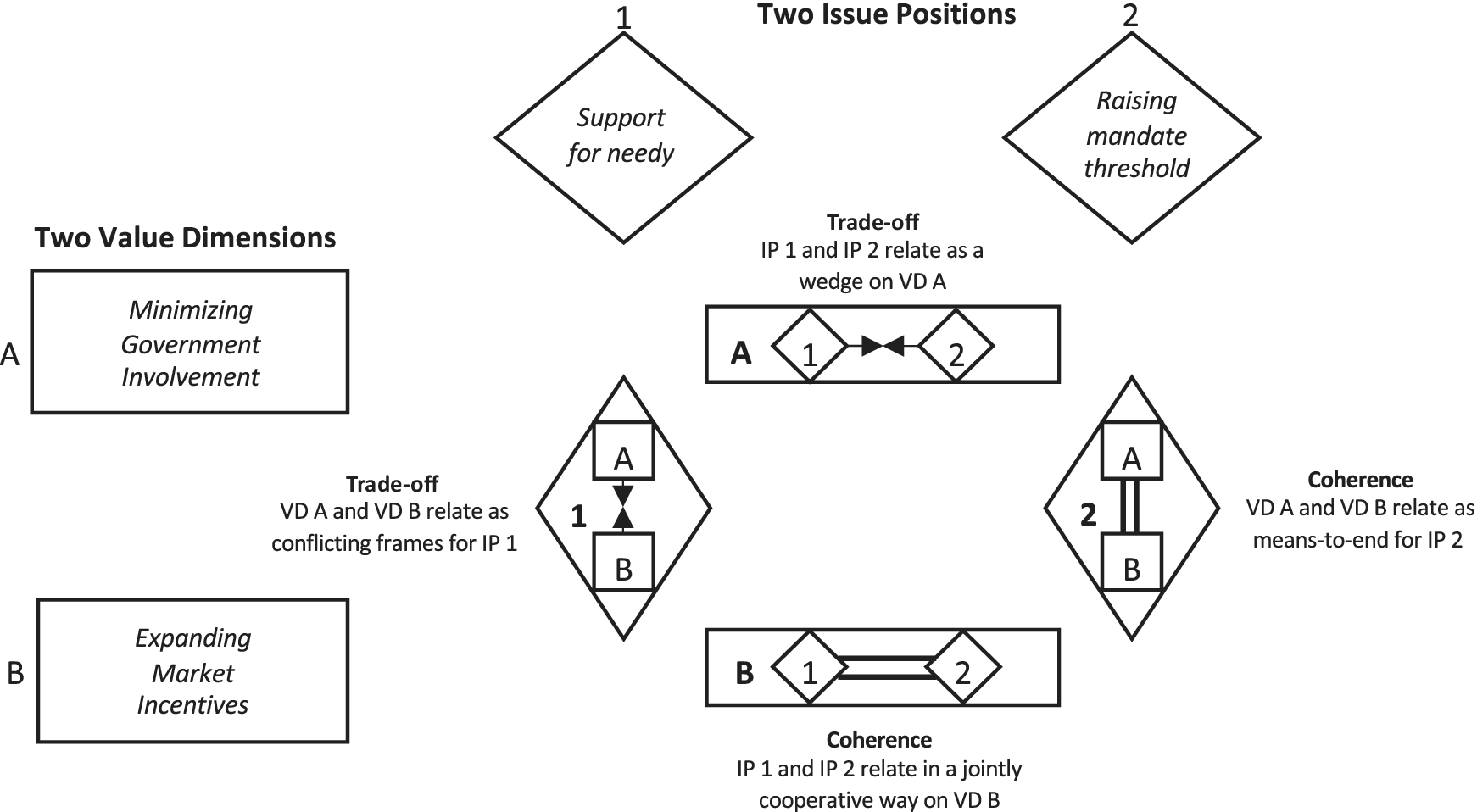
But what about the reverse? How did Republican Problem Solvers reach out to more conservative Republicans? After all, for conservative Republicans issue position (i), “ensuring government support for the financially needy,” and issue position (ii), “raising the mandate threshold for business coverage,” formed a wedge—a trade-off—on their preferred value dimension of “minimizing government involvement in health insurance.” Republicans would be giving up some of that “minimizing government involvement” value via issue position (i), ensuring governmental support for the needy, in order to gain some of that value via issue position (ii), raising the mandate threshold on business coverage (Rodriguez Reference Rodriguez2017; Olsen Reference Olsen2018).
On a second value dimension harbored by Republicans, though, these two issue positions did not pose a trade-off but instead cohered. Call it the value dimension of “expanding the use of market incentives.” The issue position Republicans favor, “raising the mandate threshold for businesses,” certainly promotes that value. It removes the command-and-control requirement that businesses with fewer than five hundred employees provide insurance, freeing them to do so, as Republican Problem Solvers noted, only if market incentives—that is, the need to attract qualified employees—require them to (Finkle Reference Finkle2017).
Yet the issue position conservative Republicans were hesitant about—“ensuring governmental support for the financially needy”—also, Republican Problem Solvers pointed out, would advance this same value dimension of “expanding the use of market incentives.” Instead of mandating individuals to buy health insurance through command and control, as Obamacare had, providing government support for the needy through guaranteed CSR funding gives them market-style incentives to purchase insurance. Republican Problem Solver Representative Bill Johnson’s website stated that his goal was to “make coverage more accessible and lower costs”—to use “incentives to individuals to purchase health insurance coverage”—“rather than having it mandated by Washington” (King Reference King2014) “Alternatives to the individual mandate,” the Problem Solvers Caucus declared, center around “incentives to purchase health insurance” (Findlay Reference Findlay2017). So the two issue positions, “raising the mandate threshold for business” and “ensuring governmental support for the financially needy”—the one by diminishing the business mandate, the other by substituting for the individual mandate—both, in their anti-mandate character, cohere in promoting the value of “expanding the use of market incentives” to induce the purchase of health insurance. Or so Republican Problem Solvers argued to their more conservative colleagues.
What’s more, the two value dimensions, “minimizing government involvement” and “expanding the use of market incentives,” relate as means to an end: subordinate to superior. The point of minimizing government involvement in any area of the economy is to allow space for market incentives to do their work, and should be assessed by how it contributes as a means toward that end. Certainly, when it comes to its issue position of raising the business mandate threshold, Problem Solvers’ argumentation illustrated that “expanding market incentives,” not “minimizing government involvement,” is the end value dimension. “Without the employer mandate in place,” even the liberal Urban Institute acknowledged, market “incentives” will induce businesses to “tailor benefits to their workers’ preferences in order to attract the best workers” (Holahan and Blumberg Reference Holahan and Blumberg2017). Likewise, the ultimate value dimension for assessing the issue position of “guaranteeing government support to the financially needy” should be whether it expands market incentives, not whether it minimizes government involvement. As Republican Problem Solver Representative Leonard Lance put it to his colleagues, the “cost-sharing reduction … program implements free-market policies” because it furnishes incentives for low-income Americans to purchase insurance (Associated Press 2017; Olson Reference Olson2017).
Republican Problem Solvers, then, placed the two issue positions on two value dimensions in order to appeal to conservative Republicans (see Figure 7).
Problem Solvers’ Outreach to less Moderate Republicans to forge a deal with more Moderate Democrats

In each of the Bridges, Inglis, Casey, and LFG cases, where the outreach involves centrist partisans on one side or the other reaching out to their more orthodox co-partisans, a pair of issue positions is simultaneously placed on a pair of value dimensions. The Problem Solvers case varies that theme. Here, where the goal is for partisans on both sides to create a bipartisan compromise over a pair of issue positions, those issue positions are simultaneously placed on two very different pairs of value dimensions, one pair being of pertinence to Democrats and the other to Republicans. Precisely because of their different partisan orientations, different pairs of value dimensions were operative for the two sides. I will now explore a case with a reverse dynamic: where politicians in each party reach out not to less moderate politicians on their own side but to traditional voters on the other side—and not in an effort to forge a bipartisan compromise but to make their own party a bigger tent.
Redistributive Outreach, Regressive Outreach
In this section, I examine how liberal political actors reach out to upper-income Americans in trying to persuade them of the virtues of redistribution: the twin issue positions of (i) raising taxes on those upper-income Americans themselves while (ii) increasing government expenditures for those less well-off. And I will draw some parallels with the opposite kind of outreach: when conservative political actors try to persuade low-income Americans of the merits of regressivity—that is, the twin issue positions of (i) cutting taxes on the wealthy while (ii) cutting program spending for those low-income Americans themselves.
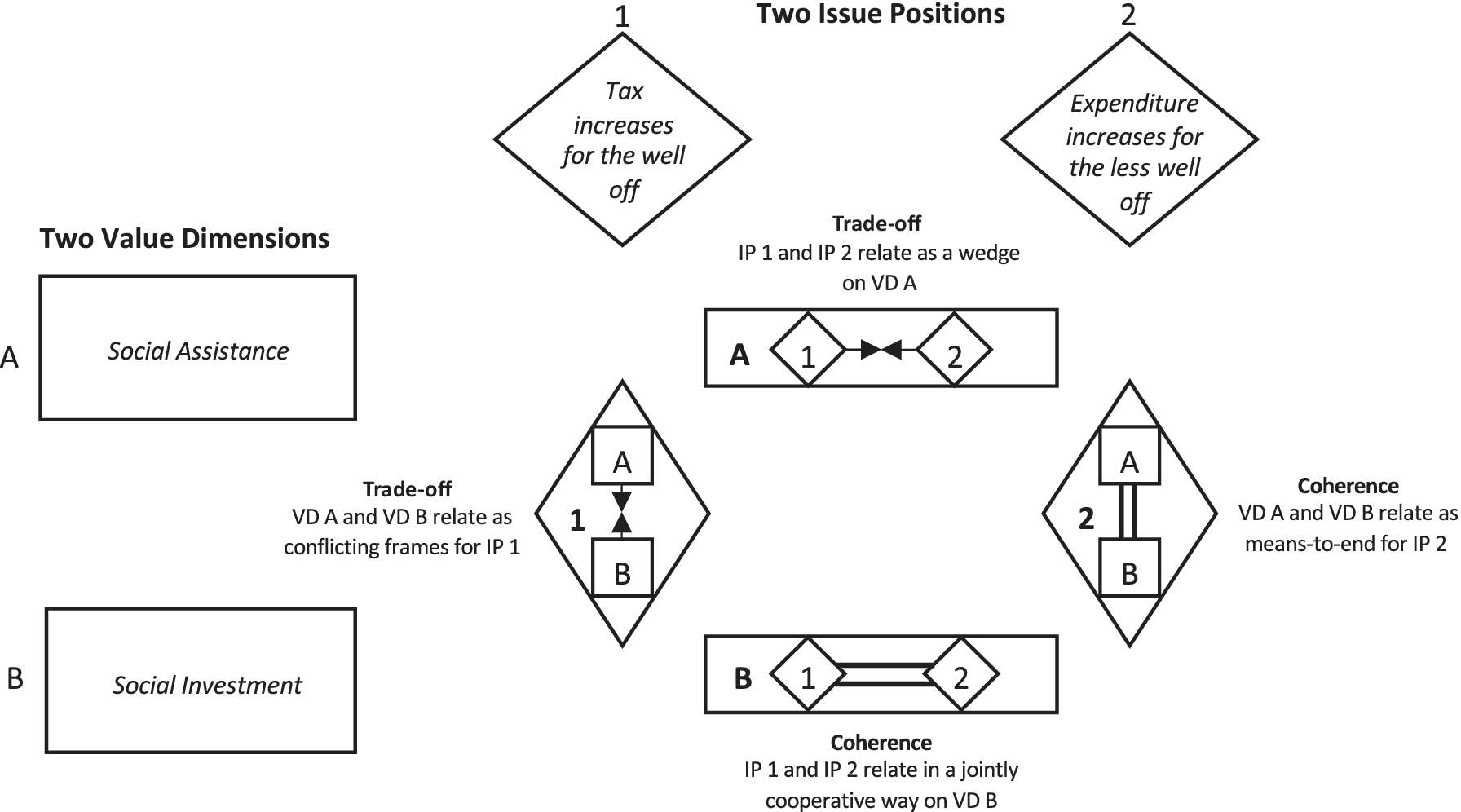
There is a sense in which the two redistributive issue positions, (i) raising taxes on the well-off in order to (ii) increase expenditures for those less well-off, form at best a wedge—a quid pro quo—for the well-off. The well-off are making a payment, a quid, via issue position (i), and potentially benefitting, getting a quo, via issue position (ii), should they themselves ever become less well-off and require Medicaid, housing assistance, and the like. Or, in the case of Social Security, Medicare, or public education, the well-off are paying a comparatively greater quid than those less well-off for the same quo, while benefitting from it comparatively less since they have access to private options. On what might be called the “social assistance” value dimension, issue positions (i) and (ii) pose at best a wedge, a trade-off, for those well-off in their roles as possible program beneficiaries (Medicaid, housing assistance) and income earners (Social Security, Medicare). It’s a quid of increased taxes for a potential or partial quo, which is why, historically, the “social assistance” outreach argument for redistribution has been an uneasy one (Skocpol Reference Skocpol, Jencks and Peterson2001).
But on another value dimension, issue positions (i) and (ii) do not form a quid pro quo for the well-off in which they forgo some value and get even less in return. Instead, issue positions (i) and (ii) cohere in returning all the value the well-off forgo and then even more on top. This is one way of interpreting the “social investment” strand of rhetorical outreach liberals have increasingly been making to upper-income Americans in arguing for redistribution (see, e.g., Morel, Palier, and Palme Reference Morel, Palier and Palme2012). On this “social investment” value dimension, (i) increased taxes for the well-off and (ii) increased expenditures for those less well-off cohere in yielding those well-off a sizeable return in the form of a productive workforce that will generate new added value for the well-off in their roles as wealth holders or employers. “Every employer knows [that] equipping people with employability and skills through education is the foundation to stimulating the economy,” West Virginia Democrat Paula Swearengin (Reference Swearengin2018) declares in arguing for boosting public-school funding in less well-off neighborhoods, “[i]t is an investment that employers can earn back with profit, … paying dividends in the long run.” “Kristi supports Medicaid expansion to keep more Kansans healthy,” says Kansas Democratic legislative candidate Kristi Kirk’s website. “Healthy people are productive. Productive people contribute to our economy. Healthy people = Healthy economy” (Kirk Reference Kirkn.d.).
There is another sense in which issue position (i), increased taxes for the well-off, and issue position (ii), increased expenditures for those less well-off, cohere in generating new value as a social investment for the well-off. Together, the two redistributive issue positions will yield the well-off a return by saving them, in their roles as taxpayers, from having to pay an even greater amount in the long run. “[F]unding [for] early childhood education has been proven,” Kansas Democratic gubernatorial candidate Arden Andersen (Reference Andersen2018) declares, “to be an effective means to combat … dependency on government programs later in life.” “In West Virginia, we have thousands of people in recovery from addiction,” Democratic state senator William Ihlenfeld (Reference Ihlenfeld2018) notes, “[t]he fight to stay sober is incredibly difficult and those who are in the fight need resources to support their long-term recovery. [Otherwise] the likelihood of them reoffending and returning to prison is much greater, thus costing taxpayers even more to pay for incarceration.”
So, on one hand, the two redistributive issue positions, (i) increased taxes for the well-off and (ii) increased expenditures for those less well-off, pose a quid for (at best) a partial or potential quo on the social-assistance value dimension for the well-off in their roles as income earners and program recipients. But, on the other hand, the two issue positions work together in yielding the well-off new value on the social-investment value dimension in their roles as wealth holders and taxpayers.
Nor, crucially, are those two value dimensions, “social assistance” and “social investment,” simply conflicting frames—the first offering a net negative quid pro quo and the second a net positive investment and return—for upper-income Americans to use in evaluating the twin redistributive issue positions. On the contrary, the two value dimensions cohere as subordinate means (social assistance) to a superior end (social investment).
This would be comparatively evident to well-off voters when it comes to one of the two redistributive issue positions, (ii) increased program expenditures for the less well-off. Even the well-off themselves do derive some value from such expenditures on the value dimension of social assistance in their roles as income earners looking forward to Social Security or as potential program recipients should their circumstances change. Any value they derive from those expenditures on the social-assistance dimension is, however, but a means to aid them—a backstop—as they pursue the end goal of becoming entrepreneurs and investors (i.e., wealth holders) and hence benefitting from those increased program expenditures on the value dimension of social investment:
Programs like Social Security and Medicare, as President Obama has argued, actually enable people to reach higher. ‘They free us to take the risks that make this country great.’ [They] encourage more risk taking, entrepreneurship, and job creation … the safety net … backs up people who start businesses (Callahan Reference Callahan2013; see also Hacker Reference Hacker2009; Smith Reference Smith2019).
So yes, the redistributive issue position of (ii) increased expenditures for the less well-off brings some value, on the dimension of social assistance, to the well-off in their capacities as income earners and potential program recipients. But that value is a subordinate one. It’s a stepping stone that enables the well-off to earn far greater returns from those expenditures, as wealth holders and employers, on the superior social-investment value dimension.
And so the well-off should view the other redistributive issue position, (i) increased taxes on the well-off themselves, in the same light. Consider Michael Bloomberg’s argument: “No one likes the imposition of taxes … But devastating the very services that make this the world’s second home is far worse … If you think taxes are too high, I would argue you’re probably a little bit out of step with businesses that are coming here, businesses that are expanding here.”
Bloomberg (Reference Bloomberg2003) argues that if the well-off attempt to preserve value for themselves on the dimension of social assistance by opposing tax increases that involve transfers from them to those less well-off, their doing so would be “far worse,” for them, than their gaining value on the dimension of social investment by allowing those increases. It would be to get things backwards. When it comes to the issue position of tax increases on the well-off, the value dimensions of social assistance and social investment do not conflict as a mere trade-off. Instead they cohere, for the well-off themselves as subordinate means to a superior end.
Or consider an argument advanced by Jim Barnett, a liberal Republican gubernatorial candidate in Kansas. “The number one thing,” Barnett said, is “not taxes, which is what [conservative Kansas Republicans] are talking about; the number one thing is the workforce … . What businesses need is a workforce [via] education [and] health care” (Brooks Reference Brooks2018; see also Arizona Chamber Foundation 2013). Yes, increased taxes represent a loss of value, for the well-off, on the social-assistance value dimension, as they derive only partial or potential value from those increases in their roles as income earners or program recipients. But on the value dimension of social investment, those taxes, in going to health and education services for the less well-off, will generate new value for the well-off in their roles as taxpayers. And that’s not just a competing frame. It’s “the number one thing.”
Figure 8 schematizes redistributive outreach to the well-off.
Redistributive Outreach to the Well-off

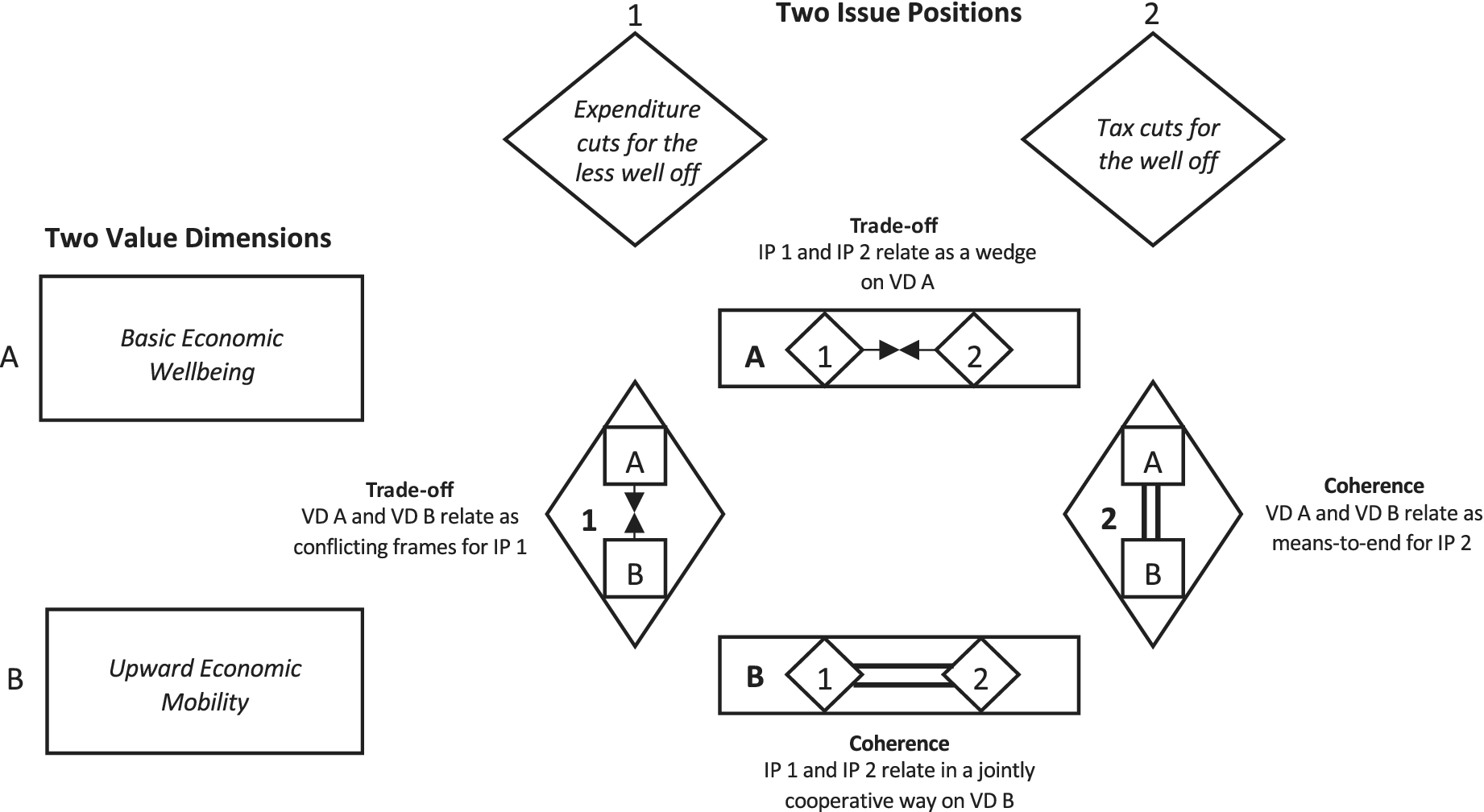
Now consider regressivist outreach to the less well-off on behalf of the twin issue positions of (i) cuts in program expenditures for the less well-off and (ii) cuts in taxes for the well-off. The two form a quid pro quo for the less well-off, a trade-off, on what might be called the value dimension of “basic economic well-being.” Those less well-off are asked to give up some value in terms of basic economic well-being via issue position (i), cuts in expenditures for themselves, in return for gaining some via issue position (ii), cuts in taxes for the well-off. After all, those tax cuts will trickle down to them, in their roles as income earners, via the good jobs the well-off will create.
In making such an argument, regressivists explicitly cast their appeal to those less well-off as a trade-off on the basic economic-well-being value dimension. As one conservative writer (Conard Reference Conard2016, 77) puts it, he is asking the less well-off to “forgo … redistributed income” via (ii) expenditure cuts for themselves in order to gain “value from … investment” in job creation via (i) tax cuts for the well-off. Cuts to social programs are “painful,” Senator Jim DeMint (Reference DeMint2012) conceded, but worth it for those less well-off because cutting “taxes on high earners” will result in “wealth generation” that will benefit low-income earners. A variant, the Laffer Curve argument, claims that the two regressivist issue positions represent a quid pro quo not because of the jobs those tax cuts will create but because of the new tax revenues a growing economy will generate even at lower tax rates. Those less well-off might be giving up some basic economic well-being through expenditure cuts now, but they will get at least some of that value back—in their role as program recipients—in the form of greater government expenditures over time (Smith Reference Smith2009, 111).
In effect, the two regressivist issue positions, (i) expenditure cuts for the less well-off and (ii) tax cuts for the well-off, form a wedge for those less well-off on the “basic-economic-well-being” value dimension. While the less well-off are said to gain some basic economic well-being from (ii) the tax cuts, both as income earners (trickle down) and as program recipients (Laffer Curve), they are asked to pay for it by relinquishing some basic economic well-being via (i) the expenditure cuts. On a second value dimension, though—call it the “upward-economic-mobility” value dimension—both issue positions, tax cuts for the well-off and expenditure cuts for the less well-off, are said to jointly generate value for those less well-off.
Writing about the 1999 Republican tax bill, which would have cut taxes for well-off Americans while imposing spending cuts on those less well-off, a Detroit News columnist argued that “low-income Americans will benefit … because many low-income Americans will become higher-income Americans” (McKenzie Reference McKenzie1999; see also the discussion in Martin Reference Martin2013, 2, 199; Scheve and Stasavage Reference Scheve and Stasavage2016, 207; Schuck Reference Schuck2017, 72; Sowell Reference Sowell1999). To the extent that the less well-off harbor for themselves the value-dimension of upward economic mobility—to the extent that they identify as future or even current members of the well-off—then tax cuts for the well-off and expenditure cuts for the lesswell-off alike cohere in generating value for them. “[W]orking-class voters support tax cuts for the rich and benefit cuts for everyone else,” as Joan C. Williams (Reference Williams2017) writes, “[b]ecause the white working class resents programs for the poor, [and] to the extent that benefit cuts target the poor, that’s attractive” (see also Hochschild Reference Hochschild2016, 70). The twin regressivist issue positions of expenditure cuts for the less well-off and tax cuts for the well-off, which form at best a trade-off for the less well-off on the value dimension of their basic economic well-being, cohere in generating value for them on another value dimension they harbor: their upward economic mobility. So regressivists argue.
Nor, crucially, are those two value dimensions, their basic economic well-being and their upward economic mobility, simple reframes—one a negative frame, the other a positive frame—for the less well-off to use in evaluating the twin regressivist issue positions. The two value dimensions do not pose a trade-off but rather cohere, their basic economic well-being ultimately but a means to their upward economic mobility.
This means–ends relationship is made particularly clear on one of the two regressivist issue positions, tax cuts for the well-off, where the two value dimensions are both positive frames for the less well-off. Those tax cuts promote the value of basic economic well-being for the less well-off, as income earners, via the jobs they create. But that is just a stepping stone, a means, toward the end value of the less well-off then benefiting from those tax cuts as taxpayers themselves due to the ensuing upward economic mobility they will enjoy. As Marco Rubio (Reference Rubio2013) says, tax cuts not only “create new middle class jobs,” they “create new taxpayers” who will then reap value from those lower rates as wealthier taxpayers.
The Niskanen Center’s Samuel Hammond (Reference Hammond2019) makes this point explicit in his pitch, directed at lower-income Americans, for tax cuts for the wealthy. What matters about the “Tax Cuts and Jobs Act” is not so much the jobs the well-off would create for those less well-off but the fact that “people move in and out of top income percentiles all the time.” Yes, the less well-off will benefit, in an indirect, trickle-down way, from tax cuts for the well-off in their roles as income earners on the value dimension of basic economic well-being. But they do so to the end of their ultimately directly benefiting from those tax cuts for the well-off, as taxpayers themselves, on the value dimension of upward economic mobility.
The issue position of tax cuts for the well-off, then, allows regressivists to argue that the subordinate or means value dimension for the less well-off is their basic economic well-being, while the superior or end value dimension is the upward economic mobility to which that basic economic well-being is a stepping stone. Therefore, where a sacrifice on the subordinate value dimension of basic economic well-being is necessary to make an advance on the superior value dimension of upward economic mobility—as with the regressivist issue position of expenditure cuts for the less well-off—that’s what should be indicated. Cutting “government programs that drive the debt,” Paul Ryan (Reference Ryan2011) says, “is a means to a greater end: a prosperous, growing economy … defined by upward mobility.” Or as Ted Cruz (Reference Cruz2013) puts it,
Republicans should conceptualize and articulate every domestic policy with a single-minded focus on easing ascent up the economic ladder. We should assess policy with a Rawlsian lens, asking how it affects those least well-off among us. [And on this score] widespread economic redistribution … rarely helps the recipients of government largess. Free-market policies expand opportunity … especially for those working to climb the economic ladder.
When it comes to expenditure cuts for the less well-off, the value they sacrifice on the basic-economic-well-being dimension in their roles as program recipients and the value they reap on the upward-economic-mobility dimension as future wealth holders do not relate as an unfortunate trade-off. Rather, they cohere as means to ends. Figure 9 displays the structure of regressivist outreach to the less well-off.
Regressivist Outreach to the less Well-off

When redistributive outreach to the well-off is considered together with regressivist outreach to the less well-off, the discursive structure of bridging emerges in a further variant. Unlike the health-care case, which involves two sides trying to reach bipartisan consensus on one pair of issue positions, the redistributive/regressivist case features two sides each trying to reach out to supporters of the other, offering two competing pairs of issue positions in doing so.
But the redistributivist/regressivist case departs from the health-care case in yet another way. The health-care case involves two very divergent pairs of value dimensions, one for Democrats and the other for Republicans. Democratic Problem Solvers appealed to their co-partisans by subordinating the means dimension of maximizing coverage to the end dimension of creating a universal public system. Republican Problem Solvers did so by subordinating the means dimension of minimizing government involvement to the end dimension of expanding market incentives. The redistributive/regressivist case, by contrast, involves each side reaching across to supporters of the other. And, accordingly, it displays two convergent pairs of value dimensions.
Consider redistributive outreach to the well-off. Here, on the means value dimension—the value dimension of social assistance—the well-off are appealed to in their roles as income earners (Social Security) and potential program recipients (Medicaid). When, however, it comes to the end value dimension, the value dimension of social investment, they are appealed to instead in their roles as wealth holders and taxpayers. Likewise with regressivist outreach to the less well-off. It is on the means value dimension, the value dimension of their basic economic well-being, that the less well-off are appealed to in their roles as income earners (trickle down) and program recipients (Laffer Curve). And it is on the end value dimension, the value dimension of their upward economic mobility, that they are then appealed to in their roles as taxpayers and future wealth holders.
There exists a convergence between the redistributionist and regressivist value dimensions. And this makes sense. While health-care outreach was directed toward divergent partisans who see the country’s present and its future very differently, regressivist and redistributivist outreach are directed to the less well-off and the well-off precisely insofar as they see themselves on the same present-to-future timeline. The value that comes from being an income-earner or a program recipient, for the well-off as for the less well-off, is but a subordinate means to the superior end of enjoying value as a wealth holder or a taxpayer: according to redistributivist and regressivist outreach alike.
Conclusion
The debates I have examined involve partisans on one side of the spectrum reaching out to those who are less moderate on their own side, or partisans doing so jointly with partisans on the other side in order to form a bipartisan consensus, or partisans reaching out to traditional supporters on the other side in order to expand their tent. The bridging discursive pattern they together reveal suggests itself as a phenomenon analogous to wedges and frames. Indeed, it is structured so as to overcome them and hence is a fitting major variable for future empirical analysis, whether to test its effectiveness with target audiences or the circumstances under which it is used, just as wedges and frames have been.
Measuring the persuasiveness of political rhetoric is a much-discussed topic, with a variety of approaches having been suggested (for a good overview see Mutz, Sniderman, and Brody, Reference Mutz, Sniderman, Brody, Mutz, Sniderman and Brody1996), all of which lend themselves to the bridging discursive structure I have examined. Certainly, persuasive success comes in many forms other than winning elections or votes; it comes as well with the broader and less explicit shifts in opinion that experimental and survey research are able to measure (see, e.g., Steiner Reference Steiner2012, 151). Future research might also consider, given the typology I have developed here—one pair of issue positions and one pair of value dimensions, one pair of issue positions and two pairs of divergent value dimensions, two pairs of issue positions and two pairs of convergent value dimensions—whether other variations on the theme exist, either as hybrids or beyond these possibilities, and how persuasively successful each might be and under what circumstances.Footnote 5
Here, I have undertaken the kind of study Rogers Smith (Reference Smith1988, 90) describes when he speaks of the need for “qualitative studies of the patterns of reasoning characteristic of various strains of … discourse.” Such studies, Smith says, constitute independent “investigations into one dimension of political conduct—a dimension that needs to be assessed like any other if we are to build up a comprehensive empirical portrait of political life.” The attempt to take two issue positions that conflict on one value dimension and create a bridge between them by placing them on a second value dimension where they cohere in a joint venture—and, simultaneously, to take two value dimensions that conflict on one issue position and create a bridge between them by showing how they cohere as means and ends for a second issue position—suggests itself as a discernible form of American political outreach. It is a way of overcoming the trade-offs involved in wedges and reframing. If not yet a norm, it is an ideal to which many political actors seem to commonly aspire in an otherwise polarizing era, and a guide for those who seek to build bridges in a highly partisan age.



Comments
No Comments have been published for this article.