Introduction
Is suicide a unique individual event? It is certainly usually an individual act. However, suicides are not random acts. Such deaths are grounded in the individual who exists within an ecological structure, and this societal structure has its own determinants and commonalities. This paper examines the nature of these societal determinants on death by suicide within the context of deaths by suicide during the years 2005–2011 (inclusive) in Northern Ireland.
The relevance of an area (context) effect has been well demonstrated across a range of health outcomes, example lip cancer (Clayton & Kaldor, Reference Clayton and Kaldor1987), chronic illness (Jones & Duncan, Reference Jones and Duncan1995), birth weight (Pearl et al. Reference Pearl, Braveman and Abrams2001; Rauh et al. Reference Rauh, Andrews and Garfinkel2001), diabetes (Chaix et al. Reference Chaix, Billaudeau, Thomas, Havard, Evans, Kestens and Bean2011). The number of deaths from suicide in Scotland (1981–1983 and 1991–1993) has shown a more marked differential between areas with the least and most deprivation (Boyle et al. Reference Boyle, Exeter, Feng and Flowerdew2005). In addition, Congdon (Reference Congdon1996), Congdon (Reference Congdon2013), Whitley et al. (Reference Whitley, Gunnell, Dorling and Davey Smith1999) and Gunnell et al. (Reference Gunnell, Wheeler, Chang, Thomas, Sterne and Dorling2011) have shown strong associations between rates of suicide and levels of deprivation.
Invariably, these area effects have been demonstrated with multilevel models. Studies where area deprivation has been included as a covariate at the individual level have frequently shown that area-level deprivation did not indicate a statistically significant result (Neeleman & Wessely, Reference Neeleman and Wessely1999; O'Reilly et al. Reference O'Reilly, Rosato, Connolly and Cardwell2008). A discussion of the issues involved with the analysis of area (ecological) level and that of the individual level in this choice of analysis can be found in Subramanian et al. (Reference Subramanian, Jones, Duncan, Kawachi and Berkman2003).
The importance of economic stressors, such as personal debt, unemployment and financial crisis on suicidal ideation has been demonstrated in a range of research papers (Platt & Hawton, Reference Platt, Hawton, Hawton and van Heeringen2000; Jenkins et al. Reference Jenkins, Bhugra, Bebbington, Brugha, Farrell, Coid, Fryers, Weich, Singleton and Meltzer2008; Meltzer et al. Reference Meltzer, Bebbington, Brugha, Jenkins, McManus and Dennis2011). In addition, economic stressors often covary with particular medical conditions in terms of suicidal ideation. It is the combination of these stressors which increases the risk of suicidal intent and behaviour (Nock et al. Reference Nock, Borges, Bromet, Alonso, Angermeyer, Beautrais, Bruffaerts, Chiu, de Girolamo, Gluzman, de Graaf, Gureje, Haro, Huang, Karam, Kessler, Lepine, Levinson, Medina-Mora, Ono, Posada-Villa and Williams2008), and it is likely that on average those in poorer neighbourhoods face the greatest combination of stressors and with the least resources to do something about them.
The current analysis does not set out to partition variance explained at the different levels, but to indicate the importance of economic well-being as a major contributory factor to personal and social well-being. The explanation is offered in terms of standardised mortality ratios (SMRs) at the area level.
In Durkheim's view, the different expressions of religion such as Judaism, Catholicism and Protestantism could have consequences for individualistic acts such as suicide. Conversely, where the influence of social control as exercised by the family, religion or politics is weakened, then rates of suicide would be higher. For a critical evaluation of deaths by suicide from Durkheim's theoretical perspective, within the context of the Northern Irish society, see Tomlinson (Reference Tomlinson2012). There is some evidence that community religiosity can assist in the development of a moral socialisation and integration, and act as a buffer against suicide (Maimon & Kuhl, Reference Maimon and Kuhl2008). However, when Maimon and Kuhl examined this in the context of major denominations they found, like Pescosolido & Georgianna (Reference Pescosolido and Georgianna1989) before them, that the inclusion of different denominations did not have a significant effect on suicidality.
Deaths by suicide have frequently have been shown to occur with a greater frequency in the 35–50 age groups (Scowcroft, Reference Scowcroft2017). In this report, by Scowcroft, from the Samaritans, the number of deaths by suicide per 100 000 in England is 15.4, in Wales 21.0, Scotland 18.5 and Northern Ireland 26.0.
This study examines area variation in SMRs for deaths by suicide in Northern Ireland over a 7-year period. How large are these area effects in terms of SMRs within the society? A number of explanatory variables are examined as determinants of area-level SMRs: (1) area-level deprivation, (2) the religious composition of the area and (3) differential effects of age.
Method
Data
The current database was compiled by C.C. from records held in the Northern Ireland Coroner's office. Approval was provided by the then Senior Coroner Mr John Leckey and the then Presiding Coroner Lord Justice Weir, with the permission of the Lord Chief Justice for Northern Ireland The Right Honourable Sir Declan Morgan, Lord Chief Justice of Northern Ireland.
The current dataset contains information relating to deaths by suicide over a 7-year period (2005–2011). In order to conduct an analysis at an area level of aggregation, deaths by suicide were combined at the various area levels using figures obtained from the Northern Ireland Statistics and Research Agency (NISRA) website, for 2010. The population of Northern Ireland can be divided into Local Government Districts (LGDs) and Wards (amongst others) area subdivisions, and these can be further subdivided usually by gender and age.
At the time of the data collection, there were 26 LGDs within Northern Ireland before the recent re-organisation, which resulted in 11 new LGDs. The current analysis is based on the 26 LGDs. Northern Ireland's 582 Wards vary greatly in population size from fewer than 800 residents to more than 9000. The expected number of deaths was obtained by applying the Northern Ireland-wide rates to the area population.
The Northern Ireland Multiple Deprivation Measure (2010) comprises 52 indicators, which are grouped within seven different domains, with each domain being given a separate weight: (income deprivation 25%; employment deprivation 25%; health deprivation and disability 15%; education, skills and training deprivation 15%; proximity to services 10%; living environment 5% and crime and disorder 5%). In the current study, the combined index was used.
Deaths from suicide in Northern Ireland showed a marked increase from 2005. This may in a large part be due to an administrative reorganisation that took place. Prior to this period, there were six Coroners’ Offices, one in each county. From 2004, these were all amalgamated into one office in Belfast. The current data are based on the reported date of death, rather than the registered time of death.
Analysis
The data are represented as counts within a given location (LGDs, Wards), and this can include zero events; and a Poisson regression strategy has been used, within a multilevel structure. A Poisson model in conjunction with empirical Bayes prediction was used to obtain SMRs for different locations using GLAMM software in STATA (Rabe-Hesketh et al. Reference Rabe-Hesketh, Skrondal and Pickles2004; Skrondal & Rabe-Hesketh, Reference Skrondal and Rabe-Hesketh2004). SMRs are defined as the ratio of the number of suicides to the expected number of suicides. In the current data, the Northern Ireland population figures for 2010 have been used as the standard population. The number of deaths over a period of 7 years (years) was 1653, and the population was taken as 1 773 800. The Bayesian approach has a number of advantages in the current context, not least than the flexibility in terms of modelling strategy. In addition, the method is more appropriate where the number of deaths in an area may be small in number, and with the nature of the current data, this is a substantial problem. Further, the current approach allows us to take account of the potential distorting effects of clustering within the data. The standard errors are based on the use of a sandwich estimator, which takes into account the potential dependencies within the counts (spatial correlations).
Results
Deaths by LGDs (adjusted for population size)
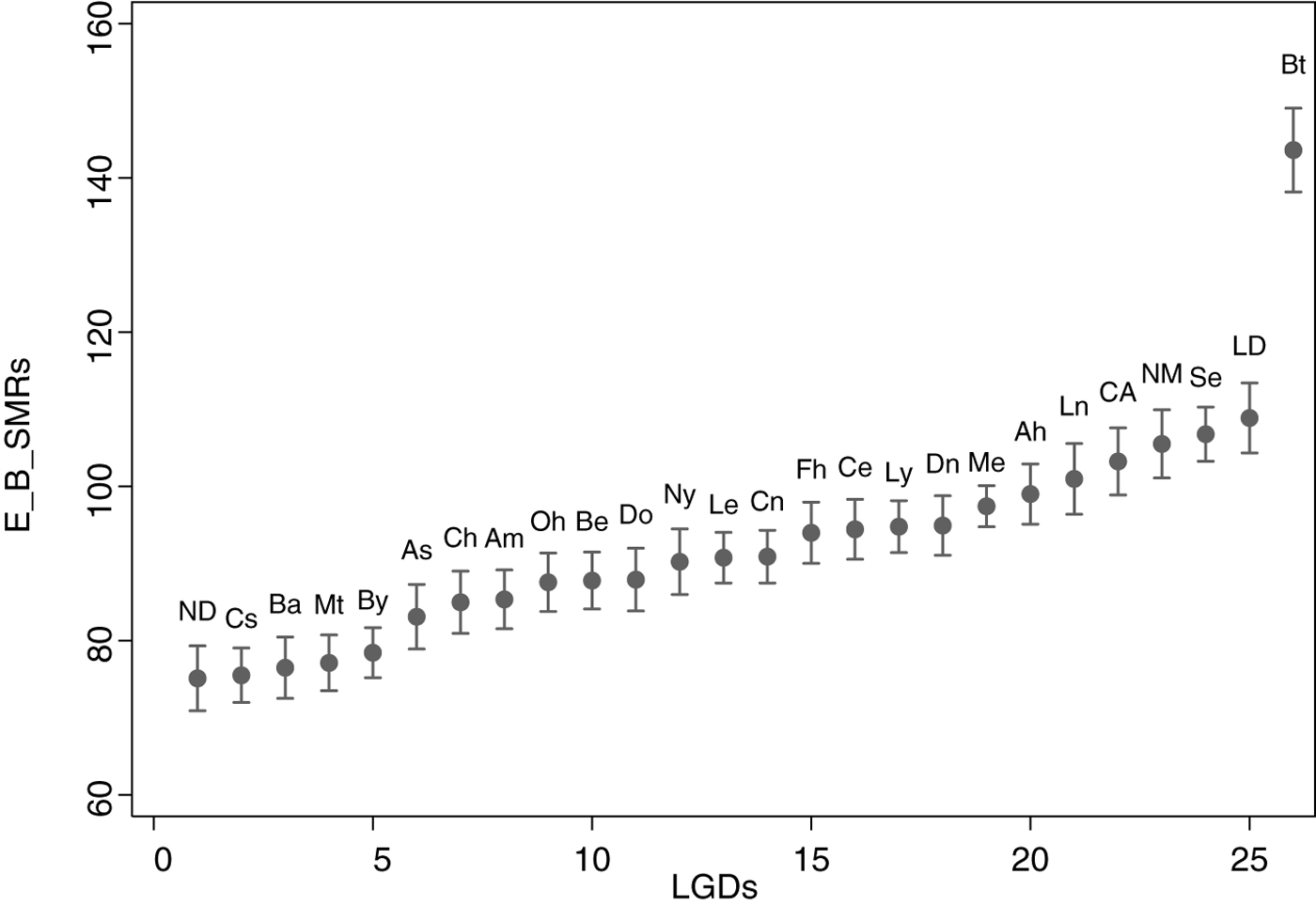
There is a discernible pattern of deaths when the analysis is at the level of the LGD (Fig. 1). A number of LGDs can be seen to have 20% less deaths by suicide than the overall average; i.e. those below the value of 80 on the horizontal axis. For every five deaths by suicide (during the past 7 years), one less occurred within this cluster of areas than the Northern Ireland average. If the figures from these areas were generalised to the average number of deaths within a LGD, then some 330 fewer deaths would have occurred, over this 7-year period. At the other end of the continuum, Belfast has over 40% more deaths by suicide than the Northern Ireland average (calculations based on LGDs). If during the past 7 years, the Belfast rate had occurred across Northern Ireland, the society would have been faced with over 660 more deaths by suicide, approaching an extra 100 deaths per year.
Empirical Bayes standardised mortality ratios for the 26 Local Government Districts (LGDs) in Northern Ireland. Notes: LGD names are as follows. North Down (Nd), Carrickfergus (Cs), Ballymena (Ba), Magherafelt (Mt), Ballymoney (By), Ards (As), Castlereagh (Ch), Antrim (Am), Omagh (Oh), Banbridge (Be), Down (Do), Newtownabbey (Ny), Larne (Le), Cookstown (Cn), Fermanagh (Fh), Coleraine (Ce), Limavady (Ly), Dungannon (Dn), Moyle (Me), Armagh (Ah), Lisburn (Ln), Craigavon (CA), Newry&Mourne (NM), Strabane (Se), Derry/Londonderry (LD) and Belfast (Bt).

Deaths by Wards
Within Northern Ireland, there are 582 Wards. Over a period of 7 years (2005–2011), records of 1653 deaths were obtained from the Northern Ireland Coroner's Office. In 79 Wards, no deaths were reported, and in 422 Wards (73%), less than three deaths were recorded. The remaining 160 Wards (27%) had deaths ranging from 4 to 25 (Table 1).
Number of deaths, unadjusted for the number of individuals, within each of the 582 Wards

Empirical Bayes SMRs
The recorded number of deaths within an area, from any cause, will be influenced by a number of factors, and not least amongst these will be the number of individuals living in the designated area. Within this analysis, an adjustment has been made for the number of individuals within a specified Ward. SMRs were calculated for each Ward: where the SMR is defined as the ratio of the number of suicides to the expected number; and in the current analysis this is based on the premise that the expected number of deaths in any Ward is equal to that in the general population (Northern Ireland) (Table 2).
Empirical Bayes standardised mortality ratios for the 582 Wards in Northern Ireland

Note. Robust standard errors.
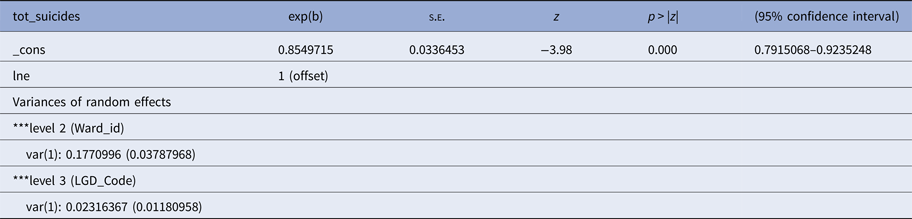
The exponent of the intercept (cons) value indicates that the average number of deaths by suicide within Wards, over this 7-year period, has been 2.35. The random coefficient for the LGD shows that once the effect of the Wards has been taken into account, here as a random coefficient, that the variance between the LGD is small when compared with the standard error. However, there is substantial random variation present between the Wards.
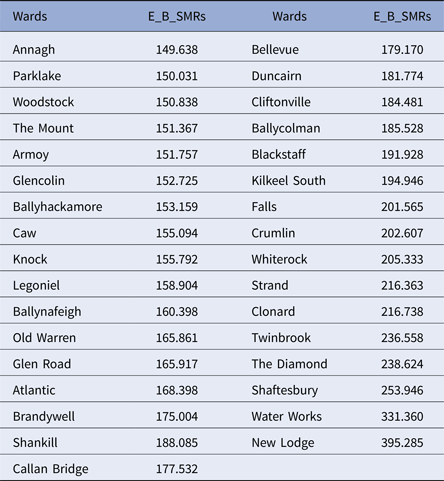
The estimated SMRs indicate that 33 of the 582 Wards (6%) had at least 50% more deaths than the background average in the society (see online Supplementary Appendix 1 for a map of deaths by Wards in Northern Ireland) (Table 3).
Empirical Bayes standarised mortality ratios for Wards where the predicted value exceeded a 50% increase in deaths over the average expected value in Northern Ireland

Area deprivation has a strong association with the number of deaths occurring in a location. With the average rate of deaths in the society set at 100 for the SMRs, it is evident from the results in Fig. 2 that nearly all of the 200 most deprived Wards had deaths above the societal norm. It is equally evident that very few Wards above the 200 most deprived had deaths above the societal average. The number of deaths by suicide increases dramatically in areas with the highest levels of deprivation, controlling for the percentage of Catholics living in a Ward.
Plot showing the relationship between the Empirical Bayes standardised mortality ratios and Ward deprivation.

Random intercept model with covariates for deprivation and religion
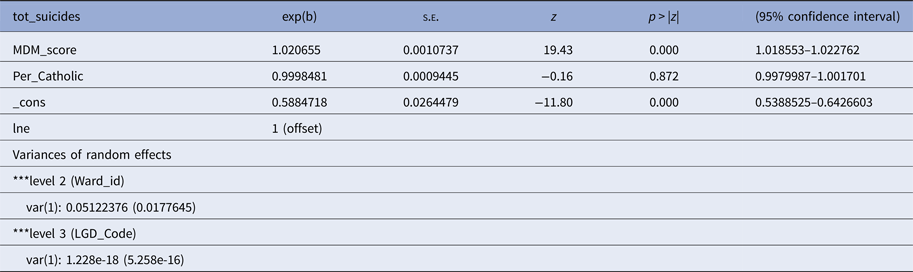
A second possible explanation, at the Ward level, for the number of deaths that are reported could be that of religion. Within Northern Ireland, a high degree of religious segregation is in place. This segregation by religion within areas may have consequences for group solidarity, social norms and social cohesion. Area deprivation and the religious composition of an area have a moderate level of association (0.36). In order to assess if the percentage of Catholics living in an area was associated with the number of deaths by suicide over and above the effects of deprivation, both variables were included as possible area-level-associated measures in terms of the area SMRs (Table 4).
Random-intercept Poisson model as a predictor of the empirical Bayes SMRs, using area deprivation and the percentage of Catholics living in an area as explanatory measures

Note. Robust standard errors.
The result indicates that only deprivation has explanatory power in terms of SMRs. In the current analysis, LGDs and Wards have been included as random effects. From the variance and standard errors shown in relation to LGD, it is evident that the differences between these LGDs can be explained by the inclusion of information regarding Wards. This was further confirmed in a separate analysis where LGDs were included within the model as a fixed effect for all 26 LGDs. The results showed no statistical difference (0.05 level) between the number of deaths occurring at the LGD level once an adjustment for population size, Ward and deprivation was included within the model.
The exp (0.5884718 + 1.020655) = 4.998 indicates that one-unit shift in deprivation was associated with a change in the standardised mortality ratio of five units. The multiple deprivation scores ranged from 1.43 to 83.33, with a mean value = 21.59 and standard deviation = 19.95.
The results indicated that the number of deaths recorded (exp 1.02 = 2.77), controlling for the other variables in the model, indicated that SMRs were increased by nearly three points for every one-unit change in deprivation. The deprivation score ranged from 1.43 to 83.33 between Wards.
Random intercept model with covariates for age, deprivation and religion
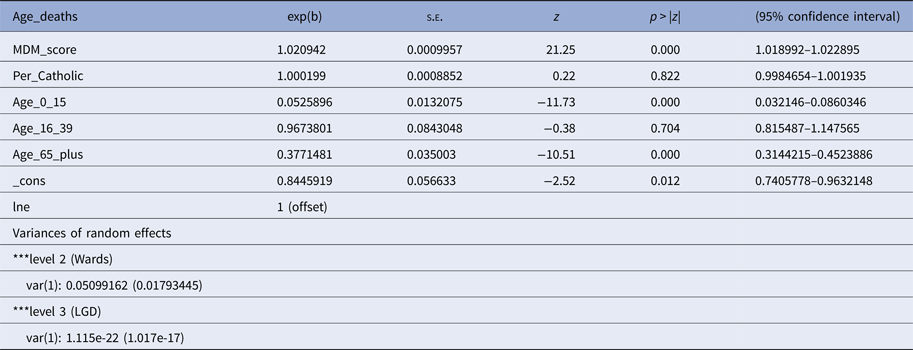
In order to test the effects of age, the data were restructured, so that deaths within each Ward were divided into four age categories (582 × 4 = 2328), and in this case, the number of individuals within each age group was used as the offset. This had little consequence for the effects of deprivation or religion on SMRs. However, for age, the results indicate that the number of deaths amongst those in the 16–39 age group was similar to that occurring in the 40–64 age group once the number of individuals in both age groups had been controlled. It is also apparent that fewer deaths were occurring, as might be expected based on governmental-level data, in the very young age group and in the older population (Table 5).
Random-intercept Poisson model as a predictor of the empirical Bayes SMRs, to test age classification while using area deprivation and the percentage of Catholics living in an area as explanatory measures

Note. Robust standard errors.
Discussion
The fraction of the population who died over this 7-year period, given the 2010 population size, was close to one in every 1000 individuals in the society. However, these deaths were far from equally distributed across the population. From an examination of the LGDs, it appears that the larger urban areas of population were most affected, and in particular Belfast. This was followed by a number of other largely urban areas. The difference between these LGDs can be explained in terms of deprivation, since once the area deprivation level was controlled, the statistical differences (0.05 level) between the LGDs was no longer present. This powerful effect of deprivation indicates the importance of economics in deaths from suicide, but since these are area-aggregated data, it is not reasonable to take this as a proxy for what is happening at the level of the individuals (ecological fallacy).
Indeed, once the area of aggregation moved to the Ward level, the importance of the LGDs has little explanatory power, since the Wards are a more sensitive marker for both deaths by suicide and deprivation. Thirty-three Wards with deaths from suicide had an excess of 50% more deaths above the societal average. This is <6% of Wards with this level of access deaths. Seventy per cent of the 33 Wards listed in Table 3 were in the top 100 areas as ranked in terms of the Multiple Deprivation Measures (MDM). This indicates an important association between deprivation and the measure of SMR, but one that is far from perfect, thus showing a potentially unique effect at the Ward level. Of course this is a partial picture, as it only relates to 33 of the possible 582 Wards. Without an adjustment for deprivation or any other explanatory variable, the average number of deaths by suicide within Wards, over this 7-year period, has been 2.35. A small number of Wards had between two and four times this societal expected value, though this is a relatively small number of Wards (N = 10; 2%). Seventy-nine (14%) of the Wards had no deaths within the same period. It is therefore apparent that the excess in deaths during this 7-year period is highly concentrated in a small number of areas.
There are certain characteristics of the areas with a high number of deaths, though without the data for all areas this is speculative; nevertheless, the areas with the highest SMRs are largely in locations with a high proportion of the housing in the private sector rented, which may indicate a more transient population. However, many of the areas with at least twice the expected number of deaths are areas with much public housing. These are issues that require further investigation.
Suicide and religion have been much discussed since Durkheim's influential work entitled ‘Suicide’ was published in Reference Durkheim, Spaulding, Simpson and Simpson1897. If area deprivation is ignored, then religion has some impact as an explanatory measure, because in a society such as Northern Ireland, given its political history, religion and deprivation are related. However, in the present analysis, once deprivation is included within the model, the effect of the area's religious composition is no longer statistically significant and the effect of deprivation is shown to be very strong. The results indicated that the number of deaths recorded (exp 1.02 = 2.77), controlling for the other variables in the model, indicated that SMRs increased by nearly three points for every one-unit change in deprivation.
Given the current data, it was possible to address the issue of age cohorts and deaths by suicide, within broad age groupings. This was done using four age bands, with those in the 45–64 age group being used as the reference category. Again adjustments for the number of individuals within each of the age groups was undertaken, as it is obvious that if more young people are in the society then, if all else was equal, it would be reasonable to expect that more deaths would occur amongst younger individuals, but it may not be a higher proportion of younger people than those in the older age group. Once the number of individuals in each age category was controlled, no difference was seen between those in the 16–39 age group and those in the 40–64 age group. Not unexpectedly, fewer deaths occurred amongst those in the very young age group and amongst those in the oldest age group. Deaths from suicide are occurring with about the same level of frequency across all age groups from 16 to 64 years.
Limitations
Within the current dataset, it is not possible to address how the social context might influence the data. Who is it that dies by suicide within an area? It is possible that in some areas with a high number of deaths by suicide, many of these individuals have come from other locations, or their actions may have been influenced by others in the vicinity. The social context, of access to relevant types of work, housing, greater exposure to threats to physical and mental health and historical disadvantage can be perceived and understood differently in different locations. Nevertheless, it is obvious that places are different, and the ‘choices’ made to live in one location against another come, in part, with a given view of oneself and the world. The disaggregation of these contextual factors from individual compositional factors of income, work experience, living arrangements and physical and mental health have not been examined, in part because this would require a much larger sample, due to the small number of event counts within a substantial number of Wards. In addition, as pointed out by a reviewer of an earlier draft of this paper, future researchers should examine ‘… how integrated a person feels within his ecological context and the impact of this integration on his well-being’. This suggestion has implications for sampling strategies, if the ecological context is to be taken more seriously.
Seventy-eight per cent of the sample were men. Consideration was given to doing the analysis separately for females and males, but given that the number of deaths in many areas was small, separate analyses were not done as this would have had consequences for the reproducibility of the results.
A significant challenge is the issue of neighbourhood v. community. The current study has used Wards as a key area designation. This has considerable advantages since Local Government Elections are based on this area of designation and hence some common political identification is established. A key advantage in using the Wards is that it is possible to adjust for the number of people living in this designated area. Within Northern Ireland, Wards vary in size from 800 to around 9000 residents, and it is important to have adjusted for the number of individuals living in a given area. Location matters, but the boundaries of these locations will come down to different types of indicators depending on the individuals concerned and without much greater detail of the context within which each Ward or area exists this separation of neighbourhood from community will remain a substantial challenge.
Supplementary material
The supplementary material for this article can be found at https://doi.org/10.1017/S0033291717003026.