Introduction
According to the resource-based view (RBV), resources such as knowledge and technology are bases for formulating unique value-creation strategies and related activity systems that are applied to specific markets and customers in a unique manner. From such strategies and activity systems, sustainable competitive advantages can be obtained by implementing new value-creation strategies that are difficult for competitors to imitate (Conner & Prahalad, Reference Conner and Prahalad1996; Lane, Salk, & Lyles, Reference Lane, Salk and Lyles2010). In practice, enterprises often acquire such knowledge and technological resources through means such as independent research and development (R&D), technological alliances, and technological mergers and acquisitions (M&As) (Fernández, Triguero, & Alfaro-Cortés, Reference Fernández, Triguero and Alfaro-Cortés2019; Rodríguez & Jesus Nieto, Reference Rodríguez and Jesus Nieto2016). The resources are also combined with enterprises' existing available resources, which enables technological M&As to develop into an important means of improving firms' innovation ability (Bauer, Matzler, & Wolf, Reference Bauer, Matzler and Wolf2016; Graebner, Reference Graebner2004; Jo, Park, & Kang, Reference Jo, Park and Kang2016). However, with regard to obtaining competitive advantages for enterprises in dynamic environments, dynamic capability theory can make up for the deficiencies of the RBV with respect to dynamics and uncertainties of environment. Scholars have pointed out that enterprises can realize their values in the process of resource integration, relocation, and resource acquisition and release (Peng & Lin, Reference Peng and Lin2019; Teece, Pisano, & Shuen, Reference Teece, Pisano and Shuen1997). According to this view, technological M&As are an important means by which to redeploy resources to more efficient business processes (Berchicci, Reference Berchicci2013; Fernández, Triguero, & Alfaro-Cortés, Reference Fernández, Triguero and Alfaro-Cortés2019; Jo, Park, & Kang, Reference Jo, Park and Kang2016). Thus, this study assesses firms' innovation performance following technological M&As, and provides a theoretical and realistic basis for the validity of resource matching and combination.
Innovation is the source of enterprises' sustainable operation, and a necessary condition for maintaining competition and long-term development (Aliasghar, Rose, & Chetty, Reference Aliasghar, Rose and Chetty2019; Hamidi & Gabrielsson, Reference Hamidi and Gabrielsson2017; Rodríguez & Jesus Nieto, Reference Rodríguez and Jesus Nieto2016; Zobel, Reference Zobel2017). In face of intense competition and complicated science and technology, enterprises find it difficult to maintain and enhance their competitiveness by relying only on independent R&D (Vermeulen & Barkema, Reference Vermeulen and Barkema2001). Thus, enterprises generally obtain technological resources required for development through means such as M&As (Aliasghar, Rose, & Chetty, Reference Aliasghar, Rose and Chetty2019; Bauer et al., Reference Bauer, Matzler and Wolf2016; Fernández, Triguero, & Alfaro-Cortés, Reference Fernández, Triguero and Alfaro-Cortés2019; Jo, Park, & Kang, Reference Jo, Park and Kang2016). Scholars have proposed two different views regarding the influence of technological M&As on innovation performance (Jo, Park, & Kang, Reference Jo, Park and Kang2016; Ma & Liu, Reference Ma and Liu2017). Dezi, Battisti, Ferraris, and Papa (Reference Dezi, Battisti, Ferraris and Papa2018) integrated relevant studies on the relationship between M&As and innovation from 2012 to 2017 in a systematic literature review, and identified five different types of M&As. Among these, ‘M&As as R&D’ place more emphasis on enhancing the internal knowledge base and process of innovation, which indicates that M&As provide a suitable setting to examine how utilizing open innovation affects reconfiguration of the firm's core technological portfolio. Technological M&As can redeploy firms' technological assets and enhance the probability of enterprises crossing the innovation threshold (Cefis & Marsili, Reference Cefis and Marsili2015). With respect to the allocation of enterprises' technological resources and the organizational motivation mechanism, some scholars believe that the interaction between technological resources and complementary resources can enhance innovation performance (Cefis & Marsili, Reference Cefis and Marsili2015; Ma & Liu, Reference Ma and Liu2017; Valentini, Reference Valentini2016). However, some scholars hold the opposite opinion, believing that target firms and acquiring firms tend to ignore the input in R&D due to changes in technological resources and similarities (Hoskisson, Hitt, & Hoskisson, Reference Hoskisson, Hitt and Hill1993; Olivier, Bertrand, and Pluvia, Reference Bertrand and Zuniga2006). Regarding the knowledge bases of acquiring and target firms, Ahuja and Katila (Reference Ahuja and Katila2004) indicated that the correlation of knowledge bases of acquiring firms with those of target firms during technological M&As has a nonlinear effect on innovation performance. Thus, not all enterprises can improve their R&D abilities through technological M&As.
Nevertheless, in relevant studies on strategic management, knowledge management, and organizational learning, a high degree of knowledge compatibility facilitates the integration of external knowledge and the internal knowledge base (Lee, Shin, & Kim, Reference Lee, Shin and Kim2019). When heterogeneity among this knowledge is too high, enterprises may have to pay more to integrate the knowledge and resources acquired through the technological M&As into the development of core competences. Resource-based heterogeneity not only gives rise to individual heterogeneity among enterprises, but also drives differences in enterprises' competitiveness (Arikan & Knoben, Reference Arikan and Knoben2014; Tang & Naumann, Reference Tang and Naumann2016). Dynamic capabilities remain relevant from an organization's establishment through its development, and rely on specific paths and particular resource bases (Peng & Lin, Reference Peng and Lin2019; Teece, Pisano, & Shuen, Reference Teece, Pisano and Shuen1997). Enterprises own various financial resources, management abilities, and matched equity structure and governance structure, which influence their innovation performance following M&As. However, although studies on the effect of technological M&As on innovation performance have focused on the actions of technological M&As, types of M&As, knowledge bases of acquiring and target firms, and so on (Ahuja & Katila, Reference Ahuja and Katila2004; Makri, Hitt & Lane, Reference Makri, Hitt and Lane2010; Cloodt, Hagedoorn & Van Kranenburg, Reference Cloodt, Hagedoorn and Van Kranenburg2006), the influence of the acquiring firms' characteristics on M&A performance remains under-researched. Thus, this study discusses the different impacts caused by acquiring firms' heterogeneity on innovation performance.
From the point of view of dynamic capabilities, the identification and internalization of knowledge by the acquiring firms in the process of M&As will change the value generated from technological M&As. The absorptive capacity of the acquiring firms will play a key role in this regard (Lane, Salk, & Lyles, Reference Lane, Salk and Lyles2010), becoming an important factor for enterprises to identify market opportunities and carry out innovation activities (Xie, Zou, & Qi, Reference Xie, Zou and Qi2018). Generally, enterprises acquire knowledge primarily through internal compensation or external absorption, and the ability to acquire knowledge is closely related to absorptive capacity. Specifically, absorptive capacity will affect enterprises' integration and utilization of resources, thereby affecting their innovation performance (Gopalani & Shick, Reference Gopalani and Shick2011; Scuotto, Del Giudice & Carayannis, Reference Scuotto, Del Giudice and Carayannis2017). Thus, enterprises' knowledge absorptive capacity is vital for value creation (Andrea & Tribe, Reference Andrea and Tribe2008; Zahra & George, Reference Zahra and George2002). Previous studies have shown that although absorptive capacity can promote firms' innovation performance and financial performance (Chen, Lin, & Chang, Reference Chen, Lin and Chang2009; Lichtenthaler, Reference Lichtenthaler2009; Sears & Hoetker, Reference Sears and Hoetker2013), it does not necessarily have a direct effect on innovation performance, though it may have an indirect effect through the influence on enterprises' available resources (Lane, Koka, & Pathak, Reference Lane, Koka and Pathak2006). However, few studies have been conducted on this aspect. To fill in this gap, this study discusses the adjusting effect of absorptive capacity, and seeks to verify whether absorptive capacity intensifies the influence of acquiring firm heterogeneity on innovation performance.
With the aim of providing a decision reference for M&As of high-tech enterprises and offering new insights to enable enterprises to enhance their innovation performance, this study explores the influence of acquiring firm heterogeneity on the innovation performance of enterprises following M&As, and the adjusting effect of absorptive capacity from the perspectives of financial resources, equity structure, and governance structure. Based on the arguments outlined above, this study aims to provide following contributions. First, it discusses the influence of resource heterogeneity on innovation performance from the perspective of resource base and dynamic capability, and provides new insights regarding technological M&As. Second, this study utilizes database information to verify empirical results on the innovation performance of technological M&As, and provides more objective results. Third, it places greater importance on the inhibiting effect of absorptive capacity, and thereby provides rich theoretical contributions to the viewpoint of dynamic capacity in the development sequence of dynamic capacity that satisfies resource–capability–performance.
Literature review and hypothesis development
Theoretical background
The RBV is an effective theoretical framework by which to explain how enterprises obtain and maintain competitive advantages (Cui & O'Connor, Reference Cui and O'Connor2012; Peteraf, Reference Peteraf1993; Sammarra & Biggiero, Reference Sammarra and Biggiero2008). This theory assumes that resources are distributed across different enterprises, and resource differences persist over time (Huang, Chen, & Liang, Reference Huang, Chen and Liang2018). Therefore, when enterprises own specific or unusual resources, they can obtain sustainable competitive advantages by implementing new strategies for creating value, and these strategies are difficult for competitors to copy (Conner & Prahalad, Reference Conner and Prahalad1996; Lopez-Vega et al., Reference Lopez-Vega, Tell and Vanhaverbeke2016). In addition, if the acquired resources are complementary to enterprises' related activity systems, the enterprises' potential to create lasting competitive advantages will increase (Cassiman & Veugelers, Reference Cassiman and Veugelers2006; Felipe, Monteiro, & Birkinshaw, Reference Felipe, Monteiro and Birkinshaw2016). To explain why and how some enterprises possess competitive advantages in the context of rapidly and irrevocably changing environments, scholars have begun to extend the RBV to dynamic markets (Jiang, Tao, & Santoro, Reference Jiang, Tao and Santoro2010; Teece, Pisano, & Shuen, Reference Teece, Pisano and Shuen1997). In dynamic markets with fast-changing competition patterns, dynamic capabilities become a source of sustainable competitive advantages – i.e., through managers' ability to rapidly integrate, build, and reallocate internal and external advantages to cope with changing environments (Jiang, Tao, & Santoro, Reference Jiang, Tao and Santoro2010; Nilssen, Bertheussen, & Dreyer, Reference Nilssen, Bertheussen and Dreyer2015). The resources that can be used to execute value-creation strategies, such as special equipment, scientific research personnel, and organizational structure, constitute the core foundation of enterprises' competitiveness (Mcevily & Marcus, Reference McEvily and Marcus2005). Therefore, there is a need to study the influence of subject heterogeneity of enterprises' available resources on innovation performance.
Many studies have indicated that the scale of knowledge acquisition significantly impacts the positive effect of technological M&As on innovation performance (Ahuja & Katila, Reference Ahuja and Katila2004; Datta & Roumani, Reference Datta and Roumani2015). Particularly in high-tech industries with high knowledge density, external knowledge can be effectively acquired through technological M&As in the face of rapid technological innovation and highly complex environments. However, some scholars feel not only that innovation should come from new knowledge, but that more importance should be attached to recombining different types of existing knowledge (Lee, Shin, & Kim, Reference Lee, Shin and Kim2019). In other words, even if acquiring firms can gain numerous knowledge resources conducive to innovation through technological M&As, they may not necessarily improve their innovation performance directly (Cefis & Triguero, Reference Cefis and Triguero2016; Valentini, Reference Valentini2016). If acquiring firms fail to add a suitable knowledge resource, or if this resource is insignificant, the innovative risk is very high. Datta and Roumani (Reference Datta and Roumani2015) discussed M&As based on the essence of the knowledge base, and argued that when the characteristics of the knowledge base from both sides are not the same, acquiring firms obtain a ‘mixed bag’ of useful and useless knowledge from target firms. In other words, when the heterogeneity of resources is too high, it is difficult for acquiring firms to integrate and apply these knowledge resources to its own knowledge base; on the contrary, many problems, such as storage costs or capacity risk, arise as a consequence. Despite the abovementioned research, few empirical studies have discussed the heterogeneous characteristics of technological M&As and innovation performance. According to the RBV, knowledge is a resource; thus discussing the heterogeneous characteristics of resources offers several theoretical and practical implications. This study focuses on three characteristics of acquired firms' resources to investigate the impact of heterogeneity on innovation performance: financial slack resources, governance structure, and equity structure.
Heterogeneous characteristics of technological M&As and innovation performance
Financial slack resources and innovation performance
Resources comprise an essential guarantee of, and are a necessary premise for, R&D and innovation within high-tech enterprises (Mazzarol, Reboud, & Soutar, Reference Mazzarol, Reboud and Soutar2009). In terms of the RBV, previous studies have broadly distinguished two kinds of organizational slack: absorbed slack and unabsorbed slack (Tan & Peng, Reference Tan and Peng2003). Liu, Chen, and Wang (Reference Liu, Chen and Wang2017) stated that absorbed slack can be regarded as existing fixed assets within the organization, which are difficult to apply strategically in a flexible way; although unabsorbed slack can be seen as logistic support for innovation at any time, which meets resource demands for high-tech enterprises when they conceive creative projects and new innovative strategies. Nevertheless, in technological M&As there are two kinds contained in the slack absorbed by acquired firms. It is clear that unabsorbed slack can improve innovation performance, but there exists a knowledge gap in the discussion about absorbed slack. Liu et al. (Reference Liu, Chen and Wang2017) and Liu, Ding, Guo, and Luo (Reference Liu, Ding, Guo and Luo2014) considered previous studies on the slack–innovation link, which also verified that absorbed slack has a positive effect on innovation. However, these studies were conducted in the non-M&A context, indicating that the discussion in the context of technological M&As remains underdeveloped. In the current study, financial slack resources are cited as one of the factors of heterogeneity, since, whether for acquiring firms or target firms, the attributes of unabsorbed slack are similar and highly compatible, and acquiring firms can be directly applied in existing or future innovation activities (Voss, Sirdeshmukh, & Giraud Voss, Reference Voss, Sirdeshmukh and Giraud Voss2008). However, some absorbed slack may be difficult to integrate due to differences in resource characteristics. For instance, the inventory or exclusive assets of target firms may give rise to extra handling costs for acquiring firms.
Financial slack resources consist of redundancy of cash and redundancy of liabilities, referring to the financial resources that are retained within enterprises and exceed the requirements of daily operations (Sorenson & Stuart, Reference Sorenson and Stuart2001). Existing literature has generally posited that financial redundancy can promote enterprises' R&D investment (Troilo, Reference Troilo2014; Voss, Sirdeshmukh, & Giraud Voss, Reference Voss, Sirdeshmukh and Giraud Voss2008), but agreement has not yet been reached on the impact of financial redundancy on enterprise innovation performance. In addition, some scholars hold the opposite opinion, believing that slack resources may make managers feel overly comfortable and lack motivation to promote innovation, thereby reducing investment in R&D (Nerkar & Atul, Reference Nerkar and Atul2003). In technological M&As, acquiring firms need unabsorbed financial slack resources that provide capital when they conduct new product development or innovative behaviors. Since the innovation of high-tech firms is focused on speed and quality, absorbed financial slack resources make the firms dedicate more time to integration and screening, thereby indirectly increasing time for innovation (Ma & Liu, Reference Ma and Liu2017). Moreover, Herold, Jayaraman, and Narayanaswamy (Reference Herold, Jayaraman and Narayanaswamy2006) suggested that financial redundancy is synonymous with ‘waste’ and ‘inefficiency,’ and the amount of slack resources held is negatively correlated with innovation efficiency. With respect to the RBV and technological M&As, although specific assets and investments of target firms can be regarded as financial slack resources, in the case of low compatibility these idle assets may make it difficult for acquiring firms to allocate them effectively (Chen, Reference Chen2020; Chen, Li, & Meng, Reference Chen, Huyghebaert, Lin and Wang2019). Thus, in seeking to utilize these financial slack resources managers may erroneously decide to change the existing innovation-oriented resource allocation, thereby failing to facilitate the approval of fund usage in the face of uncertainty and innovative stream (Ma & Liu, Reference Ma and Liu2017). Based on above arguments, this study proposes that financial slack resources in technological M&As may not merely enable managers to dispose of more resources and lead to intensified agency problems, but also mean that the controlling shareholders' decisions on strategic innovation behavior cannot be effectively supervised. Thus, Hypothesis 1 is proposed as follows.
Hypothesis 1: Absorbed financial slack resources negative affect the innovation performance of acquiring firms following M&As.
Governance structure and innovation performance
Governance structure refers to the formal structure, informal structure, and processes within the company that entails regulatory roles and responsibilities (Hambrick, Werder, & Zajac, Reference Hambrick, Werder and Zajac2008). The board of directors is a key part of corporate governance (Sapra, Subramanian, & Subramanian, Reference Sapra, Subramanian and Subramanian2015). Existing research has shown that board size has a significant impact on the innovation ability of an enterprise (Felipe, Monteiro, & Birkinshaw, Reference Felipe, Monteiro and Birkinshaw2016; Gerard & Wood, Reference George, Robley Wood and Khan2001). An active board of directors can provide complementary scientific advice to aid technology innovation decisions by managers, improve the efficiency and accuracy of decisions, and promote R&D innovation activities of enterprises (Borch, Huse, & Senneseth, Reference Borch, Huse and Senneseth1999; Gabrielsson & Politis, Reference Gabrielsson and Politis2007). However, an excessively large board of directors will reduce the decision influence of individual directors and increase the cost of poor decisions made by individuals, thus giving rise to the ‘free-rider’ phenomenon (Lipton & Lorsch, Reference Lipton and Lorsch1992; Müller & Victor-Octavian, Reference Müller2014).
Prior to technological M&As, target firms' managers are likely to give up good investment opportunities and cut down R&D spending funds and personnel (Alzoubi, Reference Alzoubi2016; Khafid & Arief, Reference Khafid and Arief2017), thus harming the interests of shareholders who are at an informational disadvantage (Jensen & Meckling, Reference Jensen and Meckling2007). Through technological M&As, independent directors of acquiring firms can make public comments on the proposals of the board of directors from a third-party standpoint, significantly reducing target firms' opportunistic behaviors and meaningless decision-making (Hamidi & Gabrielsson, Reference Hamidi and Gabrielsson2017). For acquiring firms, technological M&As are purposeful strategic behaviors, and managers may cause free cash flow to be wasted and enact excessive investments at the expense of shareholders' interests (Hans & de Jong, Reference Hans and de Jong2006). However, the superior governance structure can effectively overcome the information asymmetry between outside shareholders and internal management echelons, play a role in supervision, reduce the plunder of profits that reduces the value of the firm, and increase investment in innovative activities. Cornett, Marcus, and Tehranian (Reference Cornett, Marcus and Tehranian2008) found that a higher proportion of independent directors can increase the relative independence of the board of directors, making innovation decisions of enterprises more scientific. On this basis, Hypothesis 2 is proposed as follows.
Hypothesis 2: The governance structure of acquiring firms positively affects their innovation performance.
Equity structure and innovation performance
Most scholars agree that differences in equity structure have a significant influence on firm performance; however, there has been no consistent conclusion on the validity of such influence. Some scholars have argued that a centralized equity structure can improve the efficiency of decisions and reduce information asymmetry (Alzoubi, Reference Alzoubi2016; Partington, Reference Partington2010). In technological M&As, there may be cross-shareholding among the directors of two companies. Generally, the stock rights for acquired firms are higher than those of target firms. When a target firm has abundant resources (Ahuja & Katila, Reference Ahuja and Katila2004), it improves the ability of the top management of the acquiring firm to identify market opportunities (Joshi & Campbell, Reference Joshi and Campbell2003), and an acquiring firm with higher stock rights may pursue ground-breaking innovative development through the combined knowledge obtained (Srivastava & Gnyawal, Reference Srivastava and Gnyawal2017). However, on the contrary, as the rights of majority shareholders expand, majority shareholders tend to absorb the final decision-making power of the enterprise by virtue of their absolute controlling stake; thus, it can be inferred that majority shareholders seek private interests at the expense of minority shareholders and the enterprise, resulting in the ‘entrenchment effect.’ In addition, innovation activities such as technological M&As feature high risk, chronicity, and slow reaction (Aliasghar, Rose, & Chetty, Reference Aliasghar, Rose and Chetty2019). The board of directors of acquired firms applies a pyramid shareholding structure with layers of holding (Almeida & Wolfenzon, Reference Almeida and Wolfenzon2006; Morck, Wolfenzon, & Yeung, Reference Morck, Wolfenzon and Yeung2005) to ensure that the strategy direction of technological M&As is consistent with the original target. However, following technological M&As a board of directors with an excessive concentration of equity in minority shareholders needs to consider the possibility of profit or loss brought about by innovation activities, which may be inconsistent with the existing business team in making strategic decisions, and further leads to the principal agency problem of ‘principal–principal’ (Chen et al., Reference Chen, Lin, Lin and Hsiao2016; Masulis, Pham, & Zein, Reference Masulis, Pham and Zein2011). Since the innovation benefits brought about via technological M&As require time to manifest, in the process of short-term operation a board of directors with a high concentration of equity chooses steady returns in order to maximize stockholders' equity (Love & Nohria, Reference Love and Nohria2005), rather than making it conducive to the enhancement of long-term value for the enterprise, and thereby reducing innovation investment. Furthermore, limited by a centralized shareholding structure, enterprises are prone to form ideological shackles, which encourages managers' passive attitude and failure to promote innovation (Hussinger & Wastyn, Reference Hussinger and Wastyn2015), and leads to the unreasonable use of high-quality resources and the continuous use of inferior resources (Gotsi et al., Reference Heracleous, Papachroni, Andriopoulos and Gotsi2017), thus falling into the ‘competency trap’ (March, Reference March1991). Srivastava and Gnyawal (Reference Srivastava and Gnyawal2017) further examined the competency trap of firms and explained that the strained relations between value creation and protection reduce the firm's benefits from portfolio resources. Through empirical research, Lehmann, Warning, and Weigand (Reference Lehmann, Warning and Weigand2004) proved a negative correlation between high ownership concentration and M&A performance. Thus, this study argues that the more concentrated the acquiring firms' equity, the less constrained the self-interested majority shareholders following M&As will be (Partington, Reference Partington2010). This will ultimately damage the M&A performance of listed companies. As a result, Hypothesis 3 is proposed as follows.
Hypothesis 3: A centralized equity structure of acquiring firms negatively affects their innovation performance.
The moderating effect of absorptive capacity
According to the theory of dynamic management innovation, absorptive capacity means that enterprises explore, acquire, and absorb new knowledge from the external environment through some means (Lane, Salk, & Lyles, Reference Lane, Salk and Lyles2010; Patterson & Ambrosini, Reference Patterson and Ambrosini2015; Zahra & George, Reference Zahra and George2002), and that such new external knowledge is integrated with existing knowledge of enterprises to improve their innovation ability and obtain sustainable competitiveness. Knowledge has the characteristics of complexity, implicitness, and dynamism (Carrillo, Messeni Petruzzelli, Albino, & Carbonara, Reference Carrillo, Messeni Petruzzelli, Albino and Carbonara2009), so identifying, acquiring, and using external knowledge in the development of open innovation has become a huge challenge for enterprises (Wang, Guo, & Yin, Reference Wang, Guo and Yin2017). Previous studies have shown that most scholars believe that absorptive capacity at the enterprise level can promote technology innovation performance (Apa, Marchi, Grandinetti, & Sedita, Reference Apa, Marchi, Grandinetti and Sedita2020; Ma & Liu, Reference Ma and Liu2017; Rakthin & Calantone, Reference Rakthin and Calantone2016). Some scholars have further divided absorptive capacity into ‘potential’ and ‘realized’ (Zahra & George, Reference Zahra and George2002): Potential absorptive capacity refers to the firm's capacity to identify, acquire, and assimilate new external knowledge, while realized absorptive capacity refers to the fact that newly acquired knowledge is combined with existing knowledge to construct new ideas that are applied to new products and processes (Riikkinen, Kauppi, & Salmi, Reference Riikkinen, Kauppi and Salmi2017). On this basis, some scholars have also conducted research from a multi-dimensional perspective on knowledge absorptive capacity that includes knowledge acquisition, knowledge assimilation, knowledge transformation, and knowledge development, finding a significant positive correlation between absorptive capacity and innovation performance (West & Bogers, Reference West and Bogers2014; Xie, Zou, & Qi, Reference Xie, Zou and Qi2018). Enterprises with high absorptive capacity can better identify opportunities, obtain external resources, and understand customer needs, thus improving technology innovation performance (Ma & Liu, Reference Ma and Liu2017; Zahra & George, Reference Zahra and George2002). Therefore, it can be seen that absorptive capacity has both direct and indirect effects on the technology innovation performance of enterprises (Lane, Koka, & Pathak, Reference Lane, Koka and Pathak2006).
Firms' innovation comes from their accumulation of knowledge (Chen, Lin, Lin, & Hsiao, Reference Chen, Lin, Lin and Hsiao2016; Lee, Shin, & Kim, Reference Lee, Shin and Kim2019; Peng & Lin, Reference Peng and Lin2019). New energy can be infused into innovation activities for acquired firms through technological M&As during the acquisition of valuable knowledge and resources (Chen, Reference Chen2020; Chen et al., Reference Chen, Lin, Lin and Hsiao2016). However, some scholars have suggested that, following technological M&As, the knowledge and resources of target firms may not have a positive impact on the innovation performance of acquired firms (Ma & Liu, Reference Ma and Liu2017). Namely, from the perspective of dynamic capability, new value must be created for innovation through cultivating and developing the firm's core capability (Peng & Lin, Reference Peng and Lin2019). In this way, competence has the characteristic of path dependence, which conforms to the concept of ‘resource–capability–performance’ proposed by Lu, Zhou, Bruton and Li (Reference Lu, Zhou, Bruton and Li2010). Thereby, in technological M&As the absorptive capacity possessed by acquired firms will become key to the relationship change between resource heterogeneity and innovation performance (Lee, Shin, & Kim, Reference Lee, Shin and Kim2019; Ma & Liu, Reference Ma and Liu2017).
Regarding financial slack resources, despite the fact that excessive absorbed financial slack resources may have a negative effect on innovation performance, they are a necessary condition for high-tech firms faced with increasing R&D expenses (Carboni & Medda, Reference Carboni and Medda2019). Acquiring firms have strong absorptive capacity to quickly recognize financial slack resources, which are conducive to innovation (Ma & Liu, Reference Ma and Liu2017), and use leverage in knowledge creation (Kuiper, Reference Kuiper2016), thereby reducing restructuring costs (Lee, Shin, & Kim, Reference Lee, Shin and Kim2019) to indirectly lower the negative impact of absorbed financial slack resources. Furthermore, technological M&As pertain to the governance pattern of equity investment, by which target firms are acquired through ownership or equity investment, indicating that acquired firms have substantive control over target firms (Chen et al., Reference Chen, Lin, Lin and Hsiao2016). However, acquired firms and target firms may not have comparable systems of administration, and difficulties in knowledge integration from the perspective of knowledge management will lead to specific challenges in knowledge innovation. Absorptive capacity can be regarded as a continuous process of organizational learning, and the process must be driven from the top down by the top management team to spread the culture and concept of learning throughout the company (Peng & Lin, Reference Peng and Lin2019). Thus, the larger the governance structure of acquired firms with absorptive capacity, the more they can contain and change the original governance system of target firms, thereby reducing possible contradictions and inconsistencies between the two sides, improving the consensus and cohesion required for knowledge creation, and promoting innovation performance. Finally, from the perspective of equity structure, for acquiring firms with high ownership concentration, majority shareholders tend to choose to avoid risks in light of their own interests (Love & Nohria, Reference Love and Nohria2005), while top management teams tend to choose innovation investments with high risks and high returns. When equity is more concentrated in the hands of few owners, knowledge, information, and ideas tend to be generated at the top and cascade down the organization (Carney, Reference Carney2005). Thus, acquiring firms usually face a dilemma – especially firms with a high degree of absorptive capacity. The reason for this is that equity owners possess superior monitoring and resource management capabilities, with which they can more efficiently integrate and use resources in existing product markets. This conflicts with the concept of optimal resource allocation required for absorptive capacity in the pursuit of innovation performance that is emphasized by top management teams (Chen et al., Reference Chen, Lin, Lin and Hsiao2016). When there is disagreement between the two, owners with an excessive concentration of equity will make decisions that they think are most advantageous to replace the decisions made by top management teams. In other words, the contribution and value of top management teams are weakened in these firms, which reduces R&D investments and damages innovation performance (Lehmann, Warning, & Weigand, Reference Lehmann, Warning and Weigand2004). Based on this, Hypotheses 4a and 4b are proposed as follows.
Hypothesis 4a: The high absorptive capacity of acquiring firms will weaken the negative effect of financial slack resources on innovation performance.
Hypothesis 4b: The high absorptive capacity of acquiring firms will intensify the positive effect of governance structure on innovation performance.
Hypothesis 4c: The high absorptive capacity of acquiring firms will intensify the negative effect of equity structure on innovation performance.
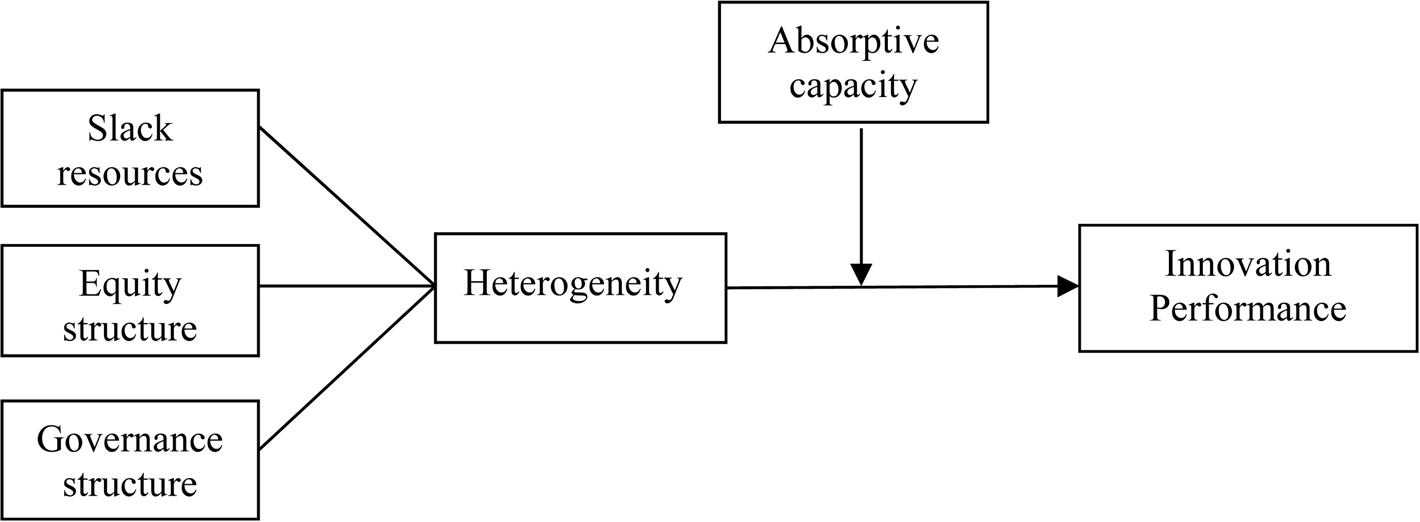
To sum up, the research framework of the hypotheses of this study is shown in Figure 1.
Research framework of hypotheses.

Methodology
Sample formation
A-share listed companies in the top five high-tech industries specified in the statistical classified catalog published by the State Statistical Bureau were taken as the sample enterprises for this study (Note: The official name of A-share is RMB common stock; that is, it is issued by China-registered companies and listed on the Shanghai Stock Exchange and Shenzhen Stock Exchange, with the face value indicated in RMB, and can be traded and subscribed to in RMB by individuals and institutions in China [excluding Hong Kong, Macao, and Taiwan]). Such enterprises have greater demands for knowledge and technologies, and technology innovation and development are their primary strategies. Technological M&As by companies in the high-tech industry from 2012 to 2016 were selected as the initial research sample. Considering the lag of innovation results, patent application data from 2012 to 2018 were used. In this study, technological M&As are defined based on the criteria outlined by Ahuja and Katila (Reference Ahuja and Katila2004). An M&A announcement indicates that a target firm acquired the patents, technologies, or key R&D personnel of a target firm, or that a target firm obtained patents within 5 years prior to the M&A. On this basis, the initial research samples were screened to: (1) exclude failed M&As; (2) exclude M&As of listed companies with abnormal financial status and other abnormalities – i.e., companies subject to Special Treatment; (3) ensure acquiring firms acquired a controlling stake of not less than 20% of the target firm, and would have had a significant influence on the operating decisions of the target firm; (4) in the case of multiple M&As that occurred in the same year, include the one with the largest transaction amount in the sample (multiple M&As that occurred in different years are included in the sample); and (5) exclude samples with incomplete data. Subject to the above criteria, a total sample size of 169 was obtained. The M&A and financial data used in this study came from the China Stock Market Accounting Research Database, and the patent data were taken from the Patent Inquiry System of the State Intellectual Property Office. Because data were collected by hand, a more generalizable sample was obtained. This is expected to improve the external validity of the results and the construct validity of the M&A variable (Barkema & Schijven, Reference Barkema and Schijven2008; Reus, Reference Reus2012). Moreover, holding the acquiring firm's country constant alleviated home country effects. In addition, by including only Chinese acquirers in the sample, the information about the acquiring firm was collected from a single database, providing more reliable data. As a result, keeping the host country constant increased both the reliability and construct validity of the study (Cook & Campbell, Reference Cook and Campbell1979; Schwab, Reference Schwab1999). All data were subjected to manual sorting and comparison before use.
Operational definition of variables
Dependent variable
The technology innovation output of acquiring firms following a technological M&A is used as the dependent variable. The innovation performance of enterprises can be measured by innovation input (e.g., R&D spending) and innovation output (e.g., number of patents). Based on the research method used by Ahuja and Katila (Reference Ahuja and Katila2004), this study uses the number of patent applications of enterprises as the proxy variable of innovation performance. In addition, considering the lag of the innovation results of enterprises, this study uses the sum of the number of patent applications in the current period of the technological M&A, the first year after the M&A and the second year after the M&A of each acquiring firm. The greater the number of patents acquired by acquiring firms, the better the innovation performance of the enterprise. Furthermore, the mean value of the number of patent applications in the current period of the technological M&A, the first year after the M&A and the second year after the M&A of each acquiring firm is used as a robustness test.
Independent variables
Relevant literature has shown that several characteristics impact the innovation performance of enterprises. Net profit, net working capital, and intangible assets affect the level of R&D spending of high-tech enterprises, while input in intangible assets has a significantly positive correlation with operating profits (Basso, Reference Basso2012). Board size has a significantly positive effect on R&D spending; moreover, scholars have suggested that ownership concentration is significantly correlated with the performance of acquiring firms (Lehmann, Warning, & Weigand, Reference Lehmann, Warning and Weigand2004).
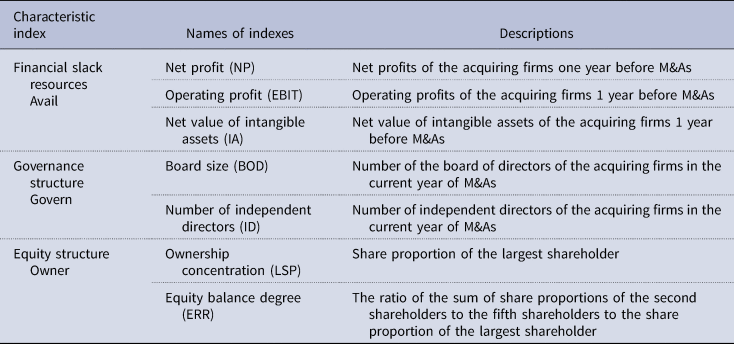
To avoid multi-collinearity of the original variables and to present the main characteristics of enterprises in all directions, seven indexes, including net profit, operating profit, net value of intangible assets, board size, number of independent directors, largest shareholder shareholding ratio, and equity balance degree, are used for factor analysis. The seven indexes are simplified into three principal component factor indexes using steps such as data standardization, feasibility test, principal component extraction, and maximum rotation factor analysis. Financial slack resources, equity structure, and governance structure of enterprises are used as the final measurement indexes, as shown in Table 1.
Index system of main characteristics

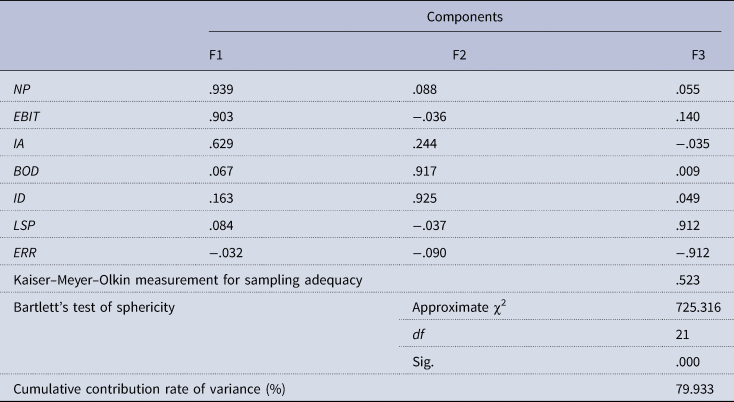
First, data are subject to the KMO test and Bartlett's test of sphericity to determine whether the selected indexes are suitable for factor analysis. It can be seen from Table 2 that the KMO value of the selected original variables is .523, while the p-value of Barlett's test of sphericity is less than .001 and there is a strong correlation among variables. Thus, the selected data are suitable for factor analysis. Second, the principal component factor variables are extracted. The cumulative contribution rate of variances of the first three common factors reaches 79.933%, indicating that the three common factors extracted explain 79.933% of the total information, and the information contained in the original variables is mostly retained. It can be seen from the rotated component matrix that the first common factor (F1) is mainly determined by NP, EBIT, and IA, of which load values for the principal factors are .939, .903, and .629, reflecting the financial slack resource index (Avail) of the acquiring firms. The second common factor (F2) has larger load values on BOD and ID, which are .917 and .925, respectively, reflecting the governance structure (Govern) of the acquiring firms. Similarly, the third common factor (F3) represents the equity structure (Owner) of enterprises.
Rotation component matrix

Moderating variable
Jo, Park, and Kang (Reference Jo, Park and Kang2016) pointed out that enterprises can enhance their knowledge absorptive capacity by accumulating technological knowledge and investing in technical capabilities. In previous studies, scholars have mainly measured absorptive capacity using indexes such as R&D spending, R&D intensity, the proportion of R&D personnel, and the number of patent licenses. Lane, Salk, and Lyles (Reference Lane, Salk and Lyles2010) measured technology absorptive capacity via the ratio of R&D investment to the patent licensing of the acquiring firms. Kostopoulos, Papalexandris, Papachroni, and Ioannou (Reference Kostopoulos, Papalexandris, Papachroni and Ioannou2011) measured the actual absorptive capacity of enterprises based on the R&D spending index of the current year. In addition, Lewin, Massini, and Peeters (Reference Lewin, Massini and Peeters2011) used a questionnaire survey to measure the absorptive capacity of enterprises from three dimensions, including identification and acquisition, assimilation and absorption, and integration and application of technical knowledge. Thus, drawing on a method proposed by Deeds (Reference Deeds2001), this study uses R&D intensity as the proxy index of absorptive capacity. This index can better reflect the strength of R&D spending and innovation efforts of enterprises. R&D intensity is measured by the ratio of R&D spending to sales revenue in the year of the M&A. Moreover, considering the continuity of absorptive capacity, this study measures the absorptive capacity of each acquiring firm using the mean value of the ratio of R&D spending to sales revenue in the current year of the M&A and the 2 years following the M&A.
Control variables
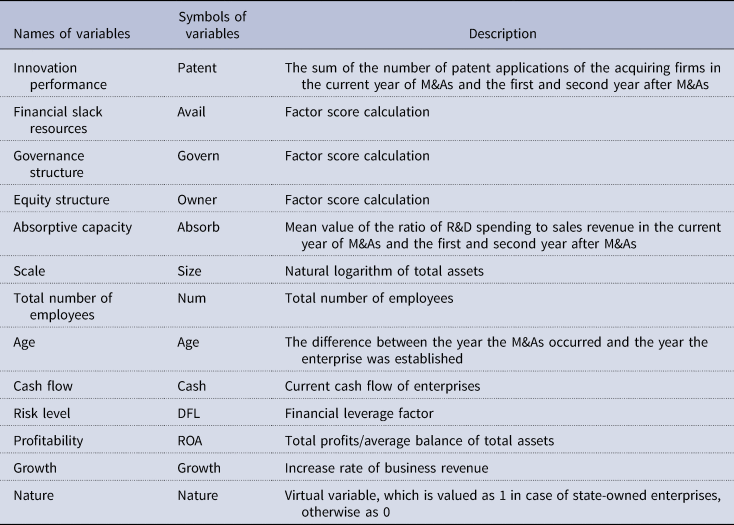
In view of the influence of factors other than the independent variables on innovation performance, and based on existing research, this study uses the scale, total number of employees, age, cash flow, debt paying ability, profitability, growth, and nature as control variables (Table 3).
Definition and specific measurement of variables

Model estimation
Based on technology innovation theory, learning theory, and synergistic effect, a multiple linear regression model is used for data analysis in this study, and measurement models related to technological M&As are created as follows:
First, measurement model (1) is created to verify the influence of subject heterogeneity under technological M&As on innovation performance:
Then, the interactive items of financial slack resources, equity structure, and governance structure with absorptive capacity are added to the above basic model to verify the moderating effect exerted by the absorptive capacity between the main characteristics in technological M&As and innovation performance. Thus, the moderating effect is created in model (2) as follows:
 $$\eqalign{{\rm Patent} =\, & {\rm \alpha }_{\rm 1}+{\rm \beta }_{\rm 1}{\rm Size }+{\rm \beta }_{\rm 2}{\rm Num }+{\rm \beta }_{\rm 3}{\rm Age }+{\rm \beta }_{\rm 4}{\rm Cash }+{\rm \beta }_{\rm 5}{\rm Lev }+{\rm \beta }_{\rm 6}{\rm ROA } \cr & +{\rm \beta }_{\rm 7}{\rm Growth }+{\rm \beta }_{\rm 8}{\rm Nature }+{\rm \beta }_{\rm 8}{\rm Avail }+{\rm \beta }_{\rm 8}{\rm Govern }+{\rm \beta}_{\rm 9}{\rm Owner }+ \varepsilon}$$
 $$ \eqalign{{\rm Patent} &= {\rm\alpha}_1 + {\rm\beta}_1 {\rm Size} + {\rm\beta}_2 {\rm Num} + {\rm\beta}_3 {\rm Age} + {\rm\beta}_4 {\rm Cash} + {\rm\beta}_5 {\rm Lev} + {\rm\beta}_6 {\rm ROA} + {\rm\beta}_7 {\rm Growth} \cr & \quad+ {\rm\beta}_8 {\rm Nature} + {\rm\beta}_8 {\rm Avai} + {\rm\beta}_9 {\rm Absorb} + {\rm\beta}_{10} {\rm Avail} \times {\rm Absorb} + {\rm\varepsilon} {\noalign{\vskip10pt}}\cr {\rm Patent} & = {\rm\alpha}_1 + {\rm\beta}_1 {\rm Size} + {\rm\beta}_2 {\rm Num} + {\rm\beta}_3 {\rm Age} + {\rm\beta}_4 {\rm Cash} + {\rm\beta}_5 {\rm Lev} + {\rm\beta}_6 {\rm ROA} + {\rm\beta}_7 {\rm Growth} \cr & \quad+ {\rm\beta}_8 {\rm Nature} + {\rm\beta}_8 {\rm Govern} + {\rm\beta}_9 {\rm Absorb} + {\rm\beta}_10 {\rm Govern} \times {\rm Absorb} + {\rm\varepsilon} {\noalign{\vskip10pt}} \cr {\rm Patent} & = {\rm\alpha} 1 + {\rm\beta} 1{\rm Size} + {\rm\beta} 2{\rm Num} + {\rm\beta} 3{\rm Age} + {\rm\beta} 4{\rm Cash} + {\rm\beta} 5{\rm Lev} + {\rm\beta} 6{\rm ROA} + {\rm\beta} 7{\rm Growth} \cr & \quad+ {\rm\beta} 8{\rm Nature} + {\rm\beta} 8{\rm Owner} + {\rm\beta} 9{\rm Absorb} + {\rm\beta} 10{\rm Owner} \times {\rm Absorb} + {\rm\varepsilon} } $$
Empirical results
Descriptive statistics
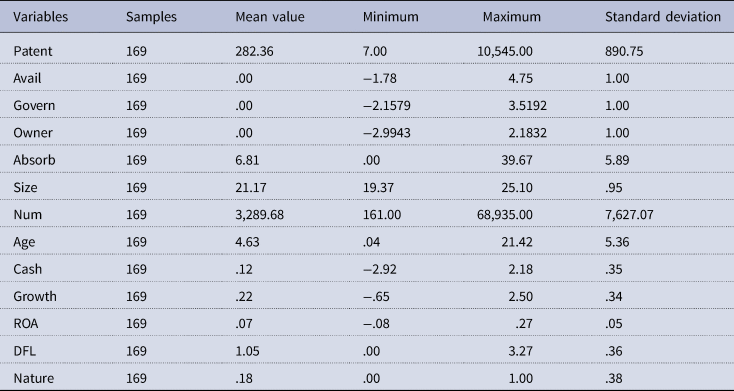
Descriptive statistical analysis was first performed on each variable; the analysis results are shown in Table 4. Specifically, the mean value of innovation performance is 282.36, and the maximum and minimum values are 10,545 and 7, respectively. This indicates that the innovation performance of the sample enterprises following technological M&As varies quite significantly. Therefore, it is highly valuable to study what kinds of characteristics can improve the innovation performance of enterprises on the basis of acquiring external resources through technological M&As. The financial slack resources, governance structure, and equity structure are calculated from the results of the factor analysis, and all of them meet the standard normal distribution. Thus, the mean value is 0, and the standard deviation is 1.
Descriptive statistics results of variables

Correlation analysis
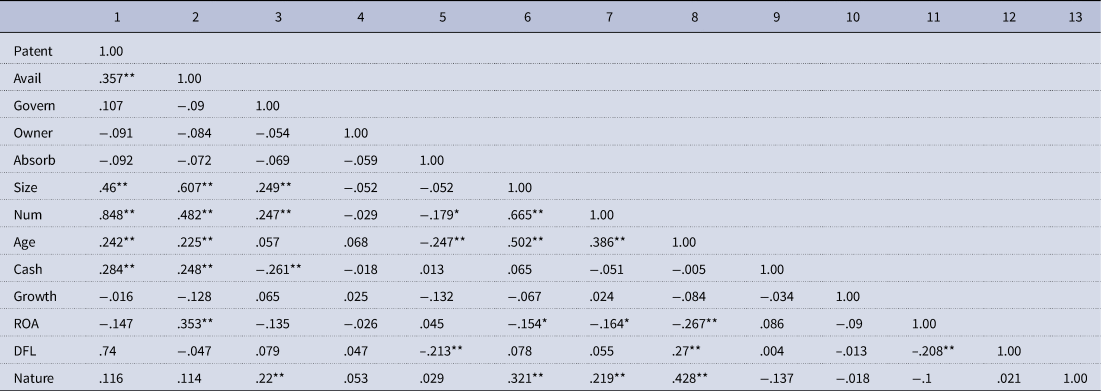
The Pearson correlation test is adopted in this study to initially verify the correlation between variables. Table 5 shows that there is a strong correlation between variables. Specifically, the independent variable – financial slack resources – is significantly correlated with innovation performance at a significance level of 5%; control variables such as scale, total number of employees, age, and cash flow are significantly correlated with innovation performance at a significance level of 5%. In order to test for possible multi-collinearity between the independent variables, variance inflation factors (VIFs) are calculated, and values of all the independent variables are found to be below the threshold. This shows that there is no multi-collinearity between the independent variables used in this study (Shin, Han, Marhold, & Kang, Reference Shin, Han, Marhold and Kang2017). The maximum VIF values for each regression model are indicated in Table 6.
Correlation analysis results of variables

Note: ** and * mean the significant correlation at the significance levels of 5% and 10%, respectively.
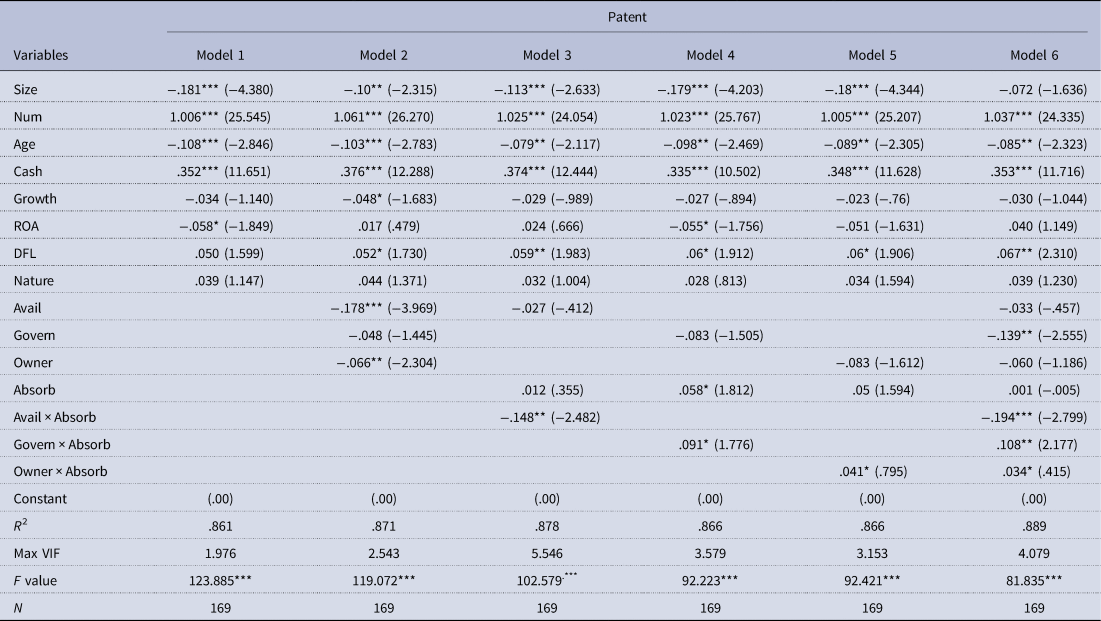
Regression analysis results of variables

Note: Data in the table are standardized regression coefficients, and the data in brackets are t-test values.
***, **, and * indicate significant correlation at the significance levels of 1%, 5%, and 10% levels, respectively.
Analysis of regression results
Subject heterogeneity and innovation performance under technological M&As
As shown in Table 6, model 1 reflects the effect of only the control variables. Model 2 shows the result of the direct independent variables, and models 3–5 show the results of the direct independent variables and moderator variables. Finally, in model 6 the full model, containing all variables used in our analysis, is presented. Model 1 shows that scale and age have a significantly negative correlation with innovation performance at a significance level of 1%, which indicates that large enterprises have their own limitations, such as scale operation and approach streamlining. They are more willing to upgrade their existing technologies than to conduct R&D innovation on new technologies following technological M&As. The total number of employees and cash flow have a significantly positive correlation with innovation performance at a significance level of 1%, indicating that human capital and capital base have a positive effect on R&D innovation following M&As. Model 2 adds three independent variables (e.g., financial slack resources, governance structure, and equity structure) to model 1. In particular, financial slack resources are significantly negatively correlated with innovation performance at a significance level of 1%, and equity structure is significantly negatively correlated with innovation performance at a significance level of 10%. Hypotheses 1 and 3 are thus verified. Governance structure has no significant effect on innovation performance, so Hypothesis 2 is not supported. This shows that excessive financial redundancy funds are not conducive to enhancing innovation performance under technological M&As.
The moderating effect of absorptive capacity
Three groups of interactive items are generated to test the moderating effect of absorptive capacity, and hierarchical regression analysis is conducted with innovation performance following M&As as the dependent variable. As shown in Table 6, model 3 adds financial slack resources, absorptive capacity, and the interactive items of the two indexes on the basis of model 1. Compared with model 1, the degree of fit (R 2) of model 3 clearly increases, and the financial slack resources have a significantly negative correlation with the interactive items of absorptive capacity at a significance level of 5%. This indicates that absorptive capacity exerts a moderating effect between financial slack resources and innovation performance of the acquiring firms. If the acquiring firms have many financial slack resources, the increase in R&D spending following technological M&As will enhance the utilization of financial resources, thus improving the innovation performance of acquiring firms following M&As. Therefore, Hypothesis 4a is supported.
Likewise, models 4 and 5 add governance structure with absorptive capacity, equity structure with absorptive capacity, and interactive items of the two indexes on the basis of model 1. Both interactive items of governance structure with absorptive capacity and interactive items of equity structure with absorptive capacity are positively significant at a significance level of 10%. This shows that absorptive capacity will intensify the relationship between governance structure and equity structure with innovation performance of the acquiring firms. Hypothesis 4c is thus supported, and Hypothesis 4b is partially supported. In the same way, in model 6 the full model contains all variables to test all moderating effects, and the results are similar to those of models 3–5, thus verifying the moderating role of absorptive capacity between heterogeneity characteristics of the technological M&As and innovation performance.
Robustness test
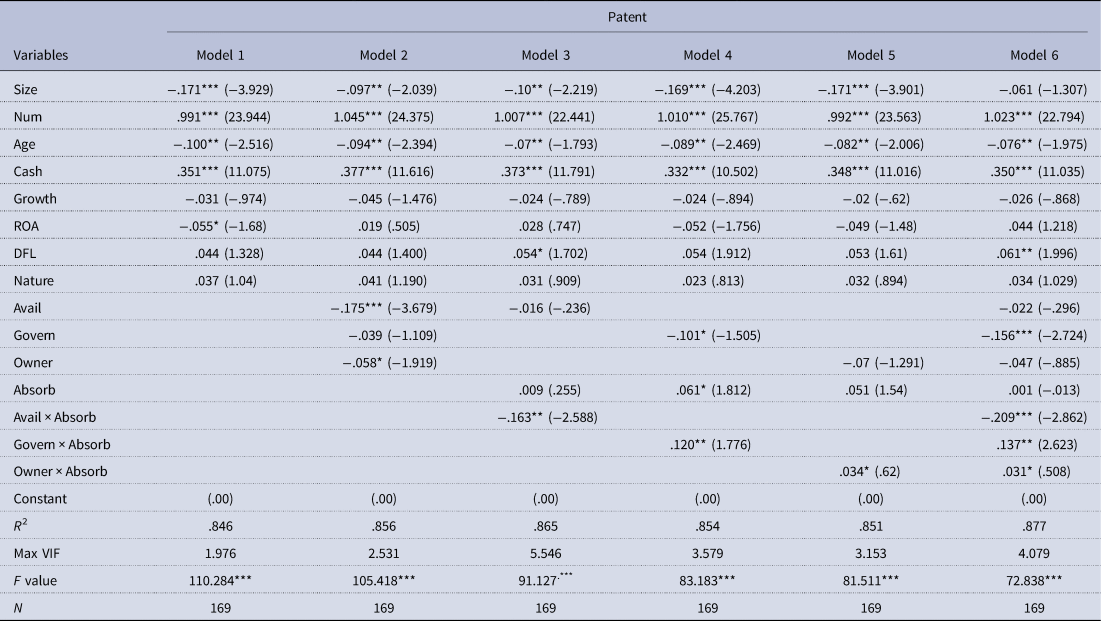
To ensure the reliability of the regression results, the mean value of the number of patent applications in the current year of the technological M&A, and the first and second year following the technological M&A are used to replace the dependent variable as a robustness test. As shown in Table 7, the financial slack resources and highly centralized equity structure of enterprises are not conducive to improving their innovation performance following technological M&As. A regulation effect test shows that the increase in R&D investment intensity following a technological M&A helps to enhance the allocation efficiency of financial redundancy capital, and motivate enterprises to carry out R&D innovation, thus enhancing their innovation performance. This is in line with the preceding regression results, signifying the reliability of the results.
Regression analysis results of variables

Note: Data in the table are standardized regression coefficients, and the data in brackets are t-test values. ***, **, and * indicate significant correlation at the significance levels of 1%, 5%, and 10% levels, respectively.
Discussion and conclusions
Discussion
From the perspective of the RBV and dynamic capability view, the influence of subject heterogeneity under technology-driven M&As is discussed, and the absorptive capacity is taken as the adjusting factor for the relationship between subject heterogeneity and innovation performance. The technological M&As of A-listed companies in five major high-tech industries from 2012 to 2016 were selected as the research sample, and factor analysis and multivariate regression analysis were applied to verify the influence of heterogeneity of the acquiring firms on innovation performance following M&As. First, factor analysis was conducted to measure the heterogeneity of the acquiring firms, and the maximum variance method was used for rotation. In addition, the three main characteristics were extracted using principal component analysis. Second, the three main characteristics were subject to multivariate regression analysis.
The research findings show that financial slack resources and ownership concentration have a significantly negative effect on innovation performance. The innovation performance after M&As was not significantly affected by the scale of governance structure. This signifies that excessive financial slack resources and high ownership concentration of enterprises following technological M&As do not help enterprises improve their innovation performance. Specifically, the results regarding financial slack resources show that, following technological M&As, the acquiring firms fails to effectively apply financial resources in R&D, new product development, or innovation activities. Moreover, if the equity of the acquiring firms excessively concentrates on the minority shareholders, internal innovation knowledge activities cannot be properly organized. When the direction and decision-making power of knowledge innovation depend on the minority group or shareholders, it will be difficult to spread new knowledge in enterprises, thereby impairing innovation performance generated by new knowledge following technological M&As. An interesting finding is that the governance structure of the acquiring firms is negatively, rather than positively, correlated with innovation performance. Possible reasons for this include the fact that the governance structure is indirectly affected by the ownership concentration. When the governance structure is complex, the internal supervisory authority structure will not be balanced. Moreover, innovation is not guaranteed to result in visible profits. Thus, the side advocating innovation may be unable to carry out supervision activities, and instead concentrate on activities for profit improvement. As claimed by scholars who study ambidexterity, the exploration of innovation may have a trade-off relationship with the utilization of innovation.
This study uses mean value of R&D investment intensity to measure absorptive capacity. The findings show that the high absorptive capacity of acquiring firms will enhance the negative relationship between financial slack resources and innovation performance of those firms. High absorptive capacity also helps enterprises utilize financial slack resources in a flexible way. When resources are utilized for existing knowledge-creation activities and such activities are integrated and spread, the acquiring firms are able to engage in the creation and innovation of new knowledge, and to improve innovation performance in the present stage. Moreover, the governance structure has no significant effect on innovation performance, but the research results show that the positive relationship between them will be significantly intensified when the enterprise has a high absorptive capacity. In other words, when the acquiring firm has a complex governance structure, the absorptive capacity can balance conflicts or inconsistencies, help senior management to engage in activities of knowledge creation and integration, and improve innovation performance, despite the fact that different strategy directions and supervision mechanisms may cause discrepancies in the enterprise. Another interesting research finding is that the negative correlation between the original ownership concentration and innovation performance will be changed into a positive one when the acquiring firm has a high absorptive capacity. When the majority of ownership concentration of the acquiring firm is taken by the minority shareholders, the increase in high-risk and high-input R&D spending will not only require the enterprise to have competitive resource integration capability, but also control the self-serving behaviors of substantial shareholders, thus inhibiting the innovation performance.
Theoretical implications
Drawing on the RBV, this study discusses the influence of subject heterogeneity of acquiring firms on innovation performance following technological M&As, and tests the moderating effect of absorptive capacity on this influence. In previous studies of M&As, scholars have mostly concentrated on the characteristics of the target firm to identify the characteristics that facilitate M&As. However, taking the characteristics of acquiring firms as a starting point, this study expands the research scope of influencing factors to technological M&As. The findings show that the heterogeneity of the acquiring firms impacts innovation performance at different levels in technological M&As. These results are similar to those of Huang, Chen, and Liang (Reference Huang, Chen and Liang2018), Tsai (Reference Tsai2018), and Yang and Wang (2018), who showed that heterogeneity, especially network and knowledge heterogeneity, affects innovation performance. However, this study emphasizes the heterogeneity of internal factors of the acquiring firms, and analyzes this from the perspective of financial resources, governance structure, and ownership concentration, which fills a theoretical gap in the literature on M&A outcomes and innovation performance. Moreover, the results of this study enrich the theoretical perspective of the RBV by applying it to the context of technological M&As and finding that resources do not have a positive impact on innovation as previously claimed (Felipe, Monteiro, & Birkinshaw, Reference Felipe, Monteiro and Birkinshaw2016; Hamidi & Gabrielsson, Reference Hamidi and Gabrielsson2017; Ma & Liu, Reference Ma and Liu2017; Srivastava & Gnyawal, Reference Srivastava and Gnyawal2017), especially for technological M&As between high-tech firms. Thus, it is necessary to examine the heterogeneity of resources in the process of resource acquisition and integration. The research results also provide interesting insights into the field of knowledge management (Lee, Shin, & Kim, Reference Lee, Shin and Kim2019; Shin et al., Reference Shin, Han, Marhold and Kang2017), as they indicate that knowledge exchange occurs in the context of knowledge linking, knowledge transfer, joint ventures, and network cooperation. In addition, significant topics such as similarity, compatibility, and heterogeneity of knowledge should be further discussed to provide insights into the substantive innovation of firms.
Most previous studies have considered absorptive capacity as the direct acting factor of firm performance. Aliasghar, Rose, and Chetty (Reference Aliasghar, Rose and Chetty2019) and Scuotto et al. (2016) discussed the relationship between absorptive capacity and innovation performance, and Jo, Park, and Kang (Reference Jo, Park and Kang2016) considered the impact of relative absorptive capacity on innovation performance following technological M&As. However, few studies have considered absorptive capacity as a moderating factor for improving the innovation performance of acquiring firms following technological M&As. This study proposes that absorptive capacity does not directly affect innovation performance, but dynamically moderates the innovation performance of enterprises based on existing resources such as financial capital and equity structure. According to the research results, absorptive capacity not only can strengthen the negative relationship between financial slack resources and innovation performance, but also convert the negative relationship between ownership concentration and innovation performance into a positive one. The moderating effect of absorptive capacity will be more conducive in explaining the effect of the internal heterogeneity of acquiring firms on innovation behaviors and performance under technology-driven M&As. The research results are similar to those obtained by Bauer et al., Reference Bauer, Matzler and Wolf2016, Zhai et al. (Reference Zhai, Li and Gu2019), and Wang, Guo, and Yin (Reference Wang, Guo and Yin2017). These findings provide new ideas and insights for enterprises that lack absorptive capacity in the process of open innovation, and dynamic capability theory is applied to model building, making the research conclusions more credible.
Managerial implications
With the rapid development of high technology and increasingly fierce market competition, it is difficult for enterprises to obtain competitive advantages quickly by depending only on independent R&D innovation. They must therefore acquire new knowledge and new technologies through external channels such as technological M&As to improve the capability of technology innovation. However, not all enterprises can bring overall improvement through technological M&As. Thus, when making decisions on M&As, acquiring firms should not only evaluate the scale, development prospects, and knowledge base of the target firms, but also develop an overall understanding of the personal heterogeneity, and accurately judge the future of the technology development trends of the industry based on the enterprises' development strategy and capabilities, so as to make appropriate decisions on M&As. In addition, the decision on whether to increase R&D investment intensity following M&As requires concrete analysis based on financial resources, equity structure, and other conditions of enterprises. Based on the above conclusions, this study provides the following suggestions to managers.
First, enterprises should carry out dynamically balanced and optimized management of financial slack resources to convert financial redundancy into innovation output. The results of this study show that financial slack resources are negatively correlated with innovation performance, but absorptive capacity can regulate and reverse the negative impact of financial redundancy on innovation performance. In practice, when enterprises have excessive financial slack resources managers should further improve the R&D investment intensity, acquire knowledge and technological resources from outside, and integrate these with prior resources and enterprises for applications in commercial activities according to the actual situation of financial redundancy, thereby constantly enhancing innovation performance.
Second, enterprises should optimize their ownership concentration, and build a relatively counterbalanced equity structure that can mitigate the short sightedness of management and protect the supervisory right of minority shareholders. The results of this study indicate that ownership concentration is negatively correlated with innovation performance, and absorptive capacity further intensifies this negative impact. Thus, when an enterprise has a high ownership concentration, a blind increase in R&D investment will not enhance innovation performance. Thus, enterprises should have a clear understanding of their own equity structure, improve the checks-and-balances between first majority shareholders and other substantial shareholders, and strengthen supervision and management of shareholders' decisions.
Limitations and suggestions for future research
Restricted by individual abilities and conditions, this study could be improved in the following ways. This study used the number of patent applications in the current year of the M&A to measure the innovation performance of enterprises; however, this index cannot fully reflect the innovation ability of enterprises. In addition, this study was limited by data availability, and only secondary data were used. Thus, quantitative evaluation of the innovation ability and performance of enterprises remains to be conducted. The time lag effect should also be added into the discussion of innovation performance – that is, innovation results within a certain period following technological M&As should be considered, and the effects arising from resource acquisition or integration compared using time series data. It is suggested that subsequent researchers consider the innovation performance at different time points to further understand the effect of technological M&As.
This study focused on technological M&As of enterprises in the high-tech industry; while this can avoid the influence caused by industry differences, it limited the sample size and reduced the explanatory power of the data. Thus, future studies can include technological M&As of non-listed companies in the research sample and extend the sample time span to enhance the generalizability of the findings. In addition to high-tech industries, several other industries also conduct M&As, including biosciences, financial services, precision machinery, and other industries. It is suggested that future researchers analyze different industries to understand the innovation performance of various industries following technological M&As.
This study mainly discussed the impact of the main characteristics of acquiring firms on their innovation performance following M&As, considering only factors such as scale, age, nature, growth, and financial status. However, in practice there are also many other factors affecting the innovation performance of enterprises. Thus, future studies should seek to deeply explore the influencing factors and modes of action of technological M&As by comparing the characteristics of acquiring firms and target firms.