Introduction
In all species, exposure to high temperatures is stressful and potentially lethal. As temperatures increase, insects display various physiological responses (Colinet et al., Reference Colinet, Sinclair, Vernon and Renault2015). These responses are often associated with an increase in the production of free radicals and reactive oxygen species (ROS), leading to significant physiological and structural damage. This damage, including the oxidation of proteins, enzymes and DNA, lipid peroxidation and glutathione depletion, has been observed in several species (e.g. Scapharca broughtonii (An & Choi, Reference An and Choi2010), Panonychus citri (Yang et al., Reference Yang, Huang and Wang2010) and Aspergillus niger (Abrashev et al., Reference Abrashev, Pashova, Stefanova, Vassilev, Dolashka-Angelova and Angelova2008)).
Insects have an antioxidant defense system to reduce the oxidative stress caused by ROS. This system involves several enzymes, including superoxide dismutase (SOD), catalase (CAT), glutathione-S-transferase (GST) and peroxidase (POD) (Barbehenn, Reference Barbehenn2002; Jia et al., Reference Jia, Dou, Hu and Wang2011; Fahmy, Reference Fahmy2012). For example, when subjected to heat stress, the oriental fruit fly, Bactrocera dorsalis, displays significant increases in lipid peroxide levels and in the activities of SOD, CAT and GST, providing protection against oxidative damage due to ROS (Jia et al., Reference Jia, Dou, Hu and Wang2011).
Heat-shock proteins (HSPs) also play an important role in the response to heat stress (Nover & Scharf, Reference Nover and Scharf1997; King & MacRae, Reference King and Macrae2015). Indeed, the production of these proteins during periods of cellular stress increases the tolerance of heat and other stresses. The production of HSPs is, thus, a key survival strategy used by many organisms during exposure to high temperatures. HSPs can be classified into several families on the basis of their molecular mass and function: small HSPs (20–40 kD), HSP60, HSP70, HSP90 and HSP110 (Parsell & Lindquist, Reference Parsell and Lindquist1993). The cytoplasmic HSP70 family is the most conserved of these families and has been studied extensively in the context of thermal stress (Krebs & Feder, Reference Krebs and Feder1997; Bahrndorff et al., Reference Bahrndorff, Mariën, Loeschcke and Ellers2009; Calabria et al., Reference Calabria, Dolgova, Rego, Castañeda, Rezende, Balanyà, Pascual, Sørensen, Loeschcke and Santos2012). This family includes two types of proteins with different expression profiles (Karlin & Brocchieri, Reference Karlin and Brocchieri1998; Rinehart et al., Reference Rinehart, Yocum and Denlinger2000; Mahroof et al., Reference Mahroof, Zhu, Neven, Sunramanyam and Bai2005). The first, inducible HSP70, is produced in small amounts in normal conditions but is rapidly induced by heat shock and other environmental stresses. The other, the cognate heat-shock 70 protein (HSC70), is constitutively expressed under normal conditions and slightly upregulated in response to heat stress (Kiang & Tsokos, Reference Kiang and Tsokos1998; Mahroof et al., Reference Mahroof, Zhu, Neven, Sunramanyam and Bai2005; Daugaard et al., Reference Daugaard, Rohde and Jäättelä2007).
Like many other cellular stresses, heat stress can trigger apoptosis, a physiological cell suicide program (Chowdhury et al., Reference Chowdhury, Tharakan and Bhat2006). Apoptosis may involve several pathways, but the principal apoptotic pathway is that associated with mitochondria (Cullen & Martin, Reference Cullen and Martin2009). This pathway, which can be induced by ROS (Circu & Aw, Reference Circu and Aw2010), involves several proteins, including cytochrome c, apoptotic protease activating factor-1 (Apaf-1), procaspase-9 (all of which are involved in transducing the apoptotic signal of the apoptosome) and caspases (Chowdhury et al., Reference Chowdhury, Tharakan and Bhat2006). The caspases involved include the initiator caspases involved in upstream regulatory events, and the effector caspases (the executioners of apoptosis) directly responsible for disassembling the cell (Chang & Yang, Reference Chang and Yang2000). Briefly, heat stress induces the release of cytochrome c from the mitochondria into the cytosol, where it binds Apaf-1. This binding triggers the cleavage of procaspase-9 to generate the active initiator caspase-9, which activates the effector caspases, including caspases-3 and -7. These effector caspases execute the apoptosis program via the downstream caspase cascade and play a critical role in the final death of the cell (Chang & Yang, Reference Chang and Yang2000).
The diamondback moth (DBM) is probably the most destructive and cosmopolitan insect pest of cruciferous crops worldwide (Furlong et al., Reference Furlong, Wright and Dosdall2013), and it has become a model pest for studying insecticide resistance. In Chinese populations, resistance to several organophosphate (OP) insecticides is conferred by a single resistance allele, ace1R, of the ace1 gene, which encodes the acetylcholinesterase enzyme targeted by these OPs (Zhang et al., Reference Zhang, Jing, Li, Li, Bourguet and Wu2015a ). The ace1R allele is characterized by two tightly linked mutations – A201S and G227A – affecting the amino acid sequence of the acetylcholinesterase enzyme (Zhang et al., Reference Zhang, Jing, Li, Li, Bourguet and Wu2015a ). Our previous studies of DBM have shown that, under heat stress, individuals of a resistant strain (i.e. individuals heterozygous or homozygous for the ace1R allele) have lower pupal survival rates (Zhang et al., Reference Zhang, Wu, Wang, Liu, Zhuang and Wu2015b ), adult emergence rates (Zhang et al., Reference Zhang, Wu, Wang, Liu, Zhuang and Wu2015b ), adult longevity (Zhang et al., Reference Zhang, Jing, Li, Li, Bourguet and Wu2015a ) and fertility (Zhang et al., Reference Zhang, Jing, Li, Li, Bourguet and Wu2015a ) and greater damage to the wing veins (Liu et al., Reference Liu, Miyata, Wu, Li, Wu, Zhao and Xie2008; Zhang et al., Reference Zhang, Wu, Wang, Liu, Zhuang and Wu2015b ) than individuals of a related susceptible strain. In terms of physiological effects, individuals of this resistant strain have higher basal levels of expression for several hsp genes, and for the Apaf-1 and caspase-7 genes than susceptible individuals (Zhang et al., Reference Zhang, Wu, Wang, Liu, Zhuang and Wu2015b ). They are also characterized by the weaker upregulation of several hsp genes (Liu et al., Reference Liu, Miyata, Wu, Li, Wu, Zhao and Xie2008; Zhang et al., Reference Zhang, Wu, Wang, Liu, Zhuang and Wu2015b , Reference Zhang, Wang, Zhuang, Jing and Wu c ), and stronger upregulation of the caspase-7 (Zhang et al., 2011, Reference Zhang, Wu, Wang, Liu, Zhuang and Wu2015b ) caspase-9 (Zhang et al., 2015b) and Apaf-1 (Zhang et al., Reference Zhang, Wang, Zhuang and Wu2014, Reference Zhang, Wu, Wang, Liu, Zhuang and Wu2015b ) genes at high temperature.
We further explored the lower fitness of this resistant strain, its sensitivity to heat stress and the underlying physiological processes. We compared an additional life history trait, mortality, between adults of the resistant and susceptible strains exposed to different temperatures. We also compared the level of damage to sperm and ovary cells between individuals of these two strains, and focused on three physiological aspects: oxidative stress, apoptosis and HSPs.
Materials and methods
Strains of Plutella xylostella
We used two strains of P. xylostella: the Sm strain, which is mostly susceptible to chlorpyrifos, and the Rc strain, which displays a high level of resistance to this insecticide. These strains were obtained from a population collected close to Shangjie (34°480N, 113°180E), around Fuzhou (Fujian region, China), in November 2005. Details of the selection of these two strains are provided elsewhere (Zhang et al., Reference Zhang, Jing, Li, Li, Bourguet and Wu2015a ). The LC50 of chlorpyrifos in the Rc strain was 2769 µg l−1, indicating a susceptibility to this chemical 100 times lower than that in the Sm strain. The frequency of the resistance allele of ace1 – the gene encoding the acetylcholinesterase targeted by chlorpyrifos – differed between the Sm (frequency of 0.15) and Rc (frequency of 0.85) strains (Zhang et al., Reference Zhang, Jing, Li, Li, Bourguet and Wu2015a ).
Thermotolerance in adults
Rc and Sm larvae were reared at 25°C with a photoperiod of 16 h light: 8 h dark until emergence of the adults. Four to eight hours after emergence, virgin males and virgin females were transferred to 25, 30, 35 or 40°C conditions, and mortality rates were recorded after 24, 48 and 72 h. Adults that did not respond to prodding with a pencil tip were considered to be dead. For each strain, sex and temperature considered, we used three replicates, with 100 female or male adults per replicate.
Damage to sperm and ovary cells
Sm and Rc were exposed, 4–8 h after emergence, to temperatures of 25, 30, 35 and 40°C for 24, 48 and 72 h with a photoperiod of 16 h light: 8 h dark. Experiments were performed in insect environmental chambers (Experimental instrument Co., Ltd., Haishu Saifu, Ningbo, Zhejiang, China). Regardless the temperature and duration of the experiment, adults were supplied with sugar solution. For each strain and [temperature × duration] treatment, we used four replicates of at least 20 males and ten females. After treatment, a pair of spermaries was extracted from each treated male and immediately placed in liquid nitrogen. The ovaries of each treated female were also dissected and homogenized in physiological saline (see below). Damage to sperm or ovary cells was assessed in the single-cell gel electrophoresis (SCGE) assay (Singh et al., Reference Singh, McCoy, Tice and Schneider1988).
Sperm cells
For each replicate of each [temperature × duration] treatment, a mixture of 15–20 pairs of spermaries was thawed and resuspended in Grace's medium containing 10% dimethyl sulfoxide (v:v = 1:1). The resulting mixture was used for at least ten SCGE experiments, providing at least ten slides of sperm cells for analysis. For each SCGE experiment, an aliquot of 15 µl of the suspension of spermaries was mixed with 110 µl of 0.5% low-melting point agarose (Sangon Ciotech, Ltd., Shanghai, China). This mixture was allowed to solidify and undergo protein degradation. Three layers of agarose gel were then prepared: two layers of 1% normal-melting point agarose (Sangon Ciotech, Ltd., Shanghai, China) separated by a layer of 0.8% low-melting point agarose containing the dried mixture of sperm cells. The three-layered gel was used for horizontal electrophoresis and stained. From the ten slides of sperm cells, we selected 50 cells at random, under a fluorescence microscope (at 400× magnification) for examination as described below. There were four replicates, resulting in the examination of 200 sperm cells in total for each [temperature × duration] treatment.
Ovary cells
For each replicate of each [temperature × duration] treatment, the ovaries extracted from ten females were mixed and resuspended in 0.5 ml of physiological saline. This mixture was used immediately, for at least ten SCGE experiments, thus providing at least ten ovary cell slides for analysis. For each SCGE run, the first layer of agarose gel was prepared with 100 µl of 1% normal-melting point agarose and covered with a coverslip during solidification. The coverslip was removed after 20 min and a 10 µl aliquot of the ovary mixture, containing 0.8% low-melting point agarose, was then dispensed onto the first layer of agarose. It was covered with a coverslip for 20 min. The coverslip was then removed and the third layer of low-melting point agarose was then added on top of the second layer and covered with a coverslip for 20 min. The coverslip was removed and the three-layered gel was immersed in a lysis solution (2.5 M NaCl, 100 mM EDTA, 1% Triton X-100, 1% sarkosyl, 10% DMSO, 10 mM Tris, pH 10, supplemented with 0.06 mg ml−1 proteinase K) for 3 h to degrade the proteins. The gel was used for horizontal electrophoresis in a cold alkaline electrophoresis buffer (12.3 g sodium acetate, 6.1 g Tris and 18.6 g Na2EDTA in 500 ml H2O, pH 10) for 40 min at 4°C, 20 V and 200 mA. After electrophoresis, the gel was washed with fresh neutralization buffer (0.4 M Tris–HCL at pH 7.0) to remove any remaining alkali and detergent and was then immersed in a staining solution (SYBR Green I diluted 1:10,000 in TBE buffer) for 15 min. We randomly selected 20–410 cells from the ten slides of ovary cells for examination under a fluorescence microscope (at 10× magnification), as indicated below. Hence, with four replicates, we examined between 88 and 1621 ovary cells per [temperature × duration] treatment.
Cell analyses
The images of each of the selected sperm and ovary cells were captured with an Olympus fluorescence microscope and analyzed with Comet Assay software (Konca et al., Reference Konca, Lankoff, Banasik, Lisowska, Kuszewski, Gozdz, Kaza and Wojcik2003). This software made use of two parameters to determine cell damage: (1) the percentage of damaged cells, calculated as the number of cells without a comet tail/total number of cells observed, multiplied by 100 and (2) comet tail length, estimated from the image as the length of the tail from the nuclear region to its end. For ovary cells, an additional parameter was included: tail moment, determined as tail length × the fraction of total DNA in the tail. Overall, the treatments and replicates resulted in the analysis of 2400 sperm cells for both Rc and Sm, and 5485 and 3530 ovary cells for Rc and Sm, respectively.
Enzyme assays and ROS levels
Heat stress in adults
Levels of SOD (EC 1.1.5.1.l), CAT (EC 1.11.1.6) and POD (EC 1.11.1.7) activity and of ROS were measured in adults after exposure to temperatures of 25, 33.5, 37 and 42°C for 1, 8, 24, 48 and 72 h, respectively.
Preparation of enzyme extracts
For each DBM strain and each enzyme, three replicate enzyme extracts were used. For each replicate, ten adults were homogenized at 0°C in 50 mM sodium phosphate buffer (pH 7.0) and then centrifuged at 12,000 × g and 4°C for 20 min. The supernatants were used to determine SOD, CAT and POD activities.
Preparation of extracts for the measurement of ROS levels
For each DBM strain, we performed three replicates. For each replicate, ten adults were homogenized at 0°C in 65 mM sodium phosphate buffer (pH 7.8) and centrifuged at 5000× g and 4°C for 20 min. The supernatants obtained were used for the determination of ROS levels. Protein concentration was determined by the method of Bradford (Reference Bradford1976), with bovine serum albumin as the standard.
Enzymatic activity
SOD activity was determined by the pyrogallol auto-oxidation method (Marklund & Marklund, Reference Marklund and Marklund1974). The reaction mixture (4.5 ml) contained sodium phosphate buffer (pH 8.3, final concentration 50 mM), pyrogallol (final concentration 0.02 mM) and 10 µl of enzyme extract. The absorbance of the mixture was measured at 325 nm, every 30 s for 3 min, at 25°C. One unit (U) of SOD corresponded to the amount of enzyme required to inhibit pyrogallol auto-oxidation by 50% in 4.5 ml of assay mixture at 25°C. SOD activity (U mg−1 protein) = [(0.07 − ΔA325 min−1)] × 100% / [0.07 × 50% × mg protein].
CAT activity was measured as described by Liu & Wu (Reference Liu and Wu2006). The reaction mixture (5 ml) contained sodium phosphate buffer (pH 7.0, final concentration 50 mM), H2O2 (final concentration 8 mM) and 100 µl of enzyme extract. The reaction was conducted at 30°C for 1 min and was stopped by adding 2 ml 10% H2SO4. The absorbance of the mixture was measured at 240 nm, every 30 s for 5 min, at 30°C. CAT activity is expressed as ΔA240 min−1 × mg−1 protein.
POD activity was measured as described by Liu et al. (Reference Liu, Zhang and Shan2007). The reaction mixture (3 ml) consisted of sodium phosphate buffer (pH 6.0, final concentration 100 mM), guaiol (final concentration 30 mM), H2O2 (final concentration 26 mM) and 150 µl of enzyme extract. The increase in absorbance at 470 nm and 30°C was recorded after adding 2 ml of 20% chloroacetic acid. The specific activity of the enzyme is expressed as ΔA470 min−1 × mg−1 protein.
ROS levels
The rate of O2 − production was assessed as described by Schneider & Schlegel (Reference Schneider and Schlegel1981). In the presence of superoxide radicals, hydroxylamine was oxidized to nitrite. The reaction mixture (2 ml) consisted of 0.9 ml 65 mM sodium phosphate buffer (pH 7.8), 0.1 ml 10 mM hydroxylamine hydrochloride and 1 ml of extract. The mixture was incubated at 25°C for 20 min. Nitrite formation was assessed by 0.70 ml each of 17 mM sulphanilic acid and 7 mM α-naphthylamine to 0.70 ml of reaction mixture. The mixture was incubated at 25°C for 20 min and absorbance at 530 nm was recorded. Nitrite concentration was determined by comparison with a standard curve. The rate of O2 − production is expressed as nmol × min−1 × mg−1 protein.
Levels of mRNA for hsp and apoptosis-related genes
Heat stress in adults
Before RNA extraction, individuals were exposed to different temperatures for various periods of time. Virgin adults developing from larvae reared at 25°C, were exposed, 4–8 h after emergence, to a temperature of 40°C for 24, 48 or 72 h. Individuals were allowed to recover for 1 h at 25°C and were then frozen for RNA extraction.
RNA extraction
For each gene, we performed at least three independent RNA extractions. For each extraction, we obtained total RNA from 12 individuals with a simple total RNA extraction kit (Tiangen Biotech Co., Ltd., Beijing, China), and cDNA was synthesized from 1 µg of total RNA with the SuperScriptTII First-Strand System (Life Technologies, Carlsbad, California, USA).
Real-time quantitative PCR (qPCR)
We estimated mRNA levels for six heat shock protein genes (hsp genes) and four apoptotic genes connected to the mitochondrial pathway of apoptosis, identified by our research group in P. xylostella from Fujian, China. We also estimated mRNA levels for the β-actin gene, used as a reference gene. The hsp genes included hsp69-3 (encoding a protein with 629 amino acids (aa), GenBank number ADK94699.1), hsp69-4 (632 aa, ADK39311.1), hsp72-2 (669 aa, ADV58254.1), hsc70 (651 aa, JN676213), hsp90 (717 aa, KF471526) and hsp20 (174 aa, KF471527). The four mitochondrial apoptosis pathway-related genes studied were the cytochrome c (cyt c; 108 aa, KC507801), Apaf-1 (1548 aa, KC588901), caspase-9 (451 aa, KF365914) and caspase-7 (300 aa, HM204505) genes. The primers used for qPCR were designed from the conserved regions of the genes (Table S1).
The mRNA levels of these hsp and mitochondria-associated apoptotic pathway genes were estimated by real-time qPCR using SYBR Premix Ex TaqTM kit (Takara Co., Dalian, China) as described by Zhuang et al. (Reference Zhuang, Wuang, Miyata, Wu, Wu and Xie2011) and Zhang et al. (Reference Zhang, Wu, Wang, Liu, Zhuang and Wu2015b ). The thermal cycling conditions used were an initial DNA denaturation at 95°C for 10 s followed by 40 cycle of denaturation at 95°C for 6 s, primer annealing at optimal temperature 60°C for 25 s, and an additional incubation step at annealing temperature for 10 s to measure the SYBR Green fluorescence. Finally, melt curve analysis was performed by slowly thermaling the PCR products from 70 to 95°C (0.2°C per cycle hold 2 s) with simultaneous measurement of the SYBR Green signal intensity. Relative mRNA expression of hsps and mitochondria-associated apoptotic pathway genes was measured to the housekeep gene β-actin, which was amplified by PCR using primers β-actin-F and β-actin-R (Table S1). The transcriptional level of inner-control was similar among different samples.
For all genes, the mean normalized expression was calculated by comparing the threshold cycle of these genes to that of β-actin gene according to the equations of standard curves in the target genes and the reference gene (Larionov et al., Reference Larionov, Krause and Miller2005). The standard curves of target genes and reference gene were made using ten times serial dilutions with six different cDNA concentrations. The mRNA expression was replicated on at least three biological replicates with 12 insect individuals in each replication.
Statistical analysis
We used Fisher exact tests and post hoc pairwise Fisher's exact tests to compare the percentages of ovary and sperm cells damages. Means (for mortality rates, comet tail lengths, tail moments, transcription levels and enzyme activities) were compared either using Dunn's tests of multiple comparisons using rank sums and applying a false discovery rate. All statistical analyses were conducted using the software R version 3.2.0 (R Development Core Team, 2015).
Results
Thermotolerance
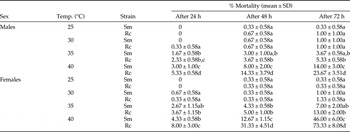
At 25 and 30°C, mortality was very low for both strains (≤1.3%) regardless of the duration of heat treatment (Table 1). The exposure of adults to temperatures of 35 and 40°C led to an increase in the mortality of both males and females to a maximum of about 23% (for males) and 73% (for females) after 72 h at 40°C (Table 1). Males were significantly more heat tolerant than females, with female mortality generally twice that for males (Table 1). Finally, with few exceptions, the males and females of the resistant strain (Rc) had a higher mortality than those of the susceptible strain (Sm). At all temperatures and for all durations of treatment, adults of the Rc strain generally had a heat tolerance about half that of the Sm strain, and this difference in survival was significant after 72 h at 35°C for females and after 48 and 72 h at 40°C for both males and females (Table 1).
Male and female adult mortality rates of the Sm and Rc strains exposed to different temperatures.

Notes: Temp. corresponds to temperature. For each sex and at each duration of treatment, means followed by different letters were significantly different (Dunn's tests, P ≤ 0.05).
Damage to sperm and ovary cells
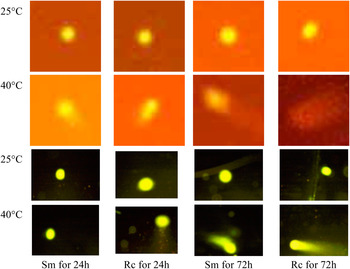
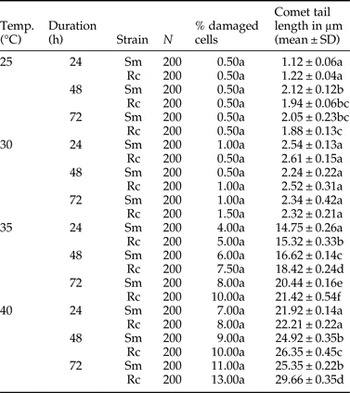
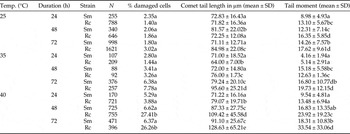
The percentage of damaged sperm and ovary cells increased with temperature and, for a given temperature, with the duration of exposure of the males and females (Tables 2 and 3 and fig. 1). Regardless the duration of exposure, the percentages of damaged cells remained low (≤ 10%) at 25, 30 and 35°C. At these temperatures, the percentages of damaged cells did not differ significantly between susceptible and resistant adults. Following the exposure of females to a temperature of 40°C for at least 48 h, the level of damage to ovary cells was found to be significantly higher in Rc (26–27%) than in Sm (6–7%) females (Table 3). At 40°C, the percentage of damaged sperm cells was also higher for Rc males than for Sm males (11 versus 13% after 72 h), but this difference was not significant (Table 3).
Damages of sperm (upper two lines) and ovary (down two lines) cells in adults of the Rc and Sm strains exposed at 25 or 40°C for either 24 or 72 h.

Comet tail length of sperm cells in adult males of the Sm and Rc strains exposed at different temperatures during different durations of exposure.

Notes: Temp. corresponds to temperature and N corresponds to the number of sperm cells observed. For each temperature, % of damaged cells and mean comet tail length followed by different letters were significantly different (P ≤ 0.05) (Fisher exact tests and Dunn's tests, respectively).
Comet tail length and tail moment of ovary cells in adult females of the Sm and Rc strains exposed at different temperatures during different durations of exposure.

Notes: Temp. corresponds to temperature and N corresponds to the number of ovary cells observed. For each temperature, % of damaged cells in one hand and mean comet tail length and mean tail moment on the other hand followed by different letters were significantly different (P ≤ 0.05) (Fisher exact tests and Dunn's tests, respectively).
For both types of cells, the length of the comet tail strongly increased with the temperature and duration of exposure (see Tables 2 and 3 for sperm and ovary cells, respectively). After 48 and 72 h of exposure to temperatures of 35 and 40°C, the comet tails of the sperm and ovary cells were always longer in Rc than in Sm adults. For both sperm and ovary cells, this difference in length became significant after 48 and 72 h of exposure to a temperature of 40°C (Tables 2 and 3). After 72 h of exposure to a temperature of 40°C, the comet tail of the sperm cells was 17% shorter in Sm than in Rc males and that of the ovary cells was 29% shorter in Sm than in Rc females.
Finally, the tail moment of ovary cells was always greater in Rc than in Sm females, but this difference was significant only after 72 h of exposure to a temperature of 40°C (Table 3).
SOD, CAT, POD activities and ROS contents
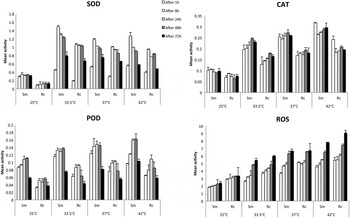
At 25°C, adults of the Sm strain had significantly higher SOD, CAT and POD activities and lower ROS contents than those of the Rc strain. No significant differences in SOD, CAT and POD activities or ROS content were found after exposure to a temperature of 25°C for 1–72 h (fig. 2 and Table S2). By contrast, significant increases in SOD, CAT and POD activities and ROS content were found in both Rc and Sm adults exposed to temperatures of 33.5, 37 and 42°C for 1, 8, 24, 48 and 72 h (fig. 2 and Table S2). However, the profiles of enzyme activity or ROS content increase varied with the enzyme, temperature or duration of exposure considered. The activities of SOD and POD reached a plateau after 8–48 h, but then declined significantly after 72 h of exposure to temperatures of 33.5, 37 and 42°C. CAT activity changed little in response to exposure between 1 and 72 h to temperatures of 33.5, 37 and 42°C. Finally, ROS levels increased gradually from 1 to 72 h of exposure to temperatures of 33.5, 37 and 42°C. In general, for all temperatures and exposure times, adults from the Rc strain had significantly lower SOD, CAT and POD activities, and significantly higher ROS contents than those of the Sm strain (fig. 2 and Table S2).
Mean (±SD) activities of SOD, CAT and POD and ROS contents in adults of the Rc and Sm strains exposed at different temperatures. For SOD, CAT, POD and ROS, activities are expressed as U mg−1 min−1, ΔOD 240 mg min−1, ΔOD 470 mg min−1 and nmol mg−1 pro min−1, respectively. The exact mean values and the statistical comparisons between means are given in Table S2.

Levels of mRNA for hsp/hsc and apoptosis-related genes
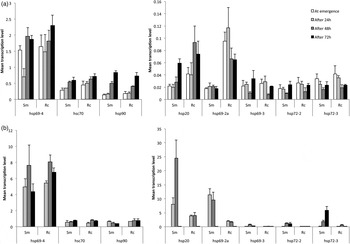
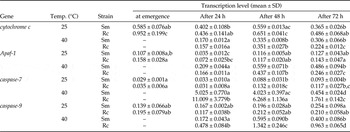
In general, at 25°C, mRNA levels for hsp (hsp20, hsp70s, hsc70 and hsp90) (fig. 3 and Table S3) and for apoptosis-related (cytochrome c, Apaf-1, caspases-9 and -7) (Table 4) genes remained constant over time. Transcription levels for these genes therefore remained essentially constant from emergence to 72 h after emergence. At 40°C, a significant upregulation of the expression of all the hsp and apoptosis-related genes was observed in both Sm and Rc adults. Conversely, in both strains, mRNA levels for hsc70 were not significantly higher at 40°C than at 25°C.
Mean (±SD) transcription levels of the hsp/hsc genes in adults of the Rc and Sm strains exposed at 25 (a) and 40°C (b). The exact mean values and the statistical comparisons between means are given in Table S3.

Transcription level of several key genes of the mitochondria associated apoptotic pathway in the Rc and Sm strains exposed at two different temperatures.

Notes: Temp. corresponds to temperature. For each gene and for each temperature, means followed by different letters are significantly different (Dunn's tests, P ≤ 0.05).
At 25°C, the gene expressions of hsp20, hsp69-2a and cytochrome c were significantly higher in Rc than in Sm adults (fig. 3, Table S3 and Table 4). The influence of heat stress on gene expression was significantly different in the two strains. For all but two of the hsp genes (hsp69-4 and hsp90), the increase in mRNA levels at 40°C was significantly smaller in Rc than in Sm adults. For apoptosis-related genes, the increase in mRNA levels at 40°C was significantly smaller (for cytochrome c and Apaf-1) or larger (for caspases-7 and -9) in Rc than in Sm individuals (Table 4).
Discussion
Thermosensitivity
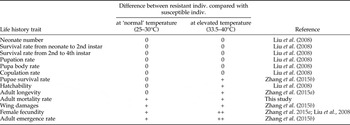
Individuals of the susceptible and resistant strains of the DBM studied here differed in several life history traits. The traits affected include pupal survival rate, adult longevity, hatchability, wing structure, female fecundity and adult emergence rate, but a number of other traits appear to be unaffected (Table 5). Here, we explored adult mortality, an additional life history trait. As already reported in many other studies (Atwal, Reference Atwal1955; Yun et al., Reference Yun, Chuanqing, Bo and Yujing2013), including some performed as long ago as 1917 by Marsh (Reference Marsh1917), the mortality of adult DBM at high temperatures (i.e. 35 and 40°C) was much higher than that at more usual temperatures (i.e. 25 and 30°C). More importantly, mortality was higher in the insecticide-resistant strain than in insecticide-susceptible strain. Indeed, at all temperatures and for all durations of treatment, adults of the resistant strain Rc were generally only half as heat tolerant as those of the susceptible strain Sm.
Comparative values of several life history traits between the susceptible and resistant DBM strains.

For a given trait, ‘0’ means that the value of the trait was not statistically different in the two strains and ‘+’ (‘++’) means that individuals of the resistant strains had a lower (much lower) value for this trait.
However, contrary to other life history traits, this difference was not temperature dependent. Indeed, we have recently shown (Zhang et al., Reference Zhang, Jing, Li, Li, Bourguet and Wu2015a , Reference Zhang, Wu, Wang, Liu, Zhuang and Wu b ) that the difference in several life history traits appeared (pupal survival rate, adult longevity, hatchability) or was magnified (female fecundity and adult emergence rate) at high temperature (Table 5). Like the degree of wing damage (Table 5), adult mortality was greater in resistant than in susceptible individuals even at temperatures favorable for development, but this difference did not increase at higher temperatures.
Fecundity, fertility and damage to sperm and ovary cells
Zhang et al. (Reference Zhang, Jing, Li, Li, Bourguet and Wu2015a ) and Liu et al. (Reference Liu, Miyata, Wu, Li, Wu, Zhao and Xie2008) found that fecundity was about 20% lower in resistant females than in susceptible females at temperatures optimal for development, and that the relative fecundity of the resistant females decreased further at high temperatures. We show here that this temperature-sensitive decrease in fecundity may be due to greater damage to reproductive cells in resistant than in susceptible individuals. Indeed, at high temperatures (i.e. 35 and 40°C), greater damage to ovary and sperm cells was observed in resistant than in susceptible adults. This damage may have a detrimental impact on male and female fertility in individuals of the resistant strain, with possible effects on fecundity, as documented by Liu et al. (Reference Liu, Miyata, Wu, Li, Wu, Zhao and Xie2008) and Zhang et al. (Reference Zhang, Jing, Li, Li, Bourguet and Wu2015a ).
The greater damage to reproductive cells in resistant than in susceptible individuals may be directly linked to the higher ROS contents in resistant than in susceptible individuals (see below). Indeed, excessively high levels of ROS have been shown to play an important role in the pathogenesis of many reproductive disorders in human (Agarwal et al., Reference Agarwal, Saleh and Bedaiwy2003). In insects, DeJong et al. (Reference DeJong, Miller, Molina-Cruz, Gupta, Kumar and Barillas-Mury2007) provided strong evidence for a direct impact of cumulative oxidative damage due to ROS on fecundity in the Anopheles gambiae mosquito. Consistent with the known effect of ROS on reproductive cells in insects, the depletion of CAT – a strong antioxidant enzyme that breaks down ROS – has been shown to result in the production of smaller numbers of oocytes by the phlebotomine sand fly Lutzomyia longipalpis after blood feeding (Diaz-Albiter et al., Reference Diaz-Albiter, Mitford, Genta, Mauricio, Anna, Rod and Dillon2011). Similarly, Sim & Denlinger (Reference Sim and Denlinger2011) found that the inhibition of CAT activity resulted in greater damage to the ovaries of the Culex pipiens mosquito. Consistent with these findings, we found that CAT activity levels were lower in resistant than in susceptible DBM.
Oxidative stress and ROS
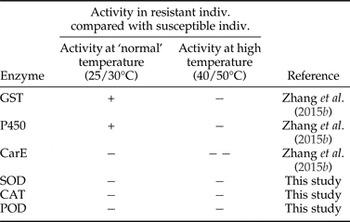
In a previous study (Zhang et al., Reference Zhang, Wu, Wang, Liu, Zhuang and Wu2015b ), we evaluated the levels of three antioxidant and detoxifying enzymes: GST, P450 and CarE. At 25°C, resistant DBM produced larger amounts of GST and P450 and smaller amounts of CarE than susceptible DBM (Table 6). The production of these three enzymes was inhibited at both 36 and 40°C, for both types of individuals, but this inhibition was significantly stronger in resistant than in susceptible DBM (Table 6). Like CarE, the three additional antioxidant enzymes tested here (CAT, SOD and POD) displayed lower levels of basal expression in resistant individuals (Table 6). However, by contrast to CarE, GST and P450, the difference in enzymatic activity between resistant and susceptible individuals did not increase further after exposure of the adults to higher temperatures (Table 6). Cells produce antioxidant enzymes in response to the oxidative stress induced by ROS in the mitochondria. As expected, ROS content was therefore higher in resistant than in susceptible individuals, but this difference in content remained roughly constant at all temperatures tested. The production of larger amounts of ROS may decrease the investment in reproduction (see above) or in other functions, such as immunity (thereby increasing the risk of death), and damage may accumulate faster (thereby accelerating the aging process) (Monaghan et al., Reference Monaghan, Metcalfe and Torres2009). The higher level of oxidative stress in resistant than in susceptible individuals may therefore be the key to the difference in fitness between our two strains of the DBM.
Relative activities of several antioxidative and detoxifying enzymes in the adults of the susceptible and resistant strains of the DBM.

For a given enzyme, ‘−’, ‘− −’ and ‘+’ mean that the enzyme displayed a lower, much lower and higher activity in individuals of the resistant strain (compared with those of the susceptible strain), respectively.
Apoptotic genes
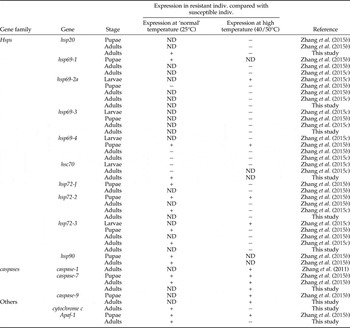
In a previous study (Zhang et al., Reference Zhang, Wu, Wang, Liu, Zhuang and Wu2015b ), we carried out a comparative analysis of the expression of the four apoptotic genes tested here (cytochrome c, Apaf-1, caspases-7 and -9) during the pupal stage in DBM (Table 7). Resistant pupae had a higher basal level of expression and displayed stronger upregulation of three of these genes than susceptible pupae. The exception was the cytochrome c gene, which was more strongly upregulated in resistant pupae, but had similar levels of basal expression in the two types of pupae. In adults, we observed no differences in the basal expression of these four apoptotic genes between resistant and susceptible individuals, with stronger upregulation of the caspases-7 and -9 genes in resistant adults (Table 7). Overall, our results suggest that the resistant strain displays a higher level of apoptosis than the susceptible strain that is further increased by the exposure of the individual, at the pupal or adult stage, to unfavorable temperatures. This higher level of apoptosis may, therefore, together with the higher level of oxidative stress, be another physiological component of the difference of fitness between the two strains.
Relative gene expression of several hsps genes and apoptotic genes in the susceptible and resistant DBM strains.

For a given gene, ‘−’ and ‘+’ mean that the enzyme displayed a lower and higher expression in individuals of the resistant strain (compared with those of the susceptible strain), respectively. ND means not determined.
Heat-shock proteins
HSPs play a key role in preventing the cellular damage associated with several stresses (Kregel, Reference Kregel2002; King & MacRae, Reference King and Macrae2015) and stress-induced apoptosis (Beere, Reference Beere2004).
HSC70 does not normally respond to heat stress (Kiang & Tsokos, Reference Kiang and Tsokos1998). Accordingly, hsc70 mRNA levels were not significantly higher at 40°C than at 25°C and were similar in susceptible and resistant individuals. Unlike HCS70, HSPs generally rapidly increase in abundance in response to thermal stress (King & MacRae, Reference King and Macrae2015). An upregulation of the expressions of hsp70 genes in response to heat stress has thus been documented in many lepidopteran pests (Cydia pomonella (Yin et al., Reference Yin, Wang, Tang, Hansen and Lurie2006), Chilo suppressalis (Cui et al., Reference Cui, Du, Lu and Qiang2011), Helicoverpa zea (Zhang & Denlinger, Reference Zhang and Denlinger2010), Spodoptera exigua (Xu et al., Reference Xu, Zou, Zheng, Zhang, Tang and Wang2011) and Spodoptera litura (Shen et al., Reference Shen, Gong, Gu, Huang and Feng2014)), parasitoid wasps (Macrocentrus cingulum (Xu et al., Reference Xu, Xiao, Liu, Li and Huang2010) and Cotesia vestalis (Shi et al., Reference Shi, Wang, Zhu and Chen2013)) and the fruit fly, Drosophila melanogaster (Udaka et al., Reference Udaka, Ueda and Goto2010). Our results are consistent with this general trend, with larger amounts of hsp70 proteins produced at high temperatures.
Here, we found that two hsp genes (hsp20 and hsp69.2a) had, like hsc70, higher levels of ‘basal’ expression in resistant than in susceptible individuals (Table 7). At high temperatures, these two genes and two other hsp70 genes (hsp72.2 and hsp72.3) displayed weaker upregulation in resistant than in susceptible individuals (Table 7). These findings are consistent with our previous findings for comparative expression analyses and for the upregulation of hsp genes in these resistant and susceptible DBM strains (Table 7).
Toward an overall explanation of the difference of fitness
The results of this and our previous studies (Liu et al., Reference Liu, Miyata, Wu, Li, Wu, Zhao and Xie2008; Zhang et al., 2011, Reference Zhang, Wang, Zhuang and Wu2014, Reference Zhang, Jing, Li, Li, Bourguet and Wu2015a , Reference Zhang, Wu, Wang, Liu, Zhuang and Wu b , Reference Zhang, Wang, Zhuang, Jing and Wu c ) provide a comprehensive explanation of why individuals of our resistant strain had a lower fitness than those of its related susceptible strain. At the temperatures to which the insect is normally exposed (about 25–30°C), the decrease in fitness principally manifests as a lower adult emergence rate, lower levels of adult dispersal (due to damage on the wing structure), lower female fecundity and higher mortality. This impact at temperatures optimal for DBM development and survival can be accounted for by: (1) a higher ROS content, possibly due to lower levels of activity for many antioxidant enzymes (e.g. CAT, SOD, CarE, POD) and (2) the overexpression of several genes (such as hsp20 and hsp69.2a). This greater investment in protein synthesis decreases the amount of resources available for other critical functions, accounting, together with the higher ROS content, for the lower longevity of individuals of the resistant strain.
At temperatures above 33.5°C, the difference of fitness between the two strains increased. All four life history traits affected at favorable temperatures continued to be affected, but the impact on two of these traits (female fecundity (Liu et al., Reference Liu, Miyata, Wu, Li, Wu, Zhao and Xie2008; Zhang et al., Reference Zhang, Jing, Li, Li, Bourguet and Wu2015a ) and adult emergence rate (Zhang et al., Reference Zhang, Wu, Wang, Liu, Zhuang and Wu2015b )) increased. In addition, rising temperatures had a deleterious effect on three additional life history traits not affected at favorable temperatures: hatchability, pupal survival rate and adult longevity. This thermosensitivity may be due to both: (1) weaker upregulation of hsp gene expression, although we must keep in mind that a weaker upregulation of a gene does not necessarily mean that its mRNA titer is lower and (2) stronger upregulation of the expression of caspases-7 and -9. Lower HSP levels are associated with lower levels of thermotolerance and protection against a number of stresses other than heat, including ROS injury (Kalmar & Greensmith, Reference Kalmar and Greensmith2009). HSPs also exert anti-apoptotic effects (Garrido et al., Reference Garrido, Gurbuxani, Ravagnan and Kroemer2001; Ravagnan et al., Reference Ravagnan, Gurbuxani, Susin, Maisse, Daugas, Zamzami, Mak, Jäättelä, Penninger, Garrido and Kroemer2001). The weaker upregulation of the genes encoding these proteins, together with the stronger upregulation of apoptotic genes, could, therefore, greatly increase apoptosis levels at high temperatures.
Fitness cost associated with the ace1R allele in Chinese DBM populations
The difference in fitness between the susceptible and resistant strains studied here and in our previous studies (Liu et al., Reference Liu, Miyata, Wu, Li, Wu, Zhao and Xie2008; Zhang et al., Reference Zhang, Jing, Li, Li, Bourguet and Wu2015a , Reference Zhang, Wu, Wang, Liu, Zhuang and Wu b ) might have several non-exclusive origins. Part of this cost is directly linked to the ace1R – the allele conferring the resistance to several to several OP insecticides – or to other alleles of genes linked to ace1. Indeed, in a previous experiment and using the same strains, we monitored the frequency of ace1R (by genotyping more than 20,000 adults) and the level of resistance (through bioassays on more than 50,000 individuals) over several generations (Zhang et al., Reference Zhang, Jing, Li, Li, Bourguet and Wu2015a ). For all strains, replicates and experimental conditions, we observed a decrease in the level of resistance to chlorpyrifos (an OP) over time, in the generations reared in the absence of chlorpyrifos. This decrease in resistance was associated with a decrease in the frequency of the ace1R allele over generations. This clearly indicated that ace1R – or closely linked alleles – is costly in the absence of insecticide. This cost is a general tendency (Kliot & Ghanim, Reference Kliot and Ghanim2012). Indeed, considerable disadvantages in terms of life history traits and physiological processes have been found to be associated with insecticide resistance due to mutations and/or the overexpression of resistance alleles in many insect species: P. xylostella (the DBM) (Liu et al., Reference Liu, Miyata, Wu, Li, Wu, Zhao and Xie2008), Leptinotarsa decemlineata (Zhu et al., Reference Zhu, Lee and Clark1996), Culex quinquefasciatus (Berticat et al., Reference Berticat, Bonnet, Duchon, Agnew, Weill and Corbel2008), Culex pipiens (Bourguet et al., Reference Bourguet, Guillemaud, Chevillon and Raymond2004), A. gambiae (Djogbénou et al., Reference Djogbénou, Noel and Agnew2010), Aedes aegypti (Martins et al., Reference Martins, Ribeiro, Bellinato, Peixoto, Valle and Lima2012), Myzus persicae (Castañeda et al., Reference Castañeda, Baeeientos, Cortes, Figueroa, Fuentes-contreras, Luna-Rudloff, Silva and Bacigalupe2011), and several species of Drosophila (Shi et al., Reference Shi, Lougarre, Alies, Fremaux, Tang and Fournier2004).
In our previous experiment, we also showed that the frequency of ace1R resistance allele decreased faster at high temperature than at optimal temperature. In other words, the fitness cost associated with ace1R is temperature sensitive (Zhang et al., Reference Zhang, Jing, Li, Li, Bourguet and Wu2015a ), a feature reported for resistances to other insecticides in the DBM (Li et al., Reference Li, Liu, Liu and Ye2007).
The decrease in fitness in the resistant strain might correspond to a fitness cost associated with ace1R also partly be due to genetic divergence at loci unlinked to ace1. The susceptible and resistant strains originated from the same 2005 collection and may have a rather similar genetic background; however, they have undergone different selective pressures in the laboratory and have probably undergone bottlenecks during that time. Ten years of laboratory culturing is likely to have had a major impact on the genome. In addition, it is hard to believe that all of the phenotypic and expression differences reported here and in our previous studies (Liu et al., Reference Liu, Miyata, Wu, Li, Wu, Zhao and Xie2008; Zhang et al., Reference Zhang, Jing, Li, Li, Bourguet and Wu2015a , Reference Zhang, Wu, Wang, Liu, Zhuang and Wu b ) are simply due to two amino acid substitutions in ace1. Indeed, the ace1R resistance allele differed from susceptible alleles by two tightly linked mutations – A201S and G227A – affecting the amino acid sequence of the acetylcholinesterase enzyme (Zhang et al., Reference Zhang, Jing, Li, Li, Bourguet and Wu2015a ). This change in two amino acids probably modifies the substrate specificity of the active site of this enzyme (i.e. it certainly reduced the affinity between OP insecticides and the acetylcholinesterase). To our knowledge, there is no direct interaction between acetylcholinesterase and either the oxidative stress or the physiological cascade leading to apoptosis. The factors governing the differential expression or regulation of hsp genes and apoptotic genes therefore remain to be identified.
Supplementary material
The supplementary material for this article can be found at https://doi.org/10.1017/S0007485317000049.
Acknowledgments
This study received financial support from the National Natural Science Foundation of China (NNSFC) (grant no. 31272049) and the Key Foundation of Technology project of Fujian Province (grant no. 2014N0003).
Conflict of interest
None.
Author contributions
DB and GW conceived the experiments, analyzed the data, generated the tables, produced the figures and wrote the manuscript. LJZ, GW, JLC, BLY and XGK performed the experiments.