Significant outcomes
-
∙ Serum levels of l-serine and d-serine in the patients with depression were higher than those of control subjects.
-
∙ The ratio of l-serine to glycine in the patients with depression was significantly higher than that of control subjects.
-
∙ Serine enantiomers would be a peripheral biomarker for depression.
-
∙ Abnormalities in the synthesis and metabolism of serine enantiomers may play a role in the pathophysiology of depression.
Limitations
-
∙ In this study, we did not measure serum levels of amino acids in drug-naïve patients with depression.
Introduction
Accumulating evidence suggests that glutamatergic neurotransmission via N-methyl-d-aspartate (NMDA) receptors plays a key role in the pathophysiology of major depressive disorder (MDD), as well as the therapeutic mechanisms of antidepressants (Reference Sanacora, Zarate, Krystal and Manji1–Reference Hashimoto, Malchow and Faljai3). The NMDA receptor antagonist, ketamine, is an extremely attractive therapeutic agent, as ketamine shows rapid and sustained antidepressant effects in patients with treatment-resistant MDD (Reference Krystal, Sanacora and Duman4–Reference Yang, Shirayama and Zhang7). In addition, a high dose (1000 mg/day) of d-cycloserine, a partial agonist at the NMDA receptor, significantly improved depressive symptoms in treatment-resistant MDD (Reference Heresco-Levy, Gelfin and Bloch8). This implied that antagonistic activity at glycine modulatory sites on the NMDA receptor could represent a therapeutic target for treatment-resistant depression.
Previously, we measured tissue levels of the amino acids d-serine, l-serine, glycine, glutamate and glutamine in postmortem brain samples from control subjects, as well as MDD, bipolar disorder (BD) and schizophrenia patients (Reference Hashimoto, Sawa and Iyo9). We found that glutamate levels in the prefrontal cortex of MDD and BD brain samples were significantly higher than those of control samples (Reference Hashimoto, Sawa and Iyo9), suggesting that increased glutamatergic neurotransmission is crucial to the pathogenesis of MDD and BD (Reference Hashimoto2,Reference Hashimoto, Sawa and Iyo9). Recently, we reported that serum levels of d-serine, glycine and glutamine in patients with stable BD were significantly higher than those of healthy controls, whereas serum levels of l-serine in BD patients were lower than those of healthy controls (Reference Pålsson, Jakobsson and Södersten10), indicating a probable abnormality of NMDA receptor neurotransmission in BD.
This study aimed to determine whether serum levels of d-serine, l-serine, glycine, glutamate and glutamine showed changes between patients with MDD and age- and gender-matched healthy controls.
Methods and materials
Participants
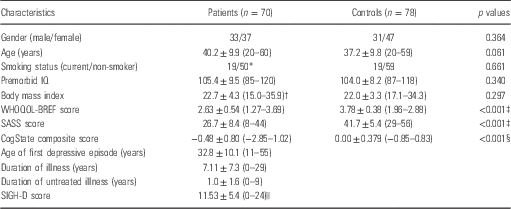
A total of 70 patients with MDD and 78 age-matched healthy controls were enrolled into this study (Table 1). All patients were outpatients and met DSM-IV criteria for MDD. There were no specific medication criteria for inclusion. A total of 66 patients had received antidepressants, including paroxetine, sertraline, fluvoxamine, amitriptyline, amoxetine, trazodone, duloxetine, milnacipran, mirtazapine and sulpiride. Two of the four patients, who were antidepressant therapy naïve, had received anxiolytics. Control subjects were screened using the Structured Clinical Interview for DSM-IV Axis I Disorders, Non-Patients Edition, and were required to be free of Axis I disorders, according to DSM-IV criteria. Study investigators recruited healthy controls who matched patients on age, male/female ratio, premorbid intelligence quotient (IQ) (as assessed by the Japanese Adult Reading Test-25 version, the Japanese version of the National Adult Reading Test), body mass index and smoking status. Smoking status was dichotomised into current smokers versus non-smokers. Exclusion criteria for all subjects included any current or past history of neurological disorders, including head injury, cerebral vascular disorders, epilepsy, and alcohol or drug abuse. Subjects who rarely used personal computers were excluded from the study. Before commencement of the study, all subjects provided written, informed consent after receiving a full explanation of the study, as well as any potential risks and benefits of study participation. The study was approved by the Ethics Committee of Chiba University Graduate School of Medicine (Chiba, Japan), and performed in accordance with the Declaration of Helsinki II.
Demographic data of subjects
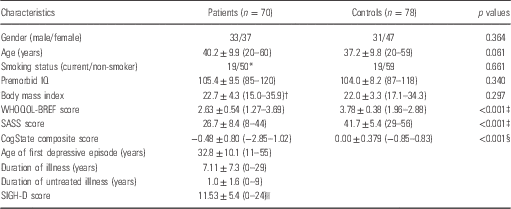
IQ, intelligence quotient; SASS, Social Adaptation Self-evaluation Scale; SIGH-D, 17 items of the Structured Interview Guide for the Hamilton Depression Rating Scale; WHOQOL-BREF, World Health Organization Quality of Life-Short Version.
Data show the mean±SD. The numbers in parenthesis represents the range.
* Data for one patient is missing.
† Data for three patient are missing.
‡ Student’s t-test.
§ Mann–Whitney’s U test.
|| Data for four patient are missing.
Assessment of clinical variables
Depression was assessed using 17 items of the Structured Interview Guide for the Hamilton Depression Rating Scale (SIGH-D) (Reference Hamilton11). Quality of life (QOL) was assessed using World Health Organization Quality of Life-Short Version (WHOQOL-BREF). Social function was assessed using the Japanese version of the Social Adaptation Self-evaluation Scale (SASS) (Reference Ueda, Suda and Nakagawa12), a validated self-evaluation scale for assessment of social functioning (Reference Bosc13).
Cognitive impairment was assessed using the Japanese language version of the CogState battery, a rapid, automatically administered computerised battery, which assesses verbal learning, visual learning, speed of processing, attention/vigilance, visual working memory, spatial working memory, reasoning and problem solving, and social cognition (Reference Yoshida, Suga and Arima14,Reference Yoshida, Ishikawa and Niitsu15; www.cogstate.com). The primary measure from each task of this battery was standardised by creating Z-scores. The healthy control mean was set to 0 and SD set to 1, as previously reported (Reference Yoshida, Suga and Arima14,Reference Yoshida, Ishikawa and Niitsu15). A composite score was calculated by averaging all Z-scores from the eight primary measures of the CogState battery.
Measurement of serum amino acids levels
Measurement of total, d- and l-serine levels in plasma was carried out using a column-switching high-performance liquid chromatography (HPLC) system (Shimadzu Corporation, Kyoto, Japan), as previously reported (Reference Fukushima, Kawai, Imai and Toyo'oka16). The measurement of glycine, glutamine and glutamate was carried out using an HPLC system with fluorescence detection, as previously reported (Reference Pålsson, Jakobsson and Södersten10). Briefly, serum (20 µl) was homogenised in 180 µl of methanol (HPLC grade) on ice. The homogenates were centrifuged at 3000×g for 6 min at 4°C, and 20 µl of supernatant was evaporated to dryness at 40°C. To the residue, 20 µl of H2O (HPLC grade), 20 μl of 0.1 M borate buffer (pH 8.0) and 60 μl of 50 mM 4-fluoro-7-nitro-2,1,3-benzoxadiazole (NBD-F; Tokyo Kasei Kogyo Co. Ltd, Tokyo, Japan) in CH3CN (HPLC grade) were added. The reaction mixture was heated at 60°C for 2 min, then quenched immediately with 100 μl of H2O/CH3CN (90/10) containing 0.1% trifluoroacetic acid (TFA) to stop the reaction.
A 20 µl aliquot of the resultant solution was injected into the HPLC system. A reversed-phase ODS column (TSKgel ODS-80Ts; Tosoh Corporation, Tokyo, Japan; as Column 1) was used for the separation and quantification of total (d- and l-) serine, and the gradient elution of the mobile phase was maintained at a constant flow rate of 0.8 ml/min. Mobile phase 1a consisted of H2O/CH3CN (90/10) containing 0.1% TFA, and phases 1b and 1c of H2O/CH3CN (10/90) containing 0.1% TFA and CH3CN, respectively. The time programme for gradient elution was as follows: 0–25 min 1a : 1b : 1c=92 : 8 : 0, 25–25.1 min linear gradient from 8% 1b to 100% 1b, 25.1–35 min 1a : 1b : 1c=0 : 100 : 0, 35–35.1 min linear gradient from 8% 1b to 100% 1c, 35.1–40 min 1a : 1b : 1c=0 : 0 : 100 and 40.1–60 min 1a : 1b : 1c=92 : 8 : 0. The chiral column (Column 2) used for the separation and quantification of d- and l-serine with NBD-F comprised two Sumichiral OA-2500 columns (S) (Sumika Chemical Analysis Service Ltd, Osaka, Japan) connected in tandem. The mobile phase was 15 mM citric acid in MeOH. The flow rate was isocratically pumped at 1.0 ml/min. Column temperatures were maintained at 35°C. Fluorescence detection was performed at 530 nm with an excitation wavelength at 470 nm.
For determination of glycine, glutamine and glutamate, a reversed-phase ODS column was used. The gradient elution of the mobile phase was kept at a constant flow rate of 0.8 ml/min. The time programme for gradient elution was programmed as follows: 0–50.5 min 1a : 1b : 1c=95 : 5 : 0, 50.5–55.5 min 1a : 1b : 1c=0 : 100 : 0 and 55.5–57 min 1a : 1b : 1c=0 : 0 : 100. The temperature of all columns was maintained at 35°C. Fluorescence detection was performed at 530 nm with an excitation wavelength at 470 nm.
Statistical analyses
The data show the mean±standard deviation. χ2 test was used for categorical variables. Parametric Student’s t-test or non-parametric Mann–Whitney test were used to compare the two groups. Correlations with clinical variables were performed using Pearson’s correlation or Spearman’s correlation. P values of <0.05 were deemed statistically significant. All analyses were carried out using SPSS version 20.0 (SPSS, Inc., Tokyo, Japan)
Results
Demographic data and clinical variables
The demographic information and clinical variables of subjects are presented in Table 1. Age, gender, estimated premorbid IQ, body mass index and smoking status did not differ between the two groups. The WHOQOL-BREF and SASS scores in patients with MDD were significantly lower than those of controls, indicating decreased QOL and poor social function in patients with MDD. Furthermore, composite scores on the CogState battery in patients with MDD were significantly lower than those of healthy controls, suggestive of cognitive impairment in MDD patients (Table 1).
Serum levels of amino acids
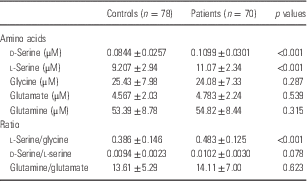
Serum levels of d-serine and l-serine in MDD patients (n=70) were significantly (p<0.001) higher than those of controls (n=78) (Table 2). In contrast, serum levels of glycine, glutamate and glutamine in MDD patients did not differ from controls (Table 2). Interestingly, the ratio of l-serine to glycine in MDD patients was significantly higher than in controls (p<0.001), although the ratio of d-serine to l-serine and the ratio of glutamine to glutamate did not differ between two groups (Table 2).
Serum levels of amino acids and the ratio of amino acids in control subjects and major depressive disorder patients
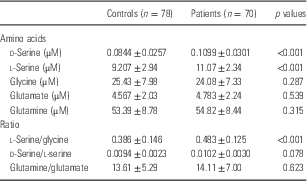
The data show the mean±SD. The data were analysed by Student’s t-test.
There were positive correlations between l-serine and glycine (r=0.548, p<0.001) and glutamine (r=0.446, p<0.001) in patients. Furthermore, there was a positive correlation (r=0.345, p=0.003) between d-serine and glutamine in patients, but not controls. Interestingly, we found a negative correlation between the ratio of l-serine to glycine and glutamate in patients (r=−0.787, p<0.001).
Correlations with clinical variables
There were significant correlations between SASS scores and the CogState composite score (r=0.381, p<0.001), SIGH-D scores (r=0.587, p<0.001) and Beck Depression Inventory (BDI) (r=−0.676, p<0.001), implying a possible association between social function, and both cognitive impairment and the severity of depressive symptoms in MDD patients. Furthermore, there were also negative correlations between CogState composite scores and the severity of depressive symptoms (SIGH-D: r=0.289, p=0.019; BDI: r=−0.445, p<0.001), indicating that cognitive impairment may be associated with depressive symptoms in MDD patients. In contrast, there were no correlations between serum levels of amino acids and any clinical variables in MDD patients.
Discussion
Here, we found that in MDD patients serum levels of d-serine and l-serine were significantly higher than those of age- and gender-matched healthy controls. Previously, Maes et al. (Reference Maes, De Backer, Suy and Minner17) noted that plasma levels of dl-serine (or total serine) in depressed patients (n=123) were significantly higher than those of controls (n=50). Subsequently, Sumiyoshi et al. (Reference Sumiyoshi, Anil and Jin18) reported that plasma levels of dl-serine in medication-free MDD patients (n=44) were higher than those of controls (n=49). Both of these studies strongly support our data, although it was not possible to determine the levels of d-serine and l-serine in plasma owing to the extremely low proportion of d-serine in total serine (~1% of total serine). To the best of our knowledge, this is the first report showing increased serum levels of d-serine and l-serine in patients with MDD, where levels of serine enantiomers were not associated with clinical variables. Therefore, it is likely that serine enantiomers in blood could be peripheral biomarkers for depression.
In contrast, Mitani et al. (Reference Mitani, Shirayama and Yamada19) reported that plasma levels of d-serine and l-serine in patients with MDD (n=23) were the same as healthy controls (n=31), although for glutamate, glutamine and glycine in MDD patients plasma levels were significantly higher than those of controls, findings which are inconsistent with the present and previous studies (Reference Maes, De Backer, Suy and Minner17,Reference Sumiyoshi, Anil and Jin18). Interestingly, there was a negative correlation (r=−0.704, p=0.001) between plasma l-serine and the severity of depressive symptoms in patients (Reference Maes, De Backer, Suy and Minner17). However, in this study, we found no correlation between serum levels of amino acids and the severity of depression in patients with MDD, in keeping with a previous report (Reference Altamura, Maes, Dai and Meltzer20). Patients enrolled in this study showed moderate, rather than severe symptoms of depression (SIGH-D score: 11.53±5.4), compared with the previous report (16.0±10.2) (Reference Maes, De Backer, Suy and Minner17). Thus, it is likely that the lack of correlation between amino acid serum levels and depression severity seen in our report may be due to the absence of severe disease within our cohort of patients. A further study of patients with severe depression will be needed to resolve this issue.
Previously, we reported that tissue levels of serine enantiomers in the prefrontal cortex from MDD patients were not different from control subjects (Reference Hashimoto, Sawa and Iyo9), inconsistent with the present results from serum samples. Although the reasons underlying this discrepancy are current unknown, samples (serum vs. postmortem brain) may contribute to the difference. Furthermore, we found a positive correlation (r=0.548, p<0.001) between l-serine and glycine in the MDD patients, consistent with the correlation from postmortem brain samples from MDD patients (Reference Hashimoto, Sawa and Iyo9). Thus, it is likely that l-serine-glycine cycle may play a role in the pathophysiology of depression.
In this study, we found that the ratio of l-serine to glycine in MDD patients was significantly higher than that of controls, replicating previous data showing an increased ratio of dl-serine to glycine in depressed patients (Reference Sumiyoshi, Anil and Jin18). The ratio of l-serine to glycine is known to be an index of l-serine–glycine interconversion, via serine hydroxymethyltransferase (SHMT) (Reference Hashimoto21). It has also been reported that the activity of SHMT in psychotic depressive patients (n=18) is significantly (p<0.001) lower than that of non-psychotic depressed patients (n=22), suggesting abnormal SHMT activity during the psychotic state in depressed patients (Reference Waziri, Mott and Wilcox22). Therefore, it would be of great interest to examine the relationship between serum levels of amino acids and the activity of SHMT in patients with MDD.
We have reported that serum d-serine levels in mood-stabilised patients with BD were significantly higher than those of controls (Reference Pålsson, Jakobsson and Södersten10), indicating aberrant d-serine metabolism in BD patients. It remains unclear whether changes in serum d- and l-serine levels are a trait or state marker for BD. We propose that enhanced activity at NMDA receptors, mediated by increased d-serine levels, may contribute to the pathophysiology of mood disorders, such as MDD and BD. In contrast, serum d-serine levels in patients with schizophrenia are lower than those of controls (Reference Hashimoto, Fukushima and Shimizu23), implying attenuated NMDA receptor activity, due to the decreased d-serine levels found in schizophrenia. Interestingly, Moaddel et al. (Reference Moaddel, Luckenbaugh and Xie24) reported that levels of d-serine in the blood at baseline may be a potentially reliable biomarker for the antidepressant effects of ketamine in patients with treatment-resistant depression. Given the key role of d-serine in NMDA receptor neurotransmission, its use as a biomarker to measure the antidepressant effect of NMDA receptor antagonism will be highly useful in the clinical setting (Reference Hashimoto25). Considering the contrasting effects of ketamine in schizophrenia and mood disorders (MDD and BD), it seems that opposing alterations in NMDA receptor function are crucial to the pathogenesis of schizophrenia and mood disorders (Reference Hashimoto26).
The main limitation to this study was the small cohort size for the medication-naïve patients with severe symptoms of depression. As antidepressant medication may affect the serum levels of amino acids, further studies using larger samples of medication-naïve patients will be needed. It would also be of great interest to conduct a follow-up study of medication.
In conclusion, we found that serum levels of d-serine and l-serine in patients with MDD were significantly higher than those of healthy controls, and that the ratio of l-serine to glycine in patients with MDD was significantly higher than that of controls. These findings suggest abnormalities in the synthesis and metabolism of serine enantiomers in depression. This raises the possibility that serine enantiomers could act as peripheral biomarkers for mood disorders.
Acknowledgements
The authors appreciated to all subjects who participated in this study. Authors’ Contributions: K.H. for substantial contributions to conception and design, acquisition of data, analysis and interpretation of the data, drafting the article and final approval of the version to be published; all other authors for substantial contributions to sample collection, measurement of amino acids and final approval of the version to be published.
Financial Support
This study was supported by a grant from Comprehensive Research on Disability, Japan Agency for Medical Research and Development (AMED) (K.H., H26-Seishin-Ippan-015), Japan.
Conflicts of Interest
None.
Ethical Standards
The study was approved by the Ethics Committee of Chiba University Graduate School of Medicine (Chiba, Japan). The authors assert that all procedures contributing to this work comply with the ethical standards of the relevant national and institutional committees on human experimentation and with the Helsinki Declaration of 1975, as revised in 2008.