Introduction
Previous studies on bilingualism have debated the extent to which bilingual speakers integrate the syntax of their two languages. The controversy centers on whether bilinguals share one representation for similar constructions in two distinct languages. Two theoretical accounts have taken different perspectives on this issue. According to the separate-syntax account (e.g., De Bot, Reference De Bot1992), bilinguals represent syntactic information separately for each language, even for constructions that are similar on an abstract level (e.g., passive sentences in English and Spanish). In contrast, the shared-syntax account (e.g., Hartsuiker et al., Reference Hartsuiker, Pickering and Veltkamp2004) maintains that if similar constructions exist in their two languages, bilinguals can develop and use a single syntactic representation for both.
Evidence that cross-linguistic syntactic priming can occur supports Hartsuiker et al.’s (Reference Hartsuiker, Pickering and Veltkamp2004) shared-syntax account in that such priming effects lead a structure in one language to activate an equivalent structure in the other language (e.g., Bernolet et al., Reference Bernolet, Hartsuiker and Pickering2007, Reference Bernolet, Hartsuiker and Pickering2009). However, questions remain about this account’s generalizability. First, there is no consensus on the extent to which shared-syntax is independent of word order (e.g., Loebell & Bock, Reference Loebell and Bock2003; Song & Do, Reference Song and Do2018). Second, few studies have investigated whether cross-linguistic syntactic priming occurs, when one language has syntactic variations for a shared syntactic structure (Bernolet et al., Reference Bernolet, Hartsuiker and Pickering2012, Reference Bernolet, Hartsuiker and Pickering2013). More questions arise in light of the shared-syntax account of adult L2 learners’ syntactic acquisition (e.g., Hartsuiker & Bernolet, Reference Hartsuiker and Bernolet2017). Hartsuiker and Bernolet (Reference Hartsuiker and Bernolet2017) hypothesized that early L2 learners may not have shared representations between the L1 and L2, but that learners can eventually share abstract representations after their L2 proficiency is fully developed.
This study investigates the roles of different word orders, language-specific syntactic variations, and L2 proficiency in cross-linguistic syntactic priming. It examines dative alternations in Korean and English, which have different basic word orders and different syntactic variations for dative structures. Specifically, unlike English, constituents in Korean dative alternations can be freely moved, so various orders of them are possible (e.g., Saito, Reference Saito2003; Sohn, Reference Sohn2001). In addition, this study explores whether syntactic priming effects differ for intermediate versus advanced L2 learners.
Literature Review
Syntactic priming
Syntactic priming refers to the phenomenon in which speakers are more likely to access a grammatical form they have recently encountered or produced (e.g., Bock, Reference Bock1986). For instance, after reading or producing a passive construction (e.g., The thief was chased by the policeman), a speaker is more likely to comprehend or produce another passive construction (e.g., The highway was paved by the crew) than an active one (e.g., The crew paved the highway). Syntactic priming provides evidence that we store abstract syntactic representations that are independent of conceptual and lexical knowledge. These representations include syntactic constituents (e.g., noun phrases [NP]) and their configurations (e.g., NP → Det N) (Mahowald et al., Reference Mahowald, James, Futrell and Gibson2016; Pickering & Ferreira, Reference Pickering and Ferreira2008).
Syntactic priming has been explored within and between languages (e.g., Bernolet et al., Reference Bernolet, Hartsuiker and Pickering2013; Kantola & van Gompel, Reference Kantola and van Gompel2011), in aural and written modalities (e.g., Kaan & Chun, Reference Kaan and Chun2018; Song & Do, Reference Song and Do2018), in comprehension and production (e.g., Hartsuiker et al., Reference Hartsuiker, Pickering and Veltkamp2004; Wei et al., Reference Wei, Boland, Brennan, Yuan, Wang and Zhang2017), and in lab-based settings and natural discourse. It has been studied in various languages (e.g., German: Jackson & Ruf, Reference Jackson and Ruf2017) and with many different methodologies (e.g., confederate scripting tasks, picture description tasks). The findings of such research have provided support for several theories, such as a model of representation of syntactic information (Pickering & Branigan, Reference Pickering and Branigan1998), implicit learning (Bock & Griffin, Reference Bock and Griffin2000), and error-based learning (Chang et al., Reference Chang, Dell and Bock2006).
In particular, syntactic priming has been widely used to test whether abstract grammatical representations exist and, further, whether they are shared between two languages. For example, Pickering and Branigan (Reference Pickering and Branigan1998) proposed a lexicalist residual activation model that was later extended to bilinguals by Hartsuiker et al. (Reference Hartsuiker, Pickering and Veltkamp2004). Pickering and Branigan suggested that syntactic priming provides evidence for abstract syntactic representation in a within-language context. Specifically, they proposed that a lemma at one level of lexical representation (e.g., give) is linked to combinatorial nodes that specify its grammatical uses in a sentence (e.g., dative alternations). They also speculated that all possible lemmas (e.g., dative verbs) share corresponding combinatorial nodes. For instance, when a speaker processes The teacher gave the student a letter, the lemma of the verb and the ditransitive combinatorial node are activated. The activated combinatorial node is retained, leading the speaker to reuse a ditransitive sentence rather than using a prepositional dative sentence upon encountering other dative verbs.
Hartsuiker et al.’s (Reference Hartsuiker, Pickering and Veltkamp2004) shared-syntax account extended Pickering and Branigan’s (Reference Pickering and Branigan1998) original monolingual model, suggesting that lemmas from the two languages that bilinguals use (e.g., transitive verbs in English and Spanish) can be linked to the same combinatorial nodes (e.g., active and passive), if they have identical grammatical uses for verbs. If this is the case, then when an English transitive verb and passive structure are activated, a bilingual speaker would tend to reuse a passive structure with Spanish transitive verbs. Hartsuiker et al. conducted an experiment with a confederate scripting task in which Spanish L2 English speakers described a picture in English, after they had determined whether a confederate’s Spanish description matched the picture. The confederate used an active, passive, intransitive, or object – verb – subject construction (1a–1d) to describe each picture.
-
(1) Harsuiker et al., Reference Hartsuiker, Pickering and Veltkamp2004
-
a. El taxi persigue el camión. (active)
The taxi chases the truck.
-
b. El camión es perseguido por el taxi. (passive)
The truck is chased by the taxi.
-
c. El taxi acelera. (intransitive)
The taxi accelerates.
-
d. El camión lo persigue un taxi. (object – verb – subject word order)
The truck[chasee] it chases a taxi[chaser]
-
The results showed that the participants’ exposure to a Spanish passive construction, as in (1b), facilitated their activation of the passive combinatorial node, which Spanish and English share: They were more likely to produce a passive form in English after they encountered a Spanish passive sentence than after a Spanish intransitive or object – verb – subject sentence, as in (1c) and (1d). Hartsuiker et al. therefore argued that bilinguals possess integrated syntactic representations, as long as their languages share aspects of syntax. In other words, cross-linguistic syntactic priming provides evidence that bilinguals share abstract grammatical representations between two languages.
Following Hartsuiker et al. (Reference Hartsuiker, Pickering and Veltkamp2004), several studies have evaluated the shared-syntax account using different methodologies, priming directions (i.e., L1 – L2, L2 – L1), and constructions (Bernolet et al., Reference Bernolet, Hartsuiker and Pickering2007, Reference Bernolet, Hartsuiker and Pickering2009, Reference Bernolet, Hartsuiker and Pickering2012, Reference Bernolet, Hartsuiker and Pickering2013; Cai et al., Reference Cai, Pickering, Yan and Branigan2011; Chen et al., Reference Chen, Jia, Wang, Dunlap and Shin2013; Hartsuiker et al., Reference Hartsuiker, Beerts, Loncke, Desmet and Bernolet2016; Hartsuiker et al., Reference Hartsuiker, Pickering and Veltkamp2004; Kantola & van Gompel, Reference Kantola and van Gompel2011; Loebell & Bock, Reference Loebell and Bock2003; Salamoura & Williams, Reference Salamoura and Williams2007; Shin & Christianson, Reference Shin and Christianson2009; Song & Do, Reference Song and Do2018; Weber & Indefrey, Reference Weber and Indefrey2009). For instance, Kantola and van Gompel (Reference Kantola and van Gompel2011) found that Swedish L2 English learners showed equally strong syntactic priming effects when they completed Swedish or English sentence fragments after they were exposed to an English or Swedish prime sentence, where both the fragments and the prime sentences employed either a ditransitive or prepositional dative construction. They argued that a syntactic representation of the constructions, or combinatorial nodes, is presumably shared between Swedish and English, and thus residual activation of the representation yielded equal syntactic priming effects in both languages.
Word order and cross-linguistic priming
Although the shared-syntax account has been widely explored, some controversial issues motivate further investigation. For one, Hartsuiker et al. (Reference Hartsuiker, Pickering and Veltkamp2004) did not explicitly define “moderately related” in regard to syntax of two languages. They indirectly interpreted it as the condition that two languages share the same word order, when they compared the magnitude of priming effects between English and Spanish passive constructions to the effects between English and German passive constructions in Loebell and Bock (Reference Loebell and Bock2003). Because the participle precedes the by-phrase in both English and Spanish but follows the by-phrase in German, Hartsuiker et al. claimed, the representation of passive constructions is more likely to be shared between English (2a) and Spanish (2b) than between English (2a) and German (2c).Footnote 1
-
(2)
-
a. English (Hartsuiker et al., Reference Hartsuiker, Pickering and Veltkamp2004): The bottle was hit by the bullet.
-
b. Spanish (Hartsuiker et al., Reference Hartsuiker, Pickering and Veltkamp2004):
El camion es perseguido por el taxi.
The truck is chased by the taxi.
“The truck is chased by the taxi.”
-
c. German (Loebell & Bock, Reference Loebell and Bock2003):
Die Böden werden von dem Hausmeister gereinigt.
The floors are by the janitor cleaned.
“The floors are cleaned by the janitor.”
-
However, given that the word order of prime sentences can be reflected in the production of target sentences (Hartsuiker, Reference Hartsuiker1999; Hartsuiker & Westenberg, Reference Hartsuiker and Westenberg2000), the priming effects between two languages with identical word order could result from surface word order rather than a shared abstract representation (Song & Do, Reference Song and Do2018). Therefore, it is not always possible to identify the commonalities between two languages by whether they share the same word order (see van Gompel & Arai, Reference van Gompel and Arai2017).
Only a few studies have dealt with the shared-syntax account with materials that test participants’ language behavior independent of word order (Bernolet et al., Reference Bernolet, Hartsuiker and Pickering2007; Chen et al., Reference Chen, Jia, Wang, Dunlap and Shin2013; Loebell & Bock, Reference Loebell and Bock2003; Shin & Christianson, Reference Shin and Christianson2009; Song & Do, Reference Song and Do2018; Weber & Indefrey, Reference Weber and Indefrey2009). They have had mixed results. Some did not find cross-linguistic priming between languages with different word orders (Bernolet et al., Reference Bernolet, Hartsuiker and Pickering2007; Loebell & Bock, Reference Loebell and Bock2003), whereas others did (Shin & Christianson, Reference Shin and Christianson2009; Song & Do, Reference Song and Do2018). Loebell and Bock (Reference Loebell and Bock2003) and Bernolet et al. (Reference Bernolet, Hartsuiker and Pickering2007) argued that shared syntax requires the two languages to have the same word order, and that structures from languages with different word orders are represented separately. Bernolet et al.’s (Reference Bernolet, Hartsuiker and Pickering2007) study employed confederate-scripting tasks in which a confederate read either an adjective + noun or noun + relative clause as a prime, and then the participant was required to produce either of the structures to describe a target picture. Their participants were Dutch (L1) – English (L2) bilinguals and Dutch (L1) – German (L2) bilinguals. Although they revealed within-language syntactic priming (i.e., Dutch – Dutch, English – English), they found only partial cross-linguistic priming, and only when the prime and the target shared word order (i.e., Dutch – German). Possibly because noun + relative clause phrases have different word orders in Dutch (relative pronoun, adjective, verb) and English (relative pronoun, verb, adjective), they did not prime each other. However, Song and Do (Reference Song and Do2018) observed cross-linguistic priming independent of word order between English (L2) and Korean (L1) with subject-to-object raising structures, as in 3a–3d. English and Korean have distinct word orders (English: SVO, Korean: SOV), but both allow the subject of an embedded clause to become a direct object in the main structure (e.g., O’Grady, Reference O’Grady1987). Song and Do’s participants produced significantly more Korean subject-to-object raising structures, as in (3d), after they were exposed to the English counterparts as primes.
-
(3) Song & Do, Reference Song and Do2018
-
a. Michael believed that Ted was creative.
-
b. Michael believed Ted to be creative.
-
c. John-i Yengmi-ka yeyppu-ta-ko sayngkak-hay-ss-ta.
John-NOM Yengmi-NOM pretty-DECL-COMP thought-do-PST-DECL
John thought that Yengmi was pretty.
-
d. John-i Yengmi-lul yeyppu-ta-ko sayngkak-hay-ss-ta.
John-NOM Yengmi-ACC pretty-DECL-COMP thought-do-PST-DECL
John thought Yengmi to be pretty.
-
As this section’s discussion indicates, cross-linguistic syntactic priming and word order priming must be teased apart to provide better understanding of the shared-syntax account.
Different syntactic variations and cross-linguistic priming
Although Hartsuiker et al.’s (Reference Hartsuiker, Pickering and Veltkamp2004) shared-syntax account recognizes individual languages’ syntactic variations, it is not clear how grammatical representations of these variations are stored in the model; also unclear is the extent to which L2 learners share an abstract representation between their two languages, as well as whether they consider the syntactic variations of each language simultaneously (see van Gompel & Arai, Reference van Gompel and Arai2017). Bernolet et al. (Reference Bernolet, Hartsuiker and Pickering2009) explored this issue by using active (4a) and passive (4b–d) alternations in Dutch and English. Although Dutch and English have similar alternating pairs of active and passive sentences, Dutch has greater variation in possible by-phrase positions in passive sentences; the by-phrase can appear sentence-finally, -medially, or -initially (4b–d).Footnote 2
-
(4) Dutch (Bernolet et al., Reference Bernolet, Hartsuiker and Pickering2009)
-
a. De politieagent achtervolgt de monnik.
The policeman chases the monk.
-
b. De monnik wordt achtervolgd door de politieagent . (Final by-phrase)
-
c. De monnik wordt door de politieagent achtervolgd. (Medial by-phrase)
-
d. Door de politieagent wordt de monnik archtervolgd. (Initial by-phrase)
-
The monk is chased by the policeman.
Bernolet et al. (Reference Bernolet, Hartsuiker and Pickering2009) found that Dutch learners of English produced English passive sentences more often to describe pictures after listening to a confederate’s Dutch passive sentences in two of the three passive conditions. Priming effects were revealed when the prime included medial by-phrase, with the same functional assignment (i.e., patient = subject, agent = object) and the same information structure (i.e., direct object = given information that occurs first, subject = new information; see Bock & Irwin, Reference Bock and Irwin1980) as the English counterparts, but a different constituent order than the English counterparts. In addition, priming occurred when the primes included final by-phrase, which share the same functional assignment, information structure, and constituent order as passives in English. Dutch sentences with initial by-phrases, which have the same functional assignment, but different constituent structure order, and different information structure than English passives, did not show priming effects. Based on these findings, the authors argued that the different syntactic variations of the English passive structures and the Dutch medial by-phrase did not influence the occurrence of syntactic priming.
In spite of the variations in syntax in the two languages, shared information structure leads to priming between Dutch and English. The order of syntactic constituents that determines the structure of sentences among syntactic alternations (i.e., active – passive) manifests information structure in a sentence (Lambrecht, Reference Lambrecht1994). An earlier constituent carries given information, which is the most accessible, whereas a later constituent is new information (Bock & Warren, Reference Bock and Warren1985; Ferreira & Yoshita, Reference Ferreira and Yoshita2003; Marefet, Reference Marefat2005). Thus, in the Dutch passives in (4b–c), the direct object, de monnik wordt provides given information and appears earlier, and the subject, de politieagent following the direct object as either the medial or the final by-phrase is new information. The information structure in these cases is therefore identical to that of the English counterpart, and this is what allows the cross-linguistic priming effects between English and Dutch.
In addition, Bernolet et al. (Reference Bernolet, Hartsuiker and Pickering2012, Reference Bernolet, Hartsuiker and Pickering2013) showed indirect evidence for cross-linguistic syntactic priming with different syntactic variations between Dutch and English genitive constructions. In Dutch and English, s-genitives and of-genitives are used alternatively. Although the two languages have similar alternating pairs, the s-genitive in Dutch can be constrained to particular names (e.g., Anna’ s fiets, “Anna’s bike”) or common nouns indicating a person (e.g., vaders fiets, “father’s bike”). In addition, when the noun ends in a sibilant, the possessive s is deleted (e.g., Bush’ beleid, “Bush’s policy”). Despite these restrictions in Dutch, Bernolet et al. found cross-linguistic syntactic priming from Dutch to English. When Dutch learners of English had to describe pictures by using either an s-genitive or an of-genitive in English after listening to a confederate’s Dutch prime sentences, the learners used more English s-genitives than of-genitives, if the prime sentence had Dutch s-genitive.
The findings of Bernolet et al. (Reference Bernolet, Hartsuiker and Pickering2009) and Bernolet et al. (Reference Bernolet, Hartsuiker and Pickering2012, Reference Bernolet, Hartsuiker and Pickering2013) may demonstrate that grammatical representation can be shared between two languages, regardless of the syntactic variations in each language. However, this issue has not been tested between two languages with different word orders and syntactic variations relevant to the main constituents that cannot be omitted to reach the grammaticality of an entire sentence, such as subject and object. To better understand the structure of the linguistic systems in L2 learners, further research needs to investigate cross-linguistic syntactic priming, regardless of each language’s syntactic variations, with different constructions.
Proficiency and cross-linguistic priming
Hartsuiker and Bernolet (Reference Hartsuiker and Bernolet2017) proposed a developmental model, suggesting that adult L2 learners pass through several stages before reaching the shared-syntax stage, in which two languages finally share identical syntactic information (or combinatorial node; Hartsuiker et al., Reference Hartsuiker, Pickering and Veltkamp2004). According to the model, L2 learners develop abstract grammatical representations over time. Specifically, at the beginning of L2 learning, learners develop L2 lexical representations that lack any connection to combinatorial nodes. At this stage, explicit memory strategies, such as repeating prime sentences, lead to syntactic priming within L2, and grammatical representations may not even exist for the L2. After sufficient exposure, learners start developing syntactic representations in the L2, beginning with highly frequent structures and adding less frequent structures as they progress. Subsequently, L2 learners connect these abstract representations to possible L2 lemmas to generalize them, but cross-linguistic syntactic priming still does not occur. Only L2 learners who attain a highly advanced level are eventually able to share abstract representations of structures between their L1 and L2. Therefore, on this account, only advanced L2 learners have language-independent grammatical representations that can yield cross-linguistic priming.
Learners who do not reach such advanced L2 proficiency may show within-language syntactic priming; however, limited proficiency may modulate the magnitude of priming effects (Jackson & Ruf, Reference Jackson and Ruf2017; Kim & McDonough, Reference Kim and McDonough2008; McDonough, Reference McDonough2006; McDonough & Fulga, Reference McDonough and Fulga2015; Shin & Christianson, Reference Shin and Christianson2012). For instance, Kim and McDonough (Reference Kim and McDonough2008) divided Korean EFL learners into low-, intermediate-, and high-proficiency groups, based on their scores in a cloze test. In a picture description activity, a researcher, working with each participant individually, provided primes by describing a picture using either passive or active sentences. The participants, who were given verb prompts, then described the picture. Although all the groups tended to use passive sentences after listening to the researcher’s passive sentences, the low- and intermediate-proficiency groups’ production was more dependent on verb repetition between primes and prompts. Likewise, Jackson and Ruf (Reference Jackson and Ruf2017) indicated that intermediate English learners of German showed different magnitudes of syntactic priming effects between fronted temporal (e.g., Im Winter trinkt der Opa heiße Schokolade [in winter drinks the grandpa hot chocolate]) and fronted locative phrases (e.g., Auf dem Berg trinkt der Opa heiße Schokolade [on the mountain drinks the grandpa hot chocolate]), and greater priming effects if lexical items were repeated. Although both phrase types primed the L2 learners’ production in the short term, no long-term priming was found in the case of fronted locative phrases. Compared to fronted locative phrases, fronted temporal phrases are more common in English and more frequently dealt with in most beginning German textbooks. The study suggests that while the intermediate learners of German had stored grammatical representations of the L2 fronted temporal phrases, they had not developed representations of L2 fronted locative phrases, which prevented long-term syntactic priming.
Three cross-linguistic syntactic priming studies (Bernolet et al., Reference Bernolet, Hartsuiker and Pickering2013; Hartsuiker & Bernolet, Reference Hartsuiker and Bernolet2017; Hwang et al., Reference Hwang, Shin and Hartsuiker2018) explicitly support the claim that only advanced L2 learners have stored shared-syntactic representations between their L1 and L2. The cross-linguistic priming effects reported by Bernolet et al. (Reference Bernolet, Hartsuiker and Pickering2013) were significantly modulated by L2 proficiency, leading the authors to conclude that L2 learners with low proficiency did not share grammatical representations between Dutch and English, but had separate representations for the two languages. Similarly, Hartsuiker and Bernolet (Reference Hartsuiker and Bernolet2017), who reanalyzed the data from Schoonbaert et al.’s (Reference Schoonbaert, Hartsuiker and Pickering2007) study of cross-linguistic syntactic priming from Dutch (L1) to English (L2) dative constructions, found an interaction between priming and L2 proficiency (self-rated). Hwang et al. (Reference Hwang, Shin and Hartsuiker2018) demonstrated that Korean and English bilinguals displayed greater cross-linguistic syntactic priming of transitive structures if they had higher English proficiency, based on cloze test results. Taking these studies’ results together, we can predict that L2 learners will experience syntactic priming across languages, but the magnitude of the effects will depend on their proficiency.
The Present Study
The present study assesses whether the shared-syntax account can be applied to adult L2 learners, and whether different syntactic variations influence any priming effects. It employs an experiment with a picture-description task to test cross-linguistic syntactic priming between an L1 (Korean) and an L2 (English) with different word orders, using dative alternations. Although Korean is a SOV language and English is a SVO language, they both have dative alternations that consist of an agent (A), a recipient (R), and a theme (T). However, in Korean, unlike in English, ditransitive constructions are used infrequently and only with specific verbs, and the constituents can be freely moved. This study exploits these differences between Korean and English in how dative constructions are used to investigate whether syntactic representations of dative alternations can be shared between the two languages, in spite of the different syntactic variations.
In English, ditransitive (5a) and prepositional (5b) dative constructions alternate freely.
-
(5)
-
a. John gave Mary an apple
-
b. John gave an apple to Mary.
-
In contrast, in Korean, ditransitive constructions (or “double object,” DO) (6a) occur only in restricted conditions. The accusative case marker (-ul/lul) is assigned to a recipient of the DO only when the sentence verb is cwuta (give), karuchida (teach), or meokita (feed) (Choi & Lim, Reference Choi, Lim, Park and Kim2004; Jung & Miyagawa, Reference Jung, Miyagawa and Kim2004; Lee, Reference Lee1997; O’Grady, Reference O’Grady1991; Oh, Reference Oh2010). This structure occurs much more frequently in spoken than in written language (Shin & Christianson, Reference Shin and Christianson2009). The postpositional dative construction (or “postposition + object,” PO) has no such restrictions; in it, the recipient is marked by a postposition (-eykey), as in (6b).
-
(6)
-
a. John-i Mary-lul sagwa-lul cwu-ess-ta.
John-NOM Mary-ACC apple-ACC give-PST-DECL
-
b. John-i Mary-eykey sagwa-lul cwu-ess-ta.
John-NOM Mary-DAT apple-ACC give-PST-DECL (ART)
-
In addition, Korean has relatively free word order before the predicate of a sentence (Grewendorf & Sabel, Reference Grewendorf and Sabel1999; Lee, Reference Lee1993; Lee, Reference Lee2007a, Reference Lee2007b; Miyagawa Reference Miyagawa1997, Reference Miyagawa and Karimi2003; Saito, Reference Saito2003; Sohn, Reference Sohn2001; Sternefeld, Reference Sternefeld1994). The basic order of PO is subject (Agent; A), indirect object (Recipient; R), and direct object (Theme; T), as in (6b). Because different case markers are assigned to all the constituents of Korean PO, and these case markers show the thematic role of each constituent in a sentence, their order can be “scrambled” without changing the meaning of the sentence (Lee & Ramsey, Reference Lee and Ramsey2000). In other words, the constituents continue to carry the same semantic information even after they are scrambled, although different word order of the constituents leads to changes in the order of thematic roles (Jackson, Reference Jackson2008; Saito, Reference Saito1992). Scrambling is ruled out only if two subsequent noun phrases have the same case assigned (e.g., ?Pi-ka kwulum-i toynta [rain-NOM cloud-NOM becomes]; Lee, Reference Lee2007b). Hence, the various possible scrambled sentences, illustrated in (7a–7e), are not formed to emphasize one of the constituents; rather, they are all interchangeable in terms of intended meaning (see also Park, Reference Park2014).
-
(7)
-
a. John-i sagwa-lul Mary-eykey cwu-ess-ta.
John-NOM apple-ACC Mary-to give-PST-DECL (ATR)
-
b. Mary-eykey John-i sagwa-lul cwu-ess-ta.
Mary-to John-NOM apple-ACC give-PST-DECL (RAT)
-
c. Sagwa-lul John-i Mary-eykey cwu-ess-ta.
apple-ACC John-NOM Mary-to give-PST-DECL (TAR)
-
d. Mary-eykey sagwa-lul John-i cwu-ess-ta.
Mary-to apple-ACC John-NOM give-PST-DECL (RTA)
-
e. Sagwa-ul Mary-eykey John-i cwu-ess-ta.
apple-ACC Mary-to John-NOM give-PST-DECL (TRA)
-
For instance, T occurs first in (7c) and (7e), which makes the theme precede the agent and the recipient; however, T’s location may not be determined by semantic and/or pragmatic prominence, as it can be changed by scrambling. Scrambling in Korean is not a focus-driven movement (Im, Reference Im2008); thus, fronted T is not pragmatically focused. In this regard, regardless of their location within a sentence, the relative positions of R and T determine information structure of Korean dative alternations, as is the case with English counterparts (see also, Choi Reference Choi2009). Thus, (7c) and (7e) have identical information structure with (7a).
In sum, while dative alternations exist in both Korean and English, Korean has restrictions in the use of DOs and has various types of POs due to scrambling; thus, there is no one-to-one mapping between Korean and English dative alternations. This study investigates whether Korean learners of English are able to share abstract syntactic representations of the dative construction between their L1 and L2 in spite of the different word orders and the L1’s language-specific syntactic features.
Research questions
-
1. Does cross-linguistic syntactic priming occur between Korean and English dative alternations, despite the languages’ different word orders?
-
2. Do Korean scrambled sentences influence cross-linguistic syntactic priming between Korean and English dative alternations?
-
3. Does the learners’ level of proficiency affect cross-linguistic syntactic priming between Korean and English dative alternations?
Method
Participants
The participants were 46 Korean EFL learners (age: M = 23.11, SD = 2.58) at a university in South Korea. They all had learned English in instructional settings, and some of them had visited or resided in English-speaking countries for short periods, in study-abroad programs and internships (M = 3.02 months, SD = 5.29). Following Hartsuiker and Bernolet’s (Reference Hartsuiker and Bernolet2017) proposal that sufficient proficiency is required to reach the shared-syntax, this study limited its participants to learners at either high intermediate or advanced level. Based on their standardized test scores (TOEFL, TOEIC, IELTS), 22 of the participants had high intermediate level (TOEFL scores of 72–94, TOEIC scores of 785–945, or IELTS scores of 5.5–6.5), while 24 had advanced proficiency level (TOEFL scores over 94, TOEIC scores over 945, or IELTS scores over 6.5). According to an ETS equivalency table, the three ranges of standardized test score are equivalent (Papageorgiou et al., Reference Papageorgiou, Tannenbaum, Bridgeman and Cho2015).
Materials
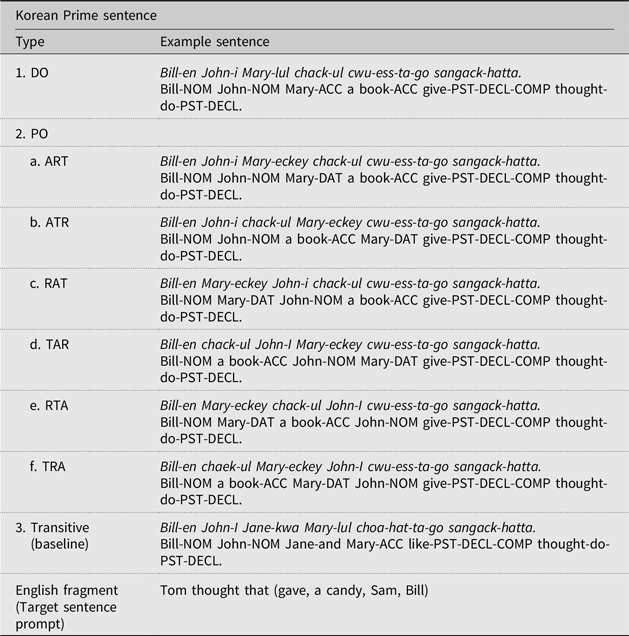
The experimental materials consisted of 48 pairings of Korean prime sentences and English target fragments, along with pictures. The prime sentences were either DO (Type 1 in Table 1), PO (Type 2a–2f in Table 1) or transitive sentences as baseline (Type 3 in Table 1). The constituents of POs were scrambled into six different versions. Six sentences for each type of prime sentence were presented. The agent and the recipient were always animate, and the theme was always inanimate. The stimuli of the scrambled Korean prime sentences, particularly the sentences starting with either the recipient or the theme, should allow this study to explore whether either an abstract representation or a surface word order affects the participants’ production. For instance, if participant holds an abstract representation of the dative construction, then, after reading a prime of a Korean RAT sentence aloud, the participant may produce a grammatical English PO rather than a sentence starting with a recipient that is similar to the recipient in the Korean prime sentence. Considering that, the English target fragments started with a subject and a verb of a main clause and the complementizer that (e.g., Bill thought that…), followed by a parenthesis including three noun phrases and a verb. The words in parentheses functioned as prompts to clarify the events depicted and facilitate the participants’ completion of the target sentence (e.g., Hwang et al., Reference Hwang, Shin and Hartsuiker2018; Jackson & Ruf, Reference Jackson and Ruf2017; Song & Do, Reference Song and Do2018). The order of the words in parentheses was randomized.Footnote 3 In every pair, the meaning of the verb in the English fragment was unrelated to the meaning of the verb in the Korean prime sentence to exclude lexical boost effects on cross-linguistic syntactic priming (e.g., Bernolet et al., Reference Bernolet, Hartsuiker and Pickering2013; Cai et al., Reference Cai, Pickering, Yan and Branigan2011). Noun phrases were also not repeated in prime–target pairs. In addition to the critical items, the participants saw 96 pairs of fillers with various structures, including passive sentences and sentences with intransitive verbs, but never DO or PO.
Summary of experimental stimuli
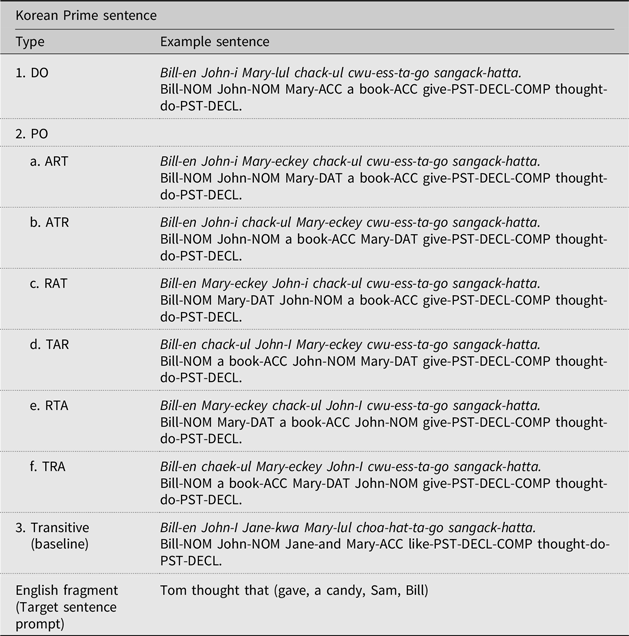
Because only cwuta (give), karuchida (teach), and meokita (feed) occur in the Korean DO (e.g., Jung & Miyagawa, Reference Jung, Miyagawa and Kim2004; O’Grady, Reference O’Grady1991), all prime sentences used only these three verbs. To avoid verb-bias toward either construction in producing target sentences (Gries & Wulff, Reference Gries and Wulff2009) and to control the number of a specific verb’s usage, the verbs in English target fragments were selected from Gries’s (Reference Gries2007) statistical analysis of verb-bias. Three verbs that prefer a ditransitive construction (i.e., tell, show, offer), and three that prefer a prepositional dative construction (i.e., bring, pass, sell), were used once in each category of target fragments. Thus, each category had an even number of verbs biased toward DO and PO. The transitive constructions, which have only a theme rather than both a recipient and a theme like a dative, were considered the baseline condition (Bernolet & Hartsuiker, Reference Bernolet and Hartsuiker2010).
The pictures were presented with the English target fragments. They contained three entities corresponding to the noun phrases in parentheses, which were engaged in the actions described by the verb in parentheses. Thus, the pictures helped the learners understand each noun phrase’s thematic role within a target sentence: as an agent, a recipient, or a theme. The fillers were also accompanied by 96 pictures as cues to complete the filler fragments. The main materials and the fillers were presented in pseudorandom order, and the five different sets of the experimental materials were randomly assigned to the participants.
Procedure
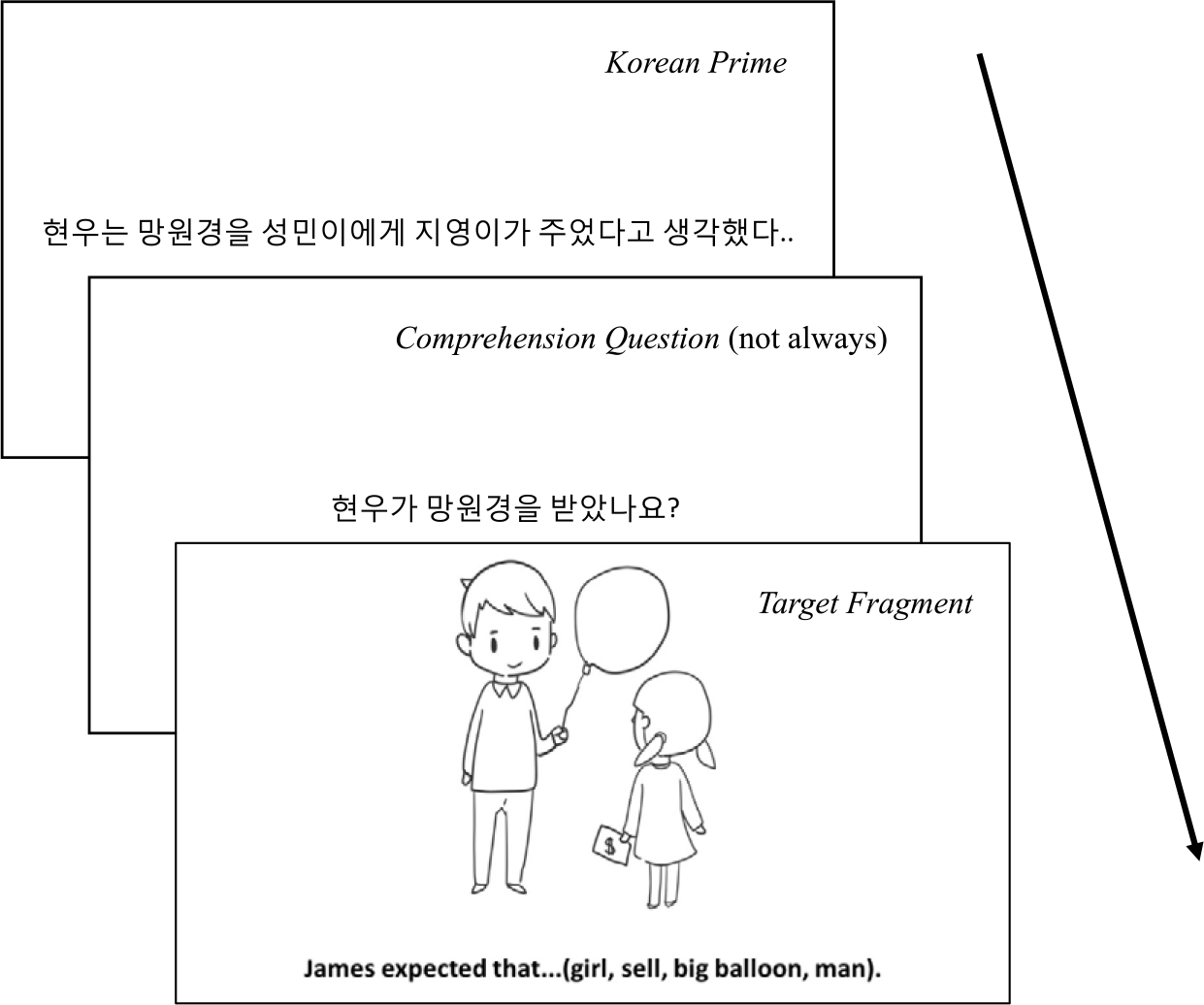
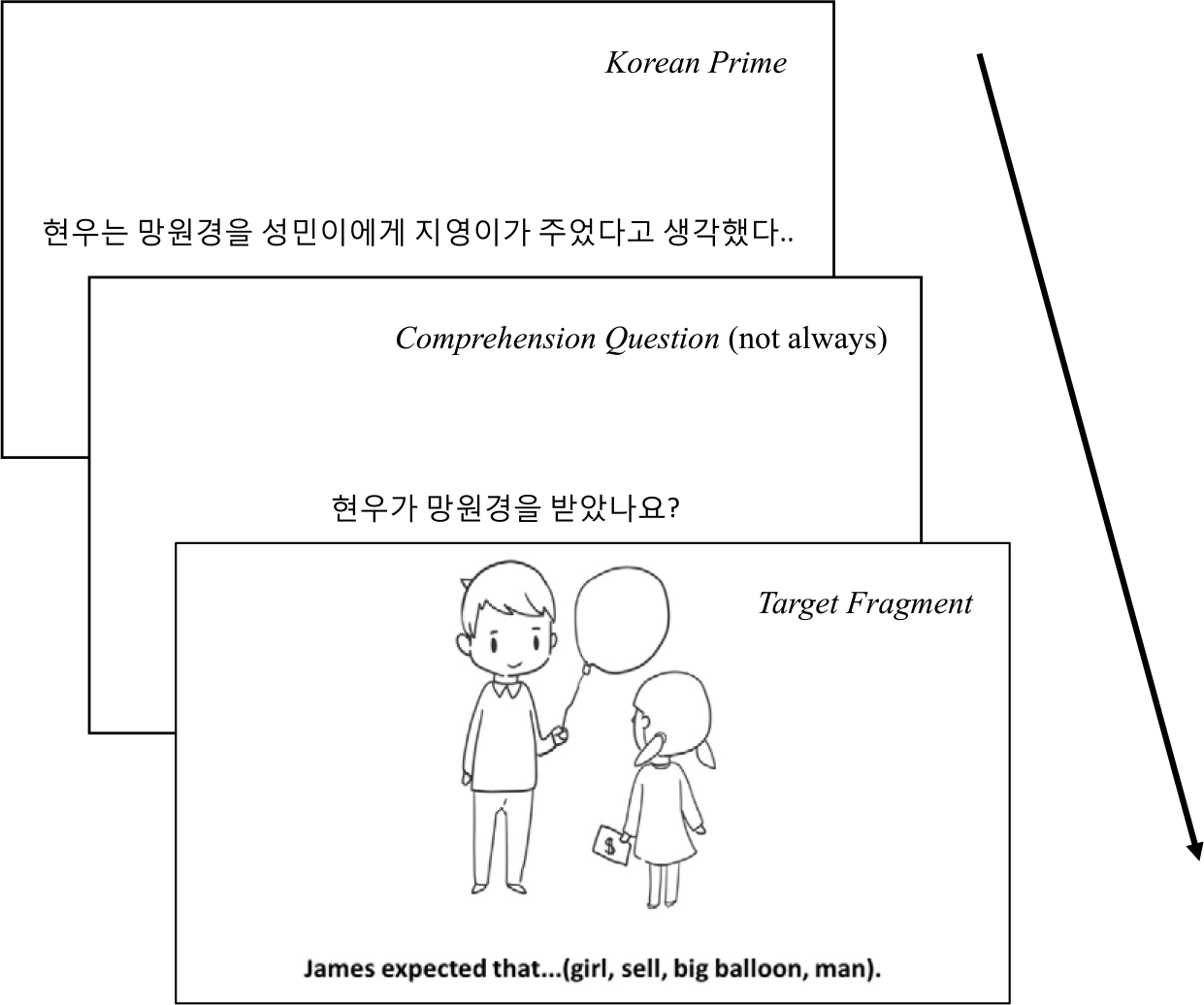
Individual participants completed the experiment in a single session with the guidance of the researcher. Participants sat in front of a computer and read written instructions on the monitor. E-prime was used to present the experimental stimuli, and Apple iPhone X was used to record participants’ answers. Participants were instructed that they would see several sets of pages on the monitor throughout the experiment and that assessing the extent to which they could describe pictures in English was the purpose of the experiment.Footnote 4 They were asked to describe a picture with English target words as accurately and fast as possible. A Korean sentence was displayed on a page, and they were required to read it aloud. They were then asked a comprehension question, which they answered by pressing specific keyboard buttons: j for yes, f for no. The comprehension questions were in Korean. The purpose of the comprehension question was to confirm whether the participants paid attention to and processed the sentence. Following the question, the monitor displayed an English fragment, along with prompt words in parentheses and a picture. Participants were required to complete an English sentence to describe the displayed picture by using the words in parentheses (see Figure 1). They pressed the space bar to move to the next sequence. The first three stimuli functioned as practice items to help participants become familiar with the experimental setting. The main experimental stimuli followed the practice trials in pseudorandom order.
Procedure of experiment.
Scoring
Participants’ responses were transcribed and scored as DO, PO, or other. The latter category included ungrammatical sentences, such as sentences with scrambled order or ungrammatical subject—verb agreement, transitive sentences, and sentences including unprovided keywords. Pronunciation errors and omission of determiners were ignored in the scoring.
Results
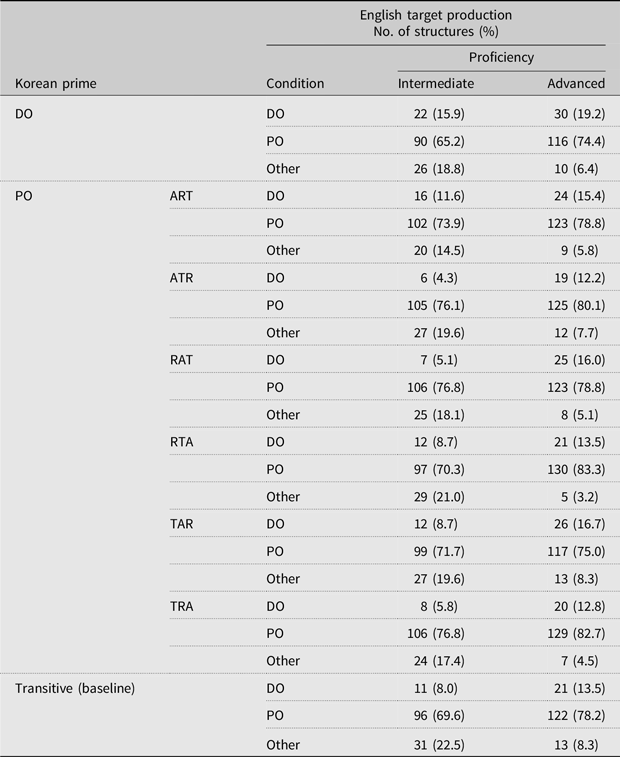
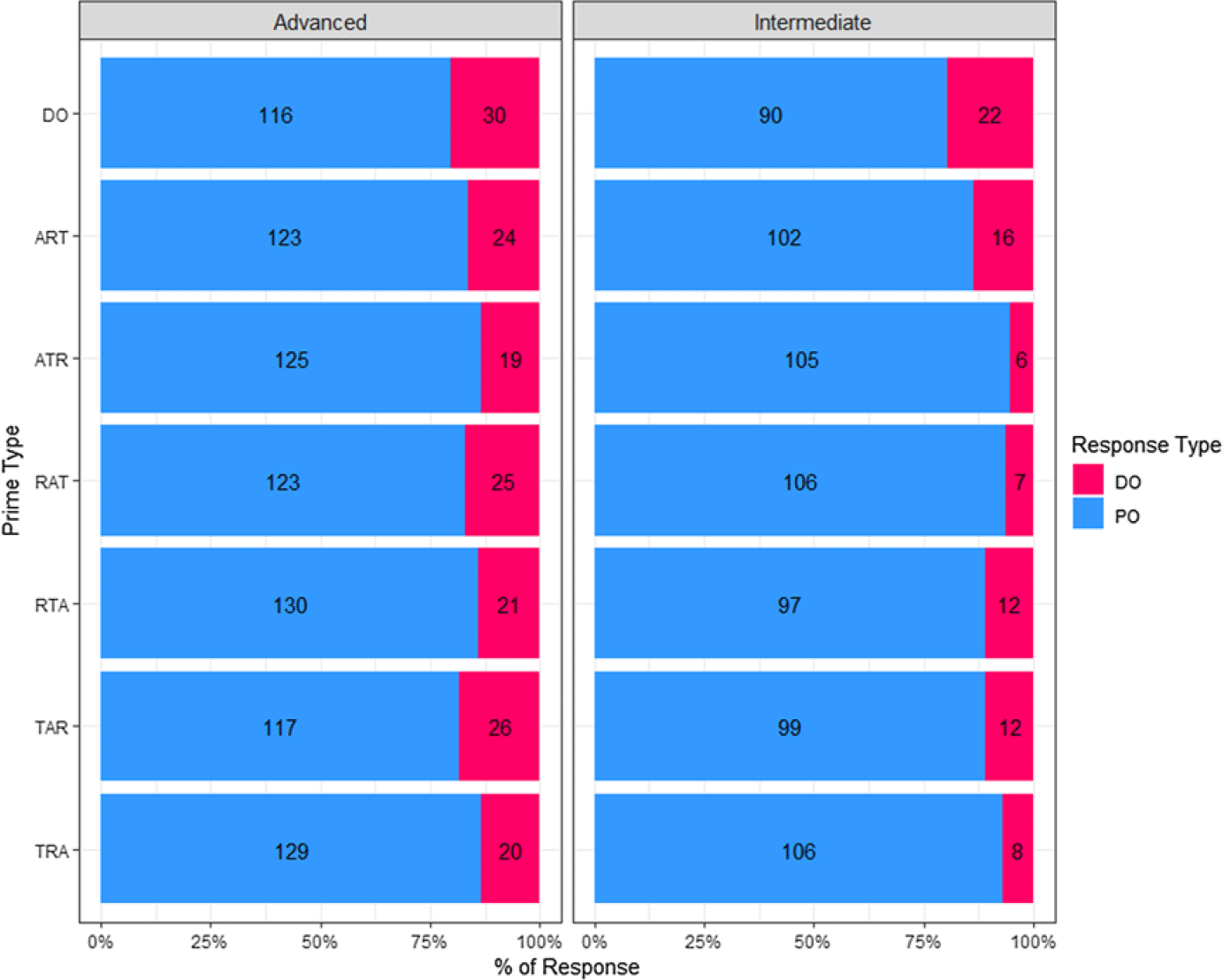
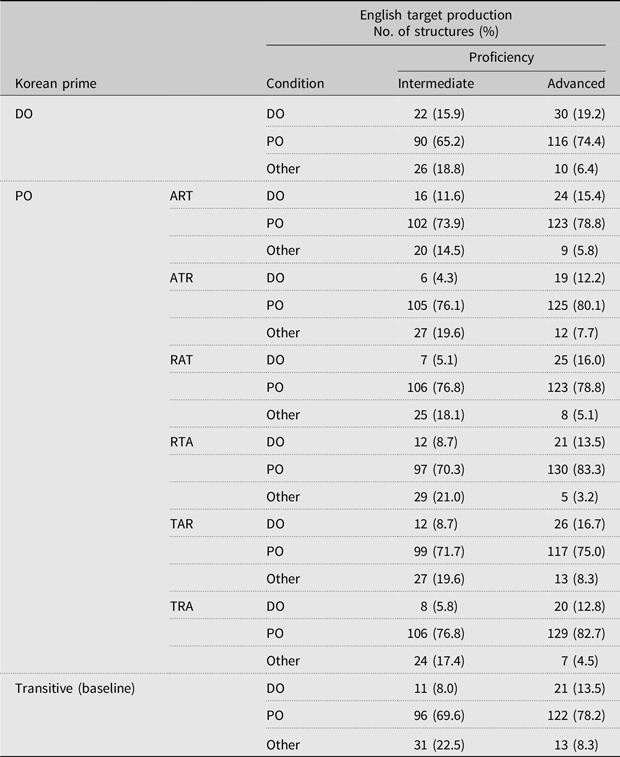
Participants produced 2,352 sentences including 280 DO (11.9%), 1786 PO (75.9%), and 286 “other” (12.2%; 209 from intermediate and 77 from advanced) (see Table 2). All “other” responses were excluded in the statistical analyses. The data were analyzed with logit mixed-effect regression models, using the lmer4 package in R (R Core Team, 2018). The results of descriptive statistics showed that these Korean learners of English preferred to produce PO in the experiment, regardless of prime type (e.g., DO production: 19.2% vs. PO production: 74.4% after DO prime). Nevertheless, the ratio of English DO to PO was influenced by type of prime sentences: L2 learners were more likely to produce DOs after they read Korean DOs (DO prime: 20.1% vs. PO prime: 12.6%), and more likely to produce POs after reading Korean POs (DO prime: 79.8% vs. PO prime: 87.4%).
Descriptive statistics of responses
Following previous studies, this study constructed two statistical models. The use of these models enabled the exploration of not only the extent to which each critical condition led to different responses from the other condition but also the extent to which the participants’ production after the two conditions differed from their general preference. Thus, they investigated cross-linguistic priming and the magnitude of priming effects sufficiently. In particular, the first model compared the participants’ responses to DO to those to PO directly, which can show statistical difference of the participants’ production after each of the dative constructions (see Bernolet et al., Reference Bernolet, Hartsuiker and Pickering2009; Chan et al., 2013; Jackson, Reference Jackson2018; McDonough, Reference McDonough2006; Shin & Christianson, Reference Shin and Christianson2009; Song & Do, Reference Song and Do2018). By contrast, the second model revealed whether the syntactic priming effects of DO or PO were significantly different from a general preference for production of DO or PO, respectively (see Bernolet et al., Reference Bernolet, Hartsuiker and Pickering2012, Reference Bernolet, Hartsuiker and Pickering2013; Pickering et al., Reference Pickering, Branigan and McLean2002).
In the first model, the responses to the baseline condition, which included irrelevant structures, were excluded. The effects of the participants’ proficiency were also considered in the statistical analysis. The dependent variable was type of English target sentences (coded as DO, PO). Type of prime sentence (coded as ART, ATR, RAT, RTA, TAR, TRA, and DO) proficiency (coded as intermediate, advanced) and the interaction between type of prime sentence and proficiency were included as fixed effects in the model. ATR, which had greater ratio for PO, is the referential level of type of prime sentence, and intermediate is the referential level of proficiency. Treatment coding was used to code the two fixed effects. Models including additional random slopes had a convergence problem; thus, only random by-subject and by-item intercepts were added in the model.
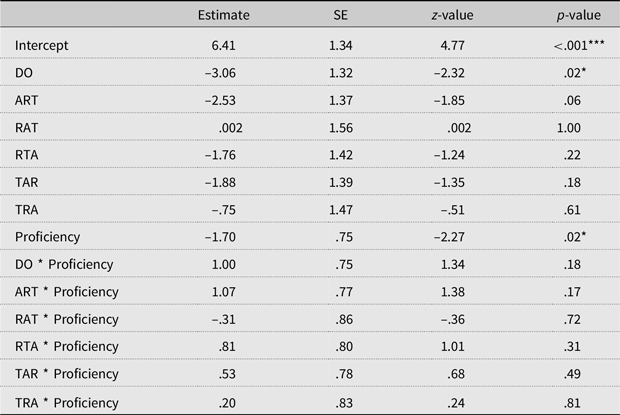
The L2 learners significantly preferred to produce English PO rather than DO after they encountered a Korean ATR (β = 6.41, SE = 1.34, z = 4.77, p < .001). The nonsignificant negative coefficient of most of the other scrambled PO in Korean indicates that the magnitude of these structures’ priming effects was weaker than that of ATR; however, the difference was not significant, indicating that L2 learners produced English PO more after reading ATR and other scrambled sentences. However, they tended to produce an English PO significantly less when they read either a DO or an ART as a prime sentence (p = .02, p = .06, respectively), suggesting that the prime sentences had negative (positive) influence on their PO (DO) production. In addition, type of prime sentence did not interact with proficiency level. The two proficiency groups showed parallel patterns and the priming effects were not mediated by proficiency level. Both intermediate and advanced learners showed a similar preference for PO after they processed PO, and for DO after they encountered DO. The first model’s results showed that the Korean learners of English were primed by Korean dative alternations in their production of English sentences, and that a proficiency difference did not lead to significant differences in their production of target sentences (see Table 3 & Figure 2).
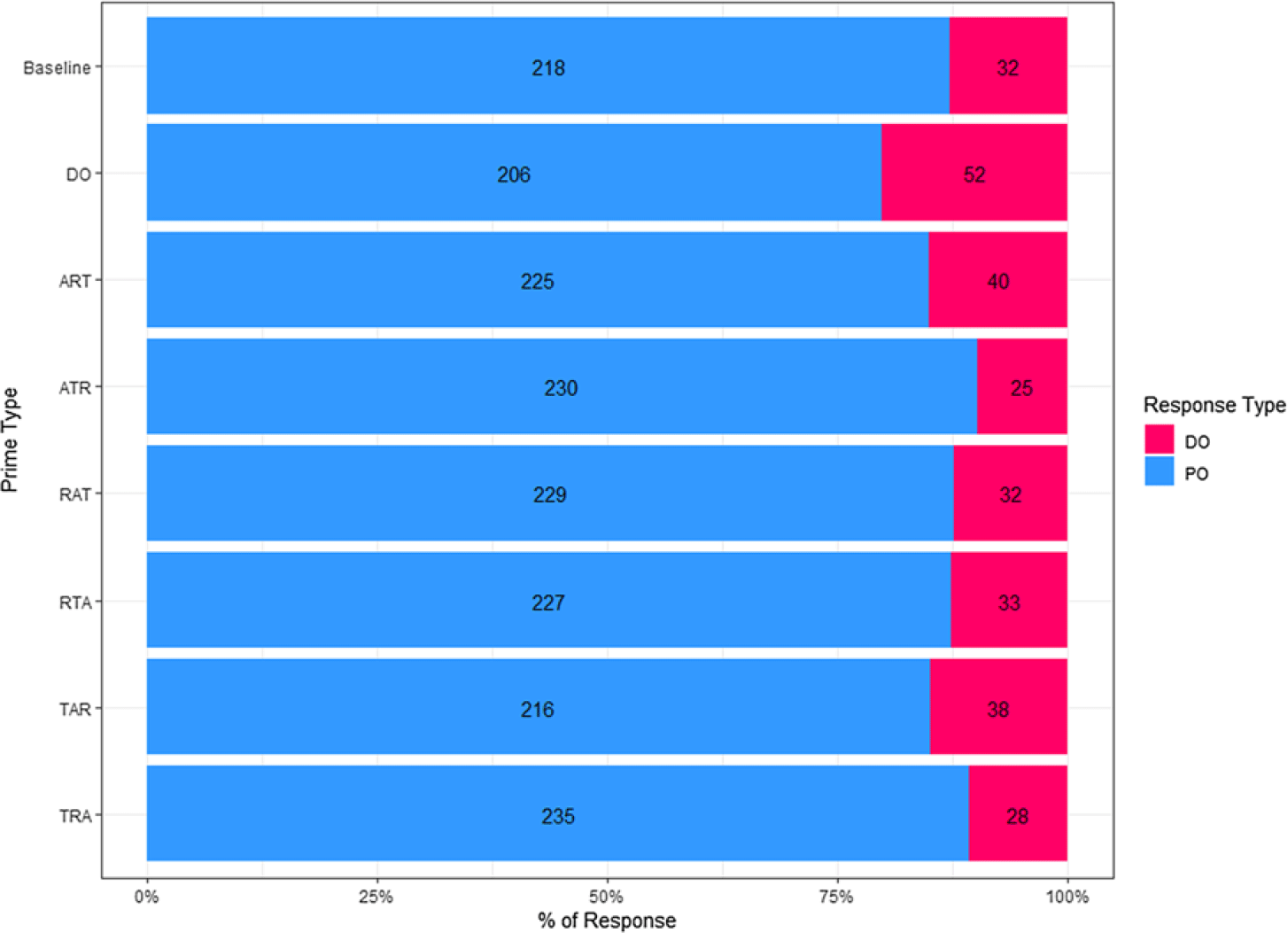
The amount of priming effects did differ across scrambled POs (e.g., the ratio to PO; 90.2 % after ATR vs. 84.9 %Footnote 5 after ART). Given the L2 learners’ general preference for POs (the ratio to PO; 87.2% after Transitive), it is possible that some types of scrambled PO may have similar results or an even lower number of productions of POs than the baseline condition. Thus, the second model was performed, including a baseline condition. Based on the results of the first model, this model excluded proficiency.
Results from the logit mixed-effect regression model excluding the baseline

Note: *p < .05; ***p < .001.
Proportion of responses in experimental conditions excluding baseline.

Proportion of responses in experimental condition including baseline.
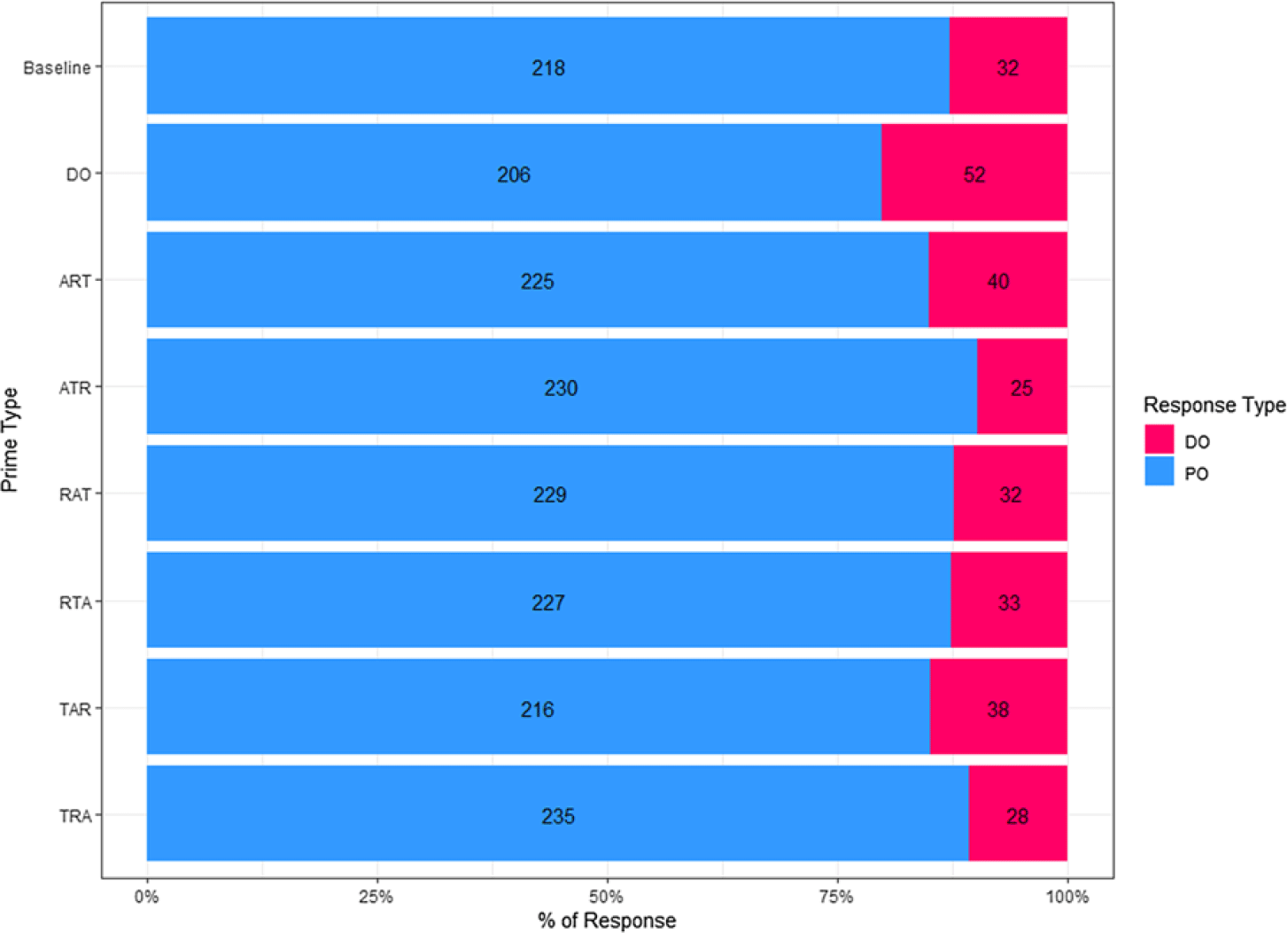
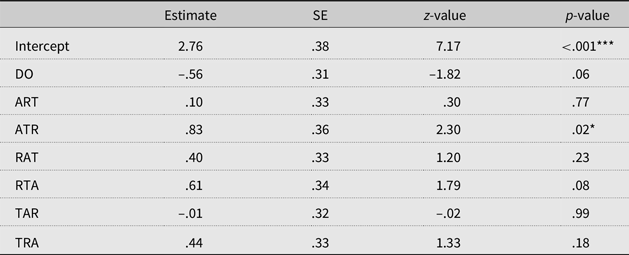
Type of English target sentence was the dependent variable (coded as DO, PO), and type of prime sentence (coded as ART, ATR, RAT, RTA, TAR, TRA, DO, and baseline; the baseline was the referential level) was the fixed effect. Because models including additional random slopes had a convergence problem, random by-subject and by-item intercepts were added in the model. The results revealed that the Korean learners of English had a general preference for English prepositional dative sentences in their production, regardless of type of prime sentence (β = 2.76, SE = .38, z = 7.17, p <.001). Compared to the baseline condition, ATR showed significant syntactic priming effects (β = .83, SE = .36, z = 2.30, p = .02), while DO showed a marginal priming effect (β = –.56, SE = .31, z = –1.82, p =.06) (see Table 4 & Figure 3). The L2 learners had a tendency to produce more English POs (DOs) after they processed Korean ATRs (DOs). In contrast, most of the scrambled POs and ART had positive coefficients with no significant difference from the baseline condition. These results indicate that although the L2 learners produced POs more than DOs in English after they read aloud Korean scrambled POs and ART, their productions in these conditions were affected by their general preference for POs, rather than priming effects from Korean sentences.
Results from the logit mixed-effect regression model including the baseline
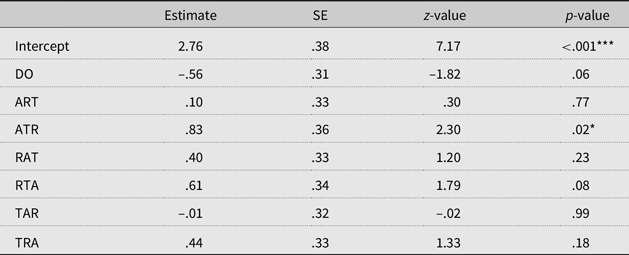
Note: *p < .05; ***p < .001.
Overall, Korean learners of English preferred to produce English POs, but they were more likely to produce equivalent English forms after they comprehended either Korean DOs or POs. These results lead to the conclusion that cross-linguistic syntactic priming occurred between Korean and English dative alternations. In addition, Korean scrambled sentences facilitated the production of English POs, but only ATR showed significant difference from the neutral baseline condition. The results also indicate that different levels of proficiency did not influence the magnitude of the syntactic priming effects: Intermediate and advanced L2 learners showed similar patterns of syntactic priming effects.
Discussion
The aim of this study is to assess the shared-syntax account in the case of L1-Korean English learners’ L2 production after L1 processing. In particular, this study investigates the effects of: (a) different L1–L2 word orders, (b) different syntactic variations in the L1 and the L2, and (c) different levels of L2 proficiency. The study utilized a picture description task in which Korean learners of English comprehended a Korean DO or PO and completed an English fragment to describe a picture. The results revealed that syntactic priming can occur between Korean and English, which have different word orders. Of the Korean scrambled variants, only ATR and DO order yielded syntactic priming effects. In addition, the intermediate and advanced L2 learners showed similar priming effects, indicating that the priming effects of dative alternations were not mediated by L2 proficiency.
Word order and cross-linguistic priming
The results support the argument that cross-linguistic syntactic priming is possible despite different word orders (Chen et al., Reference Chen, Jia, Wang, Dunlap and Shin2013; Desmet & Declecq, Reference Desmet and Declercq2006; Hwang et al., Reference Hwang, Shin and Hartsuiker2018; Shin & Christianson, Reference Shin and Christianson2009; Song & Do, Reference Song and Do2018), in contrast to Bernolet et al. (Reference Bernolet, Hartsuiker and Pickering2007) and Loebell and Bock (Reference Loebell and Bock2003). Although Korean and English have different surface word orders (SOV in Korean, SVO in English), the Korean learners of English tended to produce an English PO (or DO) after they encountered a Korean PO (or DO). In other words, Korean dative alternations significantly facilitated the production of equivalent English forms. This study’s finding of syntactic priming from Korean to English provided further evidence for the shared-syntax account even in the case of different word order languages, indicating that the Korean learners of English may share an abstract representation of a structure rather than being influenced by the surface order of constituents in Korean when producing English sentences.
This study also found that the magnitude of syntactic priming may differ across alternating syntactic pairs, suggesting that having a shared representations does not necessarily mean that each element of syntactic pair has identical power or strength (Bernolet et al., Reference Bernolet, Hartsuiker and Pickering2009; Chan et al., 2013; Jackson, Reference Jackson2018; McDonough, Reference McDonough2006; Shin & Christianson, Reference Shin and Christianson2009; Song & Do, Reference Song and Do2018). The study explored the extent to which each of the dative alternating pairs primed L2 production, as in Chen et al. (Reference Chen, Jia, Wang, Dunlap and Shin2013), Hwang et al. (Reference Hwang, Shin and Hartsuiker2018), and Shin and Christianson (Reference Shin and Christianson2009). The results revealed that more English DOs were produced after reading Korean DOs than Korean POs and more English POs were produced after reading Korean POs than Korean DOs. The comparison of the Korean DO condition to the Korean ATR condition showed that the Korean DO had weaker priming effects than the PO.
These findings are consistent with those of Shin and Christianson (Reference Shin and Christianson2009) and Kaan and Chun (Reference Kaan and Chun2018). Shin and Christianson also found Korean learners’ general preference for PO and smaller priming effects of DOs in cross-linguistic syntactic priming from Korean to English; in addition, Kaan and Chun’s (Reference Kaan and Chun2018) study showed that Korean L2 learners of English preferred PO, and that immediate DO priming effects did not occur. The results suggest that Korean learners of English may have a limited abstract representation of DO (Kaan & Chun, Reference Kaan and Chun2018; Kim, Reference Kim2010; Park, Reference Park2007).
The findings of the limited priming effects of Korean DOs may be due to the participants’ previous L2 learning experience. McDonough (Reference McDonough2006) proposed that L2 learners’ limited exposure to English DOs explains why an abstract representation of such structures is not activated by priming (see McDonough & Fulga, Reference McDonough and Fulga2015). Similarly, the learners in this study might have had less exposure to English DOs than to English POs, given that POs are more frequently included in Korean EFL textbooks, including the textbooks that these learners used (Yook, Reference Yook2012). Likewise, the natural developmental sequence of learning PO in L2 acquisition (Hawkins, Reference Hawkins1987) may provide an explanation, as the participants may have acquired the rule of POs before the rules of DOs (Shin & Christianson, Reference Shin and Christianson2009). Hence, stability of syntactic representation of each sentence may not be identical.
Another possible reason for the weaker priming effects of the DO may be related to Korean syntactic features. As mentioned, DO in Korean can only be used with cwuta (give), karuchida (teach), and meokita (feed) (e.g., Choi & Lim, Reference Choi, Lim, Park and Kim2004; Oh, Reference Oh2010) and is rarely used in writing (Shin & Christianson, Reference Shin and Christianson2009). Thus, dative alternations in Korean are unbalanced, and Korean native speakers are more inclined to use PO in written mode of their L1. The limited use of ditransitive constructions in Korean may influence these learners’ development of a shared syntactic representation of DO between Korean and English, which might have led to weaker syntactic priming effects.
These possible explanations may be in line with Pickering et al.’s (Reference Pickering, Branigan and McLean2002) finding that syntactic priming effects did not take place with highly infrequent and uncommon structures, such as English shifted prepositional sentences (e.g., The racing driver showed to the mechanic the extremely dirty and badly torn overall, p. 589). Pickering et al. (Reference Pickering, Branigan and McLean2002) argued that shifted structures have weaker syntactic priming than PO because the former are used only in restricted conditions, such as when the final noun phrase is long or holds heavy information. In short, both their limited exposure to L2 English DO and the limited use of DO in their L1 may have led to the smaller syntactic priming effects of DO in this study.
Different syntactic variations and cross-linguistic priming
Using various Korean scrambled PO structures, the present study provides further evidence for the shared-syntax account. In particular, scrambling in Korean allows syntactic variations of Korean POs to have divergent characteristics, such as information structure and order of thematic roles, which allows the exploration of how one language’s specific syntactic variations may be stored along with a shared abstract syntactic representation. Although Korean has a different word order than English, Korean DO and one variant of the Korean POs (ATR) share an identical functional assignment (i.e., agent = subject, recipient = indirect object, theme = direct object), information structure, and order of thematic roles with their equivalent forms in English. In terms of information structure,Footnote 6 the sequential order of direct and indirect objects determines the type of structure between the alternating pairs (i.e., DO and PO) and indicates whether either of them is given information that is more accessible and emphasized (Bock & Warren, Reference Bock and Warren1985; Ferreira & Yoshita, Reference Ferreira and Yoshita2003; Marefet, Reference Marefat2005). An indirect (direct) object that precedes a direct (indirect) object is emphasized in DO (ATR and English PO). Recipient (theme) is followed by theme (recipient) in DO (ATR and English PO). These are the structures that had strong syntactic priming effects in this study.
In contrast, ART and the four other scrambled PO structures (RAT, RTA, TAR, TRA) elicited response patterns similar to the pattern elicited by the baseline condition. ART shares with the English PO constructions identical functional assignments, but its information structure and order of thematic roles are comparable with English DO rather than PO. TAR and TRA share identical functional assignments and information structures but have different order of thematic roles. In particular, because of scrambling, the order of all the constituents can change, which leads to different order of thematic roles, such as theme–agent–recipient in TAR and theme–recipient–agent in TRA. However, both of these structures emphasize a direct object rather than an indirect object; thus, the information structure is identical with that of ATR and the English counterpart. RAT and RTA share identical functional assignments but have different information structures (i.e., indirect object > direct object) and orders of thematic roles.
In sum, in the available syntactic alternatives for PO in Korean, the direct object is given information in ATR, TAR, and TRA, so that it always occurs earlier than the indirect object; however, unlike ATR, TAR and TRA, which have a different thematic order than the English counterparts, showed no priming effect (i.e., no difference from the participants’ general preference), just like the three other scrambled PO structures.
As discussed in the preceding text, Bernolet et al. (Reference Bernolet, Hartsuiker and Pickering2009) pointed out that Dutch by-phrases in both medial and initial positions have different constituent structures from English passives, yet of the two, only the medial by-phrase condition, which has the same information structure as the target English passive form, led to priming. Cross-linguistic syntactic priming occurred only between Dutch passive with by-phrases and English passive form in which the patient is placed first. In addition, based on their finding that Dutch initial by-phrases did not elicit more English active sentences (with which they share thematic role order), Bernolet et al. argued that cross-linguistic syntactic priming may not be caused by shared order of thematic roles but by shared information structure, which indicates that a first-mentioned element must be identical between the two languages.
If shared information structure is a “prerequisite” for cross-linguistic syntactic priming between primes and targets with different syntactic variations (Bernolet et al.’s [Reference Bernolet, Hartsuiker and Pickering2009] conclusion), then TRA and TAR sentences in Korean, which have the same information structure as English PO sentences, should have had priming effects in this study. To be specific, a direct object appears earlier than an indirect object in both TRA and TAR and the English PO. However, the results indicate priming did not occur with TRA and TAR, just as it did not occur with the three other scrambled sentence types, which have different orders of thematic roles; the only exception was ATR, which shares an identical order of thematic roles with English PO. Thus, while Bernolet et al. found partial cross-linguistic syntactic priming with identical information structure in the primes and targets, the present study found partial cross-linguistic syntactic priming only with identical orders of thematic roles.
The results of the current study may not support Bernolet et al.’s (Reference Bernolet, Hartsuiker and Pickering2009) argument, but may instead support the conclusions of Chang et al. (Reference Chang, Bock and Goldberg2003) and of Griffin and Weinstein-Tull (Reference Griffin and Weinstein-Tull2003). For instance, Chang et al. found that participants were more likely to follow the thematic order of a previous sentence (e.g., The maid rubbed polish onto the table), when they were required to recall another sentence (e.g., The farmer heaped straw onto the wagon). They suggested that thematic roles and order of nouns may be retained in memory and influence following production. Chang et al. investigated within-language priming; the current study suggests that cross-linguistic syntactic priming may also require the same thematic order of constituents. In this regard, when two languages do not have identical symmetrical syntactic features, structures may need to share the same thematic order to realize cross-linguistic syntactic priming. Hence, for their English counterparts, Dutch medial by-phrases and Korean DO and ATR may be effective primes in Bernolet et al.’s (Reference Bernolet, Hartsuiker and Pickering2009) and this study, which is why they resulted in cross-linguistic syntactic priming. However, ART and the other Korean scrambled POs have the same functional assignment, but showed no syntactic priming effects in this study. The difference between Korean DO and ATR structures, which did have priming effects, and the other scrambled sentences, which did not have priming effects, is the different order of thematic roles than in the equivalent English forms. Taken together, these results suggest that some parts of one language’s syntactic variations may be stored with an abstract syntactic representation if the variations share identical nonsyntactic characteristics with their counterpart in the other language. However, because the limited evidence for the effects of different syntactic variations on cross-linguistic syntactic priming is inconsistent, it would be premature to conclude that L2 learners store one language’s specific syntactic features as well as develop a shared abstract syntactic representation between two different languages at the same time. Further investigation may be required with various constructions.
Proficiency and cross-linguistic priming
Previous studies have demonstrated that L2 learners with different levels of proficiency showed different levels of syntactic priming effects (Bernolet et al., Reference Bernolet, Hartsuiker and Pickering2013; Hartsuiker & Bernolet, Reference Hartsuiker and Bernolet2017; Hwang et al., Reference Hwang, Shin and Hartsuiker2018). Before L2 learners reach sufficient proficiency, they may not develop shared representations between L1 and L2. For instance, as described in the preceding text, Hwang et al. (Reference Hwang, Shin and Hartsuiker2018) demonstrated greater cross-linguistic syntactic priming of transitive structures for Korean learners of English with higher English proficiency, based on the accuracy of a cloze test. In contrast, this study found no significant differences between intermediate and advanced learners in syntactic priming effects of dative alternatives; in addition, the two proficiency levels showed similar patterns of syntactic priming effects.
One possible explanation is that dative alternating pairs are acquired at an earlier stage than the active and passive structures that Hwang et al. (Reference Hwang, Shin and Hartsuiker2018) used. That is, it is possible that the intermediate L2 learners in this study had already developed a shared representation of dative constructions. In this regard, different structures may have different developmental stages for shared representations. In addition, however, different ways of measuring L2 proficiency may lead to inconsistent results for the effects of L2 proficiency on cross-linguistic syntactic priming. For instance, whereas Hwang et al. used cloze tests, this study used standardized test scores to divide participants into two different proficiency levels, and Hartsuiker and Bernolet (Reference Hartsuiker and Bernolet2017) included self-rated L2 proficiency in Schoonbaert et al. (Reference Schoonbaert, Hartsuiker and Pickering2007) in the statistical analysis.
Conclusion
This study’s findings indicate that cross-linguistic syntactic priming occurs between Korean and English dative alternations, despite the two languages’ different word orders. No significant difference was found between the baseline condition and Korean scrambled sentences, except for the case in which Korean and English sentences share an order of thematic roles, and syntactic priming effects were not affected by proficiency levels. These results suggest that Korean learners of English are able to develop and share an abstract representation of a dative alternation between their L1 and L2 at quite an early stage, but also that this ability may be influenced by each language’s unique syntactic features.
This study’s use of scrambled structures in Korean sheds light on the effects of different syntactic variations on cross-linguistic syntactic priming, as did Bernolet et al.’s (Reference Bernolet, Hartsuiker and Pickering2009) utilization of the different locations of by-phrases. In addition, future research should further explore the effects of a wider range of proficiency levels by using a greater variety of syntactic structures on cross-linguistic syntactic priming to gain a better insight into L2 learners’ shared grammatical representation between their L1 and L2.
Acknowledgments
I would like to thank Dr. Patti Spinner and Dr. Shawn Loewen for their constructive feedback and valuable insights on this study. I am indebted for their continuous support and guidance throughout the process of completing this paper from its initial stages until the final product. I would like to thank the anonymous reviewers who also provided me with ideas toward the improvement of the paper. Any errors remaining my own.