Introduction
Many of the non-infectious disorders in poultry such as tibial dyschondroplasia and tarsal varus-valgus angulations result in abnormal gait and even lameness (Bradshaw et al., Reference Bradshaw, Kirkden and Broom2002; Mench, Reference Mench2004). These disorders induce pain in some cases and impair birds’ behavioural repertoire (McGeown et al., Reference McGeown, Danbury, Waterman-Pearson and Kestin1999; Danbury et al., Reference Danbury, Weeks, Chambers, Waterman-Pearson and Kestin2000; Julian, Reference Julian2004). Several approaches have been used to reduce the occurrence of these leg problems. Genetic selection has been used to reduce these diseases because susceptibility to leg problems differs between hybrids and heritability of such traits is relatively high (Kestin et al., Reference Kestin, Knowles, Tinch and Gregory1992; Le Bihan-Duval et al., Reference Le Bihan-Duval, Beaumont and Colleau1996 and Reference Le Bihan-Duval, Beaumont and Colleau1997; Kestin et al., Reference Kestin, Su and Sorensen1999; Sanotra et al., Reference Sanotra, Berg and Lund2003). However, there is still a need to identify suitable rearing methods to improve leg condition.
Reduction in growth rate during the starting period has been shown to be effective in reducing the occurrence of leg problems (Classen, Reference Classen1992; Thorp, Reference Thorp1994; Leterrier and Constantin, Reference Leterrier and Constantin1996 for review). Another method is to enhance motor activity, which is known to improve the musculo-skeletal apparatus (Thorp and Duff, Reference Thorp and Duff1988) and thus reduce the occurrence of these abnormalities in both experimental (Reiter and Bessei, Reference Reiter and Bessei1998; Reiter, Reference Reiter2004) and field conditions (Waldenstedt and Lansfors, 2003). Some diets, such as those low in lysine, are known to reduce growth and enhance general activity (Bolton et al., Reference Bolton, Squibb and Collier1979; Rovee-Collier et al., Reference Rovee-Collier, Collier, Egert and Jackson1993). However, broilers cannot be fed continuously with deficient diets since this would lead to unacceptable reduction of growth for commercial production. We therefore hypothesised that a low-lysine diet could be used to reduce leg problems when combined with diets with a high or normal lysine content, which would partly or entirely compensate for growth reduction. The consecutive feeding of different diets over a period of 1 or 2 days is called sequential feeding (Gous and Du Preez, Reference Gous and Du Preez1975). It provides chickens with a more varied feed composition through an adapted distribution pattern, while maintaining an overall nutritional balance. This balance is no longer obtained from a single balanced feed, but from the different complementary feeds used in the programme. Sequential feeding programmes have mainly been studied for nutritional purposes (Foote and Rose, Reference Foote and Rose1991; Rose et al., Reference Rose, Fielden, Foote and Gardin1995; Bouvarel et al., Reference Bouvarel, Barrier-Guillot, Larrouche, Boutten, Leterrier, Merlet, Vilarino, Roffidal, Tesseraud, Castaing and Picard2004; Lozano et al., Reference Lozano, De Bazilio, Oliveros, Alvarez, Colina, Bastianelli, Yahav and Picard2006), but one has also indicated improvement in leg problems (Bouvarel et al., Reference Bouvarel, Barrier-Guillot, Larrouche, Boutten, Leterrier, Merlet, Vilarino, Roffidal, Tesseraud, Castaing and Picard2004).
Sequential feeding was first used to reduce leg problems by alternating a low-lysine and a standard feed (Bizeray et al., Reference Bizeray, Leterrier, Constantin, Picard and Faure2002). An increase in foraging activity was observed during and after the periods when the chickens received low-lysine levels. This increased activity probably had a beneficial effect in preventing leg problems, but the improvement in gait score was also related to a reduction in BW at slaughter age. Since reduced weight at slaughter age may correspond to reduced welfare and is not acceptable under commercial conditions, it is important to investigate other schedules with low-lysine diets that would modulate growth and enhance activity, but would not impair welfare or the birds’ final weight. Experiments have indicated that an alternation of 70% and 130% of the standard lysine level induces a mild reduction in growth that can be compensated for when a well-balanced diet is given at the end of the rearing period (Leterrier et al., Reference Leterrier, Favreau, Constantin and Picard2005 and Reference Leterrier, Perrot, Favreau, Constantin, Bouvarel, Lessire and Picard2006).
However, high-lysine diets are too expensive under commercial conditions and new experiments with more traditional diets are now needed to adapt this method to field conditions. Diets varying in protein and metabolisable energy content can be used commercially, but unlike low-lysine diets, their effects on activity have not been established. In the present experiment, an alternation of diets differing in protein and energy (93% of a standard energy content and 120% of a standard protein content alternated with a diet containing 107% of the energy and 80% of the protein of a standard diet) was used since these variations have been shown to allow good growth performance (Bouvarel et al., 2007). The cycle length was 48 h, since it has previously been demonstrated that this duration is the most suitable for reducing leg problems without impairing commercial performance (Leterrier et al., Reference Leterrier, Perrot, Favreau, Constantin, Bouvarel, Lessire and Picard2006). The experiment was designed to investigate whether starting sequential feeding at an early age would have any beneficial effects on leg problems and to determine whether changing the feeding pattern could be related to changes in activity and would maintain commercial performance.
Material and methods
Animals and housing
Standard meat-type male chickens (n = 352 Ross PM3) were divided into thirty-two 3.7 × 1.7 m pens (11 males/pen; 1.9 birds/m2). The floor was covered with wood shavings. Lighting was reduced from 24L to 20L/4D on day 3, and to 16L/8D on day 7, and then increased to 20L/4D from day 28 to slaughter.
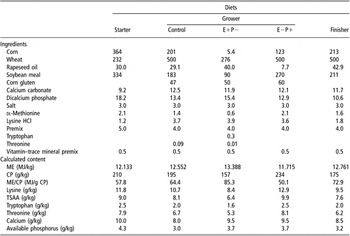
The birds were given access to feed and water ad libitum. From day 0 to day 8, birds were fed a starter feed (Table 1). From day 8 to day 28 they were fed a standard diet (Group C; 16 pens) or they received sequential feeding (Group SF; 16 pens). From day 28 to slaughter all birds received a standard finisher-type feed (Table 1).
Composition and calculated characteristics of experimental feeds

E+P− = high-energy/low-protein diet; E−P+ = low-energy/high-protein diet; ME = metabolisable energy; TSAA=total sulphur amino acids.
Feeding schedules
The diet used for SF birds differed in energy and protein levels. A standard grower diet was used as a control (C: metabolisable energy, ME = 12.55 MJ/kg and crude protein, CP = 190 g/kg). The SF schedule alternated between an energy-rich and protein-poor diet (E+P−: ME = 13.39 MJ/kg, CP = 150 g/kg) and an energy-poor and protein-rich diet (E−P+: ME = 11.72 MJ/kg and CP = 230 g/kg).
The sequential feeding period (day 8 to day 28) consisted of ten 48-h cycles. During each cycle, the birds were fed E+P− and E−P+ diets for 24 h each. The first cycle began at 1400 h on day 8, in the middle of the light period, and each change in diet took place at 1400 h. The 16 pens receiving the sequential feeding were divided into two groups: the S1 group (eight pens) received E+P− the first day followed by E−P+, and the S2 group was fed E−P+ followed by E+P−.
Growth and consumption data
Birds were individually weighed on days 0, 8, 18, 28 and 38. The daily feed consumption was measured during the sequential feeding period and also each time birds were weighed, in order to calculate the feed conversion ratio for each period.
Behaviour and gait score measurements
Behaviour was measured using scan sampling for one cycle during sequential feeding (day 21 to day 22). The pens were observed in a random order every hour for the whole light phase and several general activity patterns were measured: standing, eating, scratching or pecking the litter or other inanimate objects. Each bird was observed in its home pen at 37 days of age and assigned to different categories of lameness by two observers working together, based on a classification adapted from Kestin et al. (Reference Kestin, Knowles, Tinch and Gregory1992). There were five categories of gait score, from 0, designating a broiler with no detectable abnormality, to 4, designating a bird with a severe gait defect. A score of 1 was given to chickens whose gait was doubtful. A score of 2 indicated a broiler with a slight defect resulting in an uneven gait. A score of 3 was given to a bird with a gait defect, which could be identified by an inexperienced observer, resulting in considerably increased waddling. A score of 4 corresponded to a severe defect although the bird was still able to walk but sometimes needed to open its wings to keep its balance. A score of 5 was not included because birds with this score would no longer have been able to walk and would have already been culled. Birds with scores of 3 and 4 were considered to have abnormal gait.
Post-mortem measurements
Birds were slaughtered under commercial conditions at day 38 and carcasses were stored at 4°C for 24 h. Post-mortem measurements were carried out on two birds per pen. The right tibiotarsi were removed at 24 h post mortem. The bones were weighed for hydrated weight and were then immersed in diethyl-ether for 24 h, dried at 105°C for 12 h to obtain a defatted dry weight and the ratio of dry to hydrated matter was calculated. The bones were then incinerated at 550°C for 14 h to measure the mineral material weight and calculate its percentage in relation to the defatted dry weight (Leterrier and Constantin, Reference Leterrier and Constantin1996). Breast muscles, thigh + shank and abdominal fat were removed and weighed at 24 h post mortem. The ultimate pH of breast muscle was recorded.
Statistical analysis
The effect of sequential feeding on growth, carcass conformation and bone quality was tested with a one-way analysis of variance. Each pen was considered as a statistical unit for the analysis of feed intake and the feed conversion ratio. When this effect was significant (P < 0.05), the treatment means were tested using the Fisher PLSD test for multiple comparisons.
Behaviours were analysed using non-parametric statistics. A mean value per pen was calculated for all the behavioural data analysed. Treatment effects were tested with the Kruskall–Wallis analysis followed by the Mann–Whitney U-test. Cycle day effects were tested with the Wilcoxon test within each treatment.
Gait score was an ordinal variable analysed using the Kruskall–Wallis analysis followed by the Mann–Whitney U-test, and the prevalence of abnormal gait was analysed using the χ 2-test.
Results
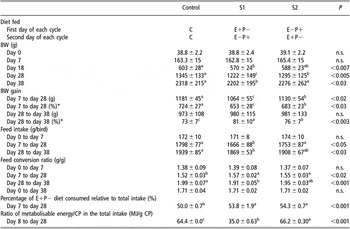
The sequential feeding programmes significantly reduced the weight of S1 birds on day 18 (−5.5% compared to Group C) and of S1 and S2 birds on day 28 (−9.1 and −3.7%, respectively, Table 2). The weight gains during the period from day 28 to day 38 showed compensatory growth in both groups: S2 body weight (BW) was not significantly different from controls on day 38 (−1.8% compared to Group C; P > 0.05), while compensatory growth was insufficient to allow the S1 group to make up the difference with Group C (−5%; P < 0.05). The decrease in weight gain percentage during sequential feeding was higher in the S1 group (−9.8% compared to Group C) than in the S2 group (−5.6% compared to Group C). Its subsequent rise was also higher in the S1 group than in the S2 group (+11.1% compared to Group C v. 4.4% in S2 compared to Group C). The reduction in BW gain and the subsequent compensatory growth was highest in the S1 group and intermediate in the S2 group.
BW, feed intake and feed conversion ratio of chickens following a standard (Group C) or sequential (Groups S1 and S2) feeding programme from 8 to 28 days of age (mean ± s.d.)

S1: high-energy/low-protein diet (E+P−) for 24 h followed by a low-energy/high-protein diet (E−P+) for 24 h.
S2: reverse distribution (E−P+ diet followed by E+P−).
*Weight gain percentage: weight gain relative to BW on the initial day (days 7 and 28).
Means with different superscript letters within a line are significantly different (P < 0.05).
The total feed consumption was lower in the S1 group than in the control and S2 groups during sequential feeding, and the difference between S1 and S2 disappeared thereafter (Table 2). More E+P− than E−P+ feed was consumed in both SF groups, as indicated by the ratio of its consumption relative to total intake. The feed conversion ratio was impaired during this period in both SF groups, but it improved during the finishing period in the S1 group. It did not differ between groups when measured over the whole rearing period (Table 2). The E+P− intake represented around 54% of the total intake in both SF groups and did not differ significantly between S1 and S2 birds. This switch to the highest energy diet resulted in an increase in the energy/protein ratio of the intake. This ratio was higher in S1 birds compared to controls, but was lower in the S1 than in the S2 group because of the larger reduction in the total intake during SF in S1 birds (Table 2).
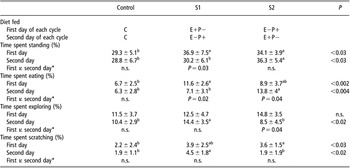
Sequential feeding significantly increased the average time spent standing during the first and second days of the observed cycle (C: 28%; S1:33%; S2: 35%; P < 0.05). When fed the E+P− diet, SF birds spent more time standing (around 36% v. 29% in Group C; Table 3) and eating (around 12% v. 6.5% in Group C; Table 3) than C birds. S2 birds also spent longer time standing when they were fed E−P+. Exploration (scratching and pecking at the litter or at an inanimate object) increased in SF groups when they were fed the E−P+ diet. Time spent scratching the litter did not differ between the first and second day of the observed cycle within groups; however, it increased in both sequential feeding groups when fed the E−P+ diet. Behavioural activities were closely related to the diet that was offered. Time spent standing, eating and scratching did not differ between S1 and S2 birds when they were fed the same diet, only time spent exploring tended to be lower in S2 birds when fed the E+P− diet.
Behaviour of chickens following a standard (Group C) or sequential (Groups S1 and S2) feeding programme at 20 and 21 days of age (mean ± s.d.)

S1: high-energy/low-protein diet (E+P−) for 24 h followed by a low-energy/high-protein diet (E−P+) for 24 h; S2: reverse distribution (E−P+ diet followed by E+P−).
*Result of the within-group comparison between the two days when behaviour was measured.
Means with different superscript letters within a line are significantly different and represent group effects (P < 0.05).
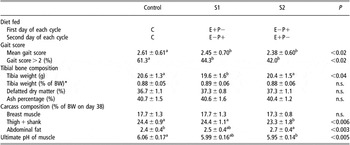
The clinical observations indicated that gait score was mainly impaired due to rotated tibias and varus-valgus angulations of the tarsal joint (Leterrier and Nys, Reference Leterrier and Nys1992). Mean gait score improved in the sequential feeding groups (Table 4). The percentage of birds with abnormal gait (gait score > 2) was lower when birds were fed sequentially (43.1%) than in the control group (61.3%; P = 0.001). There was no difference in the score or occurrence of leg abnormalities between the S1 and S2 groups. The occurrence of severe abnormalities (Gait score = 4) was 3.4% and did not differ between the S1, S2 and control groups.
Gait score, tibia and carcass composition, ultimate pH of breast muscle of chickens following a standard (Group C) or sequential (Groups S1 and S2) feeding programme from 8 to 28 days of age and slaughtered at 38 days of age (mean ± s.d.)

S1: high-energy/low-protein diet (E+P−) for 24 h followed by a low-energy/high-protein diet (E−P+) for 24 h; S2: reverse distribution (E−P+ diet followed by E+P−).
*Bone weight was expressed as a percentage of BW.
Means with different superscript letters within a line are significantly different (P < 0.05).
Tibial weight was lower in S1 birds since they were lighter than the other groups, but the tibia-to-BW ratio was similar in the three groups (Table 4). The tibiotarsal composition and breast yield did not differ between groups at slaughter age (Table 4). The percentage of thigh + shank was reduced while the abdominal fat percentage was higher in the S2 group. The ultimate pH was reduced in this group.
Discussion
Both sequential schedules tested were effective in improving the walking ability. This experiment was designed to induce early growth reduction, like previous studies on sequential feeding using low- and high-lysine diets (Bizeray et al., Reference Bizeray, Leterrier, Constantin, Picard and Faure2002; Leterrier et al., Reference Leterrier, Favreau, Constantin and Picard2005 and Reference Leterrier, Perrot, Favreau, Constantin, Bouvarel, Lessire and Picard2006). This reduction in growth was linked to diet composition, and also to the fact that the programme started as early as 8 days of age; no such reduction was observed in a programme using similar diets starting on 10 days and 21 days of age (Bouvarel et al., Reference Bouvarel, Barrier-Guillot, Larrouche, Boutten, Leterrier, Merlet, Vilarino, Roffidal, Tesseraud, Castaing and Picard2004 and Reference Bouvarel, Chagneau, Lescoat, Tesseraud and Leterrier2008). It appears that this reduction in early BW is a determining factor in the pathogenesis of leg abnormalities, as previously observed by several authors (Classen, Reference Classen1992; Leterrier and Constantin, Reference Leterrier and Constantin1996), since only one experiment with sequential feeding mentioned gait score improvement without early growth reduction (Bouvarel et al., Reference Bouvarel, Barrier-Guillot, Larrouche, Boutten, Leterrier, Merlet, Vilarino, Roffidal, Tesseraud, Castaing and Picard2004). Moreover, it is noteworthy that the improvement in leg condition was of a lesser magnitude than differences in gait score obtained with greater growth reduction (Bizeray et al., Reference Bizeray, Leterrier, Constantin, Picard and Faure2002; Leterrier et al., Reference Leterrier, Perrot, Favreau, Constantin, Bouvarel, Lessire and Picard2006). Reduction in BW alleviates mechanical stress on the leg joints and increases the time spent standing (Rutten et al., Reference Rutten, Leterrier, Constantin, Reiter and Bessei2002). The reduction in the prevalence of birds with abnormal gait in the present experiment is probably due to the combined effects of modified growth and motor activity. Our sequential feeding treatments induced major changes in motor activity related to each diet. The time spent standing was mainly enhanced by feeding activity during E+P− distribution in both SF groups. This enhancement of activity through feeding behaviour corroborates previous experiments, suggesting that feeding behaviour induces a high motivation to walk (Bokkers and Koene, Reference Bokkers and Koene2002) and can be used to increase activity (Nielsen et al., Reference Nielsen, Litherland and Nøddergaard2003). The increase in exploring and scratching activities during E−P+ distribution has previously been observed with a diet containing a low energy/protein ratio (Bouvarel et al., Reference Bouvarel, Chagneau, Lescoat, Tesseraud and Leterrier2008) or low lysine content (Bizeray et al., Reference Bizeray, Leterrier, Constantin, Picard and Faure2002). This could be explained by metabolic modifications leading to excess energy and the need to expend energy, as suggested by Bizeray et al. (Reference Bizeray, Leterrier, Constantin, Picard and Faure2002). Another study demonstrated that changes in growth and feeding behaviour induced by a mash diet also improved walking ability (Brickett et al., Reference Brickett, Dahiya, Classen, Annett and Gomis2007). These changes in activity do not appear to be sufficient to improve bone quality, whereas high levels of exercise have clearly demonstrated beneficial effects on broiler bone tissue. Exercise on a treadmill improves vascular patterns of the tibial growth plate (Thorp and Duff, Reference Thorp and Duff1988) and strengthens the tibial cortical bone in broilers (Rutten et al., Reference Rutten, Leterrier, Constantin, Reiter and Bessei2002). Floor systems improve the mineral apposition rate compared to cage systems (Vitorovic et al., Reference Vitorovic, Nokolic and Cvetkovic1995) and increase the ash content of the humerus (Tolon and Yalcin, Reference Tolon and Yalcin1997). However, changes in tibia ash content appear to require much larger changes in activity than those observed in the present experiment, which may explain why sequential feeding was not effective in improving ash percentage. Moreover, the small size of the pens and the low stocking density used may have reduced the magnitude of the motor activity increase. A low density was used to ensure that the chickens had enough room to move, but this may have reduced normal activity linked to disturbance by other birds. This disturbance is frequent in commercial conditions (Estevez, Reference Estevez2007), which suggests that the increased activity observed under the present experimental conditions is likely to be amplified in commercial farms. The lack of improvement in bone mineral content is in line with other experiments (Brickett et al., Reference Brickett, Dahiya, Classen, Annett and Gomis2007), suggesting that the pathogenesis of leg disorders in birds involves not only bones but also the whole musculo-skeletal system, especially the enlargement of breast muscles, since broad-breasted birds show highly pronounced lateral oscillations (Abourachid, Reference Abourachid1991) and high stress on the pelvic joint (Abourachid, Reference Abourachid1993). The involvement of breast muscles in the pathogenesis of leg abnormalities has also been suggested by a positive genetic correlation between breast muscle size and the occurrence of valgus angulations (Le Bihan-Duval et al., Reference Le Bihan-Duval, Beaumont and Colleau1997). The breast muscle percentage was lower in sequential feeding groups than in controls, but this difference was not significant. While this reduction was not significant, it may have played a role in the pathogenesis of lameness, since threshold effects are well-known in this kind of disease and many factors contribute to the lame state (Classen, Reference Classen1992; Mench, Reference Mench2004).
Both sequential feeding schedules used in the present experiment were therefore effective in improving gait score, but results on commercial performance differed between S1 and S2 treatments: BW was reduced at slaughter age in S1 birds, while carcass conformation was impaired in S2. The growth reduction was linked to a reduction in food intake, an unbalanced consumption of E+P− and E−P+ feeds and a reduction in feed efficiency during the sequential phase. The reduction in feed intake during sequential feeding was smaller in S2 than in S1, which explains why growth reduction was also smaller in this group. Because of this difference and over-consumption of E+P−, the energy content of both diets was highest in S2, as shown by the energy/protein ratio calculated by the amount of feed eaten. Since abdominal fat yield was higher in this group, it can be assumed that excess energy in relation to the amount of protein led to greater storage of energy as fat. The energy storage may also have occurred in muscle, since ultimate pH was reduced in this group, suggesting a higher glycolytic potential due to a higher amount of glycogen (Berri et al., Reference Berri, Debut, Santé-Lhoutellier, Arnould, Boutten, Sellier, Baéza, Jehl, Jego, Duclos and Le Bihan-Duval2005). The reason why there was such a marked difference in feed intake between S1 and S2 remains unclear, since the two groups differed only in the order the feeds were presented. It does not appear to be a block effect since it is in line with a previous experiment in cage, demonstrating that the order of diet distribution has marked consequences on growth (Bouvarel et al., 2007): the low-energy diet should be given first in order to avoid reduction in feed intake and hence reduction in BW at slaughter. This difference between the S1 and S2 groups could be linked to negative metabolic effects induced by the reduction in energy supply after contact with a high-energy diet that may have induced a high anabolic activity. It may also be linked to the birds’ cognitive abilities; they were initially pleased to eat a high-energy diet and were then frustrated with the low-energy feed (Martaresche et al., Reference Martaresche, le Fur, Magnusson, Faure and Picard2000). In this case, the reduction in growth could be explained by the low intake during the second day of SF. Both explanations are in agreement with the tendency to spend more time exploring in chickens S1 than S2 when fed the E+P− because increased exploratory behaviour may reflect an unbalance in the metabolic state (Bizeray et al., Reference Bizeray, Leterrier, Constantin, Picard and Faure2002) or dissatisfied expectations (Martaresche et al., Reference Martaresche, le Fur, Magnusson, Faure and Picard2000).
We can conclude that walking ability can be improved by using sequential feeding based on 48-h cycles and on diets varying in metabolisable energy (±7% of a standard diet) and protein content (±20% of a standard diet). This improvement can be achieved without reduction in BW at slaughter or impairment of the feed conversion ratio by stopping sequential feeding before 29 days of age in order to compensate for reduced growth and obtain commercial BW at slaughter. The improvement in gait score thus appears to be closely related to the reduction in early growth that can be obtained by starting sequential feeding as early as on 8 days of age and by the increase in motor activity induced by sequential feeding. However, the order of alternating the diets should be respected, since it seems to have a consequence on growth and carcass conformation. In view of the good growth performances and in order to validate this method at the industrial level, sequential feeding should be tested on commercial farms to see whether similar improvements in leg problems are observed in field conditions.
Acknowledgements
The present study is part of the Welfare Quality® research project, which has been co-financed by the European Commission, within the 6th Framework Programme, contract no. FOOD-CT-2004-506508. The text represents the authors’ views and does not necessarily represent a position of the Commission who will not be liable for the use made of such information. The authors thank Florence Favreau for her technical assistance and are grateful to Sue Edrich for her revision of the English manuscript.