Introduction
Grief, as a reaction to bereavement has been extensively studied from its typical manifestation to maladaptive forms during the past decades. Complicated grief, also labeled as “traumatic grief” or “prolonged grief,” has been identified as a unique construct distinguished from major depression, generalized anxiety disorder, post-traumatic disorder, adjustment disorder, and acute stress disorder (Maercker et al., Reference Maercker2013). It is characterized by intense painful, disabling, and persistent responses to bereavement with specific symptoms such as pervasive yearning or pre-occupation with the deceased and associated emotional pain, and lead to dysfunction (Maercker et al., Reference Maercker2013).
Among the risk factors of complicated grief, the traumatic nature of a death has been widely examined in various cultures and different populations. According to Kaltman and Bonanno (Reference Kaltman and Bonanno2003), traumatic bereavement includes sudden death and violent death, with the former one emphasizing suddenness and the latter including death involving violence. In the current study, objective traumatic death includes both sudden death such as death caused by acute illness, and violent death such as accident, suicide, and homicide. Accordingly, the current study encompasses both suddenness and subjective traumatic levels regarding subjective traumatic death.
First, unexpected death was found to be a risk factor for developing complicated grief in Japan (Fujisawa et al., Reference Fujisawa, Miyashita, Nakajima, Ito, Kato and Kim2010). In Germany (Kersting et al., Reference Kersting, Brähler, Glaesmer and Wagner2011) and China (Li et al., 2015), prevalence of complicated grief was higher among people who experienced traumatic death. Compared with non-violent death (i.e. illness), violent death was related to more severe prolonged grief symptoms in orphans and widows from Rwanda (Schaal et al., Reference Schaal, Jacob, Dusingizemungu and Elbert2010), as well as in adults from the Netherlands (Boelen, 2013) and China (He et al., Reference He, Tang, Yu, Xu, Xie and Wang2014). Nonetheless, other studies did not find a difference between traumatic and non-traumatic death in the Netherlands (van der Houwen et al., Reference van der Houwen, Stroebe, Stroebe, Schut, Bout and Meij2010), nor among American children and adolescents who lost their parents (Melhem et al., Reference Melhem, Moritz, Walker, Shear and Brent2007). A review of empirical studies found similar results (Hibberd et al., Reference Hibberd, Elwood and Galovski2010).
Despite the numerous findings on objective traumatic death, rare research investigated the subjective traumatic death, characterized by its suddenness and traumatic experience. The self-rated, unexpectedness of the death, was positively linked to prolonged grief symptoms (van der Houwen et al., Reference van der Houwen, Stroebe, Stroebe, Schut, Bout and Meij2010), implying the importance of including subjective perception as risk factors of complicated grief or prolonged grief. However, when examining the role of traumatic death in the development of complicated grief, previous research only emphasized the objective traumatic nature of the death and had overlooked the subjective experience of the death as a trauma, thereby failing to provide a comprehensive understanding of how the traumatic death works.
Fortunately, discussions from the area of PTSD may bring about some insights for bereavement research. It is reported that individuals who encountered non-traumatic events could experience comparable symptoms of PTSD (Cameron et al., Reference Cameron, Palm and Follette2010), or even experience a greater severity of PTSD symptoms than those who experienced objective traumatic events (Gold et al., Reference Gold, Marx, Soler-Baillo and Sloan2005). It is noteworthy that in the Gold et al. (Reference Gold, Marx, Soler-Baillo and Sloan2005) study, 64% of the participants identified death or illness of a loved one as a traumatic event, despite whether the death was objectively traumatic or not. Boals and Schuettler (Reference Boals and Schuettler2009) analyzed this issue further, directly adopting participants’ subjective ratings rather than researchers’ classifications to define traumatic events and found that the objective classifications of traumatic events had little to no correlation to PTSD symptoms when subjective ratings were considered. Weinberg and Gil (Reference Weinberg and Gil2016) also highlighted the importance of recognizing trauma as a subjective experience, and identified the subjective experience of the trauma as a threat that was associated with the risk for PTSD symptoms. These discoveries provide important implications for valuing participants’ subjective experience in understanding the influences of bereavement.
Despite the significance of understanding objective and subjective traumatic death in bereavement, knowledge about the growing aging population is rare. Few studies on risk factors of bereavement outcomes focused specifically on older adults (Newson et al., Reference Newson, Boelen, Hek, Hofman and Tiemeier2011), and none of them examined the role of traumatic death. Studies conducted in a mainland Chinese population did not consider the experience of older adults (He et al., Reference He, Tang, Yu, Xu, Xie and Wang2014; Li et al., Reference Li, Chow, Shi and Chan2015). Little is known about older Chinese adults in Hong Kong.
The current study aims to investigate the relationship between subjective and objective traumatic death and bereavement outcomes, for the first time, in bereaved older people in Hong Kong. Specifically, the current study will first examine the relationship between subjective and objective traumatic death to see whether they are identical. If not, then their respective relationships to complicated grief, depression, and anxiety will be explored.
Method
Participants and procedure
Adults aged 65 years and above who have lost their family members during the past five years were recruited from 17 centers for older adults in Hong Kong. Those who received psychiatric treatment before the bereavement experience or have impaired mental functioning were excluded. After obtaining the verbal informed consent of the participant, a face-to-face structured interview was arranged. Ethical approval was obtained from the Human Research Ethics Committee for Non-Clinical Faculties, The University of Hong Kong (EA071209).
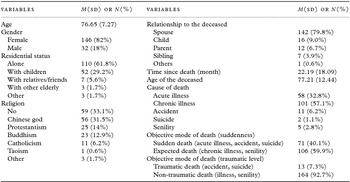
Three hundred and forty bereaved older adults were invited to join the study, 197 agreed, and 178 (90.4%) participants completed the study (Table 1), 19 withdrew because of a sudden change in either health condition or schedule.
Demographic and bereavement-related information of the participants

Measurements
Background information
The demographic information includes the age, gender, residential status, and religion of the bereaved person. The bereavement-related information includes the relationship to the deceased, age of the deceased, time since death, cause of death, suddenness (measured by the question, “How much have you mentally prepared for the death?” on a ten-point scale, 1 = totally unprepared, 10 = totally prepared for the death), and subjective traumatic level (assessed by the question, “How traumatic do you think the death was?” on a ten-point scale, 1 = not traumatic at all, 10 = very traumatic).
Inventory of complicated grief (ICG, Prigerson et al., Reference Prigerson1995)
The ICG is a 19-item inventory assessing the frequency of complicated grief symptoms over the past month, such as “I think about this person so much that it can be hard for me to do things I normally do.” The items are rated on a five-point scale, ranging from 0 (never) to 4 (always). The Cronbach's α is 0.911 in this study.
Geriatric depression scale (GDS, Sheik and Yesavage, Reference Sheik, Yesavage and Brink1986)
The GDS is a 15-item scale assessing depressive symptoms in older adults over the past week using questions such as “Have you dropped many of your activities and interests?” The items are scored on a dichotomous scale (0 = absence, 1 = presence) and five items are scored in reverse. The Chinese GDS has been validated (Lee et al., Reference Lee, Chiu and Kwong1994). The Cronbach's α is 0.817 in this study.
Hospital anxiety and depression scale – Anxiety subscale (HADS, Zigmond and Snaith, Reference Zigmond and Snaith1983)
The anxiety subscale of HADS measures thoughts, feelings, and physical sensations of anxiety over the past week, such as “I get a sort of frightened feeling as if something bad is about to happen.” The seven items are rated on a four-point scale, ranging from 0 (not at all) to 3 (very often). The Cantonese version of HADS has been validated by Leung et al. (Reference Leung, Ho, Kan, Hung and Chen1993). The Cronbach's α of the anxiety scale is 0.657 in this study.
Statistical analyses
First, a χ 2 test, independent sample t-test, ANOVA, and Pearson correlation were conducted to investigate whether the objective mode of death and subjective traumatic level differ among subgroups. Then, hierarchical multiple regression analyses were conducted to examine whether the background information, objective, and subjective traumatic death could explain symptoms of complicated grief, depression, and anxiety, and which variable could best explain these symptoms.
Results
Group differences in objective mode of death
Time since sudden death was significantly shorter than that of expected death (t (174) = −2.099, p = 0.037). However, no difference in background information was found between traumatic and non-traumatic death.
Group differences in subjective traumatic level
First, age of the deceased was positively related to suddenness (r = 0.202, p = 0.007), indicating that the older the deceased was, the more prepared the bereaved was. Moreover, suddenness differed significantly among subgroups of relationship to the deceased, F (4, 172) = 5.274, p = 0.002. LSD post-hoc test reveals that the bereaved who lost a child was less prepared for the death than those who lost a spouse (mean difference = −2.03, p = 0.025), sibling (mean difference = −4.99, p = 0.001), and parent (mean difference = −4.23, p = 0.001), while those who lost a spouse were less prepared than those who lost a sibling (mean difference = −2.96, p = 0.026) and parent (mean difference = −2.20, p = 0.033).
Second, there were significant differences of suddenness among subgroups of the cause of death, F (4, 172) = 7.173, p < 0.001. LSD post-hoc test reveals that people who lost loved ones due to chronic illness were more prepared than those who lost loved ones due to acute illness (mean difference = 2.58, p < 0.001), accident (mean difference = 2.84, p = 0.008), and suicide (mean difference = 5.65, p = 0.018). There was no difference between chronic illness and senility regarding the suddenness (p = 0.574).
Last, the age of the deceased was negatively related to subjective traumatic level (r = −0.240, p = 0.001), which means that the younger the deceased was, the more traumatic feelings the bereaved experienced. There were no significant differences among subgroups regarding cause of death, F (4, 172) = 2.158, p = 0.076.
Relationships between objective modes of death and subjective traumatic level
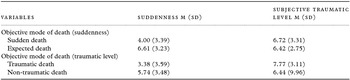
Table 2 shows the suddenness and subjective traumatic level in different objective modes of death. Bereaved older adults whose loved ones died suddenly were less prepared for the loss than others (t (175) = 5.170, p < 0.001), indicating that the objective sudden nature of the death was consistent with the subjective suddenness. Those encountered traumatic death were also less prepared than others (t (175) = 2.344, p = 0.020), suggesting traumatic death has relation to suddenness too.
Comparison for suddenness and subjective traumatic level between modes of death

The subjective traumatic level, did not differ between sudden death and expected death (t (175) = −0.662, p = 0.509) or between traumatic death and non-traumatic death (t (175) = −1.554, p = 0.122), thereby implying that the objective traumatic nature of the death was not necessarily related to the subjective experience of the death as a trauma.
Also, suddenness was negatively related to subjective traumatic levels (r = −0.197, p = 0.009), which indicates that the less mentally prepared one was, the more traumatic feelings one experienced.
Objective modes of death and subjective traumatic level relating to bereavement outcomes
In terms of objective modes of death, sudden death and expected death did not differ in symptoms of complicated grief (t (171) = −1.051, p = 0.295), depression (t (170) = 1.321, p = 0.188), and anxiety (t (174) = 1.089, p = 0.277). Similarly, traumatic death and non-traumatic death showed no difference in complicated grief (t (171) = −1.387, p = 0.176), depressive (t (170) = 0.008, p = 0.994), and anxious symptoms level (t (174) = −0.184, p = 0.854).
As shown in Table 3, suddenness was negatively associated with complicated grief (r = −0.222, p = 0.003), suggesting that being mentally prepared was associated with lower complicated grief symptom severity. However, suddenness was not related to depression and anxiety.
Pearson Correlation between subjective traumatic death and bereavement outcomes

Note. **p < 0.01.
*** p < 0.001.
Subjective traumatic levels were positively related to complicated grief (r = 0.657, p < 0.001), depressive (r = 0.301, p < 0.001), and anxious symptoms severity (r = 0.195, p = 0.01). Notably, the correlation between complicated grief and subjective traumatic level was stronger than its correlation with suddenness.
Background information, objective modes of death, and subjective traumatic levels associated with complicated grief
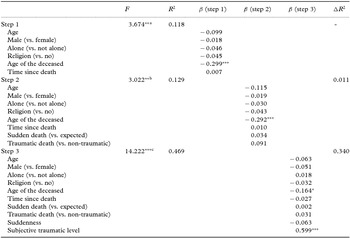
Hierarchical multiple regression analysis was conducted, in which independent variables were entered in three blocks are as follows: (1) background information, (2) objective modes of death, and (3) subjective traumatic level (Table 4).
Summary of the hierarchical multiple regression analysis for complicated grief symptoms

Note. *p < 0.05.
** p < 0.01.
*** p < 0.001.
a df1 = 6, df2 = 165.
b df1 = 8, df2 = 163.
c df1 = 10, df2 = 161.
Age of the deceased and the subjective traumatic level were significantly related to the symptoms of complicated grief, F (10, 161) = 14.222, p < 0.001, R 2 = 0.469, which indicated that the younger the deceased was, the more severe complicated grief one experienced (β = −0.164, p = 0.010), whereas the higher subjective traumatic level was, the higher the level of complicated grief one experienced (β = 0.599, p < 0.001). Notably, whether the death was objectively a sudden death (β = 0.002, p = 0.970) or a traumatic death (β = 0.031, p = 0.627), or whether the bereaved was mentally unprepared (β = −0.063, p = 0.344) were not correlated with complicated grief symptoms severity.
Background information, objective modes of death, and subjective traumatic level associating to depression
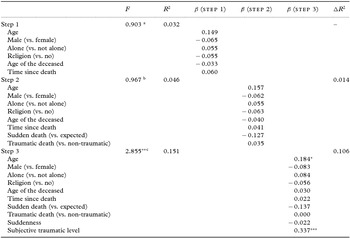
The same hierarchical multiple regression analysis was conducted, with the dependent variable replaced by depression (Table 5). The age of the bereaved and the subjective traumatic level significantly explained symptoms of depression. F (10, 160) = 2.855, p = 0.003, R 2 = 0.151, indicating that the older the bereaved was, the more depressive symptoms they experienced (β = 0.184, p = 0.023). Whereas the higher subjective traumatic level was, the more severe depression one experienced (β = 0.337, p < 0.001). Again, whether it was a sudden death (β = −0.137, p = 0.106) or a traumatic death (β = 0.000, p = 0.998), or whether the bereaved was mentally unprepared (β = −0.022, p = 0.793), were not related to the severity of depressive symptoms.
Summary of the hierarchical multiple regression analysis for depressive symptoms

Note. *p < 0.05.
** p < 0.01.
*** p < 0.001.
a df1 = 6, df2 = 164
b df1 = 8, df2 = 162.
c df1 = 10, df2 = 160.
Background information, objective modes of death, and subjective traumatic level associating to anxiety
In this analysis, the dependent variable was replaced by anxiety. However, the regression models in Step 1(F (6, 168) = 0.731, p = 0.625, R 2 = 0.025), Step 2 (F (8, 166) = 0.665, p = 0.722, R 2 = 0.031), and Step 3 (F (10, 164) = 1.123, p = 0.348, R 2 = 0.064) were not significant, which means that none of the proposed risk factors can explain the variance of anxious symptoms.
Discussion
In the current study, we examined whether a traumatic death was significantly associated with symptoms of complicated grief, depression, and anxiety among older Chinese people in Hong Kong and if subjective and objective traumatic death played different roles in developing these symptoms.
The first main finding was that the subjective traumatic level of the death had no relation to a specific cause of death, the objective suddenness of the death, or objective traumatic nature of the death, implying that the subjective and objective perception of traumatic death are not necessarily linked. As shown in a previous study conducted among bereaved spouses or partners, although there were associations between the negative meaning of the loss, the frequency of the traumatic events and prolonged grief, the negative meaning of the loss became the only significant predictor of prolonged grief in the regression model (Tomarken et al., Reference Tomarken2012). This suggests there are distinct functions of subjective world beliefs and the objective world. Therefore, we suggest that when future research and clinical work refers to traumatic death, both subjective and objective components should be assessed, as these two aspects might be discrepant.
Second, as expected, the subjective traumatic level was the primary risk factor for complicated grief and depression. However, neither sudden death nor the objective traumatic nature of the death was significantly related to bereavement outcomes. Earlier research reported similar findings that the violent death was not related to concurrent depression (Kaltman and Bonnano, Reference Kaltman and Bonanno2003). These results echo the idea of “cognitive appraisal” used by Stroebe et al. (Reference Stroebe, Folkman, Hansson and Schut2006) in the bereavement context. This demonstrates understanding individual differences in emotional outcomes, requires knowing the perception of the stressor. In the cognitive-behavioral conceptualization of complicated grief, Boelen et al. (Reference Boelen, Van Den Hout and Van Den Bout2006) demonstrated how cognitive factors impact bereavement-related outcomes with supportive empirical evidence (Boelen and Klugkist, Reference Boelen, van de Schoot, van den Hout, de Keijser and van den Bout2011; Nagy and Szamosközi, Reference Nagy and Szamosközi2014). Our findings confirmed that the appraising process of the event is significant since the subjective experience of the death as a trauma was greatly related to the severity of complicated grief and depression.
The current study also examined the relationship between objective and subjective sudden death, and their relationship with bereavement outcomes. The subjective suddenness of the death relied much on the cause of death and was substantially associated with modes of death, with sudden death and traumatic death being less expected. However, as mentioned above, sudden death did not have a relation to complicated grief, depression, or anxiety. Similarly, a previous review pointed out that results were inconsistent predicting complicated grief for sudden death (Stroebe et al., Reference Stroebe, Schut and Stroebe2007), and another earlier study also reported that the suddenness of the death was not related to both concurrent and persistent symptoms of depression (Kaltman and Bonnano, Reference Kaltman and Bonanno2003). Reactions to unexpected life events might be subdued in the Chinese culture due to roots in Taoist and Buddhist belief. Life adversities are perceived to be controlled by fate that comprises external forces and cannot be easily altered (Leung, Reference Leung and Bond1996).
Apart from the role of objective and subjective traumatic death in the development of complicated grief and depression, the age of the deceased and the bereaved also were associated with different outcomes. As an old Chinese idiom states that nothing is as heartbreaking as “granny in mourning,” which means people with white hair (older persons) grieve for those with black hair (younger persons), it is not surprising that younger age of the deceased was associated with higher levels of complicated grief symptoms, consistent with previous findings in Chinese bereaved young adults (He et al., Reference He, Tang, Yu, Xu, Xie and Wang2014). This is in contrast to findings from the USA (Melhem et al., Reference Melhem, Moritz, Walker, Shear and Brent2007), Rwanda (Schaal et al., Reference Schaal, Jacob, Dusingizemungu and Elbert2010), Japan (Fujisawa et al., Reference Fujisawa, Miyashita, Nakajima, Ito, Kato and Kim2010), Germany (Kersting et al., Reference Kersting, Brähler, Glaesmer and Wagner2011), and the Netherlands (van der Houwen et al., Reference van der Houwen, Stroebe, Stroebe, Schut, Bout and Meij2010). On the other side, older age of the bereaved was associated with greater severity of depression symptoms. A meta-analysis reviewed 24 studies reporting an age-specific prevalence of depression and found that the rates of depressive disorders increased substantially in those aged 85 years or above (Luppa et al., Reference Luppa2012). Therefore, it may be helpful to pay more attention to the depression symptoms when working with bereaved older persons.
Notably, the regression model for complicated grief explained larger variances than the model for depression. Moreover, the link between background information and anxiety was not found. The findings support that grief is the primary reaction following bereavement, and as consistently reported in previous studies, prolonged grief, depression, and anxiety are distinguishable syndromes (Boelen et al., Reference Boelen, van de Schoot, van den Hout, de Keijser and van den Bout2010; Spuij et al., Reference Spuij, Reitz, Prinzie, Stikkelbroek, de Roos and Boelen2012). This implies that the newly proposed Persistent Complex Bereavement Disorder in DSM-5 and Prolonged Grief Disorder in ICD-11 are meaningful and thus warrant a place in standardized psychiatric taxonomies.
All findings must be viewed with caution, given the limitations of the current study. The first limitation is that we only included one question when assessing subjective traumatic level. The ratings may be biased due to participants’ personalized interpretation of the word “traumatic.” Further research exploring how participants understand traumatic death and why they perceived non-traumatic death as traumatic could be useful for a more comprehensive evaluation of subjective traumatic death. Another limitation is that we did not assess traumatic outcomes such as PTSD symptoms. Although complicated grief is the most significant syndrome to bereavement, it is still possible that traumatic death can better explain PTSD rather than complicated grief or depression. Hence, the inclusion of PTSD symptoms as one of the bereavement outcomes could clarify the linkage between traumatic death and bereavement outcomes and possible further revisions for current interventions. Third, the findings are restricted to a sample of bereaved older persons in Hong Kong. Replication in other age groups or population-based representative samples should be conducted before generalizing the conclusion of the current study. Finally, we are acutely aware that our cross-sectional design precludes any causal interpretations. Future longitudinal studies are needed to further explore the predictive function of subjective traumatic death.
Despite these limitations, the current study has enriched knowledge of the distinguishable concepts of subjective perceptions and the objective nature of traumatic death. It has illustrated the importance of subjective experiences of the death as a trauma in the development of complicated grief and depression. Moreover, it is noteworthy because it first attempts to understand risk factors of complicated grief and depression in older people in Hong Kong. These findings correspond with current theorizing of the significant appraising processes in coping (see Stroebe et al. (Reference Stroebe, Folkman, Hansson and Schut2006)). This also suggests the significance of assessing and monitoring the clients’ subjective experience of the death as a trauma during clinical intake interview and intervention.
Conflict of interest
None.
Description of authors’ roles
Suqin Tang formulated the research question, analyzed the data, and wrote the paper. Amy Y. M. Chow designed the study, supervised the data collection, and assisted with writing the paper.
Acknowledgments
The authors would like to express gratitude to all the workers of the Hong Kong Sheng Kung Hui Welfare Council (HKSKH) for recruiting the participants and to all the participants who joined the study. This work is funded by the Hong Kong Jockey Club Charities Trust under the CADENZA Fellow program.