The duality of nomad/sedentary or nomads/settlers—in Arabic badu/hadhar—is a classic feature of the social history of the Middle East. Related to this duality is the notion of tribe and its cultural ideology, tribalism. These are all concepts familiar to the students of the region, although increasingly, they are acquiring an antiquated character due to rapid urbanization and other forms of socioeconomic change. In the Arabian Peninsula, the dichotomy is still widely used. Whereas important research has been carried out over the years on the relationship between tribalism and nationalism in the Middle East, the persistence of this particular dichotomy in the Gulf has received little analytical attention.1
Among the exceptions are Dale Eickelman, “Being Bedouin: Nomads and Tribes in the Arab Social Imagination,” in Changing Nomads in a Changing World, ed. Joseph Ginat and Anatoly Khazanov (Brighton: Sussex Academic Press, 1998), 38–49 and Ugo Fabietti, “Control and Alienation of Territory Among the Bedouin of Saudi Arabia,” Nomadic Peoples 20 (March 1986), 33–40.
J. G. Lorimer, Gazetteer of the Persian Gulf, Oman and Central Arabia. Historical Part I B (Farnborough: Gregg International, 1970).
See, for example, Madawi al-Rasheed, Politics in an Arabian Oasis. The Rashidies of Saudi Arabia (London, New York: I. B. Tauris, 1991); Fabietti, “Control and Alienation.”
The observations on which this article builds took place over seven years, from 1987 to 2004. The interviews and surveys, however, were conducted in the main between 1999 and 2002.
HADHAR AND BADU: WHO THEY ARE AND HOW EACH CATEGORY PERCEIVES THE OTHER
In present-day popular speech, the term hadhar designates Kuwaitis whose forefathers lived in Kuwait before the launch of the oil era (1946) and worked as traders, sailors, fishermen, and pearl divers. In contrast, the term badu designates a specific group of newcomers: these are immigrants, mostly from Saudi Arabia, who used to live on animal pastoralism; they moved to Kuwait between 1960 and 1980, after Kuwait had become an independent, oil-exporting nation, and have been granted Kuwaiti nationality over the years since then.4
“Badu” is the Arabic word used by Kuwaitis when speaking of the hadhar–badu dichotomy. In this article, I will keep to this practice and use the English term bedouin only when writing about pastoral nomads in general and especially in the pre-oil era.
In 1967, Kuwait held its second election for the National Assembly. The outcome was the overwhelming defeat of the Nasserist opposition led by Ahmad al-Khatib. Al-Khatib and his followers were all recruited from among the hadhar community. The opposition accused the government of electoral fraud, ballot stuffing, miscounts, and gerrymandering. The badu immigrants were identified as the instrument used by the government to achieve its aims. Ever since, they have remained in the eyes of the Kuwaiti liberal opposition the symbol of governmental antidemocratic manipulations.
Immediately after liberation, it was commonly said that the majority of the Kuwaitis who remained in the country under the Iraqi occupation lived in the central areas of Kuwait City. These are all hadhar areas. The outlying badu areas on the other hand were said to have been vacated by their inhabitants already in the early days of the invasion. It was also pointed out that the badu's flight from Kuwait was organized by tribal leaders, and practically no badu took part in the local resistance against occupation. To these accusations, the badu countered that they were simply following the amir in exile and their leaving Kuwait was an expression of their loyalty toward the personified symbol of the state. See Anh N. Longva, “Citizenship in the Gulf States: Conceptualization and Practice,” in Citizenship and the State in the Middle East: Approaches and Applications, ed. Nils A. Butenschön, Uri Davis, and Manuel Hassassian (Syracuse, N.Y.: Syracuse University Press, 2000), 179–97.
The hadhar claim that the badu are alien elements in Kuwaiti society. Arriving en masse from the desert in the 1960s and 1970s, they are said to have only one purpose in mind: to lay their hands on the welfare goods and services Kuwait could offer.7
To speak of the badu's large presence and their exploitation of the welfare system, some hadhar make use of a classic metaphor in the region, that of “an army of locusts.”
Jill Crystal, Oil and Politics in the Gulf: Rulers and Merchants in Kuwait and Qatar (Cambridge: Cambridge University Press, 1990); Rosemary Zahlan, The Making of the Gulf States (London: Ithaca Press, 1988).
The badu's perception of the hadhar is, in my experience, much less clearly articulated—they do not spend the same amount of time speaking about hadhar—and on the whole, it is much more flattering and positive. Most badu do not contest the hadhar's legitimacy of belonging: Kuwait is rightfully theirs; they built this society. Conversely, it is asserted that the badu may be recently naturalized but, as true Northeastern tribes, their dirah or “tribal pastures” used to encompass this part of the peninsula and they therefore cannot be called strangers to Kuwait. Of interest, most badu agree with many of the cultural stereotypes assigned to them by hadhar. The difference is what the latter look upon as backwardness, the badu see as valuable qualities and practices. For example, my badu informants readily acknowledge that tribal ties are real enough but to them this is solidarity and not nepotism, and they would argue that tribal solidarity is what makes tribal society more caring, therefore, better than any other societies. As for their attitude toward Kuwait, they see no contradiction between devotion to the tribe and love of Kuwait. The badu claim that the hadhar also have multiple allegiances to Kuwait and to political ideologies such as ba

thism, Arab nationalism, communism, khomeinism, and so forth. It is pointed out that these ideological allegiances, which are all imported from the outside world, have led oppositional hadhar to attack the country's regime and the country's leaders, in words but occasionally also in deeds (e.g., bomb throwing and airplane hijacking in the 1980s). Moreover, if some badu carry two passports, they say, quite a few hadhar have the green card, which allows them to settle in the United States when the going gets rough in Kuwait. The badu also unabashedly defend what they call the “protected” position of badu women, which hadhar call “subordinate.” They pride themselves upon their conservative traditionalism and view the large badu families as a sign of physical vigor and social strength, not a symptom of backwardness. It is also a political asset because, thanks to this physical vigor, badu now make up 60 percent of the Kuwaiti population (excluding the foreign migrant workers). Their number gives them a voice that the hadhar cannot ignore. The badu shrug at accusations of abuse of the welfare-state, and say that they simply make use of their citizens' rights, as hadhar do. The truth, they say, is that the hadhar fear the dynamic competition of the badu. Furthermore, although admitting that they may not be as urbane as the hadhar, all the badu I have met categorically refute the description of badu as ignorant, unskilled, and uneducated. They point out that several departments of Kuwait University have a majority of students and a growing number of teachers with bedouin background. They are particularly proud that many Ph.D. holders are badu, whose parents were illiterate. Many second-generation badu immigrants declare that they feel as Kuwaiti as the hadhar, in fact some claim to belong in the hadhar category (“I was born and grew up in Kuwait, attended Kuwaiti schools, and work in the Kuwaiti state. That makes me a full-fledged Kuwaiti, that is a native of this city, that is a hadhar,” a man in his mid-twenties argued). They maintain their lifestyle is identical to that of any hadhar; and, if the hadhar do not acknowledge this, it is ultimately because they are unwilling to relinquish their dominant position in society. They are unwilling to share their social and economic privileges and are keen to preserve the distinction “hadhar/badu” to keep the badu out in the cold. Hadhar are said to be particularly unwilling to let badu enter the private sector, which is where large fortunes can be made, and to seek to restrict their job opportunities to the public sector, where they depend on a fixed salary paid by the state. Most hadhar refute these claims and would quote lists of badu names in private business to prove their point.
There are of course no monolithic hadhar or badu views on all these matters nor are all individual views always consistent. Some badu are keen to emphasize the discriminatory hadhar attitudes but would at the same time acknowledge that “this is after all their society.” Many agree that the cultural gap between the two categories is substantial, some explaining it in evolutionary terms: “The hadhar are today where we will be in ten, twenty years' time.” On the whole, badu are confident that the gap is narrowing quickly. Although there are hadhar who dismiss the hadhar–badu dichotomy altogether and insist that “we are all the same people,” the majority I have met are convinced that it would take many, many generations for the gap between hadhar and badu to close.
THE POLITICS OF CATEGORIZATION
Whereas hadhar and badu are used only in popular speech, they have their equivalents in legal texts and governmental statistics. Thus, the 1959 Nationality Law differentiates between Kuwaitis by origin (bi-l-asl) and Kuwaitis by naturalization (bi-l-tijanis). Among the “original” Kuwaitis are members of the ruling family and people whose forefathers were permanent residents in Kuwait from 1920. Among naturalized Kuwaitis are all who settled in Kuwait after 1920 and were granted nationality at a later stage. The category “naturalized Kuwaitis” includes Shi
a (mostly from Iran, but also from Southern Iraq and al-Hassa), a few Sunni Arabs from Iran (hawala) and other Middle Eastern countries, and a handful of Christian Arabs from Southern Iraq and Palestine. These naturalized citizens came to Kuwait before the country shed its status as a British protectorate and became an independent state in 1961. Although not all can trace their presence in Kuwait back to 1920, they are considered part and parcel of the hadhar community, because as traders, laborers, fishermen, and seamen, or as teachers and doctors (in the case of the Palestinians), they had all contributed to the economy and development of the town before independence. The overwhelming majority of naturalized Kuwaitis, meanwhile, consist of badu. Several formal features distinguish the badu from the naturalized hadhar. Almost all badu originate from what has been internationally recognized since 1932 as the Kingdom of Saudi Arabia (they were in other words Saudi subjects before they opted to become Kuwaiti citizens) and practically all are Sunni Muslim. The naturalized badu, thus, are culturally more homogeneous than the naturalized hadhar. Furthermore, their immigration, which occurred mainly in the 1960s and 1970s, after Kuwait's independence, was neither individual nor spontaneous but collective and encouraged by the Kuwaiti authorities.
9Before 1961, especially in the 1950s, many bedouin from the Saudi Northeastern province flocked to Kuwait to seek work in the incipient Kuwaiti oil industry. Their migration was individual and spontaneous. Despite their origin, these early migrants are usually not included among the badu. See Mohammed al-Haddad, “The Effect of Detribalization and Sedentarization on the Socio-Economic Structure of the Tribes of the Arabian Peninsula: The Ajman Tribe as a Case-Study” (Unpublished Ph.D. diss., University of Kansas, 1981).
Six days after Kuwait declared its independence on 19 June 1961, Iraqi troops stood at its border and threatened to invade the new state on the grounds that Kuwait used to belong to the province of Basra during the Ottoman period. That first threat was averted thanks to the military intervention of Great Britain and the Arab League.
Parliamentary democracy was limited, because until 1995, only male Kuwaitis of the “original Kuwaiti” category had the right to vote and stand. Since 1995, all male Kuwaitis can vote, but only sons of the naturalized citizens can stand, not their naturalized fathers. Kuwaiti women of all categories did not gain the franchise until May 2005.
Nicholas Gavrielides, “Tribal Democracy: The Anatomy of Parliamentary Elections in Kuwait,” in Elections in the Middle East: Implications of Recent Trends, ed. Linda L. Layne (Boulder, Colo.: Westview Press, 1986).
In the 1990s, this picture began to change as badu support for Islamism increased and some badu threw their weight behind candidates from the Islamist opposition.
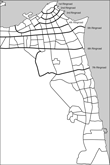
Like the legal texts, the official statistics published by the Ministry of Planning support the popular distinction between hadhar and badu, without precisely using these terms. The governorates of Jahra and Ahmadi are sometimes described as al manatiq al-kharijiyya or the “outlying areas”, whereas the central governorates are known as al-manatiq al-dakhiliyya or “central areas.” Likewise, dwellings in Kuwait come in two types, the ordinary one, which has no specific name, and buyut sharqiyya, literally “Eastern houses” but officially translated as “traditional houses.” These houses are concentrated in the so-called outlying areas. The picture that emerges is that of a society divided into a central urban core and an outlying rural area, inhabited by two sociologically, if not ethnically, distinct categories, the hadhar and the badu. The concrete dividing line between the two social worlds is generally considered to be the Sixth Ringroad (see map). Between the First and the Fifth Rings lie the undisputedly “hadhar” neighborhoods. The area between the Fifth and the Sixth Rings is a zone of transition with a mixed population of hadhar, badu, and foreign migrants. The area south of the Sixth Ringroad was, until recently, “badu territory.”
14We also find here a large number of migrant workers from the Indian subcontinent and East Asia.
a) have received government housing in the new residential area of Qorain, where they live side by side with badu families.
15Housing the badu immigrants has always been an acute problem, as the authorities' efforts never seemed to be able to keep pace with the demand. A first housing complex with 4,000 units, complete with a school, clinics, police stations, mosques, and markets, was built in 1965. Named Sabah al-Salim after the project's initiator, this neighborhood lies just south of the Sixth Ringroad. At the time of its construction, however, it was at some distance from the capital city, the border of which stopped at the Second Ringroad. See Robert L. Jarman, Sabah Al-Salim Al-Sabah. Amir of Kuwait, 1965–77. A Political Biography. (London: The London Centre of Arab Studies, 2002). Only recently has the acute need for housing been met in a decisive way: starting in the late 1990s, the government systematically developed the desert area Southeast of the Sixth Ring and built rows upon rows of houses aimed mainly at the young generation of citizens of immigrant origin. A whole new governorate, Mubarak al-Kabeer, was established, which encompasses the coastal region between the Sixth and the Seventh Ringroads (see map).
It must be pointed out that the term hadhar or town dweller is part of the traditional bedouin vocabulary. Urban Kuwaitis do not use it as a term of self-reference. When they need to emphasize their collective identity as against the badu, they would simply speak of “the Kuwaitis” or ahl al-sur, “the people from within the wall,” in reference to the mud wall that surrounded the town in the old days and protected it from desert raids. Although demolished in the 1950s the wall is still a powerful trope in the discursive construction of hadhar identity, as the official division of Kuwait into manatiq dakhiliyya and manatiq kharijiyya clearly indicates: inside and outside are concepts that exist only in relation to a dividing line or a wall. In naming the badu areas in terms that remind of their original status as outsiders, the state contributes to keeping alive the perception of difference between hadhar and badu and the battery of cultural images that goes with it.
Yet, the role of the authorities in this matter is ambiguous. In Kuwait, sects and tribes, two forms of community that powerfully challenge the unity of the nation-state, do not figure prominently in official public discourse. References to a person's tribal or sectarian belonging are rarely made in the media, for instance.16
It could be argued that this is not necessary, as people's names are adequate indicators of their backgrounds. I suggest nevertheless that this is also due to the fact that, in Kuwait today, the official discourse on identity lays overwhelming emphasis on the nation-state and not on tribes and sects. A universalist discourse is, of course, no guarantee of nondiscriminatory policies.
This claim is supported by the fact that tribes and tribal identities are particularly sensitive topics in Kuwait. One of the reasons is the way the ruling family has made political use of the so-called “low” tribes that used to be employed in their service in the pre-oil days. These tribes were semisedentary and were “low” in relation to the “noble” tribes, which were truly nomadic. “Low” tribes were vassals of specific “noble” tribes, and there was no marriage alliance between the two categories. The traditional tribal hierarchy has undergone tremendous change over the past fifty years. For the purpose of the present discussion, suffice it to say that since the advent of oil and independence, members of the “low” tribes who had always rendered loyal services to the al-Sabah, have been rewarded with influential positions in the government. As part of the post independence ruling establishment, they, naturally enough, keep to a strictly modern discourse of civic equality and individual merit and do not encourage the propagation of ancient tribal lore based on tribal hierarchy and tribal discriminations.
MODERN ETHNOPOLITICS: THE NAMING GAME
At the top of hadhar society are the Sunni merchant families, who founded Kuwait in the early 18th century. These hadhar families issue from the same North Arabian tribes to which the overwhelming majority of badu immigrants belong: Anaiza, Mutayr, Ajman, Utayba, Shammar, and so forth. They are thus living proof that the two categories are porous. Furthermore, the transition from badu to hadhar is not only possible, but it is also the critical event the result of which was the creation of Kuwait. In other words, transition from badu to hadhar is the key element in this country's history, the very condition for its existence. The Kuwaitis are fully aware of this, yet many hadhar are convinced that the new immigrants from Saudi Arabia are unable to follow the path of integration that their forefathers traveled so successfully. In this section, I look into the transition process itself and ask what signaled it in the old days and is the same mechanism still in operation today?
When queried about this subject, my informants, both hadhar and badu, answered that no particular events or rituals marked the passage from badu to hadhar. Whenever I suggested change of names as a possibility, people were surprised and on the whole, skeptical. Yet, name change has also caught the attention of other authors.18
For example, al-Haddad, “The Effect of Detribalization”; Jill Crystal, Kuwait: The Transformation of an Oil State (Boulder, Colo.: Westview Press, 1992).
Among the Northeastern and Eastern tribes of Arabia, tribal segmentation is roughly as follows: qabila (tribe), batn (lit. belly), fakhth (lit. thigh), and a
ila (family). The units most often mentioned by my informants are the fakhth, usually translated as lineage, and the a
ila, the family. The fakhth was crucial for life in the desert, much more so than the tribe which, due to its size, was more of an imagined community. The fakhth comprises only five generations. It was a corporate unit holding collective rights: the ownership of wells, the most important form of collective ownership in the desert, was invested in the fakhth. The use of the wells by other than members of the proprietor fakhth was strictly subject to requests and permissions. Many a conflict among bedouin originated from disputes about the ownership and/or use of wells. The fakhth functioned first and foremost as a defense and vengeance unit. Any man could count on his fakhth to fight on his side when he was wronged or attacked. Members of a fakhth shared the same blood responsibility: if one of them killed an outsider, they were all responsible and any male within the fakhth could be killed in retribution. If the victim's family accepted blood money instead, all the fakhth members had to contribute equally. In other words, the fakhth was the level at which security was ensured and justice was obtained; in comparison, the tribe was a much more abstract entity. See Donald P. Cole, Nomads of the Nomads: The Al Murrah Bedouin of the Empty Quarter (Chicago: Aldine Publishing Company, 1975); Fabietti, “Control and Alienation.”
In addition to the al-Sabah, one can cite the al-Khorafi (Utayba), the al-Sayyer (Mutayr), the al-Ghannem (Anaiza), and many others.
A woman in her 30s from an old hadhar family told me of her surprise when she recently learned that her family's surname used to include al-Harbi. This showed that the family comes from the Harb tribe. “I had no idea!” she said, genuinely astonished. When I asked why she thinks the bedouin dropped their tribal names upon settling in Kuwait, she suggested that “probably because they were embarrassed.” To this hadhar with clear tribal roots, being badu is a stigma, because it implies ignorance and backwardness.
One famous exception is the family of the legendary Hillal al-Mutayri, a destitute bedouin who found his luck in pearl diving and became the richest merchant of Kuwait at the beginning of the 20th century.

A map of the Kuwait metropolitan area. Adapted from the Kuwait Pocket Guide 2004; adapted by Kjell Helge Sjøstrom.
How are we to interpret the symbolic meaning of name change under the process of sedentarization? Beside its practical motivations (e.g., hadhar names are indicative of people's new occupations), are we to view the change as a way for the kin group to make explicit their intention of giving up their previous way of life and status, a sort of public announcement that they have, or intended to, become hadhar? This does not seem to be the case; if it had been, one could expect the move to have a special significance in people's social awareness, even expect it to be treated as a kind of rite of passage. I have found no indications that lead me to this conclusion. In fact, I have had much difficulty finding out about this process, let alone the underlying reasons, from my informants. Most Kuwaitis, especially the hadhar, have an ambivalent attitude to the matter of names: names are of great importance to them yet their knowledge of the mechanisms that resulted in people being named as they are today is limited. Only a handful among my hadhar informants knew why, when, and under what circumstances their ancestors dropped their lineage or tribal names and adopted a new hadhar name. My inquiries on this subject often left them puzzled; some would admit that they had never thought about the matter, but my friends told me that I read too much into “this thing about names.” This I find curious, since most hadhar do a lot of reading themselves when they interpret the badus' use of their tribal names as a sign of their unwillingness to integrate into Kuwaiti, meaning hadhar, society. In other words, while the failure of the newcomers to give up their tribal names is perceived as an expression of their bad faith, the decision of the earlier bedouin to change their names is looked upon matter of factly, as an event without any particular significance. When my hadhar informants complain that this society is getting more and more tribal they would mention the renewal of the importance of tribal names as a telltale feature. Yet, the same persons did not grant any importance to the name change their forefathers undertook some decades or centuries ago. When I pressed them for details, they usually shrugged and said that “all this happened long ago.” Name change does not seem to be an event about which grownups tell their children; consequently, it does not seem to occupy any particular place in the collective memory of the kin group. Nor do people—both hadhar and badu—appear to have reflected much over the reason(s) why the badu immigrants of the past decades have changed to being called by their tribal rather than their lineage names.
There is no indication that earlier name change was compulsory; people were free to choose the names by which they wished to be identified in their hadhar existence. Today, this situation has changed. It has been suggested that the adoption of tribal names is a deliberate policy undertaken by the state to make people vote along tribal lines.23
Crystal, Kuwait.
THE TRIBALIZATION OF THE NATION OR THE NATIONALIZATION OF TRIBES?
Are tribes overtaking the previously hadhar society of Kuwait? Or are tribes and tribal culture succumbing to the urbanization and nation-building processes? Do tribes impact on the Kuwaiti state or the other way round? To come to grips with these questions, let us look into a development frequently mentioned as indisputable evidence of the society being tribalized: the growing concern with asl among Kuwaitis.
Strictly speaking, asl means “origin”; but to Kuwaitis, whether badu or hadhar, the term has a particularly positive connotation. Only individuals with untainted origin know where they come from, mixed origins being by definition difficult or impossible to trace. Therefore, asl can be translated as purity of origin rather than simply origin. Until recently, the adjective asli used to be contrasted with baisari. Whereas asli is an Arabic word, baisari derives from Persian and is said to mean “without a head” or “without origin.” The implication was that all Persian Shi
a were of lowly descent compared with Arabs, especially those from “noble” tribes, which are at the apex of the traditional Arabian hierarchy. According to badu informants, “in the old days” no bedouin would think of marrying a hadhar, because the hadhar way of life was perceived as contaminated by the mix of cultural practices that characterizes town life. The contamination was at its worst when the hadhar married outside their kin groups, and to baisaris. Among the Northeastern tribes, the endogamy rule was still strictly observed in the 1970s
24William Lancaster, The Rwala Bedouin Today (Cambridge: Cambridge University Press, 1981).
I have not come across instances of hadhar men marrying badu women.
In Kuwait, a prime example of marriage alliance between two tribes is the one linking the Awazzim and the Rashayda, two local, that is, nonimmigrant, tribes. They have exchanged wives for so long that many Kuwaitis consider them as just one tribe. Other examples are the tribes of Anaiza and the Shammar.
a, as well as among the old merchant upperclass. The main norm, however, is that Kuwaitis should not look for marriage partners from among the ca. 1.5 million non-Kuwaitis who live and work in the country. The badu's presence may have helped bring to the surface a deep-seated view that is commonly shared by all Kuwaitis. However, it would be more appropriate to trace the norm of “marrying Kuwaiti” to the fact that Kuwaitiness is a limited good in a society where the Kuwaitis are a privileged minority holding vast social power over a population of migrant workers with circumscribed rights. Rather than the old tribal value system, it is wealth and ethnic stratification that foster the politics of exclusion among modern-day Kuwaitis.
27Anh N. Longva, “Kuwaiti Women at a Crossroads: Privileged Development and the Constraints of Ethnic Stratification,” International Journal of Middle East Studies 25 (1993): 443–56.
As far as men are concerned, this is true only for the first marriage. For later marriages there is no assistance from the state. This is one reason why men often marry foreigners (non-Kuwaiti Arabs) as second, third, and fourth wives. Another major reason is because most Kuwaiti women would remain unmarried rather than marrying a man who already has a wife. This finding shows that Kuwaiti women can pick and choose because of their privileged status.
Anh N. Longva, “Neither Autocracy nor Democracy but Ethnocracy: Citizens, Expatriates and the Socio-Political Regime in Kuwait,” in Connections and Identities in the Arab Gulf, ed. James Piscatori, Paul Dresch, and Madawi al Rasheed (London: I. B. Tauris, 2006), 114–135.
PROMOTING NATIONALISM THROUGH WELFARE
The Kuwaiti state is a strong state. Its strength resides less in its use of force than in its use of generosity when dealing with its citizenry. By this is meant that the state grants free housing, free healthcare, and free education to its citizens, and a host of other economic advantages, in addition to more general benefits such as heavily subsidized basic food items, water, electricity, and petrol.30
Anh N. Longva, Walls Built on Sand: Migration, Exclusion and Society in Kuwait (Boulder, Colo.: Westview Press, 1997).
One example of general conservatism is the disenfranchisement of Kuwaiti women, which lasted until May 2005. This status is commonly presented in Western media as the work of Islamist and tribal forces hostile to women's rights. The implicit assumption is that most “nontribal” people, which in the Kuwaiti context means the hadhar, are in favor of these rights. This interpretation disregards the fact that no laws were ever passed to enfranchise women in the 1960s and the 1970s when the liberal hadhar deputies were in absolute majority in the National Assembly; nor was the question ever treated as a priority matter by them. The political marginalization of Kuwaiti women was due not so much to badu conservatism as to the combination of cultural conservatism among both badu and hadhar and the constraints of ethnic stratification. See Anh N. Longva, “Kuwaiti Women at a Crossroads.” Regarding the Islamists, we need to keep in mind that, as a political movement, Islamism in Kuwait is at heart an urban phenomenon, and the Islamist leadership has so far always been recruited from among the hadhar. Badu men, indeed, are conservative in gender matters but so are the majority of hadhar men. The cultural stereotypes that draw a neat line between “liberal hadhar” and “conservative badu” in gender questions must be reassessed critically.
One might ask, why does the state bother to try to break down social barriers through an indiscriminate welfare policy if it ultimately aims at establishing a tribal society? The answer is obviously that the state does not seek to build a traditional tribal society but a traditional national society, where the nation, not the tribe, is the object of collective devotion. Today the state has taken over the task of tribes (to provide groups with a collective identity) and that of lineages (to provide individuals and families with security, law and order).
32See note 19.
Fredrik Barth, “Introduction,” Ethnic Groups and Boundaries (Oslo: Universitetsforlaget, 1969), 9–38.

ila) is acquiring greater significance for most badu, a development that brings them closer to the hadhar condition. Although awareness of tribal belonging may still be vivid among the badu, it is an identity that derives its social significance only from within the national context. It is the nation-state, through its monopoly of the distribution of welfare goods and services, which steers the social reproduction of tribal imagination and tribal identity, not the other way around. Tribes and tribal discourse are still commonly used among badu to speak of the relations between self and society, but the overarching frame of reference is no longer the tribe but the Kuwaiti nation-state.
ANTI-IMMIGRATION FEELINGS: THE UNINTENDED CONSEQUENCE OF THE WELFARE-STATE
Earlier I quoted a hadhar informant who nostalgically recalled that “in the 1960s and 1970s, we were all Kuwaitis: no one cared about what tribe you belong to.” Whether this perception is a correct description of how things really were in those days or not is not important; what matters is that this perception is widely shared among hadhar. What led to the resurgence of the hadhar–badu dichotomy in Kuwaiti popular discourse in the 1980s and 1990s? Throughout my research I have been struck by the ease with which the discourse is accepted as “normal” by both Kuwaitis and outside observers. This finding, I suggest, is due to the familiarity of the form and the content of the discourse. Succinctly, familiarity of form can be explained by the centrality of the hadhar–badu dichotomy in Arabian sociology, popularized long ago by classic scholars such as Ibn Khaldun.34
Ibn Khaldun, The Muqaddimah: An Introduction to History. Trans. Franz Rosenthal; ed. N. J. Dawood (London: Routledge & Kegan Paul, 1967).
Citizenship in Kuwait may not entail many political rights, but it certainly entails extensive social rights.35
Anh N. Longva, Walls Built on Sand, 1997.
The transition from badu to hadhar was easier in the past because it provided the hadhar community, especially the merchants, with a larger pool of cheap labor. In those days, no one worried much about whether the nomads' “mentality” or “culture” would prevent them from carrying out this transition successfully. Nowadays, when a “badu” becomes “hadhar,” he does not become a potential worker but an actual user of the extensive social goods offered by the state to its citizens. Suddenly, the badu's capacity to adapt to the hadhar way of life is called into question. With the rise of citizenship and the welfare-state, the stakes have changed dramatically, leading to the rise of nationalism.
CONCLUSION
It is tempting to approach the hadhar–badu debate from a purely historical–cultural perspective. Traditional discourse and collective memory combine to lend this perspective credibility. Yet, such an approach has limited explanatory value. It may tell us an interesting story about how the hadhar–badu distinction arose and was played out in the prenational era; it does not explain its revival and persistence under the present circumstances. Such an explanation obtains if we compare what goes on in Kuwait with what goes on in the rest of the world. The GCC countries enjoy economic prosperity amidst a regional sea of poverty. It is not surprising that they have become the focal point of international migration from Asia and other Middle Eastern countries, and their efforts to protect their welfare-state privileges from being extended to noncitizens are well documented. What is often overlooked is that, within the GCC itself, there are also discrepancies between national incomes, and movements of population across national borders do take place, albeit under different conditions and on a different scale. The badu phenomenon in Kuwait arises from such migrations.
Cultural differences between the hadhar host population and the badu immigrants should not be overlooked, but they do not by themselves account for the ongoing social tension. It is more fruitful to explain this tension by resorting to analytical models centered on nationalism and the role of the welfare-state. There has always been a tendency to treat the Gulf societies as exceptional sociological cases, mainly because of their unique reliance on oil, their political regimes, and their demographic makeup. However, when it comes to social dynamics between groups and the impact of immigration on nationalism, Kuwait is very much like other societies where citizenship is largely defined in terms of access to welfare-state benefits. It has been argued that welfare-state systems granting extensive social rights are most successful in relatively homogeneous societies.36
See inter alia John D. Stephens, The Transition from Capitalism to Socialism (London: Macmillan, 1979); Gosta Esping-Andersen, The Three Worlds of Welfare Capitalism (Princeton, N.J.: Princeton University Press, 1990).
Author's note: I am indebted to my colleagues from Kuwait University, especially Dr. Abdallah al-Anzi, with whom I have had many enlightening discussions over the years on the topics treated here. I alone am responsible for the views presented herein. I also thank the Norwegian Research Council and the Faculty of Social Sciences at the University of Bergen, which generously funded my research in Kuwait between 1994 and 2002.