“Dear Mr. Fuller,” wrote a penniless and, at that time, virtually unknown twenty-nine-year-old African American poet, journalist, and single mother on 20 September 1964. The recipient of June Jordan's letter was the sixty-nine-year-old, white American, internationally renowned architect, engineer, and inventor R. Buckminster Fuller, best known for visually and technologically radical designs such as the Dymaxion house and multifunctional geodesic dome. “I hope you are very well,” she continued. “The foregoing four pages represent my effort to organize our undertaking into an outline.” The undertaking which this seemingly unlikely pairing had embarked on was nothing if not ambitious. As Jordan's letter described, it was a plan for “a new reality of Harlem,” one that would manifest “our goal of a pacific, life expanding design for a human community.”Footnote 1 Seven months later, Jordan and Fuller's collaboration was featured in the pages of Esquire magazine, whose editors labelled it a “Utopia for Harlem.” An explanatory article by Jordan described how an “integrated” neighbourhood would replace the existing “ghetto.” Alongside this, a bird's-eye drawing of the scheme (Figure 1) by Fuller's architectural partner, Shoji Sadao, gave an impression of its physical form. Fifteen giant, conical towers, each one hundred stories tall, eight city blocks in diameter, and equipped with interior car ramps spiralling up to their summits, loomed over Harlem's streets and avenues, row houses and high-rise projects. “Skyrise for Harlem,” Jordan assured Esquire’s readers, “can be completed in thirty-six months.”Footnote 2
Shoji Sadao's illustration of the “Skyrise for Harlem” design conceived by R. Buckminster Fuller and June Jordan, 1965. Courtesy, the Estate of R. Buckminster Fuller. Courtesy Department of Special Collections, Stanford University Libraries.

What kind of future did the civil rights transformations of the 1960s portend for the world's most famous black neighbourhood? In the years immediately before and after the 1964 Civil Rights Act, this question exercised the imaginations not only of Harlem's residents, but also of an array of American intellectuals, artists, and professional urbanists. As the nation's most potent symbol of racialized space, Harlem's future became an especially vexed question, a microcosm for imaginings of a post-segregation US society. Getting anything built in Harlem – including designs far more modest than Jordan and Fuller's “Skyrise” – became enormously difficult during the 1960s as the neighbourhood's fractious political environment and the weight of its symbolism bore down on successive initiatives. When New York's governor, Nelson Rockefeller, responded to pressure from black civic leaders by announcing in 1966 that a State Office Building would be constructed on 125th Street – an attempt to signify the integration of Harlem into the city, state, and nation – he did not anticipate the ground swell of local opposition that culminated in a three-month occupation of the building site in 1969, an episode journalists dubbed “Rockefeller's Vietnam.”Footnote 3
Acting as advocates for the protestors, the Architects’ Renewal Committee in Harlem (ARCH), which had formed in 1964, charged the state with imposing the office building on the local community, in much-needed space on Harlem's key thoroughfare, without consultation and to the neglect of Harlem's pressing needs for affordable housing, cultural facilities, and a high school. The state's top-down, heavy-handed actions, ARCH believed, threatened Harlem's very “future as a major Black community.”Footnote 4 In another, more famous and more successful, campaign, ARCH had joined with student protesters and Harlem residents in 1968 to block Columbia University's plans to build a gymnasium in Morningside Park, seen by many Harlemites as a landgrab from Harlem's western periphery that would annex precious recreational space.Footnote 5 Working with neighbourhood associations, ARCH sought to democratize urban renewal in Harlem and generate designs commensurate with the needs and lifestyles of local people. Within these confrontations lie the roots of today's anti-gentrification mobilizations in Harlem.Footnote 6 Yet much of the character and urgency of the earlier protests derived from the exigencies of their own moment, not least the question implicitly posed by the passage of the Civil Rights Act: what should become of the neighbourhood long known as the “capital of black America” in what was heralded as a post-segregation era?Footnote 7
In this article, I spotlight the social, spatial, and architectural dimensions of what we might call the civil rights and black power imaginations – namely the visions of societal transformation and future existence that inspired, propelled, and shaped protest and activism, or that were inspired by that activism and the prospect of imminent change. Within the rich, voluminous scholarship on the black freedom struggles of the 1960s, surprisingly few studies engage deeply with the ways in which a post-segregation future was contemplated, desired, or imagined.Footnote 8 Campaigns for open housing and against red-lining, restrictive covenants, and the other conspiratorial practices that sustained residential segregation have been extensively and powerfully chronicled.Footnote 9 Yet seldom have scholars paused to ask how an “integrated” future was actually envisioned. What kinds of relationships, families, communities, and neighbourhoods did activists, intellectuals, commentators, and onlookers long for – or recoil from – when they peered into the future? The field of black power studies has documented that movement's forceful critique of the displacement of African Americans by postwar urban renewal, as well as activists’ demands for community control of local institutions and for policies that would redress racialized inequalities in the distribution of resources between cities and suburbs.Footnote 10 Yet few studies explore in detail the ways in which activists or theorists conceived of an idealized black power future.Footnote 11 What, then, were the imagined futures for which civil rights and black power activists, supporters, and sympathizers yearned?Footnote 12
In what follows I seek to prise open this enquiry, and, in particular, to argue that visions of “place” and the built environment served as crucial vectors through which post-segregation futures were imagined, advocated, and contested.Footnote 13 I do so by exploring two starkly opposed visions of Harlem's future, and, by extension, of the future of black America and of US society as a whole: Jordan and Fuller's “Skyrise” and ARCH's campaigns, designs, and counterdesigns for the neighbourhood. By their very nature as architectural texts, these projections convey especially vivid, graphic, and embodied imaginings of a time beyond segregation and white supremacy; their visions of an anticipated time are grounded in the concreteness and specificity of an anticipated place. The concept of “place” – conjoining the physical and the social, the material realm and the meanings invested in it – holds particular value for recovering and comprehending the civil rights and black power imaginations. It was, to a significant degree, through the construction of places, real and imagined, that the categorizing schema of “race” had come to be felt and perceived as more than an abstraction.Footnote 14 Never had this been more the case in the US than during the 1960s, by which time decades of accelerated and segregated black urbanization and white suburbanization had produced a more racially polarized American landscape than had ever existed previously.Footnote 15
Any reckoning with the post-segregation future was, then, at least implicitly a reckoning with place – with neighbourhoods and the communities that would inhabit them. The architectural designs explored below have the advantage, for this study, of making that reckoning with place explicit, graphic, and intense. Conjuring populated urban landscapes, they transfigured the abstractions of “integrationism” and “nationalism” into vivid, embodied scenarios. In doing so, they confronted the dilemmas of the racial future with unusual directness, revealing what was ultimately at stake in contemplating the shape of a post-segregation society: the continuation or demise of a black peoplehood that was simultaneously a legacy of the injustices of enforced racialization and a source of identity, creativity, and pride.
ECHOES OF HARLEM
That tension or duality in the notion of black peoplehood had itself marked, and been marked by, the bifurcated imagery of Harlem as the archetypal black place. Since the 1920s, when Harlem had become home to the world's largest black urban community, the neighbourhood had served as a canvas on which competing views of the nature and fortunes of black America were portrayed. Proclaimed a “race capital” by Alain Locke in 1925, Harlem was made the emblem of the new, more hopeful phase of African American life that race strategists such as Locke and James Weldon Johnson were attempting to will into being. The figure of the “New Negro” who would transform the race's image and prospects of equal citizenship needed to be grounded in the image of a new kind of black urban space, and they saw no more fitting candidate than Harlem. Segregated black communities in US cities were typically confined to the most dilapidated, polluted districts, areas already considered “slums.” But black Harlem had coalesced on terrain that included elegant streets lined with brownstone townhouses and apartment blocks built to accommodate prosperous white families, which had opened up to substantial black occupation due to a local property crash in the 1900s. Johnson furnished a rhapsodic, highly selective image of Harlem's architecture, the “handsome dwellings” and “well-paved and well-lighted streets” of what he deemed a “beautiful and healthful” neighbourhood.Footnote 16
The notion of Harlem as the vanguard of black progress – a “race capital” and the locus of an exceptional black community – emerged from a tradition of black thought and activism that Earl Lewis has termed “congregation,” which viewed black peoplehood and communal life not merely as products of segregation, but as active, creative responses to it.Footnote 17 With its profusion of artistic and cultural invention and thriving associational life, Harlem figured in this discourse as a vindication of black peoplehood, evidence that a future of black self-reliance, autonomy, and flourishing lay within reach. Yet from the outset, Harlem was simultaneously enlisted into a very different representational strategy. Even before the riots of 1935 and 1943 deflated much of the celebratory rhetoric about the neighbourhood, the word “ghetto” had begun to attach itself to Harlem as a counterpoint to “race capital.”Footnote 18 When, in 1964, Harlem inaugurated a new sequence of riots that would engulf black urban America over successive summers, Time magazine dubbed Harlem “the archetypal Negro ghetto.”Footnote 19 Once hailed as the epitome of race progress, Harlem's image was now routinely deployed as an indictment of America. “Walk through the streets of Harlem,” wrote James Baldwin, “and see what we, this nation, have become.”Footnote 20 Notions of Harlem as the “capital of black America” and a site of potential empowerment lingered, as Fidel Castro's visit in 1960 and Malcolm X's base of operations on Lenox Avenue underscored Harlem's reputation as black America's political epicentre.Footnote 21 Yet a rising discourse of black urban “pathology,” intended to mobilize support for liberal social policies, increasingly centred on images of Harlem's physical and social decay to illustrate the misery and dysfunction of the African American “ghetto.”Footnote 22
By the 1960s, then, Harlem's image had long been divided and contested, used to signify, through place, either the achievements, vibrancy, and agency of black communal life or the harms inflicted upon it by segregation and white supremacy. As the prospect of a meaningful federal commitment to desegregation came into view, envisioning Harlem's future became an acutely resonant means of grappling with the legacies of the racialized past. What should become of the “capital of black America” – or the “archetypal Negro ghetto” – once desegregation was federal policy? With half a century's hindsight and the knowledge that discrimination and polarization have continued to structure patterns of residence to the present day, such questions might appear naive. Yet during the 1960s, the Civil Rights Act, the War on Poverty, the soaring rhetoric of integration epitomized by Martin Luther King Jr.’s address at the March on Washington, and the subsequent surge of black nationalist consciousness all fuelled such questioning. “Tear Down the Ghetto,” urged the front page of New York's Village Voice in response to the Harlem riot of 1964, citing Michael Harrington's call for “decent integrated housing, schools, and hospitals.”Footnote 23 The “integrated transformation of a ghetto” was, indeed, how Jordan characterized the “Skyrise” proposal.Footnote 24
Should black Harlem stay, or should it go? And if it went, would something of value be lost? Even amid the wreckage of the riot's aftermath, the African American artist Romare Bearden's pop-tinged collage Evening Meal of Prophet Peterson (1964) contemplated, with a sense of impending loss, the absorption of Harlem and black America into an undifferentiated American culture of consumerism and domesticity.Footnote 25 In a more melodramatic vein, the journalist Seymour Krim had in 1959 predicted the eclipse of Harlem as a black neighbourhood. Torn between his liberal commitment to integration and a distinctly primitivist nostalgia for black Harlem, Krim fretted that
within a decade (some say two) it will probably end as Negroes become increasingly integrated and sinewed into the society around them. I will truly hate to see Harlem go – where then will I seek in my time of need, O merciless life? – and yet I would obviously help light the match that blows it out of existence.Footnote 26
The 1964 novel The Siege of Harlem, by another Jewish American writer, Warren Miller, held out against this prospect by indulging in a fantasy of Harlem's secession from the United States.Footnote 27 A year later, LeRoi Jones (the future Amiri Baraka), burnishing his new credentials as a black nationalist, echoed Miller's conceit more earnestly by issuing “a call for a Black Nation. In Harlem, where 600,000 [sic] Black People reside.”Footnote 28
Whether Harlem was a “race capital” in need of rejuvenation or a “ghetto” in need of destruction, the neighbourhood's physical decay was widely seen as indexing and exacerbating white contempt for black life. Harlem, for Ralph Ellison, had long been a “ruin” of “crumbling buildings,” its scarred streetscape the “scene and symbol of the Negro's perpetual alienation in the land of his birth.”Footnote 29 Baldwin wrote in 1960 of Harlem's “invincible and indescribable squalor,” to which the “colorless, bleak, high, and revolting” postwar public housing projects had only added new varieties.Footnote 30 And for the psychologist Kenneth B. Clark, writing about Harlem in 1965, “If the Negro has to identify with a rat-infested tenement, his sense of personal inadequacy and inferiority … is reinforced by the physical reality around him.”Footnote 31 Yet the 1960s and 1970s also witnessed a pronounced celebration of black urban culture that frequently identified the spatial character of the black urban neighbourhood as that culture's indispensable basis. No less important to the expression of black pride than the “natural” hairstyle was a veneration of the black expressive culture of “the street,” evident, for example, in Bearden's Harlem collage The Dove (1964), Martha and the Vandellas’ Motown hit “Dancing in the Street” (1964), Billy Abernathy's street photography, Gil Scott-Heron's record Small Talk at 125th and Lenox (1970), and Miles Davis's On the Corner (1972).Footnote 32
What emerges from these sentiments – and more vividly from the architectural discourses explored below – is the extent to which ideas concerning black peoplehood were grounded in ideas of (black) place. Integral to the many and contrasting forms that the civil rights and black power imaginations assumed during these years were divergent understandings of, and affective responses to, the physical and social qualities of black urban neighbourhoods. Whether in Johnson's paeans or Baldwin's lamentations, Harlem's built environment had long been vital to the neighbourhood's symbolic embodiment of black America. As the future existence of black peoplehood was contemplated and questioned during the 1960s, both integrationists and black nationalists articulated visions of Harlem's future – and, hence, of the future of black peoplehood – that were profoundly rooted in perceptions of the neighbourhood's streets and buildings, and of the kinds of community and culture they were believed to have shaped.
That “Skyrise” approached Harlem as a testing ground for radical mass-housing designs that would engender a postracial society was in no small part a consequence of June Jordan's experiences in, and deeply pessimistic view of, black urban places. Drawn, at this time, to the pathologist diagnosis of black urban life, Jordan's remedy for the injustices of racialization and oppression entailed the demise of black Harlem and, indeed, of black peoplehood. Since pathologism comprehended black life and culture primarily in terms of the harms inflicted on them by racial oppression, little value was placed on the distinctive ways in which African Americans had come to inhabit urban space. By contrast, ARCH's vision of Harlem's future – like that of the architect and urban planner W. Joseph Black, whose closely related ideas will also be explored – began with the premise that black urban culture was more than a tragic by-product of oppression. ARCH's and Black's stories illuminate the largely unacknowledged phenomenon of black power urbanism, a cultural nationalist architecture that remains overshadowed by the literature and drama of the black arts movement, but that warrants recognition as a powerful conceptualization of the post-segregation future.Footnote 33 For J. Max Bond, who played a leading role in defining ARCH's black power urbanism, Harlem's streetscape contained not only dilapidation and blight, but also a precious architectural heritage in the midst of which a black community had developed a unique, creative, functional way of life that was the foundation on which the neighbourhood's future must be built. As black power surged in popularity and organizational strength in the late 1960s, the interracialism and postracial longings that had characterized Jordan and Fuller's collaboration were increasingly muted.
Underlying the incommensurability of these two visions was a dilemma fundamental to any determination of the post-segregation future. Should a place, a peoplehood, and a culture that were born of injustice nevertheless be valued and preserved?
SKYRISE FOR HARLEM
It may surprise those familiar with June Jordan's better-known work that her answer to this question during the mid-1960s was far from affirmative. Towards the end of the decade, Jordan would begin to establish her enduring reputation as a black nationalist and feminist author whose poetry, young adult fiction, journalism, scholarship, and activism championed Black English and resonated with the concerns of the black power and black arts movements.Footnote 34 But in 1964, as her interracial marriage to Michael Meyer, a graduate student, collapsed, and against the backdrop of Harlem's violence, “Skyrise,” a collaboration with a white, male architect four decades her senior, took shape in Jordan's mind as a rearguard action, a final bid to stave off despair about the possibilities of interracial human relationships and a postracial future. “I proposed a collaboration with Bucky Fuller,” she recalled years later. “[H]e was the only person I was willing to try; maybe working with him could save me from the hatred I felt, and the complete misery I felt, the want.”Footnote 35
Jordan had been born in Harlem in 1936, but had moved in 1942 with her parents, immigrants from Jamaica and Panama, to the black neighbourhood of Bedford-Stuyvesant, Brooklyn. After leaving Barnard College without completing her degree, Jordan eventually found herself drawn back to Harlem in 1963 and 1964 as she established a fledgling writing career.Footnote 36 She was assigned by the New York Herald Tribune to document Harlem's mood during the weeks before the riot, and worked as an assistant to the film producer Frederick Wiseman during the making of The Cool World (1963), a bleak portrayal of Harlem gang life.Footnote 37 While living in Queens, Jordan spent evenings at the Donnell Library in midtown Manhattan, pursuing a fascination with architecture that led her to books by and about Fuller.Footnote 38
What she later called her “preoccupation with Fuller's ideas” took root at a moment when it seemed to Jordan that only a truly visionary intervention could save Harlem from its acute suffering and physical decay.Footnote 39 Fuller's grand (mostly unrealized) schemes to mass-produce human shelter – such as his nine-thousand-foot-high, tetrahedronal “floating city” for Tokyo Bay, a design commissioned in 1960 – conveyed an arresting, anti-Malthusian optimism about technology's capacity to resolve human problems.Footnote 40 The same efficient use of resources that humankind had perfected in the development of weaponry could be adapted, Fuller believed, to the provision of basic human needs at a planetary level and the pursuit of the peaceful social ends he called “livingry.”Footnote 41 Such optimism held deep appeal for Jordan as she confronted Harlem's dispiriting conditions.
As news of rioting broke on 18 July 1964, Jordan hurried to the scene and spent the night “running on the streets of Harlem,” administering first aid, and “trying to avoid being killed” in the “unbelievable, horrifying siege.”Footnote 42 It was the “agony of that moment,” she later wrote, that “propelled me into a collaborative architectural redesign of Harlem, as my initial, deliberated move away from the hateful, the divisive.”Footnote 43 Jordan's deep, almost spiritual admiration for Fuller's “work, dedication, and blessed goals” would be forthrightly expressed in letters to him over the years.Footnote 44 Fuller was moved by Jordan's struggles, commitment, and creative intelligence. In a recommendation that would help secure an environmental design fellowship for Jordan at the American Academy in Rome, he wrote in 1969 of how this “Harlem-born girl” had “managed to break out of the pattern to get herself an education,” and “came to me on her own initiative and asked me to undertake this design.”Footnote 45
“Skyrise” receives only brief mentions in studies of Fuller, which dwell on his Dymaxion house and car, geodesic domes, and better-known urban schemes such as a giant umbrella to shelter midtown Manhattan.Footnote 46 A few scholars of Jordan's career have paid the collaboration close attention and have noted that Esquire’s editors trivialized Jordan's contribution by presenting her article as though she were merely describing a design by Fuller, rather than elaborating a project she had initiated and coauthored.Footnote 47 Indeed, Jordan's letter to Fuller of 20 September 1964 provides an intricate, impassioned brief that clearly established the parameters within which he determined the material design. The progressive social and environmental impulses animating “Skyrise” have been well documented by Cheryl Fish and Vermonja Alston, including Jordan's principal concern that “slum clearance” must not mean, as it so often had, “Negro removal,” and that the design must conserve natural resources, reduce traffic deaths, and increase access to parks and shoreline.Footnote 48
What prior accounts have not fully acknowledged is the drastic nature and extent of the transformation entailed by “Skyrise,” which amounts, I argue, to an erasure of Harlem – the destruction or evacuation of the entire built environment within which black Harlem's history had unfolded, and which, for all its deficiencies, had contributed powerfully to Harlem's culture, politics, and symbolic significance within African American and black diasporic life. Shoji Sadao's bird's-eye illustration has, perhaps unwittingly, masked the scale of the physical transformation that Jordan and Fuller advocated. Picturing the fifteen giant structures superimposed onto Harlem's existing urban fabric, Sadao's drawing was intended to capture an intermediate phase, in which the new structures would be assembled (from large, prefabricated components delivered by helicopter) above the existing buildings, “supported by columns driven into the backyards of the slum.” This, Jordan explained, would allow “all residents to remain on the site while new and vastly improved dwelling facilities rise directly above the old,” obviating the familiar pattern of “permanent expulsion of Negro populations.” Esquire’s editors, however, labelled the drawing as the second part of a “Before and After” pairing, alongside an aerial photograph of “Harlem today,” thereby implying that the drawing represented the project's completed form.Footnote 49 While this layout understated the scheme's radicalism, the text of Jordan's article and related sources leave little doubt as to the magnitude of the transformation she and Fuller intended.
“Harlem,” Jordan's article began, “is life dying inside a closet, an excrescence beginning where a green park ends, a self-perpetuating disintegration of walls, ceilings, doorways, lives.”Footnote 50 Her language, here and elsewhere in the article, is suffused with the liberal pathologist imagery of black urban life that had intensified since the 1940s and now peaked in 1965. That year saw the publication of Kenneth B. Clark's psychological study Dark Ghetto and Claude Brown's memoir Manchild in the Promised Land, both of which centred on Harlem's degeneration, as well as the leaking of the federal government's “Moynihan Report” on the “crumbling” black urban family.Footnote 51 Branding Harlem “an excrescence,” or, as the novelist Chester Himes had done in 1963, “an American Cancer,” was typical of pathologism's medical-diagnostic imagery and relentless focus on black urban communities’ deficiencies and miseries, to the virtual exclusion of their strengths, functionality, creativity, and pleasures.Footnote 52 In characterizing not only Harlem's buildings but also its “lives” as locked in “self-perpetuating disintegration,” Jordan echoed Clark's characterization of a “self-perpetuating” black “tangle of pathology.” In pointing out that half of Harlem's children “live with one parent or none,” Jordan's essay also chimed with pathologists’ preoccupation with black family structures.Footnote 53
The necessary response to a cancer or excrescence is excision, eradication, or, in Jordan's wording, “exorcism.” Like Clark, Jordan made no mention of Harlem's past or present as a site of cultural flourishing, diasporic consciousness, and political mobilization. From this rhetorical erasure of black Harlem's historical and symbolic significance followed a prescription for physical erasure of its cityscape: “The design will obliterate a valley of shadows … Partial renovation is not enough.” No trace of Harlem's interwar “Renaissance” survived Jordan's invocation of a “half century of despair” that “requires exorcism.” And little trace of Harlem's urban fabric would survive the realization of this “proposal to rescue a quarter million lives by completely transforming their environment.” Jordan elaborated that “once the elevated replacement is complete and inhabited, the lower depths will be cleared for roadways and park space.” An “aerial view of New Harlem” would “disclose a radical landscape: vast, cleared ranges of space with fifteen peaks rising into the sky.”Footnote 54
Demographic projections further confirmed that none of Harlem's extant buildings would remain inhabited. Jordan explained that “New Harlem” would incorporate “an additional quarter million residents,” so that the area would “encompass a half million people.” The figure given as Harlem's new total population was also given as the population of the new “conical structures.” The fifteen towers would thus accommodate Harlem's entire population: existing residents, who would “move … up,” and new residents, “anyone willing to participate in the integrated transformation of a ghetto.”Footnote 55
Borrowing the language of “maximum feasible participation” of poor communities from the federal War on Poverty legislation of 1964 – which she noted as a potential source of support for “Skyrise” – Jordan wrote to Fuller of the need for “provision of effective participation by Harlem residents in the transformation of Harlem.” The participation Jordan imagined, however, was not, apparently, that Harlem's residents would decide whether to abandon Harlem's existing buildings, nor that they would have a say in the new buildings’ design. Rather, drafts of her Esquire essay state, “Residents will decide the fate of the now abandoned lower depths of Harlem,” and they “may elect to preserve some of the structures for future studies in anthropology.”Footnote 56
Fuller, too, spoke of preserving and even “rehabilitat[ing]” some of the old structures “as something that society would want to come to some day and really look at.” In an interview he and Jordan recorded with the journalist Patricia Marx to coincide with the proposal's publication, Fuller made what appear to be the only public remarks in which he or Jordan acknowledged that Harlem was more than an “excrescence.” He observed, in passing, “There have been many things about Harlem that are romantic, fascinating, culturally extraordinarily important.”Footnote 57 Yet beyond the fossilized preservation of a number of disused buildings, it was unclear how Harlem's “romantic” history and “extraordinarily important” culture were to be reflected in or accommodated by the “New Harlem.”
One of the most striking aspects of the proposal, indeed, is its abolition of the key locus and spatial context of so much African American sociability, expressive culture, and political mobilization: the street. The towers, Jordan explained in Esquire, would be interlinked by elevated roads conveying car traffic and by “entirely separate” pedestrian routes, also raised above the “valley of shadows.” Unlike the “commonly known sidewalk,” these “wide walkways” would dispense with the “rigid” and “monotonous” grid pattern of streets. Yet the walkways would evidently be isolated not only from traffic, but also from homes, shops, and other indoor spaces. Pedestrian circulation within the towers, meanwhile, was scarcely mentioned.Footnote 58 Every apartment would have an adjacent parking space, and Fuller revelled in explaining to Marx how you “drive up to your own apartment,” and “it is your own, because you've driven to it, you don't feel yourself going through hallways … you cut out the interference. So you really feel as if you had a beautiful chalet on a great mountain.” Face-to-face, pedestrian encounters were thus “interference” to be minimized, and the rustic “chalet” metaphor conjured anti-urban ideals of privacy and solitude. When Marx asked Fuller about the “cultural centers” that were to feature within the towers, alongside “shops, supermarkets, game rooms and workshops,” he only replied vaguely that “the main tower will have all kinds of central services, of course.”Footnote 59
Jordan's aversion to the traditional urban grid likely reflected a very personal sense, as a young African American woman, of the dangers of streets and street corners.Footnote 60 She wrote to Fuller that the “cross-intersection pattern too often becomes a psychological crucifixion,” with the pedestrian experiencing the corner as “a danger zone vulnerable to enemies approaching in at least two directions.”Footnote 61 Beside cars, Jordan probably had in mind human, particularly male, “enemies” who posed threats of sexual harassment and abuse. This may, indeed, help explain the marked contrast between the abolition of the street in “Skyrise” and the growing celebration of black street culture during these years, evident, as already noted, from music to the visual arts. Yet other factors were also at play. Distaste for streets as dingy, claustrophobic, dangerous spaces was a feature of the modernist urbanism that enthused Jordan during her visits to the Donnell Library. Le Corbusier had written in 1929 of his “horror” of “the street,” which “disgusts us” by the “constriction of its closing walls,” and where “death threatens us at every step” from “rapidly moving vehicles.”Footnote 62 Jordan was captivated by Le Corbusier's work, and Sadao's bird's-eye drawing of “Skyrise” unmistakably echoes the Swiss-born architect's visionary interwar designs featuring widely spaced mega-towers, such as his Plan voisin (1925) for Paris.Footnote 63
In contrast, ARCH and the architect W. Joseph Black, while acknowledging that the streets of black neighbourhoods could be spaces of danger and police brutality, nevertheless affirmed black people's creative use of streets as “living rooms of the community.”Footnote 64 If Jordan's preference for separated “walkways” was rooted in profound concern with safety and with gender and environmental justice, her writings during this period, and the erasure of the streetscape required by “Skyrise,” assigned little value to Harlem's famed street parades and street-corner orators, or the sociability of the “stroll” and the stoop. This spatial culture, too – structured, undoubtedly, by the patriarchal dynamics of the wider society, but also shaped and engaged by black women as well as men – was to be consigned to anthropological posterity.Footnote 65
It is surprising, then, that “Skyrise” has been situated “squarely in the corner of [Jane] Jacobs’ approach” to city planning.Footnote 66 In combining residential and commercial uses (no mention of industry is made in the proposal), the towers can indeed be seen to embody something of the “mixed-use aesthetic” that Jacobs and others championed against the separation of functions favoured by New York City's urban renewal chief, Robert Moses.Footnote 67 But when the erasure implicit in “Skyrise” is acknowledged, it seems clear that virtually every other aspect of the scheme would have offended Jacobs: the monumental scale of its architecture; the sweeping designation of all Harlem as a “slum”; the prescription for large-scale demolition; and especially the abandonment of the street and the short block, which Jacobs saw as the vital crucibles of urban neighbourliness, excitement, and indeed safety. Formally, “Skyrise” would have been vexingly familiar to Jacobs as a hyperbolic application of the very features of modernist urban planning she had written The Death and Life of Great American Cities to oppose, and which she traced back to the antiurbanism of Le Corbusier: towers set in parkland, superblocks replacing the traditional grid, and elevated highways.Footnote 68
Jordan and Fuller's determination to avert “Negro removal” was a significant rebuke to postwar urban renewal. Yet to conclude that their design “challenged many of the dominant practices of urban planning in the 1960s” is to overlook the extent to which “Skyrise” reproduced and exaggerated many of those dominant practices, even as grassroots and professional resistance to them burgeoned.Footnote 69 By the mid-1960s, as Christopher Klemek, Samuel Zipp, and others have described, a “fierce backlash” against modernist urbanism was in evidence across the US and Western Europe. Activists and writers sought to arrest the large-scale “bulldozer renewal” of city districts declared irremediably “blighted,” and urged gentler renewal through rehabilitation, small-scale or “vest-pocket” developments, and retention of traditional streetscapes.Footnote 70 Herbert Gans, whose sociology classes Jordan had attended while studying at Barnard, published a widely discussed critique of slum clearance's disintegrative effects on communities in 1962.Footnote 71 Campaigns waged in East Harlem by African American and Puerto Rican residents, together with social workers and dissident urban planners, became “a major source of inspiration for an informal, but ultimately effective, movement to dislodge modernist urbanism from its reigning influence.”Footnote 72 Jordan and Fuller seemed not to register that this opposition was often aimed not only against population displacement, but also against the destruction of the familiar, dense fabric of streets and low-rise buildings and its replacement by an unfamiliar, sometimes alienating, environment of superblocks and high-rises.
Jordan's willingness to countenance the physical erasure of historic Harlem, and her rhetorical erasure of the neighbourhood's past as a hopeful site of black congregation, accorded with both the ascendant pathologist vision of black urban life and the orientation of modernist urban architecture. Yet this willingness seems also to have reflected a depth of feeling rooted in Jordan's own experiences growing up in Harlem and Bedford-Stuyvesant within a family she described as rife with physical abuse, and in her sense of the dangers of the street environment.Footnote 73 Added to this was the distressing effect of her visits to Harlem immediately before and during the 1964 riot. In a report for the New York Herald Tribune that summer, which the newspaper rejected, Jordan described a notorious block on East 117th Street and her disgust at “stairways of urine that never collapse” and the “wretched disintegration of every wall and post and ceiling, floor and window sill.” Such slow disintegration was “sadistic. Because no one has the guts, the mercy to bomb this block, to all at once destroy every item of structure from the door knob to the roof.”Footnote 74 An inventory of Harlem's decay leads, here, to a fantasy of wholesale physical destruction. In a letter to Fuller that laid out her initial ideas for their collaboration, Jordan extended this fantasy:
Having spent two weeks in Harlem, leaning against walls, sitting in rooms, looking out of windows, I can only imagine a hopeful perspective if I imagine Harlem as a new Hiroshima. Remove everyone. For example, there are nearby wastelands in New Jersey or even in Brooklyn where temporary dwelling places could be speedily erected … Then raze the entire area that is Harlem and not re-build, but truly build a community.
Harlem by now prompted, for Jordan, feelings of acute revulsion, its streets and buildings mere evidence of the rejection of its people by a “sadistic” society.Footnote 75 As she told Patricia Marx, “Physically speaking, this is an environment which mutilates the spirit of anyone in it for more than two hours.” But “Skyrise” would “transform this physical circumstance into a beautiful one” for Harlemites: “there's an elevation, literally, of their lives.”Footnote 76
No less radical than the plan's physical reconstitution of Harlem was its aim of engendering an integrated, indeed postracial, future there. The “biggest thing of all,” Fuller told Marx, was that the towers would accommodate not only Harlem's existing population but also an equal number who would “come from the rest of the world” because “it would be such a wonderful place.” Harlem would be “inviting to all races and all colors, so that there would be spontaneous integration occurring.”Footnote 77 Fuller's vision of the human future was of hypermobility, with people moving between cities and even countries every few years in an increasingly integrated global economy and society. As the architectural commentator Elizabeth Kassler noted, Fuller had long rejected “permanent settlements” and instead advocated “mass production of light, environment-controlled structures designed for air-lift to any part of the globe, for in universal mobility he sees the key to human freedom, world shelter, and development of World Man, brother to all and everywhere at home.”Footnote 78 This “universal mobility” necessarily had profound implications for Harlem's future as a black community and status as “capital of black America.” Fuller explained to Marx his prediction of the emergence of “World Man” through spontaneous “cross-breeding.” Lamenting humanity's historic segmentation into geographically and visually distinct “races,” which he likened to “in-breeding” of animals into a fragile, “unworldly” condition, he enthusiastically forecast an inevitable return, through miscegenation, to “general adaptability” of the species. Fuller, who elsewhere labelled racists “a dying group,” saw the development of a superior “World Man” of “average coloration” as key to “solv[ing] our world problems.”Footnote 79
While Jordan was less expansive in conjuring a postracial future, her vision was nonetheless of an integrated Harlem conceived as a universalistic model for human development everywhere. Their project, she told Fuller, would be “a pilot experiment in the rational, the coherent creation of a community for human life.”Footnote 80 Explaining to Marx that the proposal, though it might be presumed astronomically expensive, would in fact be highly cost-efficient, Jordan foresaw large economies of scale through mass production of the living units and application of the design to “any community that wanted” this “change in their lives.” Though aimed at avoiding “Negro removal,” her conception of the “New Harlem” did not, in the manner of ARCH, seek to develop an urbanism tailored to the cultural particularities of urban African Americans. She wished, she told Marx, “to avoid a racial approach to this problem entirely.”Footnote 81 The “goal” she had outlined to Fuller was essentially raceless, and in many respects placeless: “a pacific, life expanding design for a human community.”Footnote 82
In later years, Jordan would sometimes characterize her integrationism of the 1950s and early to mid-1960s as pragmatic, as when she wrote in 1980, “I was advocating a push for integration because I thought that, otherwise, you might achieve better housing for Black families but you would still lack supporting community services.”Footnote 83 On other occasions, however, she recalled that integration had been a deep ideological commitment. Her marriage to Michael Meyer, she stated in 1981, had been a “defiant” act at a time when “the central thrust against racism in this country was to integrate, whether it was in the schools or getting married.”Footnote 84 “Skyrise” was Jordan's last, desperate plea for a future beyond race.
For Esquire’s editors, “Skyrise” was a fantasy prompting levity and incredulity in equal measure. “Prometheus Unbound. Instant Slum Clearance. R. Buckminster Fuller's Utopia for Harlem,” announced the contents page of the April 1965 issue.Footnote 85 Fuller would not have denied that the proposal was “utopian.” The word did not, for him, signify the unrealizable; the following year, he would tell the New Yorker that technological advances meant that “utopia is possible now, for the first time in history.”Footnote 86 While it is doubtful that Fuller believed implementation was probable, he insisted to Marx that it was “extraordinarily practical.”Footnote 87 And in a letter of recommendation for Jordan in 1971, he blamed the “immediately subsequent inability to realize the actual structure” on the conservatism and vested interests of the construction and real-estate industries.Footnote 88
Jordan, meanwhile, took some consolation from what she perceived to be the influence of “Skyrise” on other architects contemplating Harlem's future. In March 1967, she wrote to Fuller of her recent visit to the Museum of Modern Art's exhibition The New City: Architecture and Urban Renewal.Footnote 89 Four university-based teams of architects and planners had been charged with presenting blueprints for the improvement of discrete sections of Harlem, and Jordan was excited by the results:
it was an amazing experience. There, presented as practical and practicable suggestions, are many of our ideas for Harlem's transformation: You saw your basic idea of building over, on top of, existing structures, and the idea of integrating residence with transportation, the idea of converting 125th Street into a major, arterial extension of the Triboro Bridge, and the idea of using the waterfront for beauty and recreation … Perhaps implementation will occur, after all!Footnote 90
THE ARCHITECTS’ RENEWAL COMMITTEE IN HARLEM (ARCH) AND W. JOSEPH BLACK
The same MoMA exhibition elicited a very different response from a young white architect, C. Richard Hatch. In October 1964, Hatch, a former activist with the Student Nonviolent Coordinating Committee (SNCC), had enlisted volunteers from the American Institute of Architects to form a nonprofit organization that would offer free architectural and planning support to residents’ groups in Harlem. By 1967, ARCH had secured War on Poverty funding and several foundation grants, and employed a staff of five at its office in central Harlem, including Hatch as executive director.Footnote 91 Reviewing MoMA's exhibition for Architectural Forum, Hatch fiercely critiqued the designs for Harlem produced by the four teams from Princeton, Cornell, Columbia, and MIT. While ARCH does not appear to have issued any response to “Skyrise” – the proposal, though reported in New York's black newspaper, the Amsterdam News, may have escaped their attention, or may have appeared to them so outlandish as to require no response – Hatch's objections to the MoMA designs provide a telling insight into the ways in which ARCH's perspective on Harlem differed from Jordan and Fuller's.Footnote 92
The university teams, Hatch believed, had signally failed to engage with Harlem as a functioning neighbourhood containing a living, distinctive community. Excepting the MIT architects, who proposed creating 270 acres of new land in the Harlem river, the teams had approached Harlem “simply as if it were an ugly place” to be remodelled according to their whims. Hatch's critique embodied ARCH's objection to the imposition of top-down, abstract, and formalist architectural schemes on communities, and encapsulated ARCH's insistence that architecture must begin with consideration of the character, lifestyle, and needs of local people. “The will to form,” he charged, “has taken precedence over the necessity to give form to life. It is as if the designers believe there is nothing worth preserving in the local scene.”Footnote 93
The Cornell team adopted a particularly Olympian perspective with their “static” plan, which Hatch found reminiscent of Le Corbusier's “dealings with Paris.” Considering central Harlem an incoherent melange of traditional street grid and towers-in-parkland, Colin Rowe and his colleagues proposed to sort the neighbourhood into distinct zones of one or the other variety – in part by razing a long, north–south corridor west of Eighth Avenue that included some of Harlem's finest nineteenth-century architecture and erecting ten sixty-story apartment towers. Here, indeed, were parallels with “Skyrise.” For Hatch, the Cornell plan epitomized the teams’ disregard for the character of Harlem's built environment and of the community that inhabited it. Aside from the Columbia group, the teams showed little of the commitment to housing Harlem's existing residents that was axiomatic to “Skyrise.” Yet much like Jordan and Fuller, they approached Harlem, physically, almost as a tabula rasa, and made little, if any, attempt to root their designs in its people's existing spatial or expressive culture. Hatch was scathing about what he saw as the placeless universalism and interchangeability of the MoMA schemes: “If the project architects by and large have no feeling for Harlem as a community and an important low-rent housing area, they have less comprehension of its special character: the four proposals would be at home in almost any city, inhabited by any group of mid-1960[s], middle-class families.”Footnote 94
Given his sensitivity to Harlem's “special character,” it is striking how seldom Hatch himself referred to its predominantly black demographic, or to Harlem's significance to African American politics, culture, and memory; more typically, he wrote of “the urban poor.”Footnote 95 By 1968, however, ARCH would have a new, black leadership that brought considerations of race and African American urban culture to the fore.Footnote 96 Under a succession of African American executive directors, beginning with the Harvard-trained architect J. Max Bond, ARCH continued the work that had made it one of the United States’ first “advocacy planning” organizations: advising local residents on tenants’ rights and assisting them in legal actions, soliciting residents’ responses to renewal and building proposals, and providing technical assistance to develop grassroots counterproposals – all free of charge. Part of a rising “New Left urbanism” influenced by thinkers such as Percival and Paul Goodman who challenged technocratic modernism and authoritarian renewal, ARCH, throughout its existence, linked planning and design to participatory democracy and social justice.Footnote 97 “We envision a change,” ARCH stated in 1968, “from the architect representing the rich patron to the architect representing the poor.”Footnote 98 Beyond these continuities, however, ARCH during the late 1960s embraced a black power sensibility that entailed not only principles of community control, but also, in the manner of black cultural nationalism, an effort to engender a distinctive architecture and urbanism commensurate with the culture of African American communities.
Bond had spent the years from 1964 to 1967 living and working in Ghana, and ARCH's outlook from the late 1960s incorporated a Third World and pan-Africanist sensibility that valourized the indigenous, informal urbanisms of communities of colour.Footnote 99 “What we are trying to capture,” a document from 1968 explained, “is not Brasilia but that shantytown next to Brasilia; not Tema (Ghana's new city), but Ashiaman, the shantytown next to it.” These settlements were “shantytowns” because they lacked “public services and facilities,” but what they – like Harlem – did possess was “the spirit and life of an urban place that Brasilia and Tema lack. They are in fact the people's creation, full of the vibrancy and color that go with life.”Footnote 100
In contrast to Jordan and Fuller's abolition of the street and erasure of Harlem's existing physical character, ARCH celebrated Harlem's streetscape as the indispensable setting of its communal life, and as a terrain studded with sites of memory that invoked Harlem's history and significance to black American and diasporic life. Bond remarked in 1968,
The elements in the Black community that we would like to maintain as good, that we feel are good, have their origins in the street organization. You can send your children out to play and the neighborhood will take care of them, because the street is the living room. The streets are informal, they're real. They're the place where your friends are, but where your enemy (the police) is too. Black people enjoy the streets; they like to go for walks. Everyone is at home outdoors. Many corners are symbolic places – 125th Street and Seventh Avenue where Malcolm X used to speak, Michaud's [sic] bookshop used to be – in the struggle for equality, for liberation.
Equally, Bond's characterization of Harlem as a physical environment differed sharply from Jordan and Fuller's. “Physically, Harlem is terrific,” he told the journalist Priscilla Tucker, who noted, “While emphasizing the need to eliminate the rotting tenements, he points to Harlem's human scale, to the fact that Harlem was well and spaciously laid out for the middle class.”Footnote 101 Even ARCH's solutions for “rotting tenements” favoured conservation where possible. Among its proposals was an “Extensive Rehabilitation” scheme for old-law tenements that would increase light and ventilation by grouping the buildings in threes and removing the rear portion of each central building to create a courtyard.Footnote 102
As an advocate for Harlem community groups during the late 1960s, ARCH assisted not only in channelling local opposition to various redevelopment proposals, but also in devising counterproposals – all unrealized – informed by residents’ wishes. In the process, ARCH pioneered a black power urbanism rooted in principles of democratic participation, community control, and cultural pluralism. Improvement of Harlem's environment was to begin not with the architect's visual idealization of building forms, but with consideration of the needs identified by the community, and with appreciation of that community's culture and ways of inhabiting space.
ARCH's 1969 “Position Paper” concerning the State Office Building plan outlined a number of alternative proposals, based on views canvassed from protestors and other local residents, for “a facility which is tailor made to Harlem's economic, social and cultural needs.” Of paramount importance was ensuring Harlem's “future as a major Black community,” which many residents considered threatened by multiple plans for the redevelopment of 125th Street. Those plans, ARCH stated, were aimed at making Harlem's space serve interests outside the community, and would “facilitate large numbers of whites coming into Harlem, destroying the threat of black power. From Harlem's point of view this policy would fragment the community, by scattering its residents.”Footnote 103 The concentration of African Americans in neighbourhoods like Harlem, often seen by integrationists as intrinsically exclusionary and debilitating, was thus characterized as indispensable to “black power.”
Moreover, ARCH's vision of development was predicated on a sense of Harlem's particularity and symbolic importance. The “Position Paper” stated that 125th Street “has a history as a political area and an organizing force in the Harlem community. Any new buildings should build on this history,” as well as “giving the black residents of Harlem a chance to end their economic dependence.” ARCH outlined three alternative proposals for the State Office Building site that included, in various combinations, a high school, a “Black cultural center,” low-income housing, a trade centre, office space, and child care facilities. All would be “owned collectively by the Harlem community” through a share-issuing “125th Street Development Corporation.”Footnote 104
Unlike the vague allusions to cultural facilities and sites of sociability that dotted Jordan and Fuller's descriptions of “Skyrise,” a good deal of ARCH's energy was directed to envisioning the improvement of Harlem's public spaces. This involved determining residents’ priorities and fashioning their demands into particularistic, sometimes Afrocentric, design concepts. While the acute need for decent low- and middle-income housing was integral to ARCH's proposals, its advocacy was equally focussed on provision of health and education facilities and spaces for recreation and sociability that would build on the existing, distinctive spatial culture of Harlem's black community and allow it to flourish.
In autumn 1968, at the request of the West Harlem Community Organization, ARCH published counterproposals in response to Columbia University's aborted construction of a gymnasium in Morningside Park and the widely held suspicion that the City's planned demolition of much of the adjacent area east of the park would lead to displacement of residents by new student and faculty housing. ARCH's plan called for “complete community involvement and control” of the renewal process and outlined a comprehensive vision for the park and adjoining West Harlem area based on consultations with neighbourhood groups. Brownstones and newer tenements should be preserved and rehabilitated; the new housing that would replace unsalvageable old-law tenements should retain “the positive features of the present living patterns while also allowing for new innovations in design and construction.” The proposals specified a multitude of ways in which the park itself, which the City had allowed to fall into dilapidation, should be adapted to Harlemites’ culture and needs. An “amphitheater seating approximately 1200 people” would provide space for “performances by Motown artists, the Negro Ensemble Company, the New Heritage Repertory Theatre, and local musical, singing, and acting groups of all ages.” An “African Museum,” “teenage dance area,” and “Black culture & crafts workshop” could also be accommodated. A nearby “education park” would contain a cluster of new schools, each under “community control” and placing “emphasis on Black history and culture.”Footnote 105
Also in 1968, ARCH submitted a counterproposal in response to the City's renewal plan for the East Harlem Triangle, an eighty-five-acre site by the Harlem river above East 125th Street. In 1961, the City's Planning Commission had declared this mixed-use area blighted and unsuitable for housing, and specified that it should be rebuilt exclusively for industrial and commercial uses. Mid-decade estimates put the area's population at 4,500 residents, 70 percent of them African American, 20 percent Puerto Rican, and 10 percent white. The Community Association of the East Harlem Triangle (CAEHT), formed to oppose displacement of this severely impoverished community, eventually persuaded the City not only to site some housing in the area but also to contract CAEHT itself to produce alternative proposals. The resulting East Harlem Triangle Plan, authored by ARCH as CAEHT's advocates and technical advisers, was “dedicated to exploding the myth that Afro-American and Spanish American people lack the necessary organizational and technical skills to plan their own destinies.” It envisaged two thousand new homes for existing residents and five hundred for middle-income newcomers, as well as “new jobs, and new types of social services.” A community-led Neighborhood Economic Development Board would negotiate with incoming firms to ensure that training programs would lead residents directly into jobs. At the heart of the redeveloped area would be a new “Triangle Commons,” a service centre housing facilities geared to “employment, health, golden age, narcotics addiction and alcoholics treatment, day care, legal services, recreational and creative arts services, and special education for youth,” as part of a “total employment and economic scheme” for the area.Footnote 106
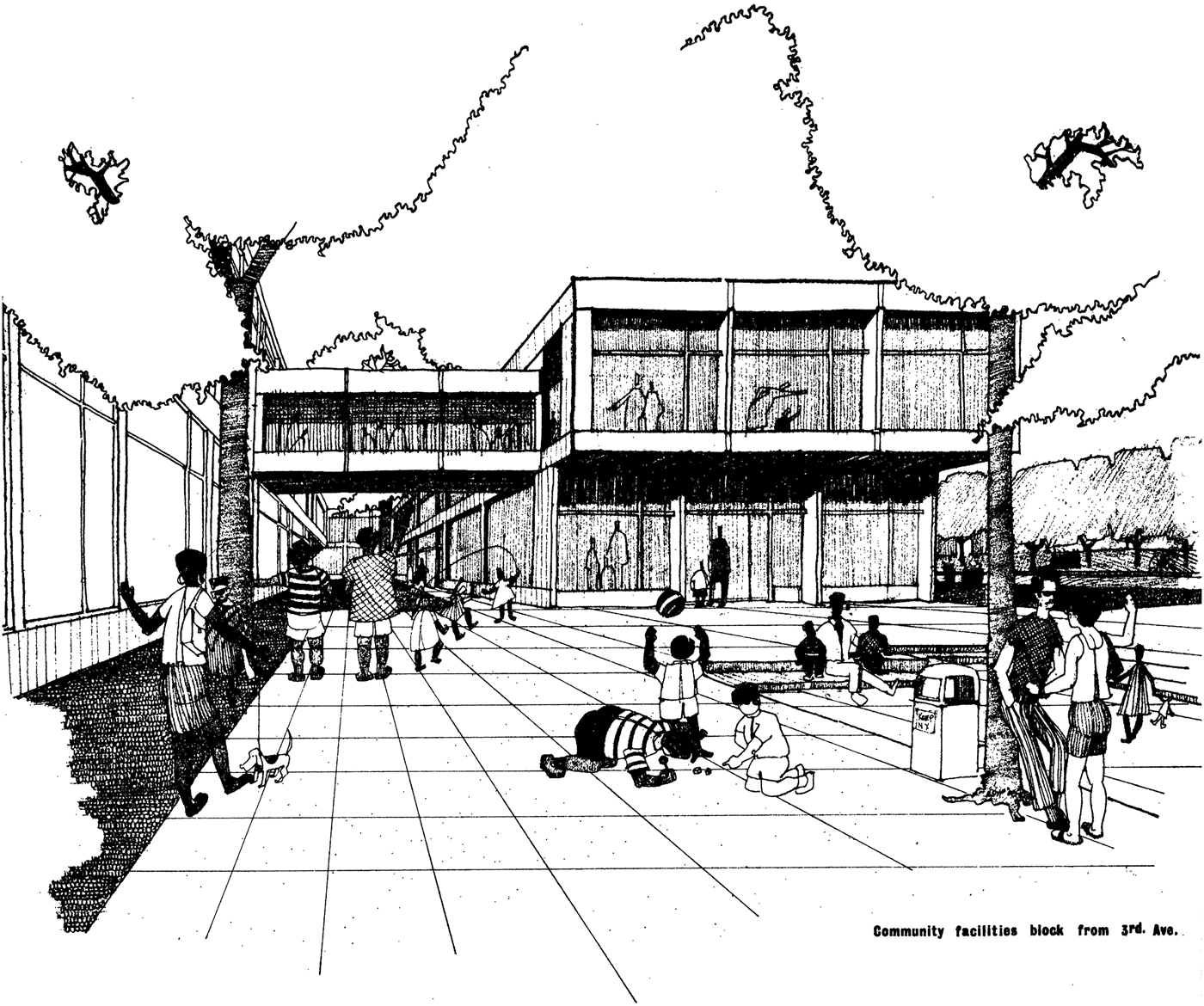
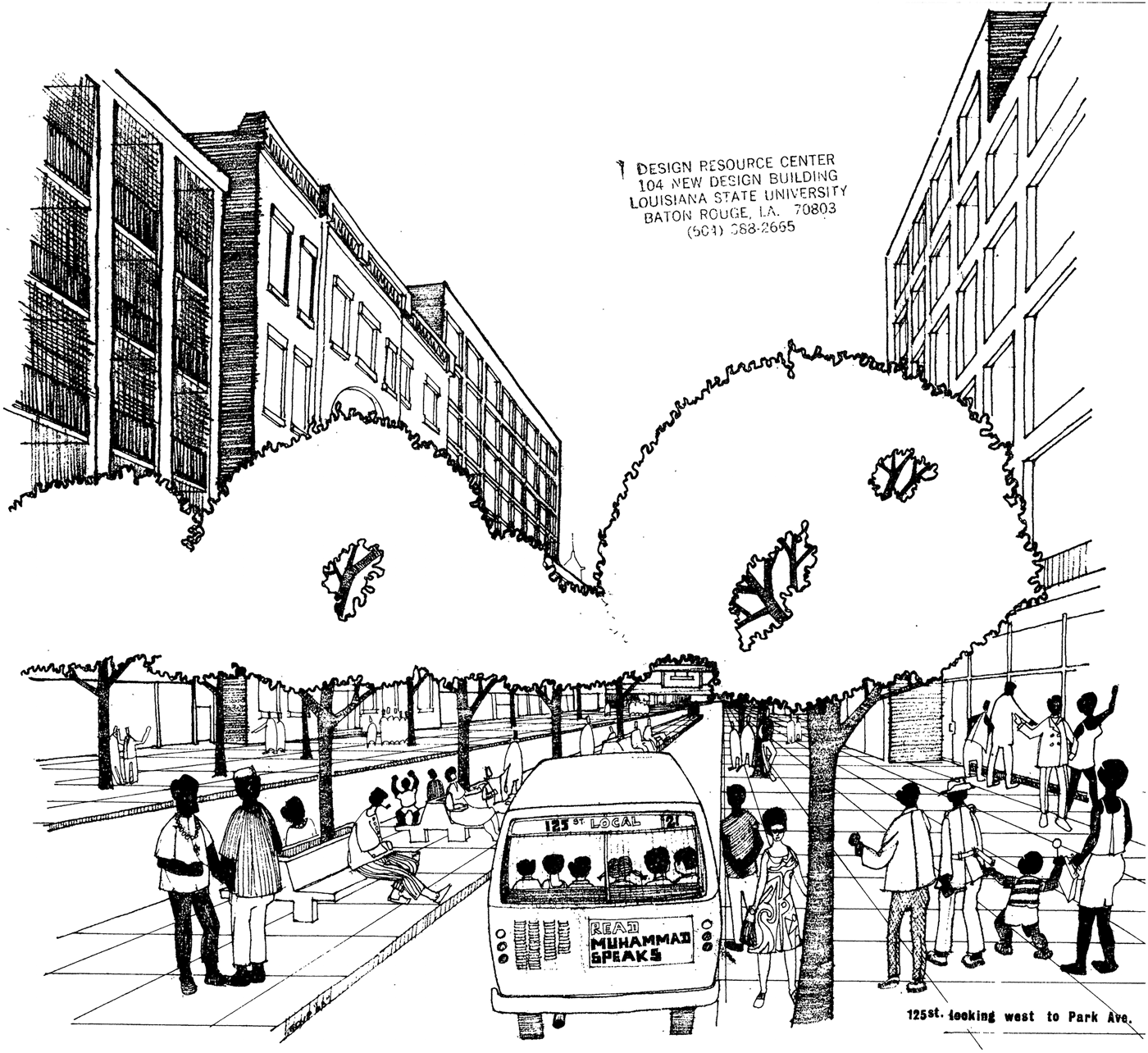
ARCH's illustration of the Triangle Commons (Figure 2), like the sketches that appeared in its other publications, envisioned a distinctively black and democratic urban space. If Shoji Sadao's bird's-eye rendering of “Skyrise” suggested the lofty perspective of the architect and the imposition of designs from above, ARCH's illustrations offered ground-level views of densely populated spaces in a manner that encapsulated the organization's grassroots, consultative practice and orientation towards the community and its culture. Visual emphasis was placed not on building forms, but on neighbourhood people's creative use of public spaces as communal “living rooms.” A sketch of a design for 125th Street (Figure 3) that also featured in the East Harlem Triangle Plan was an apt counterpart to Bond's description of Harlem's key thoroughfare and its “symbolic places.” The black figures’ Afrocentric attire and the advertisement for the Nation of Islam's newspaper Muhammad Speaks served to project Harlem's future as an extension of its past and present: as a centre of an enduring black peoplehood.
Illustration of the proposed “Triangle Commons” from the East Harlem Triangle Plan produced by the Architects’ Renewal Committee in Harlem (ARCH), 1968. Drawing by E. Donald Van Purnell. Courtesy Arthur L. Symes.

Illustration of a design for 125th Street from the East Harlem Triangle Plan produced by the Architects’ Renewal Committee in Harlem (ARCH), 1968. Drawing by E. Donald Van Purnell. Courtesy Arthur L. Symes.

The government and foundation grants that flowed to ARCH during its peak years – exceeding $100,000 in 1966–67 – exemplified a brief moment when, as Christopher Klemek has shown, an embattled Great Society liberalism made concessions to a “New Left urbanism” that rejected large-scale modernist renewal and championed grassroots participation in planning and a “gentler, gradual renewal of cities.” The failure to secure implementation of ARCH's proposals and the organization's demise in 1975 were equally typical of the fate of this New Left urbanism, as the conservative resurgence in national politics that began in the late 1960s reined in back municipal liberalism and its resources.Footnote 107 Nevertheless, ARCH had played a significant role in a wider effort to articulate a black power urbanism and thereby visualize a post-segregation future for black peoplehood, the history of which remains largely untold.
Among the other, little-known participants in this effort was the African American architect and city planner W. Joseph Black (1934–77). Born in Carthage, Texas, and raised in Chicago, Black trained at the University of Illinois at Chicago and Columbia University and worked as an architect in Mexico, Argentina, Brazil, Portugal, and Britain before moving to New York in 1968. While undertaking graduate studies at Columbia's School of Architecture and working in various roles for the New York City Planning Commission, Black observed ARCH's activities with admiration as he formulated his own, closely related visions of Harlem's, and black America's, future.Footnote 108
Like Bond, Black rejected what he saw as an urban renewal establishment that conceived of black urban communities only in pathologist terms of social “vices” and physical deficiencies, and argued instead that genuine renewal must comprehend and build on “the virtues of the black community.”Footnote 109 During the 1970s, Black worked on several iterations of a project titled “Visions of Harlem,” which initially comprised his 1971 Master's dissertation, then a plan for an exhibition, and finally a book manuscript that remained unpublished following his death from cancer, aged forty-two. In these writings, Black refuted “the notion of Harlem as one vast slum devoid of interest, quality architecture, or visual delight,” and revelled in describing the neighbourhood's “unsurpassed examples of Nineteenth Century urban design.”Footnote 110 Among his papers are reams of photographs cataloguing the intricacies of Harlem's architecture that he spoke of with appreciation in an interview in 1971: “The decorative detail that is expressed in glasswork, metalwork, woodwork, the street scene itself.”Footnote 111 Black wrote that in their “life styles and values,” Harlemites “differ from the typical New Yorkers” in ways that
affect the use of space and time in the urban environment, and have implications for planning and architecture. For example, the streets in Harlem function as “playgrounds and living rooms of the community” where residents air their opinions, vend their wares, and display their creative talents. They are the open air forums and parade grounds for individuals who have something of interest to say or show.
Again like Bond, Black asserted that there were “many unique and positive aspects of Harlem that need not only to be preserved, but built on” if Harlem were to provide its residents with “cultural nourishment, economic growth, social acceptance and personal fulfillment.”Footnote 112
Perhaps Black's most significant contribution to the emerging discourse of black power urbanism was his vision of the development of major black urban enclaves as “sub-cities.” Neither segregation, nor assimilation, but what might be termed incorporation best captures Black's view of how the relationship between these black neighbourhoods and their surrounding cities should be remade. The indigenous urbanism that had evolved in these communities as a creative response to segregation, poverty, and overcrowding – a round-the-clock culture that made vibrant use of public space – implied, for Black, a natural social and economic role for these neighbourhoods as providers of arts, entertainment, and “essential goods and services on an 18 to 24 hour basis.” In this way, “Harlem should be comprehensively planned and developed as a self-contained community functionally related to the economic growth of New York City.” The “sub-city” notion thus combined the black power imperatives of community control and cultural self-determination with a blueprint for economic codependence with “the greater metropolitan area.”Footnote 113 It was a vision of continued black peoplehood, rooted in black urban places and yet interconnected with the broader American society.
Moreover, what Black saw as Harlem's exceptional status among black urban communities suggested even greater potential for the neighbourhood's future: “As the cultural capital of Black America, more music, dance, drama, art, literature and media material is produced and distributed in Harlem than [in] any other black community in the world.” Accordingly, Harlem should “be developed as a modern educational, communications and entertainment center of the third world.”Footnote 114 Half a century after the heralds of the New Negro had proclaimed Harlem a “race capital” and “a city within a city, the greatest Negro city in the world,” Black continued to envision Harlem's future not only as a distinctively black neighbourhood of New York, but as an emblem of the rising power of black people throughout America and of people of colour throughout the world.Footnote 115
CONCLUSION
Jordan and Fuller's “Skyrise” and ARCH's advocacy planning were products of a moment when it seemed both possible and necessary to rethink, in fundamental ways, the place of black people within the American cities and nation of the future. If the passage of the Civil Rights Act announced that segregation would no longer enjoy legal sanction, the rioting that erupted in Harlem only weeks later was a stark reminder of the polarization and inequality that remained. Even then, the federal War on Poverty signalled, for a window of a few years, the prospect of government and society marshalling resources on a grand scale in pursuit of a new social and spatial settlement; for both Jordan and Hatch, the War on Poverty promised – falsely, it transpired – to underwrite a radically different urban future. Yet while “Skyrise” and ARCH were both conceived amid this sense of possibility, the futures they invoked were diametrically opposed. In the very magnitude of their opposition, they reveal what was at stake in imagining Harlem's future during the 1960s.
By this time, Harlem's image had bifurcated so dramatically that its built environment could be perceived, on the one hand, as an “excrescence” that “mutilates the spirit,” redeemable only if approached as a kind of ground zero; and on the other, as “physically … terrific,” a terrain that had incubated a vital, vibrant communal life that should be conserved and nurtured. “Contained within the central mythology of Harlem,” wrote LeRoi Jones in 1962, were “almost as many versions of its glamour, and its despair, as there are places with people to make them up.”Footnote 116 Yet two motifs, above all, had fixed themselves to Harlem over the preceding decades through efforts to use the specificity of place to give concrete expression to the two dominant views of the condition and prospects of black America. Harlem as “archetypal Negro ghetto” became the incontrovertible proof of segregation's cataclysmic injustice and harrowing effects, while Harlem as “capital of black America” designated the epitome of congregation, the evidence of black peoplehood and its capacity to flourish. What should become of a place and peoplehood that had been forged by injustice and oppression? Just as Harlem's image had been wielded to indict segregation or to affirm the achievements of congregation, so, at the moment when segregation's death knell was sounded, imagining Harlem's future became a means of picturing America's post-civil rights future in microcosm.
The disjuncture between the sweeping, visionary scale of “Skyrise” and the focussed scope of ARCH's proposals may seem to lessen the value of their comparison. Yet the choice to engage with Harlem either through monumental projections or through grassroots, ground-level mobilizations is itself one that signals the dilemmas of envisioning the African American urban future during the 1960s. That Jordan and Fuller could contemplate Harlem's physical erasure was a possibility immanent in the discourse of pathologism, which had rendered Harlem a key spatial metaphor for the cruelties of segregation and of racialization itself. And that Jordan found solace in imagining a future in which black peoplehood was eclipsed by new forms of community speaks powerfully of her own experiences in, and affective responses to, black urban places. Meanwhile, the streets and corners that Jordan reimagined as “vast, cleared ranges of space” in a postracial “New Harlem” were the very “symbolic places” that made Harlem, for J. Max Bond and W. Joseph Black, the physical embodiment of the past, present, and future of a black peoplehood that had been engendered by the slave ship, the lash, and Jim Crow, but that now stood on the threshold of triumph.